RAF Foulsham – A Leader in Electronic Warfare. (Part 3)

In Part 2, we reached a milestone in the life of Foulsham as it was on the brink of changing hands once more. As the new Group takes over new challenges are about to be faced, and FIDO, the fog dispersal system is desperately needed to counter the appalling weather.

By the 25th November, the move had been completed, and both 514 and 1678 HCU had now departed the airfield. With Foulsham now empty, it would undergo yet another change of ownership, this time to 100 Group, the specialists in electronic warfare. This change of ownership would, as before, bring another two new units, 192 Sqn and a supporting training unit 1508 (Blind Approach Training) Flight.

100 Group was formed that November as 100 (Special Duties) Group under the Command of Air Commodore E.B. Addison CB, CBE with its headquarters at Radlett in Hertfordshire. The aim of the move was to place all the electronic units under one single command, thus unifying its aim and bringing together all the resources of the thinly spread units. One of the main aims of the Group was to provide ‘spoof’ operations, confusing the ground operators and radar controlled night fighters, thus spreading them over wider areas. This would in turn, it was hoped, reduce the number of casualties from RAF bombers and achieve better bombing results as a consequence.

Other duties of the Group would involve the jamming of radar and radio equipment used by German aircraft and ground stations, monitoring German airways and providing incorrect orders to German crews using native speaking RAF crewmen. The war had become a battle of science.

RAF Foulsham

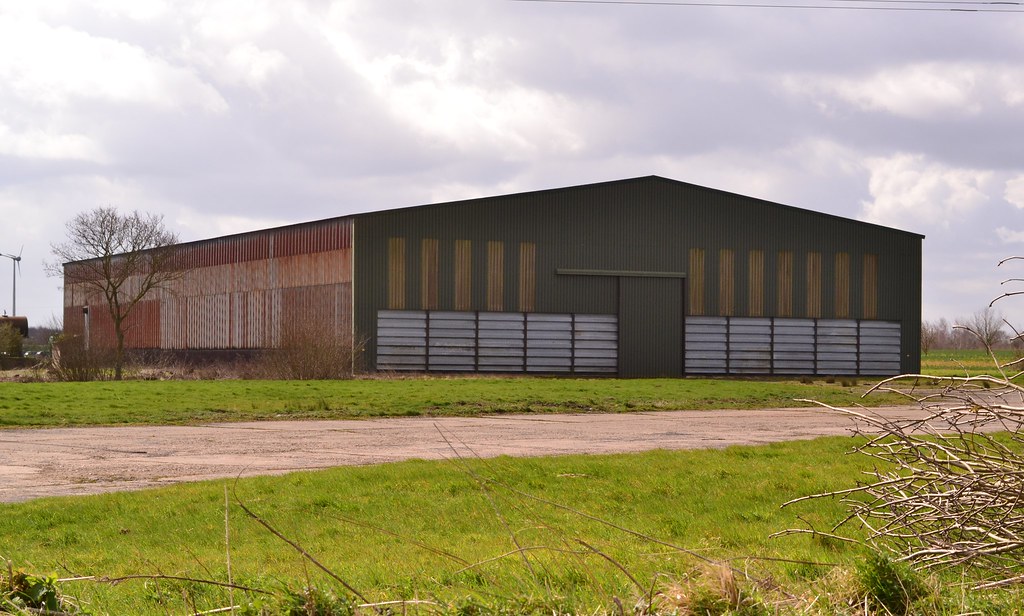
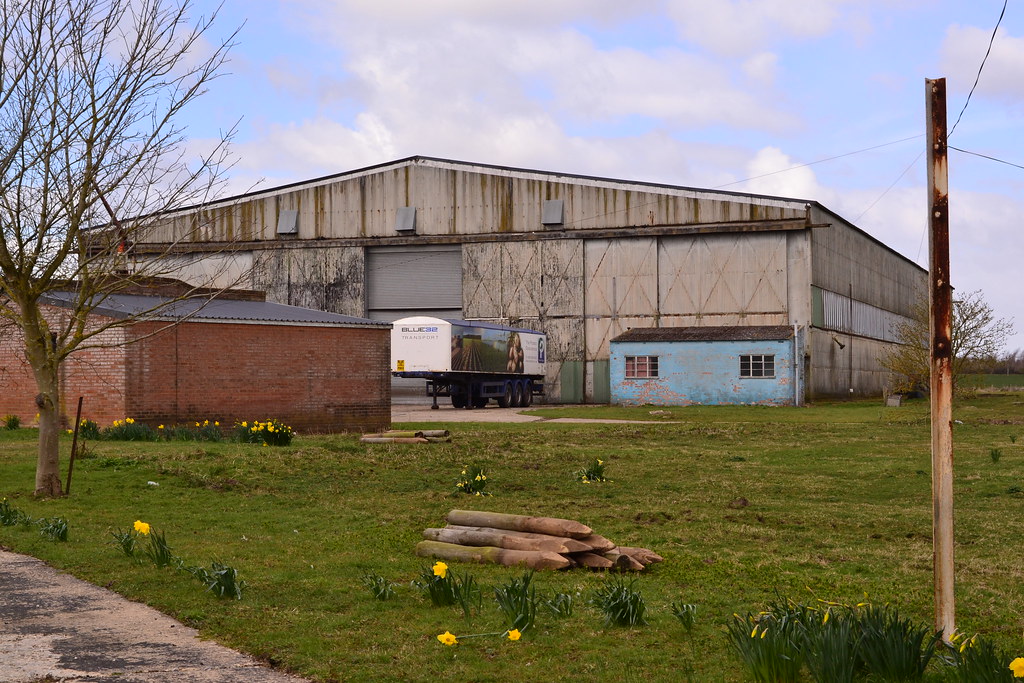
One of four T2 hangars.

Over November and December, airfields were taken over and aircraft supplied to the new Group. Squadrons were brought in to fill these sites and the Group grew from strength to strength.

A newly registered unit, 192 Sqn (formed a year before at RAF Gransden Lodge)  operating a mix of Wellingtons, Mosquitoes, Halifax IIs and more  recently, their newly acquired Halifax Vs, were transferred over to Foulsham, in one of the first moves to the airfield.

Formed through the renumbering of 1474 (Special Duties) Flight, 192 Sqn had been previously been monitoring the German Ruffian and Knickebein beams. In their new form they would monitor, amongst others, the western approaches to the Bay of Biscay, monitoring and recording night fighter channels.

However, the winter weather was up to its usual tricks, and it played havoc with initial flights. But despite this, within 48 hours of their arrival, 192 Sqn was classed as operational, and a memo to that effect was sent off to Headquarters 3 Group Bomber Command.

With no flying over the next three days due to the continuing bad weather, initial flights were able to begin on the 29th November, with three aircraft, all Wellingtons, performing Special Duties Flights over the Bay of Biscay. After landing at Davidstow Moor for refuelling, there was a major electrical fault at the airfield and the entire flare path and flying control facilities were put out of action. As a result, the three Wellingtons were grounded and unable to continue their flight home.

The weather continued to play havoc for the crews at Foulsham. A flight planned for a Mosquito and two Wellingtons on the 1st December had to be postponed and then finally cancelled. The next day, 2nd December 1943, three aircraft were ordered to fly to the Frisian Islands and the Dutch coast, but one had to return due to the pilot’s escape hatch blowing off, and a second overshot the runway on take off becoming bogged down in the mud. The aircraft was damaged but the crew were unhurt in the incident.

On December 7th, Foulsham officially became part of 100 Group and another unit No. 1473 (Radio Counter Measures) Flight also arrived here to assist with the ELINT (Electronic Intelligence) operations. By February 1944, it was decided to merge the Flight with 192 thus forming a ‘C’ Flight. With additional Mosquitoes and Ansons – the hardware inventory at Foulsham was now growing rapidly.

Much of December suffered the same fate as its preceding months however, poor weather rendering flying unsuitable, leaving many aircraft and their crews grounded for prolonged periods of time.

100 Group’s inaugural operation on the night of 16th / 17th December, did not however, go in their favour. On what has become known as ‘Black Thursday’ the RAF bomber force of over 480 aircraft, took heavy losses. These losses whilst high over occupied territory, were made far worse by poor weather which claimed some eight aircraft from 97 Squadron at RAF Bourn – one sixth of its strength,

The beginning of the new year, 1944, saw big changes not only in Bomber Command, but at Foulsham also. As the second phase of the ‘Battle of Berlin’ began, Stirling squadrons and now Halifax units were being pulled out of the front line bombing campaign; their shortcomings becoming all to obvious as losses in the types began to mount. The poor weather continued to cause misery across Britain’s airfields, rain and fog preventing large  continuous attacks on the German heartland.

The interminable fog was the driving force behind the new FIDO system now being installed at Foulsham. Bomber command had initially asked for eight airfields across the UK, but by the end of 1943 they were seeking twelve, and Foulsham (designated Station XXI) was identified as one suitable.

William Press were given the contract to install the system, and by mid February work had begun. Supplying the huge storage tanks was going to be a challenge though, and so a new siding was constructed at nearby Foulsham railway station. Its not known for sure whether the fuel was then piped the two mile distance to the airfield, or brought across in tankers, but whichever it was, it required a good deal of extra work.

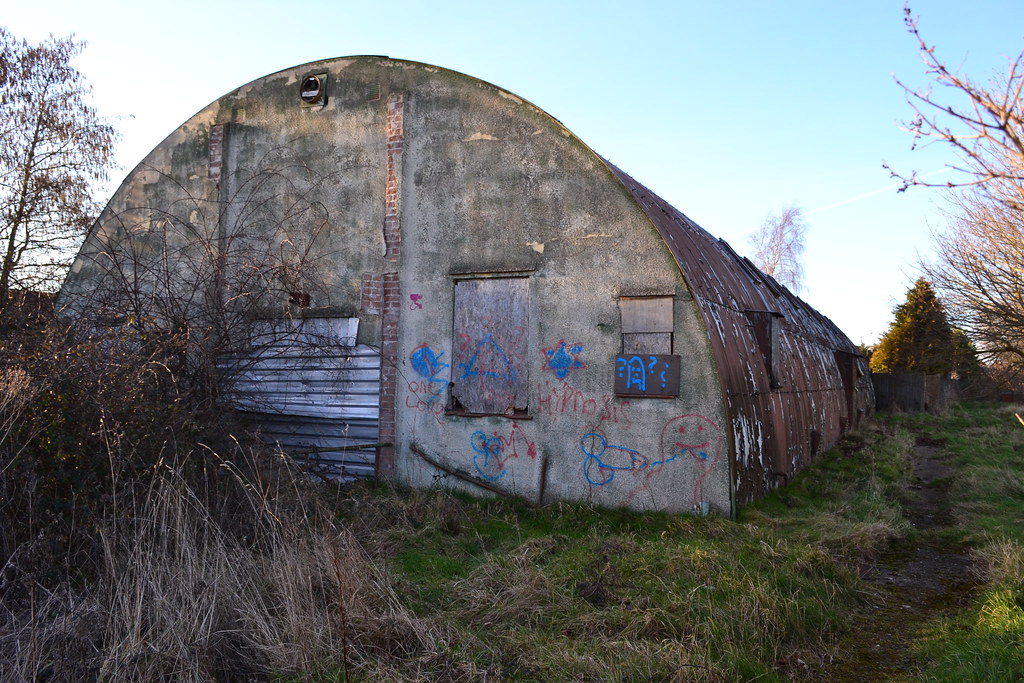
At the airfield site, three storage tanks were assembled on Land at Low Farm, located at the northern end of the main runway. The much needed pump house and control point were also located here. Operators were kept on a 24 hr watch system, being billeted near to the equipment in two Nissen huts, one for officers and the other for ‘other ranks’.

RAF Foulsham

One of the air raid shelters used around wartime airfields.

Initial plans were for a mile of runway to be lined with the Haigill MK IV burners, with intersecting burners placed in trenches across the two intersecting runways. The placing of these burners, well out of the way of moving aircraft, initially being a difficult challenge to overcome.

Operating the burners was a tedious and dangerous job. After opening the valves and allowing petrol to fill a pool through which the operator had to walk, a match was thrown into the pool and the poor ‘Erk’ had to then run as fast as he could and throw himself into a small indentation in the ground hoping the flames would pass over and not ignite the clothes he was wearing. Once the burn had been achieved and all aircraft were down safely, the system was shut down and allowed to cool. Once the pipes were cool enough to touch, some 72,000 holes along the length of the pipes adjoining the runway had to be cleaned out to prevent a build up of soot. It was perhaps, one of the most tedious but vital jobs, RAF personnel had to perform.

Before the system could be fully tested though, a bizarre accident happened that resulted in no crew injuries, but two badly damaged aircraft and a Senior Flying Control Officer being posted and demoted.

In the next part (4) Foulsham’s  appalling weather accounts for a bizarre accident. The arrival of a new and relatively unique aircraft brings excitement to the site and FIDO really comes into its own.

The entire story of Foulsham can be seen in Trail 22.

RAF Foulsham – A Leader in Electronic Warfare. (Part 2)

In part 1 we saw how Foulsham began its life and how early squadrons suffered with bad weather and malfunctioning guns. In Part 2, we continue our journey and find out how an American pilot, who crash landed at Foulsham was awarded the Medal of honour.

On that particular day, the aircraft, “Ruthie II“, was in a mass formation heading for Hanover, when a canon shell ripped through the windscreen splitting the pilots head. In addition to this, the oxygen system to the tail, waist, and radio positions was  also inoperable, the top turret gunner had lost both arms and had major injuries to his side; the intercom system was out of action and several crew members had lost consciousness due to the lack of Oxygen.

Morgan grappled with the severely wounded pilot, who had wrapped his arms round the controls, to try and maintain level flight. Morgan decided the protection of the formation was better than heading for home alone, and so for the next two hours he flew in formation holding the pilot back with one hand whilst steering with the other. Eventually the navigator came forward and gave assistance allowing the aircraft to reach the safety of England and Foulsham.

For his actions, Morgan, of Vernon, Wilbarger County, Texas, received the Medal of Honour the following December in a ceremony presided over by Lt. General Ira C. Eaker. The story of Morgan’s bravery would form a part of the story line in the book and movie “Twelve O’Clock High”.*3

The posting of 98 and 180 Squadrons in August 1943 was no coincidence, as the airfield saw further development and new hangars added. These hangars were erected at various locations around the airfield site, ready to accommodate the forty or so Horsa gliders that would soon arrive here escorted by 12 Heavy Glider Maintenance Section. Their arrival marking the beginning of the  preparations for the invasion of Normandy the following year.

A few days later, on September 1st, 1943, the handover of Foulsham took place and 3 Group became the new owners in a move that also signified the forming of 514 Squadron with Lancaster IIs, the less common radial engined version of this famous Avro aircraft.

514 Sqn was initially headed by Acting Wing Commander A.J. Samson D.F.C., although the first to arrive at the airfield was the squadron adjutant. On first inspection, he and his small party found that the office blocks had been completely stripped of all their furniture, even shelving had annoyingly been removed from walls. As a result the offices were virtually unusable, and so a huge clean up operation began in readiness for the ground and air crews who were to shortly follow.

RAF Foulsham

One of the original T2 hangars.

Accommodation sites 2 and 5 were quickly allocated to the squadron for personnel use, and as soon as equipment began arriving, on a rainy and very wet September day, everyone was drafted in to unload and store the various much needed supplies.

To provide flying personnel for the new squadron, a support unit would also be formed at the airfield, that of 1678 Heavy Conversion Unit. The formation of this unit was achieved through the renumbering of the Flight of the same designation, a changeover that took place a month later, on October 16th 1943. The role of this unit was to convert experienced bomber crews over to the new Lancaster.

In the interim period, the new aircraft began to arrive. The first Lancaster ‘DS735’ touching down on 11th September, 1943, followed by three more (DS785, 783 and 784) over the next three days. Their arrival was met not with pomp and ceremony though, but by heavy showers and thunderstorms, the weather that had dogged earlier squadrons continued to play its terrible part in life at Foulsham. Over the next few weeks, aircraft were quickly modified and air-tested ready for flying, by the end of the month, eighteen Lancasters had been flown in and virtually all the crews had arrived ready for converting to the new type.

Over the next month, and although the weather yet again played havoc with flights, cross-countries and air tests were carried out with a high level of success. However, no one could control the weather, and the first planned operational sortie had to be cancelled due to extensive fog that blanketed the Norfolk countryside. Not until November 6th did a break allow any operational flying to take place, and that break allowed two small flights to get airborne.

A mining operation undertaken by four aircraft along with a bombing mission in which only two aircraft got off the ground, were the squadrons break into operational flying; not a major mission, but one that nevertheless broke the ice.

With the poor weather continuing, several more ‘ops’ were again cancelled allowing only the occasional ‘Bulls-eye’ or morning flight to get away. Whilst it must have been frustrating for crews, this did allow them to finally put into practice all the training they had undertaken so far.

Then on the 14th November 1943, news came through from above that 3 Group was being reorganised and that 514 Sqn would be moving from Foulsham to RAF Waterbeach in Cambridgeshire as a result. The move, expected to be completed by the 23rd, would coincide with the first operation to Berlin, a move that also signified the first phase of the ‘Battle of Berlin’. This would also be the first time a 514 Sqn aircraft (DS784 ‘JI-C’) would not return from operations; the loss being a blow to the squadron. Of the seven-man crew, one would be taken prisoner (F/S. B. Haines (RAAF)) whilst a further (Sgt. H. Lucas) would evade capture,  successfully hiding out in Brussels until its liberation in 1944. The remaining five crewmen however, all perished in the aircraft’s crash.

In Part 3, Foulsham passes to new ownership and its life in electronic warfare begins. The new Group will bring new challenges, new aircraft and the installation of FIDO, the Fog dispersal system.

The entire story of Foulsham can be seen in Trail 22.

RAF Foulsham – A Leader in Electronic Warfare. (Part 1)

In Norfolk sits an airfield that only had a short wartime life, but it is one that is more than significant. Used in the electronic warfare role, it went on to house a small number of heavy bomber squadrons all crammed with electronics to detect, monitor and interfere with enemy transmissions.

In conjunction with this, it also saw a detachment of two-seat P-38/F-5 Lightnings, a rare aircraft in this country, and possibly the only one to do so. Dogged by bad weather it was identified as a suitable site for ‘FIDO’ the fog dispersal system, and post war it was used in both the scrapping of DH Mosquitoes and as a storage unit.

In Trail 22 we revisit the former RAF Foulsham.

RAF Foulsham

RAF Foulsham, sits approximately 8 miles north-east of the Norfolk town of Dereham. It had a short active life of just three years, lasting between May 1942 and 1945, at which point it was closed to flying and used as a storage site for military hardware. It remained in this lesser state until the 1980s when it was deemed surplus to requirements and finally closed. The land it stood on, was then sold off to local farmers.

Built over the period 1940-41 by the construction company Kirk and Kirk Ltd, RAF Foulsham occupied land some 173 feet above sea level, and opened under the control of 2 Group Bomber Command. Much of the material that was brought in to construct Foulsham came via nearby railways stations, then along local roads through the village, leaving locals facing endless mud and traffic.

As a war-time airfield, Foulsham would have three tar and wood chip runways, one of which would later be equipped with the fog dispersal system ‘FIDO’, a valuable if not bizarre system designed to dissipate fog along airfield runways.

Foulsham’s three runways were 1,900 and 1,350 yards long, with the main runway heading in a north-south direction. By the end of the war it would have thirty-seven heavy bomber hardstands, nine T2 hangars and one B1, and as such, was a formidable size. Personnel numbers were reflected in this, with accommodation spread over several sites to both the south and east, able to accommodate upward of 2,500 personnel of mixed rank and gender. The ever important technical site sat to the east, with the bomb store situated to the south-west of the airfield, just off the end of the main north-south runway.

RAF Foulsham

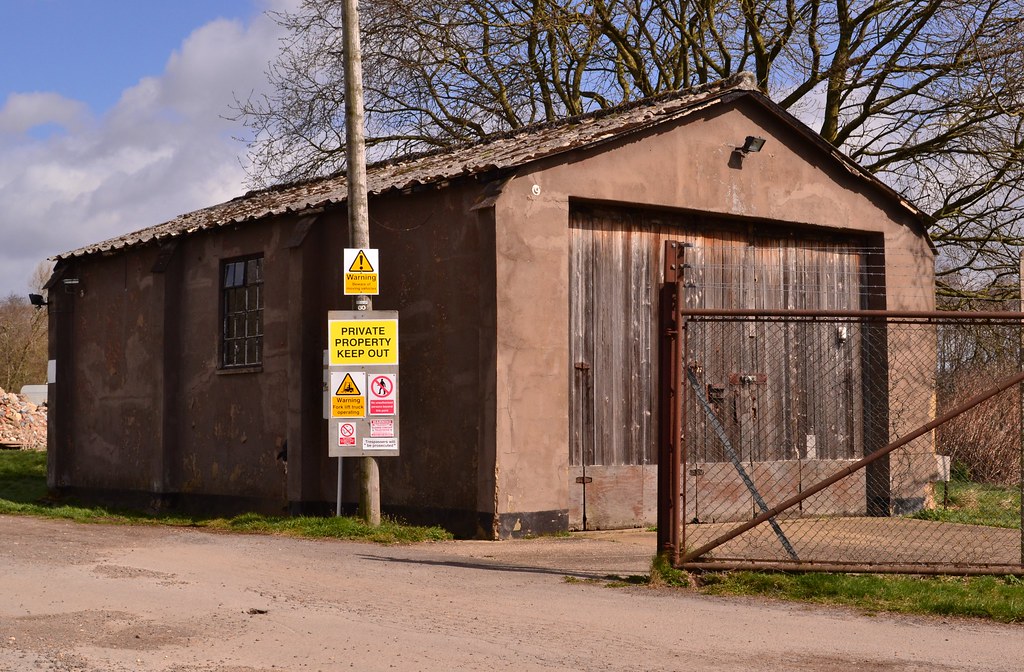
The original Fire Tender shed.

The watch office, now long gone, was built to design 518/40 which included and Meteorological section attached to the building. These designs were a development of earlier models using a new 9 inch rendered brick wall as opposed to timber, although timber was initially required for the floors and ceilings. Due to a shortage in wood at the time though, concrete replaced a large portion of these leaving only the balcony and control room using such material.

Whilst Foulsham opened under 2 Group, it would almost immediately – within a month of opening – be handed over to the US forces of the 8th Air Force and be renamed station B.13. However, this change never evolved into anything  more as no American personnel were stationed here, and by the October it was back in RAF hands, and 2 Group once more. The next few years would see the airfield change hands several more times, and with each change would come new aircraft, new personnel and new roles.

The first units to arrive here were those of the host unit 2 Group. Both 98 and 180 Squadron arrived in mid October 1942 after their reformation/formation at RAF West Raynham. During this time, they both began to receive their aircraft, the American built B-25 ‘Mitchell II’. Their transfer across to Foulsham gave the airfield the honour of being the first station to use the type operationally. Both squadrons would remain active in the light bomber role until 18th August 1943 at which point they would depart and the airfield would change ownership once more.

98 Squadron, a First World War unit, had been operating out of Kaldadarnes in Iceland following a terrible loss of personnel when the Lancastria was sunk in June 1940. Their reformation at West Raynham, and subsequent move to Foulsham, had been quickly met with yet more losses, when one of the Mitchells ‘FL206’, spun killing all four members of the crew on board.

After this, the squadron would be dogged by misfortune, the squadron adjutant noting in the Operational Records that excessive rain had turned the site into a “disgraceful condition”; the weather was one aspect the staff would have to put up with for some time to come. *5

For the first sixteen days of November, all but a handful of days were washed out, the despair of staff being felt through the Operational Records, each day met with ‘Lectures continue, adverse weather for flying‘. However, on the 16th, training flights did manage to take place, but it too was met with more sadness as a second set of fatalities occurred.

During the training flight, Mitchell FL179 suffered a bird strike in the carburettor of the starboard engine, this caused the engine to fail. With only one serviceable engine the pilot, Flt. Sgt. K. Williams (s/n: 1062588), tried to land at nearby RAF Attlebridge, unfortunately the aircraft stalled and went into a spin. The resultant crash killed all three aircrew on board and wrote off the Mitchell.

Things were to not get any better for the squadron either. On the 30th, a third crash took yet four more lives when FL708 collided with high tension cables near to RAF Wendling. The explosion from the collision also killed a local farmer who was ploughing his field at the time of the accident. It had been a terrible start for the fledgling unit.

The poor weather continued relentlessly, hampering the squadron’s progress, both on the ground and in the air, with training flights being cancelled on a regular basis. During the small numbers that were taking place, further problems came to light adding to the frustrations already felt by the crews.  Since taking on the initial batch of nine Mitchells on September 18th, the squadron had been having problems with the aircraft especially the guns and their turrets.

Gunners had found that extended bursts of gunfire were impossible, usually no more than a dozen rounds could be fired at any one time, a situation borne out by Wing Commander Foster, the Group Armament Officer, on the 16th December. In an attempt to remedy the situation, an American gun turret specialist visited the squadron, but by the 18th it was considered that the guns were ‘obsolete’.

RAF Foulsham

A defence ‘pill box’.

January was much the same, snow added to further problems and again the aerodrome was noted as being in a “very bad condition“, all flying being cancelled until the middle of the month when a small number of flights did get airborne.

The first battle order came through on January 21st, but due to a late delivery of bombs, it was also cancelled, meaning the squadrons first operation flight wouldn’t take place until the next day.

Six aircraft were ordered to operations, and whilst all made it to the target, one aircraft, FL693, was hit by flak and disintegrated. All on board were presumed killed.  The first months of 98 squadron had been challenging and difficult for those posted here.

180 Squadron had fared a little better, although after walking into a spinning propeller, L.A.C. J. Aspinall was killed, the only fatality of the squadron during the same period.

On July 26th 1943, an emergency landing was made at Foulsham by a B-17F #42-29802 of the 326th BS, 92nd BG, 8th AF, after a traumatic series of events that earned the co-pilot, John C. Morgan Flight Officer (later 2nd Lt.), the Medal of Honour for his valour and courage in action.

In part 2 we see how Morgan earned this prestigious award and how Foulsham continues to develop.

The entire story of Foulsham can be seen in Trail 22.

RAF Sculthorpe – A relic of the Cold War (Part 5)

After Part 4, in this, the final part, we see how Sculthorpe has fared, and what has happened to it now. As a major Cold War player its future is uncertain, but definitely not yet over! Gradually, as nuclear deterrents turned to both missiles and naval based platforms, Sculthorpe’s activity began to slow. Being returned to RAF ownership in 1964, it was eventually placed in care and maintenance once more, held open by only a small detachment of support staff. However, all was not yet lost, for later in that same decade, Sculthorpe saw yet another reprieve, when the USAF returned once more, needing a base from which to operate its aircraft whilst other airfields were redeveloped and runways resurfaced. This temporarily brought new life back to Sculthorpe, with American F-4 Phantoms and C-130s operating from here. The RAF, needing a similar facility, also used Sculthorpe as a temporary base, Coltishall for example, basing their Jaguars here temporarily. This process went on well into the late 1980s and Sculthorpe became a mecca for plane spotters for at least another few years. Eventually all this too ceased and before the final farewell the site was used to store North American Sabres prior to them being scrapped and disposed of.  
Airmens huts

‘Hut 380’, a Second World War remnant.

Sculthorpe finally closed its doors in 1992, the enormous accommodation blocks and technical sites were sold off. Both these and many of the remaining buildings were left to decay, whilst planners gave thought as to what they should be used for. However, like a phoenix, Sculthorpe returned from the dead yet again. The RAF, the Army Air Corps and the USAF using it for manoeuvres, seeing such diverse models as the V-22 Osprey tilt wing aircraft, using it for paratroops and rehearsals of supply drops over its enormous runways; much of this activity taking place at night. Even up until recently, C-130s had also been seen operating here, again rehearsing quick ‘stop-‘n’-go’ drops, something that continues in part to this day. The rise in ‘Soviet Aggression’ and post conflict tensions during the Cold War had secured the immediate post-war future of Sculthorpe. Not only were atomic weapons stored here ready, but a wide range of US aircraft that would otherwise not have been seen on British soil, were also based here. The demise of world peace had been the saviour of Sculthorpe’s future. Looking at Sculthorpe, it is hard to believe its origins were in the Second World War. Being a real monster of the Cold War, Sculthorpe is clinging on by the skin of its teeth. The accommodation blocks that once housed 10,000 personnel are decaying and vandalised, refurbished areas are now sold off and accommodating local families. A small industrial area has been developed from the technical area, and the local farmer grazes his cattle on the far reaches of the site. Many of the older original buildings have been left to rot and fall down. The American authorities still retain some ownership of the site, whilst a large part of it is in private hands, such ownership does prevent some access but a good deal of the site is visible from permissible points. The original guard-house is no longer manned, and a number of other buildings close by are also empty. A small public track that once took eager plane spotters to the rear of the airfield, still allows views across the north of the now quiet site where a blister hangar continues to stand alone. The control tower is still intact visible in the distance from this point, as are a number of original Nissan huts and Second World War buildings hidden amongst new buildings and old developments.
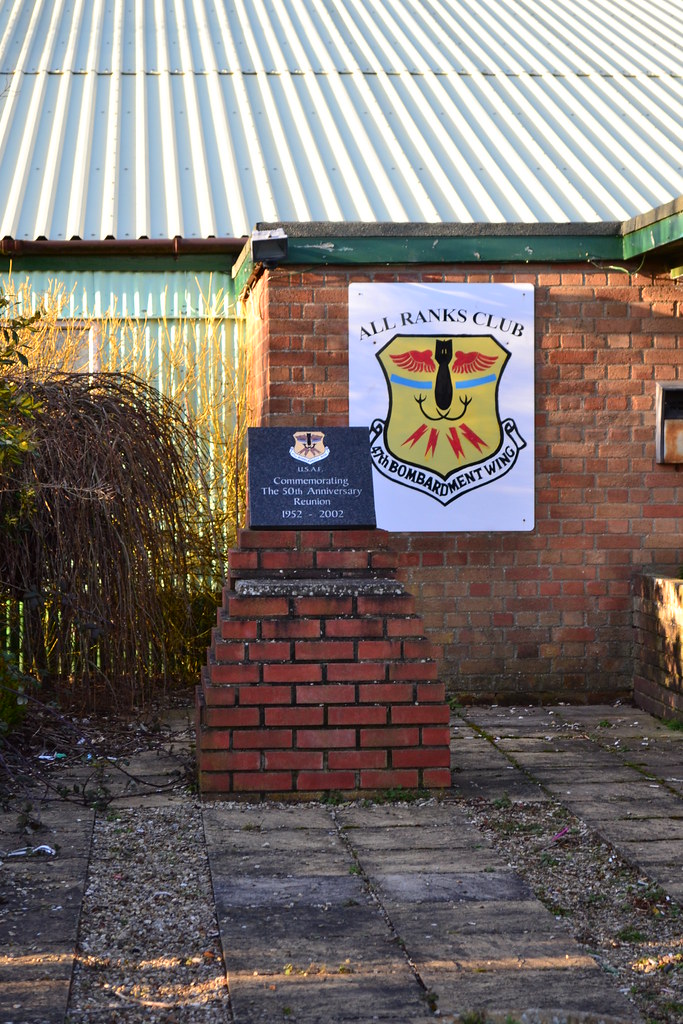
Reunion 'memorial'

In remembrance of the 47th BW, 50th anniversary reunion, 2002.

The post war ‘All Ranks Club’ houses a small exhibition of artefacts and information about Sculthorpe, depicting its post war life, and includes many interesting photos. The exhibition is open at certain times throughout the year allowing visitors to view them and talk to the volunteers some of which actually served here at the base. Sculthorpe was once a bustling airfield, it was home to some of the world’s heaviest bombers, and a mecca for aviation enthusiasts and plane spotters alike. Today, it is a decaying industrial site, a mix of old buildings and new developments; a remnant of the Cold War, it clings on to life by the skin of its teeth, maybe, just maybe, the Phoenix will rise up once more and spring into life once again. The full history can be seen in Trail 21. Sources and further information. *1 National Archives – AIR 27/1924/17 *2 Gunn, P.B., “Flying Lives – with a Norfolk Theme“, Peter Gunn, 2010 *3, *5 Cahill, W. “The Unseen Fight: USAAF radio counter-measure operations in Europe, 1943 to 1945” Journal of Aeronautical History Paper, 2020/06 *4 21 Sqn ORB Summary of Events 1943 Oct 01 – 1943 Nov 30, AIR 27/264/19 *5 Cahill, W., “The Unseen Fight: USAAF radio counter-measure operations in Europe, 1943 to 1945” Journal of Aeronautical History, Paper 2020/06 *6 The Spyflight Website which gives considerable detail into the flights. National Archives: AIR 27/1924/19; AIR 27/1935/19; AIR 27/1326 Photos of Sculthorpe in its heyday can be seen on the Sculthorpe  Air Base website. Further information and personal stories can be found on the 214 (Federated Malay States) Squadron website. Gunn, P., “Sculthorpe – Secrecy and Stealth, A Norfolk Airfield in the Cold War“, 2014, The History Press.

RAF Sculthorpe – A relic of the Cold War (Part 4)

In Part 3, Sculthorpe had been through he war, and was now being developed ready for the arrival of B-29s on 90 day rotations. Their arrival though, was not as easy as they had hoped. The arrival of the aircraft did not all go to plan though, as on July 21st 1949, whilst transferring across from the US, one of the B-29s #44-62191 ‘suffered problems’ 2 miles east of Wisbech in Cambridgeshire. The aircraft, a Boeing B-29A-65-BN, had a crew of twelve on board, but it soon became clear that they were not going to make it, and so decided to abandon the aircraft and leave it to its fate. All twelve of the crew successfully departed the aircraft landing nearby, but in doing so, two of them sustained serious, but not thought to have been life threatening, injuries after exiting. The worst, suffered by the pilot, was a possible fractured skull, whilst the second crewman suffered a fractured leg; it is believed both airmen made full recoveries. The aircraft itself ultimately crashed, landing in a field east of the small Fenland market town. The remains were quickly retrieved and some parts have since ended up in the local Fenland and West Norfolk Aviation Museum located in Wisbech. The lack of constant use however, meant that much of the accommodation at Sculthorpe had deteriorated to an unacceptable level. Damp and rot had set in and more work was now needed to bring it back up to standard before further deployments could take place. Even as this was being carried out though, bombs and other supplies were quickly beginning to arrive, and soon Sculthorpe was ready to allow an American foothold on British soil once more. Further temporary deployments included both the 92nd and 98th BGs, each also flying B-29s that were capable of dropping atomic weapons should the need arise, thankfully, this requirement wasn’t needed and at the end of each deployment the units moved on to other theatres or their home bases back in the United States. These regular ninety day duty rotations became a bit of a saviour for Sculthorpe, with other aircraft like the mighty B-36 ‘Peacemaker’ and the North American B-45 ‘Tornado’ finding themselves located here. Acting as the front-line bombers designed to attack Soviet targets from the UK, they became a major deterrent in the dramatic face off between East and West.
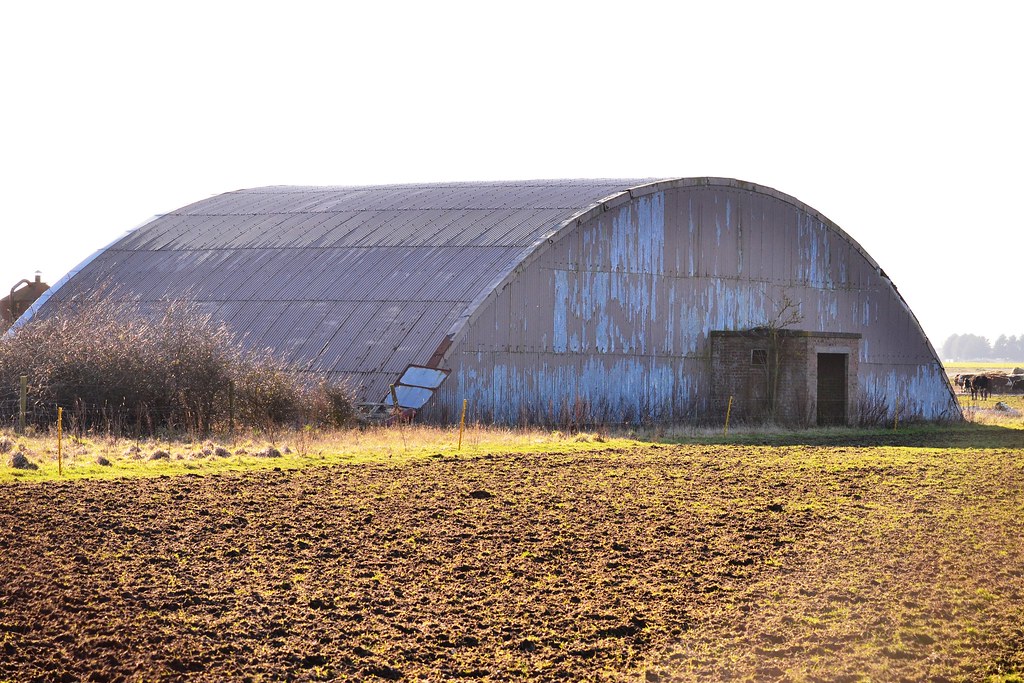
Blister Hangar

Sculthorpe’s remaining Blister hangar in a low setting sun.

Further cold war tensions saw in 1952, the deployment of the 47th Bomb Wing (formally the 47th BG) of the Strategic Air Command from the United States. This wing consisted of the 84th, 85th, and 86th BS, along with the 420th Refuelling Sqn and the 19th Tactical Reconnaissance Sqn. These units operated a number of aircraft types including the: B-45, B-66, KB-29, KB-50, and RB-45C aircraft. The 47th was activated on March 12th 1951, initially as the 47th Bombardment Wing (BW) but with just two squadrons – the 84th and 85th. As a new unit, it had the honour of being not only the first, but the only jet powered medium bomber Wing in the US Air Force. With NATO becoming more established and nuclear weapons arsenals expanding at a great rate of knots, the 47th were posted to Sculthorpe to provide an airborne nuclear strike force in support of NATO forces  who would be operating on the ground in any future conflict. A year later, a third squadron would arrive to join the Group, that of the 422nd BS. Within a month or two of its arrival though, the unit was re-designated as the 86th BS a move that brought it in line with its two sister squadrons. For three years the 47th would operate out of Sculthorpe acting as a nuclear support unit for NATO forces in Europe. Coinciding with the arrival of the US Wing in 1952, was the formation of the ‘Special Duties Flight Sculthorpe’. This was a British unit, led by Squadron Leader John Crampton (who replaced the initial choice Sqn. Ldr. Micky Martin of the ‘Dambusters’ fame, as he had failed a high altitude medical examination)  and was designed to perform deep penetration flights into Soviet airspace carrying out reconnaissance missions for Britain’s planned ‘V’ Bomber force. This was also used as a cover for covert US operations. Only two such flights were made, each with three aircraft; the first on 17th/18th April 1952, and the second on 28th/29th April 1954*6. These flights were performed by British crews flying American RB-45Cs with their US markings replaced by British roundels. A political ‘loop-hole’ that prevented US aircraft flying over Soviet territory allowed British aircraft to do so. These flights took place under Operation ‘Ju-jitsu‘, with four aircraft which were leased from the US 91st Strategic Reconnaissance Wing. Initially three routes were chosen, one of which took the aircraft close to Moscow. To ‘protect’ crews, they were issued with false papers and maps, and told, if caught, to explain  that rather implausibly, they had simply become incredibly lost! After these flights, which weren’t totally without mishap, the crews were congratulated by General LeMay, and the unit was then disbanded. However, it was reformed again, also at Sculthorpe, in 1954 (after a second such temporary reformation in September 1952) and a second flight was made. This time the Soviets were ready for them, after having evaluated their air defence network they were far better prepared and the crews were at a much greater level of danger than during their initial flights. It has since been revealed that Soviet aircraft were instructed to ram the RB-45Cs as they had no suitable radar with which to track the intruders. However, no such contact was made, and whilst flak was now the problem, it was generally ineffective, but sufficient to make the crews on board make a hasty return to the West where they received more fuel before returning to Sculthorpe. The unit was then again disbanded and all flights by them ceased. The RB-45Cs now being outdated, were too slow and obsolete to perform such high risk flights over soviet territory.
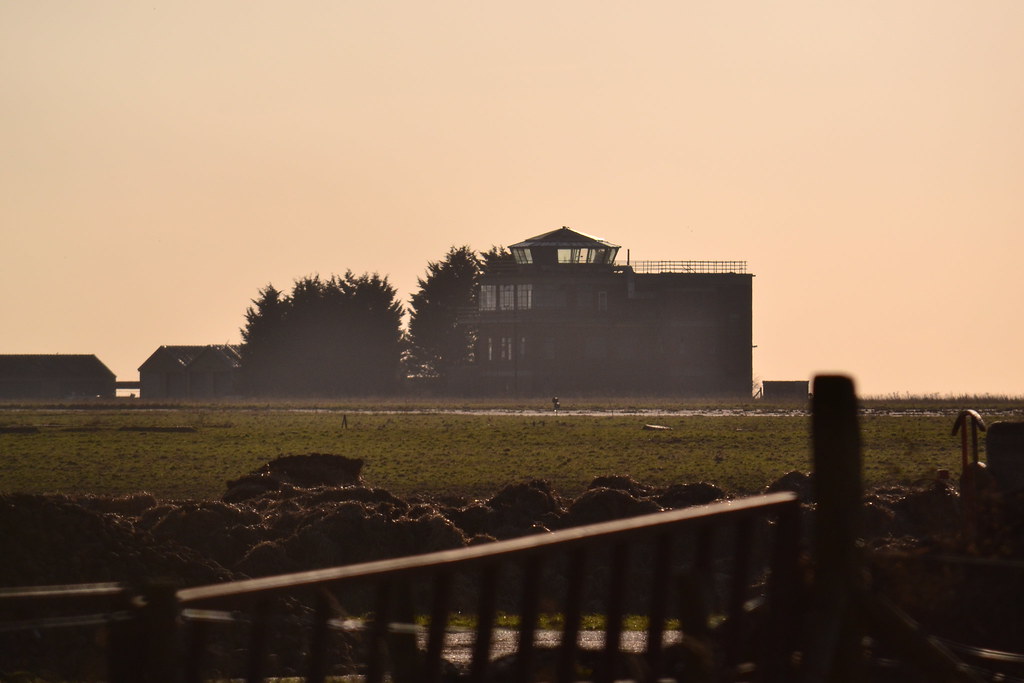
Control Tower

The watch office in a setting sun

Meanwhile at Sculthorpe, the operations of the 47th BW were gradually being taken over by other branches of the US Strategic Air Command (SAC), this take over reached such a point that inevitably the 47th were withdrawn and transferred home to the US. Once here, they were dissolved, and on February 8th 1955, the wing was removed from the US military inventory and their remarkable achievements condemned to the history books. After this, political talks and imposed de-escalation strategies between the Cold War factions, prevented further deployment of large-scale US bombers on European soil, and so further deployments on this scale would not be seen again in the UK. As the Cold War subsides, Sculthorpe’s future become uncertain, but it is definitely not yet over. In the last part we see how Sculthorpe has fared and look at what the future holds now. The full history can be seen in Trail 21.

RAF Sculthorpe – A relic of the Cold War (Part 3)

In Part 2, we left with the winter of 1942-43 arriving along with a special visitor. The harsh winter of 1943-44 would see a special visitor come to Sculthorpe. Wing Commander Leonard Cheshire arrived to discuss, with Pickard, the plausibility of dropping food and clothing to his brother in Sagan (Salag Luft III) using the Mosquito. Cheshire knowing Pickard’s vast experience, thought he was the ideal person to speak to. Whether this was a personal effort to provide comfort to his brother or whether Cheshire was considering the Mosquito for low level precision attacks is not known, but the latter befell the Wing not long after Cheshire’s visit. The December of 1943 would bring major changes here at Sculthorpe. On New Year’s Eve, the Wing, along with Pickard and all three Mosquito squadrons, would leave the Norfolk site, taking their Mosquito VIs to RAF Hunsdon. A much smaller airfield, where the overcrowding experienced at Sculthorpe must have been considerably worse. It was from Hunsdon that Pickard would famously make his last flight. A story goes that Pickard had left his dog ‘Ming’ at Sculthorpe to be looked after whilst he was away. On the day he was shot down, 18th February 1944, on the Amien raid, the dog fell gravely ill. Pickard’s wife, Dorothy, went to get him and sensed that Pickard had been killed after seeing the state of the animal. It took months for Ming to recover, and some years later whilst living in Rhodesia, Ming went outside, looked up to the sky as he always did when Pickard was flying, heard a whistle, collapsed and died.*2 The departure of the Wing effectively left Sculthorpe with no operational units, until on January 6th 1944, when a new and very different squadron began to move in. Crews from 214 (Federated Malay States) Squadron based under 3 Group at Downham Market, arrived in two waves, the initial group coming across in early January 1944, whilst the main body continued  operations flying their Stirling bombers. Those that arrived here quickly settled in, but a lack of decent paths meant that initial training was mixed with the unenviable task of digging and laying of new paths. Whilst attending lectures and link training were the primary tasks for the pilots and Flight Engineers, the gunners and other aircrew were given the more ‘practical’ task of constructing the new paths ready for the remainder of the squadron’s arrival. Then on the 25th, the remaining crews and staff of the squadron departed Downham Market, thus ending their link with 3 Group. Once here, flying circuits and more lectures became the order of the day. Additional training on ‘Monica‘ equipment, fighter affiliation tasks and local cross countries then took the squadron to late spring at which point operations began to take place. The arrival of 214 Sqn heralded more than just a new bomber squadron though, for they would not be flying the Stirling as they had been; instead, they were set up as part of 100 Group, becoming an official member in mid January 1944. Their arrival here would not only see them change Groups but would also see them convert to the American built B-17 ‘Flying Fortress’. Now designated 214 (BS) Sqn,  214 Sqn’s  arrival would bring a major change to Sculthorpe, a change that would continue for the next five months. Operating in the Electronic Warfare role within 100 Group, they would carry out radio jamming operations, an early form of Electronic Counter Measures (ECM). The urgency of the conversion, led to the unit taking on fourteen UK based B17-Fs , their ordered ‘G’ models being used as a trade off*3. The British B-17 (designated Fortress I, II and III) crews were joined by personnel from various U.S. units. Their role was to train and support the air and ground crews in both flying and maintaining the new aircraft, a role they performed well, right into the early summer of 1944. The set up was so successful that American personnel were soon posted in to fly alongside the RAF crews, thus expanding the influence of the Group.
Technical site buildings

A large part of Sculthorpe has been left to rot, piece by piece.

Flying along side other bomber formations, 214 squadron would use systems including ‘Monica‘ to track or jam enemy radar, they performed ‘spoof’ missions to entice enemy fighters up to them rather than the main force that was attacking targets elsewhere; a rouse that worked well initially. Other operations flown by the Group, included: jamming or swamping German radio communications, jamming navigation aids and searching for new signals that may suggest new or improved German radar.*3 The successes of 100 Group, prompted the setting up of the U.S. 803rd (Prov) BS (H) in March that year, a US Group who would learn from and perform in the same role as 214 Sqn. Initially taking six veteran crews, all having reached 25 missions, from 96th BG at Snetterton Heath combined with those already at Sculthorpe, they would soon build up to a strength of twelve aircraft all based here at the Norfolk airfield. Of these initial six all but one were fitted with Carpet and Mandrel jamming equipment, whilst the sixth (B-17G) had jammers and search equipment in the form of SCR-587 and Hallicrafters S-27 VHF signals intelligence receivers (SIGINT) to track Luftwaffe radar and radio transmissions.*5 The initial set up of the unit was seen as ‘messy’ and disorganised with no real focus. This led to delays in preparation, organisation and training. As D-day appeared over the horizon, the U.S. group was distinctly lacking in preparation and action was needed fast. To assist in the training and operations of the Fortress, a new separate unit was also set up here at Sculthorpe. From April 24th 1944, 1699 (Fortress Training) Flight who operated each of the Fortress I, II and III, carried out the conversion and training role for these crews, and to speed the process up, they also used the B-24 Liberator along with some smaller examples such as the Avro Anson and Air Speed Oxford. Then, five months after their arrival, both 214 Sqn and the 803rd were both posted out to RAF Oulton, (May 1944), where they continued with their ECM roles. The 803rd, now commanded by Lieutenant Colonel Clayton Scott, began to work on the support of Operation Overlord, and even as late as June 5th, equipment was still being fitted to the aircraft. The Fortress Training Flight moved with the two ECM units and in October it was disbanded and immediately reformed as 1699 (Bomber Support) Conversion Unit, a designation it used for a year before being renamed once more. The departure of the three squadrons (along with the resident non-flying units) was not a coincidence, for Sculthorpe had been earmarked for redevelopment into a Very Heavy Bomber base (VHB). As soon as the personnel had moved out, workmen moved in, taking up residence in the now empty nissen huts.
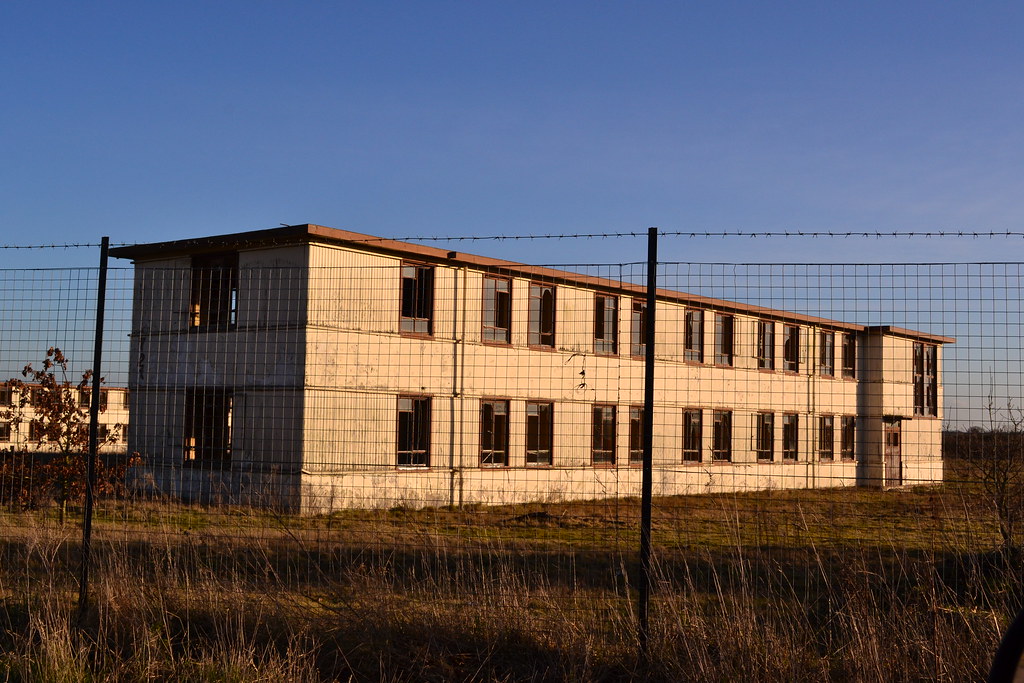
Accomodation Block

Barrack Block

There then followed a period of sustained redevelopment. This included the removal and reinstatement of longer runways along with the construction of twelve very heavy bomber hardstands. Surrounding public roads were also diverted and further properties were demolished to make way for the airfield’s new expansion. The driving force behind this move was the anticipated deployment of the enormous Boeing B-29 “Superfortress”, but when the war in Europe came to an end a year later, further development of Sculthorpe ceased and the B-29s never arrived as permanent residents. For the next 3 years or so, the station was basically closed, it was placed into care and maintenance with only occasional use keeping it alive; one such operator being the 1510 Beam Approach Beacon System Flight (BABS) based at nearby Bircham Newton. However, four years after the war’s end, between May and August of 1949, the airfield got a reprieve, when the 344th BS, 98th BG, USAAF did bring B-29s to Sculthorpe for the first of a number of several 90 day deployments. The first of these temporary postings were in response to the growing Soviet aggression in Eastern Europe. Identified as one of only a few sites suitable for the heavy bomber, the reprieve led to further development of the site with new storage facilities being constructed. The focus of these buildings were specifically to house and prepare atomic bombs ready for use should Anglo-Soviet relations deteriorate to a war status. In Part 4, as the Cold War warms up, Sculthorpe becomes a major player in the front line of a potential European war. The full history can be seen in Trail 21.

RAF Sculthorpe – A relic of the Cold War (Part 2)

In Part 1 we saw how Sculthorpe was developed in the mid war years but had not lived up to expectations. Two squadrons were about to move in, 464 and 487 neither of whom were overly impressed by its lack of comfort! 487 were the first to transfer. On the 19th, the advance party left Methwold followed in the early afternoon of the 20th by the main road party. The aircraft and crews then transferred over an hour or so after that.  On the 21st the aircraft of 464 Sqn also departed Methwold, the departure tinged with sadness as many were sorry to be leaving what had been a good home. The weather typical as it is, once again closed in, and several aircraft had to try two or three times before finally getting down safely at Sculthorpe. Fortunately there were no mishaps and all crews and aircraft arrived safely. By the evening all were unpacked and settling down for the night. The lack of buildings became quickly evident though, a fact made worse by the lack of bicycles, Sculthorpe being so widespread that it meant it was difficult to get around without transport. As a result, more bikes were needed and an order was placed with an urgent request. Coinciding with this, was a memo informing staff, of the impending move to form a new headquarters here, a move which would see both new recruits along with an increase in staffing levels. This was a further worry as there was still insufficient accommodation for those already here.
Bomb store

Sculthorpe’s bomb store.

The month ended on a better note however, with good weather, night sorties and training on new equipment gave a hint of things to come. A new station Commander also arrived at this time, in the form of Group Captain P.C.  Pickard DSO, DFC, once again hopes for the two squadrons were rising. Pickard’s arrival was by no means a coincidence – a new Wing was being formed and he had been chosen to lead it. Pickard’s record as a leader was outstanding, and he had been hand picked, for the role, by none other than Air Vice Marshall Basil Embry. Pickard’s role here at Sculthorpe was to set up and command 140 Wing, a new unit consisting of three Mosquito squadrons, under the control of 2 Group of the Second Tactical Air Force headed by Embry himself. Even while the new Wing was being formed, training continued for those already here at Sculthorpe. On August 18th, whilst on one such flight, one of the Venturas (AE668) of 464 Sqn crashed into a Welsh hillside at Llandwrog, with the loss of all four crewmen. What was unusual, and concerning, was why the aircraft was so far off course at the time; the Welsh mountains not being where it should have been. It was not known why the aircraft crashed nor indeed whether the deviation of course was a factor in the accident, but it was a heart felt tragedy and the squadron’s first accident whilst at Sculthorpe. Three days after this, on August 21st, the first of the new replacement aircraft arrived, two DH Mosquitoes, a milestone that coincided the following day with the setting up of a Mosquito Conversion Flight. The purpose of the Flight was to convert Ventura aircrew from both 464 and 487 Sqns over to the Mosquito. Flying was slow to start with, as appalling weather prevented any chance of taking off, even in the day-time; a situation that would prevail for some time. By now, the new postings for the surplus gunners of both units had begun to filter through, and gradually, one by one, they trickled out of Sculthorpe to their new respective squadrons elsewhere. It wasn’t  just the aircrew that were being posted out either, a number of tradesmen were also posted out, but oddly enough, they were not being replaced. The distinct lack of skilled technical personnel soon raised alarm bells amongst the units, for as a Mosquito squadron,  487 had no carpenters, and other skilled workers were becoming distinctly lacking. By early September Mosquito numbers had reached well into double figures, the lack of manpower was now the issue which was being made worse by the lack of spares, a situation that led to many aircraft being classed as unserviceable. A common problem seemed to be the undercarriages, repairs taking longer than usual keeping aircraft annoyingly grounded. The 15th September 1943 saw another turn in the status of Sculthorpe, seeing it gain its own independence and becoming an operational airfield in its own right. With this, Sculthorpe had finally grown up. On the 28th, the numbers of aircraft on the books had reached over 70 when another squadron (21) arrived to join both 464 and 487 thus completing the formation of the Wing. The ORB for 464 Sqn stating that the airfield was not built for three squadrons (and a conversion flight) and that overcrowding was now a major issue for those based here at a cold and wet Sculthorpe. 21 Sqn was another Ventura unit, themselves having a history as far back as 1915, and very soon after their arrival, they too, would begin to receive the Mosquito. As with 464 and 487 Sqns, pilots were quickly placed on the conversion course flying with the Conversion Flight at Sculthorpe. The transformation from Ventura to Mosquito being expedited with all speed. By the 4th October, virtually all pilots had converted and completed cross country solo flights at low level. Only the incident on the 1st, when Ft.  Lt. Henderson suffered engine trouble and subsequent fire, marred the otherwise rapid and clean transfer across. In the incident, Fl. Lt. Henderson managed to bring the aircraft down safely at RAF Attlebridge. Other good news for the unit was that those in the administration offices were now able to move from their cold and unsuitable temporary accommodation block to a new permanent building, this new block being the ‘best they had experienced since leaving RAF Oulton‘. Meanwhile 464 and 487 Sqn had both been flying operationally, October 9th being the blackest day yet for the New Zealanders, when twelve Mosquitoes were dispatched for the first operations over occupied territory. An attack on Metz was planned but owing to bad weather only one or two aircraft managed to find the target. After dropping their bombs it wasn’t clear whether the target was hit or not, but worse news was yet to come. The formation, which had been dispersed due to poor weather, was being led by Wing Commander Alan G. Wilson DFC along with his navigator F.O. Donald C. F. Bridgman of 487 Sqn. During the attack the formation encountered severe anti-aircraft fire, and Wilson’s aircraft (HX965) was repeatedly hit. The navigator sustained mortal wounds and the aircraft was set on fire. In a desperate attempt to clear the fire, Wing Commander Wilson had to douse the flames with his hands causing extensive burning and injury. He managed to eject the now smouldering materials from the aircraft, but considerable damage had by now been done. Now flying on his own with his mortally wounded companion beside him, Wilson showed extreme courage and determination, flying the stricken aircraft back to England where he made a successful crash landing at RAF Manston in Kent.
Accomodation blck adjacent to the guard room

Blocks adjacent to the Guard Room.

A second aircraft (HX912), flown by Flt. Lt. Phillip C. C. Kerr and F.O. Bernard J. E. Hannan (464 Sqn) – were less lucky, both being killed when the aircraft dropped its bombs at low level. It is believed the subsequent explosion also blew up the Mosquito. On a separate operation to attack the aircraft engine factory at Woippy in France, Mosquito  HX938 piloted by Sqn. Ldr. Walter F. Wallington DFC and navigator P.O.  James H. Fawdrraf, dropped its bombs by accident  and crashed. This time, both airmen managed to bail out, but some thirty people on the ground were killed. Sqn. Ldr. Wallington managed to evade capture but P.O. Fawdrraf was not so lucky and was picked up by German ground forces. The same fate did not befall two more 487 Sqn airmen that day. Flt. Lt. Edgar W. P. Court and Flt. Lt. Jack B. Sands were both killed when their Mosquito (HX937) blew up whilst flying on one engine near to Antwerp. It had been a very sad day for the Wing, and the loss of several ‘good’ men would be deeply felt by both squadrons. More rain and strong winds eventually turned Sculthorpe into something that resembled a “seaplane base”, by the end of the month, the entire site was waterlogged. The winds were so severe they were reported to have lifted hut roofs off their mountings causing even more problems for those inside. The foul weather broke momentarily on the 22nd – 23rd October and allowed for some bombing practice to take place. On return, one of the 464 Sqn Mosquitoes overshot and crashed onto a hedge at the end of the runway. On the 23rd, one of 487’s Mosquitoes ‘T’ for Tommy, did exactly the same thing, coming to rest only feet from the wreck that was previously a Mosquito. As if that was not remarkable enough, a few minutes later one of 21 Sqn’s aircraft also overshot, landing directly on top of the 464 Sqn aircraft! Miraculously no one was hurt in any of these incidents, but according to 21 Sqn’s ORB “considerable loss of public property sustained“, presumably referring to the pile of wood chippings now sitting at the end of the runway.*4 The fact that no one was hurt was a miracle in itself, and all the cockpits remaining intact was a sight that gave the personnel at Sculthorpe a great belief in the strength of the Wooden Wonder! By October’s end, the crews of all squadrons were now fully conversant with the new Mosquito, and the supporting Conversion Flight was disbanded; specific training units taking on the role elsewhere. In Part 3, the harsh winter of 1943-44 arrives and so does a special visitor. Does it mean something new for Sculthorpe? The full history can be seen in Trail 21.  

RAF Sculthorpe – A relic of the Cold War (Part 1)

In the heart of Norfolk, lies an airfield that had its origins in the Second World War, but its legacy is more of a Cold War monster that was a key player in what could have been the world’s demise. In the second part of Trail 21, we return to that relic of the Cold War – RAF Sculthorpe. RAF Sculthorpe  Sculthorpe airfield is located a few miles to the north-west of the town of Fakenham in Norfolk, in a parish that has links as far back as the Romans and even pre-historic eras. The airfield itself however, has its origins more recently, in the latter part of the Second World War, but it has a much larger claim to fame one that it still retains to this day.
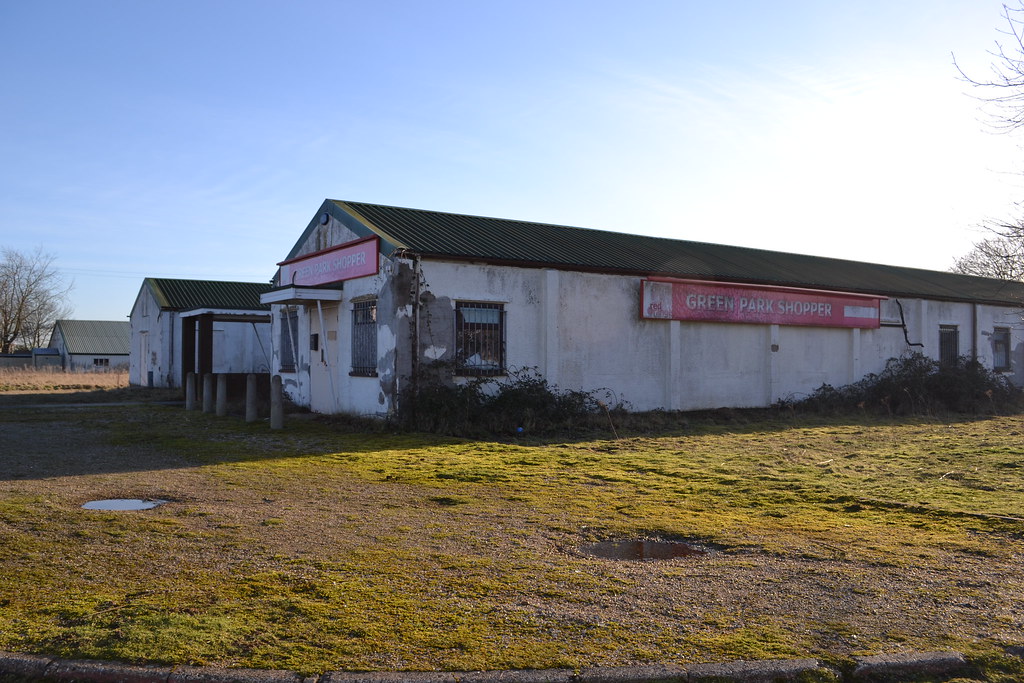
A once busy shop

A once busy shop now derelict and forgotten.

Designed initially as a heavy bomber site, and satellite to RAF West Raynham, Sculthorpe had three runways, one of 12,000ft and two of 6,000ft, and all made of concrete. By the end of its life, it had enormous technical and administration sites and was capable of housing up to 10,000 personnel, giving Sculthorpe the ability to boast being one of the biggest airbases in Western Europe, an honour it retains to this day. Built by a collection of major companies including: Bovis Ltd, John Laing & Sons, and Constable Hart & Co. Ltd; it would boast as many as five major hangars, one B1 and four T2s, along with several blister hangars all located around the site. Although built in the Second World War, Sculthorpe had a limited War life, being opened quite late, in January 1943. Operating under the control of 2 Group, the first users were those of the 11 Heavy Glider Maintenance Section along with 2 Heavy Glider Maintenance Unit, who both moved in as soon as it opened. As non-flying units they prepared, repaired and maintained Horsa gliders, many of which would have been used the following year in the Normandy invasion. These units remained in situ at Sculthorpe for almost a year, departing in mid March 1944. Following an initial year’s development and growth, Sculthorpe finally opened operationally with Boston IIIAs of 342 (Lorraine) Squadron on May 15th 1943. 342 Sqn had originally been set up as a Free French squadron in September 1941, operating in the Middle East with French crews. Their time there had not been good though, with many losses as a result of flying what were now considered ‘out of date’ aircraft – the Blenheim. It was then decided, after talks between the RAF and General Valin, the Commander of the Free French Air Force, to bring these men back and retrain them on more modern aircraft, and so in September 1942, orders from the UK directed many of these airmen back to the UK. Sadly however, during their return voyage, two of the four ships that were used to transport them, were sunk by German U-boats and many of the  personnel were lost as a result. Once in the UK, refresher courses were undertaken with 342 Sqn being officially re-formed, on April 1st 1943, using these French personnel at nearby RAF West Raynham . Once formed, training continued, followed not long after by the first loss, when one of the aircraft attempted an emergency landing after running out of fuel. That aside, the Boston IIIa, or A20, they were now using, was considered a much improved model compared to the Blenheim, with both greater power and better armament, it was far more suited to the role it was about to perform. Following further training, the squadron finally transferred over to Sculthorpe on May 15th 1943, where crews attended lectures on “evasive action and fighter control”. Two further crashes would cost the squadron several more airmen, some of whom were highly experienced and valued members of the unit.  The move of the squadron also signified a change for Sculthorpe itself, as at this time, it ceased to be a satellite of West Raynham – the move to total independence was now a step nearer, albeit temporarily.
RAF Sculthorpe

One of many buildings on site today.

As the saying goes, any port in a storm, and Sculthorpe provided that port. On May 19th, an American B-17 was forced to make an emergency landing at the airfield. On board the aircraft were three injured crewmen, the ball turret gunner, and the two waist gunners. The Ball Turret Gunner was given urgent medical assistance, but unfortunately he later died from those injuries, whilst the two waist gunners, both with frost bite to their hands and ears, thankfully survived. A second B-17 landed some time after the landing and collected the crewmen, transferring them back to their own base where they received further medical assistance. There then came yet another change at Sculthorpe, as the Free French unit was combined with two other squadrons, 88 and 107 to form the new 137 Wing; a Wing made up of both French and British units.  On June 12th 1943, under the new Wing, 342 Sqn’s first operational flight took place, a ‘circus’ raid undertaken in conjunction with 107 Sqn. These types of operations would become the norm for the next month, and whilst there were some losses, they were thankfully light. In mid July, orders came through for the unit to depart Sculthorpe and move to nearby RAF Great Massingham, a move that was well organised and one that went smoothly. By the evening of July 19th all but two aircraft had departed Sculthorpe, and crews were settling in well to their new home. There was no let up at Sculthorpe though, as over the next two days two more squadrons would move in to the now vacant premises. Orders for the transfer of both 464 (RAAF) and 487 (RNZAF) Squadrons were received with mixed emotions though. To make things worse, the transfer of both men and machinery did not go totally to plan and only happened following a change in operations and planning. Both Squadrons had been flying from  RAF Methwold, an airfield not far from Sculthorpe, as light bomber units with Lockheed’s Venturas. They regularly attacked targets in western Europe, often without fighter escort, which resulted in some heavy losses for the units. It was whilst at Methwold that Sqn. Ldr. Leonard Trent would perform so bravely receiving the Victoria Cross for his actions on May 3rd, 1943, with 487 (RNZAF) Sqn. The whole process began in mid June with an initial order requiring 464 (RAAF) Sqn, to move to Dunsfold, however, that move never materialised, the order being cancelled on July 4th. This meant that preparations would stop, and the squadron would remain here at Methwold. They then entered a period of training, the weather having curtailed many operational flights for both this unit and others across the UK. Then on July 10th, the weather broke just enough for an operational flight to be carried out by 464, attacking targets at St. Omer. These were hit with great success; the 487 squadron commander commenting “a wizard piece of bombing”,  but still the squadron awaited, with anticipation, news of its next posting. Then two days later, whilst a contingent of the Australian press where visiting, news came through that the two units were to change its aircraft for Mosquitoes, and that the pilots would be fully trained within 6 weeks. The swap although not what was expected, was generally accepted well by the squadrons, but it brought disappointment for both the wireless operators and air gunners of each unit, who would have no place on board the two-seat ‘Mossie’,  and would have to be transferred out. Following further training, the long awaited news finally arrived. For 487 Sqn it arrived on July 16th, noted as ‘Panic day’, and on July 17th for 464 Sqn. Both squadrons would now transfer over to Sculthorpe. In preparation, 464 Sqn’s station adjutant visited the new airfield on the 19th to assess its condition, but he was not impressed! He reported that “there was very little of it to work in comfort and everything is drastically dispersed.”*1 His aggrieved feelings about the site were further exasperated by a lack of office space, the only silver lining to the whole move, being that more accommodation was apparently ‘in the pipeline’. In Part 2 we see how both 464 and 487 Sqns get on at this dispersed, lacking in comfort site. The full history can be seen in Trail 21.

RAF West Raynham Trail 21 – Part 5.

We have now seen how West Raynham developed from an expansion period airfield, through the Second World War and on into the Cold War. With tensions now easing and Government cuts biting hard, the future of West Raynham and the Service, hangs in the balance. But with new jets in the pipeline, changes to the Nuclear deterrent coming, a new direction may save the airfield from immediate closure. We also see how one man takes matters into his own hands and protests as these events which are to shape the future Air Force.

Later in August that same year, Nos. 1 and 54 Squadrons arrived at West Raynham boosting the numbers of personnel present here once more. Both units transferred over from Waterbeach in Cambridgeshire, in a move that saw the return of the Hawker Hunter F.G.A. 9.

No.1 Squadron, one of the RAF’s longest serving squadrons had provided almost continuous service since 1912, and had flown a wide variety of aircraft across Britain, France and the Far East. They brought with them a long and distinguished history.

It was perhaps a No. 1 Sqn pilot who defined West Raynham’s lasting legacy, that of the Flight Commander – Flight Lieutenant Alan Pollock, who around midday on 5th April 1968, flew a Hawker Hunter FGA.9 (XF442) between the two spans of Tower Bridge in London. The stunt, a protest by Pollock already annoyed at the Government’s defence cuts, was to raise the concerns of personnel at the lack of celebration of the RAF’s fiftieth anniversary. After leaving Tangmere (following a celebration dinner) he and his colleagues headed back toward their home base at RAF West Raynham. Pollock then turned away from the group and flew at tree top level along the Thames circling the Houses of Parliament no less than three times, before dipping his wings at the RAF Memorial and heading along the river and home. However, before long he was faced with Tower Bridge and a split second decision had to made. He decided to fly through the arches rather than over the bridge.

His fate was well and truly sealed, he was going to be disciplined and severely. On the way home, his single handed salute to the service he adored included ‘beating up’ Wattisham, Lakenheath and Marham airfields, before carrying out an inverted flypast at West Raynham. On landing, Pollock was arrested by the Military Police, after which a long, drawn out legal process was put into place. Rather than face a public outcry, the authorities gave him the ‘option’ to leave on medical grounds or through the more severe removal under Queens Regulations with the loss of all financial backing.

There was no option, and Flt. Lt. Pollock was sent packing. The political fallout from the event went on for months afterwards, leading to a stronger rebellion from the press who were already gunning for the Wilson Government. No one in authority wanted their ‘dirty washing’ aired in a public hearing.

54 Sqn meanwhile operated out of West Raynham as part of 38 Group Air Support Command.  A role that required them to fly as a ground support unit, operating in conjunction with army ground forces. They flew from West Raynham for seven years, departing at the end of the decade. During this time, they would reinforce the Mediterranean and Germany even locating to Gibraltar after political ‘pressure’ from General Franco.

The 1960s also saw a change in direction for Britain’s defence network, which was brought about by the same 1957 Defence White Paper that saw the demise of 85 Sqn. The basis of this saw manned fighters be replaced by guided missiles along with investment in the V bombers, a retaliatory force that could deliver Britain’s nuclear weapons arsenal.

On September 1st, 1965, the first of West Raynham’s guided surface-to-air missiles arrived. The reformation of No. 41 Sqn with two units (sixteen missiles in each) saw the construction of a secure Bloodhound missile site on the eastern side of the airfield. These MK.II guided weapons would become the main airfield protection system of that time, although their presence only lasted five years before the unit was again disbanded and the missiles put onto storage.

With the birth of vertical take off and landings in the form of the Kestrel (later the Harrier) an evaluation unit was set up here at West Raynham. Designed to test the flying abilities of the Kestrel, up to and including near service conditions, it was made up of pilots from the UK, USA and West Germany. The unit, designated the Tri-Partite Evaluation Squadron Royal Air Force (TES), was designed to see how the aircraft would perform from both airfields and unprepared sites, using its VTOL and STOL capabilities. To this end the unit also used Buckenham Tofts located in the Stanford Training Area, the Army’s huge training area near to Thetford.

Testing any new aircraft is a risky business, the Kestrel being no different, and on April 1st 1965, Kestrel XS696, caught fire and crashed following a take off from West Raynham. Only a month old, the aircraft was struck off charge the same day as a Cat.5(c) and the remains scrapped after all recoverable components had been removed. The pilot was thankfully unhurt in the incident.

The accident didn’t completely deter the US Government though, and at the end of the year, six aircraft were sold to the US for further tests. Initially they were not convinced of its use, but the US Marine Corps were interested, and subsequently a long service began for the Harrier in both the US and here in the UK.

In 1967, Napalm saw a return to West Raynham when famously the Torrey Canyon struck rocks off the Cornish coast. The ship soon grounded and began to break up, spilling its cargo of oil onto rocks and into the waters around Cornwall. The Government decided to bomb the stricken vessel to reduce the impact of the oil spill, and so aircraft from the Fleet Air Arm and RAF were called in to bomb it. No. 1 Squadron were assigned the challenge and four Hunters were tasked with the role. Eventually after several attempts the wreck finally sank and much of the oil was burnt off.

Two years later in 1969, both No. 1 and No. 54 Sqns departed West Raynham. Their gap quickly being filled by No. 4 Sqn who arrived in September that year staying until the following March. Both 1 and 54 Sqns would become new Harrier units, forming squadrons in both Germany and here in the UK.

The dawning of 1972 saw the return of 85 Sqn, who after a spell of some nine years at Binbrook, returned with a new model Canberra the PR.3, a long range photo-reconnaissance aircraft, it was unarmed and relied on its high speed to escape any enemy aircraft.

A month later in February, it was decided to also reform 100 Sqn here at West Raynham, initially using staff from 85 Sqn. Starting off with the Canberra B.2, they quickly began changing these for the T.19, essentially a T.II with its Airborne Intercept radar (A.I.) removed – West Raynham was now awash with Canberras. One of the roles of 85 Sqn was to act as enemy intruders so QRA crews could perform practice intercepts. Although the QRA crews were aware of the nature of the intercepts, Canberras would fly in low and then climb over the UK coast imitating a Soviet bomber – often to great success.

On June 26th 1972 tragedy would strike at West Raynham once more, when a 100 Sqn Canberra T.19 ‘WJ610’ crashed shortly after take off. The Aircraft, crewed by  Flight Lieutenant Nicholas Whitlock (pilot) with navigator Flight Lieutenant John Sheran, struck trees 2 miles south, south west of Rougham whereupon it burst into flames killing both airmen.

In the months before the accident, the aircraft had been on loan to 85 Sqn, although this had no bearing on the cause of the crash itself, but it has led to some confusion as to which squadron it was actually with at that time,

Investigations recorded that the aircraft was one of a pair that took off in bad weather flying on instruments. Then as it entered low cloud, Flt. Lt. Whitlock reported that the aircraft had suffered an undercarriage problem, at which point it peeled away from its leader, the assumption being that Flt. Lt. Whitlock was aiming to deal with the issue in hand. The investigation surmised that he may have been concentrating on the gear issue and became disorientated as a result. It is thought this then led to the accident and the aircraft’s inverted crash.

As a result of the tragic loss, formation take offs by Canberras were subsequently prohibited, any future take offs having a minimum of 30 seconds between each departing aircraft, it was a tragic loss that served to help others*2.

A brief interlude in the autumn of 1972 saw the reformation of 45 Sqn with Hunter F.G.A.9s, once established and organised the unit quickly transferred out, leaving West Raynham behind.

The 1970s saw further big changes within the RAF. The handing over of the nuclear deterrent to the Royal Navy for one along with Britain’s air defence missiles (Bloodhound) being withdrawn and transferred to Germany. However, later concerns over potential attacks forced a review, and as a result, in December 1975, 85 Sqn were disbanded, the aircraft were transferred out, and they were  immediately reformed as a new Bloodhound unit. The missiles were brought out of storage and placed here in Norfolk. Some of the 85 Sqn personnel were absorbed into West Raynham’s 100 Sqn but they would only remain here at West Raynham for a further month before they too moved out.
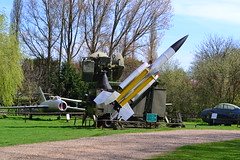
Bloodhound

Bloodhound Missile at the Norfolk and Suffolk Air Museum (2014)

85 Sqn operated across a number of sites. Primarily based at West Raynham, they had Flights at both Bawdsey on the south Essex coast and North Coates in Lincolnshire. In October 1989 the squadron grew further, absorbing No. 25 Sqn, which gave the unit three more Flights at Wattisham, Barkston Heath and Wyton. By the start of the 1990s though, Bloodhound had become obsolete ‘Rapiers’ being the new low level airfield defence missile, and so Flights ‘B’, ‘C’ , ‘D’, and ‘F’ were all disbanded. This left the HQ (West Raynham), ‘A’ Flight (North Coates) and ‘E’ Flight (Wattisham), until these too were disbanded the following summer.
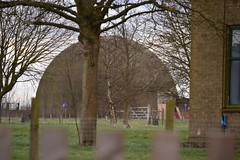
RAF West Raynham

West Raynham’s Rapier training dome is now of ‘Historic Interest’. (2015)

By the time the 1980s had dawned, front line flying at West Raynham had been scaled back and no operational fighter units were based here. The airfield had entered the long and slow wind down to eventual closure.

By July 1991, with the last of the Bloodhound units being disbanded, the missiles they had been using scrapped or sold to the Swiss military, and the personnel pulled out, the site was left all but empty.

Any residue support units were also removed and in 1994 West Raynham finally closed its hangar doors. The airfield itself remained in MOD hands, but sadly the housing lay empty and it quickly became derelict, targeted by vandals. The accommodation blocks were damaged and windows were smashed. Long debates and scornful banter over the housing shortage boiled over in parliament and sites such as West Raynham were seen as prime land, with a huge infrastructure already in place, they were half way to meeting the needs of a growing community. The MOD eventually gave in, agreed to the sale and the site was handed over.

The two gate guardians, a Bloodhound missile ended up at Cosford Museum whilst the Javelin XH980 , was scrapped on site and disposed of. Since then the site remained closed and quiet.

This closure left what is a rare example of a complete wartime  and post-war airfield. As a result, many of its buildings are now of ‘historical interest’ and attempts at obtaining a Grade II listing to a large number of the airfield’s buildings was made by the English Heritage. Sadly, this was later withdrawn and no follow-up made although the post war Watch Office is now Grade II listed and more recently a private dwelling.

For many years the site stood empty gradually decaying.  A number of planning applications were submitted and some of the accommodation blocks were transformed into private homes. This has thankfully meant that the original style and layout has been maintained. However, the runway and Bloodhound sites have now gone, having been replaced by what is reputed to be, one of Britain’s largest Solar Parks.

In 2016 a proposal was put forward to develop the site into a mix of housing, leisure facilities and industrial units, all utilising the existing buildings where possible. A design brief was put forward by FW Properties who estimated the 158 acre site to be worth £7.3m with a refurbishment value of some £5.2m. The proposal was for a four phase plan to include refurbishment of the original properties for housing, redevelopment of the landscape and infrastructure and new builds to create an integrated community on the site. A grand proposal that would keep the integrity of the site and utilise as many of the buildings as possible.

When I initially visited, the site had been sealed off, but the control tower along with a wide range of smaller ancillary buildings, were all shrouded in scaffolding. The  Officers Mess had seen better days and the adjacent tennis courts had been reclaimed by trees.

The Rapier training dome, original Battle headquarters and wartime pill boxes were also evident. A memorial to the crews of West Raynham had been erected in what is now the centre of a housing area that utilises the old accommodation blocks.

Today, much of it hasn’t changed, many of the smaller buildings continue to decay, but the post war watch office is a private dwelling, open for visitors and tours on heritage days, the guard house is a shop for fire places and the hangars are used by small, light industrial companies.

A Hunter F.1 ‘WT660’ has been acquired and sits near to the modern watch office, previously on display/stored in Scotland, it has been brought back to be refurbished and displayed in the colours it would have worn whilst in the Day Fighter Leader School between 1955 and 1957 here at West Raynham.
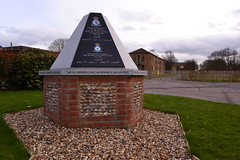
RAF West Raynham

The West Raynham memorial sits next in the former accommodation area.

West Raynham is one of only a few complete sites that reflect the development and commitment of Britain’s air defences. Its origins and initial construction in the 1930s has seen continued improvements leading to its gaining a remarkable status that few other sites have gained.

Throughout its history it has seen a wide range of units, personnel and aircraft, it has been a training airfield, a front line fighter defence, a bomber airfield and even a missile base. Its future is now in the hands of a developer, who are implementing a gradual change from airfield to community utilising the main buildings on site to support light industry and housing. What the eventual model will look like only time will tell, lets hope the promises hold and West Raynham becomes a model for other disused airfields before they are bulldozed and all their history cleared for evermore.

I hope to make a further visit shortly and capture some more up to date photos.

The full story can be read in Trail 21 – North Norfolk Part 2.

Sources and further Reading (West Raynham).

*1 National Archives Operational Record Book 114 Sqn August 1941 – AIR 27/882/36

*2 Aviation Safety Network database

*3 National Archives AIR 27/882/36

*4 National Archives AIR 27/1456/75

*5 “Hansard 1803–2005”  digitised editions of Commons and Lords Hansard, the Official Report of debates in Parliament. Hunter Aircraft (report of Enquiry)

National Archives AIR 27/731/1

AIR 27/801/1
AIR 27/882/33
AIR 27/2870/21
AIR 27/971/33

For personal stories and more photos see the West Raynham Association website.

The West Raynham Development Brief published by FW Properties.

My thanks to Jon Booty at the West Raynham Control Tower for corrections.
RAF West Raynham Trail 21 – Part 4.

At the end of Part 3, West Raynham had seen the war out and entered a new stage of life. With more upgrades and new aircraft arriving, its future looked secure. But not all would be well for those stationed here. The mid 50s, would see a tragedy that could have been so much worse.

The immediate post war period then saw fighter trials become the order of the day. The Royal Navy basing many of their types here for various trials and research projects. With two second line squadrons bringing their aircraft here No 746 Sqn  and No 787 Sqn, the last piston engined examples to fly from West Raynham were the Fireflys and Hellcats of 746 Sqn RN, operating as part of the Naval Fighter Development Unit.

With the departure of the last aircraft, West Raynham was once again earmarked for upgrading which included amongst other things, another new watch office, designed to replace the mid-war example that had served so well. An additional extension to the perimeter track was also planned in, as was the creation of further, larger hardstands. In addition to all this, an increase in personnel was also envisaged and so extensions to the accommodation areas were also planned in once more. These upgrades were not subject to the same planning constraints as those originally built, and as such these buildings were not as ‘impressive’ as the older, original examples that remained on the site.

This particular watch office example (294/45), was a new and modern approach to airfield control buildings, incorporating for the first time an airfield control room (ACR later called Visual Control Room) the first of its kind. What made this building more significant than its predecessors was that it was designed with three floors as opposed to two, a style more commonly seen at wartime Naval stations.

The ground floor was primarily used as crew rest rooms (air and fire) with a kitchen, GPO equipment and a meteorological room. The first floor contained a planning room with a large plotting table and map wall, a feature reminiscent of World War II watch offices. A number of smaller rooms were also located off this room, providing accommodation for the Wing Commander and a Navigation Officer. The top floor was primarily the airfield control room (ACR) again a plotting table and additional staff rooms were located here. Also found here was the airfield lighting panel, R/T equipment and access to the ‘glasshouse’ above, with its distinguishable slanted windows. This floor gave a complete 3600 view around the entire airfield, a much improved view over pre and mid-war designs. The very design of this building has since been its saviour, as the best example of only one of five examples, its architectural interest, rarity, ‘completeness’ and interior systems, have enabled Historic England to list it as a  Grade II building; this should at least offer it some protection from future development or demolition.

On completion of the work the airfield was passed to The Central Fighter Establishment (CFE) under the control of the RAF, where it began a new role as Britain’s top fighter training establishment, taking the airfield through the 1960s and on into the 1970s.

The CFE was a huge organisation formed in late 1944 through the amalgamation of a number of other training units: The Fighter Interception Unit, Air Fighting Development Unit, Fighter Combat School and the Fighter Leader School to name but a few. It would use personnel from across the military spectrum including: the RAF, Fleet Air Arm, Army Air Corps and the United States Air Force.

THE ROYAL AIR FORCE, 1950-1969

Aircraft of the Central Fighter Establishment (CFE) October 1962, before moving to RAF Binbrook. Aircraft represented: (L to R): Spitfire (P5853), EE Lightning F.1 (XM136), Gloster Javelin, Hawker Hunter F.6 (XF515) & Hawker Hunter T.7 (XL595). In the foreground are personnel representing the CFE including RAF, Fleet Air Arm, Army Air Corps and United States Air Force. (@IWM RAF-T 3476)

During this time, West Raynham operated as both a front line fighter base and as an aircrew training airfield. This would mean a huge influx of personnel and so a  return to the high numbers of staff and aircraft that had been seen here during the war-time period.

In 1956, tragedy struck The Central Fighter Establishment here at West Raynham, when on 8th February, eight Hunter F1s took off from the airfield to carry out an exercise only to have six of them crash.

The exercise, a 4 against 4 dogfight involved two instructors and six students, and took place around 45,000ft in airspace above the airfield. By the time it had been completed, the weather over West Raynham had deteriorated so much that the eight aircraft had to be diverted to an alternative airfield, and RAF Marham was assigned. The cloud base was by now very low over West Raynham, as little as 250ft in places, and so a visual landing was almost impossible without GCA talk down (Ground Controlled Approach). Unfortunately, there was substantial R/T congestion that day and Marham GCA had great difficulty in picking up the Hunters. By now, the group had paired off and each pair had descended, flying low over West Raynham to pick up a heading for Marham’s runway (both runways were almost in direct line of each other), most of the aircraft were by now down to just minutes of fuel in their tanks.

By the time the aircraft were approaching Marham, the weather there had also deteriorated, and as such, the aircraft were unable to make a GCA landing. Of the eight, two managed to land one running out of fuel as it departed the runway, but the remaining six aircraft struggled, low on fuel and unable to see the ground, it became a near catastrophe.

Of those six, Hunter ‘WW639’ ‘N’ descended to 250 ft, after which the pilot lost visual contact with his leader. Now lacking sufficient fuel to land safely or divert elsewhere, the pilot elected to climb to 2,000 ft and eject. The Hunter, now pilot-less and without power, then crashed 3 miles south of Swaffham.

The second Hunter, ‘WW635’ ‘L’ was the only aircraft to have a fatality. The aircraft crashing four-and-a-half miles north-west of Swaffham killing the pilot Sqn. Ldr. R.J. Tumilty, (31).

The pilot of the next aircraft, Hunter ‘WW633’ ‘H’, descended to 500 ft, but with limited ground visibility also decided to climb away. Unfortunately he suffered an engine flame out and so ejected from the aircraft leaving it to crash in a field three-and-a-half miles north-west of Swaffham.

The fourth Hunter, ‘WW603’ ‘G’ attempted to land, but only managed a wheels up landing after also suffering a flame out. The aircraft came down not far from the eastern side of the airfield, the pilot escaping unhurt.

The fifth pilot, that of ‘WT639’  ‘N’, descended to 600 ft after being unable to contact Marham GCA. The cloud at this level was very dense, and also after losing his leader he too elected to climb away. As with other Hunters that day, he also suffered a flame out  and so ejected at 2,500 ft leaving the aircraft to fall to Earth in a forest 2.5 miles south-west of Swaffham.

The final aircraft, ‘WT629’ ‘T’ suffered the same fate as many of the others. After running out of fuel, and unable to see the ground at 600 ft, the pilot elected to climb to 4,000 ft and eject.  Now without either power or a pilot, the aircraft crashed in fields 2 miles northwest of Swaffham.

In a ministerial briefing after the Court of Enquiry had published their report, it was noted that the aircraft were not defective nor was there any question of inadequate fuel being supplied. The short range of early jets and these Hunters in particular being acknowledged by those present. The board highlighting that “the accidents were primarily caused by the sudden and unexpected deterioration in the weather“.

The board then questioned the basis of the divert to Marham, as it was based on the assumption that the weather was good at Marham.

The question then arises whether, notwithstanding the deterioration that had taken place at West Raynham, the decision taken to divert the aircraft to Marham, spaced for visual landings, was correct. This diversion was ordered on the assumption that visual landings would be possible”.

The conclusion was that mistakes had been made and the report then went on to firmly lay the blame at the controller’s feet:

The findings of the enquiry concluded that this was an error on the part of the controllers at West Raynham, “who failed to appreciate that, because of the relative positions of the two airfields, it was probable that any deterioration in the weather at West Raynham would affect Marham shortly afterwards, thus necessitating Ground Control Approach landings there”.*5

As a result, controllers at West Raynham were subjected to disciplinary action over the incident, one of whom was removed from his post. It was a sad day indeed for the squadron and for all those who were involved at West Raynham. However, what turned out to be a loss of one life could have been so tragically worse.

The 1960s then saw even more changes at the airfield. As tensions across the world began to rise once more, so the country was put on alert. At West Raynham more new squadrons would arrive, the first, 85 Sqn, arrived at the airfield in September 1960, bringing more front line fighters to the site, this time it was Gloster’s distinguishable delta, the Javelin FAW 8.

Whilst at their previous base RAF West Malling, the squadron had been dogged with both starter problems and the serviceability of the A.I. radars on the Javelins; both of which continued after they arrived at West Raynham. At the end of the month senior officials from both the RAF and G.E.C. visited the base  with a view to resolving the ongoing A.I. situation. However, the problems persisted even after they had gone, problems which merely compounded other issues the squadron were having around poorly fitted equipment, bad weather and surprisingly a lack of married quarters.

The Javelin was brought in to complement the Lightning, operating in the Night Fighter and all weather role, it was designed to intercept bombers that threatened the cities or airfields of Britain. In order to train aircrew in this role, a number of ‘support’ units were also established during this time. These included the Javelin Operational Conversion Squadron, a unit set up to convert pilots to the Javelin from other aircraft; the Fighter Support Development Squadron; the Fighter Command Instrument Training Squadron; the Radar Interception Development Squadron; the Night All Weather Wing and the Night Fighter Development Wing, along with numerous other units that supported the training of fighter pilots at this very busy airfield.

In July / August 1962, there were a spate of engine fires in Javelins at West Raynham, something that seemed to be a problem with these aircraft. Three such events affected XJ128, XA646 and XA701 during a three week period. There are no reports of injuries as a result of the incidents, and records simply show ‘engine fires at start up’. But it would appear to have been a rather regular occurrence at this time.

85 Squadron was then disbanded on March 31st 1963, a move that was forced by Duncan Sandy’s White Paper cutting back military expenditure on front line fighter units. They immediately reformed the next day taking over from the Target Facilities Squadron. They obtained new aircraft to fulfil the role, the Canberra T.11 – a B.2 converted to facilitate target towing, fighter interception and navigator training; all achieved through the fitting of a nose radome and A.I. radar. Their stay at West Raynham only lasted one more month though, when they finally left, transferring out to RAF Binbrook in Lincolnshire.

As Duncan Sandy’s White paper cut deep into the heart of the RAF, many of those connected with the Force were angered. In the last part of West Raynham, we see how one man took matters into his own hands only to suffer the severe consequences.

The full story can be read in Trail 21 – North Norfolk Part 2.