RAF Methwold – unassumingly famous.

The East Anglia countryside is littered with remnants of the Second World War. The massive build up that occurred here in the mid 1940s has led to changes in both landscape and culture, the ‘friendly invasion’ as it has become fondly known, had a huge impact on the towns and villages around here. An area rich in aviation history there are numerous tales of heroism and valour to be found.

Whilst on the eighth Trail of aviation sites, we stop at the former site that was RAF Methwold.

RAF Methwold

Methwold Village sign

Methwold village sign

Located between Downham Market and Thetford, Methwold is a small rural setting on the edge of Thetford Forest. Its village sign and combined memorial, remind the passer-by of its strong air force links – a Lockheed Ventura taking off over the village church.

Methwold was actually built as a satellite for nearby RAF Feltwell and as such, had few squadrons of its own. Being a satellite its runways were of grass construction with little in the way of luxuries for accommodation.

On the day war broke out in Europe, 214 Squadron, equipped with Wellington MKIs, moved from RAF Feltwell to here at Methwold. Feltwell being larger, offered a prime target for the Luftwaffe and so their loss would be Methwold’s gain. The first production Wellington, the MKI was powered by two 1,000 hp Bristol Pegasus XVIII radial engines, and would soon be updated and replaced by the MKIA; the main difference being a change in gun turret from the Vickers to the Nash & Thomson. As part of Bomber Command, 214 Sqn did not carry out its first operational bombing flight until June 1940 some four months after it had left Methwold; but that is not to say casualties were not suffered.

On Monday November 6th 1939, Wellington L4345, crashed whilst circling on approach to Methwold. The accident resulted in the deaths of both crewmen, Pilot Officer J. Lingwood and Aircraftman 1, – A. Matthews.

Tragic accidents were not uncommon in these early stages of the war, another similar incident occurring at Methwold only a month later. In mid December, Pilot Officers W. Colmer and R. Russell-Forbes, along with Leading Aircraftman J. Warriner, were all killed whilst on approach to the airfield flying in another Wellington, R2699. Both these Officers were only recently commissioned and were still considered relative flying ‘novices’.

In February 1940, 214 Sqn departed Methwold and transferred to RAF Stradishall leaving only a small number of Wellington IIIs of 57 Sqn detached from their parent station at Feltwell. These would, in September 1942, be replaced by the mighty Lancaster, the four engined bomber that formed the backbone of the RAF’s Bomber Command.

The Intelligence Room of No. 140 Wing, No. 2 Group, at Methwold, Norfolk. © IWM (HU 81315)

Little happened at Methwold for the next two years, then in October 1942, 21 Sqn arrived. After having flown many missions against coastal targets in the Mediterranean, they were disbanded at Luqa only to be reformed and re-equipped at Bodney the same day. After changing their Blenheims for Venturas in May 1942, they transferred to RAF Methwold where they stayed for six months.

Operating both the Ventura MKI and II, they were the first Bomber Command squadron to re-equip with the type, and were one of the small number of squadrons who took part in the famous Eindhoven raid, attacking the Philips radio factory in December 1942. The daring Operation Oyster, would see the loss of sixteen aircraft – three of which belonged to 21 Sqn. Two of these aircraft crashed in enemy territory, whilst the third ditched in the North Sea after having been hit by enemy gunfire. Using a mix of Venturas, Bostons and Mosquitos, this mission perhaps revealed the true vulnerability of such aircraft over enemy territory, a warning that would violently repeat itself in the months to come.

The spring of 1943 would again see changes at Methwold; as 21 Sqn departed, the ‘Flying Dutchmen’ of 320 (Dutch) Sqn would move in. 320 Sqn, were formed after the German forces invaded the Netherlands and consisted of mainly Dutch nationals. They carried out both anti-shipping and rescue duties before transferring, from Leuchars, to Methwold via Bircham Newton. Upon arriving here, 320 Sqn was absorbed into No. 2 Group and would shortly swap their Hudson VIs for Mitchell IIs. After a very short transfer period, they then departed Methwold, moving to the much larger base at Attlebridge.

Two further squadrons of Venturas arrived at Methwold in the early spring of 1943. Both 464 (RAAF) and 487 (RNZAF) Sqns were formed, transferred and disbanded in unison, and both consisted of commonwealth crews. Having entered the war in a baptism of fire, they also flew alongside 21 Sqn on the Eindhoven raid; 464 Sqn contributing fourteen aircraft whilst 487 contributed sixteen – each squadron losing three aircraft and all but four of the twenty-four crewmen.

DSC_0029

One of the original hangers

The Venturas earned themselves the unsavoury title the ‘flying pig‘ partly due to their appearance and partly due to poor performance. Based on the Lockheed Model 18 Lodestar, it was primarily a passenger aircraft and even though it had powerful engines, it performance was low and so operational losses were often high.

On May 3rd 1943, whilst on a ‘Ramrod‘ mission, eleven out of twelve (one returning due to engine trouble) 487 Sqn aircraft were lost to enemy action, and all but twelve of the forty-four crewmen were killed. Of these twelve, Squadron Leader Leonard H. Trent, was captured and taken to Stalag Luft III where he participated in the ‘Great Escape‘. On his eventual return to England at the end of the war, he was awarded the Victoria Cross for his leadership in ensuring the bomb run was completed despite heavy enemy resistance and very high losses.

In the summer of 1943, both 464 and 487 Squadrons became part of the newly formed Second Tactical Air Force; a move that led to their departure from Methwold, along with a new role and new aircraft.

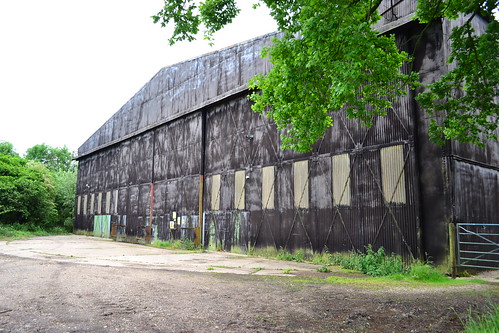
Following their departure, Methwold was passed over to 3 Group and was designated to receive the heavy four-engined bombers of Bomber Command. To accommodate them, the site was upgraded to Class ‘A’ standard. Three runways were built, five hangars (four ‘T2s’ and one ‘B1’) were erected, and a wide range of ancillary buildings added. Aircraft dispersal consisted of 36 hard standings mainly of the spectacle type.

The incoming ground and aircrews would be accommodated in areas to the east of the airfield, buildings were sufficient for a small bomber site of some 1,800 men and just over 300 women, by no means large.

In this interim period on March 13th, a lone American P-47 #42-74727, suffered engine failure whilst on a routine training flight in the area. In an attempt to land at Methwold, the P-47 Thunderbolt crashed, slightly injuring the pilot but writing off the aircraft.

The first of the heavy bombers to arrive at the newly constructed Methwold were the mighty Stirling IIIs of 218 Sqn. A small detachment from RAF Woolfox Lodge, they would operate from here along side 149 Squadron who moved here from RAF Lakenheath in May 1944. 149’s record so far had been highly distinguished. Participating in the RAF’s second bombing mission of the war on September 4th, they had gone on to take part in the first 1,000 bomber raid, attacked prestige targets such as the Rhur, and had taken part in the Battle of Hamburg. They had also been in action in the skies over the Rocket development site at Peenemunde. They had gone on to drop essential supplies to the French Resistance, and one of its pilots, Flight Sergeant Rawdon Middleton, had won the VC for his valour and determination in action. 149 Sqn would go on with the offensive right up until the war’s end, replacing the ill-fated Stirlings with Lancaster MKIs and later the MKIIIs in August 1944.

During the D-Day landings, 149 Squadron were tasked with dropping dummy parachutists away from the Normandy beaches. As part of Operation Titanic, they were to deceive the German ground forces, aiming to draw them away from the Normandy beaches, thus reducing the defensive force. A task that proved relatively successful in certain areas of the invasion zone, it caused confusion in the German ranks and pulled vital men away from drop zones. During this dramatic operation, two 149 Sqn Stirlings were lost; LJ621 ‘OJ-M’ and LX385  ‘OJ-C’ – with all but three of the eighteen crew being killed.

In August 1944, 218 Sqn moved the remaining crews over to Methwold completing the unit’s strength once more. This move also led to them taking on the Lancaster MKIs and IIIs. 218 Sqn was another squadron with a remarkable record of achievements, its most notable being the VC posthumously awarded to Flight Sergeant Arthur Aaron for his ‘most conspicuous bravery’ whilst at RAF Downham Market.

As the allied advance moved across Europe, 149 Sqn supported them. In December 1944, 218 Sqn departed Methwold taking their Lancasters to RAF Chedburgh and disbandment the following year. 218’s losses were not over though, just days before the war’s end on April 24th 1945, Lancaster NF955 ‘HA-H’ crashed on take off, the last fatality of the squadron’s operational record. For 149 Sqn food packages replaced bombs as the relief operation – Operation Manna – took hold. After the fall of Germany in 1945, 149 Sqn ferried POWs back to Methwold in Operation Exodus, and for many, it was their first taste of freedom for many years.

The final squadron to be stationed at Methwold was 207 Squadron, between October 1945 and the end of April 1946 also flying the Lancaster I and III. As with many other bomber command squadrons, its history was also long and distinguished; flying its final mission of the war on 25th April 1945, against the SS Barracks at Berchtesgaden. During its wartime service 207 Sqn had completed some 540 operations, lost 154 crews and earned themselves a total of 7 DSOs, 115 DFCs and 92 DFMs.

In 1946, the Lancasters of 149 Squadron departed Methwold and all fell quiet. The site was officially closed in 1958 and the land returned to the former owners. In the early 1960s, much of the concrete was removed for hardcore, buildings were demolished and the land returned to agriculture, a state it primarily survives in today.
RAF Methwold

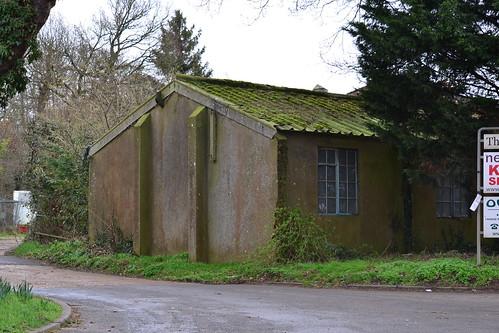
Stores huts used for light industry

Methwold airfield is located south of the village of Methwold, accessible by the B1112. As you drive along this road, the technical area is to your left and the main airfield to your right. The entire site is primarily agricultural, with some of the remaining buildings being used for farming purposes or light industry. Many of these are accessible or at least can be seen from the main public highway.

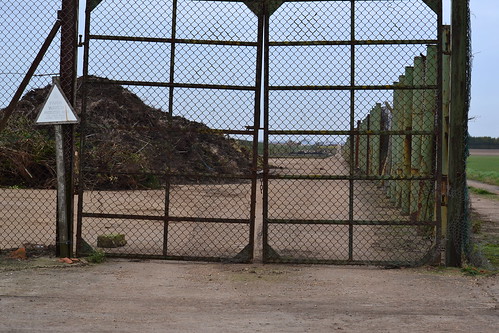
Large parts of the runways do still exist, although much of them are covered in newly developed industrial units, or are hidden away on private land. These most notable developments are at the northern end of the runway closest to Methwold village. However, best views of what’s left, are from the southern end, along a farm track that was once the perimeter track. Also here, is a single large and original ‘T2’ hangar, now used for storing agricultural equipment and other farm related products. This main north-westerly runway, built later in the war, is also used for farm related storage. Divided by a large fence, it is now part track and part storage. The remaining sections of perimeter track, a fraction of its original size, allows access to the runway past the hangar to an area of development further south to where the turret trainers once stood. Also visible here, is the Gymnasium built to drawing 16428/40 later adapted by the addition of a projection room (889/42) for recreational films.

Back alongside the B1112 hidden amongst the woods, is the technical area. Here in between the trees are the former technical huts and workshops now used by small industrial units, many of which survive in varying conditions, some of these are accessible to the general public.
RAF Methwold

One of the former runways looking north-west.

Methwold was never intended to be major player in the war. home to a small number of squadrons, it housed a variety of aircraft and a number of nationals who all combined, tell incredible stories of heroism, bravery and dedication. The squadrons who passed though here, carried out some of the RAF’s most daring raids, whether it be as part of a thousand bomber raid, a small force to attack the heart of Reich, or a diversionary raid to foil air and ground forces.

Methwold is now quiet, agriculture has taken over. The sound of heavy piston engines are now replaced by the sound of tractors, the buildings that once housed brave young men and their incredible machines now home to the machinery of food and farming. The small remnants of Methwold hold stories of their own, for it is here that history was made, war was won and lives were lost – and all in a very unassuming manner.

Notes and further reading:

Methwold appears in Trail 8 and was originally visited in April 2013.

Local information and further detail is available from the local Methwold history group. 
Lancaster Pilot Maxwell Storey – 149 Squadron

I was recently contacted by a reader who was trying to find out information about her grandfather, F.O. Maxwell Graydon Storey, 149 Squadron (East India) RAF, Bomber Command, RAF Methwold.

This is his story so far:

He joined the Air Force in Australia in 1942/43 and was sent to England in December 1943. Here he was attached to the RAF and continued with his training as a bomber pilot. He transferred through a number of stations honing his skills and advancing his flying attributes. On completion, he joined 149 Squadron at RAF Methwold, where he flew Lancaster MK IBs up to and after the war. He flew a small number of bombing and food parcel missions before the war ended and his eventual return to Australia.

Maxwell died earlier this year (2016) at the age of 92, he didn’t reveal very much about his time in England and so there are a number of gaps to be filled. Whilst I have manged to find out a fair bit, we are lacking photographs and finer details, if you, or anyone you know, could provide these, they would be a most welcome addition to the history of this Lancaster pilot and help his granddaughter find the missing pieces to his life.

Training sites in the UK.

1.RAF Flying Training Command RAF Smith’s Lawn.(RAF Smith’s Lawn was used primarily used as dispersal site and Relief Landing Ground for the de Havilland Tiger Moth trainers of the unit. He would have more likely been at RAF Fairoaks near Cobham).

Wrexham Instrument Flying School – Does anyone have any record of this site?

RAF Abingdon Training Station, Oxfordshire – used to train crews in landing in poor weather flying medium bombers (Vickers Wellingtons possibly of 10 Operational Training Unit)

RAF Wing – flying Wellington X Bombers 26 OTU Again there is very limited information about this, can anyone shed any light on it?

No 3 Aircrew Survival School, Whitby – I have no information on this.

1651 HCU- RAF Woolfox Lodge – Information about 1651 HCU?

RAF Methwold – posted to 149 Sqn either February or more likely March 1945. (149 Squadron arrived Methwold 15.5.44).

Aircraft he is known to have flown with, targets and crews: 

img_4736

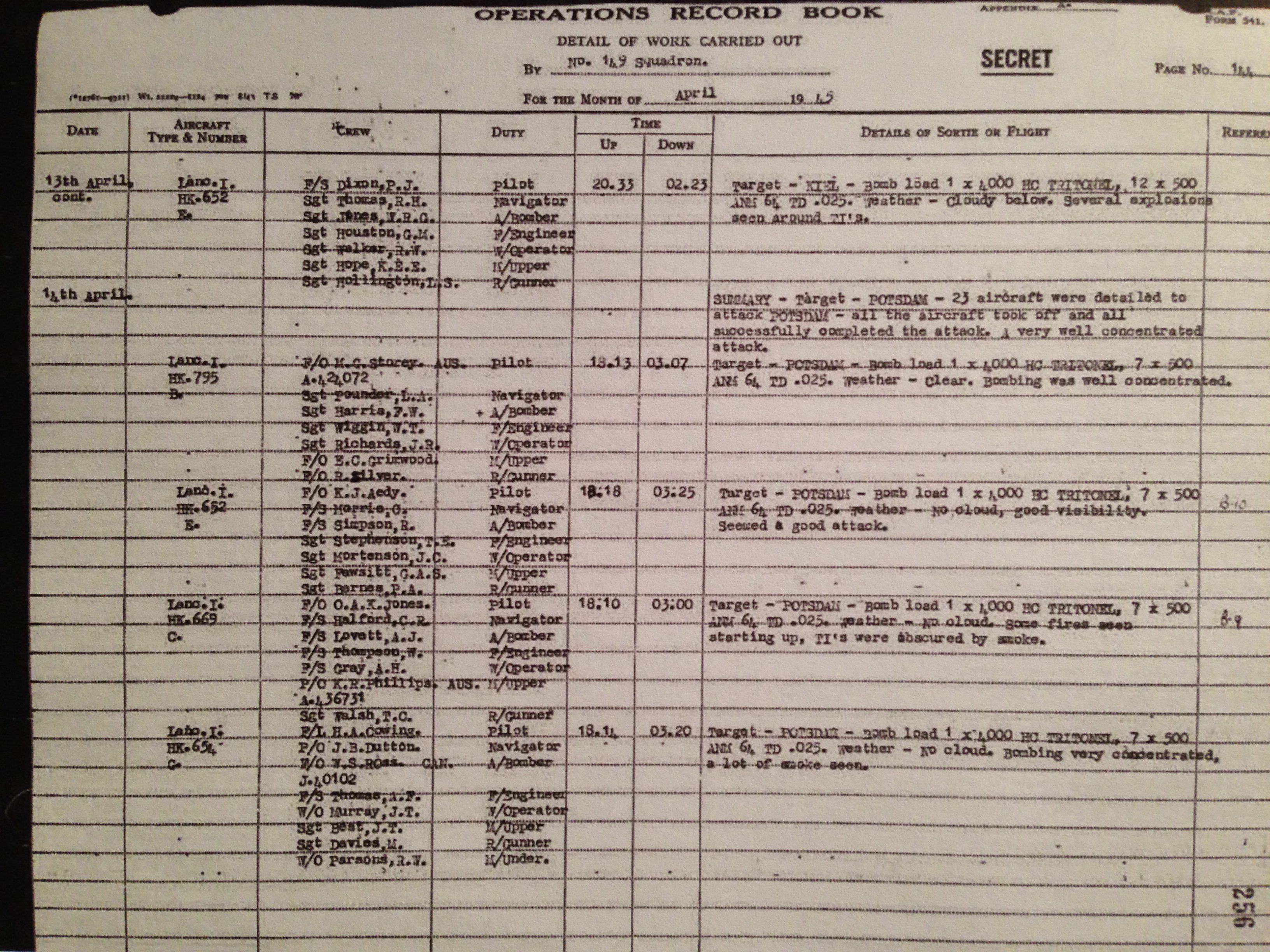
April 14th 1945, P.O. Storey flew Lancaster HK795 ‘TK-B’ to Potsdam.

Lancaster I – HK 795 – “TK-B” – 14 April 1945 – bombing mission to Potsdam

F/S. L. A. Pounder (Nav.), Sgt F.W. Harris (Bomb Aimer), Sgt W. T. Wiggins (F/Eng), Sgt J.R. Richards (W/op), F/O E.C. Grimwood (M/upper) and F/O R. Silver (R/G)

Lancaster 1 – HK 645 – “TK-D” – 18 April 1945 – bombing mission to Heligoland

F/S. L. A. Pounder (Nav.), Sgt F.W. Harris (Bomb Aimer), Sgt W. T. Wiggins (F/Eng), Sgt J.R. Richards (W/op), Sgt. J. Bell (M/upper) and Sgt M. Stewart (R/G).

Lancaster 1 – HK 652 – “TK-E” – 22 April 1945 – bombing mission to Bremen

F/S. L. A. Pounder (Nav.), Sgt F.W. Harris (Bomb Aimer), Sgt W. T. Wiggins (F/Eng), Sgt J.R. Richards (W/op), F/S R.P. Irwin (M/Upper) and F/S. A.E. Sutton (R/G)

Lancaster I – HK654 – “TK-G” – 1 May 1945 – ‘Target’ The Hague – Food parcels

F/S. L. A. Pounder (Nav.), Sgt F.W. Harris (Bomb Aimer), Sgt W. T. Wiggins (F/Eng), Sgt J.R. Richards (W/op), F/L T.B. Oddie (M/Upper) and F/O. E.C. Grimwood (R/G)

Lancaster I – HK577 – “TK-H” – 7 May 1945 – ‘Target’ Gouda – Food parcels

F/S. L. A. Pounder (Nav.), Sgt F.W. Harris (Bomb Aimer), Sgt W. T. Wiggins (F/Eng), Sgt J.R. Richards (W/op), F/S G. Moxham (M/Upper) and F/S A. Perkins (R/G).

If you have any information about any of the places or people mentioned above, I would love to hear from you and would be only to willing to pass the information on.

Sources and further reading

The National Archives, London.

Mildenhall (15, 90, 149, 218 and 622 sqn Association) website.

The National Archives of Australia 


Col. Ashley Woolridge; 106 Missions in a B-26

At the height of the war, the life expectancy of a fighter pilot was measured in weeks, for a bomber crew it was perhaps even less. With tours of duty standing at around 30 missions, it was rare to find anyone who survived these tours without at least serious injury or mental health issues. Many paid the price with their life.

Whilst aircraft could be salvaged, patched up, repaired and put back into the air, it was not  so easy for crewmen to be returned to battle so quickly. It was therefore, very rare to find anyone completing one or even two missions in a front line aircraft. Of course the subject of what constitutes a mission is in itself open for debate, ‘milk runs’ leaflet drops etc all create fractions of a mission, but this aside, for any airman to surpass 100 missions was indeed rare.

We have seen that Master Sergeant Hewitt Dunn flew 104 missions from RAF Framlingham, the highest in the European Theatre, but he was by no means the only one to surpass this incredible number.

Pilots and crews occasionally transferred across theatres, especially at the end of the war in Europe, or conveyed via the U.K. to the Middle Eastern theatre during these hostilities. One such man was Ashley E. Woolridge, initially a 2nd Lt. in the U.S.A.A.F. during the Second World War.

Woolridge was born on November 8th, 1916 in Clearfield County, Pennsylvania. He graduated from school in 1934 going on to West Point Military Academy and then achieving a BSc from Lock Haven State Teachers College also in Pennsylvania. He used his numerous qualifications to teach Maths, English and Science at  Hanover High School until 1941, when, just prior to the Japanese attack on Pearl Harbour, he enrolled in the U.S. Aviation Cadet Detachment, graduating in July of 1942. He was commissioned as a 2nd Lt. and pilot of the Air Corps.

Woolridge’s first operation was to fly the northern route to England with his group the 319th Bomb Group (Medium) operating the B-26 ‘Marauder’. The 319th initially arrived at East Anglia along with three other medium bomb groups. The 319th were sent to RAF Shipdham where they regrouped before being posted to nearby Horsham St. Faith (now Norwich airport). A period of low-level training across the Norfolk countryside, saw the unit posted to their designated theatre in north Africa. A number of accidents due to poor weather saw Woolridge’s crews suffer before experiencing any battle at all.

The 319th began transferring to Africa in the Autumn of 1942, joining the Twelfth Air Force, who would attack targets in Tunisia until early 1943. After further training, Woolridge and the 319th went on to support the Sicily and Italy campaigns: Salerno, Anzio and Monte Cassino.

At the beginning of November 1944, he was awarded command of the 320th BG, a sister group of the 319th and one who had followed them across the Atlantic and onto Africa.

By early 1945 he had achieved 106 missions, accumulating in excess of 440 combat hours. He and the groups he had served in, had gained a number of distinguished awards including Unit Citations. Personally, he gained a Silver Star, a DFC with two clusters, a Presidential Unit Citation with two clusters and two Personal Croix De Guerre Avec Palms. At the end of 1945, in November, he was discharged from the Air Force with a remarkable record of achievement behind him.

In civilian life he joined a number of church groups, married Barbara Anne Leitzinger on September 16th, 1948  and raised a family many of whom preceded him in death.

Ashley Woolridge eventually died on Monday, May 3, 2004 at the age of 87. He was buried at Hillcrest Cemetery, Clearfield,
Pennsylvania. His memorial stone depicts a B-26, the aircraft he flew 106 incredible missions in and achieved so much with.

Lt. A. Woolridge in the cockpit of a B-26 Marauder, nicknamed “Hellcat.” (IWM)

His full obituary can be seen on the ‘Findagrave website.

Other remarkable achievements can be found in “Heroic Tales“.

RAF Hethel – from Africa to Norfolk

As we leave both Swanton Morley and Hingham behind, we head directly east crossing the main A11 toward Wymondham and Mulbarton. Here we visit another former USAAF base now home to Lotus cars. We stop off at RAF Hethel.

RAF Hethel (Station 114)

RAF Hethel was initially designed for the RAF but, like so many airfields of the Second World War, it was transferred very quickly to the USAAF for use by the bombers of the  Eighth Air Force. Construction of the site began in 1941 and wasn’t complete when the first units arrived in 1942.

The ground echelons of the 320th BG arrived at Hethel in September, poised and ready for training. Travelling across the northern sea route, they arrived long before the air echelons who, due to extremely bad weather, had to divert from their designated route to the longer Southern route, via Africa. As this was considerably further to fly, many of the B-26s, of these units did not arrive until well into the December.

A dramatic picture of B-24 Liberator ’44-40085′ “Z-Bar” of the 389th BG after crash landing at Hethel. It was hit by British Flak and on trying to land, crashed into a radar building. Surprisingly all the crew escaped. 22nd April 1944 (IWM)

Training of these raw crews became the responsibility of the Eighth Air Force – and raw they certainly were. The 320th had only been active since June 23rd that year, and within  weeks they would be posted to North Africa once suitable airfields had been secured.

Construction work continued on Hethel throughout the latter stages of 1942 and into 1943; the number of hardstands rose from the original 36 to 50 giving a mix of both ‘spectacle’ and ‘frying pan’ types dotted around the three concrete runways. The main runway ran north-east to south-west with two smaller runways traversing east-west and north-west to south-east respectively. A large bomb store was located to the north-west, the opposite side to both the technical and accommodation areas both of which were to the south-eastern side of the airfield. That all important commodity, fuel, was stored to the south, and three T2 hangars would eventually provide room for aircraft maintenance away from the bitter 1940’s winters.

With the 320th away in North Africa, Hethel was operationally quiet, but the summer of 1943 would once again bring changes.

Oil had long been considered a major target, reduce your enemies oil supplies and you reduce their ability to function. Stopping these supplies however, was going to be no easy task. The mighty German war machine was using oil located in the far eastern regions of Europe, located at the very edge of any major allied aircraft’s range. This gave the Luftwaffe plenty of time to attack, on both the inward and outward journeys. With round trips in excess of 2,000 miles, they would be dangerous and difficult missions for any crews. Polesti in Romania would become synonymous with oil production and a major target for the allied forces. To reach it, crews would have to fly from North Africa at very low-level, something they had not even thought possible let alone trained for in B-24s. In the summer a plan was hatched to do just that, a low-level bomber raid by B-24 Liberators of the Eighth and Ninth Air Force launched from bases in North Africa.

Hethel and the 389th would play their part in this daring plan. The first vanguard of the 389th led by Brigadier General Jack Wood, arrived at Hethel on June 11th 1943, followed by the air echelons of the four squadrons: 564th, 565th, 566th and 567th over the next two weeks. The ground echelons travelling by ship, would arrive some time later. Urgency was the key word and so as to not lose valuable training time, ground crews were drafted in from nearby Shipdham (93rd BG) and Hardwick’s 44th BG.

This change in tactics, from high-level to low certainly perplexed the crews of the 389th. New top-secret bomb sights had been trialled over The Wash to the north of the Norfolk coast and they had been successful in their operation. Extensive training operations were put in place to prepare the crews for the forthcoming operations. So intense was this low-level training, that two B-24Ds collided over East Anglia, ’42-40687′ piloted by 1st Lt. Edward Fowble, and ’42-40774′ “Heaven Can Wait” piloted by 1st Lt. Harold James, struck each other. Whilst both aircraft managed to return to Hethel, one of the navigators, 2nd Lt. Charles Quantrell sadly lost his life. Eventually on the 31st June, the crews left Hethel, to join those they had worked so hard with, they flew via Portreath to their destination in Libya. From here they would undertake a multitude of missions including the support of the Sicily invasion before going on to attack the infamous oil refineries at Polesti. Whilst in Libya the 389th would earn many distinctions including a posthumous Medal of Honour to Lt. Lloyd H. Hughes (s/n 0-666292) for his determination in dropping his bombs on target even though his B-24 was burning ferociously. The 389th would also receive the Distinguished Unit Citation (DUC) from Lt. General Spaatz and hence forth become known as “The Sky Scorpions“.

Former RAF Hethel

One of the remaining buildings on the Accommodation site.

Whilst the main sections of the 389th were out in Libya, the remaining Hethel units were reduced to training and Air-Sea rescue missions, ironically searching for downed B-17 crews, something the Liberator would prove to be invaluable at.

With the return of the Africa detachments, the Bomb Group  was complete again, and missions over occupied Europe could begin once more from Hethel. Their first contribution to this new phase was to attack Leeuwarden, but cloud cover forced them to find alternative targets on which they unleashed their devastating load. With operation STARKEY about to commence, the 389th were ordered to target the Luftwaffe airfields in the St. Omer region, and then again six days later they visited St. Andre De L’Eure. The next day, the 389th were informed that they would be returning to North Africa this time in support of the Salerno beachhead. A blow to those crews who had only recently arrived here at Hethel.

With the group split again, Hethel based units would continue the fight on. As the renamed 2nd Bombardment Division, they now carried a large Black ‘C’ enclosed in a white circle on their tail fins and starboard wingtip, they would also fly the updated ‘H’ model B-24. With a nose turret, more experienced crews had their reservations about these aircraft, slower and heavier they were also colder due to gaps in the turret surrounds.

A number of strategic missions took these aircraft over occupied Europe many deep across the German Heartland. As 1943 drew to a close the 389th would attack dock yards at Vegesack, Danzig and Wilhelmshaven; targets at Munster, Breman, Emden and Kiel to name but a few. It was at Emden that the Luftwaffe fighters were trialling a new weapon, a bomb dangled on 100 feet of wire to catch the bombers. A rather poor attempt it nevertheless caused great concern for pilots having to fly through wires hanging in an already busy sky. To bring 1943 to a close, on the 30th and 31st December, the 389th were part of further large formations attacking both Ludwigshafen on the Rhine and the airfield at St. Jean D’Angeley respectively.

Former RAF Hethel

Views of the former Technical site, now under the ownership of Lotus cars. The grey line across the centre of the photograph is the former runway now a testing track.

A new year brought little change, but with the introduction of H2X-equipped aircraft, bombing became more accurate, and new targets were identified; ‘No Ball’ operations began and attacks on German cities increased. Late February saw the 389th in action during ‘Big Week’, an operation designed to cripple the German aircraft industry by targeting both aircraft and component manufacturing sites.

With the lead up to D-day, operations would occur almost every day from June 2nd up to June 29th, there would be only six days in this month period where no missions were flown by the 389th.

November 1944 would bring another devastating blow to the crews of Hethel. A collision between B-24J ’42-50452′ ‘Earthquake Magoon‘ and another B-24J ’44-10513’ on November 21st over the local parish of Carelton Rode, saw the loss of 17 of the 20 crew men. A devastating blow that highlighted the need for good communication and careful flying in these close quarters.

Missions carried on and as the war drew to a close, fighter attacks became less effective but even more daring. Pockets of resistance were becoming a ‘nuisance’ and the need for the further ports led to an attack in the Bordeaux region. On April 14th 1945, 1,161 heavy bombers were sent to the area. The 2nd Air Division accounted for 336 of these aircraft, of which only two were lost; B-24J ’42-50774′ “Stand By” and B-24J ’42-51233′ “The Bigast Boid“.

In “The Bigast Boid” of the 567th BS, was pilot 2nd Lt. Edward Bush and his nine other crew members. The aircraft was seemingly hit by friendly fire from B-17s flying above, completely severing the aircraft in half at the trailing edge of the wing, resulting in total loss of control. In the subsequent crash all ten crew members were killed. Other pilots from the 389th who witnessed the accident, attributed the fires and crash to flares being dropped from higher flying B-17s, – such was the danger of flying in tight formations.

Leon J Nowicki, and engineer of the 389th Bomb Group with the nose art of a B-24 Liberator (serial number 42-51233 nicknamed

Leon J Nowicki, engineer of the 389th BG with the B-24 “The Bigast Boid”. The aircraft would be lost to ‘friendly fire’ on April 14th 1945.  (IWM)

Eleven days later on April 25th, 1945 the 389th BG flew its final mission. The last target to receive the attention of the four squadrons was Salsburg, an operation that closed the books on 321 operational missions in five different versions of B-24. In total they dropped 17,548 tons of ordnance, lost 116 aircraft as Missing in action and claimed 209 enemy aircraft shot down. In 1945 they were awarded ‘best squadron’ on efficiency, an award that clearly reflected their attitude and dedication to the war effort.

With the departure of the air echelon at the end of May 1945 and the ground echelons from Bristol, the unit was given 30 days ‘R and R’ before inactivation in September. Hethel like so many airfields was then handed back to RAF Fighter Command who stationed a small number of Squadrons here before disbanding them. In September 1945, 65 Sqn and 126 Sqn were here with Mustang IVs. 65 Sqn stayed taking on Spitfire LF XVI E models before moving to Spilsby in early 1946. 126 Sqn left, had a months stay at Bradwell bay and then returned here, also taking the Spitfire LF XVI E and eventual disbandment in the following March.

Five Polish squadrons then came to Hethel. During the period March to December 1946: 302, 303, 308, 316 and 317 each stayed bringing with them Spitfire XVIs / Es, Mustang IIIs, and IVs, before all being disbanded in the December 1946.

Some technical activity on the site became almost token in comparison and eventually, after being used for repatriation and displaced persons purposes, Hethel was closed and sold off. After laying dormant for a number of years, the majority of the site was bought by Lotus Cars, the company who own the ‘airfield’ today using part of the main runway and perimeter track for testing their high performance cars. The remaining accommodation areas were bought back by the local farmer and are now used for chicken farming, or left allowing the woods to envelop what is left of the accommodation sites.

Former RAF Hethel

A T2 Hangar moved to the northern side of the airfield. One of the better ‘accessible’ features of Hethel.

Considering the role of the Lotus factory, access is generally good. Look for signs for ‘Lotus Engineering’ and drive along the road passing the Lotus site. This was the main entrance to the airfield, separating the ten accommodation and defence sites (on your right) from the main airfield to your left. On the right hand side are some of the former Defence site buildings, now used by small industrial units, the Lotus factory taking over the main technical area including the control tower. On your left is one of the original three hangars. Continue on past the Lotus entrance along the road as far as you can. To your right is a wood, this once housed Communal Site 1 and beyond this the other accommodation sites. A footpath allows access through here where a small number of buildings can be seen albeit enveloped in very dense undergrowth. The road along here eventually turns into a farm, and private property, however, the chapel and Gymnasium are located along this road and have since been turned into a museum. Access to the museum is through this gate. Beyond, the road turns into a footpath and utilises the former perimeter track linking to the main runway to the north. This runs alongside the track now used by Lotus.

From here turn back, return to the main road and turn right. Follow the road parallel to the former east-west runway and turn right. Keep going following the road round, eventually you come to another T2 Hangar. Not originally erected here, it was moved at some point from elsewhere, but is perhaps one of the better examples of airfield archaeology left on the site that is ‘accessible’.

Whilst the majority of Hethel has been removed or utilised by Lotus, it makes for a fascinating trip. The museum, run by volunteers, opens infrequently but I believe offers a fabulous insight into life on the base during the war. One of the more stunning aspects of the exhibition is a number of murals painted in 1944 by “Bud” Doyle. A small memorial is also located at the museum in honour of those who served here.

Hethel was once a heaving airfield, it has now taken on a new sound, but the memories of those brave young men still linger in the Norfolk air; the trees sway to the tunes of their music and their lives rest peacefully at last, honoured in the churches of the nearby Norfolk villages.

Sources and notes

While in the area, visit All Saints Church at Hethel, a memorial headstone dedicated to the crews of Hethel is located in the churchyard with a Roll of Honour inside the church itself. It also contains a Roll of Honour and extracts from ‘The Attlebridge Diaries’, for those who flew as part of the 466th BG from nearby RAF Attlebridge.

A plaque and small stained glass window in All Saints Church, Carelton Rode, commemorates the deaths of the seventeen airmen killed in a mid-air collision in November 1944.

The Hethel Museum was closed on my visit, but a blog site gives some details of the exhibits along with the restricted opening time information.

I recommend: Freeman, R.A., “The Mighty Eighth“, published by Arms and Armour, 1986 which has proven to be a valuable source of background information.

Also Joe Baugher’s website, for serial numbers of the USAAF aircraft.

Hingham – an airfield fallen into obscurity.

Continuing  on Trail 38, we depart Swanton Morley and travel south-east toward the former RAF / USAAF base at Hethel. Here we find fast cars, a museum, and more remnants of yesteryear. On the way, we pass-by another former RFC airfield from the First World War – the Home Defence Station at Hingham.

Hingham Home Defence Station.

There is considerable speculation about the true location of Hingham airfield. It is sadly one of those sites that has long since gone, and its history is now so blurred that its true location is not accurately known. It is known however, that it housed only three squadrons in its very short life: 51 (HD), 100 and 102, but only 51 Sqn remained for any period of time, thus making it the sole unit to have flown actively from this airfield.

A grass site, it was believed to be located near to the village of Hingham in Norfolk, some 12 miles south-west of Norwich, however, some sources cite it as Scoulton (latterly Watton airfield) located a few miles to the west of here. Wherever the true whereabouts of Hingham are, it is known that it did play a small but important part in the defence of Great Britain, and therefore worthy of a thought as we pass by.

Following the reorganisation of the RFC and RNAS in 1916, it was known that 51 (HD)  transferred from Thetford to Hingham, arriving at the fledgling airfield on 23rd September 1916, with the Royal Aircraft Factory BE12s. With detachments at Harling Road, Mattishall and Narborough, they were widely spread and would operate solely in the Home Defence role. These airfields were designated Home Defence Stations of which there were two, the ‘Flight‘ station (the smaller of the two) and the ‘Squadron‘ Station, the larger and main station. It is very likely that Hingham was designated as a Flight Station.

In October 1916, 51 (HD) replaced with the BE12s with  two-seat FE2bs and then with further RAE aircraft, the BE2e, in December 1916. The Hingham flight moved to Marham in early august 1917, whilst the Mattishall flight remained where they were.  ‘B’ flight moved west to Tydd St. Mary, a small airfield located on the Lincolnshire / Cambridgeshire border.

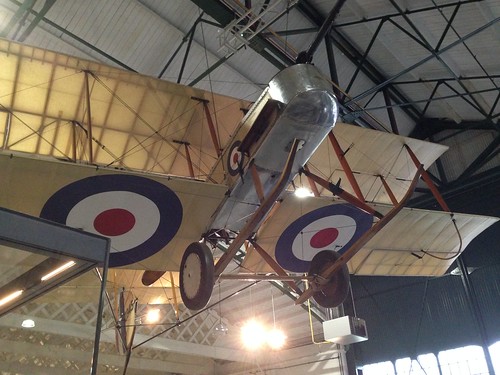
RAF Museum Hendon

The Royal Aircraft Factory F.E.2b at Hendon, London

Throughout the war 51 (HD) squadron fought against the Zeppelins that foraged over the eastern counties. By flying across the North Sea and then turning into The Wash, they were aiming to reach targets as far afield as Liverpool, Coventry and London.

One of several Home Defence airfields in this region, the role of Hingham aircraft (and the other Home Defence units around here), was to protect these industrial areas by intercepting the Zeppelins before they were able to fly further inland.

However, in the early days of the war, Zeppelins were able to fly at greater speeds and altitudes than many of the RFC aircraft that were available, and so the number of RFC ‘kills’ were relatively light. Many of these German Naval airships were able to wander almost at will around the Fens of Cambridge and Lincolnshire dropping their bombs wherever they pleased. It was this lack of a strong defence strategy that perpetuated the creation of the Home Defence squadrons. This new organisation along with improvements and developments in both ammunition and aircraft performance, began to improve the ‘kill’ success rates, and gradually the number of raids decreased. 51 (HD) Sqn played a pivotal part in this role, attacking Zeppelins on a number of occasions in these mid-war years.

It was during this time that two new RFC squadrons would be formed at Hingham. On February 11th 1917, the nucleus of 51 Sqn were relocated here to form the new 100 Sqn, whilst on August 9th that same year, the new 102 Sqn was formed. Both these units would train in the night bombing role and then go on to attack airfields and troops in Northern France in support of the stagnating Allied ground troops.

A stay of about 6 weeks for 102 Sqn and 12 days for 100 Sqn saw them both depart to pastures new, St. Andre-aux-Bois in France and Farnborough in the south of England respectively. It was at these locations that they would collect their operational aircraft before reuniting in Northern France in March that year.

After 51 (HD) squadron left Hingham, the site was never used again by the military and it was subsequently closed down. Whatever structures that were there were presumably sold off in the post war RAF cutbacks, and the field returned to agriculture with all traces, if any, removed – Hingham’s short history had finally come to a close.

Hingham was a small airfield that played its own small part in the defence of the Eastern counties. Whilst its true location is sadly not known, it is certainly worthy of a thought as we travel between two much larger, and perhaps much more significant sites, in this historical part of Norfolk.

RAF Swanton Morley – Small but rich in history.

In this Trail, we return to Norfolk and take in three former airfields each of notable historical value. Our first is probably better known as an Army barracks than it is an RAF airfield, but, for the duration of the Second World War, it would be home to a number of different aircraft types and to a range of international crews. Amongst the many residents here would be those from Poland, the Netherlands, Australia and New Zealand. We start our journey at the former RAF Swanton Morley.

RAF Swanton Morley

Following the end of hostilities in 1918, Britain’s defences and in particular the RAF, were cut back dramatically. From around 250,000 personnel (the worlds largest air force) to just under 30,000 by the early 1920s, the reductions were both severe and widespread. Political in-fighting between the three armed forces and the Government had seen the RAF lose out significantly, and under the terms of the ‘Ten year Rule’, expansion was prevented, and so little could be done to redress the declining situation.

During the 1930s, world developments (and in particular those in Germany) raised the threat of yet another war, at which point the Government realised that Britain’s defences were now totally inadequate and in dire need of redevelopment and expansion.

Their response was a series of expansion ‘schemes’  which would not only reshape the organisation of the RAF, but would cater for the huge increase in numbers of personnel that would be required to raise an adequate fighting force .

Considered lacking in direction by many, these early schemes surprisingly paid little attention to future needs, and so no real provision was made for supporting aspects such as training, maintenance or supply.

Scheme A, approved in July 1934, would set the bench mark at 84 home-based squadrons, a figure that was still woefully inadequate compared to the might that was building up across the channel. Each scheme would build on and replace the former, taking into account layout, new developments and the materials available – but all under the monetary restrictions of the 1930’s depression.

By the time war came, Scheme ‘M’ had been implemented (November 7th 1938), which called for 163 home based squadrons involving 2,500 aircraft for Britain’s home defence. It was under this scheme that Swanton Morley would be built.*1.

Initially designed as a fighter station, construction began in 1939, and one of the criteria for this scheme was to include type ‘C’ hangars. However, being incomplete by the outbreak of war, it was caught in the transition period between temporary and permanent aircraft storage. The ‘C’ types were cancelled in favour of three ‘J’ types, only one of which was actually built – this left Swanton Morley with considerably less hangar space than was actually required. Unfinished, the airfield opened on September 17th 1940 under the ownership of No. 2 Group Bomber Command.

As war broke out, a small detachment of 107 Squadron Blenheim IVs were based here. 107 Sqn were widely spread with other detachments at: Lossiemouth, Newmarket, Hunsdon, Horsham St. Faith and Ipswich, whilst the main squadron was based at RAF Wattisham. As part of 83 Wing, 107 would be joined by a further detachment from 110 Sqn the following month, also bringing the twin-engined Blenheim IV.

It was a No. 2 group aircraft that famously made the first sortie over the German frontier on the very day war broke out, and then on the second day, Monday September 4th 1939, a flight of four 107 Sqn aircraft and one 110 Sqn all from RAF Wattisham, dropped the first salvo of bombs on German ships at Wilhelmshaven . It was from one of these aircraft (Blenheim IV ‘N6240’) that Observer, Sergeant George Booth, and AC1 L. J. Slattery would become the first British Prisoners of War, captured when their Blenheim was shot down by German defences. None of the five aircraft returned, a rather disastrous start to the war for the RAF.*2

Work continued at Swanton Morley throughout the next two to three years, and eventually accommodation blocks were raised, hard perimeter tracks laid and four T2 hangars erected. Around twenty hardstands were created although many aircraft were still dispersed on the grassed areas around the technical site. A bomb store was developed to the south, and lighting added to the three runways, but despite of all the improvements, upgrades and developments, it was felt Swanton Morley did not warrant having any hard runways and so they continued to remain as grass.

It wasn’t until the end of October 1940, that Swanton Morley would have its own squadron of aircraft, 105 Squadron arrived bringing their Blenheim IVs to compliment those of 107 Sqn and 110 Sqn. With two detachments at Lossiemouth and Luqa (Malta), 105 would take part in anti-shipping sorties and attacks on targets in the low countries. A successful unit they swapped these for the Mosquito IV in November 1941, becoming the first operational squadron to receive these highly manoeuvrable aircraft, taking them to nearby Horsham St. Faith in the following month.

ROYAL AIR FORCE BOMBER COMMAND, 1939-1941.

A Blenheim of 105 Squadron passing over a fiercely burning enemy merchant vessel (© IWM (C 1940)

One of Swanton Morley’s earliest casualties was a 105 squadron aircraft, piloted by F/O. D. Murray DFC with Sgt’s C. Gavin and T. Robson. The aircraft, Blenheim IV ‘T1890’, was brought down over Brussels with the loss of all three crew members.

It was during August of 1941, that the first of many units would arrive – No. 152 Squadron. Like so many other squadrons around the country, their stay was to be short-lived taking their Spitfire IIAs to Coltishall the following December.

Coinciding with 105’s departure, was 226 Squadron’s arrival. At the end of December 1941, 226 Sqn would bring a new twin-engined aircraft to the grounds of Swanton Morley, the Douglas Boston. The Mk III was proving to be a formidable medium bomber and night-fighter, featuring improved armour, larger fuel tanks and its two Wright Twin Cyclone engines providing 1,600hp each. 226 Sqn were to later replace the MKIIIs with the MKIIIAs in January 1943 under the lend-lease agreement and then very shortly afterwards, with the B-25 Mitchell II. 226 Sqn operated these aircraft for almost a year at Swanton Morley before moving on to Hartford Bridge and the continent in 1944, thus becoming Swanton Morley’s longest standing squadron.

It was with 226 Squadron that the United States would make its mark on the war. On June 29th 1942, with both Eisenhower and Churchill present, twelve RAF Boston IIIs were sent to bomb the Marshalling yards at Hazebrouck, one of these aircraft (AL743) was flown by an all American crew. A rather ‘unofficial’ entry into the conflict, it was made more formal on Independence day, July 4th 1942 when six U.S. crews joined 226 Squadron in a low-level attack against Luftwaffe airfields in Holland. Twelve RAF aircraft took off a few minutes after 07:00 hrs and flew low and fast over the North Sea toward Holland. After splitting up to attack their designated targets, one group encountered severe flak and was badly beaten, one aircraft crashing whilst another had an engine knocked out. Before the pilot could regain control, the aircraft, Boston AL750, scraped the ground coming remarkably close to a complete disaster. However, the pilot Major Charles Kegelman, managed to regain control and nurse the stricken aircraft back to Swanton Morley. Of the twelve Bostons sent out, two U.S. and one RAF crewed aircraft failed to return. A baptism of fire that resulted in a 30% loss of the U.S. Air Force contingency. For their bravery, three DFCs were awarded to the U.S. crews, with Major Kegelman receiving a D.S.C. from Major Gen. Dwight D. Eisenhower, American commander in the European war theatre. This made Major Kegelman the first member of the United States forces in Europe to be decorated for gallantry against the enemy.

Whilst not the first U.S. involvement nor their first casualties of the war, their actions did officially bring the United States into the European conflict.

Sergeant Bennie Cunningham, Technical-Sergeant Robert Golay, Major Charles C Kegelman and Lieutenant Randall Dorton in front of a Boston bomber. (Roger Freeman Collection IWM)

1943 would go on to prove to be an eventful year for Swanton Morley. With the Allied invasions plans taking shape, a new force was needed to support those destined to take to the Normandy beaches. The creation of the Second Tactical Air Force (TAF) in November 1943, was designed to meet that challenge and with it came changes at Swanton Morley.

Ownership now passed from Bomber Command to the Second TAF, and many units that would operate from here were part of that force. Following a relatively short stay by 88 Squadron (30th March 1943 – 19th August 1943) flying both the Boston III and IIIA, No. 305 (Weilkopolski) Squadron would arrive bringing the first Polish crews to Swanton Morley. Being the fourth and final Polish bomber squadron to be formed, they arrived in early September bringing Wellington MK Xs with them. Whilst serving in Bomber Command, the Polish had amassed some 1,117 sorties in which they had lost 136 brave young men as either killed or captured.

After arrival here, 305 Sqn changed their Wellingtons for Mitchell IIs and in line with the Second TAF objectives, began attacking targets around the Cap Griz Nez region. Being daylight operations, this was something new for the Polish crews, but one they relished and carried out well. In November after only being at Swanton Morley for two months, the Polish crews left leaving 226 Sqn with only a small detachment of 98 Squadron Mitchells for company.

At the end of 1943, three days after Christmas, No. 3 Squadron arrived bringing  a new breed of aircraft with them – the single-engined Typhoon IB, which they kept at Swanton Morley until February 14th 1944. No. 3 Sqn had been one of three founder squadrons of the Royal Flying Corp in 1912 and they remain one of the few squadrons to retain an active role today, flying the aircraft’s namesake, the modern Eurofighter Typhoon.

Whilst here at Swanton Morley, No. 3 Sqn carried out duties that the ill-fated Hawker Typhoon performed well at, low-level ground attack and anti-shipping roles. Dogged by development problems – engines fires and deadly levels of Carbon Monoxide in the cockpit – the Typhoons suffered terrible problems throughout their wartime service, subsequently virtually every model was scrapped at the end of war.

February 1944 was all change again at Swanton Morley. A detachment of 107 Squadron would return after a couple of years absence, and with their arrival came the departure of 226 Sqn after just over two years of being at Swanton. On the thirteenth of that month, they left for Hartford Bridge in Hampshire, in preparations for the Allied invasion at Normandy.

In the two months that followed, Swanton Morley began its wind down, a move signified by a number of short stay units. Each of these would however bring a wide range of nationalities, including crews from the Australian unit No. 464 (RAAF) Sqn, from 25th March 1944 to 9th April 1944. Then came 180 Sqn (12 – 26th April 1944) a short-lived unit that survived just under four years before disbandment only to be reformed as No. 69 Sqn.

Coinciding with 180 Sqn was the Auxiliary Squadron, No. 613 Sqn with Mosquito VIs. This too would disband at the end of the war also to reform as 69 Squadron. Then as April drew to a close another international unit would arrive and depart, a New Zealand unit, No. 487 Sqn (RNZAF)  also bringing Mosquito VIs – an aircraft they used in conjunction with 464 Sqn in the attack on the Amiens prison earlier on.

Finally for two weeks in May 1944 (6th – 18th), a dutch contingency arrived in the form of No. 320 Squadron. 320 Sqn was formed out of evacuated Dutch airmen along with a handful of Fokker T-VIIIW seaplanes which they used until spares were no longer available. Here at Swanton Morley they had lost their seaplanes and were now flying Mitchell IIs, wreaking their revenge by attacking enemy communication lines and airfields. After the war the crews of this unit were transferred to the Royal Netherlands Navy and 320 was disbanded as an RAF unit.

ROYAL AIR FORCE: 1939-1945: COASTAL COMMAND

Before arriving at Swanton Morley, No. 320 Sqn flew a handful of Fokker T-VIIIW float-planes, that they had brought with them when the Netherlands fell to the Germans. Here, one is being serviced at Pembroke Dock, August 1940. (© IWM (CH 1042)

Coinciding with the invasion of Normandy in June 1944, the Bomber Support Development Unit (BSDU) transferred across from RAF Foulsham. Developed under the wing of 100 Group, they used a range of aircraft to investigate and develop electronic counter measures and radar technologies for aircraft.  At Swanton Morley, this involved nine Mosquitoes, MK XIX and XXX, to operate in both operational and non-operational duties. The BSDU (and 100 Group) were responsible for a range of electronic devices including Serrate, Hookah, Perfectos and Mandrel to name but a few, and were involved in some 114 operations, claiming  five air-to-air victories.

The USAAF were to play another small and final part in the life of Swanton Morley, when on 25th July 1944, B-24H ’41-29402′ “The Mad Monk” of the 786th BS, 466th BG, took off from nearby Attlebridge. It clipped some trees causing it to crash-land at Swanton-Morley; the aircraft was so severely damaged it was condemned and salvaged for spares.

Another near disaster was averted at Swanton Morley when Mosquito NFXXX (MM797) of the BSDU crashed after take off on the night of 2nd-3rd January 1945. On take off, with a full fuel load, the port engine began leaking glycol at a furious rate. Too low to bail out, the pilot, Flt. Lt. Harry White DFC, put the aircraft down on the frozen ground. After both pilot and co-pilot were pulled from the wreckage by local farmers, the aircraft exploded creating a ferocious fireball that destroyed the air frame completely.

Eventually the war came to a close, the ‘Window’ research station was transferred to the BSDU and in the summer 100 Group was disbanded. With that Swanton Morley fell quiet and no further operational units would serve from here.

In the closing months of 1946, No. 4 Radio School moved in using Avro’s Anson, and Percival’s Proctor and Prentice aircraft. Various ground units also used the site but gradually flying all but ceased. Eventually on September 15th 1995, Battle of Britain day, the RAF Ensign was lowered and RAF Swanton Morley was officially closed. A small private micro-light club took over part of the site, but in 1996 the Army claimed the airfield forcing the club to close. It remains in the hands of the Army today as the ‘Robertson Barracks’, named after Field Marshal Sir William Robertson and no flying takes place.

Swanton Morley’s history was fairly rare, in that it never had any concrete runways and boasted to be one of the longest lasting Worlds War 2 grassed airfields. It had, at its peak, one – ‘J’ Type hangar and four – ‘T2’ hangars. Its watch office, built to drawing 5845/39, included a Met Section and is now thankfully, a Grade II listed building making it one of the best originally preserved examples of Watch Office designs.

Swanton Morley june 2016 (3)

Swanton Morley had four T type hangars. All but one have been demolished. This one remains in private ownership.

Many of the original buildings have gone and either their concrete bases left or more modern replacements put in their place. Some of the concrete pathways have been removed as have all the dispersal pans. The bomb store is now a field and all but one of the hangars were demolished – the remaining one being re-clad.  A number of pill boxes and air-defence structures also remain, but like the main airfield site it is all securely kept behind very high fences and armed guards.

The public highway circumnavigates Swanton Morley, but views are best achieved from the main entrance. As with all active military sites there is a no stopping rule, but as you pass, careful observations will reveal some of the main buildings of the accommodation area.

Swanton Morley retains some if its historical features, and they are all in the care of either the Army or the local farmer. As the MOD holds this site, many of these features are well hidden from public view, but for now at least, this along with the preservation order on the watch office, does at least mean Swanton Morley’s past is in part ‘protected’ for future generations.

From Swanton Morley we visit two more airfields in the area, Hethel, a USAAF base with its own museum and Hingham an airfield that had possibly the shortest life of any UK airfield.

Sources and further reading

*1 Royal Air Force Historical Journal No. 35

*2 Chorley, W.R., “Bomber Command Losses of the Second World War, V1, 1939-40″, Classic, 1992

Norfolk Heritage Website

Freeman, R.A., “The Mighty Eighth“, Arms & Armour, 1970

Bowman, M., “100 Group (Bomber Support)”, Pen & Sword, 2006

RAF Mattishall Airfield – Part of Trail 36

Following on from previous posts about Tydd St. Mary and Narborough airfields, RAF Mattishall was used by the same squadron, 51 (HD) Sqn to combat the threat from Zeppelin airships over the eastern counties of England. Now long gone and sadly relegated to the history books, we visit another airfield that played a role in the defeat of these once mighty airships.

RAF Mattishall.

Close by to RAF Swannington is the former RAF/RFC airfield at Mattishall, a few miles to the south beyond Attlebridge and its huge USAAF base. Closed at the end of the First World War, Mattishall saw detachments of 51 Squadron during the First World War. 51 (HD – Home Defence) Squadron had its headquarters at Thetford, with other flights at Harling Road, Narborough and Tydd St Mary. Flying a range of models, including both the BE2 and BE12 models; 51 (HD) Sqn had a mix spread across these airfields taking on the FE2b in both single and two variants later on in the war.

Intrusions by Zeppelins were more common in the earlier stages of the war, and the Home Defence Squadrons were created to counter-act them. Poor performance initially led to poor successes against these airships but that didn’t stop the determined young crews of the RFC and latterly the RAF. Toward the end of the war in 1918, home defence had been scaled back. However, as the newer Zeppelins, Gotha and Zeppelin-Staaken were able to fly at much higher altitudes, home defence squadrons needed a more able aircraft to combat them. In poured numbers of Sopwith Camels, SE5 and DH4s, but it was all a bit ‘too-little, too-late’ for the mighty airships that once ruled the skies.

During the last Zeppelin raid of the war on the night of August 5th/6th, 1918, RAF DH4s and Sopwith Camels attacked a small fleet of airships of the Norfolk coast. Inland the home defence squadrons were alerted and scrambled but the group of Zeppelins never made it in-land and flights from 51 Squadron at Mattishall were to play no part in their eventual downfall. Sadly Lt. Drummond from Mattishall flying in FE2b ‘A5732’ had to make a forced landing at Skegness, presumably as a result of engine trouble. This was to bring the night fighter operations to an end and with it the end of both 51 Sqn and RAF Mattishall.

The airfield was built close to Toll House Farm and had a range of facilities common to First World War airfields. A few wooden huts and two hangars were erected on-site and these proved to be the limit of accommodation on the 80 acre site. Post war, these were all sold off to local businesses and farms and the land returned to the farmer.

Now completely agricultural, Mattishall was once a hive of flying activity for a short period of the war, where flying bravely in open cockpits and without parachutes was common place. Sadly, Mattishall’s existence has disappeared into the history books and it is no more.

A short history of Mattishall along with some personal accounts can be found here.

Mattishall is can be found in Trail 36 – North Norfolk (Part 6).

RAF Tydd St. Mary

Just over the Cambridge border into the area known today as South Holland in Lincolnshire, is a field that was a small airfield during the First World War. Designed for home defence, it was used for attacking marauding Zeppelin airships approaching England across the North Sea. Larger towns and cities such as Norwich and Lincoln were prime targets, although most designated targets were much further north for example Manchester and Liverpool. To protect themselves, the crews of these mighty airships flew at night and at altitude, but navigation skills were poor and crews were generally unaware of their actual location. As a result, they rarely made it beyond the eastern counties or the Fens of Cambridge and Lincolnshire. Because of poor weather and inexperienced pilots flying against these ships, some Zeppelins were able to wander – at the will of the weather – for as much as 10 hours unabated, randomly dropping bombs on what they considered to be ‘prime targets’.

A major turning point in this air-war, was the night of January 31st 1916 when nine Zeppelins of the German Navy attacked what they believed to be the industrial north-west. In fact they had barely got beyond the lower regions of Lincolnshire before dropping their ordnance. These attacks resulted in the loss of sixty-one people and whilst no British fighter was known to have engaged the airships, a number of Royal Flying Corps (R.F.C) crews were lost due to bad weather.

This disastrous night led to major changes in the Home Defence Squadrons of the R.F.C and R.N.A.S (Royal Naval Air Service), a process that would take a considerable time to complete.

As a part of these changes, an airfield was developed just south of the South Holland Drain a mile or so north of the village of Tydd St. Mary.

RAF Tydd St. Mary

Designed as a class 1 landing ground, Tydd St. Mary covered 125 acres by the time it closed in 1919. Development of the site began in mid 1916 following the re-organisation of the home defence force, but the first units didn’t arrive until the autumn of 1917. Not much more than a field, it did eventually have a small number of  Bessonneau*1 hangars and a small selection of crew huts.

The main unit to use Tydd St. Mary was 51 Home Defence (HD) Squadron whose main flight was based at Thetford. Formed from the nucleus of 9 Reserve Squadron (RS) on 15th May 1916, they moved to Hingham with flights dispersed at Harling Road, Norwich (‘A’ Flight), Mattishall (‘B’ Flight), ) and Narborough (‘C’ Flight). Initially they were equipped with the BE2c, which were soon replaced by the BE12 and subsequently the FE2b aircraft and then the BE2e in December 1916.

For a short while Zeppelin intruder flights were rare and this breather allowed for extensive practice flights by both 51 (HD) Sqn and their partner unit 38 (HD) Sqn who were based a little further to the north.

This lull in movements ceased in the autumn of 1916, when a large formation of Zeppelins gathered over the wash and headed for London. Badly hindered by fog and bad weather, they were eventually scattered across the southern and eastern regions of England where they dropped their bombs on remote farmland. This attack caused no damage to property, nor were the Zeppelins challenged in any major way – the marauders had little to worry about other than poor weather. Patrols by 51 and 38 (HD) Sqn’s were in vain, a pattern that was to continue for the large part, for the duration of the war.

At the end of 1916, Tydd St. Mary was re-designated a Night Landing Ground (NLG) following the renaming of R.F.C Home Defence Stations. 51 (HD) Squadron would soon fly from here in the defence of the eastern counties.

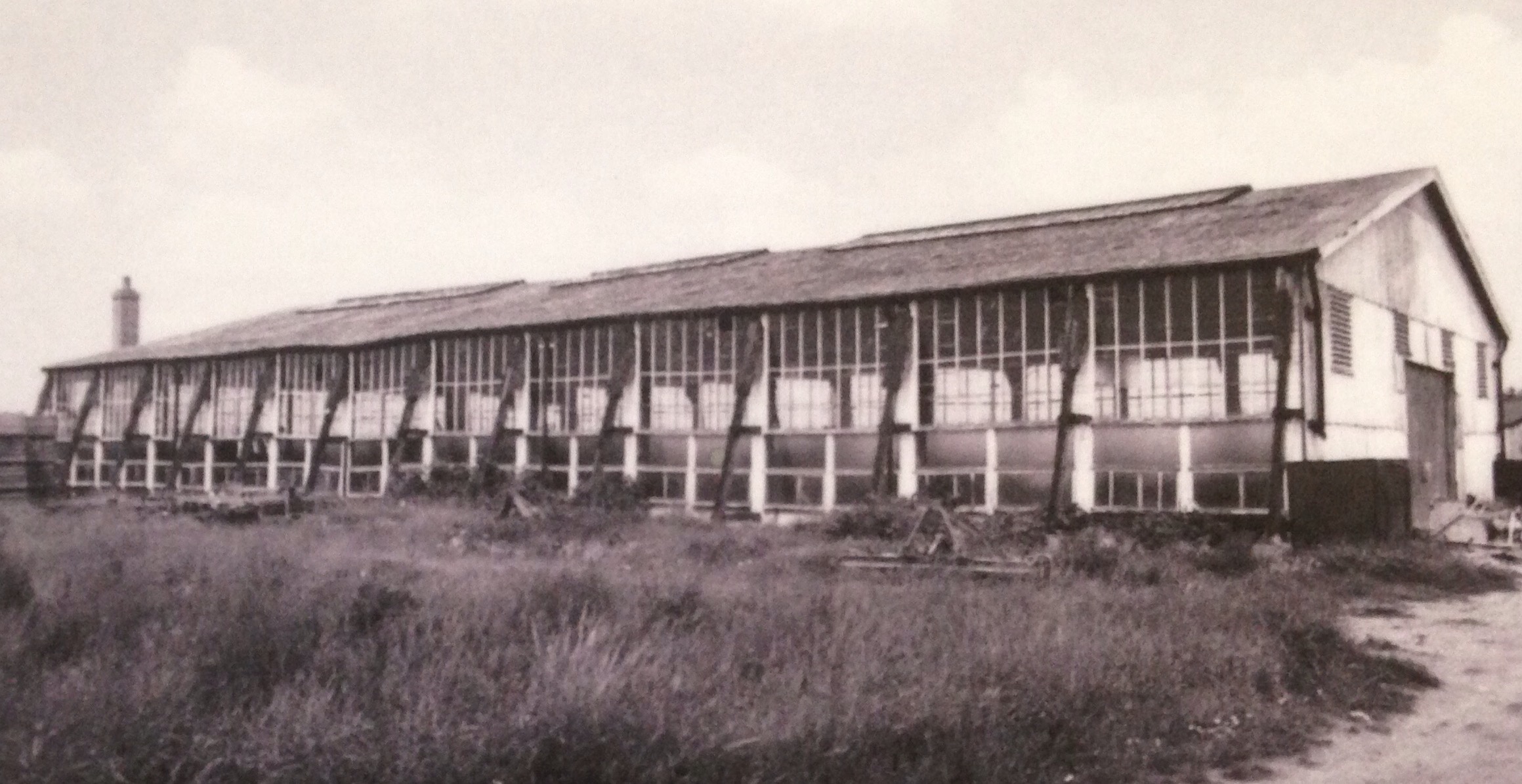
51(HD) Sqn aircraft hangar modified for agricultural use post war.*2

The Zeppelins main advantage over the British was the poor performance of the aircraft types the R.F.C used.  Whilst capable of operating at the 8,000 – 10,000 ft altitude used by the Zeppelins, many aircraft simply took too long to get there and thus could not reach the airship in time to attack it.

As performance improved along with the development of the explosive ammunition that would ignite the airship’s gases, the odds were a little more balanced and larger numbers of airships were being brought down over the eastern region. The tide was turning and pilots of 51 (HD) Sqn were playing a large part in this.

In the early part of 1917  cuts to the Home Defence units were announced based on the increasing gains made by units of the Norfolk / Cambridge / Lincoln squadrons. But the Germans had not given up yet. Reductions in weight enabled new Zeppelins to reach greater altitudes. Now capable of 16,000 – 20,000 feet, few British defences could reach them.

As the tide was turning in France, attacks became fewer and fewer. These high altitude flyers were more at the mercy of the bitter cold and poor weather than defending aircraft.

In August 1917 51 (HD) Sqn moved their headquarters to Marham, and ‘A’ Flight arrived at Tydd St. Mary and 51 (HD) Sqn began replacing their BE2e aircraft with the Martinsyde G.100 ‘Elephants’ – so-called because of their size and poor manoeuvrability.

A large contingent of airships gathered once more on the night of October 19th 1917, requiring extensive sorties by 51 (HD) Sqn at Tydd St. Mary and her counterparts. Whilst a determined effort was made by the R.F.C crews, they had little or no impact, and the gathered airships made off only to be badly beaten by bad weather and anti-aircraft fire over France.

Further changes to R.F.C Squadron designations  in the latter parts of 1917/18, dropped the title ‘Home Defence’ and Tydd St. Mary became the base for 51 Sqn ‘A’ Flight in Eastern Command. Aircraft by now were primarily Royal Aircraft Factory FE2bs, although 51 Sqn were now replacing some of their ‘Elephants’ with BE12b variants which they kept until the autumn of that year. Further changes in February 1918 meant that ‘A’ Flight moved to Mattishall, whilst ‘B’ Flight took their place at Tydd St. Mary.

As the R.F.C turned into the R.A.F on April 1st 1918, Tydd St. Mary would once again become significant. On the night of April 12th 1918, Zeppelin L62 was sighted close by and aircraft took off to intercept. As it was dark at 22:00 the flare path was lit to assist the now R.A.F crews, which openly guided L62 directly onto the airfield. Gliding above the site, L62 dropped a small number of incendiary bombs onto the aerodrome in an attempt to damage or destroy aircraft on the ground. Fortunately the bombs fell well away from parked aircraft and caused no damage to either buildings or aircraft. Pursuit was made by Lt. F. Sergeant in FE2b ‘A5753’, but to no avail and he returned to base empty-handed. Other pilots also tried to catch L62, some crashing due to engine failure, but many simply weren’t able to catch-up with the intruder. Eventually L62 reached the coast and made a break for it across the sea under the protection of yet more bad weather.

By November 1918 the final FE2bs had been relinquished and for the remainder of the year and into May 1919, 51 Sqn operated Sopwith Camels. A move by ‘B’ Flight in May to Suttons Farm (RAF Hornchurch) not only signified the end of the Camels (replaced by Sopwith Snipes) but the end of 51 Squadron who were disbanded in June. This departure also meant the end of Tydd St. Mary and in November 1919 notice of closure was given and the site finally closed in January 1920.

Tydd Gote Village sign

The village sign at Tydd Gote, remembers the RFC from the airfield at Tydd St Mary.

At its height Tydd St. Mary covered an area of 125 acres, and contained two Home Defence flight sheds as single units (believed to measure 130 x 60 ft). These were utilised by local farmers and business and lasted for many years. Other buildings were also utilised, the last, believed to be the Flight Office, is thought to have been demolished as late as 2009.

Not a major player in the war and never to return to aviation, Tydd St. Mary is a notable site and perhaps when passing, a second thought for those who flew from here in defence of the Eastern counties, should be offered.

Tydd St. Mary forms part of Trail 37.

Sources and Further Reading

*1 Early Bessonneau hangars were constructed of wood covered in canvas. Various types were made and were designed to be erected by small trained groups of men. Later models replaced wood with metal and were more permanent.

*2 Photo on display at Thorpe camp, Woodhall Spa.

Goodrum, A. ‘No Place For Chivalry: RAF Night Fighters Defend the East of England Against the German Air Force in Two World Wars‘. 2005, Grub Street

The Great War Forum – website 

RAF Narborough – Norfolk’s first Airfield.

Resting not more than a mile or so from the boundary of RAF Marham, is an airfield that never made it beyond the First World War – but it played such a major part, it should never be forgotten. Opened originally as a satellite by the Royal Naval Air Service, it became the biggest First World War airfield and led the way for the aviators of today’s Royal Air Force.

RAF Narborough

Built as the largest, aircraft based, World War One aerodrome, Narborough was known under a range of different names. The most common, ‘The Great Government Aerodrome’ reflected not only its size but also its multi-national stature and its achievements in aviation history. Used by both the Royal Naval Air Service (RNAS) and the Royal Flying Corps (RFC) it would also have names that reflected both these fledgling services.

Designed to counteract the threat of the German Zeppelin and Schütte-Lanz airships, Narborough was initially used by the RNAS as a satellite station to RNAS Great Yarmouth. No crews were permanently stationed here, but ‘on-duty’ crews would fly in and await the call to arms should a raid take place over East Anglia.

The first recorded arrival was in August 1915; an event that would keep the site in use by the RNAS for the next ten months before being designated as surplus to requirements, and handed over to the RFC in June 1916.

Used as a training ground, accommodation was basic to say the least, being described as a “desolate God-forsaken place”*1 buildings needed to be erected for accommodation, training and maintenance. A total of seven Boulton and Paul hangars and up to 150 buildings would be built on the site over the next two years. By the end of the war, some 1,000 personnel would be based at Narborough – a number comparable with any modest Second World War airfield.

As the First World War raged on the European continent, the use of aircraft was seen as a new way to monitor, kill and record enemy troop movements; it would develop into a lethal weapon and a very potent reconnaissance vehicle. Training programmes were rushed into place, and Narborough would become a preparation ground for new recruits. With training considered basic by today’s standards, recruits had to pass a series of tests before being sent to the France. Written examinations followed up by twenty hours solo flying, cross-country flights and two successful landings, were followed by flying for fifteen minutes at 8,000 feet and landing with a cut engine. These daring young men, many who were considered dashing heroes by the locals, would display their skills for all who lined the local roads awe-inspired by their antics.

Life was not always ‘fun’ though. Accident rates were high and survival from a crash was rare. Some 15 graves lay in the local church  at Narborough, all young men who never made it through the training and on to the battle in France.

The occurrences of these accidents were so frequent, that one instructor, W.E. Johns, creator of ‘Biggles’ cited spies as the cause of many ‘accidents’ – tampering with machines causing the deaths of the crews on board. Johns, himself having written of many machines, believed Americans with German sounding names were to blame for aircraft breaking up in mid-air or crashing at the bottom of loops. More likely, the fault lay with over exuberant or poorly trained recruits.

Narborough as a training station would operate a wide range of aircraft. The French designed Henry Farman F.20, a military reconnaissance trainer, would operate with 35 Squadron from June 1916 until October when they were replaced by the Armstrong Whitworth FK8; 35 Sqn moving to France with these aircraft in January 1917.

The first full squadron to be formed here was 59 Sqn on 21st June 1916. Born out of 35 Sqn, they would operate Avro’s 504K followed by the second French design, the Maurice Farman Shorthorn; named so because of the length of the skids designed to prevent recruits overturning the aircraft on landing. After these came the BE2c, BE12 and RE8s, before the squadron moved to St-Omer in February 1917.

It was during this year that 83 Squadron would be born out of 18 Reserve Squadron (RS) operating various aircraft in the training role. They arrived at Narborough during December that year with FE2bs before they themselves moved to St-Omer in March 1918.

As the war drew to a close, one further squadron was formed at Narborough; 121 Squadron on New Year’s Day 1918. Whilst originally formed to fly the DH9, they actually used a variety of aircraft before being moved to Fliton and eventual disbandment on 17th August 1918.

Three other units would pass through Narborough before it closed. Now part of the Royal Air Force, 56, 60 and 64 Sqns would all come here as cadres in February 1919. 64 Sqn disbanded here in the following year, whilst both 56 and 60 Sqn moved to Bircham Newton and onto disbandment.

The end of the war saw the closure of Narborough. But unlike its sister station RAF Marham a mile or so away, it would remain closed. The buildings were all sold off in what was considered to be one of the biggest auctions in Norfolk, with some of them going to local farmers, small industrial units, schools and the like. Some of these buildings still exist at various places around the local area today but many have long since succumbed to age and inevitable deterioration.

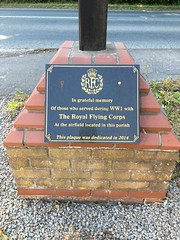
Narborough itself having no hard runways or perimeter tracks has long since gone. A small memorial has been erected by a local group aiming to promote and preserve the memory of Narborough, a memorial plaque also marks the fifteen graves of those who never made it to France; and the small Narborough Museum & Heritage Centre holds exhibits of 59 Squadron in the local church.

Significant not only in size, but in its history, Narborough has now been relegated to the history books. But with the dedication and determination of a few people the importance and historical significance of this site will hopefully continue to influence not only the aviators of tomorrow, but also the public of today.

The memorial to those who served at Narborough.

Sources, Links and Further Reading.

*1 letter from 2/AM C. V. Williams from 59squadronraf.org.uk

C.G. Jefford, RAF Squadrons, Airlife Publishing limited, 2001

The Narborough History Society cane be visited through their website.

The Narborough Airfield Research Group tell the history of 59 Squadron at Narborough, this includes personal notes and details of the Narborough airfield.

Air Crew Memorials – Sgt R. C. Land (RAFVR)

Young men who died in service for their country, may their memories last forever.

On February 4th 1943, Lancaster III, ED496, ‘WS-P’ of No. 9 Squadron (RAF) took off from its base at RAF Waddington, Lincolnshire. On board were the crew members: Sgts Land, Packer, Gullery, Levesque (RCAF) and McGonigal all of the RAF (VR). This was to be a routine test flight for the crew, but it would end tragically for all those on board.

February 1943 was one of the mildest on record, experiencing low snowfalls and warmer temperatures across the country. However, on the fourth, particularly low temperatures were recorded, and during the night many aircraft on operations turned back due to associated icing problems. During that month there was a very low seasonal rainfall, particularly around Lincoln and the east coast area; with prevailing south-westerly winds, the weather was considered to be ‘fair’.

Lancaster WS-P took off on a routine air test, it was to undertake a number of circuits carrying out practice landings testing on-board equipment aiding such manoeuvres. At 16:00, the aircraft dived in to the ground crashing at Scopwick, north of Sleaford, Lincolnshire. With all its four engines still running when the aircraft struck the ground, the resultant crash led to an inevitable explosion and fire killing all on board. Whilst Sgt Land’s body was thrown clear, the remaining crew members were not and they remained trapped inside. The force of the crash buried the aircraft  deep in to the peaty Lincolnshire soil, rendering any recovery virtually impossible.

The crash was investigated by the Air Investigation Branch and their findings summarised in report W1458; but whilst no firm conclusions were drawn, it is believed that ‘structural failure’ of the air frame was to blame for the accident.

The aircraft and bodies remain in the ground to this day and a small monument has been erected in their honour. Sgt Land’s body was taken to Weston Longville, Norfolk, where he was buried in the grounds of All Saints Church. His companions are all honoured at the Runnymede Cemetery, Surrey.

The crew of Lancaster WS-P were:

Sgt Charles Richard Land, (s/n 1332099)
Ronald Jack Packer (s/n 901009) (Panel 160)
Sgt  Hugh Francis Gullery, (s/n 1378136) (Panel 151)
Sgt Joseph Thomas Levesque (RCAF) (s/n R/55503) (Panel 183)
Sgt Francis Victor McGonigal, (s/n 1554452) (Panel 157)

Sgt. CR Land,

Sgt Land is buried in the grounds of All Saints Church, Weston Longville, Norfolk.