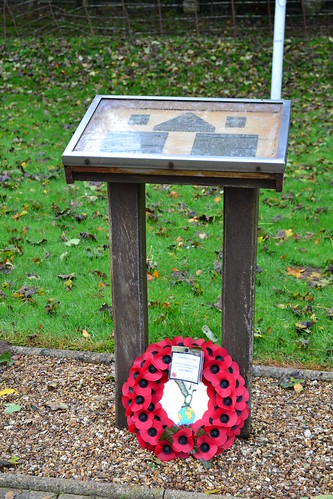
389th BG Exhibition at Hethel.

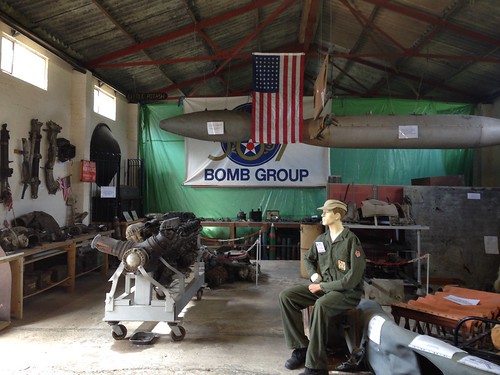
Whilst visiting RAF Hethel (Trail 38), we drop into the exhibition of the of the 389th BG who were stationed here during World War II.

The exhibition is small but it has a lot to offer. Located in the former Chapel/Gymnasium, it has been carefully restored and filled with information and artefacts pertaining to the former airfield and U.S Air Force during the Second World War.  There are also articles from the 466th Bomb Group who were based at nearby RAF Attlebridge, the RAF and stories from local people who befriended the Americans whilst they were here.

The exhibition is located on a working poultry farm and so access is limited, open every second Sunday of each month between April and October, from 10:00 am to 4:00 pm.

The buildings have been painstakingly restored by volunteers, some of whom have had connections with the airfield or Lotus cars, the current owner of the airfield itself. In 2001 the museum opened its doors to the public, after moving a collection of memorabilia from the Lotus site over to their new home here at the 389th exhibition.

It was during the restoration that two murals were discovered, these are perhaps one of the more stunning aspects of the exhibition. Painted in 1943 by Sgt. Bud Doyle, the then Chaplin’s driver, they are located on one of the walls of the Chapel. One is of Christ on a cross, whilst the other is a portrait of a pilot, both have been restored and remain on display where they were originally painted all those years ago..

389th BG Exhibition Hethel

The restored murals in the Chapel.

Located here, are a number of items many with stories attached. In the Chaplin’s quarters next door, are maps and other documents relating to the groups activities.

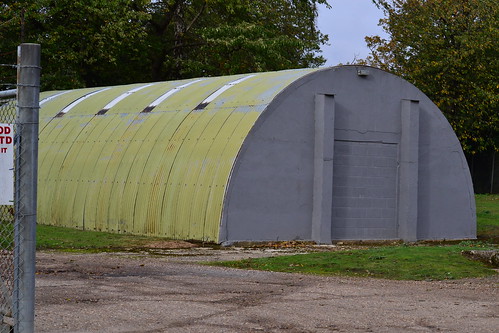
Two new Nissen huts have also been built, opened and dedicated in 2014 and 2017, they extend the exhibition further to include uniforms, service records, numerous photographs and more memorabilia.

RAF Hethel, 389th BG Museum

The dedication plaque.

There is also a refreshments bar offering the usual tea and snacks, along with a toilet facilities.

From the museum there are public footpaths into what was one of the accommodation areas of RAF Hethel, here are some of the remains of buildings, shelters primarily, hidden amongst the undergrowth. The footpaths are mainly concrete once you get onto the site.

RAF Hethel, 389th BG Museum

Part of the exhibition inside the former Chapel at RAF Hethel.

A nice little museum it has free entry and welcomes donations to help with the upkeep and maintenance of the site, if in the area, it is well worth a visit and your support .

The 389th website has further details and opening times and information of forthcoming events.

Flt. Sgt. Arthur L. Aaron, V.C., D.F.M., 218 Sqn, RAF Downham Market

The Second World War produced some incredible heroes, men and women, who in he face of incredible odds, continued to carry out their duties, often going beyond those expected of anyone.

One such man was Arthur Louis Aaron, of 218 Squadron, RAF Downham Market, Norfolk.

Image result for arthur louis aaron

Arthur Louis Aaron (RAFVR) V.C., D.F.M, (source unknown)

Aaron, born 5th March, 1922, in Leeds,  who at the time that war was declared, was training to become an architect at Leeds School of Architecture. On joining the Royal Air Force on December 15th, 1941, he was sent, via Canada, to No.1 British Flying Training School (B.F.T.S.) at Terrell, Texas, where he completed his initial flying training.

Aaron like the other recruits would pass through ten weeks of biplane flying, moving onto monoplane aircraft at which point, if successful, they would receive their wings. Returning back home also via Canada, he was hoping to fly fighters but was disappointed when he was posted to bomber training, and was sent to 6 Advanced Flying Unit at Little Rissington. After further training, he was sent on to 1657 Heavy Conversion Unit (Stradishall) flying Stirling MKIs, and then on 17th April 1943, he was posted to his first operational flying unit, 218 (Gold Coast) Squadron, at RAF Downham Market.  

Whilst here at Downham Market, Aaron continued flying Short Stirling bombers, the large heavy bomber that proved to be both vulnerable to fighters and poor performing. Due to high losses it  was eventually pulled out of front line bombing duties, and used for mine laying, glider towing and parachute operations.

Aaron’s first mission would be the very next day after arriving at Downham Market. He, and his crew, would fly a ‘gardening’ mission laying mines off Biaritz, after which he would be sent on more heavily defended targets within German occupied Europe and Germany itself.

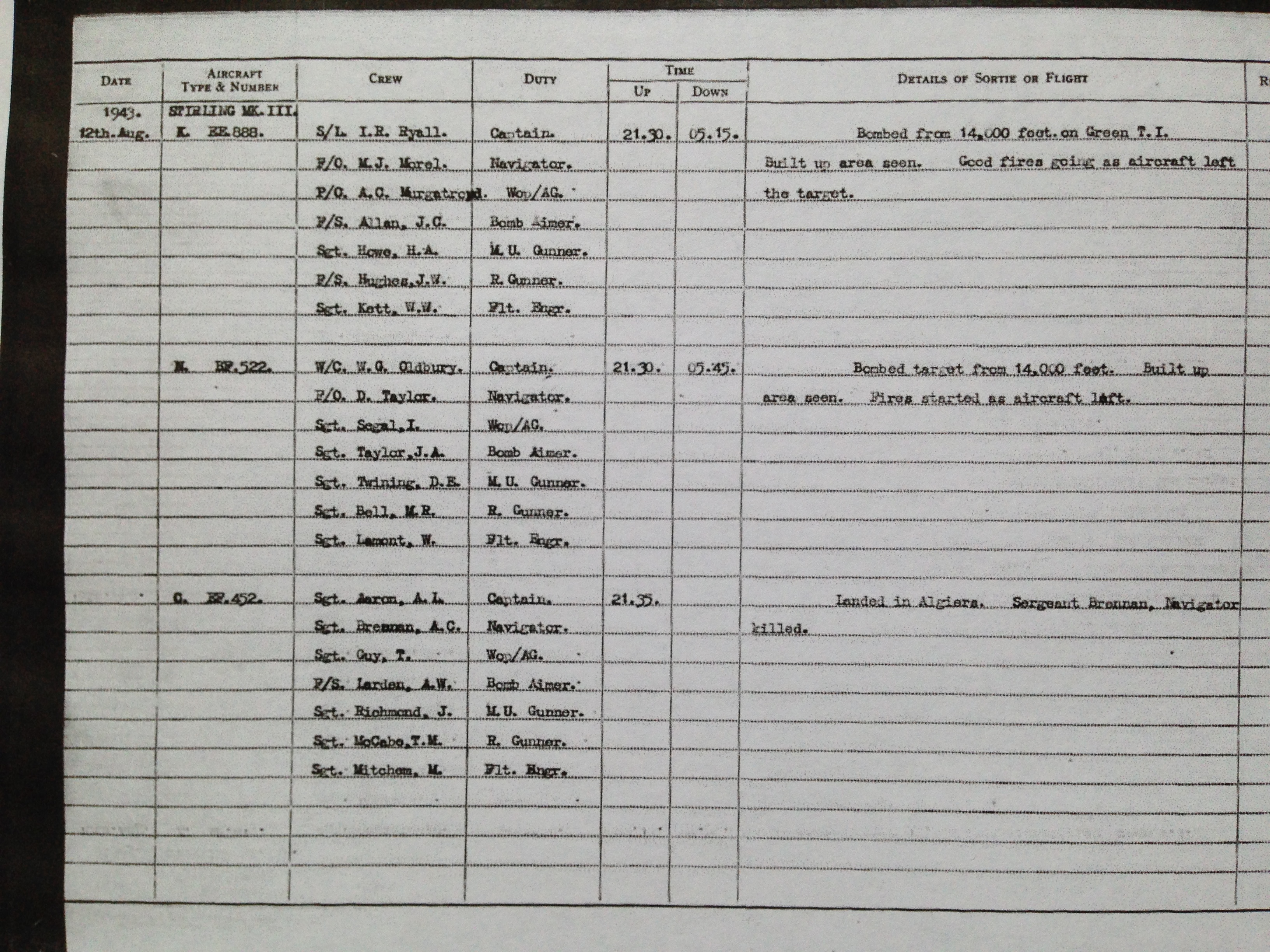
At 21:35 on the night of August 12 – 13th 1943, Flt. Sgt. Aaron and his crew: Sgt. M. M. Mitchem (Flt Eng.); Sgt. A. C. Brennan (RCAF) (Nav.); Flt. Sgt. A. W. Larden (RCAF) (Bomb Aim.); Sgt. T. Guy (Wop/AG); Sgt. J. Richmond (M.U. Gunner) and Sgt. T. M. McCabe (R. Gunner), all took off from Downham Market on their second mission of August to attack Turin, a night that featured several attacks on Italian targets.

This would be Aaron’s 20th and final mission, three as co-pilot and seventeen as pilot. He was a man known for his courage and bravery, only 12 days earlier he had struggled with his aircraft whilst his crew bravely fought fires that had broken out in the fuselage after being hit by incendiaries from aircraft flying above. Using his skill and judgement, he managed to evade both flak and searchlights by corkscrewing his aircraft whilst the crew members put out the fire that resulted from the accident. For his action on this day, he would be awarded the D.F.M.,*1 one of the highest possible awards for non-commissioned officers in the Royal Air Force, but this, like his V.C., would only come posthumously after his death on 13th August 1943.

That night, two of the thirteen 218 Sqn aircraft from RAF Downham Market in Norfolk, would be posted ‘missing’; Stirling HA-Y ‘MZ 263’ piloted by F/O J. McMallister, and that of 21-year-old Arthur Aaron – Stirling III ‘EF452’ HA-O . Whilst in the bomber stream heading toward Turin,  the aircraft was hit by gunfire from another aircraft. The navigator, (Sgt. Brennan s/n R/117605) was killed, Sgt. Mitchem and Flt. Sgt. Larden were both injured. The aircraft, now badly damaged, had been hit in three of the engines resulting in one of them being put out of action. Both front and rear turrets were immobilised, various control lines were broken and the windscreen was shattered. During the attack, Aaron received devastating blows to his face, his jaw being broken and quantities of flesh being blown away. A further bullet struck him in the chest, puncturing his lung. Now in great pain and severely injured, Aaron fell against the control column forcing the aircraft into a dive. After the Flight Engineer regained control, a course was set for North Africa, Aaron was moved to the rear of the plane where he was treated. He remained here for only a short time, insisting on returning to the cockpit where he was placed with his feet on the rudder bars. Wanting to take over, he had simply insufficient strength, and was persuaded to assist rather than fly. He wrote notes with his left hand, guiding the crew toward the airfield at Bone, in Algiers. After four failed attempts at landing, the bomb-aimer finally managed to get the aircraft down, low on fuel and with its undercarriage still raised.

The entry in the Operations Record Book for August 12th 1943, merely states “Landed in Algiers, Sergeant Brennan, Navigator Killed.”*2

At 15:00 on August 13th 1943, Arthur Aaron finally lost his determined battle to survive and died from his terrible injuries. He had fought on, overcoming severe pain and injury to guide his crewmen back to safety. Flt. Sgt. Aaron was buried alongside Sgt. Brennan in Bone War Cemetery, in Algeria.

For their action Flt. Sgt. Larden received the C.G.M., and Sgt Mitcham and Sgt. Guy, both a D.F.M.

Arthur Aaron was awarded not only his D.F.M. from his previous mission, but the V.C., the highest honour for military personnel. His V.C. was announced in the London Gazette on November 5th, 1943*3.

It reads:

Air Ministry, 5th November, 1943.

The King has been graciously pleased to confer the Victoria Cross on the undermentioned airman in recognition of most conspicuous bravery:
1458181 Acting Flight Sergeant Arthur Louis Aaron, D.F.M., Royal Air Force Volunteer Reserve, No. 218 Squadron (deceased).

On the night of 12 August 1943, Flight Sergeant Aaron was captain and pilot of a Stirling aircraft detailed to attack Turin. When approaching to attack, the bomber received devastating bursts of fire from an enemy fighter. Three engines were hit, the windscreen shattered, the front and rear turrets put out of action and the elevator control damaged, causing the aircraft to become unstable and difficult to control. The navigator was killed and other members of the crew were wounded.

A bullet struck Flight Sergeant Aaron in the face, breaking his jaw and tearing away part of his face. He was also wounded in the lung and his right arm was rendered useless. As he fell forward over the control column, the aircraft dived several thousand feet. Control was regained by the flight engineer at 3,000 feet. Unable to speak, Flight Sergeant Aaron urged the bomb aimer by signs to take over the controls. Course was then set southwards in an endeavour to fly the crippled bomber, with one engine out of action, to Sicily or North Africa.

Flight Sergeant Aaron was assisted to the rear of the aircraft and treated with morphia. After resting for some time he rallied and, mindful of his responsibility as captain of aircraft, insisted on returning to the pilot’s cockpit, where he was lifted into his seat and had his feet placed on the rudder bar. Twice he made determined attempts to take control and hold the aircraft to its course but his weakness was evident and with difficulty he was persuaded to desist. Though in great pain and suffering from exhaustion, he continued to help by writing directions with his left hand.

Five hours after leaving the target the petrol began to run low, but soon afterwards the flare path at Bone airfield was sighted. Flight Sergeant Aaron summoned his failing strength to direct the bomb aimer in the hazardous task of landing the damaged aircraft in the darkness with undercarriage retracted. Four attempts were made under his direction; at the fifth Flight Sergeant Aaron was so near to collapsing that he had to be restrained by the crew and the landing was completed by the bomb aimer.

Nine hours after landing, Flight Sergeant Aaron died from exhaustion. Had he been content, when grievously wounded, to lie still and conserve his failing strength, he would probably have recovered, but he saw it as his duty to exert himself to the utmost, if necessary with his last breath, to ensure that his aircraft and crew did not fall into enemy hands. In appalling conditions he showed the greatest qualities of courage, determination and leadership and, though wounded and dying, he set an example of devotion to duty which has seldom been equalled and never surpassed.

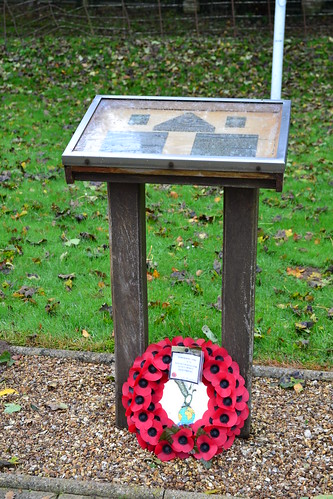
A number of memorials exist in honour of Arthur Aaron. On the site of the former accommodation blocks at Bexwell (RAF Downham Market) stands a small plaque in his honour along side that of Squadron Leader Ian Bazalgette, who also won the V.C. whilst at Downham Market.

There is another plaque in the main hall of Roundhay School, Leeds, Aaron’s former school; another commemoration can be found at the AJEX Jewish Military Museum in Hendon, London, and a five-metre bronze sculpture by Graham Ibbeson has been erected on a roundabout to the north of Leeds city centre. Unveiled on 24th March 2001 by the last survivor of the crew, Malcolm Mitchem, it represents the freedom Aaron’s sacrifice helped ensure.

RAF Downham Market

The Memorial Plaque at the former RAF Downham Market.

Sources and Further Reading:

RAF Downham Market appears in Trail 7.

Other Heroic tales appear in Heroic Tales of WW II.

*1 London Gazette, 15th October 1943, page 4620.

*2 Air 27/1351 – National Archives

*3 London Gazette, (supplement) 5th November 5th, 1943, page 4859

No. 218 Gold Coast Squadron, 1936-1945. A blog that has many letters, from Aaron along with the history of 218 Squadron.

R.A.F. East Fortune – Scotland’s Baby that Grew up.

After leaving R.A.F Drem, we travel a few miles to the east, away from Edinburgh to an airfield that was originally built in the First World War. In the mid war years it was closed and returned to agriculture; then, as the Second World War loomed, it was reopened, used by both the Navy and the Air Force. As such, its history goes back to the turn of the last century. Today it is Scotland’s home of the National Museum of Flight, it is also has one of the best preserved collections of original buildings left in the country. In the second part of Trail 42, we visit the former airfield of R.A.F East Fortune.

R.A.F East Fortune.

R.A.F East Fortune is another airfield that has its roots in the First World War. Located 4 miles north-east of the small town of Haddington, and a similar distance east of R.A.F Drem, it has since become Scotland’s premier aviation museum, housing one of the best collections of aircraft in the north.
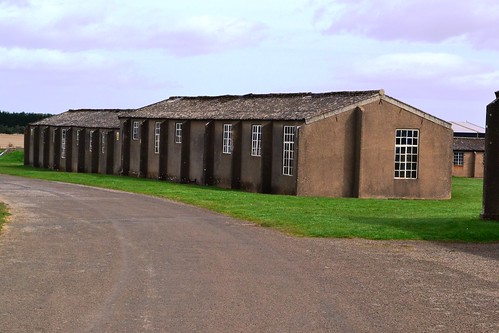
East Fortune National Museum of Flight

One of the many buildings left at East Fortune.

With the outbreak of war in 1914, German intrusions over British towns and cities became both a tangible and frightening threat. Scotland and the north-east along with North Sea shipping lanes, all became targets. To counteract these threats, a string of defensive airfields (Stations) were built along the eastern coast of Britain operating as a combined force in the British Home Defence Network.

East Fortune become one such station, from which, during 1915, a small number of aircraft would operate. Designed to protect the waters around the city of Edinburgh and the North Sea coast, it fulfilled this role using a selection of aircraft including types such as the: Sopwith Scout, Maurice Fairman, Avro 504 and B.E.2c.

It wasn’t until 1916 though that the airfield really came into its own. Officially opened in August as a Royal Naval Air Station, it operated initially Coastal Class airships, followed shortly after by North Sea Class airships, both of the non-rigid design. Later on, as airships developed, the more famous ‘R’ series rigid airships appeared and took their place at East Fortune.

As a major airship station, there would often be five or six of the type at East Fortune at any one time, each carrying out submarine patrols over the North Sea. To ensure their safety whilst on land, a number of airship sheds were built; the design and development of these sheds proceeded almost as fast and dramatic as the airships themselves.

When war broke out, the threat posed to British ships  by German submarines, became all too apparent. The Admiralty recognising the potential of airships as spotters, were soon to put in an order for a ship that would be able to travel at speeds of between 40 – 50 mph, carry two crew, 160lb of bombs, wireless equipment and sufficient fuel for up to 8 hours flying time. These airships would ideally reach altitudes of around 5,000ft, and their design be so basic, that the crew could be trained and in the air within weeks rather than months. The first of these ships was the Submarine Scout (S.S.) class, a design that was so simple, the first were airborne within three weeks of the initial prototype being built. In essence, these used the wingless fuselage of a B.E.2c aeroplane suspended beneath a simple envelope. These ‘S.S.’ ships were so successful in their role, that the Admiralty ordered more, bigger and faster airships, and so the Coastal Class was then born.

The Coastal Class was larger at 195.6 feet long. They had two 150hp engines, a top speed of 52 mph, and could be airborne for up to 22 hours at a time. Designed around a French design, they were made of three sections, an unusual “Tri-lobe” design. The gondola itself, utilised two shortened Avro seaplane aircraft fuselages, the tails were removed and the two sections joined back-to-back. This produced a car that could seat four or five crew members with two engines at opposing ends. Canvas and planking was added for further strength and improved crew comfort. Operating successfully for two years, many soon became weary and in need of updating. Deciding to opt for an improved alternative, the Admiralty scrapped the Coastal Class and brought in the last of the non-rigid designs, the North Sea (N.S.) Class.

Initial trials and operations of the N.S. Class proved it to be very unpopular. Problems with the drive system left many crews unhappy about its performance, its top speed of 57mph rarely, if ever, being achieved. The original engines, 250 horse-power Rolls Royce engines, had very elaborate transmission systems, in fact so elaborate that they were prone to breaking. The only answer was to replace the entire system and attach the propellers directly to the engine itself. Once this problem was overcome, the airship was hailed as a success to the point that many of them broke flight endurance records on an almost regular basis. Whilst flights of 30 hours or more were not unusual, some extended as far as 61 hours, and even post war, one of these ships flew for an incredible 101 hours non stop.

The period 1916 – 17 saw a rapid advancement in airship design and development. The larger rigid airships (so-called because the envelope was now wrapped around a rigid frame) were now coming into being, and the remainder of the war would see these new airships coming on-line and into service, many appearing at East Fortune.

To counter the German’s Zeppelin threat, three new manufactures were contracted to build these rigid ships: Beardmore, Armstrong and Whitworth, and lastly Shorts Brothers.

At East Fortune, (H.M.A) R.24 was delivered on October 28th 1917, and not without its problems. Initial testing revealed that it was two-thirds of a ton heavier than its sister ship R.23, and after investigations as to why, it was discovered that it was the rivets used that were the problem. In order to move the craft from its Beardmore shed, a number of weight modifications had to urgently be made. These modifications included removing an engine and all the associated components from the rear car.

RAF EAST FORTUNE DURING THE INTERWAR YEARS

The camouflaged Airship shed built to house H.M.A. R.34 at East Fortune. Note the smaller shed to the right. (IWM – Q103040)

Although now much lighter, R.24 paid the price with speed, with no replacement of the propulsion unit, she remained slow, achieving a top speed of little more than 35 mph. But she did cover some 4,200 miles and flew for 164 hours in total; most of which were as training flights. As an operational airship however, she was little more than useless, and was eventually scrapped in 1919.

The next rigid airship to arrive and operate from East Fortune was R.29 in the following June. R.29 went on to be considered the most successful wartime rigid airship. Being the only one to be involved in direct enemy action, she was responsible for the sinking of the German submarine UB.115. Commissioned on 20th June 1918, she was based at East Fortune and would cover around 8,200 operational miles, in some 335 hours flying time. This would be a short-lived active life though, lasting only five months before the war finally came to an end.

Carrying on flying post war, she would eventually be scrapped in October 1919 having covered in total, 11,334 miles in service, more than any other British rigid airship up to that time.

Post war, rigids continued to operate from East Fortune; R.34 perhaps being the most famous. Another craft from the works of William Beardmore and Co. Ltd. of Inchinnan near Glasgow, R.34 would be constructed in the later stages of the war under War Specifications. At 634 feet in length with a top speed of 62 mph generated by five 270 hp Sunbeam ‘Maori’ engines, she would cost £350,000 to build. R.34 would be designed to carry twenty 100 lb and four 550 lb bombs, a range of Pom-Pom, Lewis and two-pounder quick-firing guns, but as she wasn’t finished until after the war, none of these were ever fitted, nor was she flown in anger.

R.34 probably at East Fortune. (author unknown)

Completed in early 1919, she just missed out the first Atlantic crossing, being laid up by damage caused by poor handling, and thus beaten to the record now held by Alcock and Brown. In May, she arrived at East Fortune, here she carried out a number of test flights including an endurance flight across the Scandinavian countries. Then in July 1919, she became the first aircraft to make the Atlantic crossing, both east to west, and back again.

On the evening of 1st July 1919 the ship was fueled to capacity, in the early hours of the morning she was moved out of her shed and prepared for the flight. Her captain, Major Scott, decided gave the order to release and at 1.42 am (GMT) R.34 lifted slowly in to the Scottish sky.

A record was made, R.34 had put East Fortune firmly on the map. After 108 hours and 12 minutes flying time, R.34, her crew and two stowaways: William Ballantyne and a small tabby kitten called “Whoopsie”, landed at Mineola, Long Island, New York.

After a major refit at East Fortune, R.34 left for Pulham airship base in Norfolk. Here she carried out a number of flights, but was eventually badly damaged in strong winds, and after being stripped, she was sold for scrap – a rather ungainly ending to an incredible machine.

Airships were not to be the only user of East Fortune though. With the formation of the Royal Air Force in 1918, it would initially house No. 208 Training Depot Station (T.D.S.), designed to train torpedo bomber pilots using a variety of aircraft types, such as the Sopwith Camel and Beardmore W.B.III. In August 1918, it became 201 Training Depot Station, merging both 1 Torpedo Training Squadron, and the Torpedo Aeroplane School already at East Fortune.

A Sopwith Cuckoo (N6954) of the Torpedo Aeroplane School dropping a torpedo during trials at East Fortune, 24 – 26 July 1918. (IWM Q 67496)

On 21st October 1918, No. 185 Squadron was formed here, made by merging elements of 31, 33, 39 and 49 Torpedo Depot Stations, they would fly the Sopwith Cuckoo until April 1919, when it was reduced to a cadre, and then disbanded five days later on April 14th, 1919.

It was also in this month on the 31st, October 1918, just days before the armistice that year, that Bristol F.2b B8942 of 201 T.D.S, left R.A.F. East Fortune for a bombing mission against the German Fleet. During the take off, the aircraft stalled and crashed into the ground. In what must have been the last casualties of 201’s operations, the two crew: Lieutenant Lynn N. Bissell (age 19), and  Lieutenant Eric W. Bragg (22), were both killed when a bomb they were carrying exploded on impact. They have remained together ever since in Athelstaneford Parish Churchyard in East Lothian*1.

201 Training Depot Station were soon re-designated as the Torpedo Training School, finally being disbanded on February 1st, 1920, here at East Fortune.

This move signalled the end of East Fortune as an airfield for now. The site was closed, many of the buildings were removed either scrapped or sold off, and no further flying activity would take place.
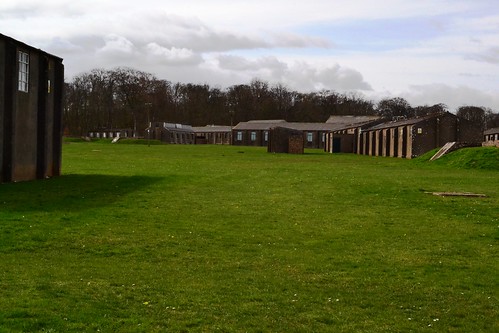
East Fortune National Museum of Flight

A small part of the collection of wartime buildings that still exist at East Fortune.

After laying dormant for around twenty years, the outbreak of war saw East Fortune brought back to life once more. Designated a satellite for R.A.F. Drem, it was virtually unchanged in its layout. After a period of expansion and development, new runways were laid, a technical site established, and accommodation and administration areas developed. A bomb dump was created to the south-west, well away from the other areas to the north. The runways, tarmac laid on hardcore, were all non-standard lengths, 1,710 yards, 1,560 yards and 1,100 yards but they were the standard 50 yards wide.

The first to arrive were 60 Operational Training Unit (O.T.U.)  in June 1941. A night fighter development unit they flew a range of aircraft including: Boulton Paul’s Defiant, Miles’ Master and Magister, and Westland’s Lysander. In June 1942, the  twin-engined Beaufighter also arrived here, a year which also saw a return of the Blenheim and Beaufort. Some of these Beaufighters were dual control and several had Aircraft Interception (A.I.) equipment installed.

It was in one of these Defiants, that pilot Sergeant Anthony. D.C. La Gruta, (s/n 400719) (R.A.A.F.) was killed when the aircraft he was in plunged into the ground with such force that it buried itself some 16 feet down. The Ministry of Defence, unable to recover the wreckage, declared it a war grave and his body remains there to this day. A monument and parts of the wreckage currently mark the spot where the aircraft lies. Whilst it can’t be confirmed, it would appear that whilst out conducting a series of ‘homing tests’, the pilot lost control of the aircraft resulting in the tragic accident.
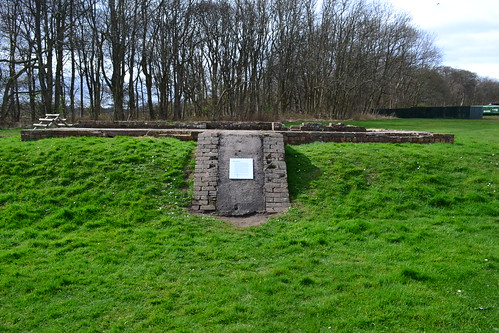
East Fortune National Museum of Flight

One of several Air Raid shelters at East Fortune.

During October 1942, No. 2 Glider School were formed here, they were quickly moved on however, and disbanded later at Dumfries – playing virtually no part in the development of East Fortune. On 24th November 1942, 60 O.T.U. was officially disbanded, and then immediately reformed as 132 (Coastal) Operational Training Unit, remaining at East Fortune airfield. Operating under the leadership of No. 17 (Training) Group (R.A.F. Coastal Command) it was designed to train crews in the long-range fighter and strike role. To achieve this, there were some sixty aircraft split primarily between Beaufighters and Blenheims; with other models such as Beauforts, Lysanders, Magisters and Spitfire VBs also adding to the busy airspace in this region of Southern Scotland.

In May 1944, Belgian Flying Officer, Gilbert A. E. Malchair, (s/n 132969), and Flight Sergeant, Roger H. L. Closon, (s/n 1424811), both of the Royal Air Force Volunteer Reserve, took off in Beaufighter ‘EL457’ on what is believed to be a training sortie. Little is still known about the accident but it is believed that the pilot reduced height to prevent icing, in doing so, the aircraft collided with the ground at Hedgehope Hill (Threestoneburn Wood) in the Cheviots. As a result, both crewmen were killed.

In 1944 a few D.H. Mosquitoes arrived at the airfield, but by now East Fortune had begun the long wind down. By May 1946, 132 O.T.U. was disbanded, and the aircraft were either dispersed or scrapped.

The airfield remained in R.A.F. hands, but during the cold war years, the U.S. Air Force lengthened two of the runways in anticipation of the Cold War becoming ‘hot’. Thankfully however,  hostilities never broke out and occupation of the site never materialised. East Fortune was then used as storage facility in case of any subsequent Soviet attack, primarily for the ‘Green Goddess’ fire engines, and later to store food stuffs by the Ministry for Agriculture and Fisheries. The site remained ‘open’, and for a short period – April to August 1961 – it acted as a replacement for Edinburgh’s Turnhouse international airport recording just short of 100,000 passenger movements. After this, in 1961, East Fortune was finally closed and the site vacated.

Callender-Hamilton Hangar East Fortune National Museum of Flight

Two of the three Callender-Hamilton hangars.

Over the years East Fortune had gone from an Airship site to a night fighter training school. Operational Training Units had lost crews and the entire site developed and expanded. Two of the three runways were expanded up to 2,000 yards, 46 hardstands were laid, it had 3 Callender-Hamilton hangars, 8 blister hangars, and accommodated 1,501 R.A.F personnel and 794 W.A.A.Fs. Designed as a satellite it had achieved a remarkable status, incredibly much more than it was ever designed to do.

Since its closure however, it has taken on a new role, developing both its past and preserving its history, turning it into what is possibly Scotland’s finest aviation museum. Many of the Second World War buildings still remain: The night flying store (drawing number 17831/40); three Callender-Hamilton hangars; Nissen stores, latrines and a refurbished parachute store. The Watch Office sadly not refurbished, is also present on the airfield site, as are a number of air raid shelters. The main runway is also still in situ, now used for Sunday markets, with the original section and extended post war sections being dissected by the road through the site. The perimeter track and secondary runways are also intact, having been used in part for racing activities.
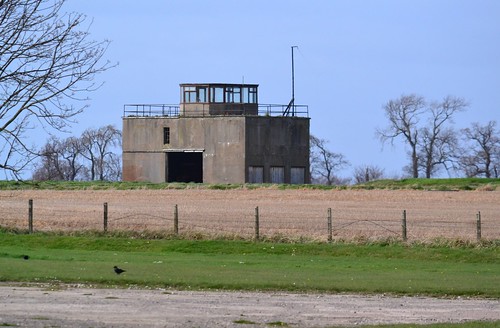
East Fortune

The Watch Office remains on the ‘active’ side of the airfield site.

One of the benefits of East Fortune is the location of all these buildings, primarily on one relatively small site. Access is easy although many of them are sadly locked and out-of-bounds to the public.

Considering its early history and the sacrifice many of its crews gave, East Fortune is an important site, it stands as a memorial to all those who came and died here, and to all those who not only wrote history, but have contributed to it over the last 100 years.

Sources and further reading:

Further details of R,34’s trip can be found here.

Additional pictures of East Fortune can be found on flckr.

More detailed information about R.34 and the development of Airships can be found on The Airship Heritage Trust website .

The Eastern Daily Press ran several articles on the commemoration of R34’s journey 100 years on. The articles are available on the EDP Website.

*1 The Commonwealth War Graves Commission website.
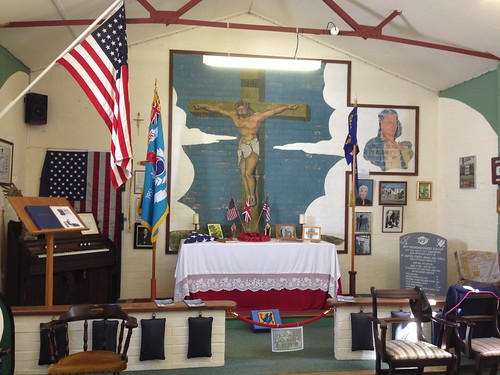
July 2nd 1919, H.M.A. R.34 Sets A World Record Flight.

On July 2nd 1919 at 01:42, airship R.34 lifted off from the airfield at East Fortune, east of Edinburgh, to make an epic voyage – the first crossing of the Atlantic Ocean east to west by a powered aircraft.

R.34 possibly at East Fortune. (author unknown)

Conceived as early as 1916, R.34 was built at the works of William Beardmore and Co. Ltd. of Inchinnan near Glasgow. At 634 feet in length with a top speed of 62 mph, she would have five 270 hp Sunbeam ‘Maori’ engines, and would cost £350,000 to build. Her massive size gave her an impressive 1,950,000 cubic feet for gas storage, and she would be equivalent in size to a Dreadnought battleship. A major step forward in airship design, her aerodynamic shape reduced total air resistance to that of just 7% of an equivalently sized flat disc.

As she was designed under war specifications, R.34 would be built to carry twenty 100 lb and four 550 lb bombs, a range of Pom-Pom guns, Lewis machine guns and a small number of two-pounder quick-firing guns; but as she wasn’t finished until after the war, none of these were ever fitted, nor was she ever flown in anger.

Completed in early 1919, she just missed out on achieving the record of the first Atlantic crossing, being laid up by damage caused by poor handling, and thus beaten to the record now held by Alcock and Brown.

In May, she arrived at East Fortune airfield, a major airship station in East Lothian, from where she carried out a number of test flights including an endurance flight across the Scandinavian countries. In July she was set to make the first  Atlantic crossing, east to west.

In preparation for the flight, eight engineers were sent to the United States to train ground crews in the safe handling of the airship. The Admiralty provided two  warships, the Renown and Tiger, as surface supply vessels, and should R.34 have got into difficulty, she could have been taken in tow by one, or both of the two vessels.

On the evening of 1st July 1919 the ship was fueled to capacity (some 6,000 gallons), and in the early hours of the morning she was moved out of her shed and prepared for the flight. Her captain, Major G. H. Scott, gave the order to release early, and at 1.42 am (GMT) R.34 lifted slowly in to the Scottish sky.

After battling strong winds and Atlantic storms, R.34 finally arrived at Mineola. Huge crowds had turned out to greet her and her crew, a grandstand had been erected, parks and public spaces were packed with onlookers. Major J. Pritchard (The Special Duties Officer) put on a parachute and jumped from the airship to become the first man to arrive in America by air. He helped organise ground staff and prepared the way for R.34 to safely dock. As she settled on her moorings, she had not only become the fist aircraft to fly the Atlantic East to West, but broke the current endurance record previously held by the North Sea Airship NS 11, also based at East Fortune.

A record was made, R.34 had put British Airship designs and East Fortune firmly on the map. After 108 hours and 12 minutes flying time, R.34, her crew and two stowaways: William Ballantyne and a small tabby kitten called “Whoopsie”, had landed at Mineola, Long Island, New York.

After a 3 day stay in which the crew were treated like the heroes they were, R.34 was prepared for the homeward journey. On Wednesday July 10th 1919, at 23:54 she lifted off and set sail for home.

With prevailing winds carrying her eastward, she made an astonishing 90 mph, giving the opportunity to cut some of the engines and preserve fuel. This gave the crew a chance to divert over London, but due to a mechanical breakdown, this was cancelled and R.34 continued on her original route. Poor weather at East Fortune meant that she was ordered to divert to Pulham Air Station, Norfolk, but even after clarification that the weather had improved, her return to East Fortune was denied and she had to continue to Pulham – much to the disgust of the crew on board. At Pulham, the reception was quiet, RAF personnel greeted her and secured her moorings. She has covered almost 7,500 miles at an average speed of 43 mph.

Eventually after a major refit at East Fortune, R.34 left for the return to Pulham. After six weeks of static mooring, R.34 was sent to Yorkshire, to Howden Airship Station. Here she was used to train American crews, was modified for mast mooring and used for general training duties. During one such training mission, she was badly damaged in strong winds, and after sustaining further damage whilst trying to moor and secure her, she began to buckle. Falling to the ground, she broke up and was damaged beyond repair. R.34 was then stripped of all useful materials and the remainder of her enormous structure sold for scrap – a rather ungainly ending to an incredible and historical machine.

H.M.A. R.34 and her crew had become the first to cross the Atlantic east to west, they had achieved the  longest endurance flight, and become the first aircraft to complete a double-crossing of the Atlantic.

East Fortune

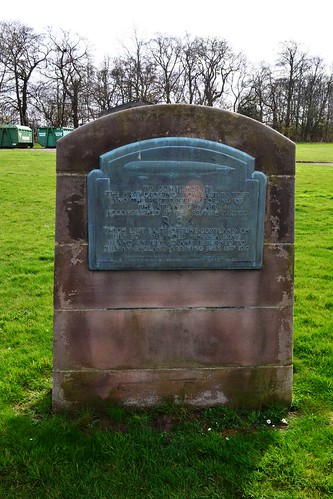
The memorial stone at East Fortune airfield commemorating the epic flight of R.34.

The Flight Crew for the Atlantic journey were:

Major G. H. Scott A.F.C – Captain
Captain G. S. Greenland – Second Officer
Second Lt. H. F. Luck- Third Officer
Second Lt. J. D. Shotter – Engineering Officer
Major G. G. H. Cooke DSC – Navigator
Major J. E. M. Pritchard O.B.E. – Special Duties
Lt. G. Harris – Meteorological Officer Second
Lt. R. F. Durrant – Wireless Officer
Lt. Commander Z. Lansdowne – Representative U S Navy
Brigadier General E. M. Maitland – Special Duties
Warrant Officer W. R. Mayes – First Coxswain
Flight Sergeant W. J. Robinson – Second Coxswain

Sergeant H. M. Watson – Rigger
Corporal R. J. Burgess – Rigger
Corporal F. Smith – Rigger
F. P. Browdie – Rigger
J. Forteath – Rigger Corporal

H. R. Powell – Wireless Telegraphy
W. J. Edwards – Wireless Telegraphy

W. R. Gent – Engineer
R. W. Ripley – Engineer
N. A. Scull – Engineer
G. Evenden – Engineer
J. Thirlwall – Engineer
E. P. Cross – Engineer
J. H. Gray – Engineer
G. Graham – Engineer
J. S. Mort – Engineer
J. Northeast – Engineer
R. Parker – Engineer

W. Ballantyne – Stowaway
“Whoopsie” – a small tabby kitten and stowaway

The crew of R.34 Crew – with the crew pets.

East Fortune airfield appears in Trail 42.

Sqn. Ldr. Ian Willoughby Bazalgette (RAFVR) VC

RAF Downham Market was one of a small number of airfields that were home to the RAF’s Pathfinder Squadrons. Elite airmen who would lead formations of heavy bombers into some of the most heavily defended areas of the Reich, often against insurmountable odds and always at great risk to themselves. The Pathfinders produced some remarkable flyers and many, many heroes. Of all the crews who flew with 8 Group PFF, only three were rewarded for their valour and gallantry with the highest possible accolade, the Victoria Cross. One of those went Posthumously to Sqn. Ldr. I. W. Bazalgette, whose long and distinguished career led him to achieving 58 missions before his death. Based at RAF Downham Market, Bazalgette, would become legendary, flying his Lancaster bomber in pursuit of victory against a tyranny beyond all evil.

Ian Willoughby Bazalgette.jpg

Sqn Leader Ian Bazalgette (RAFVR) died August 4th 1944, a few days before his 26th Birthday.*1

Squadron Leader Ian Willoughby “Baz” Bazalgette was born on October 19th 1918 in Calgary, Canada and was the youngest of three children. His parents decided to move to England in 1924 when he was six, settling in New Malden, Surrey on the outskirts of London.

During his school life he developed a passion for music, and in particular Classical Music, which he immersed himself in spending hours listening to and writing about.

As a teenager, he would have his first real battle, that of tuberculosis, which meant he would have to undergo four long months of hospital treatment. Bazalgette’s strength and determination would see him pull though this, a strength and determination that would go on to show itself on a number of occasions later on during his RAF career. 

Prior to the outbreak of war, Bazalgette decided to enlist, applying to, and being accepted by, the Royal Artillery; achieving a commission as Second Lieutenant within a year. This new role took him to the outskirts of Edinburgh operating a radar searchlight, protecting both the city, and the Forth Estuary from Luftwaffe bombers. Dissatisfied with the routine of searchlight activities, he decided to give up this role, and whilst on a trip into nearby Edinburgh in March 1941, he applied to the Royal Air Force Volunteer Reserves. His application was accepted and in the following July, he received his first posting to a training unit – 22 Elementary Flying Training School at Cambridge.

Throughout his training Bazalgette showed great tenacity and promise, quickly passing  a number of stringent and difficult flying tests. Flying solo for the first time during August, gave him the opportunity he had been longing for. His flying skills impressed his seniors so much that on the 28th, he passed the C.O.s test taking just 30 minutes to complete the flight. Upon passing, he was graded as an ‘above average’ pilot by his examiners.

Bazalgette was then transferred to Cranwell where he trained on Airspeed Oxfords. At Cranwell he achieved his wings, and after a short break, he was sent to Scampton and 18 Beam Approach School. Bazalgette eventually left Scampton, heading towards his first operational unit, 25 Operational Training Unit, where he would form his first crew.

Informal crewing up was very much encouraged by the RAF, but those that didn’t manage the task were allocated crew members by the relevant staff at the various bases; Bazalgette had no problems in finding his own.

Whilst at the OTU, Bazalgette would have his first experience of heavy bombers flying the Vickers Wellington; a remarkable aircraft that used Barnes Wallis’ geodesic construction in Rex Pierson’s design.  Bazalgette and his crew competed a range of training flights whilst at 25 OTU, including air gunnery and bombing practice, all of which they passed. On September 18th 1942, after accumulating some 223 hours as a pilot, Bazalgette received his first posting to a fully operational Squadron, 115 Squadron at RAF Marham, Norfolk, he was off to war.

The very next day he flew “Second Dickie” assisting an experienced crew tackling the rigours of an operational sortie to Saarbrucken. Two days later he was back out, but this time laying mines on a ‘Gardening’ mission shortly before the squadron moved to nearby RAF Mildenhall in Suffolk. It was here that Bazalgette would fly his first operational mission as a pilot leading his own crew.

After moving to East Wretham, 115 squadron then began the task of replacing their Wellingtons with Stirlings, and Bazalgette was sent to 1567 Operational Conversion Unit (OCU) to convert to the big heavy four-engined aircraft. Between him completing the course and returning to East Wretham though the Stirling had been superseded, proving to be a poor performer in conflict zones. Bazalgette would now get his chance to fly the legendary Lancaster.

On the 3rd April 1943, Bazalgette was awarded the DFC, and the same strength and determination that had got him though tuberculosis would get him through his tour of 30 missions. On completion, as was customary at this point, he and his crew were separated and scattered across a range of new squadrons within the Air Force.

Bazalgette was sent back to Scotland and RAF Lossiemouth where he reluctantly trained new bomber pilots, a position he disliked immensely. He pleaded for postings to an operational unit, a plea that was eventually granted in April 1944, and a posting to RAF Warboys and the Pathfinder Conversion Unit.

From here he transferred with a new crew to 635 Squadron at RAF Downham Market, in Norfolk, a few miles west of Marham the very station he had spent his early days at with 115 Sqn.

As a model crew, he was looked up to by others at Downham Market. He would go on to fly 58 missions in total, two off his score of two tours of duty.

However, his 58th mission would be his last. On August 4th 1944, Lancaster ‘M’ for Mother would not be listed for duty, but an absent crew left an opening that Bazalgette and his crew jumped at. It was a decision that would change their lives forever.

On that day, Bazalgette would fly Lancaster Mk III, F2-‘T’ for Tommy, not their usual aircraft but it was ready, fuelled and bombed up. The aircraft was known for a history of mechanical problems, its usual pilot tending to work the engines much harder than necessary, but it was a choice of stay on the ground or fly the mission: for Bazalgette and the crew of ‘M’ for Mother it was an easy choice.

The mission for the day was as Master Bomber of the Pathfinder squadron to identify and mark a V1 storage site at Trossy St. Maximin, a heavily defended area to the north of Paris. Take off was set for 11:00, over the next fifteen minutes at five-minute intervals, 14 Lancasters of 635 Sqn would leave Downham Market heading for France. The weather was less than 3/10 cloud over the target, excellent for the determined and accurate anti-aircraft gunners below. On the second run in to the target, the Master Bomber and Deputy Master bomber were both hit, one being downed (PA983 F2-A piloted by F/L. R. W. Beveridge) and the second forced to return home, leaving Bazalgette as the lead aircraft.

Flak was incredibly intense and his aircraft repeatedly hit. The starboard wing was struck causing damage to both engines, subsequently putting them both out of action. In the wing the fuel tanks caught fire, fuel poured into the rear of the fuselage and the situation becomes desperate. The bomb aimer was mortally wounded, his arm barely recognisable due to his injuries, but Bazalgette managed to reach the target, drop both his markers and his bombs, whereupon the aircraft began a steep spin toward the ground below. As the situation worsened, he gave the order to bail out, all but three; Bazalgette, F/Lt. I. A. Hibbert and F/Sgt. V. V. R. Leader are left.

Bazalgette continued to fight with the controls and quite remarkably managed to keep the stricken bomber flying long enough to avoid the French village of Senantes. Unable to maintain height, the aircraft finally hit the ground, resting momentarily before exploding in a massive fireball killing all those remaining on board.

Once the ferocious fire subsided, locals were able to reach the wreck and remove the bodies of both Leeder and Hibbert. Bazalgette’s remains were not found until the air frame was removed, some days later.

For his bravery and sacrifice, Ian Bazalgette was awarded the V.C., the highest honour for military personnel. The London Gazette, of 14th August 1945, published the following:

On 4th August 1944 Squadron Leader Bazalgette was “Master bomber” of a Pathfinder Squadron detailed to mark an important target for the main bomber force. When nearing the target his Lancaster was seriously damaged and set on fire by anti-aircraft fire; the bomb aimer was badly wounded. As the deputy “Master bomber” had already been shot down, the success of the attack depended on Squadron Leader Bazalgette who despite appalling conditions in his burning aircraft pressed on gallantly, bombed, and marked the target accurately. That the attack was successful was due to his magnificent effort. The condition of the aircraft had by now become so bad that Squadron Leader Bazalgette ordered his crew to leave the aircraft by parachute. He attempted the almost hopeless task of landing the crippled and blazing aircraft to save the wounded bomb aimer, and one air-gunner, who had been overcome by fumes. With superb skill and taking great care to avoid a French village, be brought the aircraft safely down. Unfortunately it then exploded and this gallant officer and his two comrades perished. His heroic sacrifice marked the climax of a long career of operations against the enemy. He always chose the more dangerous and exacting roles. His courage and devotion to duty were beyond praise.

Ian Bazalgette’s sacrifice marked the end of a career covering an incredible 58 operational missions. His courage, determination and devotion to duty going way beyond those expected of any serving officer. With him that day on ‘T’ for Tommy were: Sgt. G. R. Turner; F/L. G. Goddard; F/L. I. A. Hibbert DFC; F/O. C. R. Godfrey DFC; F/S. V. V. R. Leeder (RAAF) and F/O. D. Cameron DFM. Of the four men who manged to get out of the aircraft: Turner, Goddard, Godfrey and Cameron, all managed to evade capture*2.

In his honour, Bazalgette has a Garden in New Malden, Surrey named after him, a school in Calgary, the ‘Ian Bazalgette Junior High School’, and at the Bomber Command Museum of Canada, an Avro Lancaster, FM159, was painted in the markings of his aircraft; the Lancaster was dedicated in 1990. At the ceremony, Bazalgette’s sister, Mrs. E. Broderick, unveiled a commemorative plaque whilst the aircraft itself was unveiled by two of Bazalgette’s former crew members, Chuck Godfrey DFC and George Turner, both of whom were with him of that fateful night.

Outside the church of St. Mary’s at Bexwell close to the accommodation sites of Downham airfield, stands a small memorial in his name. Laying beside him is the memorial of another V.C. winner Arthur Aaron, who was also based at RAF Downham Market during the Second World War.

Ian Bazalgette was one of those many young men who sacrificed their lives in the hope of saving others. He dedication to duty, determination to win and above all, his value of other’s led to a tragic and sad end, that shall forever be remembered in the hearts and minds of those who lived through those terrible years 1939-45.

RAF Downham Market

The memorial at St. Mary’s Church Bexwell.

RAF Downham Market appears in Trail 7: Northwest Norfolk.

There is a book written listing every operation of 635 Sqn whilst at RAF Downham Market, with crew details, aircraft profiles and mission aerial photographs. It is an amazing record and the result of three years work. The author Christopher Coverdale, is also on the committee aiming to construct the new memorial at RAF Downham Market.

Notes and Further Reading.

Coverdale C. ‘Pathfinders 635 Squadron – definitive history March 1944 – September 1945‘ Published by Pathfinder Publishing, 2009. ISBN: 978-0-9561145-0-1

The Bomber Command Museum of Canada website has a detailed account of the restoration of Lancaster FM159.

*1 Photo IWM – CH 15911 in the public domain.

*2 Chorley, W. R. ‘Bomber Command Losses of the Second World War‘ Vol 5, 1944, 1997

Other records of heroism and crew stories can be found on the Heroic Tales page.

Appeal for Help RAF Methwold 320 sqn.

I have been contacted by a reader (Diek Roessingh) looking for information and / or photographs of his Uncle, Albert Roessingh, of 320 (Dutch) Sqn based at RAF Methwold.

Albert and his crew: Willem Ritte, Evert van’t Eind, William Blok and Cornelius van de Does, were all killed when their aircraft, B-25 Mitchell FR144 crashed into the sea on July 30th 1943.

I have sent the Operational Record Books and various links to websites covering the aircraft and other crew members, but nothing has come to hand about Albert.

Diek is also looking for details of a second airmen, Albert’s friend, Kees Waardenburg who died on August 30th 1943 (although I believe this may be 1944).

Any information about Albert or Kees would be gratefully received and passed onto Diek.

A New Memorial to Honour Those Who Never Came Home.

RAF Downham Market in Norfolk, was home to 6 squadrons during the Second World War: 214, 218, 571, 608, 623 and 635 along with a number of other non-flying units. It was also home to a number of aircraft types, Short’s enormous Stirling, the famous Lancaster and of course de Havilland’s ‘Wooden Wonder’ the Mosquito of the RAF’s Pathfinder force.

RAF Downham Market

One of the many huts still left on the airfield.

It was also the airfield that launched the last bombing mission by an RAF aircraft, a Mosquito, on May 2nd 1945, to attack retreating German forces at the Kiel canal.

Considering the strong links it has with the RAF and Bomber Command, it has never been given a fitting memorial, but maybe finally, this is about to change.

A proposal has been put forward to erect a grand memorial on a site next to where one of the former accommodation sites once stood. It will honour not only those who flew from Downham Market and never returned, but those who served and were stationed here as well.

It is hoped that the new memorial will consist of seven polished, black granite slabs with each name of the 700 crewmen who lost their lives, carved into it, in the order in which they were lost. It is hoped to raise £250,000 to cover the cost of the structure which will be grand in scale and stand next to the main A10, a road that was made using the runways for its hardcore.

Currently the only reminder of their sacrifice is a small memorial outside of Bexwell church. It is a small memorial telling the stories of the two heroic crew members, Flight Sergeant Arthur Louis Aaron and Squadron Leader Ian Bazalgette, two pilots who both received the Victoria Cross whilst at Downham Market, for extreme bravery in the face of the enemy.

Today whilst none of the runways or perimeter tracks exist, a number of the original buildings are still present, used by small businesses and light industry. Recently however, a  £170m regeneration plan was announced, one that may signify the end of these buildings and Downham Market airfield for good (see here).

RAF Downham Market and especially the many crew members, who came from all across the Commonwealth, deserve great recognition for the work they did. Perhaps this, is finally a sign that it may now happen.

The full story and pictures can be accessed on the Eastern Daily Press website. There are more details and a link to the donations page on the RAF Downham Market website. 

RAF Downham Market appears on Trail 7 – North West Norfolk. 


The 392nd – The Highest Degree of Bombs on Target.

In the northern reaches of Norfolk lies an airfield that was the most northerly American base of the Second World War in East Anglia. Of all its crews that flew on the first mission, only four were still around to fly on the 200th a year or so later. This airfield was home to only one operational flying group, a group that was cited for its incredible bombing accuracy over occupied Europe. In this trip, we visit Station 118, otherwise known as RAF Wendling.

 RAF Wendling (Station 118)

On 15th January 1943, a new bomb Group was formed at Davis-Monthan Field in Arizona, it would be the 392nd BG and would consist of four squadrons: the 576th, 577th, 578th and 579th Bomb Squadrons. On completion of its training, the 392nd would leave the United States, and fly across the Atlantic to their new base in England. These four squadrons would be the first to operate the newly updated B-24 ‘H’ model ‘Liberators’; an improvement of the previous variants by the addition of a motorised front turret, improved waist gun positions and a new retractable belly turret. The supporting ground echelons had left the United States, sailing on the Queen Elizabeth from New York, much earlier, and before the group had received these newer models. As a result, they had neither received any training, or gained any experience with these new updated variants. The arrival of these new aircraft would therefore be met with some surprise, followed by a steep learning curve supported by additional training programmes.

The first B-24s of the 392nd arrived at Wendling, Norfolk, on 15th August 1943, and would soon be joined by the 44th at nearby Shipdham, the 389th at Hethel and the 93rd at Hardwick; four Groups that would be combined to form the Second Bombardment Wing (later 2nd Bombardment Division)*1. Battle hardened from fighting in the Mediterranean Theatre, these other three groups knew only too well the dangers of bombing missions, all having suffered some heavy losses themselves already.

Wendling’s Watch office before it was modified (see below) (IWM FRE 1670).

During September 1943,  the 392nd joined with these other three units flying missions under Operation ‘Starkey‘; probing German defences and gauging their responses to massed allied attacks on coastal regions. Largely uneventful they went on to undertake diversionary missions over the North Sea, the first three being escorted by fighters, and without incident. On the fourth however, the fighters were withheld and the bombers struck out alone.

On this particular flight, 4th October, 1943, the 392nd would gain their first real taste of war, and it would be an initiation they would rather forget. During the battle over thirty Luftwaffe fighters would shoot down four B-24s with the loss of forty-three crew members. A further eleven were injured in the remaining bombers that managed to continue flying and return home – it was not a good start for the 392nd.

Licking its wounds, they would then be combined with more experienced units, flying multiple missions as far as the Baltic regions before returning to diversionary raids again later that month. Viewed with some misgivings by crews, these ‘H’ model Liberators were soon found to be heavier, slower and less responsive at the higher altitudes these deeper missions were flown at.

The 392nd would take part in many of the Second World War’s fiercest operations; oil refineries at Gelsenkirchen, Osnabruck’s marshalling yards and factories at both Brunswick and Kassel were just some targets on the long list that entered the 392nd’s operations records book.

RAF Wendling (Beeston)

Wendling’s runway looking West.

The massive effort of ‘Big Week’ of February 20 – 25th saw the 392nd in action over Gotha, in an operation that won them a DUC for their part. Upon entering enemy airspace, the formation was relentlessly attacked by Fw-190s, Me 110s and Ju 88s using a mix of gun, rockets, air-to-air bombing and even trailing bombs to disrupt and destroy the groups. Ironically it was the very same twin-engined aircraft and component factory that was the intended target that day; a focus of the Second Bomb Division in an operation that saw the lead section, headed by aircraft of the 2nd Combat Wing, bomb in error due to the bombardier collapsing onto his bomb release as a result of oxygen starvation. Unrelenting the 392nd carried on. They realised and ignored the major error, and flew on to drop 98% of their bombs within 2,000 feet of the intended target. This highly accurate bombing came at a high cost though, Missing Air Crew Reports  (MACR) indicate seven aircraft were lost, with another thirteen sustaining battle damage.

The 392nd would carry on, with further battles taking their deadly toll on both crews and aircraft. In March that same year, the 392nd would turn their attention to Friedrichshafen – a target that would claim further lives and be the most costly yet.

Even before entering into enemy territory, losses would be incurred. Flying in close formation, two B-24s flew too close – one through the prop wash of another – which caused them to collide bringing both aircraft down.  One of those B-24s #42-109824 ‘Late Date II‘, lost half of its crew.

Despite good weather over the target the attack on Friedrichshafen in southern Germany, would have to be led by pathfinders. In an attempt to foil the attackers, the Germans released enormous quantities of smoke, enveloping the town and concealing it from the prying eyes high above. Of the forty-three bombers to fall that day, half were from the 14th Combat Wing of which fourteen came from the 392nd. Despite losses elsewhere, this would prove to be the worst mission for the 392nd, in all some 150 crew men were lost that day.

Bombing targets in Europe was never straight forward and bombs often fell well away from the intended site. On one rather unfortunate occasion at the end of March, the 392nd joined the 44th BG in mistakenly bombing Schaffhausen, a town in neutral Switzerland. The event that not only deeply upset the Swiss, but heavily fed the Nazi’s determined propaganda machine.

Eventually March, and its terrible statistics, was behind them. The 392nd would then spend the reminder of 1944 supporting ground troops, bombing coastal defences in the lead up to D-day (their 100th mission), airfields and V-weapons sites in ‘NOBALL‘ operations. Like many of their counterparts they would support the St. Lo breakout, and hit transport and supply routes during the cold weeks of the Battle of the Bulge.

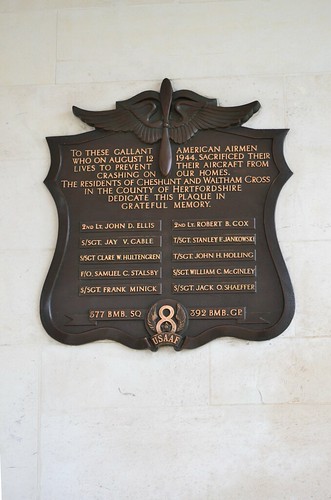
It was during this time, on 12th August 1944 that heroic pilot, 2nd Lt. John D. Ellis, flying B-24H #42-95023, would manage to steer his stricken aircraft away from a residential area at Cheshunt, some 15 miles north of London,  crashing the aircraft near to what is now the A10 road. Sadly all on board were killed in the incident but undoubtedly the lives of many civilians were saved, and a memorial in their memory lies in the nearby library at Cheshunt and on the wall at Madingley, the American War Cemetery, Cambridge.

DSC_0572

The Memorial Plaque at the American War Cemetery, Madingley, Cambridgeshire.

This was not to be the only accident that the 392nd (nor any other B-24 unit) were to suffer. Crews were finding that these heavier machines were difficult to get out of if hit by flak or attacking fighters. Ferocious fires in the wing tanks and fuselage were leading to many losses, and in particular, the pilots who after fighting to keep aircraft stable long enough for crewmen to jump out, were then finding it viciously spinning the moment they let go of the controls.

On February 16th 1945 Liberator #42-95031 ‘Mary Louise‘ flown by 1st Lt. Albert J. Novik, was hit by falling bombs from another aircraft flying above him. After wrestling for some four and half hours to keep the aircraft flying, he ordered the crew out and then attempted to leave the aircraft himself. This event occurred only a month after a similar incident where he had managed to dive through the open bomb bay to safety. In this instance though, Novik was pinned to the roof as the bomber, half its tail plane missing, spun violently towards the Norfolk landscape beneath. Eventually, after a 7,000 ft fall, he was released from this centrifugal grip by a change in the aircraft’s direction. He managed to crawl down from his position and throw himself out through the bomb bay just seconds before the aircraft exploded, sending burning aircraft parts tumbling all around him. For his actions Novik was awarded the DFC, but many others were not quite so lucky, and perished in these huge lumbering giants of the sky.

On April 25th 1945, Mission 285, the 392nd BG prepared for what would be their last mission of the war. The Target, Hallein Austria. Not only would it end the 392nd’s aerial campaign, but that of the Eighth Air Force, bringing the air war in Europe to an end for the American units based in England.

By then, the 392nd had conducted some 285 missions with a high rate of loss, some 184 aircraft in total, with over 800 young men killed in action. They had dropped around 17,500 tons of bombs on some of the highest prestige targets in the German heartland. The group was cited by Major General James Hodges for its degree of accuracy for bombs on target – higher than any other unit of the 2nd Air Division over 100 consecutive missions. Operations had ranged from Norway to southern France and as far as the Baltic and advancing Russian armies at Swinemunde. Over 9,000 decorations were handed out to both air and ground crews for bravery and dedication.

Bomb dump buildings

One of several bomb dump buildings now a nature reserve.

After flying food supply missions to the starving Dutch, the 392nd departed Wendling and the site closed down, remaining dormant until it’s disposal in 1963/4.

RAF Wendling, otherwise known as Beeston from the nearby village, was classified as Station 118 by the Americans. Initially intended as an RAF Bomber base it was updated during the winter of 1942/43 opening in the summer of 1943. It would have 3 concrete runways of class ‘A’ specification, one of 2000 yards and two of 1,400 yards. The bomb dump which survives today as a nature reserve, was to the south-east, whilst the technical area is to the north-west. Two T2 hangars were located near to these sites and the watch office (drawing 5852/41) seems to have been modified in 1943 with the addition of what may have been a Uni-Seco control room (1200/43). Originally built with an adjoining Nissen hut (operations / briefing room) this is now encompassed within another more modern building, and is not visible from the outside.

Around the perimeter were a mix of ‘pan’ (28) and ‘spectacle’ (26) style hardstands, all of which have since been removed or built upon. The technical area, housing a range of: stores, workshops, huts and associated buildings, were to the north-west also. Interestingly, Wendling used Orlit huts, built by the Orlit Company of West Drayton, a mix of panel and concrete posts they were more economical than the British Concrete Foundation (BCF) huts initially ordered by the Ministry of Works.

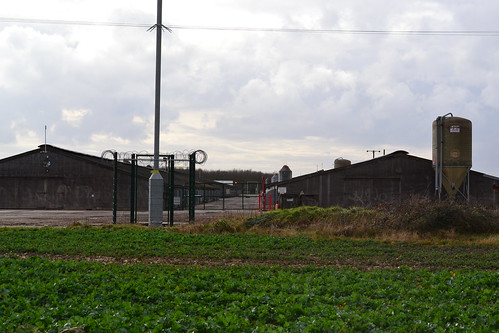
Today, parts of two of the main runways still survive, housing turkey farms these buildings synonymous with Norfolk. The third was removed and the perimeter track has been reduced to a path. The bomb dump is part of a local nature reserve which has very limited parking, but access to the remaining buildings there is straight forward. Many of the buildings from the remaining twelve accommodation sites have been removed, however a number are still believed to be standing bound in heavy undergrowth, or used by local businesses. One currently retains a huge mural covering an entire wall, with evidence of others also within the same building.

DSC_0114

A stunning memorial now stands in memory of those who served.

Unfortunately when I visited Wendling, daylight ran out forcing me to make a retreat and head for home – a return visit is certainly planned for later. Like many other airfields in this part of the country, losses were high, and the toll on human life dramatic, both here, ‘back home’ and of course, beneath the many thousands of tons of high explosives that were dropped over occupied Europe. Now a high number of these sites house turkey farms, small industrial units or have simply been dug up, and forgotten. I hope, that we never forget and that they all get the honour and respect they deserve.

On a last note, there is a remarkable memorial in the Village of Beeston to the west of the airfield site. This is in itself worth a visit. Not only does it mention the 392nd, but all the auxiliary units stationed on the base, something we often forget when considering the Second World War. A nice and moving end to the trip.

DSC_0117

Memorial to the 392nd BG at Wendling.

Notes and further reading.

Wendling forms part of Trail 10.

*1 September 1943 saw a reorganisation of the US Eighth Air Force, and in September, the ‘Wings’ designation was changed to ‘Divisions’. Then in early 1944, a further reorganisation led to further strategic changes of the Air Force, one of which, saw the 44th and 392nd join with the 492nd to form the 14th Combat Wing, 2nd Bomb Division. Both  the 389th and the 93rd became part of the 2nd and 20th Combat Wings respectively.

A detailed website covering every mission, aircraft and most crew members offers a good deal of information and supporting photographs. It is well worth a visit for further more detailed information .

RAF North Pickenham – The Worst Record of the Eighth

There were many airfields in the eastern region of England during the Second World War, and countless crews were lost flying in combat operations. Undeterred and undaunted by these losses, many continued the brave fight to release Europe from the evil grip that was slowly strangling it. Loses were high, but at one particular airfield, the loses of one Group were the highest, and of those that came here, few were to return home alive.

In Trail 9 we visit RAF North Pickenham, an airfield with a short life, but one with a terrible tale of loss and sacrifice.

RAF North Pickenham (Station 143)

RAF North Pickenham was built in the later part of the Second World War (1943/44) and was officially handed over to the USAAF, 492nd Bomb Group (BG), on May 22nd 1944, by an RAF Officer during a ceremonial hand-over parade. This handover would see the culmination of USAAF takeovers of British Airfields – some sixty-six in all. America’s ‘friendly invasion’, would result in eighty-two major operational units moving to the UK, all of which would occupy some seventy-seven military sites in total.

RAF North Pickenham (Station 143) was built with three concrete runways, 50 ‘spectacle’ style hardstands and a substantial bomb store to the north-west. Accommodation for the crews, was divided into a: communal site (site 3), mess site (site 4), six officers’ quarters (sites 6 to 11) and a sick quarters (site 5). Three further sites, 12-14, consisted of a small sentry post, sewage disposal site and H.F.D.F station. All the accommodation areas were to the eastern side of the airfield well away from the extended bomb store to the west.

The 492nd were a new unit, only being activated in the previous October. On arrival in the UK in April, they were assigned to the 2nd Bomb Division, 14th Combat Wing and sent to RAF North Pickenham where they entered combat on May 11th 1944. The main body of the ground echelon was formed with personnel taken from units already in the U.K. whilst the air echelons were trained states-side and then ferried across the southern Atlantic route.

This first mission, which took the 492nd to marshalling yards in north-eastern France, saw 364 B-24s of the 2nd and 3rd Bomb Divisions combine with 536 fighters over occupied Europe. Whilst relatively uneventful for the 492nd, two B-24s did run out of fuel on their return journey; the first, B-24J #44-4087 “Sweet Chariot” crashing at Bury St. Edmunds, whilst the second, came to grief at West Wittering in Sussex. Thankfully, only one crewman was lost (3 were injured), but he was to be the first of the many casualties of the 492nd’s operational war.

RAF North Pickenham

Operations Block, North Pickenham

Throughout the month of May, the 492nd operated against industrial targets in Germany, and being a new unit, their loses would be high. On May 19th 1944, a week into operations, they suffered their first major casualties, eight aircraft in total, all shot down in operations over Brunswick. Loses were not only happening in air either, only two days later, on May 21st, two B-24s collided on the ground whilst taxing -‘What’s Next Doc‘ struck ‘Irishman’s Shanty‘ – causing the former to be written off. It was not a good omen for the 492nd.

In the following month, on June 20th, a massed 2nd Bomb Division formation attacked Politz, an attack that saw the 492nd lose a further fourteen aircraft, six of which managed to limp to Sweden before finally coming down.

Things then went from bad to worse for the 492nd, but undaunted and undeterred, they would continue their quest, attacking V-weapons sites, coastal batteries, and other defences along the Normandy coast. Apart from supporting the St. Lo breakout on July 25th, they continued to attack targets in the German homeland for the remainder of what would be their brief existence.

RAF North Pickenham

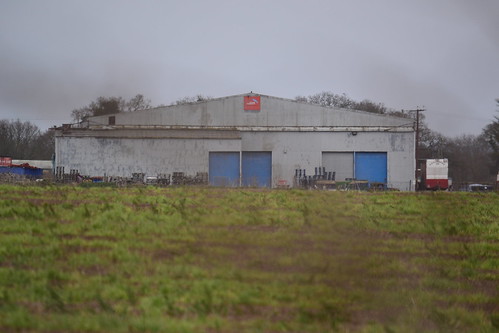
North Pickenham’s last remaining hangar before it was burnt down in 2014.*1

Consisting of the 856th, 857th, 858th and 859th Bomb Squadrons, they were not to fare well at all. In total, the 492nd would carry out sixty-six missions accumulating just over 1,600 sorties. During these operations, they would lose fifty-seven aircraft (including six non-operationally) which was the highest loss of any B-24 unit of the entire Eighth Air Force. Talk of ‘blame’ for these losses was rife; some blamed the aircraft’s all metal finish, saying it attracted fighter attention, others pinned loses on the Luftwaffe’s determination to bring down one single group, whilst another placed it solely at the inability of the crews to fly in neat well-structured formations. Whatever the reasons, it was certain that the 492nd were often ‘Tail-end Charlies‘ finding themselves in the weakest and most vulnerable positions of the formations – easy pickings for the now determined and desperate Luftwaffe pilots.

With loses continuing to climb and talk of a jinxed group spreading, an order came though on August 5th 1944 for the 492nd to withdraw from combat missions and take over ‘Carpetbagger‘ operations previously being performed by the 801st at RAF Harrington.  This order would not end the 492nd’s increasing casualties though. On the following day, another two B-24s would both collide on approach to the airfield. #44-4016 ‘Sugar-n-Spice‘ and #42-50719 ‘Sans Souci‘ struck each other causing them both to crash. The accident resulted in the loss of eleven crewmen with another nine injured.

Finally, on 7th August the order was put in place and after the last mission that day, the move began. This reshuffle of numbers and crews was in reality the disbandment of the 492nd, the crews and ground staff being spread far and wide and the 492nd name being transferred to an already well established unit – the 801st.

The loss of these personnel gave North Pickenham a short respite from the rigours of war. But it would only be short. Within a few days, conflict would return as yet another B-24 unit, the 491st Bomb Group, would move in.

Originally designated to reside at North Pickenham, they were instead directed to RAF Metfield, primarily due to the immense progress that the 492nd had made in their training programme. Whilst there must have been concerns around the jinxed airfield, in terms of operational records, the 491st were to be quite the reverse of the 492nd. The 491st arrived at North Pickenham on the 15th August, and continued with their operations over occupied Europe. Like their previous counterparts, they focused on industrial targets in Germany, flying deep in to the heart of the Reich: Berlin, Hamburg, Cologne. Gelsenkirchen, Hannover and Magdeburg.

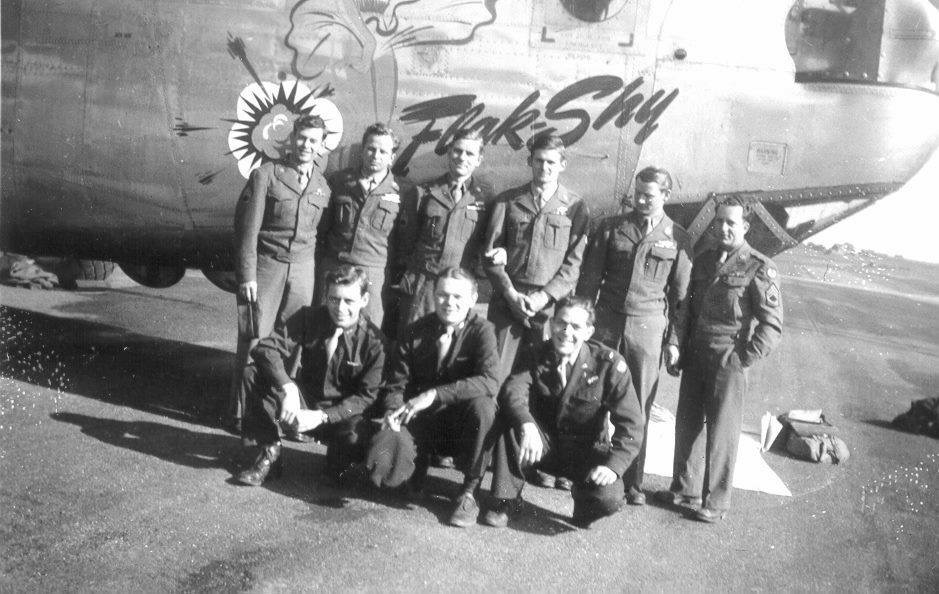
Ben Glidden front left pilot of ‘Flak Shy’ 491BG (Photo John Glidden)

It was on one of these missions, on November 26th 1944, that they were awarded a Distinguished Unit Citation (D.U.C.) for successfully bombing their target in Misburg despite very heavy loses from a prolonged and determined German counter attack. Out of the original 27 aircraft that set out from North Pickenham that day, 15 were lost to enemy action.

As 1944 turned into 1945 the appalling European weather set in. The cold snows of the 1944/45 winter were one of the worst on record, as troops in the Ardennes and ground crews of the Allied Air Forces were to find out to their discomfort.

Many bombing missions were scrubbed, often at the last-minute, but desperate attempts were regularly made to not only get supplies through, but to bomb strategic positions held by the Germans. On January 5th 1945, heavy snows fell across England and in an attempt to attack German positions, two B-24s of the 491st took off from North Pickenham with disastrous results.

The two aircraft, B-24 #44-40165 ‘Rage in Heaven‘ the unit’s assembly ship, and B-24J #42-50793, both crashed just after take off, with considerable loss of life. As a result, the decision was then made for the 491st to abandon any further attempts to get aircraft airborne, and their part in this operation was cancelled. Even though some 1,000 aircraft of the 1st, 2nd and 3rd Air Divisions would get aloft that day, January 5th would become a black day and notoriously famous for a number of such incidents across the English countryside.

The remains of B-24 #42-50793 lay in the heavy snows of North Pickenham following a crash on January 5th 1945.  One of two 491st aircraft that crashed that day in snow storms. (IWM FRE 8588)

Eventually by April 1945, “The Ringmasters” as they had become known, had amassed over 5000 sorties, dropping over 12,000 tons of bombs, for the loss of only 47 aircraft on operational missions over occupied Europe. In June and July, after cessation of conflict, they began their withdrawal and a gradual return to the United States. A few days of ‘R and R’ then led to their inactivation on September 8th 1945.

After the group left North Pickenham, no other flying squadrons were based here, neither American or RAF, but a brief residency of Thor missiles operated by 220 Sqn between 22nd July 1959 and 10th July 1963, saw the site brought back to life momentarily. Finally, a last reprieve in 1965 saw testing of the Kestrel VTOL aircraft which of course became famous as the Harrier, one of the many British Jet Aircraft to see combat operations in the post war eras.

After the Kestrel trials were over, the site was closed and sold off, returning to a mix of poultry farming, and light industry. Many of the hardstands were removed, buildings left to deteriorate and the perimeter track reduced to a fraction of its former self. As time has gone on wind turbines have sprouted up across the open landscape making good use of the winds that blow across the Norfolk countryside.

RAF North Pickenham

“Stanton” shelter located at South Pickenham.

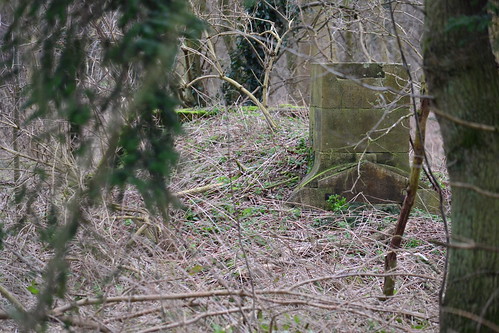
Despite this decline, there are still signs of this once busy station to see. If approaching from the south, you will pass through South Pickenham first. Follow the leafy road toward the village, but keep a sharp eye open for amongst the trees are a series of “Stanton” air raid shelters of which there are five in total. Many of these are only visible by the escape hatches serving the top of the shelter. These were part of the domestic site that once served the airfield.

Some of these shelters are easily accessible being a few feet from the roadside, but as always, caution is the key word when visiting, and remember the laws of trespass! Moving further on, take a left and you pass a small collection of buildings on the right hand side.

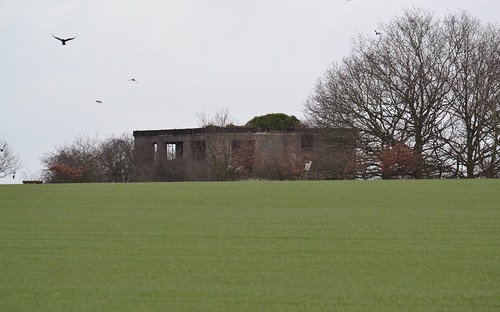
These are the operations block and the store for the American  Norden M7 bomb sight. In a very poor state of repair, they once played a major role in the American offensive over Nazi Germany, – there must be many stories held within their crumbling and decaying walls. Continue past the buildings and you arrive at a ‘T’ junction. Turning right will take you to the airfield, now an industrial site and turkey farm. Access from here is both limited and private. Instead turn left, follow the road along, and then join the B1077. Turn right and drive for a mile or two, the airfield is on your right. A suitable parking space allows views across the field where its enormity can be truly understood. Now containing many turkey sheds along its runways, the outline is distinct and relatively clear considering its age. Up until November 2014 one of the original hangars still remained*1 fire destroying the structure, and what was left then subsequently removed. A number of ordnance huts mark the former location of the bomb dump, these can still be seen in the foreground from this high vantage point. The Watch Office, built to design 12779/41was demolished many years ago but stood opposite you and to the right.

It is also possible to view the main runway. By driving around the site via Swaffham, or retracing your steps though the village, the best view is from the northern end of the airfield on the road from Swaffham to Bradenham, close to the village where the base gets its name. Substantial is size, these runways have fared remarkably well and the sheer size of them easily discernible from the views at this end.

North Pickenham may truly fit the description of ‘ghost’ airfield, its chequered history includes not only one of the worst fatality records of the whole eighth Air Force, but it also attracted a lot of Luftwaffe attention. In excess of 200 German bombs were dropped on it during its short and rather dramatic wartime life. Handed over to the Americans in May 1944, it was the 66th and final one to be so, thus ending a remarkable chapter in world history.

A memorial to the servicemen who flew from North Pickenham, lays silently in the village on the edge of a new housing development. Wreaths from nearby RAF Lakenheath enforce the link between the current American Air Force and Norfolk’s legendary flying history.

On leaving the remnants and stories of North Pickenham, we continue south-east, toward the former RAF Watton, another now extinguished British airfield.

DSC_0056

Memorial dedicated to those who flew from, and never returned to, North Pickenham.

North Pickenham was originally visited in early 2014, this post has since been updated.

*1 This hangar was burnt down in November 2014. My thanks to the anonymous reader for the updates and corrections.

Sqn. Ldr. Leonard Trent VC – RAF Methwold.

RAF Methwold was a small airfield that was never intended to be a major player in the Second World War, yet it would see some remarkable achievements performed by the people who were stationed there.

Once such notable person was Squadron Leader Leonard Trent V.C., who, on 3rd May 1943, took a squadron of Lockheed Venturas on a ‘Ramrod’ Mission to attack an electricity power station on the northern side of Amsterdam.

As part of a larger attack, it would not be a mission central to Bomber Command’s overall bombing strategy, but more a mission of support and encouragement to the resistance fighters bravely fighting in occupied Holland.

Trent (N.Z.248i), born in Nelson, New Zealand on 14th April 1915, achieved his wings with the RNZAF in Christchurch in May 1938, a month before sailing to England and a role with the Royal Air Force.

At the outbreak of war he was sent with No. 15 Squadron flying Fairy Battles, to France to carry out photo-reconnaissance sorties over occupied territory. The squadron then moved back to England (RAF Wyton) and changed their Fairy Battles for Bristol Blenheim IVs.

After carrying out a number of low-level attacks, he was awarded a DFC for his part in the air war over Belgium, after which he became a flying instructor for RAF crews.

Wing Commander G J “Chopper” Grindell (centre), Commanding Officer of No. 487 Squadron RNZAF, with his two flight commanders in front of a Lockheed Ventura at Methwold, Norfolk. On his left is the ‘A’ Flight commander, Squadron Leader T Turnbull, and on his right is the commander of ‘B’ Flight, Squadron Leader L H Trent. (IWM)*1

In 1942 he returned to operational duties as a newly promoted Squadron Leader taking command of B Flight, 487 (NZ) Squadron at Feltwell. At the time 487 were part of No. 2 Group and were in the process of replacing their Blenheims with Venturas. The squadron moved from Feltwell to Methwold in early April 1943. Little did they know that only a month later, the Squadron’s Operations Record Book would read: “This is a very black day in the Squadron history…a better set of boys could not be met in 30 years. Everybody is still feeling dazed by the news.”

As an experienced pilot Trent would fly several low-level missions over the low countries, using an aircraft that was originally designed around a small passenger aircraft back in the United States. Whilst having powerful engines, Venturas suffered from poor manoeuvrability and a heavy air frame, these two failings combined with its rather ‘fat’ appearance, earned it the name “flying pig”.

Loses in Ventura operations would be high, and this was reflected nowhere else than on the very mission that Trent would fly on May 3rd 1943.

On that day fourteen Venturas of 487 Sqn were detailed to attack a target in Amsterdam, however only twelve aircraft actually took off, all at 16:43 from RAF Methwold. These aircraft were all part of a much wider operation, one that would involve an escort of nine RAF fighter squadrons. Timing was therefore crucial, as was low-level flying and maintaining the element of surprise. Within five minutes of their departure though, ‘EG-Q’ piloted by Sgt. A. Baker, would return after losing the crew escape hatch. This left eleven aircraft to carry on to the target.

A diversionary attack carried out by aircraft of 12 Group flying ahead of the main formation flew in too high, too soon, thus losing the surprise and alerting the defenders of the impending attack. Caught out by low fuel, many of the escorting fighters had to then leave thus reducing the overall effectiveness of the defensive escorting force. The Luftwaffe, now ready and waiting, had scrambled numerous fighters, a deadly cocktail of FW-190s and Bf-109s. The squadron record book reports an estimated “80+ ” enemy aircraft in the locality of the attacking Venturas.

From this point on things went very badly for 487 Sqn.

As they crossed the Dutch coast Ventura ‘AJ478’ (EG-A) was attacked and shot down by Luftwaffe fighters. Ditching in the sea the crew took to a life raft where Sgt. T Warner, injured in the attack, died of his injuries. Committing his body to the sea the remaining three would be captured and become prisoners of war. Warner’s body would wash up two days later on a Dutch beach and be buried in the small town of Bergen op Zoom – all four were from New Zealand.

A second aircraft, ‘AE916’ (EG-C) was also very badly shot up by the pouncing fighters. However, it managed to return to England landing at their former base RAF Feltwell. The pilot and navigator were both unhurt, but the wireless operator and air gunner were both badly wounded, and were immediately taken directly the RAF hospital at Ely, Cambridgeshire. The aircraft was so badly damaged in the attack that it was written off. For their actions the pilot (F/Lt. Duffill) and navigator (F.O. Starkie) were both awarded the DFC, whilst the wireless operator (Sgt. Turnbull) and gunner (Sgt. Neill) the DFM.  Dufill later went on to become the managing director of Humbrol paints, a company renowned for its paint and modelling supplies.

Pressing on to the target, the casualties got worse and the loss rate increased.

Firstly, Ventura ‘AE684’ (EG-B) was shot down at 17:45 near Bennebroek with the loss of two; at the same time ‘AE731’ (EG-O) was shot down  just north of Vijfhuizen, three crewmen were captured but the fourth, Sgt. Tatam, died. Five minutes later at 17:50, ‘AE780’ (EG-S) was lost, with only one crew member surviving – the aircraft crashing into the suburbs of Amsterdam. Within three more minutes, a fourth aircraft of this group would go down; ‘AE713’ (EG-T) was hit, also causing it to crash in the northern suburbs of Amsterdam, this time killing all on board. By 18:00 there were only two of the eleven aircraft left, ‘AJ209’ (EG-V) flown by Squadron Leader Leonard Trent, and ‘AE716’ (EG-U) flown by F.O. T. Baynton.

Baynton’s aircraft, ‘EG-U’, would then be shot down by fighters causing it to crash in the outskirts of Amsterdam, also killing all four on board. Squadron Leader Trent, seeing all around him fall from the sky, pressed on. Flying toward the target he dropped his bombs and then turned away. Trent bravely and coolly defended his aircraft, shooting down a Bf-109 with his forward facing guns. Shortly after, he too was hit, the aircraft badly damaged, spiralled earthward uncontrollably, breaking up as it did so, throwing both Trent and his navigator F.L. V. Philips, out of the falling wreckage.

Both Trent and Philips were later captured and taken prisoner, the other two crew members; F.O. R. Thomas and Sgt. G. Trenery, both lost their lives in the crash.

One further aircraft, ‘AJ200’ (EG-G) piloted by New Zealander Sgt. J Sharp was thought to crash 3 km west of Schiphol, with only Sharp surviving; whilst the remaining two unaccounted aircraft, ‘AE956’ (EG-H) and ‘AE 798’ (EG-D), were lost over the sea on the way to the target. All eight crewmen were presumed killed, two of them being washed up several days later on the Dutch coast. The remainder were never heard from again.

In the space of only a few minutes, eleven aircraft had been attacked and ten shot down with the loss of 28 young RAF lives.

operations-record-page

The Operations Record Book for May 3rd 1943, shows the depth of feeling felt by the crews at Methwold following the disastrous mission. (Crown Copyright*2)

Trent spent the remainder of the war in Stalag Luft III where he participated in the ‘Great Escape‘. Only on his eventual return to England did the full and disastrous story of what had happened come out. He was awarded the Victoria Cross for his leadership in ensuring the bomb run was completed despite heavy enemy resistance and very high losses. The London Gazette published his citation on Friday 1st March 1946, in the Third Supplement which said:

“Before taking off, Squadron Leader Trent told the deputy leader that he was going over the target, whatever ‘happened…”

It later went on to say…

“On this, his 24th sortie, Squadron Leader Trent showed outstanding leadership. Such was the trust placed in this gallant officer that the other pilots followed him unwaveringly. His cool, unflinching courage and devotion to duty in the face of overwhelming odds, rank with the finest examples of these virtues.” *3

A determined attack, it was flawed from the moment the preceding force were spotted. The Venturas, woefully inadequate and unprotected, were literary cut down from the sky. Fighters escorting the Venturas confirmed seeing seven parachutes from the aircraft, but the scale of the loss was a blow so devastating, it left only six operational crews in the entire squadron.

For many days after, the Operational Record Books indicated “no news of the boys“, and as new crews and aircraft arrived, prayers for their return faded, but hopes for a return to operational status rose. Following a number of training flights, the next operational mission would finally take place on May 23rd, a mission that was a total success, and one that must have boosted the morale of the squadron immensely.

This mission was a disaster for the Royal Air Force and for Methwold in particular. The loss of life dealt a huge blow to the community both on, and around the base. In memory of these gallant young men, many of whom were never found, their names are inscribed on the Runnymede memorial, whilst those whose bodies were recovered, remain scattered in various graves across the Dutch countryside.

May their memories live for evermore.

RAF Methwold appears in Trail 8.

Sources and further reading.

*1 Photo source The Imperial War Museum Collections

*2 AIR\27\1935\13

*3  The London Gazette: (Supplement) no. 37486. p. 1179. 26 February 1946. Retrieved 29th January 2017

AIR\27\1935\13 – Operational Records Book (summary), The National Archives

AIR\27\1935\14 – Operational Records Book (work carried out), The National Archives

Chorley, W.R., Bomber Command Losses, 1943, Midland Counties, 1996