November 7th 1945 – World Air Speed Record Herne Bay.

Trail 44 takes a look at the aviation highlights of the North Kent Coast in the small town of Herne Bay and its neighbour Reculver. It was here, on November 7th 1945, that the World Air Speed record was set in a ‘duel’ between two Gloster Meteors, as they raced across the Kent Sky.

On that day, two Meteor aircraft were prepared in which two pilots, both flying for different groups, would attempt to set a new World Air Speed record over a set course along Herne Bay’s seafront. The first aircraft was piloted by Group Captain Hugh Joseph Wilson, CBE, AFC (the Commandant of the Empire Test Pilots’ School, Cranfield); and the second by Mr. Eric Stanley Greenwood O.B.E., Gloster’s own chief test pilot. In a few hours time both men would have the chance to have their names entered in the history books of aviation by breaking through the 600mph air speed barrier.

The event was run in line with the Fédération Aéronautique Internationale‘s rules, covering in total, an 8 mile course flown at, or below, 250 feet. For the attempt, there would be four runs in total by each pilot, two east-to-west and two west-to-east.

With good but not ideal weather, Wilson’s aircraft took off from the former RAF Manston, circling over Thanet before lining his aircraft up for the run in. Following red balloon markers along the shoreline, Wilson flew along the 8 mile course at 250 feet between Reculver Point and  Herne Bay Pier toward the Isle of Sheppey. Above Sheppey, (and below 1,300 ft) Wilson would turn his aircraft and line up for the next run, again at 250ft.

Initial results showed Greenwood achieving the higher speeds, and these were eagerly flashed around the world. However, after confirmation from more sophisticated timing equipment, it was later confirmed that the higher speed was in fact achieved by Wilson, whose recorded speeds were: 604mph, 608mph, 602mph and 611mph, giving an average speed of just over 606mph. Eric Greenwood’s flights were also confirmed, but slightly slower at:  599mph, 608mph, 598mph and 607mph, giving an overall average speed of 603mph. The actual confirmed and awarded speed over the four runs was 606.38mph by Wilson*1.

The event was big news around the world, a reporter for ‘The Argus*2‘ – a Melbourne newspaper – described how both pilots used only two-thirds of their permitted power, and how they both wanted permission to push the air speed even higher, but both were denied at the time.

In the following day’s report*3, Greenwood described what it was like flying at over 600 mph for the very first time.

As I shot across the course of three kilometres (one mile seven furlongs), my principal  worry was to keep my eye on the light on the pier, for it was the best guiding beacon there was. On my first run I hit a bump, got a wing down, and my nose slewed off a bit, but I got back on the course. Below the sea appeared to be rushing past like an out-of-focus picture.

I could not see the Isle of Sheppey, toward which I was heading, because visibility was not all that I wanted.

At 600mph it is a matter of seconds before you are there. It came up just where I  expected it. In the cockpit I was wearing a tropical helmet, grey flannel bags, a white silk shirt, and ordinary shoes. The ride was quite comfortable, and not as bumpy as some practice runs. I did not have time to pay much attention to the gauges and meters, but I could see that my air speed indicator was bobbing round the 600mph mark.

On the first run I only glanced at the altimeter on the turns, so that I should not go too high. My right hand was kept pretty busy on the stick (control column), and my left hand was. throbbing on the two throttle levers.

Greenwood went on to describe how it took four attempts to start the upgraded engines, delaying his attempt by an hour…

I had to get in and out of the cockpit four times before the engines finally started. A technical hitch delayed me for about an hour, and all the time I was getting colder and colder. At last I got away round about 11.30am. 

He described in some detail the first and second runs…

On the first run I had a fleeting glance at the blurred coast, and saw quite a crowd of onlookers on the cliffs. I remembered that my wife was watching me, and I found that there was time to wonder what she was thinking. I knew that she would be more worried than I was, and it struck me that the sooner I could get the thing over the sooner her fears would be put at rest.

On my first turn toward the Isle of Sheppey I was well lined up for passing over the Eastchurch airfield, where visibility was poor for this high-speed type of flying. The horizon had completely disappeared, and I turned by looking down at the ground and hoping that, on coming out of the bank, I would be pointing at two balloons on the pier 12 miles ahead. They were not visible at first.

All this time my air speed indicator had not dropped below 560 mph, in spite of my back-throttling slightly. Then the guiding light flashed from the pier, and in a moment I saw the balloons, so I knew that I was all right for that.

On the return run of my first circuit the cockpit began to get hot. It was for all the world like a tropical-summer day. Perspiration began to collect on my forehead. I did not want it to cloud my eyes, so for the fraction of a second I took my hands off the controls and wiped the sweat off with the back of my gloved hand. I had decided not to wear goggles, as the cockpit was completely sealed. I had taken the precaution, however, of leaving my oxygen turned on, because I thought that it was just that little extra care that might prevent my getting the feeling of “Don’t fence me in.”

Normally I don’t suffer from a feeling of being cooked up in an aircraft, but the Meteor’s cockpit was so completely sealed up that I was not certain how I should feel. As all had gone well, and I had got half-way through the course I checked up my fuel content gauges to be sure that I had plenty of paraffin to complete the job.

I passed over Manston airfield on the second run rather farther east than I had hoped, so my turn took me farther out to sea than I had budgeted for. But I managed to line up again quite satisfactorily, and I opened up just as I was approaching Margate pier at a height of 800 feet. My speed was then 560 mph.

Whilst the first run was smooth, the second he said, “Shook the base of his spine”.

This second run was not so smooth, for I hit a few bumps, which shook the base of my spine. Hitting air bumps at 600 mph is like falling down stone steps—a series of nasty jars. But the biffs were not bad enough to make me back-throttle, and I passed over the line without incident, except that I felt extremely hot and clammy.

After he had completed his four attempts, Greenwood described how he had difficulty in lowering his airspeed to enable him to land safely…

At the end of my effort I came to one of the most difficult jobs of the lot. It was to lose speed after having travelled at 600 mph. I started back-throttling immediately after I had finished my final run, but I had to circuit Manston airfield three times before I got my speed down to 200mph.

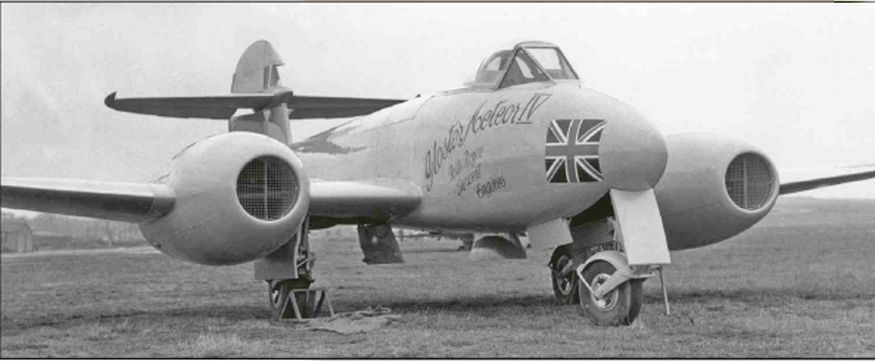
The two Meteor aircraft were especially modified for the event. Both originally built as MK.III aircraft – ‘EE454’ (Britannia ) and ‘EE455’ (Yellow Peril) – they had the original engines replaced with Derwent Mk.V turbojets (a scaled-down version of the RB.41 Nene) increasing the thrust to a maximum of 4,000 lbs at sea level – for the runs though, this would be limited to 3,600 lbs each. Other modifications included: reducing and strengthening the canopy; lightening the air frames by removal of all weaponry; smoothing of all flying surfaces; sealing of trim tabs, along with shortening and reshaping of the wings – all of which would go toward making the aircraft as streamlined as possible.
Related image

EE455 ‘Yellow Peril’ was painted in an all yellow scheme (with silver outer wings) to make itself more visible for recording cameras.*4

An official application for the record was submitted to the International Aeronautical Federation for world recognition. As it was announced, Air-Marshal Sir William Coryton (former commander of 5 Group) said that: “Britain had hoped to go farther, but minor defects had developed in ‘Britannia’. There was no sign of damage to the other machine“, he went on to say.

Wilson, born at Westminster, London, England, 28th May 1908, initially received a short service commission, after which he rose through the ranks of the Royal Air Force eventually being placed on the Reserves Officers list. With the outbreak of war, Flt. Lt. Wilson was recalled and assigned as Commanding Officer to the Aerodynamic Flight, R.A.E. Farnborough. A year after promotion to the rank of Squadron Leader in 1940, he was appointed chief test pilot at the Royal Aircraft Establishment (R.A.E.) who were then testing captured enemy aircraft. He was promoted to Wing Commander, 20th August 1945, retiring on 20th June 1948 as a Group Captain.

Eric Greenwood, Gloster’s Chief Test Pilot, was credited with the first pilot to exceed 600 miles per hour in level flight, and was awarded the O.B.E. on 13th June 1946.

His career started straight from school, learning to fly at No. 5 F.T.S. at Sealand in 1928. He was then posted to 3 Sqn. at Upavon flying Hawker Woodcocks and Bristol Bulldogs before taking an instructors course, a role he continued in until the end of his commission. After leaving the R.A.F., Greenwood joined up with Lord Malcolm Douglas Hamilton (later Group Captain), performing barnstorming flying and private charter flights in Scotland.

Greenwood then flew to the far East to help set up the Malayan Air Force under the guise of the Penang Flying Club. His time here was adventurous, flying some 2,000 hours in adapted Tiger Moths. His eventual return to England saw him flying for the Armstrong Whitworth, Hawker and Gloster companies, before being sent as chief test pilot to the Air Service Training (A.S.T.) at Hamble in 1941. Here he would test modified U.S. built aircraft such as the Airocobra, until the summer of 1944 when he moved back to Gloster’s – again as test pilot.

It was whilst here at Gloster’s that Greenwood would break two world air speed records, both within two weeks of each other. Pushing a Meteor passed both the 500mph and 600mph barriers meant that the R.A.F. had a fighter that could not only match many of its counterparts but one that had taken aviation to new record speeds.

During the trials for the Meteor, Greenwood and Wilson were joined by Captain Eric ‘Winkle’ Brown, who between them tested the slimmed-down and ‘lacquered until it shone’ machine, comparing  drag coefficients with standard machines. Every inch of power had to be squeezed from the engine as reheats were still in their infancy and much too dangerous to use in such trials.

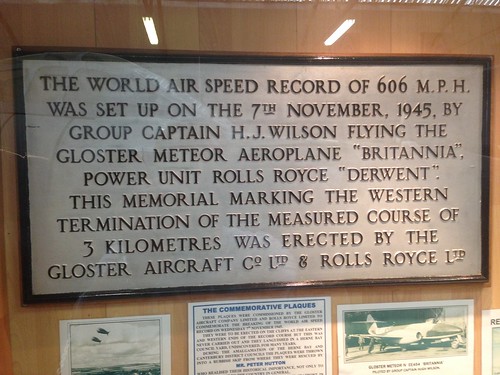
To mark this historic event, two plaques were made, but never, it would seem, displayed. Reputed to have been saved from a council skip, they were initially thought to have been placed in a local cafe, after the cliffs – where they were meant to be displayed – collapsed. The plaques were however left in the council’s possession, until saved by an eagle-eyed employee. Today, they are located in the RAF Manston History Museum where they remain on public display.
RAF Manston History Museum

One of the two plaques now on display at the RAF Manston History Museum.

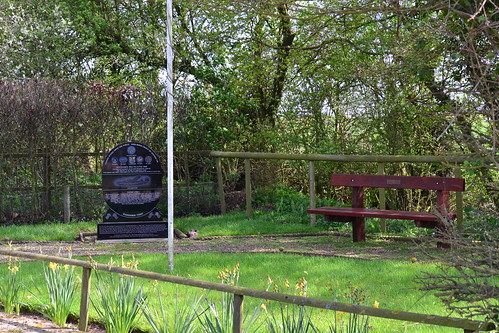
To mark the place in Herne Bay where this historic event took place, an information board has been added, going some small way to paying tribute to the men and machines who set the world alight with a new World Air Speed record only a few hundred feet from where it stands.

Part of the Herne Bay Tribute to the World Air Speed Record set by Group Captain H.J. Wilson (note the incorrect speed given).

From Herne Bay, we continue on to another trail of aviation history, eastward toward the coastal towns of Margate and Ramsgate, to the now closed Manston airport. Formerly RAF Manston, it is another airfield that is rich in aviation history, and one that closed with huge controversy causing a great deal of ill feeling amongst many people in both the local area and the aviation fraternity.

Sources and Further Reading.

*1 Guinness World Records website accessed 22/8/17.

*2 The Argus News report, Thursday November 8th 1945 (website) (Recorded readings quoted in this issue were incorrect, the correct records were given in the following day’s issue).

*3 The Argus News report, Thursday November 9th 1945 (website)

*4 Photo from Special Hobby website.

The RAF Manston History Museum website has details of opening times and location.

The Manston Spitfire and Hurricane Memorial museum website has details of opening times and location.

RAF Metheringham – One of Bomber Command’s finest. (Part 3)

In this, the last part of RAF Metheringham, we see how one of its brave crews earned the Victoria Cross for their outstanding bravery, and how, as the war camr to a close, Metheringham was closed down and disposed of.

On the night 24th/25th April, 1944, took 106 Sqn back to Germany once more, to Munich and another ‘clear night’ with accurate bombing reported. But, then it was Schweinfurt a city that would become synonymous with high casualties especially amongst colleagues in the US Air Force.

Metheringham would send sixteen aircraft that night with take off commencing at 21.25 from the Lincolnshire airfield with another mix of 4,000lb, 41lb and 30lb bombs. Over the target, marking would again be low level by Mosquitoes but this time  it was inaccurate. Strong winds hampered the bombers, with many of the bombs falling away from the main target. Crews reported large fires across the city accompanied by ‘large explosions’. Sadly these were not to be the target and as a result the mission was not deemed a success.

Of the 206 Lancasters sent out that night (26th/27th) twenty-one were lost to heavy and sustained night fighter attacks, a figure of 10% of the force, a terrible blow for Harris and his Command. From Metheringham, five aircraft failed to return, with a further one returning on three engines. Methringham’s loss that night was some 31%, a third of its force gone in one mission. It was a difficult mission for 106 Sqn, with thirty-six airmen lost,  (JB601 was carrying a second pilot). Ten of these were taken alive as POWs, four managed to evade capture, whilst the rest were killed. The deaths of the remaining twenty-two must have had another huge impact in the Metheringham dining room that morning.

During this mission the remarkable actions by the crew of Lancaster ME669, and in particular Flight Engineer Sergeant Norman C. Jackson (later Warrant Officer), would become well known. After being hit several times by a  night fighter, a fire started in the inner wing section next to the upper fuel tank.  Sgt. Jackson, who had been wounded in the leg and shoulder, donned his parachute and grabbed a fire extinguisher before climbing out on to the wing through an escape hatch in the fuselage roof. Upon leaving, his parachute was deployed into the cockpit area, where his colleagues gathered it up and gradually fed the lines through the hole allowing Jackson to gain access to the fire in the wing. Undertaking such an act on a burning aircraft and at altitude, was no easy task and getting back, had he been successful, virtually impossible. The wind knocked the extinguisher out of his grip which prevented Jackson from succeeding in achieving his aim. The fire, now spreading, began to burn both his parachute, hands and face and fearing for his safety, his colleagues let go, releasing him from the stricken bomber. Sgt. Jackson fell to Earth, his parachute partially burned, opened and allowed him to reach the ground alive, but suffering several injuries in the process.

The 21 year old Canadian Captain, F/O. Frederick M. Miffin D.F.C., then ordered the crew to abandon the aircraft; himself and 20 year old F/Sgt, Norman H. Johnson (Air Gunner) both failing to survive.

Sgt. Jackson’s brave attempt to save his colleagues and their aircraft earned him the Victoria Cross for his actions, his citation being published in the Fourth Supplement to the London Gazette on Tuesday 23rd October 1945.*2

The Schweinfurt raid had been a major blow to the Metheringham crews, but it had also shown their courage and determination to win, regardless of the dangers to their own safety.

Another heavy blow on the night of 7th/8th May took another four aircraft along with all but one of the crew, Sgt. J Smith evading capture, in a month that would see a further six aircraft go down with heavy losses.

June 1944 would see another remarkable event take place. Although the entire crew of DV367 were lost on the night of 7th / 8th, they were all awarded the DFM for their action, an usual act in any squadron, and one that nonetheless reflected the bravery of RAF crews at that time.

RAF Metheringham

Metheringham’s memorial garden rests besides a C-47 Dakota ‘KG651’ as a representative model that visited the airfield at the end of the war. Visitors are able to enter the aircraft and sit in the cockpit.

Following the Allied invasion of Normandy, the US forces would begin to use Metheringham as an evacuation point for wounded American troops from nearby  Nocton Hall Military Hospital. Once a suitable recovery had been made, the troops were brought to Metheringham and flown on to Prestwick for onward travel and reparation to the United States.

Rarely a month would go by without the squadron facing some loss. Exactly a month later in July, Metheringham would see yet another dip in their crew numbers as five more aircraft went down on the mission to St.-Leu-D’Esserent – the flying bomb storage dump. A force of 208 Lancasters and thirteen Mosquitoes accurately bombed the mouth and access roads to the tunnels in which the bombs were being stored. Metheringham’s loss was particularly high, almost a third of the sixteen sent out being lost. Whilst many airmen were either captured or evaded capture, another eighteen were lost.

In September 1944, No. 1690 (Bomber) Defence Training Flight arrived ay Metheringham airfield. A unit formed seven months earlier at Syerston after 1485 (Bomber) Gunnery Flight was re-designated, it operated a number of single and twin engined aircraft including the Spitfire, Oxford and Wellington bomber under the code ‘9M’. They were used to train bomber crews in the art of defence against fighters, performing violent moves to throw off their attacker. One famous pilot of this unit who served at Metheringham was the Commanding Officer Sqn. Ldr. John Leslie Munro, CNZM, DSO, QSO, DFC, JP of 617  Sqn fame. The Flight would leave Metheringham in the summer of 1945, being disbanded in October that same year back at Syerston.

It had been a long and difficult war for the crews at RAF Metheringham. As the end of the war drew ever closer, they all knew their last mission would soon be here. On April 25th 1945, that day arrived.

Sixteen Lancasters took off to either bomb Tonsberg in the southern region of Norway, or mine the Oslo fjord. A last ditch effort to force the capitulation of the German leadership and end the conflict that had devastated the world for the last six years.

By the time the cease fire was announced, 106 squadron had flown 5,834 sorties with a loss of 187 aircraft (59 from Metheringham), 3.21% on average per mission. 17,781 tons of bombs and mines were dropped and 267 decorations awarded.

After the war, 106 Sqn was earmarked for ‘Tiger Force’ operations and training was tailored to meet these new requirements: fighter affiliation sorties, high level bombing and air-sea firing exercises. Also during May, operation ‘Exodus‘ was put into place and a number of 106 Sqn aircraft flew to the Continent to bring back POWs, many landing at Dunsfold on their return. On the 9th May, whilst evacuating POWs from Rheine airfield, one aircraft from 106 Sqn struck a bomb crater causing damage to the aircraft, the crew and their valuable cargo of POWs thankfully escaped unhurt. The aircraft was then repaired with parts being ferried over from Metheringham the next day. Between May 4th and May 11th, Metheringham crews repatriated 1,484 prisoners of war bringing them home from captivity.

During June aircraft were exchanged with those from 8 Group at RAF Oakington, RAF Warboys and RAF Graveley, allowing Operation ‘Firebrand‘ to be completed by the 19th. Other operations included ‘Rebecca‘, ‘Dodge‘, ‘Nickel‘ and ‘SPASM‘.

On June 15th, another Lancaster squadron, No. 467 (RAAF), joined 106 here at Metheringham. In the days preceding their arrival, they spent many hours dropping ordnance into the sea, a comment in the ORB stated “it seemed like the old days with all serviceable aircraft loaded with incendiaries and it looked like a real operational take off.” It goes on to say a ‘waste but necessary‘ reflecting perhaps the feelings of the men as the squadron wound down for the final few weeks.

The advanced party arrived to make sure the transition went smoothly, with the main party arriving shortly afterwards. Beer was supplied by Metheringham and the crews soon got to know each other well. On July 11th, an athletics competition was run between the two squadrons, involving contests such as ‘tug-o- war’, ‘hop, step and jump’, ‘throwing the cricket ball’ and distance races.

With the announcements of Japan’s capitulation on August 15th, all 106 Sqn ‘Tiger Force’ training flights were cancelled although it continued to be used as the basis of further training operations. B.A.B.S. (Beam Approach Beacon System) training also continued at the airfield.

RAF Metheringham

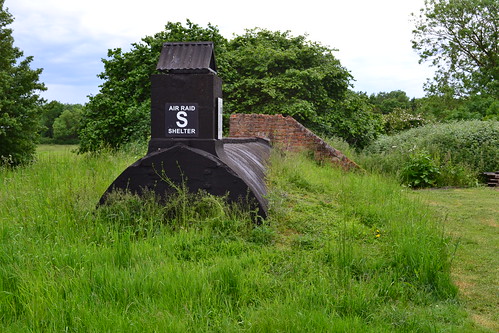
Air Raid Shelters were once common place on Britain’s airfields.

Shortly after 467’s disbandment on September 30th 1945, October saw yet another Lancaster unit arrived at Metheringham, No. 189 Squadron who brought yet more Lancaster MK.Is and III. to be disposed of and they too were disbanded within a month.

The poor weather that had caused so many problems during the winters of the 1940s leading to Metheringham having FIDO installed, continued on into 1946 curtailing many flights and operations. On 13th  February 1946 the final curtain came down and a memo came though to Metheringham to ‘stand down’ from all operational and non-operational flying as of 00:01, 15th February 1946. Sixteen aircraft were to be ferried to RAF Graveley to have Mark III H2S units fitted, although this was cancelled and the aircraft were sent to Waddington (10), Binbrook (1), Lindholme (4) and one further Lancaster going to Waddington. By 22nd February 1946 all aircraft had left Metheringham and the squadron no longer existed, 106 Squadron was once more consigned to the history books and Metheringham airfield would follow not long after. Men, machinery and administrative items were then disposed of in accordance with the relevant Bomber command instructions. By April, everyone had left, the site was stripped and placed in care and maintenance, a condition it remained in until December 1950, whereupon it was abandoned before being sold off ten years later.

Like many stations, local people used the accommodation sites for their own accommodation, the runways were eventually pulled up for hardcore, buildings and other metal structures were removed for scrap or sold off to farmers. By the early 1970s Metheringham had all but been wiped off the map. The Watch Office left to decay has since been bought by a local developer, with a mammoth task ahead of him he hopes to turn it into accommodation and a small museum/residential block.

Metheringham’s record of achievement was a proud one, with generally low loss statistics they were to face some of the toughest challenges of the war, losing many crews in the process. Their determination to survive and to win over the Nazi tyranny led to many brave and heroic acts, acts which helped secure the release of hundreds of captured airmen.

RAF Metheringham

There are many reminders of RAF Metheringham.

Metheringham’s gallant and brave young men, are all remembered in a small, but excellent museum that now utilises part of one of the accommodation areas. A memorial to the aircrew stands on the eastern perimeter track as a reminder of the 995 Airmen who were lost whilst serving with 106 Sqn.

Much of Metheringham’s runway and perimeter track still exists today, in most part as a public road. The width of the concrete bases far exceeding the width of the road. A memorial stands to the eastern side overlooking the main airfield site (Site 1) with lines of tress denoting the remainder of runways long gone. The main B1189 road dissects the accommodation areas with Site 1, as was common with late wartime airfields. The museum lies off the junction of this road and the main Woodhall Spa road B1191 along the entrance to Westmoor Farm. If taking the B1189 toward the Metheringham village, you will pass a number of former wartime buildings used as small industrial units and farm storage. These are on private land although the museum do organise visits to some of these at certain times of the year. After passing these, turn right, this road was one of the secondary runways and crosses the remains of the main runway part way down. It then bends to the right taking you along the perimeter track, and then right again to the memorial – a circular route that traverses what was the peri track. Several of the hardstands still survive, mainly on farm property and difficult to see from the ground, but the number of buildings still standing is quite remarkable for such a short lived airfield.

Trail 1 then continues on, visiting another former Bomber Command airfield RAF Woodhall Spa.

Sources and further reading.

*1 Fleming, J., “The Callendar Effect: The Life and Work of Guy Stewart Callendar (1898-1964)“, 2007, The American Meteorological Society

*2 The London Gazette, 23rd October 1945.

*3 Operational Record Book March 1944 – IWM AIR-27-834-6

Operational Record Book January 1944 – IWM AIR 27/834/1

Operational Record Book November 1943 – IWM AIR 27/833/22

Operational Record Book April 1944 – IWM AIR 27/834/8

Operational Record Book – Squadron Number: 106 Summary of Events: Y – IWM AIR 27/835/9, (01 May 1945 – 28 February 1946)

467 RAAF (Royal Australian Air Force) Summary of Events: Y 01 May 1945 – 30 September 1945 – IWM AIR 27/1931/33

Middlebrook. M., Everitt. C., “The Bomber Command War Diaries.” 1996, Midland Publishing.

Records of a 1690 BDTF pilot can be read on the Website ‘A Pilot’s Story‘.

Metheringham Airfield Museum webiste holds details of opening times, admission fees and special events. An excellent little museum it is well worth a visit.

RAF Metheringham – One of Bomber Command’s finest. (Part 2)

After Part 1, we continue following the crews of 106 Squadron at RAF Metheringham. The weather and in particular fog became a huge problem for aircrew, and bomber Command in particular. Something had to be done.

During the 1940s, fog was a particular problem around Britain’s airfields, often reducing visibility down to virtually nil, meaning bombers could neither take off nor land. Arthur Harris realising the effect this was having on his bomber operations, requested investigations be carried out into a possible method for clearing the fog thus allowing bombers to operate in this appalling conditions and widening the possibilities of operations in bad weather.

Churchill, influenced by Harris’s argument, instructed his Scientific Adviser Lord Cherwell to begin action at once, and so the Petroleum Warfare Department began to assemble a team of experts – who had already carried out some investigations into the weather and methods for dealing with fog – into a team to investigate the problem. A wide ranging group of scientists and industrialists carried out research concluding that heat was by far the best method for clearing fog over the low lying landscape.

The requirement put forward was to clear a standard Class A runway of at least 1,000 yards long and 50 yards wide, and an area up to 100 feet above the ground – a staggering 1.65m cubic yards of air. Further limitations were then put on the order restricting the placement of any obstacles likely to endanger an aircraft within 50 feet of the runway’s edge.  A mammoth task but one which saw the development of the oil burning FIDO system.

The FIDO (Fog Investigation and Dispersal Operation) system was developed under the leadership a British Civil Engineer Arthur Clifford Hartley, CBE who worked with the Petroleum Warfare Department, and whose initial ideas involved using one of two streams of fuel; petroleum trialled at RAF Graveley, and Coke trialled at RAF Lakenheath.  After initial (and rather crude) tests at both Moody Down (petroleum) and Staines (coke), petroleum was found to be the better of the two fuels, and henceforth, the Gravely model was used as a template for fourteen further sites of which Metheringham was one.

Installed at Metheringham during early 1944, it saw pipes laid alongside the runway which when lit, created an initial mass of smoke. Once the system had ‘warmed up’ the smoke dissipated and the fog began to ‘burn off’ as the immense heat from the burners created an up draft of warm air.

By the war’s end FIDO had been used across England to assist in the landing of almost 2,500 aircraft most of which would otherwise have not been able to land without great danger to the crews or ground staff; it had been one of the war’s greatest success stories and was sold as such to the wider public. So successful in its outcomes, FIDO was intended to be installed at London’s major airport Heathrow, after the war, but the cost of running each system was astronomical, burning some 6,000 – 7,000 gallons of fuel in four minutes – the time it took to clear the designated volume of air. It is estimated that during its wartime use, something like 30 million gallons of fuel were burnt and whilst the cost to the taxpayer was tremendous,  it is thought to have saved the lives of over 10,000 airmen in the process.*1

Back in the air, the night of March 15th/16th saw split missions  with one section going to Stuttgart and and a further six aircraft heading to the aero-engine factory at Woippy in France. These six made up a total formation of twenty-two Lancasters, a flight that included 617 Sqn aircraft. With promises of good weather over the Metz region, it came as  a huge disappointment to find 10/10 cloud cover over the entire target.  Even with the target being identified on the H2S screen and five marker flares being dropped, the leader announced the mission scrubbed and all aircraft were instructed to return to base taking their full complement of bombs with them. So strong were the crew feelings that 617 Sqn’s leader, Leonard Cheshire, seriously considered complaining! However, despite this, all aircraft returned including those of 106 Sqn to Metheringham with only minor flak damage to ND331.

Lancaster B Mark IIIs of No. 106 Squadron at Metheringham,heading to Frankfurt. The attack on 22/23 March 1944 caused extensive destruction to eastern, central and western districts of the city. © IWM (CH 12543)

With the next few missions passing without major incident, the night of March 30th, would deal a hefty blow to the crews of 106 Sqn.

With take off starting at 22:15, seventeen Lancasters would depart Metheringham heading for Nurumberg carrying a range of 4,000lb, 1,000lb, 500lb, 41lb and 30lb bombs. Over the target, skymarkers guided the bomb-aimers as cloud was reported as heavy as 10/10 again. Searchlights and flak were evident as were fighters which attacked and damaged Lancaster ND332 piloted by F/O. Penman. The Lancaster, which claimed two enemy aircraft damaged, returned to England putting down on Manston’s emergency runway. Both the rear and mid upper turrets were out of action, one of the engines caught fire, and on landing, the undercarriage collapsed due to the enemy action. luckily though, no crewmen were injured in the sustained attack that caused the Lancaster’s severe damage.

A further Lancaster had to return early, Lancaster JB567 after suffering the failure of the port inner engine landing back at Metheringham after two and half hours into the flight. Similarly it was an engine failure that also caused the early return of JB641 this time landing three hours after departure. Three of the seventeen Lancasters were already out of action.

Meanwhile on the continent, Lancaster ND585, was reported missing, later being found to have been shot down by a German night fighter, crashing in Belgium with the loss of all its crew. On board was, at 18 years old, another of Bomber Command’s youngest ever crewmen, Sgt. Julian Mackilligin RAFVR (S/N: 1804016), who even at his young age, was already half way through his operational quota. He was buried at the Hotton War Cemetery, Luxenbourg.

Next came another two losses, Lancasters JB566 piloted by F/S. T. Hall DFM and ND535 piloted by F/O. J Starkey. Both went down with the loss of all but four crewmen. The mission had indeed been costly, forty-two airmen were out of action, seventeen of them killed.*3

By the end of the first quarter of 1944, 106 Sqn had carried out more sorties than any other 5 Group squadron (358) losing 8 aircraft in the process. This gave the men of Metheringham an average of 19 sorties per aircraft in the first 90 days.

April began with a mix of bombing and ‘Gardening‘ missions, operations that included laying mines along the Koningberger Seekanel, with mines being dropped from as low as 150 ft. Even though some aircraft reported heavy ground fire from the banks of the Canal, the mission was deemed to be a great success and all aircraft returned safely.

The month continued to go well for the Metheringham crews, but the night of April 22nd / 23rd would take another toll on the morale of the crews. That  night saw twenty Lancasters fly to Brunswick as part of  a much larger force of 238 Lancasters and seventeen Mosquitoes. The mission, whilst generally uneventful, marked the first operation in low level target marking by No. 5 Group over a large city, an aid that proved fruitless on this occasion partly due to low cloud/haze obscuring the bomb aimer’s clear sight. With varying reports of cloud from 5/10 to no cloud and haze, all bombers reported bombing on markers, but damage and ground causalities were recorded as low.

RAF Metheringham

The former Gymnasium now forms part of the museum and holds a range functions including weddings and talks.

RAF loses that night were also relatively low, with only four aircraft being lost from the whole flight. Sadly though, one of these, Lancaster MK.III ‘JB567’ ZN-E piloted by F/Lt. J. Lee was a Metheringham aircraft. F/Lt Lee had only one more mission to go before completing his first tour of duty. Only two of his crew survived, being picked up by German forces and sent to POW camps. This loss only went to strengthen the idea that it was difficult, if not impossible, to achieve a full tour of duty unscathed.

The next night 24th/25th April, 1944, took 106 Sqn back to Germany once more, to Munich and another ‘clear night’ with accurate bombing reported. But, then it was Schweinfurt a city that would become synonymous with high casualties especially amongst colleagues in the US Air Force.

In part 3, we see how incredible brave acts earned a Metheringham airman the highest honour – the Victoria Cross.

The entire post can be seen in Trail 1.

RAF Metheringham – One of Bomber Command’s finest. (Part 1)

In this post we return to Lincolnshire and ‘Bomber County’, to the area south of the city of Lincoln. Here, we are not far from the still active RAF Coningsby, the former RAF Woodhall Spa, the Officer Training College at RAF Cranwell and the former bomber base RAF East Kirkby.

Many of the airfields in this area were the RAF’s Bomber Command airfields, several housing the four-engined heavies the Lancaster bomber. Being a flat region of England it was an ideal landscape for Bomber Command, it was also near enough to the continent and yet far away from intruders to suffer the risk of major attack.

We continue on on this trail by visiting one such airfield, an airfield that lasted until the war’s end featuring only one major flying unit, 106 Squadron. Today, we add a new addition to Trail 1 as we visit the former base RAF Metheringham.

RAF Metheringham.

Located on the edge of the Lincolnshire Fens 3 miles east of the Lincoln Cliff escarpment, and near to the village from which it takes its name, Metheringham was opened in 1943 as a class ‘A’ bomber airfield under the control of No. 54 Base, 5 Group, RAF Bomber Command. It would fall under the control of the main base at RAF Coningsby, operating in conjunction with RAF Woodhall Spa, in a three station network implemented to streamline the Bomber Command structure.

Like many airfields of the time, it had the usual three concrete  runways; a main runway running slightly off north-south at  2,000 yds,  and two additional runways of 1,400 yds each running north-east to south-west and north-west to south-east. The technical area was located to the west of the airfield, with the huge bomb store to the north. Metheringham had two T2 hangars and one B1, along with numerous spectacle hardstands around the perimeter track.

RAF Metheringham

Large sections of Metheringham’s runways still exist mainly as public highways. The line of trees denotes a further runway.

The accommodation areas, mainly Nissen hutting, were spread to the south and west of the airfield, separated from the main airfield by the public highway, a feature common with many late wartime airfields. The entire site covered 650 acres, previously utilised as forest or rich farmland,

Built from requisitioned land over the winter of 1942/43, construction was not complete until after the advanced party arrived in early November 1942. Described by some as ‘cold’, ‘bleak’ and ‘inhospitable’, it was not unlike the many other unfinished wartime airfields scattered across Britain at the time. Muddy and with little in the way of creature comforts, it was soon to be home for bomber crews of the Royal Air Force, who would reside here for the remainder of the war.

With the advanced party hurriedly connecting mains water and power, the first and primary unit to serve from the airfield, 106 Squadron, began arriving hoping for something more than cold huts and muddy pathways.

A First World War Squadron who had been disbanded in 1919 and reformed in 1938 as war loomed, 106 Squadron had initially operated single engined and twin-engined light trainers before transferring to No. 5 Group and bombers. It first real foray into the bomber war was with the under-powered Manchester before switching to the far superior big sister, the Lancaster, in May 1942. This change over occurred at their previous station RAF Syerston, and within a week of their November 11th arrival here at Metheringham, they were flying their first Metheringham mission, and it would be right into the German Heartland.

Following on from the usual familiarisation flights, thirteen Lancasters of 106 Sqn would take to the air on the night of November 18th/19th for a bombing raid on the German capital. Mid November signified the start of  a period known as the ‘Battle of Berlin’, a period in the Second World War where Air Chief Marshal Sir Arthur Harris, would finally get the chance to put into practice the idea that massed bombing of the capital would bring about the demise of the morale of the population by sustained attacks from Bomber Command. After witnessing first hand the Blitz of Britain’s cities, Harris was determined that such a campaign could succeed. However, ignoring the fact that the German’s own example had failed in reducing the British morale, he pressed on, sending wave after wave of bombers deep into Germany and Berlin itself.

So it began on that November night. With each 106 Sqn Lancaster carrying a 4,000lb bomb along with a mix of smaller bombs, they set off for Berlin. With moderate flak over the target, and no night-fighters encountered,  resultant damage was light especially compared to some missions that would be flown by the Command.

The raid itself was not considered a great success, and whilst no major injuries were sustained on the mission, Sgt. R. Smith, the Mid upper gunner of Lancaster JB642, suffered severe frost bite after passing out due to a faulty Oxygen system in the aircraft. After landing at the fighter airfield at RAF Tangmere, Sgt Smith was treated for his injuries.

With one other aircraft landing away from base, the remainder of 106 Sqn all made it back to Metheringham with relatively minor damage. A remarkable escape considering the nature of the target.

RAF Metheringham

There were plans to rebuild the Watch Office, a mammoth task considering its very poor condition.

A return to Berlin saw 106 Sqn back in the air on the 22nd/23rd and then again on the following night 23rd/24th November. The continuing spell of good luck saw all crews return safely again with only light to moderate damage to their aircraft. However, the night of 26th/27th would see 106’s luck finally run out and the first Metheringham loss.

Lancasters JB592 piloted By F/O. J. Hoboken DFC (his third flight to the capital that week) and ED873 piloted by F/O. R. Neil, were both lost that night. JB592, was brought down not far from Gross-Karben, in Hesse Germany with the loss of all the crew on board. ED873 suffered early engine problems with the starboard outer engine surging not long after take off. Once passed the coast, the 4,000 lb bomb was safely jettisoned and sent to the waters below where it was seen to explode by the crew. The aircraft then turned to land, overshot the runway and crashed into a field opposite the airfield. The crew were uninjured apart from the rear gunner (Sgt. Parker) who received minor injuries in the crash. This injury would however, prove to be a godsend, playing a vital role in his survival later on. This third night of bombing saw a force of 443 Lancasters take a heavy toll, with 28 being lost in action over the continent and another 14 over England. A loss rate of over 6%.

It was F/O. Neil’s crew who, after their lucky escape, would fall as the next victims of Berlin’s defence. With the original rear gunner still out of action due to the broken arm received in the last crash, he was replaced by Sgt. G. Stubbs, who made his last and fatal flight in ED874 on the night of December 2nd/3rd. The aircraft was brought down with the loss of all those on board, including the replacement Sgt. Stubbs. Berlin was fast becoming a rather large and sharp thorn in the side of Metheringham crews who by now, longed for a change in the target.

With one more Lancaster lost that year (Lancaster MK.III ‘JB638’, ZN-G) again with all on board, the cold 1943 winter drew to a close with many empty bunks in the Metheringham huts. It would be a long and bitter winter though, a winter that would last for several months over the 1943/44 period and all as the Battle for Berlin continued to rage on.

The New Year 1944 should have brought new hope for the Metheringham crews, but sadly things were to be worse – much worse. In fact, it would go on to prove to be the worst year in 106 Sqn’s history with their highest losses experienced to date.

The year began with fine but cold weather recorded as fifteen crews reported for duty on New Years Day. With bated breath they waited for the curtain to be pulled back to see where the bomb run marker would now take them. A thin line that denoted high chances of survival or low. But once again, and to the dismay of crews, the flight line marked its way across the continent to Berlin, it would be yet another night over the capital. With a take off time of 23:59, crews were briefed, checks carried out and engines started. Over the target 10/10 cloud were reported, so bombing was carried out on Pathfinder markers, with many of the Metheringham aircraft verifying their position with H2S.

Although fifteen aircraft took off, only thirteen made it to Berlin, Lancasters JB642 ‘ZN-J’ and JB645 ‘ZN-F’, both MK.IIIs, were shot down with the loss of thirteen airmen. The youngest of these, Sergeant John Alfred Withington (s/n: 1628244) was only 18 years of age and one of the youngest causalities of Bomber Command. The only survivor, F/S. A. Elsworthy, was captured and taken to a POW camp, Stalag Luft III in the German province of Lower Silesia  not far from the town of Sagan.

RAF Metheringham

Many of Metheringham’s buildings remained scattered about the accommodation areas.

With yet more flights to Berlin, briefings were becoming rather repetitive, and January ended the way it began with the loss of another seven air crew led by RAAF pilot P/O. K Kirland. Over the whole month, 106 Squadron had flown 123 sorties over nine nights, a total of 769 flying hours,  dropping 497 tons of bombs, the second highest total in the whole of No. 5 Group.

In the next post we see how Metheringham along with thirteen other airfields coped with the problem of fog, and how they continued to take the battle deep into the heart of Germany.

The full post can be seen in Trail 1. 

RAF Shipdham – The 44th BG ‘The Jinx Squadron’ (Pt. 2)

In part 1 we left the “Eightballs” in the middle of a cold and icy winter, before which, a heavy toll had been paid. The January of 1944 would not prove to be any better for the men of the 44th BG, with both further losses and the high levels of stress playing their part in the coming months at RAF Shipdham.

On January 13th, a training mission was organised for a new crew, who had only joined the group on the Christmas Eve, and were barely three weeks into their war. On this day, B-24 #42-7551 of the 68th BS piloted by 2nd Lt. Glenn Hovey, would come in on approach to Shipdham, a landing in which one of the engines was feathered to simulate one engine out. With flaps and gear down, the pilot overshot, banking to the left striking a tree causing the aircraft to crash. The ensuing fireball killed nine men instantly, the tenth 2nd Lt. Richard Sowers being taken to hospital where he died shortly after. For a rookie crew this was perhaps the worst possible cause of death.

B-24 Liberators, including a B-24 (serial number 41-29153) nicknamed

Liberators, including a B-24 (#41-29153), ‘Greenwich’ of the 506th BS, 44th BG (pilot 1st Lt. Robert Marx) conducts a raid on a German airfield near Diepholz. February 21st 1944. This aircraft was subsequently lost on April 8th 1944, all the crew were taken prisoner. (Official U.S. Air Force Photo)

The extreme pressures placed of aircrew were beyond that imaginable, and for some, it was just too much. After having joined the 44th and flown since July 1943, for one pilot it all became too great, and on January 20th he sadly took his own life. Not a unique event by any means, but his death shows the great pressure that airmen were subjected to and for some it was simply a step too far.

The end of March and into April saw the poor weather continuing, with many missions being aborted. On April 1st, a mission to Grafenhausen was yet again cancelled, but B-24s of the 44th and 392nd did continue on. Unbeknown to them, they were way of course, and when they released their bombs it was the Swiss town of Schaffhausen that was beneath them, and not the Germany city. Ten aircraft were lost that day whilst Swiss papers reported the loss of thirty residents. The Nazi propaganda machine-made good use of this most unfortunate accident.

Only eight days later the ‘Eightballs’ would suffer their greatest loss of the war, April being the month that cost more in men and machines than any other month of the conflict. This was a month that put even Ploesti and Foggia in the dark. A mission to Brunswick was scrubbed as the town was shrouded in smoke, and so a secondary target was selected Langenhagen Aerodrome near Hanover in Germany.

Now for the first time, fitted with PFF, the B-24s flew toward the target. It was a cloudless and sunny day, an escort of P-51s were with the Liberators when suddenly, out of the sun, came a whole horde of enemy fighters. They struck from above and in front making a concentrated attack that took out eleven of the 44th’s group; forty-one airmen were killed that day with almost as many being taken prisoner.

For the remainder of the war the group attacked many high prestige targets, including airfields, oil refineries, railways, V-weapon sites, aided the Normandy landings and the breakout at St. Lo. They supported the ground forces in the Battle of the Bulge and attacked railway bridges, junctions and tunnels preventing German reinforcements arriving at the front.

With their last operational bombing sortie taking place on April 25th 1945, never again would they lose as many aircraft as they did during those three major raids. Bombing turned to food supplies and transit flights bringing home POWs from camps across Europe.

Then over May / June 1945, the various echelons began to depart Shipdham returning to the U.S., they had completed 343 missions using six different marks of B24. They had flown against submarine pens, industrial complexes, airfields, harbours and shipyards. Whilst in Africa they had flown in the Ploesti raid in Romania, the raid on Foggia and had helped in the invasion of Italy.

The Unit achieved one of the highest mission records of any B24 group for the loss of 153 aircraft, the highest loss of any B-24 group. They had taken the taunting of the B-17 crews, been called ‘Jinxed’ and had lost a lot of young men in the process. The 44th had paid the price, but they had earned two DUCs, a Purple Heart and numerous other medals for gallantry and bravery in the face of adversity.

The 44th and their home at Shipdham had well and truly written itself into the history books.

Following cessation of conflict the mighty 8th left Shipdham. The airfield became a POW camp closing in 1947, it then remained in care and maintenance until finally being sold off in 1963. Over the years it has been turned into agricultural premises with an industrial complex covering the technical area of the airfield. Fortunately, flying activity has managed to keep a small part of Shipdham alive with the Shipdham Aero Club utilising one of the remaining runways.

If you drive round the site to the industrial area, you  can clearly see the remaining two hangers through the fence. Behind these are a small selection of dilapidated buildings from what was the technical site, including the control tower and operations block.

RAF Shipdham

Shipdam’s runway used for storage.

The tower is now a mere shell and in danger of demolition. For those not tempted to venture further, views of these can be seen from across the fields on the aero club side of the site. Further views reveal one runway covered in farm storage units, but the runway they sit on, remains intact.

This is a large site, much of which is now either agriculture or industrial, with what is left is in desperate need of TLC. Whilst there is a small part of this airfield alive and kicking, the more physical features cling on by their finger nails desperate for the care and attention they wholeheartedly deserve.

The club house at the aero club houses a small museum in memory of those who flew from here, with many pictures and personal stories it is one to add to the list of places to go.

I found this rare original footage of the 44BG taken at Station 115 on ‘You Tube’.  This features a number of B-24s preparing for, and returning from, the November 18th Mission to Kjeller Airfield, Oslo (not the 19th as implied on the film). It also includes B24H #42-7535 ‘Peepsight‘ of the 506th crash landing after a mission.

The latter half of the film includes footage from 1944-45 noted by the change in the tail fin Bomb Group coding (Black stripe on white background as opposed to the black ‘A’ in a white circle). It would appear therefore to be a compilation of dates, but this aside, it is very much worth watching.

Shipdham was a relatively short-lived airfield, used by only one unit, the 44th Bomb Group, it saw many crews come and go and bore witness to some incredible actions. Whilst Shipdham lives on, the future of its buildings remain in doubt, the creeping industrial strong hold gaining in strength with each passing day. How long will it be before it sinks into obscurity and the brave actions of those who never returned are forgotten.

RAF Shipdham appears in Trail 10.

Sources and Further Reading.

Lundy, W., “44th Bomb Group Roll of Honor and Casualties“, 2005, Greenharbor.com  – a detailed account of the 44th’s missions, including personal accounts of each mission and details of the losses. (Twitter @44thbgROH)

Todd, C.T., “History of the 68th Bomb Squadron 44th Bomb Group – The Flying EIghtballs“. PDF document

RAF Shipdham – The 44th BG ‘The Jinx Squadron’ (Pt. 1)

As part of Trail 10, we revisit the first Norfolk airfield opened as a heavy bomber base for the USAAF. It is an airfield that lives on – just – and was the home to only one major bomb group. This group led the way for the B-24, they took heavy loses and bore the brunt of B-17 jokes. Their loses were so high that unofficially, they became the ‘Jinx Squadron’.

In this Trail, we go to RAF Shipdham otherwise known as Station 115.

RAF Shipdham (Station 115)

On leaving Watton, we travel north-east across the countryside to the small village of Shipdham, some 3.5 miles south of East Dereham. If you miss the turn, you will pass along the main road and a row of memorial trees dedicated to the parishioners of Shipdham who died in both World Wars. A list of those concerned is on a large board placed adjacent to the road. Turn back, return towards the village and take the left turn toward the airfield site. Opened in 1942, it was the first airfield to receive the Mighty 8th, who named it Station 115.

RAF Shipdham

One of Shipdham’s remaining Hangars.

Shipdham was built during the period 1941-42 and opened as the first US heavy bomber airfield in Norfolk. It was built as a Class A airfield having three concrete runways, one of 2,000 yards, and two of 1,400 yards, each 50 yards wide. A standard perimeter track linked all three runways, the main one of which ran east-west.

The technical and administrative area was located in the south-eastern corner, the bombs store to the south-west, and the accommodation areas dispersed off to the south, unusually, between the two aforementioned sites. There were initially 50 concrete hardstands, but this increased later on to 55 as the airfield was updated. The majority of these hardstands (37) were the single pan style, whilst the remainder were the dual spectacle style.

Accommodation was built for around 3,000 personnel using a range of temporary buildings over nine different sites, with a further two sites, both sewage works, and a wireless transmitter site, also being located here . Shipdham unusually had three communal sites, two male and a WAAF, and many buildings were temporary in nature: Laing, Nissen, Thorn and some Hall huts. A further number of buildings were brick with both temporary and permanent designs in use.

The Watch Office (built to drawing 8936/40) was part timber and part concrete, a deviation from drawing 2423/40, and still stood, albeit in a very poor condition, at the time of visiting.

The first group to arrive here were the 319th BG, a group made up of twin-engined B-26 ‘Marauders’, who flew across the northern route of the Atlantic during September 1942. Their trip across was hazardous, many aircraft suffering as a result of the cold and closing winter months. Sent to Shipdham to begin training operations, they only remained here for around one month, being moved to RAF Horsham St. Faith in October, and with it vacating Shipdham for good. In their place came the main resident unit, the 44th BG known as the ‘Flying Eight Balls‘ bringing with them the mighty B-24 Liberators.

RAF Shipdham

Shipdham’s Watch Office sites amongst the cranes and industrial buildings. (Just below the two cranes)

Activated on January 15th 1941, they were the USAAF’s first Liberator unit, becoming an operational training unit in February 1942, carrying out anti-submarine duties before making preparations for the European theatre. They moved from MacDill Field in Florida to Barkdale Field, Louisiana, and then onto Will Rogers Field in Oklahoma before setting off for England in October 1942. The three squadrons of the 44th, the 66th, 67th and 68th BS, were finally provided with aircraft and a full complement of aircrew at Will Rogers; however, this did not include the fourth and final squadron, the 404th BS, who were diverted to Alaska to protect the west coast against potential Japanese attacks. Being only three squadrons, the 44th BG would operate below full strength for almost six months until the replacement squadron, the 506th BS, would arrive. This weakened force would play its part in the 44th’s short and tragic history.

On September 4th, the ground echelons sailed on the Queen Mary, arriving in Scotland on the 11th. The first aircraft did not leave the US until later that same month, after which all personnel were gathered at their temporary base at Cheddington before moving off to Shipdham in October.

Once in England, the Liberators of the 44th were modified, flown to Langford Lodge, they were given scanning windows in the nose, the fitting of British IFF equipment, and improvement to the guns. The B-24s had been supplied with limiting ‘cans’ of ammunition rather than the much longer belt fed ammunition. Another adaptation at this point was the fitting of two .50 calibre machine guns in the nose, similar in style to those of the B-17.

On November 7th 1942, the ‘Flying Eight Balls‘ were put on limited combat status, with a small number of eight aircraft being sent on their first operational sortie. A diversionary flight, it was followed by four more sorties, of which only one involved any bombing at all. The 44th were not having a successful time though, the equipment they had been provided with was not protecting the crews from the extremely low temperatures found at high altitudes, several crewmen suffering from frostbite as a result.

By early December the last of the modified B-24s arrived back at Shipdham and the Group was back up to its three squadron strength. On the 6th December 1942, the group flew its first mission, a nineteen strong formation was sent to bomb the airfield at Abbeville-Drucat in France.

This mission would not go well. A diversionary attack, it would see the two squadrons the 66th and 67th called back, the abort signal did not however reach the 68th who unaware of the changes, carried on to the target. Being only six aircraft, they were woefully under protected, and after releasing their bombs over the target, were attacked by around thirty FW-190s. What resulted was devastating for the 68th, one aircraft was lost, Liberator #41-23786 piloted by 1st Lt. James Du Bard Jr. (s/n: 0-410225), along with its entire crew.  Witness accounts from other crews say that as the aircraft went down, its guns continued to fire, the gunners of #786 staying at their respective stations even though their fate was sealed. As the pilot struggled to regain control and get the aircraft home, they managed to bring down two enemy aircraft before crashing into the sea themselves. For their actions and bravery, the entire crew were awarded the Silver Star.

In the attack on Abbeville-Drucat , every B-24 was hit by enemy cannon fire. Following a head on attack by fourteen FW-190s in waves of three or four, an exploding 20mm shell in the cockpit of  ‘Victory Ship‘ #41-23813, badly injured both the pilot and co-pilot; but undeterred, 1st  Lt. Walter Holmes Jr (s/n: 0-437615), managed to get home and land the aircraft even though he and his copilot, 2nd Lt. Robert Ager, were badly injured. For his brave action and determination to get home, he was awarded the first DFC for the group. Holmes would also go onto receive a DSC in the mission to Ploesti in August going on to complete his tour of duty later that same month.

A medical truck and ground personnel of the 44th Bomb Group on standby as a B-24 Liberator (V, serial number 41-23813) nicknamed

A medical truck and ground personnel standby as B-24 Liberator #41-23813 “Victory Ship” returns from a mission. (IWM FRE 640)

A second attack to the same target was aborted, but during this mission one crewman suffered frostbite and had to have his arm amputated at the elbow. Then followed the  third mission, and it proved just as disastrous for the 44th. A flight of 101 aircraft, a mix of B-17s and B-24s were sent to Romilly-sur-Seine, and of the 101 aircraft sent, only seventy-two made it to the target, the remainder being lost or aborting. From the 44th, only twelve of the twenty-one sent out made it through, and of these, one suffered a head on attack by a FW -190. The pilot Cap. Algene E. Key took evasive action but cannon shells ripped through the aircraft killing gunner S/Sgt. Hilmer Lund and seriously wounding two others. Key manged to fly the aircraft to the target and then home, even though it was badly damaged and difficult to fly. For his actions he was awarded the DSC.

The start of the war was not a good one for the 44th, many of those who came over were now in a state of shock, the extremely cold temperatures and determined fighters of the Luftwaffe both taking a toll on the crews. The early days of the 44th were difficult and the crews faced a very steep learning curve.

When the 44th’s sister group the 93rd BG departed for North Africa, the 44th’s three squadrons consisting of only nine aircraft each, accounted for the entire Liberator force in the European Theatre. Performance figures for the B-24s made it difficult to fly in tight formations, the faster speed of the B-24 also meant it ended up at the rear of the large formations and slightly higher. It was a difficult aircraft to fly and crews were finding it hard to maintain flight with the slower and lighter B-17s.

To counteract these problems they were given restricted fuel levels, a restriction that proved to be fatal on the January 3rd 1943 mission to St. Nazaire. With further aircraft aborting, only 8 aircraft reached the target and able to drop their bombs. On the way back, the leading B-17s took an incorrect heading, and the flight flew up the Irish Sea as opposed to crossing over southern England. Now desperately short of fuel they split up, searching for a safe haven. Some aircraft unable to locate an airfield, ran out of fuel, and had to land in fields with the expected results. Three crewmen were killed that day and seventeen were wounded, some dying later from injuries sustained in the crashes.

1943 had started as badly as 1942 had ended. Spirits were now low and over the next few weeks several aborted missions added to the misery of the 44th. With further losses in the few missions they flew, rumours spread of a ‘hard luck’ squadron, and questions were raised as to the suitability of the B-24 as a bomber. Things got so bad that the 67th was reduced to just three aircraft, with no sign of replacements of men or machine being delivered anytime soon.

Nissen huts at Shipdham airbase, home of the 44th Bomb Group. Image via Colonel William R Cameron. This is part of the 67th BG LIVING SITE

Relaxation time at the 67th BS accommodation site (IWM FRE 670)

Then came some good news, the fourth squadron the 506th, arrived in March 1943 raising the 44th to its full complement of four squadrons for the first time since leaving the United States. Manning these aircraft was going to be another challenge though, many of the gunners were ground crews retrained as aircrew, some were drafted in from other squadrons, often being crewmen who had ‘failed’ in their previous roles. The future didn’t look any better even with the full complement of staff.

The Eighth now looked toward night flying as a possibility, the 93rd, having returned from Africa, stopped flying in order to train in their new role, leaving the 44th to ‘carry the can’ once more. Reduced to diversionary raids, the 44th were sent to Kiel on May 14th 1943, carrying a large number of incendiaries. Flying behind the higher B-17s, they were easy pickings for the FW-190s who picked off five of the twenty-one sent out before they reached the target. However, the determination of the crews saw some aircraft both get through and bomb successfully, a determination that won the group their first Distinguished Unit Citation (DUC).

With another aircraft lost on the return leg, the 44th had taken yet another beating, apart from odd crewmen who had been on leave or indisposed, the entire 67th had now been wiped out, one-quarter of the 44th was gone. Those that were left became bitter, some refused to fly, some had breakdowns but many others became stronger and more determined to see this through. The strength of those left was fuelled by both the bitter feeling toward the B-17 crews who continually mocked them, referring to them as ‘the jinx unit’, and those in command who it was felt used them for Luftwaffe bait.

There then followed a short period of good luck. A raid on the Submarine repair depot at Bordeaux on May 17th 1943 saw the loss of only one aircraft. ‘Avenger II‘ #42-40130 suffered engine problems, and being too far from England to make it back, the pilot 1st Lt. Ray Hilliard and the crew, decided to try their luck in neutral Spain. Turning south, they landed at the airfield at Alhama de Aragon where they were interned spending the next three months at the pleasure of the Spanish, before being returned to England.

There next followed an operational intermission, the B-24s swapping ‘ops’ for low flying practice over the English countryside until, on June 26th, when they departed Shipdham for the warmer climates of North Africa. Here they would carry out bombing missions over Italy and southern Europe including the famous Ploesti Oil refinery raid in August, for which they took another hammering and earned a second DUC in August 1943.

In late August, the 44th began returning  to Shipdham, with some detachments remaining in North Africa, this meant that the 44th was split between both England and North Africa, performing missions from both locations. A disastrous few months however, had taken further tolls on the crews, but camaraderie remained high and resilience strong.

The winter of 1943/44 was one of the worst for the cold, ice and snow. England like most of Europe was snowed in and temperatures dropped dramatically. For the 44th, the new year would not bring any let up, and it started on yet another terrible note!

The 446th BG (H), “The Bungay Buckaroos” – Part 2

In part 1 of this Trail (Trail 14) we saw how Bungay had grown from a satellite airfield into a fully fledged bomber airfield housing the 446th BG known as “The Bungay Buckaroos”.

The night of April 22nd 1944 saw the USAAF’s Mission 311, when over 800 bombers, a mix of B-17s and B-24s, were ordered to attack the marshalling yards at Hamm in three waves, each with its own designated target. The bombers were to take off from their respective bases between 17:50 and 18:21, but even before the stream arrived over the target, Bungay would bear witness to what was about to happen that night.

For the crew of #42-50306 “Dragon Lady“, it would begin at home. On take off the B24 skidded and crashed killing not only the ten airmen on-board, but two ground staff as well. Then, shortly before arriving over the Dutch coast, a B-17 #42-19818 of the 401st BG at Deenethorpe, suffered a fire inside the fuselage. As the fire took a grip of the aircraft, the pilot Lt. Roland Schellenberg put the B-17 into a steep dive during which three crew members either fell or jumped from the aircraft. Eventually, the fires were extinguished and the aircraft returned to the UK making an emergency landing here at Bungay, with nor further loss. The aircraft was salvaged at the Salvage depot at Watton, but the three crewmen who left the aircraft, were never found even after an intense RAF Air Sea Rescue Search of the area.

B-24H #42-50306 crashed on take off at Bungay on April 27th 1944 with killing twelve men. (IWM FRE 6607)

As the bomber stream made its way to Hamm, unpredicted winds played havoc with many aircraft, some passing beneath the higher groups as they approached the bomb release point, putting themselves in grave danger of being hit from falling bombs. Others following these leading groups also began arriving too early over the target, and were unable to distinguish landmarks due to the heavy smoke from the previous wave’s bombing.

Whilst conditions were very difficult, most aircraft did manage to bomb either their given target or alternative targets of opportunity, and considering this, results were generally good for the three Divisions. However, the troubles for the crews didn’t really start until they left the target and began their flight home.

Being a late operation, returning bombers were not locating their bases until well after dark, a situation the Luftwaffe exploited to their full advantage. A small force of Me-410 night fighters mingled with the returning bombers, and so ground radar were then unable to pick them up. Once the ground staff realised what was happening airfield lights were extinguished and crews ordered to other bases. Unseen, the German fighters gradually picked off the bombers as they tried in vain to land at darkened airstrips.  One such pilot, 2nd. Lt. Frank Baker,  luckily managed to avoid not only the fighters but another B-24 as he struggled to bring his aircraft (#42-95294) down at an alternative base. For his action that night, Baker received an Oak Leaf Cluster to add to his DFC. The entire night cost the USAAF nearly 60 men, some of these being to friendly fire in the confusion that reigned in the skies that night. Twenty Liberators had been damaged by the marauding Luftwaffe fighters, many crashing with fatal results.

The night of June 5th 1944, brought good news and a surprise for the men of the 446th. A crew briefing was called at 23.30 in which they were told they would lead the Eighth Air Force’s part in the invasion the next day. A massive operation, it would require pin-point accuracy and split-second timing to achieve its aim. Bombers were to take off in darkness and rendezvous at given heights with the 2nd Division forming up in an area between the Mersey and Humber estuaries. Take off was just before 02:00 with the 446th’s ‘Red Ass‘ piloted by Captain Charles Ryan, along with Sgt William Barlow, (G); Sgt Stuart Merwin, (R/O); Sgt Bruno Corridino, (G); Sgt Jesse Davis, (G); Sgt Joseph Parkin, (G); Sgt Howard Weaver, (Flt. Eng/G); 1st. Lt Robert McConnel, (C/P); 1st. Lt. Banks Jacobs, (B/A); and 1st. Lt. Michael Paczan, (N) taking the lead. Also on board that day was Col. Jacob Brogger the station Commander.

At 05:55 the formation was over Vierville  dropping one hundred 500lb bombs. A days long event that saw continued and repeated attacks behind the invasion line. With no Luftwaffe intervention, the event was more of a side-show for the gunners of the heavy bombers, and very few casualties were incurred by the crews. This did not mean however, that casualties were absent throughout the invasion period. On June 7th, #42-51116 crashed on takeoff on a mission to Alencon in France. In the accident eight members of the ten crew were killed.

It was also the 446th that would suffer from the little impact that the Luftwaffe had. On the next day 8th and then again on 12th near Jersey and Rennes respectively, they were attacked by a small group of Bf109s, on each day one 446th aircraft was lost.

On the 8th, the first of these two days, #42-109830 went down in the English Channel with the loss of five crewmen. The remaining five were rescued by French fishermen only to be picked up later the German forces.*2 On the second day, B-24 #42-94859 also went down with another five aircrew killed. Of those who survived, one was caught and taken prisoner, whilst the remaining four managed to evade capture.*3

As the allies pushed on thorough France, Holland and into Germany, the 446th supported them. They targeted bridges, gun batteries and enemy troop positions during the St. Lo breakout in July. They dropped supplies to the paratroops around Nijmegen in September and attacked marshalling yards, bridges and road junctions in the Ardennes, preventing German reinforcements from pushing through in December 1944 – January 1945. This support continued right up to the wars end, dropping supplies to advancing troops over the Rhine and on through Germany itself.

Through all these missions, the ‘Bungay Buckaroos‘ managed some remarkable achievements. Liberator #42-52612 of the 706th BS, “Home Breaker” flew 102 missions before returning to the US, and both the 706 BS and the 707 BS surpassed 60 consecutive mission each (62 and 68 respectively) without loss.

RAF Bungay (Flixton)

Admin and bomb site Site – now a decaying.

The end of the war however brought a final twist for the 446th. On April 11th, when on the return flight from Regensburg, two B-24s #42-50790 and #42-51909, both of the 706th BS, collided over the base killing all twenty-two airmen on-board. But as if that were not enough, there was another evil twist of the knife just two weeks later, on the 26th, when two days after their final mission, a transition flight crashed killing a further six crewmen. It was a tragic and sad end to the Group’s war.

In all, the 446th had carried out 273 missions in total, dropping just short of 17,000 tonnes of bombs for the loss of 68 aircraft in combat and 28 through accidents and other incidents. Yet with all these remarkable achievements, the Group were never awarded any recognition in the form of a Citation or Group award.

With the war at an end, the 446th would depart Bungay for home. The aircraft departing mid June via the southern routes and the ground parties departing on the Queen Mary from Greenock in early July.

Bungay airfield, then surplus to US requirements, was transferred over to the Fleet Air Arm and renamed HMS Europa II on September 25th 1945. Bungay formed one of a small cluster of former USAAF airfields handed over to the Fleet Air Arm in preparation for the war in the Pacific. Acting as a satellite for HMS Sparrowhawk (formally RAF Halesworth another US airbase), it fell under the command of  Lt. Csr. R.J. Hanson D.S.O., D.S.C. but due to the end of the war against Japan, it only operated until May 1946 when it was handed back to the RAF and placed under the control of 53 Maintenance Unit. A further change in management saw it pass to 94 Maintenance Unit in November 1947 who stored surplus munitions along its runways and inside its buildings. A range of ordinance, from 250lb bombs to 4,00lb bombs, cables, flares, mines and German munitions were all stored here before disposal.

In the early 1950s the site was gradually run down, no longer needed by the RAF and finally closed in 1955. It was eventually sold off in 1961 and was returned to agriculture. As it closed, the last main gate board to adorn the site was rescued and now rests in the Norfolk and Suffolk Aviation Museum a short distance away.

Bungay gate sign

The last main gate sign from Bungay.

After that some private flying did take place at the airfield, the Martlesham Heath Parachute Club using it with a variety of aircraft types, but this was short-lived. Gradually the site was taken over by agricultural uses, the runways and perimeters tracks being all but removed, the buildings allowed to deteriorate with many being removed over time. Time had gone full circle, and Bungay airfield is no more. In memory of those who were stationed here a memorial stone in the shape of a B24 tail fin marks the site of the former airfield. Just one of several memorials in the local area.

Tucked away down a country lane, Bungay is best found from the B1062. Stopping on the small country lane, Abbey Road, you can see along what is left of these parts. Now predominately agriculture, fields stretch where the Liberators once stood, trees adorn the admin areas and hard standings support tractors and other modern farm machinery. Much of what remains is rooted on private land, and many of these buildings contain murals created by those who were stationed here in the latter part of the war. Dilapidated huts, they are gradually falling into ruin, overgrown with bushes and trees.

A well presented memorial and garden marks the site, and the Airfield entrance is now a farm along with its associated dwellings. A small plaque signifies a crash site at Barsham some 3 miles east and a superb museum at nearby Bungay  houses a range of artefacts associated with the 446th and other Eights Air Force groups. The nearby church holds a roll of honour and its own memorial to the group. A former rest room for the crews is now the local Community Centre and it too holds a plaque in memory of the 446th.

RAF Bungay (Flixton)

A peaceful memorial garden to the 446th marks the site of Station 125.

Sources and further reading.

*1 MACR 1735
*2 MACR 5482
*3 MACR 5802

Freeman, R.A., “The Mighty Eighth“, 1986, Arms and Armour Press.

A website dedicated to the 446th has further details of the crews and aircraft.

The 446th BG (H), “The Bungay Buckaroos” Part 1

In Trail 14 we visit an airfield that was built in the mid part of the war and one that took some time to establish itself as a front line bomber station. However, it is one that would have its own share of problems, heroic acts, records and sacrifice.  In the second part of this trip, we visit the former airfield RAF Bungay.

RAF Bungay (Flixton) (USAAF Station 125)

Bungay airfield lies in Suffolk, above an area known as the Waveney Valley, about two miles from the village from which it takes its name and fifteen miles from Norfolk’s county town of Norwich. It served under a variety of names: HMS Europa II,  RAF Flixton,  RNAS Bungay and USAAF Station 125. However, throughout its short life, it remained primarily under the control of the United States Army Air Force as a heavy bomber station designated Station 125.

Construction began in 1942, by Kirk & Kirk Ltd, but the work would not be completed for at least another two years until the spring of 1944. Even though the site was unfinished, the first units to be stationed here, would be so in the autumn of that same year, 1942.  Initially designated as a satellite for the heavy bombers of RAF Hardwick, it would be some time before Bungay would establish itself as a fully operational front line airfield.

With the invasion of North Africa dominating the European theatre, a build up of military might would see many of Britain’s airfields taken over and utilised for both men and machinery. A part of this build up was the arrival of the twin-engined units the: 47th, 310th, 319th and 320th BGs operating the North American B-25 Mitchell. The 310th BG initially arrived at RAF Hardwick, over September and into October, where they would continue their flying training before departing for North Africa. The 310th consisted of the usual four Bomb Squadrons: 379th, 380th, 381st and 428th BS, and it was whilst training at Hardwick that one of these squadrons, the 428th, would move across to Bungay. Their arrival here was no more than as a dispersed site, allowing for free movement of aircraft in the busy skies over this part of East Anglia. At the end of their short stay, they would rejoin the main Group and depart for the warmer climates of North Africa.

The next group to arrive was something considerably bigger but also posted from nearby RAF Hardwick, the 329th BS of the 93rd BG with their B24 Liberators. Known affectionately as ‘Ted’s Travelling Circus‘ (after the CO, Colonel Ted Timberlake), the 93rd BG earned their unique name as a result of their constant moving around, continuously being spread across, what must have seemed, the entire European and Mediterranean theatres of war. Often split between the two, rarely were the Group ever together for any length of time.

During this period UK-based units of the 93rd at Hardwick began transferring to the 2nd Bombardment Wing, where they began training for ‘special duties’. Gaps in the 329th BS were filled with crews from the other 3 squadrons of the Group (328th, 330th, 409th) and were moved here to Bungay. Once here, the aircraft were fitted with the British ‘Gee‘ system and crews trained in its use. A remarkably accurate system of radio navigation, it was devised initially by Robert Dippy as a short-range aid for blind landings, but its success encouraged its development for a much greater use by the  Telecommunications Research Establishment (TRE) at Swanage.

RAF Bungay (Flixton)

The remains of Bungay’s NE-SW runway looking north-east.

Bungay was Initially planned to equip the 44th BG, but the 329th were chosen over them and within a very short time the crews were ready, and ‘Moling’ mission could now begin. Designed as a ‘blind bombing’ utility, and because of fears of the system falling into enemy hands, heavy cloud cover was needed for operations to go ahead. Such conditions occurred early in 1943, on January 2nd, when four B-24s of the 329th set off from Bungay for the Ruhr. Unfortunately, as they neared the target, the cloud cover broke and the flight was exposed. This exposure prevented Gee from being used as it was intended, and the aircraft returned both without bombing and without using their Gee successfully. The weather again proved to be the Achilles heel in the planning on both the 11th and 13th January, when similar conditions were experienced and again all aircraft returned without bombing. These erratic weather conditions carried on well into March, the last attempt being made on the 28th, after which it was decided to abandon the idea, and ‘Moling’ operations were cancelled.

It was not a complete disaster for the 329th though, the experience of flying over occupied territory and using blind bombing equipment, meant they were able to transfer to a new Pathfinder role, now skilled in equipment not known about in other units of the USAAF.

At the end of these trials, and in the absence of her sister squadrons, the 329th joined up with the 44th BG in a move that led to their imminent departure from Bungay.

Following their departure, the work on Bungay’s construction continued. Built to Class A specifications, it would have three concrete, tarmac and wood chip runways intersecting to form the ‘A’ frame. Thirty-six frying pan and fourteen spectacle hardstands provided dispersed aircraft accommodation and two T2 hangars provided covered space for maintenance and repairs. The main technical area lay to the west of the airfield, the bomb store to the east and the main administration site (site 2) across the road to the west. As a dispersed site, many of its accommodation areas would be hidden amongst the trees beyond here. Linked by a maze of footpaths and small roadways, there were two communal sites (sites 3 and 4), seven officer and other ranks sites, a WAAF site, a sewage works and a sick quarters. In all it could accommodate around 3,000 men and women of mixed rank. Updating of the watch office included the addition of a Uni Seco control room (5966/43) by anchoring it to the roof of the already built observation room. By late autumn 1943, it was completed and the site was handed over to the 446th BG (H), Bungay’s most prominent resident, who would become known as  “The Bungay Buckaroos”.

Their arrival here commenced on 4th November 1943, with four squadrons of B-24s – the 704th, 705th, 706th and 707th – all of which formed the larger 20th Combat Wing of the Second Bombardment Division, Eighth Air Force. The remainder of this wing included those of Hardwick’s 93rd BG and Seething’s 448th BG.

The 446th’s journey took the ground echelons from Arizona, to Colorado and onto Bungay via the Queen Mary,  and the air echelons the southern air route via Brazil and Marrakesh. Under the command of Colonel Jacob J. Brogger, they would begin operations on the 16th December 1943. Throughout their term here the 446th would attack prestige targets including: U-boat installations, Bremen’s port, the chemical plants at Ludwigshafen, Berlin’s ball-bearing plants, the aero-engine works in Munich and the marshalling yards at Coblenz. In addition to these, the 446th would support the Normandy invasion, the break out at St.Lo, and drop supplies to the ground forces at both Nijmegen and in the snowy conditions of the Ardennes.

This remarkable list of strategic targets would begin with Bremen. The mission would see twenty-three heavy bomber groups along with a Pathfinder group drop over four thousand 500lb general purpose bombs and over ten thousand 100lb incendiary bombs. During the raid four B-17s would collide in mid-air and as for the 446th, they would not escape without loss. Two of their aircraft would crash, one of which, a Ford built B-24H-1-FO Liberator #42-7539, “Ye Old Thunder Mug“, would run out of fuel and crash near to its home airfield at Bungay.

The 446th would unusually send just one aircraft to Bremen four days later. This aircraft, a 704th BS Liberator, #42-7494 “Bumps Away” was hit by flak over Texel, one of the Dutch Wadden Islands. The strike sheered the tail turret sending the aircraft momentarily out of control. After the pilot (Second Lieutenant Thomas B. Long) stabilised the aircraft, it went on to complete its mission only to collide with another B-24 of the 392nd BG on its return journey. The collision sent the Liberator crashing into the North Sea killing all those on board*1.

Then on the 22nd, the 446th were sent back to Germany, this time Osnabruk. On this mission, B-24 #42-7611, another 704th BS Liberator thought to be ‘Silver Dollar‘, was hit by falling bombs from above. The aircraft fell from the sky killing eight of the crew with another two surviving, both being taken prisoner by the Germans. On board this aircraft was right waist Gunner Sergeant Walter B. Scurlock who had survived the crash landing in “Ye Old Thunder Mug” earlier that month on the 16th. It had been a difficult start for both Sgt. Scurlock and the 446th.

A B-24 of the 446th BG lands at a cold and frosty Bungay 24/12/44 (IWM FRE 6571)

January 1944 then took the men of the 446th to Kiel, but the cold and icy winter would be as much of an enemy to the group as the occupying German forces were a short distance across the sea. With several missions being curtailed during the month, those that did take place were prone to their own problems. On the 7th, the Bomb Group was unable to rendezvous with the 392nd and returned without bombing; on the 11th, the mission to Brunswick was recalled, again due to the bad weather. Following a Noball mission to St. Pierre-des-Jonquies on the 14th, the group were grounded for a week after yet more bad weather closed in. The continuing poor conditions prevented further immediate attacks,  but the 28th would see the weather ease and the start of four days of consecutive flights to Frankfurt, Brunswick and two further Noball targets.

February, March and April were much more conducive to flying activities but the weather still played its part in cancelled or aborted operations. As the lead up to D-Day began, breaks in the weather allowed for strategic targets to be hit, airfields and marshalling yards, along with yet more Noball targets.

April 22nd 1944 saw the USAAF’s Mission 311, a mission that would become notorious in the history of the Eighth Air Force. On this day, the Eighth would lose more aircraft to enemy infiltrators than at any other time in its wartime history. The mission was to attack the  marshalling yards at Hamm, which was considered a highly important strategic communications target, especially in the lead up to the allied invasion of Normandy. Hamm was especially chosen as it was said to be capable of dealing with up to 10,000 railways wagons a day, making it the busiest marshalling yard in Germany, and a prime target for the heavy bombers of the Allied forces.

On that particular day, over 800 bombers, a mix of B-17s and B-24s, were ordered to attack in three waves, each with its own designated target. The bombers were to take off from their respective bases between 17:50 and 18:21, but even before the stream arrived over the target, Bungay would bear witness to what was about to happen that night.

In part two we shall see what happened on the night of April 22nd and how Bungay developed during the closing stages of the war and beyond.

RAF Waterbeach – A period of change (Part 3).

In this last part looking at RAF Waterbeach we see how its military career finally came to a close. The jet age was had arrived but would soon pass, the curtain was about to fall on this historic airfield.

Immediately after the war, two new squadrons would take up residence at Waterbeach. During early September 1945 No. 59 Squadron would arrive followed within a few days by No. 220 Squadron, both flying the Consolidated B-24 Liberator. Both these squadrons transferred from Coastal Command into the Transport Command and were used to ferry the many troops back and forth from India and the Far East. These operations would continue well into May (59 Sqn) and June (220 Sqn) 1946 whereupon both Squadrons were disbanded. The cessation of the units allowed for crews of the Squadrons to be transferred to a new unit and training on the Avro York aircraft, a model 59 Sqn would then use once reformed in 1947 at Abingdon. No. 220 Sqn would later reform flying the Shackleton, returning once more to Maritime Patrols from Kinloss in Scotland. Neither Squadron would return to Waterbeach, but whilst here, they would carry almost 19,000 troops across the world, a tremendous achievement indeed.

Whilst neither 59 nor 220 Squadrons would return, the Avro York would come to Waterbeach. In the August of 1946, No. 51 Squadron brought the C.1 York from Stradishall, continuing the India flights that both 59 and 220 had performed before her. Initially carrying freight, they the went on to carry passengers before departing themselves to Abingdon in December 1947.

RAF Waterbeach

Waterbeach seen through the fence.

The advanced party of 51 Sqn would arrive on the 16th, with the main party arriving on the 20th of August (1946). Flights would occur almost daily for the whole of August, flying to Palam (India) and back. In that month alone the Squadron would fly 1,435 hours of training flights, 355 of which were at night.

With a regular number of aircrew being posted to RAF Bourn amongst other airfields, the turnover of staff would be very high. Specific training was targeted at the long distance flights, many going to Cairo or Singapore, and many flying via RAF Lyneham in Wiltshire.

A year later, in mid November 1947, 242 Squadron joined the York group, crews gradually absorbing into 51 Sqn. Shortly after this however, notice came through that 51 Squadron was to move to Abingdon, along with the remnants of three other squadrons (242 included) to form a new long-range unit there.

After their departure, two more transport squadrons moved in to Waterbeach, taking a step backwards in terms of aircraft, both with that Second World War Veteran the  Dakota. No. 18 and 53 Squadrons stayed here, operating flights to and around the Middle East from December 1947 to early September 1948 (18 Sqn) and the end of July 1949 (53 Sqn).

With the Berlin Airlift demanding high levels of aircraft, 18 and 53 Sqns were soon ordered into the affray, and began carrying out flights under operation ‘Plainfare‘. After their withdrawal from the operations, 18 Sqn moved to Oakington for almost a year, during which time No. 24 Squadron moved into Waterbeach momentarily sharing the ramp with 53 Sqn. Yet another York unit, they also flew Avro’s Lancastrians and Dakotas, a role that involved them carry numerous dignitaries such as Field Marshall Lord Montgomery to various destinations around the globe. A short return of 18 Sqn meant that Waterbeach was again particularly busy with transport aircraft, and then for another short two month period it would get even busier.

During the New Year period, 1st December 1949 – 20th February 1950, No 206 Squadron appeared at Waterbeach, also reforming with that old favourite the C-47 Dakota. Using examples such as KN701, it was another squadron who had a long and distinguished history in Maritime patrol, eventually going on to return to this role also from Kinloss in Scotland.

Between the 25th February and the 29th February 1950, both No. 18 and 24 Squadrons departed Waterbeach, 18 Squadron disbanding and 24 Sqn moving to Oakington. During the move, the resident aircraft were disposed of, and the new Vickers Valletta was used in their place.

Quiet then reigned at Waterbeach for about three months. After which time Waterbeach took yet another turn of its page in the history books. With a combined flight of twenty-seven Meteors from both No. 56 and 63 Squadrons the silence was broken and the jet age had arrived. On May 10th 1950, the Meteors became the first major units of the RAF’s front line to be stationed at Waterbeach, two units that would remain here for a number of years operating several variants of the Meteor, Supermarine’s Swift and then the Hawker Hunter.

The initial variants of Meteor F.4 were replaced within two years by the F.8, during which time a number of accidents occurred – some incurring fatalities. Perhaps the worst blow came with the death of the Station Commander Sqn. Ldr. J. Yeates DFC when on 27th June 1951 his Meteor F.8 (WA953) rolled after take off crashing into the ground. Sqn. Ldr. Yeates was killed in the resultant crash and is buried in the local cemetery next to the airfield.

Sqn. Ldr. J. Yeates DFC

Sqn. Ldr. J. Yeates DFC killed on 27th June 1951.

Sqn. Ldr. Yeates’ death came at the end of a month that had seen four other aircraft damaged in landing accidents. These included two Station Flight Tiger Moths and two other Meteor F.8s, a decidedly bad month for the two squadrons.

A further landing accident brought home the dangers of jet aircraft on November 1st 1951, when Meteor WA940 of 63 Sqn collided with Meteor VZ497 of 56 Sqn after landing. The collision caused a fire in which both F/O. K Jones and Sgt. G Baldwin were both killed. As if through foresight, the personnel of 63 Sqn has noted on their arrival in 1950 that not only was the accommodation sub-standard but the hangarage and aircraft dispersals were insufficient for the needs of two squadrons. Highlighting the problems certainly didn’t prevent this tragedy from occurring. The terrible conflict of the Second World War may have been over, but casualties at Waterbeach would continue on for some time yet.

The work of 56 Sqn and 63 Sqn was carried out in cooperation with the US forces at nearby RAF Lakenheath, who at that  time were operating Boeing’s B-29 ‘Superfortress’ known for their devastating effect on Japan. These exercises, carried out over the skies of the UK,  were joint Anglo-American fighter affiliation exercises and included not only the B-29s but F-86 ‘Sabres’ as well.

As if history was to repeat itself, the bad weather that had brought disaster upon the bombers of the RAF’s Bomber Command on ‘Black Thursday‘ (RAF Bourn) ten years earlier also brought havoc to 56 Sqn on December 16th 1953.

With visibility down to a little as 100 yards on the Tuesday, Wednesday saw some improvements. With flying restricted to four aircraft per flight, it was going to be difficult. The Cathode Ray Direction Finding equipment (C.R.D.F.) was not working and so bearings needed to be obtained by VHF. Whilst the majority of aircraft were able to land using a Ground-Controlled Approach (G.C.A.) ‘A’ flight were not so lucky. Red Section were diverted to Duxford, but failed to achieve a landing. Being too low on fuel to continue on or try for a third time, the two aircraft climbed to 5,000 feet and the pilots, Flt/Lt. G. Hoppitt  and F/O. R. Rimmington ejected. Fuel gauges at the time were reading as little as 20 Gallons. Both aircraft came down near to each other, no damage was caused to public property and both pilots were unhurt. Yellow section, also diverted to Duxford, where they attempted G.C.A. landings also, but unable to do so, the section leader, F/O. N. Weerasinghe suffered a broken neck and fractured skull after he force landed in a field. The fourth pilot, F/O. Martin, broke his back in two places after ejecting at only 700 feet. A court of enquiry ruled that three of the pilots had difficulty in jettisoning their canopies, and F/O. Martin, even though he managed to succeed,  ejected at an all time low-level. It was well into the New Year before  F/O. Weerasinghe regained consciousness, and all four aircraft, WA769, WH510, WA930 and WH283 were written off.  In a light-hearted but perhaps tasteless ‘that’s how its done‘ demonstration, both Flt/Lt. Hoppitt  and F/O. Rimmington jumped off the bar at a Pilot’s party in the Bridge Hotel.*2

Over the next four years a number of other squadrons would arrive and depart Waterbeach. On 18th April 1955 a new night fighter squadron was formed, that of No. 253 Sqn. Operating the DH Venom NF.2A, an aircraft designed around the earlier Vampire, it was a short-lived squadron, disbanding on September 2nd 1957. 253’s reforming would however, see the beginnings of a string of Night Fighter Squadrons being stationed here at Waterbeach.

Almost simultaneously to the disbanding of 253 Sqn, was the arrival of a second Night Fighter squadron, the Meteor NF.14 of 153 Sqn from RAF West Malling absorbing the staff of the now disbanded 253 Sqn. Training crews on Meteors along with being on 24 hour standby, meant that flights were frequent, a regime that continued until July 2nd 1958 when 153 was disbanded being renumbered 25 Sqn. After having a short spell in the turmoil of the Middle East, they then began to prepare to upgrade to Gloster’s Delta wing fighter the Javelin in September. By December only a handful of aircraft had been received, but further training and upgrades saw the FAW.7 replaced by the FAW.9. Work was slow but by late 1959 the squadron was considered operational.  By the October 1961, 25 Sqn was posted north to Scotland and RAF Leuchars, where it received the FAW.7 back before being disbanded once more.

Gloster Javelin FAW.7 of No 25 Squadron RAF Waterbeach, showing its missile complement of De Havilland Firestreak infra-red homing air-to-air missiles. © IWM (RAF-T 2172)

During this time 56 Sqn who had been one of Waterbeach’s longest standing squadrons, departed to RAF Wattisham where it would receive the Lightning, the RAF’s high-speed interceptor that burnt fuel at an incredible rate of knots. No. 56 Sqn had whilst here at Waterbeach, used not only the Meteor but the Supermarine Swift (F.1 and F.2) and the Hunter F.5 and F.6. No. 63 Sqn, who also flew the Hunter F.6 was also disbanded at Waterbeach during this period (October 1958), and the loss of these Hunters would also see the end of the line for 63 Sqn RAF.

The last 5 years would see the last of the RAF’s involvement at Waterbeach. July 17th 1959 saw the arrival of No. 46 Sqn with Javelin FAW.6s. Disbanded in 1961 the nucleus would remain ferrying Javelins to the Far East. The November 1961, would then see two more squadrons arrive; No. 1 on the 7th and No. 54 on the 23rd.

Both these squadrons were Hunter FGA.9 Squadrons, both moving in from RAF Stradishall operating as Ground Attack squadrons. With successive  deployments to the Middle East, they were armed for operational flying patrolling the border along Aden.

By August 1963, both No.1 and No.54 Sqn were moved on, thus ending the RAF’s ‘front line’ flying involvement with Waterbeach. Whilst the military retained Waterbeach as an active airfield, the Royal Engineers as airfield construction and maintenance units used the site to  test numerous runway surfaces and construction methods. Testing of these surfaces used a wide variety of aircraft types, from small jets to large multi-engined aircraft such as the Hercules and BAC 111. A further ten years of intermittent flying activity ensured that the legacy of Waterbeach continued on. With various open days and flying events to raise much need money bringing crowds onto the airfield, Waterbeach’s life was extended yet further, but then in March 2013 the MOD finally pulled out, and the site has since been earmarked for development.

The post war era saw many gate guardians at Waterbeach. Spitfire Mk22 (PK664) was later moved to Binbrook, whilst the Hurricane MKIIc went to Bentley Priory. Another  Spitfire replaced both these examples, Mk XVIe (TE392) which was brought here in 1961 and remained here until 1966. A veteran of 63, 65, 126, 164, 595 and 695 Sqns, it eventually ended up in the United States flying with the Lone Star Flight Museum in Texas.

Other guardians include Westland Whirlwind HAR3  (XG577) of the Royal Air Force and a Hawker Hunter (WN904) which flew with 257 Squadron at RAF Wattisham. It was brought in to represent the Hunters, the last aircraft that flew from Waterbeach, and was present here until 2012. It was then moved to the Sywell Aviation Museum in Northampton.

Plans are already in the pipe-line to develop the 293-hectare site along with adjacent fields into a £2.5bn ‘Silicon Valley’ style township, complete with marina facilities and three schools. The barracks site alone will include 6,300 new homes with some original aspects such as the Watch Office utilised in the modern development.

At present the site is empty, entrance strictly controlled and by prior appointment only, the gate guarded by a private security firm. A fabulous museum exists in a managed building just inside the gate and can only be accessed by appointment. Whilst the site is gradually becoming overgrown, it is virtually intact, the main runway, hangars and ancillary buildings are all present. Local farmers store hay on the disused runways and an eerie silence blows across the parade ground.

Some views are possible from certain public advantage points but these are very limited and restrictive. The busy A10 allowing only occasional glimpses to the watch office and hangars, and side roads giving no more than fleeting glimpses through high fences and locked gates.

This once thriving airfield has finally met its match. The enormous hangars that once housed the heavy bombers of Bomber Command, the mighty B-24s of Transport Command and the fast jets of Fighter Command, now shells awaiting their fate. Once one of the RAF’s biggest and most important airfields, Waterbeach will soon been relegated to the history books, buried beneath the conglomeration of houses, schools and small technology businesses that thrive in today’s fast living world. Which buildings survive have yet to be finalised, the future of Waterbeach lays very much in the hands of the developer, and as a historical site of major aviation significance it is hoped that they look upon it sympathy and understanding, something that is often left out when it comes to development.

RAF Waterbeach appears in full in Trail 11 with Mepal and Witchford.

Sources and further reading.

*Aviation Trails – “The Development of Britain’s Airfields“.
*2 AIR 27/2620/1 – The National Archives
AIR 27/789/5 – The National Archives
AIR 27/792 – The National Archives
AIR 27/1977/2 – The National Archives
AIR 27/1978/11 – The National Archives

Grehan, J., & Mace. M. “Bomber Harris – Sir Arthur Harris’ Despatch on War Operations 1942-1945“, Pen & Sword. 2014

The museum website has details of opening times and access.

For details of the development of Waterbeach see the Cambridge News Live website, with links to the plans.

RAF Waterbeach – Stirlings to Lancasters (Part 2).

In Part 1 we saw how Waterbeach was built. How the Conversion Units were created in response to the demands of Bomber Command and how crews were being  trained in old and war weary aircraft. In this next part we see how the station transitioned from the Stirling to the Lancaster and how Waterbeach’s squadrons fared with the aerial war.

Training exercises in old and worn aircraft were often the cause of mishaps, accidents and tragedies, and as was seen in other training squadrons, the casualty rates were sometimes high. One of the first accidents for 1651 Conversion Unit (CU) at Waterbeach was caused by a malfunction in the extractor controls of N3642 which was being flown solo at the time by Sgt. K. Richards. The damage to the aircraft was so severe that it was downgraded being used as an instructional airframe only. Thankfully Sgt. Richards was unhurt in the incident and went on to fly with a new operational squadron later on.

Several more incidents in the following months led to further badly damaged aircraft, but the first fatalities came on the evening of June 16th 1942 when Stirling N6088 ‘LS-X’ flown by 24-year-old New Zealander F/O. Milan Scansie (s/n: 411491) was seen to fall from the sky over Nottingham with its port wing in flames and parts falling away. The entire crew died as a result of the accident, the cause of which has not yet been verified. The Stirling they were flying, was a veteran of European Operations, it had flown for nearly 250 hours and in twenty-two operational sorties, a remarkable achievement for a Stirling!

Bombing-up a Stirling of No 1651 CU/HCU  Waterbeach, Cambridgeshire, 30 April 1942.© IWM (CH 5474)

Gaining operational experience was one of the most valuable tasks the trainee crews could undertake, and there was no ‘softly, softly’ approaches for the Conversion Units. The first 1,000 bomber raid to Cologne required every available aircraft and the Conversion Units were called upon to provide some of these aircraft.  In June 1942, whilst on operations to Bremen, the first operational aircraft casualty would occur when N7442 was shot down shortly before 01:00 by a Luftwaffe night-fighter over Holland. Another factor that made this loss so great was the fact that not only did all seven crewmen lose their lives, but one of the crew, P/O. Lewis A. Booth (s/n: 118627), had international caps for the England rugby team.

Born in 1909, Booth is one of sixteen boys from the Malsis School, who is commemorated on the Chapel’s stained glass window. After playing his debut match against Wales, his career ended in a game against Scotland at Murrayfield. In-between these games he achieved seven international caps for England scoring three tries.

The following July and August were to see the start of a catalogue of accidents and operational losses that would reflect not only the poor quality of the machines that trainees were expected to fly, but the disadvantages that the Stirling became famous for. The night of July 28th/29th being one of the worst with the loss of four aircraft in a mission to Hamburg, followed on the 30th by a further loss of an aircraft whilst on a training flight. In two nights alone, twenty-four airmen had lost their lives with a further one being injured and four taken prisoner.

Waterbeach would prove to be a safe haven again on the night of August 10th/11th 1942, when aircraft sent to drop SOE troops at zones ‘Giles‘ and ‘John‘ found their home base at Fairford fog-bound. Spread far and wide the sight of Waterbeach’s runway must have been a very welcome sight indeed.

In the early days of October 1942, on the 7th, the two flights, 214 and 15 Squadron Conversion Flights were amalgamated fully into 1651 Conversion Unit raising the number of personnel to over 1,000. This change would mean that 1651 would now be designated 1651 Heavy Conversion Unit (HCU) allowing for the first time, flight engineers and second air gunners to join the crews. Training would then continue, some of it for only a matter of a few weeks, as would more losses.

Whilst the transition between Conversion and Heavy Conversion Unit went smoothly, the 2nd and 18th saw two more training accidents. Whilst both incidents only involved one crewman – the pilot – both accidents involved the aircraft developing a swing that became uncontrollable – the resultant crash leaving both aircraft severely damaged.

1942 turned to 1943, and by the end of the year 1651 HCU would eventually depart Waterbeach. With a further small number of training accidents, some due to the aircraft swinging, some due to mechanical failures, others were due to forces outside of the control of Waterbeach crews.

On the night of 4th/5th May 1943, a Lancaster from 97 Squadron from RAF Bourn was diverted to land at Waterbeach. On landing, the aircraft overshot the runway colliding with Stirling MK.I  (BF393), wrecking both aircraft. Of the seven aircrew in the Lancaster, the pilot Sgt. Anthony Reilly (s/n: 1005145) was killed with a further three injured, thankfully there were no injures associated with the parked Stirling.

May would also see an increase of the numbers of Heavy Conversion Units at Waterbeach, but inadequate planning meant that this unit was spread across three separate airfields, a situation that proved too much and so within a month, they were all moved to RAF Woolfox Lodge. This short interlude by 1665 HCU played no major part in Waterbeach’s history.

The last 1651 HCU  accident occurred at Waterbeach on October 27th 1943 when Stirling N3704 piloted by F/O. K Becroft DFC, another New Zealander, and F/S. F Burrows, an Australian, landed with its undercarriage still retracted. Neither airmen were hurt in the accident, but it was F/O Becroft’s third accident in a Stirling in the last year. Whilst no further accidents were to occur at Waterbeach, a 1651 HCU aircraft did have the misfortune to crash-land at RAF Witchford a few miles away, after suffering brake failure, on the last day of the month.

November 1943 would bring further changes to Waterbeach as 1651 CU pulled out, moving to Wratting Common to allow room for the new radial engined version of the famous Lancaster bomber – the Lancaster MK.II of 514 Squadron and her associated Conversion Unit 1678 HCU. This move was in response to a reorganisation of No. 3 Group, the whole process of transferring taking a mere few days, primarily by road.

514 were formed on 1st September 1943, and 1678 HCU on the 16th September, both whilst at Foulsham (under the control of No.3 Group) and would go on to specialise in blind bombing techniques. Like many of Bomber Command’s Squadrons, 514 Sqn would draw their crews from a broad spectrum of the Commonwealth countries, giving it a real multi-national feel.

The squadrons first mission took place on the night of November 26th/27th and it would be to the German heartland, and Berlin. This would be their second trip into the Lions den in three days and would see eight aircraft  leave Waterbeach each carrying 4,000lb bombs and a wide range of incendiaries. Leaving between 17:45 and 17:55, they would arrive over the target at around 21:30 dropping their bombs from a height of between 20,000 and 21,000 feet. Large fires were seen from the bomber stream, some crews saying from 100 miles away, indicating that the city was “well alight”. On this mission, one aircraft returned at 19:28 with engine problems jettisoning its bombs before returning and another was reported ‘missing’ over the target area. It was later found that the aircraft was shot down over Germendorf killing all on board. Lancaster MK.II (DS814) ‘JI-M’ was piloted by twenty-one year old Canadian F/O. Maurice R. Cantin (RCAF).

RAF Waterbeach

The main entrance of Waterbeach through which many have passed.

It was during this period of the war that the Stirling was withdrawn from front line operations, its losses far outweighing its benefits. From this point on no further action over Germany would include the Stirling, and the hunters now focused on the Halifaxes and Lancasters. On this night alone over 40 Lancasters were lost (either over the target or crashing in England) with the majority of the crews being killed. This would prove to be one of the most devastating raids of Berlin causing extensive damage, loss of life and casualties.

The terrible winter of 1943/44 made operational flying very difficult. Ice was a problem as was thick cloud over the target area. With numerous bombing missions taking place, many to Berlin again, Harris’s desire to destroy the German Capital was proving difficult. Whilst many front line squadrons were suffering high casualties, for 514 Sqn, losses would be light.

The first loss of 1944 would not occur until January 14th/15th in a raid to Brunswick. During this night two Lancasters would be lost, that of LL679 ‘JI-J2’ and LL685 ‘JI-G2’ with the loss of fourteen airmen. For a raid that cost thirty-eight Lancasters, equivalent to 7.6% of the force, it provided very disappointing results, many of the bombs falling on open countryside or in the suburbs of the city.

Berlin would be hit hard during January. Over almost three consecutive nights, 27th-31st Lancasters would strike at the heart of the Reich, 514 Sqn losing  no aircraft in their part even though nineteen aircraft would participate in the mission. Of those nineteen, four would not get off the ground and one would return early.

February 1944 was a big month for both the RAF and USAAF as more combined operations began against the aircraft production and supply facilities. On the 19th/20th, Leipzig was hit by 823 aircraft of which 561 were Lancasters. 514 Sqn would lose three aircraft that night: DS736 ‘JI-D2’, piloted by F/S. Norman Hall, DS823 ‘J1-M’ piloted by F/S. Walter Henry and LL681 ‘JI-J’ piloted by F/L. Leonard Kingwell, there were no survivors from any of the three aircraft.

Schweinfurt ball bearing factories were once again targeted on the night of the 24th/25th, a foreboding target that had proven so disastrous for the USAAF in the previous October. Luckily for 514 Sqn though, losses were much lighter, with only one crew failing to return home.

As the summer arrived in England, so too did the invasion of continental Europe. May meant that the RAF’s bomber force would switch from the industrial targets of Germany to strategic bombing of defences, marshalling yards, communication lines and fortifications all along western France and in particular the Normandy area. Allied leaders stressed the importance of blocking a German reinforcements through the rail network, as a result, the entire system west of the Rhine became a target with Bomber Command being given the lion’s share to attack. Seventy-nine rail centres were chosen for the attacks, and by D-Day all those assigned to Bomber Command had received their attention.

On the days before the invasion the aircraft were painted with the well-known black and white invasion stripes, used to allow easy identification of allied aircraft by friendlies. On the early morning of June 6th, twenty-two 514 Sqn aircraft set off to attack fortifications at  Ouistreham, the port at the mouth of the Canal de Caen à la Mer, the canal that serves Caen found on the eastern flank of the allied beachhead area.

RAF Waterbeach

The remaining hangars in close proximity to the Cemetery.

Considering that the June raids set new records for the number of Bomber Command raids, 514 Sqn suffered no casualties. The first coming in the days after when two Lancasters (DS822) ‘JI-T’ and (LL727)  ‘JI-C2’ were lost over France. With a loss of four, the remainder of the two crews were either captured or managed to escape.

By June 1944 the need for the HCU had diminished, crews no longer needing the training to transfer to heavy bombers, and so 1678 HCU was disbanded in the usual grand style that was becoming famous in RAF circles.

It was also at this time, mid June, that 514 Sqn began to replace it MK.II Lancasters with the more famous Merlin engined MK.I and IIIs. The change itself didn’t herald a significant change in operations, now dogged by bad weather the constant cancellation of missions began to affect morale as crews were stood down often at a moments notice. The poor weather continued for most of the summer, what operations did take place were in support of the Allied forces as they advanced through France. Harris remained under the control of Eisenhower and so the focus of attacks continued to be Western France and German supply lines to the invasion area.

July into August saw a return to Germany for the bombers, a new experience for many crews of Bomber Command. By the October, raids were now being carried out in daylight hours. The first enemy jet aircraft were encountered and morale was high. However, the year would not end quietly.

December 29th 1944 was a hazy day with severe frost, fourteen aircraft were allocated for operations whilst H2S and G.H. training was provided for the non-operational crews. Out on the dispersal, the operational aircraft were being loaded with their bombs and prepared for the forthcoming flight, when suddenly one of the bombs being loaded on to Lancaster (PD325) ‘JI-L2’ fell and exploded. The explosion completely destroyed the aircraft and severely damaged seven others including NG141 which was parked alongside. The blast, heard as far away as Mildenhall, had repercussions across the airfield damaging windows and sending aircraft parts far and wide. Nine members of the ground crew attending to the aircraft also died, some simply ‘disappeared’ as did a tractor along with its portable generator. Following the incident, which was thought to have been caused by an ‘old stock’ bomb, the Station Commander cancelled operations for the day, partly in case time-delayed bombs exploded. To clear them and make the area safe, bomb disposal teams were brought in to remove those that were left remaining in the aircraft’s bomb bays.

1945 brought good fortune as the war came to an end. ‘Manna’ operations became the order of the day along with ‘Exodus’ flights bringing POWs back home for their captive camps across the continent. Slowly flights were wound down and on August 22nd 1945, 514 Squadron was disbanded at Waterbeach. Whilst they had been here, 514 Sqn had lost sixty-six aircraft on operational missions with the loss of over 400 aircrew, some of whom are buried in the neighbouring Cemetery at Waterbeach.

Thus ended the wartime exploits of RAF Waterbeach, despite crews leaving and the aircraft being taken away, Waterbeach’s wartime legacy would go on, strongly embedded in Britain’s aviation history. The peace would not last long though, for within a month a new era would dawn, a new aircraft type would arrive and Waterbeach would begin to see a change in operational flying take place.

In the final part of this trail we see how Waterbeach entered a new age of flying and how its wartime legacy was carried on through the front line fighters of the RAF as the jet age arrived.