What Now for 2015?

Now that Christmas and the New Year celebrations are over, it’s time to take stock and consider where we go next with the blog.

Since starting this site last April, the blog has grown and developed in ways I never thought possible. I’ve visited over 40 different airfields and written trails about each one. As each trail has been written, I’ve found some amazing stories of heroism, bravery and heartache. The more I delve, the more I find, to the point where it has now become quite factual in its basis but the original idea of a nostalgic trip is still strong and evident in each and every article.

I have now of course, had a great deal of help from Marcella, whom I met on ‘Twitter’, spent Christmas 2013 with and have developed an amazing long distance relationship with. With her living in the United States and me in England, we have learnt to live with 3,500 miles and a time difference of 5 hours. Not easy at times!

She has an incredible eye for detail and a determination to find and check every detail, researching many of the additional facts and pieces of information that I wouldn’t necessarily have the time to do. She has also brought new ideas to the blog and has played a large part in its overall development.

As a result of this partnership, the blog has diversified from a range of trails around Britain’s old disused airfields, themselves a record of historical events, to include poetry and personal tales of bravery and heroism. It has also given me the chance to talk at length with my father, to learn about his time in the RAF, to know some of the stories behind his photos. We have learned about the structure of the USAAF, individual squadrons of the RAF and the ‘friendly invasion’ that affected so many lives both here in Britain and in the United States.

The blog following has grown too. Traffic to the site has grown steadily, readership is on the increase and a ‘family’ of friends has developed through a shared interest. I met in person, people through the blog who have shared their own pictures and stories. I personally have learned so much from others. It has truly been a terrific year.

So what now, where do we go? Certainly more trails, they are the backbone of the blog and tell the tale of events in World War Two. More heroic tales too, to highlight the sacrifices these young men (boys in many cases) made in the name of freedom and democracy. Perhaps too a new look, a revamp of the style. More factual information to back up the trails, and perhaps some revisits to old sites to update them and see what has happened since I was last there.

We would also like to share our trails with more people, raise the awareness of the state of these sites, and maybe encourage others to follow the trails around Britain’s disused airfields. Now is a fantastic time (if you are brave enough to withstand a little wintry weather), to go out and have a look round. The winter provides excellent views of buildings and other remnants of history that remain on these airfields, that in the summer, are obscured by trees and other greenery.

We welcome guest posts too, encouraging readers to add and share their own trails or stories. The more trails, the better the record we have! These posts need not necessarily be about a trail. We would love to share stories of those who served during this tumultuous time in history.

Finally, as always, we greatly appreciate your feedback and thoughts in the comments sections.

With a readership that is growing world-wide, ‘Aviation Trails‘ has truly taken off and is climbing. Here’s to 2015, new trails and new friends!

Andy and Marcella
What the Luftwaffe failed to do, the local council have finally managed.

Many of Britain’s airfields have hung on desperately to a small corner of history. Hawkinge is sadly one of those that has been buried deep beneath housing, schools and shops. Sadly, one of England’s most historic airfields, has finally been defeated not by Goring’s Luftwaffe, but by local planners.

Hawkinge was at the forefront of the Battle of Britain, it was repeatedly attacked by the bombers of the Luftwaffe. Because of its location, just minutes from France, crews would often have little warning and would have to take to the sky unprepared. Many returning aircraft would use its runways as a safe haven returning battle damaged and weary; Hawkinge fire crews were some of the busiest Britain was to have. It was used as a transport depot in the First World War, became a mecca for international pilots, saw some of the first ‘drones’ and was used in the filming of the 1969 film ‘The Battle of Britain’.

Today a small museum, utilises what’s left of the original buildings whilst housing creeps like poison ivy, ever further across the airfield.

The nearby cemetery is home to not only RAF pilots but also fallen Luftwaffe crews, ironically remaining in the land they tried to take all those years ago.

As part of a second aviation trail around historic Kent, Hawkinge is a must for any follower of history, aviation or the Battle Of Britain.

See the full story and Kent’s second trail here.
lady cropped 2 B&W


Eisenhower stopped off at Lashenden

It was during this time, on July 4th 1944, that General Eisenhower stopped off at Lashenden following one of his many flights over the German lines in Normandy. His pilot, Brig. Gen. Elwood R. Quesada, veteran of 90 sorties, was berated by his superiors for such a ‘foolish’ act. In response he said, “When a five-star general says ‘Go,’ you go!”

Lashenden, also known as Headcorn, was an advanced landing ground, built initially for the RAF, it was taken over by the US Ninth Airforce who used to to fly P-51s and P-47s out over France.

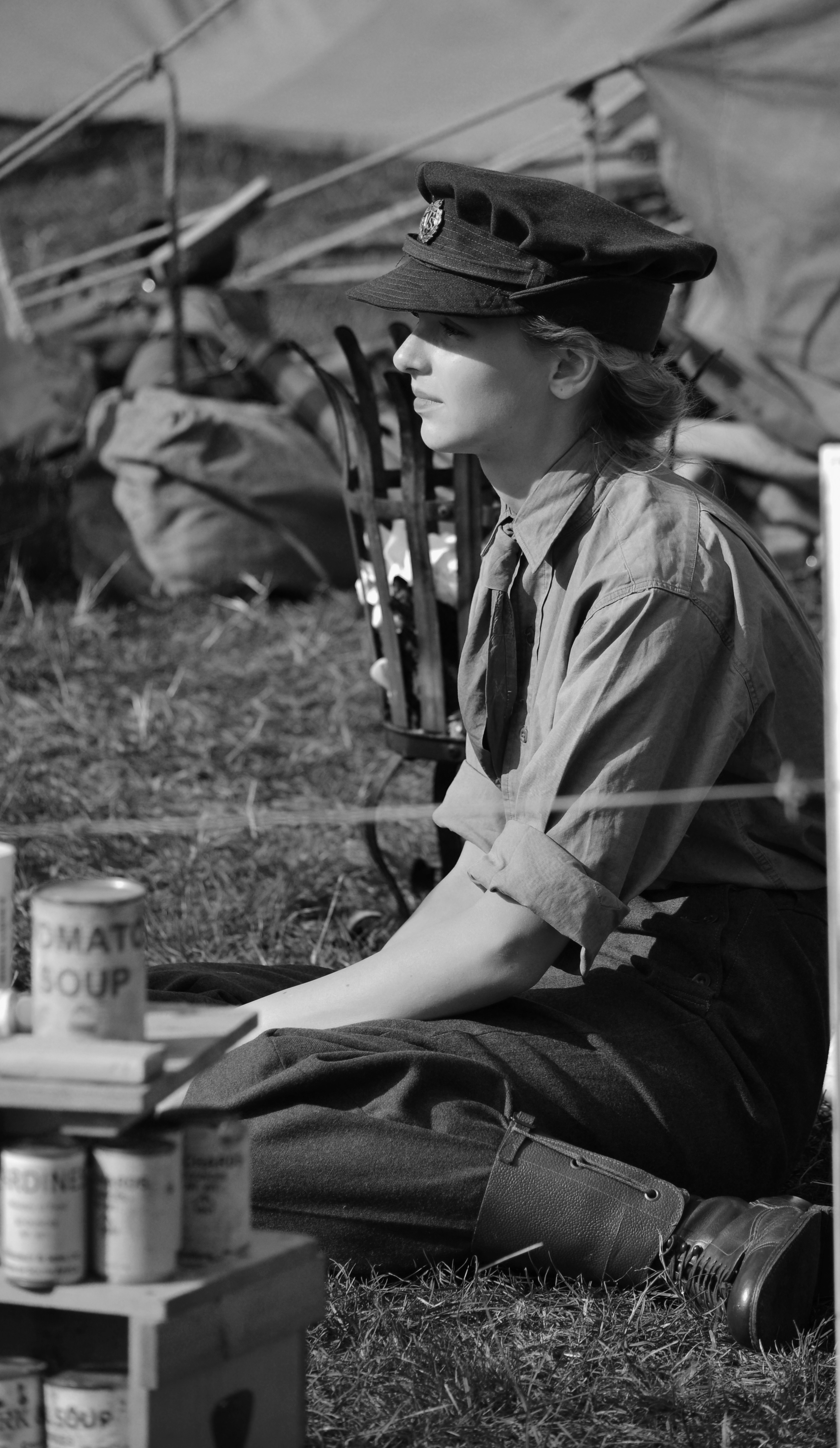
Today it is a thriving airfield, whose annual reenactments bring back the nostalgia of 1940s Britain. Find out more about Lashenden’s history and other airfields in Kent. Click on this link.

lady cropped 2 B&W

1940s Britain is reenacted on the Former Lashenden Advanced Landing Ground used by the Ninth Air Force.


Polish Fighter Ace Turned a V1 on its back.

The first V1 for 315 sqn was shot down by Flt Sgt Jankowski at 13:10 on July 11th. There were three more the following day and several others would meet similar fates. Shooting down a V1 was dangerous, many aircraft being caught in the subsequent blast. Other, less conventional methods would include tipping the wing of the V1 destabilising the gyroscopic guidance system within, sending it tumbling to the ground. On one occasion, WO Tadeusz Szymanski managed to completely turn a V1 onto its back using such a method.

Brenzett, was an advanced landing ground, built to be temporary, but even so, it produced some remarkable stories.

As part of a second trail around Kent, we visit three more of Britain’s airfields, Hawkinge, Brenzett and Lashenden. Each with its own story to tell. Want to know more? click here to go back to 1940s England and then see what has happened to these historic places.

Brenzett village sign

Brenzett Village Sign Depicts its Aviation History


The de Havilland Sea Mosquito

The de Havilland Mosquito was undoubtedly one of the Second World War’s most famous and prestigious aircraft, achieving fame alongside models like the Lancaster, Spitfire and Hurricane.

During recent conversations I’ve had with friends, I was intrigued to know more about the different variants, and in particular, the Sea Mosquito – one I had very little knowledge of.

Built in a hangar (disguised as a barn) on the estate of Salisbury Hall near Hatfield, the Mosquito, or  ‘Mossie‘, was a unique aircraft of wooden construction. This design feature eventually gave birth to its nickname the ‘Wooden Wonder‘.

Taking its first flight on November 20th 1940, prototype E0234 (later designated W4050 by the Air Ministry), flew with Pilot Geoffrey de Havilland Jnr at the controls. Its potential as a military aircraft was quickly realised, especially by those who were in opposition of the original idea, and further development trials were organised.

IMG_0343

Prototype E0234 (later designated W4050) under restoration at the de Havilland Museum.

The Mosquito went on through various design modifications and variants (41 in all), including fighter-bomber, reconnaissance, target tug and trainer. It also served with numerous air forces across the world, some as far afield as China and Israel. Postwar it obtained notoriety as a film star, the most famous being ‘633 Squadron‘ in which a squadron of ‘Mossies’ attacked the V2 fuel production plant in Norway by bombing an overhanging rock. Film stars such as Cliff Robertson, David McCallum and Gregory Peck have all graced our screens alongside the Mosquito.

With the sad crash of G-ASKH on July 21st, 1996 and the death of both pilot and co-pilot, there is no longer a Mosquito flying in the U.K. On September 27th 2012, Mosquito KA114, restored in New Zealand, took to the skies for the first time making it the only flying example in existence at that time.

Plans to build a U.K. flying example are afoot with ‘The People’s Mosquito’ who are raising money as we speak. It is hoped to get the aircraft built and operational, within a few years.

Undoubtedly a success, the Mosquito was a devastatingly potent aircraft, its speed and agility unmatched by most other aircraft of its time. It is a beautiful aircraft and one that was loved not only by those who made, flew and worked with it, but those who, like me, stood in awe and watched it fly. The sound of its two Merlin engines something to behold.

The Mosquito was a great success in a number of operational configurations, and in different theatres, however, one of the lesser well-known variants, and less successful, was the Sea Mosquito.

Impressed with the performance of the aircraft, the Admiralty showed an interest in obtaining a carrier-based version. The de Havilland Aircraft Company put forward the idea of a redesigned model based on the FB.VI – the concept was soon accepted. Trials began soon after in which Mosquito LR359 was adapted, the body strengthened to take the strain of arrester hook landings; its weight was reduced and the Merlin power plants improved.  These tests proved successful, and the first carrier landing completed in late March 1944 by Lt Cdr Eric ‘Winkle’ Brown onboard HMS Indefatigable.

This was a major achievement in many ways, not only for the Navy, but it was the first time any twin-engined aircraft had landed on a sea-based carrier. Further tests followed, and a second Mosquito, also adapted for naval use, joined LR359 in trials onboard naval carriers.

The scene had been set and the Admiralty put forward a specification for a full production naval version, which deHavilland would designate the TR.33.

As with all naval carriers, space was of a premium and so the new version had wing modifications that allowed them to fold. A new and improved landing gear was also needed for the heavy landings that a carrier-based aircraft would be subjected to. Radar was also installed with later adaptations giving the aircraft an odd ‘thimble-shaped’ nose. In addition, attachments for torpedoes were added to the belly of the aircraft giving it greater anti-shipping capabilities.

Image

Modified from a MK.VI, LR387 became a TR.33 Sea Mosquito and appeared on the front of ‘Life Magazine’.

The first production model, TW227, left the factory in late 1945, but orders came through too late to meet the Japanese threat. Of the initial 100 ordered, only 50 were ever completed. Further trials were undertaken, and the TR.33 would be modified to form the TR.37. This had armament modifications and an upgraded radar system. Again, as with the TR.33, only a few ever made it out of the factory, with only 6 of the original order being completed.

Mosquitoes, whilst being outstanding aircraft, only ever made it to one frontline naval service, 811 squadron of the Fleet Air Arm. Most that were produced were operated from land-based stations and were involved in various trials around munitions development and investigations into naval capabilities. Of those that were made, many of them, in particular the TR.33s, were modified back to regular models and sold off to other air forces, notably the Israeli Air Force.

No further seaworthy variants were made and production concentrated on the land-based models.

The hangar used to build the Mosquito is now the home of the de Havilland Aircraft Museum, (previously the Mosquito Museum) and its main exhibits include, amongst others, the original prototype  Mosquito (W4050) under restoration. Dedicated to de Havilland aircraft, it has a range of models showcasing de Havilland aircraft production from its early days of the 1920s right up to the later modern production fighters and airliners of the 1960s.

Their website can be found here. I visited them a while ago, and my trail can be found here.

More details on 633 squadron can be found on Wikipedia using this link.

Details of Lt Cdr Eric Brown and his achievements can be found through this link.

A remarkable and detailed book illustrating the development of the Mosquito can be purchased from the de Havilland shop. It gives some amazing photos and development history of the aircraft from its conception to cessation of production, detailing production models, uses and variants; it is a worthy book to anyone’s collection.

de Havilland Mosquito – An Illustrated History Vol 2, Ian Thirsk, Crecy Publishing, 2006.

The People’s Mosquito can be found on WordPress or through ‘Aviation Trails’, alternatively on Facebook and Twitter (@peoplesmosquito).

Plan a Trip to a WWII Aviation Heritage Site and Write a Guest Post

Where did the summer go? It was here, and now suddenly, the days are shorter, the sun less bright, and it’s autumn. Before the winter arrives, why not plan your own ‘aviation trail?’ It doesn’t even have to be a series of airfields. It could just be one. It could be a memorial, or a museum that tells the story of a part of Britain’s most impressive aviation history. It’s a lovely time for a road trip. The leaves are changing, the air is crisp and cool, and Britain’s aviation heritage is waiting… for you.

Have you ever wanted to write something of interest to you? To share with others your thoughts, impressions and words, and to actually see them in print? Here is your opportunity!

‘Aviation Trails’ is inviting you to take an autumn journey to an RAF airfield(s) or other aviation heritage site of your choice. While you are there, remember to take along a notebook to jot down some thoughts and ideas, and of course, take some photographs. If it is an airfield, as you walk about, try to imagine it as it must have been when it was bustling with activity during the days of World War II, when the roar of Merlins vibrated through the air, so often, it became the norm. If it is a memorial or a museum, take time to consider the sacrifices made by those brave men and women and how their lives and the lives of their loved ones, were forever altered by the course of World War II.

When you return home, have a go at writing your very own blog post. Do you know any stories about this airfield, memorial or museum that you have heard over the years? Is there someone in your family who served in the RAF or USAAF and was stationed at one of these airfields?  Since Andy last visited some of these airfields, have there been changes you noticed? We would love to hear some of your stories, to learn what you know, and then to be able to share that with our readers.

Once you have completed your post (and be sure to include a few photographs), submit it to: aviationtrails@yahoo.co.uk – We will have a look and consider your piece for publication as part of ‘Aviation Trails’ as a ‘Guest Post.’

This is one of the final weeks for aviation-related events as it is the autumn half-term break for most of the schools across England. Due to this, there will be some airfields offering ‘Open Days’ for museums, as well as other special events that encourage people to visit before the season comes to a close.  I will try to include some of those details below, but it is always best to check out the websites on your own beforehand to find out about opening and closing times, admission fees, etc.

For this post, I’ve decided to focus the suggestions on Lincolnshire, also known as “Bomber Country’. Many of these airfields, museums, memorials and attractions were covered by Andy in Trail 1: Lower Lincolnshire, so you can find additional information and links to museums and such on that page. To have a look, see the link here.

Some of the more well-known airfields and attractions in Lower Lincolnshire include:

  • RAF East Kirkby (Open Mon. – Sat. 9:30 am-5:00 pm through end of Oct.). Also. special event on Sat. 1st Nov. 2014: Lancaster night, taxi runs and fireworks).
  • RAF Woodhall Spa
  • RAF Coningsby (Andy provides very helpful information about the viewing area around Coningsby, so take a look at the link above for his Trail 1).
  • Thorpe-Camp Visitor Centre (Open Sundays 1:00-5:00 pm through end of Oct. and by appointment). Also, on Wed. 29th Oct. 2014 – Coningsby Spotters Get Together).
  • Dambusters Memorial
  • The Petwood Hotel (of Guy Gibson fame)

That being said, you might be in an entirely different county. Please do not feel left out! There are many areas Andy has yet  to have the opportunity to visit, and we would LOVE to hear about an RAF airfield, memorial or museum in a county not covered on one of the ‘aviation trails.’ Please feel free to visit one near you, and then write about what you know; tell us about the stories you have heard, or tell us about your family member who once bravely served at one of these airfields.

Before long, these RAF airfields will be but a distant memory. You will no longer have the opportunity to visit as you do now. Inevitably, as we have seen all over England (e.g. Manston Airport), these treasured places of Britain’s aviation past will be developments with rows of  houses and not a remnant of their once glorious past or the brave men and women who served to protect their beloved England.

So, do not miss your chance to visit an RAF airfield, a memorial or a museum, and give yourself a chance to be the writer you always wanted to be.

If you have any questions or suggestions, please feel free to email us.

Marcella M. Beaudreau (@LadyofShalottMA)

DSC_0031

Autumn leaves at Downham Market


17 Trails Around Britain’s Lost Airfields

As a youngster, I was fascinated by aircraft, the Second World War and the airfields that the brave young men of the RAF and USAAF  flew from. A mixture of nationalities, they gave their lives without hesitation or question.

My interest and love of this period extended to the Cold War, to fast jets and amazing feats of aerobatics that defy logic and gravity. I would badger my parents into visiting a nearby airfield when on holiday, I would stand eyes skyward watching as the roar of a jet came and went. Books were collected, photos gathered and dreams made.

As an adult, I started visiting these old sites, and more recently began the blog chronicling my experiences for those who wish to share them with me.

So far, I have covered 17 trails, which include  over 40 airfields ranging from Lincolnshire to Kent, Norfolk to Northamptonshire. As I travel further afield, my experiences, the people I meet and the stories I find, never fail to amaze me.

Why not come on a voyage of discovery and nostalgia; choose a trail; see what part they played and see what remains of those places today.

Click on the links below to see some of the pages in the site.

Choose your Aviation Trail.

See the memorials to these people.

Read about heroic tales and acts of bravery.

Find out about the inspiration behind my love of aviation, my father.

View the interactive map.

DSC_0025Mepal peri track south of the Airfield

to sort 412

A B26 – that holds a remarkable record…

B-26B of the 449th BS (322ndBG)  – ‘Flak Bait‘  – went on to complete a total of 207 missions; more than any other American aircraft during World War II, a record only surpassed by a DH Mosquito of the RAF. This aircraft returned to United States after the war and is now housed in the Smithsonion National Air and Space Museum as a reminder and memorial.

Station 468, Bury St Edmunds (RAF Rougham) is now a museum and small active airfield that pays homage to the crews of the USAAF. Visit Trail 16 and see what remains.

Photo by MSGT Bernard Leroy Oligschlaeger (1921-1976) USAAF – Gunner/Radioman in 394th BG/586th BS

Cold and unhomely, it was home to 2000 personnel

The admin blocks were designed to accommodate 1,845 men and 250 women, in a large area to the south of the airfield. Tuddenham had a total of 12 administration and technical areas spread across the entire site. Hurriedly built, the accommodation blocks were unheated, cold and un-homely“.

RAF Tuddenham, located in the western side of Suffolk, close by to RAF Mildenhall, one of the USAF’s busiest bases, was home to Stirlings and Lancasters of RAF Bomber command. They suffered heavy losses in the bombing campaign over europe.

Visit Tuddenham today in Trail 16.

DSC_0002

Tuddenham village sign depicts a Lancaster of 90 Squadron RAF flying overhead.

What’s the answer?

Whilst on my trails I find it disheartening to see so many of our former airfields disappear under builders machinery or industry looking for a cheap alternative to building their own premises. Using the guise of ‘recycling’ old sites, they fail to understand the history, importance or significance of these ‘brown field’ places.

These airfield were not simply a place where aircraft took off and landed a long time ago, but they are places where people died, suffered terrible injuries. were traumatised or lost loved ones and friends. It’s where young men, many away from their families for the first time, spent their last days on gods earth before giving themselves up in the name of peace.

Yes I see the relevance and difficult balance between the building infrastructure, jobs and housing needs against the desire to preserve small areas of heritage, history and desire to respect the need to preserve what are important marks that represent a major tuning point in the worlds development. It is hard, and not one that any political or historical follower takes lightly I’m sure. But if it were not for volunteers, people with a real understandings of the relevance of these matters, we would have very little to show for what was an incredible and turbulent time in world history.

Is there an answer? I don’t know, I wish I did. It would be easy to say “save every airfield” but for what? To rot, to be a time capsule soaking money form important public areas like health and education. Or is it dig them up, we don’t need them it was a long time ago, let’s move on!

All I know is, with each visit I make a little more of history disappears, a memory is lost and as the years roll on, a veteran passes away. Something needs doing and it needs doing soon.

IMG_1956.JPG