The end of October marks the end of an era, with the grounding of Avro Vulcan XH558. After an eight year reign as Queen of the skies, she finally bows out after the three main technical companies that support her, withdrew their support. In her last flight on October 28th 2015, she completed a short 15 minute flight, the culmination of 228 flights and 346 hours flying time. After a long taxi to runway 02 at Robin Hood Airport, she performed her last flight to a small crowd of gathered people whilst streaming the event live on YouTube. Creating her own cloud, she had the grace of an angel, performing a touch and go before landing for good and so closing the book on this remarkable story.
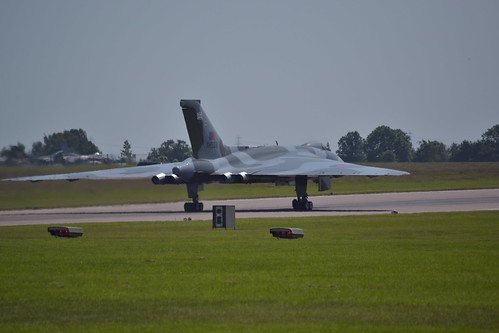
XH558 lands at Waddington July 2014
The Vulcan was the last of the Cold War bombers to fly and achieved a great following across the country. The ‘Vulcan effect’ as it became affectionately known would draw thousands to street corners, road sides and airshows just to see the graceful bird and hear her incredible howl.
The first flight of XH558 as she returned to the sky after a 14 year restoration.
For me personally the Vulcan was the aircraft I used to watch as a child from my parent’s bedroom window; my first real close up, large jet aircraft and one of the many that drove my love of aviation. They would do circuits around Bitteswell airfield following maintenance or upgrading, so it seems fitting therefore, that the last time I would see her in person, would again be from my own back garden so many years later as she flew over my home.
Lots of jet wash on take off at Waddington 2013
Famed for flying to the Falkland Islands and bombing the runway at Port Stanley airport, Vulcans supported by 13 Victor tankers, undertook the longest bombing raid on military record. An incredible feat and one that will go down in history for a very long time, probably eternity.
Designed initially by Roy Chadwick and built by the Avro company, it was one of many iconic aircraft to leave the Avro works. Shown to the public for the first time at Farnborough in August 1952, a Vulcan went on in 1955 to perform an amazing barrel roll much to the amazement of the crowd. Designed to carry weapons of mass destruction, the Vulcan formed the backbone of Britain’s nuclear deterrent and would carry a nuclear warhead to Russia should the demand arise. Crews were on standby 24 hours a day, 365 days a year ready to take off knowing they would probably not be returning. The Vulcan had a truly devastating punch. Her beauty and grace were matched only by her prowess and destructive power.
XH558 at Waddington June 2013
XH558 in particular was the RAF’s own display aircraft for 33 years eventually retiring from service in 1993. Bought and maintained by C Walton Ltd, she would go on to be cared for by the Vulcan to the Sky Trust. She was flown to Bruntingthorpe and refurbished to airworthy status over a period of 14 years at a cost of £7,000,000. XH558 was then flown to her new home at Doncaster airport, itself a former Vulcan bomber station, RAF Finningley.
From there she would undertake a huge number of flights, displaying to thousands across a range of airshows around Britain, far exceeding her original target of 250 hours flying time such was the demand to see her.
Eventually though her time would come, and even with the huge public support, the technical skills needed and provided by: B.A.E., Rolls Royce and Marshall Aerospace, have finally been pulled and her flying days are now over.
XH558 flies over for the last time.
XH558 will continue to reside at Doncaster in a Heritage centre alongside a new Technical School. She will be kept in taxiing condition, still run her engines and keep full electrical power. A new era dawns, and she joins the other grounded Vulcans, with a new vision and a new life.
With the grounding of XH558, airshows across Britain won’t be the same, but at least she had the chance to fly again and amaze the thousands who flocked repeatedly to see a mighty Vulcan fly in Britain’s skies once more.
Sadly, I didn’t get to see her on her last tour of Britain, but even the Vulcan can’t be everywhere at once. I have some fantastic memories of her, from Waddington to Eastbourne, with the two Lancasters at Marham, and many, many more that I have gathered over the years.
For the chance to see a Vulcan in the skies again, to the team and XH558, from me personally, a very big heartfelt thank you.
XH558 doing what she does best at Eastbourne 2015
The First of two tours forming the farewell flight of XH558 from inside the cockpit.
Pledges and support can continue to be offered for the upkeep of 558 through their dedicated website. Her history, visits and other information can also be accessed through this link.
In this trip we head back northwards into Lincolnshire otherwise known as ‘Bomber Country’ to an airfield that is steeped in history; active since the first world war, it stands high above Lincoln but only a few miles from the Cathedral, a landmark welcomed by many a returning bomber crew. It was here that three Victoria Crosses were earned, Lancasters filled the skies and from here the famous ‘Dambusters’ of 617 Squadron carried out their daring raid on the dams of the Ruhr. It is of course RAF Scampton.
RAF Scampton.
RAF Scampton is to Bomber Command what Biggin Hill is to Fighter Command. It embodies all that is the air war of those dark days of the 1940s; the bravery and dedication of crews, the sacrifice, the loss and the heartache. It has had a long and successful life; even today it is a military airfield but one that sadly operates as a shadow of its former self.
Opened during the First World War under the name of Brattleby Cliff, Scampton was a Home Defence Flight Station, operated by the Royal Flying Corps with 11, 60 and 81 squadrons. A variety of aircraft were based here and it performed in this role until closing shortly after the cessation of the conflict in 1918. For a while Scampton lay dormant, many buildings being removed, but, as a new war loomed over the horizon, it once more sprang into life as RAF Scampton.
Opening in 1936, it was designed as a grass airfield. Its firsts residents were the Heyford IIIs of No 9 squadron (RAF) in 1938, who stayed for just short of two years. They were joined by the Virginia Xs of 214 Squadron (RAF) who arrived in October that same year. A brief spell by 148 Squadron (RAF) in 1937, further added to the variety of aircraft at this base.
The next units to arrive would see Scampton into the Second World War. Both 49 and 83 Squadrons arrived with Hawker Hinds, models they retained until replaced by the more modern twin-engined Hampdens in 1938. Using these aircraft, Scampton would have an auspicious start to the war. With inexperienced crews, flying was very ‘hit and miss’ – delays, missed targets and inaccurate flying all became common place during this period of the ‘phony’ war.
However, as the mighty German war machine charged across Europe, Scampton’s crews were to find themselves in the thick of the fighting. With bombing and mine laying being the main focus for them, they would learn quickly through flying into high risk areas – many heavily defended by flak and determined fighter cover – that they had to be better. It was in this early stage of the war that the first Victoria Cross would be earned by a Scampton pilot.
Flight Lieutenant Roderick Learoyd who by now was a veteran of 23 missions, fought to hold his badly damaged aircraft on track during a raid on the Dortmund-Ems Canal. Then, nursing the crippled aircraft home, he would remain circling the airfield for three hours, so he could land his aircraft safely in the daylight rather than endangering his crew by landing at night.
Scampton’s sorties would become almost continuous. Barely a month would pass before a second V.C. would be won by wireless operator Sergeant John Hannah flying with 83 Squadron, in a raid on ports in the lowland countries. It was believed that the Germans were massing their invasion barges here and vital that they were bombed to prevent the invasion taking place. During the raid, Hannah would extinguish an onboard fire using a small fire extinguisher, then his log book and finally his hands. Badly burned and in great pain, he helped nurse the stricken aircraft home after two of the crew bailed out.
Scampton continued to develop as bomber station. Crew quarters were in short supply and often cramped. In March 1940, Fairy Battles of 98 Squadron would have a very brief spell here whilst on their way to RAF Finningley. In December 1941, 83 Squadron received the new Avro Manchester as a replacement for the now poorly performing Hampden, followed in April 1942 by 49 Squadron. These aircraft were not loved or admired, suffering from gross under power, and major hydraulic issues, they would soon go in favour of the RAF’s new bomber and Scampton’s icon, the Lancaster I and III.
Scampton from Gibson’s window. Nigger’s grave can be seen to the left.
Both 49 and 83 squadrons would leave Scampton soon after this upgrade. Scampton itself would then go through a period of quiet until when in September that year, on the 4th, Lancaster I and IIIs arrived with 57 Squadron. They would stay here operating over Europe for one year before moving off to nearby RAF East Kirkby. 467 Squadron joined 57 for a short period, being formed at Scampton on November 7th 1942 again with the formidable Lancaster I and IIIs. Their stay was much shorter however, within a month of arrival they would have gone to RAF Bottesford.
It was the following year that Scampton really became famous with the formation of 617 Squadron (RAF) in March 1943. Commanded by Wing Commander Guy Gibson, a Scampton ‘veteran’ himself, 617 Sqn was put together for a very special operation using specially modified Lancaster IIIs. ‘Operation Chastise’ is probably the best known military operation of Bomber Command and the story of the Dams raid on the Mohne, Eder and Sorpe dams is well documented in virtually every form of media possible. This raid was to become synonymous with Scampton even though 617 Sqn were only here for a very brief period of time. They would only undertake two raids from Scampton, the Dams raid and a second to Northern Italy, before they moved to Coningsby, and later Woodhall Spa (Trail 1), both a short distance to the south. It was of course that as a result of this raid, Scampton would earn a third VC through the actions of Wing Commander Guy Gibson.
The departure of both 57 and 617 Squadrons from Scampton allowed for development of the runways. Concrete was laid for the first time, in sufficient amounts to accommodate more heavy bombers, and the first to arrive were the Lancaster I and IIIs of 153 Squadron (RAF).
153 Sqn were to see out the war at Scampton, but their stay was not a good one. As the war drew to a close, 153 began the mining operations that Scampton had been so used to at the outbreak of war. Casualties were high with many crews being lost including that of the Gibson’s contemporary, Canadian born Wing Commander Francis Powley. On the night of April 4th/5th, two Lancaster Mk. Is – NX563 ‘P4-R’ and RA544 ‘P4-U’ with Powley on board, were both shot down by Major Werner Husemann of I./NJG3, over Kattegat, whilst on a ‘gardening’ mission. The crews were all lost without trace and are commemorated on the Runnymede memorial.
Two Sisters under refurbishment in one of the four hangars.
On this same night, more Lancasters I and IIIs arrived from RAF Kelstern with 625 Squadron (RAF) and together they formed part of the last major Bomber Command operation of the war. On 25th April 1945, they flew against Hitler’s mountain retreat at Obersalzberg, Berchtesgaden. 153 Sqn was eventually disbanded on September 28th 1945 followed by 625 Sqn on October 7th that same year.
A brief 3 month stay by 100 Squadron saw flying from Scampton cease and it remained without operational flying units for the next two years.
Scampton would next play a part in the Berlin Airlift. American B.29 Superfortresses were stationed here for a year as part of the US Strategic Air Command between 1948 and 1949 flying operations into the besieged Berlin. There then followed another quiet period, something that was common place for Scampton and it wasn’t until 1953 that it would see flying activity once again.
On 15th January 1953, 10 Squadron would reform here, followed not long after by 27 Squadron (15th June), 18 Squadron (1st August), and finally 21 Squadron on 21st September1953; all operating the new Canberra. Many of these units would stay for only a short period of time, moving on to new bases relatively quickly. However, as the ‘cold war’ threat increased, Scampton would come back into the limelight once more.
In 1956 the main runway was extended to 10,000ft causing the main A15 road to be re-routed giving it its notable ‘bend’. After two years, on 1st may 1958, 617 squadron would return to its historical home, being reformed at Scampton with the mighty Vulcan B.1. 617 Sqn would fly a variety of versions: B.1A, B.2 and B.2A, until disbandment on New Years Eve 1981*1. It was during this time that the Blue Steel would form Britain’s Nuclear deterrent, the very reason the Vulcan was designed. History was to repeat itself again on 10th october 1960, as 83 Squadron, who had flown Hampdens at the outbreak of war from here, were also reformed at Scampton, also with the B.2 and B.2A Vulcan. 27 Sqn were also to return, going through a number of reforms and disbandment forming up again at Scampton on 1st April 1961 to join what became known as the ‘Scampton Wing’. 83 Sqn sadly though, were not to last as long as their historical counterparts, being disbanded on 31st August 1969.
Then on 16th January 1975, more Vulcans would arrive, those of 35 Squadron (RAF) who would go on to serve until disbandment on March 1st 1982 again here at Scampton. This being the last ever operational flying unit to grace the skies over this iconic airfield.
A small reprieve for Scampton came in the form of two separate stays by the adored aerobatics team the Red Arrows, who have continued to use Scampton as their base stunning crowds at airshows around the world. Currently stationed here until the end of the decade, Scampton at least has retained some flying for the foreseeable future.
Today RAF Scampton is home to only two small non-flying but operational units; the Air Control Centre (ACC) who merged with the Control and Reporting Centre (CRC) and the and Mobile Met Unit (MMU). These are responsible for monitoring British Airspace 24 hours a day, 365 days a year ready to alert the RAF’s QRA units when intruders are detected. These units provide Scampton with around 200 working personnel, somewhat dwarfed in a base built for 2000.
Scampton is of course synonymous with the Dambusters, and it is predominately this history that keeps Scampton alive today.
The four enormous ‘C’ type hangers stand virtually idle, no longer holding the huge aircraft they were designed to hold. No Vulcans fill their beams, no Lancasters roar into life on moon lit nights. Instead private companies use one for storage, the Red Arrows another and the Heritage Centre a third. The last one is utilised by the Museum of RAF Firefighting to store some 40+ historically important RAF and civilian fire engines all once used to fight the fierce fires of crashed aircraft. Reputedly the largest collections of fire fighting equipment, models, photographs and memorabilia in the world, it is an extensive collection and well worth the visit.
Two of the four ‘C’ types Hangars, each one could take 4 Vulcans. Note the Red Arrow Hawk.
Whilst only a fraction of Scampton is used these days, its crew quarters quiet and locked, it remains under very strict security with patrolling armed guards. Photography is strictly forbidden around the former quarters, but once on the actual airfield security is relaxed – albeit in a small amount. Access is only by prior permission as a visitor to either the National Museum of Fire Fighters or to the Heritage Centre. It is these volunteers that care for and share the very office used by Guy Gibson when 617 sqn prepared for their mission to the Ruhr.
On arrival at Scampton an armed guard watches vigilantly, as guides check your ID, a passport or drivers licence, who then take you through the gate to walk along where Gibson and his crews were briefed on that very night. The buildings that line either side of the road are no different from that day and it is here in this very spot where Guy Gibson (Richard Todd) walked away from Barnes Wallis (Michael Redgrave) at the end of the 1955 film “The Dambusters”. The main gate you walk through to enter the site is the very gate at which the squadron mascot ‘Nigger’ was run over and killed by a car. Not by a hit and run driver as portrayed in the film, but a passer-by who stopped, collected the dog and reported it to the very guard-house that stands there today. Like many films portraying the brave and heroic acts of the Second World War, the factual accuracy of the film is somewhat skewed. However, the film makers could be forgiven for this as much of the operational records were still on the secret list when the film was made.
Once passed the accommodation blocks cameras are permitted and the views over the airfield are stunning. The control tower – moved after the redevelopment of the airfield – watches over its quiet expanses, little moves here expect the Hawks of the Red Arrows.
The names of those who took part in Operation Chastise.
Gibson’s office stands overlooking this part of the field, and perhaps the only reminder of that night, is Nigger’s grave. A ‘headstone’ enclosed in a fence marks the dog’s grave, placed in front of Gibson’s offices slightly offset so Gibson himself could be laid to rest here with him. Sadly his death on September 19th 1944 near Steenburgen in Holland prevented the reuniting of Gibson’s body with his beloved pet and the two remain separated for eternity.
His office, so well reconstructed, stands with period furniture as it would have been during his stay here with 617 sqn. Uniforms, photos and numerous other artefacts from that time are displayed for the visitor.
Below this floor, a large model of a Lancaster and more artefacts reflect the historical importance of 617 squadron from its earliest days of the Second World War to the point when they were to return with the RAF’s modern fighter the Tornado.
Guy Gibson trail then takes you through a mock-up of the crew quarters and on into the hangar. Here several aircraft are stored, a Hunter, Sukhoi SU 22, Gnat and Hawk both in Red Arrows colours. Also a second Hawk used to train RAF Technicians ready for the Red Arrows. Two Lancaster front sections are being carefully restored and a number of artefacts are stored here waiting their fate whatever that may be.
Scampton as an ‘active’ base may well have a reprieve over the next year or so. With the recent announcements from the RAF that Waddington will no longer host an airshow due to ‘increased security risks’, Scampton has been identified as a possible replacement venue after 2017. Whether this will come to fruition or not is yet to be seen, but if it does, it may well breath new life into this historic and truly iconic airfield.
Further reading, links and notes.
There are many additional stories linked with Scampton that would simply fill a book. The live bomb unknowingly used as a gate guard for a number of years, the Lancaster that served here and now stands in the Imperial War Museum, London, and the little known story of Iris Price, possibly the only WAAF to see a bombing mission from an allied aircraft. Passing out due to oxygen loss, she was nearly thrown out of the aircraft so as to dispose of the body, thus avoiding a court-martial for her and the crew.
Guy Gibson’s own book ‘Enemy Coast Ahead’ gives a fabulous insight into his life especially whilst at Scampton and is highly recommended.
The ‘Dambusters’ Pub located near to the airfield was frequented by the crews of Scampton and is now a popular haunt for the Red Arrows. It is filled with memorabilia, photographs and is purely fascinating, a museum with beer, even producing its own tipple – ‘Final Approach’!
*1 617 would go on to be reformed later, with the ‘Tornado’ at RAF Marham forming a front line fighter squadron.
For current operational information on Scampton and how to visit the Heritage Centre click here.
In this revised trip, we go back to Woodhall Spa, and visit the former Bomber Command airfield, famed for its crews, missions and aircraft. Woodhall Spa is a remarkable airfield, yet it is hardly known, or recognisable today.
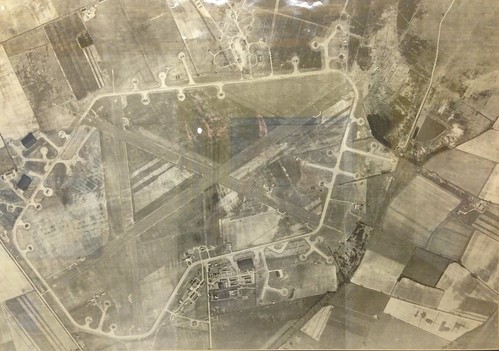
RAF Woodhall Spa was originally built as a satellite to RAF Coningsby a short distance away, and opened on 1st February 1942. It was built with three concrete runways; two of 1,400 yds (1,353 m) and a third and main runway of 2,000yds all 50yds (46 m) wide. The site like other Standard ‘A’ class airfields had two T2 hangars and one B1, thirty-six pan-style hardstands and numerous support buildings scattered around its perimeter. Accommodation was spread over 7 sites, along with a WAAF, sick quarters and 2 communal sites all located to the south-east. The technical and administrative sites were also to the south-east side of the airfield between the accommodation areas and the main airfield.
A bomb store was well to the north and the main entrance to the north-west. A range of accommodation and technical style huts were used, Laing / Nissen / Seco and a Watch Tower to drawing 15956/40.
An aerial photograph of Woodhall Spa taken post war. The B1 and T2 hangers can be seen to the north-west, a further T2 to the south. The accommodation block are below the frame. (Taken from a photo at the Thorpe Camp museum).
One remarkable features of Woodhall Spa was the installation of six arrester gear units on the runways. These were designed to prevent aircraft overshooting the runway and were installed during the building programme. Some 120 units were manufactured in all but only a handful of sites had them. On October 22nd 1942, the Woodhall Spa units were tested using an Avro Manchester from the Royal Aircraft Establishment and all went well. However, as the war progressed, reservations were registered about such a technique and the units were never used ‘operationally’ in any of the allocated sites.
At the same time that Woodhall Spa opened, the newly equipped Lancaster (Mk I & III) squadron, 97 Sqn, moved from RAF Coningsby into RAF Woodhall Spa and within a month were flying operations from their new home. However, their first operation, mine laying, was to be fatal for three aircraft, cashing on the journey home. This was not to be the general theme for 97 Sqn though. For the next year they would prove themselves more than capable, hitting many targets accurately with bravery and courage.
Lancaster Mk I ‘R5495’ OF-N of 97 Sqn Woodhall Spa, bombs up. This aircraft was shot down over Essen 8th/9th June 1942, the crew were all killed.*4
The following March (1943) the main bulk of 97 Sqn moved to Bourn to form part of the new Pathfinder force, with detachments at Graveley, Gransden Lodge, Oakington and a further section remaining at Woodhall. On April 18th 1943, 619 Sqn was formed from the Woodhall Spa detachment retaining their Lancaster Is and IIIs. However, their stay was very short; they moved out to Coningsby in January 1944 and were replaced overnight by the famous 617 (Dambusters) Sqn*5.
During their year here, 619 Sqn would prove themselves further in raids over the Ruhr, Düsseldorf, Oberhausen and Krefeld. Casualties were light during these early missions, but in the following August (1943) the RAF a mounted a massive raid consisting of 596 aircraft on the V2 rocket site at Peenemunde. Three of the twelve aircraft sent by 619 Sqn would fail to return.
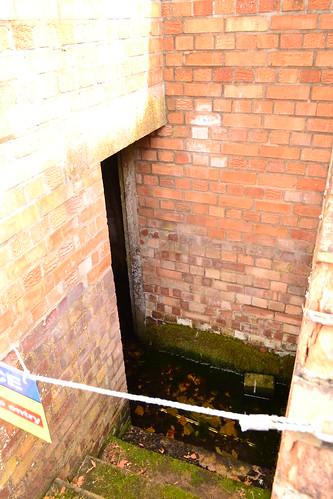
The bomb shelter now flooded and inaccessible.
When 619 Sqn moved out, 617 Sqn moved in. Lead by Group Captain Leonard Cheshire, 617 Sqn were the elite of 5 Group, Bomber Command and accordingly were to be assigned some of the most difficult and outright dangerous precision bombing missions.
Throughout 1944, 617 Sqn would have many near misses, and losses, ranging from low-level bird strikes to fighter attacks and flak. Targets varied considerably including those at: Limoge (aircraft engine factory), the Antheor Viaduct, Albert, St. Etienne and Metz (aircraft parts factories); many using the new ‘Tall Boy’ 12,000lb bomb.
On 15th April 1944, 617 Squadron were joined by 627 Sqn and obtained some D.H. Mosquito VIs, using these to good effect in the Pathfinder role while their Lancasters continued with the bombing. In June, they had a small respite from bombing missions and on the day of the Allied Invasion, they were tasked with dropping ‘Window’ over the Pas-de-Calais to fool the Germans into believing the invasion force would strike there.
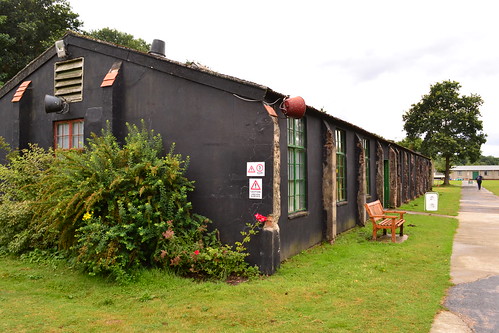
A handful of huts and buildings remain.
Throughout the remainder of 1944, 617 Sqn continued to use ‘conventional’ and Tall Boy bombs on prestige targets like U-boat pens and the Samur Tunnel. Cheshire found himself handed a P-51, and after having it unpacked and engine tested, he used it to mark a V1 target to which 617 struck a devastating blow.
Further major targets were to befall the wrath of 617 Sqn. Flying 2,100 miles to a forward operating base at Yagodonik with Lancasters from 9 Sqn, they attacked the German main Battleship the ‘Tirpitz’. During the mission, for which they had long-range fuel tanks, of the 38 aircraft that set off, six were to crash on the outward journey, one turn back and one to crash on the return. The Tirpitz however was to remain ‘unsinkable’ for some time. It would take two more return trips by 617 Sqn from Lossiemouth to finally sink the ship, the last being on 12th November 1944, with the loss of 1000 German sailors.
Bombing and pathfinder operations for Woodhall spa crews continued right up to the end of the war. Early that year they would start to use the new ‘Grand Slam’ 22,000lb bomb, with their last operational fatality being on 16th April 1945. That was not the end for Woodhall Spa though. The famous Guy Gibson drove here and ‘borrowed’ a Mosquito of 627 Sqn against a backdrop of changed minds, mishaps and misjudgements, the resulting crash leaving him dead.
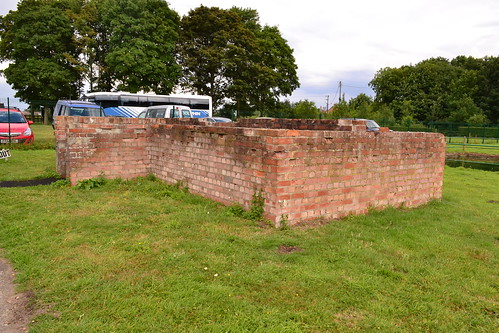
Brick walls outline former structures.
Woodhall closed soon after the war ended, but it was identified as a suitable location for Britain’s air defence missile the ‘Bloodhound’ and on May 1st 1960, Woodhall Spa became the base of 222 Sqn with Bloodhound MkI missiles. These were disbanded in June 1964 and replaced by Bloodhound Mk IIs of 112 Sqn on November 2nd 1964. These stayed until 1st October 1967 when they moved to Episkopi in Cyprus.
After the removal of the Bloodhound squadron, the RAF continued to use a small site near to the main entrance, utilising the 617 Sqn T2 hangar and other ancillary buildings as an engine maintenance and testing facility. This too has since closed and the main use is now as a quarry.
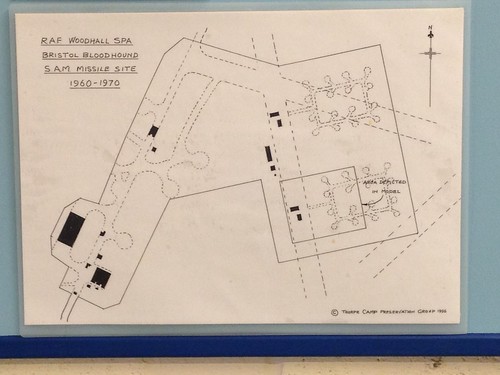
Map showing the location of the Bloodhound Missile Site (Photo of the display at the museum)
A long and distinguished life, Woodhall Spa’s operational losses totalled 91 aircraft, of which 74 were Lancasters and 17 Mosquitoes. Daring and brave crews, they gave their all for freedom and the love of flying.
Today little exists of this former airfield. Being a quarry and partly MOD, much of the land it is not accessible to the general public. Most of the buildings have long since gone and the runways mostly dug up. A few minor concrete ‘side roads’ are in situ and with searching some evidence can be found. The tower was demolished just after the war as were many of the other buildings and huts. Steps have now been taken to turn whats left into a nature reserve (see post dated 4th July 2015) and a memorial has been placed at the intersection of the runway remains. The best remnants can be seen a little way to the south-east at the former No 1 communal site at Thorpe Camp (see below).
The former NAAFI for 469 airmen and 71 officers.
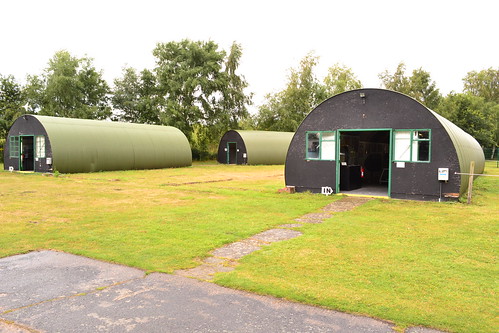
A small number of buildings remain here utilised now as a museum. These include a war-time NAAFI able to accommodate 469 airmen and 71 officers, the ablutions block, ration store and various Nissen huts. A bomb shelter is also here, now flooded and blocked off along with other part brick structures.
In the adjacent woods, the airmen’s quarters and other buildings can be found, now derelict and in a dangerous condition. Odd buildings are scattered about the various sites but these too are few and far between.
Considering the history of Woodhall Spa, the men who flew from here, the operations they undertook, the testing of revolutionary equipment, the new and deadly bombs, it has suffered possibly greater than most and much of this history, if it were not for the Thorpe Camp museum, would now be lost forever. Now it has become a nature reserve in part, then maybe, just maybe, the footsteps of those who were stationed here may once again be walked by others and their memories brought back to life.
*2 617 Squadron are most famous for the raid on the Ruhr dams in Operation Chastise ‘Operation Chastise’ carried out on 17 May 1943 under the command of Wing Commander Guy Gibson.
I recently updated the original Trail on this site after visiting the Thorpe Camp Museum. A really pleasant little museum, it provides a wealth of information for very little cost. Its history and that of the area, is incredible.
Thorpe camp museum sits on the original communal site 1 on the former RAF Woodhall Spa and was acquired in 1988 by a group of volunteers (The Thorpe Camp Preservation Group) who have utilised the original buildings and pathways that would have been used by RAF personnel during their stay at Woodhall Spa. Entrance is a nominal fee and worth every penny.
Original buildings of No. 1 communal site are now a museum.
A number of original huts and buildings display a range of letters, photos, memorabilia and other artefacts that take you through aspects of life both at Woodhall Spa and Lincolnshire life during the Second World War. Specific displays tell you about each of the four squadrons based here (97, 617, 619 (Dambusters) and 627) , the crew members, aircraft and personal stories. A memorial stands at the centre of the site reflecting their dedication.
Extensive work has been done to research the famous dams raid of 617 Squadron, how the bouncing bomb was developed, how it worked and what the aftermath of the operation was.
A small shop provides food and drink, and is a welcome break after a long journey.
An Allan Williams Turret on the site.
A civilian section shows life ‘at home’. Weddings of the Second World War were scant affairs due to lack of money and rationing, but brides made the most of what they had; examples of these are nicely displayed. The home guard, ARPs, and domestic life are all represented in this atmospheric museum.
Many young men were sent from within the borders of Lincolnshire on major operations such as ‘Market Garden’, these too are represented through displays of uniforms, photos, letters and official documents.
Further buildings, also originals, house well stocked displays of the V1 and V2 development. The terror weapons used by Hitler to break the morale of the British people. Over 3000 of these V2s were used against targets in the UK predominately London and the South East. Models, photographs and documents again show the extent of this development.
Something I had never come across before was the idea of using arrester gear on heavy bombers where runways may have been shorter than ideal. The principle, based upon that used by the navy on their aircraft carriers, was to place one or more steel cables across the runway for a landing bomber to ‘catch’ as it landed. A small number of airfields in the UK has these, Woodhall Spa being one of them, and an original winch has been removed from the airfield and carefully refurbished. This now has pride of place in the museum. It is believed a further example remains on the airfield alongside the remains of the runway. A rather ingenious but ineffective idea, it was not widely used due to mis-landings and the increased weight that the arrested gear added to an already heavy aircraft.
An Arrester Gear Hub that was used on RAF Woodhall.
Thorpe Camp provides a chance to see inside a Lancaster cockpit. A replica, painstakingly built includes all the detail of an original Lancaster bomber. Other parts, including turrets, dials and engines can also be found in this dedicated exhibition room.
Staff at Woodhall Spa are carrying out renovation projects and have their own workshop to do this. The process can be viewed and makes for an added interest to the visit.
As an aviation enthusiast the trip is topped off with another feature in the form of a BAC Lightning F1A (XM192) in 111 Squadron markings standing proud beside another cold war relic the Bristol Bloodhound missile.
BAC Lightning of 111 Squadron RAF.
Using a range of original documents, photographs, letters and memorabilia, Thorpe Camp at Woodhall Spa is a delight to wander and a real insight not only into the life of this Second World War airfield but life during those hard times in general.
Thorpe Camp is part of Trail 1, and is located near to RAF Coningsby. It has its own dedicated webpage where you can find further information and details.
This museum forms Trail 26 of our tour around Britain’s aviation past. It is of particular interest to me, not just because of its aviation heritage, but because it’s not far from where I was brought up. Indeed, I was born in the City of Coventry, a mere three miles or so from here. After about 6 months we moved away to more leafy surroundings but the influence of Coventry was not left behind.
More importantly though, my father, my inspiration and the man who gave me my love of aviation, worked here at Baginton on the Argosy for Armstrong Whitworth, an aviation company long since gone. A dear friend of his, also worked here on some secret aircraft, so secret my father sadly never saw it.
The main building; the Sir Frank Whittle Heritage Centre.
Of course, this area is steeped in aviation history. The Jet engine was developed around here, Sir Frank Whittle’s name is used in his honour for a number of pubs and industrial sites across the region. I used to live not far from Lutterworth, famed for ‘Bitteswell’ where many test flight were made for AW, modifications were carried out to Britain’s Vulcans, Buccaneers, Gnats and Hawks to name but a few all under the name of British Aerospace. Also not far from my home was Whetstone, which had the first purpose-built jet engine factory. Coventry itself was a main target for the Luftwaffe suffering great casualties and damage during the blitz and the Cathedral ruins now stand as a monument to those who lost their lives during those terrible times. The former Standard (Later British Leyland) Motor works here built over 1000 Mosquitos and a number of other aircraft parts were made in this area. Baginton itself produced heavy bombers such as the Whitley and the Lancaster, Dunlop has a factory here as does Rolls Royce. Coventry and the area around it is steeped in both wartime and aviation history.
So Baginton holds good links to my past, and it has been far too long since I was there. So, whilst in the area, I decided to take a detour and visit the Midland Air Museum, Coventry.
The cargo hold of the Argosy
The museum is located to the northern side of Baginton (Coventry) Airport and has utilised this site since 1975. It originally had only five exhibits when it opened but has grown into the enormous collection it is today, holding around 40 airframes and various exhibits including: helicopters, a range of aircraft engines, cockpits, galleries and a vast collection of models. The main building, the ‘Sir Frank Whittle Jet Heritage Centre‘ is not only the main building for the displays and engines but holds a dedicated exhibition of Sir Frank Whittle’s remarkable work.
In here, are a vast number of photographs, letters and other documents relating to the creation and development of the Jet Engine. It takes you through, step by step, the process of development of the engine, Frank Whittle’s life and the organisations that built and developed this major invention.
Sir Frank Whittle and the early jet engine
The exhibition is housed in a small hangar crammed with jet engines amongst a small collection of aircraft. A meteor F-4 (and Mk 8 cockpit), a DH Vampire F-1, Saab J-29 and Lockheed’s T-33 being the most prominent. Cockpits other than the Meteor include that of the Harrier and a Canberra from RAF Wyton and some of these the visitor is free to sit in and experience what it was like as a pilot. Upstairs in this building, are displays of Baginton’s links with the air industry and local events of the Second World War. Again, photographs and documents relate the lives of those who lived through the war in the surrounding area. An absolute wealth of information here finished of with a huge range of well made models,
Sadly, most of the airframes are outside, some succumbing to the weather and all that the elements can throw at them. However, this aside, the range and selection of airframes is tremendous. Most models here come from the post war era, remnants of the Cold War. A Meteor night fighter stands next to the modern Tornado, A Gloster Javelin, A.W. Sea Hawk, D.H. Sea Vixen, Fairy Gannet and Harrier represent the great naval traditions of British aviation. From the RAF we have the Canberra, Hunter, Gnat, Percival’s Prentice, D.H. Beaver and two stunning E.E. Lightnings; a Saudi T-55 and a Binbrook F6 retired in 1988.
Many of these aircraft saw development in the years following the Second World War. The Canberra, first flown in 1949, served right up until 2007 and achieved many awards for altitude and performance flights. Used by Air Forces across the world, variants saw action over the Suez Canal, in Vietnam and in the Indo-Pakistan conflict in the late 1960s. Built under licence in the United States with a redesigned cockpit, the B-57 was admired by many. Production of the Canberra and its variants total around 1,500 and filled a number of roles with a variety of Air forces.
The Boulton Paul P.111A bulit in one piece and designed to explore the aerodynamic properties of the Delta wing.
Baginton is not just limited to RAF types either. The USAF is also represented through several models, there’s the North American F-86A Sabre and F-100D Super Sabre, McDonnell Douglas F-101B Voodoo and of course the famous McDonnell Douglas F-4c Phantom.
Initially designed as a carrier based aircraft, the Phantom was adopted by numerous air forces across the world including the Royal Air Force and the Royal Navy. First flown in 1958, it was so successful that it would continue to serve into the early 21st century; with production totaling nearly 6,000 – it was a major contribution to aviation history. Like other models here, the Phantom fulfilled a variety of roles, being continually adapted to meet new demands and challenges. Truly a great aircraft.
No Cold War exhibition would be complete without opposing aircraft. A MIL Mi-24D Hind helicopter with its formidable nose mounted cannon and gas turbine engine stands alongside Russia’s highly proven warrior, the Mig 21.
A McDonnell Douglas F-101B Voodoo
The Midland Air Museum has a good international flavour to it. Lockheed’s F-104 Starfighter, dubbed ‘Witwenmacher‘ or ‘Widowmaker’ because of its unforgiving nature, stands in Royal Danish Air Force colours, the Mig 21, East German, the Gnat in Finnish Air force markings and the French represented with Dassault’s Mystere IV.
However, amongst all this hardware, there are two airframes that stand out for me here at Baginton, and not for their size alone, Avro’s B2 Vulcan ‘City of Coventry’ XL 360 which stands in 617 Squadrons colours, a squadron it served with before retirement, and Armstrong Whitworth’s Argosy 650, of which this is the oldest surviving example. To see both, not only remind me of my younger days, but provide a link to my father whose memories are fading as each day goes by.
One of the delights of the Midland Air Museum is that you can sit for free (donations accepted) in many of the cockpits where knowledgable guides will talk you through its history and features, something rarely found elsewhere.
Avro Vulcan B2 XL360 ‘City of Coventry’
To finish off your walk round, there is a small but clean and pleasant cafe, a shop that is filled to the brim with model kits, books and other mementos of your day. The staff are friendly and helpful, always a blessing.
Whilst some of the airframes are looking a little jaded, there is an extensive collection to be found here, and for those interested in all things aviation, especially the development of the Jet engine; from the early days of the Sapphire, through to the Olympus, the Avon and the RB199 turbo fans of the Tornado; the Midland Air Museum has them all.
Sisters sit side-by-side
Coventry Cathedral is about 3 miles from here, and if time permits, is also worthy of a visit.
Details of the museum can be found through their website.
This airfield concludes our four-part tour around Norfolk. It visits a large airfield that played a revolutionary part in the Second World War. So revolutionary, that it paved the way for air defence well beyond the Second World War. We go to the very edge of North Norfolk, to an area of sanctuary, mud flats and a bird watchers paradise. A place where the sound of the Lark has replaced the roar of the piston engine.
RAF Langham
RAF Langham is located at the tip of North Norfolk’s coast. Its location perfect for the role it was to operate.
Built as a satellite to Bircham Newton, it opened in 1940, with three grass runways, and would take aircraft from a number of nearby airfields. Not having any official resident units until 1941, when the Polish and Czech units of 300 and 311 squadrons used it as a forward operating base, it saw little operational action. Langham was initially used as a gunnery training airfield, towing targets for gunnery practice at nearby Stiffkey, a few miles to the north. This is perhaps Langham’s most famous role and the one that many people associate with Langham.
Langham Airfield (photo of the display board at Langham Dome).
Then in November 1942 Langham was closed and redeveloped having concrete runways laid and around 35 looped style dispersals. The longest runway, (NE/SW) was of 1,988 yards, the second (N/S) 1,400 yards and the third (E/W) also of about 1,400 yards, all approximate. The accommodation sites were well away from the airfield many in and around the village of Langham itself to the east or south-east. Three T2 hangars were also erected, one to the north-west and two the south-east in the technical area. There were also various technical and administration blocks and a bomb storage area well away to the north of the site.
Langham’s Watch Office.
The first operational units arrived in April 1944, with Beaufighters of 455 (Australian) and 489 (New Zealand) squadrons of the Beaufighter Strike Wing, on the 8th and 13th respectively. This wing would famously form a combined attack against enemy shipping in the North Sea, being responsible for the sinking of 4 ‘U’ Boats and 36 surface vessels whilst here. A combination of nose mounted cannons and underwing rockets proved a deadly adversary for the flak ships and merchant vessels of the German Navy.
In August that year, the 521st Squadron moved from their base at RAF Docking to Langham to carry out its role of meteorological reconnaissance. Operating with Lockheed Hudsons, they would soon be ‘upgraded’ to Boeing’s massive B-17 adapted for these special duties. Other coastal command roles such as air-sea rescue were also carried out from Langham and a range of aircraft types would operate from here for the duration.
A collection of technical buildings still exist today.
Post war Langham was used by the Royal Netherlands Air Force as a Technical Training School, until June 1947 when it was vacated and then finally put into care and maintenance in the following September. For a short period between March 1953 and November 1958, it became a target towing site once more, pulling targets for No. 2 Civilian Anti-Aircraft Cooperation Unit and finally as if to defy the odds, it was used as an emergency landing ground for aircraft from nearby RAF Sculthorpe.
As with many of these Norfolk sites, Langham was eventually sold off, bought by Bernard Matthews becoming home to a number of turkey Sheds, the role it performs to this day.
Like so many in Norfolk, Langham’s main runway now houses poultry.
The majority of the concrete layout of Langham remains today, utilised by the company for transportation and storage. The technical sites and accommodation sites virtually indistinguishable from the farmland it once occupied. A small collection of buildings can be seen from the public road including: the watch tower, Fire tender shed, a Floodlight trailer, tractor shed, a Night flying equipment store and a small brick hut used for weather balloons. To the north-east, on the brow of the hill sits the restored battle headquarters. But certainly the most famous and most distinguishable building of this site, is the former gunnery trainer dome.
The ‘famous’ Langham Dome – former Gunnery Trainer.
Refurbished through Lottery Money, the dome is now classed as an ancient monument and a museum run by the Trust and Friends of the Langham Dome. Much has been written about the dome and recently (May 17th 2015) the BBC ran a programme about its development and history which is available on BBC iplayer for a short period. Only a small number of these structures exist today, none of which are accessible, which is what makes the Langham dome so special and unique. Developed in conjunction with Kodak, it projected a film of an aircraft onto the dome wall, to simulate an attack, at which the gunner would ‘fire’ his gun. The trainer would measure the trainees accuracy using a dot to the front of the aircraft visible only to himself. A remarkable breakthrough in gunnery training, it led the way in anti-aircraft training for a good number of years even after the war.
A plaque from Veterans of the Royal Netherlands Airforce in the Church at Langham.
Langham is one of Norfolk’s most Northerly airfields, it provided a safe haven for returning aircraft, and its residents conducted air-sea rescue missions, sank a number of ships and played a role in meteorological reconnaissance and anti-aircraft training. A mixed bag, but certainly an important one, the memory of Langham should continue and thrive for without it, there would certainly have been many more casualties in the Second World War.
References
A website dedicated to the Dome and life at RAF Langham can be found here. It includes a range of photographs and first hand accounts of what it was like to live on or near the airfield.
The BBC iplayer programme may only available in the UK and for a short period of time. You can find it here.
A recent revisit took me back to the Battle of Britain memorial at Capel-le-Ferne between Folkestone and Dover, in Kent. It sits high on the cliff-top, in a windy corner, a stones throw from the international docks at Dover, and the Battle of Britain airfield at Hawkinge. A ‘recent’ addition to the range of memorials, it is a poignant reminder of the young men who, from many nationalities, gave their lives in the name of freedom and the defence of this country.
Last time I was here, work was starting on the new visitor centre and the two replica aircraft, a Spitfire and Hurricane, had both been removed.
The replica Hurricane.
This week, on May 25th 2015, I went back to see what had been done.
The new centre is superb. First of all it has a good car park with ample space for a large number of cars.
The visitors centre itself has a bright open reception area and a small shop for souvenirs (I had to buy a book!) and upstairs a new cafe with a balcony overlooking the monument and across the English Channel to France.
The Visitors center behind the ‘Wall of Honour’.
Entrance to the memorial is still free, but there is the option to try the ‘scramble’ experience, which I believe costs £6.00.
The Spitfire and Hurricane are both back, admittedly both are metal replicas but up here it gets very windy and the weather can change dramatically in seconds, so it’s probably for the best. They are certainly good replicas.
The carved Pilot, sitting in the centre of a three-bladed propeller, gazes patiently out to sea, watching for his missing friends. Designed by Harry Gray of the Carving Workshop, Cambridge, the pilot is surrounded by the creats of those squadrons who took part in the famous battle in the Kent skies.
To either side, two large mounds, signify the locations of anti-aircraft batteries, now silent and filled in, perhaps two replica emplacements might add to the ‘feel’ of the site, although sometimes less is more.
As before, the monument is a quiet and moving place to sit; to read the names of those who gave their lives for us, and to absorb yourself in the battle through the numerous information panels around the site. From here you begin to imagine the vapour and smoke trails high above you and to think that Hitler and his invasion forces, stood not more than 30 miles away in the distant haze on the coast of France.
Trail 20 is a Trail that takes us round northern Norfolk. Our first stop is RAF Docking. After Docking, we travel to Bircham Newton.
Bircham Newton has it origins in the First World War prior to the birth of the Royal Air Force. Its distinguished career, saw action in both World Wars and post war right up to 1965 when it finally closed.
The former Guard House now stands as a shop.
Opened in 1916, its first operational use was as a fighter gunnery School in 1918. Its runways were grass and early residents included: DH4, DH5 and the DH9, amongst others. There then followed a period of expansion and development where larger buildings and accommodation blocks were built. Its first and possibly its most significant early aircraft, were the Handley Page V/1500 bombers. An enormous 4 engined aircraft, it was designed to hit Germany hard, targeting Berlin from airfields in East Anglia.
During expansion, a number of squadrons were based here: 7, 11, 166, 167 and 274 to name but a few. Primarily a bomber base during this period, it was soon passed to Coastal Command, who would also take charge of a number of other airfields around this area, including both satellites at RAF Docking and RAF Langham. Many of the original buildings were demolished and those we see today built instead.
Former armoury and photographic building.
New residents for Bircham featured heavier twin-engined aircraft such as the Lockheed Hudson, Bristol Beaufighter and Vickers Wellington, for which steel matting was laid to prevent sinking in the soft earth.
The majority of missions from here were anti-shipping activities, mine laying and Air-Sea rescue. Like its satellite, Docking, it saw a large number of squadrons pass through it gates, too many to give the required credit to here.
As the second World War drew to a close, Bircham’s activity began to dwindle and its role lessened. From Anti Shipping activities to Flying Training, Transport Command and finally to a Technical Training unit, training the Officers of the future. Flying reduced, and Chipmunks became the order of the day. The most notable ‘resident’ of Bircham being HRH The Duke of Edinburgh, who made several landings here as part of his flying training in the early 1950s.
One of the former technical buildings no longer used.
Finally, in 1962, Bircham Newton closed its doors to aviation, but it was not to be the end of the story. In 1965, with the development of the Kestrel, Hawker Siddeley’s VTOL baby, Bircham came to life once more, albeit briefly, with the sound of the jet engine.
A year later, Bircham was sold to the National Construction College and the pathways are adorned with young building apprentices, diggers and cranes of varying sizes. Being a busy building college, many of the original buildings hae been restored but the runways, flying areas and sadly the Control Tower, removed. Whilst private, the airfield retains that particular feel associated with an airfield.
The main stores with two of the C-type hangars in the background.
Luckily, the main road passes through the centre of Bircham. A memorial project has been set up to remember those that served at the airfield with photos and exhibits from days long gone. A memorial has also been erected and stands outside the original Station Commanders house, just off the main road and is well sign posted. The original accommodation blocks, technical buildings and supporting blocks are still visible even from the road. The 1923 guard-house, is now a shop and the operations block, the reception centre.
The original squash courts are still used as they were intended.
Reputedly haunted, the squash courts (built-in 1918) continue to serve their original purpose, and most significantly, the three large C-type hangers and 2 Bellman sheds are still there – all visible from the public highway.
RAF Bircham Newton, stands as a well-preserved model one of Britain’s wartime airfields. Although Private now, the buildings reflect the once time bustling activities of a busy centre of aviation.
The recently added RAF Memorial and behind, the Station Commanders house
The memorial project at RAF Bircham Newton has a website and can be found here. Norfolk Heritage Explorer also has more details here.
The government recently announced their final budget before the forthcoming general election. Amongst the tax hype, vote buying and pre-election promises we have come so accustomed to, was a small recognition to those who gave their all for the security of Britain.
Recognition has finally been given to the deterioration of Britain’s wartime airfields. In particular Stow Maries that dates back for the First World War, the museum at Hendon and the chapel at the former RAF base at Biggin Hill, have all been the subject of grants to improve and update them.
This does not in itself signify a dramatic change in heart of the upkeep or a reduction in planning and development of Britain’s wartime airfields, but it does show a change in attitude toward those that flew from them and the memories we hold of them.
Any small recognition of the sacrifice made by these people, and the fading historical aspect of these now decaying sites has to be good. Maybe just maybe, somewhere along the line planning regulations may change to allow for preservation of some small part of these sites before they are all gone forever.
This has to be a positive step forward, let’s hope so!
An interesting article relating to this appeared in the “Telegraph” newspaper on May 21st. It’s well worth a read and can be found here
Lt Raymond Harney (Photo courtesy of Tsymond Harney JR.)*1
A recent story that came to light, was that of two American airmen whose World War II story has finally come to a close 70 years after their death.
The two airmen, U.S. Army Air Corps 1st Lt. Raymond Harney (s/n O-523208) and U.S. Army Air Corps 2nd Lt. Warren French, (s/n O-2056584) of the 349th BS, 100th BG, were in a B17G (44-6306) over Germany on September 28th 1944, when they were hit by flak whilst on a mission to Merseberg. This would be their eighth and final mission.
Mission 652 involved a total of 342 B-17s which were sent to bomb the Merseburg/Leuna oil refinery and any additional targets of opportunity. During the operation, 10 B-17s were lost, 4 were damaged beyond repair and 251 damaged but repairable. Escort for the mission was provided by 212 P-51s of the USAAF.
B-17 ’44-6306′, was delivered to Kearney airbase on 28th June 1944, then moved to Grenier airbase, New Hampshire on 9th July 1944, for onward transport to the United Kingdom. It was assigned to the 349th Bomb Squadron, of the 100th Bomb Group, given the code ‘XR-G’, and based at RAF Thorpe Abbotts from the 12th July 1944.
The crew of 44-6306, assigned on the 28th August 1944, was: (Pilot) 1st Lt Raymond E.Harney, (co-pilot) 2nd Lt William R.Kimball, (Navigator) 2nd Lt Charles M.Hamrick, (Bombardier) 2nd Lt Warren.M.French, (Top Turret/Engineer) Cpl Thadeus L.Gotz, (Radio Operator/Gunner) Cpl Hubert J.Burleigh,Jr., (Ball Turret) Cpl Melvin F.Cordray, (Waist Gunner) Cpl Robert C.Minear, (Waist Gunner) Cpl James J.Sorenson, and (tail Gunner) Cpl John H. Bundner. (For this particular mission, Gotz was not aboard, S/Sgt Jack D.Francisco flew as tail gunner and Cpl Robert C.Minear flew as Flt. Engineer.)
At 12:10, whilst over the target, the B-17 was hit in the number 2 engine by anti-aircraft flak. As a result, the engine caught fire, the aircraft withdrew from the protection of the formation, joining another formation further back, but began to fall back again when the number 4 engine was also feathered. Harney continued to fly the crippled B-17 for a further two hours after being hit, before finally ordering the crew to bail out. He decided that he and the injured French, would remain and try to land the aircraft.
Outside of the village of Schwickershausen, to the north of another major target, Schweinfurt, Germany, they attempted a belly landing bringing the aircraft down in a turnip field. The B-17 slid across the ground, ripping off the port wing, causing a tremendous fire. Neither Harney nor French sadly survived the subsequent fireball.
Although he managed to get the crew to leave the aircraft, their safety was not guaranteed and sadly, many were killed by local the police in the following days. Only two of the gunners, Cpl. Melvin F.Cordray, and Cpl. Robert C.Minear, survived as POWs.
What makes this story more significant than usual, is what followed after the crash.
The Cross and Certificate Donated to the Thorpe Abbot Museum. *2
The local people, made a wooden cross in remembrance of the crew and they kept it hidden away in the local church for over 70 years.
The large wooden cross, had the words “Hier ruhen in Gott! 2 amer. Flieger,” or “Here rests in God 2 American flyers,” engraved on it, along with details of the aircraft crash. On the 70th anniversary of the crash, 28th September 2014, a memorial service was held in the village of Schwickershausen. Following this, on 5th October, the cross was flown over to England in an American KC-135 Stratotanker from RAF Mildenhall, with two Luftwaffe Tornados ‘escorting’ over Germany. The cross was donated to the ‘Bloody 100th’ museum at Thorpe Abbots for safe keeping. A certificate was also handed over along with the cross signifying not only the now peaceful and co-operative alliance between the two nations, but the final closing of a chapter of the history of two crew members of the “Bloody Hundredth.”
This is a remarkable story, and one that certainly stands out amongst the horrors and heroism of the Second World War.
Warren French’s memorial stone in Belgium*3
Lt Raymond E. Harney’s Gravestone is at F.t Snelling Cemetery in Minnesota, his remains are in the graveyard at Gemeindefriedhof Schwickershausen. Warren French’s headstone is in the Ardennes, Neuville-en-Cond, in Belgium.
Thorpe Abbotts airfield and museum is featured in Trail 12







 Aviation Trails