June 25th 1944, loss of a Rugby Star.

Sir Arthur Harris’s continuation of the bomber initiative of 14th February 1942, in which German cities became the focus for RAF raids, led to massed formations of light and heavy bombers striking at the very heart of Germany.

In order to achieve these aims, bomber forces of 1,000 aircraft would be required, meaning every available Bomber Command aircraft would be utilised along with those from Operational Training Units (OTU) and (Heavy) Converstion Units (CU).

On June 25th, 1942, whilst on operations to Bremen, the third of the ‘1,000’ bomber raids, one of the first operational aircraft casualties  for 1651 CU would occur when N7442 was shot down shortly before 01:00 by a Luftwaffe night-fighter over Holland. One factor that made this particular loss so great was that not only did all seven crewmen onboard lose their lives, but one of the crew, P/O. Lewis A. Booth (s/n: 118627), had gained international caps playing for England’s National  rugby team.

Born on September 26th 1909, Lewis Booth was the son of Alfred and Amie Booth. He was educated initially at Giggleswick School in Yorkshire, after which he transferred to the Malsis School becoming one of sixteen boys who was lost during the war and since commemorated on the Chapel’s Stained glass window.

Booth attended the Malsis school for two years, 1920-22, when the school first opened. A grand School, it was founded by Albert Henry Montagu, which grew and expanded over the years.

Ten years after he left the school, Booth made his international rugby debut in a game against Wales at Twickenham (January 21st, 1933), in front of a crowd of 64,000 fans; a game in which Wales beat England by 7 points to 3. Booth played his last international match against Scotland at Edinburgh’s Murrayfield stadium two years later on March 16th, 1935. Throughout his two year international rugby career he achieved seven caps for England scoring three tries, his first for England against Ireland at Twickenham, on 11th February 1933. After serving his national team, Booth went on to serve his country joining  the Royal Air Force where he achieved the rank of Pilot Officer within Bomber Command.

On the night of 25/26th June 1942, he was in a Short Stirling MK.I flying with 1651 Conversion Unit (CU) based at RAF Waterbeach in Cambridgeshire. 1651 CU was one of three Conversion Units set up in January 1942, by merging previously formed Conversion Flights. It served to convert crews of No. 3 Group to the Stirling, a rather ungainly aircraft that developed a poor reputation as a bomber. 1651 CU would join that night, sixty-eight other Stirlings in a force of over 1,000 aircraft; a mix of heavy and light bombers, ranging from the Hampden and Whitley to the Halifax and Lancaster.

Take off was at 23:58 from RAF Waterbeach, the weather that week had been good with little rain for many days. After forming up they headed for Germany a course that would take them across the North Sea and on to the western coast of Holland. Just 40 minutes into the flight, whilst over Waddenzee, the Stirling was attacked by a Luftwaffe night fighter and shot down with the loss of all seven crewmen on-board.

ROYAL AIR FORCE BOMBER COMMAND, 1942-1945.

A Stirling MK.I bomber of 1651 HCU at Waterbeach. @IWM (COL202)

P/O. Booth was publicly reported missing four days later on Tuesday 30th June in an article in the local paper “Yorkshire Post and Leeds Intelligencer”, which stated that he had been ‘lost in a Bomber Command raid’. The article highlighted Booth’s rugby career, saying that he had been a member of the Headingly Club playing over sixty games for his county team Yorkshire, before leaving to join up. 

P/O. Booth died just short of his 33rd birthday, he left behind a wife, Gladys, and a son Michael. His son would follow in his father’s footsteps also taking up rugby and also playing for his home country. P/O. Booth’s body was never recovered and remains missing to this day.

P/O Lewis Booth is joined by two other Pilot Officers, two Flying Officers, a Flight Lieutenant and two Sergeant Pilots amongst other ranks and service personnel all honoured by the Malsis School. Amongst the many awards they’ve achieved are three D.F.C.s and an A.F.M.

The game of rugby was hit hard by the Second World War, during which Germany would lose 16 of its international rugby players, Scotland 15, England 14, Wales 11, Australia 10, Ireland and France both 8, Wales 3 and New Zealand 2. All these losses were a severe blow to the international game, a game that brought many enemies face to face in a friendly tournament where there was little more at stake that honour and a cup.

With no official burial, P/O Booth’s service was commemorated on Panel 68 of the Runneymede Memorial, Surrey.

Lewis Alfred Booth @Tim Birdsall from the Malsis website.

Sources

ESPN Website.

The British Newspaper Archive.

Old Malsis Association website.

Rugby Football History website.

RAF Bradwell Bay Event July 17th 2021

A recent request from Eric Simonelli at the RAF Bradwell Bay Preservation Group. Eric is a key member of the group who are trying to preserve and promote the former RAF Bradwell Bay. He has kindly supplied a short write up and a flyer promoting a study day to be held in July for anyone interested. If you are, please contact the group direct and not myself at Aviation Trails.

RAF Bradwell Preservation Group.

Bradwell started off as a small grass aerodrome serving the firing range on the Dengie Peninsula, in the late 1930’s. In 1942 the aerodrome was expanded and became a large bases for 2,500 personnel who were to fly intruder missions to the continent and provide refuge for bombers returning with damage, casualties and short of fuel. To enable this level of activity there were many career opportunities for both men and women. This included aircraft maintenance, radio control, catering, motor transport and may more. Women were to fill all roles, apart from combat.  Today the RAF is fully inclusive.

RAF Bradwell Bay was host to many different squadrons up to the end of the war, with a variety aircraft types including Boston Havocs’, Mosquito’s, Spitfire’s, Tempest’s, Blenheim’s and Beaufighter’s. Other aircraft were based there for training and administrative purposes such as Miles Magisters, De-Haviland Dominies, Tiger Moths. At sometimes Bradwell Bay would have been an aeroplane spotter’s paradise. At least 25 squadrons are known to have been based there at different times.

Some parts of the airfield survive including the runways and control tower. However, the site is under threat of being demolished to make way for a second nuclear power station. As a group we are working to preserve as much as is possible, including building an archive to preserve memories and stories.

We have an unusual memorial and now are building an exhibition in the, nearby, Othona Centre. We are hoping to staff the exhibition at weekends or by appointment.

Bradwell Bay Memorial

Bradwell bay Memorial (Photo Eric Simonelli 2021)

more information can be found at: www.rafbradwellbay.co.uk

or email at: info@rafbradwellbay.co.uk

Eric has asked me to add the following ‘flyer’ to let you know about the study day being held locally for anyone interested in supporting the group and their aim to preserve Bradwell Bay. 

Inaugural Study Day

@ The Othona Community Centre

Saturday 17th July 2021

09:30 Reception and Coffee

3 Talks

WARTIME MALDON (World War 2) – by Stephen P. Nunn

A talk on George folliottPowell-Shedden by His Daughter

The Last CO – by Eric Simonelli

£25 inc Lunch, tea, and coffee (please advise of any dietary requirements on booking)

To book your place please complete the contact form on our website http://www.rafbradwellbay.co.uk

Members discount available

My thanks to Eric and good luck to them in their venture. 

4th June 1944 – Death of a Lancaster Crew

On June 3rd 1944, Lancaster ND841 ‘F2-D’ piloted by F/O. George. A. Young (s/n: 134149) RAFVR 635 Squadron, was detailed to mark and attack Calais as part of the preparations for D-Day. There would be eight other aircraft from RAF Downham Market also detailed for the mission and take off would be late that evening.

Initially, the aircraft and crew, were designated for training, but that night, nine aircraft and crews, were then detailed for operations to Calais, including F/O. Young’s crew in ‘D-Dog’. They were given orders to mark a coastal defence battery, as part of the preparations for the forthcoming D-Day invasion.

The mission as a whole would involve 127 Lancasters and 8 Mosquitoes of No.1, 3 and 8 Groups and the targets would be the gun batteries at both Calais and Wimerereux. It was a  diversionary raid as part of Operation “Fortitude South“, to fool the Germans into believing the invasion would occur in the Pas-de-Calais region.

At 28 minutes past midnight, F/O. Young lined the Lancaster up on the runway, opened the throttles and began the long run down the runway. As the Lancaster approached take off, it began to swing striking the roof of a B1 Hangar. In an uncontrollable state the aircraft crashed just outside the airfield killing all on board.

All other eight aircraft took off and returned safely after having dropped their bombs.

On board Lancaster F2-D that night was:

Lancaster D - Dog crashed RAF Downham Market 4.6.44

Lancaster ND841 ‘D’ and its crew before the fatal crash on June 4th 1944.

Pilot: F.O. George Ambrose Young, aged 24 (s/n: 134149) RAFVR.
Flight Engineer: Sgt. Thomas Snowball, aged 32 (s/n: 1100769) RAFVR
Navigator: F.Sgt. Howard Pritchard, aged 22 (s/n: 1578502) RAFVR
Bomb Aimer: F.O. Walter Thomas Olyott, aged 21 (s/n: 151238). RAFVR
Wireless Operator / Gunner: F.Sgt. Robert Sadler, aged 23 (s/n: 1526058). RAFVR
Air Gunner: F.Sgt. Stanley Wharton, aged 30 (s/n: 1578013) RAFVR
Air Gunner: F.Sgt. Charles Patrick Nallen, aged 20 (s/n: 427537) RAAF

The Operations record book (AIR 27/2155/7) for that day simply  states:

3.6.44  ‘D’ F/O Young G.A. hit hangar after taking off and crashed on airfield when large bomb exploded and the crew all killed.  8 aircraft returned to base .

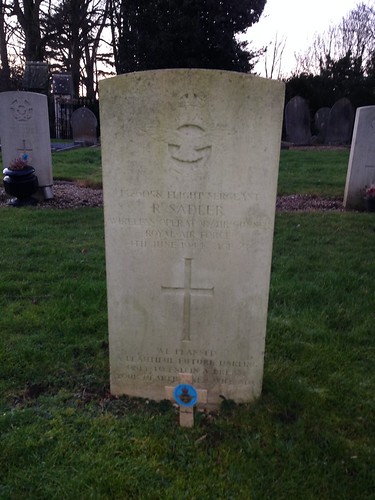
Three of the crew are buried in Kings Walk Cemetery, Downham Market, a short distance from the airfield.

Downham Market Cemetery

F.Sgt. Stanley Wharton (RAFVR)

Downham Market Cemetery

F.Sgt. Robert Sadler (RAFVR)

Downham Market Cemetery

F.O. Walter Thomas Olyott (RAFVR)

2nd Lt. John Walter Crago (RAF Kings Cliffe)

I was recently contacted by Mike Herring and Trevor Danks, regarding the story of 2nd Lt. John Crago who was based at RAF Kings Cliffe in Northamptonshire during World War 2.

It was sad tale of how this young man died in a tragic accident not long after arriving in the UK from the United States.

Mike and Trevor have allowed me to reproduce the entire text with photos to share with you, my sincere thanks go to them both. Here is John Crago’s story.

This is the story of 2nd Lt. John Walter Crago who tragically lost his life in an aircraft crash on 31st December 1943 whilst operating from Kings Cliffe airfield.

Firstly, however, let us look at his origins.

His grandparents were Harry and Bessie Crago who were born and lived in Cornwall on the SW tip of England. Harry was born in Liskeard in November 1858 and Bessie in Duloe in May 1862.

The surname “Crago” is quite common in that area. Cornwall had been a major source of tin and lead for many years and there were extensive mine works around the county.

After leaving school Harry worked in the mines from about the age of 12.

In 1878 Harry and Bessie, still unmarried, moved to the coal mining village of Wingate, near Durham, in the North East of England, where Harry worked as a coal miner.

In the early part of 1879 Harry and Bessie married at Wingate and by 1881 they were living at 13, Emily Street, Wheatley Hill, Wingate and had a one year old son with them – William.

As an aside the village of Wingate is well known to some people in Kings Cliffe. It was the home of the writer’s wife’s parents until their recent death and  brothers and sisters still live there.

The coincidence increases as it is also the place where friends, Rodger Barker, living in Kings Cliffe, and Jim Vinales, managed to crash a Vulcan bomber in 1971, that had lost two engines. The crew fortunately survived. (see chapter one of “Vulcan 607” Corgi books).

In 1882 Harry and Bessie emigrated to the USA, by now having two children , and it is no co-incidence that they settled in Pennsylvania which was a significant coal mining area, Harry working there as a miner.

Their third child, Walter P Crago, was born at Houtzvale, P.A. on 16th August 1893. He is the father of the subject of this story.

In the US Census of 1910 16 year old Walter is shown as having no occupation, although his father and elder brother are working as miners.

In the 1920 US Census, Walter is married to Margaret K Crago and they have a one year old son, John Walter, born 5th April 1917 who is the subject of our story. His father’s marriage to Margaret does not seem to have lasted as by 1930 Walter has married Lorena C Crago (nee’ Curtis).

John Walter Crago is brought up in Philipsburg, PA, a small town of about 3000 people (twice as big as Kings Cliffe) which is situated about 200 miles due west of New York.

Philisburg main street via Mike Herring

A view of modern Philipsburg main street.

Our next glimpse of John W is in his High school Year book in 1934 when he was 17 years old.
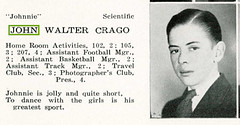
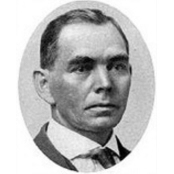
John Walter Crago via Mike Herring

Johnnie did one year in high school and was clearly keen on his sport as well as the local girls!

Six year later in the US Census of 1940 John’s father, Walter, is by then the part owner and bar tender of a restaurant/tap room in Philipsburg and John W is working for him.

In Europe WW2 is in full flow and clearly the US is preparing for its possible involvement as John is signed on in the draft on 16th October 1940.

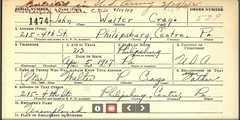
He is described on his draft form as 5’-8 ½” (1.74m) tall, weighing 135 pounds (61kg) with hazel eyes, light completion and brown hair.
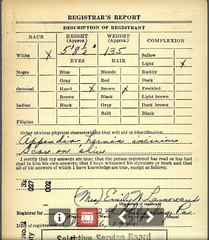
draft via Mike Herring

John’s Draft paper.

draft 2 via Mike Herring

John trained to be an Army Air force pilot and joined the 55th fighter squadron, part of the 20th fighter group.

They arrived at Clyde in Scotland in August 1943, then travelled to their new base at Kings Cliffe in Northamptonshire, England. The 20th fighter group consisted of three squadrons of about 14 planes each – 55th, 77th and 79th.

The group was the first to fly the new P-38 Lightning escort, fighter ground attack air craft in combat in Europe.

P-38 via Mike Herring

P-38 Lightning

There was insufficient room at Kings Cliffe for all of three squadrons and therefore 55 Fighter Squadron , of which John Crago was a member, were based at RAF Wittering, just two miles North of Kings Cliffe.

The P-38 Lightning had a somewhat chequered history in its’ early days. It had several recognised problems, but because of the needs in Europe for a powerful, high flying escort aircraft, the early ones were shipped out without those problems being resolved. They suffered from many engine failures, and instability in certain circumstances.

Of significance to our story is part of the Wikipedia article on the development of the P-38 which reads –

“Another issue of the P-38 arose from its unique design feature of outwardly rotating, counter rotating propellers. Losing one of the two engines in any two engine non centre line thrust aircraft on take-off creates sudden drag, yawing the nose towards the dead engine and rolling the wing tip down on the side of the dead engine. Normal training in flying twin engine aircraft when losing one engine on take-off is to push the remaining engine to full throttle to maintain airspeed. If the pilot did this on a P-38, regardless of which engine had failed, the resulting engine torque produces an uncontrollable yawing roll and the aircraft would flip over and hit the ground.”
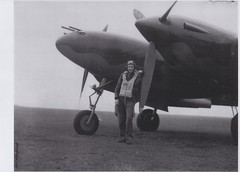
Crago with P-38 via Mike Herring

John Crago with his P- 38J Lightning – 1943


Crago at Kings Cliffe 1943 via Mike Herring

John W Crago in 1943 at Kings Cliffe

The first mission for 55 squadron was on 28th  December 1943 consisting of a sweep across the Dutch coast without encountering enemy aircraft. The mission summary report for that day reads –

28th December 1943

  1. 55th Fighter Squadron, 20th Fighter Group, Captain McAuley leading.
  2. 12 up at 1308 Down Wittering 1510
  3. Nil
  4. O 4 SWEEP
  5. To N. Nil
  6. Altitude over English coast mid-channel R/T jammed and remained so until mid-channel return trip. Landfall in, Wooderhoodf, at 1402. Altitude 20,000 feet. Light to moderate flak accurate for altitude over Flushing. Left turn and proceeded from Walchern to Noordwal 18 to 20,000 feet.
  7. Landfall out 1416 Noordwal. Weather clear all the way.

The second mission on the 30th December was more serious, escorting B-17 and B-24 bombers on an attack on a chemical plant near Ludwigshafen. The mission report for that day reads –

30th December 1943

  1. 55th Fighter Squadron, 20th Fighter Group
  2. 14 up 1121 at Kings Cliffe. Down 1500 Wittering.
  3. 3 aborts. Captain Jackson, Lt. Col. Jenkins – Radio. Lt. Sarros, gas siphoning.
  4. Bomber escort. Field order No. 210
  5. Nil
  6. Nil
  7. Nil
  8. Nil
  9. Landfall Ostend 24,000 feet at 1212. Climbed to 25,000 feet Brussels circled area 15 minutes. Proceeded to R/v with bombers. St. Menechoulde 25,000 feet at 1312. Reims 2 Me 109’s seen diving through bomber formation. Squadron left Bombers Compegiegne 1346. Encountered light flak Boulogne. Landfall out 1407, 24,000 feet. Clouds 6/10 over channel. 10/10 just inland. R/t ok.

The third mission was scheduled for 31st December and involved escorting bombers on an attack on a ball bearing factory at Bordeaux. John Crago was one of the 14 pilots of 55 squadron scheduled to be on this trip. He was temporarily based at RAF Wittering whilst suitable accommodation was built at Kings Cliffe and was flying from Wittering to Kings Cliffe to be briefed on the mission with the other pilots of 55, 77 and 79 Squadron who made up 20 Group. On arriving at Kings Cliffe he reported problems with his landing gear and did a low level fly past the control tower so that they could observe any obvious problem. As he approached the tower smoke was seen coming from his left hand engine.

He would have been flying slowly, close to stall speed, so that the tower had more time to observe any problem. Bearing in mind the reported problem with the P-38 flying on one engine the plane probably became uncontrollable. He clearly achieved some height as his eventual crash site was about two miles away at the village of Woodnewton. He did not survive the crash.

map via Mike Herring


location of crash via Mike Herring

Map of Woodnewton – crash site marked in red.
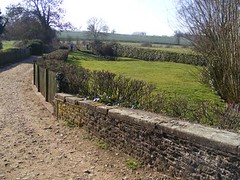
Lt. Crago's crash site

Lt. Crago’s crash site. (Photo courtesy Trevor Dank)

Lt. Crago's crash site

Lt. Crago’s crash site. (Photo courtesy Trevor Dank)

John Crago is buried at the Cambridge American Cemetery; plot A/5/22.

Commemoration Plaque

Plaque to commemorate Lt. Crago. (Photo courtesy Trevor Dank)

His was one of the bodies of American servicemen whose next of kin decided not to repatriate.  One could conjecture that he was left to rest in the land where many generations of his forefathers had lived.

Grave via Mike Herring


Kings Cliffe old blokes via Mike Herring

‘Kings Cliffe Old Blokes Club’ at the grave of John Crago.

Mike Herring
Kings Cliffe Heritage

Sources:

Vulcan 607 by Rowland White, Corgi Books.
US Census 1900, 1910, 1920, 1930, and 1940.
UK Census 1861, 1871,and 1881
Ancestry.com
Ancestry.co.uk
The American Air Museum – Duxford  www.iwm.org.uk/duxford
2nd Air Division Memorial Library – Norwich www.2ndair.org.uk

Report from Woodnewton Heritage Group

New Year’s Eve this year marks the 75th anniversary of a tragic accident in Woodnewton which resulted in the death of an American pilot and brought the realities of the Second World War closer to the inhabitants of our village.

JOHN WALTER CRAGO

John Walter Crago held the rank of 2nd Lieutenant in the US Army Air Force. He died instantly in an accident on 31st December 1943 when his aircraft crash landed in Woodnewton, in the field known as Stepping End just beyond Conegar Farm.

Lieutenant Crago was born on 5th April 1917 in Phillipsburgh, Pennsylvania, the son of Walter P Crago and Margaret K Jones. He had enlisted in March 1942 and was a member of the 55th Fighter Squadron of the 20th Fighter Group.  This Group was under the command of the 67th Fighter Wing of the Vlll Fighter Command of the USAAF. When he died he was 26 years old.

The circumstances leading to the accident on 31st December are recorded here in general terms only as told by former and existing residents of Woodnewton and supported by information from the Internet. It is not meant to be definitive.

The USAAF was assigned RAF Kings Cliffe in early 1943 and it was re-designated as Station 367. It was the most northerly and westerly of all US Army Air Force fighter stations. At that time RAF Kings Cliffe was a very primitive base, lacking accommodation and other basic facilities, so the Americans undertook an extensive building programme at the base during 1943. The 20th Fighter Group arrived on 26th August 1943 from its training base in California having crossed the USA by railway and then the Atlantic aboard HMS Queen Elizabeth on a five-day unescorted trip. The Group comprised three Fighter Squadrons; two of those Squadrons were based at Station 367 whilst the third, the 55th Fighter Squadron (Lieutenant Crago’s), was based at RAF Wittering whilst additional accommodation was being built at Kings Cliffe. The Group did not come back together at Station 367 until April 1944. Up to December 1943 the Group flew Republic P-47 Thunderbolt planes. With the arrival of their new Lockheed P-38 Lightening planes in late December 1943 the 20th Fighter Group entered fully into operational combat and was engaged in providing escort and fighter support to heavy and medium bombers to targets on the continent.

In the early morning of 31st December 1943 Lieutenant Crago was to fly from RAF Wittering to Station 367 to be briefed on his first combat mission – to provide escort protection on a bombing mission to attack an aircraft assembly factory at Bordeaux and an airfield at La Rochelle. This was to be just the 3rd mission by the fully-operational Group flying P-38’s. The planes of the 55th Squadron took off from RAF Wittering three abreast but unfortunately the right wing-tip of Lieutenant Crago’s plane struck the top of a search light tower on take-off.  Lieutenant Crago must have lost some control of the aircraft but not it would appear the total control of the plane. He flew it from Wittering and was trying to get to Station 367. Unfortunately, he only got as far as Woodnewton.

The plane approached the village from the north-east, flying very low over Back Lane (Orchard Lane) and St Mary’s Church but crash landed in the field known as Stepping End just beyond Conegar Farm. Eyewitnesses said that the pilot discharged his guns to warn people on the ground that he had lost control of the plane and was about to crash. Wreckage from the plane was still visible in Stepping End in the 1950’s and a “drop tank” (for additional fuel) could also be seen in the hedge between King’s Ground and Checkers. A brief reconnoitre in November 2018 however found no recognisable evidence of the plane in the hedgerows around the fields.

Stepping End is the first open field – no hedges or fencing – on the right-hand side of the track from Woodnewton to Southwick. From Mill Lane, cross the bridge over the Willowbrook, and continue until the land begins to rise at the start of the hill. King’s Ground and Checkers are the next two fields on the right along the same track.

It is understood that 2nd Lieutenant Crago, whilst no doubt a qualified and proficient pilot, had had only 7 hours flying experience in the Group’s new P-38 Lightning at the time of the accident.

A memorial plaque to Lieutenant Crago was put up in St Mary’s Church to commemorate his death. The wording on this memorial faded over time however, and the plaque was replaced in 2001, although the wording on the two plaques is the same.

2nd Lieutenant John Crago is buried and commemorated at the Cambridge American Cemetery and Memorial (Plot A Row 5 Grave 22). His photograph can be seen at “www/20thfightergroup.com/kiakita”.


My sincere thanks go to Mike and Trevor for sending the text and pictures and for allowing me to share the sad story of Lt. John Walter Crago. 

Loss of Mosquito FBVI ‘NS828’ RAF Swanton Morley.

Memorial to Fl. Lt. J Paterson and Fl. Lt J. Mellar

On April 25/26th 1944, 487 Sqn (RNZAF) moved from RAF Gravesend to RAF Swanton Morley in Norfolk, taking with them D.H. Mosquitoes. They had only been at Gravesend a few days when news of the new move came through.

487 Sqn had previously been involved in ground attacks on German airfields across the occupied countries, and in several high profile missions. In particular, during the previous February, they had been involved in Operation ‘Jericho‘, the attack on the Amiens Jail, in France. It was also a Methwold based Ventura piloted by Squadron Leader Leonard H. Trent, who, on 3rd May 1943, had led the Squadron in a disastrous daylight attack on the power station at Amsterdam. As a result of his actions that day, Sqn. Ldr. Trent received the V.C., the highest honour bestowed on personnel of the armed forces.

On their arrival at Swanton Morley, 487 Sqn would immediately begin training for new air operations, their part in the forthcoming D-day invasion at Normandy, with the first flights taking off the following day.

On April 27th three ‘targets’ were chosen, the Grimston Range not far away from Swanton Morley, the Bradenham Range in the Chilterns, and lastly the Army Gunnery School site at Stiffkey, on the North Norfolk coast. Each of these were to be ‘attacked’ in cross country sorties by the Mosquitoes.

In one of those Mosquitoes ‘EG-A’ was Pilot Flight Lieutenant John Charles Paterson (NZ/2150), and his Navigator Flight Lieutenant John James Spencer Mellar (s/n: 49175) both of the R.N.Z.A.F.

The day’s sortie went well, until the return flight home was made. It was on this leg of the flight that the port engine of the Mosquito, a Hatfield built FBVI ‘NS828’ under contract 555/C.23(a), began to overheat.

Immediately Flt. Lt. Paterson feathered the engine – now flying on just one. The Mosquito was lined up on approach to Swanton Morley for a single-engined landing, but all did not go well. Unfortunately,  instead of putting the aircraft down on the runway, the aircraft overshot the airfield crashing into a field beyond, the resultant accident killing both pilot and navigator instantly.

The Operational Record Book (AIR 27/1935/31) for April 27th states:

Formation dive bombing on Grimstone [sic] range. Low level bombing on Bradenham Range. Formation cross country with air to sea firing practice off the coast at Wells. In the evening six aircraft carried out formation attacks on gun positions at an army Gunnery School at Stiffkey. Returning from this ‘A’, F/Lt. Paterson developed engine trouble and feathered the airscrew.  In attempting to land, he overshot and crashed. F.Lt. Paterson and his navigator F. Lt. Mellar, were both killed.”

Since then, a memorial has been erected in memory of the two men, located on the side of the B1110 Dereham Road just outside the village of North Elmham in Norfolk, it stands not far from the site of the crash site, west of Swanton Morley airfield. After the crash, Flt. Lt. Paterson’s body was buried at Shepperton Church Cemetery, whilst Flt. Lt. Mellar was buried at Brookwood Military Cemetery plot 24. D. 20.

Flight Lieutenant Mellar was 29 on the date of his passing, he was the son of William Edward and Eleanor Mellar; and husband of Dorothy Freda Mellar. Flight Lieutenant Paterson was 24 years of age, he was the son of John Alexander and Alice Louise Paterson, of Papakura, Auckland, New Zealand, and husband of Doris Josephine Paterson, of Shepperton.

Swanton Morley appears in Trail 38.

P.O William Davis (Eagle Sqn) – March 18th 1941

RAF Sutton Bridge, was a small airfield on the Norfolk / Lincolnshire border a few miles from the Wash off the north Norfolk coast. Before, during and after the war it served as  training camp for new pilots, training them in the art of gunnery, utilising a firing range that had been in situ since 1926.

Many airmen of the RAF passed through Sutton Bridge, many of these were Commonwealth aircrew, some from Czechoslovakia and a few from the United States.

In the church yard behind the church of St. Matthew in the village, lie almost 60 graves of those who died in the fight for freedom, they are also joined by a German airman, foe united in death.

One such airmen is that of American Airman Pilot Officer William Lee Davis s/n: 61459 (RAFVR) who joined as part of the famed ‘Eagle’ Squadron, a group of volunteer American flyers.

P.O. Davis was from St. Louis and graduated at Central High School, before going on to attend Washington University. He was the son of William J. Davis of 4500 Arsenal Street, and a salesman in a cork and insulation firm in the area, when he joined up at the age of 25.

He left his job, signing with the Clayton-Knight Committee, a recruitment company for the Canadian and British Air Forces operating in the United States.  He was initially stationed at Love Field in Dallas, where he received four weeks of intensive training in aerobatics, gunnery and combat flying. After qualifying here, he transferred to Ottawa, where he was commissioned and then sent onto England to further his training. He was the first person from St. Louis to obtain a Commission in the Royal Air Force obtaining a deferment of his draft in doing so. When asked about joining the RAF, he told reporters that it was “a matter of sentiment and heritage” citing his English grandfather’s role as an officer in the Boar war.

P.O. Davis was no stranger to flying, having been a flyer before signing up for the RAFVR, achieving a total of 223 hours flying time, a commercial pilots licence and an advanced CAA Licence.

On arrival on March 5th 1941, these pilots were generally sent to No.3 Personnel Reception Centre at Bournemouth, before posting to No.56 Operational Training Unit (OTU) at Sutton Bridge. Here they completed their training and were then sent onto their respective operational squadrons. 

There were something in the region of 156 American Airmen who found their way into 56 OTU, many passed through with little or only minor mishaps. For P.O. Davis though it was to be the end of his dream, in an accident that would take his life.

On March 18th, a week after his arrival at Sutton Bridge, he took off in Hurricane P5195 on a general map reading flight across the Lincolnshire Fens. Whilst on the flight P.O. Davis became lost and decided to put down on farm land at New Leake Fen near Boston. Unfortunately, the ground in the Fens was soft causing the undercarriage to dig in and flip the Hurricane on its back. In the resultant crash, P.O. Davis broke his neck killing him instantly. He was not only the first from St. Louis to die, but the first American from Sutton Bridge to die also.

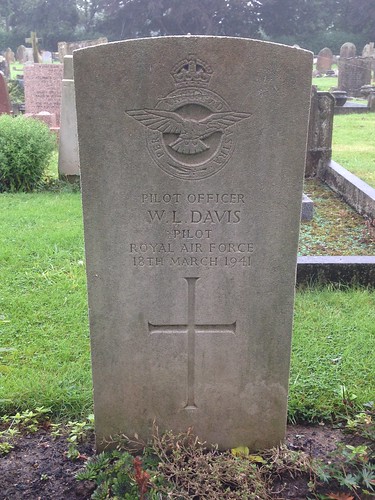
A citizen of the United States, Pilot Officer William Lee Davis is buried in the Church yard of St. Matthew’s Church, Sutton Bridge, Lincolnshire, Section P, Grave 56.

Pilot Officer William Lee Davis

Pilot Officer (Pilot) William Lee Davis

Operation ‘Fuller’ – “The Channel Dash”.

On 12th February 1942, 18 young men took off on a daring mission from RAF Manston, in outdated and out gunned biplanes, to attack the German fleet sailing through the English Channel.

Leaving Brest harbour, a force of mighty ships including the Scharnhorst, Gneisenau and Prinz Eugen, attempted a break out, supported by sixty-six surface vessels and 250 aircraft, they were to head north through the Channel out into the North Sea and homeward to Germany where they could receive valuable repairs.

For many weeks the British had been monitoring the vessels awaiting some movement out to sea. Then,  German transmitting stations based at both Calais and Cherbourg, began a cat and mouse game transmitting false readings to interfere with British radar sets on the south coast. In mid February, the Luftwaffe organised themselves over northern France and the radars went wild with false readings and interference. Temporarily blinded by these measures, the British were unable to ‘see’ the mighty armada slip out into the Channel waters. Their escape had been a success.

The British, fearing such an attempt, had prepared six Fairy Swordfish of 825 Naval Air Squadron at nearby RAF Manston in readiness for the breakout. Ageing biplanes, they were no match for the Luftwaffe’s fast and more dominant fighters, nor the defensive guns of the mighty German fleet they were hoping to attack.

Of the eighteen men who took off that day, only five were to survive.

Leading the attack, Lt. Cdr. Esmonde was warded the V.C. Posthumously, he had previously been awarded the Distinguished Service Order for his part in the attack on the Battleship Bismark; an award that also went to: S/Lt. B Rose, S/Lt. E Lee, S/Lt. C Kingsmill, and S/Lt. R Samples. Flying with them, L/A. D. Bunce was awarded the Conspicuous Gallantry Medal and twelve of the airmen were mentioned in dispatches.

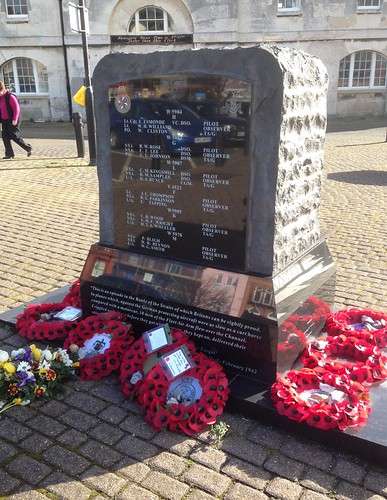
In their honour and to commemorate the brave attempt to hit the German fleet that day, a memorial was erected in Ramsgate Harbour, the names of the eighteen men are listed where their story is inscribed for eternity.

Operation Fuller was a disaster not only for the Royal Navy but also for the Royal Air Force. A force of some 100 aircraft made up from almost every Group of Bomber Command also made its way to the Channel. By the time evening had dawned it had become clear that some fifteen aircraft from the force had been lost. The loss of life from those fifteen aircraft totalled sixty-three, with a further five being captured and incarcerated as prisoners of war.*1

February 12th had been a disaster, but from that disaster came stories of untold heroism, bravery and self sacrifice that have turned this event into one of Britain’s most remarkable stories of the war.

Operation 'Fuller'

The memorial stands in Ramsgate Harbour.

Operation 'Fuller'

The names of the 18 airmen and the Swordfish they flew.

Further reading

*1 To read more about Bomber Commands part in Operation Fuller and a German film of the event, see the Pathfinders Website

Help Wanted – RAF King’s Cliffe!

In 2014, I published Trail 6 – ‘American Ghosts’ a trail around six American bases from the Second World War, one of these, RAF King’s Cliffe, was, at the time, under threat of development.

In 2015, objections from over 300 people were received which included supporters of Glenn Miller, aviation enthusiasts, wildlife groups and local people alike, who all highlighted concerns over the proposed development of the site and the impact it may have.

At an initial meeting in September that year, the council failed to come to any overall decision as they needed to consider further reports from different interested parties.  At a second meeting held on Wednesday 14th October,  after considering all the issues raised, East Northamptonshire Council approved the plans and so planning for 55 holiday homes were passed on an area known as Jack’s Green.

This area includes a memorial to the late Glenn Miller, who performed his last ever hangar concert here at King’s Cliffe before being lost over the sea. Assurances from the land owner at that time, were that the development would be in keeping with the area and that the memorial would remain “exactly as it was”.

I have not been able to return to Jack’s Green, nor King’s Cliffe airfield to see how this development has affected the area, and was wanting to know if anyone had photos of the development taken since the development started or more so, in the years following. As it would directly affect the memorial and adjoining public footpath, I was interested in the Jack’s Green area especially. I know that many geocachers use this path as do horse riders, walkers and enthusiasts alike, and am hoping someone may have a small collection of photos I could see.

Any photos you are willing to share would be very much appreciated.

My sincere thanks.

Andy

Links

The BBC report can be accessed here.

RAF King’s Cliffe was visited in Trail 6

Previous reports can be found here.

Glenn Miller Memorial RAF Kings Cliffe Dec 2014

Glenn Miller Memorial RAF Kings Cliffe Dec 2014

RAF Tuddenham – The last of the FIDOs (Part 2)

In Part one, we saw Tuddenham’s opening to the war. A rather cold and uninspiring airfield, it housed the Stirlings of 90 Squadron. Now, the Lancasters were arriving and front line bombing missions were once again on the horizon. 

The first of these major operations was on the night of 10th/11th June, when seven Lancasters, a mix of MK.Is and MK.IIIs, left Tuddenham to bomb rail facilities at Dreux –  90 Sqn had at last returned to the ‘front line.’

Sadly it was not to be the best night for the squadron, of the seven Lancasters that departed, two never returned home. The first NE149 ‘WP-A’ and the second NE177 ‘WP-B’ (both MK.IIIs), crashing in France. Of the fourteen airmen on board, three evaded capture, one was caught, and the remaining ten were all killed – it was not the most auspicious start for the unit. 

With two more Lancasters lost that month – one on the infamous Gelsenkirchen raid in which seventeen Lancasters were lost – June had proven to be difficult, and even though Stirlings were still operating, the Lancaster had become the main type and it wasn’t going to be an easy ride to Christmas. Forty-three, 90 Sqn airmen had been posted as either ‘killed’ or ‘missing’ in June alone.

Bomber Command’s tactical support of the land based forces continued on until mid September, by which time, Harris was back in charge and Bomber Command could once again turn its attention to targets in the German heartland. As the allied forces moved ever closer, night raids turned to daylight as allied air power began to get its grip on the skies over Europe. 

In October, a new squadron would reform here at Tuddenham, 186 Squadron also flying Lancaster MK.I and IIIs. Originally having its roots on board HMS Argus in 1918, it was another unit that had had short spells of activity before being disbanded once again. In a very different guise to its original formation, this time it was born out of 90 Sqn’s ‘C’ Flight, there the differences cease and by the December,  the squadron had left Tuddenham moving to Stradishall where it remained until the war’s end, and its final disbandment once more. 

The remainder of the year was relatively quiet for the Tuddenham group, regular missions with little or no opposition meant losses were low, and results were generally considered successful. But with bad weather setting in across both the UK and the wider continent, many squadrons had days of being stood down. Tuddenham on the other hand, with their FIDO system, was able to put up more flights than many others. Indeed during the Battle of the Bulge in the Ardennes, 90 Sqn were one of the few units able to launch attacks when most others were fog bound. 

The dawn of 1945 brought hope for an end to the war as the allied war machine moved ever closer to Berlin. The German’s last ditch attempt in the Ardennes was eventually overrun, and bombing picked up as fair weather returned once more. 

On February 2nd, Wing Commander W. G. Bannister joined the squadron on attachment. On the same day as he arrived, he took off at 20:52 in Lancaster HK610 ‘WP-Z’ along with thirteen other Lancasters from the squadron. Around an hour later, the aircraft collided with Lancaster PD336 ‘WP-P’, striking the tail trapping the rear gunner, Sgt. K. Hudspeth, inside the turret by his legs. Injured, he lay slumped over his guns. The pilot turned the aircraft over the Wash and ordered the bombs dumped in the sea. The rear tyre of the aircraft was burst and the port side of the tail was badly damaged, maybe even missing, and the turret by now was hanging off the aircraft. The pilot ordered chutes to be put on, after which the mid gunner Sgt. G. Wraith, went to help Sgt. Hudspeth, pulling him back into the aircraft’s fuselage where he administered morphine. The Lancaster made its way back to Tuddenham, and with the radio knocked out, red flares were fired to inform ground staff of its difficulties. Badly damaged with injured on board, the Lancaster made a safe landing, thanks to the skill of the pilot and crew.

Bannister’s Lancaster however, did not recover from the collision. After striking ‘P’ for Peter, the aircraft fell from the sky, crashing at 21:25,  3 miles from Bury St. Edmunds;  sadly there were no survivors.   

March 1945 saw a return of the Stirling to Tuddenham with 138 Sqn*3 transferring from Tempsford with the MK.V. As soon as they arrived they began to replace these with Lancasters MK.I and IIIs. 138 Sqn had been heavily involved in clandestine operations with the SOE, dropping agents into occupied Europe. With the need for such missions now largely gone, operations were wound down and the Stirling squadron were to be upgraded to front line bomber status. The first operational mission under this new guise was planned for the 28th but postponed until the following day. Three aircraft were ordered and all returned safely after having bombed the target. 

As the war drew  to its conclusion, 90 Squadron turned their attention to Kiel with both mining and bombing to prevent a German withdrawal. By the of the month it was all but over and operation Manna was put into place. On April 30th, 90 Sqn began their part in dropping supplies to the Dutch – targeting Rotterdam. Drop zones were identified by red T.Is and / or white crosses placed on the ground. By the end of the month 23 tons of food supplies had been dropped by the one squadron alone. During May, they began flights to Juvincourt to collect and bring back prisoners of war, dropping them at various sites including Dunsfold, Tangmere, Wing and Oakley; the aircraft then returned to base before carrying out further flights. 

On the 25th, ‘Cooks tours’ began, aircrew flying ground crew to Germany to see for themselves the damage inflicted by the war on the German heartland, it was a harrowing site for many. 

RAF Tuddenham

An electrical sub station shows its original RAF paint work

With no operational flying to do, training flights took over. It was a major change for  both the air and ground crews. As bases around the country began to close, so squadrons were moved around in preparation for disbandment. In April, two more Lancaster squadrons arrived here at Tuddenham, both 149 and 207 Sqns transferring across from RAF Methwold. The number of bomber squadrons now residing at Tuddenham totalling four.

Finally, in November 1946 the death knell finally rang for Tuddenham and it too was closed, flying ceased and the aircraft were all withdrawn. All four squadrons were pulled out of Tuddenham, 90 and 186 Sqns taking their Lancasters to RAF Wyton, whilst 149 and 207 went to RAF Stradishall. In what must have been a mass exodus, Tuddenham fell suddenly silent.

The airfield stood dormant for many years  whilst remaining in RAF hands, but then in 1953 life returned once more as the USAF arrived and used it as an ammunition storage area and renovation depot for surplus WWII ammunition and equipment. The American forces remained here for four years until 1957 when they too finally withdrew.

Tuddenham itself continued to stay in RAF ownership for a short while longer. As tension rose in the early part of the Cold War, ideal because of its low population and rural location, it was earmarked as a site for the new Thor missiles. New launch pads were built and a small section of the site was redeveloped accordingly.  Then in July 1959, 107 Squadron RAF reformed here, operating three of the Thor missiles as part of the UK-USA nuclear deterrent agreement. Retaining these until July 1963, the site finally closed once and for all. At this point all military personnel moved out and the gates were finally locked.

After this, Tuddenham was earmarked for quarrying to meet the rising demand for housing. Large sections were returned to agriculture, but a quarry opened to extract the much-needed materials for house construction. This operation has continued to the present day and has been responsible for the removal of large quantities of the main airfield site.

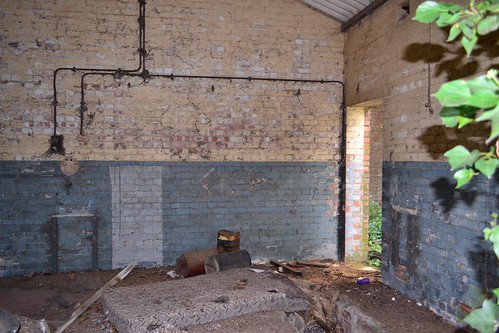
Visiting Tuddenham, reveals little of the history of the airfield and the people who stayed here. A few buildings, primarily the gymnasium and squash court remain standing, but in a very poor state and are likely to be pulled down soon. The roof has collapsed and part of the walls are missing. Located to the south of the airfield, they stand as reminders of those days long gone.

Other technical areas and the main part of the airfield, are now the workings of the quarry. The entrance to this site, rather insignificant, is part of the original perimeter track and is marked by an electrical sub-station. The shell is intact and complete with two blast walls, even the original RAF paint work can be seen! Overgrown and hidden beneath large thorns, this lone building will no doubt soon go the way of others some distance away.

Tuddenham airfield now stands lonely, large parts excavated and gone along with the memories of those who were stationed here. A pig farm covers a large part of the southern section and very little remains other than a few dilapidated buildings whose days are also very numbered. Tuddenham’s place in history is most certainly confined to the books and the memories of those whose numbers are also rapidly diminishing.

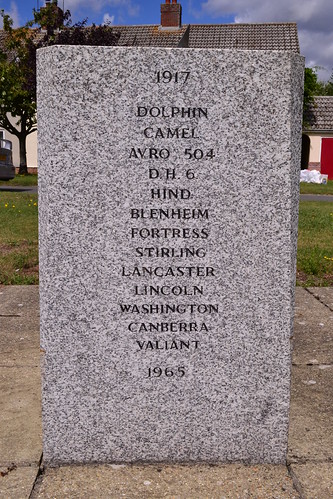
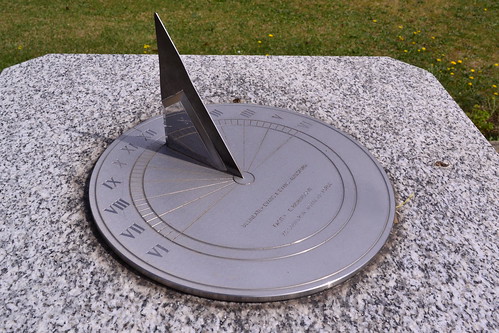
Before leaving Tuddenham, return to the village and stop at the village green. The village sign depicts a Lancaster flying low over the Suffolk landscape. A sundial, beautifully crafted marks the history of 90 Sqn, both the aircraft flown (1917 – 1965) as well as the airfields they were stationed at throughout their life. A superb tribute to a once active airfield and the gallant heroes of 90 Squadron Royal Air Force who served here*4.

RAF Tuddenham

Beneath the sundial, all the aircraft used by 90 squadron.

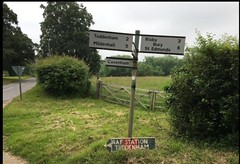
In July 2021 I was contacted by Herb Zydney who was stationed at the former RAF Tuddenham in the mid 1950s, he kindly sent some photos and has since sent the original road sign ‘home’ to remind us of RAF Tuddenham. Hopefully this will be suitable displayed. 

RAF Tuddenham road sign

The original road sign to Tuddenham airfield. It has since been returned to Tuddenham for display. (Photo courtesy Herb Zydney)

On leaving Tuddenham, carry on in a south-easterly direction toward Bury St. Edmunds and follow the A14 east. Passing Bury, we arrive at an industrial area on your left. Here we discover an aviation dream world see Trail 16.

Sources and Further Reading.

*1 National Archives AIR 27/731/25

*2 Grehan. J. & Mace. M. “Bomber Harris – Sir Arthur Harris’ Despatch on War Operations“, Pen & Sword, 2014

*3 No. 138 Squadron RAF went on to be the first ‘V-bomber’ squadron of the RAF, flying the Vickers Valiant between 1955 until being disbanded in 1962.

*4 Personal stories of personnel from 90 Squadron at Tuddenham can be found here on the Wartime Memories Project website.

*5 Williams, G. “Flying Through Fire – FIDO The Fogbuster of World War Two“, Alan Sutton Publishing. 1995 (An excellent book detailing the work on FIDO and its installations at each airfield).

National Archives: AIR 27/733/3; AIR 27/733/4

My thanks to Herb Zydney for the You Tube video and photos, they are very much appreciated.

RAF Tuddenham – The last of the FIDOs (Part 1).

In this trail we return to an RAF bomber airfield which opened later in the war. With a relatively quiet start, it soon became a front line base operating the four engined heavies the Lancasters of Bomber Command. Within a short time of it opening, it would become one of only a small number of airfields that would use the cleverly designed fog clearing system FIDO, a system that allowed aircraft to take-off and land in difficult weather conditions. As a result, it became a safe haven on more than one occasion. 

In Trail 16 we return to RAF Tuddenham.

RAF Tuddenham

Tuddenham (as opposed to the decoy site North Tuddenham) is one of those places that is today surrounded by large towns. To the north-east lies Thetford, to the south-east, Bury-St.-Edmunds and to the south-west that mecca of horse racing – Newmarket. As a result, the landscape of the area today is somewhat different to what it was in the 1930s and 40s.

Using land requisitioned in 1943 it was opened that same year. A standard Class ‘A’ airfield, its main runway ran south-east to north-west and was the standard 2,000 yards in length. With two secondary runways both of 1,400 yards, it would open under the control of 3 Group Bomber Command. For its protection it had its own decoy site built a short distance away at Cavenham, but even this didn’t stop attacks on the airfield, none of which thankfully caused any major damage.

Built by Taylor Woodrow, it would have two T2 and later one B1 hangar, with thirty-eight loop style hardstands and a perimeter track of the standard 50 yards width. A standard watch office for all commands (design 12779/41) was later redesigned to match the new war-time standard 343/43 design which had the smaller windows especially designed for bomber airfields.

RAF Tuddenham

Tuddenham village sign showing its links to a once active airfield.

Accommodation for air and ground crews was located on land to the south of the airfield spread across twelve sites. A mix of huts, they would accommodate around 2,000 personnel of which some 250 were WAAFs. Built as temporary buildings, these huts were unheated and unhomely, they were cramped and cold and as such, Tuddenham was not one of the most popular stations with crews posted there.

A fairly nondescript airfield, it was first frequented by the RAF’s 90 Squadron with the huge Stirling MK.III. 90 Squadron in name, had been in existence since 1917 although it had been disbanded and reformed on no less than four previous occasions, and had been at a variety of locations before arriving here at Tuddenham. This time however, it would be a much more permanent formation, and for the duration of the war it would reside at only one station, that of RAF Tuddenham.

90 Squadron had previously been recreated to test the suitability of B-17s for RAF service. Initially based at Watton, it would be less than a year before they were disbanded once more. Their more recent reincarnation led them to Wratting Common, from where they departed on their journey to Tuddenham on October 13th 1943.

According to the official records*1, this move was ‘worked out in every detail‘ and it went ‘expeditiously without incident‘ even though the airfield was still in a state of non completion. 90 Squadron’s first operational mission from Tuddenham occurred on the 17th, a return to mine laying off the Frisian Islands. Classed as ‘minor’ operations three aircraft were ordered to fly that day, one of which had to return early due to being struck by lightning and suffering damage to a number of areas including the rear turret. With only three other mining operations and an air-sea rescue search that month, the move to Tuddenham would have been uneventful had it not been for an accident involving Stirling EF497, piloted by Sgt. Wallace Jones who was aged just 21. The crew of the Stirling were on an air test when the aircraft struck trees just close to RAF Benson in Oxfordshire. As a result, all of the crew, of which three were in the RCAF, died in the ensuing crash. 

With only two other operational losses before the year was out, the Stirlings of 90 Sqn were not fairing as badly as many other units, but the days of the type were indeed now numbered as losses overall in 3 Group were high. The Stirling would soon be relegated to secondary duties completely. 

December 1943 would see a major installation take place at Tuddenham. By now, the fog dispersal system FIDO, was in place across several other British airfields and was proving to be a major breakthrough in poor weather flying.

Designed after pre-war investigations into ways of dispersing fog, it led to oil burners being laid along a mile length of the main runway at Tuddenham. Where these crossed secondary runways, the burners were entrenched and metal plates placed over the top to prevent aircraft using these runways, from having an accident. 

At Tuddenham (classed as FIDO Station XIX), the Mark IV Haigill burners were used, each burner was 40 yards in length and made of three pipes looped at the ends. Oil was fed into the burner via a feed pipe from the main pump on the southern side of the airfield. 

Supplying these burners took huge quantities of oil, this was brought in on the nearby railway which passed through the village of Higham. A special siding was constructed which could take a large number of wagons from which fuel was pumped into a small pumping station. From here, it would then cross several fields via underground pipes into one of three large storage tanks capable of holding around half a million gallons of fuel in total.

Work began at Tuddenham early in the new year 1944, and again Taylor Woodrow were charged with the task of carrying out the construction. By August, they were ready and stocks had begun arriving ready for a test burn.

Location unknown. FIDO burners alongside a runway 1945. © IWM CH 15274

FIDO amazed all those who saw it for the first time. Its ability to clear not only fog but low cloud as well, was a god send to those who were unfortunate enough to have found themselves lost in the thick of it. The first use of FIDO at Tuddenham was on August 8th 1944, when by pure accident, an American B-26 ‘Marauder’ was caught by fog. On that day, a test burn was planned, the burners were lit and the amazed onlookers watched as both fog and low cloud began to clear. Suddenly, out of the darkness and murk came the B-26, who had attempted to land elsewhere no less than eight times unsuccessfully. Seeing the bright blaze of Tuddenham’s burners, the pilot made for the airfield, flew over it to ascertain what it was, and once satisfied, made a successful wheels up landing. 

FIDO would be used regularly over the next few months, in November it provided a safe haven for both RAF and USAAF aircraft. In Geoffrey Williams’ book ‘Flying Through Fire‘, he quotes one pilot as stating he could see Tuddenham’s FIDO “from Ostend at 7,000 ft“, a point that illustrates the effectiveness of FIDO in poor conditions. 

The idea behind FIDO was to install it at a number of airfields that were located in a ‘hub’ of other airfields, thus keeping returning aircraft as close to their parent airfield as much as possible. It allowed returning aircraft to land (and take off) safely in poor or deteriorating weather conditions, but it was used ‘sparingly’, as in one day’s total of 6 hours burn, some 200,000 gallons*5 of fuel had been used. Not many sites actually had FIDO installed, just fifteen in the UK, eleven of which were Bomber Command airfields. However, FIDO was undoubtedly successful, these fifteen alone enabled somewhere in the region of 2,500 safe landings that would have no doubt led to a number of casualties or even deaths had it not been available. The airfields were very much appreciated by those who were caught out when returning from raids over Europe, the only major complaints being glare from the bright fires as aircraft came into land*2

RAF Tuddenham

South of the airfield lay the Squash court and Gymnasium.

Back in early 1944, Tuddenham’s operations continued, the Stirlings of 90 Sqn were soldiering on. More mining operations and bombing raids on the French coast dominated the months of January and February, whilst ‘special duties’ (SOE supply operations) took over as the main focus from March to May. By this time the Stirlings were starting to be replaced by the Lancaster, as it was now being relegated universally to secondary operations: supply sorties, paratroop transport and mining operations off the European coast. 

This transition began on May 11th, with pilots gaining initial experience by flying as 2nd pilot in other squadrons. New crewmen were soon being posted in, many of these from Conversion Units, whilst 90 Sqn’s Stirling crews were posted out. The continual cycle of trained crews coming in and ‘untrained’ crews going out filling the record books.

During all this operations continued on, and Stirlings continued to be lost. Four aircraft were shot down in May, three of them, on the two consecutive nights between the 8th and 10th, with many of the crewmen either being killed or captured.

The last Stirling to be lost on operations for 90 Sqn was on the night of June 2nd / 3rd when EF294 ‘WP-B’ crashed in France in the early hours of the 3rd. Of those on board, two managed to evade capture whilst the remaining five were caught and imprisoned in POW camps. 

With the invasion of Normandy on June 5th/6th, four Lancasters and fifteen Stirlings were prepared for operations in connection with the landings, but the Lancasters were withdrawn – perhaps to the annoyance of those on board. The Stirlings all took off and carried out their mission successfully, each one returning to Tuddenham safely. 

The last Stirling only operation took place on June 7th, the last two aircraft to return landing at Newmarket after completing their special operations. The Lancaster would now take over as the main aircraft and so 90 Squadron would soon return to bombing operations once more.

RAF Tuddenham

A sundial on the village green remembers the crews of 90 Squadron RAF.

In Part two the Lancaster arrive, but it is not the most auspicious of starts for the squadron.