Sqn. Ldr. Leonard Trent VC – RAF Methwold

RAF Methwold was a small airfield that was never intended to be a major player in the Second World War, yet it would see some remarkable achievements performed by the people who were stationed there.

Once such notable person was Squadron Leader Leonard Trent V.C., who, on 3rd May 1943, took a squadron of Lockheed Venturas on a ‘Ramrod’ Mission to attack an electricity power station on the northern side of Amsterdam.

As part of a larger attack, it would not be a mission central to Bomber Command’s overall bombing strategy, but more a mission of support and encouragement to the resistance fighters bravely fighting in occupied Holland.

Trent (N.Z.248i) was born in Nelson, New Zealand on 14th April 1915 the son of dentist Leonard Noel Trent and his wife, Irene Violet Everett.

The family moved to Takaka when Trent was four years old where, a short while later, he would be introduced to flight, and a ride in a Gipsy Moth.

As an older child he attended Nelson College, a boarding school, where he took up golf, and rather that focus on his work, he focussed on his new found hobby which would eventually take him to victory in the Nelson Golf Club Senior Championship.

After finishing his studies, Trent worked in various jobs, saving steadily to reach his goal of earning a pilot’s licence. Once qualified, he returned to flying at Taieri near Dunedin, where a brief training course prepared him to join the RNZAF.

Following his Air Force training, he earned his wings in Christchurch in May 1938 – just one month before departing for England to begin service with the Royal Air Force.

At the outbreak of war he was sent with No. 15 Squadron flying the out-gunned and out-performed Fairy Battles, to France to carry out photo-reconnaissance sorties over occupied territory. As part of the Advanced Air Striking Force, he flew only one mission before the squadron would return to England (RAF Wyton) and change their Fairy Battles for Bristol Blenheim IVs.

After carrying out a number of low-level attacks, he was awarded a DFC for his part in the air war over Belgium, a career that preceded him becoming a flying instructor for RAF crews.

Wing Commander G J “Chopper” Grindell (centre), Commanding Officer of No. 487 Squadron RNZAF, with his two flight commanders in front of a Lockheed Ventura at Methwold, Norfolk. On his left is the ‘A’ Flight commander, Squadron Leader T Turnbull, and on his right is the commander of ‘B’ Flight, Squadron Leader L H Trent. (IWM)*1

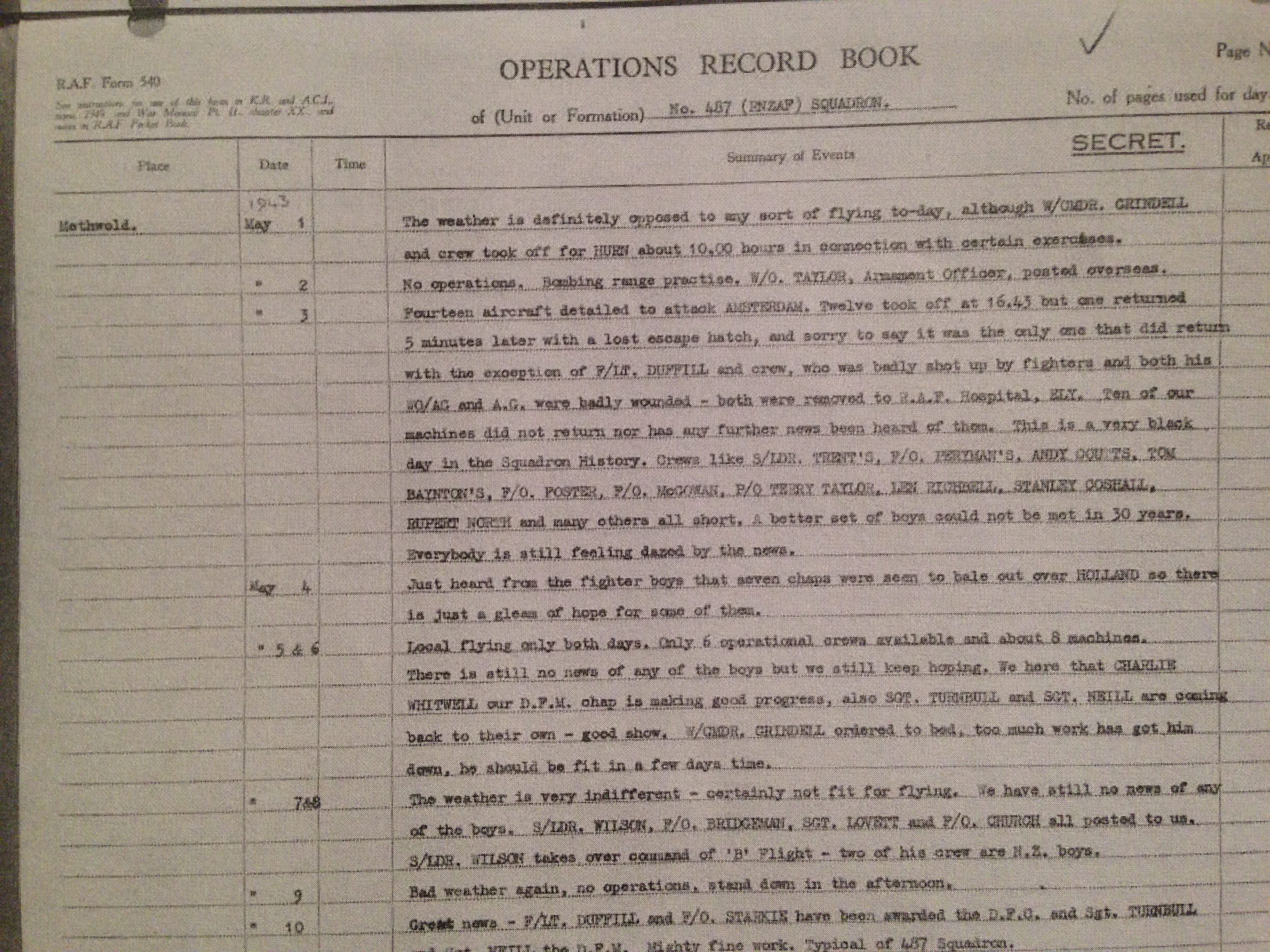
In 1942 he returned to operational duties as a newly promoted Squadron Leader taking command of B Flight, 487 (NZ) Squadron at RAF Feltwell. At the time 487 were part of No. 2 Group and were in the process of replacing their Blenheims with Venturas. The squadron moved from Feltwell to Methwold in early April 1943. Little did they know that only a month later, the Squadron’s Operations Record Book would read: “This is a very black day in the Squadron history…a better set of boys could not be met in 30 years. Everybody is still feeling dazed by the news.”

As an experienced pilot Trent would fly several low-level missions over the low countries, using an aircraft that was originally designed around a small passenger aircraft back in the United States. Whilst having powerful engines, Venturas suffered from poor manoeuvrability and a heavy air frame, these two failings combined with its rather ‘fat’ appearance, earned it the name “flying pig“.

Loses in Ventura operations would be high, and this was reflected nowhere else than on the very mission that Trent would fly on May 3rd 1943.

On that day fourteen Venturas of 487 Sqn were detailed to attack a target in Amsterdam, however only twelve aircraft actually took off, all at 16:43 from RAF Methwold. These aircraft were all part of a much wider operation, one that would involve an escort of nine RAF fighter squadrons. Timing was therefore crucial, as was low-level flying and maintaining the element of surprise. Within five minutes of their departure though, ‘EG-Q’ piloted by Sgt. A. Baker, would return after losing the crew escape hatch. This left eleven aircraft to carry on to the target.

A diversionary attack carried out by aircraft of 12 Group flying ahead of the main formation flew in too high, too soon, thus losing the surprise and alerting the defenders of the impending attack. Caught out by low fuel, many of the escorting fighters then had to leave, thus reducing the overall effectiveness of the defensive escorting force. The Luftwaffe, now ready and waiting, had scrambled numerous fighters, a deadly cocktail of FW-190s and Bf-109s. The squadron record book reports an estimated “80+ ” enemy aircraft in the locality of the attacking Venturas.

From this point on things went very badly for 487 Sqn.

As they crossed the Dutch coast Ventura ‘AJ478’ (EG-A) was attacked and shot down by Luftwaffe fighters. Ditching in the sea the crew took to a life raft where Sgt. T Warner, injured in the attack, died of his injuries. Committing his body to the sea the remaining three would be captured and become prisoners of war. Warner’s body would wash up two days later on a Dutch beach and be buried in the small town of Bergen op Zoom – all four were from New Zealand.

A second aircraft, ‘AE916’ (EG-C) was also very badly shot up by the pouncing fighters. However, it managed to return to England landing at their former base RAF Feltwell. The pilot and navigator were both unhurt, but the wireless operator and air gunner were both badly wounded, and were immediately taken directly the RAF hospital at Ely, Cambridgeshire. The aircraft was so badly damaged in the attack that it was written off. For their actions the pilot (F/Lt. Duffill) and navigator (F.O. Starkie) were both awarded the DFC, whilst the wireless operator (Sgt. Turnbull) and gunner (Sgt. Neill) the DFM.  Dufill later went on to become the managing director of Humbrol paints, a company renowned for its paint and modelling supplies.

Pressing on to the target, the casualties got worse and the loss rate increased.

Firstly, Ventura ‘AE684’ (EG-B) was shot down at 17:45 near Bennebroek with the loss of two; at the same time ‘AE731’ (EG-O) was shot down  just north of Vijfhuizen, three crewmen were captured but the fourth, Sgt. Tatam, died. Five minutes later at 17:50, ‘AE780’ (EG-S) was lost, with only one crew member surviving – the aircraft crashing into the suburbs of Amsterdam. Within three more minutes, a fourth aircraft of this group would go down; ‘AE713’ (EG-T) was hit, also causing it to crash in the northern suburbs of Amsterdam, this time killing all on board. By 18:00 there were only two of the eleven aircraft left, ‘AJ209’ (EG-V) flown by Squadron Leader Leonard Trent, and ‘AE716’ (EG-U) flown by F.O. T. Baynton.

Baynton’s aircraft, ‘EG-U’, would then be shot down by fighters causing it to crash in the outskirts of Amsterdam, also killing all four on board. Squadron Leader Trent, seeing all around him fall from the sky, pressed on. Flying toward the target he dropped his bombs and then turned away. Trent bravely and coolly defended his aircraft, shooting down a Bf-109 with his forward facing guns. Shortly after, he too was hit, the aircraft badly damaged, spiralled earthward uncontrollably, breaking up as it did so, throwing both Trent and his navigator F.L. V. Philips, out of the falling wreckage.

Both Trent and Philips were later captured and taken prisoner, the other two crew members; F.O. R. Thomas and Sgt. G. Trenery, both lost their lives in the crash.

One further aircraft, ‘AJ200’ (EG-G) piloted by New Zealander Sgt. J Sharp was thought to crash 3 km west of Schiphol, with only Sharp surviving; whilst the remaining two unaccounted aircraft, ‘AE956’ (EG-H) and ‘AE 798’ (EG-D), were lost over the sea on the way to the target. All eight crewmen were presumed killed, two of them being washed up several days later on the Dutch coast. The remainder were never heard from again.

In the space of only a few minutes, eleven aircraft had been attacked and ten shot down with the loss of 28 young RAF lives.

operations-record-page

The Operations Record Book for May 3rd 1943, shows the depth of feeling felt by the crews at Methwold following the disastrous mission. (Crown Copyright*2)

Trent spent the remainder of the war in Stalag Luft III where he participated in the ‘Great Escape‘, being the 79th man out of the famous tunnel, just as the sentry discovered the escape route. Trent was almost stood on by the guard. Being captured at this point possibly saved his life after Hitler gave orders to shoot many of the escapees. Only on his eventual return to England did the full and disastrous story of what had happened come out. He was awarded the Victoria Cross for his leadership in ensuring the bomb run was completed despite heavy enemy resistance and very high losses. The London Gazette published his citation on Friday 1st March 1946, in the Third Supplement which said:

“Before taking off, Squadron Leader Trent told the deputy leader that he was going over the target, whatever ‘happened…”

It later went on to say…

“On this, his 24th sortie, Squadron Leader Trent showed outstanding leadership. Such was the trust placed in this gallant officer that the other pilots followed him unwaveringly. His cool, unflinching courage and devotion to duty in the face of overwhelming odds, rank with the finest examples of these virtues.” *3

A determined attack, it was flawed from the moment the preceding force were spotted. The Venturas, woefully inadequate and unprotected, were literary cut down from the sky. Fighters escorting the Venturas confirmed seeing seven parachutes from the aircraft, but the scale of the loss was a blow so devastating, it left only six operational crews in the entire squadron.

For many days after, the Operational Record Books indicated “no news of the boys“, and as new crews and aircraft arrived, prayers for their return faded, but hopes for a return to operational status rose. Following a number of training flights, the next operational mission would finally take place on May 23rd, a mission that was a total success, and one that must have boosted the morale of the squadron immensely.

This mission was a disaster for the Royal Air Force and for Methwold in particular. The loss of life dealt a huge blow to the community both on, and around the base. In memory of these gallant young men, many of whom were never found, their names are inscribed on the Runnymede memorial, whilst those whose bodies were recovered, remain scattered in various graves across the Dutch countryside.

Trent himself, was transferred back to the UK in 1947 on a permanent commission, and from 1948 to 1959,  he was attached to Training HQ No. 3 Group based at Mildenhall. During this time, he would be posted to RAF Oakington and as Commander of 214 Sqn at RAF Marham, from where he flew Vickers Valiants during the Suez crises of 1956. On the night of 1st – 2nd September 1956, he flew a Valiant non-stop from Loring Air Base in Maine to RAF Marham, a time of 6 hours and 25 minutes – the first non-stop ‘V’ bomber flight across the Atlantic*4.

After that, and for the next three years, he would command RAF Wittering before being posted to the British Defence staff in Washington as an assistant air attaché, where he remained up until his retirement in 1965. During this time, he would also take up the role of Senior Air Staff Officer, Chief Intelligence Officer (RAF) and as an aide-de-camp to Her Majesty the Queen, Queen Elizabeth II.

After retirement, Trent would return to his homeland, where he would build a home for himself and his family.

In 1983, Leonard Trent managed an emotional return visit to his former station, RAF Methwold, from where he and so many of his friends took off from on that fateful day. Just three years later he would pass away at the age of Seventy-one.

As an accomplished golfer, painter and expert flyer, Leonard Trent was proud of his nationality and of his homeland. His distinguished service record and numerous honours position him among the nation’s foremost military pilots, securing his legacy as a revered figure.

RAF Methwold appears in Trail 8.

Sources and further reading.

*1 Photo source The Imperial War Museum (© IWM HU 81283)

*2 AIR\27\1935\13

*3  The London Gazette: (Supplement) no. 37486. p. 1179. 26 February 1946. Retrieved 29th January 2017

*4  RAF Museum Website accessed 3/11/25

Times Newspaper 20th May 1986.

AIR\27\1935\13 – Operational Records Book (summary), The National Archives

AIR\27\1935\14 – Operational Records Book (work carried out), The National Archives

Chorley, W.R., “Bomber Command Losses 1943, Midland Counties, 1996

Operation ‘Fuller’ – “The Channel Dash”.

The Second World War was full of extraordinary operations many of which succeeded in their aim resulting in great jubilation on home shores, whilst others will always be remembered for their catastrophic fail and loss of life. In these operations, and even though the mission may have failed, those who took part went far beyond the ‘call of duty’, showing incredible bravery and self sacrifice for the better good.

One such operation took place on February 12th 1942.

Up until now, German warships had been causing havoc in the waters around Britain, sinking in excess of 100,000 tons of allied shipping since the opening days of the war; their ‘trophies’ including the aircraft carrier HMS Glorious and the battleship HMS Hood. In January 1942, three of those German warships responsible the Gneisenau, Scharnhorst (Gluckstein and Salmon as the ships were known by bomber command crews) and Prinz Eugen, all heavily armed and battle hardened, were laying in the port of Brest. Even by remaining there, they were causing the Royal Navy an immense headache, as they were diverted from other important tasks, including operations in the Middle East against German supply ships supplying Rommel, and the valuable protection of allied shipping crossing the Atlantic. The small fleet were a major thorn in the Royal Navy’s side and had to be dealt with.

Coastal Command had been closely monitoring the vessels over a period of months, but information had led to little more than that. With the aim of sinking these ships, the RAF became involved undertaking a total of 299 attacks against them whilst docked in the port. During these attacks, forty-three aircraft were lost along with 247 brave airmen. Included in these raids, were in December 1941, ten such operations by Bomber Command which resulted in the loss of some twenty aircraft and seventy airmen. On the 8th of that month, forty-seven bombers escorted by ten fighter squadrons also attacked the docks. Whilst the three ships remained intact, three enemy fighters were claimed to have been shot down but with with the loss of four Stirlings.

During this time though, the ships were indeed hit, and in the case of Scharnhorst, damaged badly, but none ever badly enough not to be beyond repair.

The decision was eventually made therefore, to move the ships, Hitler’s fear of a second front being opened in Scandinavia proving to be the deciding factor. On that decision two routes were considered, the northern route around Scotland which would take the small, but powerful fleet in range of British carriers and warships at Scapa Flow, a fight the Germans did not want to engage in. Alternatively, they could attempt a daring dash through the narrow and well defended English Channel. It was a difficult decision to make.

The presence of the ship and their likely move to safer harbours prompted William Helmore (one of those behind the Turbinlite project) to go to the Alan Muntz Company with an idea as to how to sink them. In conjunction with GEC, RAE Farnborough, Dowty and Stones of Deptford to name but a few, the idea of a radio controlled, 5 ton torpedo with a diameter of 39 inches able to fit a Lancaster bomber, was devised.

The idea was that a Mosquito would control the torpedo once it had been dropped from the Lancaster, and a mast would rise to maintain radio contact with the controlling aircraft. The torpedo would have a range of 25 miles with a warhead weighing 1 ton, limited only by the size of the Lancaster. While tests were carried out, many issues raised their heads including an air supply for the engine, (a Meteor Tank engine) which all proved too complicated and the project was eventually shelved*4.

However, following a meeting on January 12th, 1942 between many top ranking German officials including Hitler, Raeder (the C In C of the Navy), Vice-Admiral Ciliax and Adolf Galland as commander of the Luftwaffe in the Channel area, a decision was finally made, the shorter English Channel route would be the one to take and so Operation Cerberus, (the breakout) was born.

The decision raised great concerns though. Both Galland and other Luftwaffe officials knew that there were too few available fighters in the region – just some two groups and a few training units – to be able to provide the 24 hour protection the ships needed as they dashed through the straits. Night fighters were especially needed, a decision which was affirmed and granted by Major General Jeschonnek, the Luftwaffe Chief of Staff; but the numbers of aircraft available to Galland would still remain greatly inferior to those on British soil ready to attack.

So, Operation Thunderbolt (Donnerkeil ) was put in place, the air umbrella that would protect the ships as they sailed northward. Operation Cerebus (the breakout) was affirmed with February 11th chosen as ‘X’ day, and a sailing time set at 8:00pm. In the weeks leading up to the ‘dash’, German transmitting stations based at both Calais and Cherbourg, began a cat and mouse game transmitting a series of elaborate but false messages to interfere with British radar stations along the south coast. They provided a cover story, suggesting that the fleet would set sail but head toward the Pacific in support of the Japanese and not north to Scandinavia. In preparation, trial runs were made to test engines, guns and communications. The British, still monitoring their actions, began a series of raids on the port, none of which achieved any great success.

During these attacks, which had been occurring regularly since early January, several aircraft were lost including: three Manchesters from 61 Squadron; two Hampdens from 144 Sqn; three Wellingtons, one each from 12, 142 and 300 Sqns and on the 10th February, another Manchester from 61 Sqn.

To meet the anticipated challenge, Galland had some 252 fighters, including a mix of 109s, 190s and some thirty 110 night fighters at his disposal, but he argued, it was still not enough to provide the cover he wanted.

As ‘X’ day approached, the radars went wild with false readings and interference. But the British, now aware of an impending escape, were on high alert, additional Motor Torpedo Boats (MTBs) were docked at Dover and Swordfish aircraft were drafted in to RAF Manston in Kent. Some 1,100 magnetic mines were laid along the projected route and Dover command was put on standby. At 8:00pm on February 11th,  the flotilla began to assemble outside of Brest harbour, just as a routine air raid was launched, and so the port was shut down. Although only one aircraft was lost, a Wellington from 150 Sqn, the raid proved no more than a nuisance, only delaying the fleet’s departure by two hours.

Now temporarily blinded by false radio measures, the British were unable to ‘see’ the mighty armada as it finally slipped out into the open waters of the Channel. Their escape had been a success.

During the night, good progress was made by the fleet and the lost time was made up quickly. Meanwhile, the skies remained quiet, the British not yet realising the ruse. The early morning remained dark, night fighters patrolled along side the fleet at wave top level, thus avoiding detection by British radar. Day fighters joined them in a relay operation that would be held below the cloud ceiling of 1,500 feet.

At 11:00 am on the 12th, the Germans intercepted a British message signalling that the fleet had been spotted. But it remained another hour before further RAF aircraft were seen, the British being wary and unsure of the message’s accuracy. Even though for months the British Command had been monitoring the fleet, those in command failed to act on valuable information, a mistake that led to a vital delay in operations.

Then, in the early hours of the afternoon, as the fleet approached the narrowest point of the Channel, British defences at Dover opened fire. A sea battle then raged between German warships and British MTBs, but for all their valiant efforts they failed to achieve their goal.

At 13:20 A group of sixteen Spitfires took off from Kenley on a Beaufort escort mission that were sent out to search for, and attack the fleet. They initially  rendezvoused with twelve more Spitfires from 602 Sqn, but then failed to meet the Beauforts over Manston. The formation then continued on to the target area looking for the convoy and its escort. Soon after arriving over the Channel, 485 (NZ) Sqn’s leader, Group Captain, Francis V. Beamish DSO and Bar, DFC, AFC, spotted six destroyers, two E-Boats and two German Battle cruisers. At his altitude there was no fighter escort, the mix of Bf109s and FW190s remaining firmly below radar level at 600ft.

Seizing his chance, Beamish then attacked one of the destroyers raking it with gunfire along the length of its deck, a Spitfire’s guns were no match for the destroyer though and little damage was done. The remaining aircraft of the two squadrons then took on the enemy who were forming a low level protective umbrella, achieving a greater rate of success with several ‘kills’ being reported back at Kenley.

Now fully aware of the situation, the RAF and Navy were called into action. At RAF Manston, eighteen young men began to prepare for take off, their target, the escaping German fleet of some sixty-six surface vessels including the warships Gneisenau, Scharnhorst and Prinz Eugen, now sailing almost unopposed through the English Channel.

The six Fairy Swordfish of 825 Naval Air Squadron were ageing biplanes, they were no match for Galland’s fast and more dominant fighters, nor the defensive guns of the mighty German fleet they were hoping to attack. To pitch a handful of biplanes with torpedoes against such a heavily armed and well prepared armada, turned out to be no less than suicide.

In front of their Swordfish, Lieut Cdr E Esmonde, RN, (2nd Left) on board HMS Ark Royal, October 1941. This photo was taken after the attack on the Bismark, and includes the various aircrew who received decorations as a result of that daring attack. (Left to right: Lieut P D Gick, RN, awarded DSC; Lieut Cdr E Esmonde, RN, awarded DSO; Sub Lieut V K Norfolk, RN, awarded DSC; A/PO Air L D Sayer. awarded DSM; A/ Ldg Air A L Johnson, awarded DSM). (© IWM A 5828)

The winter of 1942 was very cold, but the Swordfish were kept ready, engines warmed and torpedoes armed, now they could no longer wait, and instead of attacking as planned at night, they would have to attack during the day, and so the order to go was given. The crews started their engines and set off on their daring mission in what was appalling weather.

Shortly after take off, the escort arrived, merely ten Spitfires from No. 72 Squadron RAF, led by Squadron Leader Brian Kingcombe, and not the five Spitfire squadrons promised. The six Swordfish, led by  Lt. Cdr. Eugene Esmonde, dived down to 50 feet and began their attack. Hoping to fly below the level of the anti-aircraft guns each of the six Swordfish flew gallantly toward their targets. Eventually, and even though they were hit and badly damaged, they pressed home their attacks, but they were out-gunned, and out performed, and just twenty minutes after the attack began, all six had fallen victim to the German guns. No torpedoes had struck home.

Of the eighteen men who took off that day, only five were to survive.

Leading the attack, Lt. Cdr. Esmonde (an ex-Imperial Airways captain) was warded the V.C. Posthumously, he had previously been awarded the Distinguished Service Order for his part in the attack on the Battleship Bismark; an award that also went to: S/Lt. B Rose, S/Lt. E Lee, S/Lt. C Kingsmill, and S/Lt. R Samples. Flying with them, L/A. D. Bunce was awarded the Conspicuous Gallantry Medal and twelve of the airmen were mentioned in dispatches.

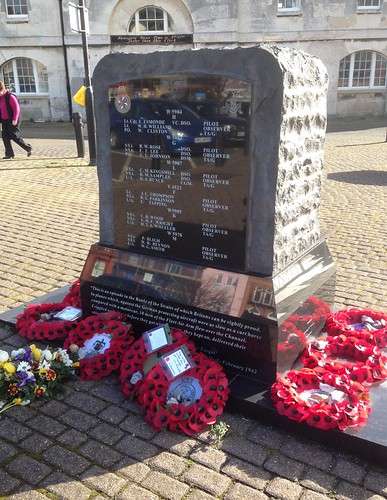
The attack became known as ‘The Channel dash’ officially called Operation Fuller, and in honour of the brave attempt to hit the German fleet that day, a memorial was erected in Ramsgate Harbour, the names of the eighteen Swordfish crew are listed where their story is inscribed for eternity.

Operation Fuller was a disaster not only for the Royal Navy and Coastal Command who had been monitoring the fleet for many months, but also for the Royal Air Force. A force of some 100 aircraft made up from almost every Group of Bomber Command had made its way to the Channel. By the time evening had dawned, it had become clear that some sixteen aircraft from the force had been lost. The loss of life from those sixteen aircraft totalled sixty-four, with a further five being captured and incarcerated as prisoners of war.*1

Bomber Command were not without their terrible stories either. The sad loss of W/C. R MacFadden DFC and his six crew who remained in their dingy after their Wellington from 214 Sqn ditched in the cold waters of the Channel. Over a period of 72 hours all but Sgt. Murray, slowly died from the cold, he being rescued at the last minute and incarcerated by the Germans. Of all the RAF squadrons that took part that day, their losses amounted to: 49 Sqn (4 x Hampdens); 50 Sqn (1 x Hampden); 103 Sqn (1 x Wellington);  110 Sqn (1 x Blenheim); 114 Sqn (1 x Blenheim); 144 Sqn (2 x Hampdens); 214 Sqn (1 x Wellington); 419 Sqn (2 x Wellingtons); 420 Sqn (2 x Hampdens) and 455 Sqn (1 x Hampden)*2

February 12th had been a disaster, so bad that The Daily Mirror reported on February 16th 1942 under the headline “9 Lost Hours in the Channel“,  that a demand had been put forward to Parliament for a complete statement on Naval strategy during the event. It also questioned the “suitability of Admiral Sir Dudley Pound”, in fulfilling his role. The paper goes onto say that a lag of some nine hours had largely been ignored by officials, that being the time between the first notice and when action was finally taken against the fleet. It also says that although the initial sighting was no earlier than 10:42 am, it took another hour before it too was responded to.  The public had been mislead it believed.

The entire operation has been badly organised by those in command, with little or no cohesion nor coordination between this various forces involved. As a result, the entire operation was a catastrophe with a major loss of life and no real result. The entire operation was seen by some as akin to a “Gilbert and Sullivan” comedy*3.

However, from that disaster came stories of untold heroism, bravery and self sacrifice by a group of men that have turned this event into one of Britain’s most remarkable and incredible stories of the war.

Operation 'Fuller' The memorial stands in Ramsgate Harbour.
Operation 'Fuller' The names of the 18 airmen and the Swordfish they flew.

Sources and Further reading

*1 To read more about Bomber Commands part in operation Fuller and a German film of the event, see the Pathfinders Website.

*2 Chorley, W.R., “Bomber Command Losses of the Second World War – 1942” 1994, Midland Counties publications.

*3 Bennet, D “Pathfinder“, Goodall, 1998

*4 McCloskey, K., “Airwork – A History.” The History Press, 2012

A German account of the ‘dash’ is given in “The First and the Last” by Adolf Galland published in 1955 by Meuthuen & Co.. Ltd.

Smith. G., “Heroes of Bomber Command – Cambridgeshire“. Countryside Books (2007)

National Archives AIR 27/1933/20, AIR 27/1933/21

RAF East Kirkby – Part 2 – a Relentless Slog.

In Part 1 we saw how East Kirkby came about, how its one main unit was used to create further units and how the war had taken its toll on those stationed here. In this part, we end 1943, but the high hopes of better things are far, far away.

The opening of September 1943, was however, the tip of the iceberg, for on the night of 23rd – 24th, three more aircraft were lost whilst on operations to Mannheim; all but five of the twenty-one men involved being killed, with those surviving five being incarcerated by the German forces. The operation had seen almost 630 aircraft take part in a raid that resulted in huge devastation with over 25,000 people being bombed out of their homes.

With the loss of two further aircraft in the closing days of September, the total dead or captured stood at seven Lancasters (forty-nine crewmen) with only four airmen returning to their Lincolnshire home. It had been a devastating start for the squadron at their new home in Lincolnshire.

October 1943 was much the same, major battles over the German Reich took further tolls with another four Lancasters falling from the skies. Most of these crews were also killed with just a handful surviving to be taken prisoner. The numbers of experienced crews on roll were quickly dwindling and replacements were now urgently needed.

NX611 'Just Jane'

The Lancaster ‘DX-F’ at East Kirkby, paying tribute to all those who flew from the airfield and in Bomber Command.

Then in mid November, 57 Sqn would be split for a second time to form yet another new squadron. This time, ‘B’ Flight were taken out and re-designated 630 Sqn. Initially being given the designation of an auxiliary squadron, it was however, a status that was never achieved. The entire flight consisting of nine crews and 106 ground staff, were led by the American, Sqn. Ldr. Malcom Crocker DFC, who simply moved across the airfield locating to new quarters and new dispersals, thus creating two operational squadrons at the site. Being battle hardened already, it took less than three days to complete the move before operations for them began once again.

November also saw Bomber Command enter its fourth month of the ‘Battle of Berlin‘, a period that saw intense bombing of the German capital with repeated raids on the city by heavy bombers of the RAF. It was also a time when the ill-fated Stirlings were finally pulled out of front line bombing campaigns, their losses becoming insurmountable. The decision to do so however, would put further pressure on the Lancaster and Halifax crews who were then left to complete the job with fewer aircraft and increasingly tired crews.

This period would become one of the RAF’s most testing times, and for the next four and a half months, Bomber Command, led by Sir Arthur Harris,  would continue to pound Berlin and other major cities deep inside Germany. The winter would be harsh, flights would be long, and it would be a gruelling time for the crews of Bomber Command.

The void left by the Stirlings was filled by the Halifaxes, and their loses now also soared. The battle for Berlin was a battle that would quickly diminish the capability of the RAF if loses were to continue at their current pace.

As the war entered 1944, the crews of Bomber Command became weakened and tired. Extensive battles had taken their toll and a rest was much needed. With poor weather dominating January that rest came, as crews were grounded unable to fly in the appalling winter weather.

The new year would see 617 Squadron dominate the way for 5 Group, their fame and successes taking a large chunk of the new reels. However, at East Kirkby, 630 Squadron would take on a new commander with the arrival of Wing Commander Deas in early February, taking over from Wing Commander J. Rollinson. Deas would continue to lead the squadron for the next five months, as it battled its way through the harsh winter period into spring and onto summer.

The pressure was however on Harris. He was now ordered to turn his men away from Berlin and help the Americans with the invasion plans supporting them in Operation Argument, otherwise known as ‘Big Week’. The operation was designed to weaken the German aircraft industry to prevent reinforcements of aircraft in the build up and launch of Operation Overlord.

In one last vain attempt to hit the capital, Harris planned four nights of raids in February, but poor weather curtailed these allowing only one raid to take place that on the night of the 15th – 16th February.

In the raid, which proved to be Bomber Command’s penultimate flight over the city, both 57 and 630 Squadrons would be involved. A mix of almost 900 Halifaxes and Lancasters saw losses amounting to over forty aircraft, one of these coming from 57 Sqn and another from 630 Sqn with the loss of all crewmen.

In order to lower losses, the formations would be concentrated, dropping 2,600 tonnes of bombs in just twenty minutes, a rain-storm of explosives that would see forty-five aircraft bomb every minute.*2

With that the Battle of Berlin came to an end, fizzling out as operations turned to The Rhine and its heavily defended industrial infrastructure.

The first area targeted was Leipzig, on the night of February 19th-20th. Here another 800 plus aircraft flew to Germany and back. They met determined German fighters as soon as they crossed the coast after which ensued a relentless air battle all the way to the target. Once there, it was completely covered in cloud and sky marking by the Pathfinders was the only possible method of identifying the target. In the operation, 630 Sqn put up nineteen aircraft and 57 Sqn, twenty; all but three returned home that night.

The Leipzig attack would prove to be a disaster for Bomber Command, strong winds meaning some bombers had arrived before the Pathfinders, and then had to circle the target for some considerable time before the markers arrived. This resulted in many of them being shot down by flak with some colliding in the dark, night sky. A loss of seventy-five aircraft that night led to the withdrawal of the second of the heavies – the Merlin powered Halifaxes – from front line operations; like the Stirlings before them, their loses had become unsustainable. This move put yet another heavy burden on the Lancasters crews, as it became the main heavy bomber now able to carry the war into Germany,

The night also proved to be an important one for one East Kirkby Pilot, W.O. J. White, whose determination to get the ‘job done’ and come home, led to him receiving the award of a DFM. In the attack, his rear gunner was mortally wounded, and the aircraft badly shot up with both hydraulics and an outer engine rendered unserviceable. Undeterred, W.O. White carried on to the target, dropping the bombs and then returning to England. On arrival, he managed to negotiate  landing the crippled aircraft at an unfamiliar airfield away from home. His courage and determination being more than worthy of the award he received for his actions.

With no break nor time to rest, another operation was ordered the following night, and although the 20th-21st attack on Stuttgart was a clear scoreboard for 57 Sqn, 630 lost another two; one of these ‘ND563’ swinging violently to port after travelling three-quarters of the way along the main runway. After crashing through a boundary fence and crossing a road on its belly, the bomb load exploded before anyone could escape. It was a tragic loss of life for those based at East Kirkby.

BBC war correspondent Richard North interviews the crew of Lancaster “S -Sugar” of No. 630 Squadron RAF on their return to East Kirkby, after bombing the marshalling yards at Juvisy-sur-Orge, France. IWM (CH 12778)

February closed with operations to Schweinfurt and Augsburg, an enquiry into the crash of ND5663 and the funerals of those who had lost their lives that day. With one squadron each losing a further crew, losses were continuing to mount for the two squadrons.

The early spring months would finally draw to a close over two disastrous nights. The first, on 24th – 25th March, saw Harris send his men back to Berlin one more time. In a last effort to bomb the capital, the RAF sent another 800 plus aircraft to the German capital, it would prove to be one of the worst for 630 Sqn, when three aircraft, including that of W.O. J. White who had just been awarded the DFM, were lost.

It was a dramatic figure that would be repeated on the last night of the month, when almost another 800 aircraft made up of Lancasters, Halifaxes and Mosquitoes were sent to Nuremberg. Weather reports from a Meteorological Mosquito were ignored and whist the operation should have been cancelled, it went ahead. In a moon-filled sky, the  result was carnage.

By the time all aircraft had returned, losses stood at 95 crews, almost 12% of the entire force sent out, and the biggest loss for the Command of the war so far. The weather experienced had caused the biggest problems, not only for the main bomber-stream, but also for the Pathfinders,  with strong winds blowing many aircraft widely off track causing them to bomb Schweinfurt, some 50 miles away,  by mistake. Of those that did bomb the correct target, many reported that they were unable to see it due to heavy cloud, which combined with the strong winds, forced both them and the Pathfinders to mark and bomb the wrong area. As a result, little damage was done to the city, and dropping bombs too early, caused ‘creep back’ to extend for some 10 miles ahead of the target. All-in-all more crews were lost that night then there were casualties on the ground, losses that were totally unsustainable for the command.

The German defences on both nights had been extensive and determined. Tame Boar and Wild Boar tactics along with Schrage Musik, the upward firing cannons, had devastated formations who were scattered far and wide. Harris had gambled with his crews and lost.

The disastrous nights of Berlin and Nuremberg led to a short pause in operations in much the same way as the dreaded raid on Schweinfurt did for the Americans. A new focus would take no chances, and precise bombing became the order of the day.

After devastating operations over the German cities, thoughts turn to the invasion and supporting the ground forces. A choice that did not agree with Harris, but one the crews would take in their stride…

The full page can be read in Trail 1 – Lower Lincolnshire.

RAF Sawbridgeworth – Part 4 – The end of an Era.

Continuing on from Part 3

2 (AC) Sqn by now, also had a move away on the cards, and following a meeting on the 28th January the advanced party departed first, followed on the 31st by the ground party. The Mustangs moving to RAF Bottisham, from where they would now operate before being divided and part moving to Fowlmere.  After a short stay at the two sites they returned to the Hertfordshire airfield once more. Their departure had lasted a mere four months.

RAF Sawbridgeworth Emergency generator

The Standby Generator House now a stores for machinery.

Whilst they were away, the airfield was used on a temporary basis by 652 Sqn flying Austers, On arrival, they immediately took over Blount’s Farm and used it for their own personal use. In the short time they were here, they participated in Exercise “Spartan” again in conjunction with the Army, departing the airfield in late  March.

After being spilt between Bottisham and Fowlmere, 2 (AC) Squadron was now reunited and returned to training flights, air to air firing, ground support flights and increased operational activities. A large part of the squadron’s role now included photographic reconnaissance of enemy territory, many of these operations taking place over the Hook of Holland, den Helder, Kijduin, and Ameland. Some of these required the squadron to detach to other stations but the majority of operations flew from Sawbridgeworth, the Mustangs fairing much better than the heavy Typhoons of 182 Squadron earlier on.

In Mid may, disaster struck again for the unit when three aircraft crashed into a hillside after setting off on a photo reconnaissance flight to photograph locomotive movements in northern France in Operation “Asphalt“. On the way out, a bank of sea fog was encountered and the order to climb was given. Unfortunately, flying abreast,  three of the ten Mustangs failed to clear the hill they encountered, and Pt. Off. J. McLeod, Fl. Off. D. Hirst and Fl. Off. N. Miller were all killed. The remaining aircraft then flew to Thruxton where they were detached to,  and a search commenced for the missing airmen. Their bodies were later recovered and funerals held in their respective homes at the end of the month.

Photo reconnaissance flights and attacks on shipping, increased becoming the main role for the squadron.  Sadly during one of these operations, Operation “Lagoon“, Fl. Off. Butt was killed when his Mustang crashed into the ground before he was able to land. The resultant explosion and fire killing him.

July 1943 saw yet another move for the squadron, this time to Gravesend, where they were immediately billeted under canvas and then inspected for fitness to serve overseas. No such move came through though, and after moving around various other local airfields, in November, 2 Sqn returned to the Hertfordshire airfield that had become their semi-permanent home; this time though, they were not unaccompanied, they brought with them the Mustangs of 4 Squadron.

During their absence, Sawbridgeworth had not been deserted, in fact it had been very busy and home to several other squadron detachments. On the 12th November 1943, 63, 168 and 170 Squadrons had all moved in with Mustangs, then on the 30th, both 63 and 168 departed moving back to their parent unit, their short detachment coming to an end; whilst 170 remained here until mid January when they were disbanded.

The return of 2 Sqn and the new Mustang unit that November, saw a continuation of reconnaissance operations  over the continent. 4 Sqn had been dogged by mechanical issues resulting in many unserviceable aircraft and even for the move, only five aircraft were able to make the initial flight. It was these ongoing issues that led to them to begin changing their old models for newer examples, a change that would unfortunately take time to complete.

For much of December the weather played the dominant part, the winter of 1943 – 44 being extremely wet and foggy. For much of the month the airfield was yet again, unserviceable and only top priority operational flying could take place and even that was sporadic.

At nearby Hunsdon, both a Mosquito and a Spitfire along with suitable trainers were made available, and it soon became known that 4 squadron was going to re-equip with both and move to Aston Down.  At last, the older, problematic Mustangs were being replaced by a much needed and higher performing aircraft.

Conversion of the crews would take place at Hunsdon who would transfer across regularly to take flight instructions whenever the weather allowed.  It didn’t come a moment too soon either as serviceability for the Mustangs of both squadrons, remained critically low; at the end of the month, 4 Sqn only had two airworthy aircraft.

In early January 1944, 4 Sqn finally got their departure orders and made the move to Aston Down. The conversion had been successful, and further training flights were carried out once at Aston Down, gradually more and more of the new models arrived bringing the squadron back up to full strength once more. That was not the end of 4 Squadron though, as on March 3rd 1944, they returned to Sawbridgeworth with their new Spitfires and their Mosquitoes, their period of reconnaissance training on the two types now almost complete.

On the 3rd March, two parties left Aston Down, the road party in the morning and then, in the afternoon, the air party, forming the largest ‘Balbo‘ the unit had known for some time. in all, twenty-two aircraft made up of Spitfires, Mosquitoes and Mustangs flew in formation all the way to Sawbridgeworth, their arrival in the late afternoon must have been a magnificent sight for those waiting on the ground.

The squadron was then divided into two flights, ‘A’ Flight flying the Spitfires and ‘B’ Flight the Mosquitoes. During March the ‘A’ Flight Spitfire XIs were used to fly photo reconnaissance sorties over ‘Noball‘ targets – rocket installations in France, the first operational sortie since December 12th. However, and a blow to the squadron, there was 10/10ths cloud over the target area and no photos were taken as a result.

With ‘A’ Flight busy on operational sorties, ‘B’ Flight continued with their Training flights in their Mosquitoes. However, as with the Typhoons earlier, things were not as straight forward and easy and they may have been. It was found that stones and clinker had found its way onto the tracks and these had been thrown up damaging the tail plane of the aircraft rendering all the aircraft used unserviceable.

Poor weather continued to hamper operations as it had done for months, the Mosquitoes now taking part in photographic flights having their flights cancelled and the squadron being stood down on several occasion.

In early April, they were ordered out of Sawbridgeworth and on the 4th, both air and ground parties left for Gatwick, their penultimate stop before moving to the continent where they would stay for many years after the war’s end.

Meanwhile, 2 Sqn had continued operations over enemy territory, carrying out both air-ground attacks and reconnaissance flights over the continent. Yet more detachments away at various airfields including Benson and North Weald, led to them being divided once more. However,  being posted to North Weald caused problems for the resident 268 Sqn who were now forced to leave there and come to Sawbridgeworth, North Weald being too small to accommodate both units. When 2 Sqn returned to Sawbridgeworth on March 26th to continue their operational activities, 268 departed, being transferred to RAF Gailes where the entire squadron undertook a Naval Bombardment course.

During their time here, 268 had been operational flying regular sorties over France. With the impending invasion, they photographed beach defences along the French coast, Radar station at Ostend and carried out “Noball” operations searching for and photographing V1 launch sites.

2 Sqn’s last departure from Sawbridgeworth than came, and on 24th March 1944, they along with 4 squadron shortly after, departed the airfield for Gatwick, never to return to Sawbridgeworth again.

2 Sqn would go on to serve well into the future, taking their Tornadoes to Marham in 1991 after serving in Germany post war. With a long and distinguished history that extends as far back as 1912, they would operative some of the worlds most modern aircraft including: Meteors, Hunters and Jaguars all in front line operations.

With 2 Squadron now departed and not going to return, there was room for other squadrons to utilise the airfield. April saw the arrival of both 80 Squadron on the 24th April followed by 126 Sqn on the 30th; both units flying Spitfires VB and IX respectively.

80 Sqn had been overseas for the last few years and as soon as they arrived at Sawbridgeworth, they were granted leave of up to seven days. Many were disgruntled at such a short period of time and some were given extensions. On return, the squadron then moved immediately to Hornchurch to form a new Wing along with 229 and 274 Squadrons.

Only one other squadron used the airfield after that, 126 Sqn, who, like 80 Squadron, had been abroad and were essentially regrouped here. No flying took place and once settled they were assigned to RAF Culmhead.

After D-Day no other units used the airfield and Sawbridgeworth had had its day. Now redundant it was handed over to the Maintenance Command and placed into care. All flying ceased, military units were pulled out and the airfield gradually wound down.

Its demise was swift, the mesh runways were quickly removed using POWs,  the tower was demolished a year after the cessation of conflict in 1945, and many other buildings were removed or demolished; the land rapidly turned back to agriculture.

Wandering the site today, there is luckily still quite a bit of evidence about. The perimeter track is complete, not in its full width throughout, but a large proportion of it. A number of pill boxes remain scattered around the perimeter of the site and the Battle Headquarters (design 11008/41) can be found with determined searching amongst the brambles and hedgerows.

To the west of the site is a small industrial complex utilising what was a ten-bed sick quarters, dental annex, a twelve bed Barrack hut that doubled as a hospital ward, mortuary and an ambulance shed. An ablutions block is was also located here and the site is more or less complete. Not far from here, is a modern farm, which houses a number of smaller original buildings including a Parachute store (built to drawing 11137/41), fabric store, sub station, main stores and other technical buildings. These are all located on private land and in use by the farmer. There is also a signals block, located nearby to these sites and easily visible from the road.

Across to the east of the airfield, is whats left of the communal site. Here stood 33 buildings in total, incorporating a wide range of supporting units for recreation and general living. The only remaining buildings being the standby generator house and the grocery store. Both are used by local businesses.

A memorial to those who served at Sawbridgeworth stands outside what was the guard house. A recent addition, it is a nice reminder of the dedication of the crews who were stationed here during two world wars.

Sawbridgeworth took years to develop and continually struggled with nature and her elements. Those stationed here struggled with mud and poor weather, undertaking co-operation flights, photographic reconnaissance operations and attacks on enemy targets on the continent. But it never really reached its true, and full potential, languishing in the background with no real direction or planning to see it thrive. Possible loved by many, but loathed by some, it remains today as a reminder of what those dark days of the 1940s were all about.

It is a small well hidden airfield and takes some finding. Hidden by woodland and crops, it was created through luck rather than good planning. The crews and aircraft of Sawbridgeworth played a big part in the Second World War, and all in its short but yet significant life.

Whilst in the area, a third,  very important and still active airfield, can be found not far away at North Weald.

Sources and Further Reading (Sawbridgeworth)

*1 Herts Memories website accessed 30/6/24

*2 National Archives AIR 27/406/1, 39 Squadron Operational Record Book 1916 May 01 – 1930 June 30

*3A Fleeting Peace’ website. visited 1/9/2024.

*4 (a form of gas that is thought to be harmless and used in trials. Mustard Gas would be stored and used in the event of an invasion). National Archives Air/27/19.

*5 National archives AIR 27/1135/1 – 182 Squadron Operational Record Book

National Archives: AIR 27/19/9;  AIR 27/19/13, AIR 27/19/15; AIR 27/19/19;  AIR 27/19/21, AIR-27-2876; AIR 27/19/25; AIR 27/19/30; AIR 27/19/33; AIR 27/19/32; AIR 27/19/36; AIR 27/19/30; AIR 27/1564/5; AIR 27/671/7;

For personal stories and further information see the Wartime Airfields website.

The Hertfordshire Airfields and Memorial Group have further information about the site and the memorial on their website.

The full story can be read in Trail 25.

RAF Sawbridgeworth – Part 3 – P-51s Arrive.

Continuing on from Part 2

With all Tomahawks now airworthy, if not troublesome, exercises away at other airfields were the main order of the day. Courses held here were well attended meaning the airfield would see a range of personnel, including naval staff, residing at the site for short durations, over the coming months.

RAF Sawbridgeworth Perimeter Track

Perimeter track

Personnel spirits were raised once more when Flt. Lt. Houseman and Sqn. Ldr. Eyres visited RAF Duxford in February to see the new American built P-51 ‘Mustang’, it was thought this was to be the new replacement for the Tomahawks which had been nothing but problematic throughout their time at Sawbridgeworth.

Convinced of the Mustang’s superiority, arrangements were quickly made for other personnel to also visit the airfield and see for themselves what the new aircraft was capable of. Then, in April 1942, after some initial training at Bottisham, the first three Mustangs arrived at Sawbridgeworth flown in from Speke, Liverpool. With a further six arriving the next day, the total number of Mustangs at the airfield quickly began to increase.

RAF Mustangs of 2 (Army Cooperation) Sqn.

As with the introduction of the Tomahawk, the introduction of a new aircraft takes time and is rarely trouble free. On April 9th, no less than three Mustangs were either written off or substantially damaged in accidents. The first, ‘AG401’, was on a message dropping flight when it inadvertently hit hidden HT cables severing its pitot head and aerial. With no air speed indicator, the aircraft made a fast landing causing the wheel to slip off the tracking and hit a hole in the ground. The wheel lodged itself in the hole causing the aircraft to flip onto its nose. In the second accident,  as ‘AG403’ piloted by Pt.Off. G. Gosnell, ran down the runway, it struck a second Mustang, ‘AG488’ piloted by Pt. Off. P. Willmett, who was taxiing prior to taking-off. After the impact, ‘AG403’ rose into the air, flipped onto its back and crashed into the ground fatally wounding Pilot Officer Gosnell. Pt. Off. Willmett in the second Mustang was however, uninjured in the collision.

Only ten days later Pt. Off. Willmett was involved in another accident when the Mustang he was flying, this time ‘AG492’, suffered a stalled engine. Unable to restart it, Willmett made a forced landing in a field near to High Wycombe. Neither he nor the aircraft suffered any injury or damage.

In June, further consideration was given to extending the runway once again and more surveys were made of the ground by Captain Storey of C.R.E. Bottisham. But any positive news from this was marred by the two deaths of personnel from Sawbridgeworth. Firstly , P. O. G. Young was killed in an air firing exercise at Stert Point ranges on Fenning Island. The aircraft failed to pull up after the attack and subsequently hit the sea wall completely destroying the aircraft. The cause of the accident remains unknown. The second person to die was LAC Dodds, who accidentally drowned whilst swimming in a river local to the airfield, both tragic accidents that marred an otherwise positive day.

Exercises in July took detachments to both  Snailwell and Wendling. Residing at Shipdham, they carried out forty-six sorties altogether all with excellent results – the Mustang and its crews were performing well. With the official release of the P-51 at the end of the month, the squadron was visited by press officials who were invited to take photos and also meet the crews who would be flying them.

On August 8th, 1942,  one of many support training units that were to operate from the airfield, was created here at Sawbridgeworth. The 1495 (Target Towing) Flight, who like 2 (AC) Sqn early on, was equipped with the Lysander and Martinet. It was a short lived unit though, created to support air-to-air gunnery practice using targets towed behind the aircraft; being absorbed into another unit at Hutton Cranswick merely a year later.

The naval link continued in September when a detachment of No. 809 Sqn Fleet Air Arm, arrived bringing with them Fairey Fulmars. The three aircraft staying here, were practising low level attacks through smoke screens in conjunction with 54 Division Battle School. A further twelve officers and six more aircraft then arrived at the end of the month bringing the total number of naval personnel to nine. These were very quickly supplemented over the next few days, and soon the airfield was awash with staff.

This cooperation between units brought many varied aircraft and personnel to Sawbridgeworth. A detachment of 239 Sqn arrived here for a short stay between 22nd October and 18th November, flying their own Mustang Is in conjunction with those of 2 (AC) Sqn, this move would have considerably increased the number of aircraft using the site and the station would have become increasingly active.

RAF Sawbridgeworth Sick quarters

Former Sick quarters

October 29th would sadly be another black day for the airfield though, with the loss of three more Mustangs during night manoeuvres. Flying in bad weather and unsure of their location, the flight of three descended to lower altitudes to gain visual references. In doing so, the first aircraft, ‘AG605’ flown by Pt. Off. D.  Williams, collided with trees and crashed. The aircraft was destroyed and the pilot was sadly killed. In the second incident, one of the wingmen (AG633), was forced to make a wheels up landing in a field next to the airfield after attempting an overshoot. The pilot, Pt. Off. P. Whittenham luckily escaped without injury. The last of the three, the leader of the flight (AG465), ran out of fuel and baled out leaving the aircraft to crash into hotel grounds at Ludgershall, Buckinghamshire. He landed without further incident.

Further cooperation flights, involved the arrival at the end of November, of sixteen Spitfires from the Norwegian squadron then based at North Weald. The pilots were here to train in Army cooperation, again operating alongside the Mustangs of the now expert 2 (AC) Sqn.

With the principle aircraft now being the Mustang for 2 (AC) Sqn, a few Tomahawks still remained on their books, and it was  one of these that would crash on landing causing minor injuries to the pilot Pt. Off. P. Gordon-Crosby in ‘AK144’. The type had by now though, seen its day and was largely phased out of squadron use by this time.

As 1942 drew to a close, Sawbridgeworth had grown and developed. It had links with squadrons across the country and across different forces, it had also seen a variety of nationalities reside at its grounds. Whilst it was at least now making its mark, conditions at the site were far from perfect, a problem that was to be highlighted when news came in to 182 Squadron based at Martlesham Heath that they were to relocate to Sawbridgeworth. In preparation, the station commander, Sqn. Ldr. T. Pugh and adjutant Flt. Lt. R. Melhuish, set off by road to inspect the airfield, paying particular attention to its  accommodation facilities, hardstands and runways.

It was clear from the outset that the airfield was “going to give everyone a formidable array of difficulties to face, the accommodation is uncompleted, the dispersals are uncompleted and deep in thick, clayey mud, and the larger hangar is only half erected and has no roof, and everywhere is mud, thick and sticky.” *5

These findings were then confirmed by  Flt. Lt. Manak, who returned to Martlesham after landing a Hurricane at Sawbridgeworth. The entry recorded in the ORB *5 reflected Manak’s feelings in just a few words: “He returns with a very dismal face.”

As a result, Sqn. Ldr. Pugh contacted Headquarters 11 Group to express his deepest concerns at the state of the airfield, but promised to try and see if the squadron could operate from it,despite the difficulties they would face. It was a brave attempt that would not last long. That night, in honour or the squadron, a party and competition were held between 132 and 182 Sqns at Martlesham which, as often happens, became a little ‘boisterous’ resulting in the C.O. and Squadron Engineer Officer both being sent to hospital for injuries sustained in the activities.

Then, on the 6th December, the ground party began their move, followed the next day by the air party lead by Flt. Lt. Manak, in which seventeen Typhoons and one Hurricane took off in groups of four, set for Sawbridgeworth. The problems they were going to face became immediately obvious as they were faced with sticky mud as soon as they landed. Undaunted by the challenges ahead, by the evening they are all bedded down ready for the challenges of their new home.

Conditions at the dispersals made flying virtually impossible for the heavier Typhoons, and considerable work was needed to bring them up to any sort of standard, deep “cleyey‘” mud prevailed making movement difficult, even the runways were a challenge despite the fact there was matting lain down.

By the 13th December, a week into their stay things had improved slightly, and flying began with thirteen officers putting in twelve hours thirty-five minutes of patrols.

RAF Sawbridgeworth Signals Block

Former Signals block

But by the 15th, the rain had returned, and the airfield became difficult to fly from once more. Further rain followed and by the 17th it was completely out of commission, a state it remained in for many days thereafter. With flying scaled right back, it was decided to make good use of the time by providing ground lectures covering a wide-range of topics. By the end of the month, little had changed and six aircraft were ordered to disperse as soon as possible to nearby RAF Hunsdon so that some flying could, at least, take place.

It was not until the 29th December that the airfield was in any state to permit flying to take place.  The six aircraft destined for Hunsdon then managed to take off, lead by Sqn. Ldr. Manak. To support them, a ground party also left taking with them supplies and spares to Hunsdon from where they would now operate until further notice.

To combat the continuing mud problem, the north-south runway was eventually relaid, the east-west runway was considered ‘usable’, as long as there was no further rain, and it was therefore left in situ. The slightest amount of rain however, would simply turn the ground into thick mud and slush.

Christmas then passed, and 1943 would see little change in the weather. After a few dry days, adverse weather returned once more, and once again the early days of January saw little flying take place. However, a short break did allow history to be made when, on the 3rd January 1943, the first operational sortie of 182 Squadron was made. Two Typhoons, flown by Flt. Lt. Manak and Sergeant Shields, flew to Martlesham Heath, where they were ‘ bombed up’ with 250lb bombs and then attacked inland port installations at Bruges. Whilst the overall outcome of the operation was not known, it was nevertheless the squadron’s first operation since its inception and there were no losses.

Between then and the 17th, bad weather persisted, it became so bad, that at one point the mud seeped through the mesh and a substantial amount of flying by the squadron, had to be cancelled as a result. However, on the 17th, ten aircraft were able to get airborne and after joining with four of those detached at Hunsdon, they made their way, with two lighter Mustangs from 2 (AC) Sqn, to RAF Snailwell where they would take part in ground support operation with Army Command. Snailwell’s resident 181 Sqn welcomed their sister squadron with open arms, and threw a huge party in their honour. The following day, they all took part in the training exercise “Shatter“, before all aircraft, from both squadrons, returned to Sawbridgeworth and the mud they had left behind. 182 Sqn then made the decision to attempt to operate the all its aircraft from the airfield, but, with mud accumulating along the track, by 23rd the new station commander W. Cdr. Bristow, had had enough and declared the runways unserviceable and the airfield all but closed.

By the 27th, concerns for Sawbridgeworth had reached the higher ranks of the military and the Air Officer Commanding  Army Co-operation Command, Air Marshal Sir Arthur Barratt KCB, CMG, MC, who arrived at the airfield to discuss the future of 182 Squadron with W. Cdr. Pugh. The outcome was that the squadron would have to move elsewhere as training had been held up for far too long, and this must now stop; a move away was on the cards and not a moment too soon either.

By the 30th January, all was set and the squadron managed to get airborne returning to their former station at Martlesham Heath. The following day all ground personnel also left and the squadron settled in at their former airfield, leaving a disastrous stay at Sawbridgeworth well and truly behind.

Part 4 continues with the end of the war and the end of Sawbridgeworth. The full story can be read in Trail 25.

RAF Sawbridgeworth – Part 2 – 1941

Continuing on from Part 1

The New Year 1941, started with good news when Wing Commander Geddes, received an OBE in the New Years Honours list. Celebrations were only slightly marred with two more attacks by German bombers; as before, there was no major damage and there were no casualties as a result.

Winter being what it was in 1941, poor weather very soon made its mark, and as a result, little flying was achieved over the whole of the new month.

It was during 1941, that Wing Commander Geddes and 2 (AC) Sqn would be heavily involved in the secret work of the Special Operations Execute (SOE) who were involved in dropping agents into occupied France. Much of the training of the aircrews for this role took place here at Sawbridgeworth, with practice flights using the famous ‘Black’ Lysanders. Even today, many years later, these operations and the role of the photographic reconnaissance units based here, remain deeply buried in the Archives, hidden from many a prying eye.

Winter lectures and the occasional flights, were interrupted by a three day visit by Colonel L. Kennedy, Air Liaison Officer of the American Armoured Forces. He inspected various aspects of the airfield and met with the airmen on various occasions.

The next few weeks up to spring saw little change, with fog, rain and snow persisting until mid March when warmer weather finally broke. But the persistent heavy rain had rendered the airfield unserviceable for even the Lysander, and so it was out of operation for much of the time. Not only had the rain affected flying, but the huts now being used for personnel had flooded, and as such, were classed as ‘uninhabitable’;  a position they remained in for a good while. Eventually, if only temporarily, routine training flights did resume, working in conjunction with the Army once again, they performed more gas attacks and dive bombing flights, but April’s infamous showers would soon return and play havoc, closing the airfield to flying due to the ground being waterlogged.

At the end of May, there was a hint of changes to come, when radio equipment was sent to Henlow to be fitted to Curtis Tomahawks, suggesting a replacement  aircraft was now on the cards. This, followed by several visits by the Works and Buildings representatives to discuss runway extensions and improvements, further went to affirming the suggestion of another step forward, both new facilities and a new aircraft – hopefully one that could operate in the damper weather now dogging the crews at Sawbridgeworth.

The weather over May then improved significantly, hot dry days helped dry out the previously sodden ground, and just in time too as 170 men from the Aerodrome maintenance company arrived to be housed under canvas for the duration of their week’s stay. Their role, to lay Army Track, the first hard runway used at the airfield.

With fine warm weather now presiding, pilots in groups of three, were sent to Old Sarum, a former WWI airfield, for conversion training to the new Tomahawks. Their return was greeted by a visit from both Marshal Viscount Trenchard CGB, GCVO, DSO, DSL, LLD and Air Marshal Sir Arthur Barrett KCG, CMG, MC. who were here to inspect the squadron and their current facilities.

RAF Sawbridgeworth Pill box

Part of the defence network

By the middle of August 1941, virtually all air crew were transitioned onto the Tomahawk, and were ready to fly the new type, the first of which began arriving from the Cunliffe Aircraft Co. Ltd over the next few weeks. The transition would not go smoothly however, with two aircraft, AH945 and AH928, both ground looping on the 9th and 10th September respectively. In addition, a further Tomahawk, ‘AH940’, was forced to land in a field the following week, when the engine cut out for no apparent reason. Whilst the pilot was unharmed, the aircraft sustained considerable damage to its underside and propellers. An investigation began immediately which revealed that faulty generator drive had been responsible, and so all Tomahawks were grounded until the bevel gears had been inspected by engineers from the Air Ministry.

September would prove to be a dark month for the squadron. Not only were the Tomahawks proving to be troublesome, but a water tanker hit and killed a 15 year old girl (Doris Bird) from the nearby village. An investigation was also held into this and no blame was apportioned to the driver. Doris’s funeral took place a short time later and was well attended by members of the station.

The continual presence of officials from various departments were bolstered by the arrival of representatives of the AMWD (Air Ministry Works Department) on both the 26th September and 10th October 1941, who inspected the runways and perimeter tracks. Within days, on 16th October, Flt.Lt. Hampton brought along revised plans for development of these tracks, taking into account the layout and difficulties that had been suffered, it would go on to change the format of the entire airfield once again.

Two days after this, Mr. Pallott, an electrical engineer from 10 Works Area, met with staff at the airfield to discuss the fitting of the Drem lighting. Development plans were now well in hand and Sawbridgeworth was heading ever closer toward expansion and classification as an airfield in its own right.

The sunny summer weather soon passed and by November ‘fair weather’ was the main description recorded in the operations books. Making best use of what dry weather there was, enabled both photographic and navigational exercises to take place. Then finally, on November 28th 1941, Sawbridgeworth’s day had at last arrived when Flt. Lt. K.K. Horn MC, took over control of the newly named Royal Air Force Sawbridgeworth, the name and title were now official, and the airfield had at last achieved its independence.

Little immediately changed however. The plans for development continued to roll on, as no work had as yet, been carried out, and the Lysanders, still being used, continued to take off for photographic sorties and training exercises;  lectures and ground based training also continued for all personnel, and many of the Tomahawks which were now airworthy again, also took part in exercises such as “Scorch” and “Swift“.

The weather continued to be a mix of high winds, fair days and rain, the weather again cancelling several night flights. Manoeuvres continued in conjunction with the various troop units and gas spraying training flights carried on as usual. During many of these manoeuvres, flights would disperse to other airfields giving the appearance of vacating Sawbridgeworth. These exercises could take days, and so the airfield became quiet for short periods of time whilst ground parties took spares, vehicles and rations to wherever they were being temporarily stationed.

The remaining personnel made good use of the facilities at Hyde Hall, attending ENSA shows and enjoying a christmas meal served by the Officers and NCOs. With spirits high, it was hoped that the new year 1942, would be a year that would bring further changes to both the airfield and those stationed here.

One thing that didn’t change though, was the seemingly continual arrival of ‘guests’, with both Sir Archibald Sinclair, Secretary of State for Air along with Group Captain Sir Louis Greig, looking round the station before enjoying an evenings ENSA entertainment.

In the middle of January, yet more dignitaries arrived, but these were not social visits but more strategic ones. A group made up of Air Commodores, Wing Commanders, Group Captains and Squadron Leaders along with representatives of the Army and the Air Ministry, all arrived to attend a meeting to discuss the future of RAF Sawbridgeworth. The many aspects of its design were discussed including the accommodation facilities, technical blocks, runways and wider airfield development, aspects that had no yet been reflected upon until now.

RAF Sawbridgeworth dispersal pen

The remaining dispersal pen

The meeting had a very positive outcome for Sawbridgeworth, and would see it finally become a fully developed airfield able to operate in its own right. It was unfortunately decided that concrete runways could not be laid down at the current time, and so Sommerfeld tracking would have to be the preferred option. However, it was also decided that a concrete perimeter track could be laid down and that it should be able to marry up with concrete runways in the future when and if, they were to be added. As Army Tracking was already in place, this would need to be replaced, and so it was decided to extend the runways at the same time. With limitations on the length of the runways due to the geographical nature of the site, it was decided to extend them as far as was feasible at that time. With this is mind, it was decided to lengthen the main east / west to 1,750 yards, whilst the north / south runway was to be extended to 1,200 yards, and the the North-east / south-west runway to 1,400 yards, not the full Fighter Command lengths but certainly large enough to take most light aircraft.

The runways here had given considerable problems over the years particularly with the poor weather, and many flights had had to be cancelled, sometimes for days at a time. In order to solve the problem, a number of different materials were trialled, including (as referred to in some resources) ‘coir matting’ an experimental material using coconut fibres formed into a mat (still commonly used today as domestic door mats) and laid down as a runway. However, this was found to be a failure, as it, like grass, soaked up the water causing great difficulty for the aircraft. This type of matting also required a lot of maintenance, and so metal Army track was used. During this latest upgrade the Sommerfeld tracking chosen would see Sawbridgeworth through to the end of the war and no concrete would be laid for runways.

Pieced together using interlocking sections, Sommerfeld Track required a lot less maintenance and was very strong.  With the new runways came the Drem lighting system which was developed at RAF Drem in Scotland, and was fast becoming the standard airfield lighting system. Here at Sawbridgeworth, it was placed alongside the track embedded into concrete blocks as opposed into the runway edges itself.

Now designated a Class ‘C’ aerodrome, Sawbridgeworth would also have concrete dispersals; fighters on the north side with Army Command on the south; both commands would also have dispersals located north of Matham’s Wood. In addition, hangars would be built as well as hardstands, the number of each being initially determined by Fighter Command requirements; six double Blenheim pens; two hardstands and four extra-over blister hangars. With further developments and later upgrades,it would eventually have eleven Dorman Long (4630/42) blister hangers along with one type T2 hangar. Buildings were upgraded and developed too. In the technical area there would be a parachute store; designed to drawing 11137/41, they are easily identifiable by their unique roof structure, designed to accommodate the hanging of parachutes as they dried out in the temperature controlled environment within.

As with many airfields a Battle Headquarters would also be added, (drawing 11008/41) these were sunk or partially sunk, and constructed with 13.5 inch thick walls. Inside was a PBX, an office and a space for messengers. In many cases only the roof and viewing slit was visible from the outside.

Around the perimeter thirteen (and not the original six) ‘Blenheim’ style aircraft pens were added with an additional fifteen (as opposed to two) frying pan style hardstands of 40 ft diameter each. In addition, eight dispersed sites of temporary construction were eventually added to the east of the airfield for accommodation, Hyde Hall accommodation would cease and it would be passed over to the Army for Motor vehicles storage and maintenance. A watch tower, fire tender station, hospital, grocery store, Link trainer, gymnasium and the usual accommodation blocks all added to create a much bigger site than had been previously been designed . At its peak Sawbridgeworth would accommodate 1,000 personnel of mixed rank and gender.

The conditions at the airfield were considered so poor at this time though, that immediate changes had to be made in order to keep it operationally active. The ground and accommodation areas being totally unsuitable for an operational airfield. The new upgrade would take time, so basic changes were made, and all in line with the longer term plans. These would enable Sawbridgeworth to operate both fighter and army Co-operation aircraft, even before the upgrade had taken place. The development was going to require a lot of maintenance and constructions workers to be on site, but rather than move the squadron and all its personnel to another airfield, it was decided to keep them all here and operate in conjunction with the development crews.

Part 3 continues with the development of Sawbridgeworth. The full story can be read in Trail 25.

RAF Sawbridgeworth – Humble Beginnings.

In Hertfordshire (Trail 25) is a small long, gone airfield that was once home to a number of squadrons including both 2 and 4 Squadrons RAF; two squadron that went on to operate, for many years, in Germany post war.

It is an airfield that its origins in the First World War. It struggled with poor weather, exceedingly bad drainage and was one that developed not through careful planning, but more the luck and perseverance of its station commander.

With remnants of its part still remaining, we take a look at the former RAF Sawbridgeworth.

RAF Sawbridgeworth

RAF Sawbridgeworth, also known as Mathams Wood and RFC Sawbridgeworth, was originally constructed as a second-class night landing ground during April 1916. After considering three sites in the area, Sawbridgeworth, a 31 acre site to the west of Shingle Hall was chosen, the reason being it had good approaches, was flat and had a main public road running alongside it.

Facilities at the ground were limited however; there were no hangars and only a small wooden hut with an occasional tent was provided in cases of bad weather. Any aircraft landing due to difficulties or damage, could have minor repairs carried out, but little more than that. As a result, staffing at the site was also minimal, manned by just one RFC officer and a handful of civilians who would carry out repairs and maintenance to any aircraft using the site. Whilst based here, the primary role of the RFC Officer was merely to provide signals to landing aircraft by using flares laid out in the form of an ‘L’ with the longer leg pointing downwind.*1

Sawbridgeworth was small, only being intended to take aircraft from 39 Sqn, a home defence unit who were currently based at nearby North Weald, and who were activated to combat the Zeppelins flying in from Germany to bomb targets in southern and eastern England.

It was indeed Lt. Leefe Robinson of 39 Sqn who attacked and shot down the first Zeppelin over British Territory on 2nd September 1916. Called the ‘Cuffley Zeppelin’ after the village near to where it crashed, Robinson was immediately  awarded the Victoria Cross for his action on that night, an honour not bestowed lightly.

Wreck of the German Zeppelin L 21 at Cuffley, Hertfordshire (IWM Q73672).

The squadron was initially formed with its headquarters at Hounslow, and had two Flights – one based at Hainhault Farm, and the other at Sutton’s Farm – both part of the Home Defence force, and were directed to protect London from Zeppelin attacks from the north-east coming across the Wash and down through East Anglia.

In August, the Headquarters were transferred to Woodford in Essex and a third Flight established at North Weald Bassett. The three Flights were then merged to form 39 Sqn RFC. The squadron would indeed primarily attack Zeppelins, but records show they also attacked a number of German Gothas also used to attack the capital..*2

Little use was made of Sawbridgeworth however, and in November 1918 it was closed as a landing ground, the site quickly reverting to its former agricultural use.

For almost 20 years the site remained in this form, until 1928, when a small gliding club was formed at nearby Shingle Hall Farm. It would turn out to be a short -lived venture however, ceasing to operate within a year or so. But despite this, all was not lost, and in 1933, a ‘Great Air Pagent’ took place in which fifteen aircraft paraded past a growing crowd who had come to experience the thrills and spills of flying. The Pagent itself, was part of a wider programme designed to tour the country raising money for local hospitals, and successfully visited 180 towns and cities across the country, being seen by over one million spectators. *3

Led by Mr. Charles W. A. Scott, AFC, the famous airman who held the world record for his flight from England to Australia, the event was to specifically raise money for a new wing at the Bishops Stortford Hospital, and would showcase a range of daring flying stunts to amaze the gathered crowd. The event was a great success, and a new wing was indeed opened at the hospital as a result. Also taking part was one of the more notable aviators, Pauline Gower, who would later go on set up the Women’s Section of the Air Transport Auxiliary in 1939.

However, there was no further flying activity at the site after the pageant, and no further aviation interest was shown in the area, until after 1934 when a beacon was located on the south side of the field.

Then, with tensions rising on the continent, it was decided to begin training troops in preparation for what may lie ahead, and in order to do this, a new landing ground was needed in the vicinity. However, due to developments in aircraft design, size and power, the site at Shingles Farm was determined too small and not able to accommodate the new types of aircraft coming through. To remedy the problem another area just a short distance away, was then chosen as the new site. *1

The new site lay between Shingle Hall Farm and a wooded area known as Matham’s Wood, (seen on 1/4 inch map sheet 9, Ref:L 9137) located to the north-west of the farm, and was larger in area then the previous site used. The Ministry obtained it in 1937, and it was passed directly to the control of Army Co-Operation (AC) Squadrons, commanded by the 22nd Army Co-Operation Command. It would immediately become an Advanced Landing Ground (ALG).

Designated Matham’s Wood ALG, Army Co-Operation units, in particular, 2 (AC) Squadron, would operate with Army units, under operational conditions, simulating what it would be like for the troops to perform in times of war. These training operations would later become fundamental in the training of SOE agents who would be transported into occupied Europe to work with numerous groups including the French Resistance. Whilst the site was only used intermittently, it nevertheless set the seeds for the growth of the site into the what would become Sawbridgeworth airfield.

Former grocery store

The former Grocery store.

2 (AC) would remain the primary user of Matham’s Wood arriving in June 1940 after their retreat from France earlier in May. Whilst on the continent, they were  attacked on many occasions by the advancing Germany forces, receiving as many as 75 bombs in one attack alone. In support of the Allied retreat to Dunkirk,  they carried out sorties both over the town itself and over the advancing German front lines; eventually being forced to pull back to England and Bekesbourne in Kent, where they initially made their new home.

On June 15th 1940, Matham’s Wood ALG officially opened with its first ‘resident’ units, and was referred to as Sawbridgeworth Advanced Landing Ground for the first time. Flt Lt. P. Edinger was the Officer in Charge, who would oversee two Flights on rotation in conjunction with a third Flight then based at Hatfield. With them, were the associate section 5 A.I.L and a photographic section with their trailer. In support of operations, a range of appropriate night flying equipment was also transported over to the airfield.

The move would also see the requisition of Blounts Farm on the southern side of the airfield – this would be used as the Flight Office. Crew accommodation however, would once again be rudimentary at best – initially tents being the main form of accommodation for anyone stationed here.

Over the next few months various tactical flights would take place in conjunction with numerous Army Units, many of these involving the Lysanders of 2 (AC) Sqn ‘dive bombing’ the ground troops or performing mock gas spraying attacks. This rather deadly weapon was kept stored at various airfields around the country including Macmerry in Scotland and were a back up to thwart any invasion attempt made by the Germans.

Later, at the end of July, the bulk of 2 (AC) Sqn was divided, one Flight moving from Hatfield to Cambridge, leaving the other two Flights at Sawbridgeworth.  This meant that ‘C’ Flight, now at at Cambridge, would operate under HQ 2 Corps, whilst ‘A’ and ‘B’ Flights left at Sawbridgeworth, would operate under XI Corps. This move, whilst minor in itself,  was the next step forward in establishing an airfield here at Sawbridgeworth. For the next few years 2 (AC) Sqn would operate out of Sawbridgeworth, spending in some cases days or even weeks at a time at other airfields as part of their operational role. This would be a regular occurrence until mid 1944 when they finally departed and moved onto the continent following D-day.

Following the defeat of the Allied forces in France and their retreat from Dunkirk, the fear of invasion was now high, and tactical reconnaissance sorties were flown daily over the coast and inland water ways looking for intruders. Lysanders of the two units based at Sawbridgeworth carried out many of these flights, photographing areas of coastline stretching from The Wash in Norfolk, to the Thames Estuary in the south.

Fearing that Lysanders were no match for enemy fighters, Wing Commander Geddes of 2 (AC) Sqn, put in a request for fighter aircraft for the Squadron to support any action that may be needed. The Boulton-Paul Defiant was identified as a possible model, and so flight trials began, trials which continued well into September.

The crews at Sawbridgeworth, still residing in temporary accommodation, were given a ray of hope on September 11th, 1940, when the Great Hyde Hall, a 15th  Century Manor House, was requisitioned for the billeting of 2 (AC) Sqn personnel; because of its size and location though, it would be destined to become a temporary Station Headquarters and the Officer’s Mess.

With this increasing use, Sawbridgeworth ALG was gradually growing and developing into an airfield in its own right. This was largely through luck more than careful planning, and was mainly due to the efforts of the Commanding Officer of 2 (AC) Squadron, Wing Commander A. W. Geddes.

It was Geddes who made another step forward when he met with the Section Officer, No. 10 Works, on September 20th, 1940 to discuss further improvements to Sawbridgeworth. These talks were very fruitful and the future of the site began to look more promising.

During all this, operations continued with co-operation and reconnaissance flights occurring regularly. The use of gas in these training sessions was a high priority as there was a fear that the Germans would use such a weapon themselves, or that if the invasion came, the Lysanders would be ordered to use it as well. To meet the demand for training, supplies of “S3D” gas were constantly forthcoming, with 650 Gallons of the type arriving at Sawbridgeworth at this time*4

October 1940 began with a parade and the awarding of the DFC to Sgt. J. Clark by Air Vice Marshal C.H.B. Blount CB, OBE, MC; after the parade, the AOC went on to inspect the ‘airfield’ including the Great Hyde Hall, to see how it was being used  following its requisitioning earlier on. On the same day, Brigadier Withington of XI Corps also visited Sawbridgeworth, examining the few huts now on site to check their suitability for a possible aerodrome guard, a cookhouse and possible accommodation blocks. These visits were all seen as positive steps for the airfield.

RAF Sawbridgeworth

Remains of a building located in Mathams Wood.

By now, the airfield had gained the attention of the Luftwaffe, firstly when a Ju 88 crashed nearby at Bishops Stortford church, exploding on impact, and secondly, a few days later on 8th October 1940, when two parachute mines were dropped in the grounds of Hyde Hall  causing damage to the windows, but thankfully without causing any casualties.

Another major move then came on October 9th, when the first permanent members of 2 (AC) Sqn moved in, a move that was followed five days later, when nearby Townsend House was taken over by the Equipment Section, and immediately turned it into a stores block.

On the 20th, nine more bombs fell, this time they hit the cricket field of Great Hyde Hall, but with little overall effect except perhaps, to disrupt the challenge of playing matches. In all these attacks, no one was hurt nor any major damage sustained, but each bomb brought the front line that little bit closer to home once more.

December came and Christmas approached adding a little merriment to the routines of airfield life. It was a worrying time for the cooks though, as the cook house located in the Assembly Hall in Sawbridgeworth itself, burnt down. A new cookhouse was quickly set up within the Great Hyde Hall, and was duly opened on December 24th just in time for a much welcomed Christmas dinner the following day.

Part 2 continues with the development of Sawbridgeworth. The full story can be read in Trail 25.

Lt. Jack Watson 303rd BG. – From Villain to Hero.

The end of training flights in the Second World War in the quiet and blue skies of the United States, were occasionally ‘celebrated’ with flyovers and ‘buzzing’ of the home town of family or girl friends. Whilst this unofficial activity was frowned upon, in general, a blind eye was turned by Commanding Officers of the various Groups. However, one such activity was not taken quite so lightly, and almost led to the end of a promising career before it had even started.

At RAF Molesworth (Station 107) not far from Huntingdon, Cambridgeshire, the 303rd Bomb Group (BG) had been serving the Allied offensive since mid September 1942. They had taken heavy casualties after participating in many prestige missions including the disastrous August and October raids on the ball-bearing plant at Schweinfurt. The invincibility of the heavily armed B-17 was very quickly shown to be a myth.

After a period of calm, primarily due to persistent bad weather rather than any  significant strategic military decision, the USAAF was allowed unofficial time to recuperate, rebuild and rearm. During this period, new recruits and aircraft poured into the United Kingdom via either the Northern or the Southern transit routes over the Atlantic Ocean.

On one of these aircraft was Lt. Jack Watson, a ‘green’ pilot’ who had recently completed his training, and was now on his way to fight in a war a long way from his Indianapolis home.

jack watson page

A fresh faced 2nd Lt. Jack Watosn who bravely brought home his burning and crippled B-17 bomber after ordering his crew to bail out. (IWM UPL 32160)

On eventual arrival at Molesworth, Lt. Watson was soon to experience for himself the horrors and reality of war. On January 11th 1944, he was part of a 291 bomber force attacking both the FW190 production factory as Oschersleben and the Junkers factory at Halberstadt, Germany. On what became one of the blackest days for the Group, eleven out of the forty aircraft dispatched were lost, an attrition rate of just over 25%, which was also the highest loss of the entire force.

On the inward flight, the weather, which had dogged much of the winter, closed in over the continent.  A recall message was sent out, the 2nd and 3rd Divisions turning for home, but it was ignored by Brigadier General Robert F. Travis, 1st Bombardment Division Commander in the lead plane – ‘The Eight Ball‘. Original orders were to bomb by visual methods but if cloud cover prevailed then pathfinder Liberators  were to mark the target.

As the weather had deteriorated, cloud being present as high as 24,000 feet, fighter cover was all but withdrawn. The bombers were now virtually on their own and much smaller in number.

Alerted early on, the Luftwaffe had managed to form an enormous welcoming party for the now weakened force. It would be the strongest collection of Luftwaffe aircraft since the October raids, and it was waiting, eager for blood.

The first contact between the two forces was made over the shallow waters of the  Zuiderzee on the inward flight. A collection of rocket-firing fighters launched a gruesome attack on the lead section of the 303rd, an attack that lasted for several hours and took out numerous aircraft.

From the Initial point (IP) to the target, flak was light but accurate, more aircraft took hits and further damage was sustained by the formation. Those bombers that did get through managed to bomb the target, the accuracy of which was considered ‘excellent’.

On the return flight  B-17F #42-29524 ‘Meat Hound‘, piloted by Lt. Jack Watson was attacked again by waves of enemy fighters who zoned in on the bomber and its supporting formation. With many aircraft now crippled, the B-17s were easy targets for the fierce and determined Luftwaffe defenders.

Lt. Watson’s aircraft, (a B-17F-55-BO, which had previously been assigned to the 306th BG transferring to the 303rd in July 1943), was hit hard over Durgerdam. The damage looked terminal, two engines were on fire, there was substantial damage around the wing root and the left elevator had been shot completely off. With such damage, not only was the aircraft difficult to control but it was losing vital airspeed and altitude as well.

Lt Watson, gave the bail out order, holding the aircraft steady until all the crew had departed. Lt. Watson, who had by then put the aircraft on automatic pilot, was himself preparing to jump, but the thought of the cold waters below forced his retreat to the cockpit and the challenge of getting home alone.

Of those who did jump, four fell into the Ijsselmeer and sadly drowned, and another four were caught by occupying forces and sent to POW camps. The ninth, Lt. Col. Clayton David, the Co-Pilot, managed to evade capture eventually making his way back to England. Clayton’s journey took him through Holland and Belgium and on into France, where he headed south, eventually crossing the Pyrenees into Spain. From there, he reached Gibraltar eventually returning to England in May 1944, four months after he was reported as ‘Missing in Action.’ For his efforts he received the Purple Heart*1.

Lt. Watson, now alone in the crippled B-17 fought on, keeping the aircraft flying toward England. Once over home territory he brought the aircraft down through the thick cloud that had dogged so many of Britain’s airfields that winter, landing at RAF Metfield, an American Fighter airfield home at that time to the 353rd Fighter Group.

So severe was the fire on the aircraft that it took fire crews a considerable time to extinguish it. These crews were not only amazed to see just one crewman exit the aircraft, but also to find an unexploded shell sitting directly behind the pilots seat.

WM UPL 32171

B-17 ‘Meat Hound‘ on the ground at Metfield, Suffolk after landing with two burning engines. The aircraft was subsequently written off and salvaged for usable parts.  (IWM UPL 32171).

On his arrival back at Molesworth, Lt Watson received a telegram sent by New York Mayor Fiorello LaGuardia, forgiving Watson for his villainous activity previously in late 1943.

It was at this time that Watson along with three other pilots; 2nd Lts. Robert Sheets, Elmer Young, and Joseph Wheeler, buzzed the World Series game between St. Louis Cardinals and the New York Yankees at the Yankee Stadium, New York. Mayor LaGuardia was so incensed by the action at the time, that he insisted Watson and the others be disciplined, court martial proceedings being instigated as soon as the four landed in Maine*2.

However, it was not to be, the top brass needing every aircraft and crewman they could muster, sent the four on their way with a $75 fine and a stiff telling off!

Although tinged by the sad loss of his crew, the villain of the World Series’ Buzzing, had gone on to prove himself more than a worthy pilot, making history in more ways than one.

Yankee Stadium, Bronx, NY, October 5, 1943 – B-17 Flying Fortress bombers makes a surprise visit during the first game of the 1943 World Series

A Boeing B-17 ‘buzzes’ the Yankee stadium October 5th 1943. (Author unknown).*3

The crew of ‘Meat Hound‘ were:

Pilot – 2nd Lt. Jack Watson (Returned to Duty)
Co-Pilot – Lt Col. Clayton David (Evaded)
Navigator – 2nd Lt. John Leverton (POW)
Radio Operator –  Stf. Sgt. Harry Romaniec (KIA)
Bombardier – 2nd Lt. Vance Colvin (KIA)
Flight Engineer/Top Turret Gunner – Stf. Sgt. Sam Rowland (POW)
Right Waist Gunner – Sgt. William Fussner (KIA)
Left Waist Gunner – Gene Stewart (POW)
Tail Gunner – Sgt. Roman Kosinski (POW)
Ball Turret Gunner – Sgt. Fred Booth (KIA)

The B-17F, #42-29524, was delivered to Denver 31st December 1942; then assigned to the 423rd BS (306th BG) as ‘RD-D’ at Thurleigh 2nd March 1943. It was later transferred to the  358th BS (303rd BG) as ‘VK-K’ based at Molesworth on 30th July 1943.

For their efforts in this mission, the 303rd Bomb Group were awarded a Distinguished Unit Citation, the only time the entire unit achieved such an accolade.

This and other similar stories appears in Heroic tales of World War 2.

Sources and Further Reading.

Missing Air Crew Report 4269

*1 Herald-Whig Obituaries Website accessed 27/5/19

*2 303rd BG website ‘Outfield Fly’ by Hap Rocketto accessed 27/5/19

*3 Photo appeared in ‘Old-Time Baseball Photos and Essays’, blogsite. accessed 27/5/19

Little Snoring hardly the quietest of airfields! (Part 4)

In Part 3 Little Snoring had seen some short stay visitors, it had been attacked by enemy bombers and a famous face had been posted here. The bad weather had played havoc with flying duties but the parties had more than made up for it. In the final part, the war draws to a close, the airfield declines eventually closing to military activity. But its not quite the end for this little airfield with a big, big history.

The dawn of 1945 brought more of the same with both squadrons remaining here until after the end of hostilities.

The Sunderland Cup, an annual award presented to the most efficient WAAF section within Bomber Command, finally came to Little Snoring in 1945. A prestigious award, it brought many dignitaries to the airfield including: Air Commodore R.G. Spencer, Group Captain B.R. O’B. Hoare, DSO., DFC., and Air Vice Marshal E.B. Addison, CB., CBE., Air Officer Commanding 100 Group.

The cup was presented by Group Officer C. Woodhead, Deputy Director WAAF. to Flight Officer C.L. Gallavan, officer in charge of the WAAF. Section at the airfield. It was a very proud moment for the ladies of the airfield.

A group of WAAF. officers photographed with the Sunderland Cup. L-R – Front: Flight Officer Kitson of RAD Chipping Warden, Squadron Officer Ford of 100 Group, Group Officer E.C. Bather of H.Q. Bomber Command; Group Officer C. Woodhead, Deputy Director W.A.A.F. Flight Officer C.L. Gallavan of Little Snoring. (© IWM. CH15776)

515 were finally disbanded on June 10th that year whilst 23 Squadron remained in situ until 25th September 1945. With the addition of 141 Squadron in July 1945, the last few months were much quieter operationally even though there were three squadrons on the base, During this time, a great change began in the structure of the Air Force, with crews being posted out to other squadrons and units, and surplus aircraft being put into storage. Operational records show a continuous list of ‘Operational Flying Hours – Nil’.

The new Mosquito NF XXXs began replacing the ‘old stock’ of Mosquitoes that had been so successful in the previous months and years. But these updated models, with their more sophisticated radars, were not to see any operational flights with these units.

Eventually in September 1945, flying officially ceased  and the airfield was soon reduced to care and maintenance. Given over to 274 Maintenance Unit it became a storage site designated as No 112 Storage Sub-Site.

Like other airfields in this area, it became the home for surplus Mosquitoes on their way to a sad ending under the choppers blade. Luckily for some though, their fate would not be so awful and they were fired up and flight tested ready for delivery to the Fleet Air Arm or alternative Air Forces overseas. Many sadly though, ended up as fire wood.

The Nissen huts, like many airfield huts, were used to accommodate civilians until such times as suitable housing became available locally. In July 1951, No. 2 Civilian Anti-Aircraft Cooperation Unit (CAACU) was formed here, and flying a collection of warbirds including a: Beaufighter TT 10 (RD781); Spitfire XVI (TD344); Mosquito TT.35 (TA633); Vampires FB.5  (WA117); FB.9 (WL573); T11 (WZ584); Oxfords and an Anson. These would take to the skies, operating over the Wash off the Lincolnshire / Norfolk coast. In 1953 they too pulled out though, the airfield becoming too run down to be operational.

At this point, the site was largely passed to civilian hands, what was left was used by the Americans to store their own surplus equipment and not for any flying activities. A short lived move that eventually led to the final closure and demise of the airfield.

Following sale of the site, a large number of buildings were demolished or taken away for use elsewhere. The officers’ mess – which housed four ornately and beautifully written honours and awards boards, painted by Douglas Higgins – was also demolished, but luckily, these were saved by a local woman and now reside in the base’s ‘official’ church, St. Andrew’s, on the west wall. Written in paint, they detail the awards and ‘kills’ of the various crew members stationed at Little Snoring. Just a short walk from the church is the village sign which depicts a Mosquito, often seen over the skies of Little Snoring all those years ago.

In 1957, the McAully Flying Club was established here as the Fakenham Flying Club headed by its founder Elwyn ‘Mac’ McAully who sadly lost his life three years later in a flying accident at the airfield.

Since its closure, the runways have virtually all been removed, with only a few remnants of concrete left existing; the northern threshold of the main runway being used to store gravel and other road material. The largest and best preserved examples are two of the original T2 hangars, both used to store farm produce. A blister hangar is also on site but thought not an original of Little Snoring. Private flying now occurs on the sole remaining part of the runway located to the west. Part of the perimeter track forms the public road on the boundary of the eastern side of the airfield, and a small number of buildings, mainly huts, exist in private gardens used as storage sheds. The local caravan site has what is believed to be the base hospital and / or mortuary now a washing block.

Little Snoring’s gem is its watch office, standing proud in the centre of the site, a lone wind sock fluttering from its walls. Run down and dilapidated, it is crying out for love and restoration, but I suspect this isn’t  going to happen and perhaps its days are very sadly numbered.

During its short operational life, twelve Lancasters and forty-three Mosquitoes were lost during missions over enemy territory and up until 2018, there existed no ‘official’ memorial in memory of these tragic losses. In July,  the Airfields of Britain Conservation Trust placed an airfield marker on the western end of the site, just beyond the runway’s threshold, that omission has at least been corrected.

The base commander, ‘glass eyed’ Group Captain ‘Bertie’ Rex O’Bryan Hoare (Sammy) was a known character and has been mentioned in a number of books discussing night intruder missions. He was a very successful Mosquito pilot  and looked up to by his fellow pilots. A superbly detailed account of him appears in ‘The Snoring Villages and is certainly worth a read. He sadly died in an air accident in 1947 in Singapore.

Little Snoring was by far a sleepy airfield. Those who were stationed here made the best use of what they had, and when the cold winter weather put paid to operational activities, recreational ‘sorties’ took over and the airfield came to life in other ways. Operationally, Little Snoring played a huge part in intruder operations, strafing airfields and interfering with German Night Fighter operations. Even Adolf Galland in his book ‘The First and the Last‘ acknowledges the extent to which 100 Group went to “set really difficult problems for the German Night Fighter Command”. A true accolade to any wartime airfield and the men and women who worked there.

Sources and further reading 

*1 National Archives AIR 27/890/15; AIR 27/890/16; AIR 27/1094/17; AIR 27/288/11; AIR 27/1981/31

*2 Ward C., & Smith S. “3 Group Bomber Command An Operational Record” Pen and Sword, 2008

*3 This is taken from the official Squadron Operational records, other sources including Chorley’s Bomber Command Losses state the crash was near to Broughton near Huntingdon.

*4 Bowman, M., “Battle of Berlin: Bomber Command over the Third Reich, 1943–1945” 2020, page 297 Pen and Sword (accessed via google books) 

Galland, A., “The First and and the Last“. Methuen & Co., London, 1955
The four award and honours boards in St. Andrew’s Church can be seen on the Flickr page.
A personal recollection of life at Little Snoring can be heard via the International Bomber Command Website.
The full story can be seen in Trail 22.

Little Snoring hardly the quietest of airfields! (Part 3)

In Part 2, 115 Squadron moved away from Little Snoring and the Electronic Warfare Group 100 Group took over. With that came a new type of aircraft, the Mosquito, operating as night intruders attacking enemy night fighters at their airfield. In this part, we see more new faces, a small detachment arrives, and a famous face is posted in.

The first of these new faces would appear over March and April, a small section comprising of only three aircraft (believed to be just two P-51s and a P-38) flying in American colours for training and trials with 100 Group. On March 24th, one of these aircraft would take part, somewhat unofficially, in the raid over Berlin. Flown by Major Tom Gates, he managed to get his name added to the operations board for that night, taking a P-51 to Berlin and back. During this epic flight, he apparently strayed over the Ruhr but the German anti-aircraft gunners failed to bring him down and he returned to Little Snoring unscathed by the first of several such experiences.*4

During mid April, Little Snoring was itself the subject of an attack from Luftwaffe aircraft, these intruders following the bomber stream home from a Serrate mission over Tergnier. According to operational records, the attack consisted of scattered bombs and cannon fire which caused no major damage nor casualties.

Another new face, this time for 515 Sqn, was that of Sqn. Ldr. Harold B. ‘Mick’ Martin of 617 Sqn fame, pilot of Lancaster ‘P – Poppsie‘. Whilst at 515 Sqn Martin would excel as a Mosquito pilot, strafing airfields, trains, railway yards and a flying boat base all in one night. He is also accredited with the shooting down of an unidentified aircraft and an Me 410.

But the bad luck that had shadowed Little Snoring crews would have the final say, when on April 11th, Mosquito DD783 flown by F.O. H. Stephen and F.O. A. Clifton spun from what was thought to have been a low level roll that went wrong. The manoeuvre led to a stall and spin at a height between 2,000 and 3,000 feet. Both airmen were sadly killed in the crash, the only 169 Sqn airmen to lose their lives whilst at the airfield.

Finally on June 4th 1944, both 169 Sqn and 1692 (Radar Development) Flight departed Little Snoring for pastures new. The move, hours before the D-Day landings being more than coincidental. The 3rd and 4th were given over to packing and moving equipment to Great Massingham, and only one early morning sortie was planned, but it had to be cut short when the aircraft developed engine trouble and hour or so into its flight over France.

With that, the two squadrons moved out and began to prepare for early morning flights over the Normandy coast in the early hours of June 6th 1944. Their short time at Little Snoring had been far from noteworthy, other than to say how badly the weather and lack of serviceable aircraft had dogged their early flying days.

515 Squadron who had moved onto the airfield just days after 169, would now be joined by 23 Sqn, also flying the Mosquito VI.   Both these squadrons would concentrate on enemy night fighter airfields, seeking them out and destroying enemy aircraft on the ground, a low level intruder role that 23 Sqn had performed well in the Middle East.

RAF Little Snoring

The watch office now derelict and forlorn.

The summer arrival brought a little light relief to those at Little Snoring. 23 Sqn who had arrived in two parties via Liverpool and Gourock, had previously been at Alghero in Sardinia. Their journey had not been the delight they would have wished for,  both ferries, the Strathnaver and the SS Moolton, being held outside the ports for over four days before staff were allowed to disembark. However, once at the airfield, seven days leave was granted and the majority of personnel left for London and a week’s recreation.

Training flights, night flying practise and target practice then filled their time with both squadrons taking part in firing practise over the Holbeach Range on the Wash. Compasses were swung on the aircraft and low flying became the immediate focus. Those crews undertaking night flying were amazed at the number of lights displayed at British airfields, the 23 Sqn adjutant describing them as ‘Pansy’ when referring to the Drem lighting system employed at many airfields at this time.

Sadly the poor weather returned and yet again many flights were cancelled at the last minute. Instead parties were held, and great merriment once again fell over the airfield.

On 5th June, ten sorties were carried out over night by 515 Sqn Mosquitoes. Airfields at Montdider, Rossieres, Ardorf, Varal and Marx being targeted. Further patrols were carried out over Wunstorf, Celle, Creil, Beavis and Courmeilles with bombs being dropped on some and vehicles set on fire at others. A road bridge and barge were attacked on the Vecht Canal and airfields at Twente and Plant Lunns were patrolled by two more Mosquitoes. Further patrols and attacks were undertaken using a variety of HE bombs and incendiaries. Other vehicles were also set on fire during these intruder raids. Two aircraft flown by, Sqn. Ldr. Shaw (the Flight Commander) and Sgt. Standley Smith (a/c 950), along with Flt. Lt. Butterfield and Sgt. Drew (a/c 189), took off from Little Snoring but neither were ever heard from again and were recorded as missing in action.

The remainder of June involved much the same, poor weather hampering night flying but where the squadron was able to get airborne, 515 patrolled numerous enemy airfields, attacking goods trains and destroying a small number of enemy aircraft. Some He 111s and Ju 88s were amongst those destroyed whilst attempting to take off. The month ended with 515 crews undertaking in excess of 415 hours night flying time and 48 hour daylight flying.

23 Sqn meanwhile were suffering the same disappointments with the weather, although this did not spoil the merriment, the adjutant reporting several parties occurring whilst the remainder of leave was taken and the last of the crews arrived from abroad. Some night sorties did take place, again trains were attacked and several airfields were bombed. A small number of aircraft were seen and attacked with some resulting in ‘kills’.

A small number of the Mosquitoes of both squadrons were modified to carry ASH, the American built airborne interception (AI) radars. By the end of the year training on the new equipment was in full swing as were the parties!

December brought a devastating blow for 23 squadron though, with the loss of their Commanding Officer W.Com. A. M. Murphy DFO, DFC and C de G with Palm. He had been in charge of 23 Sqn for almost a year and was both liked and respected by all those in the squadron. Air-sea patrols were carried out by the squadron in conjunction with the Air Sea Rescue Service but nothing was found of him, his aircraft, nor his navigator Flt. Sgt. Douglas Darbon. That night, the squadron was stood down and on the following day a party was held in which many attended from lunch time to well into the night – few were seen before lunch the following day. Within a few days, Murphy’s navigator took a turn for the worst, and applied for a posting out of the squadron. Much to his disappointment though he was offered an Operational Training Unit (OTU), a move he did not wish for nor relish.

On the 9th December a little lightheartedness crept into the squadron when two Canadian aircrew landed at the wrong base by mistake. Only when they were down did they realise their mistake and were immediately awarded the M.H.D.O.I.F. The adjutant doesn’t explain the acronym, but it is likely to be something derogatory!

The number of sorties being performed by the crews in 23 Sqn were reflected in their departures. With seven crews with between 50 and 65 flights on their logs, they were all lost as tour expired, the lack of crews now becoming an issue at the airfield.

The poor weather returned once more closing down the station on several occasions. More training mean that December had been the ‘heaviest’ training month since the squadron arrived in the UK. 23 Squadron’s first ASH sortie had to be scrubbed on the night of 18th, and was followed by the inevitable party and poker.

The 22nd saw two aircraft manage to get off the ground. Unfortunately these ASH equipped aircraft had no luck in seeking out the enemy. A Lancaster diverted from its own airfield made an appearance at the airfield on Christmas Eve and the crews were treated to one of Little Snoring’s magnificent parties, a party that needless to say, went on well into Christmas Day.

The squadron remained stood down for several days, but as December drew to a close further ASH equipped aircraft took part in sorties over occupied Europe. The year ended on a positive note though, and although the squadron had lost many experienced and well liked crews, they were looking forward to better weather and more operational flying.

In the last part, the war draws to a close, the military eventually pull out leaving the airfield to nature and new owners. Although there is no more military action, it is not yet the end of flying. Little Snoring is to live on for some time yet.
The full story can be seen in Trail 22.