RAF North Witham – Leading the way into Normandy.

If you follow the A151 towards the main A1, close to the Lincolnshire / Leicestershire border, and you come across Twyford Woods, and an airfield that is little known about, yet its part in history is perhaps one of the most important played by any airfield in Britain. Famous battles such as the Normandy invasion, the Ardennes and the crossing of the Rhine all took place because of the events that occurred here, and were it not for this airfield, many may not have been as successful as they were. In Trail 3, we head further west to perhaps one of Britain’s best kept secrets – RAF North Witham.

RAF North Witham (Station 479)

RAF North Witham sits quietly amongst the trees of Twyford Woods, a site originally known as Witham Wood, which is now a public space owned and maintained by the U.K.’s Forestry Commission.

Originally, North Witham was one of twelve airfields in the Leicestershire cluster intended to be an RAF bomber station for No. 7 Group, however, it was never used operationally by the Royal Air Force, instead like ten others in the area, it was handed over to the US Ninth Air Force and in particular the IX Troop Carrier Command.
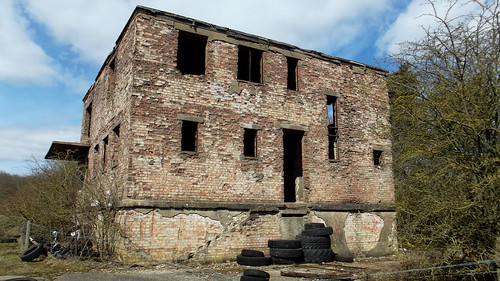
North Whitham control tower

North Witham’s Tower – now a mere shell.

As it was originally designed as a bomber station it was built to the Air Ministry’s class ‘A’ specification, formed around the usual three triangular runways, perimeter track and aircraft hardstands. With construction beginning in the mid-war years 1942/43, its main runway would be 2000 yds long, with the second and third runways 1,400 yds in length and all 50 yds wide. To accommodate the aircraft, 50  ‘spectacle’ style dispersals were built, scattered around the adjoining perimeter track. As a bomber base it had a bomb store, located to the north-eastern side of the airfield, with the admin and technical site to the south-east. The usual range of stores and ancillary buildings adorned these areas. One architectural feature of North Witham was its operations block, built to drawing 4891/42, it was larger than most, with ceilings of 14 feet high. Amongst the myriad of rooms were a battery room, cipher office, meteorology room, PBX, traffic office and teleprinter room, all accessed through specially designed air locks. A further feature of this design was the attachment of a Nissen hut to house plant and boiler equipment, a feature not commonly seen at this time.

Aircraft maintenance could be carried out in one of two ‘T2’ hangars with additional work space provided by one of six ‘Butler’ hangars. Designed and built by the Butler Manufacturing Company of Kansas, USA, these were supplied in kit form and had to be erected on site by an Engineer Aviation Battalion. These hangars consisted of rigid box section girders over a canvas cladding, and once fully erected, gave a wide 40 ft span. Quite a rare feature, these types of structures were only built in limited numbers during the Second World War and only appeared on American occupied airfields. Post-war however, they were far more commonly used appearing on many American cold-war sites across the UK.

north whitam

A ‘Butler’ hangar under construction by members of the 833rd Engineer Aviation Battalion (EAB) at a very snowy North Witham (@IWM479)

The Ninth Air Force was born in 1942 out of the ashes of the V Air Support Command, and then combined with units already located in the England operating under the American Eighth Air Force. Its initial activities focused on the allied push across North Africa followed by the move up into southern Europe through Italy.

Moving to England in October 1943, it then became the tactical Air Force that would support the Normandy invasion, supplying medium bombers, operating as troop support and finally providing supply flights. Facilitation of this massive invasion required both a huge backup, and an intricate supply and support network. North Witham would form part of this support network through both repair and maintenance of the troop carrier aircraft that were operated by the Ninth Air Force – primarily the C-47s. The main group undertaking this role at North Witham was the 1st Tactical Air Depot comprising the 29th and 33rd Air Depot Groups between January and September 1944*1. One of a number of depots, they were once described as the “backbone of Supply for the Army Air Force”, and had a complicated arrangement that encompassed numerous groups across the entire world theatre.

For such a large base, North Witham would be operationally ‘underused’, the only unit to fly from here being those of the IX Troop Carrier Command (TCC), who would primarily use C-47 ‘Skytrains’ – an established and true workhorse, and one that would go on to supply many air forces around the world.

During the Sicily campaign, it was found that many incoming aircraft were not finding the drop zones as accurately as they should, and as a result, paratroops were being widely and thinly scattered. More accurate flying aided by precise target marking was therefore required, and so the first Pathfinder School was set up.

North Whitham pen

Part of one of North Witham’s 50 dispersal pans.

The IX TCC Pathfinder School (incorporating the 1st, 2nd, 3rd and 4th Pathfinder Squadrons) was formed whilst the TCC was at RAF Cottesmore in Rutland. Initially having only seven C-47 aircraft, it arrived at North Witham on March 22nd 1944. These aircraft were fitted with, at the time, modern Gee radar and navigation equipment, along with SCR-717 navigational radar housed in a dome beneath the fuselage of the aircraft. This combination of equipment would allow the aircraft to be used as ‘Pathfinders’, and would be used to train both crews and paratroops of the 101st and 82nd Airborne to mark targets prior to the main invasion force arriving.

These crack troops would train at North Witham before returning to their own designated bases to pass on their newly acquired skills. The idea being that these troops would set up ‘homing’ stations using ‘Eureka’ beacons that would connect to ‘Rebecca’ receivers in the aircraft (distinguished from the outside by antenna protruding from the nose). This would allow flying to near pinpoint accuracy even in poor weather or at night; something that would be employed with relative success in the forthcoming Normandy landings.

On arrival at North Witham, the Pathfinders were accommodated in the huts originally provided for the depot’s crews – some 1,250 enlisted men and 75 officers. Many of these displaced men were rehoused in tents along the northern end of the site which only added a further strain to the already rudimentary accommodation that was already in place at the airfield. At its height, North Witham would house upward of 3,700 men in total, a figure that included an RAF detachment of 86 men and large quantities of GIs.

After arrival, the crews began training for the invasion. Flying cross country flights enabled them to practise using their new radar sets, flying in all weathers, at night and during the day. By D-Day, all navigators had been using the equipment in excess of 25 hours and were considered more than competent in its operation.

With postponements of the invasion came frustration, crews and paratroops mentally prepared for war were let down, there was little for them to do to release the tension that many must have felt.

On June 5th, after the plan was finally given the go ahead, some 821 Dakotas at various sites across England were primed ready for the initial wave of the invasion. Timing was of the utmost importance. As rehearsals had shown, seconds could mean the difference between life and death – for the crews of the C-47s, the pressure was on.

Around 200 Pathfinders of North Witham were the first to leave the UK and enter the Normandy arena. Departing late in the evening of June 5th, men of the 82nd and 101st Airborne climbed aboard their twenty C-47s and rose into the night sky. North Witham based C-47A*2 ‘#42-93098’ piloted by Lieutenant Colonel Joel Crouch*3, led the way. Nineteen other North Witham aircraft joined Crouch that night, and remarkably only one aircraft was lost in the entire flight. Flying under mission ‘Albany‘, the Douglas built C-47A-15-DK Skytrain, #42-92845 (aircraft #4) was lost en route either due to mechanical failure, or as some sources say, following a direct hit by Anti-Aircraft fire. Either way, the aircraft lost an engine and was forced to ditch in the sea. Once down, the crew and paratroops on-board were rescued by the British destroyer HMS Tartar.

Image result for Lieutenant Colonel Joel Crouch and his crew

The Crew of C-47A #42-93098, a few hours before they left for Normandy. Including Pilot, Lieutenant Colonel Joel Crouch (centre), Captain Vito Pedone (copilot), Captain William Culp (Navigator), Harold Coonrod (Radio Operator), along with Dr. Ed Cannon (physician), and E. Larendeal (crew chief)*1

The aircraft flew in groups of three in an in-line ‘V’ formation; aircraft 1, 2, 3 followed by 4, 5, 6; 19 and 20 (added as a late decision); 7, 8, 9; 10, 11, 12; then 16, 17 and 18. The formation was finally completed with aircraft 13, 14 and 15 bringing up the rear. Each C-47 would deposit its collection of Paratroops over six drop zones (DZ) A, C, D, O, N and T between 00:20 and 02:02.

Flying alongside aircraft #19, the only pair on the flight, was C-47 #20 piloted by 1st Lt. Paul F. G. Egan, of Massachusetts. Joining him in the aircraft were: Sgt. Jack Buchannon, Crew Chief (Mass); 2nd Lt. Richard A. Young, Co-Pilot (Ohio); 2nd Lt. Fern D. Murphy, Navigator (PA);  Staff Sgt. Marvin Rosenblatt, Radio Operator (NY) along with ten Combat Engineers of the 101st Airborne who  were dropped at Sainte-Mère-Église on the Cherbourg Peninsula early in the morning 6 June 1944.

Lt. Paul Egan had a remarkable service history, serving in each of the US Army, US Army Air Force and US Air Force after the war, a service that stretched from 1939 to 1967. His remarkable record includes: Pearl Harbour in 1939 and the Japanese attack in December 1941, the Battle of Midway in 1942, followed by advanced training in 1943. This training kept Lt. Egan in military intelligence as a Pathfinder pilot flying mostly C-47s out of both North Witham and later Chalgrove. As well as dropping the paratroopers on D-Day in Operation Market Garden, he also dropped troops in Operation Varsity along with every other major airborne operation flown from England. He also flew bombing missions in B-17s and flew ‘secret’ missions in early 1945. At the signing of the Japanese surrender onboard the USS Missouri on September 2nd 1945, he was the only USAAF representative there, General McArthur wanting someone who was present at Pearl Harbour to also be present at the surrender. His record is certainly remarkable and one to admire.*5
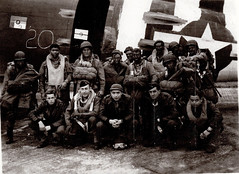
1st Lt Paul F. G. Egan and crew (photo courtesy Jean Egan)

Photo taken at North Witham Air Base, England on June 5, 1944, the night before D-Day. C-47 #20 (note the number chalked in front of the door to ensure paratroops boarded the right aircraft, and the crudely painted invasion stripes) one of the first 20 aircraft to fly with the elite group, the Pathfinders.  Front row: Sgt. Jack Buchannon, Crew Chief; 2nd Lt. Richard A Young, Co-Pilot; 2nd Lt. Fern D. Murphy, Navigator; 1st Lt. Paul F. G. Egan, Pilot (Captain); Staff Sgt. Marvin Rosenblatt, Radio Operator along with ten 101st Airborne Combat Engineers dropped on the Cherbourg Peninsula early morning 6 June 1944, “D-Day” (Photo courtesy Jean Egan).

Pathfinder training continued at North Witham beyond D-Day, well into 1944. The scope of those trained expanding to include Polish paratroops of the 1st Independent Polish Airborne Brigade, who would perform a similar role to their American counterparts. These various Pathfinder groups would go on to have long and distinguished careers, supporting the battles at Arnhem, the Ardennes and also Operation Varsity – the Allied crossing of the Rhine.

As the Allies pushed further into enemy territory, the flying distance from England became too great and so new airfields were either hastily constructed on the continent or captured airfields refurbished. As a result, the Pathfinder School soon moved away to Hampshire and the maintenance units, needed nearer the front lines, gradually departed to these newly acquired bases on the continent.

September 1944 would see big changes in the Ninth and the knock-on was felt at North Witham. Firstly, the IX TCC transferred from the Ninth AF to the First Allied Airborne Army, and as a result, the Air Depot title was changed to IX Troop Carrier Service Wing (Provisional), which was re-assigned to aid and supply the new Troop Carrier Groups (TCG) now based in France. To accomplish this new role, groups often used borrowed or war-weary C-47s, C-46 (Commandos) or C-109s (converted B-24 Liberators) to fulfil their role. Secondly, the Pathfinder School was re-designated IX Troop Carrier Pathfinder Group (Provisional) and they moved away from North Witham to their new base at Chalgrove near Oxford. Now much quieter, life otherwise continued on at North Witham, but it wouldn’t long before the demand for UK-based maintenance and repair work would slow, and within months North Witham’s fate would be finally sealed.

As the end of the war approached, the airfield quickly became obsolete, and the long wind-down to closure, that many of these unique places suffered, began to take effect.

By the time the war was over, the last American personnel had pulled out and the site was handed back to the RAF’s 40 Group who, after using it for a brief spell as a maintenance depot themselves, placed it under care and maintenance. It was used as a munitions and hardware store until 1948, and then finally, in 1956, it was closed by the Ministry and within two years the site was sold off.

Photograph of North Witham taken on 17th January 1947. The technical site and barrack sites are at the top left, the bomb dump is bottom left. (IWM RAF_CPE_UK_1932_FP_1221)

The site, intact as it was, was returned to the Forestry Commission who planted a range of new tress around the site, covering the vast areas of grass. The technical area was developed into a small industrial unit and perhaps most sadly the watch office left to decay and fall apart.

Today the three runways and perimeter track still exist almost in their entirety, and remarkably, in generally good condition. Largely overgrown with weeds and small trees, the remainder is well hidden obscuring what little there is in the way of buildings – most being demolished and the remains left piled up where they stood. However, a T2 hangar is now used on the industrial estate and the watch office still stands tucked away amongst the trees and undergrowth. This area is a favourite place for dog walkers, and because of its runways, it is accessible for prams and pushchairs. Whilst here, I spoke to quite a few people, remarkably none of them knew of the site’s historical significance let alone the office’s existence!

Today the watch office remains open to the elements. Surrounded by used tyres and in constant threat of the impending industrial complex over the fence, its future is uncertain. Access stairs have been removed, but an entrance has been made by piling tyres up to the door – presumably by those wishing to enter and ‘explore’ further. Little evidence of its history can be seen from the outside, even the rendering has been removed, and so, any possible personal links with the past are more than likely now gone.
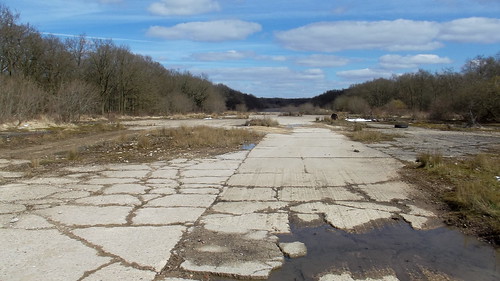
North Whitham runway

The view of the main runway from outside the tower.

Returning back to the main public entrance along the perimeter track, a number of dispersal pens can be found; overgrown but relatively intact, they are a further sign that even here, war was never very far away.

North Witham was one of those ‘backroom boys’ whose contribution, whilst extremely important, is little known about. The work carried out here not only helped to maintain a strong and reliable fighting force, but one that spearheaded the frontal invasion of Normandy. It served as a cold and perhaps uncomfortable home to many brave troops, many of whom took the fight direct to Nazi Germany.

Standing here today, it is quiet and strangely surreal – you can almost hear the roar of engines. Looking along its enormous runways you get an eerie feeling – how many troops also stood here, spending their last few hours in this quiet place. Looking around now, it is difficult to imagine the immense work that went on here, the gathering of equipment as preparations were made for the big push into Normandy on that famous June night.

North Witham is truly a remarkable place, hidden away amongst the trees as a giant time capsule, a monument to those who lived, worked and died during that turbulent time in 1944-45.
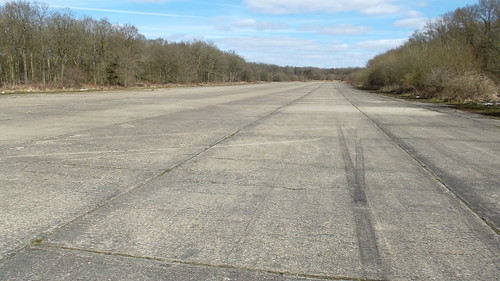
North Whitham runway

Another view along the main runway.

Sadly in May 2015, Twyford Woods was the scene of a large illegal rave, over 1000 people attended the event where a number of arrests were made in the violent altercations that took place*4. A sad day that would turn the souls of those who sacrificed themselves for the freedom we take for granted so very easily today.

(North Witham was originally visited in early 2013)

Links and sources (RAF North Witham)

*1 American Air Museum in Britain

*2 C-47A #42-93098 itself was later lost whilst flying with the 439th Troop Carrier Group (TCG) on September 18th 1944, whilst flying in support of Operation ‘Market Garden‘ in Holland.

*3 Superb footage of Crouch and his crew as they depart from North Witham is available on-line, it also shows the Watch Tower in its former glory.

*4 A report of the event is available on the BBC News website.

*5 My sincere thanks go to Jean Egan, daughter of Lt. Paul Egan, for the information and photograph.

An excellent website contain photos of paratroops and air crew as they prepare for embarkation and advance through France.

Merry Christmas and a Happy New Year!

December has finally come round and what a year it has been.

The later part of this year has been spent updating older posts (apologies for repeating myself) but I felt they needed a bit of a revisit, and in some cases, to see how things had changed. This was also partly driven by big changes in my personal circumstances.

This year, I decided to depart from full time education after almost 20 years in the classroom and more recently, covering senior management – the situation becoming just too ridiculous for words. So I took early retirement and opted for Teacher supply work on odd days to supplement my pension. I also sold my house and moved in with my partner whilst we endeavour to find a new one in a housing market that has been just crazy. During all this, all my books, clothes and personal belongings have remained stored in a shipping container on a nearby industrial estate – far from ideal.

Throughout this I have endeavoured to keep the blog going and hope that soon, once things have settled again, I can turn to a more focused approach and add more trails to the 62 that I have managed to achieve so far.

In the mean time, I thank you for your continued support, and hope that you stay with me as we enter 2022 and all that it may bring – whatever that will be.

To each and everyone of you, wherever you are, have a very Happy and safe Christmas, and a truly wonderful New Year.

God bless!

Christmases past – my sister, brother and myself (in the car) at Christmas in the 1960s.

Memories of a Vulcan XH558 Restoration Volunteer.

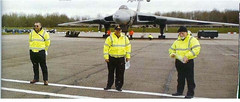
I was recently contacted by Trevor Danks, a volunteer during the restoration of Vulcan XH558, until 2015, the world’s last flying Vulcan bomber. Trevor very kindly sent me his memories along with a selection of his photos, taken whilst working as a volunteer during the aircraft’s restoration.

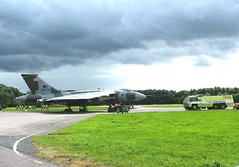
The Vulcan’s final farewell flight took place on October 28th 2015.

My sincere thanks go to Trevor for sharing his memories and photos with me.

Memories of a Vulcan XH558 Restoration Volunteer.

I joined the 558 Club at the RIAT 2000 at RAF Cottesmore. At that time I was unable to play any active part due to work commitments. However by 2005 I was semi retired and when the request came out for volunteers to help out with the restoration of XH558, I replied immediately.

I had been an Airframe Mechanic during my National Service in the RAF between 1955 and 1957. I had been fortunate to be posted to 232 OCU Valiant Squadron at RAF Gaydon and became a member of a ground crew on a Valiant. So the prospect of being in close proximity to the Vulcan was an exciting prospect.

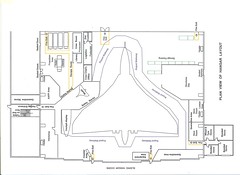
Following the first call for volunteers an e-mail was sent out asking if anyone knew someone who could do a drawing of the hangar at Bruntingthorpe, at minimum cost. I replied by e-mail to say that I would do it on my CAD system at no cost as part of my volunteer work. So on a cold April morning in 2005, I met Colin Marshall at Bruntingthorpe to discuss what was required. The first task was to take measurements of the hangar.  I was also supplied with a drawing of the Vulcan which had to be shown in position in the hangar. Another volunteer, Derek Bates, helped with the measuring of the hangar. The original drawing was to be part of a document for the Heritage Lottery Fund. However as time passed the drawing was amended a few times and the later version is shown below, which shows the visitors walkway.

Hangar Layout (Bruntingthorpe).

Hangar layout

The Hangar layout at Bruntingthorpe (Trevor Danks)

I became a member of the Wednesday Crew (See photo) together with a number of other volunteers. On that day there were a basic six of us who, from the start, did a variety of jobs. In the beginning we helped to set up the hangar to meet the requirements of Marshall Aerospace, the hangar becoming part of their engineering facilities located at Cambridge. Apart from the tidying up, dismantling or erecting shelving and racking, we participated in the setting up of the technical library, under the supervision of Frank Edmondson, this held all the Air Publications (AP’s).

Our main task lay with the 600 tons of spares held in the Deep Store, better known as “The Shed”. Over the days of the restoration we sorted, counted, placed in boxes and put the spares in the racking. This information was input to the computer. After which we then had to find and retrieve spares as and when required by the engineers. All this was carried out under the supervision of Simon Chipman. We were a happy bunch beavering away in The Shed, sometimes very hot and sometimes very cold depending on the time of the year. During tea and lunchtime breaks in the Airfield Diner we would reminisce about our days in the RAF or times past when the Vulcan was flying at displays.

In August 2006 it had reached a critical point where more finance was need to be able to complete the restoration. A fund raising operation had been carried out but the trust was still £500,000 short so the paid employees had been put on notice to end their employment. Everyone was convinced that it looked as this was to be the end of the project. After the aircraft had been rolled out to loud cheers a louder cheer went up as Sir Michael Knight, Chairman of VTTS Trust, announced a donation of £500,000 had been received from a mystery donor. The donor turned out to be Jack Hayward, owner at the time of Wolves football club.

When the Vulcan finally got to the stage of emerging from the hangar for such as engine runs we joined together with all the other volunteers who came on other days of the week. This usually required us to do a ‘FOD Plod’ which entailed us doing a walk of where the Vulcan was to pass, picking up any debris lying about. The first time the Vulcan was taken out for an engine test run, it was taken to a dispersal pad on the edge of the airfield. Having run the engines individually the time came to run them together up to 75% full power. I and a colleague were stationed on the perimeter track to prevent anyone coming along it. As the power increased we noticed a shed on the side of the perimeter track beginning to move. We quickly flagged the ground crew to shut down before the shed disappeared into the trees. The aircraft was then repositioned to continue the engine run.

First Flight.

The most enjoyable FOD Plod was on 18th October 2007 when we were all out on the runway at 7.30am as dawn broke. The expectancy on that day was electric; our little crew had been appointed as the emergency team in the team bus with the task of dashing to an emergency entrance on the edge of the airfield. This was to let in emergency vehicles in the event of a mishap. Fortunately the day blossomed into a beautiful day both weather-wise and the rebirth of a much loved aircraft. When the crew of XH558 let off the brakes and that famous engine “Howl” was heard, one minute it was rushing down the runway and the next 100 feet up as it went past us in the viewing area.  We cheered like mad and hugged each other with not a dry eye in the house.

Sqd Ldr Dave Thomas - VOC Display Pilot ; AEO Barry Masefield - VOC AEO & Radio Op; Sqd Ldr Al McDicken - Marshalls Test Pilot

Sqd. Ldr Dave Thomas – VOC Display Pilot:  AEO Barry Masefield – VOC AEO & Radio Op.: Sqd Ldr Al McDicken – Marshalls’ Test Pilot

This was not the end but the beginning, as much had to done to get it to the stage of giving a display at the Waddington Air Show in 2008. There were other engine runs and flights, with XH558 getting her certificate to display just two days before the first day of the Air Show. All the time the Vulcan remained at Bruntingthorpe I continued to visit there on a Wednesday. When it moved to RAF Lyneham and the office to Hinckley, I changed my visits to Hinckley and became part of the education team. From this I developed my Power Point presentation to give talks about the restoration time.  However I retain the happy memories of our days at Bruntingthorpe and count myself very lucky to have been part of what can only be described as a great adventure. I was at Waddington for that first display and also managed to attend the day she flew with the two Lancaster bombers.

Since those days I have managed to visit Robin Hood Airport on a couple of occasions. The last time I managed to get the signatures of Taff Stone and Andrew Edmondson added to all the other signatures in my copy of Vulcan 607.

Photo Collection.

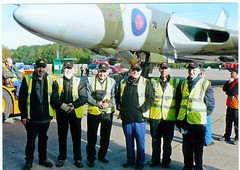
Weds crew John, Trevor, Peter, Dave, Bob and Vic.

‘The Wednesday Crew’ – John, Trevor, Peter, Dave, Bob and Vic.

Volunteers with Brunty Bear (XH558 Mascot)

Volunteers with ‘Brunty Bear’ (XH558 Mascot) On head centre front row.

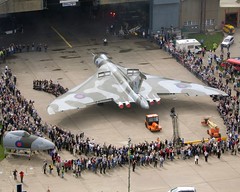
Roll Out Day - XH558 Outside for first time August 2006

Roll Out Day – XH558 Outside for first time August 2006.

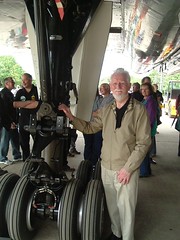
With Starboard Undercarriage Leg on Roll Out Day

With Starboard Undercarriage Leg on Roll Out Day.

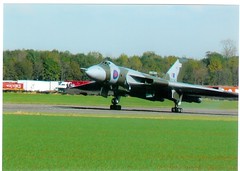
First Flight.

Nose Wheel Off for First flight

Nose Wheel Off for First flight.

Volunteers after the First flight.

Volunteers after the First flight.

Start of Display Season.

Starting Fod Plod along runway April 2008 ready for display Season (John, Bob, Trevor)

Starting ‘Fod Plod’ along runway April 2008 ready for display Season. (John, Bob, Trevor).

At RAF Lyneham

At RAF Lyneham.

Trevor Danks – VOC Volunteer.
Founding Guardian No. 338.

My personal thanks again to Trevor and all the volunteers who took part in the restoration and displaying of XH558 and also to those who continue to work for her preservation.

A Happy Christmas!

I would just like to take this opportunity to wish all those of you who have followed, read or commented on the blog, a very merry Christmas and a very happy and safe New Year.

A extra big thanks goes out to those of you who have stuck around for so long, we’re now approaching our seventh year of the blog and have managed to visit over 125 airfields, 105 memorials and 40 museums. These have stretched from Perth in Scotland to the South coast of England, Suffolk in the east to Gloucestershire in the west. The range of these airfields is enormous, and they continue to vanish, with many in a worse state now than they were when I visited at the beginning of the journey.

Very soon many of these will be gone, lets hope the memories of those who served are not also gone with them.

A very happy Christmas one and all!

RAF Andrews Field – (Great Saling/Station 485) – Trail 33: Essex Part 1.

RAF Attlebridge  (Station 120) – Trail 7: Northwest Norfolk.

RAF Barkston Heath (Station 483) – Trail 2: Lincoln Borders and Newark

RAF Barton BendishTrail 7: Northwest Norfolk.

RAF Biggin Hill (Westersham) (Station 343) – Trail 4: Kent Part 1.

RAF Bircham NewtonTrail 20: North Norfolk (Part 1).

RAF Bodney (Station 141) – Trail 8: Swaffham and Her Neighbours (Part 1 of 3).

RAF Bottesford (Station 481) – Trail 52: Leicestershire’ Borders.

RAF Bottisham (Station 374) – Trail 55: Around Newmarket

RAF Boulmer – Trail 47: Northumberland.

RAF BournTrail 31: Southern Cambridgeshire (Part 2).

RAF Brenzett (ALG) – Trail 18: Kent Part 2.

RAF BruntonTrail 47: Northumberland.

RAF Bungay (Flixton) (Station 125) – Trail 14:  Central Suffolk (Part 1).

RAF Bury St. Edmunds (Rougham) (Station 468) – Trail 16: West Suffolk (part 1).

RAF Castle CampsTrail 45: Essex (Part 2).

RAF Caxton GibbetTrail 29: Southern Cambridge (Part 1).

RAF Charterhall Trail 41: The Borders of Scotland and England.

RAF ChedburghTrail 49: Bomber Command – Bury St. Edmunds to Haverhill

RAF Collyweston Trail 37: The Northern Reaches of Cambridgeshire.

RAF Coltishall – Trail 7: Northwest Norfolk.

RAF ConingsbyTrail 1: Lower Lincolnshire.

RAF CottamTrail 40: Yorkshire (East Riding).

RNAS CrailTrail 53: Scotland’s East Coast – Fife

RAF CranwellTrail 2: Lincoln Borders and Newark.

RAF Debach (Station 152) – Trail 39: Suffolk around Ipswich (Part 1).

RAF Debden (Station 356) – Trail 46: Essex Part 3.

RAF Deenethorpe (Station 128) – Trail 6: American Ghosts.

RAF Deopham Green (Station 142) – Trail 27: Southern Norfolk (Part 3).

RAF Digby (Scopwick) – Trail 1: Lower Lincolnshire.

RAF Docking – Trail 20: North Norfolk (Part 1).

RAF Downham Market (Bexwell) – Trail 7: Northwest Norfolk.

RAF Drem – Trail 42: Edinburgh’s Neighbours.

RAF Dunino –  Trail 53: Scotland’s East Coast – Fife.

RAF East Fortune – Trail 42: Edinburgh’s Neighbours.

RAF East Kirkby Trail 1: Lower Lincolnshire.

RAF East Wretham (Station 133) – Trail 13: Southern Norfolk around Diss (Part 2).

RAF Eye (Brome) (Station 134) – Trail 14: Central Suffolk (Part 1).

RAF Fersfield – (Station 130) – Trail 28: Southern Norfolk (Part 4).

RAF FoulshamTrail 22North Norfolk (Part 3).

RAF FowlmereTrail 32Southern Cambridgeshire (Part 3).

RAF Framlingham (Parham) (Station 153)Trail 39: Suffolk around Ipswich (Part 1).

RAF GamstonTrail 54: The Great North Road.

RAF Glatton (Station 130) – Trail 6: American Ghosts.

RAF Gransden Lodge – Trail 31: Southern Cambridgeshire (Part 2).

RAF Graveley – Trail 29: Southern Cambridge (Part 1).

RAF Grafton Underwood (Station 106) – Trail 6: American Ghosts.

RAF Great Dunmow (Station 164)- Trail 33: Essex (Part 1).

RAF Great MassinghamTrail 21: North Norfolk (Part 2).

RAF Great Sampford (Station 359) – Trail 50: Haverhill’s neighbours – Wratting Common and Great Sampford.

RAF Hardwick (Station 104) – Trail 12: Southern Norfolk around Diss (Part 1).

RAF Hawkinge – Trail 18: Kent Part 2.

RAF Hethel – Trail 38: To the West of Norwich.

RFC HinghamTrail 38: To the West of Norwich.

RAF Holme on Spalding Moor Trail 40: Yorkshire (East Riding).

RAF Hunsdon – Trail 25: Hertfordshire.

RAF Kimbolton (Station 117) – Trail 6: American Ghosts.

RAF King’s Cliffe (Station 367) – Trail 6: American Ghosts.

RAF LanghamTrail 23: North Norfolk (Part 4).

RAF Lashenden (Headcorn) – Trail 18: Kent Part 2.

RAF Lavenham (Station 137) – Trail coming soon.

RAF Leuchars – Trail 53: Scotland’s East Coast – Fife.

RAF Little SnoringTrail 22North Norfolk (Part 3).

RAF Little Walden – – Trail 46: Essex Part 3.

RAF Macmerry Trail 51: Southern Scotland

RAF MarhamTrail 7: Northwest Norfolk.

RAF Martlesham HeathTrail 48: Suffolk around Ipswich (Part 2).

RAF Matching (Station 166) – Trail 33: Essex Part 1.

RAF Matlaske (Station 178) – Trail 34: North Norfolk (Part 5).

RAF MattishallTrail 36: North Norfolk (Part 6).

RAF Mendlesham (Station 156) – Trail 15: Central Suffolk (Part 2).

RAF MepalTrail 11: Around Ely.

RAF MetheringhamTrail 1: Lower Lincolnshire.

RAF Methwold – Trail 8: Swaffham and Her Neighbours (Part 1).

RAF Milfield –  Trail 47: Northumberland.

RAF Narborough (Narborough Aerodrome)- Trail 7: Northwest Norfolk.

RAF Newmarket Heath – Trail 55: Around Newmarket

RAF North CreakeTrail 23: North Norfolk (Part 4).

RAF North Pickenham (Station 143) – Trail 9: Swaffham and Her Neighbours (Part 2).

RAF North WealdTrail 25: Hertfordshire.

RAF North Witham (Station 479) – Trail 3: Gone But Not Forgotten.

RAF Old Buckenham (Station 144) – Trail 13: Southern Norfolk around Diss (Part 2).

RAF Oulton – Trail 34: North Norfolk (Part 5).

RAF Polebrook (Station 110) – Trail 19: Northamptonshire American Ghosts II.

RAF Rattlesden (Station 126) – Trail 15: (Central Suffolk (Part 2).

RAF SawbridgeworthTrail 25: Hertfordshire.

RAF ScamptonTrail 30: Scampton and the Heritage Centre.

RAF SconeTrail 56: Perthshire.

RAF SculthorpeTrail 21: North Norfolk Part 2.

RAF Sedgeford – Trail 20: North Norfolk (Part 1).

RAF Shipdham (Station 115) – Trail 10: Swaffham and Her Neighbours (Part 3).

RAF Snailwell (Station 361) – Trail 55: Around Newmarket

RAF Snetterton Heath – (Station 138) – Trail 27: Southern Norfolk (Part 3).

RAF Spanhoe Lodge (Station 493) – Trail 6: American Ghosts.

RAF Steeple Morden – Trail 32: Southern Cambridgeshire (Part 3).

RAF Stoke OrchardTrail 24: Gloucestershire.

RAF Stradishall- Trail 49: Bomber Command – Bury St. Edmunds to Haverhill

RAF Sutton BridgeTrail 3: Gone But Not Forgotten.

RAF Swannington – Trail 36: North Norfolk (Part 6) 

RAF Swanton Morley – Trail 38: To the West of Norwich.

RAF Thorpe Abbotts (Station 139) – Trail 12: Southern Norfolk around Diss (Part 1).

RAF Tibenham (Station 124) – Trail 13: Southern Norfolk around Diss (Part 2).

RAF Tuddenham – Trail 16: West Suffolk (Part 1).

RAF Tydd St. Mary – Trail 37: The Northern Reaches of Cambridgeshire.

RAF Upwood – Trail 17: The Pathfinders.

RAF Warboys – Trail 17: The Pathfinders.

RAF WaterbeachTrail 11: Around Ely.

RAF Watton (Station 376/Station 505) – Trail 9: Swaffham & Her Neighbours (Part 2).

RAF Wendling (Station 118) – Trail 10: Swaffham and Her Neighbours (Part 3).

RAF West Malling Trail 4: Kent Part 1.

RAF West RaynhamTrail 21: North Norfolk Part 2.

RAF WethersfieldTrail 45: Essex (Part 2).

RAF Westley – Trail 16: West Suffolk (part 1).

RAF WinfieldTrail 41: The Borders of Scotland and England.

RAF Winthorpe Trail 2: Lincoln Borders and Newark.

RAF WitchfordTrail 11: Around Ely.

RAF Wittering  – Trail 37: The Northern Reaches of Cambridgeshire.

RAF Woodall SpaTrail 1: Lower Lincolnshire.

RAF Wratting CommonTrail 50 – Haverhill’s neighbours – Wratting Common and Great Sampford.

25th November 1942 – Loss of Lancaster ‘EM-F’

On November 25th 1942 a Lancaster involved in the Bomber Command mission to Bad Zwischenahn crashed at Easton near Grantham. On board were eight young men who all sadly perished. Three of these young men are buried in the churchyard at Bottesford, a small village in Leciestershire, England.

On the afternoon of November 25th 1942, at 15:00 hrs aircraft R5694 (EM-F) a Lancaster BI of No. 207 Sqn manufactured by A.V. Roe (Manchester), took off from RAF Langar in Nottinghamshire heading for Bad Zwischenahn west of Bremen and south of Wilhelmshaven in northern Germany.

Flying in the aircraft that day were: Flt. Lt. J. Hannan DFC; Sgt. P. Thompson; Flt. Sgt. J. Barnett Lee; Sgt. B McKenzie; Sgt. A. Roberts; Sgt. J. Burton; Sgt. E. Piper and Sgt. J Sanders  It is unclear what happened, but it is thought that the aircraft hit high ground on its return flight, at 18:10 six miles south-east of Grantham near Easton in Lincolnshire. Upon crashing, the aircraft burst into flames killing seven of the crewmen  with one further crewman dying the following day.

They were a young crew, ranging in age from 19 to 26 years of age. Five of the crew are buried in St. Mary the Virgin church in Bottesford near to their former airbase, the others are buried elsewhere: Sgt Burton in Nottingham Northern Cemetery; Sgt Piper in Winchester (Magdalen Hill) Cemetery and Sgt. Sanders in Swansea (Danycraig) Cemetery.

On board the aircraft that day were:

Pilot – Flight Lieutenant Raymund Joseph Hannan DFC (s/n: 43035) age 25:
Flight Engineer – Sergeant Peter John Thompson (s/n: 575861) age 21
Navigator – Flight Sergeant John Kennerleigh Barnett Lee (RAFVR) (s/n 1174918) age 26
Wireless Op./Air Gunner – Sergeant Bryant Leonard McKenzie Jenkin (RNZAF)(s/n 412885) age 24
Wireless Op./Air Gunner – Sergeant Albert Roberts (RAFVR)(s/n 1104522) age 21
Air Gunner  – Sergeant John Bernard Burton (RAFVR) (s/n: 1575141) age 21
Air Gunner – Sergeant Ernest Raymond Donald Piper (RAFVR) (s/n 1319737) age 19
Air Gunner – Sergeant John Sanders (RAFVR) (s/n 1316262) age 20

RAF Bottesford

Flight Lieutenant Raymund Joseph Hannan DFC

RAF Bottesford

Sergeant Peter John Thompson

RAF Bottesford

Sergeant Albert Roberts

Sgt. Bryant Leonard McKenzie Jenkin

Sergeant Bryant Leonard McKenzie Jenkin

RAF Bottesford

Flight Sergeant John Kennerleigh Barnett Lee

May their names live on for evermore.

Trail 52 – RAF Bottesford and the bizarre accident that killed five airmen.

In this next trail we turn westward and head to the Midlands towards Nottingham and Leicester. Here we take in an airfield that was part of the RAF’s Bomber Command, and whilst it is an airfield that saw only a small number of squadrons operating from it, it nonetheless has a very significant story to tell.  Now a successful industrial park, much of the site remains – albeit behind a security gate and fencing. This airfield was home to both the RAF and the USAAF and played an important part in the fight against Nazi Germany. Today we visit the former airfield RAF Bottesford.

RAF Bottesford (Station 481)

RAF Bottesford was built in the period 1940 / 41 by the major airfield builder George Wimpey & Co. Ltd. It was known more locally as Normanton after the small village that lies on the south-western corner of the site, and although a Leicestershire airfield, it actually straddles both Leicestershire, Nottingham and Lincolnshire. As a new bomber airfield, it was the first in the area to be built with concrete surfaces, a welcome break from the problematic grassed surfaces that Bomber Command had been fighting against before.

In 1941 Bottesford would open under the control of No. 5 Group, a group formerly headed by Air Chief Marshal Sir Arthur Harris, who had seen the group carry out anti-shipping sweeps over the North Sea and leaflet drops over Germany. Now under the guidance of Air Chief Marshal Sir John Slessor, No. 5 Group was able to muster a considerable number of heavy bombers capable of reaching Germany’s heartland.

As a bomber airfield Bottesford had a wide range of technical buildings, three concrete runways, one of 2,000 yds (after being extended) and two just short of 1,500 yds, all 50 yds wide and linked by a perimeter track. The technical site with its various support buildings lay to the north-west of the airfield with the bomb site to the east, and accommodation areas dispersed to the north-east beyond the airfield perimeter.

Bottesford would accommodate around 2,500 personnel of mixed rank, both male and female, in conditions that were often described as ‘poor’, the site suffering from extensive rain and lack of quality drainage as the Operational Records would show *1.

Around the airfield there would eventually be 50 dispersals, half of these being constructed initially as ‘frying pan’ hardstands, and then with the introduction of the improved ‘spectacle hardstand’, this number was doubled by 1945.

Aircraft maintenance would initially be in four hangars, but these were also increased to ten in total, giving a mix of T2 and B1 designs. An unusual design feature of Bottesford was that some of these dispersals, and later hangars, were across a public road and, like RAF Foulsham (Trail 22), a gate system operated by RAF Police would allow the road to be closed off when aircraft were moved into or out of the area. The airfield would therefore, undergo quite a major change during its operational life.

Aerial photograph of Bottesford airfield looking west, the technical site is bottom right, 8 June 1942. Photograph taken by No. 1 Photographic Reconnaissance Unit, sortie number RAF/HLA/590. English Heritage (RAF Photography).

RAF photo reconnaissance photo taken on 8 June 1942. Compare this to the photograph taken three years later (below)*2

Aerial photograph of Bottesford airfield looking east, the technical site with seven T2 hangars, control tower and airfield code are top left, the bomb dump is on the right, 30 May 1945. Photograph taken by No. 544 Squadron, sortie number RAF/106G/LA/203. English Heritage (RAF Photography).

Bottesford 1945 *3

Only three operational front line RAF units would operate from Bottesford, the first being 207 Squadron flying the Avro Manchester, arriving on November 17th 1941, the same month as production of the Manchester ceased. Their arrival would also coincide with the arrival of 1524 (BEAM Approach Training) Flight operating the Airspeed Oxford.

207 Sqn were reformed as a new squadron at the beginning of November 1940, taking on the ill-fated Avro Manchester MK.I, before arriving here at Bottesford a year later. The first squadron to operate the type, they were soon to discover it had major issues, and so poor was the Manchester, that by the Spring of 1942 it was being withdrawn, replaced by its more successful sister the Lancaster. After its promising introduction into Bomber Command in late 1940, it became clear that the Manchester was going to become a troublesome aircraft. With engine seizures often followed by fires, it was very much under-powered even though it had what were in essence, two V12 engines mounted in one single engine.  Bearing failures led to engines failing, and already working at its limits, the Rolls-Royce Vulture engine was not able to keep the Manchester aloft without great skill from the crew.

After a period of bedding in and conversion of the crews to the new Manchester, the new year at Bottesford would start off badly, seeing the first casualty for 207 Sqn, on the night of 9th January 1942. On this mission, Manchester MK.I L7322 piloted by F/O G Bayley, would crash after being hit by flak on operations to Brest. There were 151 aircraft on this mission, with this aircraft being the only causality in which only three of the crew’s bodies were ever recovered.

The transition from the Manchester to the Lancaster would not be straight forward for 207 Sqn. Whilst on training flights, Lancaster MK.I ‘EM-G’ R5501 would collide in  mid-air with a Magister from RAF Cranwell, four crewmen would lose their lives along with the pilot of the Magister. Then on the 8th April, a second Lancaster would suffer problems when ‘EM-Z’ R5498 experienced fuel starvation in both starboard engines causing them to cut out. The aircraft crashed close to Normanton Lodge on the north-south boundary on approach to Bottesford’s main runway. Fortunately no one was seriously injured in the accident.

A third training accident occurred on the night of May 24th 1942, when Lancaster R5617 hit the ground in poor visibility near to Tavistock in Devon. In the resultant crash, four of the crew were killed whilst two further crewmen were injured. It was proving to be  a difficult transition for the crews of 207 Sqn.

The first operational loss of a 207 Sqn Lancaster came on the night of June 3rd / 4th, when ‘EM-Y’ R5847 was shot down whilst on a mission to Bremen in north-west Germany. During the flight, the aircraft were attacked by German night fighters. As a result a number of aircraft from various squadrons were lost, including this one flown by pilot W/O C. Watney, who along with all his crew, were killed.

With the last mission by a Manchester taking place on the night of June 25th / 26th, 1942 would be a difficult year for 207 Sqn, losing four Manchesters and twenty-five Lancasters, which when added to the twenty Manchesters lost in 1941, proved that things were not going well for the 5 Group squadron at Bottesford.

RAF Bottesford

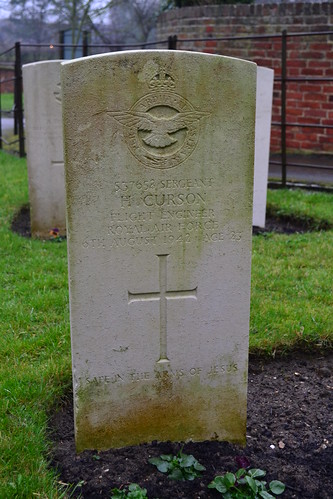
Sgt. Harold Curson (s/n: 537658) was killed in a bizarre accident at Bottesford when a Manchester landed on top of a Lancaster destroying the aircraft and killing three of its crew.

Perhaps one of the most bizarre accidents to happen at Bottesford, occurred on August 6th 1942, when Manchester L7385 landed very badly. Somehow, the aircraft ended up on top of a Lancaster, R5550 who was also engaged in training operations. The accident was so severe, that two of the crew in the Manchester and three of the crew in the Lancaster were killed. The remaining five crewmen, whilst not killed in the accident, all sustained various degrees of injury.

Then in September 1942, 207 Sqn were transferred from Bottesford to nearby Langar, the satellite airfield for Bottesford. This would be the first of many moves that would last into early 1950 when the squadron was finally disbanded whilst operating the Avro Lincoln. The squadron’s tie with Avro had finally come to an end (207 Sqn would reform several times eventually being disbanded in the mid 1980s).

The October / November 1942 then saw two further Bomber Command squadrons move into this Leicester airfield, those of 90 Squadron and 467 Squadron.

Reformed here after being disbanded and absorbed into 1653 HCU the previous February, 90 Sqn brought with them the other great heavy bomber, the Stirling.

An enormous aircraft, the Stirling also failed to live up to its promise, suffering from a poor ceiling and often being targeted by fighters when in mass formations. The Stirlings were eventually pulled out of front line operations and moved to transport and SOE operations, such were their high losses.

At the end of the year once the squadron was fully manned and organised, No. 90 Sqn departed Bottesford taking the Mk.Is to RAF Ridgewell, where they continued on in the bomber role. The only casualty for 90 Sqn during this short time occurring on the very same day they moved when ‘WP-D’ BK625 crash landed at Ridgewell airfield.

Also during the month of November 1942, on the 24th, 467 Squadron (RAAF) joined 90 Sqn, in a move that saw the return of the Lancaster MK.I and MK.III, these crews must have been the envy of those who struggled with the mighty Stirling in their sister unit. Formed on the 7th November at RAF Scampton under the command of W/Cdr. C. Gomm DFC No. 5 Group, 467 Sqn were another short-lived squadron eventually being disbanded on September 30th 1945 at Metheringham airfield in Lincolnshire.

In the first days of their formation there were initially sixteen complete aircrews, divided into two flights: ‘A’ commanded by Acting S/Ldr. D Green DFC and ‘B’ Flight with Acting S/Ldr. A. Pappe DFC. As yet though, they had an insufficient number of aircraft to accommodate all the crews.

After arriving at Bottesford, 467 Sqn battled with lack of equipment and poor weather which hindered both training and flying activities. A number of dances were held to make the Australians and New Zealand crews “feel at home”,  and a visit was made by Air Marshal Williams (RAAF). At the end of the month, aircraft numbers totalled just seven.

By the end of December new aircraft had been delivered and the Lancaster total stood at nineteen, but poor weather continued to hamper flying. Early January saw the first sign of any operational action at Bottesford, which occurred on the night of January 2nd / 3rd 1943. Five crews were assigned to a ‘Gardening’ sortie, laying mines, which excited the ground crews who were keen to see their aircraft finally participating in operations. It wouldn’t be until January 17th / 18th that 467 Sqn would finally venture into German territory laden with bombs. A mission that took them to the heart of Germany and Berlin.

RAF Bottesford

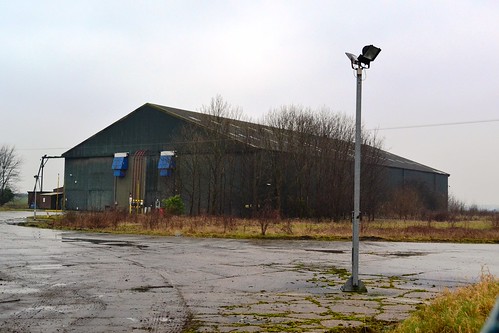
One of Bottesford’s hangars in use today.

With great excitement nine Australian crews, who were keen to show what they were capable of, took off from Bottesford to hit the target. The mission was considered a ‘disappointment’, damage to the target being very light due to both haze and lack of good radar. Target Indicators were used for the first time on this mission and it was the first all four-engined sortie. On their return flight, Sgt. Broemeling, the rear-gunner of F/Lt. Thiele’s crew was found unconscious, he had suffered from oxygen starvation and even after diving the aircraft to a safe breathing height and giving artificial resuscitation, he was declared dead on arrival at Bottesford.

A second night saw 187 RAF bombers from No. 1, 4 and 5 Groups in a subsequent raid that, like the previous night, also resulted in poor results.  Bombing saw little damage on the ground but twenty-two aircraft were lost. One of these aircraft being from 467 Sqn, that of Lancaster ‘PO-N’ W4378, which was piloted by a New Zealander, Sgt. K Aicken. Sgt Aicken had been one of the original pilots at 467’s formation. All seven crewmen from ‘PO-N’ were killed that night.

The next casualties would occur a month later, in a mission that saw 338 RAF heavies attack the port of Wihelmshaven in northern Germany. With the mission considered a ‘failure’, outdated maps were blamed, pathfinders marking the target area inaccurately as a result. The raid would also be notable for the loss of two Bottesford Lancasters; ED525 and ED529. On board the second aircraft were two crewmen Sgt. Robert Sinden (s/n: 577701) and Sgt. Derek Arnold Booth (RAFVR) (s/n: 1378781) who were just 18 and 17 years old respectively – the youngest crewmen to lose their lives in Bomber Command’s campaign of 1943. None of the fourteen men were ever found, their aircraft lost without trace.

A year after their arrival 467 Sqn then departed Bottesford heading for RAF Waddington, a point at which the RAF handed Bottesford over to the Americans in answer to their call for airfields to support the forthcoming invasion of the continent. 467 Sqn would go on to fight under Bomber Command, and in that month a special Lancaster would join the Sqn, that of R5868 ‘PO-S’ which went on to be the first Lancaster to reach the 100 mission milestone completing a total of 137 before the war’s end. She sat outside RAF Scampton as a gate guard after the war but has thankfully ended her days as the centre piece of the Bomber Command Hall at the RAF Museum in Hendon.*4

RAF Museum Hendon

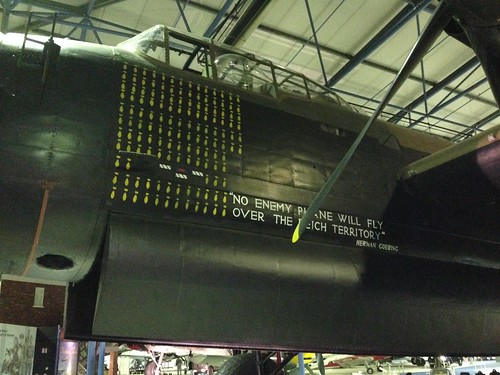
‘S-Sugar’ a former 467 Sqn Lancaster stands in the RAF Museum, Hendon. Note the incorrect Spelling of ‘Hermann’ beneath the quote.

As one of a cluster in the area (North Witham (Trail 3), Spanhoe (Trail 6), Barkston Heath and Langar amongst others), Bottesford would become a home to the Glider units of the US Troop Carrier Command (TCC).

The airfield (renamed Station 481) would become the headquarters of the 50th Troop Carrier Wing (TCW), Ninth Air Force, and used as a staging post for new C-47 units arriving from the United States. The 50th remained here at Bottesford until April 1944 at which point they moved south to Exeter in their final preparations for the Normandy invasion.

This deployment would see a number of American units arrive, be organised and transfer to their own bases elsewhere, these included the eight squadrons of the 436th Troop Carrier Group (TCG) and the 440th Troop Carrier Group (TCG).

The 436th TCG were made up of the four squadrons:79th Troop Carrier Squadron (TCS), 80th TCS, 81st TCS and 82nd TCS, all flying C-47 aircraft. The Group was only one year old when they arrived at Bottesford, and their introduction to the war would be a baptism of fire.

The cramped barracks of the 436th TCG and 440th TCG at Bottesford. (IWM – FRE 3354)

Whilst primarily training and organising themselves at Bottesford they would go on to take part in the Normandy invasion, dropping paratroops early in the morning of June 6th 1944 into the Normandy arena. In the afternoon, they returned with gliders, again dropping them behind enemy lines to supply and support those already fighting on the ground. A further trip the following morning saw the group awarded a Distinguished Unit Citation (DUC) for their action over the Normandy landing zones. Before the war’s end the 436th would take part in four major allied airborne operations, dropping units of both the 82nd and the 101st Airborne.

The 440th, like the 436th, were a very young unit, only being activated the previous July, and like the 436th, their introduction would be a memorable one. Dropping paratroops of the 101st Airborne into Carentan on D-Day, followed by fuel, food and ammunition the next; for their action they too were awarded a DUC. The 440th would also take part in the Battle of the Bulge supplying troops at Bastogne and later the crossing of the Rhine.

Whilst both units were only here at Bottesford a short time, they undoubtedly played a major part in the Allied invasion and all major airborne battles on the continent, a point that Bottesford should be remembered for.

The 436th moved to Membury whilst the 440th moved to Exeter in a mass move with the 50th TCW. After this, the US brought in a Glider repair and maintenance unit, who only stayed here for a short time before they too departed for pastures new. This then left Bottesford surplus to American requirements, and so in July 1944 it was handed back to the RAF and 5 Group once more.

This transfer would see the last flying unit form here at Bottesford – the death knell was beginning to ring its ghostly tones.  The RAF’s 1668 Heavy Conversion Unit (HCU) formed on the 28th, brought back the heavy bomber, the Lancaster MK.I. Working with the HCU were the 1321 Bomber (Defence) Training Flight consisting of mainly Beaufighter and Spitfire aircraft, who operated here until 1st November 1944 when they were absorbed into 1668 and 1669 HCUs. The HCU used these aircraft for fighter affiliation tasks and heavy bomber training.

As a training unit there would be many accidents, either due to aircraft problems or pilot error, including the first major accident on 12th December 1944 where fire tore through the port wing of Lancaster MK.III JA908. Diverted to East Kirkby the Lancaster attempted a landing but damaged a wheel, and had to crash-land in a field near to the airfield. Whilst no-one was killed in the crash, eight aircrew were injured in the resultant fire.

In the August 1945, the HCU moved to Cottesmore and there was no longer a need for Bottesford as an operational airfield. Surplus to requirements it was placed into care and maintenance, and used to store surplus equipment including ammunition before being closed and sold to the farmer who’s been using it since 1962.

As with all RAF / USAAF airfields a number other flying units operated from Bottesford, maintenance units, RAF squadrons and Glider units all played their part in its rich tapestry of wartime history. A history that provided one of the largest numbers of hangars collectively, and one that saw many young men come and go, many not coming back at all.

Today Bottesford is a thriving industrial and agricultural park, the farmer using large parts of it but the technical site being used by a number of industrial companies. The hangars are still present and in use, as are the runways now used for storage of vehicles rather than Lancasters, Stirlings, Manchesters or C-47s. The watch office has been refurbished and is used as offices, and several of the original buildings still remain in various states of disrepair. A flag of remembrance was hoisted outside the office in May 1995 and veterans have visited the site to pay their respects.

With access to the site through a security gate, you are left with some poor views from public roads, but the local church does have a small number of graves and a memorial which includes a book of remembrance.

Bottesford may have only been in existence for a short period, but it saw many aircraft and many crews, a mix of international airmen who brought new life to this small village on the border of three counties.

RAF Bottesford

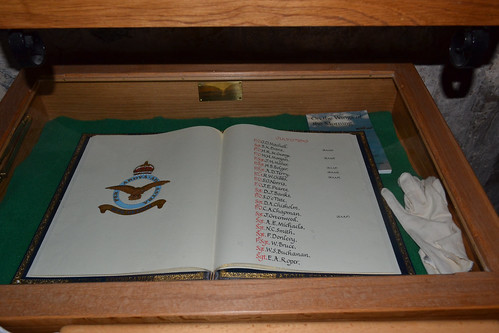
A book of remembrance sits in the local church St. Mary the Virgin along with a small number of graves.

Links and sources

*1 AIR\271930\1 Operational Record Book 467 RAAF (Royal Australian Air Force) Summary of Events (National Archives).

*2 Source Imperial War Museum photo ref: RAF_HLA_590_V_6004

*3 Source Imperial War Museum photo ref: RAF_106G_LA_203_RP_3093

*4 The AVRO Heritage Museum Website has details of ‘S for Sugar’ and her journey to Hendon.

Defence of the Realm, Tony Wilkins takes a detailed look at the Avro Manchester.

The Bottesford Living History Group have a detailed website with photographs and personal accounts and is worth visiting.

50 Aviation Trails Reached!

I am pleased to announce that since starting Aviation Trails four years ago, I have now reached that magic number of 50 Trails around Britain’s wartime airfields, a feat I never thought would happen.

Each Trail covers two or more sites, in some cases six, many three, covering in total, over 100 former RAF and USAAF airfields and museums around Britain.

I can honestly say its been a terrific four years, in which I have learnt a lot about Britain’s wartime past, the men and machines that flew from these places and the tragedies that occurred at so many. The development of these airfields was staggering, the process of construction, and the subsequent decay just as eye-opening. These sites and the people who used them, have changed both the British and world landscape, leaving in many cases scars that may never heal. The buildings and stretches of concrete that remain are monuments to human endurance and sacrifice, a sacrifice that we hope may never have to be repeated.

RAF Tibenham Perimeter track

The perimeter track at the former RAF Tibbenham.

During these four years there have been several changes at many of these sites, hangars and other buildings have gone, runways are continuing to be dug up as they become prime land for development. As we speak there are numerous sites under planning proposals, whilst others are waiting in the wings to hear what their fate will be.

To compile these trails I have personally visited each and every one of these sites, even a field has a certain something when you know who stood there before you.

To all those who have visited, commented and followed me on this journey, I thank you, I hope you have enjoyed the journey back in time as much as I have writing it. I hope that through these trails, the memories of those who gave their all may live on so that future generations may know who they were and what they did, so that we may enjoy the peace we do today.

Here’s to the next 50!

Andy.

RAF Andrews Field – (Great Saling/Station 485) – Trail 33: Essex Part 1.

RAF Attlebridge  (Station 120) – Trail 7: Northwest Norfolk.

RAF Barton BendishTrail 7: Northwest Norfolk.

RAF Biggin Hill (Westersham) (Station 343) – Trail 4: Kent Part 1.

RAF Bircham NewtonTrail 20: North Norfolk (Part 1).

RAF Bodney (Station 141) – Trail 8: Swaffham and Her Neighbours (Part 1 of 3).

RAF BournTrail 31: Southern Cambridgeshire (Part 2).

RAF Brenzett (ALG) – Trail 18: Kent Part 2.

RAF BruntonTrail 47: Northumberland.

RAF Bungay (Flixton) (Station 125) – Trail 14:  Central Suffolk (Part 1).

RAF Bury St. Edmunds (Rougham) (Station 468) – Trail 16: West Suffolk (part 1).

RAF Castle CampsTrail 45: Essex (Part 2).

RAF Caxton GibbetTrail 29: Southern Cambridge (Part 1).

RAF Charterhall Trail 41: The Borders of Scotland and England.

RAF ChedburghTrail 49: Bomber Command – Bury St. Edmunds to Haverhill

RAF Collyweston Trail 37: The Northern Reaches of Cambridgeshire.

RAF Coltishall – Trail 7: Northwest Norfolk.

RAF ConingsbyTrail 1: Lower Lincolnshire.

RAF CottamTrail 40: Yorkshire (East Riding).

RAF CranwellTrail 2: Lincoln Borders and Newark.

RAF Debach (Station 152) – Trail 39: Suffolk around Ipswich (Part 1).

RAF Debden (Station 356) – Trail 46: Essex Part 3,

RAF Deenethorpe (Station 128) – Trail 6: American Ghosts.

RAF Deopham Green (Station 142) – Trail 27: Southern Norfolk (Part 3).

RAF Digby (Scopwick) – Trail 1: Lower Lincolnshire.

RAF Docking – Trail 20: North Norfolk (Part 1).

RAF Downham Market (Bexwell) – Trail 7: Northwest Norfolk.

RAF Drem – Trail 42: Edinburgh’s Neighbours.

RAF East Fortune – Trail 42: Edinburgh’s Neighbours.

RAF East Kirkby Trail 1: Lower Lincolnshire.

RAF East Wretham (Station 133) – Trail 13: Southern Norfolk around Diss (Part 2).

RAF Eye (Brome) (Station 134) – Trail 14: Central Suffolk (Part 1).

RAF Fersfield – (Station 130) – Trail 28: Southern Norfolk (Part 4).

RAF FoulshamTrail 22North Norfolk (Part 3).

RAF FowlmereTrail 32Southern Cambridgeshire (Part 3).

RAF Framlingham (Parham) (Station 153)Trail 39: Suffolk around Ipswich (Part 1).

RAF Glatton (Station 130) – Trail 6: American Ghosts.

RAF Gransden Lodge – Trail 31: Southern Cambridgeshire (Part 2).

RAF Graveley – Trail 29: Southern Cambridge (Part 1).

RAF Grafton Underwood (Station 106) – Trail 6: American Ghosts.

RAF Great Dunmow (Station 164)- Trail 33: Essex (Part 1).

RAF Great MassinghamTrail 21: North Norfolk (Part 2).

RAF Great Sampford (Station 359) – Trail 50: Haverhill’s neighbours – Wratting Common and Great Sampford.

RAF Hardwick (Station 104) – Trail 12: Southern Norfolk around Diss (Part 1).

RAF Hawkinge – Trail 18: Kent Part 2.

RAF Hethel – Trail 38: To the West of Norwich.

RFC HinghamTrail 38: To the West of Norwich.

RAF Hunsdon – Trail 25: Hertfordshire.

RAF Kimbolton (Station 117) – Trail 6: American Ghosts.

RAF King’s Cliffe (Station 367) – Trail 6: American Ghosts.

RAF LanghamTrail 23: North Norfolk (Part 4).

RAF Lashenden (Headcorn) – Trail 18: Kent Part 2.

RAF Lavenham (Station 137) – Trail coming soon.

RAF Little Snoring – – Trail 22North Norfolk (Part 3).

RAF MarhamTrail 7: Northwest Norfolk.

RAF Martlesham HeathTrail 48: Suffolk around Ipswich (Part 2).

RAF Matching (Station 166) – Trail 33: Essex Part 1.

RAF Matlask (Station 178) – Trail 34: North Norfolk (Part 5).

RAF MattishallTrail 36: North Norfolk (Part 6).

RAF Mendlesham (Station 156) – Trail 15: Central Suffolk (Part 2).

RAF MepalTrail 11: Around Ely.

RAF Methwold – Trail 8: Swaffham and Her Neighbours (Part 1).

RAF Millfield –  Trail 47: Northumberland.

RAF Narborough (Narborough Aerodrome)- Trail 7: Northwest Norfolk.

RAF North CreakeTrail 23: North Norfolk (Part 4).

RAF North Pickenham (Station 143) – Trail 9: Swaffham and Her Neighbours (Part 2).

RAF North WealdTrail 25: Hertfordshire.

RAF North Witham (Station 479) – Trail 3: Gone But Not Forgotten.

RAF Old Buckenham (Station 144) – Trail 13: Southern Norfolk around Diss (Part 2).

RAF Oulton – Trail 34: North Norfolk (Part 5).

RAF Polebrook (Station 110) – Trail 19: Northamptonshire American Ghosts II.

RAF Rattlesden (Station 126) – Trail 15: (Central Suffolk (Part 2).

RAF SawbridgeworthTrail 25: Hertfordshire.

RAF ScamptonTrail 30: Scampton and the Heritage Centre.

RAF SculthorpeTrail 21: North Norfolk Part 2.

RAF Shipdham (Station 115) – Trail 10: Swaffham and Her Neighbours (Part 3).

RAF Snetterton Heath – (Station 138) – Trail 27: Southern Norfolk (Part 3).

RAF Spanhoe Lodge (Station 493) – Trail 6: American Ghosts.

RAF Steeple Morden – Trail 32: Southern Cambridgeshire (Part 3).

RAF Stoke OrchardTrail 24: Gloucestershire.

RAF Stradishall- Trail 49: Bomber Command – Bury St. Edmunds to Haverhill

RAF Sutton BridgeTrail 3: Gone But Not Forgotten.

RAF Swannington – Trail 36: North Norfolk (Part 6) 

RAF Swanton Morley – Trail 38: To the West of Norwich.

RAF Thorpe Abbotts (Station 139) – Trail 12: Southern Norfolk around Diss (Part 1).

RAF Tibenham (Station 124) – Trail 13: Southern Norfolk around Diss (Part 2).

RAF Tuddenham – Trail 16: West Suffolk (Part 1).

RAF Tydd St. Mary – Trail 37: The Northern Reaches of Cambridgeshire.

RAF Upwood – Trail 17: The Pathfinders.

RAF Warboys – Trail 17: The Pathfinders.

RAF Watton (Station 376/Station 505) – Trail 9: Swaffham & Her Neighbours (Part 2).

RAF Wendling (Station 118) – Trail 10: Swaffham and Her Neighbours (Part 3).

RAF West Malling Trail 4: Kent Part 1.

RAF West RaynhamTrail 21: North Norfolk Part 2.

RAF WethersfieldTrail 45: Essex (Part 2).

RAF Westley – Trail 16: West Suffolk (part 1).

RAF WinfieldTrail 41: The Borders of Scotland and England.

RAF Winthorpe Trail 2: Lincoln Borders and Newark.

RAF WitchfordTrail 11: Around Ely.

RAF Wittering  – Trail 37: The Northern Reaches of Cambridgeshire.

RAF Woodall SpaTrail 1: Lower Lincolnshire.

RAF Wratting CommonTrail 50 – Haverhill’s neighbours – Wratting Common and Great Sampford.


RAF North Witham – A Truly Historical Place

On the western fringes of Lincolnshire close to the Leicestershire border, is an airfield that is little known about, yet its part in history is perhaps one of the most important played by any airfield in Britain. Famous battles such as the Normandy invasion, the Ardennes and the crossing of the Rhine all took place because of the events that occurred here, and were it not for North Witham, many may not have been as successful as they were. For the next part of trail 3, we head west to perhaps one of Britain’s best kept secrets.

RAF North Witham (Station 479)

RAF North Witham sits quietly amongst the trees of Twyford Woods, a site originally known as Witham Wood, it is now a public space owned and maintained by the U.K.’s Forestry Commission.

Originally, North Witham was one of twelve airfields in the Leicestershire cluster intended to be an RAF bomber station for No. 7 Group, however, it was never used operationally by the Royal Air Force, instead like ten others in the area, it was handed over to the US Ninth Air Force and in particular the IX Troop Carrier Command.

North Whitham control tower

North Witham’s Tower – now a mere shell.

As it was originally designed as a bomber station it was built to the Air Ministry’s class ‘A’ specification, formed around the usual three triangular runways, perimeter track and aircraft hardstands. With construction beginning in the mid-war years 1942/43, its main runway would be 2000 yds long, with the second and third runways 1,400 yds in length and all 50 yds wide. To accommodate the aircraft, 50  ‘spectacle’ style dispersals were built, scattered around the adjoining perimeter track. As a bomber base it had a bomb store, located to the north-eastern side of the airfield, with the admin and technical site to the south-east. One feature of North Witham was its operations block, built to drawing 4891/42, it was larger than most, with ceilings of 14 feet high. Amongst the myriad of rooms were a battery room, cipher office, meteorology room, PBX, traffic office and teleprinter room, all accessed through specially designed air locks. A further feature of this design was the attachment of a Nissen hut to house plant equipment and boiler equipment, a feature not commonly seen at this time.

Aircraft maintenance could be carried out in one of two ‘T2’ hangars with additional work space provided by one of six ‘Butler’ hangars. Designed and built by the Butler Manufacturing Company of Kansas, USA, these were supplied in kit form and had to be erected on site by an Engineer Aviation Battalion. These ‘hangars’ had rigid box section girders over a canvas cladding, and once fully erected, gave a wide 40 ft span. Quite a rare feature, these types of structures were only built in limited numbers during the Second World War and only appeared on American occupied airfields. Post-war however, they were far more commonly used appearing on many American cold-war sites across the UK.

A hangar under construction at the 1st Tactical Air Depot at North Witham. Printed caption on reverse: '77877 AC - A butler hangar under construction by members of the 833rd Engineer Aviation Battalion at North Witham, England. U.S. Air Force Photo.'

A ‘Butler’ hangar under construction by members of the 833rd Engineer Aviation Battalion (EAB) at a very snowy North Witham (IWM479)

The Ninth Air Force was born in 1942 out of the ashes of the V Air Support Command, and then combined with units already located in the England operating under the American Eighth Air Force. Its initial activities focused on the allied push across North Africa followed by the move up into southern Europe through Italy.

Moving to England in October 1943, it then became the tactical Air Force that would support the Normandy invasion, supplying medium bombers, operating as troop support and providing supply flights. Facilitation of this massive invasion required both a huge backup, and an intricate supply and support network. North Witham would form part of this support network through both repair and maintenance of the troop carrier aircraft that were operated by the Ninth Air Force – primarily the C-47s. The main group undertaking this role at North Witham was the 1st Tactical Air Depot comprising the 29th and 33rd Air Depot Groups between January and September 1944*1. One of a number of depots, they were once described as the “backbone of Supply for the Army Air Force”, and had a complicated arrangement that encompassed numerous groups across the entire world theatre.

For such a large base, North Witham would be operationally ‘underused’, the only unit to fly from here being those of the IX Troop Carrier Command (TCC), who would primarily use C-47 ‘Skytrains’ – an established and true workhorse, and one that would go on to supply many air forces around the world.

During the Sicily campaign, it was found that many incoming aircraft were not finding the drop zones as accurately as they should and as a result, paratroops were being widely and thinly scattered. More accurate flying aided by precise target marking was therefore required and so the first Pathfinder School was set up.

North Whitham pen

Part of one of North Witham’s 50 dispersal pans.

The IX TCC Pathfinder School (incorporating the 1st, 2nd, 3rd and 4th Pathfinder Squadrons) was formed whilst the TCC was at RAF Cottesmore. Initially having only seven C-47 aircraft, it arrived at North Witham in March 1944. These aircraft were fitted with ‘modern’ Gee radar and navigation equipment, and would be used to train paratroops of the 101st and 82nd Airborne to mark targets prior to the main invasion force arriving.

These crack troops would remain at North Witham for short periods before returning to their own designated bases. The idea being a joint venture to land the troops who would then set up a ‘homing’ station using ‘Eureka’ beacons that would connect to ‘Rebecca’ receivers in the aircraft. This would allow flying to near pinpoint accuracy even in poor weather or at night; something that would be employed with relative success in the forthcoming Normandy landings.

On arrival at North Witham, the Pathfinders were accommodated in the huts originally provided for the depot’s crews – some 1,250 enlisted men and 75 officers. Many of these displaced men were rehoused in tents along the northern end of the site which only added a further strain to the already rudimentary accommodation that was already in place at the airfield. At its height, North Witham would house upward of 3,700 men in total, a figure that included an RAF detachment of 86 men and large quantities of GIs.

Pathfinders of North Witham were the first to leave the UK and enter the Normandy arena. Departing late in the evening of June 5th, men of the 82nd and 101st Airborne climbed aboard their C-47s and departed in to the night sky. North Witham based C-47A*2 ‘#42-93098’ piloted by Lieutenant Colonel Joel Crouch*3, led the way. Nineteen other North Witham aircraft joined Crouch that night, with only one being lost in the entire mission. The Douglas built C-47A-15-DK Skytrain, #42-92845 was lost en route due to mechanical failure – the aircraft ditching in the sea. All the crew and paratroops on-board were believed to have been rescued by the British destroyer HMS Tartar.

Image result for Lieutenant Colonel Joel Crouch and his crew

The Crew of C-47A #42-93098, a few hours before they left for Normandy. Including Pilot, Lieutenant Colonel Joel Crouch (centre), Captain Vito Pedone (copilot), Captain William Culp (Navigator), Harold Coonrod (Radio Operator), along with Dr. Ed Cannon (physician), and E. Larendeal (crew chief)

Pathfinder training continued at North Witham into the summer of 1944, training that included Polish paratroops (1st Independent Polish Airborne Brigade) who would perform a similar role to their American counterparts. These various Pathfinder groups would go on to have long and distinguished careers, supporting the battles at Arnhem, the Ardennes and participating in Operation Varsity – the Allied crossing of the Rhine.

As the Allies pushed further into enemy territory, the flying distance from England became too great and so new airfields were either constructed or captured airfields refurbished. The Pathfinder School soon moved away to Hampshire and the maintenance units, needed nearer the front lines, gradually departed to new bases on the continent.

September 1944 would see big changes in the Ninth and the knock-on was felt at North Witham. Firstly, the IX TCC transferred from the Ninth AF to the First Allied Airborne Army, and as a result, the Air Depot title was changed to IX Troop Carrier Service Wing (Provisional), which was re-assigned to aid and supply the new Troop Carrier Groups (TCG) now based in France. To accomplish this new role, groups often used borrowed or war-weary C-47s, C-46 (Commandos) or C-109s (converted B-24 Liberators) to fulfil their role. Secondly, the Pathfinder School was re-designated IX Troop Carrier Pathfinder Group (Provisional) and they moved away from North Witham to their new base at Chalgrove near Oxford. Now much quieter, life otherwise carried on at North Witham, but gradually the UK-based maintenance and repair work slowed down, and before long its fate was sealed and the airfield began the long wind-down that many of these unique places suffered.

By the war’s end the last American personnel had pulled out and the site was handed back to the RAF’s 40 Group who, after using it for a brief spell as a maintenance depot themselves, placed it under care and maintenance. It was used as a munitions and hardware store until 1948, and then finally, in 1956, it was closed by the Ministry and the site sold two years later.

Photograph of North Witham taken on 17th January 1947. The technical site and barrack sites are at the top left, the bomb dump is bottom left. (IWM RAF_CPE_UK_1932_FP_1221)

The site, intact as it was, was returned to the Forestry Commission who planted a range of new trees around the site, covering the vast areas of grass. The technical area was developed into a small industrial unit and perhaps most sadly the watch office left to decay and fall apart.

Today the three runways and perimeter track still exist almost in their entirety, and remarkably, in generally good condition. Largely overgrown with weeds and small trees, the remainder is well hidden obscuring what little there is in the way of buildings – most being demolished and the remains left piled up where they stood. However, a T2 hangar is now used on the industrial estate and the watch office still stands tucked away amongst the trees and undergrowth. This area is a favourite place for dog walkers, and because of its runways, it is accessible for prams and pushchairs. Whilst here, I spoke to quite a few people, remarkably none of them knew of the site’s historical significance let alone the office’s existence!

Today the watch office remains open to the elements. Surrounded by used tyres and in constant threat of the impending industrial complex over the fence, its future is uncertain. Access stairs have been removed, but an entrance has been made by piling tyres up to the door – presumably by those wishing to enter and ‘explore’ further. Little evidence of its history can be seen from the outside, even the rendering has been removed, and so, any possible personal links with the past are more than likely now gone.

DSCF1273

The view of the main runway from outside the tower.

Returning back to the main public entrance along the perimeter track, a number of dispersal pens can be found; overgrown but relatively intact, they are a further sign that even here, war was never very far away.

North Witham was one of those ‘backroom boys’ whose contribution, whilst extremely important, is little known about. The work carried out here not only helped to maintain a strong and reliable fighting force, but one that spearheaded the frontal invasion of Normandy. It served as a cold and perhaps uncomfortable home to many brave troops, many of whom took the fight direct to Nazi Germany.

Standing here today, it is quiet and strangely surreal – you can almost hear the roar of engines. Looking along its enormous runways you get an eerie feeling – how many troops also stood here, spending their last few hours in this quiet place. Looking around now, it is difficult to imagine the immense work that went on here, the gathering of equipment as preparations were made for the big push into Normandy on that famous June night.

North Witham is truly a remarkable place, hidden away amongst the trees as a giant time capsule, a monument to those who lived, worked and died during that turbulent time in 1944-45.

After leaving North Witham, we return to the main A1 road and head south. Any journey here can not avoid briefly mentioning RAF Wittering, its Harrier still standing proudly outside the main gate. All went quiet here following the Government cutbacks of December 2010, but flying has now returned in the form of Grob Trainers – a small reprieve for this historic site. Wittering can seen later in Trail 37.

Another view along the main runway.

Another view along the main runway.

Sadly in May 2015, Twyford Woods was the scene of a large illegal rave, over 1000 people attended the event where a number of arrests were made in the violent altercations that took place*4. A sad day that would turn the souls of those who sacrificed themselves for the freedom we take for granted so very easily today.

(North Witham was originally visited in early 2013)

Links and sources

*1 American Air Museum in Britain

*2 C-47A #42-93098 itself was later lost whilst flying with the 439th Troop Carrier Group (TCG) on September 18th 1944, whilst flying in support of Operation ‘Market Garden‘ in Holland.

*3 Superb footage of Crouch and his crew as they depart from North Witham is available on-line here, it also shows the Watch Tower in its former glory.

*4 A report of the event is available on the BBC News website.