Squadron Leader Emile Fayolle: A Free, French Pilot.

June 1940: Britain’s last remaining European ally, France; was now hors de combat, and the French people began to face the gruelling prospect of an indeterminate period of time in the shadow of the Swastika, under German occupation.

As news of the ignominious armistice and the new collaborationist Vichy government under Marshal Petain spread, there were many brave and defiant French servicemen who refused to acknowledge it. Some went underground, founding the Maquis; the French Resistance movement, whilst quite a number decided to get to England, by any available means, following their chosen leader: Brigadier-General Charles de Gaulle. Once in England, they formed themselves into La France Libre, the Free French Forces, with General de Gaulle as their commanding officer.

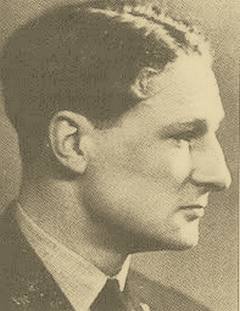
One such Frenchman was a nearly 24 year-old, qualified Pilote de Chasse, (fighter pilot) who was then serving overseas in the Armee de l’Air at Oran in French Algeria. He was Sergeant Emile “Francois” Fayolle.

Battle of Britain London Monument - ADJ EFM FAYOLLE

Sgt. Emile “Francois” Fayolle (Photo: © Friends of the Battle of Britain Monument)

Born on 8th September 1916, at Issoire, in Central France, Emile’s father was an Admiral in the French Navy and his Grandfather was none other than Marshal Marie Emile Fayolle, the legendary French Army commander of the First World War. With such ancestry, it was little wonder that Emile refused to acknowledge the humiliating armistice of Compiegne. After much discussion, and despite the warnings of dire consequences from their Station Commander, Emile, his good friend and squadron-mate Francois De Labouchere and two other like-minded pilots, stole two of the station’s aircraft and flew to the British base at Gibraltar. There all four took ship to England, arriving in Liverpool in mid July. Emile Fayolle and his close friend Francois De Labouchere strengthened their already inseparable partnership throughout their RAF training and even made sure they were posted to the same fighter squadron later.

On August 18th 1940, at the height of the Battle of Britain, Emile and Francois were posted to 5 OTU, (Operational Training Unit) at Aston Down. Both men were by now commissioned as Pilot Officers and at 5 OTU, they would be learning to fly and fight with the Hurricane. Pilot Officers Fayolle and De Labouchere would join 85 Squadron, commanded by Squadron Leader Peter Townsend at Church Fenton, on September 13th 1940, flying Hurricanes. They would both soon start making their presence felt with the Luftwaffe.

Emile stayed with 85 Squadron for nearly three months, being posted to 145 Squadron on December 3rd. He stayed with 145 Squadron till April 26th 1941, when he was then posted to Douglas Bader’s 242 Squadron. Although the Battle of Britain was over by then and the German night Blitz on Britain’s major towns and cities had largely petered out, every now and again the Luftwaffe could, and would, still mount a really big raid, such as the one they made on London during the night of May 10th 1941. Exactly one year to the day since they’d started the whole ball rolling by attacking the Low Countries and France, this raid would prove to be pretty much the Luftwaffe’s swansong; their final, despairing fling. Making use of the full moon in a cloudless night sky, the Luftwaffe, in that one night, seemed to drop a month’s worth of bombs and incendiaries on the British Capital. The damage they inflicted was widespread and severe.

It was on this night, during a late evening patrol, that Pilot Officer Emile Fayolle scored his first confirmed ‘kill’. Emile’s victory was one of three that night; all Heinkel 111 bombers and all scored by French pilots. Pilot Officer Demozay of 1 Squadron shot his down over East London, whilst Pilot Officer Scitivaux and Pilot Officer Emile Fayolle, both of whom were serving with 242 Squadron, had their encounters over the London Docks. All three ‘kills’ were confirmed.

On October 14th 1941, Emile was posted to 611 Squadron, flying the Hurri-bomber: a cannon-armed, bomb carrying, fighter-bomber version of the Mk IIc Hurricane. It wasn’t long before he personally took a heavy toll on enemy shipping. Despite being there for only three weeks, Emile seemed to take particularly well to 611 Squadron’s role, becoming something of a specialist in the rather risky art of fast and accurate low-level attacks. He was posted to a very special unit; 340 Squadron, at Turnhouse.

When the RAF formed 340 Squadron, it was the first, all-Free French, squadron. It was formed as part of the Ile de France fighter group and Emile, as well as his great friend Francois de Labouchere, naturally joined the unit. Promotion, as well as confirmed ‘kills’, swiftly followed. As well as the Heinkel 111 he’d shot down on 10th May 1941, he also had confirmed a FW 190 on 3rd May 1942 and a JU88 shot down into the sea on 11th May 1942. His tally of enemy shipping stood at an impressive 25 sunk by then. At the end of July 1942, Emile was further promoted; to the rank of Squadron Leader, and given command of 174 Squadron at Warmwell.

On the Dieppe operation of 19th August 1942, his first one as Commanding Officer, his Hurricane took a hit from defending German anti-aircraft fire after he’d led his squadron of Hurri-bombers fast and low into the attack. His battle-damaged aircraft lost height and crashed in the Channel on the way back to England, not far from Worthing.  Emile was still in the cockpit.

But that is not quite the end of this extraordinary Frenchman’s story. By the strange vagaries of the English Channel’s currents, Emile’s body was eventually washed ashore in his native France. The Germans recovered it and given that he was wearing what remained of the uniform of an RAF Squadron Leader, but with some French insignia, they presumed him to have been a Canadian. Emile’s body had been in the water for some time and was in no real state to be positively identified, so the Germans buried him in a grave marked “Unknown RAF Squadron Leader”.

It wasn’t till 1998, after much laborious research had been done, that Emile finally got a headstone of his own. He is buried at Hautot-sur-Mer (Dieppe Canadian) Cemetery and he is also commemorated on the London Battle of Britain memorial; with all the other gallant countrymen of his who had flown and fought with the RAF in the Battle of Britain. His fighting prowess had earned him a total of four medals, including the DFC and the Croix de Guerre. At the time of his death; the remarkable, Squadron Leader Emile Fayolle, had been just two weeks and six days short of his 26th birthday.

By Mitch Peeke

My thanks to Mitch for this story.

 An Unknown Airman; No longer

A Guest Post by Mitch Peeke.

At 10:30 on the morning of Tuesday 3rd September, over the Kent village of Chart Sutton, near Maidstone, the then usual sounds of cannon and machine gun fire, from yet another dogfight high in the heavens, were heard. Then came the other sound; a high-pitched screaming, as a blazing Hurricane plunged toward the earth out of the summer sky, with a long plume of black smoke marking its descent. Farm workers and others watched in horror; the stricken fighter looked set to crash onto the village school, where classes of local children were in attendance. But at almost the last moment, the doomed fighter was seen to veer sharply away to Port and to then crash in flames on the edge of the apple orchard at nearby Parkhouse Farm. The unfortunate pilot was obviously still at the controls.

The force of the crash was so great that identification of the pilot and aircraft seemed virtually impossible at the time, though in typically British fashion, a sharp-eyed local Police Officer watching the events unfold, had managed to note the aircraft’s serial number and the crash was reported to the Hollingbourne district ARP office. Despite this, it would be another forty-five years before the identity of this self-sacrificing pilot would even be guessed at, and a further five years before it was even remotely confirmed. Until then, he would simply be one of the increasing number of unsung heroes; young pilots who were simply posted as “Missing, presumed Killed In Action” as the Weald of Kent continued to be both a witness to, and a graveyard of, the great aerial struggle that was known as The Battle Of Britain.

Yet what this tiny piece of the huge Battle of Britain jigsaw vividly illustrates, is precisely the reason that this period of our island’s history is so dear to us.

As I said; the identity of the gallant pilot, who had stayed with his blazing aircraft and steered it away from the village school, remained a mystery for years. In 1989, I’d just moved to that area and was intrigued when one Sunday afternoon, I saw a Hurricane and a Spitfire, obviously from the RAF’s Battle of Britain Memorial Flight, performing a display over a nearby farm. My curiosity was of course aroused, as I knew the BBMF do not spare the engine hours of their aircraft lightly; so I asked around locally the following day and started to piece together the story, which ultimately turned into a full page article for the local newspaper, commemorating the 50th anniversary of the battle.

During the course of my research in 1989, I came across the following reports in the Kent County Archive at Maidstone:

Tuesday 3rd September 1940, Hollingbourne District A.R.P. Office: 

10:42.  A British Fighter has crashed in flames on Parkhouse Farm, Chart Sutton. Map reference 21/73.

11:12.  The aircraft is still burning fiercely and its ammunition is now exploding. There is no news of the pilot yet.

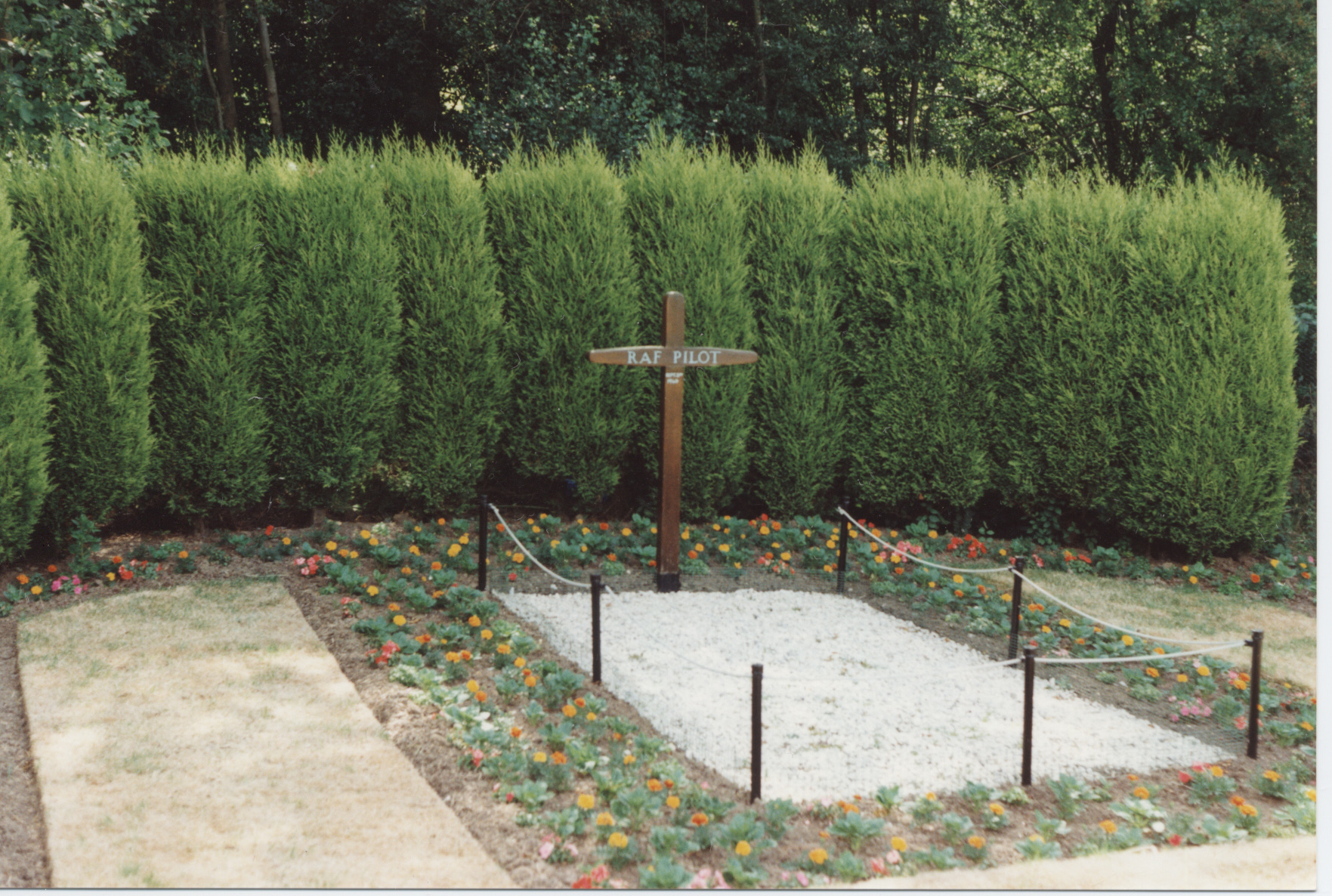
I also found out, thanks to the helpful locals, that even then, 49 years on from the crash, there is in fact a memorial to this unknown pilot, very close to where the aircraft crashed. It is a peaceful, beautifully kept garden, with a simple wooden cross bearing the inscription “RAF PILOT 3rd September 1940”. It was above this little memorial garden that the RAF had been performing their display.

The memorial lies hidden in a shady copse beside an apple orchard, on a south-facing slope that overlooks the one of the most beautiful parts of the county: the Weald of Kent. It is only open to the public once a year, and few people outside of the local Royal Air Force Association’s Headcorn branch and the people of Chart Sutton village, know its location. The whole thing, even now, is still a rather private affair between the local people, the RAF and the memory of the fallen pilot.

In 1970, the overgrown crash site was cleared and a formal garden constructed. There has been a memorial service every year at Chart Sutton Church ever since, which is usually followed by a display from either a lone fighter, or a pair of fighters, from the RAF’s Battle of Britain Memorial Flight. Tuesday, 3rd September 1940, is a date that Chart Sutton, and the RAF, have never forgotten.

Despite the fact that a local Police Officer had actually witnessed the crash and managed to log the involved aircraft’s number, confusion arose at the time because two more British fighters crashed in close proximity to the first very soon afterwards; one the next day in fact, at neighbouring Amberfield Farm and one ten days later on 14th September, almost unbelievably at Parkhouse Farm again.

The RAF sent a recovery squad to Chart Sutton on September 26th 1940, to clear the wreckage from all three crash sites. Although a local constabulary report to the RAF cited Hurricane P3782 as having been cleared from Parkhouse Farm, along with the fragmented remains of its pilot, plus the remains of the other pilot who’d crashed there on the 14th, that single piece of seemingly unimportant paper then got buried, lost in the general Police archives for years. It didn’t come to light again till the early to mid-nineteen eighties, probably during a clearout. It was then reproduced in that epic book, “The Battle of Britain Then & Now”.

Meanwhile, the removed remains of both pilots were interred at Sittingbourne & Milton Cemetery, in graves marked “unknown British airman”. The fighter that crashed at Amberfield Farm had left very little in its wake, having gone straight into the ground, so it is easy to see now, how the confusion over the identification of the three pilots subsequently arose, as aircraft crashes in Kent were of course quite commonplace during that long hot summer of 1940.

That was pretty much how things remained, till in 1980 a museum group excavated the site of the second Parkhouse Farm crash. Forty years to the very day since he’d crashed, Sergeant Pilot J.J. Brimble of 73 Squadron and his Hurricane, were exhumed from the Kent soil and positively identified. Also excavated at sometime soon afterwards, was the site of the Amberfield Farm crash, which was then positively identified as being that of Flying Officer Cutts of 222 Squadron, and his Spitfire. This left the last of the three “unknown airmen” and Hurricane P3782, the number from the now rediscovered police report.

Hurricane P3782 belonged to No. l Squadron, whose records show that on 3rd September 1940, it was allocated to Pilot Officer R.H. Shaw. The squadron log posts both Shaw and Hurricane P3782 as: “Missing, failed to return from a standing patrol” on the morning of Tuesday September 3rd 1940.

There can be little doubt now as to whom the Chart Sutton memorial belongs, but as the engine and cockpit of Shaw’s Hurricane are still deeply buried where they fell, there is nothing to base any official identification upon. Despite this, and the fact that the RAF removed what human remains they could find at the time, it has always been regarded locally as the last resting place of this gallant young airman.

Pilot Officer Robert Henry Shaw of 1 Squadron. By kind permission of Winston G. Ramsay, via Mitch Peeke.

Robert Henry Shaw was born on 28th July 1916, in Bolton to a family in the textile Business. He was commissioned as a Pilot Officer in the RAF on February 1st 1940 and posted to 11 Group, Fighter Command. On March 11th, he joined No.1 Squadron in France, as part of the force attempting to stem the German advance. The squadron was withdrawn to Tangmere, in Hampshire just before Dunkerque. It was at this time that Robert was inadvertently shot down by the pilot of another British fighter, who had evidently mistaken Robert’s Hurricane for a Messerschmitt 109. However, Robert managed to land his damaged Hurricane back at Tangmere and was himself unhurt.

I had the pleasure of meeting Robert’s brother when we were introduced to each other at the annual memorial service the year after the local newspaper ran my original story. Unbeknown to me, the paper had traced and contacted Robert’s family. His brother, who was completely unaware that Robert’s memory had been honoured annually in Chart Sutton for the previous nineteen years, travelled down for the 1991 service. At our meeting, he told me that Robert, in connection with the family’s textile business, had been a frequent visitor to Germany before the war and was at first mightily impressed by Hitler’s regime. However, during what turned out to be his final visit in 1937, Robert was witness to a public incident that dispelled any illusions he had formed of Hitler’s new Germany. Robert never did say exactly what it was that he’d witnessed, but though obviously tight of lip, he was decidedly firm of jaw. Robert came straight home and joined the RAF Volunteer Reserve, immediately.

The exact circumstances of Robert’s death have never been established, but it seems likely that he and his flight commander, Flight Lieutenant Hillcoat, probably encountered a pack of “Free hunting” Messerschmitt 109’s; ironically, one of the last such hunting pack operations before Goring unwisely tied his fighters to the bomber formations as a close escort. Robert was by then a seasoned and experienced fighter pilot, but the ensuing dogfight would have been anything but equal. Despite the odds being heavily against them, the pair did not shrink from the fight. Flight Lieutenant Hillcoat was also killed.

Pilot Officer Robert Henry Shaw of 1 Squadron Chart Sutton, Maidstone (photo Mitch Peeke)

The Chart Sutton memorial is the village’s way of honouring that last great courageous deed of Robert’s in steering his blazing and doomed Hurricane away from the village school. It was his final, desperate act of pure self-sacrifice that has justly made twenty-four year-old Pilot Officer Robert H. Shaw an immortal part of that Kent village.

Since I first penned this, some evidence has now emerged in the form of an engine plate that was apparently dug up at the site as long ago as 1987, which has now at last been brought out into the light of day. One is left to wonder just how many such artefacts, souvenired at some point in the past, still lie undiscovered in people’s houses!

My thanks go to Mitch for bringing this story to us.

An update to the Allhallows 379th BG Memorial.

A note kindly sent in by Mitch Peeke regarding an update of the Allhallows memorial – 379th BG after its winter ‘clean up’.

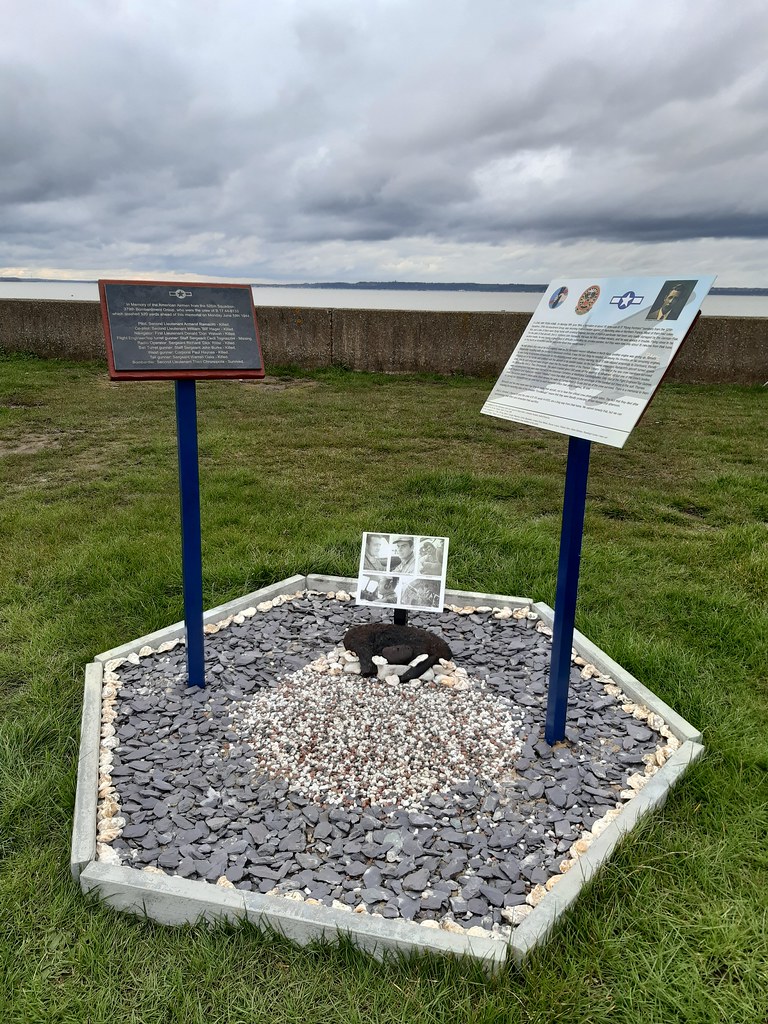
I had taken the plaque and the storyboard down for the winter, after I got out of hospital (that’s another story!). The storms we’d had plus the unprecedented amount of rain, had inflicted some damage to the base work. Paul Hare and his Grounds keeping team at the Holiday Park once again stepped in. They installed a third, lower stand for me and then carefully removed the decorative stones so they could concrete the entire base, putting the stones back on the setting concrete so that the whole thing is now set and solid. I came back and repainted the original stands.

I then re-installed the original plaque and storyboard, the backboards of which I had re-varnished. On the third, lower stand is a new plate I had made, bearing the only known photos of some of the crew members. The pictures had been taken by Teddy Chronopolis during a training flight in Texas. His daughter, Jeanne, very kindly let me have copies, which I took to the signmakers. Having done that, I went down onto the beach and gathered up loads of Oyster shells and some driftwood. I laid the driftwood at the base of the lower stand with some of the Oyster shells, then used the rest of the shells to lay a complete border around the inner perimeter of the memorial base. The driftwood and shells are to symbolize the aircraft’s final resting place.I then took a photo, which I sent to both Jeanne and Noel. They were both touched by this “Mk II” memorial!

The memorial has now been formally inducted into the Allhallows Village Heritage Trail. The first guided Heritage walk was held on the second weekend in March and was well attended. Unfortunately of course, the Coronavirus restrictions have curtailed such activities at the moment and the Holiday Park is closed to holidaymakers too. But people do still exercise their dogs and themselves along the seafront. Hopefully, things will return to some kind of normality before this summer is done!

Allhallows Memorial update

Photo by Mitch Peeke 14/3/20

My thanks to Mitch for the update and photo, the memorial is looking splendid!

The original story was told in ‘A Long Way From Home‘.

The unveiling took place on June 22nd 2019.

A Happy Christmas!

I would just like to take this opportunity to wish all those of you who have followed, read or commented on the blog, a very merry Christmas and a very happy and safe New Year.

A extra big thanks goes out to those of you who have stuck around for so long, we’re now approaching our seventh year of the blog and have managed to visit over 125 airfields, 105 memorials and 40 museums. These have stretched from Perth in Scotland to the South coast of England, Suffolk in the east to Gloucestershire in the west. The range of these airfields is enormous, and they continue to vanish, with many in a worse state now than they were when I visited at the beginning of the journey.

Very soon many of these will be gone, lets hope the memories of those who served are not also gone with them.

A very happy Christmas one and all!

RAF Andrews Field – (Great Saling/Station 485) – Trail 33: Essex Part 1.

RAF Attlebridge  (Station 120) – Trail 7: Northwest Norfolk.

RAF Barkston Heath (Station 483) – Trail 2: Lincoln Borders and Newark

RAF Barton BendishTrail 7: Northwest Norfolk.

RAF Biggin Hill (Westersham) (Station 343) – Trail 4: Kent Part 1.

RAF Bircham NewtonTrail 20: North Norfolk (Part 1).

RAF Bodney (Station 141) – Trail 8: Swaffham and Her Neighbours (Part 1 of 3).

RAF Bottesford (Station 481) – Trail 52: Leicestershire’ Borders.

RAF Bottisham (Station 374) – Trail 55: Around Newmarket

RAF Boulmer – Trail 47: Northumberland.

RAF BournTrail 31: Southern Cambridgeshire (Part 2).

RAF Brenzett (ALG) – Trail 18: Kent Part 2.

RAF BruntonTrail 47: Northumberland.

RAF Bungay (Flixton) (Station 125) – Trail 14:  Central Suffolk (Part 1).

RAF Bury St. Edmunds (Rougham) (Station 468) – Trail 16: West Suffolk (part 1).

RAF Castle CampsTrail 45: Essex (Part 2).

RAF Caxton GibbetTrail 29: Southern Cambridge (Part 1).

RAF Charterhall Trail 41: The Borders of Scotland and England.

RAF ChedburghTrail 49: Bomber Command – Bury St. Edmunds to Haverhill

RAF Collyweston Trail 37: The Northern Reaches of Cambridgeshire.

RAF Coltishall – Trail 7: Northwest Norfolk.

RAF ConingsbyTrail 1: Lower Lincolnshire.

RAF CottamTrail 40: Yorkshire (East Riding).

RNAS CrailTrail 53: Scotland’s East Coast – Fife

RAF CranwellTrail 2: Lincoln Borders and Newark.

RAF Debach (Station 152) – Trail 39: Suffolk around Ipswich (Part 1).

RAF Debden (Station 356) – Trail 46: Essex Part 3.

RAF Deenethorpe (Station 128) – Trail 6: American Ghosts.

RAF Deopham Green (Station 142) – Trail 27: Southern Norfolk (Part 3).

RAF Digby (Scopwick) – Trail 1: Lower Lincolnshire.

RAF Docking – Trail 20: North Norfolk (Part 1).

RAF Downham Market (Bexwell) – Trail 7: Northwest Norfolk.

RAF Drem – Trail 42: Edinburgh’s Neighbours.

RAF Dunino –  Trail 53: Scotland’s East Coast – Fife.

RAF East Fortune – Trail 42: Edinburgh’s Neighbours.

RAF East Kirkby Trail 1: Lower Lincolnshire.

RAF East Wretham (Station 133) – Trail 13: Southern Norfolk around Diss (Part 2).

RAF Eye (Brome) (Station 134) – Trail 14: Central Suffolk (Part 1).

RAF Fersfield – (Station 130) – Trail 28: Southern Norfolk (Part 4).

RAF FoulshamTrail 22North Norfolk (Part 3).

RAF FowlmereTrail 32Southern Cambridgeshire (Part 3).

RAF Framlingham (Parham) (Station 153)Trail 39: Suffolk around Ipswich (Part 1).

RAF GamstonTrail 54: The Great North Road.

RAF Glatton (Station 130) – Trail 6: American Ghosts.

RAF Gransden Lodge – Trail 31: Southern Cambridgeshire (Part 2).

RAF Graveley – Trail 29: Southern Cambridge (Part 1).

RAF Grafton Underwood (Station 106) – Trail 6: American Ghosts.

RAF Great Dunmow (Station 164)- Trail 33: Essex (Part 1).

RAF Great MassinghamTrail 21: North Norfolk (Part 2).

RAF Great Sampford (Station 359) – Trail 50: Haverhill’s neighbours – Wratting Common and Great Sampford.

RAF Hardwick (Station 104) – Trail 12: Southern Norfolk around Diss (Part 1).

RAF Hawkinge – Trail 18: Kent Part 2.

RAF Hethel – Trail 38: To the West of Norwich.

RFC HinghamTrail 38: To the West of Norwich.

RAF Holme on Spalding Moor Trail 40: Yorkshire (East Riding).

RAF Hunsdon – Trail 25: Hertfordshire.

RAF Kimbolton (Station 117) – Trail 6: American Ghosts.

RAF King’s Cliffe (Station 367) – Trail 6: American Ghosts.

RAF LanghamTrail 23: North Norfolk (Part 4).

RAF Lashenden (Headcorn) – Trail 18: Kent Part 2.

RAF Lavenham (Station 137) – Trail coming soon.

RAF Leuchars – Trail 53: Scotland’s East Coast – Fife.

RAF Little SnoringTrail 22North Norfolk (Part 3).

RAF Little Walden – – Trail 46: Essex Part 3.

RAF Macmerry Trail 51: Southern Scotland

RAF MarhamTrail 7: Northwest Norfolk.

RAF Martlesham HeathTrail 48: Suffolk around Ipswich (Part 2).

RAF Matching (Station 166) – Trail 33: Essex Part 1.

RAF Matlaske (Station 178) – Trail 34: North Norfolk (Part 5).

RAF MattishallTrail 36: North Norfolk (Part 6).

RAF Mendlesham (Station 156) – Trail 15: Central Suffolk (Part 2).

RAF MepalTrail 11: Around Ely.

RAF MetheringhamTrail 1: Lower Lincolnshire.

RAF Methwold – Trail 8: Swaffham and Her Neighbours (Part 1).

RAF Milfield –  Trail 47: Northumberland.

RAF Narborough (Narborough Aerodrome)- Trail 7: Northwest Norfolk.

RAF Newmarket Heath – Trail 55: Around Newmarket

RAF North CreakeTrail 23: North Norfolk (Part 4).

RAF North Pickenham (Station 143) – Trail 9: Swaffham and Her Neighbours (Part 2).

RAF North WealdTrail 25: Hertfordshire.

RAF North Witham (Station 479) – Trail 3: Gone But Not Forgotten.

RAF Old Buckenham (Station 144) – Trail 13: Southern Norfolk around Diss (Part 2).

RAF Oulton – Trail 34: North Norfolk (Part 5).

RAF Polebrook (Station 110) – Trail 19: Northamptonshire American Ghosts II.

RAF Rattlesden (Station 126) – Trail 15: (Central Suffolk (Part 2).

RAF SawbridgeworthTrail 25: Hertfordshire.

RAF ScamptonTrail 30: Scampton and the Heritage Centre.

RAF SconeTrail 56: Perthshire.

RAF SculthorpeTrail 21: North Norfolk Part 2.

RAF Sedgeford – Trail 20: North Norfolk (Part 1).

RAF Shipdham (Station 115) – Trail 10: Swaffham and Her Neighbours (Part 3).

RAF Snailwell (Station 361) – Trail 55: Around Newmarket

RAF Snetterton Heath – (Station 138) – Trail 27: Southern Norfolk (Part 3).

RAF Spanhoe Lodge (Station 493) – Trail 6: American Ghosts.

RAF Steeple Morden – Trail 32: Southern Cambridgeshire (Part 3).

RAF Stoke OrchardTrail 24: Gloucestershire.

RAF Stradishall- Trail 49: Bomber Command – Bury St. Edmunds to Haverhill

RAF Sutton BridgeTrail 3: Gone But Not Forgotten.

RAF Swannington – Trail 36: North Norfolk (Part 6) 

RAF Swanton Morley – Trail 38: To the West of Norwich.

RAF Thorpe Abbotts (Station 139) – Trail 12: Southern Norfolk around Diss (Part 1).

RAF Tibenham (Station 124) – Trail 13: Southern Norfolk around Diss (Part 2).

RAF Tuddenham – Trail 16: West Suffolk (Part 1).

RAF Tydd St. Mary – Trail 37: The Northern Reaches of Cambridgeshire.

RAF Upwood – Trail 17: The Pathfinders.

RAF Warboys – Trail 17: The Pathfinders.

RAF WaterbeachTrail 11: Around Ely.

RAF Watton (Station 376/Station 505) – Trail 9: Swaffham & Her Neighbours (Part 2).

RAF Wendling (Station 118) – Trail 10: Swaffham and Her Neighbours (Part 3).

RAF West Malling Trail 4: Kent Part 1.

RAF West RaynhamTrail 21: North Norfolk Part 2.

RAF WethersfieldTrail 45: Essex (Part 2).

RAF Westley – Trail 16: West Suffolk (part 1).

RAF WinfieldTrail 41: The Borders of Scotland and England.

RAF Winthorpe Trail 2: Lincoln Borders and Newark.

RAF WitchfordTrail 11: Around Ely.

RAF Wittering  – Trail 37: The Northern Reaches of Cambridgeshire.

RAF Woodall SpaTrail 1: Lower Lincolnshire.

RAF Wratting CommonTrail 50 – Haverhill’s neighbours – Wratting Common and Great Sampford.

November 7th 1945 – World Air Speed Record Herne Bay.

Trail 44 takes a look at the aviation highlights of the North Kent Coast in the small town of Herne Bay and its neighbour Reculver. It was here, on November 7th 1945, that the World Air Speed record was set in a ‘duel’ between two Gloster Meteors, as they raced across the Kent Sky.

On that day, two Meteor aircraft were prepared in which two pilots, both flying for different groups, would attempt to set a new World Air Speed record over a set course along Herne Bay’s seafront. The first aircraft was piloted by Group Captain Hugh Joseph Wilson, CBE, AFC (the Commandant of the Empire Test Pilots’ School, Cranfield); and the second by Mr. Eric Stanley Greenwood O.B.E., Gloster’s own chief test pilot. In a few hours time both men would have the chance to have their names entered in the history books of aviation by breaking through the 600mph air speed barrier.

The event was run in line with the Fédération Aéronautique Internationale‘s rules, covering in total, an 8 mile course flown at, or below, 250 feet. For the attempt, there would be four runs in total by each pilot, two east-to-west and two west-to-east.

With good but not ideal weather, Wilson’s aircraft took off from the former RAF Manston, circling over Thanet before lining his aircraft up for the run in. Following red balloon markers along the shoreline, Wilson flew along the 8 mile course at 250 feet between Reculver Point and  Herne Bay Pier toward the Isle of Sheppey. Above Sheppey, (and below 1,300 ft) Wilson would turn his aircraft and line up for the next run, again at 250ft.

Initial results showed Greenwood achieving the higher speeds, and these were eagerly flashed around the world. However, after confirmation from more sophisticated timing equipment, it was later confirmed that the higher speed was in fact achieved by Wilson, whose recorded speeds were: 604mph, 608mph, 602mph and 611mph, giving an average speed of just over 606mph. Eric Greenwood’s flights were also confirmed, but slightly slower at:  599mph, 608mph, 598mph and 607mph, giving an overall average speed of 603mph. The actual confirmed and awarded speed over the four runs was 606.38mph by Wilson*1.

The event was big news around the world, a reporter for ‘The Argus*2‘ – a Melbourne newspaper – described how both pilots used only two-thirds of their permitted power, and how they both wanted permission to push the air speed even higher, but both were denied at the time.

In the following day’s report*3, Greenwood described what it was like flying at over 600 mph for the very first time.

As I shot across the course of three kilometres (one mile seven furlongs), my principal  worry was to keep my eye on the light on the pier, for it was the best guiding beacon there was. On my first run I hit a bump, got a wing down, and my nose slewed off a bit, but I got back on the course. Below the sea appeared to be rushing past like an out-of-focus picture.

I could not see the Isle of Sheppey, toward which I was heading, because visibility was not all that I wanted.

At 600mph it is a matter of seconds before you are there. It came up just where I  expected it. In the cockpit I was wearing a tropical helmet, grey flannel bags, a white silk shirt, and ordinary shoes. The ride was quite comfortable, and not as bumpy as some practice runs. I did not have time to pay much attention to the gauges and meters, but I could see that my air speed indicator was bobbing round the 600mph mark.

On the first run I only glanced at the altimeter on the turns, so that I should not go too high. My right hand was kept pretty busy on the stick (control column), and my left hand was. throbbing on the two throttle levers.

Greenwood went on to describe how it took four attempts to start the upgraded engines, delaying his attempt by an hour…

I had to get in and out of the cockpit four times before the engines finally started. A technical hitch delayed me for about an hour, and all the time I was getting colder and colder. At last I got away round about 11.30am. 

He described in some detail the first and second runs…

On the first run I had a fleeting glance at the blurred coast, and saw quite a crowd of onlookers on the cliffs. I remembered that my wife was watching me, and I found that there was time to wonder what she was thinking. I knew that she would be more worried than I was, and it struck me that the sooner I could get the thing over the sooner her fears would be put at rest.

On my first turn toward the Isle of Sheppey I was well lined up for passing over the Eastchurch airfield, where visibility was poor for this high-speed type of flying. The horizon had completely disappeared, and I turned by looking down at the ground and hoping that, on coming out of the bank, I would be pointing at two balloons on the pier 12 miles ahead. They were not visible at first.

All this time my air speed indicator had not dropped below 560 mph, in spite of my back-throttling slightly. Then the guiding light flashed from the pier, and in a moment I saw the balloons, so I knew that I was all right for that.

On the return run of my first circuit the cockpit began to get hot. It was for all the world like a tropical-summer day. Perspiration began to collect on my forehead. I did not want it to cloud my eyes, so for the fraction of a second I took my hands off the controls and wiped the sweat off with the back of my gloved hand. I had decided not to wear goggles, as the cockpit was completely sealed. I had taken the precaution, however, of leaving my oxygen turned on, because I thought that it was just that little extra care that might prevent my getting the feeling of “Don’t fence me in.”

Normally I don’t suffer from a feeling of being cooked up in an aircraft, but the Meteor’s cockpit was so completely sealed up that I was not certain how I should feel. As all had gone well, and I had got half-way through the course I checked up my fuel content gauges to be sure that I had plenty of paraffin to complete the job.

I passed over Manston airfield on the second run rather farther east than I had hoped, so my turn took me farther out to sea than I had budgeted for. But I managed to line up again quite satisfactorily, and I opened up just as I was approaching Margate pier at a height of 800 feet. My speed was then 560 mph.

Whilst the first run was smooth, the second he said, “Shook the base of his spine”.

This second run was not so smooth, for I hit a few bumps, which shook the base of my spine. Hitting air bumps at 600 mph is like falling down stone steps—a series of nasty jars. But the biffs were not bad enough to make me back-throttle, and I passed over the line without incident, except that I felt extremely hot and clammy.

After he had completed his four attempts, Greenwood described how he had difficulty in lowering his airspeed to enable him to land safely…

At the end of my effort I came to one of the most difficult jobs of the lot. It was to lose speed after having travelled at 600 mph. I started back-throttling immediately after I had finished my final run, but I had to circuit Manston airfield three times before I got my speed down to 200mph.

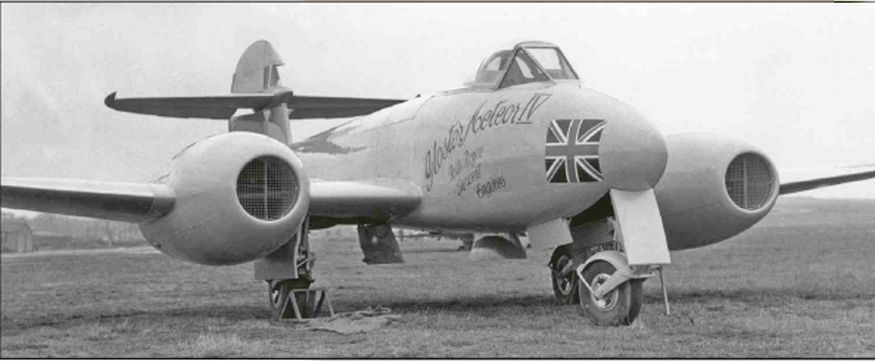
The two Meteor aircraft were especially modified for the event. Both originally built as MK.III aircraft – ‘EE454’ (Britannia ) and ‘EE455’ (Yellow Peril) – they had the original engines replaced with Derwent Mk.V turbojets (a scaled-down version of the RB.41 Nene) increasing the thrust to a maximum of 4,000 lbs at sea level – for the runs though, this would be limited to 3,600 lbs each. Other modifications included: reducing and strengthening the canopy; lightening the air frames by removal of all weaponry; smoothing of all flying surfaces; sealing of trim tabs, along with shortening and reshaping of the wings – all of which would go toward making the aircraft as streamlined as possible.

Related image

EE455 ‘Yellow Peril’ was painted in an all yellow scheme (with silver outer wings) to make itself more visible for recording cameras.*4

An official application for the record was submitted to the International Aeronautical Federation for world recognition. As it was announced, Air-Marshal Sir William Coryton (former commander of 5 Group) said that: “Britain had hoped to go farther, but minor defects had developed in ‘Britannia’. There was no sign of damage to the other machine“, he went on to say.

Wilson, born at Westminster, London, England, 28th May 1908, initially received a short service commission, after which he rose through the ranks of the Royal Air Force eventually being placed on the Reserves Officers list. With the outbreak of war, Flt. Lt. Wilson was recalled and assigned as Commanding Officer to the Aerodynamic Flight, R.A.E. Farnborough. A year after promotion to the rank of Squadron Leader in 1940, he was appointed chief test pilot at the Royal Aircraft Establishment (R.A.E.) who were then testing captured enemy aircraft. He was promoted to Wing Commander, 20th August 1945, retiring on 20th June 1948 as a Group Captain.

Eric Greenwood, Gloster’s Chief Test Pilot, was credited with the first pilot to exceed 600 miles per hour in level flight, and was awarded the O.B.E. on 13th June 1946.

His career started straight from school, learning to fly at No. 5 F.T.S. at Sealand in 1928. He was then posted to 3 Sqn. at Upavon flying Hawker Woodcocks and Bristol Bulldogs before taking an instructors course, a role he continued in until the end of his commission. After leaving the R.A.F., Greenwood joined up with Lord Malcolm Douglas Hamilton (later Group Captain), performing barnstorming flying and private charter flights in Scotland.

Greenwood then flew to the far East to help set up the Malayan Air Force under the guise of the Penang Flying Club. His time here was adventurous, flying some 2,000 hours in adapted Tiger Moths. His eventual return to England saw him flying for the Armstrong Whitworth, Hawker and Gloster companies, before being sent as chief test pilot to the Air Service Training (A.S.T.) at Hamble in 1941. Here he would test modified U.S. built aircraft such as the Airocobra, until the summer of 1944 when he moved back to Gloster’s – again as test pilot.

It was whilst here at Gloster’s that Greenwood would break two world air speed records, both within two weeks of each other. Pushing a Meteor passed both the 500mph and 600mph barriers meant that the R.A.F. had a fighter that could not only match many of its counterparts but one that had taken aviation to new record speeds.

During the trials for the Meteor, Greenwood and Wilson were joined by Captain Eric ‘Winkle’ Brown, who between them tested the slimmed-down and ‘lacquered until it shone’ machine, comparing  drag coefficients with standard machines. Every inch of power had to be squeezed from the engine as reheats were still in their infancy and much too dangerous to use in such trials.

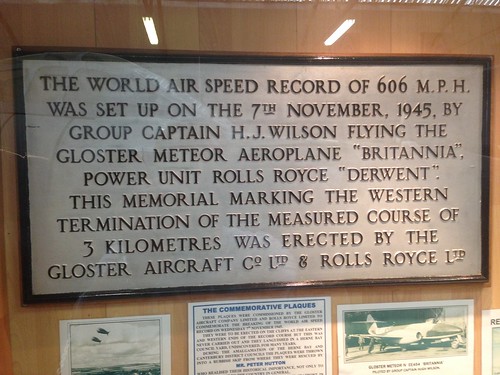
To mark this historic event, two plaques were made, but never, it would seem, displayed. Reputed to have been saved from a council skip, they were initially thought to have been placed in a local cafe, after the cliffs – where they were meant to be displayed – collapsed. The plaques were however left in the council’s possession, until saved by an eagle-eyed employee. Today, they are located in the RAF Manston History Museum where they remain on public display.

RAF Manston History Museum

One of the two plaques now on display at the RAF Manston History Museum.

To mark the place in Herne Bay where this historic event took place, an information board has been added, going some small way to paying tribute to the men and machines who set the world alight with a new World Air Speed record only a few hundred feet from where it stands.

Part of the Herne Bay Tribute to the World Air Speed Record set by Group Captain H.J. Wilson (note the incorrect speed given).

From Herne Bay, we continue on to another trail of aviation history, eastward toward the coastal towns of Margate and Ramsgate, to the now closed Manston airport. Formerly RAF Manston, it is another airfield that is rich in aviation history, and one that closed with huge controversy causing a great deal of ill feeling amongst many people in both the local area and the aviation fraternity.

Sources and Further Reading.

*1 Guinness World Records website accessed 22/8/17.

*2 The Argus News report, Thursday November 8th 1945 (website) (Recorded readings quoted in this issue were incorrect, the correct records were given in the following day’s issue).

*3 The Argus News report, Thursday November 9th 1945 (website)

*4 Photo from Special Hobby website.

The RAF Manston History Museum website has details of opening times and location.

The Manston Spitfire and Hurricane Memorial museum website has details of opening times and location.

379th BG Memorial, June 22nd 2019

June 22nd 2019, the day of the unveiling of the memorial to the crews of two 379th Bomb Group B-17s that collided over Allhallows, Kent on June 19th 1944.

The day finally arrived, after six months of organising, emailing, badgering and beavering away, Mitch Peeke’s vision of a memorial for the crew of B-17 #44-6133 piloted by 2nd Lieutenant Armand Ramacitti, finally arrived.

A break in what had been many days of storms and heavy rain allowed the sun to shine on this, a quiet corner on the northern coast of Kent. A place which overlooks the mud flats of the Thames Estuary, with Essex and Southend beyond. A place where like minded people gathered to pay their respects to the brave crew of a B-17 that fought tirelessly in the skies of Europe during World War II.

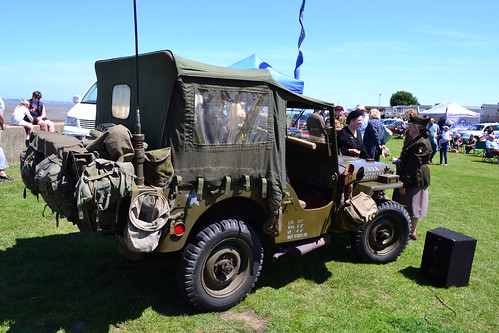
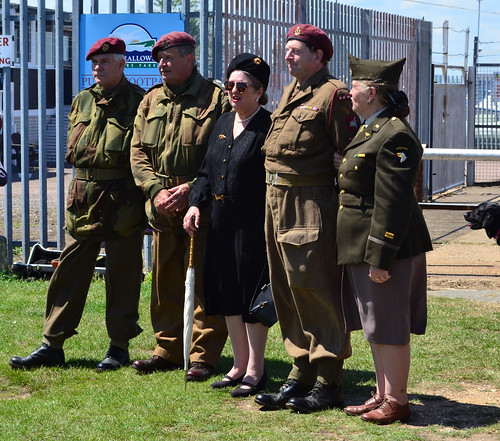
Flanked by two authentic World War II jeeps, reenactors and an Air Cadet Guard of Honour, Mitch Peeke took centre stage and reminded us why we were here. With the ‘Stars and Stripes’ flapping in the wind, Mitch told the story of the two aircraft that collided in the skies above, an accident in which eleven young men lost their lives almost 75 years ago to the day.

Allhallows Memorial 379th BG

The Thames Estuary were the B-17 came down.

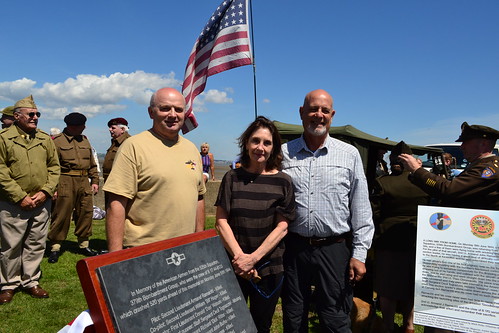
A solemn silence fell as Mitch then introduced two living relatives of that crew, Jeanne Cronis-Campbell (the daughter of Bombardier Second Lieutenant Theodore ‘Teddy‘ Chronopolis) and Noel Togazzini (nephew of Flight engineer/top turret gunner: Staff Sergeant Cecil Tognazzini), who had flown over all the way from the United States for this special occasion.

The sound of TAPS then resonated across the site, after which Jeanne and Noel lifted the flag from the plaque. The Reverend Steven Gwilt then blessed the memorial, and lead the gathered in  prayers of remembrance.

Allhallows Memorial 379th BG

Jeanne and Noel unveil the memorial.

The silence  prevailed, people’s thoughts perhaps turning to that day in 1944, and what must have been going through the minds of those young men as they battled to get out of that B-17 as it fell perilously towards Earth and a decisive fate.

Mitch then stepped forward once more, introduced the band who lightened the moment with their collection of well known 1940’s music. The band played on throughout the afternoon, the drinks flowed and friendships were forged. Just as in the 1940s, hands that had stretched across the sea were now hands together, stories and personal moments were shared, it was like meeting an old friend.

Allhallows Memorial 379th BG

The Memorial at Allhallows.

The day was more than a success, it was a celebration of life. A celebration that now sees a memorial, long since missed,  standing as close as it can to the point of impact, where all but one of the Ramacitti crew died.

My own personal thanks go to Mitch for the hard work he put in to organising the event, to both Jeanne and Noel, for sharing their stories and also to Geoff Burke for sharing stories of his own personal voyage to this point.

Most of all though, I would like to thank the crew of B-17 #44-6133, who fought so bravely for the freedom we all enjoy today.

The crew of #44-6133 were:

Pilot: Second Lieutenant Armand Ramacitti
Co-pilot: Second Lieutenant William ‘Bill’ Hager
Navigator: First Lieutenant Donald ‘Don’ Watson
Flight engineer/top turret gunner: Staff Sergeant Cecil Tognazzini
Radio Operator: Sergeant Richard ‘Dick’ Ritter
Ball turret gunner: Staff Sergeant John Burke
Waist gunner: Corporal Paul Haynes
Tail gunner: Sergeant Warren Oaks (his second mission)
Bombardier: Second Lieutenant Theodore Chronopolis

The full story of the accident can be read in Mitch’s guest post “A Long Way From Home.

Allhallows Memorial 379th BG

Mitch, Jeanne and Noel.

Allhallows Memorial 379th BG

World War II Jeep ‘Jezebel’.

Allhallows Memorial 379th BG

Allhallows Memorial 379th BG

Geoff’s print of the two B-17s signed by some surviving members of the crew and relatives. Many of these crewmen have now passed on.

Allhallows Memorial 379th BG

Some of the reenactors.

A Wing and a Prayer – B-17 Memorial update.

The planned memorial for the crew of B-17 #44-6133 which collided with another B-17 ‘Heavenly Body II’ over Allhallows in Kent, has taken a major step forward recently.

In the crash all but one of the crewmen were killed and Mitch Peeke has been organising the erection of a memorial to commemorate the tragic accident.

With a large part of the funding having been raised, materials donated and a considerable number of leaflets distributed, there has been great interest shown from not only the UK but also from the United States.

Both Mitch and I have been in contact with Noel Tognazzini, the nephew of S/Sgt. Cecil Tognazzini, Flight Engineer/Top Turret Gunner on the B17 #44-6133.

Noel has made arrangements for not only himself, but also the daughter of 2nd Lt. Theodore Chronopolis, (Bombardier), Jeanne Crons Campbell, the only child of the sole survivor of #44-6133, to attend both the 75th anniversary of the crash on June 19 and the Allhallows event which Mitch has organised for June 22nd.

With a collection of Second World War vehicles, a live band and stalls from aviation related organisations, it is going to be a superb day with a great deal of supporters in attendance. With other events occurring locally at the same time, this will be a remarkable way to commemorate the loss of these young men who were so tragically taken from us in 1944.

Following the collision between the two aircraft, #44-6133 fell into the mud flats at Allhallows, from where most of the bodies were recovered; some at the time, some a while later, and who are now interred in the American Cemetery at Madingley, Cambridge. The body of Gunner Louis Schulte from #44-6133 was sent home and rests in a cemetery in St. Louis. Only two crewmen are still unaccounted for: Fred Kauffman, Co-pilot of Heavenly Body II, the second B-17, and Cecil Tognazzini from #44-6133, both of whom are listed on the tablets of the missing at Madingley. Their last resting places are very probably in the soft Thames mud that the aircraft crashed in.

Sole survivor Theodore Chronopolis, landed safely by parachute. He was fished out of the water by a passing  boat. The eight men of #44-6133’s crew who died that day were: Pilot 2nd Lt. Armand Ramacitti, Co-pilot 2nd Lt. William Hager, Navigator 2nd Lt. Donald Watson, Gunner S/Sgt. Richard Ritter, Gunner S/Sgt. Cecil Tognazzini, Gunner S/Sgt. John  Burke, Gunner Sgt. Warren Oaks and Gunner Cpl. Paul Haynes.

Mitch has set up a ‘gofundme’ fundraising account, with a target of £1000 to help secure the memorial for those young men who lost their lives that tragic day. Additional funds and collections on the day will go towards the up keep of Britain’s only flying B-17 – ‘Sally B’ (http://www.sallyb.org.uk/). 

For further information or if you would like to have a stall promoting your group, please contact Mitch direct at: madmitch.peeke978@gmail.com or leave a comment here and I’ll make sure he gets it.

Find the fund-raising account at: https://www.gofundme.com/ww2-aircrew-memorial 

The full story of the crash can be found using the link: ‘A Long way from Home’.

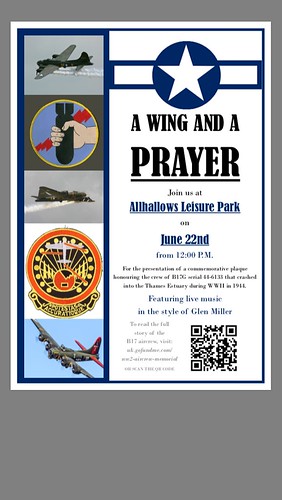
B-17 Memorial flyer Allhallows, Kent.

Latest update to 379th BG Memorial

Since the first posting about the proposed memorial to the crews of two B-17s, #44-6133 and  #42-97942 (Heavenly Body II) who collided over Allhallows on Monday 19th June 1944, I am pleased to announce that Mitch has made excellent progress and has secured: a Guard of Honour, a Vicar to bless the memorial, materials to build the memorial, a 1940’s ‘swing’ band, a display of military vehicles, refreshments for the day and a representative of the USAF possibly from the 48th Fighter Wing from RAF Lakenheath. Also, the plaque has been delivered to Mitch, and the story board to complement the memorial is also in the process of being made. Sadly a fly past was not permitted largely due to the fact that the flight path for Southend airport lies directly overhead!

The park where the memorial is to be placed is expecting between 3,000 and 4,000 people to be there, so this is an ideal opportunity for local charities or aviation related organisations to attend and raise themselves some much-needed funds.

Funding for the memorial itself has reached £500 (half of which has been promised by the park on which the memorial will stand) 50% of the original £1,000 sought after. A considerable amount of materials have very kindly been donated, the local paper ‘Kent Messenger’ has published the story, and local television news are also following the project with great interest. A number of other supporters have also shown an interest and their support.

Any money left over, along with money raised by collection buckets on the day, will go to support the B-17 ‘Sally B‘ (http://www.sallyb.org.uk/) to help keep Britain’s only B-17 where she belongs – in the sky.

The event is set for Saturday 22nd June 2019, with the unveiling taking place at midday, the first weekend after the anniversary of the crash.

Anyone wishing to attend, either as a visitor or for a stand, can contact Mitch at: madmitch.peeke978@gmail.com or leave a comment here and I’ll make sure he gets it.

Anyone wishing to donate to the memorial can do so at:  https://www.gofundme.com/ww2-aircrew-memorial 

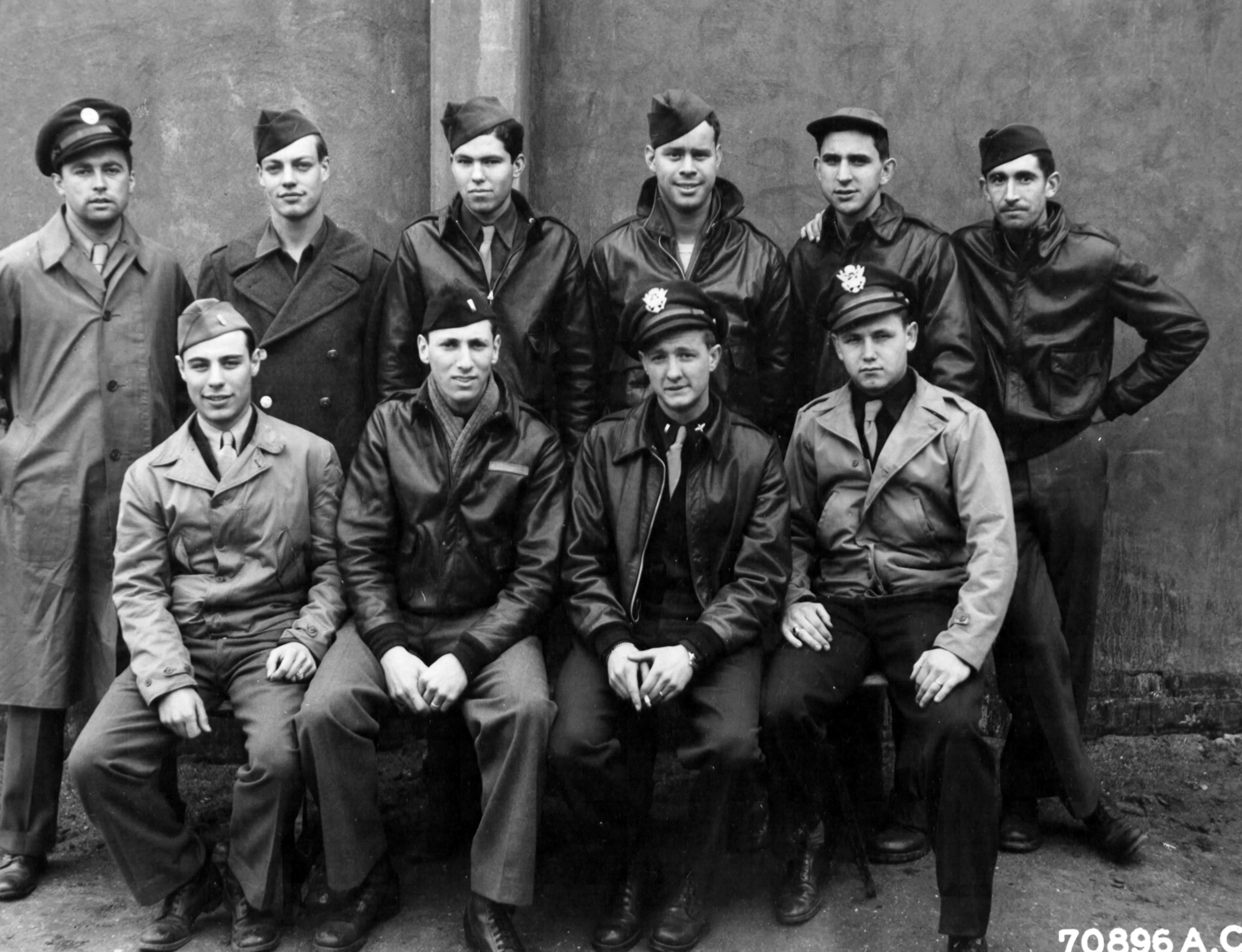
Crew of Heavenly Body II: Front Row, L to R: Edward Sadler; Fred Kauffman; Jack Gray; Lloyd Burns
Back Row, L to R; Louis Schulte; Leroy Monk; Richard Andrews; Richard Billings; William Farmer; Leonard Gibbs (Photo courtesy 379th BG Association archive,  by kind permission.)

B-17  #44-6133 was a Douglas/Long Beach B-17G-45-DL Flying Fortress delivered to Tulsa airbase, Oklahoma, May 10th, 1944. It was transferred to Hunter airbase, Savannah, Georgia, on May 19th, 1944, and then onto Dow Field on May 29th, 1944. She was assigned to the 525th BS, 379th BG as ‘FR-Y’at Kimbolton Jun 8th, 1944. The crew of #44-6133 were:

Pilot: Second Lieutenant Armand Ramacitti
Co-pilot: Second Lieutenant William ‘Bill’ Hager
Navigator: First Lieutenant Donald ‘Don’ Watson
Flight engineer/top turret gunner: Staff Sergeant Cecil Tognazzini
Radio Operator: Sergeant Richard ‘Dick’ Ritter
Ball turret gunner: Staff Sergeant John Burke
Waist gunner: Corporal Paul Haynes
Tail gunner: Sergeant Warren Oaks (his second mission)
Bombardier: Second Lieutenant Theodore Chronopolis

#42-97942 (Heavenly Body II) was a Lockheed/Vega B-17G-40-VE Flying Fortress delivered to Denver on April 11th, 1944. She then went onto Kearney air base in Nebraska on May 4th, 1944, before transferring also to Dow Field May 23rd, 1944. She was then assigned to 525th BS,  379th BG at Kimbolton as ‘FR-K’. The crew of #42-97942 were:

Pilot: First Lieutenant Lloyd Burns (just 19 years of age)
Bombardier: Second Lieutenant Jack Gray
Flight engineer/top turret gunner: Technical Sergeant Leonard Gibbs
Radio Operator: Technical Sergeant Leroy Monk
Ball turret gunner: Staff Sergeant William ‘Bill’ Farmer
Waist gunner: Staff Sergeant Richard ‘Dick’ Andrews
Co-pilot: Second Lieutenant Fred Kauffman
Navigator: Flight Officer Edward Sadler
Tail gunner: Staff Sergeant Louis Schulte

“1940: The Battles to Stop Hitler” – Mitch Peeke

A book review.

This is a superbly written book that looks at the Battle of Britain through the life of the airmen who were primarily based at a now disused RAF station (RAF Gravesend) in Kent. Whilst being historically accurate throughout, it is not one of those books that is full of data, figures and graphs, more a book based on personal and general historical events. It deals well with the political climate in Europe post World War I, setting the scene for Hitler’s rise to power, and the lethargic way in which the Allies allowed him to achieve his ultimate goal. It looks at the political unrest at home, and how that shaped both a public and government totally unprepared for war.

Each of the first four chapters look at specific events that led to the declaration of war on September 3rd, 1939. It looks at how the Allied response to Poland’s invasion was belittled by the massive and hugely technologically advanced German forces, who cut through Belgium circumnavigating the Maginot line, forcing the BEF and French forces to a small pocket at Dunkirk. It then looks at the evacuation through the eyes of two small boats (one of which Mitch supports through his book sales) and those who sailed on her. By examining the infrastructure surrounding the evacuation, it adds a very personal touch to what was a massive undertaking, and one that the many other books, films and documentaries have failed to highlight.

After Dunkirk, Mitch examines the Battle of Britain as it occurred in the skies over Kent and London. Individual skirmishes, with details of those involved, add a very personal touch to the blow-by-blow account of the battle as it weaves its way to its ultimate ending.

It is clear from the references to the skirmishes that Mitch has carried out extensive and prolonged investigations into each one, even pinpointing in many cases the actual crash site of the aircraft. Added to this are the personal and eye-witness accounts which continue to keep the personal aspect very much at the front. As the battle draws to its conclusion, life in London’s city streets are revealed through events that are again backed up with eyewitness accounts and personal details. Some of these stories will make you laugh, the absurdity of ill-fitting fire hoses and the tenacity of the firemen to solve the problem whilst all around were in chaos, is just one incredible example. It also shows that how through it all, the people of Britain managed to keep smiling, still seeing the good in what was a terrible time.

Whilst the Battle of Britain officially ended on 31st of October, Mitch continues to tell the story as autumn turns to winter and as the Battle of Britain turned to the Blitz. The nightly bombing of British cities gave rise to some dark secrets and activities, but balanced with these are other more informal and light-hearted highlights, all of which add to pulling the reader into the atmosphere of 1940s Britain.

In summing up, Mitch analyses the flaws in the German strategic plan for attacking Britain. He looks at how poor decisions enabled Britain to refocus and rearm thus building her forces up to a strength that was far better than those that remained in the period immediately following Dunkirk.

He then reintroduces the characters that had appeared throughout the book informing the reader of their postwar lives, some of whom were his own family members and who witnessed first hand, the true horrors of war.

Throughout Mitch’s final chapters there is a glowing slant toward the people,  showing the true grit and resolve of the British people who ‘pulled together’, that has become synonymous with those dark days of 1940/41. But this is not a patriotic, ‘let’s wave the flag and tell the world how good we were’ book, it’s more a heartfelt look at a very decisive time in world history, one that could have been so very different if it were not for ‘the few’, their leaders and the British people who supported them.

As appendices, Mitch looks at one RAF Station in particular, RAF Gravesend, its history and what has happened to the site since its closure post war. Now long gone, it is one of the many airfields that were so important to Britain’s survival, yet nothing remains of it today. He also looks at the 15 brave airmen who lost their lives in 501 and 66(F) Sqns, their names now on a plaque on the wall of a leisure centre on what was the former entrance to the airfield. Reading their short biographies really brings home the tender age of those who paid the ultimate sacrifice for our freedom.

I read this book in about two days, it’s easy, and compelling reading, very detailed and very personal. “1940: The Battles to Stop Hitler” is not about the Battle of Britain per se, but more a personal examination of the people who were involved in the two battles; Dunkirk and the Battle of Britain, and how their lives were interwoven in the summer of 1940. Light hearted in places, extremely moving in others, it adds another dimension to those famous battles, and I for one would most certainly recommend it.

1940: The Battles to Stop Hitler” by Mitch Peeke is available from Pen and Sword Books Limited. It is sadly only available in digital format and all the author’s royalties go to The Medway Queen Preservation Society, The Medway Queen being a survivor of the Dunkirk evacuation and featured in Mitch’s book.

1940: The Battles to Stop Hitler”  is available from Pen and Sword Books,  ISBN: 9781473858091, Published: 24th June 2015. https://www.pen-and-sword.co.uk/1940-The-Battles-to-Stop-Hitler-Kindle/p/11118

I would like to pass on my immense gratitude to Mitch for providing me with a copy of the book via publishers Pen and Sword Books.

Amy Johnson CBE. – Herne Bay – Trail 44.

Not only is Herne Bay in Kent famous for the location of the World Air Speed Record and its strong links to Barnes Wallis and the RAF’s 617 Sqn, but it is also linked to a famous female aviator, one who set many world records before her mysterious disappearance over the North Sea.

In Trail 44, we continue with the famous people theme, and see how this corner of Kent saw yet another link to aviation, this time very under tragic circumstances.

Amy Johnson Statue

The life-size Bronze Statue of Amy Johnson in Herne Bay, Kent.

Amy Johnson is one of those names known the world over for her achievements in aviation, being the first woman to fly solo halfway around the world from England to Australia in 1930. This amongst numerous other flying achievements made her one of the most influential women of the 1900s.

She was born in 1903, at 154 St. George’s Road in Kingston upon Hull, in the East Riding of Yorkshire. The eldest daughter of John William Johnson and Amy Hodge, she was the oldest of four sisters. Her education took her through Boulevard Municipal Secondary School and on to the University in Sheffield, where she studied economics at degree level, before moving to London to start a new life after a failed relationship.

One Sunday afternoon while she was away from her office work, Amy travelled to Stag Lane Aerodrome in North London, where she was immediately captivated and enthralled by the aircraft she saw. Amy was determined she was going to fly, and even though flying was the preserve of the rich and famous, she persevered using money supplied by her father. She gained a number of certificates including a ground mechanics qualification and an aviator’s certificate before going on to gain her pilots “A” Licence, on 6th July 1929.

Ignoring the ridicule she was targeted with by the media, Amy began to fly, taking solo flights to her home town and across the United Kingdom.

Amy’s biggest challenge came when she decided to fly solo to Australia. Plotting the most direct route from England, she would cross some of the world’s most inhospitable landscapes, meaning she would have to be airborne for many hours at a time, with no accurate weather reports or radio contact with the ground. Fuel would be supplied en-route, and it was therefore imperative that she made each stop on time in order to achieve her goal. Before long, the ridicule stopped and the media began to take serious notice of what she was doing. They began to praise her, call her “Wonderful” and compare her to Charles Lindbergh.

On May 24th 1930, she finally touched down in her second-hand de Havilland DH.60 Gipsy Moth, an aircraft she had called ‘Jason‘. She landed in Australia, in a time that was sadly outside of the previous record set by the Australian aviator Bert Hinkler in 1928. Nevertheless Amy was still an aviation heroine, and was welcomed and revered across the world.

Now Amy really had the bug, and flying would become a series of challenges, each as daring as the last. A year later in 1931, she would fly with her mechanic and friend, Jack Humphreys, to Tokyo. Together they would set a new record from Moscow to Japan. Amy then fell in love with another pioneering aviator, Jim Mollison, in 1932, a relationship that bonded two like-minded people with a common interest, and they began many journeys flying together. But Amy, still determined to achieve great things, also continued with her solo efforts.

She set another record flying from London to Cape Town in 1933, and then flew across the Atlantic with her husband, being given a tumultuous reception in America. Amy and Jim then took part in the MacRobertson Air Race, a gruelling air race that took competitors from Great Britain across the world to Australia. Sadly, part way across, engine trouble forced the couple to retire from the race, much to their frustration. In 1936, just  six years after achieving her pilots licence, Amy undertook her last record-breaking flight when she flew from England to South Africa setting yet another new world record.

In the years before the Second World War, Amy turned away from record-breaking flights and began her own business ventures. She carried out modelling projects using her good looks and personality to model clothes by Elsa Schiaparelli, the Italian fashion designer, another prominent and influential woman of the inter-war years. But flying was never far from her heart and with the outbreak of war, both the draw to serve her country and to fly, were too much, and she joined the Air Transport Auxiliary service In 1940.

Ferrying aircraft around the country, Amy dutifully carried out this work until January 5th 1941. On this day she was asked to take an Airspeed Oxford from Blackpool to RAF Kidlington, in Oxfordshire.

Sadly, Amy and her passenger never made their destination. For some reason Amy was flying way off course, over the east coast of England rather than down the west coast or across central England, bot more direct routes. Over the North Sea, a few miles off-shore of Herne Bay, an aircraft was heard, and a parachute was seen falling from the snowy sky. A ship, HMS Haslemere raced toward the downed crew but even after frantic searches, neither of them could be found. The commander of HMS Haslemere, Lt. Cmdr. Walter Fletcher, himself dived into the icy waters to search for survivors, but he couldn’t locate anyone, and sadly perished as a result of the extremely cold water. For his bravery and determination he was posthumously awarded the Albert Medal, an award given for extreme acts of gallantry, and the highest honour until the introduction of the George Cross in 1940.

Shortly after, personal items belonging to Amy along with parts of her aircraft were washed up on the nearby shores, strengthening the argument that it was indeed Amy’s aircraft that had come down.  However, why she was flying where she was, and how she died, both remained a mystery, as does the whereabouts of her Airspeed Oxford aircraft.

Conspiracy theories were not slow in forthcoming. Ranging from secret missions to a victim of friendly fire, secret agents and covert operations were all banded about. Sailors on board HMS Haslemere believe she was sucked into the spinning propellers of the ship, a claim that is certainly plausible but not as yet substantiated. The exact cause why she was so far off course and what caused her aircraft to crash has never been satisfactorily identified and continues to remain a mystery to this day.

A vast number of plaques, buildings and statues have been dedicated in Amy’s honour, Schools and public buildings have been named after her, even aircraft have been called ‘Amy Johnson’ after the intrepid flyer. Her portrait has been displayed on tail fins and her home town of Hull have dedicated a number of structures and buildings to her, and the corridors of educational establishments resonate to the sound of her name.

In Herne Bay, a life-size bronze stature was erected and unveiled jointly by HRH Prince Michael of Kent and Tracey Curtis-Taylor (a modern-day aviator herself embroiled in media attention) on 17th September 2016 to mark the 75th anniversary of Amy’s untimely death. A bronze statue, it was designed by Stephen Melton, and sponsored by a number of local and national businesses.

Nearby to the statue is a wooden bi-plane bench, also as a commemorative feature not only to Amy Johnson but all those who served in the Air Transport Auxiliary Service during the war.

There has been much written about Amy Johnson’s life, her achievements and the records she set. She was indeed a remarkable woman, one whose determination proved that dreams can come true, and one whose dramatic life was tragically taken away from her at such a young age. She achieved many, many great things and is a superb role model to all, especially to women and aviators alike.

The Amy Johnson Arts Trust has a wealth of information about Amy and her links to aviation. Their website is worth visiting.