This is a repost of an event that took place on February 22nd 1944, as told by my good friend Mitch Peeke.
Kimbolton station was home to the four Squadrons of the 379th BG, Eighth Air Force flying B-17 ‘Flying Fortresses’, identifiable by a triangle and large ‘K’ on the fin.
The 379th BG took part in many of the war’s greatest air battles carrying out numerous bombing missions over occupied Europe. They also flew, unprotected, into the heartland of Germany, attacking prestige industrial targets, losing many aircraft and aircrew in the process.
As with many squadrons of both the USAAF and RAF, heroic acts of bravery and self-sacrifice were common place, crews putting their own lives in jeopardy to save those of their fellow crewmen and colleagues. Many did not return as a result. This is the story of one such crew, told by Mitch Peeke.
I was recently contacted by a lady via the GoFundMe (now closed) page linked to the memorial I am raising here at Allhallows, to 2nd Lieutenant Armand Ramacitti and the crew of B-17 #44-6133. The lady’s name is Mary Barton and her Dad was a pilot in the 524th Squadron, 379th Bombardment Group, who were also based at Kimbolton.
Mary Barton’s Dad was 1st Lieutenant John E Morse and his B-17 was #42-5828 “The Sweater Girl“.
The John Morse Crew: (not the final crew of ‘The Sweater Girl’ – see below) Standing left to right : John F. Humphreys (top-turret gunner, fatally injured , mission 54, Dec. 31, 1943) Charles S. Sechrist S/Sgt – Eng/TTG; Homer L. Neill S/Sgt – BTG; Charles E. Cox S/Sgt – RWG; Andrew L. Allen S/Sgt – LWG; Willard H. Clothier T/Sgt RO; Kneeling left to right: John E. Morse 1st Lt – Pilot; Robert J.Philips FO – CP; Robert Y. Daniels 2nd Lt – Bom; Leonard R Lovelace 2nd Lt – Nav; Photo by kind permission of Mary Barton
John Morse’s crew were the second crew assigned to that ship, taking over when the first crew completed their tour. She had already been named “The Sweater Girl” by her first crew. As she’d seen her previous crew safely through their tour, John and his crew kept the name. Sadly, the run of luck was not set to continue. On John’s third mission, their Top turret gunner, John Humphreys was fatally wounded when a German fighter attacked the aircraft.
John’s eighth mission was on February 22nd 1944 during “Big Week.” The target was an aircraft factory at Halberstadt. However, near Koln, “Sweater Girl” was seen to take a devastating hit from Flak in the starboard wing. The aircraft dropped out of formation and went down in a spin. No parachutes were seen to emerge and “Sweater Girl” was presumed lost.
The exploding Flak shell had not only severely damaged the aircraft, but it had started a fire in the Cockpit and terribly wounded the Radio Operator, T/Sgt Willard Clothier. The shrapnel had practically severed Clothier’s thigh. The Tail Gunner, Sgt Edward Pate, had also been wounded and now had a large gaping hole in his ankle. However, John Morse was an exceptional pilot, he’d been a flying Instructor for two years previously and was just shy of thirty years old when he’d volunteered for combat duty. He was not about to give up on his ship or his crew. Somehow, John managed to regain control of the aircraft pulling it out of its potentially terminal fall.
The Cockpit fire having now been put out, John and his Co Pilot realised that “Sweater Girl” would never make it back to Kimbolton. With two critically wounded crewmen aboard, John’s next decision was how best to get his crew and his aircraft safely down. There were really only two options: a traditional wheels-up crash landing, or letting the crew bail out.
By now, they were over the German town of Oberbruch, about six miles short of the Dutch border. It was crunch time. John saw a piece of open ground below, away from the houses, but it wasn’t big enough to accommodate a B-17 coming in wheels-up. Gently banking left, he began circling, giving the “Everybody out!” order to the crew. The Bombardier had already put a tourniquet on the Radio Operator’s thigh and a field dressing on the Tail gunner’s ankle. Both men were now strapped into their parachutes and put out of the aircraft. As the rest of the crew bailed out, John trimmed the stricken B-17 and lashed the control yoke with belts to hold “Sweater Girl” in the shallow spiral dive he’d started, then he too bailed out.
John’s piloting skills had saved his crew. Moreover, as “Sweater Girl” continued to circle, descending unmanned over that open ground, the people on the ground watching the drama unfold had plenty of warning that a crash was inevitable. Witnesses on the ground said that the plane had circled for nearly fifteen minutes before finally and literally flying itself into the ground behind the houses. There was no explosion and nobody was hurt.
B-17 ‘The Sweater Girl’ #42-5828 after crashing at Oberbruch (by kind permission of Mary Barton)
The Tail Gunner, Sgt Edward Pate, and the Radioman, T/Sgt Willard Clothier, were both repatriated some months later, after treatment in a POW Hospital, Clothier losing his leg. John Morse and the rest of “Sweater Girl”s crew spent the remainder of the war as POW’s. All later returned home.
In 2015, A civic-minded citizen of Oberbruch, Helmut Franken, created a monument to the event bearing the names of all nine crew members, near to the place where the B-17 crashed. He also sent Mary, John Morse’s daughter, the pictures of the wreck, which were taken the day after the crash. Oberbruch has never forgotten how John Morse’s actions that day not only saved the lives of his crew, but also spared the town from what certainly would have been a devastating plane crash.
A few years ago, Mary was fortunate enough not only to have been given a tour, with her sister, of Kimbolton as it is now, but also to have been able to take a flight in a B-17. She described it as an unforgettable experience and one that added to her understanding of her late Father. She wants others to be able to have that experience, which is why she is kindly supporting A WING AND A PRAYER. She wants to help keep Britain’s last remaining airworthy B-17 in the air, as a flying memorial to the 79,000 US and British airmen who gave their lives flying B-17’s during World War 2.
Thank you, Mary; for your support and for sharing your Dad’s remarkable story and the equally remarkable photographs.
Note:
My own thanks go to Mitch for writing the article and for gaining Mary’s permission to publish both it and her photos. I also thank Mary for taking the time to share her father’s story, it is truly a remarkable one.
‘Sweater Girl‘ was a B-17-F-VE ‘Flying Fortress’ delivered to Long Beach March 1st, 1943. She travelled to Sioux City, onto Kearney and then to Dow Field where she was assigned to the 524thBS/379thBG and Kimbolton. Her loss is detailed in MACR 2868.
The crew at the time of the crash were:
Sgt. Edward T Pate (TG) – repatriated
1st Lt. John E. Morse (P) – POW
F.O. Robert J. Philips (CP) – POW
2nd Lt. Leonard R. Lovelace (Nav) – POW
2nd Lt. Robert Y. Daniels (Bom) – POW
T. Sgt. Willard H. Clothier (RO/Gunner) – RTB
S/Sgt. Homer L. Neil (BTG) – POW
S/Sgt. Charles S. Sechrist (Eng/TTG) – POW
S/Sgt. Charles E. Cox (RWG) – POW
S/Sgt. Andrew L. Allen (LWG) – POW
Kimbolton airfield is part of Trail 6, little exists of it, the main buildings and runways being removed many years ago. Patches of concrete do still remain and part of it forms a kart track. A memorial and a Roll of Honour stand outside what was the airfield’s technical area.
Trail 44 takes a look at the aviation highlights of the North Kent Coast in the small town of Herne Bay and its neighbour Reculver. It was here, on November 7th 1945, that the World Air Speed record was set in a ‘duel’ between two Gloster Meteors, as they raced across the Kent Sky.
On that day, two Meteor aircraft were prepared in which two pilots, both flying for different groups, would attempt to set a new World Air Speed record over a set course along Herne Bay’s seafront. The first aircraft was piloted by Group Captain Hugh Joseph Wilson, CBE, AFC (the Commandant of the Empire Test Pilots’ School, Cranfield); and the second by Mr. Eric Stanley Greenwood O.B.E., Gloster’s own chief test pilot. In a few hours time both men would have the chance to have their names entered in the history books of aviation by breaking through the 600mph air speed barrier.
The event was run in line with the Fédération Aéronautique Internationale‘s rules, covering in total, an 8 mile course flown at, or below, 250 feet. For the attempt, there would be four runs in total by each pilot, two east-to-west and two west-to-east.
With good but not ideal weather, Wilson’s aircraft took off from the former RAF Manston, circling over Thanet before lining his aircraft up for the run in. Following red balloon markers along the shoreline, Wilson flew along the 8 mile course at 250 feet between Reculver Point and Herne Bay Pier toward the Isle of Sheppey. Above Sheppey, (and below 1,300 ft) Wilson would turn his aircraft and line up for the next run, again at 250ft.
Initial results showed Greenwood achieving the higher speeds, and these were eagerly flashed around the world. However, after confirmation from more sophisticated timing equipment, it was later confirmed that the higher speed was in fact achieved by Wilson, whose recorded speeds were: 604mph, 608mph, 602mph and 611mph, giving an average speed of just over 606mph. Eric Greenwood’s flights were also confirmed, but slightly slower at: 599mph, 608mph, 598mph and 607mph, giving an overall average speed of 603mph. The actual confirmed and awarded speed over the four runs was 606.38mph by Wilson*1.
The event was big news around the world, a reporter for ‘The Argus*2‘ – a Melbourne newspaper – described how both pilots used only two-thirds of their permitted power, and how they both wanted permission to push the air speed even higher, but both were denied at the time.
In the following day’s report*3, Greenwood described what it was like flying at over 600 mph for the very first time.
As I shot across the course of three kilometres (one mile seven furlongs), my principal worry was to keep my eye on the light on the pier, for it was the best guiding beacon there was. On my first run I hit a bump, got a wing down, and my nose slewed off a bit, but I got back on the course. Below the sea appeared to be rushing past like an out-of-focus picture.
I could not see the Isle of Sheppey, toward which I was heading, because visibility was not all that I wanted.
At 600mph it is a matter of seconds before you are there. It came up just where I expected it. In the cockpit I was wearing a tropical helmet, grey flannel bags, a white silk shirt, and ordinary shoes. The ride was quite comfortable, and not as bumpy as some practice runs. I did not have time to pay much attention to the gauges and meters, but I could see that my air speed indicator was bobbing round the 600mph mark.
On the first run I only glanced at the altimeter on the turns, so that I should not go too high. My right hand was kept pretty busy on the stick (control column), and my left hand was. throbbing on the two throttle levers.
Greenwood went on to describe how it took four attempts to start the upgraded engines, delaying his attempt by an hour…
I had to get in and out of the cockpit four times before the engines finally started. A technical hitch delayed me for about an hour, and all the time I was getting colder and colder. At last I got away round about 11.30am.
He described in some detail the first and second runs…
On the first run I had a fleeting glance at the blurred coast, and saw quite a crowd of onlookers on the cliffs. I remembered that my wife was watching me, and I found that there was time to wonder what she was thinking. I knew that she would be more worried than I was, and it struck me that the sooner I could get the thing over the sooner her fears would be put at rest.
On my first turn toward the Isle of Sheppey I was well lined up for passing over the Eastchurch airfield, where visibility was poor for this high-speed type of flying. The horizon had completely disappeared, and I turned by looking down at the ground and hoping that, on coming out of the bank, I would be pointing at two balloons on the pier 12 miles ahead. They were not visible at first.
All this time my air speed indicator had not dropped below 560 mph, in spite of my back-throttling slightly. Then the guiding light flashed from the pier, and in a moment I saw the balloons, so I knew that I was all right for that.
On the return run of my first circuit the cockpit began to get hot. It was for all the world like a tropical-summer day. Perspiration began to collect on my forehead. I did not want it to cloud my eyes, so for the fraction of a second I took my hands off the controls and wiped the sweat off with the back of my gloved hand. I had decided not to wear goggles, as the cockpit was completely sealed. I had taken the precaution, however, of leaving my oxygen turned on, because I thought that it was just that little extra care that might prevent my getting the feeling of “Don’t fence me in.”
Normally I don’t suffer from a feeling of being cooked up in an aircraft, but the Meteor’s cockpit was so completely sealed up that I was not certain how I should feel. As all had gone well, and I had got half-way through the course I checked up my fuel content gauges to be sure that I had plenty of paraffin to complete the job.
I passed over Manston airfield on the second run rather farther east than I had hoped, so my turn took me farther out to sea than I had budgeted for. But I managed to line up again quite satisfactorily, and I opened up just as I was approaching Margate pier at a height of 800 feet. My speed was then 560 mph.
Whilst the first run was smooth, the second he said, “Shook the base of his spine”.
This second run was not so smooth, for I hit a few bumps, which shook the base of my spine. Hitting air bumps at 600 mph is like falling down stone steps—a series of nasty jars. But the biffs were not bad enough to make me back-throttle, and I passed over the line without incident, except that I felt extremely hot and clammy.
After he had completed his four attempts, Greenwood described how he had difficulty in lowering his airspeed to enable him to land safely…
At the end of my effort I came to one of the most difficult jobs of the lot. It was to lose speed after having travelled at 600 mph. I started back-throttling immediately after I had finished my final run, but I had to circuit Manston airfield three times before I got my speed down to 200mph.
The two Meteor aircraft were especially modified for the event. Both originally built as MK.III aircraft – ‘EE454’ (Britannia ) and ‘EE455’ (Yellow Peril) – they had the original engines replaced with Derwent Mk.V turbojets (a scaled-down version of the RB.41 Nene) increasing the thrust to a maximum of 4,000 lbs at sea level – for the runs though, this would be limited to 3,600 lbs each. Other modifications included: reducing and strengthening the canopy; lightening the air frames by removal of all weaponry; smoothing of all flying surfaces; sealing of trim tabs, along with shortening and reshaping of the wings – all of which would go toward making the aircraft as streamlined as possible.
EE455 ‘Yellow Peril’ was painted in an all yellow scheme (with silver outer wings) to make itself more visible for recording cameras.*4
An official application for the record was submitted to the International Aeronautical Federation for world recognition. As it was announced, Air-Marshal Sir William Coryton (former commander of 5 Group) said that: “Britain had hoped to go farther, but minor defects had developed in ‘Britannia’. There was no sign of damage to the other machine“, he went on to say.
Wilson, born at Westminster, London, England, 28th May 1908, initially received a short service commission, after which he rose through the ranks of the Royal Air Force eventually being placed on the Reserves Officers list. With the outbreak of war, Flt. Lt. Wilson was recalled and assigned as Commanding Officer to the Aerodynamic Flight, R.A.E. Farnborough. A year after promotion to the rank of Squadron Leader in 1940, he was appointed chief test pilot at the Royal Aircraft Establishment (R.A.E.) who were then testing captured enemy aircraft. He was promoted to Wing Commander, 20th August 1945, retiring on 20th June 1948 as a Group Captain.
Eric Greenwood, Gloster’s Chief Test Pilot, was credited with the first pilot to exceed 600 miles per hour in level flight, and was awarded the O.B.E. on 13th June 1946.
His career started straight from school, learning to fly at No. 5 F.T.S. at Sealand in 1928. He was then posted to 3 Sqn. at Upavon flying Hawker Woodcocks and Bristol Bulldogs before taking an instructors course, a role he continued in until the end of his commission. After leaving the R.A.F., Greenwood joined up with Lord Malcolm Douglas Hamilton (later Group Captain), performing barnstorming flying and private charter flights in Scotland.
Greenwood then flew to the far East to help set up the Malayan Air Force under the guise of the Penang Flying Club. His time here was adventurous, flying some 2,000 hours in adapted Tiger Moths. His eventual return to England saw him flying for the Armstrong Whitworth, Hawker and Gloster companies, before being sent as chief test pilot to the Air Service Training (A.S.T.) at Hamble in 1941. Here he would test modified U.S. built aircraft such as the Airocobra, until the summer of 1944 when he moved back to Gloster’s – again as test pilot.
It was whilst here at Gloster’s that Greenwood would break two world air speed records, both within two weeks of each other. Pushing a Meteor passed both the 500mph and 600mph barriers meant that the R.A.F. had a fighter that could not only match many of its counterparts but one that had taken aviation to new record speeds.
During the trials for the Meteor, Greenwood and Wilson were joined by Captain Eric ‘Winkle’ Brown, who between them tested the slimmed-down and ‘lacquered until it shone’ machine, comparing drag coefficients with standard machines. Every inch of power had to be squeezed from the engine as reheats were still in their infancy and much too dangerous to use in such trials.
To mark this historic event, two plaques were made, but never, it would seem, displayed. Reputed to have been saved from a council skip, they were initially thought to have been placed in a local cafe, after the cliffs – where they were meant to be displayed – collapsed. The plaques were however left in the council’s possession, until saved by an eagle-eyed employee. Today, they are located in the RAF Manston History Museum where they remain on public display.
One of the two plaques now on display at the RAF Manston History Museum.
To mark the place in Herne Bay where this historic event took place, an information board has been added, going some small way to paying tribute to the men and machines who set the world alight with a new World Air Speed record only a few hundred feet from where it stands.
Part of the Herne Bay Tribute to the World Air Speed Record set by Group Captain H.J. Wilson (note the incorrect speed given).
Sources and Further Reading.
*1 Guinness World Records website accessed 22/8/17.
*2 The Argus News report, Thursday November 8th 1945 (website) (Recorded readings quoted in this issue were incorrect, the correct records were given in the following day’s issue).
*3 The Argus News report, Thursday November 9th 1945 (website)
The Second World War was full of extraordinary operations many of which succeeded in their aim resulting in great jubilation on home shores, whilst others will always be remembered for their catastrophic fail and loss of life. In these operations, and even though the mission may have failed, those who took part went far beyond the ‘call of duty’, showing incredible bravery and self sacrifice for the better good.
One such operation took place on February 12th 1942.
Up until now, German warships had been causing havoc in the waters around Britain, sinking in excess of 100,000 tons of allied shipping since the opening days of the war; their ‘trophies’ including the aircraft carrier HMS Glorious and the battleship HMS Hood. In January 1942, three of those German warships responsible the Gneisenau, Scharnhorst (Gluckstein and Salmon as the ships were known by bomber command crews) and Prinz Eugen, all heavily armed and battle hardened, were laying in the port of Brest. Even by remaining there, they were causing the Royal Navy an immense headache, as they were diverted from other important tasks, including operations in the Middle East against German supply ships supplying Rommel, and the valuable protection of allied shipping crossing the Atlantic. The small fleet were a major thorn in the Royal Navy’s side and had to be dealt with.
Coastal Command had been closely monitoring the vessels over a period of months, but information had led to little more than that. With the aim of sinking these ships, the RAF became involved undertaking a total of 299 attacks against them whilst docked in the port. During these attacks, forty-three aircraft were lost along with 247 brave airmen. Included in these raids, were in December 1941, ten such operations by Bomber Command which resulted in the loss of some twenty aircraft and seventy airmen. On the 8th of that month, forty-seven bombers escorted by ten fighter squadrons also attacked the docks. Whilst the three ships remained intact, three enemy fighters were claimed to have been shot down but with with the loss of four Stirlings.
During this time though, the ships were indeed hit, and in the case of Scharnhorst, damaged badly, but none ever badly enough not to be beyond repair.
The decision was eventually made therefore, to move the ships, Hitler’s fear of a second front being opened in Scandinavia proving to be the deciding factor. On that decision two routes were considered, the northern route around Scotland which would take the small, but powerful fleet in range of British carriers and warships at Scapa Flow, a fight the Germans did not want to engage in. Alternatively, they could attempt a daring dash through the narrow and well defended English Channel. It was a difficult decision to make.
The presence of the ship and their likely move to safer harbours prompted William Helmore (one of those behind the Turbinlite project) to go to the Alan Muntz Company with an idea as to how to sink them. In conjunction with GEC, RAE Farnborough, Dowty and Stones of Deptford to name but a few, the idea of a radio controlled, 5 ton torpedo with a diameter of 39 inches able to fit a Lancaster bomber, was devised.
The idea was that a Mosquito would control the torpedo once it had been dropped from the Lancaster, and a mast would rise to maintain radio contact with the controlling aircraft. The torpedo would have a range of 25 miles with a warhead weighing 1 ton, limited only by the size of the Lancaster. While tests were carried out, many issues raised their heads including an air supply for the engine, (a Meteor Tank engine) which all proved too complicated and the project was eventually shelved*4.
However, following a meeting on January 12th, 1942 between many top ranking German officials including Hitler, Raeder (the C In C of the Navy), Vice-Admiral Ciliax and Adolf Galland as commander of the Luftwaffe in the Channel area, a decision was finally made, the shorter English Channel route would be the one to take and so Operation Cerberus, (the breakout) was born.
The decision raised great concerns though. Both Galland and other Luftwaffe officials knew that there were too few available fighters in the region – just some two groups and a few training units – to be able to provide the 24 hour protection the ships needed as they dashed through the straits. Night fighters were especially needed, a decision which was affirmed and granted by Major General Jeschonnek, the Luftwaffe Chief of Staff; but the numbers of aircraft available to Galland would still remain greatly inferior to those on British soil ready to attack.
So, Operation Thunderbolt (Donnerkeil ) was put in place, the air umbrella that would protect the ships as they sailed northward. Operation Cerebus (the breakout) was affirmed with February 11th chosen as ‘X’ day, and a sailing time set at 8:00pm. In the weeks leading up to the ‘dash’, German transmitting stations based at both Calais and Cherbourg, began a cat and mouse game transmitting a series of elaborate but false messages to interfere with British radar stations along the south coast. They provided a cover story, suggesting that the fleet would set sail but head toward the Pacific in support of the Japanese and not north to Scandinavia. In preparation, trial runs were made to test engines, guns and communications. The British, still monitoring their actions, began a series of raids on the port, none of which achieved any great success.
During these attacks, which had been occurring regularly since early January, several aircraft were lost including: three Manchesters from 61 Squadron; two Hampdens from 144 Sqn; three Wellingtons, one each from 12, 142 and 300 Sqns and on the 10th February, another Manchester from 61 Sqn.
To meet the anticipated challenge, Galland had some 252 fighters, including a mix of 109s, 190s and some thirty 110 night fighters at his disposal, but he argued, it was still not enough to provide the cover he wanted.
As ‘X’ day approached, the radars went wild with false readings and interference. But the British, now aware of an impending escape, were on high alert, additional Motor Torpedo Boats (MTBs) were docked at Dover and Swordfish aircraft were drafted in to RAF Manston in Kent. Some 1,100 magnetic mines were laid along the projected route and Dover command was put on standby. At 8:00pm on February 11th, the flotilla began to assemble outside of Brest harbour, just as a routine air raid was launched, and so the port was shut down. Although only one aircraft was lost, a Wellington from 150 Sqn, the raid proved no more than a nuisance, only delaying the fleet’s departure by two hours.
Now temporarily blinded by false radio measures, the British were unable to ‘see’ the mighty armada as it finally slipped out into the open waters of the Channel. Their escape had been a success.
During the night, good progress was made by the fleet and the lost time was made up quickly. Meanwhile, the skies remained quiet, the British not yet realising the ruse. The early morning remained dark, night fighters patrolled along side the fleet at wave top level, thus avoiding detection by British radar. Day fighters joined them in a relay operation that would be held below the cloud ceiling of 1,500 feet.
At 11:00 am on the 12th, the Germans intercepted a British message signalling that the fleet had been spotted. But it remained another hour before further RAF aircraft were seen, the British being wary and unsure of the message’s accuracy. Even though for months the British Command had been monitoring the fleet, those in command failed to act on valuable information, a mistake that led to a vital delay in operations.
Then, in the early hours of the afternoon, as the fleet approached the narrowest point of the Channel, British defences at Dover opened fire. A sea battle then raged between German warships and British MTBs, but for all their valiant efforts they failed to achieve their goal.
At 13:20 A group of sixteen Spitfires took off from Kenley on a Beaufort escort mission that were sent out to search for, and attack the fleet. They initially rendezvoused with twelve more Spitfires from 602 Sqn, but then failed to meet the Beauforts over Manston. The formation then continued on to the target area looking for the convoy and its escort. Soon after arriving over the Channel, 485 (NZ) Sqn’s leader, Group Captain, Francis V. Beamish DSO and Bar, DFC, AFC, spotted six destroyers, two E-Boats and two German Battle cruisers. At his altitude there was no fighter escort, the mix of Bf109s and FW190s remaining firmly below radar level at 600ft.
Seizing his chance, Beamish then attacked one of the destroyers raking it with gunfire along the length of its deck, a Spitfire’s guns were no match for the destroyer though and little damage was done. The remaining aircraft of the two squadrons then took on the enemy who were forming a low level protective umbrella, achieving a greater rate of success with several ‘kills’ being reported back at Kenley.
Now fully aware of the situation, the RAF and Navy were called into action. At RAF Manston, eighteen young men began to prepare for take off, their target, the escaping German fleet of some sixty-six surface vessels including the warships Gneisenau, Scharnhorst and Prinz Eugen, now sailing almost unopposed through the English Channel.
The six Fairy Swordfish of 825 Naval Air Squadron were ageing biplanes, they were no match for Galland’s fast and more dominant fighters, nor the defensive guns of the mighty German fleet they were hoping to attack. To pitch a handful of biplanes with torpedoes against such a heavily armed and well prepared armada, turned out to be no less than suicide.
The winter of 1942 was very cold, but the Swordfish were kept ready, engines warmed and torpedoes armed, now they could no longer wait, and instead of attacking as planned at night, they would have to attack during the day, and so the order to go was given. The crews started their engines and set off on their daring mission in what was appalling weather.
Shortly after take off, the escort arrived, merely ten Spitfires from No. 72 Squadron RAF, led by Squadron Leader Brian Kingcombe, and not the five Spitfire squadrons promised. The six Swordfish, led by Lt. Cdr. Eugene Esmonde, dived down to 50 feet and began their attack. Hoping to fly below the level of the anti-aircraft guns each of the six Swordfish flew gallantly toward their targets. Eventually, and even though they were hit and badly damaged, they pressed home their attacks, but they were out-gunned, and out performed, and just twenty minutes after the attack began, all six had fallen victim to the German guns. No torpedoes had struck home.
Of the eighteen men who took off that day, only five were to survive.
Leading the attack, Lt. Cdr. Esmonde (an ex-Imperial Airways captain) was warded the V.C. Posthumously, he had previously been awarded the Distinguished Service Order for his part in the attack on the Battleship Bismark; an award that also went to: S/Lt. B Rose, S/Lt. E Lee, S/Lt. C Kingsmill, and S/Lt. R Samples. Flying with them, L/A. D. Bunce was awarded the Conspicuous Gallantry Medal and twelve of the airmen were mentioned in dispatches.
The attack became known as ‘The Channel dash’ officially called Operation Fuller, and in honour of the brave attempt to hit the German fleet that day, a memorial was erected in Ramsgate Harbour, the names of the eighteen Swordfish crew are listed where their story is inscribed for eternity.
Operation Fuller was a disaster not only for the Royal Navy and Coastal Command who had been monitoring the fleet for many months, but also for the Royal Air Force. A force of some 100 aircraft made up from almost every Group of Bomber Command had made its way to the Channel. By the time evening had dawned, it had become clear that some sixteen aircraft from the force had been lost. The loss of life from those sixteen aircraft totalled sixty-four, with a further five being captured and incarcerated as prisoners of war.*1
Bomber Command were not without their terrible stories either. The sad loss of W/C. R MacFadden DFC and his six crew who remained in their dingy after their Wellington from 214 Sqn ditched in the cold waters of the Channel. Over a period of 72 hours all but Sgt. Murray, slowly died from the cold, he being rescued at the last minute and incarcerated by the Germans. Of all the RAF squadrons that took part that day, their losses amounted to: 49 Sqn (4 x Hampdens); 50 Sqn (1 x Hampden); 103 Sqn (1 x Wellington); 110 Sqn (1 x Blenheim); 114 Sqn (1 x Blenheim); 144 Sqn (2 x Hampdens); 214 Sqn (1 x Wellington); 419 Sqn (2 x Wellingtons); 420 Sqn (2 x Hampdens) and 455 Sqn (1 x Hampden)*2
February 12th had been a disaster, so bad that The Daily Mirror reported on February 16th 1942 under the headline “9 Lost Hours in the Channel“, that a demand had been put forward to Parliament for a complete statement on Naval strategy during the event. It also questioned the “suitability of Admiral Sir Dudley Pound”, in fulfilling his role. The paper goes onto say that a lag of some nine hours had largely been ignored by officials, that being the time between the first notice and when action was finally taken against the fleet. It also says that although the initial sighting was no earlier than 10:42 am, it took another hour before it too was responded to. The public had been mislead it believed.
The entire operation has been badly organised by those in command, with little or no cohesion nor coordination between this various forces involved. As a result, the entire operation was a catastrophe with a major loss of life and no real result. The entire operation was seen by some as akin to a “Gilbert and Sullivan” comedy*3.
However, from that disaster came stories of untold heroism, bravery and self sacrifice by a group of men that have turned this event into one of Britain’s most remarkable and incredible stories of the war.
The memorial stands in Ramsgate Harbour. The names of the 18 airmen and the Swordfish they flew.
Sources and Further reading
*1 To read more about Bomber Commands part in operation Fuller and a German film of the event, see the Pathfinders Website.
*2 Chorley, W.R., “Bomber Command Losses of the Second World War – 1942” 1994, Midland Counties publications.
*3 Bennet, D “Pathfinder“, Goodall, 1998
*4 McCloskey, K., “Airwork – A History.” The History Press, 2012
A German account of the ‘dash’ is given in “The First and the Last” by Adolf Galland published in 1955 by Meuthuen & Co.. Ltd.
The Eagle Squadrons were three RAF Squadrons made up of American volunteers, their achievements and records are well-known and well documented, however, it was not all plain sailing for these determined and courageous flyers. For one Squadron in particular, 133 Squadron, September 26th 1942 would be a disaster, a disaster that would almost wipe out the entire flight of twelve airmen.
133 Squadron had been on the front line serving at RAF Biggin Hill and RAF Martlesham Heath before arriving at RAF Great Sampford, a satellite for RAF Debden. The ground crews were predominately British, assisting and training the US ground crews in aircraft maintenance and support. All the pilots however, were US volunteers, formed into three separate squadrons but under RAF control.
1st Lt Dominic ‘Don’ Gentile and Spitfire BL255 ‘Buckeye-Don’. The photo was taken after 133 Squadron RAF was disbanded and absorbed into the USAAF as the, 336th FS, 4th FG, 8th AF. (@IWM UPL 15072)
133 Squadron would arrive at RAF Great Sampford on September 23rd 1942, the same day as 616 Sqn RAF departed, they would be the last operational unit to fully use the airfield before its eventual closure.
Initially flying the Spitfire VBs, they soon replaced them with the MK.IX, a Spitfire that was essentially a MK.V with an updated engine. Having a higher ceiling than the FW-190 and being marginally faster, its improved performance took the Luftwaffe by complete surprise. It was so new and improved, that it remained on the secret list until after this particular operational flight.
On that fateful day, September 26th 1942, fourteen Spitfires of 133 Sqn took off from RAF Great Sampford in Essex, piloting those Spitfires were:
BS313 – F/Lt. Edward Gordon Brettell DFC (61053) The only British pilot and leader
BS275 – P/O. Leonard T. Ryerson (O-885137)
BS446 – P/O. William H. Baker Jr (O-885113)
BS137 – P/O. Dennis D. Smith (O-885128)
BR638 – P/O. G.B. Sperry (O-885112)
BS445 – P/O. Dominic “Buckeye-Don” S. Gentile (O-885109)
BS138 – P/O. Gilbert G. Wright (?)
BS279 – F/Lt. Marion E. Jackson (O-885117)
BS447 – P/O. R.E. Smith (O-885110)
BR640 – P/O. C.A. Cook (O-885112)
BS148 – P/O. Richard “Bob” N. Beaty (?)
BS301 – P/O. G.H. Middleton Jr (O-885127)
BS140 – P/O. Gene P. Neville (O-885129)
Unknown – P/O. Ervin “Dusty” Miller (O-885138) (not listed but known to have been on the flight).
They were to fly to RAF Bolt Head in Devon, where they would meet with 401 Squadron (RCAF) and 64 Squadron RAF, refuel and be briefed for the mission. A mission that was supposed to be straight forward and relatively uneventful.
The aim of the mission was to escort US bombers to Morlaix on the Brest peninsula. The usual commander of 133 Sqn, Red McColpin, was not placed in charge that day, instead he had been posted, and a British Pilot, F/Lt. Edward Gordon Brettell DFC, was issued with the task.
McColpin was a strict disciplinarian and his leadership was admired by those who followed him. Without this leadership, 133’s preparation was slack and they ultimately paid the price for this.
After landing at 12:30 hours, they realised there were no facilities at Bolt Head for refuelling, and they would have to go with what they had. This would kick-start a catalogue of errors that would ultimately seal the fate of the flight. Following a briefing in which Wing Commander Kingcombe DFC and all but two of 133 Sqn pilots had failed to show up for, the flight (which included the sixteen 401 (RCAF) Squadron Spitfire IXs from RAF Kenley) took off at 13:50 hours. Of the fourteen 133 Sqn Spitfires sent to Bolt Head, only twelve would be needed, and two pilots were instructed to remain at Bolt Head, they were P/O. Ervin Miller, and P/O. Don “Buckeye-Don” S. Gentile, they would be the luckiest two men of the squadron that day.
The briefing, a very vague and rushed one, instructed the flight to carry out a ‘Circus‘ mission escorting seventy-five B-17 Flying Fortresses from the 92nd BG, 97th BG and the 301st BG, who were bombing Cherbourg and the airfields at Maupertus and Morlaix in Brittany. When the squadron took off the weather was clear, and winds were predicted to be 35 mph at 24,000 feet, but 5 miles off the English coast, they encountered 10/10th cumulus cloud cover at 7,000 feet, and so had to climb above it so that they could locate the bombers more easily.
The take of was a mess, disorganised and lacking both radio information and in many cases maps, the aircraft were lucky not to collide with each other.
Of the three RAF squadrons involved in the mission, 401 would take the high position, 133 the middle and 64 Squadron, the lower. They were to form up over Bolt Head at 2,000 feet and then head at 200o at 180 mph to overtake the bombers before they arrived at the target. If they could not locate the bombers, the flight was to circle the target for three minutes and then depart.
As the flight approached the rendezvous area, one 133 Squadron Spitfire had to drop out of formation and return home, as he had encountered engine problems; this problem was thought to be due to his low fuel. The remainder of the flight scanned the skies for any sign of the bomber formation, and after searching for some 45 minutes, they spotted the bombers, some 50 miles south of Brest. The bombers had in fact already turned for home after having discarded their bombs near to the Pyrenees.
By now the 301st BG had been recalled, as their fighter escort failed to materialise, whilst the 97th BG had continued on. However, due to the heavy cloud cover over the target area, they had been ineffective as no bombing of the target had taken place. The American bombers, who were only three months into their European air war, had inadvertently miscalculated a tail wind putting them off track well away from the Bay of Biscay.
P/O. G.H. Middleton Jr of 133 Squadron RAF was shot down and taken Prisoner of War (@IWM UPL 18927).
The three squadrons formed up on the bombers at just after 16:45 hours, with 64 Squadron on the port side, 401 Squadron on the starboard and 133 Squadron behind. The whole formation then flew north for 30 minutes, at which point it became evident that the wind speed was in fact over 100 mph, and not the 35 mph as stated by the Meteorological Office, or at the briefing! It has since been revealed that this information was known to those in authority, but it had not been passed down the chain of command and the pilots were never informed.
The formation then spotted land, the bombers thought they were over Falmouth and turned right. 64 and 401 Squadron broke away maintaining height, but 133 Squadron dropped down below the cloud base and prepared to land.
133 Squadron then began to search for the airfield, and after searching in vain, they found a large town, this they hoped would give them the vital fix they desperately needed. Flying low over the houses they realised they were not over England at all but in fact still over France. The flight, uninformed of the 100 mph north-easterly wind at their altitude, had also been blown wildly off course, and after 1.5 hours flying time, the situation had suddenly become very severe indeed.
The Squadron flight Leader, Flight Lieutenant E.G. Brettell, wanting to ascertain his exact position, called up a ground direction finding station who provided a bearing and heading – 100 miles off the English coast with a homing vector of 020o. It was at this point they suddenly realised they were over the port of Brest, one of the most heavily defended ports under German occupation.
Immediately, the sky filled with flak and small arms anti-aircraft fire. The pilot in the number 2 position, Pilot Officer Gene Neville (O-885129) in Spitfire #BS140, took a direct and fatal hit, he was killed instantly. Three other aircraft were to be shot down in the melee that followed: Pilot Officer William H Baker Jr (O-885113) in Spitfire #BS446; Pilot Officer Leonard Ryerson (O-885137) in Spitfire #BS275 and Pilot Officer Dennis Smith (O-885128) in Spitfire #BS294 – all four were killed, and all four were awarded the Purple Heart.
2nd Lt. Gene P. Neville 133 (Eagle) Sqn RAF, stands before his MK. IX Spitfire at Great Sampford. He was Killed during the Morlaix disaster. (@IWM UPL 18912)
The remainder of 133 Squadron struggling to defend themselves, they scattered and were forced to land out of fuel, either on the island of Ouissant or on the French mainland.
Of the seven 133 squadron pilots who crash landed on French soil, five were known to have been captured immediately and taken prisoner: P/O. G.B. Sperry; F/Lt. Edward Brettell; F/Lt. M.E. Jackson; P/O. C.A. Cook and P/O. G.H. Middleton Jr., with a sixth, P/O. G.G. Wright, evading the Germans for several days before being captured later on.
Of these initial five, F/Lt. Jackson was injured in his crash and hospitalised for eight weeks. He was then taken to Stalag Luft III from where he was able to escape for about ten days by jumping from the roof of his cell house into a lorry load of evergreen branches that were being taken away from the camp.
Another Pilot, F/Lt. Edward Brettell DFC. was executed for his part in the Great Escape from the same prison camp, Stalag Luft III, whilst P/O. Robert E. Smith, the last remaining pilot, managed to abandon his aircraft evading capture, eventually returning to England on 18th January 1943.
The pilot who turned back early due to his own engine problems, P/O. Robert Beatty, crash landed his Spitfire at Kingsbridge in Devon after he too ran out of fuel over the Channel. During the crash he sustained severe injuries but luckily survived his ordeal and was able to give an account of the mission through what he heard over the radio.
Several of the 401 Squadron pilots, who had continued on, also reported being low on fuel and gave their intention to bail out before land was finally sighted. One of these, P/O. Junius L. Hokan (s/n: J/6833), did have to bail out over the sea, he was last seen in a gradual dive, his aircraft heading seaward. His body was never recovered. Others in the flight that day only just made land fall, one crashed and was taken to hospital where he recovered from his injuries, the others just managed to reach either RAF Bolt Head or RAF Harrowbeer. The Operational Record Books for 401 Squadron state that “many casualties were avoided by the clear thinking and cool behaviour of all members of our Squadron“.
A full report of the days tragic events was issued to Fighter Command Headquarters by Wing Commander Kingcombe DFC, Squadron Leader Gaze and Squadron leader K. Hodson DFC.
S/L Gordon Brettell, 133 Eagle Squadron, executed for his part in the Great Escape breakout at Stalag Luft III (@IWM UPL 25574)
The effect on those left behind in 133 Squadron was devastating. The result of poor preparation, inadequate briefings and sub-standard communication between the Met. Office and Fighter Command had cost many lives, and very nearly many, many more. A number of postings to the Far East soon followed, and many lessons weren’t that day that led to improvements preventing such a tragedy ever happening again.
133 Squadron would continue to operate after this, transferring over to the USAAF being renumbered as 336th FS, 4th FG, three days later as planned, leaving both RAF Great Sampford and the sad memories of that very tragic day far behind.
The Second World War was full of extraordinary operations many of which succeeded in their aim resulting in great jubilation on home shores, whilst others will always be remembered for their catastrophic fail and loss of life. In these operations, and even though the mission may have failed, those who took part went far beyond the ‘call of duty’, showing incredible bravery and self sacrifice for the better good.
One such operation took place on February 12th 1942.
Up until now, German warships had been causing havoc in the waters around Britain, sinking in excess of 100,000 tons of allied shipping since the opening days of the war; their ‘trophies’ including the aircraft carrier HMS Glorious and the battleship HMS Hood. In January 1942, three of those German warships responsible the Gneisenau, Scharnhorst (Gluckstein and Salmon as the ships were known by bomber command crews) and Prinz Eugen, all heavily armed and battle hardened, were laying in the port of Brest. Even by remaining there, they were causing the Royal Navy an immense headache, as they were diverted from other important tasks, including operations in the Middle East against German supply ships supplying Rommel, and the valuable protection of allied shipping crossing the Atlantic. The small fleet were a major thorn in the Royal Navy’s side and had to be dealt with.
Coastal Command had been closely monitoring the vessels over a period of months, but information had led to little more than that. With the aim of sinking these ships, the RAF became involved undertaking a total of 299 attacks against them whilst docked in the port. During these attacks, 43 aircraft were lost along with 247 brave airmen. The ships were indeed hit though, and in the case of Scharnhorst, damaged badly, but none ever badly enough not to be beyond repair.
The decision was eventually made to move the ships, Hitler’s fear of a second front being opened in Scandinavia proving to be the deciding factor. On that decision two routes were considered, the northern route around Scotland which would take the small, but powerful fleet in range of British carriers and warships at Scapa Flow, a fight the Germans did not want to engage in. Alternatively, they could attempt a daring dash through the narrow and well defended English Channel. It was a difficult decision to make.
Following a meeting on January 12th, 1942 between many top ranking German officials including Hitler, Raeder (the C In C of the Navy), Vice-Admiral Ciliax and Adolf Galland as commander of the Luftwaffe in the Channel area, a decision was finally made, the shorter English Channel route would be the one to take.
The decision raised great concerns though. Both Galland and other Luftwaffe officials knew that there were too few available fighters in the region – just some two groups and a few training units – to be able to provide the 24 hour protection the ships needed as they dashed through the straits. Night fighters were especially needed, a decision which was affirmed and granted by Major General Jeschonnek, the Luftwaffe Chief of Staff; but the numbers of aircraft available to Galland would still remain greatly inferior to those on British soil ready to attack.
So, Operation Thunderbolt was born with February 11th chosen as ‘X’ day, and a sailing time set at 8:00pm. In the weeks leading up to the ‘dash’, German transmitting stations based at both Calais and Cherbourg, began a cat and mouse game transmitting a series of elaborate but false messages to interfere with British radar stations along the south coast. They provided a cover story, suggesting that the fleet would set sail but head toward the Pacific in support of the Japanese and not north to Scandinavia. In preparation, trial runs were made to test engines, guns and communications. The British, still monitoring their actions, began a series of raids on the port, none of which achieved any great success.
During these attacks, which had been occurring regularly since early January, several aircraft were lost including: three Manchesters from 61 Squadron; two Hampdens from 144 Sqn; three Wellingtons, one each from 12, 142 and 300 Sqns and on the 10th February, another Manchester from 61 Sqn.
To meet the anticipated challenge, Galland had some 252 fighters, including a mix of 109s, 190s and some thirty 110 night fighters at his disposal, but he argued, it was still not enough to provide the cover he wanted.
As ‘X’ day approached, the radars went wild with false readings and interference. But the British, now aware of an impending escape, were on high alert, additional Motor Torpedo Boats (MTBs) were docked at Dover and Swordfish aircraft were drafted in to RAF Manston in Kent. Some 1,100 magnetic mines were laid along the projected route and Dover command was put on standby. At 8:00pm on February 11th, the flotilla began to assemble outside of Brest harbour, just as a routine air raid was launched, and so the port was shut down. Although only one aircraft was lost, a Wellington from 150 Sqn, the raid proved no more than a nuisance, only delaying the fleet’s departure by two hours.
Now temporarily blinded by false radio measures, the British were unable to ‘see’ the mighty armada as it finally slipped out into the open waters of the Channel. Their escape had been a success.
During the night, good progress was made by the fleet and the lost time was made up quickly. Meanwhile, the skies remained quiet, the British not yet realising the ruse. The early morning remained dark, night fighters patrolled along side the fleet at wave top level, thus avoiding detection by British radar. Day fighters joined them in a relay operation that would be held below the cloud ceiling of 1,500 feet.
At 11:00 am on the 12th, the Germans intercepted a British message signalling that the fleet had been spotted. But it remained another hour before further RAF aircraft were seen, the British being wary and unsure of the message’s accuracy. Even though for months the British Command had been monitoring the fleet, those in command failed to act on valuable information, a mistake that led to a vital delay in operations.
Then, in the early hours of the afternoon, as the fleet approached the narrowest point of the Channel, British defences at Dover opened fire. A sea battle then raged between German warships and British MTBs, but for all their valiant efforts they failed to achieve their goal.
At 13:20 A group of sixteen Spitfires took off from Kenley on a Beaufort escort mission that were sent out to search for, and attack the fleet. They initially rendezvoused with twelve more Spitfires from 602 Sqn, but then failed to meet the Beauforts over Manston. The formation then continued on to the target area looking for the convoy and its escort. Soon after arriving over the Channel, 485 (NZ) Sqn’s leader, Group Captain, Francis V. Beamish DSO and Bar, DFC, AFC, spotted six destroyers, two E-Boats and two German Battle cruisers. At his altitude there was no fighter escort, the mix of Bf109s and FW190s remaining firmly below radar level at 600ft.
Seizing his chance, Beamish then attacked one of the destroyers raking it with gunfire along the length of its deck, a Spitfire’s guns were no match for the destroyer though and little damage was done. The remaining aircraft of the two squadrons then took on the enemy who were forming a low level protectiove umbrella, achieving a greater rate of success with several ‘kills’ being reported back at kenley.
Now fully aware of the situation, the RAF and Navy were called into action. At RAF Manston, eighteen young men began to prepare for take off, their target, the escaping German fleet of some sixty-six surface vessels including the warships Gneisenau, Scharnhorst and Prinz Eugen, now sailing almost unopposed through the English Channel.
The six Fairy Swordfish of 825 Naval Air Squadron were ageing biplanes, they were no match for Galland’s fast and more dominant fighters, nor the defensive guns of the mighty German fleet they were hoping to attack. To pitch a handful of biplanes with torpedoes against such a heavily armed and well prepared armada, turned out to be no less than suicide.
The winter of 1942 was very cold, but the Swordfish were kept ready, engines warmed and torpedoes armed, now they could no longer wait, and instead of attacking as planned at night, they would have to attack during the day, and so the order to go was given. The crews started their engines and set off on their daring mission in what was appalling weather.
Shortly after take off, the escort arrived, merely ten Spitfires from No. 72 Squadron RAF, led by Squadron Leader Brian Kingcombe, and not the five Spitfire squadrons promised. The six Swordfish, led by Lt. Cdr. Eugene Esmonde, dived down to 50 feet and began their attack. Hoping to fly below the level of the anti-aircraft guns each of the six Swordfish flew gallantly toward their targets. Eventually, and even though they were hit and badly damaged, they pressed home their attacks, but they were out-gunned, and out performed, and just twenty minutes after the attack began, all six had fallen victim to the German guns. No torpedoes had struck home.
Of the eighteen men who took off that day, only five were to survive.
Leading the attack, Lt. Cdr. Esmonde (an ex-Imperial Airways captain) was warded the V.C. Posthumously, he had previously been awarded the Distinguished Service Order for his part in the attack on the Battleship Bismark; an award that also went to: S/Lt. B Rose, S/Lt. E Lee, S/Lt. C Kingsmill, and S/Lt. R Samples. Flying with them, L/A. D. Bunce was awarded the Conspicuous Gallantry Medal and twelve of the airmen were mentioned in dispatches.
The attack became known as ‘The Channel dash’ officially called operation Fuller, and in honour of the brave attempt to hit the German fleet that day, a memorial was erected in Ramsgate Harbour, the names of the eighteen Swordfish crew are listed where their story is inscribed for eternity.
Operation Fuller was a disaster not only for the Royal Navy and Coastal Command who had been monitoring the fleet for many months, but also for the Royal Air Force. A force of some 100 aircraft made up from almost every Group of Bomber Command had made its way to the Channel. By the time evening had dawned, it had become clear that some sixteen aircraft from the force had been lost. The loss of life from those sixteen aircraft totalled sixty-four, with a further five being captured and incarcerated as prisoners of war.*1
Bomber Command were not without their terrible stories either. The sad loss of W/C. R MacFadden DFC and his six crew who remained in their dingy after their Wellington from 214 Sqn ditched in the cold waters of the Channel. Over a period of 72 hours all but Sgt. Murray, slowly died from the cold, he being rescued at the last minute and incarcerated by the Germans. Of all the RAF squadrons that took part that day, their losses amounted to: 49 Sqn (4 x Hampdens); 50 Sqn (1 x Hampden); 103 Sqn (1 x Wellington); 110 Sqn (1 x Blenheim); 114 Sqn (1 x Blenheim); 144 Sqn (2 x Hampdens); 214 Sqn (1 x Wellington); 419 Sqn (2 x Wellingtons); 420 Sqn (2 x Hampdens) and 455 Sqn (1 x Hampden)*2
February 12th had been a disaster, so bad that The Daily Mirror reported on February 16th 1942 under the headline “9 Lost Hours in the Channel“, that a demand had been put forward to Parliament for a complete statement on Naval strategy during the event. It also questioned the “suitability of Admiral Sir Dudley Pound”, in fulfilling his role. The paper goes onto say that a lag of some nine hours had largely been ignored by officials, that being the time between the first notice and when action was finally taken against the fleet. It also says that although the initial sighting was no earlier than 10:42 am, it took another hour before it too was responded to. The public had been mislead it believed.
The entire operation has been badly organised by those in command, with little or no cohesion nor coordination between this various forces involved. As a result, the entire operation was a catastrophe with a major loss of life and no real result. The entire operation was seen by some as akin to a “Gilbert and Sullivan” comedy*3.
However, from that disaster came stories of untold heroism, bravery and self sacrifice by a group of men that have turned this event into one of Britain’s most remarkable and incredible stories of the war.
The memorial stands in Ramsgate Harbour. The names of the 18 airmen and the Swordfish they flew.
Sources and Further reading
*1 To read more about Bomber Commands part in operation Fuller and a German film of the event, see the Pathfinders Website.
*2 Chorley, W.R., “Bomber Command Losses of the Second World War – 1942” 1994, Midland Counties publications.
*3 Bennet, D “Pathfinder“, Goodall, 1998
National Archives AIR 27/1933/20, AIR 27/1933/21
A German account of the ‘dash’ is given in “The First and the Last” by Adolf Galland published in 1955 by Meuthuen & Co.. Ltd.
Trail 44 takes a look at the aviation highlights of the North Kent Coast in the small town of Herne Bay and its neighbour Reculver. It was here, on November 7th 1945, that the World Air Speed record was set in a ‘duel’ between two Gloster Meteors, as they raced across the Kent Sky.
On that day, two Meteor aircraft were prepared in which two pilots, both flying for different groups, would attempt to set a new World Air Speed record over a set course along Herne Bay’s seafront. The first aircraft was piloted by Group Captain Hugh Joseph Wilson, CBE, AFC (the Commandant of the Empire Test Pilots’ School, Cranfield); and the second by Mr. Eric Stanley Greenwood O.B.E., Gloster’s own chief test pilot. In a few hours time both men would have the chance to have their names entered in the history books of aviation by breaking through the 600mph air speed barrier.
The event was run in line with the Fédération Aéronautique Internationale‘s rules, covering in total, an 8 mile course flown at, or below, 250 feet. For the attempt, there would be four runs in total by each pilot, two east-to-west and two west-to-east.
With good but not ideal weather, Wilson’s aircraft took off from the former RAF Manston, circling over Thanet before lining his aircraft up for the run in. Following red balloon markers along the shoreline, Wilson flew along the 8 mile course at 250 feet between Reculver Point and Herne Bay Pier toward the Isle of Sheppey. Above Sheppey, (and below 1,300 ft) Wilson would turn his aircraft and line up for the next run, again at 250ft.
Initial results showed Greenwood achieving the higher speeds, and these were eagerly flashed around the world. However, after confirmation from more sophisticated timing equipment, it was later confirmed that the higher speed was in fact achieved by Wilson, whose recorded speeds were: 604mph, 608mph, 602mph and 611mph, giving an average speed of just over 606mph. Eric Greenwood’s flights were also confirmed, but slightly slower at: 599mph, 608mph, 598mph and 607mph, giving an overall average speed of 603mph. The actual confirmed and awarded speed over the four runs was 606.38mph by Wilson*1.
The event was big news around the world, a reporter for ‘The Argus*2‘ – a Melbourne newspaper – described how both pilots used only two-thirds of their permitted power, and how they both wanted permission to push the air speed even higher, but both were denied at the time.
In the following day’s report*3, Greenwood described what it was like flying at over 600 mph for the very first time.
As I shot across the course of three kilometres (one mile seven furlongs), my principal worry was to keep my eye on the light on the pier, for it was the best guiding beacon there was. On my first run I hit a bump, got a wing down, and my nose slewed off a bit, but I got back on the course. Below the sea appeared to be rushing past like an out-of-focus picture.
I could not see the Isle of Sheppey, toward which I was heading, because visibility was not all that I wanted.
At 600mph it is a matter of seconds before you are there. It came up just where I expected it. In the cockpit I was wearing a tropical helmet, grey flannel bags, a white silk shirt, and ordinary shoes. The ride was quite comfortable, and not as bumpy as some practice runs. I did not have time to pay much attention to the gauges and meters, but I could see that my air speed indicator was bobbing round the 600mph mark.
On the first run I only glanced at the altimeter on the turns, so that I should not go too high. My right hand was kept pretty busy on the stick (control column), and my left hand was. throbbing on the two throttle levers.
Greenwood went on to describe how it took four attempts to start the upgraded engines, delaying his attempt by an hour…
I had to get in and out of the cockpit four times before the engines finally started. A technical hitch delayed me for about an hour, and all the time I was getting colder and colder. At last I got away round about 11.30am.
He described in some detail the first and second runs…
On the first run I had a fleeting glance at the blurred coast, and saw quite a crowd of onlookers on the cliffs. I remembered that my wife was watching me, and I found that there was time to wonder what she was thinking. I knew that she would be more worried than I was, and it struck me that the sooner I could get the thing over the sooner her fears would be put at rest.
On my first turn toward the Isle of Sheppey I was well lined up for passing over the Eastchurch airfield, where visibility was poor for this high-speed type of flying. The horizon had completely disappeared, and I turned by looking down at the ground and hoping that, on coming out of the bank, I would be pointing at two balloons on the pier 12 miles ahead. They were not visible at first.
All this time my air speed indicator had not dropped below 560 mph, in spite of my back-throttling slightly. Then the guiding light flashed from the pier, and in a moment I saw the balloons, so I knew that I was all right for that.
On the return run of my first circuit the cockpit began to get hot. It was for all the world like a tropical-summer day. Perspiration began to collect on my forehead. I did not want it to cloud my eyes, so for the fraction of a second I took my hands off the controls and wiped the sweat off with the back of my gloved hand. I had decided not to wear goggles, as the cockpit was completely sealed. I had taken the precaution, however, of leaving my oxygen turned on, because I thought that it was just that little extra care that might prevent my getting the feeling of “Don’t fence me in.”
Normally I don’t suffer from a feeling of being cooked up in an aircraft, but the Meteor’s cockpit was so completely sealed up that I was not certain how I should feel. As all had gone well, and I had got half-way through the course I checked up my fuel content gauges to be sure that I had plenty of paraffin to complete the job.
I passed over Manston airfield on the second run rather farther east than I had hoped, so my turn took me farther out to sea than I had budgeted for. But I managed to line up again quite satisfactorily, and I opened up just as I was approaching Margate pier at a height of 800 feet. My speed was then 560 mph.
Whilst the first run was smooth, the second he said, “Shook the base of his spine”.
This second run was not so smooth, for I hit a few bumps, which shook the base of my spine. Hitting air bumps at 600 mph is like falling down stone steps—a series of nasty jars. But the biffs were not bad enough to make me back-throttle, and I passed over the line without incident, except that I felt extremely hot and clammy.
After he had completed his four attempts, Greenwood described how he had difficulty in lowering his airspeed to enable him to land safely…
At the end of my effort I came to one of the most difficult jobs of the lot. It was to lose speed after having travelled at 600 mph. I started back-throttling immediately after I had finished my final run, but I had to circuit Manston airfield three times before I got my speed down to 200mph.
The two Meteor aircraft were especially modified for the event. Both originally built as MK.III aircraft – ‘EE454’ (Britannia ) and ‘EE455’ (Yellow Peril) – they had the original engines replaced with Derwent Mk.V turbojets (a scaled-down version of the RB.41 Nene) increasing the thrust to a maximum of 4,000 lbs at sea level – for the runs though, this would be limited to 3,600 lbs each. Other modifications included: reducing and strengthening the canopy; lightening the air frames by removal of all weaponry; smoothing of all flying surfaces; sealing of trim tabs, along with shortening and reshaping of the wings – all of which would go toward making the aircraft as streamlined as possible.
EE455 ‘Yellow Peril’ was painted in an all yellow scheme (with silver outer wings) to make itself more visible for recording cameras.*4
An official application for the record was submitted to the International Aeronautical Federation for world recognition. As it was announced, Air-Marshal Sir William Coryton (former commander of 5 Group) said that: “Britain had hoped to go farther, but minor defects had developed in ‘Britannia’. There was no sign of damage to the other machine“, he went on to say.
Wilson, born at Westminster, London, England, 28th May 1908, initially received a short service commission, after which he rose through the ranks of the Royal Air Force eventually being placed on the Reserves Officers list. With the outbreak of war, Flt. Lt. Wilson was recalled and assigned as Commanding Officer to the Aerodynamic Flight, R.A.E. Farnborough. A year after promotion to the rank of Squadron Leader in 1940, he was appointed chief test pilot at the Royal Aircraft Establishment (R.A.E.) who were then testing captured enemy aircraft. He was promoted to Wing Commander, 20th August 1945, retiring on 20th June 1948 as a Group Captain.
Eric Greenwood, Gloster’s Chief Test Pilot, was credited with the first pilot to exceed 600 miles per hour in level flight, and was awarded the O.B.E. on 13th June 1946.
His career started straight from school, learning to fly at No. 5 F.T.S. at Sealand in 1928. He was then posted to 3 Sqn. at Upavon flying Hawker Woodcocks and Bristol Bulldogs before taking an instructors course, a role he continued in until the end of his commission. After leaving the R.A.F., Greenwood joined up with Lord Malcolm Douglas Hamilton (later Group Captain), performing barnstorming flying and private charter flights in Scotland.
Greenwood then flew to the far East to help set up the Malayan Air Force under the guise of the Penang Flying Club. His time here was adventurous, flying some 2,000 hours in adapted Tiger Moths. His eventual return to England saw him flying for the Armstrong Whitworth, Hawker and Gloster companies, before being sent as chief test pilot to the Air Service Training (A.S.T.) at Hamble in 1941. Here he would test modified U.S. built aircraft such as the Airocobra, until the summer of 1944 when he moved back to Gloster’s – again as test pilot.
It was whilst here at Gloster’s that Greenwood would break two world air speed records, both within two weeks of each other. Pushing a Meteor passed both the 500mph and 600mph barriers meant that the R.A.F. had a fighter that could not only match many of its counterparts but one that had taken aviation to new record speeds.
During the trials for the Meteor, Greenwood and Wilson were joined by Captain Eric ‘Winkle’ Brown, who between them tested the slimmed-down and ‘lacquered until it shone’ machine, comparing drag coefficients with standard machines. Every inch of power had to be squeezed from the engine as reheats were still in their infancy and much too dangerous to use in such trials.
To mark this historic event, two plaques were made, but never, it would seem, displayed. Reputed to have been saved from a council skip, they were initially thought to have been placed in a local cafe, after the cliffs – where they were meant to be displayed – collapsed. The plaques were however left in the council’s possession, until saved by an eagle-eyed employee. Today, they are located in the RAF Manston History Museum where they remain on public display.
One of the two plaques now on display at the RAF Manston History Museum.
To mark the place in Herne Bay where this historic event took place, an information board has been added, going some small way to paying tribute to the men and machines who set the world alight with a new World Air Speed record only a few hundred feet from where it stands.
Part of the Herne Bay Tribute to the World Air Speed Record set by Group Captain H.J. Wilson (note the incorrect speed given).
Sources and Further Reading.
*1 Guinness World Records website accessed 22/8/17.
*2 The Argus News report, Thursday November 8th 1945 (website) (Recorded readings quoted in this issue were incorrect, the correct records were given in the following day’s issue).
*3 The Argus News report, Thursday November 9th 1945 (website)
This latest chapter in the story of B17 44-6133, which crashed in shallow water at Allhallows, Kent, in June of 1944, came about during a visit I made to The Kent Battle Of Britain Museum at Hawkinge; which ordinarily, is not perhaps the sort of of venue one might expect to find anything related to The Mighty Eighth.
I have been to this excellent museum a few times. They very graciously stocked the promotional leaflets for my own Battle Of Britain E-Book; 1940: The Battles To Stop Hitler when it came out in 2015. Four years later, in the Summer of 2019, I had organized the creation of a memorial at Allhallows, commemorating the lost crew of B17 44-6133 and later that same Summer, there I was, talking to Dave Brocklehurst MBE, Curator of the museum at Hawkinge, about my project, the memorial day we’d just held there and how there was going to be a new museum at nearby Slough Fort, which would include a display relating to the crash. The Fort has a small piece of wreckage from the B17 that had washed up on the beach front at Allhallows. It was then that Dave told me that he also had a genuine piece of that B17 in storage and he offered it to me, for inclusion in the Fort’s display. It is a fair-sized but broken piece of armour plate, thought to be a section of armour from either of the Pilots’ chairs, though Dave was by no means certain of that. We arranged for him to retrieve it from his storage section and for me to return to the museum to collect it. Then came the Covid pandemic of course!
Successive lockdowns meant I couldn’t collect it. Dave was kept extremely busy, not only with the general upkeep but also the museum’s newest acquisition; a Spanish-built Heinkel 111 that had been used in the 1969 film The Battle Of Britain, which of course had seen Hawkinge used as a filming location. Each time we made our arrangements, another lockdown put paid to our plans, then finally, we were able to make a definite date, in May of 2021, nearly two years after first discussing the idea, for me to collect the B17 artefact.
Dave Brocklehurst MBE, (right) Curator of The Kent Battle Of Britain Museum at Hawkinge, Presents Mitch Peeke with the salvaged armour plate. (Photo: Mitch Peeke.)
The first thing that struck me when Dave handed the plate to me, was the sheer weight of it. The plate measures a mere 17 by 19 inches. It is a quarter of an inch thick, but it weighs an incredible 22.6 pounds: 10 kg. No wonder Dave told me not to come to collect it on my Harley! I used my wife’s SUV instead.
Once I got it safely home, I photographed it from several angles and set about the task of trying to positively identify it. To that end, I emailed the Museum of aviation at Robins Air Force Base in America, as they are currently in the process of restoring a B17 to its former glory. Their Curator, a former US Air Force officer by the name of Arthur Sullivan, replied to my enquiry with 24 hours, expressing a great interest in the the plate and the story behind it. Despite casting their expert eyes over the photos I sent them, we are still not 100% certain; but it would seem likely, given its curved edges and obvious mounting bolts underneath, that it is seat base armour from either of the Pilot’s seats; the two angled slots most likely to have been for the lap straps to pass through.
Underside of the plate, showing the mounting bolts and possible Lap Strap slots. (Photo: Mitch Peeke.)
The plate was salvaged from the wreck site, a muddy, watery crater some 500 yards off the beach at Allhallows, in the late 1970’s. By then, some nefarious low tide salvage attempts had already been made, most notably by slightly drunk members of the Allhallows Yacht Club. One such foray had resulted in the Police being called to the club when the returning “Trophy Hunters” had brought a quantity of .50 caliber machine gun bullets back with them and decided to try “firing” them from a vice on a workbench, using a hammer and the pointed end of a six inch nail. Luckily for those concerned, the bullets had deteriorated to such an extent after laying on the muddy bottom of the Thames Estuary for 32 years, that they merely fizzled and smoked. The Police confiscated them. The Trophy Hunters had also retrieved one of the bombers Browning machine guns, probably one of the waist guns, but that had been hidden from the Police. That gun was apparently later taken apart and smuggled into Canada. To discourage any further foolhardy amateur salvage operations, the Royal Engineers were called in to demolish the wreck with explosives. Nobody seemed to consider the possibility of that wreck being a War Grave. The body of Staff Sergeant Cecil Tognazzini, the bomber’s Flight Engineer/Top Turret Gunner, has never been found. He is the only member of 44-6133’s crew who is still unaccounted for.
Today, the crater is still visible at low tide, as are the fragmented remains of the B17. The tidal mud holds a lot of the wreckage in suspension, so every now and again, more of it becomes visible, sticking up out of the muddy floor of the crater, when the tide goes out. Tempting though it still is for some to venture out there, the oozing mud makes such an expedition a dangerously foolish pursuit. Letting that sleeping B17 rest in peace is a far more noble and worthy aim.
In the meantime, we do now have two tangible pieces of 44-6133; one is the small piece of wreckage that washed ashore in 2017 and the other is the newly re-discovered armour plate. Both are now on display in the Slough Fort Museum. Thanks to Jeanne Cronis-Campbell, we also now have photographs of some of 44-6133’s young crew, taken by her late Father, Teddy; who was the plane’s Bombardier and the sole survivor of 6133’s crew, which I added to the memorial last year. And of course, we finally have that permanent memorial to those men, overlooking the place where they fell. We will, remember them.
Another trip along the North Kent coast in Trail 44, brings us from Herne Bay past Allhallows to the former RAF Gravesend. Another of Britain’s airfields that has since disappeared under housing, it has a history going back to the heydays of aviation and the 1920s. It was, during the war, a fighter airfield and was home to many famous names including James “Ginger” Lacey DFM and Squadron Leader Peter Townsend. A number of RAF squadrons used the site, as did American units in the build up to D-day. A wide range of aircraft from single engined biplanes to multi-engined fighters and even air-sea rescue aircraft could have been seen here during those war years. Gravesend was certainly a major player in Britain’s war time history and thanks to Mitch Peeke, we can visit the site once more.
RAF Gravesend
Gravesend aerodrome was born during the heyday of public interest in aviation in the late 1920’s and early 1930’s. The original site was nothing more than two fields off Thong Lane in Chalk, which was used by some aviators of the day as an unofficial landing ground. One such pilot was the Australian aviator Captain Edgar Percival, who often landed his own light aircraft there when visiting his brother, a well-known Doctor in Gravesend. It is widely thought that it was Percival, who was after all a frequent user of those fields, who first suggested the actual building of an airport there.
Whether he did or whether he didn’t, the two men who founded the airport’s holding company, Gravesend Aviation Ltd., in June of 1932, were Mr. T. A. B. Turnan and Mr. W. A. C. Kingham. A local builder, Mr. Herbert Gooding, was engaged to build the Control Tower/Clubhouse building. In September of that year, with the construction work well advanced, Herbert Gooding and a man named Jim Mollison (the husband of the British aviatrix Amy Johnson), joined the Board of Directors of Gravesend Aviation Ltd.
The Mayor of Gravesend, Councillor E. Aldridge JP, officially opened the newly constructed airport as “Gravesend-London East”, on Wednesday 12th October 1932. To mark this Gala occasion, the National Aviation Air Days Display Team, led by Sir Alan Cobham, visited the new airport and gave flying demonstrations to thrill those people present. Also on display for visitors was a curious flying machine called the Autogiro, a sort of cross between a helicopter and a small aircraft, that had been built for a Spanish aviator by the name of Senor Cierva.
At the time of its opening, Gravesend airport covered 148 acres. Its two 933 yard-long runways were grass and the airfield buildings comprised the combined Control Tower/Clubhouse, two smallish barn-style hangars and some other, small ancillary workshop and stores buildings. Located in open countryside on the high, relatively flat ground on the western side of Thong Lane, between the Gravesend-Rochester road and what is now the A2 (Watling Street), Gravesend airport boasted an Air-Taxi service and a flying school among its amenities.
In November of 1932, just one month after the airport’s opening, Herbert Gooding took over as Managing Director of Gravesend Aviation Ltd. It seems likely that Mr. Gooding had effectively been “saddled” with the airport that he’d largely built. The original Directors, Messrs. Turnan and Kingham, possibly had run out of cash with which to pay Mr. Gooding for his construction work. They disappeared at this time, probably having paid Mr. Gooding with their own company shares. Jim Mollison, though married to Amy Johnson, had never been anything more than a “sleeping” director anyway, so it fell solely to Gooding to try to recoup his investment by making the airport a commercial success.
The original idea behind the airport had been to encourage the rapidly expanding European airlines to use Gravesend as an alternative London terminal to the often-fogbound Croydon airport, and this, Gooding now set out to accomplish. Although a number of airlines such as KLM, Swissair, Imperial Airways and even Deutsche Lufthansa did indeed make use of Gravesend, they didn’t utilise it on anything like the scale that had been hoped for. Perhaps it was thought at the time that Gravesend just wasn’t quite close enough to London, geographically.
Then in 1933, a year after the airport had been officially opened; Captain Edgar Percival established his aeroplane works in the small hangar next to the flying school. It was from here that he started to turn out the Percival Gull and Mew Gull aircraft. These were possibly the finest light and sports aeroplanes respectively, of their day, and in fact pilots flying these aircraft set many inter-war aviation records. Such pilots, for example, as Alex Henshaw, (who later became a Spitfire test pilot), Sir Charles Kingsford-Smith, Amy Johnson, and another well-known aviatrix, Jean Batten, as well as Edgar Percival himself.
Gravesend airport 1935 – Gravesend Airport Research Group (Ron Neudegg). During this time, a much larger, third hangar had been constructed by A.J. & J. Law Ltd. of Merton, alongside the existing two. This new hangar, forever referred to as the “Law hangar”, was 130 feet wide and 100 feet long, with integral offices and workshops running down each of its two sides. The Law hangar was completed in the early part of 1934 and prominently bore the legend “GRAVESEND LONDON EAST” above the hangar doors.
In December of 1936, Captain Percival moved his business to Luton. This may have seemed like a disaster for Gooding and his airport at the time, but as luck would have it, a company called Essex Aero Ltd., moved into Percival’s vacated premises almost immediately and stayed at Gravesend, building a thriving business from aircraft overhaul and maintenance, though their real forte was the preparation of racing aircraft and the manufacture of specialist aircraft parts.
Business at Gravesend airport was positively booming when Gooding sold the place to Airports Ltd., the owners of the recently built Gatwick airport. It was felt that if anyone could make a proper commercial success out of using Gravesend for its originally intended purpose, these people could. They certainly tried, but in the end sadly, even they couldn’t; and they quickly offered the site to Gravesend Borough Council, for use as a municipal airport. There followed protracted negotiations over terms, price, etc., all of which were suspended when, because of the increasingly ominous rumblings from Adolf Hitler’s Germany, the Air Ministry stepped in.
It was the expansion of the Royal Air Force that ultimately saved Gravesend. In 1937, No 20 Elementary and Reserve Flying Training School was established at Gravesend to train pilots for the RAF and the Fleet Air Arm.
The training of service pilots began in October of 1937. The school operated the De Havilland Tiger Moth and the Hawker Hart at that time. Accommodation for the instructors and the student pilots wasn’t exactly salubrious. For the most part, they used the clubhouse, together with rooms in some of the local houses.
Meanwhile, as the trainee service pilots learned their craft daily, (and not without accident!) the civil aviation side of Gravesend continued, with record attempts to the fore. In 1938, the twin-engined De Havilland Comet, G-ACSS that was used to set a record for the flight to New Zealand and back, was fully prepared for its successful record attempt by Essex Aero, as was Alex Henshaw’s Percival Mew Gull, which he used the following year to make a record-breaking flight from England to Capetown and back. Both of these record flights departed from Gravesend and were well publicised at the time.
The origin of the Hawker Hurricane. This visiting Hawker Fury MkI, K2062 belonging to No.1 Squadron, was photographed at Gravesend airport in 1938. Photo: S Parsonson via Gravesend Airport Research Group (Ron Neudegg).
But in the same year that Alex Henshaw set his record, war with Germany looked to be a near certainty and the Air Ministry duly set in motion the formalities needed to requisition Gravesend airport, in the increasingly likely event of war.
When war indeed came that September, No 20 E&RFTS was relocated, Airports Ltd surrendered their lease to the Air Ministry and the RAF duly took over Gravesend airport as a satellite fighter station in the Hornchurch sector. Essex Aero however, stayed; taking on a vast amount of contract work for the Air Ministry. Among the items they soon found themselves making, were fuel tanks for Spitfires.
The first fighter squadron to be based at what was now RAF Gravesend was 32 Squadron, who moved in with their Hurricanes in January of 1940. They were followed by 610 (County of Chester) Squadron with their Spitfires, who helped cover the Dunkerque evacuation. Following the deaths in action of two successive commanding officers within a short space of time, 610 Squadron was moved to Biggin Hill in July and 604 Squadron moved into RAF Gravesend temporarily with their Bristol Blenheims, whilst training as a night fighter unit. Also on temporary detachment at this time from their usual base at Biggin Hill, were the Spitfires of 72 Squadron.
It was during this period that the two decoy airfields at Luddesdown and Cliffe were completed, to help protect Gravesend. It was thought to have been an obvious matter to the Germans that the RAF would take over the airport at the commencement of hostilities. After all, the Germans certainly knew that Croydon airport was now a fighter station.
Accommodation was always to remain something of a problem at Gravesend. The clubhouse of course had some rooms, but nowhere near enough to house an operational fighter squadron’s complement of pilots, let alone the ground crews, station maintenance crews, or even the administration staff. In the end, most pilots were billeted either in the Control Tower/Clubhouse accommodation, or at nearby Cobham Hall, the ancestral home of Lord Darnley. (In fact, Lord Darnley nearly lost his home during the Battle of Britain. Not to German bombs, but to the hi-jinks of some of 501 Squadron’s pilots, who nearly burned the place down letting off steam on one drunken evening!).
The station’s Ground crews were billeted at either the Laughing Waters Roadhouse (the original site of which is now occupied by The Inn on the Lake) about one mile up Thong Lane, or just the other side of Watling Street in somewhat spartan accommodation encampments, where “home” was a village of Nissen huts hidden in Ashenbank Woods. (Nothing remains of these encampments today save for three of the large underground Air Raid Shelters). Those who could not be accommodated in the huts were billeted in Bell tents pitched around the airfield perimeter. No doubt this was fine during the spring and summer, but not so good during the winter.
On 27th July 1940, 604 and 72 Squadrons moved out and 501 Squadron took up residence, being based there throughout the greater part of the Battle of Britain period, during which time the sector boundary was changed, so that Gravesend then came under the aegis of Biggin Hill. 66(F) Squadron arrived to relieve 501 in September, but as the Battle of Britain raged and German bombs mercilessly pounded Fighter Command’s other airfields, Gravesend got off lightly, especially compared to the sector command station at Biggin Hill.
Pilots of 66(F) Squadron in the clubhouse at RAF Gravesend in September 1940. From left to right, standing: Flight Lieutenant Bobby Oxspring, Squadron Leader Rupert Leigh and Flight Lieutenant Ken Gillies. From left to right, seated: Pilot Officer C Bodie, Pilot Officer A Watkinson, Pilot Officer H Heron, Pilot Officer H (Dizzy) Allen, Hewitt (Squadron Adjutant), Pilot Officer J Hutton (Squadron Intelligence Officer) and Pilot Officer Hugh Reilley. Photo: The Times, via Gravesend Airport Research Group (Ron Neudegg).
Although the Luftwaffe reconnaissance branch belatedly photographed Gravesend airfield again in November of 1940 and updated their target identification sheet, (Gravesend was given the target designation G.B. 10 89 Flugplatz) one can only conjecture that prior to that, the decoy site at Cliffe must have performed its role superbly. The fact that only two German bombs ever landed on RAF Gravesend during the entire Battle of Britain period, and then only in passing, would seem to support this, as the decoy airfield at Cliffe was bombed many times. Each time the Germans bombed the decoy airfield at Cliffe, with its equally fake Hurricanes dispersed around it, RAF work gangs would fill in the craters. This activity in turn seemed to convince the Germans that Cliffe ought to be bombed again. In the meantime, the real fighter station at Gravesend was left virtually unmolested. On the only occasion when Gravesend airfield was specifically targeted, the Germans bombed the wrong side of Thong Lane and missed the airfield completely.
Given the fact that during the pre-war period, Lufthansa flights had regularly made use of Gravesend airport to deposit passengers, it seems all the more astonishing that the Luftwaffe were seemingly unable to find the place again when distributing their stock of bombs. Ultimately, the night decoy airfield at Luddesdown also attracted little attention from the Luftwaffe either.
Piece of paper from the Sergeants Mess at RAF Gravesend in 1940, bearing the signatures of some of the Sergeant Pilots of 501 Squadron. Clearly legible is that of James “Ginger” Lacey DFM, who became the top-scoring RAF Battle of Britain pilot, and Geoffrey Pearson, (last one down, right hand column) who was killed in combat, aged just twenty-one. Via Kent County Library Services.
In October, at Churchill’s insistence, 421 Flight was formed at Gravesend from a nucleus of 66(F) Squadron’s pilots. In recognition of their origin, 421 Flight’s aircraft wore the same squadron identification letters as 66(F) Squadron’s aircraft, (LZ) but with a hyphen between them. Their job was to act as singleton flying observers to incoming enemy raids. A job with rather a high risk element!
With the manifest failure of the Luftwaffe’s daylight offensive, 66(F) Squadron and 421 Flight moved out of Gravesend at the end of October, and 141 Squadron with their Boulton-Paul Defiants moved in. They were joined soon afterwards by the Hurricanes of 85 Squadron, a former day-fighting unit led by Squadron Leader Peter Townsend, to take up the challenging role of night-fighting. These two squadrons stayed at Gravesend throughout the remainder of 1940. Townsend’s squadron moved out just after New Year, leaving 141 Squadron as the resident unit into the spring of 1941, though another Defiant-equipped squadron, 264 Squadron, joined them for a short time while the Luftwaffe continued with their efforts to destroy London by night. When the Luftwaffe finally abandoned that enterprise late in May of 1941, the night fighters moved out and Gravesend once again saw the Spitfires of several different day-fighting squadrons based there to carry out offensive sweeps over occupied France.
In 1941, the height of the control tower was raised by one level and during more major works that were carried out during 1942 and 1943, the two existing 933-yard grass runways were extended. The north-south runway was lengthened to 1, 700 yards and the east-west runway to 1, 800 yards. The station’s storage facilities were also enlarged and runway lighting was finally installed, as was Summerfield runway tracking, in an attempt to combat the autumn and winter mud. Also enlarged was the ground crew accommodation camp at nearby Ashenbank Wood.
In December of 1942, 277 Squadron, an RAF Air-Sea Rescue unit, duly took up residence. An unusual unit inasmuch as they flew a variety of aircraft at the same time. They had the amphibious Supermarine Walrus, which one would expect given the nature of their work, but they also had Westland Lysanders, Boulton-Paul Defiants and Spitfires. They were stationed at RAF Gravesend for a total of sixteen months, making them the record holders for the longest stay of any squadron at Gravesend.
The enlargement and improvement of the station had made possible the accommodation of three squadrons and in fact, three fighter squadrons of the USAAF were stationed at Gravesend for a while. Having longer and better runways also meant that battle-damaged heavy bombers returning from raids on Germany now stood a reasonably good chance of making a successful emergency landing at Gravesend, too.
In the early part of 1944, 140 Wing of the 2nd Tactical Air Force was based at Gravesend with their Mosquito fighter-bombers. The Wing comprised two Australian squadrons and one New Zealand squadron. The Wing’s task was that of “softening up” targets prior to the Normandy landings. With the success of the D-Day landings, 140 Wing continued their operations but shortly after D-Day, a new menace totally curtailed the station’s flying activities.
On 13th June, the very first V-1 “Doodlebug” landed at nearby Swanscombe, having flown almost directly over RAF Gravesend. In the coming weeks, the sheer numbers of these high speed pilot-less rocket-bombs passing very close to, if not actually over the RAF station, meant that flying from there was now a hazardous undertaking. 140 Wing moved out.
With the aircraft gone, RAF Gravesend became a command centre for the vast number of barrage balloon units that were brought into the surrounding area to help deal with the V-1 menace. The station also became a local air traffic control centre, to ensure that no friendly aircraft fell foul of the balloons. The V-1 campaign petered out toward the end of 1944 as the advancing Allied armies rapidly overran the launching sites and five months into 1945, the war ended.
With the end of the war, Gravesend was put into a care and maintenance state and surplus service equipment was stored in the Law hangar for a while. Only Essex Aero continued to work there, as they had throughout the war, eventually taking over the Law hangar, too.
Although Essex Aero tried hard to carry on from where they had left off just before the war, the nature of civilian aircraft and aviation had changed a great deal. Air racing and record-breaking was no longer in the public eye, as they had been in the thirties. The Air Training Corps now ran a gliding operation from Gravesend, and Essex Aero continued to make specialist aircraft parts and revolutionary Magnesium Alloy products, but the biggest problem facing them was the fact that Gravesend Borough Council steadfastly refused to grant the necessary planning permission that would allow the wartime runway extensions to be properly incorporated into the post-war aerodrome.
In April 1956, unable to work on the more numerous but ever-larger civilian aircraft types, because the pre-war dimensions of the airfield would not permit them to land there, Essex Aero went into liquidation.
In June of 1956, the Air Ministry relinquished their lease on the airfield and demolition and clearance work began in 1958. First to go were the two Barn-style hangars. The Law hangar was dismantled and re-erected on Northfleet Industrial Estate, minus its offices and workshops, where it served as a bonded warehouse until the late 1990’s. The rest of the buildings, except the Control Tower/Clubhouse, which became the site offices of the developers, were bulldozed to make way for a massive new housing estate, known today as Riverview Park. In 1961, the control tower was finally demolished and the last houses were built where it had stood. No visible trace of the once vital fighter station was left to remind anyone of what had been there.
A final view to the south from the Control Tower of Gravesend aerodrome, prior to its demolition in 1961. The stacks of bricks piled up on the old hangar floors are for the construction of the houses that made up the final stage of the development. These houses were built where the airport buildings once stood, thus removing the last visible trace of this once vital fighter station. Photo: P Connolly, Gravesend Airport Research Group, via Ron Neudegg.
Yet RAF Gravesend had one last, hidden, reminder of its presence left to reveal. In April of 1990, many of the houses on the estate had suddenly to be evacuated when an unusual item was found buried in one of the gardens.
Fifty years previously, in June of 1940, the prospect of a German invasion looked very real. As we have seen, measures were taken to protect the airfield such as the setting up of the two decoy fields and the building of perimeter defence positions. Another, since totally forgotten measure, was the laying of “pipe mines” that would be exploded to deny the use of the airfield to the Germans should they succeed in invading England. It was one of these mines that had been found.
It transpired that Dolphin Developments Ltd, the building contractors who had constructed Riverview Park, were completely unaware of the presence of these mines and had happily built the entire estate on top of them. The original plans of the minefield were finally procured and the Royal Engineers were called in to locate and remove the rest of the mines. Once this operation had been successfully completed, the very last wartime vestige of RAF Gravesend had been removed.
Yet the story of RAF Gravesend doesn’t quite end there. When “Cascades” Leisure Centre was built on the eastern side of Thong Lane, almost opposite where the main entrance to the RAF station once was, they put up a plaque of remembrance to the station and the pilots who had lost their lives flying from there during the Battle of Britain. The original plaque was initially located on an outside wall. Unfortunately, the name of the first of those pilots, Phillip Cox of 501 Squadron, was somehow shamefully omitted.
Cascades Leisure Centre, Thong Lane, Chalk, near Gravesend (Mitch Peeke)
The plaque stayed there, despite the inglorious error, for many years until 2003; when Sunday 2nd March saw the dedication of an all-new memorial to commemorate RAF Gravesend, the part it played in the Battle of Britain and a new plaque commemorating all fifteen of the pilots who died in combat whilst flying from the airfield during the battle.
The memorial itself is a large Black Marble plaque with Gold lettering, bearing both the RAF and the Fighter Command crests; one set either side of the gilded legend “RAF GRAVESEND”. The plaque is set into a purpose-built, stone-clad wall outside the gates of the Leisure Centre, and faces the houses that now stand close to where the airfield’s main entrance once was. The new plaque, finally listing all fifteen pilots, can now be found on the wall in the reception of the Leisure Centre, along with other displays which include a brief history of the airfield and the two squadrons that flew from there during the Battle of Britain. A few years later, photographs of all of the fifteen pilots were put into a collective frame and added to the display.
There was a full dedication ceremony flanked by standard-bearing parties of Air Cadets from the two local units, 402 Gravesend and 2511 Longfield Squadrons, led by Flight Lieutenant Tony Barker, the Commanding Officer of 2511 Squadron. Reverend Group Captain Richard Lee, lead the service of dedication and thanksgiving. Also included was a short history of the airfield read by Ron Neudegg, a founder of the Gravesend Airport Research Group. The Right Honourable Chris Pond, MP for Gravesham, then read the lesson, before Sergeant Steve Maher of the Central Band of the Royal Air Force sounded the ‘Last Post’ on the bugle. At last was paid a truly fitting tribute to a once vital fighter station and the fifteen pilots who lost their lives while flying from there.
One last, but still little-known fact however, is that if you know where to look, you will find the graves of two of those fifteen pilots quite nearby, in Gravesend Cemetery. The graves are those of Pilot Officer John Wellburn Bland of 501 Squadron, and Pilot Officer Hugh William Reilley of 66(F) Squadron.
The fortunes of the place where the pilots used to relax, The White Hart, have been as up and down as the aircraft those pilots flew. The pub the airmen knew was opened on October 19th 1937, just as the RAF moved into Gravesend Airport and started to train service pilots there. It was a new building, replacing one that had stood there for over a century, which was itself a replacement of the much older original building. The new White Hart was owned by Truman’s Brewery and Daniel Pryor was the first Landlord of this newly built inn. Daniel’s association with the airfield’s pilots probably started with those being trained at No 20 E&RFTS. By the time Daniel’s Den was playing host to the pilots of 501 and later, 66(F) Squadrons’ pilots, a direct line had been set up from the airfield to the pub, to warn pilots of imminent air raids (and probably visits from high-ranking officers!). Daniel Pryor’s tenure lasted till 1943. After a succession of further Landlords, the building was demolished in 1999 to make way for the Harvester Pub and Restaurant that occupies the site today.
In what is surely a strange quirk of fate, more actually remains of the fake airfield at Cliffe marshes, despite the bombing, than the real one at Gravesend, today. At the site of the decoy airfield, the southwest and the western parts of the access track remain, as does the fake control point. The control point is accessible from the track and is a two-roomed, brick-built bunker with a concrete roof. The bunker is entered via a small, door-less corridor. The two rooms are at the end of the short corridor, one on each side. The left-hand room has light, due to a square hatch in the ceiling, the cover of which has long since been removed. The right-hand room is smaller and completely dark, as the whole bunker is window-less. There is nothing inside the bunker today except for a small amount of rubbish and the seemingly inevitable graffiti that adorns the walls. The three-quarter-mile-long grass runways that never actually were, are today home to grazing cattle.
The new memorial situated in Thong Lane, Gravesend, to commemorate the part played in the Battle of Britain by RAF Gravesend. Photo: Mitch Peeke.
Apart from the bunker, there is no lasting or purpose-built memorial to the part played by the dummy airfield, even though it saved untold damage being done to the real fighter station at Gravesend, not to mention the corresponding casualties that would have been sustained among the personnel stationed there. Sadly, RAF Cliffe is now but a little-known and seldom remembered place. Above all, like the vital fighter station it once protected, it is yet another example of this country’s disappearing heritage.
By Mitch Peeke.
Editors note: in 2016 the Airfields of Britain Conservation Trust erected an airfield marker outside of Cascades Leisure Centre to commemorate and mark the location of RAF Gravesend.
In the afternoon of the September 30th, 1940; a lone Messerschmitt 109 flew low and slow over Strood, Kent, belching smoke. The pilot, Unteroffizier Ernst Poschenrieder, had been in combat with Spitfires from 222 Squadron whilst escorting bombers to London. Ernst’s squadron had suffered heavily when the Spitfires pounced. The aircraft he was flying wasn’t even his usual mount. He wasn’t superstitious, but so far this definitely wasn’t his day.
Knowing he would never get back to France and that he was too low to jump, crash-landing on Broom Hill, a hilltop field cultivating vegetables for the war effort, was now his only option. He could see it would be tricky. People were tending the field, but his wounded engine was giving up. To minimise the dangers of a wheels-up landing, he overflew the field and emptied his guns harmlessly into the surrounding treetops.
Unteroffizier Ernst Poschenrieder (courtesy Shoreham Aircraft Museum)
Approaching the tree-line, Ernst throttled back and put the flaps down, losing as much airspeed as possible. The treetops seemed to be trying to grab him as he cut the dying engine; a fire prevention measure. Skimming the trees, the Messerschmitt sank through the last thirty feet of the air and hit the ground violently at 60 MPH, ploughing down the slope. Bucking and bouncing, it tore up the dry soil then broke its back, slewing half-round and stopping just before the trees. He’d made it, just; but the force of the crash had nearly broken Ernst’s back, too.
The farm workers ran to the scene with hoes and forks. Thinking the pilot had tried to machine-gun them, they sought blood; but a young Land Army girl, a Scots lass named Sarah Kortwright, got there first. Standing beside the cockpit, she kept them back. Ernst sat there, ears ringing and in intense pain; and waited. Someone had gone to fetch a Policeman.
PC Jack Matthews (back row, 3rd from right) who later arrested Unteroffizier Ernst Poschenrieder (by kind permission of Mike Hearne)
Sixty-year-old PC 28 Jack Matthews, of the Rochester Police, quickly arrived on the scene. Taking immediate control, he arrested the pilot, for his own protection. Jack was over six feet tall and athletically built. Facing the mob, truncheon in hand, he sternly announced that anyone trying to interfere would be obstructing a Police Officer or having to assault one. The mob lost interest and Ernst was carefully extracted from his cockpit, grateful to be alive.
Ernst’s crashed 109, courtesy Friends of Broomhill
Ernst was taken to Chatham Police station, then immediately to Hospital, for emergency surgery. Thereafter, he was a POW.
He returned to England in 1955, to thank both Sarah Kortwright and the doctor who’d treated him. He traced the hospital doctor, but Sarah had returned to Scotland. Undeterred, he tracked her down and armed with a bouquet of flowers, went to Scotland and took her out to dinner! In 2005, Ernst visited artist Geoff Nutkins, at the Shoreham Aircraft Museum in Kent, to sign some prints and sketches. Ernst became a frequent visitor to the museum’s events. Sadly, he died in 2009, aged 98. he was killed not by old age; but rather unexpectedly, by a car.
This article was excerpted from a new e-book. 1940: THE BATTLES TO STOP HITLER gives the full story of this and many other events like it, that took place during the time when it seemed that only the French and the British stood in Hitler’s way. Published by Pen & Sword Books Ltd this e-book is available to download at http://www.pen-and-sword.co.uk/1940-The-Battles-to-Stop-Hitler-ePub/p/11119 priced at £8:00.
Many of you will be aware of Mitch Peeke, a friend of mine and author, who has contributed several articles to Aviation Trails. He also organised the building of a memorial to the crew of B-17 #44-6133 which crashed after colliding with another B-17 over the Thames Estuary. Mitch has now written about the former RAF/RFC site at Allhallows, located not far from the memorial, which is a long abandoned airfield, now totally agriculture, located on the northern coast of Kent on the Hoo Peninsula.
It has been included in Trail 44, as an addition to the Barnes Wallis memorial statue, the Herne Bay / Reculver Air Speed Record and the Amy Johnson statue.
My thanks to Mitch.
RFC/RAF Allhallows. (1916-1935).
The operational life of this little known Kent airfield began in the October of 1916, a little over two years into World War 1. Situated just outside the Western boundary of Allhallows Village, the airfield was bounded to the North by the Ratcliffe Highway and to the East by Stoke Road. Normally used for agriculture, the land was earmarked for military use in response to a direct threat from Germany.
Toward the end of 1915 and into 1916, German Zeppelin airships had begun raiding London and targets in the South-east by night. At a height of 11,000 feet, with a favourable wind from the East, these cigar-shaped monsters could switch off their engines and drift silently up the Thames corridor, to drop their bombs on the unsuspecting people of the city below, with what appeared to be impunity.
Not surprisingly, these raids caused a considerable public outcry. To counter the threat, street lights were dimmed and heavier guns and powerful searchlights were brought in and Zeppelin spotters were mobilised. Soon, some RFC and Royal Naval Air Service squadrons were recalled from France and other, specifically Home Defence squadrons, were quickly formed as the defence strategy switched from the sole reliance on searchlights and anti-aircraft guns, to now include the use of aeroplanes. Incendiary bullets for use in aircraft were quickly developed, in the hope of any hits igniting the Zeppelins’ highly flammable lifting gas and thus bringing down these terrifying Hydrogen-filled German airships.
No. 50 Squadron RFC, was founded at Dover on 15 May 1916. Quickly formed in response to the Zeppelin threat, they were hastily equipped with a mixture of aircraft, including Royal Aircraft Factory BE2’s and BE12’s in their newly created home defence role. The squadron was literally spread about trying to cover the Northern side of the county, having flights based at various airfields around Kent. The squadron flew its first combat mission in August 1916, when one of its aircraft found and attacked a Zeppelin. Though the intruder was not brought down, it was deterred by the attack; the Zeppelin commander evidently preferred to flee back across the Channel, rather than press on to his target.
At the beginning of October 1916, elements of 50 Squadron moved into Throwley, a grass airfield at Cadman’s Farm, just outside of Faversham. This was to become the parent airfield for a Flight that was now to move into another, newly acquired grass airfield closer to London; namely, Allhallows. On 7 July 1917 a 50 Squadron Armstrong-Whitworth FK8 successfully shot down one of the big German Gotha bombers off the North Foreland, Kent.
The main entrance of the former airfield (photo Mitch Peeke)
In February 1918, 50 Squadron finally discarded its strange assortment of mostly unsuitable aircraft, to be totally re-equipped with the far more suitable Sopwith Camel. 50 Squadron continued to defend Kent, with Camels still based at Throwley and Allhallows. It was during this time that the squadron started using their running dogs motif on their aircraft, a tradition which continued until 1984. The design arose from the squadron’s Home Defence code name; Dingo.
Also formed at Throwley in February of 1918, was a whole new squadron; No. 143, equipped with Camels. After a working-up period at Throwley, the complete new squadron took up residence at Allhallows that summer, the remnants of 50 Squadron now moving out.
RFC Allhallows had undergone some changes since 1916. When first opened, it was literally just a mown grass field used for take-off and landing. Tents provided accommodation for mechanics and such staff, till buildings began to appear in 1917. The first buildings were workshops and stores huts, mostly on the Eastern side of the field, on the other side of Stoke Road from the gates. The airfield itself was never really developed, though. No Tarmac runway, no vast Hangars or other such military airfield infrastructure was ever built.
On 1st April, 1918, the RFC and the RNAS were merged to become the RAF. 143 Squadron and their redoubtable Camels continued their residence at what was now RAF Allhallows even after the Armistice. In 1919, they re-equipped with the Sopwith Snipe, but with the war well and truly over, the writing was on the wall. They left Allhallows at the end of that summer and on October 31st, 1919; 143 Squadron was disbanded.
Their predecessors at Allhallows, 50 Squadron, were disbanded on 13th June 1919. An interesting aside is that the last CO of the squadron before their disbandment, was a certain Major Arthur Harris; later to become AOC-in-C of RAF Bomber Command during World War 2.
The Allhallows was presented by the Airfields of Britain Conservation Trust. The former airfield lies beyond the trees. (Photo by Mitch Peeke).
Now minus its fighters, RAF Allhallows was put into care and maintenance. It was still an RAF station, but it no longer had a purpose. The great depression did nothing to enhance the airfield’s future, either. But it was still there.
In 1935, a new airport at Southend, across the Thames Estuary in Essex, opened. A company based there called Southend-On-Sea Air Services Ltd began operating an hourly air service between this new airport and Rochester, here in Kent. They sought and were granted, permission to use the former RAF Allhallows as an intermediate stop on this shuttle service. Operating the new twin engined Short Scion monoplane passenger aircraft, each flight cost five shillings per passenger. Boasting a new railway terminus, a zoo and now a passenger air service, Allhallows was back on the map!
Alas, the new air service was rather short-lived. The service was in fact run by Short Bros. and was used purely as a one-season only, testing ground for their new passenger plane, the Scion. At the end of that summer, the service was withdrawn. As the newly re-organised RAF no longer had a use for the station either, it was formally closed. Well, sort of.
The land reverted to its original, agricultural use. But then, four years later, came World War 2. The former RAF station was now a declared emergency landing ground. In 1940, the RAF’s Hurricanes and Spitfires fought daily battles with the German Luftwaffe in the skies over Allhallows, as the might of Germany was turned on England once again, in an attempt at a German invasion. That planned hostile invasion never came to fruition thankfully, but in 1942/43 came another, this time, friendly invasion. America had entered the war and it wasn’t long before the skies over Allhallows reverberated to the sound of American heavy bombers from “The Mighty Eighth.” It wasn’t long before the sight of those same bombers returning in a battle-damaged state became all too familiar in the skies above Allhallows, either.
On 1st December 1943, an American B 17 heavy bomber, serial number 42-39808, code letters GD-F, from the 534th Bomb Squadron of the 381st Bombardment Group; was returning from a raid over Germany. She was heading for her base at Ridgewell in Essex, but the bomber had suffered a lot of battle damage over the target. Three of her crew were wounded, including the Pilot; Harold Hytinen, the Co-Pilot; Bill Cronin and the Navigator; Rich Maustead.
B-17 42-39808 of the 534BS/381BG [GD-F] based at RAF Ridgewell, crashed landed at Allhallows following a mission to Leverkusen on 1st December 1943 . The aircraft was salvaged at Watton, all crew returned to duty. (@IWM UPL 16678)
Tired from the long flight, fighting the pain from his wounds and struggling to keep the stricken bomber in the air, Hytinen chose to crash-land his aircraft at the former RAF station, Allhallows. Coming in roughly from the South-east, he brought her in low over the Rose and Crown pub, turned slightly to Port and set her down in a wheels-up landing along the longest part of the old airfield. All ten crew members survived and later returned to duty. The USAAF later salvaged their wrecked aircraft.
That incident was the last aviation related happening at the former airfield. In 2019, the Airfields of Britain Conservation Trust erected a memorial to the former RAF station, in the car park of the Village Hall. No visible trace of the airfield remains today, as the land has long since reverted to agriculture, but the uniform badge of the nearby Primary School, features a Sopwith Camel as part of the design of the school emblem.
RAF Allhallows is yet another part of the UK’s disappearing heritage, but although it has long gone, it will be long remembered; at least in the village whose name it once bore.
By Mitch Peeke.
Editors Note: Allhallows, or to be more precise ‘Egypt Bay’ also on the Hoo Peninsula and a few miles west of Allhallows, was the location of the death of Geoffrey de Havilland Jnr., when on 27th September 1946 he flew a D.H. 108, in a rehearsal for his attempt the next day, on the World Air Speed record. He took the aircraft up for a test, aiming to push it to Mach: 0.87 to test it ‘controllability’. In a dive, the aircraft broke up, some say after breaking the sound barrier, whereupon the pilot was killed. The body of Geoffrey de Havilland Jnr. was days later, washed up some 25 miles away at Whitstable, not far from another air speed record site at Herne Bay – his neck was broken.
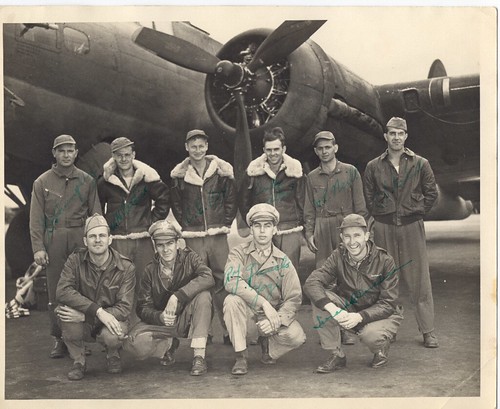
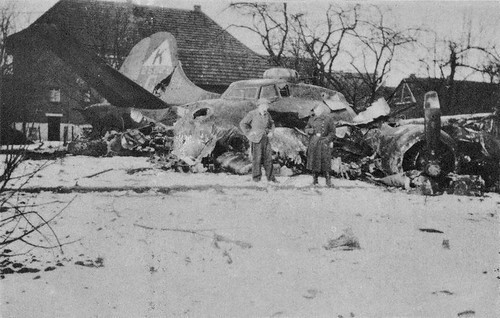
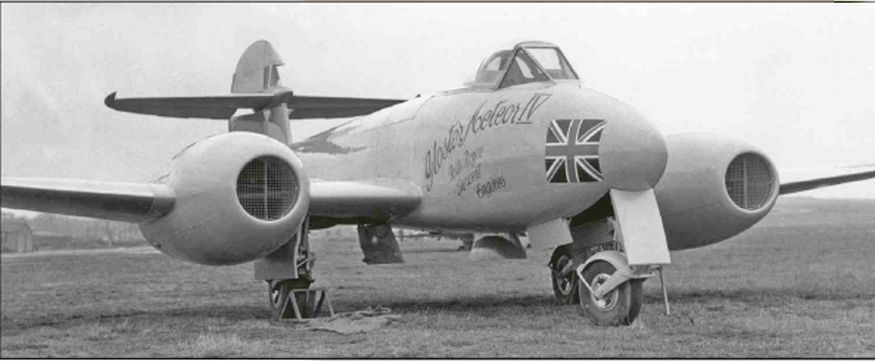
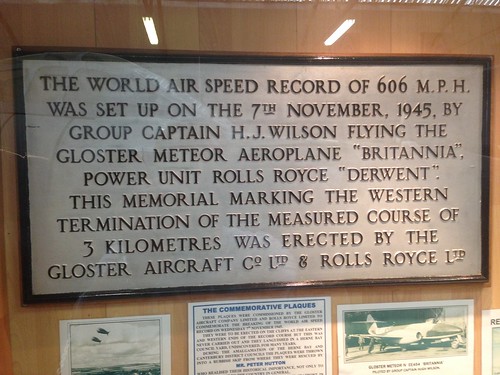


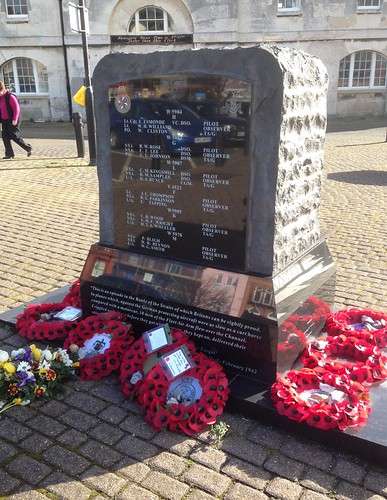
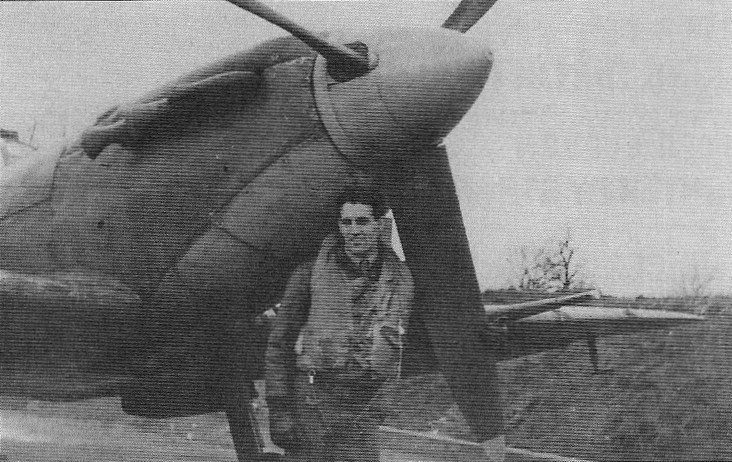


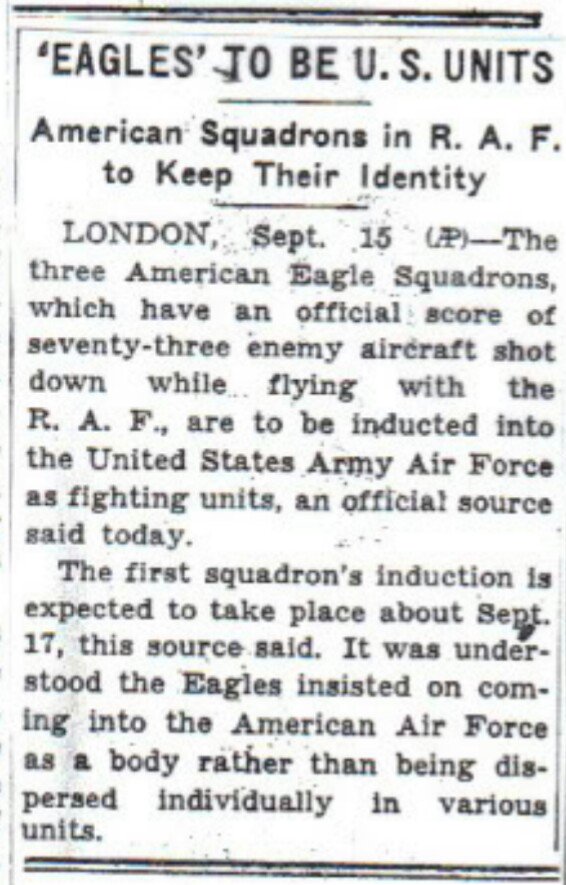
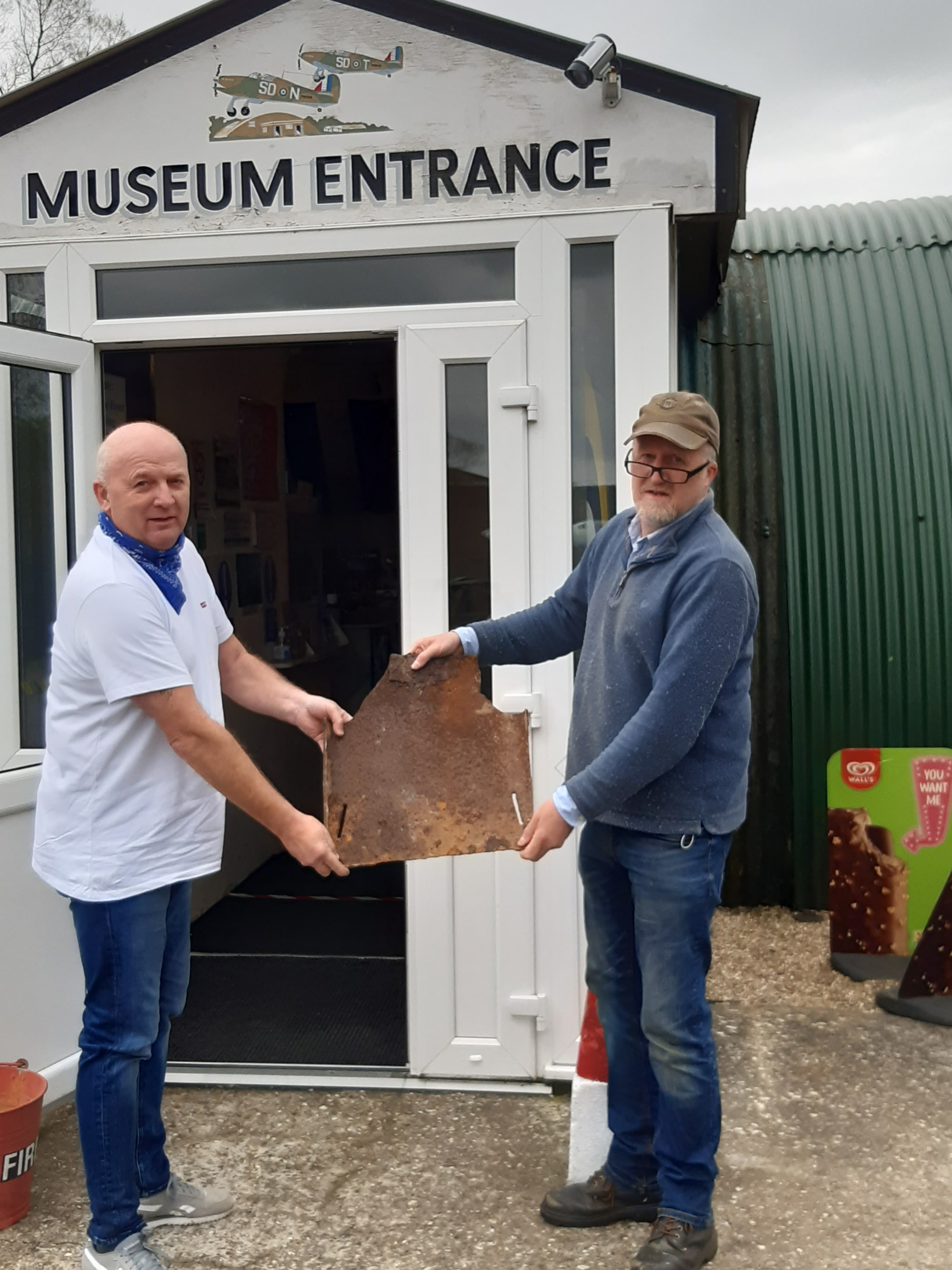
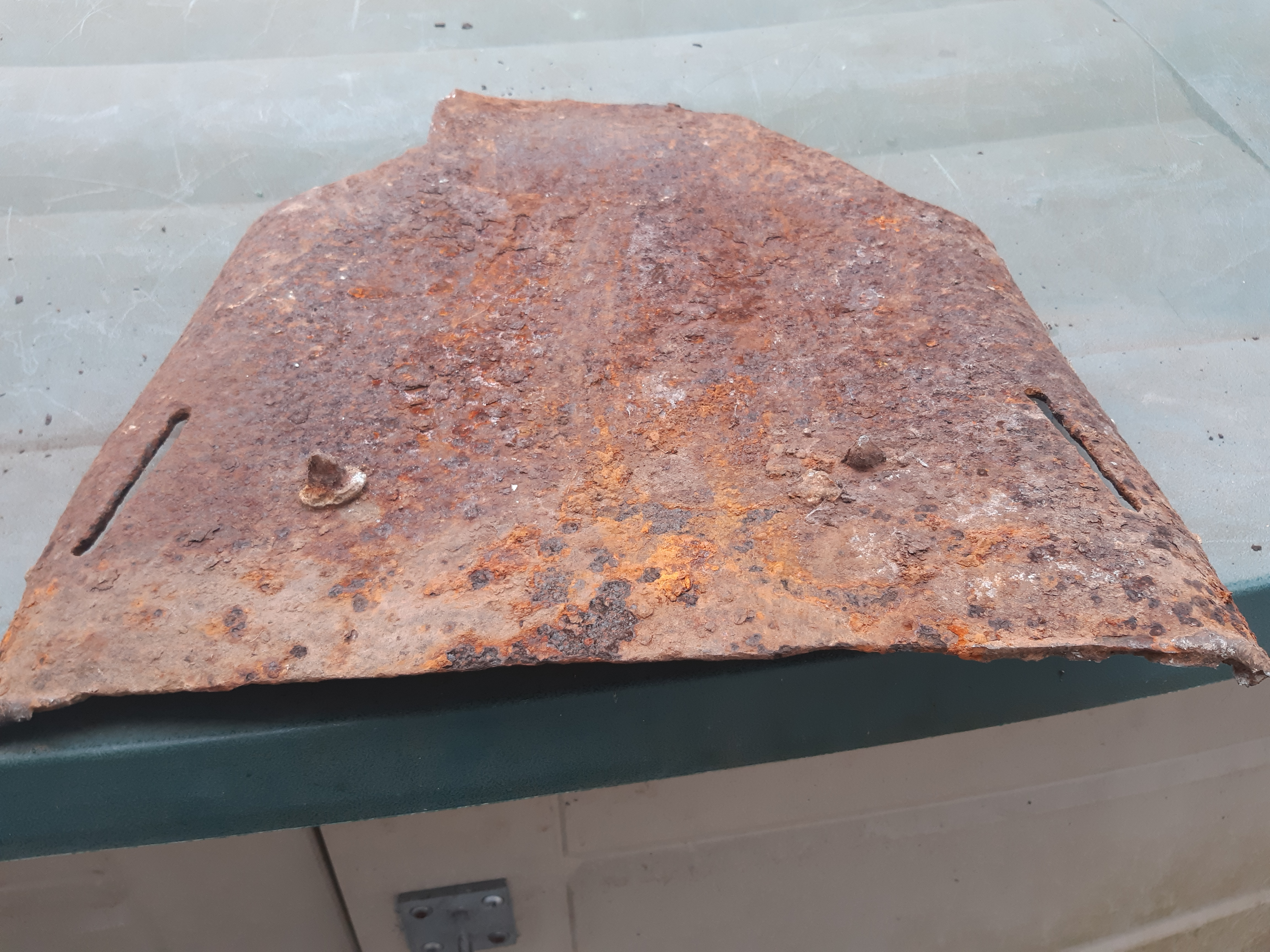

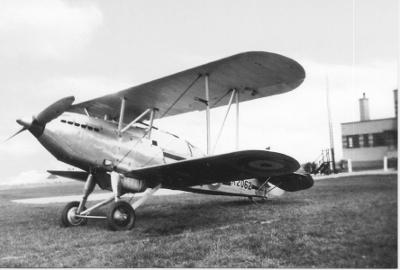

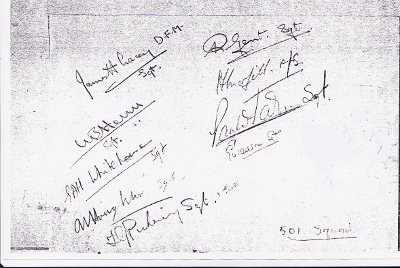

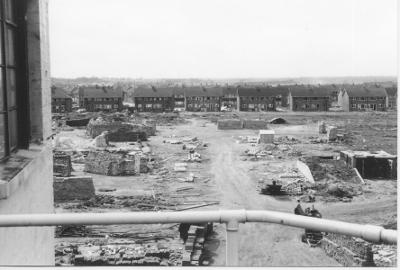
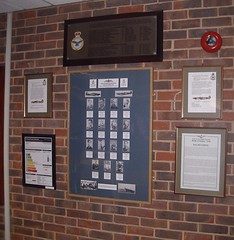
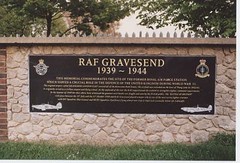
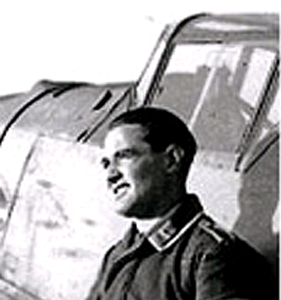

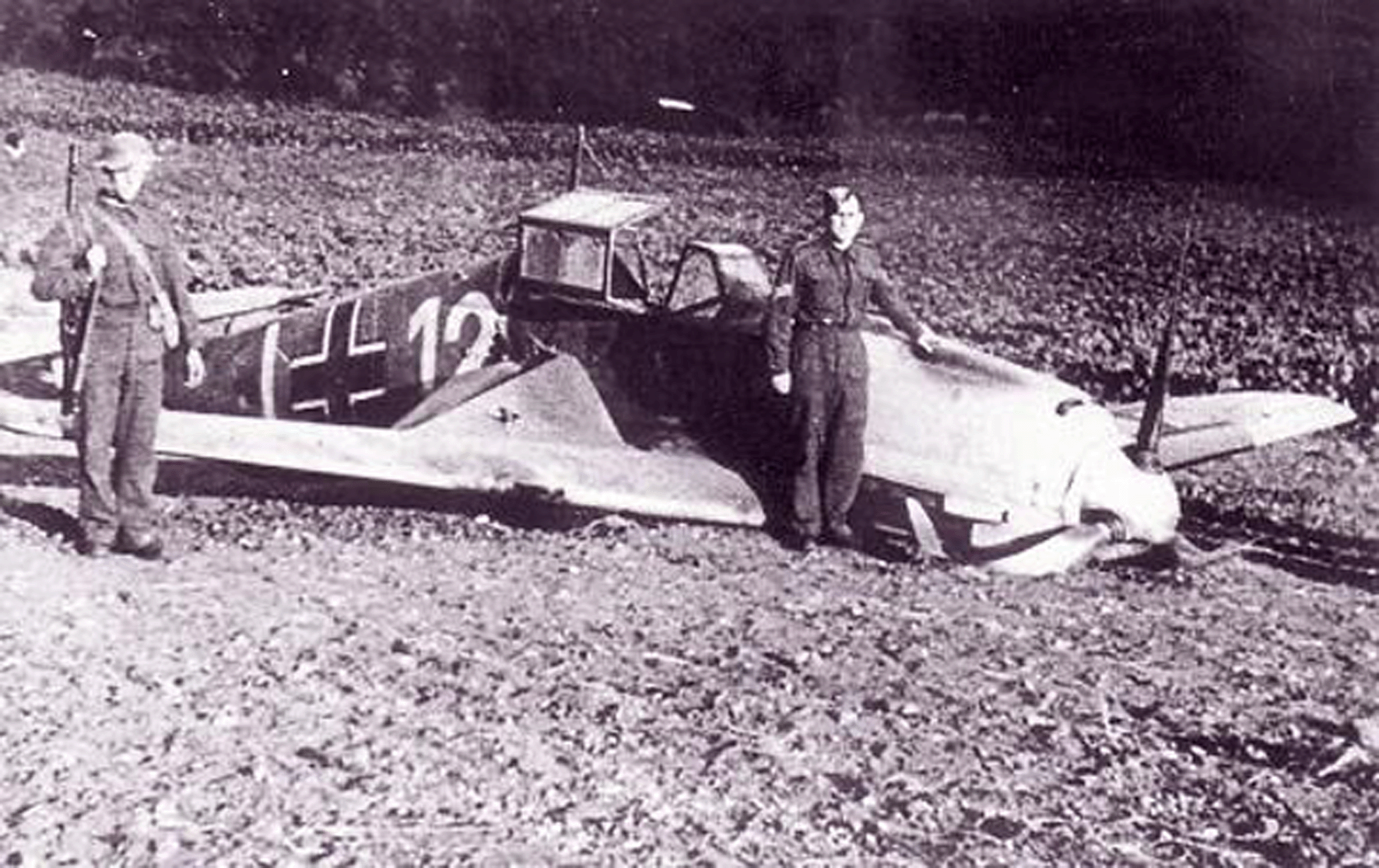


 Aviation Trails