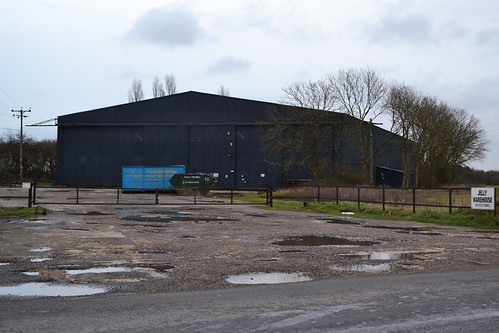
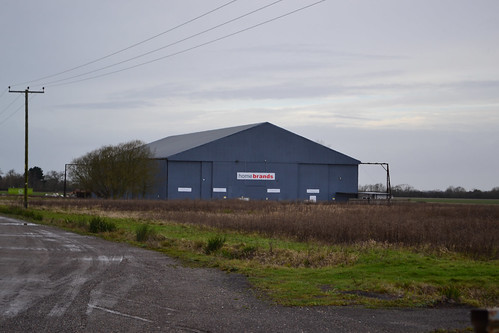
RAF Hunsdon – The Arrival of the Mosquito (Part 3)

In Part 2, we saw how the Turbinlite system failed to produce what was expected of it, and eventually the system was scrapped and the squadrons disbanded. Those left at Hunsdon continued the night operations but soon they too would depart this Hertfordshire airfield leaving room for an influx of Mosquitoes – de Havilland’s ‘Wooden Wonder’.

On May 5th 1943, 85 Sqn would officially receive its squadron badge, although it was a former World War One Squadron, it had never been officially presented with it, and time had caught up. With the whole squadron lined up outside the Bellman Hangar, A.O.C. 11 Group, Air Vice Marshall H.W. Saunders, C.B.E., M.C., D.F.C., M.M., gave a speech highlighting how well the squadron had performed; shooting down ninety enemy aircraft in France, fifty in the Battle of Britain and a further twenty in night operations whilst at Hunsdon. He went on to highlight the number of decorations its crews had been awarded: four D.S.Os; seventeen D.F.Cs; three D.F.Ms, and Bars to both the D.F.Cs. and D.F.Ms. He then presented the station badge to the Commanding Officer Wing Commander Cunningham. At this point it was announced that the squadron would be moving south to West Malling in Kent and he wished the squadron good luck.

With just a few more days left before departure,  operations continued and on the 8th, three more JU. 88s were spotted but intercepted by Spitfires from other squadrons before the Mosquitoes could get to them. It was not to be the glorious ending 85 Sqn had hoped for.

After a farewell dinner for both 85 and 3 squadrons in the officer’s mess, preparations began for the move. Three Harrows arrived to collect  personal belongings and equipment, and then, on the 13th, 85 Squadron departed, all ten aircrews performing individual flypasts over the watch office to show their respect and thanks to those who had worked along side them, it was a sad day for Hunsdon.  The Harrows once loaded, departed shortly after with the main ground party departing by train soon after that.

The dispersals and accommodation did not remain vacant for long though, they were immediately taken over by a new squadron, 157 Squadron along with their servicing wing 3081 Servicing Echelon.

The new squadron was also a Mosquito Squadron, transferring in from Bradwell Bay. Night patrols had been the order of the day and these continued, and even as the squadron moved into their new home a Do. 17 was intercepted and shot down near Felixstowe.

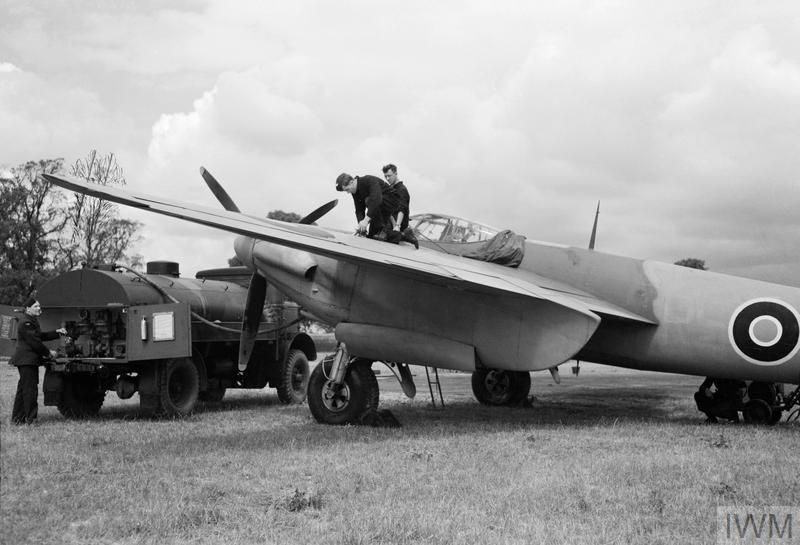
Mosquito II of 157 Sqn being refuelled at Hunsdon, 16 June 1943. (©IWM CH 10312)

During the day, personnel took to painting and refurbishing the dispersals, whilst at night patrols continued on, an F.W. 190 falling victim to Flt. Lt. H. Tappin DFC and Fly. Off. I. Thomas in Mosquito S.727

The remainder of the month and into June involved further night patrols,  many being cancelled due to poor weather, whilst on the ground yet more decorating took place, with all crews taking part.

June then saw the temporary arrival of 515 Sqn with Defiants moving in from Heston. On June 1st, all aircraft had been received at Hunsdon with the rear party arriving later by road. As soon as 11 Group Headquarters had been notified of the squadron’s readiness, the order came though to move sections to forward bases ready for night operations. Eight aircraft immediately took off from Hunsdon but poor weather curtailed any further flights and they all returned the next day without taking part. This routine pretty much set the scene the remainder of the month. Shortly after arriving here 515 would start to accept the Beaufighter, a remarkable step up from the Defiant and an aircraft they would take when they left Hunsdon for Little Snoring in December that year.

Then in July, a new version Mosquito began to arrive with 157 Sqn – the MK.VI. ‘Ranger‘ patrols became a priority, attacking freight locos across the enemy network. On the 19th August, the Sqn claimed their 100th victim, a landmark number that was acknowledged by Sector Commander Group Captain Harris.

The next few months were a  mix of sporadic contacts but few engagements, ‘uneventful’ patrols and cancelled flights due to poor weather. The arrival of a Lancaster out of fuel in early October, a Wellington damaged by flak and a lost B-17 possibly heightening the excitement on the airfield.  A large portion of this time was taken with sports including shooting until finally ‘discouraged’ by local landlords.

RAF Hunsdon Latrines and drying rooms

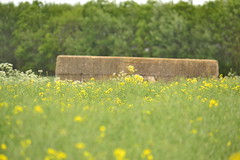
Remains of the latrines and drying rooms.

157 Sqn however, wouldn’t remain at Hunsdon for much longer, departing with their Mosquitoes for Predannack in November that same year. A relatively uneventful stay at Hunsdon had finally come to an end.

Movements into and out of Hunsdon would continue in November, with the arrival of yet another Mosquito unit, 410 (Royal Canadian Air Force) Squadron. The unit would stay here on three separate occasions throughout 1943 and 1944, each time being for a short period only before moving on again elsewhere. Each stay would bring a new model Mosquito: MK. VI, MK.XIII, and finally the MK.XXX before moving off to the continent in 1944 and their eventual disbandment in June 1945. Whilst the squadron was primarily Canadian (seventy-two personnel), it also consisted of sixteen RAF personnel and four Americans, making it a multinational mix of aircrew, officers and ground crews.

It was whilst at their previous station, West Malling, that they would make the first ‘kill’ of 11 Group, when on the 5th November, a Mosquito piloted by Flg. Off. Green and his navigator Pt. Off. Goodhew, intercepted an Me. 410 and shot it down approximately 15 miles from Dungeoness. Three days later they would arrive at Hunsdon, where a turn in the weather prevented any further kills for the unit for the remainder of the month.

Training flights were managed on the odd occasion, intercepting friendly bombers with camera guns along with several Mahmoud exercises. On the 26th November tragedy struck when on one of these flights Flg. Off. J.J. Blanchfield in Mosquito DD669 struck the target Mosquito DZ259 flown by W.Off. C. James and his navigator Flt. Sgt. T. Levine. Both crews reported that they were bailing out, but both Blanchfield and his navigator Flg. Off. K. Cox, were killed in the accident.

The squadron’s  remaining time at Hunsdon was much similar, training flights, the odd operational scramble and bad weather persisted to the end of the year. But in December, one Mosquito flown by Flg. Off. “Joe” Schultz and Flg. Off. Williams manged to shoot down no less than three Dornier 217s in an epic air battle in which they themselves narrowly missed being the victim.

After vectoring onto the initial target, Schultz managed to shoot it down even though the Dornier tried to evade the attack by both attempting to fly into cloud and carrying out violent evasive movements. After dispatching this aircraft, Schultz pursued a second aircraft which exploded some 50 feet ahead of him, causing his own aircraft to jolt as it passed through the debris. A third Dornier gave a more difficult challenge, and even though both its engines were hit, the crew continued to return fire whilst the pilot made aggressive and violent defensive movements. The Mosquito in return, had its instruments put out of action and both engines hit, causing a fire in one. Luckily, this extinguished itself, but the second engine then failed altogether. Schultz managed to safely land the aircraft at Bradwell Bay using the single damaged engine, a remarkable feat considering the damage to the Mosquito and its components.

During the month, yet another new version Mosquito began to arrive at the squadron in addition to those already on station. By the end of the December, when they finally departed Hunsdon for Castle Camps, they had on their books: two Mosquito MK.IIs, one MK.III, one XII and seventeen XIIIs. A squadron Magister was also registered, but the Oxford they had, had struck a hill severely injuring the pilot, Flt. Lt. M.A. Cybulski DFC at Winter Hill, Belmont near Bolton. Flt. Lt. Cybulski had completed his tour of duty and was transferring to 9 Group when the accident happened.

New years eve 1944 would undoubtedly bring the most significant of the RAF units to Hunsdon and the one for which it is most famous. The arrival of  21 Sqn, 464 Sqn and 487 Sqn combined together to form 140 Wing, would see a number of dare-devil raids against German targets which, like the dams raid of 617 Sqn, would be forever discussed by historians.

The full story of RAF Hunsdon can be read in Trail 25.

RAF Hunsdon – The end of the Turbinlite (Part 2)

In part 1, we saw how Hunsdon was developed and how the new Turbinlite system was developed. However, things don’t quite go to pan the system falls doesn’t meet expectations.

After taking on Hurricanes IIB/C at Martlesham Heath in April, 3 Squadron arrived at Hunsdon from Stapleford Tawney, and like 85 Sqn, would remain here until mid May 1943, when it took its Mosquitoes to West Malling.

Pilots and aircraft of 3 Sqn would make their first appearance at Hunsdon on the 2nd August 1941 when twelve pilots arrived to practice formation flying with crews of the special Havoc Flight created earlier in May. These initial twelve would be followed by another twelve on the third, and then ten more crews on the sixth. The two squadrons would perform practice night flights together, formation flying and ‘dog fighting’ tactics with drogues. By the 10th, the bulk of the squadron had moved over leaving only a detachment both at Manston and Shoreham, where crews undertook both dawn and dusk patrols over southern England and over enemy airfields looking for bombers either landing or taking off.

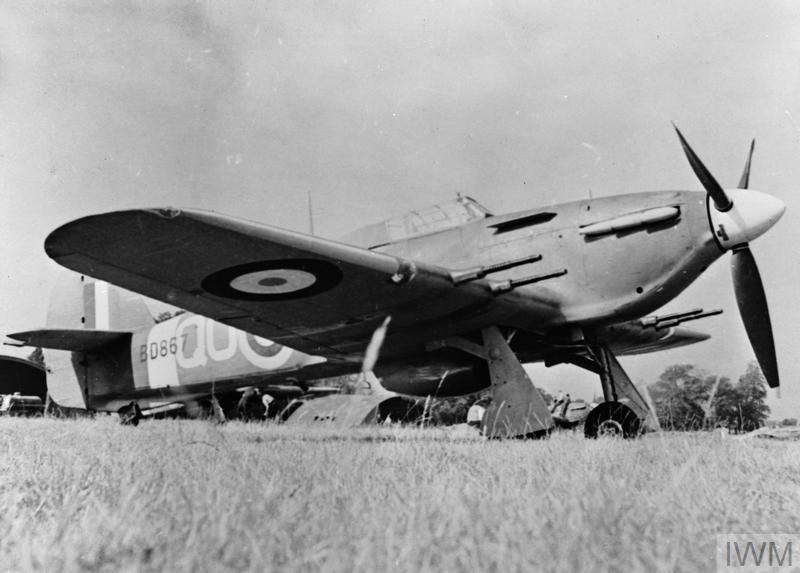
Hurricane IIC, BD867 ‘QO-Y’, 3 Sqn, at Hunsdon. The exhausts have shields over them to help prevent them being seen whilst on night fighter operations. (@IWM CH 3509)

The combined practice flights would take Hunsdon’s 3 Sqn and the Turbinlite Flights aircrew well into the summer and autumn of the following year, progress being marred by continuing poor weather. GCI (Ground Control Intercept) training and formation flying between the two units took up the majority of the time whilst they were here, however, both dusk and dawn patrols in their Hurricanes gave the pilots of 3 Sqn a little respite from the routine of formation flying with the two Special Flights.

September 1941 then brought the second of the two Special Flights to Hunsdon. On the 20th, 1459 (Fighter) Flight, the penultimate of the ten, was formed here also operating both Havoc Is and Boston IIs, Fs and IIIs. The last of the Flights to make up the ten units would follow just after, being based in northern England at RAF Acklington.

It was quickly found that the Turbinlites not only had a lack of firepower, but poor speed as well, so they were soon demoted to being used solely as a searchlight platform with 3 Squadron’s Hurricanes taking over the main role of interceptor.

With the formation of a new squadron at Croydon, 287 Sqn would have detachments spread far and wide including one here at Hunsdon. Staying here for virtually the entire war, they would fly a range of aircraft including: Blenheims, Hudsons; Lysanders; Hurricanes; Masters; Defiants; Martinets and Spitfires. Even as a detachment flying support flights, they were the longest resident at Hunsdon but never achieved the same status as many of those that were to be based here.

After the turbulence of 1941, 1942 would initially bring a much calmer time at Hunsdon, with less movements in or out of the airfield, although staff changes did cause problems for some units. Changes were initially relatively small, the first of which wouldn’t come until the July of 1942, when a small detachment of 605 Sqn Bostons arrived. After being reformed the month before, at RAF Ford, the small group remained here until mid March 1943, when after taking on the Mosquito, they transferred to Castle Camps in Essex.

605 had previously been posted to Batavia where the majority of ground personnel had been captured by enemy forces. Those that were left were posted to various units and the squadron disbanded. Its reformation at Ford would be a slow process, but gradually it would receive both men and aircraft, accepting machines from 23 Squadron as it also eventually took on the Mosquito.

Whilst based here at Hunsdon, they would primarily carry out training, performing cross country flights,  searchlight co-operation flights and gunnery practice. Navigation also came under scrutiny with logs being examined by the squadron’s navigation officer. By the end of August though, all was well and the personnel returned to Ford thus reuniting the entire squadron once more.

As was the case with many other airfields, training and support flights also used the same airfields, training pilots in new and more modern ways to fly. Hunsdon was no different, and in August a new Flight fulfilling this role was created here at Hunsdon. 1530 Beam Approach Training (BAT) Flight, who were formed specifically to train pilots to land in the dark, or poor weather, using a ‘beam’ (formally blind approach) or radio system. They remained here for some time eventually moving to Wittering where they were disbanded later in 1944.

It would also be in August 1942, that Hunsdon’s resident 85 Sqn would take on the Mosquito, the MK.IIs being a major change from the Havocs previously used. It would only be a trickle of aircraft at first, with just a small number of the ‘Wooden Wonders’ being received by the month’s end.

The trickle continued into September as did the nightly Havoc patrols. On the 7th, Sgt. McCormick sighted what he believed to be a Ju. 88, and closed in for the attack. After following the aircraft he managed to close to 150 feet at which point he opened fire on the starboard engine which quickly caught fire. The aircraft fell from the sky and was later seen burning on the sea below. It was confirmed not as a Ju. 88 but as an He.111 distinguished by its fixed rear-firing machine gun in the extreme end of the fuselage.

September 1942 then brought yet more change. At this point it was decided to raise all ten Turbinlite squadrons to squadron status. The date decided upon was September 2nd 1942. However, due to administration problems, only five could be raised on that date, the remaining five being raised six days later on the 8th of the month. By then, all ten Turbinlite training Flights had been disbanded and reformed as operational squadrons.

With that, 1451 became 530 Sqn on September 8th and continued to operate from Hunsdon, whilst 1459 became 538 Sqn and was relocated to Hibaldstow.

The reformation meant that flights were initially curtailed for 530 Sqn. The poor September weather then added to the issue meaning that flying was at best sporadic. Two further support Hurricanes soon arrived for the squadron taking the total available to four. But their arrival did not ease the situation, the poor weather and other factors continuing to dominate operations to the point that little operational flying took place at all.

October fared little better. More poor weather combined with the fact that three of their four Hurricane pilots (all American), were transferred to the US Army Air Corps, meant that 530 Sqn was unable to progress the way it had hoped. It had been a very poor start for the operational Turbinlites.

By November there were a total of eight Hurricane pilots, some of which had transferred in from O.T.Us, but all were lacking night flying experience. As a result, they were rushed through a night flying course at Hunsdon and were passed as ‘operational’ by the month’s end. However, the problems did not end there. Formation flying in good weather was considered difficult and in visibility of 2,000 ft or less, impossible. This meant that the required number of night flights were not being made which held back all operational flights. Compounding this, continuing bad weather had by now turned the ground very soft and a number of aircraft were getting bogged down in the mud. In addition, whilst aircraft serviceability was generally good, a few had experienced wrinkling of the skin over the air frame and were now awaiting an inspection before being allowed to fly. By now, the crews must have been wanting 1942 to draw to a very quick close.

And to a close it came. December brought rumours of the demise of the Turbinlite squadrons causing uncertainty amongst the personnel. Continuing bad weather had curtailed all but the most urgent of flights. Lectures prevailed bringing escape tactics and Luftwaffe organisation information up to date. A new Havoc was brought in for testing with a new windscreen deicing system, unfortunately this was found unsatisfactory, so a new hot air method was suggested by the squadron and tested under the same conditions. This proved much more successful.

Christmas celebrations then kept the personnel occupied and were ‘livelier than expected’ primarily due to the inclement weather. Crews in the meantime being kept on standby in case the weather turned and operations became necessary again.

RAF Hunsdon Battle Headquarters

The battle headquarters.

With New Year 1943, came the news that the Turbinlites were indeed being disbanded. Of the ten squadrons formed, only five made successful enemy intercepts – Turbinlite was not a great success and as a result, on the 25th January, 530 Squadron along with all other units, ceased to exist and all personnel were scattered amongst other squadrons.

The end of the Turbinlites meant that Hunsdon only had two operational units at this point, both 85 and 3 Sqn continuing to fly from the airfield when they could. The early part of the year, brought considerable fog and cold weather, the fog preventing flying on many occasions, which hampered test flights for 3 Sqn on their new Typhoons when they arrived in February.

By mid May though, both these units were to depart also, 3 Squadron transferring to West Malling, with the Mosquitoes of 85 Sqn joining them soon after, but not until after a very important ceremony.

The full story of RAF Hunsdon can be read in Trail 25.

RAF Hunsdon – The beginnings of Turbinlite (Part 1)

In Trail 25 we head to the south once more, to the west of Harlow, and to two wartime airfields; one of which played a major part in striking a blow at the very heart of the Nazi regime.

The county of Hertfordshire is an area popular with commuters to both London and the technological towns of Harlow and Bishops Stortford. Being north of London, it is also close to Stansted airport, itself an ex World War II airfield. Hertfordshire has some beautiful countryside, delightful little villages and quaint country pubs. It is also an area with a wealth of history.

Our first stop is a small airfield nestled in the heart of this beautiful countryside. It is situated north-east of the village that gives it its name, RAF Hunsdon.

RAF Hunsdon

RAF Hunsdon Village sign

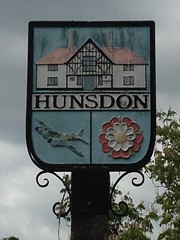
The Hunsdon Village sign reflects its history and links to the RAF.

Even before Hunsdon was built, it is referenced in some areas that the site was being used for a detachment of 107 Squadron Blenheims, then based at RAF Wattisham and later Leuchars. This may have been part of the ‘Scatter’ directive given to squadrons in the immediate period before war was officially declared, and was thought to occur between May 1939 and March 1941.  However, there are no references to this in the official squadron files and so this action is doubted. However, if this were the case, then it would certainly suggest an early use of the site before it was developed into a fully operational airfield, and it may have been an indication that an airfield was on its way in the near future.

The site was earmarked for development in 1940, with construction occurring over the period October 1940 to March 1941, after which the first squadron moved in. It was built by various construction companies and incorporated two asphalt runways; the main running east-west reaching 1,750 yards in length after its later extension, with a second running north-east to south-west  extended to 1,450 yards; both were built to the standard 50 yard width. Aircraft dispersals, maintenance and storage buildings consisted of eighteen ‘twin-engined’ hardstands; sixteen blister hangars (a mix of ‘Over’ (4) and  ‘Extra Over’ (12)) and a Bellman hangar. There was also a fuel dump and accommodation buildings for up to 2,240 airmen and some 276 WAAFs, all located across eight dispersed sites.

A large number of operational units, (in excess of twenty-five) would pass through its doors throughout its relatively short life, providing Hunsdon with a multinational mixture of crews and a number of aircraft types.

The airfield itself lies within a stone’s throw of London and so its initial role was that of night fighter operations covering London and the south / east area.

The first recognised squadron to make its mark at Hunsdon was 85 Squadron on May 3rd 1941, transferring across from RAF Debden flying Defiants and Havoc MK.Is. The move across on the 3rd went smoothly with personnel and equipment being transferred across in lorries and 32 seat busses, the majority of personnel arriving later that day.

RAF Hunsdon Parachute store

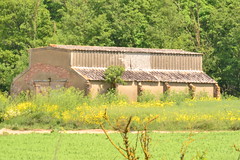
The Parachute store now holds farm machinery.

On arrival at Hunsdon, personnel of ‘A’ Flight were immediately billeted on the aerodrome close to their dispersals, whilst those of ‘B’ Flight were housed on Number 2 Site, located about a mile or so from the main airfield area. Personnel of both the Headquarters Flight and the servicing Echelon were billeted even further away, about four miles in fact, at Gilstone Park. The officers meanwhile, had the better accommodation, being billeted in a house called ‘Boningtons’ believed to be the former home of “Mr. Brooke Bond” the family of the P.G. Tea empire. It is thought that the family purchased the house in 1940, moving out of their London residency to avoid the blitz. Unfortunately, it was rather a short lived purchase as the property was requisitioned by the RAF not long after!

By the end of the 4th, all 85 Sqn personnel were in and unpacked at Hunsdon, and so night flying duties could commence straight away with patrols taking place over the Felixstowe area. Immediately, a Heinkel He.111 was vectored onto, and a skirmish took place in which both aircraft both gave and received machine gun fire. The Luftwaffe bomber came off worst though, and was last seen diving into cloud firing a white verey pistol, either as a resignation of the fight or possibly as a distress signal to any would be rescuers.

Over the next few nights further contacts were made and several Ju. 88s were either confirmed or claimed as shot down. The squadron was performing well, morale was high and all was looking good.

The night of the 13th could have been different for some though. On his return from a patrol, Fly. Off. Hemingway’s instruments failed and with little choice, he gave the order to bale out. After his operator, Sgt. Bailey, had departed the Havoc, Hemingway followed, both men landing in close proximity to each other in the grounds of Much Hadam Hall (a grade 1 listed building built in the early 1700s). Whilst both airmen were safe, Hemingway’s was not the model jump, as he came to rest in a tree in the grounds of the hall. Bailey fared little better, landing rather ungainly on a bucket not too far away. This was Hemingway’s third successful bale out of a stricken aircraft, his previous two both occurring during the Battle of Britain.

On May 17th, Wg. Cdr. Peter Townsend, now with a DSO, flew to Great Massingham, Flt. Lt. Marshall flew to Odiham to test the runway and Flt. Lt. Rabone flew to Heston from where he collected a special and secret Havoc which was to be tested by the squadron. The first flight of this new variant occurred on May 23rd, and was quickly followed by a second aircraft on the 28th, After this, they would then begin testing both aircraft as a new night flying platform.

This particular type of aircraft was the forerunner of what became known as the Turbinlite Havoc, a new design that was the brainchild of one Sidney Cotton.*3

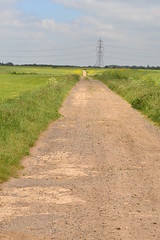
RAF Hunsdon Runway remains

The main runway has been reduced to a track.

With the help of William Helmore, Cotton took out two patents; GB 574970 and GB 574118, each one relating to this new idea. It would be Helmore (an Air Commodore) who would then develop the idea further turning it into what would become commonly known as the Turbinlite system.

Originally designated Air Target Illumination, Cotton’s idea was passed to the Alan Muntz Company, who in conjunction with G.E.C., developed it into what was at the time, the most powerful searchlight in the world, and one that would fit neatly into the nose of a Douglas Havoc, or Boston as it was known in the RAF.

The light was so powerful that it would require a staggering forty-eight batteries each stored in the bomb bay of the aircraft, adding an additional weight to the aircraft just short of 2,000lbs. The light was so strong (1,400 amps) that it would discharge in less than 12 seconds meaning its use was limited to short searches only.

Havoc Mark I (Turbinlite), AW400, on the ground at Burtonwood, Lancashire. This aircraft served with Nos. 1422 and 1454 (Turbinlite) Flights, and with 1459 (Turbinlite) Flight/538 Squadron RAF, before transfer to the USAAF in April 1943. (© IWM ATP 10654C)

The first full prototype Turbinlite aircraft fitted with the unit was Boston W8254 and was flown by Acting Squadron Leader A. Clouston of 1422 (Night Fighter) Flight formed at Heston on May 12th 1941. The Flight would then operate a number of these aircraft, along with several other types which included the only Turbinlite Mosquito; along with a Defiant, Wellington and Hurricane.

Heston was the home of Airwork, an aviation company set up by two ex-Cambridge students and soldiers of the great war, Sir Henry Nigel Norman and Alan Muntz.  Their vision, was to create the best aerodrome near London, a dream that would cost Norman his life and Muntz to lose his son. Airwork would go through many changes during its life, taking on several Government contracts including a range of flying schools to train RAF pilots throughout the Second World War. These included RAF Digby, RAF Grangemouth, RAF Scone (Perth) and RAF Linton-on-Ouse.

Airwork would themselves modify a further four Bostons, with a further sixteen being modified by the Heston Aircraft Company. A third batch was then developed at RAF Burtonwood, giving a total of nine flights for training and ten operational squadrons comprising just short of 100 aircraft in all.

It was soon realised however, that the Bostons lacked firepower and so the company began to look at the Mosquito as a possible replacement aircraft. Only one Mosquito was modified (W4087, a Hatfield built F.II) at Heston, but this idea, unlike the Boston, failed to progress any further than the prototype stage, and no other aircraft were converted.

The Only Mosquito converted to carry the Turbinlite.*5

The Turbinlite project quickly gained pace, but the units wouldn’t be raised to squadron status until September of the following year. In preparation, ten special Havoc flights were created to train crews to operate the aircraft. The first of two, formed at Hunsdon (and the first of the ten) was 1451 (Fighter) Flight on May 22nd 1941. The Flight used several examples that included both Boston IIIs (AL469 and Z2280) and Havoc Is (AE470 and AW405). It also utilised a Cygnet and Tiger Moth for pilot training. By the end of the month, 85 Sqn had flown a total of 505 hours, 482 of them undertaken in Havocs, with 213 of these being on night flights.

On August 9th 1941, 85 Sqn were joined here at Hunsdon by 3 Sqn, one of the original three squadrons to have been formed by the Royal Flying Corp. Created on May 13th 1912, when the Air Battalion of the Royal Engineers was absorbed in to the month old Royal Flying Corps, 3 Sqn joined both 1 and 2 Squadrons as the oldest units to have operated in the RFC. As such, its history is long and very distinguished.

In Part 2 we see how the Turbinlite develops, and how, as the war goes on, the first of Mosquitoes arrive.

The full story of RAF Hunsdon can be read in Trail 25.

A Happy Christmas!

I would just like to take this opportunity to wish all those of you who have followed, read or commented on the blog, a very merry Christmas and a very happy and safe New Year.

A extra big thanks goes out to those of you who have stuck around for so long, we’re now approaching our seventh year of the blog and have managed to visit over 125 airfields, 105 memorials and 40 museums. These have stretched from Perth in Scotland to the South coast of England, Suffolk in the east to Gloucestershire in the west. The range of these airfields is enormous, and they continue to vanish, with many in a worse state now than they were when I visited at the beginning of the journey.

Very soon many of these will be gone, lets hope the memories of those who served are not also gone with them.

A very happy Christmas one and all!

RAF Andrews Field – (Great Saling/Station 485) – Trail 33: Essex Part 1.

RAF Attlebridge  (Station 120) – Trail 7: Northwest Norfolk.

RAF Barkston Heath (Station 483) – Trail 2: Lincoln Borders and Newark

RAF Barton BendishTrail 7: Northwest Norfolk.

RAF Biggin Hill (Westersham) (Station 343) – Trail 4: Kent Part 1.

RAF Bircham NewtonTrail 20: North Norfolk (Part 1).

RAF Bodney (Station 141) – Trail 8: Swaffham and Her Neighbours (Part 1 of 3).

RAF Bottesford (Station 481) – Trail 52: Leicestershire’ Borders.

RAF Bottisham (Station 374) – Trail 55: Around Newmarket

RAF Boulmer – Trail 47: Northumberland.

RAF BournTrail 31: Southern Cambridgeshire (Part 2).

RAF Brenzett (ALG) – Trail 18: Kent Part 2.

RAF BruntonTrail 47: Northumberland.

RAF Bungay (Flixton) (Station 125) – Trail 14:  Central Suffolk (Part 1).

RAF Bury St. Edmunds (Rougham) (Station 468) – Trail 16: West Suffolk (part 1).

RAF Castle CampsTrail 45: Essex (Part 2).

RAF Caxton GibbetTrail 29: Southern Cambridge (Part 1).

RAF Charterhall Trail 41: The Borders of Scotland and England.

RAF ChedburghTrail 49: Bomber Command – Bury St. Edmunds to Haverhill

RAF Collyweston Trail 37: The Northern Reaches of Cambridgeshire.

RAF Coltishall – Trail 7: Northwest Norfolk.

RAF ConingsbyTrail 1: Lower Lincolnshire.

RAF CottamTrail 40: Yorkshire (East Riding).

RNAS CrailTrail 53: Scotland’s East Coast – Fife

RAF CranwellTrail 2: Lincoln Borders and Newark.

RAF Debach (Station 152) – Trail 39: Suffolk around Ipswich (Part 1).

RAF Debden (Station 356) – Trail 46: Essex Part 3.

RAF Deenethorpe (Station 128) – Trail 6: American Ghosts.

RAF Deopham Green (Station 142) – Trail 27: Southern Norfolk (Part 3).

RAF Digby (Scopwick) – Trail 1: Lower Lincolnshire.

RAF Docking – Trail 20: North Norfolk (Part 1).

RAF Downham Market (Bexwell) – Trail 7: Northwest Norfolk.

RAF Drem – Trail 42: Edinburgh’s Neighbours.

RAF Dunino –  Trail 53: Scotland’s East Coast – Fife.

RAF East Fortune – Trail 42: Edinburgh’s Neighbours.

RAF East Kirkby Trail 1: Lower Lincolnshire.

RAF East Wretham (Station 133) – Trail 13: Southern Norfolk around Diss (Part 2).

RAF Eye (Brome) (Station 134) – Trail 14: Central Suffolk (Part 1).

RAF Fersfield – (Station 130) – Trail 28: Southern Norfolk (Part 4).

RAF FoulshamTrail 22North Norfolk (Part 3).

RAF FowlmereTrail 32Southern Cambridgeshire (Part 3).

RAF Framlingham (Parham) (Station 153)Trail 39: Suffolk around Ipswich (Part 1).

RAF GamstonTrail 54: The Great North Road.

RAF Glatton (Station 130) – Trail 6: American Ghosts.

RAF Gransden Lodge – Trail 31: Southern Cambridgeshire (Part 2).

RAF Graveley – Trail 29: Southern Cambridge (Part 1).

RAF Grafton Underwood (Station 106) – Trail 6: American Ghosts.

RAF Great Dunmow (Station 164)- Trail 33: Essex (Part 1).

RAF Great MassinghamTrail 21: North Norfolk (Part 2).

RAF Great Sampford (Station 359) – Trail 50: Haverhill’s neighbours – Wratting Common and Great Sampford.

RAF Hardwick (Station 104) – Trail 12: Southern Norfolk around Diss (Part 1).

RAF Hawkinge – Trail 18: Kent Part 2.

RAF Hethel – Trail 38: To the West of Norwich.

RFC HinghamTrail 38: To the West of Norwich.

RAF Holme on Spalding Moor Trail 40: Yorkshire (East Riding).

RAF Hunsdon – Trail 25: Hertfordshire.

RAF Kimbolton (Station 117) – Trail 6: American Ghosts.

RAF King’s Cliffe (Station 367) – Trail 6: American Ghosts.

RAF LanghamTrail 23: North Norfolk (Part 4).

RAF Lashenden (Headcorn) – Trail 18: Kent Part 2.

RAF Lavenham (Station 137) – Trail coming soon.

RAF Leuchars – Trail 53: Scotland’s East Coast – Fife.

RAF Little SnoringTrail 22North Norfolk (Part 3).

RAF Little Walden – – Trail 46: Essex Part 3.

RAF Macmerry Trail 51: Southern Scotland

RAF MarhamTrail 7: Northwest Norfolk.

RAF Martlesham HeathTrail 48: Suffolk around Ipswich (Part 2).

RAF Matching (Station 166) – Trail 33: Essex Part 1.

RAF Matlaske (Station 178) – Trail 34: North Norfolk (Part 5).

RAF MattishallTrail 36: North Norfolk (Part 6).

RAF Mendlesham (Station 156) – Trail 15: Central Suffolk (Part 2).

RAF MepalTrail 11: Around Ely.

RAF MetheringhamTrail 1: Lower Lincolnshire.

RAF Methwold – Trail 8: Swaffham and Her Neighbours (Part 1).

RAF Milfield –  Trail 47: Northumberland.

RAF Narborough (Narborough Aerodrome)- Trail 7: Northwest Norfolk.

RAF Newmarket Heath – Trail 55: Around Newmarket

RAF North CreakeTrail 23: North Norfolk (Part 4).

RAF North Pickenham (Station 143) – Trail 9: Swaffham and Her Neighbours (Part 2).

RAF North WealdTrail 25: Hertfordshire.

RAF North Witham (Station 479) – Trail 3: Gone But Not Forgotten.

RAF Old Buckenham (Station 144) – Trail 13: Southern Norfolk around Diss (Part 2).

RAF Oulton – Trail 34: North Norfolk (Part 5).

RAF Polebrook (Station 110) – Trail 19: Northamptonshire American Ghosts II.

RAF Rattlesden (Station 126) – Trail 15: (Central Suffolk (Part 2).

RAF SawbridgeworthTrail 25: Hertfordshire.

RAF ScamptonTrail 30: Scampton and the Heritage Centre.

RAF SconeTrail 56: Perthshire.

RAF SculthorpeTrail 21: North Norfolk Part 2.

RAF Sedgeford – Trail 20: North Norfolk (Part 1).

RAF Shipdham (Station 115) – Trail 10: Swaffham and Her Neighbours (Part 3).

RAF Snailwell (Station 361) – Trail 55: Around Newmarket

RAF Snetterton Heath – (Station 138) – Trail 27: Southern Norfolk (Part 3).

RAF Spanhoe Lodge (Station 493) – Trail 6: American Ghosts.

RAF Steeple Morden – Trail 32: Southern Cambridgeshire (Part 3).

RAF Stoke OrchardTrail 24: Gloucestershire.

RAF Stradishall- Trail 49: Bomber Command – Bury St. Edmunds to Haverhill

RAF Sutton BridgeTrail 3: Gone But Not Forgotten.

RAF Swannington – Trail 36: North Norfolk (Part 6) 

RAF Swanton Morley – Trail 38: To the West of Norwich.

RAF Thorpe Abbotts (Station 139) – Trail 12: Southern Norfolk around Diss (Part 1).

RAF Tibenham (Station 124) – Trail 13: Southern Norfolk around Diss (Part 2).

RAF Tuddenham – Trail 16: West Suffolk (Part 1).

RAF Tydd St. Mary – Trail 37: The Northern Reaches of Cambridgeshire.

RAF Upwood – Trail 17: The Pathfinders.

RAF Warboys – Trail 17: The Pathfinders.

RAF WaterbeachTrail 11: Around Ely.

RAF Watton (Station 376/Station 505) – Trail 9: Swaffham & Her Neighbours (Part 2).

RAF Wendling (Station 118) – Trail 10: Swaffham and Her Neighbours (Part 3).

RAF West Malling Trail 4: Kent Part 1.

RAF West RaynhamTrail 21: North Norfolk Part 2.

RAF WethersfieldTrail 45: Essex (Part 2).

RAF Westley – Trail 16: West Suffolk (part 1).

RAF WinfieldTrail 41: The Borders of Scotland and England.

RAF Winthorpe Trail 2: Lincoln Borders and Newark.

RAF WitchfordTrail 11: Around Ely.

RAF Wittering  – Trail 37: The Northern Reaches of Cambridgeshire.

RAF Woodall SpaTrail 1: Lower Lincolnshire.

RAF Wratting CommonTrail 50 – Haverhill’s neighbours – Wratting Common and Great Sampford.

The Development of Britain’s Airfields (Part 7).

Whilst the runway’s remains one of the biggest features of an airfield, perhaps one of the most discussed and certainly visible is the hangar. Large sheds used to maintain aircraft, many still dominate the skyline today, used by farmers and industrial companies, they are massive buildings, but yet many remain classed as temporary or even transportable!

The development of these huge buildings is another that lasted many years, and whilst similar in layout and design, they are as complicated and as varied as any other building found on Britain’s airfields.

Hangars and Aircraft Sheds.

The topic of aircraft hangars is well versed in a large number of books and internet references. They, like the runways, can explain much about the history and use of an airfield, being the largest single building on any airfield site. Distinguishing features between hangar types is often difficult to see, many now re-clad or updated with modern features, doors or materials, even the differences between some designs is so small, without technical drawings or measurements, ascertaining the type can be all but impossible.

Hangars (or aircraft sheds as they were initially called) have been fairly constant in design, however, different services used different types, Admiralty seaplane sheds for example, were primarily side opening, whereas RAF hangars were generally front opening. Design and construction was undertaken by numerous companies (Herbertson & Co. Ltd., Nortons Ltd., Teeside Bridge and Engineering Co. Ltd., and Sir William Arrol & Co.) and even Handley Page Aircraft Co. and Boulton & Paul dabbled with the idea. With so many forms being used, it is a topic both detailed and extremely wide.

This is not therefore, intended to describe each and every hangar ever built (Second World War Air Ministry designs alone covered more than 56 types!), but more a general realisation of the huge development they undertook during this expansion and wartime period on RAF / USAAF airfields. Figures quoted here are generally rounded.

In order to understand the changes in aircraft hangars we need to briefly look at those of the First World War, where aircraft were stored in ‘sheds’, often made from canvas covering a wooden frame, or as a more permanent construction, completely wooden sheds with sliding doors. Later on these were built using metal (iron in particular) and were designed to be permanent, capable of housing several aircraft at a time.

The First World War hangars were varied and often crude, some little more than glorified tents, but through development famous names such as the Bessonneau and Hervieu were created toward the end of the war. Hangars became so large that specialist units had to be created solely to transport, erect and maintain them, and their use became more widespread.

The most common hangar of this period, the Bessonneau, was the first standard transportable hangar used on Royal Air Force airfields. Modern forms of it are still in use today, using different materials, they are quick to erect and offer reasonable protection from the weather outside.

The Bessonneau was a wooden frame structure covered in canvas. It was a simplistic design, able to be erected in as little as two days by a group of 20 skilled men. Heavy canvas doors open at one end allowing aircraft to be moved in and out with relative ease. The problem with these hangars was that the canvas was prone to freezing in winter and therefore becoming difficult to use.

There were two models of the Bessonneau built, differing only in their length – either 79 feet or 118 feet – but both were 65 feet wide.

The interwar and early war years were perhaps understandably,  the years in which the greatest hangar development occurred. The Air Ministry – the body overseeing the works – decided upon a system of ‘structure type’ using names and designations such as, Type ‘A’, ‘B’, ‘C’, Bellman, ‘T2’, etc., and just like the expansion period schemes, they progressed through this system as new developments came about.

The first type was the Type ‘A’, a permanent design, originating in 1924, it was used well into the 1930s when it was gradually replaced during the expansion period. Some examples did last well into the war and even beyond, for example, North Weald, one of the first airfields to be allocated a Type ‘A’, still uses one today.

Type A Hangar

Type A Hangar at North Weald. One of the first stations to have these types of Hangar, it has workshops attached to the Hangar side.

The Type ‘A’ is probably the first to represent the modern hangar, doors at both ends in leaves of four running on rails. Workshops are attached to the hangar side, something that was discontinued as Britain entered the war. Walls were reinforced with concrete to protect from bomb splinters, and they were built 249 feet long and 122 feet wide.

During the late 1920s, the Air Ministry published requirements for new heavy bombers, and these would require new hangars in which to maintain them. In response, the Ministry then updated the Type ‘A’ hangar to the Type ‘B’. In essence a larger version of the Type ‘A’, (160 ft span and 273 ft in length) the ‘B’ was named the ‘Goliath‘ with only three being built (each being a different length). One of these was at RAF Martlesham Heath and is still used today on what is now the industrial park. Like the Type ‘A’, the roof of the ‘B’ is possibly its most discernible feature, a series of trusses along its length crossing laterally over the roof.

With expansion period demands increasing, further developments were needed, and it was envisaged that an increasing bomber size would be needed if substantial bomb loads were to be delivered deep into the continent. The current size of hangar was now considered too restrictive and so a new buildings would be needed. The requirements of the Air Ministry was for a hangar with a span of 150 feet and length of 300 feet. With these in place, new aircraft specifications could be issued.

The Type ‘C’, (designed in 1934) as it was designated, would become the dominant building on any airfield and therefore visible from quite a distance. As airfield designs were subject to scrutiny by the Society for the Preservation of Rural England, local objections were taken into account during the design process. To appease any  objections, the steel frame was covered with local brick or stone, keeping it inline with other buildings not only on the airfield, but houses and buildings erected locally.

Most airfields during the expansion period were built with these hangars on site, and naturally went through a series of developments and improvements. This means, that there are many different forms of the Type ‘C’: gabled roof, hipped rafter and reinforced concrete. Another modified version of the ‘C’ appeared in 1938 and was designated the ‘C1’ (or ‘Protected’), this was an austerity measure development, reducing the amount of material used by lowering the roof height by 5 feet – internal metal work was also left partially exposed. Both the ‘C’ and ‘C1’, continued to be built with offices, workshops and aircrew accommodation attached to the hangar side, the idea being that it was more efficient to do so for the repair of the aircraft inside. As these were larger in width and length than their predecessors, they would have six leaf doors also sliding on top and bottom rails.

RAF Upwood

Type C at the former RAF Upwood.

1936 saw a dramatic change in hangar design, with two new requirements being issued by the Air Ministry. Firstly, storage space was now running out and so new facilities were required. These Aircraft Storage Unit Stations (ASU) would need their own hangar type, and so a requirement for these was put forward. Also at this time, the Ministry put out a demand for transportable hangars, these would replace the ageing Bessonneaus of the First World War. The response to these demands were three storage hangars and two temporary hangars.

Storage Hangars.

The Type ‘D’, ‘E’ and ‘L’ Hangars, were a development used specifically by the ASU stations, and they were not generally built on front line operational airfields. They were virtually identical in size to the Type ‘C’, but each type was marginally bigger in span 150 ft, 160 ft and 167 ft than the previous model, and all were the same length at 300 feet. The three types were different from previous hangars in that they had curved roofs, allowing the ‘E’ and ‘L’ to be covered with soil for protection and camouflage (the ‘D’ had straight side walls and therefore could not be covered). ASUs were built to assemble and disassemble aircraft for shipment to operational airfields in Britain or overseas. Aircraft were stored, in varying degrees of assembly within these units, and heavy hoists were often used to store aircraft ‘tail up’. However, with the outbreak of war, aircraft storage was thought better dispersed around the airfield and not concentrated in one space, so this method of storing aircraft was abandoned. Many of these hangars still remain today, used by small industrial units or for farm storage.

The next two types, the ‘J’ and ‘K’, were virtually identical in design, again with curved roofs, they were used for storage of aircraft. The ‘J’ can be found on many operational airfields, built in conjunction with other main hangars (Waterbeach is a very good example of this combination), whilst the ‘K’ was built on ASU stations. The design came in as a result of Expansion Scheme M, and was as a result of the call for 2,550 front line aircraft by March 1942.

The main difference between the two, (other than their location) was in the roof structure, the ‘K’ having lifting tackle rails along its width, while the ‘J’ were along its length. The ‘K’, being used for storage of aircraft, didn’t have any windows, where as the ‘J’ did as offices and workshops were in use constantly. Like previous hangars, the ‘J’ and ‘K’ both had a span of 150 ft and a length of 300 ft.

RAF Waterbeach 'J' Hangar

A ‘J’ hangar located at RAF Waterbeach.

Transportable hangars.

The 1936 transportable hangar requirement, asked for a hangar that could be easily erected and didn’t require a permanent base. It also asked for doors at both ends and needed to be simplistic in design, with parts being interchangeable. These hangers also saw the separating of the office/workshop facilities previously built onto the side of the hangars, these now being located in buildings in the technical and administrative areas. After considering numerous designs, two were chosen and ultimately built.

The first of these, and the primary choice, was the Bellman. Designed by an engineer within the Works Directorate, N.S. Bellman, they were smaller than previous hangars (88ft span and 175 ft on RAF bases) and could be built in under 500 hours by a dozen men. So successful, were they, that over 400 were built between 1938 and 1940 across a wide range of airfield types. Some of these examples even appeared in Russia.

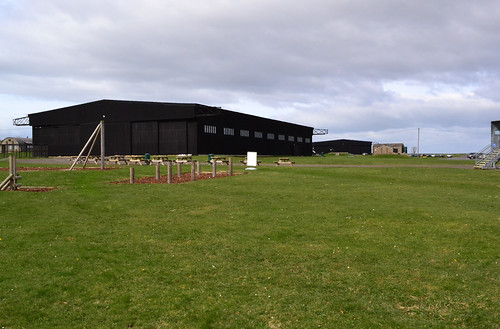
Bellman Aircraft shed

Bellman Aircraft sheds at the former RAF Bircham Newton

The second design, was the Callender (later Callender-Hamilton with modifications) Hangar, designed by the bridge design company Callender Cable and Construction. These had a span of 90 clear feet, with a length of 185 ft, and were used on both RAF and RNAS airfields. There were only eight of these built before the outbreak of war, examples of which appear at East Fortune, further examples with lower roof clearances (17 ft) being purchased after 1940. The Callender-Hamilton are best recognised by their lattice-work on the top door rails.

Callender-Hamilton Hangar East Fortune National Museum of Flight

Callender-Hamilton Hangar East Fortune National Museum of Flight

As the war approached, 1939 – 1940 saw a transition period between ‘permanent’ and ‘temporary’ buildings, although many of these temporary buildings still stand today! Because of this change, many airfields had various hangars built, something that often gives a mix of hangar designs on one airfield which can cause confusion as to its age and origin. However, from this point on, all wartime hangars were designed as temporary hangars, designed with short lives and easily assembled / disassembled.

By 1940, the Bellman was considered too small for the RAF’s requirements and a new design was going to be needed. An agreement between the Air Ministry and Teeside Bridge & Engineering resulted in the ‘T’ series of hangars, perhaps the most well-known of the hangar designs.

The ‘T’ series covers a wide range of (temporary or transportable) hangars, each slightly different to the previous, but designed as three main types; T1 (90 ft span), T2 (113 ft) and T3 (66 ft). The length of each hangar varied depending upon local requirements and the number of additional bays added as needed. The design number e.g T2 (26) indicated the number of bays (26) and hence the length.

The ‘T’ range were a diverse and complicated range, the ‘T2’ being sub split into 5 variants (T2, T2 Heavy Duty, TFB (flying Boat), TFBHD (flying boat heavy-duty) and T2MCS (marine craft shed), so the identification of each being difficult without measuring equipment.

RAF Wratting Common

A T2 hangar at RAF Wratting Common.

On first inspection the ‘T2’ and Bellman look virtually identical, both lightweight, steel lattice frames with metal side panels. The main distinctions are that the Bellman doors are flush with the top of the side panelling whereas the ‘T2’ has an extra level of panelling and so are not flush. The other difference is the lattice frame inside the roof, the ‘T2’ has only diagonal braces whereas the Bellman has vertical braces in addition to the diagonals. Both hangars have six leaf doors on sliding rails supported both top and bottom, allowing full width access.

A final addition to the ‘T2’ were the Ministry of Aircraft Production Hangars the Type ‘A’ (A1 & A2) and Type ‘B’ (B1 & B2) built in the mid war years 1942-43 and funded by the Ministry of Aircraft Production. These hangars, not to be confused with the type ‘A’ and ‘B’ of the 1920s, were designed specifically for the repair of damaged aircraft especially operational aircraft on their own airfield. They were also erected at ASUs, and Satellite Landing Grounds (SLG).

RAF Wratting Common

A B1 at RAF Wratting Common an RAF bomber station.

The ‘B1’ and ‘B2’ were built specifically at Bomber Command airfields for the repair of damaged bombers thus eliminating the need to transport them long distances to specialist repair depots. Designed by T. Bedford Consulting Engineers they were eventually found on virtually all Bomber Command airfields by the end of the war and were manned by civilian repair organisations. Examples of both the ‘T2’ and ‘B1’ can be found in use at Wratting Common.

‘A1’ and ‘A2’ hangars on the other hand, whilst similar in design – metal cladding on metal frames – were slightly smaller and found only on aircraft factory airfields. Thus again there are virtually two identical hangars designated primarily by their location!

The last hangar to be commonly found on RAF / USAAF airfields were the blister hangar. A hangar of a temporary nature that usually used a curved metal frame covered in metal sheeting. The Blister hangar was the brainchild of architects and consulting engineers Norman & Dawbarn and William C. Inman of Miskins & Sons, and was designed to accommodate small span aircraft ideally fighters dispersed around the perimeter of airfields. Maintenance or storage could easily be carried in these hangars, and they could easily and quickly be erected, no base or foundations being required before hand.

These types of hangar came in three designs, the standard blister, (timber construction), over type (light welded steel) and Extra Over (also light welded steel), and ranged in span from 45 – 70 feet, A further type built was that of Double extra Over and Dorman Long, a separate design similar in shape but securely bolted to foundations. Many of these hangars have now gone, the majority being dismantled and sold off, only to be erected elsewhere on farmland well away from their original location. The father of a friend of mine, was employed in this very role, one day finding a Spitfire inside a blister hangar which nobody claimed to own!

By the end of the war, in excess of 900 ‘T2’ hangars were erected on British airfields including those built abroad. In 2004 it was thought there were about 100*7 left surviving on MOD property in Britain. A number have also survived on farmland used to store foodstuffs or machinery, or industrial sites. The ‘T2’ remained the main hangar in use by both the RAF and USAAF during the war, appearing on all Class ‘A’ airfields, occasionally with other models also being present. A number of other older models also continue to serve even to this day. Considering many of these were built as temporary buildings, they have survived remarkably well and are testament to the engineering design of the pre and early war years.

This is by no means an exhaustive list of those hangars that were built during the period 1918 – 1945 (other examples include the: Aeroplane Twin Shed; RFC Sheds; Seaplane Sheds; General Service Sheds; Plane Stores; Running Sheds; Lamella (a German idea built in Britain); Hinaldi; Main Hangars; Lamson Hangars; Fromson Hangars; Robins Hangars; Butler (a US design); Merton; ‘S’ type Hangars (RNAS); Pentad Hangar and Boulton & Paul Hangars and of course post war examples such as the Gaydon), but hopefully it has shone a glimmer of light on these remarkable structures that often dominated the skyline and that remain the centrepiece of many a disused airfield today.

In the next section we shall look at that other main iconic building in airfield design, the watch office.

Sources and further reading. 

*7Technical Bulletin 02/02 “World War II Hangars – Guide to Hangar Identification” Ministry of Defence (February 2002).

The Development of Britain’s Airfields (Part 6).

After considering the architecture of Britain’s airfields in Part 5, we turn to the hard surfaces, primarily the runways. Developed out of necessity, they created a steep learning curve for those involved in their construction. Many problems were found, many materials were tried, but ultimately they were built and even after their removal for hardcore, many have left scars in the tissue of the earth that remind us of their once massive presence.

Runways, Perimeter Tracks and Hardstands

In the pre-war years, the development of hard runways and large airfields was a new phenomena, hard surfaces being a new aspect still very much a topic of considerable controversy. In the First World War, water logging and mud was an issue even for the small biplanes that filled the skies over Britain and  France. To overcome this, ash was spread over landing surfaces and to some degree successfully, but even though many local remedies were tried, it wouldn’t be taken seriously until the Second World War loomed.

Glatton (Conington) second runway markings

Runways like this one at Glatton (Conington) remain in good condition and used by the local flying club.

At this point the typical airfield layout included up to four grass runways, one of 1,300 x 400 yards and three of 1,000 x 200 yards, many were even smaller. Bomber and Fighter Command, realising that not only would the new era of aircraft call for longer, hard runways on its airfields, but the need to maintain year round activity was essential if Britain was to defeat the Luftwaffe.

Both Fighter and Bomber Command pushed the Government to allow these to be developed, on the one hand Sir Hugh Dowding, fighting the corner for Fighter Command, pressed home the need for hard surfaces on his fighter airfields, whilst Sir Arthur Harris on the other, pushed for hard surfaces on his bomber airfields.

The entire process was lengthy and complex, and lacked in-depth, professional knowledge. The first hard ‘pavements’ later runways and taxi ways, being constructed based on road building techniques and knowledge. So before any firm decisions could be made, trials would need to be carried out to determine not only whether or not they were indeed needed, but if so, how they should be best constructed.

Initial steps in runway construction was started as early as 1937, where ‘flexible’ runways were constructed comprising layers of brick or stone covered with two further layers of tarmac and a coat of asphalt to seal the structure in. Concrete pavements, which proved to be much stronger were either 150 mm or 200 mm thick slabs laid directly onto the ground after the topsoil had been removed by heavy machinery. As would be expected, these early designs failed quite quickly under the heavy loads of the fighters and bombers that were coming into service. Rapid repairs were carried by adding a further layer of tarmac (6.5cm) and another layer (2cm) of sealant.

These early flexible constructions continued to fail whereas the concrete designs stood up to much more wear and tear and proved longer lasting. However, time was short and the learning curve would be steep.

The test to determine these needs was to take a Whitley bomber, laden to equal its full operational weight, and taxi it across a grassed surface.  A rather primitive assessment, it was intended to ascertain the effects of the aircraft on the ground beneath. Trials were first carried out at Farnborough and then Odiham, and these were generally successful, the Whitley only bogging down on recently disturbed soils. Further trials were then carried out at RAF Stradishall in March 1938, and the results were a little more mixed. Whilst no take offs or landings took place during these trials, the general agreement was that more powerful bombers would have no problems using grassed surfaces, as long as the ground was properly prepared and well maintained. All well and good when the soils were dry and well-drained.

By April 1939, the Air Ministry conceded, and agreed to lay runways at a small number of fighter and bomber airfields, of which Kenley, Biggin Hill, Debden and Stradishall were identified.  Whilst construction was slow, only two fighters airfields being completed by the outbreak of war, progress was finally being made.

These initial runways were only 800 yards long and 50 yards wide, but were extended later that year to 1,000 yards long, as aircraft were repeatedly running off the ends on to the grassed areas. Over the years Stradishall in particular, would be further developed, its longest runway eventually extending to 2,000 yards.
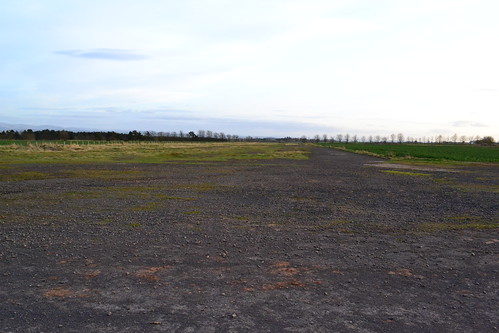
RAF Charterhall

The runway at Charterhall in the borders, breaking up after many years of use both by training units and as a motor racing circuit post war.

During the early war years, the demand for airfields grew. By early 1940 the requirement was for three runways as close as possible at 60o to each other, and of a minimum length of 1,000 yards with room for extension up to 1,400 yards. This then became the norm by late 1940 especially at bomber airfields, with the main runway being 1,400 yards and subsidiaries at 1,100 yards. A month later, this increased by another 200 yards with a requirement to be able to extend to 2,000 and 1,400 yards respectively.

However, these short piecemeal responses were not sufficient and it was both a continual problem and a thorn in the side for the Air Ministry. Sir Arthur Harris, in raising his concerns for airfields belonging to Bomber Command, also pushed the need to develop good, long and reliable surfaces. He voiced his frustration in a vehement letter*6 to Lord Beaverbrook in 1941, In which he states:

“For twenty years everybody on the stations and the squadrons has been screaming for runways without avail.”

and he continues stressing the need for hard surfaces particularly in winter as:

“Through not having runways our effort will be seriously detracted from in normal winter conditions and reduced very probably to zero in abnormal winter conditions.”

He then goes on to state that Britain’s views were ‘blinkered’ saying that:

“Every other nation throughout the world has long been convinced of the necessity for runways…”

By the summer of 1941, the length of runways had again increased, all stations would now have a main runway of 2,000 yards and two subsidiaries of 1,400 yards and where this was not possible, then a minimum of 1,600 and 1,100 yards (fighter and night fighter stations being shorter at 1,300 and 1,400 yards respectively).

The harsh winters were less than ideal for laying concrete (by far the best material for the job) but any delay could mean the difference between success and failure. Elaborate testing was therefore passed over, materials were laid and experience led the way. This method of trail and error, led to many instances of runways having to be dug up and relaid, this in itself led to problems as aircraft, men and machinery had to then be moved and housed elsewhere. The American Eighth Air Force suffered greatly with these problem, fully laden bombers repeatedly breaking through the surface or falling off the edges as it gave way.

Another consideration was that of training and satellite airfields. As the need for new pilots increased, the training of new recruits intensified. The harsh winters were causing major headaches for these airfields as mud, stones and other winter debris was causing continuous problems for flying. With both man power and materials being in short supply, suitable alternatives were sought.  A number of solutions were offered all very similar in their design and material.

The answer it seemed lay in steel matting – of which twelve different types were used – the more common being : Sommerfeld Track, Pierced Steel Planking (PSP – also called Marston Mat), or Square Mesh Track (SMT).

Sommerfeld track was a steel mat designed by Austrian Kurt Sommerfeld. The tracking was adapted from a First World War idea, and was a steel mat that when arrived, was rolled up in rolls 3.25 m (10 ft 8 in) wide by 23 m (75 ft 6 in) long. It was so well designed that a full track could be laid, by an unskilled force, in a matter of hours. Each section could be replaced easily if damaged, and the entire track could be lifted and transported by lorry, aeroplane or boat to another location and then reused.

Sommerfeld track (along with these other track types) were not only used commonly on training and satellite airfields, but also on Advanced and Forward Landing Grounds in Kent and later France after the Allied invasion of Normandy. In the build up to D-Day, 24 Advanced Landing Grounds in southern England were created using this form of Steel Matting,

Tracking had to be robust, it had to be able to withstand heavy landings and be non-conspicuous from the air. Sommerfeld track met both of these, and other stringent criteria very well, although it wasn’t without its problems. Crews often complained of a build up of mud after heavy rain, and concerns over both tyre and undercarriage damage were also extensively voiced; several records reporting tail wheels being ripped off after catching in the track lattice.

Because of the poor state and short length of runways, bombers were still regularly running off the ends, especially at night, or being unable to fly because the surfaces were poor or even unusable. A number of ideas were tested out to alleviate the problem, one such idea led to twenty sites testing arrester hook facilities. Several heavy bombers: Halifax, Manchester, Stirlings  and later the Lancaster,  were all modified to undertake these trials, with Woodhall Spa becoming the first airfield to have the full complement of six arrester sets.
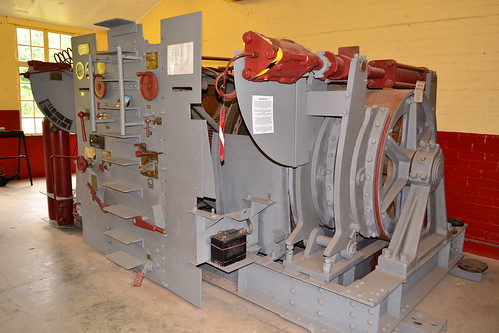
Runway arrester gear

Runway arrester gear at Woodhall Spa.

The idea was met with scepticism, but trials went ahead and in January 1942, a list of priority airfields was sent out to the Headquarters of No. 1,3,4, and 5 Groups RAF detailing those twenty sites selected for the equipment. At the top of the list was RAF Woodhall Spa in Lincolnshire, followed by Bottesford, Swinderby, Ossington, Syerston, Middleton St. George, Linton, and ending with Waterbeach and Stradishall. By late 1942 Woodhall Spa was ready and in October, five landings were made by an Avro Manchester.  A month later the decision was made to install units at all major operational airfields, but this never came to fruition and the idea was soon mothballed. By 1943, it had been forgotten about and the 120 or so units built were scrapped (many being left buried where they were laid).

It was finally during early 1942 that a standard design airfield would be put in place. Known as the Class ‘A’, it would be the standard to which all new airfields and updated older sites would be made.

A Class A airfield would be designed around three hard concrete runways, shaped like an ‘A’ with each runway at 60o  to each other where possible. The main runway would be aligned with the prevailing wind again were possible to allow aircraft to take off/land into the wind as often as possible (north-east, south-west). In several cases, due to land features and local restrictions, this was not always possible, and so many permutations of design were seen as a result.

Rapidly becoming the largest part of the airfield layout, the runways and other paved areas – perimeters tracks, aprons and hardstands – were now given high priority. The standard now called for a main runway of 2,000 yards with two subsidiaries of 1,400 yards. Each of these would be 50 yards wide whilst the connecting perimeter tracks would be 50 feet wide. Along side these runways would be an emergency landing strip, a grassed area given a landing surface of 400 and  200 yards respectively.

Dues to the high numbers of bombers returning badly damaged and unable to make safe and proper landings, a small number of emergency strips were created by extending the main runways to 4,000 yards long and 400 yards wide. One such airfield was RAF Manston in Kent. Being on of the closest airfields to the continent, it was often the first place a stricken aircraft, especially a bomber, would seek out.

Whilst the general layout of airfields did not change for the remainder of the war, some further runways were extended to 3,000 yards, one such example being RAF Sculthorpe in Norfolk which was prepared to take the heavy B29 ‘Superfortress’ and post war, the B-36 ‘Peacemaker’.

A further point worth mentioning here is that of dispersals, not required pre-war, they were also an aspect of airfield architecture that were born out of the Second World War. In the inter-war years, aircraft were housed either on a central pan (apron or ramp) or within hangars. These collections of aircraft were easy targets and even a small amount of munitions could cause huge damage. In 1939 the need for dispersals was therefore recognised and so to address the issue, hedges were removed and tracks created that took aircraft away from the main runway but kept them within easy reach of the airfield site. The initial design was that of the ‘frying pan’ a 150 ft circle connected to the perimeter track by a small concrete track.

However, by 1942, it was found that aircraft were clogging up these tracks, some even ‘falling off’ the concrete onto soft soil and so blocking following aircraft in their tracks. The answer was the ‘spectacle’ or ‘loop’ hardstand, so-called by their oval shape, generally in pairs, that allow aircraft in and out without the need to turn or block access tracks. From 1942 onward, this model became the standard hardstand for all Class A airfields, and the aim was to have 50 such hardstands placed strategically around the perimeter, with 25 at satellite airfields. As the threat of attack diminished toward the end of the war, ‘finger’ or ‘star’ dispersals began to appear, much less effective than the predecessors, they were however cheaper and easier to construct.
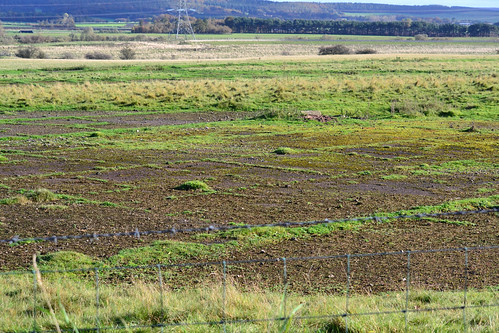
RAF Milfield

Unusual as many training airfields didn’t have aircraft pans, RAF Millfield, in the borders, had several

In addition to hardstands, pens were built on fighter stations. The first, an experimental pit, was dug at Feltwell, whilst overly expensive and obtrusive, it did lead the way to aircraft pens later on, pens that were developed as either type ‘B’ or ‘E’  on these fighter airfields. The main difference here is that the early type ‘B’ had cranked side walls whereas the ‘E’ had walls that were straight. The former requiring more space, was later phased out in favour of the ‘E’, named so by its shape, using side and back walls to protect the fighter or small bomber located within.
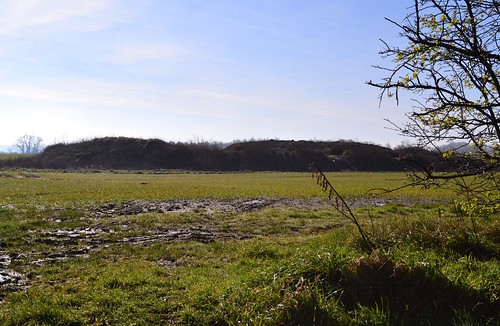
Remains of Type 'B' fighter Pen

The remains of a Type ‘B’ Fighter Pen at Matlaske.

RAF Macmerry

A Type ‘B’ Pen at RAF Macmerry. The cranked wall can be seen to the right, with the central wall on the left. The entrance is to the bottom right.

Examples of these pens were located at Matlaske (type ‘B’ – built to design 7151/41) and Macmerry in Scotland, whilst the type ‘E’ were found on airfields especially those around London that included Biggin HiIl, Kenley and North Weald.

Kingscliffe airfield

One of the ‘E’ type pens found at Kings Cliffe. Adapted with rifle slits for additional defence.

These pens were designed to specific dimensions and were designed as either a ‘Hurricane’ or ‘Blenheim’ to accommodate either a single engined or twin-engined aircraft. Within the back wall of these pens was a shelter for up to 25 personnel, and in some cases, they had Stanton Shelters built-in to the structures. Some, for example, at Kings Cliffe in Northampton, remain with rifle slits for additional protection from ground forces.
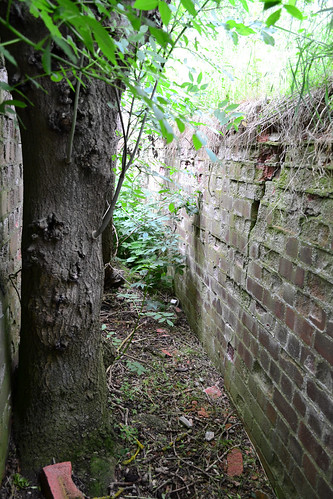
King's Cliffe airfield

Inside the aircraft pen shelter at King’s Cliffe.

Whilst the majority of these shelters were manufactured using banks of soil, sandbags, brick or concrete, there was a least one example at RAF Drem, in Scotland which used logs cut to size and shape and built in the style of a Scandinavian house. It is these various designs of aircraft pen that paved the way to modern hardened aircraft shelters (HAS) seen on military airfields today.

From the early days of grass runways to the massive lengths of concrete that were created up to and after the mid 1940s, runways and hardstands have become a defining factor in airfield design. The sole purpose of an airfield – to get aircraft off the ground as quickly as possible, get them to their target and them get them home again – led to the development of both runway lengths and construction materials, much of which has paved the way for modern airfields today. These early leaps into runway designs have enabled larger and heavier aircraft to make those important journeys that we very much take for granted in this the modern world of air travel and general aviation.

In the next section we look at one of the buildings most associated with the airfield. An early form of aircraft storage, its role changed as it was soon realised that aircraft needed to be dispersed and not grouped together on large aprons as they were in the prewar era. Aesthetics and neatly lined up aircraft were no longer an important factor in front line flying, but safety and the ability to repair aircraft quickly and efficiently were. Here we introduce the hangar, a huge building often of a temporary or transportable nature, that became one of the more longer lasting structures of airfield architecture.

Sources and further reading. 

*6 Letter from Arthur Harris to Lord Beaverbrook, February 1941 – AIR 19/492 – National Archives
50 Aviation Trails Reached!

I am pleased to announce that since starting Aviation Trails four years ago, I have now reached that magic number of 50 Trails around Britain’s wartime airfields, a feat I never thought would happen.

Each Trail covers two or more sites, in some cases six, many three, covering in total, over 100 former RAF and USAAF airfields and museums around Britain.

I can honestly say its been a terrific four years, in which I have learnt a lot about Britain’s wartime past, the men and machines that flew from these places and the tragedies that occurred at so many. The development of these airfields was staggering, the process of construction, and the subsequent decay just as eye-opening. These sites and the people who used them, have changed both the British and world landscape, leaving in many cases scars that may never heal. The buildings and stretches of concrete that remain are monuments to human endurance and sacrifice, a sacrifice that we hope may never have to be repeated.

RAF Tibenham Perimeter track

The perimeter track at the former RAF Tibbenham.

During these four years there have been several changes at many of these sites, hangars and other buildings have gone, runways are continuing to be dug up as they become prime land for development. As we speak there are numerous sites under planning proposals, whilst others are waiting in the wings to hear what their fate will be.

To compile these trails I have personally visited each and every one of these sites, even a field has a certain something when you know who stood there before you.

To all those who have visited, commented and followed me on this journey, I thank you, I hope you have enjoyed the journey back in time as much as I have writing it. I hope that through these trails, the memories of those who gave their all may live on so that future generations may know who they were and what they did, so that we may enjoy the peace we do today.

Here’s to the next 50!

Andy.

RAF Andrews Field – (Great Saling/Station 485) – Trail 33: Essex Part 1.

RAF Attlebridge  (Station 120) – Trail 7: Northwest Norfolk.

RAF Barton BendishTrail 7: Northwest Norfolk.

RAF Biggin Hill (Westersham) (Station 343) – Trail 4: Kent Part 1.

RAF Bircham NewtonTrail 20: North Norfolk (Part 1).

RAF Bodney (Station 141) – Trail 8: Swaffham and Her Neighbours (Part 1 of 3).

RAF BournTrail 31: Southern Cambridgeshire (Part 2).

RAF Brenzett (ALG) – Trail 18: Kent Part 2.

RAF BruntonTrail 47: Northumberland.

RAF Bungay (Flixton) (Station 125) – Trail 14:  Central Suffolk (Part 1).

RAF Bury St. Edmunds (Rougham) (Station 468) – Trail 16: West Suffolk (part 1).

RAF Castle CampsTrail 45: Essex (Part 2).

RAF Caxton GibbetTrail 29: Southern Cambridge (Part 1).

RAF Charterhall Trail 41: The Borders of Scotland and England.

RAF ChedburghTrail 49: Bomber Command – Bury St. Edmunds to Haverhill

RAF Collyweston Trail 37: The Northern Reaches of Cambridgeshire.

RAF Coltishall – Trail 7: Northwest Norfolk.

RAF ConingsbyTrail 1: Lower Lincolnshire.

RAF CottamTrail 40: Yorkshire (East Riding).

RAF CranwellTrail 2: Lincoln Borders and Newark.

RAF Debach (Station 152) – Trail 39: Suffolk around Ipswich (Part 1).

RAF Debden (Station 356) – Trail 46: Essex Part 3,

RAF Deenethorpe (Station 128) – Trail 6: American Ghosts.

RAF Deopham Green (Station 142) – Trail 27: Southern Norfolk (Part 3).

RAF Digby (Scopwick) – Trail 1: Lower Lincolnshire.

RAF Docking – Trail 20: North Norfolk (Part 1).

RAF Downham Market (Bexwell) – Trail 7: Northwest Norfolk.

RAF Drem – Trail 42: Edinburgh’s Neighbours.

RAF East Fortune – Trail 42: Edinburgh’s Neighbours.

RAF East Kirkby Trail 1: Lower Lincolnshire.

RAF East Wretham (Station 133) – Trail 13: Southern Norfolk around Diss (Part 2).

RAF Eye (Brome) (Station 134) – Trail 14: Central Suffolk (Part 1).

RAF Fersfield – (Station 130) – Trail 28: Southern Norfolk (Part 4).

RAF FoulshamTrail 22North Norfolk (Part 3).

RAF FowlmereTrail 32Southern Cambridgeshire (Part 3).

RAF Framlingham (Parham) (Station 153)Trail 39: Suffolk around Ipswich (Part 1).

RAF Glatton (Station 130) – Trail 6: American Ghosts.

RAF Gransden Lodge – Trail 31: Southern Cambridgeshire (Part 2).

RAF Graveley – Trail 29: Southern Cambridge (Part 1).

RAF Grafton Underwood (Station 106) – Trail 6: American Ghosts.

RAF Great Dunmow (Station 164)- Trail 33: Essex (Part 1).

RAF Great MassinghamTrail 21: North Norfolk (Part 2).

RAF Great Sampford (Station 359) – Trail 50: Haverhill’s neighbours – Wratting Common and Great Sampford.

RAF Hardwick (Station 104) – Trail 12: Southern Norfolk around Diss (Part 1).

RAF Hawkinge – Trail 18: Kent Part 2.

RAF Hethel – Trail 38: To the West of Norwich.

RFC HinghamTrail 38: To the West of Norwich.

RAF Hunsdon – Trail 25: Hertfordshire.

RAF Kimbolton (Station 117) – Trail 6: American Ghosts.

RAF King’s Cliffe (Station 367) – Trail 6: American Ghosts.

RAF LanghamTrail 23: North Norfolk (Part 4).

RAF Lashenden (Headcorn) – Trail 18: Kent Part 2.

RAF Lavenham (Station 137) – Trail coming soon.

RAF Little Snoring – – Trail 22North Norfolk (Part 3).

RAF MarhamTrail 7: Northwest Norfolk.

RAF Martlesham HeathTrail 48: Suffolk around Ipswich (Part 2).

RAF Matching (Station 166) – Trail 33: Essex Part 1.

RAF Matlask (Station 178) – Trail 34: North Norfolk (Part 5).

RAF MattishallTrail 36: North Norfolk (Part 6).

RAF Mendlesham (Station 156) – Trail 15: Central Suffolk (Part 2).

RAF MepalTrail 11: Around Ely.

RAF Methwold – Trail 8: Swaffham and Her Neighbours (Part 1).

RAF Millfield –  Trail 47: Northumberland.

RAF Narborough (Narborough Aerodrome)- Trail 7: Northwest Norfolk.

RAF North CreakeTrail 23: North Norfolk (Part 4).

RAF North Pickenham (Station 143) – Trail 9: Swaffham and Her Neighbours (Part 2).

RAF North WealdTrail 25: Hertfordshire.

RAF North Witham (Station 479) – Trail 3: Gone But Not Forgotten.

RAF Old Buckenham (Station 144) – Trail 13: Southern Norfolk around Diss (Part 2).

RAF Oulton – Trail 34: North Norfolk (Part 5).

RAF Polebrook (Station 110) – Trail 19: Northamptonshire American Ghosts II.

RAF Rattlesden (Station 126) – Trail 15: (Central Suffolk (Part 2).

RAF SawbridgeworthTrail 25: Hertfordshire.

RAF ScamptonTrail 30: Scampton and the Heritage Centre.

RAF SculthorpeTrail 21: North Norfolk Part 2.

RAF Shipdham (Station 115) – Trail 10: Swaffham and Her Neighbours (Part 3).

RAF Snetterton Heath – (Station 138) – Trail 27: Southern Norfolk (Part 3).

RAF Spanhoe Lodge (Station 493) – Trail 6: American Ghosts.

RAF Steeple Morden – Trail 32: Southern Cambridgeshire (Part 3).

RAF Stoke OrchardTrail 24: Gloucestershire.

RAF Stradishall- Trail 49: Bomber Command – Bury St. Edmunds to Haverhill

RAF Sutton BridgeTrail 3: Gone But Not Forgotten.

RAF Swannington – Trail 36: North Norfolk (Part 6) 

RAF Swanton Morley – Trail 38: To the West of Norwich.

RAF Thorpe Abbotts (Station 139) – Trail 12: Southern Norfolk around Diss (Part 1).

RAF Tibenham (Station 124) – Trail 13: Southern Norfolk around Diss (Part 2).

RAF Tuddenham – Trail 16: West Suffolk (Part 1).

RAF Tydd St. Mary – Trail 37: The Northern Reaches of Cambridgeshire.

RAF Upwood – Trail 17: The Pathfinders.

RAF Warboys – Trail 17: The Pathfinders.

RAF Watton (Station 376/Station 505) – Trail 9: Swaffham & Her Neighbours (Part 2).

RAF Wendling (Station 118) – Trail 10: Swaffham and Her Neighbours (Part 3).

RAF West Malling Trail 4: Kent Part 1.

RAF West RaynhamTrail 21: North Norfolk Part 2.

RAF WethersfieldTrail 45: Essex (Part 2).

RAF Westley – Trail 16: West Suffolk (part 1).

RAF WinfieldTrail 41: The Borders of Scotland and England.

RAF Winthorpe Trail 2: Lincoln Borders and Newark.

RAF WitchfordTrail 11: Around Ely.

RAF Wittering  – Trail 37: The Northern Reaches of Cambridgeshire.

RAF Woodall SpaTrail 1: Lower Lincolnshire.

RAF Wratting CommonTrail 50 – Haverhill’s neighbours – Wratting Common and Great Sampford.


RAF Bovingdon – The Hour that Never Was!

During the 1960s, a cult TV series hit the British Screens – ‘The Avengers’ starring  Patrick Macnee (as John Steed), and Diana Rigg (as Emma Peel).

In episode 9 of the fourth series, “The Hour That Never Was” the two characters go to an old airbase, the fictitious RAF Hamelin home to (also fictitious) 472 Squadron, where Steed had been invited to a party before the base was officially closed.

But following an accident in their car, Steed and Mrs. Peel, find things are not what they seem and so begins the investigation into what has happened.

The episode was filmed on location at the former RAF Bovingdon between the 5th July and 20th July 1965 before the site was officially closed in 1972.

The film designer used Bovingdon to cleverly achieve the illusion of abandonment, an aim successfully done through filming in the old original wartime buildings. They even manage to include a shot where Steed climbs inside a D.H. Mosquito!

Bovingdon was initially designed as a bomber airfield for the RAF, but was quickly passed over to the USAAF. Sadly it never became a true operational airbase primarily due to the three short runways. However, the 92nd BG, the only operational unit to be stationed here, are reported to have taken part in a small number of raids in both September and October 1942, before departing to Alconbury in January 1943. Bovingdon then became a training centre for bomber crews as the 11th Combat Crew Replacement Centre, training the majority of US crewmen after their arrival in the UK. It also trained and hosted a number of film stars (including Clarke Gable and James Stewart) along with reporters who were to fly over occupied Europe for reporting and making propaganda films.

As a support station for the Eighth Air Force Headquarters and the Air Technical Section, it would also see a range of aircraft types based here, the most noteworthy being General Eisenhower’s own personal B-17 stored in one of the four T2 hangars that stood on the base.

Bovingdon, now a prison, is also noted for being the location for “633 Squadron” as the fictional base RAF Sutton Craddock also with its D. H. Mosquitoes, and with “The War Lover” with Steve McQueen. Other films include: “Mosquito Squadron“, “The Battle of Britain“, and the James Bond film “The Man With the Golden Gun“.

Bovingdon has a remarkable and highly significant history and like so many others has earned its place in history.

A ‘You Tube’ version of “The Hour That Never Was” is not the best quality film, but it does give you good views of the airfield and the hangars before the airfield was closed for good.

My thanks go to fellow blogger and reader John Knifton  for the links!

Britain’s Airfields 1944

By the end of the Second World War, there were a substantial number of airfields covering the UK, mainly used by the Royal Air Force, the United States Army Air Force, the Royal Navy and all their associated branches; they were handed back to the RAF at the end of the war as the various forces were pulled out. Some were used as POW or repatriation camps, some were used to store surplus aircraft, vehicles or ordinance; many were put into care and maintenance whilst the RAF decided their ultimate fate.

Thankfully a few have lasted as airfields and are even fulfilling that role today, sadly though, many were dug up, their runways used for hardcore, the buildings demolished and the events that occurred there reserved for the history books.

The scale and pace of development was massive. The size of these sites bigger than many of the villages they took their names from, the populations larger than many towns of the time. Architecturally they changed the landscape dramatically.

Today as they dwindle away, many are mere names, locals have little knowledge of their existence, memorials are being forgotten, and life is moving on.

As a little reminder of those times and to put the scale of development into perspective, here are two maps held by the British Library that show the main Royal Air Force and Royal Navy airfields as of 31st December 1944.

The two maps, divide the UK and show not only the airfields but satellites as well. They also show Royal Air Force and Royal Navy Water Airfields, and Royal Air Force Moorings. There are a number of sites not included on the map such as relief landing grounds, and training schools, but they do give an indication of the number of airfields that covered the UK by the end of the war.

These are both low resolution pictures, and copyright is held by the British Library who have given permission for them to be reproduced here.

Security Released Airfields in the United Kingdom (Sheet 1)
Security Released Airfields in the United Kingdom (Sheet 2)

© The British Library, Maps MOD GSGS Misc. 505 (sheet 1 and Sheet 2)

Britain’s Airfields – What does the future hold?

There has been a recent ‘spate’ of developments with planning applications that affect Britain’s wartime heritage, and in particular the airfields that were used during the Second World War.

With land at a premium, a housing crisis that is growing, these sites are becoming more and more handsome as development opportunities. Many have a ready-made infrastructure, many are open fields and as such, prime agricultural or development land. So what does the future hold for Britain’s heritage?

We have seen applications submitted or at least interest shown, for the former: RAF Kings Cliffe, RAF Downham Market, RAF West Raynham, RAF Denethorpe and RAF Coltishall, further applications have now been seen affecting former RAF Dunsfold, RAF Bourn and RAF Wellesbourne Mountford.

We also know that the USAF have given notice of withdrawal from their major UK base at RAF Mildenhall, the smaller site at RAF Molesworth and the remaining site at RAF Alconbury. The Government has already announced it will be selling these sites for housing after the military withdrawal in 2020-23. These three sites form part of an estimated £500m sell-off that would also include: RAF Barnham (Suffolk), Kneller Hall (Twickenham), Claro and Deverell Barracks (Ripon), Lodge Hill (Kent), Craigiehall (Edinburgh), HMS Nelson Wardroom (Portsmouth), Hullavington Airfield (Wiltshire) and MOD Felton (London). Changes at RAF Lakenheath will also see job losses through streamlining of operations.

It is estimated that the 12 sites could accommodate an estimated 15,000 homes with Alconbury having 5,000 alone.

The former airfield and barracks at RAF Waterbeach is also subject to planning proposals, and the Bassingbourn barracks near Cambridge is also under the development spotlight. The recent closure of Manston (a vital Second World War airfield) has led to speculation of its future both as an airfield (possibly London’s third) and as a development opportunity. These are perhaps just a few of the prime areas of land that are now becoming the focus of planners and developers alike.

There are many variables in this heated and long-lasting debate, in fact far too many to raise and discuss here. Strong feelings exist both toward and against the idea of development and it is certainly not a new one. Employment, jobs, environment, heritage, housing etc, they all create discussion and a strong case for both arguments, but the debate here is not “should we build or not” this is quite frankly, inevitable and in many cases much-needed, no, it’s more how can we meet the needs of an ever-growing population with the needs to preserve historically important sites that form the very thread of today’s society.

We have a dynamic population, and as health care improves, social mobility increases and a growing desire to own our own home increases, the need for more housing, affordable homes and homes for rent also increases. We are an ageing population, care homes, schools for our children and hospitals for the sick are all in much greater need. Where do we build them?

Whilst housing demands have always been with us and the need for more housing an all important one, the recent developments suggest that these old airfields could become prime land to meet these future housing needs.

Many of the current Second World War airfields are now either industrial conurbations or agricultural areas. Most have little or no remnants of their former lives visible, and certainly not widely accessible. Many argue that these sites are scrub, derelict and in need of development, and some indeed are. A proportion of the more recently used sites, are ‘mothballed’ or in part operating aviation related activities. They cover huge areas and have a ready-made infrastructure such were the designs of war and post war airfields. These sites also contain extensive dereliction, primarily due to being left and allowed to decay by their owners. Vandalism and pilfering has left them rotting like carcasses of forgotten wild animals. Where industry has been operating, contaminates have seeped into the soils, damaging flora and fauna growth; some so severe that they are rendered too difficult to reclaim as ‘Green Space’. Certainly on paper, they offer good sources for today’s desperate housing stock.

However, balance this against the historical and cultural importance of these places and the argument becomes a little blurred at the seams. Had it not been for the people who came to this country from all over the world to fight the Nazi tyranny in the war years 1939-45, then Britain and Europe would probably not be the Europe we know today. Many thousands of people gave their lives during those dark days, and for many of them, these airfields were their last homes, cold, often draughty huts on the outskirts of some bleak airfield. Their dedication helped form the very society we live in today, the democracy and freedom of speech we so enjoy and relish, the open spaces where we can walk our dog without fear and in freedom. The fact that we can have this very debate, is in itself, testament to those who came here never to return. The very nature and fabric of our local communities has been built around the ‘friendly invasion’ the acceptance of others into our quaint life and idyllic life-styles. Influences from other nations and cultures grew and developed as a result of those who came here from far and wide to give up their lives.

These sites have become monuments to them, their lives and deaths, many still have no known grave; many simply ‘disappeared’ such was the ferocity of the explosion that killed them. The design of Britain’s airfields are architecturally significant to our heritage, buildings were designed to fulfil a purpose and just like our castles and stately homes, they are monuments to a significant period of not only British, but world history. Our education system, includes this very period as a subject for discussion, debate and analysis. To build over such sites without due regard to them would be a travesty, and one that we would regret in the future. To paraphrase that well-known quote; If we are to learn from our mistakes then we need to remember the past. The Second World War is still, for the moment, in living memory, the veterans and civilians who survived it are dwindling in numbers and very soon their memories will be lost for ever. Each day brings news of a lost veteran or a newly discovered story. If we don’t acknowledge the value of these places, if we don’t plan for their ‘preservation’ then both we and our future generations, will be the ones to regret it.

So where do we go from here? The plans published for RAF West Raynham and RAF Coltishall take into account the nature of these sites, they are sympathetic to their historical value and acknowledge the sacrifices made. West Raynham utilises the very buildings that were created, thus keeping the atmosphere for those who wish to visit. Small museums create a record, first hand experiences and artefacts, all valuable records for the education of future generations. But both of these are unique. Both closed in more recent history, they have retained their structures whereas many older sites have had theirs long since demolished.

It is a delicate balance, and as sad as it would be to see them go, there has to be legislation to create compromise. Sympathetic developments have to be the way forward, acknowledgement of the sacrifice has to be high on the agenda. Many of the airfields I have been too have no museum, no memorial barely even a signpost. Surely this is wrong.

If we are to preserve our fragile heritage, we need to consider the implications of the planning process, to look at the value of these sites as both suitable housing and significant historical areas, the sacrifice of the many needs to be acknowledged and it needs to be done soon.

Sources and Further Reading.

Laying the Foundations: A Housing Strategy for England ” HM Gov, November 2011

Stimulating housing supply – Government initiatives (England)” House of Commons Library, 9 December 2014

The “Get Surrey” news report issued on January 5th 2016 relating to Dunsfold can be found here.

Then latest news from “Cambridge News” December 16th 2015 can be found here.

The “Stratford-Upon-Avon Herald” January 6th 2016 front page story about Wellesbourne can be found here. (This may be a limited time link).

The latest news on RAF Mildenhall and Lakenheath published by the BBC, 18th January 2016 can be found here.