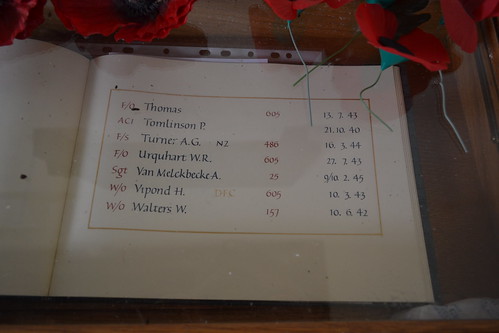
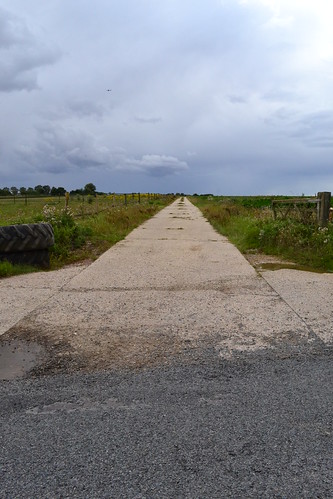
September 26th 1942, a near tragedy for three RAF Squadrons.

The Eagle Squadrons were three RAF Squadrons made up of American volunteers, their achievements and records are well-known and well documented, however, it was not all plain sailing for these determined and courageous flyers. For one Squadron in particular, 133 Squadron, September 26th 1942 would be a disaster, a disaster that would almost wipe out the entire flight of twelve airmen.

133 Squadron had been on the front line serving at RAF Biggin Hill and RAF Martlesham Heath before arriving at RAF Great Sampford, a satellite for RAF Debden. The ground crews were predominately British, assisting and training the US ground crews in aircraft maintenance and support. All the pilots however, were US volunteers, formed into three separate squadrons but under RAF control.

1st Lt Dominic 'Don' Gentile and Spitfire BL255 'Buckeye-Don', 336th FS, 4th FG, 8th AF.

1st Lt Dominic ‘Don’ Gentile and Spitfire BL255 ‘Buckeye-Don’. The photo was taken after 133 Squadron RAF was disbanded and absorbed into the USAAF as the, 336th FS, 4th FG, 8th AF. (@IWM)

133 Squadron would arrive at RAF Great Sampford on September 23rd 1942, the same day as 616 Sqn RAF departed, they would be the last operational unit to fully use the airfield before its eventual closure.

Initially flying the Spitfire VBs, they soon replaced them with the MK.IX, a Spitfire that was essentially a MK.V with an updated engine. Having a higher ceiling than the FW-190 and being marginally faster, its improved performance took the Luftwaffe by complete surprise. It was so new and improved, that it remained on the secret list until after this particular operational flight.

On that fateful day, September 26th 1942, fourteen Spitfires of 133 Sqn took off from RAF Great Sampford in Essex, piloting those Spitfires were:

BS313 – F/Lt. Edward Gordon Brettell DFC (61053) The only British pilot and leader
BS275 – P/O. Leonard T. Ryerson (O-885137)
BS446 – P/O. William H. Baker Jr (O-885113)
BS137 – P/O. Dennis D. Smith (O-885128)
BR638 – P/O. G.B. Sperry (O-885112)
BS445 – P/O. Dominic “Buckeye-Don” S. Gentile (O-885109)
BS138 – P/O. Gilbert G. Wright (?)
BS279 – F/Lt. Marion E. Jackson (O-885117)
BS447 – P/O. R.E. Smith (O-885110)
BR640 – P/O. C.A. Cook (O-885112)
BS148 – P/O. Richard “Bob” N. Beaty (?)
BS301 – P/O. G.H. Middleton Jr (O-885127)
BS140 – P/O. Gene P. Neville (O-885129)
Unknown  – P/O. Ervin “Dusty” Miller (O-885138) (not listed but known to have been on the flight).

They were to fly to RAF Bolt Head in Devon, where they would meet with 401 Squadron (RCAF) and 64 Squadron RAF, refuel and be briefed for the mission. A mission that was supposed to be straight forward and relatively uneventful.

The aim of the mission was to escort US bombers to Morlaix on the Brest peninsula. The usual commander of 133 Sqn, Red McColpin, was not placed in charge that day, instead he had been posted, and a British Pilot, F/Lt. Edward Gordon Brettell DFC, was issued with the task.

McColpin was a strict disciplinarian and his leadership was admired by those who followed him. Without this leadership, 133’s preparation was slack and they ultimately paid the price for this.

After landing at 12:30 hours, they realised there were no facilities at Bolt Head for refuelling, and they would have to go with what they had. This would kick-start a catalogue of errors that would ultimately seal the fate of the flight. Following a briefing in which Wing Commander Kingcombe DFC and all but two of 133 Sqn pilots had failed to show up for, the flight (which included the sixteen 401 (RCAF) Squadron Spitfire IXs from RAF Kenley) took off at 13:50 hours. Of the fourteen 133 Sqn Spitfires sent to Bolt Head, only twelve would be needed, and two pilots were instructed to remain at Bolt Head, they were P/O. Ervin Miller, and P/O. Don “Buckeye-Don” S. Gentile, they would be the luckiest two men of the squadron that day.

The briefing, a very vague and rushed one, instructed the flight to carry out a ‘Circus‘ mission escorting seventy-five B-17 Flying Fortresses from the 92nd BG, 97th BG and the 301st BG, who were bombing Cherbourg and the airfields at Maupertus and Morlaix in Brittany. When the squadron took off the weather was clear, and winds were predicted to be 35 mph at 24,000 feet, but 5 miles off the English coast, they encountered 10/10th cumulus cloud cover at 7,000 feet, and so had to climb above it so that they could locate the bombers more easily.

The take of was a mess, disorganised and lacking both radio information and in many cases maps, the aircraft were lucky not to collide with each other.

Of the three RAF squadrons involved in the mission, 401 would take the high position, 133 the middle and 64 Squadron, the lower. They were to form up over Bolt Head at 2,000 feet and then head at 200o at 180 mph to overtake the bombers before they arrived at the target. If they could not locate the bombers, the flight was to circle the target for three minutes and then depart.

As the flight approached the rendezvous area, one 133 Squadron Spitfire had to drop out of formation and return home, as he had encountered engine problems; this problem was thought to be due to his low fuel. The remainder of the flight  scanned the skies for any sign of the bomber formation, and after searching for some 45 minutes, they spotted the bombers, some 50 miles south of Brest. The bombers had in fact already turned for home after having discarded their bombs near to the Pyrenees.

By now the 301st BG had been recalled, as their fighter escort failed to materialise, whilst the 97th BG had continued on. However, due to the heavy cloud cover over the target area, they had been ineffective as no bombing of the target had taken place. The American bombers, who were only three months into their European air war, had inadvertently miscalculated a tail wind putting them off track well away from the Bay of Biscay.

1st Lt George H Middleton Jr 336FS, 4FG, 8AF USAAF. Former Eagle Sqn Spitfire pilot.

P/O. G.H. Middleton Jr of 133 Squadron RAF was shot down and taken Prisoner of War (@IWM).

The three squadrons formed up on the bombers at just after 16:45 hours, with 64 Squadron on the port side, 401 Squadron on the starboard and 133 Squadron behind. The whole formation then flew north for 30 minutes, at which point it became evident that the wind speed was in fact over 100 mph, and not the 35 mph as stated by the Meteorological Office, or at the briefing! It has since been revealed that this information was known to those in authority, but it had not been passed down the chain of command and the pilots were never informed.

The formation then spotted land, the bombers thought they were over Falmouth and turned right. 64 and 401 Squadron broke away maintaining height, but 133 Squadron dropped down below the cloud base and prepared to land.

133 Squadron then began to search for the airfield, and after searching in vain, they found a large town, this they hoped would give them the vital fix they desperately needed. Flying low over the houses they realised they were not over England at all but in fact still over France. The flight, uninformed of the 100 mph north-easterly wind at their altitude, had also been blown wildly off course, and after 1.5 hours flying time, the situation had suddenly become very severe indeed.

The Squadron flight Leader, Flight Lieutenant E.G. Brettell, wanting to ascertain his exact position, called up a ground direction finding station who provided a  bearing and heading – 100 miles off the English coast with a homing vector of 020o. It was at this point they suddenly realised they were over the port of Brest, one of the most heavily defended ports under German occupation.

Immediately, the sky filled with flak and small arms anti-aircraft fire. The pilot in the number 2 position, Pilot Officer Gene Neville (O-885129) in Spitfire #BS140, took a direct and fatal hit, he was killed instantly. Three other aircraft were to be shot down in the melee that followed: Pilot Officer William H Baker Jr (O-885113) in Spitfire #BS446; Pilot Officer Leonard Ryerson (O-885137) in Spitfire #BS275 and Pilot Officer Dennis Smith (O-885128) in Spitfire #BS294 – all four were killed, and all four were awarded the Purple Heart.

2nd Lt. Gene P. Neville 133 (Eagle) Sqn RAF, stands before his MK. IX Spitfire at Great Sampford. He was Killed during the Morlaix disaster. (@IWM UPL 18912)

The remainder of 133 Squadron struggling to defend themselves, they scattered and were forced to land out of fuel, either on the island of Ouissant or on the French mainland.

Of the seven 133 squadron pilots who crash landed on French soil, five were known to have been captured immediately and taken prisoner: P/O. G.B. Sperry; F/Lt.  Edward Brettell; F/Lt. M.E. Jackson; P/O. C.A. Cook and P/O. G.H. Middleton Jr., with a sixth, P/O. G.G. Wright, evading the Germans for several days before being captured later on.

Of these initial five, F/Lt. Jackson was injured in his crash and hospitalised for eight weeks. He was then taken to Stalag Luft III from where he was able to escape for about ten days by jumping from the roof of his cell house into a lorry load of evergreen branches that were being taken away from the camp.

Another Pilot, F/Lt.  Edward Brettell  DFC. was executed for his part in the Great Escape from the same prison camp, Stalag Luft III, whilst P/O. Robert E. Smith, the last remaining pilot, managed to abandon his aircraft evading capture, eventually returning to England on 18th January 1943.

The pilot who turned back early due to his own engine problems,  P/O. Robert Beatty,  crash landed his Spitfire at Kingsbridge in Devon after he too ran out of fuel over the Channel. During the crash he sustained severe injuries but luckily survived his ordeal and was able to give an account of the mission through what he heard over the radio.

Several of the 401 Squadron pilots,  who had continued on, also reported being low on fuel and gave their intention to bail out before land was finally sighted. One of these, P/O. Junius L. Hokan (s/n: J/6833), did have to bail out over the sea, he was last seen in a gradual dive, his aircraft heading seaward. His body was never recovered. Others in the flight that day only just made land fall, one crashed and was taken to hospital where he recovered from his injuries, the others just managed to reach either RAF Bolt Head or RAF Harrowbeer. The Operational Record Books for 401 Squadron state that “many casualties were avoided by the clear thinking and cool behaviour of all members of our Squadron“.

A full report of the days tragic events was issued to Fighter Command Headquarters by Wing Commander Kingcombe DFC, Squadron Leader Gaze and Squadron leader K. Hodson DFC.

The effect on those left behind in 133 Squadron was devastating. The result of poor preparation, inadequate briefings and sub-standard communication between the Met. Office and Fighter Command had cost many lives, and very nearly many, many more. A number of postings to the Far East soon followed, and many lessons weren’t that day that led to improvements preventing such a tragedy ever happening again.

133 Squadron would continue to operate after this, transferring over to the USAAF being renumbered as 336th FS, 4th FG, three days later as planned, leaving both RAF Great Sampford and the sad memories of that very tragic day far behind.

S/L Gordon Brettell 133 Eagle Squadron

S/L Gordon Brettell, 133 Eagle Squadron, executed for his part in the Great Escape breakout at Stalag Luft III  (@IWM UPL 25574)

Sources and further reading.

Great Sampford appears in Trail 50.

National Archives: Operational Record Book 133 Sqn – AIR 27/945/2

National Archives: Operational Record Book 401 Sqn – AIR 27/1772/17

National Archives: Operational record Book 64 Sqn – AIR 27/590/41

*3 Price. A., “Spitfire – A Complete Fighting History“, Promotional Reprint Company,  (1974).

The Development of Britain’s Airfields (Part 6).

After considering the architecture of Britain’s airfields in Part 5, we turn to the hard surfaces, primarily the runways. Developed out of necessity, they created a steep learning curve for those involved in their construction. Many problems were found, many materials were tried, but ultimately they were built and even after their removal for hardcore, many have left scars in the tissue of the earth that remind us of their once massive presence.

Runways, Perimeter Tracks and Hardstands

In the pre-war years, the development of hard runways and large airfields was a new phenomena, hard surfaces being a new aspect still very much a topic of considerable controversy. In the First World War, water logging and mud was an issue even for the small biplanes that filled the skies over Britain and  France. To overcome this, ash was spread over landing surfaces and to some degree successfully, but even though many local remedies were tried, it wouldn’t be taken seriously until the Second World War loomed.

Glatton (Conington) second runway markings

Runways like this one at Glatton (Conington) remain in good condition and used by the local flying club.

At this point the typical airfield layout included up to four grass runways, one of 1,300 x 400 yards and three of 1,000 x 200 yards, many were even smaller. Bomber and Fighter Command, realising that not only would the new era of aircraft call for longer, hard runways on its airfields, but the need to maintain year round activity was essential if Britain was to defeat the Luftwaffe.

Both Fighter and Bomber Command pushed the Government to allow these to be developed, on the one hand Sir Hugh Dowding, fighting the corner for Fighter Command, pressed home the need for hard surfaces on his fighter airfields, whilst Sir Arthur Harris on the other, pushed for hard surfaces on his bomber airfields.

The entire process was lengthy and complex, and lacked in-depth, professional knowledge. The first hard ‘pavements’ later runways and taxi ways, being constructed based on road building techniques and knowledge. So before any firm decisions could be made, trials would need to be carried out to determine not only whether or not they were indeed needed, but if so, how they should be best constructed.

Initial steps in runway construction was started as early as 1937, where ‘flexible’ runways were constructed comprising layers of brick or stone covered with two further layers of tarmac and a coat of asphalt to seal the structure in. Concrete pavements, which proved to be much stronger were either 150 mm or 200 mm thick slabs laid directly onto the ground after the topsoil had been removed by heavy machinery. As would be expected, these early designs failed quite quickly under the heavy loads of the fighters and bombers that were coming into service. Rapid repairs were carried by adding a further layer of tarmac (6.5cm) and another layer (2cm) of sealant.

These early flexible constructions continued to fail whereas the concrete designs stood up to much more wear and tear and proved longer lasting. However, time was short and the learning curve would be steep.

The test to determine these needs was to take a Whitley bomber, laden to equal its full operational weight, and taxi it across a grassed surface.  A rather primitive assessment, it was intended to ascertain the effects of the aircraft on the ground beneath. Trials were first carried out at Farnborough and then Odiham, and these were generally successful, the Whitley only bogging down on recently disturbed soils. Further trials were then carried out at RAF Stradishall in March 1938, and the results were a little more mixed. Whilst no take offs or landings took place during these trials, the general agreement was that more powerful bombers would have no problems using grassed surfaces, as long as the ground was properly prepared and well maintained. All well and good when the soils were dry and well-drained.

By April 1939, the Air Ministry conceded, and agreed to lay runways at a small number of fighter and bomber airfields, of which Kenley, Biggin Hill, Debden and Stradishall were identified.  Whilst construction was slow, only two fighters airfields being completed by the outbreak of war, progress was finally being made.

These initial runways were only 800 yards long and 50 yards wide, but were extended later that year to 1,000 yards long, as aircraft were repeatedly running off the ends on to the grassed areas. Over the years Stradishall in particular, would be further developed, its longest runway eventually extending to 2,000 yards.

RAF Charterhall

The runway at Charterhall in the borders, breaking up after many years of use both by training units and as a motor racing circuit post war.

During the early war years, the demand for airfields grew. By early 1940 the requirement was for three runways as close as possible at 60o to each other, and of a minimum length of 1,000 yards with room for extension up to 1,400 yards. This then became the norm by late 1940 especially at bomber airfields, with the main runway being 1,400 yards and subsidiaries at 1,100 yards. A month later, this increased by another 200 yards with a requirement to be able to extend to 2,000 and 1,400 yards respectively.

However, these short piecemeal responses were not sufficient and it was both a continual problem and a thorn in the side for the Air Ministry. Sir Arthur Harris, in raising his concerns for airfields belonging to Bomber Command, also pushed the need to develop good, long and reliable surfaces. He voiced his frustration in a vehement letter*6 to Lord Beaverbrook in 1941, In which he states:

“For twenty years everybody on the stations and the squadrons has been screaming for runways without avail.”

and he continues stressing the need for hard surfaces particularly in winter as:

“Through not having runways our effort will be seriously detracted from in normal winter conditions and reduced very probably to zero in abnormal winter conditions.”

He then goes on to state that Britain’s views were ‘blinkered’ saying that:

“Every other nation throughout the world has long been convinced of the necessity for runways…”

By the summer of 1941, the length of runways had again increased, all stations would now have a main runway of 2,000 yards and two subsidiaries of 1,400 yards and where this was not possible, then a minimum of 1,600 and 1,100 yards (fighter and night fighter stations being shorter at 1,300 and 1,400 yards respectively).

The harsh winters were less than ideal for laying concrete (by far the best material for the job) but any delay could mean the difference between success and failure. Elaborate testing was therefore passed over, materials were laid and experience led the way. This method of trail and error, led to many instances of runways having to be dug up and relaid, this in itself led to problems as aircraft, men and machinery had to then be moved and housed elsewhere. The American Eighth Air Force suffered greatly with these problem, fully laden bombers repeatedly breaking through the surface or falling off the edges as it gave way.

Another consideration was that of training and satellite airfields. As the need for new pilots increased, the training of new recruits intensified. The harsh winters were causing major headaches for these airfields as mud, stones and other winter debris was causing continuous problems for flying. With both man power and materials being in short supply, suitable alternatives were sought.  A number of solutions were offered all very similar in their design and material.

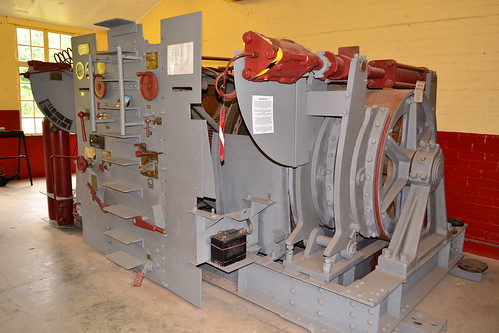
The answer it seemed lay in steel matting – of which twelve different types were used – the more common being : Sommerfeld Track, Pierced Steel Planking (PSP – also called Marston Mat), or Square Mesh Track (SMT).

Sommerfeld track was a steel mat designed by Austrian Kurt Sommerfeld. The tracking was adapted from a First World War idea, and was a steel mat that when arrived, was rolled up in rolls 3.25 m (10 ft 8 in) wide by 23 m (75 ft 6 in) long. It was so well designed that a full track could be laid, by an unskilled force, in a matter of hours. Each section could be replaced easily if damaged, and the entire track could be lifted and transported by lorry, aeroplane or boat to another location and then reused.

Sommerfeld track (along with these other track types) were not only used commonly on training and satellite airfields, but also on Advanced and Forward Landing Grounds in Kent and later France after the Allied invasion of Normandy. In the build up to D-Day, 24 Advanced Landing Grounds in southern England were created using this form of Steel Matting,

Tracking had to be robust, it had to be able to withstand heavy landings and be non-conspicuous from the air. Sommerfeld track met both of these, and other stringent criteria very well, although it wasn’t without its problems. Crews often complained of a build up of mud after heavy rain, and concerns over both tyre and undercarriage damage were also extensively voiced; several records reporting tail wheels being ripped off after catching in the track lattice.

Because of the poor state and short length of runways, bombers were still regularly running off the ends, especially at night, or being unable to fly because the surfaces were poor or even unusable. A number of ideas were tested out to alleviate the problem, one such idea led to twenty sites testing arrester hook facilities. Several heavy bombers: Halifax, Manchester, Stirlings  and later the Lancaster,  were all modified to undertake these trials, with Woodhall Spa becoming the first airfield to have the full complement of six arrester sets.

Runway arrester gear

Runway arrester gear at Woodhall Spa.

The idea was met with scepticism, but trials went ahead and in January 1942, a list of priority airfields was sent out to the Headquarters of No. 1,3,4, and 5 Groups RAF detailing those twenty sites selected for the equipment. At the top of the list was RAF Woodhall Spa in Lincolnshire, followed by Bottesford, Swinderby, Ossington, Syerston, Middleton St. George, Linton, and ending with Waterbeach and Stradishall. By late 1942 Woodhall Spa was ready and in October, five landings were made by an Avro Manchester.  A month later the decision was made to install units at all major operational airfields, but this never came to fruition and the idea was soon mothballed. By 1943, it had been forgotten about and the 120 or so units built were scrapped (many being left buried where they were laid).

It was finally during early 1942 that a standard design airfield would be put in place. Known as the Class ‘A’, it would be the standard to which all new airfields and updated older sites would be made.

A Class A airfield would be designed around three hard concrete runways, shaped like an ‘A’ with each runway at 60o  to each other where possible. The main runway would be aligned with the prevailing wind again were possible to allow aircraft to take off/land into the wind as often as possible (north-east, south-west). In several cases, due to land features and local restrictions, this was not always possible, and so many permutations of design were seen as a result.

Rapidly becoming the largest part of the airfield layout, the runways and other paved areas – perimeters tracks, aprons and hardstands – were now given high priority. The standard now called for a main runway of 2,000 yards with two subsidiaries of 1,400 yards. Each of these would be 50 yards wide whilst the connecting perimeter tracks would be 50 feet wide. Along side these runways would be an emergency landing strip, a grassed area given a landing surface of 400 and  200 yards respectively.

Dues to the high numbers of bombers returning badly damaged and unable to make safe and proper landings, a small number of emergency strips were created by extending the main runways to 4,000 yards long and 400 yards wide. One such airfield was RAF Manston in Kent. Being on of the closest airfields to the continent, it was often the first place a stricken aircraft, especially a bomber, would seek out.

Whilst the general layout of airfields did not change for the remainder of the war, some further runways were extended to 3,000 yards, one such example being RAF Sculthorpe in Norfolk which was prepared to take the heavy B29 ‘Superfortress’ and post war, the B-36 ‘Peacemaker’.

A further point worth mentioning here is that of dispersals, not required pre-war, they were also an aspect of airfield architecture that were born out of the Second World War. In the inter-war years, aircraft were housed either on a central pan (apron or ramp) or within hangars. These collections of aircraft were easy targets and even a small amount of munitions could cause huge damage. In 1939 the need for dispersals was therefore recognised and so to address the issue, hedges were removed and tracks created that took aircraft away from the main runway but kept them within easy reach of the airfield site. The initial design was that of the ‘frying pan’ a 150 ft circle connected to the perimeter track by a small concrete track.

However, by 1942, it was found that aircraft were clogging up these tracks, some even ‘falling off’ the concrete onto soft soil and so blocking following aircraft in their tracks. The answer was the ‘spectacle’ or ‘loop’ hardstand, so-called by their oval shape, generally in pairs, that allow aircraft in and out without the need to turn or block access tracks. From 1942 onward, this model became the standard hardstand for all Class A airfields, and the aim was to have 50 such hardstands placed strategically around the perimeter, with 25 at satellite airfields. As the threat of attack diminished toward the end of the war, ‘finger’ or ‘star’ dispersals began to appear, much less effective than the predecessors, they were however cheaper and easier to construct.

RAF Milfield

Unusual as many training airfields didn’t have aircraft pans, RAF Millfield, in the borders, had several

In addition to hardstands, pens were built on fighter stations. The first, an experimental pit, was dug at Feltwell, whilst overly expensive and obtrusive, it did lead the way to aircraft pens later on, pens that were developed as either type ‘B’ or ‘E’  on these fighter airfields. The main difference here is that the early type ‘B’ had cranked side walls whereas the ‘E’ had walls that were straight. The former requiring more space, was later phased out in favour of the ‘E’, named so by its shape, using side and back walls to protect the fighter or small bomber located within.

Remains of Type 'B' fighter Pen

The remains of a Type ‘B’ Fighter Pen at Matlaske.

RAF Macmerry

A Type ‘B’ Pen at RAF Macmerry. The cranked wall can be seen to the right, with the central wall on the left. The entrance is to the bottom right.

Examples of these pens were located at Matlaske (type ‘B’ – built to design 7151/41) and Macmerry in Scotland, whilst the type ‘E’ were found on airfields especially those around London that included Biggin HiIl, Kenley and North Weald.

Kingscliffe airfield

One of the ‘E’ type pens found at Kings Cliffe. Adapted with rifle slits for additional defence.

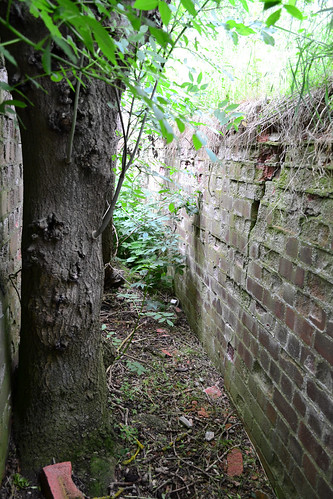
These pens were designed to specific dimensions and were designed as either a ‘Hurricane’ or ‘Blenheim’ to accommodate either a single engined or twin-engined aircraft. Within the back wall of these pens was a shelter for up to 25 personnel, and in some cases, they had Stanton Shelters built-in to the structures. Some, for example, at Kings Cliffe in Northampton, remain with rifle slits for additional protection from ground forces.

King's Cliffe airfield

Inside the aircraft pen shelter at King’s Cliffe.

Whilst the majority of these shelters were manufactured using banks of soil, sandbags, brick or concrete, there was a least one example at RAF Drem, in Scotland which used logs cut to size and shape and built in the style of a Scandinavian house. It is these various designs of aircraft pen that paved the way to modern hardened aircraft shelters (HAS) seen on military airfields today.

From the early days of grass runways to the massive lengths of concrete that were created up to and after the mid 1940s, runways and hardstands have become a defining factor in airfield design. The sole purpose of an airfield – to get aircraft off the ground as quickly as possible, get them to their target and them get them home again – led to the development of both runway lengths and construction materials, much of which has paved the way for modern airfields today. These early leaps into runway designs have enabled larger and heavier aircraft to make those important journeys that we very much take for granted in this the modern world of air travel and general aviation.

In the next section we look at one of the buildings most associated with the airfield. An early form of aircraft storage, its role changed as it was soon realised that aircraft needed to be dispersed and not grouped together on large aprons as they were in the prewar era. Aesthetics and neatly lined up aircraft were no longer an important factor in front line flying, but safety and the ability to repair aircraft quickly and efficiently were. Here we introduce the hangar, a huge building often of a temporary or transportable nature, that became one of the more longer lasting structures of airfield architecture.

Sources and further reading. 

*6 Letter from Arthur Harris to Lord Beaverbrook, February 1941 – AIR 19/492 – National Archives

50 Aviation Trails Reached!

I am pleased to announce that since starting Aviation Trails four years ago, I have now reached that magic number of 50 Trails around Britain’s wartime airfields, a feat I never thought would happen.

Each Trail covers two or more sites, in some cases six, many three, covering in total, over 100 former RAF and USAAF airfields and museums around Britain.

I can honestly say its been a terrific four years, in which I have learnt a lot about Britain’s wartime past, the men and machines that flew from these places and the tragedies that occurred at so many. The development of these airfields was staggering, the process of construction, and the subsequent decay just as eye-opening. These sites and the people who used them, have changed both the British and world landscape, leaving in many cases scars that may never heal. The buildings and stretches of concrete that remain are monuments to human endurance and sacrifice, a sacrifice that we hope may never have to be repeated.

RAF Tibenham Perimeter track

The perimeter track at the former RAF Tibbenham.

During these four years there have been several changes at many of these sites, hangars and other buildings have gone, runways are continuing to be dug up as they become prime land for development. As we speak there are numerous sites under planning proposals, whilst others are waiting in the wings to hear what their fate will be.

To compile these trails I have personally visited each and every one of these sites, even a field has a certain something when you know who stood there before you.

To all those who have visited, commented and followed me on this journey, I thank you, I hope you have enjoyed the journey back in time as much as I have writing it. I hope that through these trails, the memories of those who gave their all may live on so that future generations may know who they were and what they did, so that we may enjoy the peace we do today.

Here’s to the next 50!

Andy.

RAF Andrews Field – (Great Saling/Station 485) – Trail 33: Essex Part 1.

RAF Attlebridge  (Station 120) – Trail 7: Northwest Norfolk.

RAF Barton BendishTrail 7: Northwest Norfolk.

RAF Biggin Hill (Westersham) (Station 343) – Trail 4: Kent Part 1.

RAF Bircham NewtonTrail 20: North Norfolk (Part 1).

RAF Bodney (Station 141) – Trail 8: Swaffham and Her Neighbours (Part 1 of 3).

RAF BournTrail 31: Southern Cambridgeshire (Part 2).

RAF Brenzett (ALG) – Trail 18: Kent Part 2.

RAF BruntonTrail 47: Northumberland.

RAF Bungay (Flixton) (Station 125) – Trail 14:  Central Suffolk (Part 1).

RAF Bury St. Edmunds (Rougham) (Station 468) – Trail 16: West Suffolk (part 1).

RAF Castle CampsTrail 45: Essex (Part 2).

RAF Caxton GibbetTrail 29: Southern Cambridge (Part 1).

RAF Charterhall Trail 41: The Borders of Scotland and England.

RAF ChedburghTrail 49: Bomber Command – Bury St. Edmunds to Haverhill

RAF Collyweston Trail 37: The Northern Reaches of Cambridgeshire.

RAF Coltishall – Trail 7: Northwest Norfolk.

RAF ConingsbyTrail 1: Lower Lincolnshire.

RAF CottamTrail 40: Yorkshire (East Riding).

RAF CranwellTrail 2: Lincoln Borders and Newark.

RAF Debach (Station 152) – Trail 39: Suffolk around Ipswich (Part 1).

RAF Debden (Station 356) – Trail 46: Essex Part 3,

RAF Deenethorpe (Station 128) – Trail 6: American Ghosts.

RAF Deopham Green (Station 142) – Trail 27: Southern Norfolk (Part 3).

RAF Digby (Scopwick) – Trail 1: Lower Lincolnshire.

RAF Docking – Trail 20: North Norfolk (Part 1).

RAF Downham Market (Bexwell) – Trail 7: Northwest Norfolk.

RAF Drem – Trail 42: Edinburgh’s Neighbours.

RAF East Fortune – Trail 42: Edinburgh’s Neighbours.

RAF East Kirkby Trail 1: Lower Lincolnshire.

RAF East Wretham (Station 133) – Trail 13: Southern Norfolk around Diss (Part 2).

RAF Eye (Brome) (Station 134) – Trail 14: Central Suffolk (Part 1).

RAF Fersfield – (Station 130) – Trail 28: Southern Norfolk (Part 4).

RAF FoulshamTrail 22North Norfolk (Part 3).

RAF FowlmereTrail 32Southern Cambridgeshire (Part 3).

RAF Framlingham (Parham) (Station 153)Trail 39: Suffolk around Ipswich (Part 1).

RAF Glatton (Station 130) – Trail 6: American Ghosts.

RAF Gransden Lodge – Trail 31: Southern Cambridgeshire (Part 2).

RAF Graveley – Trail 29: Southern Cambridge (Part 1).

RAF Grafton Underwood (Station 106) – Trail 6: American Ghosts.

RAF Great Dunmow (Station 164)- Trail 33: Essex (Part 1).

RAF Great MassinghamTrail 21: North Norfolk (Part 2).

RAF Great Sampford (Station 359) – Trail 50: Haverhill’s neighbours – Wratting Common and Great Sampford.

RAF Hardwick (Station 104) – Trail 12: Southern Norfolk around Diss (Part 1).

RAF Hawkinge – Trail 18: Kent Part 2.

RAF Hethel – Trail 38: To the West of Norwich.

RFC HinghamTrail 38: To the West of Norwich.

RAF Hunsdon – Trail 25: Hertfordshire.

RAF Kimbolton (Station 117) – Trail 6: American Ghosts.

RAF King’s Cliffe (Station 367) – Trail 6: American Ghosts.

RAF LanghamTrail 23: North Norfolk (Part 4).

RAF Lashenden (Headcorn) – Trail 18: Kent Part 2.

RAF Lavenham (Station 137) – Trail coming soon.

RAF Little Snoring – – Trail 22North Norfolk (Part 3).

RAF MarhamTrail 7: Northwest Norfolk.

RAF Martlesham HeathTrail 48: Suffolk around Ipswich (Part 2).

RAF Matching (Station 166) – Trail 33: Essex Part 1.

RAF Matlask (Station 178) – Trail 34: North Norfolk (Part 5).

RAF MattishallTrail 36: North Norfolk (Part 6).

RAF Mendlesham (Station 156) – Trail 15: Central Suffolk (Part 2).

RAF MepalTrail 11: Around Ely.

RAF Methwold – Trail 8: Swaffham and Her Neighbours (Part 1).

RAF Millfield –  Trail 47: Northumberland.

RAF Narborough (Narborough Aerodrome)- Trail 7: Northwest Norfolk.

RAF North CreakeTrail 23: North Norfolk (Part 4).

RAF North Pickenham (Station 143) – Trail 9: Swaffham and Her Neighbours (Part 2).

RAF North WealdTrail 25: Hertfordshire.

RAF North Witham (Station 479) – Trail 3: Gone But Not Forgotten.

RAF Old Buckenham (Station 144) – Trail 13: Southern Norfolk around Diss (Part 2).

RAF Oulton – Trail 34: North Norfolk (Part 5).

RAF Polebrook (Station 110) – Trail 19: Northamptonshire American Ghosts II.

RAF Rattlesden (Station 126) – Trail 15: (Central Suffolk (Part 2).

RAF SawbridgeworthTrail 25: Hertfordshire.

RAF ScamptonTrail 30: Scampton and the Heritage Centre.

RAF SculthorpeTrail 21: North Norfolk Part 2.

RAF Shipdham (Station 115) – Trail 10: Swaffham and Her Neighbours (Part 3).

RAF Snetterton Heath – (Station 138) – Trail 27: Southern Norfolk (Part 3).

RAF Spanhoe Lodge (Station 493) – Trail 6: American Ghosts.

RAF Steeple Morden – Trail 32: Southern Cambridgeshire (Part 3).

RAF Stoke OrchardTrail 24: Gloucestershire.

RAF Stradishall- Trail 49: Bomber Command – Bury St. Edmunds to Haverhill

RAF Sutton BridgeTrail 3: Gone But Not Forgotten.

RAF Swannington – Trail 36: North Norfolk (Part 6) 

RAF Swanton Morley – Trail 38: To the West of Norwich.

RAF Thorpe Abbotts (Station 139) – Trail 12: Southern Norfolk around Diss (Part 1).

RAF Tibenham (Station 124) – Trail 13: Southern Norfolk around Diss (Part 2).

RAF Tuddenham – Trail 16: West Suffolk (Part 1).

RAF Tydd St. Mary – Trail 37: The Northern Reaches of Cambridgeshire.

RAF Upwood – Trail 17: The Pathfinders.

RAF Warboys – Trail 17: The Pathfinders.

RAF Watton (Station 376/Station 505) – Trail 9: Swaffham & Her Neighbours (Part 2).

RAF Wendling (Station 118) – Trail 10: Swaffham and Her Neighbours (Part 3).

RAF West Malling Trail 4: Kent Part 1.

RAF West RaynhamTrail 21: North Norfolk Part 2.

RAF WethersfieldTrail 45: Essex (Part 2).

RAF Westley – Trail 16: West Suffolk (part 1).

RAF WinfieldTrail 41: The Borders of Scotland and England.

RAF Winthorpe Trail 2: Lincoln Borders and Newark.

RAF WitchfordTrail 11: Around Ely.

RAF Wittering  – Trail 37: The Northern Reaches of Cambridgeshire.

RAF Woodall SpaTrail 1: Lower Lincolnshire.

RAF Wratting CommonTrail 50 – Haverhill’s neighbours – Wratting Common and Great Sampford.


Great Sampford – A disaster for the U.S. “Eagles”.

After leaving RAF Wratting Common, we turn south and head back past Haverhill towards Finchingfield. Reputedly one of the most photographed villages in England, it has a ‘chocolate box’ appeal, its quaint houses, old tea shops and village pond, reminiscent of Britain’s long and distant past. Finchingfield and this trail, are also close to the airfield at Wethersfield, and a short detour to the east, is an added bonus and a worthy addition to the trail.

This next airfield, a small satellite airfield, lies one and a half miles to the west of Great Sampford village, and five miles south-east of Saffron Walden. It is actually quite remote, with no public roads close to the site. Footpaths do cross parts of the former airfield, which is all now  completely agricultural.

As we head south we stop  off at the former airfield RAF Great Sampford.

RAF Great Sampford (Station 359)

RAF Great Sampford was a short-lived airfield, built initially as a satellite for RAF Debden, it would be used primarily by RAF Fighter Command, and later by the US Eighth Air Force. It was also used by 38 Group for paratroop training, and by the Balloon Command.

Being a satellite it was a rudimentary airfield, and accommodation was basic; utilising wooden huts as opposed to the more pleasant brick dwellings found at its parent station RAF Debden. It was very much the poorer of the airfields in the area, although by the war’s end a wooden hut would no doubt have been preferential to a cold, metal Nissen hut!

As a satellite it would be used by a small number of squadrons, No. 65 RAF, No. 133 (Eagle Squadron) RAF and No. 616 Squadron RAF. The famous Eagle Squadrons being manned by American volunteers, 133 Sqn was later renamed 336th Fighter Squadron (FS), 4th Fighter Group (FG), after their absorption into the US Army Air Force.

There were two runways at Great Sampford, one of grass and one of steel matting (Sommerfeld track), a steel mat designed by Austrian Expatriate, Kurt Sommerfeld. The tracking was adapted from a First World War idea, and was a steel mat that when arrived, was rolled up in rolls 3.25 m (10 ft 8 in) wide by 23 m (75 ft 6 in) long. It was so well designed that a full track could be laid, by an unskilled force, in a matter of hours. Each section could be replaced easily if damaged, and the entire track could be lifted and transported by lorry, aeroplane or boat to another location and then reused.

Sommerfeld track (along with a handful of other track types) were common on fighter, training and satellite airfields, especially in the early part of the war. It was also used extensively on forward landing grounds in Kent and later France after the Allied invasion of Normandy.

Tracking had to be robust, it had to be able to withstand heavy landings and be non-conspicuous from the air. Sommerfeld track met both of these, and other stringent criteria very well, although it wasn’t without its problems. Crews often complained of a build up of mud after heavy rain, and concerns over both tyre and undercarriage damage were also extensively voiced. Some records report tail wheels being ripped off after catching in the track lattice.

At Great Sampford the steel matting was 1600 yards long, extended later to 2,000 yards, the grass strip being much shorter at just over 1,000 yards. A concrete perimeter track circumnavigated the airfield, and due to the nature of the area the airfield took on a very odd shape indeed. With many corners and little in the way of straight sections, it may have suited the longer noses of the RAF’s Spitfires well, avoiding the need to weave continuously to see passed the long engine. However, because it was small and uneven, it caused numerous problems for pilots taking off, the hedges and trees proving difficult obstacles to clear without stalling the aircraft in an attempt to get above them.

Hangars and maintenance huts were also sparse, but four blister hangars were provided as the main structures for aircraft repair and maintenance.

Opened on 14th April 1942, the first unit to use the site was No. 65 (East India) Squadron RAF who arrived the same day that it was opened. No. 65 Sqn, being veterans of both Dunkirk and the Battle of Britain, had been moved about to regroup and refit, upgrading its aircraft numerous times before settling with the Spitfire.

The Spitfire VB of 65 Sqn (who were previously based at Debden) was a modified MK.V,  the first production version of the Spitfire to have clipped wingtips, a modification that reduced the wingspan down to 32 ft but increased the roll rate and airspeed at much lower altitudes. No. 65 Squadron, would use their Spitfire VBs for low-level fighter sweeps and bomber escort duties, something that suited the clipped wing version well.

Between April and July 1942, 65 Squadron would move between Debden, Martlesham Heath and Hawkinge with short spells in between at Great Sampford. They would then have a longer spell in Kent before leaving for RAF Drem in Southern Scotland. These repeated moves were largely in response to the threat of renewed Luftwaffe attacks on the airfields of southern England, and were part of a much larger plan put into place to protect the front line squadrons.

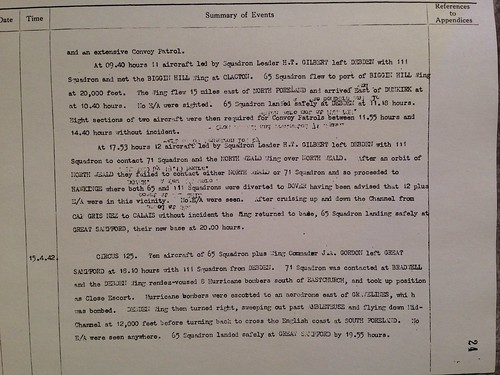
65 Squadron ORB Great Sampford

The entry in the Operational Record Book for April 14th shows the first landing of Spitfires at Great Sampford. (AIR 27/594/4)

On April 14th, the move took place, a move that was achieved under some difficulty as the squadron was called upon to participate in two Rodeo (fighter sweeps) operations. After extensive searching between Cap Gris Nez and Calais, no enemy aircraft were sighted, and so the wing returned to their various bases. At 20:00 hrs, the first 65 Sqn aircraft touched down at Great Sampford – the base was now open and operational.

The next mission would be the very next day – there was no let up for the busy flyers! “Circus 125” led by Wing Commander J. Gordon, consisted of ten aircraft from Great Sampford, who after taking off at 18:10, met with the bomber formation and escorted them to an airfield target near Gravelines. The entire mission was uneventful and the aircraft arrived safely back at Great Sampford at 19:55 hrs.

This mission pretty much set the standard for the remainder of the month. Numerous Rodeo and Circus operations saw 65 Sqn repeatedly penetrate French airspace with various sighting of, but little contact with, enemy aircraft. The first real skirmish took place on the 25th, when the Boston formation they were escorting was attacked by fourteen FW-190s. One of the Bostons was hit and subsequently crashed into the sea. Flt. Sgt. Stillwell (Red 3) of 65 Sqn threw his own dingy out to the downed crewman who seemed to make no effort to reach it – he was then assumed to be already dead.

On the April 27th, “Circus 142” took place, the escort of eight Hurricane bombers who were attacking St. Omer aerodrome. Three sections ‘Red’, ‘White’ and ‘Blue’ made up 65 Squadron’s section of the Wing, and consisted of both Rhodesian, Czech and British airmen. The Wing flew across the Channel at 15,000 ft, and when on approach to the target, they were attacked by 50-60 FW-190s. In the ensuing dogfight F/O. D. Davies, in Spitfire #W3461; P/O. Tom Grantham (s/n: 80281) flying Spitfire #BL442, and P/O. Frederick Haslett (s/n: 80143) in Spitfire #AB401, were all reported missing presumed dead. It was thought that both F/O. Davies and P/O. Grantham may have collided as they were together when they went down, P/O. Grantham was just 19 years of age.

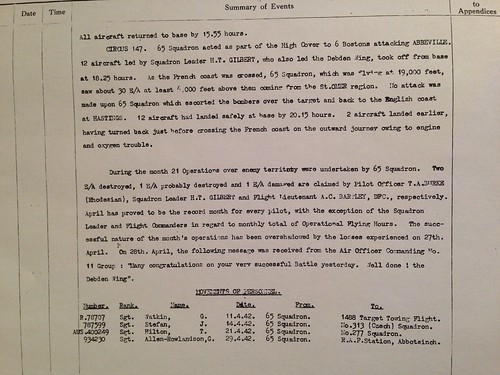
There were no further losses that month although operations continued up until the last day. In all, 21 operations had been flown in which 2 enemy aircraft were destroyed, 1 was a probable and 1 was damaged. April proved to be a record month in terms of operational flying hours for every pilot below the rank of Squadron Leader, the successes of which though, were marred by the sad events of the 27th and the loss of three colleagues.

On the 28th, their last day of this, the first of several stays at Great Sampford, a congratulatory message came though from the Air Officer Commanding No. 11 Group, “Well done the Debden Wing”, which went some way to lighten the atmosphere before the new month set in.*1

65 Squadron ORB Great Sampford

The Operational Record Book for 65 Squadron. A message of congratulations from the Air Officer Commanding No. 11 Group. (AIR 27/594/4)

It was three months later on July 29th 1942, that 65 Squadron would depart Great Sampford for the last time, and the next squadron would arrive, the Spitfire VIs of No. 616 Squadron RAF.

No. 616 Sqn were formed prior to the declaration of war in November 1938. An Auxiliary Air Force Unit, it too took part in supporting both the Dunkirk evacuation and the early days of the Battle of Britain. Now, at Great Sampford, it had been given the high altitude Spitfire, the MK. Vl, an attempt by Supermarine to tackle the Luftwaffe’s high altitude bombers, and quite the opposite to the VBs of 65 Sqn – these Spitfires had extended wingtips!

616 Squadron would, like 65 Sqn before them, spend July to September yo-yoing between Great Sampford and the airfields further south, Ipswich and Hawkinge, before departing Great Sampford for the final time on September 23rd 1942 for RAF Tangmere. Whilst here at Great Sampford, they would perform fighter sweeps, bomber escort and air patrols over northern France, engaging with the enemy on numerous occasions.

On the same day as 616 Sqn departed, the last operational unit would arrive at Great Sampford, the U.S. volunteer squadron, 133 Squadron known as one of the ‘Eagle Squadrons’. Being one of three squadrons manned totally by American crews, it had been on the front line serving at RAF Biggin Hill and RAF Martlesham Heath before arriving here at Great Sampford. Whilst some British RAF ground crews helped servicing and maintenance, the aircrew were entirely US, and crews were regularly changed as losses were incurred or crews were transferred out.

Many of these new recruits came in from other units. Ground crews coming into Great Sampford would have to get the train to Saffron Walden where they were met by a small truck who would take them to RAF Debden for a meal and freshen up. Afterwards they were transferred, again by truck, the few miles here to Great Sampford, the transformation was astonishing! In the words of many of those who were stationed here, “there was nothing ‘great’ about Great Sampford!”*2 Also flying Spitfire VBs, they were to quickly replace them with the MK.IX, a Spitfire that was essentially a MK.V with an updated engine. Having a higher ceiling than the FW-190 and being marginally faster, its improved performance took the Luftwaffe by complete surprise.

It would be a short-lived stay at Great Sampford though, as 133 Sqn RAF were disbanded on the 29th September, being renumbered as 336th FS, 4th FG, USAAF, and officially becoming US Air Force personnel. They were no longer volunteers of the Royal Air Force.

Just three days before this final transfer, on September 26th 1942, 133 Sqn would suffer a major disaster, and one that almost wiped out the entire squadron.

A small force of seventy-five B-17s from the 92nd BG, 97th BG and the 301st BG, were to mount raids on Cherbourg and the airfields at Maupertus and Morlaix, when the weather closed in. The 301st BG were recalled as their fighter escort failed to materialise, and the 97th BG were ineffective as cloud had prevented bombing to take place. The RAF’s 133 (Eagle) Sqn were to provide twelve aircraft (plus two spares) to escort the bombers on these raids. After refuelling and a rather vague briefing at RAF Bolt Head in Devon, they set off. Unbeknown to them at the time, the two pilots instructed to stay behind, P/O. Don Gentile and P/O. Erwin Miller, had a guardian angel watching over them that day.

During talks with P/O. Beaty, it was ascertained that the Spitfires had flown out above 10/10th cloud cover and so were unable to see any ground features, thus not being able to gain a true understanding of where they were. Added to that, a 100 mph north-easterly wind blew the aircraft far off course into the bay of Biscay. Finding the bombers after 45 minutes of searching, the flight set for home and reduced their altitude to below the cloud for bearings. Being over land they searched for the airfield, all the time getting low on fuel. Instead of being over Cornwall however, where they thought they were, they were in fact over Brest, a heavily defended port, and in the words of 2nd Lt. Erwin Miller – “all Hell broke loose.” *3

In the subsequent battle, all but one of 133 Sqn aircraft were lost, with four pilots being killed.  P/O. William H. Baker Jr (O-885113) in Spitfire #BS446; P/O. Gene Neville (O-885129) in Spitfire #BS140 – Millers replacement; P/O. Leonard Ryerson (O-885137) in Spitfire #BS275 and P/O. Dennis Smith (O-885128) in Spitfire #BS294.

Only one pilot managed to return, P/O. Robert ‘Bob’ Beatty,  who crash landing his Spitfire at Kingsbridge in Devon after he too ran out of fuel. During the crash he sustained severe injuries but luckily survived his ordeal. From his debriefing it was thought that several others managed to land either on the island of Ouissant or on the French mainland. Of these, six were known to have been captured and taken prisoners of war, one of whom, F/Lt. Edward Brettell  DFC was executed for his part in the Great Escape from Stalag Luft III. A full report of the events of that day are available in an additional page.

There would be no further operational flying take place for the rest of the month for 133 Sqn – all in all it was a disastrous end for them, and to their spell as RAF aircrew.*4

Pilot Officer Gene P. Neville 133 (Eagle) Sqn RAF, stands before his MK. IX Spitfire at Great Sampford. He was Killed during the Morlaix disaster. (@IWM UPL 18912)

Because these marks of Spitfire were in short supply, the remainder of the Squadron were re-equipped with the former MK.VBs, a model they retained into 1943 before replacing them with the bigger and heavier Republic P-47 ‘Thunderbolts’.

As a result of the losses, the dynamics of the group would change. The cohesive nature of the men who had been together for so long, was now broken and the base took on a very different atmosphere.

The effect on those left behind was devastating, morale slumped, and in an attempt to raise it, Donald ‘Don’ Blakeslee ordered the remaining pilots to line up along the eastern perimeter track and take off in formation; something that had been considered virtually impossible due to its short length, uneven surface and rather awkwardly placed trees along its boundary. Blakeslee, who became a legendary fighter pilot with both 133 Sqn and later the 4th Fighter Group (FG), led the group in true American Style, getting all the aircraft off the ground without any mishaps. Heading for Debden, they formed up, and flew directly over the station at below 500 feet, shaking windows and impressing those on the ground with precision flying that took as much out of the pilots as did air to air combat.

That night, the mess hall at Debden, was awash with celebrations as 133 Squadron pilots enjoyed the limelight they had for so long deserved.

On the next day, September 29th, the crews packed their personal belongings and departed Great Sampford for the comforts of Debden, where an official handover took place. General Carl Spaatz and Air Chief Marshal Sir Sholto Douglas, witnessing the official transfer of the three Eagle Squadrons to the United States Air Eighth Air Force, a move that on the whole, pleased the American airmen.

From then on, Great Sampford would remain under control of the USAAF, being used as a satellite for the 4th FG at Debden, but without any permanent residents. The occasional flight of Spitfires or P-47s would land here whilst on detachment or away pending a Luftwaffe attack. In the early stages of 1943, the Americans decided that Great Sampford (renamed Station 359 as per US designations) was no longer suitable for their needs as it wouldn’t accommodate either the  P-38s or the P-47s due to its awkward size and shape. By February 1943 they had pulled out, and Great Sampford was returned to RAF ownership. By March 1943 the airfield now surplus to flying requirements, was closed, used only by a large selection of RAF Regiments training in airfield defence, Guard of Honour duties and VIP Security. The station eventually closed in August 1944.

Airmen of the 336th Fighter Squadron, 4th Fighter Group with a clipped wing Spitfire Mk. Vb (MD-A), 1943. Handwritten caption on reverse: '19A. KP. Fall, 1942. Great Sampford Satellite Field. 336th crew by 336th Spit Mk. Vb. Wings clipped by sawing off wing & pounding in board then carving and painting it. MD-A, red/blue wheel. Source -Bill Chick, Megura.'

Airmen of the 336th Fighter Squadron, 4th Fighter Group with a clipped wing Spitfire Mk. Vb (MD-A), 1943. at Great Sampford. (@IWM – FRE3230)

However, this closure was not the end for Great Sampford. With paratroop operations progressing in Europe, the airfield was put back into use on 6th December 1944 by 620 Sqn in Operation ‘Vigour‘.

No. 38 Group, in need of practice areas, had acquired the airfield, and were dropping SAS paratroops into the site. This flight preceded another similar activity the following day where Horsa gliders pulled by 620 Sqn Stirlings, took part in Operation ‘Recurrent‘; a cross-country flight from RAF Dunmow in Essex. This flight culminated with the Horsas being released and landing here at Great Sampford. These activities continued throughout the appalling winter of 1944 / 45, and into the following months. In March, in the lead up to Operation ‘Varsity‘ the allied crossing of the Rhine, there was further activity in the skies of this small grass strip. Operation ‘Riff Raff‘  saw yet more paratroops and gliders at Great Sampford, whilst in November 1945, after the war’s end, Operation ‘Share-Out‘ saw the final use of Great Sampford by the paratroops. No. 620 Squadron, who had been based at RAF Dunmow, were now winding down themselves and their use of Great Sampford ceased virtually overnight.

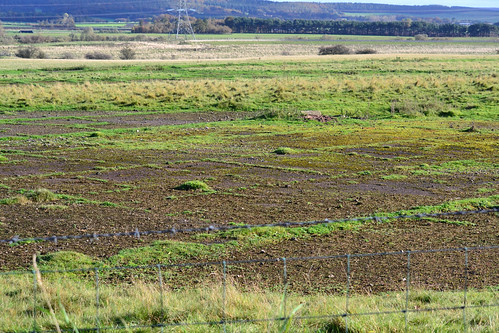
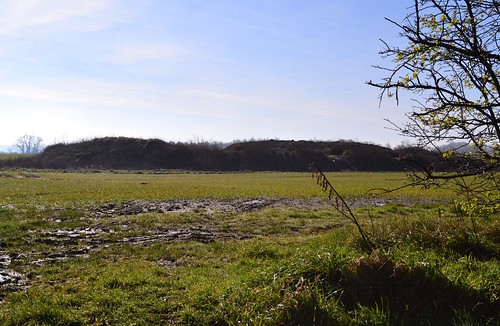
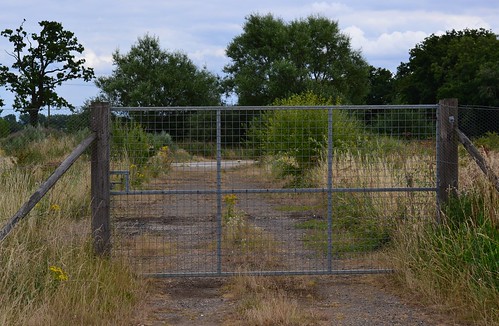
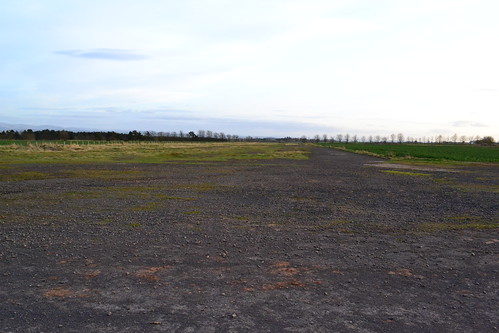
Since then, Great Sampford has become completely agricultural, the perimeter track virtually all that remains of this small but rather interesting site. It lies in a remote area, fed only by farm tracks and small footpaths. The tracks, now a fraction of their original size, still weave their way around the airfield as they did for that short, but busy time, in the mid 1940s.

Regretfully the airfield and its unique history has all but passed into the history books, and rather sadly, no memorial marks the airfield, even though many airmen were lost during  the many sorties in those dark days of the war-torn years of the 1940s.

We depart Great Sampford heading off once more, the airfields of Essex and East Anglia beckoning. As we move off, we spare a thought for those for whom this was the last view they had of ‘home’, and of those who never came back to this quiet and remote part of the world.

Sources and further reading

*1 National Archives: AIR 27/594/4 .

*2 Goodson. J,. “Tumult in the clouds” Penguin UK, (2009) 

*3 Price. A., “Spitfire – A Complete Fighting History“, Promotional Reprint Company,  (1974).
*4 National Archives: AIR 27/945/26

National Archives: AIR 27/945/25

The “Slightly-out-of-Focuswebsite has details of a photo essay documenting the planning and execution of an airborne exercise prior to Operation Varsity. It’s a detailed document which includes gliders of 38 Group RAF landing at Great Sampford.

RAF Debden (Part 3) – The USAAF Arrives.

After Part 1 and Part 2 of the trail, we find that Debden has a new owner, the USAAF. Its fortunes change and it becomes home to one of the most famous Fighter Groups of the Second World War.

121 Sqn, were reformed in 1941 at Kirton-in-Lindsey, initially with the Hurricane MK. I, and then IIBs moving on to the Spitfire IIA and eventually the VB; a model they brought with them to Debden. 71 Squadron had been formed at Church Fenton, and after moving through a series of stations that included Martlesham Heath, they arrived at Debden on 3rd May 1942 also with the Spitfire VB. On September 29th 1942 the two RAF units along a with a third, the 133 Sqn at Great Sampford,  were officially disbanded, but the men of the three units were not dispersed. Instead they absorbed into the USAAF as the 4th Fighter Group (FG). The men of these squadrons were all originally US volunteers who formed the three  American ‘Eagle Squadrons‘ operating within the Royal Air Force.

The 4th FG was specially created to take these three squadrons, they were brought together at Debden where they became the 334th (71 Sqn), 335th (121 Sqn) and 336th (133 Sqn) Fighter Squadrons (FS).  Debden would then be passed from the RAF to the USAAF, the transition of which, would be smooth and relatively uneventful, the units retaining the Spitfires they already had before replacing them with P-47s later in 1943.

A Spitfire Mk. V (QP-V) of the 334th Fighter Squadron, 4th Fighter Group. Handwritten caption on reverse: '1942. 334 FS. 4th FG.'

A Spitfire Mk. V (QP-V) of the 334th Fighter Squadron, 4th Fighter Group. (IWM)

The handover of ownership of Debden took place on the 12th September 1942, with an official ceremony on the 29th to coincide with the disbandment of the RAF units. During this ceremony both Major General Spatz and Brigadier General Hunter were joined by Air Chief Marshal Sir Sholto Douglas of the RAF’s Fighter Command, to see Debden and the aircrews officially joining the ranks of the USAAF. Initially little changed after the handover, the most prominent feature being the removal of the RAF roundels and the application of the US Star on the aircraft’s fuselage and wings. New ground crews were brought in and trained by RAF personnel to maintain the Spitfires, and so RAF crews remained on site until such times as the American were in position to become self-sufficient.

As these crews had been involved in front line operations for some time – the 71st having gathered a total of over half the 73.5 kills recorded by the three squadrons – they were immediately made operational and went on performing in the duties they had been so adept at completing thus far. So proud of their origins were they, that the 4th FG stood out from their fellow Americans both in the way they flew, and the way they behaved.

With their first mission under the ‘Stars and Stripes’ on October 2nd, they would not have to wait long before seeing action once again. The Eagle Squadrons would become famous throughout the war, achieving many records in aerial combat over the next three years. Taking part in the Normandy invasion, aerial battles over Northern France, the Ardennes, the Rhineland, and over Berlin itself; they would not be short of combat experience. Throughout their time the 4th FG would achieve many ‘firsts’. They were the oldest fighter group of the Eighth Air Force, and their combined totals of  enemy aircraft destroyed both in the air and on the ground was the highest of the entire USAAF. They were also the top scoring Allied Fighter Group of the war, destroying 1016 enemy aircraft for a loss of 241 of their own aircraft, many of which were due to flak. They would be the first unit to engage the enemy in air battles over both Paris and Berlin, and they would be the first US Eighth AF Group to penetrate German airspace – a record they established on 28th July 1943. The 4th would also be the first fighter group to be selected to escort the heavy bombers of the USAAF on their first shuttle run, landing in Russia before returning home.

Not only did they undertake many ‘firsts’, but the 4th FG gained an undeniable reputation, between the 5th March and 24th April 1944 they earned a Distinguished Unit Citation when they shot down 189 enemy aircraft whilst destroying 134 on the ground. You cannot mention the 4th without mentioning the name of Donald M. Blakeslee, credited with 16 kills, he was a brilliant fighter pilot who retired from the USAAF as a Colonel. Blakeslee was considered one of finest combat fighter leaders of the Second World War who shunned publicity even refusing to paint ‘kills’ on his aircraft, and he was known, on several occasions, to give kills to rookie airmen. Blakeslee initially flew in 401 Sqn (RCAF) before transferring to 133 Sqn and then the USAAF when they transferred across. He was a remarkable man, a great leader who was looked up to by all those who flew with him, he sadly died in September 2008 leaving a daughter. All-in-all, the 4th achieved quite a remarkable record considering they were initially volunteers of the American air war in Europe.

The 4th FG would remain at Debden thought the war, leaving it only when the RAF required the return of the airfield in July 1945, at which point the whole group packed up and departed for Steeple Morden in Cambridgeshire.

Airmen of the 4th Fighter Group ride in the back of a jeep at Debden air base. A P-47 Thunderbolt is in the background of the shot. Passed by the U.S. Army on 2 October 1943, THUNDERBOLT MISSION. Associated Press photo shows:- Pilots at a U.S. Eighth Air Force station in England are taken by truck from the Dispersal room to their waiting P-47's (Thunderbolts) at the start of a sortie over enemy territory. L-R: Lt. Burt Wyman, Englewood, N.J. ; Lt. Leighton Read, Hillsboro, W.V.; F/O Glen Fiedler, Frederickburg, Tex. AKP/LFS 261022 . 41043bi.' [ caption].' Passed for publication ....1943'. [stamp].

Taken almost a year to the day the US forces moved in, airmen of the 4th FG are taken ot heir P-47s before departing on a mission over enemy territory. The aircrew are: L-R: Lt. Burt Wyman, Englewood, N.J. ; Lt. Leighton Read, Hillsboro, W.V.; F/O Glen Fiedler, Frederickburg, Texas. (FRE 28 – IWM).

As 1943 dawned it would become much quieter in terms of movements at Debden. Now officially a US fighter airfield, the RAF had little to do here. For a short period of a week, 303 Squadron would stop over, the only visitors to make any great use of the airfield for the entire year. With Debden having long concrete runways, it was regularly visited by the lighter bombers, Marauders and Havocs taking refuge here from their own fog bound airfields during poor winter weather. It was during this time in 1943, that The Duchess of Kent, made a royal visit to Debden, taking time out to inspect the aircraft and crews of the 4th Fighter Group, accompanied by General D. Hunter and Colonel Edward Anderson.

With that 1943 faded into 1944, the jet age was dawning and the end of the war nearing sight.  In the July, 616 Squadron appeared with the Meteor, Britain’s first operational Jet aircraft. The squadron detachment stayed here until early 1945 when they moved on to Colerne and eventually the continent.

This move would signify the end of operational flying at Debden. The RAF retained the site reforming the Empire Flying Training School here on 7th March 1946 by merging both 12 and 14 Radio Schools into one. Flying a number of aircraft including Proctors, Tiger Moths, Ansons, Dominie and Lincoln IIs until October 20th 1949 when it was disbanded and Debden became the Royal Air Force Technical College, Signals Division. After a further name change the unit was finally disbanded on April 8th 1960, after it had operated a variety of aircraft including an: Anson, Air Speed Oxford, Spitfire XVI, Lincoln and Varsity.

Between 1963 and October 1973, Vampire F. MK.3 VF301 stood outside Debden’s front gate as guardian, one of several that have been here. It is now sits in the Midland Air Museum at Baginton in the markings of 605 (County of Warwick) Sqn as ‘RAL-G’.

DH Vampire F-1

A former Guardian of Debden now at the Midland Air Museum at Coventry’s Baginton airport.

Although remaining open, the airfield was used for a number of public displays and as a race track, including in 1966, the RAF Debden Motor Gala which featured Donald Campbell’s car, Bluebird CN7, in which Campbell set the land speed record in 1964.  Parts of the site are still used for racing today by the Borough 19 Motor Club*3

In 1975 the airfield officially closed although 614 Gliding School (later 614 Volunteer Gliding School) remained on site using it for flying, until they too departed moving to Wethersfield in 1982.

The army took over the site when the RAF Departed and they remain there to this day.

Debden, because if its post war usage, is a remarkably unique site, but whilst many of the original buildings remain intact, some even being listed as Grade II buildings*4, access is not permitted to the general public and therefore very little can be seen without prior permission. From public roads, high fences and thick hedges obscure most views although from the south, parts of the runway, and several dispersals can be seen quite easily.

RAF Debden

One of the pans now missing its Blister hangar.

By keeping the gate house to your right and passing along the road east to west, you pass the current accommodation area, Guard House and modern buildings used by the current Army owners. Continuing along this road soon brings you to the memorial. Whilst there is no official parking space here, there is a grass verge opposite the memorial where you can safely park your car off the busy main road. Behind the memorial is the north-south runway, still in full width, in which a small section of it can be seen as it rises and dips over the hill. Returning toward the main entrance brings you to a parking area on your right, where public access is permitted to Rowney Wood. Here there are a small number of original buildings still left along with former roads / and taxi ways. During its US occupation, there were five Blister Hangars located here, today only a couple survive, both in current use by local companies.

Like many former airfields and military sites, Debden has been identified as a possible housing location, with the potential for the construction of 55,000 homes. The announcement to close the barracks was made on November 7th 2016, as part of the ‘Better Defence Estate’ strategy, in which 91 MOD sites across the country will close by 2040. Government figures say that the move will save £140 million by closing these sites which also includes the US base at Mildenhall.*5

Considering the history of RAF Debden and the current status of its buildings, the restrictive nature of the site is also its guardian angel. However, with the axe looming heavily overhead, what will become of this site in the future? Its runways will no doubt be dug up, the older non-classified buildings could be demolished, its pathways and taxiways removed. Debden is in danger of disappearing for good leaving only small traces of this once famous airfield that not only took part in the Battle of Britain, but whose airmen defended London in what was very much our darkest hour.

Sources and further reading.

*2 AIR 27/703/17 National Archives

*3 ‘Borough 19 Motor Club’ website has details of their race activities.

*4 One such building is the Sector Operations Block, built in 1938, to the designs of J.H. Binge of the Air Ministry’s Directorate of Works and Buildings (drawing no. 5000/137).

*5 The story was highlighted in the Saffron Walden Reporter website accessed 11th October 2017.

Royal Air Force Police Flights who were at Debden have photos and information on their website.

RAF Debden (Part 2) – The Battle of Britain.

Following on from the first part of this Trail, we see how Debden was thrust into the Battle of Britain and the historic changes that followed.

On August 18th 1940,  at 17:30, the squadron consisting of thirteen aircraft were scrambled to patrol the Skies over Debden. Almost immediately they were diverted to Canterbury and ordered to patrol at 20,000 ft. Five minutes after reaching their designated point, they were ordered into battle attacking ‘raid 51’ who were crossing the coast in the vicinity of Folkestone. Within minutes, the two formations were entwined and the aircraft of 85 squadron set about the 150 – 250 machines of the Luftwaffe.

A mix of J.U. 87s, H.E.111s, J.U. 88s, M.E. 110s and M.E. 109s were staggered in layers between 10,000 feet and 18,000 feet, and as soon as the aircraft of 85 squadron were sighted, the enemy immediately employed tactical defensive manoeuvres with some of the bombers heading seaward whilst other climbed toward their fighter protection.

Hugely lacking in aircraft numbers, the RAF  had little choice but to ‘dive in’, as a result large numbers of individual ‘dog fights’ occurred, resulting in aircraft being strewn across the Essex sky around Foulness Point.  For a while there was complete chaos, aircraft were burning and crews knew little of each other’s whereabouts. In one incident P/O. J. Marshall (Yellow 2) followed his leader into attack. In the melee that followed Marshall flew into a cloud of vapour created by a damaged H.E.111 his wing colliding with the tail of the Heinkel severing it completely and cutting the wing tip-off of his own aircraft. Despite the damage Marshall nursed his crippled aircraft to Debden where he landed safely and unhurt.

During this attack six Me 110s, three Me 109s and one He 111 were confirmed as destroyed, a further He 111, Me 110, Ju 87 and Me 109 were confirmed as probables, whilst four Me 110s and two Do 17s were known to have been damaged.

85 Squadron casualties on the day consisted of one Hurricane destroyed and one damaged. It was during this attack that  Flight Lieutenant Richard H.A. Lee, D.S.O., D.F.C. (s/n 33208), flying as Blue 1, was last seen by Sqn. Ldr. Townsend and F/O. Gowers 10 miles east of Foulness Point chasing 5 Me 109s. He lost contact and failed to return to Debden.  Lee, a veteran with nine victories to his name, was Lord Trenchard’s Godson, and was reported missing that day. *2

On the next day, 19th August 1940, 85 Squadron departed Debden, swapping places with 111 squadron who had previously moved to Croydon. In a signal Air Chief Marshal Sir Cyril Newall, G.C.B., C.M.G., C.B.E., A.M., expressed his thanks to the crews of 85 Sqn, sending his gratitude for “all your hard fighting” in which he added “This is the right spirit for dealing with the enemy.” 85 Squadron went on to continue the fight at Croydon flying in the same determined manner they had shown whilst based at Debden.*2

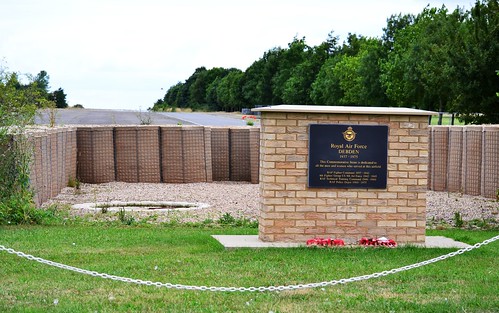
RAF Debden

The memorial at Debden sits at the end of the north south runway (seen behind).

It was also during August 1940 that Debden became a focus for attacks by the Luftwaffe. On the 20th, a small reconnaissance mission took German aircraft over the airfield along with other airfields in the region. Six days later, on August 26th, the first attack on Debden would occur, a combined attack that would also involve strikes on Kenley, Biggin Hill, Hornchurch and North Weald airfields.

Whilst 11 Group – whose sector headquarters were at Debden – put up ten squadrons and one flight to intercept the incoming raiders,  a number of bombers did get through and over 100 bombs were dropped on the airfield damaging the landing area; the sergeants mess, NAAFI , a motor transport depot and equipment stores. In addition to this the water and electricity supplies were both cut, and five personnel were killed. The raid was made worse by the inefficient vectoring of protective aircraft from Duxford due to them being unable to obtain the correct radio frequency. This mishap did little to help the ongoing ‘dispute’ between Air Marshal Sir Keith Park and Air Vice-Marshall (later Air Marshal) Sir Trafford Leigh-Mallory, who were both locked in dispute over the defences of 11 Group’s airfields – it was arguably this feud that eventually cost Park his command of 11 Group, and a move as AOC to Malta.

At the end of August, Debden would once again become the focus of Luftwaffe attacks. Shortly after 8:00am on the morning of August 31st 1940, waves of Luftwaffe bombers flew over Kent turning northwards toward North Weald, Duxford and Debden. A formation of Dornier bombers managed to reach Debden again where they dropped over 100 incendiary and high explosive bombs on the airfield. This time the sick quarters and barrack blocks received direct hits whilst other buildings were damaged by blasts.

Further attacks on September 3rd and 15th failed to materialise and Debden was finally left alone to lick its wounds and repair the damage to its fragile infrastructure. It was also during this time (2nd September to the 5th September 1940) that all three resident squadrons: 257, 601 and 111  would depart, leaving Debden behind and heading further south to pastures new.

With the ending of the Battle of Britain, things would become a little quieter at Debden, although movements of man and machine would continue with a perpetual occurrence. The October and November would see more short stays: 25 squadron (8th October for around two and half months); 219 Sqn as a detachment for two months, and 264 Sqn at the end of November for just one month. These changes would lead Debden into the new year and 1941.

During 1941, 85 Squadron would return yet again, and after being bounced around with almost regular occurrence this, their final visit, would be in the night fighter role. Initially using their Hurricanes and then Defiants, they soon replaced these with the Havoc before vacating the site for good and the fields of Hunsdon in May that year.

There were yet more short stays during 1941: 54 Squadron in June (two days), 403 Squadron (25th August  – 3rd October); 258 Squadron (3rd October  – 1st November); 129 Squadron (1st November – 22nd December); 418 squadron (15th November – 15th April 1942); a detachment of 287 Squadron; 157 who were reformed here on 13th December moving to Castle Camps five days later where they would receive their Mosquito II aircraft, and finally 65 Squadron who arrived three days before Christmas and stayed until 14th April 1942.

One of these squadrons, 403 Squadron flying Spitfire VBs, was formed as a result of Article XV of the Riverdale Agreement, in which it was agreed between the British Government and the nations of the commonwealth: Canada, Australia and New Zealand; that their trained military personnel would fly and operate as part of the Royal Air Force. This would mean that both air and ground crews would perform their duties under RAF command. Some 70 squadrons were created as a result of this agreement, and of those seventy, 67 were numbered in the 400 series. Even though they were part of the RCAF, RNZAF and RAAF, they were treated as integral parts of the British Royal Air Force for the duration of the conflict.

Into 1942 and yet more of the same, 350, 41, 124, 232 and 531 Squadrons all following this similar pattern of short stays and placements, thus life at Debden was becoming a constant carousel of ground crews and flying personnel. Two squadrons from here did make a real name for themselves though, that of 71 and 121 Squadrons.

In Part 3, we see Debden take on a new owner, its fortune changes and it becomes home to one of the most famous Fighter Groups of the USAAF – the 4th Fighter Group.

RAF Debden (Part 1) – The Build up to the Battle of Britain.

Not far from Wethersfield, lies the parent airfield of Castle Camps. Now closed to aviation, it currently resides in the hands of the Army as the Carver Barracks. On this next part of this Trail we wind our way through the Essex countryside to the former fighter station that gained notoriety during the early 1940s, and in particular the Battle of Britain. In this, the first part of the visit, we look into the development of the airfield, and the build up that took it into the heart of the Battle. We visit the former RAF Debden.

RAF Debden (Station 356) – Essex

The internet and history books are awash with pictures and information about RAF Debden, and rightly so. It is an airfield with an incredible history, famous for its part in the Battle of Britain and the defence of London, it was home to no less than thirty RAF squadrons at some point; it was used by the U.S. volunteer squadrons the ‘Eagle Squadrons’, and then taken over by USAAF as a fighter airfield following their official entry into the war. It was then used again by the RAF post war up until 1975 when the British Army took over,  those whose hands it remains in today as the Carver Barracks.  Not only is it history long but the site is historically highly significant. According to Historic England, Debden airfield represents “one of the most complete fighter landscapes of the Battle of Britain period“, considered historically important due to its “largely intact defensive perimeter and flying-field with associated blast pens“.*1

Debden is therefore a remarkable site, but as an active military base, access and views are understandably very restricted. However, some buildings can still be seen from public areas, particularly the front as you pass by the main entrance.

RAF Debden

One of 11 Blister Hangars built at Debden.

Debden’s life began in the mid 1930s, it eventually opened in 1937, as part of the expansion programme of the pre-war era, and was classified as a fighter airfield under Scheme ‘C’ of the airfield construction programme. During this period, great consideration was given to the architectural features of airfield buildings, standard designs being finished and positioned aesthetically in line with both the local landscape, stone and environment. Design and construction of these airfields, in this the second part of the expansion phase, was carried out in conjunction with the Royal Fine Arts Commission, whose influence led to an overall improvement in airfield design. During this phase of expansion, over 100 permanent sites were built using these new designs, in fact, according to Historic England, it is these sites that have tended to survive in the best condition to date largely thanks due to their post war and Cold War usage. Even in this pre-war period, aesthetics were as important as operability!

Built by W. L. Fench Limited, Debden wasn’t completed until after it had been opened, thus the first units there were using the site in its unfinished state. The two initial landing surfaces were grass, but as a fighter airfield little more was needed. Even so, and not long after it opened, these were replaced by concrete and tarmac surfaces, giving the airfield much stronger and more adaptable landing surfaces. Being the standard 50 yards wide, these runways were also extended from the initial 1,600 and 1,300 yards to 2,600 and 2,100 yards respectively, allowing for larger and more powerful aircraft to utilise the site.

Debden had a large number of hangars built: three ‘C’ type, one Bellman and eleven blister hangars which were all spread around the perimeter and technical areas of the airfield. Some 80 hardstands were also provided, thus large quantities of aircraft were expected to use the site at one point or another.

Of these thirty operational flying squadrons to pass through Debden, the primary aircraft to see service would be the Spitfires and Hurricanes of Fighter Command. Biplanes such as the Demon and the Gloster Gladiator were also to feature here, as were the twin-engined aircraft the Beaufighter, Havoc/Bostons and the jet engined Meteor in the latter stages of the war. The period 1939 – 1942 though, was by far the busiest period for Debden, the majority of squadrons operating from here during this time.

Upon opening in 1937, Debden would operate the outdated and obsolete biplanes of the Royal Air Force, Hawker’s Fury II of 87 squadron being the first to arrive on 7th June 1937, being replaced shortly after by Gloster’s Gladiator, that famous Biplane that protected Malta as ‘Faith’, ‘Hope’ and ‘Charity’. In the summer of 1938, prior to the outbreak of war, Hurricanes were brought in and the entire squadron moved to airfields in France where they would stay until May 1940, when France was invaded by the German forces. Brought back to England, a short two-day stop over at Debden, would lead to a move north and Yorkshire before returning to the battle, and a night fighter role over Southern England.

Joining 87 Sqn in June 1937 were further Gladiators, those of 80  Squadron who, themselves formed a month earlier, would stay at Debden until departing for the Middle East and Ismailia a year later. A third squadron would arrive during this time, 73 Squadron, who shortly after reforming at nearby Mildenhall, would also replace their Hawker Furys with Gladiators coinciding with their move to Debden. Also moving to France, 73 Sqn would eventually move to the Middle East, where they would remain for the duration of the war, flying from numerous airfields including that of Habbaniyah, one of several places where my father was stationed post-war.

One other squadron would grace the skies over Debden that year, that of 29 Squadron, whose Hawker Demons were adapted to accept a Frazer-Nash turret for defence. A small aircraft, they would be no match for enemy fighters and so were replaced in December 1938 by the far superior aircraft the Blenheim IIF. Coinciding with this, was the movement of a detachment of 29 sqn aircraft to Martlesham Heath, which was followed by a months stay at RAF Drem in the border region before returning to Debden once more. By the end of June though, the entire squadron have been pulled out of Debden and moved to Digby in Lincolnshire and a new role as night fighters.

1938 also saw the reforming of 85 Squadron on the 1st June. 85 sqn, as a unit, had their roots in the First World War, being stationed in France before disbandment in the summer of 1919. But on this occasion, they were reformed out of ‘A’ Flight of 87 squadron prior to them taking on their Hurricanes and imminent move abroad. During the period 1939 – 1940, 85 Sqn would move around almost weekly, with one of their longest permanent stays being between November 1938 and September 1939 whilst here at Debden. Being the parent airfield of Castle Camps, Debden units would often be dispersed there, or in some cases stationed there, whilst also operating out of Debden – 85 Sqn being no exception.

Two other squadrons would fly from Debden during the winter/spring of 1939 – 40, both 17 and 504 operating the Hurricane MK. I. On an almost weekly basis, both units would yo-yo between Debden and Martlesham Heath, an almost continuous spiral of postings saw them using the ‘Heath’ as a forward operating airfield until around May 1940, when both units were moved to France in support of the B.E.F.

Hawker Hurricane Mark Is of No 17 Squadron taxiing at Debden, July 1940. In the foreground is YB-C, that of the CO, Squadron Leader Harold ‘Birdy’ Bird-Wilson, who was shot down on 24th September flying YB-W (P3878) (IWM – HU 54517)

As the fall of France turned into the Battle of Britain, fighter units to defend Britain became top priority. The dawn of 1940 would see the beginning of six more squadrons operate out of Debden, the majority of which would arrive during the height of the Battle. Debden, as the Sector Station responsible for the Thames Estuary and eastern approaches to London, would become a prestige Luftwaffe target during those early days of the Battle. As a result, it along with other Sector stations at Northolt, North Weald, Biggin Hill, Tangmere and Hornchurch, would endure some of the most sustained and prolonged attacks by German bomber formations.

To meet the demand for fighter units, 257 Squadron were reformed and posted to Debden initially flying the Spitfire MK. I. They quickly replaced these with the Hurricane I prior to them becoming operational on July 1st. Four days later they were joined at Debden by both 601 (the ‘Millionaires Squadron’ named so after the men who initially joined it) and 111 Squadron making this one of the largest collections of Hurricanes at that time.

85 Squadron were soon in the thick of the battle. As July 1940 turned to August, patrols would be sent up as regularly as the sun would rise, many of these patrols would result in enemy engagement; the Operational Record Books being testament to the continuing battle for the skies over Britain at that time. At the beginning of August on the 7th, Air Vice-Marshal K.R. Park M.C., D.F.C. visited  Debden, a visit that preceded the transfer of Debden from 12 Group into 11 Group. It was also at this time that the funeral of P/O. Britton of 17 Sqn took place, a young man who lost his life in a flying accident on the 6th whilst carrying out an air test in Hurricane N2456. In poor weather, visibility of only four miles, P/O Britton crashed into Debden Park destroying the aircraft in which he lost his life.

In mid August 1940, both ‘A’ and ‘B’ flights of 85 Sqn were brought back from Martlesham Heath and Castle Camps to Debden, a move that preceded the not only the first but one of the largest attacks by a Debden squadron on enemy aircraft.

In part 2, we see how Debden was affected by the German campaign, the relentless attacks that drew Debden crews into battle. We look at the changes at Debden and how the American made a name for themselves as determined and fearless fighter pilots.

*1 Historic England, Historic Military Aviation Sites – Conservation Guidance, 2016.

R.A.F. Wethersfield (U.S.A.A.F. Station 170).

After a short journey from Castle Camps we soon arrive at our next port of call. This airfield, although a Second World War airfield, saw little action but was used by both the U.S.A.A.F. and the R.A.F. both during and after the war. Whilst it does not generally have active flying units today, it does house the M.O.D. dog training unit and as such is classed as an active military site.

This part of the trail brings us to the former airfield RAF Wethersfield.

R.A.F. Wethersfield (Station 170).

RAF Wethersfield was originally designed and built as a Class ‘A’ bomber airfield with construction occurring during 1942. During this expansion period materials and labour were both in short supply, which delayed the completion of the airfield until late 1943. During this period, ownership of the airfield passed hands several times, initially belonging to the Eighth Air Force, it was to be loaned to the R.A.F. between December 1942 and May 1943, before returning back to American hands. However, the delay to construction meant that by the time it was completed and opened, it would not be used by the R.A.F. but passed instead directly into the hands of the ‘new’ U.S. Ninth Air Force.

Constituted in 1941, the Ninth had already been fighting in Egypt and Libya, before they were moved to England in late 1943 in preparation for the forthcoming invasion of the continent. Throughout the remainder of the war they would pave the way for the advancing forces from Normandy deep into Germany itself. As an Air force, it would be disbanded in 1945 only to be reborn post war as part of the Tactical Air Command, and latterly the Continental Air Command, at which point it was assigned to Reserve and National Guard duties.

The first units to arrive at Wethersfield did so in the February of 1944, four months before the invasion took place. The first aircraft to arrive were the A-20 ‘Havocs’ of the 416th Bombardment Group (Light). The Group, who was only a year old itself, was made up of the: 668th, 669th, 670th and 671st Bomb Squadrons, and would fall under the control of the IX Bomber Command, Ninth Air Force who had their headquarters at the rather grand stately home Marks Hall in Essex.

A-20 Havocs, including (serial number 43-9701) of the 416th BG. 9701 was salvaged August 18th 1945. IWM (FRE 6403)

A journey that started at Will Rogers Airfield in Oklahoma, would take the men of the 416th from Lake Charles in Louisiana, through Laurel Airfield, Mississippi and onto Wethersfield some 28 miles to the south-east of Cambridge, in Essex.

As a Class A airfield, its three concrete runways would be standard lengths: 1 x 2,000 yards and 2 x 1,400 yards, all the normal 50 yards wide. Scattered around the perimeter were fifty hardstands for aircraft dispersal – all but one being of the spectacle style.

The 2,500 ground and air crews would be allocated standard accommodation, primarily Nissen huts, situated over several sites to the south-west of the main airfield site. Two T2 hangars were provided for aircraft maintenance, one in the technical area also to the south-west, and the second to the east. One notable building at Wethersfield was a Ctesiphon hut. An unusual, and indeed controversial design, it originated in the Middle East when a sergeant, unable to camouflage his tent, had poured concrete over it. As the pole was removed, the structure remained both intact and strong. The commanding officer, Major J.H. De W. Waller took the idea, named it after a 1,600 year old palace at Bagdad, and developed it in the UK, through the Waller Housing Corporation.

The idea behind the building is that a metal frame is constructed, similar in design to Nissen hut ribs, then covered with hessian after which concrete is poured over it. As the concrete hardens, the hessian sags giving added strength through its ‘corrugated’ shape. The ‘scaffolds’ are then removed leaving the hut’s shell standing independently. At Wethersfield there were originally fourteen of these huts built, all within the technical site, it is not currently known whether any of these still exist today, but it is extremely unlikely as most were pulled down post war.

The 416th BG were part of the 97th Combat Wing, and were among the first to receive the new ‘Havocs’, along with the 409th and 410th BG who were also under the control of the 97th. For the short period between the 416th’s arrival (February 1944) and the invasion in June, they carried out sustained training missions transferring their skills from the B-25s they had earlier used, to the new A-20s, which included operational sorties targeting V-weapons sites in northern France starting in March 1944.

During these flights, accidents would happen. A number of aircraft were damaged or written off whilst attempting  landings at Wethersfield: ’43-9203′, (671st BS) piloted by George W. Cowgill crashed on 21st April 1944; ’43-9209′ piloted by Pilot Elizabeth O. Turner, crashed on 13th August 1944, and ’43-9368′ crashed two days earlier on 11th August 1944. Some of these accidents resulted in fatalities, including that of ’43-9223′ (668th BS) which crashed on a routine test flight 1.5 miles north-west of Wethersfield, on 9th May 1944. The pilot Capt. William P. Battersby (the Squadron Operations Officer) and a passenger Private First Class Charles W. Coleman (s/n 32372194) a Parachute Rigger, were both killed in the accident.

In the April, two months after the Americans had moved in, the R.A.F. officially handed over the airfield to the U.S. forces in a ceremony that unusually, saw a large number of civilians take part.

As the invasion neared, the 416th began to attack coastal defences and airfields  that were supporting Luftwaffe forces. During and after the invasion they targeted rail bottlenecks, marshalling yards, road networks, bridges and other strategic targets to prevent the build up of reinforcements and troop movements into Normandy.

As the German forces retreated, the 416th attacked escape routes in the Falaise Gap to the south of Caen, destroying the many bridges that allowed the German armies to leave the encircled area. During the battle, nine aircraft were lost, and all those lucky enough to return suffered flak damage, some of it heavy. For their actions here between the 6th and 9th of August 1944, the 416th earned themselves a Distinguished Unit Citation (D.U.C.) the only one they would receive during the conflict.

By the following September, the Allies had pushed into France and the Ninth began to move across to captured airfields on the continent, the 416th being one of those to go. Leaving the leafy surroundings of Wethersfield for the Advanced Landing Ground (A.L.G.) at Melun, to the south of Paris, it would be a move that would coincide with the change to the new A-26 ‘Invader’; the 416th being the first unit to do so, another first and another distinction. During their seven month stay at Wethersfield the 416th BG would fly 141 operational sorties losing twenty-one aircraft in the process.

A-20 Havocs and A-26 Invaders of the 416th Bomb Group at Wethersfield. This picture was probably taken around the time the 416th were departing Wethersfield for the Landing Ground at Melun, France. FRE 7445 (IWM)

With their departure, Wethersfield was handed back to the R.A.F. and the First Allied Airborne Army. This would see a dramatic change from the light twin-engined A-20s to the mighty four-engined Stirlings MK.IV, the former heavy bombers turned transport and glider tugs, whose nose stood at over 20 feet from the ground.

The two squadrons operating these aircraft at Wethersfield, 196 Sqn and 299 Sqn, would both arrive on the same day, October 9th 1944 and depart within 24 hours of each other on 26th and 25th of January 1945 respectively.

The Stirling, initially a heavy bomber of Bomber Command, was pulled from front line bombing missions due to its high losses, many squadrons replacing them with the newer Lancaster. 196 Sqn however, retained the Stirling and instead transferred from Bomber Command into the Allied Expeditionary Air Force.

The Stirlings proved to be much more suited to their new role supporting resistance and S.O.E. operations in occupied Europe. But the heavy weight of the Stirling took its toll on the runways at Wethersfield, and eventually they began to break up. Now in need of repairs, the two squadrons were pulled out and sent to Shepherds Grove where they would eventually be disbanded at the war’s end.

RAF Wethersfield

One of the original T2 Hangars on the south-eastern side.

A short stay in March of 1945 by the 316th Troop Carrier Group (T.C.G.) allowed them to participate in Operation ‘Varsity‘, transporting paratroops of the British 6th Airborne across the Rhine into Wessel, and on into northern Germany itself. An operation that saw 242 C-47 and C-53 transport aircraft leave bases in England filled with paratroops and their associated hardware. For many of these troops, it was their first drop into enemy territory – a true baptism of fire. During the take offs, paratroopers witnessed a V-1 flying bomb race across the Wethersfield sky, the Germans last-ditch effort to turn the tide that was very much against them. Immediately after the operation the 316th returned to their home station at R.A.F. Cottesmore, a move that signified the operational end of Wethersfield for the Second World War. Now unoccupied the site was put into care and maintenance, a state it remained in for a good number of years.

With the heightening threat of a soviet attack and the suggestion of the Cold War turning ‘hot’, Wethersfield was then given a new lease of life. On the 1st June 1952, the U.S. returned once more with the 20th Fighter Bomber Wing (F.B.W.), the 55th and 77th Fighter Bomber Squadrons (F.B.S.) operating the F-84G ‘Thunderjet’.

To accommodate the new jets, the main runway was extended, the original wartime buildings were removed and replaced with more modern structures. The original control tower was developed and upgraded to meet the new higher standards required of a military airfield. Accommodation and family support was also considered. Like many U.S. bases in the U.K. they had their own shops, bowling complex, basketball centre, Youth club, cinema and school. Wethersfield was to become, for a short period of time, a front line base and a major part of the U.S.’s twenty-two European bases.

Children are shown around RAF Wethersfield as part of cementing American and British relations. 

The F-84G was a Tactical-fighter bomber designed to carry a 2,000 lb nuclear bomb for use on enemy airfields in the event of all out war. Operating as part of the 49th Air Division, 3rd Air Force, they would operate in conjunction with the B-45’s located at nearby R.A.F. Sculthorpe.

In June 1955, the wing, now reformed but utilising the same units, began flying the Republic F-84F ‘Thunderstreak’. The ‘F’ model was essentially a swept-wing version of the ‘G’; designed to be more powerful whilst utilising many of the tooling used by the ‘G’. Gradually the ‘G’ was phased out by the 20th with the ‘F’ becoming the standard flying air frame.

Up grading of the F-84F to the F-100 ‘Super Sabres’ occurred in 1957, during which time the unit was also re-designated the 20th Tactical Fighter Wing after a major reorganisation of the U.S. forces in Europe. The Super Sabres remaining in service here until 1970 when the nearby development of Stansted Airport led to the Wing moving to Upper Heyford in Oxfordshire. Prior to this move Wethersfield would bear witness to the first demonstration of the F-111 in U.K. skies, an aircraft that would become the back-bone of the 20th after its departure to Upper Heyford in June that year.

In 1963, Wethersfield suffered a blow when  an F-100F Super Sabre ’56-3991′ piloted by First Lieutenant Paul Briggs (s/n 69418A) and co-pilot Colonel Wendell Kelley (s/n 7784A) crashed at Gosfield in Essex. The aircraft experienced repeated “severe compressor stalls” and ongoing problems with oil pressure. After disposing of their fuel tanks over the sea, the aircraft was guided back towards Wethersfield. Eventually the crew decided to eject, the co-pilot asked for the canopy to be blown, and believing he had gone, the pilot ejected. It was not until afterwards that the pilot realised the co-pilot was still in the aircraft, and he was killed in the resultant crash in a farmer’s field. To commemorate the tragic accident that took the life of Colonel Kelley, a memorial stands on the village playing field*1.

RAF Wethersfield

Cold War Shelters located on the original hardstands.

With this move in 1970, Wethersfield went back into care and maintenance, used by the airport repair organisation the Rapid Engineer Deployable Heavy Operational Repair Squadron Engineers or RED HORSE for short, who were responsible for the rapid repair of runways and other large airfield structures in times of war. This would also mean the end of operational flying at Wethersfield, and after the departure of the 20th, no further active flying units would return.

As the Americans began their European wind down, the ‘RED HORSE’ unit was also pulled out and the site returned to Ministry of Defence ownership. The R.A.F.’s M.O.D. Police units moved in during 1991, the hands of which it remains in today.

The airfield is still complete, the runways a little worn, its surfaces ‘damaged’ by experimentation with new techniques and repair practices, but it is used by visiting aircraft associated with Police and M.O.D. operations – Police Helicopters and the like. A glider training unit 614  V.G.S. also reside here utilising one of the remaining T2 hangars, keeping the aviation spirit alive if only for a short while longer.

Today it remains an active Military base, and as such access is strictly forbidden. The roads around the airfield do offer some views but these are limited. A public road and footpath is located at the north-eastern end of the site, from here the runway, parts of the perimeter track and hangar can be seen through the fencing. Passing the main entrance, there are a small number of buildings remaining derelict on adjacent farmland, these were part of the original accommodation site and are few and far between. Continuing along this road leads to a dead-end and private dwelling, but it does allow views of the current  accommodation and training buildings on the former technical area, all now very modern.

RAF Wethersfield

There have been many of these post-war additions to the airfield,

Whilst Wethersfield remains an active site, plans were announced in March 2016 to dispose of it as part of the M.O.D.’s plan to sell off many of its sites to raise money and streamline its activities. If planning permission is granted, Wethersfield could see 4,850 homes being built on it and the resident units of the military being moved elsewhere. It is planned to pass Wethersfield over to the Homes and Communities Agency by 2020, for its disposal*2.

Having a short war service and limited cold war history, Wethersfield is one of those airfields that never achieved huge recognition. Despite this, it was nonetheless, one that played its part in major world history. Achieving many ‘firsts’ and seeing many new developments in aviation, it is slowly starting that decline into obscurity. If the Government have their way, Wethersfield will shortly become a housing estate, and its history will sadly become yet another of those condemned to the local library.

After leaving here, we carry on into Essex and yet another airfield that has remained active but not as a flying base. We go to the Carver Barracks and the former R.A.F. Debden.

Sources and further Reading.

*1A website dedicated to the 20th T.F.W. at Wethersfield has a number of pictures of both aircraft and people associated with Wethersfield and the 20th T.F.W.  It also includes a transcript of the discussion between the pilot and the tower prior to the Sabre’s crash. There are also other documents relating to the crash located on the site.

*2 The announcement was highlighted ion the Essex Live website, March 24th 2016.

RAF Castle Camps – A return to Essex.

Bordered by Cambridge and Suffolk to the North, Hertfordshire to the west, London to the south and the North Sea to the east, Essex is a coastal county that boasts a diverse range of landscapes. Primarily commuter belt for London, it has a range of its own industrial giants, electronics and pharmaceuticals being prime employers of the area. It also has a long and diverse aviation history, hosting a number of wartime airfields some of which are still in use today – albeit under a different guise.

Following on from Trail 33 (Essex Pt. 1), we return once more to Essex to its northern borders to visit some of the airfields that can be found among its green fields and idyllic villages. We start off at the former airfield, RAF Castle Camps.

RAF Castle Camps.

Castle Camps lies straddling the borders of Cambridge and Essex, a small unassuming airfield, it was none the less home to thirteen operational units at some point in their wartime career. It was constructed early on in the war, in sight of an ancient Motte and bailey built by Aubrey de Vere, soon after the Norman Conquest. Itself quite a historic monument, there is evidence that dates the site back further to both the Saxons and Romans. This castle itself is known to be the largest Medieval fortress in the county, and dates back to the latter parts of the thirteen century*1. Originally known as Great Camps, and Camps Green, it is after this Castle that both the village and airfield gained their names.

Castle Camps housed a small number of aircraft types: Hurricanes, Beaufighters, Spitfires and Mosquitos all resided here, with some as detachments, but many as full squadrons. Even with increases in Squadron  numbers, only one unit was ever formed here, that of 527 Squadron in 1943. However, that did not mean a posting here was by any means ‘quiet’.

Opening in the summer of 1940, it was designed as a satellite for nearby R.A.F. Debden and as such, both its accommodation and facilities were rudimentary to say the least. A grass airfield, with initially little more than tents for sleeping, it possessed a more ‘informal’ atmosphere than many of the R.A.F.’s other airfields.

No. 85 Squadron – a First World War unit that had only been reformed two years before war broke out – had been stationed in France to face the advancing might of the German army. Badly beaten and continuously moved around the many airfields of France: Merville, Lille, Mons-en-Chaussee and Boulogne, the squadron was completely decimated with only four aircraft from those originally sent out returning. In May 1940, these aircraft were pulled back to Debden to reform and re-equip. With detachments at both Martlesham Heath (A Flight) and Castle Camps (B Flight) they would be led by the soon-to-be-famous, Squadron Leader Peter Townsend, D.F.C.

85 Sqn would  initially take on a regime of coastal patrols many starting in the early dawn sunlight and continuing on through until dusk. These repeated flights were undertaken using many new ‘green’ crews who were eager to get back at the enemy for defeats in France. Whilst those at Martlesham would be thrown into the deep end, the Debden and Castle Camps’ crews would find their time slightly less ‘strenuous’.

The CO of No. 85 Squadron, Sqn Ldr Peter Townsend, jumps down from Hurricane Mk I P3166 ‘VY-Q’ while being refueled at Castle Camps, July 1940. © IWM (HU 104489)

With many airmen arriving with less than 10 hours flying experience, it was vital they learn discipline and extreme vigilance whilst flying, and Townsend saw these flights as a way of achieving that. By the end of June 1940, the flights at Debden and Castle Camps had undertaken 505 hours of flying, of which only 25 had been recorded as ‘operational’.*2

The importance of this training was soon realised when on July 22nd 1940, Hurricane P3895 piloted by Pilot Officer John Laurence Bickerdike (s/n 36266), undershot the runway at Castle Camps. In the resultant crash,  Bickerdike at just 21 years of age, was killed.

On August 13th, ‘B’ Flight departed Castle Camps and returned to Debden joining with ‘A’ Flight from Martlesham Heath. At last the squadron was together again and it wouldn’t be long before they would be moving on to pastures new, this time to Croydon, on the southern outskirts of London.

Other than an almost passing overnight stay in September, 85 Squadron wouldn’t return to Castle Camps until the war’s end in 1945.

Hawker Hurricane P2923 ‘VY-R’ of No. 85 Squadron. The Operational Record Books show this aircraft being flown by F/O R.H.A. Lee, D.S.O., D.F.C., at Castle Camps, August 1940. He was lost on the evening of August 18th 1940. Note the ‘temporary’ wooden airmen huts see note below. © IWM (HU 104510)

Whilst Debden remained busy – 85 Sqn making a straight swap with 111 Sqn – Castle Camps was quiet. The next users would be 73 Squadron in early October 1940.

Moving from the night training duties of Church Fenton, 73 Squadron had themselves been more successful in France than 85 Sqn. Using Hurricanes in this night fighter role though proved to be a costly mistake, as they were wholly unsuited and casualties were high in these early flights. By the end of October into early November, operational sorties has ceased as preparations were made to transfer the entire unit, via HMS Furious, to Heliopolis.

With this departure, Castle Camps fell operationally quiet again, and it was decided to upgrade both the airfield’s accommodation and flying facilities.

Three runways were built all covered with tarmac: the main running south-west to north-east of 1,900 yards, with a secondary and third runway of 1,600 yards and 1,070 yards respectively. Both the main and third runways were later extended, the main to 2,600 yards and the third to a more standard 1,100 yards. Sixteen hardstands were provided for aircraft dispersal as hangars were not yet added, but a Bellman and eight blisters were later erected.

Accommodation would be provided for 1,178 male and 184 female staff, 1,179 of which were ordinary ranks. The original temporary wooden huts (possibly Laing huts) were supplemented with ‘improved’ Ministry of Supply (MoS) huts. These differed in that they had canted sides as opposed to vertical sides normally found in these types of accommodation huts. Three of these huts are believed to survive today in a very much modified condition and used for agricultural purposes, a big change from the time they were used by the W.A.A.F.s of Castle Camps.

Once construction was near complete, operational units would again return. On the 17th December 1941, 157 Squadron (formed at Debden three days earlier) were informed of their immediate  departure to Castle Camps, which would now become a self-serving airfield. The move, which would involve 3 Officers, 34 N.C.O.s and a few airmen, began that day, with ground crews from 3081 Servicing Echelon accompanying them on the next day. A range of other staff began arriving during the course of the closing days of 1941.

However,  the running of the airfield and squadron was badly hampered by the lack of an N.C.O Disciplinarian and Clerk, and by the fact that officers were having to travel back to Debden for accommodation, as it was not available yet here at Castle Camps – the situation was far from ideal.

As Christmas approached, morale began to decline. Influenced by a number of factors it was primarily due to both the lack of work and the isolation of the Castle Camps airfield; the continuing influx of ground personnel also hindered the camp, as by now, it was beginning to put a strain on the lack of completed accommodation. On the 21st, Wing Commander Gordon Slade and Pilot Officer Truscott, his observer, both arrived on posting from 604 Squadron at Middle Wallop. Joining Slade at Castle Camps a month to the day, would be Sqn. Ldr. Rupert Clerke, formerly of No.1 Photographic Reconnaissance Unit (P.R.U.), who flew the first operational Mosquito sortie the previous year on 17th September to Brest. It would be almost a year later on September 30th 1943, that Clerke would fly the first Mosquito day sortie, a flight that resulted in the loss of a Junkers Ju 88 off the Dutch coast.

With little work to do, ‘Normal Squadron Routine‘ was repeatedly entered into the operations records, and so to help boost this flagging morale, the 25th December, was declared a general holiday for all staff who had were said to have a “real good Christmas feed and a good time was had by all“, no doubt a welcome break to the monotony that had preceded the season’s festivities.*3

Operations Record Book 157 Sqn

The entries for December reflect the poor morale and the regular Normal Squadron Routine that was becoming ‘routine’. Note the arrival of Sgt. Walters, His name appears in the Roll of Honour – see below. (AIR 27/1045)

Boxing day would see the first aircraft to arrive, bringing new hope to the squadron. A  Magister (N3880) was not what had been hoped for, but at least it was taking the squadron in the right direction.  More ground crews arrived and more “normal squadron routines” occurred. On the 29th, W/Cdr. Slade travelled to Hatfield to attend a conference on the new Mosquito and in the new year, Air Marshal Sir Sholto Douglas (A.O.C. in C. Fighter Command) arrived with the Debden Sector Commander Group Captain Peel. A full inspection of the airfield took place, which coincided with twelve airmen transferring on attachment to 32 Maintenance Unit (M.U.) at St. Athan, where the new Mosquitos were being “fitted and tested”.

A flurry of activity over the next few days saw W/Cdr. Slade travel to both Boscombe Down, and St. Athan – at last things seemed to be happening.

Finally, on the 26th January, 1942 the first Mosquito would land, flown in by W/Cdr. Slade. Slade, who had flown the prototype Mosquito previously at Boscombe Down, brought in a dual control aircraft (W4073) but hopes of more aircraft were soon dashed as this was sadly the only model to arrive for some time.

For the remaining weeks bad weather hampered work on the airfield, and with workshops, decent accommodation and tools still lacking, Castle Camps was rapidly becoming a thorn in the Squadron’s side.

Further ground staff came and went, Mosquitos were ferried between Hatfield and St. Athan by pilots of 157 sqn, for fitting of electronic equipment, W/Cdr. Slade and five officers moved in to dispersed accommodation at a large mansion known as “Walton House” near Ashdon, 3 miles from the airfield.

RAF Castle Camps

The village sign at Castle Camps reflects the ever-present Black Mosquitos of 157 Sqn at the airfield.

On February 22nd, a Beaufighter II arrived, flown by W/Cdr. Ashfield, and by the end of the month more than a dozen Mosquitos had been transferred for modification to St. Athan. There was now a light at the end of the cold, dark tunnel. Staffing was now up to 16 Officers, 12 N.C.Os and 160 other ranks; some of the accommodation site drainage had been sorted, officers showers and baths were now working, and the N.A.A.F.I was at last open and providing entertainment for the staff. The first football match was played between the squadron and the works flight, a resounding thrashing saw the squadron winning 6 – 0.

Over the next few weeks facilities would gradually improve, the weather began to get warmer, and the signs were that more aircraft would soon arrive. On March 9th 1942, the first two operational Mosquitos arrived at Castle Camps, and what a welcome sight it must have been.

The first to arrive were W4087 and W4098, neither were yet fully fitted, but that wouldn’t dishearten the staff at Castle Camps, at least things were now moving. Over the next few days a large number of Mosquitoes would arrive, these NF.IIs were Airborne Interception (AI) equipped night fighters, armed with four .303in Brownings and four 20mm cannon – all very potent weapons of the night war.

By March 29th 1942, 157 squadron had to its name: 14 Mosquitos, 1 Beaufighter (fully equipped), 1 dual Mosquito, 3 not fully equipped Mosquitos, and 2 Magisters. Night flying would now start, but a lack of workshops, sleeping accommodation and fitters meant that not all aircraft could be kept serviceable at this time. By the end of April, training flights had reached their peak, and 157 was now ready for war.

On April 27th 1942, operations would begin. Three patrols would take off followed by four the next day and then three on the 29th. No visuals were recorded from the first two nights but a Do. 217 was identified but subsequently lost in cloud.

At the end of the month F/Lt. Stoneman (Engineer Officer) invented a modification that improved the effectiveness of the Browning’s flash eliminator, an improvement that was so successful, it was quickly adopted by the Air Ministry for other models.

Successes were slow coming to 157 Sqn, problems with the A.I. sets led to frustrations and missed opportunities, but eventually they did come, and the Mosquito proved itself to be a truly outstanding night fighter.

RAF Castle Camps

The Roll of Honour in All Saints Church lists W/O. W. A. C. Walters death as 10th June 1942. Walters (s/n 755538) arrived at Castle Camps on 22nd December 1941 (see above entry in O.R.B), he is currently buried in Nottingham Southern Cemetery, Sec. F.24. Grave 55. He was Son of Arthur and Annie Walters, of West Bridgford, Nottingham, and died at the age of 21.

By  March 1943 a change in command, Wing Commander V. J. Wheeler, M.C., D.F.C. replacing W/Cdr Slade, and then as night defenders turned to intruders, the role of 157 Sqn changed, and they prepared to move to pastures new and R.A.F. Bradwell Bay.

Around this time a small detachment of Mosquitos would share the facilities at Castle Camps, 456 sqn, who were primarily based at Middle Wallop, would have aircraft use the site between March and August 1943 – a month that would take Castle Camps into a new period, and new leadership.

The 15th would be a very busy day for staff at Castle Camps, with the departure of 157 Sqn came the simultaneous arrival of 605 Squadron.

RAF Castle Camps

Part of the Perimeter Track that leads away to the airfield.

Led by the then Wing Commander George Lovell “Uncle” Denholm D.F.C., he was himself a Battle of Britain veteran, a Turbinlite advocate and was also famed for his part in the shooting down of the first German bomber on British soil. The famous ‘Humbie Heinkle’ was generally credited to Flight Lieutenant Archie McKellar of 602 Squadron from R.A.F. Drem, but Denholm and his 603 Sqn, played their part in damaging the aircraft before its eventual crash in East Lothian.

With the arrival of 605 Sqn and their Mosquitos, Castle Camps, like the stations at Bradwell Bay and Hunsdon, were quickly becoming synonymous with squadrons of the new type. Also Flying Mosquito IIs, (replaced four months later by the FB.VI) they would eventually depart here also for Bradwell Bay, but not before the ruggedness and reliability of the Mosquito would be put to the test.

On August 17th 1943, Sqn. Ldr. Mack and Flt. Sgt. Harrison, flew Mosquito FB.VI (HJ781) on a night intruder mission to Jagel in the northern most tip of Germany. Whilst on this mission, the aircraft was hit by a cable rocket projectile (Parachute and Cable or P.A.C.) fried from the ground. With a thin cable attached to a parachute they were designed to bring down allied aircraft and could be fired from either multiple or single launchers. HJ781, flew into one such cable which severed around 3 feet off the end of the starboard wing. The Mosquito, suffering considerable damage, managed to return to Castle Camps and was later repaired and returned to flight – such was the strength of the design of the Mosquito.

For the duration of their stay, 605 Sqn would perform almost nightly patrols over the airfields of the low countries and northern Germany, a tit-for-tat game played between the R.A.F. and the Luftwaffe, each aiming to catch returning aircraft as they approached their home airfield. A game that resulted in minor and relatively insignificant attacks on Castle Camps itself.

For eight months from June 1943, Castle Camps would be shared with a new squadron, the only squadron to be formed here, 527 Squadron, who were formed through the combining of both 74 and 75 Wing Calibration Flights from Duxford and Biggin Hill respectively.  Flying a collection of Hurricanes (I & IIB), Blenheim IV and Hornet Moths, they would test the accuracy of Britain’s defence radar systems across southern England and East Anglia.

The October departure of 605 sqn left 527 the only unit operating from Castle Camps, and operationally all was quiet once more. In the December 1943, 410 Sqn, another Hunsdon Mosquito unit arrived, stayed for a short while and then returned to Hunsdon in the April of 1944. A short but active spell saw them victors over a number of German types.

1944  would see another flurry of activity, with units arriving and departing in quick succession, and it would be a few months before another Mosquito would grace the skies over Castle Camps once more. 486 Sqn (RNZAF) , yo-yoed between Castle Camps and Ayr during the month of March, bringing with them yet another potent and deadly weapons platform, the Tempest V; followed by 91 Sqn while they were upgrading their Spitfire XII to XIVs.

Giving a useful indicator of scale, F/O. J. R. Cullen of No. 486 Squadron (RNZAF), poses with his Tempest Mk V at Castle Camps. Cullen became a successful Operation DIVER pilot, shooting down around 16 flying bombs. © IWM (CH 13967)

Between March and June little happened at Castle Camps, 68 Sqn*4 breaking the quiet with their Beaufighter VIFs at the end of June, which were quickly replaced with Mosquito XVIIs and Mosquito XIXs.  68 (Night Fighter) Squadron was primarily an R.A.F. Squadron, but Czechoslovak pilots formed one of its flights. The determination of the Flight’s crews resulted in some high ‘kill’ rates, with twenty-one verified kills, three probable, seven enemy planes damaged  and three V-1 flying bombs to their credit. The flight saw Twenty-three Czechoslovak pilots (twenty-one Czechs and two Slovaks) pass through their doors, culminating in an incredible 1,905 combat sorties covering 4,095 operational hours during the war.*5 By the October 68 Sqn too had departed, replaced by 151 Sqn and 25 Sqn for a short period both with yet another Mosquito model, the MK XXX.

1945 and the close of war saw units slowly begin to disband and wind down, 307 were followed by 85 Sqn who returned in the June and September also with the MK. XXX. A  huge improvement and development from their early Hurricanes of 1939 / 40 and a fitting end to a station that had seen many a brave young man come and go. 25 Sqn also returned, in both the August and October with the Mosquito VI, staying until June 1946, whereupon the airfield closed and returned to agriculture, a state it remains in today.

Castle Camps has little – aviation wise – to offer the visitor these days.  A recently erected memorial stands at the northern end of the airfield, the only visible marker of this once busy site that grew from a cold and windy field with little more than tents for accommodation, to a bustling site with possibly the most advanced and formidable fighters of the Second World War.

It may not appear to be much more than green fields and cattle farming, but sitting in the summer sun, as I did, you can still hear the rumblings of that magnificent engine the Merlin, as the Hurricanes and Mosquitos of the R.A.F. fly over your head transporting you back to those days of 1940s England.

Sources and further reading.

*1 The Castle Camps Village webiste details the history of the Castle.

*2 AIR/27/703/14 National Archives

*3 AIR/27/1045 National Archives

*4 An interesting blog highlighting some of the Czech pilots who flew with 68 Sqn.

*5 Pilot Josef Capka, D.F.M. (a member of the Guinea Pig Club) joined 68 Sqn after they left Castle Camps. His incredible story is told in the Free Czechoslovak Air Force blog and through his book ‘Red Sky at Night‘.

Britain’s Latest Housing Proposal

In November 2011, the Coalition Government, led by David Cameron, set out its ambitions to stimulate the development and construction sector in order to meet the rising demand for housing in England. The document ‘Laying the Foundations: A Housing Strategy for England ‘ sets out the long-term plans for tackling the current critical housing shortage.

The Government states in the document that:

In 2009/10, there were 115,000 new build housing completions in England. Meanwhile, the latest household projections suggest that the number of households will grow by 232,000 per year (average annual figure until 2033).

If this growing demand is to be met, then there needs to be both extensive investment and increased development in the housing sector.

The problem as seen by the Government is wide-reaching: Investors, developers, growing families, growth of tenants and restrictions by the lending banks were all factors that culminated in the stagnation of new housing development;  but one of the biggest issues, and probably the most contentious, is where to build these houses.

Land in the UK is at a premium, finding the right location that meets the demands both socially, geographically, and economically, is a challenge, and we’re not talking about a handful of houses here, we’re talking about thousands at any one given time.

As part of the proposals to solve these issues, the Government said it will:

– Free up public sector land with capacity to deliver up to 100,000 new homes – with ‘Build Now, Pay Later’ deals on the table, where there is market demand and where this is affordable and represents value for money, to support builders who are struggling to get finance upfront.

– We will provide more support for local areas that want to deliver larger scale new development to meet the needs of their growing communities – through locally planned large-scale development – with a programme of support for places with the ambition to support new housing development on various scales.

– We have consulted on simplifying planning policy through the draft National Planning Policy Framework (NPPF).

– We are giving communities new powers to deliver the development they want through Community Right to Build.

Former defence sites especially airfields, have become prime ‘targets’ for housing development, and for a variety of reasons, (many of these have been highlighted in previous posts: Britain’s Airfields – What does the future hold?). However, they are not unique. Other ‘Brown Field’ sites, ex industrial areas, derelict housing estates and so on, are also targets and have also been identified as possible areas for development. The problem with some of these sites is clearing them, many may have contaminated soils or are just ‘inappropriate’ for housing development, and so existing land, adjacent or near to other larger conurbations, is preferred. It would now seem that this is where many of these new developments are heading. (Many of the identified sites are listed in the ‘National Land Use Database of Previously Developed Land 2012 (NLUD-PDL)‘ ).

Adding to this, the Ministry of Defence is desperate to save money and recently gave notice of its intention to close and sell off a number of active sites around the UK, again these have been highlighted previously, (Britain’s Airfields – What does the future hold?). Furthermore, with American interests in European defence also wavering, the possibility of further cuts, or condensing of their activities, is also a possibility on top of those previously identified.

With all this in mind, the Government recently outlined and published its list of the first 14 sites where new ‘Garden Villages’ will be built. One of these is directly on the former airfield at Deenethorpe whilst a second directly affects the currently active site at former Andrews Field.

Whilst neither the Deenethorpe nor Andrews Field  development proposals are new, this move certainly signifies the end of flying at Deenethorpe and certain development of one of the UK’s larger former bomber bases. It also threatens flying opportunities in Essex and risks further development on that site.

This move is a major step forward in meeting the current housing crises, but at what cost both environmentally, locally and historically? How much of the history of these sites will be lost or preserved and what does it say about preservation of historical sites in this country? This could well be the ‘thin end of the wedge’ for these old sites – only time will tell.

Further reading and links

RAF Deenethorpe appears in Trail 6

RAF Andrews Field appears in Trail 33

For a full list of the 14 sites designated for development see the BBC report .

The Deenethorpe proposal can be seen as a pdf file here.

News reports about Andrews Field can be found on the Braintree and Witham Times.