RAF Little Walden (Station 165)

Sometimes, we come across quite unexpectedly, something of great interest. Whilst on my travels recently, passing through the southern regions of Cambridge into Essex, I came upon the former station RAF Little Walden. Being an unplanned visit, I was rather short in prior knowledge and preparation, no maps, aerial photographs, or other documents that I normally seek out before venturing off into the wilderness. So I was quite unprepared when I stumbled across the Watch Office from former station RAF Little Walden, otherwise known as Station 165 of the USAAF.

RAF Little Walden (Hadstock) – (Station 165)

Little Walden lies slightly closer to the village of Hadstock than it does Little Walden, and was originally called Hadstock. When construction began in 1942, it was allocated to the Eighth Air Force as a Class A bomber airfield. However, due to the bad winter of 1942/43 work ceased temporarily, being held up until well into the summer of 1943. At this point, Hadstock became known as Little Walden, a name change that coincided with the formation of the Ninth Air Force in Europe, an organisation whose primary role was the support of ground troops in the European theatre. With its headquarters at Sunninghill Park1 in Ascot, it would operate both transport and bomber units, taking many of these units (and their airfields) from the already established Eighth Air Force. Little Walden was one such airfield passing from the Eighth to the Ninth to fulfil this new role.

Although a Class A airfield, Little Walden’s main runway was slightly shorter than those of its counterparts, 1,900 yards as opposed to 2,000 yards, but the two auxiliary runways were both the standard 1,400 yards in length. A concrete and wood chip construction gave these runways good strength, it also had hardened perimeter tracks and fifty hardstands of the spectacle type. Grouped mainly in blocks of five, they were located around the perimeter track with a further block of eighteen to the north-west of the site. In the development process a public road the B1052, was closed as it passed directly though the centre of the proposed site.
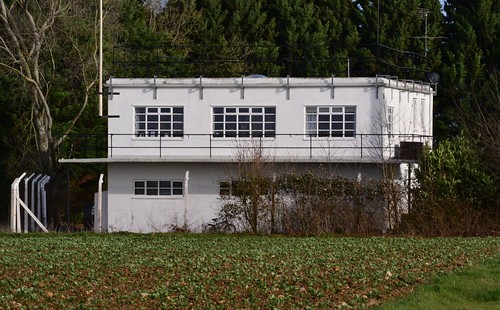
Little Walden Watch Office

Little Walden’s Watch Office is now a private residential property.

A large bomb store lay to the west of the airfield, surprisingly close to the majority of the hardstands, any major accidental discharge being likely to cause substantial damage to parked aircraft. There were four areas within the bomb store, each holding 200 tons of bombs and tail units, further stores held pyrotechnics, incendiaries, ‘small’ bombs, grenades and small arms ammunition. Most of these were secured by earth banks with fusing points (both ultra-heavy and heavy-light) being held in temporary brick buildings.

To the eastern side of the airfield lay the technical area, with one of the type T2 hangars (the second being located to the north), a fire tender shelter, and a watch office designed to drawing 12779/41 – the standard airfield design of 1942/43. Behind this, lay the main technical area, with its usual range of dingy stores, MT (Motor Transport) sheds, parachute stores and a wide range of ancillary buildings.

Accommodation for staff was, as usual by now, dispersed over eleven sites, a sick quarters, communal site and WAAF site accounting for three of them. A further sewage works made the twelfth site. All-in-all accommodation was provided for just short of 3,000 men and women of mixed rank.

On March 6th, 1944 the airfield officially opened, the day before its first residents arrived. The 409th BG were a new Group, only constituted on June 1st, the previous year (1943). They trained using Douglas A-20 Havocs (known in British service as the Boston) a twin engines light bomber capable of carrying up to 4,000lb of bombs.

The 409th BG formed at Will Rogers Field (Oklahoma) and transitioned through Woodward and DeRidder bases before arriving in the UK. Between March and September they operated out of Little Walden, bombing V-weapons sites and airfields in France in a strategic role. Initially they performed in the low-level role, but soon moved to higher altitudes, performing their first mission on April 13th 1944.

In the short period of residency at Little Walden, the 409th would lose a number of aircraft, one of the first being that of #43-9899 of the 642nd BS, which was written off in a landing accident on April 22nd 1944. Three days later a second aircraft, #43-9691, would also crash-land at Little Walden being damaged in the process.

May would also prove to be a difficult month for the 409th, with one aircraft ‘lost’ on the 9th, a further crash landing on the 11th, another lost on the 22nd and two further aircraft lost (classified as MIA) on the 27th. It was on this mission that a further Havoc would collide with a low flying Mustang resulting in several tragic deaths.

Havoc #43-10130 of the 643rd BS, piloted by Captain Roger D. Dunbar took off from Little Walden heading south-east, when it collided with P-51B #42-106907 of the 503rd FS, 339th FG, piloted by 2nd Lt. Robert L. Dickens. The Mustang, on a training flight, disintegrated killing the pilot, whilst the Havoc crashed into the farmland below. In the ensuing fire, a local farmer’s widow and trained nurse, Betty Everitt ran to the scene and managed to pull one of the airmen out of the aircraft. When returning to retrieve another crewman, one of the bombs on board the aircraft exploded killing her, her small dog, a helping Staff Sgt. and those left inside the aircraft. As a thank you to Betty, the US airmen, from the base, raised almost £3,000 to provide an education for her four-year old orphaned son, Tony2. This was not a one-off either, a fund set up by Stars and Stripes and the British Red Cross, aimed to raise funds for children who had suffered the loss of one or both parents. The amounts raised went a long way to getting these children an education that they would not otherwise have had.

Early June would see another such tragedy, when three more Havocs would collide. Havocs A-20G #43-9703 and #43-9946, both of the 641st BS, would crash whilst the third aircraft managed to land at the airfield. #43-9703 was piloted by Joseph R. Armistead, whilst #43-9946 was piloted by Thomas A. Beckett. A young girl, Marjorie Pask, ran to help, pulling two airmen out of the wreckage then waiting with them until help arrived. Five airmen including the pilots and an air gunner, Staff Sergeant Albert H Holiday, were all killed. It was not until later that Marjorie realised that there were many bombs scattered around the site and how much danger she had been in 3.
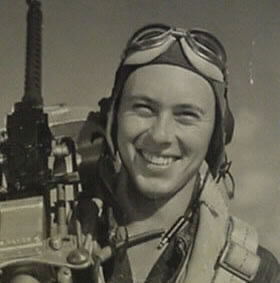
Staff Sgt. Albert H Holiday, killed June 11th 1944 in a collision between two Havocs of the 409th BG. (IWM-UPL 21530)

With two further loses and a forced landing in June, it was be a difficult month for the 409th. The late summer months of July and August would be lighter but by no means a clean sheet. In September 1944, on the 18th, the 409th were moved out of Little Walden and posted to a forward Landing Ground A-48 at Bretigny, where they would continue to suffer from landing accidents, Flak and fighters.

Next at Little Walden came the Mustangs of the 361st FG, in a move that saw possession of Little Walden pass back into the hands of the Eighth Air Force. Station 165 was now back with its original owners.

The 361st FG were the last of the P-47 Groups to arrive in the UK. Initially based at Bottisham, they converted to the P-51 in the weeks leading up to D-day. Using the Thunderbolts they earned a reputation as a strong and determined ground attack unit, hitting rail yards and transportation links across France.

A short break whilst transferring from Bottisham to Little Walden gave a somewhat minor break for the 361st. But, following changes to the Eighth’s overall structure, it was soon back to normal and more attacks over occupied France. In October, Lt. Urban Drew shot down two Me 262s who were in the process of taking off from their airfield at Achmer. What was more remarkable about the attack was that Lt. Drew had only arrived in the U.K. a few days earlier, had been grounded for a Victory Roll and then went on to become an Ace shooting down six enemy aircraft and the first pair of 262s! He was awarded the Air Force Cross, being denied the Distinguished Flying Cross until after the war when records from both the Luftwaffe and US Air Force were able to confirm his dramatic claims.

The Christmas and winter of 1944-45 was notoriously bad, very cold temperatures, fog, frost and ice played havoc with operations. The Battle of the Bulge was raging and the allies were finding it all but impossible to provide assistance from the air. Many Bomb Groups suffered terrible tragedies as collisions and accident numbers increased in the poorer weather. The Ninth, who themselves had primary roles in ground support were finding it particularly difficult. To help, a selection of men and machines from the 361st (and 352nd from Bodney) were transported to France and the airfields at St. Dizier (Y-64) and Asch (Y-29) where they were seconded into the Ninth Air Force.  The main force back at Little Walden continued to support bomber missions whenever they could, a difficult job in often appalling conditions.

Duxford American Airshow May 2016

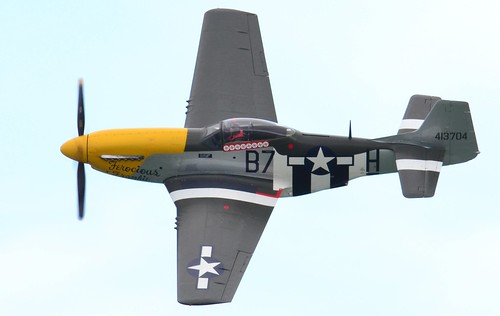
‘Ferocious Frankie’ #44-13704 (374th FS, 361st FG). The original crashed during a wheels up belly landing at RAF Little Walden, on November 9th, 1944. (This aircraft was flying at the Duxford American Airshow May 2016).
Aug 2015 317a

‘Ferocious Frankie’ (named after the wife of Lieutenant-Colonel Wallace E. Hopkins) seen at the Eastbourne Air Display August 2015.

By the end of January the seconding to the Ninth came to an end and the entire Group moved across to Belgium and Chievres, a former Belgian airfield captured and used by Luftwaffe bombers during the earlier years of the war. The 361st would remain there until April 1945 whereupon they returned back to Little Walden. During their absence Little Walden was made good use of. Being a ‘bomber airfield’ by design, its runways and hardstands were put to good use by Debach’s 493rd BG and their B-17 ‘Flying Fortresses’ whilst their own airfield was repaired and strengthened.

Spending only a month at Little Walden, the Air Echelons of the 493rd BG would depart in the April as the 361st FG returned. On the 20th, the 361st would fly their last operational mission, a flight that would close the record books culminating in a total of 441 missions. As the war ended and personnel were sent home, crews and aircraft of the 361st were dispersed to depots around the U.K., those that were left were sent home via the Queen Mary from Southampton arriving in New York in early November 1945. Within hours the group was disbanded and the men scattered to the four winds.

Between early September and early October 1945, the 56th FG ‘The Wolfpack’ were brought to Little Walden. The aircraft were also dispatched to depots around the country whilst personnel were brought to Little Walden for onward transportation to the United States. By mid October they too had gone.

Little Walden then began the wind down, transferring back to RAF ownership in early 1946. For the next twelve years or so, it was used to store surplus military equipment before they were sold off. After that, the site was returned to agriculture, the majority of the buildings pulled down and the runways dug up for road building hardcore.

The control tower stood for many years derelict and forlorn, until being purchased by an architect in 1982, eventually being turned into a private residence, the state it exists in today. The closed road has since been restored, utilising part of the NE-SW runway. Other parts that remain being a public footpath, but all a fraction of their former selves and no more than a tractor’s width wide.

What’s left of the technical area is a small industrial unit, remaining buildings being used for storage or small industrial companies. An access road from the B1052 passes the site an on to private residencies.

Little else survives of Little Walden. Memorial plaques are believed to be mounted on the side of the watch office, although I could not see these when I visited, and the village memorial mentions those who were stationed at the airfield.

The serenity of Little Walden does nothing to reflect the goings on here over 70 years ago. The aircraft are gone, the bird song replacing the sound of engines, and the busy runways now a small road. For those who were lost here, the watch office stands as  a memorial to their memory and the dedication shown by the many young men and women of the USAAF.

Sources and further reading.

1 Sunninghill Park was originally part of Windsor Forest and dates back to the 1600s and King Charles 1. Its ownership changed hands several times, and in the early 1800s during the Georgian period,  a large house was built upon it. The Ninth Air Force made it their headquarters between  November 1943 and September 1944, after which, in 1945, it was sold to the Crown Estate as a future home for Queen Elizabeth and Prince Philip, Duke of Edinburgh. However, before their marriage, the house burned down and the site remained unoccupied until the 1980s when a new property was designed and constructed for the Duke and Duchess of York. However, it was never occupied, the house fell into a very poor state of disrepair and was bought for £15m by an overseas investor. The site continued to decay and by 2014 was ordered for demolition.

2The Troy Record Newspaper Archives, Page 20, June 5th 1944 accessed 10/3/19.

3The full story can be read in ‘Balsham, A Village Story 1617-2017‘.

Little Walden is a new addition to Trail 46
September 26th 1942, a near tragedy for three RAF Squadrons.

The Eagle Squadrons were three RAF Squadrons made up of American volunteers, their achievements and records are well-known and well documented, however, it was not all plain sailing for these determined and courageous flyers. For one Squadron in particular, 133 Squadron, September 26th 1942 would be a disaster, a disaster that would almost wipe out the entire flight of twelve airmen.

133 Squadron had been on the front line serving at RAF Biggin Hill and RAF Martlesham Heath before arriving at RAF Great Sampford, a satellite for RAF Debden. The ground crews were predominately British, assisting and training the US ground crews in aircraft maintenance and support. All the pilots however, were US volunteers, formed into three separate squadrons but under RAF control.

1st Lt Dominic ‘Don’ Gentile and Spitfire BL255 ‘Buckeye-Don’. The photo was taken after 133 Squadron RAF was disbanded and absorbed into the USAAF as the, 336th FS, 4th FG, 8th AF. (@IWM UPL 15072)

133 Squadron would arrive at RAF Great Sampford on September 23rd 1942, the same day as 616 Sqn RAF departed, they would be the last operational unit to fully use the airfield before its eventual closure.

Initially flying the Spitfire VBs, they soon replaced them with the MK.IX, a Spitfire that was essentially a MK.V with an updated engine. Having a higher ceiling than the FW-190 and being marginally faster, its improved performance took the Luftwaffe by complete surprise. It was so new and improved, that it remained on the secret list until after this particular operational flight.

On that fateful day, September 26th 1942, fourteen Spitfires of 133 Sqn took off from RAF Great Sampford in Essex, piloting those Spitfires were:

BS313 – F/Lt. Edward Gordon Brettell DFC (61053) The only British pilot and leader
BS275 – P/O. Leonard T. Ryerson (O-885137)
BS446 – P/O. William H. Baker Jr (O-885113)
BS137 – P/O. Dennis D. Smith (O-885128)
BR638 – P/O. G.B. Sperry (O-885112)
BS445 – P/O. Dominic “Buckeye-Don” S. Gentile (O-885109)
BS138 – P/O. Gilbert G. Wright (?)
BS279 – F/Lt. Marion E. Jackson (O-885117)
BS447 – P/O. R.E. Smith (O-885110)
BR640 – P/O. C.A. Cook (O-885112)
BS148 – P/O. Richard “Bob” N. Beaty (?)
BS301 – P/O. G.H. Middleton Jr (O-885127)
BS140 – P/O. Gene P. Neville (O-885129)
Unknown  – P/O. Ervin “Dusty” Miller (O-885138) (not listed but known to have been on the flight).

They were to fly to RAF Bolt Head in Devon, where they would meet with 401 Squadron (RCAF) and 64 Squadron RAF, refuel and be briefed for the mission. A mission that was supposed to be straight forward and relatively uneventful.

The aim of the mission was to escort US bombers to Morlaix on the Brest peninsula. The usual commander of 133 Sqn, Red McColpin, was not placed in charge that day, instead he had been posted, and a British Pilot, F/Lt. Edward Gordon Brettell DFC, was issued with the task.

McColpin was a strict disciplinarian and his leadership was admired by those who followed him. Without this leadership, 133’s preparation was slack and they ultimately paid the price for this.

After landing at 12:30 hours, they realised there were no facilities at Bolt Head for refuelling, and they would have to go with what they had. This would kick-start a catalogue of errors that would ultimately seal the fate of the flight. Following a briefing in which Wing Commander Kingcombe DFC and all but two of 133 Sqn pilots had failed to show up for, the flight (which included the sixteen 401 (RCAF) Squadron Spitfire IXs from RAF Kenley) took off at 13:50 hours. Of the fourteen 133 Sqn Spitfires sent to Bolt Head, only twelve would be needed, and two pilots were instructed to remain at Bolt Head, they were P/O. Ervin Miller, and P/O. Don “Buckeye-Don” S. Gentile, they would be the luckiest two men of the squadron that day.

The briefing, a very vague and rushed one, instructed the flight to carry out a ‘Circus‘ mission escorting seventy-five B-17 Flying Fortresses from the 92nd BG, 97th BG and the 301st BG, who were bombing Cherbourg and the airfields at Maupertus and Morlaix in Brittany. When the squadron took off the weather was clear, and winds were predicted to be 35 mph at 24,000 feet, but 5 miles off the English coast, they encountered 10/10th cumulus cloud cover at 7,000 feet, and so had to climb above it so that they could locate the bombers more easily.

The take of was a mess, disorganised and lacking both radio information and in many cases maps, the aircraft were lucky not to collide with each other.

Of the three RAF squadrons involved in the mission, 401 would take the high position, 133 the middle and 64 Squadron, the lower. They were to form up over Bolt Head at 2,000 feet and then head at 200o at 180 mph to overtake the bombers before they arrived at the target. If they could not locate the bombers, the flight was to circle the target for three minutes and then depart.

As the flight approached the rendezvous area, one 133 Squadron Spitfire had to drop out of formation and return home, as he had encountered engine problems; this problem was thought to be due to his low fuel. The remainder of the flight  scanned the skies for any sign of the bomber formation, and after searching for some 45 minutes, they spotted the bombers, some 50 miles south of Brest. The bombers had in fact already turned for home after having discarded their bombs near to the Pyrenees.

By now the 301st BG had been recalled, as their fighter escort failed to materialise, whilst the 97th BG had continued on. However, due to the heavy cloud cover over the target area, they had been ineffective as no bombing of the target had taken place. The American bombers, who were only three months into their European air war, had inadvertently miscalculated a tail wind putting them off track well away from the Bay of Biscay.

P/O. G.H. Middleton Jr of 133 Squadron RAF was shot down and taken Prisoner of War (@IWM UPL 18927).

The three squadrons formed up on the bombers at just after 16:45 hours, with 64 Squadron on the port side, 401 Squadron on the starboard and 133 Squadron behind. The whole formation then flew north for 30 minutes, at which point it became evident that the wind speed was in fact over 100 mph, and not the 35 mph as stated by the Meteorological Office, or at the briefing! It has since been revealed that this information was known to those in authority, but it had not been passed down the chain of command and the pilots were never informed.

The formation then spotted land, the bombers thought they were over Falmouth and turned right. 64 and 401 Squadron broke away maintaining height, but 133 Squadron dropped down below the cloud base and prepared to land.

133 Squadron then began to search for the airfield, and after searching in vain, they found a large town, this they hoped would give them the vital fix they desperately needed. Flying low over the houses they realised they were not over England at all but in fact still over France. The flight, uninformed of the 100 mph north-easterly wind at their altitude, had also been blown wildly off course, and after 1.5 hours flying time, the situation had suddenly become very severe indeed.

The Squadron flight Leader, Flight Lieutenant E.G. Brettell, wanting to ascertain his exact position, called up a ground direction finding station who provided a  bearing and heading – 100 miles off the English coast with a homing vector of 020o. It was at this point they suddenly realised they were over the port of Brest, one of the most heavily defended ports under German occupation.

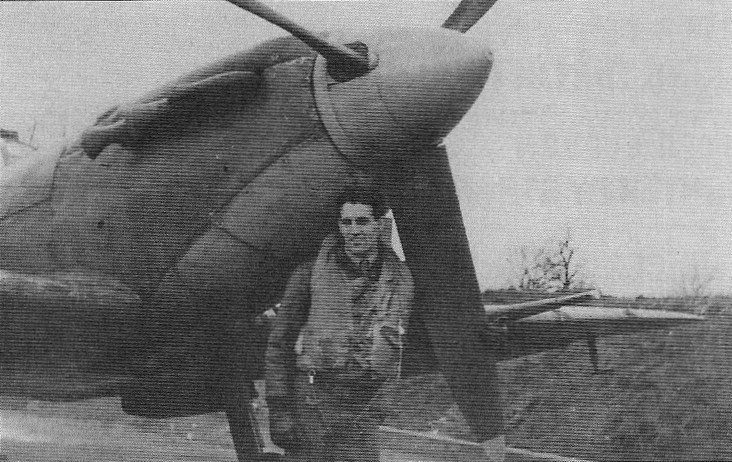
Immediately, the sky filled with flak and small arms anti-aircraft fire. The pilot in the number 2 position, Pilot Officer Gene Neville (O-885129) in Spitfire #BS140, took a direct and fatal hit, he was killed instantly. Three other aircraft were to be shot down in the melee that followed: Pilot Officer William H Baker Jr (O-885113) in Spitfire #BS446; Pilot Officer Leonard Ryerson (O-885137) in Spitfire #BS275 and Pilot Officer Dennis Smith (O-885128) in Spitfire #BS294 – all four were killed, and all four were awarded the Purple Heart.

2nd Lt. Gene P. Neville 133 (Eagle) Sqn RAF, stands before his MK. IX Spitfire at Great Sampford. He was Killed during the Morlaix disaster. (@IWM UPL 18912)

The remainder of 133 Squadron struggling to defend themselves, they scattered and were forced to land out of fuel, either on the island of Ouissant or on the French mainland.

Of the seven 133 squadron pilots who crash landed on French soil, five were known to have been captured immediately and taken prisoner: P/O. G.B. Sperry; F/Lt.  Edward Brettell; F/Lt. M.E. Jackson; P/O. C.A. Cook and P/O. G.H. Middleton Jr., with a sixth, P/O. G.G. Wright, evading the Germans for several days before being captured later on.

Of these initial five, F/Lt. Jackson was injured in his crash and hospitalised for eight weeks. He was then taken to Stalag Luft III from where he was able to escape for about ten days by jumping from the roof of his cell house into a lorry load of evergreen branches that were being taken away from the camp.

Another Pilot, F/Lt.  Edward Brettell  DFC. was executed for his part in the Great Escape from the same prison camp, Stalag Luft III, whilst P/O. Robert E. Smith, the last remaining pilot, managed to abandon his aircraft evading capture, eventually returning to England on 18th January 1943.

The pilot who turned back early due to his own engine problems,  P/O. Robert Beatty,  crash landed his Spitfire at Kingsbridge in Devon after he too ran out of fuel over the Channel. During the crash he sustained severe injuries but luckily survived his ordeal and was able to give an account of the mission through what he heard over the radio.

Several of the 401 Squadron pilots,  who had continued on, also reported being low on fuel and gave their intention to bail out before land was finally sighted. One of these, P/O. Junius L. Hokan (s/n: J/6833), did have to bail out over the sea, he was last seen in a gradual dive, his aircraft heading seaward. His body was never recovered. Others in the flight that day only just made land fall, one crashed and was taken to hospital where he recovered from his injuries, the others just managed to reach either RAF Bolt Head or RAF Harrowbeer. The Operational Record Books for 401 Squadron state that “many casualties were avoided by the clear thinking and cool behaviour of all members of our Squadron“.

A full report of the days tragic events was issued to Fighter Command Headquarters by Wing Commander Kingcombe DFC, Squadron Leader Gaze and Squadron leader K. Hodson DFC.

S/L Gordon Brettell, 133 Eagle Squadron, executed for his part in the Great Escape breakout at Stalag Luft III  (@IWM UPL 25574)

The effect on those left behind in 133 Squadron was devastating. The result of poor preparation, inadequate briefings and sub-standard communication between the Met. Office and Fighter Command had cost many lives, and very nearly many, many more. A number of postings to the Far East soon followed, and many lessons weren’t that day that led to improvements preventing such a tragedy ever happening again.

133 Squadron would continue to operate after this, transferring over to the USAAF being renumbered as 336th FS, 4th FG, three days later as planned, leaving both RAF Great Sampford and the sad memories of that very tragic day far behind.

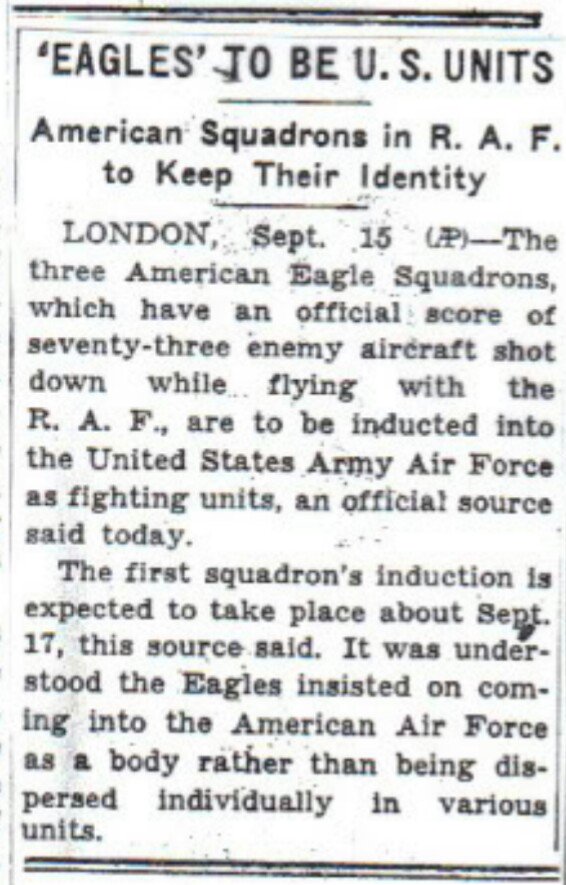
New York Times September 16 1942.

Sources and further reading.

Great Sampford appears in Trail 50.

National Archives: Operational Record Book 133 Sqn – AIR 27/945/2

National Archives: Operational Record Book 401 Sqn – AIR 27/1772/17

National Archives: Operational record Book 64 Sqn – AIR 27/590/41

*3 Price. A., “Spitfire – A Complete Fighting History“, Promotional Reprint Company,  (1974).

RAF Bradwell Bay Event July 17th 2021

A recent request from Eric Simonelli at the RAF Bradwell Bay Preservation Group. Eric is a key member of the group who are trying to preserve and promote the former RAF Bradwell Bay. He has kindly supplied a short write up and a flyer promoting a study day to be held in July for anyone interested. If you are, please contact the group direct and not myself at Aviation Trails.

RAF Bradwell Preservation Group.

Bradwell started off as a small grass aerodrome serving the firing range on the Dengie Peninsula, in the late 1930’s. In 1942 the aerodrome was expanded and became a large bases for 2,500 personnel who were to fly intruder missions to the continent and provide refuge for bombers returning with damage, casualties and short of fuel. To enable this level of activity there were many career opportunities for both men and women. This included aircraft maintenance, radio control, catering, motor transport and may more. Women were to fill all roles, apart from combat.  Today the RAF is fully inclusive.

RAF Bradwell Bay was host to many different squadrons up to the end of the war, with a variety aircraft types including Boston Havocs’, Mosquito’s, Spitfire’s, Tempest’s, Blenheim’s and Beaufighter’s. Other aircraft were based there for training and administrative purposes such as Miles Magisters, De-Haviland Dominies, Tiger Moths. At sometimes Bradwell Bay would have been an aeroplane spotter’s paradise. At least 25 squadrons are known to have been based there at different times.

Some parts of the airfield survive including the runways and control tower. However, the site is under threat of being demolished to make way for a second nuclear power station. As a group we are working to preserve as much as is possible, including building an archive to preserve memories and stories.

We have an unusual memorial and now are building an exhibition in the, nearby, Othona Centre. We are hoping to staff the exhibition at weekends or by appointment.

Bradwell Bay Memorial

Bradwell bay Memorial (Photo Eric Simonelli 2021)

more information can be found at: www.rafbradwellbay.co.uk

or email at: info@rafbradwellbay.co.uk

Eric has asked me to add the following ‘flyer’ to let you know about the study day being held locally for anyone interested in supporting the group and their aim to preserve Bradwell Bay. 

Inaugural Study Day

@ The Othona Community Centre

Saturday 17th July 2021

09:30 Reception and Coffee

3 Talks

WARTIME MALDON (World War 2) – by Stephen P. Nunn

A talk on George folliottPowell-Shedden by His Daughter

The Last CO – by Eric Simonelli

£25 inc Lunch, tea, and coffee (please advise of any dietary requirements on booking)

To book your place please complete the contact form on our website http://www.rafbradwellbay.co.uk

Members discount available

My thanks to Eric and good luck to them in their venture. 

September 26th 1942, a near tragedy for three RAF Squadrons.

The Eagle Squadrons were three RAF Squadrons made up of American volunteers, their achievements and records are well-known and well documented, however, it was not all plain sailing for these determined and courageous flyers. For one Squadron in particular, 133 Squadron, September 26th 1942 would be a disaster, a disaster that would almost wipe out the entire flight of twelve airmen.

133 Squadron had been on the front line serving at RAF Biggin Hill and RAF Martlesham Heath before arriving at RAF Great Sampford, a satellite for RAF Debden. The ground crews were predominately British, assisting and training the US ground crews in aircraft maintenance and support. All the pilots however, were US volunteers, formed into three separate squadrons but under RAF control.

1st Lt Dominic 'Don' Gentile and Spitfire BL255 'Buckeye-Don', 336th FS, 4th FG, 8th AF.

1st Lt Dominic ‘Don’ Gentile and Spitfire BL255 ‘Buckeye-Don’. The photo was taken after 133 Squadron RAF was disbanded and absorbed into the USAAF as the, 336th FS, 4th FG, 8th AF. (@IWM)

133 Squadron would arrive at RAF Great Sampford on September 23rd 1942, the same day as 616 Sqn RAF departed, they would be the last operational unit to fully use the airfield before its eventual closure.

Initially flying the Spitfire VBs, they soon replaced them with the MK.IX, a Spitfire that was essentially a MK.V with an updated engine. Having a higher ceiling than the FW-190 and being marginally faster, its improved performance took the Luftwaffe by complete surprise. It was so new and improved, that it remained on the secret list until after this particular operational flight.

On that fateful day, September 26th 1942, fourteen Spitfires of 133 Sqn took off from RAF Great Sampford in Essex, piloting those Spitfires were:

BS313 – F/Lt. Edward Gordon Brettell DFC (61053) The only British pilot and leader
BS275 – P/O. Leonard T. Ryerson (O-885137)
BS446 – P/O. William H. Baker Jr (O-885113)
BS137 – P/O. Dennis D. Smith (O-885128)
BR638 – P/O. G.B. Sperry (O-885112)
BS445 – P/O. Dominic “Buckeye-Don” S. Gentile (O-885109)
BS138 – P/O. Gilbert G. Wright (?)
BS279 – F/Lt. Marion E. Jackson (O-885117)
BS447 – P/O. R.E. Smith (O-885110)
BR640 – P/O. C.A. Cook (O-885112)
BS148 – P/O. Richard “Bob” N. Beaty (?)
BS301 – P/O. G.H. Middleton Jr (O-885127)
BS140 – P/O. Gene P. Neville (O-885129)
Unknown  – P/O. Ervin “Dusty” Miller (O-885138) (not listed but known to have been on the flight).

They were to fly to RAF Bolt Head in Devon, where they would meet with 401 Squadron (RCAF) and 64 Squadron RAF, refuel and be briefed for the mission. A mission that was supposed to be straight forward and relatively uneventful.

The aim of the mission was to escort US bombers to Morlaix on the Brest peninsula. The usual commander of 133 Sqn, Red McColpin, was not placed in charge that day, instead he had been posted, and a British Pilot, F/Lt. Edward Gordon Brettell DFC, was issued with the task.

McColpin was a strict disciplinarian and his leadership was admired by those who followed him. Without this leadership, 133’s preparation was slack and they ultimately paid the price for this.

After landing at 12:30 hours, they realised there were no facilities at Bolt Head for refuelling, and they would have to go with what they had. This would kick-start a catalogue of errors that would ultimately seal the fate of the flight. Following a briefing in which Wing Commander Kingcombe DFC and all but two of 133 Sqn pilots had failed to show up for, the flight (which included the sixteen 401 (RCAF) Squadron Spitfire IXs from RAF Kenley) took off at 13:50 hours. Of the fourteen 133 Sqn Spitfires sent to Bolt Head, only twelve would be needed, and two pilots were instructed to remain at Bolt Head, they were P/O. Ervin Miller, and P/O. Don “Buckeye-Don” S. Gentile, they would be the luckiest two men of the squadron that day.

The briefing, a very vague and rushed one, instructed the flight to carry out a ‘Circus‘ mission escorting seventy-five B-17 Flying Fortresses from the 92nd BG, 97th BG and the 301st BG, who were bombing Cherbourg and the airfields at Maupertus and Morlaix in Brittany. When the squadron took off the weather was clear, and winds were predicted to be 35 mph at 24,000 feet, but 5 miles off the English coast, they encountered 10/10th cumulus cloud cover at 7,000 feet, and so had to climb above it so that they could locate the bombers more easily.

The take of was a mess, disorganised and lacking both radio information and in many cases maps, the aircraft were lucky not to collide with each other.

Of the three RAF squadrons involved in the mission, 401 would take the high position, 133 the middle and 64 Squadron, the lower. They were to form up over Bolt Head at 2,000 feet and then head at 200o at 180 mph to overtake the bombers before they arrived at the target. If they could not locate the bombers, the flight was to circle the target for three minutes and then depart.

As the flight approached the rendezvous area, one 133 Squadron Spitfire had to drop out of formation and return home, as he had encountered engine problems; this problem was thought to be due to his low fuel. The remainder of the flight  scanned the skies for any sign of the bomber formation, and after searching for some 45 minutes, they spotted the bombers, some 50 miles south of Brest. The bombers had in fact already turned for home after having discarded their bombs near to the Pyrenees.

By now the 301st BG had been recalled, as their fighter escort failed to materialise, whilst the 97th BG had continued on. However, due to the heavy cloud cover over the target area, they had been ineffective as no bombing of the target had taken place. The American bombers, who were only three months into their European air war, had inadvertently miscalculated a tail wind putting them off track well away from the Bay of Biscay.

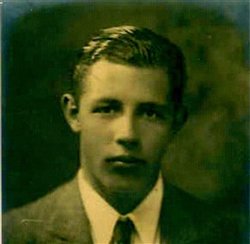
1st Lt George H Middleton Jr 336FS, 4FG, 8AF USAAF. Former Eagle Sqn Spitfire pilot.

P/O. G.H. Middleton Jr of 133 Squadron RAF was shot down and taken Prisoner of War (@IWM).

The three squadrons formed up on the bombers at just after 16:45 hours, with 64 Squadron on the port side, 401 Squadron on the starboard and 133 Squadron behind. The whole formation then flew north for 30 minutes, at which point it became evident that the wind speed was in fact over 100 mph, and not the 35 mph as stated by the Meteorological Office, or at the briefing! It has since been revealed that this information was known to those in authority, but it had not been passed down the chain of command and the pilots were never informed.

The formation then spotted land, the bombers thought they were over Falmouth and turned right. 64 and 401 Squadron broke away maintaining height, but 133 Squadron dropped down below the cloud base and prepared to land.

133 Squadron then began to search for the airfield, and after searching in vain, they found a large town, this they hoped would give them the vital fix they desperately needed. Flying low over the houses they realised they were not over England at all but in fact still over France. The flight, uninformed of the 100 mph north-easterly wind at their altitude, had also been blown wildly off course, and after 1.5 hours flying time, the situation had suddenly become very severe indeed.

The Squadron flight Leader, Flight Lieutenant E.G. Brettell, wanting to ascertain his exact position, called up a ground direction finding station who provided a  bearing and heading – 100 miles off the English coast with a homing vector of 020o. It was at this point they suddenly realised they were over the port of Brest, one of the most heavily defended ports under German occupation.

Immediately, the sky filled with flak and small arms anti-aircraft fire. The pilot in the number 2 position, Pilot Officer Gene Neville (O-885129) in Spitfire #BS140, took a direct and fatal hit, he was killed instantly. Three other aircraft were to be shot down in the melee that followed: Pilot Officer William H Baker Jr (O-885113) in Spitfire #BS446; Pilot Officer Leonard Ryerson (O-885137) in Spitfire #BS275 and Pilot Officer Dennis Smith (O-885128) in Spitfire #BS294 – all four were killed, and all four were awarded the Purple Heart.

2nd Lt. Gene P. Neville 133 (Eagle) Sqn RAF, stands before his MK. IX Spitfire at Great Sampford. He was Killed during the Morlaix disaster. (@IWM UPL 18912)

The remainder of 133 Squadron struggling to defend themselves, they scattered and were forced to land out of fuel, either on the island of Ouissant or on the French mainland.

Of the seven 133 squadron pilots who crash landed on French soil, five were known to have been captured immediately and taken prisoner: P/O. G.B. Sperry; F/Lt.  Edward Brettell; F/Lt. M.E. Jackson; P/O. C.A. Cook and P/O. G.H. Middleton Jr., with a sixth, P/O. G.G. Wright, evading the Germans for several days before being captured later on.

Of these initial five, F/Lt. Jackson was injured in his crash and hospitalised for eight weeks. He was then taken to Stalag Luft III from where he was able to escape for about ten days by jumping from the roof of his cell house into a lorry load of evergreen branches that were being taken away from the camp.

Another Pilot, F/Lt.  Edward Brettell  DFC. was executed for his part in the Great Escape from the same prison camp, Stalag Luft III, whilst P/O. Robert E. Smith, the last remaining pilot, managed to abandon his aircraft evading capture, eventually returning to England on 18th January 1943.

The pilot who turned back early due to his own engine problems,  P/O. Robert Beatty,  crash landed his Spitfire at Kingsbridge in Devon after he too ran out of fuel over the Channel. During the crash he sustained severe injuries but luckily survived his ordeal and was able to give an account of the mission through what he heard over the radio.

Several of the 401 Squadron pilots,  who had continued on, also reported being low on fuel and gave their intention to bail out before land was finally sighted. One of these, P/O. Junius L. Hokan (s/n: J/6833), did have to bail out over the sea, he was last seen in a gradual dive, his aircraft heading seaward. His body was never recovered. Others in the flight that day only just made land fall, one crashed and was taken to hospital where he recovered from his injuries, the others just managed to reach either RAF Bolt Head or RAF Harrowbeer. The Operational Record Books for 401 Squadron state that “many casualties were avoided by the clear thinking and cool behaviour of all members of our Squadron“.

A full report of the days tragic events was issued to Fighter Command Headquarters by Wing Commander Kingcombe DFC, Squadron Leader Gaze and Squadron leader K. Hodson DFC.

S/L Gordon Brettell 133 Eagle Squadron

S/L Gordon Brettell, 133 Eagle Squadron, executed for his part in the Great Escape breakout at Stalag Luft III  (@IWM UPL 25574)

The effect on those left behind in 133 Squadron was devastating. The result of poor preparation, inadequate briefings and sub-standard communication between the Met. Office and Fighter Command had cost many lives, and very nearly many, many more. A number of postings to the Far East soon followed, and many lessons weren’t that day that led to improvements preventing such a tragedy ever happening again.

133 Squadron would continue to operate after this, transferring over to the USAAF being renumbered as 336th FS, 4th FG, three days later as planned, leaving both RAF Great Sampford and the sad memories of that very tragic day far behind.

New York Times September 16 1942.

Sources and further reading.

Great Sampford appears in Trail 50.

National Archives: Operational Record Book 133 Sqn – AIR 27/945/2

National Archives: Operational Record Book 401 Sqn – AIR 27/1772/17

National Archives: Operational record Book 64 Sqn – AIR 27/590/41

*3 Price. A., “Spitfire – A Complete Fighting History“, Promotional Reprint Company,  (1974).

A Happy Christmas!

I would just like to take this opportunity to wish all those of you who have followed, read or commented on the blog, a very merry Christmas and a very happy and safe New Year.

A extra big thanks goes out to those of you who have stuck around for so long, we’re now approaching our seventh year of the blog and have managed to visit over 125 airfields, 105 memorials and 40 museums. These have stretched from Perth in Scotland to the South coast of England, Suffolk in the east to Gloucestershire in the west. The range of these airfields is enormous, and they continue to vanish, with many in a worse state now than they were when I visited at the beginning of the journey.

Very soon many of these will be gone, lets hope the memories of those who served are not also gone with them.

A very happy Christmas one and all!

RAF Andrews Field – (Great Saling/Station 485) – Trail 33: Essex Part 1.

RAF Attlebridge  (Station 120) – Trail 7: Northwest Norfolk.

RAF Barkston Heath (Station 483) – Trail 2: Lincoln Borders and Newark

RAF Barton BendishTrail 7: Northwest Norfolk.

RAF Biggin Hill (Westersham) (Station 343) – Trail 4: Kent Part 1.

RAF Bircham NewtonTrail 20: North Norfolk (Part 1).

RAF Bodney (Station 141) – Trail 8: Swaffham and Her Neighbours (Part 1 of 3).

RAF Bottesford (Station 481) – Trail 52: Leicestershire’ Borders.

RAF Bottisham (Station 374) – Trail 55: Around Newmarket

RAF Boulmer – Trail 47: Northumberland.

RAF BournTrail 31: Southern Cambridgeshire (Part 2).

RAF Brenzett (ALG) – Trail 18: Kent Part 2.

RAF BruntonTrail 47: Northumberland.

RAF Bungay (Flixton) (Station 125) – Trail 14:  Central Suffolk (Part 1).

RAF Bury St. Edmunds (Rougham) (Station 468) – Trail 16: West Suffolk (part 1).

RAF Castle CampsTrail 45: Essex (Part 2).

RAF Caxton GibbetTrail 29: Southern Cambridge (Part 1).

RAF Charterhall Trail 41: The Borders of Scotland and England.

RAF ChedburghTrail 49: Bomber Command – Bury St. Edmunds to Haverhill

RAF Collyweston Trail 37: The Northern Reaches of Cambridgeshire.

RAF Coltishall – Trail 7: Northwest Norfolk.

RAF ConingsbyTrail 1: Lower Lincolnshire.

RAF CottamTrail 40: Yorkshire (East Riding).

RNAS CrailTrail 53: Scotland’s East Coast – Fife

RAF CranwellTrail 2: Lincoln Borders and Newark.

RAF Debach (Station 152) – Trail 39: Suffolk around Ipswich (Part 1).

RAF Debden (Station 356) – Trail 46: Essex Part 3.

RAF Deenethorpe (Station 128) – Trail 6: American Ghosts.

RAF Deopham Green (Station 142) – Trail 27: Southern Norfolk (Part 3).

RAF Digby (Scopwick) – Trail 1: Lower Lincolnshire.

RAF Docking – Trail 20: North Norfolk (Part 1).

RAF Downham Market (Bexwell) – Trail 7: Northwest Norfolk.

RAF Drem – Trail 42: Edinburgh’s Neighbours.

RAF Dunino –  Trail 53: Scotland’s East Coast – Fife.

RAF East Fortune – Trail 42: Edinburgh’s Neighbours.

RAF East Kirkby Trail 1: Lower Lincolnshire.

RAF East Wretham (Station 133) – Trail 13: Southern Norfolk around Diss (Part 2).

RAF Eye (Brome) (Station 134) – Trail 14: Central Suffolk (Part 1).

RAF Fersfield – (Station 130) – Trail 28: Southern Norfolk (Part 4).

RAF FoulshamTrail 22North Norfolk (Part 3).

RAF FowlmereTrail 32Southern Cambridgeshire (Part 3).

RAF Framlingham (Parham) (Station 153)Trail 39: Suffolk around Ipswich (Part 1).

RAF GamstonTrail 54: The Great North Road.

RAF Glatton (Station 130) – Trail 6: American Ghosts.

RAF Gransden Lodge – Trail 31: Southern Cambridgeshire (Part 2).

RAF Graveley – Trail 29: Southern Cambridge (Part 1).

RAF Grafton Underwood (Station 106) – Trail 6: American Ghosts.

RAF Great Dunmow (Station 164)- Trail 33: Essex (Part 1).

RAF Great MassinghamTrail 21: North Norfolk (Part 2).

RAF Great Sampford (Station 359) – Trail 50: Haverhill’s neighbours – Wratting Common and Great Sampford.

RAF Hardwick (Station 104) – Trail 12: Southern Norfolk around Diss (Part 1).

RAF Hawkinge – Trail 18: Kent Part 2.

RAF Hethel – Trail 38: To the West of Norwich.

RFC HinghamTrail 38: To the West of Norwich.

RAF Holme on Spalding Moor Trail 40: Yorkshire (East Riding).

RAF Hunsdon – Trail 25: Hertfordshire.

RAF Kimbolton (Station 117) – Trail 6: American Ghosts.

RAF King’s Cliffe (Station 367) – Trail 6: American Ghosts.

RAF LanghamTrail 23: North Norfolk (Part 4).

RAF Lashenden (Headcorn) – Trail 18: Kent Part 2.

RAF Lavenham (Station 137) – Trail coming soon.

RAF Leuchars – Trail 53: Scotland’s East Coast – Fife.

RAF Little SnoringTrail 22North Norfolk (Part 3).

RAF Little Walden – – Trail 46: Essex Part 3.

RAF Macmerry Trail 51: Southern Scotland

RAF MarhamTrail 7: Northwest Norfolk.

RAF Martlesham HeathTrail 48: Suffolk around Ipswich (Part 2).

RAF Matching (Station 166) – Trail 33: Essex Part 1.

RAF Matlaske (Station 178) – Trail 34: North Norfolk (Part 5).

RAF MattishallTrail 36: North Norfolk (Part 6).

RAF Mendlesham (Station 156) – Trail 15: Central Suffolk (Part 2).

RAF MepalTrail 11: Around Ely.

RAF MetheringhamTrail 1: Lower Lincolnshire.

RAF Methwold – Trail 8: Swaffham and Her Neighbours (Part 1).

RAF Milfield –  Trail 47: Northumberland.

RAF Narborough (Narborough Aerodrome)- Trail 7: Northwest Norfolk.

RAF Newmarket Heath – Trail 55: Around Newmarket

RAF North CreakeTrail 23: North Norfolk (Part 4).

RAF North Pickenham (Station 143) – Trail 9: Swaffham and Her Neighbours (Part 2).

RAF North WealdTrail 25: Hertfordshire.

RAF North Witham (Station 479) – Trail 3: Gone But Not Forgotten.

RAF Old Buckenham (Station 144) – Trail 13: Southern Norfolk around Diss (Part 2).

RAF Oulton – Trail 34: North Norfolk (Part 5).

RAF Polebrook (Station 110) – Trail 19: Northamptonshire American Ghosts II.

RAF Rattlesden (Station 126) – Trail 15: (Central Suffolk (Part 2).

RAF SawbridgeworthTrail 25: Hertfordshire.

RAF ScamptonTrail 30: Scampton and the Heritage Centre.

RAF SconeTrail 56: Perthshire.

RAF SculthorpeTrail 21: North Norfolk Part 2.

RAF Sedgeford – Trail 20: North Norfolk (Part 1).

RAF Shipdham (Station 115) – Trail 10: Swaffham and Her Neighbours (Part 3).

RAF Snailwell (Station 361) – Trail 55: Around Newmarket

RAF Snetterton Heath – (Station 138) – Trail 27: Southern Norfolk (Part 3).

RAF Spanhoe Lodge (Station 493) – Trail 6: American Ghosts.

RAF Steeple Morden – Trail 32: Southern Cambridgeshire (Part 3).

RAF Stoke OrchardTrail 24: Gloucestershire.

RAF Stradishall- Trail 49: Bomber Command – Bury St. Edmunds to Haverhill

RAF Sutton BridgeTrail 3: Gone But Not Forgotten.

RAF Swannington – Trail 36: North Norfolk (Part 6) 

RAF Swanton Morley – Trail 38: To the West of Norwich.

RAF Thorpe Abbotts (Station 139) – Trail 12: Southern Norfolk around Diss (Part 1).

RAF Tibenham (Station 124) – Trail 13: Southern Norfolk around Diss (Part 2).

RAF Tuddenham – Trail 16: West Suffolk (Part 1).

RAF Tydd St. Mary – Trail 37: The Northern Reaches of Cambridgeshire.

RAF Upwood – Trail 17: The Pathfinders.

RAF Warboys – Trail 17: The Pathfinders.

RAF WaterbeachTrail 11: Around Ely.

RAF Watton (Station 376/Station 505) – Trail 9: Swaffham & Her Neighbours (Part 2).

RAF Wendling (Station 118) – Trail 10: Swaffham and Her Neighbours (Part 3).

RAF West Malling Trail 4: Kent Part 1.

RAF West RaynhamTrail 21: North Norfolk Part 2.

RAF WethersfieldTrail 45: Essex (Part 2).

RAF Westley – Trail 16: West Suffolk (part 1).

RAF WinfieldTrail 41: The Borders of Scotland and England.

RAF Winthorpe Trail 2: Lincoln Borders and Newark.

RAF WitchfordTrail 11: Around Ely.

RAF Wittering  – Trail 37: The Northern Reaches of Cambridgeshire.

RAF Woodall SpaTrail 1: Lower Lincolnshire.

RAF Wratting CommonTrail 50 – Haverhill’s neighbours – Wratting Common and Great Sampford.

379th Bomb Group Memorial update – 3 weeks to go!

A message from Mitch Peeke:

Another update for everyone, probably the final one as the event is now only three weeks away!

Everything is now pretty much “there”. We had a meeting at the Holiday Park to set out a rough timetable for the day which has now been emailed to all interested parties.

I picked up the metal supports for the plaque and storyboard yesterday. Just have to paint them now! They will be a slightly warm shade of blue, with a planished finish.

I finished mounting the plaque and the storyboard onto their respective mahogany pieces last weekend and have to admit that they look quite handsome! Three coats of Ronseal varnish brought the wood out beautifully!

The Holiday Park’s Grounds Team have now started construction of the memorial base. It will be in the form of an elongated diamond (landscape) with the plaque on the left side angled toward the crash site and the storyboard on the right angled slightly inwards toward the reader. The base will be bordered by white painted kerbstones and the whole diamond will be infilled with large plum slate chips. Once installed, the memorial will be covered with a US flag till it is unveiled.

The memorial will be unveiled jointly by Noel Tognazzini and Jeanne Cronis-Campbell; their path to the memorial flanked by an Honour Guard from TWO Squadrons of Air Cadets, whilst TAPS is being blown solo on a trumpet by the Leader of The Medway Big Band, who has been practising diligently, I am told!

After the brief unveiling and dedication ceremony, the Band will be playing the music of Glenn Miller and other relevant music for nearly two hours as a background to everything else that will be going on.

All we need now is for the English weather to smile upon us and it should be a good day and a fine tribute to those lost airmen.

Anyone wishing to make a contribution to the construction of the memorial costs can do so at: https://www.gofundme.com/ww2-aircrew-memorial  Any monies left over will be donated to the upkeep of of the B-17 ‘Sally B’, the last flying B-17 in Europe.

For those who don’t know, the original story as told by Mitch:

June 19th, 1944: Just thirteen days after the Allied D Day Invasion. The weather that day was dry, but the late afternoon sunshine over Kent in Southern England was hazy. A formation of around 30 American B17 “Flying Fortress” bombers from the 379th BG, part of “The Mighty Eighth”, were returning home across the Kent countryside, heading due North, toward their base at Kimbolton, in Huntingdonshire. They were returning from a raid on the V1 launching site at Zudausques in Northern France.

The raiders had taken some Flak, but thankfully, no German fighters had found them. They were doubtlessly busy elsewhere, trying to stem the Allied advances. But the Flak they had encountered had been accurate and had exacted a price from the 379th for their raid. Many of those B17’s were now badly damaged and flying home on three engines rather than four. More of them than not, now had “extra ventilation”, courtesy of the German Flak Gunners, and were trailing heavy smoke from those engines that remained running. However, the B17 was known to be “a good ship”. Inherently stable, it was a remarkable aircraft for its size, able to withstand a hell of a lot of battle damage and still be capable of flying. Many a pilot had been able to “nurse” one home, despite the odds. The crews all had faith in their aircraft. It was a faith that was born from hard experience in hostile skies.

The formation crossed the South coast of England at 21,000 feet. Leading the No. 2 Section was B17 Heavenly Body II, of the 525th Squadron, Captained by 1st Lieutenant Lloyd Burns. A veteran crew, this had been their 29th mission over enemy territory. Just one more mission and the crew would have completed their tour and then they’d be going home, Stateside. The D Day Invasion had of course been keeping them busy. This mission to the V1 site at Zudausques had been their second mission of the day.

Lloyd Burns was an exceptional pilot with an enviable reputation for pulling off the smoothest of landings under any circumstances. The original Heavenly Body had been written off quite recently when the brakes failed on landing. Not even Burns could prevent that aircraft from being a runaway and as the heavy B17 simply ran out of airfield space, she rolled off the end of the runway, down a small hill and straight into a pile of scrap concrete rubble. Miraculously, Burns and his entire crew walked away from that landing. They got a new aircraft and quickly named her Heavenly Body II. (In fact, there were at least 4 other US aircraft named Heavenly Body. Two B29’s, another B17 of the 401st Squadron and at least one B25, all of which had a pin-up girl as nose art). This was now their third mission in the replacement aircraft and although they’d not yet had the time to paint the name and art on the bomber’s nose, the crew had happily settled in to their new ship.

Just after the formation crossed the South coast, Lloyd Burns swapped seats with his co-pilot, 2nd Lieutenant Fred Kauffman. Fred was hoping to get a ship of his own after they completed their tour and had asked Lloyd if he could take over for the descent and landing, as he wanted more 1st pilot experience. Lloyd saw no reason not to. Now as the formation was beginning the let down toward Kimbolton, they gradually lost their height over Kent.

At nearly 18:15, the formation was almost over Allhallows and down to 17,000 feet. Ahead of them, left to right, was the Thames Estuary; even busier than usual, with all sorts of shipping, due in no small part to the D Day invasion traffic.

At 17,000 feet, the haze grew thicker. Fred Kauffman was beginning to work hard for his 1st pilot experience. He was having to fly more by instruments as the visibility forwards was down to about 1,000 yards and the horizon was beginning to disappear into the miasma, though to the airmen flying through it, it didn’t seem to be too bad at that moment.

Flying above and slightly behind Burns’ aircraft, was his Port Side Wingman. This B17  bore the serial number 44-6133, but  no name. The pilot was 2nd Lieutenant Armand Ramacitti and he was in trouble. This was his first combat mission and his B17 had been very badly damaged by the German Flak. He’d been nursing her along since leaving France behind. He’d already lost one engine, his Port elevator and a fair piece of the Starboard one had also been blown away and he had another engine on the Port side smoking heavily and running rough. Now, that engine was making an unbearably loud whining noise, looking and sounding as if it was about to seize up too. Jockeying the throttles on his remaining engines, Ramacitti was trying to compensate for the dropping power, but the flight controls were growing sloppy and with the Port elevator gone, maintaining the crippled bomber’s height was getting harder by the minute. She was beginning to give up the unequal struggle to stay in the air.

Ramacitti’s Bombardier, 2nd Lieutenant Theodore Chronopolis, saw that having surged slightly ahead of their leader, they were now dropping back, out of formation. He called Ramacitti on the intercom, warning him to pull up, as they were now dropping very close to Heavenly Body II. Ramacitti was desperately wrestling with the dying bomber’s controls, trying to claw back some height, but it was a losing battle. Without warning, 6133 side-slipped sickeningly to Starboard, literally dropping out of Ramacitti’s hands. Chronopolis frantically buckled on his parachute, as did the Navigator, for both men now knew with absolute certainty, what was coming next.

6133’s side-slip cut across the top of Burns’ aircraft at an angle of about 35 degrees. Engine bellowing, the Starboard outer prop cut into the top of Heavenly Body II‘s flight deck, right behind the Pilot’s window, killing Fred Kauffman instantly. The two aircraft momentarily locked together in a deadly embrace.

Theodore Chronopolis knew they’d hit Burns’ aircraft. All he’d heard was a very loud, sharp bang and a terrible rending sound, as the two aircraft collided. He and the Navigator went straight for the nearest escape hatch. The Flight Engineer and a couple of the Gunners were already there, but the hatch was totally jammed. Just then, 6133 rolled off Heavenly Body II‘s back and inverted. Thrown about inside the aircraft like a small toy, Theodore didn’t know what happened next. He recalled hearing another big bang, then he blacked out.

The momentum of 6133’s continuing side-slip had separated the two planes. As 6133 rolled off Heavenly Body II‘s back and then inverted, her Flak-battered Port wing now sheared off completely, which was probably the second bang that Theodore Chronopolis had heard. As the wing came off, 6133 started to spin, pointing her nose straight down and plunging headlong toward the muddy waters of the Thames Estuary below.

When Theodore came to, he was free-falling outside of the aircraft. Instinctively, he pulled the ripcord on his parachute, which thankfully deployed. As his descent rapidly slowed, he saw a B17 going down below him, its death-plunge marked by a thick trail of black smoke. Then shock set in and he blacked out again. Unbeknown to Theodore, he was the only one who’d got out of 6133 alive.

Literally moments before, on Heavenly Body II, Lloyd Burns suddenly realised that something was horribly wrong. He was about to reach over behind Fred to pull back the curtain. He wanted to see if their rookie wingman, Ramacitti, was keeping with them, when a terrible grinding noise to his left made him duck down instinctively. The daylight through the left side windows was blocked momentarily and he felt the aircraft shudder viciously. He realised in that instant that they’d been hit by another B17, which seemed to him, to be on top of them. Then as 6133 slid off the top, he looked over at Fred. Lloyd was in no doubt at all that Fred was now dead. The first thing Lloyd tried to do was to somehow stabilise the aircraft. Grabbing the controls, he found  the ailerons completely unresponsive and he got next to no feedback from the elevators. This was not surprising as the B17’s control cables ran centrally along the top of the fuselage. 6133’s prop had undoubtedly chopped through them. Heavenly Body II was still flying as she’d been trimmed, just; but for how much longer was the question.

Lloyd noticed that the Flight Engineer was at the escape hatch, trying to open it. Realising that he’d no hope of flying the plane, Lloyd quickly reached for where his parachute was stowed, but couldn’t find it. As he climbed off the flight deck, one of the crew thrust a chute into his hands and he hurriedly strapped it on; only partially as it turned out. He assisted the Engineer in forcing the escape hatch open then literally shoved him through it, as he immediately followed the Engineer himself. As his parachute opened, Lloyd realised he was only half in the harness. Hanging on for dear life, he saw a B17 going down in a steep turn with one engine smoking badly, but was unsure which of the two aircraft it was.

The Bombardier on Burns’ aircraft, Jack Gray, later recalled that the bomber’s Plexiglas nose had been all but severed and he suddenly found himself seemingly more outside of the aircraft than inside it. Jack pulled himself back in and went for his parachute.

Heavenly Body II continued flying, though steadily losing height, even though there was only the dead co-pilot at the now useless controls. Six of her crew managed to safely escape. The Ball Turret Gunner, S/Sgt William Farmer, was one of the last to leave, noting that the aircraft looked like it was coming apart. He needed no second telling to get out and fast.

The six crew members that managed to escape were: Pilot Lloyd Burns, Bombardier Jack Gray, Top Turret Gunner Leonard Gibbs, Ball Turret Gunner William Farmer, Tail Gunner Richard Andrews and Radio Operator/Gunner Leroy Monk. All but one of those six landed in the water and were rescued by fishing boats. Tail Gunner Richard Andrews came down on dry land at Canvey. The three men who didn’t make it were: Co-pilot Fred Kauffman, Navigator Edward  Sadler and Gunner Louis Schulte.

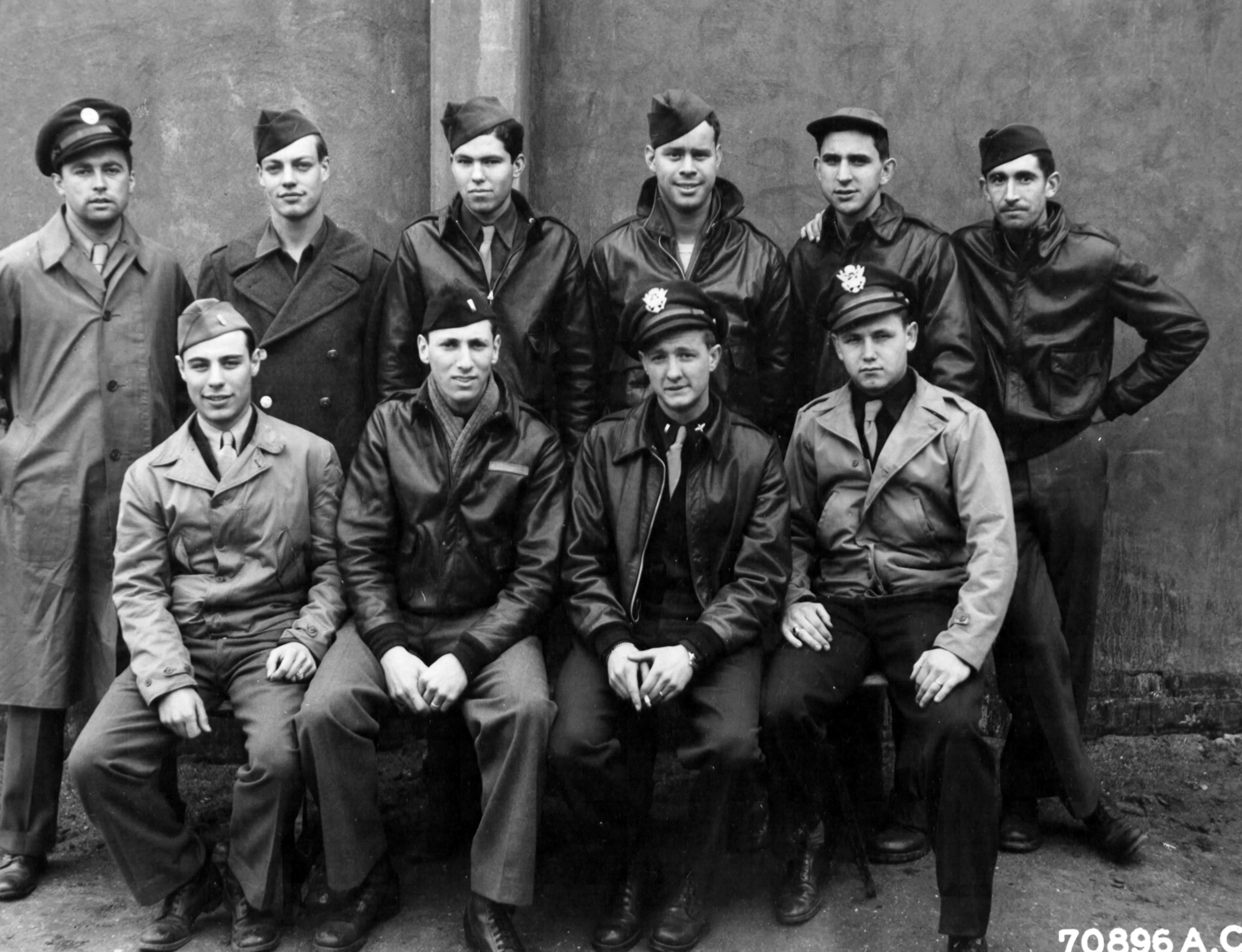
Crew of Heavenly Body II: Front Row, L to R: Edward Sadler; Fred Kauffman; Jack Gray; Lloyd Burns
Back Row, L to R; Louis Schulte; Leroy Monk; Richard Andrews; Richard Billings; William Farmer; Leonard Gibbs
Note that Richard Billings was part of the Burns crew on arrival at Kimbolton, but was the 10th man when crew size was reduced to 9, and so was not with the crew at the time of the collision. The survivors of the Burns crew are all deceased except for Richard Andrews. (Photo courtesy 379th BG Association archive,  by kind permission.)

6133 meanwhile, had gone straight down and crashed in twenty feet of water, in what was then a minefield, about half a mile or so off the west beach at Allhallows. The Estuary bottom was and still is, soft Thames mud and the main part of the wreck undoubtedly buried itself to some extent in the mud. (What remained of the wreckage was later salvaged, probably when the minefield was cleared). She had taken most of her crew with her, trapped inside.

Sole survivor Theodore Chronopolis, landed safely by parachute. He was fished out of the water by a passing  boat. The eight men of 6133’s crew who died that day were: Pilot 2nd Lt. Armand Ramacitti, Co-pilot 2nd Lt. William Hager, Navigator 2nd Lt. Donald Watson, Gunner S/Sgt. Richard Ritter, Gunner S/Sgt. Cecil Tognazzini, Gunner S/Sgt. John  Burke, Gunner Sgt. Warren Oaks and Gunner Cpl. Paul Haynes.

Meanwhile, having been abandoned by her crew, Heavenly Body II continued flying, somewhat erratically and losing height all the time. At first, she’d turned west and seemed to be heading directly toward the oil storage tanks at ShellHaven on Canvey Island. To those watching on the ground, a disaster seemed inevitable, then; still losing height, she miraculously turned east, away from the refinery, over the town, toward Canvey Point and the mudflats. It seemed as though the pilot was still trying to find somewhere safe to put her down. She then circled once over Canvey Point before she  finally nose-dived onto the mudflats, throwing an engine forward as she crashed.

To this day, those who can remember the event have always held the pilot of that aircraft in high esteem. Trouble was, the pilot was at that moment, just landing in the water off Canvey Island by parachute! Did Fred Kauffman not die in the collision after all? Had he somehow survived his injuries, regained consciousness and taken control of the shattered aircraft? Unlikely. Burns had tried to take control just after the collision and found the controls unresponsive. It is also extremely unlikely that Fred could have come round from such traumatic head injuries as he’d received when 6133’s Starboard outer prop cut through the roof and side of the Flight deck.

The answer probably has more to do with the B17’s inherent stability. With the nose section totally open and the escape hatches gone, the sheer force of the through-rushing air was probably responsible for the apparent “steering” of the aircraft. Also of course is the fact that, though a stable design, the aircraft was literally coming apart in flight. Who knows precisely how the aerodynamics were working, but one thing is certain, she was not being actively piloted.

The semi-submerged wreckage of Heavenly Body II remained on the mudflats for decades. Every so often, the tides would uncover more of it and bury other sections. The wreck was easily accessible and so subjected to many souveniring expeditions. A local historical society salvaged some of it and put it on display in a museum, until it closed. The thrown engine was salvaged fairly recently and together with some other artefacts, is now on display at another local museum. There is also a storyboard on the seafront close to the crash site at Canvey Point and a memorial plaque, dedicated to the memory of both crews. Sadly, there is nothing of the kind at Allhallows, where 6133 crashed.

Most of the bodies, including Ramacitti’s, were recovered; some at the time, some a little later, and are interred in the American Cemetery at Madingley, Cambridge; a long way from home. One body was later sent home. The body of Gunner Louis Schulte from 6133 now rests at home in a cemetery in St. Louis. Only two are still unaccounted for: Fred Kauffman, Co-pilot of Heavenly Body II and Gunner Cecil Tognazzini from 6133, both of whom are listed on the tablets of the missing at Madingley. Their last resting places are very probably in the soft Thames mud that their aircraft crashed in. They too, are a long way from home.

Post Script.

B-17  #44-6133 was a Douglas/Long Beach B-17G-45-DL Flying Fortress delivered to Tulsa airbase, Oklahoma, May 10th, 1944. It was transferred to Hunter airbase, Savannah, Georgia, on May 19th, 1944, and then onto Dow Field on May 29th, 1944. She was assigned to the 525th BS, 379th BG as ‘FR-Y’at Kimbolton Jun 8th, 1944. The crew of #44-6133 were:

Pilot: Second Lieutenant Armand Ramacitti
Co-pilot: Second Lieutenant William ‘Bill’ Hager
Navigator: First Lieutenant Donald ‘Don’ Watson
Flight engineer/top turret gunner: Staff Sergeant Cecil Tognazzini
Radio Operator: Sergeant Richard ‘Dick’ Ritter
Ball turret gunner: Staff Sergeant John Burke
Waist gunner: Corporal Paul Haynes
Tail gunner: Sergeant Warren Oaks (his second mission)
Bombardier: Second Lieutenant Theodore Chronopolis

Flight engineer/top turret gunner: Staff Sergeant Cecil Tognazzini (Photo Janet Penn, via http://www.findagrave.com)

#42-97942 was a Lockheed/Vega B-17G-40-VE Flying Fortress delivered to Denver on April 11th, 1944. She then went onto Kearney air base in Nebraska on May 4th, 1944, before transferring also to Dow Field May 23rd, 1944. She was then assigned to 525th BS,  379th BG at Kimbolton as ‘FR-K’. The crew of #42-97942 were:

Pilot: First Lieutenant Lloyd Burns (just 19 years of age)
Bombardier: Second Lieutenant Jack Gray
Flight engineer/top turret gunner: Technical Sergeant Leonard Gibbs
Radio Operator: Technical Sergeant Leroy Monk
Ball turret gunner: Staff Sergeant William ‘Bill’ Farmer
Waist gunner: Staff Sergeant Richard ‘Dick’ Andrews
Co-pilot: Second Lieutenant Fred Kauffman
Navigator: Flight Officer Edward Sadler
Tail gunner: Staff Sergeant Louis Schulte

A Wing and a Prayer – B-17 Memorial update.

The planned memorial for the crew of B-17 #44-6133 which collided with another B-17 ‘Heavenly Body II’ over Allhallows in Kent, has taken a major step forward recently.

In the crash all but one of the crewmen were killed and Mitch Peeke has been organising the erection of a memorial to commemorate the tragic accident.

With a large part of the funding having been raised, materials donated and a considerable number of leaflets distributed, there has been great interest shown from not only the UK but also from the United States.

Both Mitch and I have been in contact with Noel Tognazzini, the nephew of S/Sgt. Cecil Tognazzini, Flight Engineer/Top Turret Gunner on the B17 #44-6133.

Noel has made arrangements for not only himself, but also the daughter of 2nd Lt. Theodore Chronopolis, (Bombardier), Jeanne Crons Campbell, the only child of the sole survivor of #44-6133, to attend both the 75th anniversary of the crash on June 19 and the Allhallows event which Mitch has organised for June 22nd.

With a collection of Second World War vehicles, a live band and stalls from aviation related organisations, it is going to be a superb day with a great deal of supporters in attendance. With other events occurring locally at the same time, this will be a remarkable way to commemorate the loss of these young men who were so tragically taken from us in 1944.

Following the collision between the two aircraft, #44-6133 fell into the mud flats at Allhallows, from where most of the bodies were recovered; some at the time, some a while later, and who are now interred in the American Cemetery at Madingley, Cambridge. The body of Gunner Louis Schulte from #44-6133 was sent home and rests in a cemetery in St. Louis. Only two crewmen are still unaccounted for: Fred Kauffman, Co-pilot of Heavenly Body II, the second B-17, and Cecil Tognazzini from #44-6133, both of whom are listed on the tablets of the missing at Madingley. Their last resting places are very probably in the soft Thames mud that the aircraft crashed in.

Sole survivor Theodore Chronopolis, landed safely by parachute. He was fished out of the water by a passing  boat. The eight men of #44-6133’s crew who died that day were: Pilot 2nd Lt. Armand Ramacitti, Co-pilot 2nd Lt. William Hager, Navigator 2nd Lt. Donald Watson, Gunner S/Sgt. Richard Ritter, Gunner S/Sgt. Cecil Tognazzini, Gunner S/Sgt. John  Burke, Gunner Sgt. Warren Oaks and Gunner Cpl. Paul Haynes.

Mitch has set up a ‘gofundme’ fundraising account, with a target of £1000 to help secure the memorial for those young men who lost their lives that tragic day. Additional funds and collections on the day will go towards the up keep of Britain’s only flying B-17 – ‘Sally B’ (http://www.sallyb.org.uk/). 

For further information or if you would like to have a stall promoting your group, please contact Mitch direct at: madmitch.peeke978@gmail.com or leave a comment here and I’ll make sure he gets it.

Find the fund-raising account at: https://www.gofundme.com/ww2-aircrew-memorial 

The full story of the crash can be found using the link: ‘A Long way from Home’.

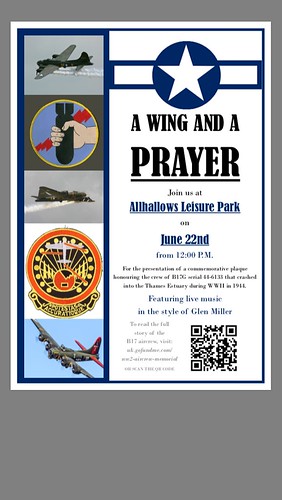
B-17 Memorial flyer Allhallows, Kent.

RAF Little Walden (Station 165)

Sometimes, we come across quite unexpectedly, something of great interest. Whilst on my travels recently, passing through the southern regions of Cambridge into Essex, I came upon the former station RAF Little Walden. Being an unplanned visit, I was rather short in prior knowledge and preparation, no maps, aerial photographs, or other documents that I normally seek out before venturing off into the wilderness. So I was quite unprepared when I stumbled across the Watch Office from former station RAF Little Walden, otherwise known as Station 165 of the USAAF.

RAF Little Walden (Hadstock) – (Station 165)

Little Walden lies slightly closer to the village of Hadstock than it does Little Walden, and was originally called Hadstock. When construction began in 1942, it was allocated to the Eighth Air Force as a Class A bomber airfield. However, due to the bad winter of 1942/43 work ceased temporarily, being held up until well into the summer of 1943. At this point, Hadstock became known as Little Walden, a name change that coincided with the formation of the Ninth Air Force in Europe, an organisation whose primary role was the support of ground troops in the European theatre. With its headquarters at Sunninghill Park1 in Ascot, it would operate both transport and bomber units, taking many of these units (and their airfields) from the already established Eighth Air Force. Little Walden was one such airfield passing from the Eighth to the Ninth to fulfil this new role.

Although a Class A airfield, Little Walden’s main runway was slightly shorter than those of its counterparts, 1,900 yards as opposed to 2,000 yards, but the two auxiliary runways were both the standard 1,400 yards in length. A concrete and wood chip construction gave these runways good strength, it also had hardened perimeter tracks and fifty hardstands of the spectacle type. Grouped mainly in blocks of five, they were located around the perimeter track with a further block of eighteen to the north-west of the site. In the development process a public road the B1052, was closed as it passed directly though the centre of the proposed site.

Little Walden Watch Office

Little Walden’s Watch Office is now a private residential property.

A large bomb store lay to the west of the airfield, surprisingly close to the majority of the hardstands, any major accidental discharge being likely to cause substantial damage to parked aircraft. There were four areas within the bomb store, each holding 200 tons of bombs and tail units, further stores held pyrotechnics, incendiaries, ‘small’ bombs, grenades and small arms ammunition. Most of these were secured by earth banks with fusing points (both ultra-heavy and heavy-light) being held in temporary brick buildings.

To the eastern side of the airfield lay the technical area, with one of the type T2 hangars (the second being located to the north), a fire tender shelter, and a watch office designed to drawing 12779/41 – the standard airfield design of 1942/43. Behind this, lay the main technical area, with its usual range of dingy stores, MT (Motor Transport) sheds, parachute stores and a wide range of ancillary buildings.

Accommodation for staff was, as usual by now, dispersed over eleven sites, a sick quarters, communal site and WAAF site accounting for three of them. A further sewage works made the twelfth site. All-in-all accommodation was provided for just short of 3,000 men and women of mixed rank.

On March 6th, 1944 the airfield officially opened, the day before its first residents arrived. The 409th BG were a new Group, only constituted on June 1st, the previous year (1943). They trained using Douglas A-20 Havocs (known in British service as the Boston) a twin engines light bomber capable of carrying up to 4,000lb of bombs.

The 409th BG formed at Will Rogers Field (Oklahoma) and transitioned through Woodward and DeRidder bases before arriving in the UK. Between March and September they operated out of Little Walden, bombing V-weapons sites and airfields in France in a strategic role. Initially they performed in the low-level role, but soon moved to higher altitudes, performing their first mission on April 13th 1944.

In the short period of residency at Little Walden, the 409th would lose a number of aircraft, one of the first being that of #43-9899 of the 642nd BS, which was written off in a landing accident on April 22nd 1944. Three days later a second aircraft, #43-9691, would also crash-land at Little Walden being damaged in the process.

May would also prove to be a difficult month for the 409th, with one aircraft ‘lost’ on the 9th, a further crash landing on the 11th, another lost on the 22nd and two further aircraft lost (classified as MIA) on the 27th. It was on this mission that a further Havoc would collide with a low flying Mustang resulting in several tragic deaths.

Havoc #43-10130 of the 643rd BS, piloted by Captain Roger D. Dunbar took off from Little Walden heading south-east, when it collided with P-51B #42-106907 of the 503rd FS, 339th FG, piloted by 2nd Lt. Robert L. Dickens. The Mustang, on a training flight, disintegrated killing the pilot, whilst the Havoc crashed into the farmland below. In the ensuing fire, a local farmer’s widow and trained nurse, Betty Everitt ran to the scene and managed to pull one of the airmen out of the aircraft. When returning to retrieve another crewman, one of the bombs on board the aircraft exploded killing her, her small dog, a helping Staff Sgt. and those left inside the aircraft. As a thank you to Betty, the US airmen, from the base, raised almost £3,000 to provide an education for her four-year old orphaned son, Tony2. This was not a one-off either, a fund set up by Stars and Stripes and the British Red Cross, aimed to raise funds for children who had suffered the loss of one or both parents. The amounts raised went a long way to getting these children an education that they would not otherwise have had.

Early June would see another such tragedy, when three more Havocs would collide. Havocs A-20G #43-9703 and #43-9946, both of the 641st BS, would crash whilst the third aircraft managed to land at the airfield. #43-9703 was piloted by Joseph R. Armistead, whilst #43-9946 was piloted by Thomas A. Beckett. A young girl, Marjorie Pask, ran to help, pulling two airmen out of the wreckage then waiting with them until help arrived. Five airmen including the pilots and an air gunner, Staff Sergeant Albert H Holiday, were all killed. It was not until later that Marjorie realised that there were many bombs scattered around the site and how much danger she had been in 3.

Staff Sgt. Albert H Holiday, killed June 11th 1944 in a collision between two Havocs of the 409th BG. (IWM-UPL 21530)

With two further loses and a forced landing in June, it was be a difficult month for the 409th. The late summer months of July and August would be lighter but by no means a clean sheet. In September 1944, on the 18th, the 409th were moved out of Little Walden and posted to a forward Landing Ground A-48 at Bretigny, where they would continue to suffer from landing accidents, Flak and fighters.

Next at Little Walden came the Mustangs of the 361st FG, in a move that saw possession of Little Walden pass back into the hands of the Eighth Air Force. Station 165 was now back with its original owners.

The 361st FG were the last of the P-47 Groups to arrive in the UK. Initially based at Bottisham, they converted to the P-51 in the weeks leading up to D-day. Using the Thunderbolts they earned a reputation as a strong and determined ground attack unit, hitting rail yards and transportation links across France.

A short break whilst transferring from Bottisham to Little Walden gave a somewhat minor break for the 361st. But, following changes to the Eighth’s overall structure, it was soon back to normal and more attacks over occupied France. In October, Lt. Urban Drew shot down two Me 262s who were in the process of taking off from their airfield at Achmer. What was more remarkable about the attack was that Lt. Drew had only arrived in the U.K. a few days earlier, had been grounded for a Victory Roll and then went on to become an Ace shooting down six enemy aircraft and the first pair of 262s! He was awarded the Air Force Cross, being denied the Distinguished Flying Cross until after the war when records from both the Luftwaffe and US Air Force were able to confirm his dramatic claims.

The Christmas and winter of 1944-45 was notoriously bad, very cold temperatures, fog, frost and ice played havoc with operations. The Battle of the Bulge was raging and the allies were finding it all but impossible to provide assistance from the air. Many Bomb Groups suffered terrible tragedies as collisions and accident numbers increased in the poorer weather. The Ninth, who themselves had primary roles in ground support were finding it particularly difficult. To help, a selection of men and machines from the 361st (and 352nd from Bodney) were transported to France and the airfields at St. Dizier (Y-64) and Asch (Y-29) where they were seconded into the Ninth Air Force.  The main force back at Little Walden continued to support bomber missions whenever they could, a difficult job in often appalling conditions.

Duxford American Airshow May 2016

‘Ferocious Frankie’ #44-13704 (374th FS, 361st FG). The original crashed during a wheels up belly landing at RAF Little Walden, on November 9th, 1944. (This aircraft was flying at the Duxford American Airshow May 2016).

Aug 2015 317a

‘Ferocious Frankie’ (named after the wife of Lieutenant-Colonel Wallace E. Hopkins) seen at the Eastbourne Air Display August 2015.

By the end of January the seconding to the Ninth came to an end and the entire Group moved across to Belgium and Chievres, a former Belgian airfield captured and used by Luftwaffe bombers during the earlier years of the war. The 361st would remain there until April 1945 whereupon they returned back to Little Walden. During their absence Little Walden was made good use of. Being a ‘bomber airfield’ by design, its runways and hardstands were put to good use by Debach’s 493rd BG and their B-17 ‘Flying Fortresses’ whilst their own airfield was repaired and strengthened.

Spending only a month at Little Walden, the Air Echelons of the 493rd BG would depart in the April as the 361st FG returned. On the 20th, the 361st would fly their last operational mission, a flight that would close the record books culminating in a total of 441 missions. As the war ended and personnel were sent home, crews and aircraft of the 361st were dispersed to depots around the U.K., those that were left were sent home via the Queen Mary from Southampton arriving in New York in early November 1945. Within hours the group was disbanded and the men scattered to the four winds.

Between early September and early October 1945, the 56th FG ‘The Wolfpack’ were brought to Little Walden. The aircraft were also dispatched to depots around the country whilst personnel were brought to Little Walden for onward transportation to the United States. By mid October they too had gone.

Little Walden then began the wind down, transferring back to RAF ownership in early 1946. For the next twelve years or so, it was used to store surplus military equipment before they were sold off. After that, the site was returned to agriculture, the majority of the buildings pulled down and the runways dug up for road building hardcore.

The control tower stood for many years derelict and forlorn, until being purchased by an architect in 1982, eventually being turned into a private residence, the state it exists in today. The closed road has since been restored, utilising part of the NE-SW runway. Other parts that remain being a public footpath, but all a fraction of their former selves and no more than a tractor’s width wide.

What’s left of the technical area is a small industrial unit, remaining buildings being used for storage or small industrial companies. An access road from the B1052 passes the site an on to private residencies.

Little else survives of Little Walden. Memorial plaques are believed to be mounted on the side of the watch office, although I could not see these when I visited, and the village memorial mentions those who were stationed at the airfield.

The serenity of Little Walden does nothing to reflect the goings on here over 70 years ago. The aircraft are gone, the bird song replacing the sound of engines, and the busy runways now a small road. For those who were lost here, the watch office stands as  a memorial to their memory and the dedication shown by the many young men and women of the USAAF.

Sources and further reading.

1 Sunninghill Park was originally part of Windsor Forest and dates back to the 1600s and King Charles 1. Its ownership changed hands several times, and in the early 1800s during the Georgian period,  a large house was built upon it. The Ninth Air Force made it their headquarters between  November 1943 and September 1944, after which, in 1945, it was sold to the Crown Estate as a future home for Queen Elizabeth and Prince Philip, Duke of Edinburgh. However, before their marriage, the house burned down and the site remained unoccupied until the 1980s when a new property was designed and constructed for the Duke and Duchess of York. However, it was never occupied, the house fell into a very poor state of disrepair and was bought for £15m by an overseas investor. The site continued to decay and by 2014 was ordered for demolition.

2The Troy Record Newspaper Archives, Page 20, June 5th 1944 accessed 10/3/19.

3The full story can be read in ‘Balsham, A Village Story 1617-2017‘.

Little Walden is a new addition to Trail 46

Latest update to 379th BG Memorial

Since the first posting about the proposed memorial to the crews of two B-17s, #44-6133 and  #42-97942 (Heavenly Body II) who collided over Allhallows on Monday 19th June 1944, I am pleased to announce that Mitch has made excellent progress and has secured: a Guard of Honour, a Vicar to bless the memorial, materials to build the memorial, a 1940’s ‘swing’ band, a display of military vehicles, refreshments for the day and a representative of the USAF possibly from the 48th Fighter Wing from RAF Lakenheath. Also, the plaque has been delivered to Mitch, and the story board to complement the memorial is also in the process of being made. Sadly a fly past was not permitted largely due to the fact that the flight path for Southend airport lies directly overhead!

The park where the memorial is to be placed is expecting between 3,000 and 4,000 people to be there, so this is an ideal opportunity for local charities or aviation related organisations to attend and raise themselves some much-needed funds.

Funding for the memorial itself has reached £500 (half of which has been promised by the park on which the memorial will stand) 50% of the original £1,000 sought after. A considerable amount of materials have very kindly been donated, the local paper ‘Kent Messenger’ has published the story, and local television news are also following the project with great interest. A number of other supporters have also shown an interest and their support.

Any money left over, along with money raised by collection buckets on the day, will go to support the B-17 ‘Sally B‘ (http://www.sallyb.org.uk/) to help keep Britain’s only B-17 where she belongs – in the sky.

The event is set for Saturday 22nd June 2019, with the unveiling taking place at midday, the first weekend after the anniversary of the crash.

Anyone wishing to attend, either as a visitor or for a stand, can contact Mitch at: madmitch.peeke978@gmail.com or leave a comment here and I’ll make sure he gets it.

Anyone wishing to donate to the memorial can do so at:  https://www.gofundme.com/ww2-aircrew-memorial 

Crew of Heavenly Body II: Front Row, L to R: Edward Sadler; Fred Kauffman; Jack Gray; Lloyd Burns
Back Row, L to R; Louis Schulte; Leroy Monk; Richard Andrews; Richard Billings; William Farmer; Leonard Gibbs (Photo courtesy 379th BG Association archive,  by kind permission.)

B-17  #44-6133 was a Douglas/Long Beach B-17G-45-DL Flying Fortress delivered to Tulsa airbase, Oklahoma, May 10th, 1944. It was transferred to Hunter airbase, Savannah, Georgia, on May 19th, 1944, and then onto Dow Field on May 29th, 1944. She was assigned to the 525th BS, 379th BG as ‘FR-Y’at Kimbolton Jun 8th, 1944. The crew of #44-6133 were:

Pilot: Second Lieutenant Armand Ramacitti
Co-pilot: Second Lieutenant William ‘Bill’ Hager
Navigator: First Lieutenant Donald ‘Don’ Watson
Flight engineer/top turret gunner: Staff Sergeant Cecil Tognazzini
Radio Operator: Sergeant Richard ‘Dick’ Ritter
Ball turret gunner: Staff Sergeant John Burke
Waist gunner: Corporal Paul Haynes
Tail gunner: Sergeant Warren Oaks (his second mission)
Bombardier: Second Lieutenant Theodore Chronopolis

#42-97942 (Heavenly Body II) was a Lockheed/Vega B-17G-40-VE Flying Fortress delivered to Denver on April 11th, 1944. She then went onto Kearney air base in Nebraska on May 4th, 1944, before transferring also to Dow Field May 23rd, 1944. She was then assigned to 525th BS,  379th BG at Kimbolton as ‘FR-K’. The crew of #42-97942 were:

Pilot: First Lieutenant Lloyd Burns (just 19 years of age)
Bombardier: Second Lieutenant Jack Gray
Flight engineer/top turret gunner: Technical Sergeant Leonard Gibbs
Radio Operator: Technical Sergeant Leroy Monk
Ball turret gunner: Staff Sergeant William ‘Bill’ Farmer
Waist gunner: Staff Sergeant Richard ‘Dick’ Andrews
Co-pilot: Second Lieutenant Fred Kauffman
Navigator: Flight Officer Edward Sadler
Tail gunner: Staff Sergeant Louis Schulte

379th BG Memorial update.

Recently I posted a guest post from Mitch Peeke regarding the collision and subsequent deaths of a number of crewmen on board two 379th BG B-17s over southern England, on 19th June 1944.

Mitch is aiming to have a memorial erected close to the site where one of the B-17s  #44-6133 fell, killing all but one of the crew. So far, he has received permission and a very positive response from the land owners on which the memorial is hoped to go, along with information, including a crew photograph, from the 379th BG Association.  Mitch has also been contact with the local TV station and newspapers hoping to generate further interest and funds to cover the cost of such a memorial.

A number of other avenues are still being pursued but the response so far has been very promising indeed!

A preliminary date has been set for the anniversary of the crash but this will of course, largely depend on progress over the coming weeks.

Mitch has set up a ‘gofundme’ fundraising account, with a target of £1000 he hopes the public will get behind the project and secure a memorial for those young men who lost their lives that tragic day. Find the account at: https://www.gofundme.com/ww2-aircrew-memorial 

Crew of Heavenly Body II: Front Row, L to R: Edward Sadler; Fred Kauffman; Jack Gray; Lloyd Burns
Back Row, L to R; Louis Schulte; Leroy Monk; Richard Andrews; Richard Billings; William Farmer; Leonard Gibbs (Photo courtesy 379th BG Association archive,  by kind permission.)

Sgt Cecil A Tognazzini

Flight engineer/top turret gunner: Staff Sergeant Cecil Tognazzini (Photo Janet Penn, via www.findagrave.com)