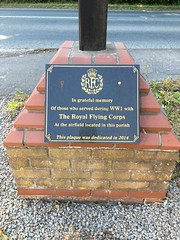
R.A.F. Wethersfield (U.S.A.A.F. Station 170).

After a short journey from Castle Camps we soon arrive at our next port of call. This airfield, although a Second World War airfield, saw little action but was used by both the U.S.A.A.F. and the R.A.F. both during and after the war. Whilst it does not generally have active flying units today, it does house the M.O.D. dog training unit and as such is classed as an active military site.

This part of the trail brings us to the former airfield RAF Wethersfield.

R.A.F. Wethersfield (Station 170).

RAF Wethersfield was originally designed and built as a Class ‘A’ bomber airfield with construction occurring during 1942. During this expansion period materials and labour were both in short supply, which delayed the completion of the airfield until late 1943. During this period, ownership of the airfield passed hands several times, initially belonging to the Eighth Air Force, it was to be loaned to the R.A.F. between December 1942 and May 1943, before returning back to American hands. However, the delay to construction meant that by the time it was completed and opened, it would not be used by the R.A.F. but passed instead directly into the hands of the ‘new’ U.S. Ninth Air Force.

Constituted in 1941, the Ninth had already been fighting in Egypt and Libya, before they were moved to England in late 1943 in preparation for the forthcoming invasion of the continent. Throughout the remainder of the war they would pave the way for the advancing forces from Normandy deep into Germany itself. As an Air force, it would be disbanded in 1945 only to be reborn post war as part of the Tactical Air Command, and latterly the Continental Air Command, at which point it was assigned to Reserve and National Guard duties.

The first units to arrive at Wethersfield did so in the February of 1944, four months before the invasion took place. The first aircraft to arrive were the A-20 ‘Havocs’ of the 416th Bombardment Group (Light). The Group, who was only a year old itself, was made up of the: 668th, 669th, 670th and 671st Bomb Squadrons, and would fall under the control of the IX Bomber Command, Ninth Air Force who had their headquarters at the rather grand stately home Marks Hall in Essex.

A-20 Havocs, including (serial number 43-9701) of the 416th BG. 9701 was salvaged August 18th 1945. IWM (FRE 6403)

A journey that started at Will Rogers Airfield in Oklahoma, would take the men of the 416th from Lake Charles in Louisiana, through Laurel Airfield, Mississippi and onto Wethersfield some 28 miles to the south-east of Cambridge, in Essex.

As a Class A airfield, its three concrete runways would be standard lengths: 1 x 2,000 yards and 2 x 1,400 yards, all the normal 50 yards wide. Scattered around the perimeter were fifty hardstands for aircraft dispersal – all but one being of the spectacle style.

The 2,500 ground and air crews would be allocated standard accommodation, primarily Nissen huts, situated over several sites to the south-west of the main airfield site. Two T2 hangars were provided for aircraft maintenance, one in the technical area also to the south-west, and the second to the east. One notable building at Wethersfield was a Ctesiphon hut. An unusual, and indeed controversial design, it originated in the Middle East when a sergeant, unable to camouflage his tent, had poured concrete over it. As the pole was removed, the structure remained both intact and strong. The commanding officer, Major J.H. De W. Waller took the idea, named it after a 1,600 year old palace at Bagdad, and developed it in the UK, through the Waller Housing Corporation.

The idea behind the building is that a metal frame is constructed, similar in design to Nissen hut ribs, then covered with hessian after which concrete is poured over it. As the concrete hardens, the hessian sags giving added strength through its ‘corrugated’ shape. The ‘scaffolds’ are then removed leaving the hut’s shell standing independently. At Wethersfield there were originally fourteen of these huts built, all within the technical site, it is not currently known whether any of these still exist today, but it is extremely unlikely as most were pulled down post war.

The 416th BG were part of the 97th Combat Wing, and were among the first to receive the new ‘Havocs’, along with the 409th and 410th BG who were also under the control of the 97th. For the short period between the 416th’s arrival (February 1944) and the invasion in June, they carried out sustained training missions transferring their skills from the B-25s they had earlier used, to the new A-20s, which included operational sorties targeting V-weapons sites in northern France starting in March 1944.

During these flights, accidents would happen. A number of aircraft were damaged or written off whilst attempting  landings at Wethersfield: ’43-9203′, (671st BS) piloted by George W. Cowgill crashed on 21st April 1944; ’43-9209′ piloted by Pilot Elizabeth O. Turner, crashed on 13th August 1944, and ’43-9368′ crashed two days earlier on 11th August 1944. Some of these accidents resulted in fatalities, including that of ’43-9223′ (668th BS) which crashed on a routine test flight 1.5 miles north-west of Wethersfield, on 9th May 1944. The pilot Capt. William P. Battersby (the Squadron Operations Officer) and a passenger Private First Class Charles W. Coleman (s/n 32372194) a Parachute Rigger, were both killed in the accident.

In the April, two months after the Americans had moved in, the R.A.F. officially handed over the airfield to the U.S. forces in a ceremony that unusually, saw a large number of civilians take part.

As the invasion neared, the 416th began to attack coastal defences and airfields  that were supporting Luftwaffe forces. During and after the invasion they targeted rail bottlenecks, marshalling yards, road networks, bridges and other strategic targets to prevent the build up of reinforcements and troop movements into Normandy.

As the German forces retreated, the 416th attacked escape routes in the Falaise Gap to the south of Caen, destroying the many bridges that allowed the German armies to leave the encircled area. During the battle, nine aircraft were lost, and all those lucky enough to return suffered flak damage, some of it heavy. For their actions here between the 6th and 9th of August 1944, the 416th earned themselves a Distinguished Unit Citation (D.U.C.) the only one they would receive during the conflict.

By the following September, the Allies had pushed into France and the Ninth began to move across to captured airfields on the continent, the 416th being one of those to go. Leaving the leafy surroundings of Wethersfield for the Advanced Landing Ground (A.L.G.) at Melun, to the south of Paris, it would be a move that would coincide with the change to the new A-26 ‘Invader’; the 416th being the first unit to do so, another first and another distinction. During their seven month stay at Wethersfield the 416th BG would fly 141 operational sorties losing twenty-one aircraft in the process.

A-20 Havocs and A-26 Invaders of the 416th Bomb Group at Wethersfield. This picture was probably taken around the time the 416th were departing Wethersfield for the Landing Ground at Melun, France. FRE 7445 (IWM)

With their departure, Wethersfield was handed back to the R.A.F. and the First Allied Airborne Army. This would see a dramatic change from the light twin-engined A-20s to the mighty four-engined Stirlings MK.IV, the former heavy bombers turned transport and glider tugs, whose nose stood at over 20 feet from the ground.

The two squadrons operating these aircraft at Wethersfield, 196 Sqn and 299 Sqn, would both arrive on the same day, October 9th 1944 and depart within 24 hours of each other on 26th and 25th of January 1945 respectively.

The Stirling, initially a heavy bomber of Bomber Command, was pulled from front line bombing missions due to its high losses, many squadrons replacing them with the newer Lancaster. 196 Sqn however, retained the Stirling and instead transferred from Bomber Command into the Allied Expeditionary Air Force.

The Stirlings proved to be much more suited to their new role supporting resistance and S.O.E. operations in occupied Europe. But the heavy weight of the Stirling took its toll on the runways at Wethersfield, and eventually they began to break up. Now in need of repairs, the two squadrons were pulled out and sent to Shepherds Grove where they would eventually be disbanded at the war’s end.

RAF Wethersfield

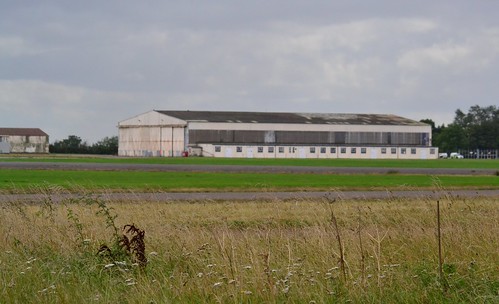
One of the original T2 Hangars on the south-eastern side.

A short stay in March of 1945 by the 316th Troop Carrier Group (T.C.G.) allowed them to participate in Operation ‘Varsity‘, transporting paratroops of the British 6th Airborne across the Rhine into Wessel, and on into northern Germany itself. An operation that saw 242 C-47 and C-53 transport aircraft leave bases in England filled with paratroops and their associated hardware. For many of these troops, it was their first drop into enemy territory – a true baptism of fire. During the take offs, paratroopers witnessed a V-1 flying bomb race across the Wethersfield sky, the Germans last-ditch effort to turn the tide that was very much against them. Immediately after the operation the 316th returned to their home station at R.A.F. Cottesmore, a move that signified the operational end of Wethersfield for the Second World War. Now unoccupied the site was put into care and maintenance, a state it remained in for a good number of years.

With the heightening threat of a soviet attack and the suggestion of the Cold War turning ‘hot’, Wethersfield was then given a new lease of life. On the 1st June 1952, the U.S. returned once more with the 20th Fighter Bomber Wing (F.B.W.), the 55th and 77th Fighter Bomber Squadrons (F.B.S.) operating the F-84G ‘Thunderjet’.

To accommodate the new jets, the main runway was extended, the original wartime buildings were removed and replaced with more modern structures. The original control tower was developed and upgraded to meet the new higher standards required of a military airfield. Accommodation and family support was also considered. Like many U.S. bases in the U.K. they had their own shops, bowling complex, basketball centre, Youth club, cinema and school. Wethersfield was to become, for a short period of time, a front line base and a major part of the U.S.’s twenty-two European bases.

Children are shown around RAF Wethersfield as part of cementing American and British relations. 

The F-84G was a Tactical-fighter bomber designed to carry a 2,000 lb nuclear bomb for use on enemy airfields in the event of all out war. Operating as part of the 49th Air Division, 3rd Air Force, they would operate in conjunction with the B-45’s located at nearby R.A.F. Sculthorpe.

In June 1955, the wing, now reformed but utilising the same units, began flying the Republic F-84F ‘Thunderstreak’. The ‘F’ model was essentially a swept-wing version of the ‘G’; designed to be more powerful whilst utilising many of the tooling used by the ‘G’. Gradually the ‘G’ was phased out by the 20th with the ‘F’ becoming the standard flying air frame.

Up grading of the F-84F to the F-100 ‘Super Sabres’ occurred in 1957, during which time the unit was also re-designated the 20th Tactical Fighter Wing after a major reorganisation of the U.S. forces in Europe. The Super Sabres remaining in service here until 1970 when the nearby development of Stansted Airport led to the Wing moving to Upper Heyford in Oxfordshire. Prior to this move Wethersfield would bear witness to the first demonstration of the F-111 in U.K. skies, an aircraft that would become the back-bone of the 20th after its departure to Upper Heyford in June that year.

In 1963, Wethersfield suffered a blow when  an F-100F Super Sabre ’56-3991′ piloted by First Lieutenant Paul Briggs (s/n 69418A) and co-pilot Colonel Wendell Kelley (s/n 7784A) crashed at Gosfield in Essex. The aircraft experienced repeated “severe compressor stalls” and ongoing problems with oil pressure. After disposing of their fuel tanks over the sea, the aircraft was guided back towards Wethersfield. Eventually the crew decided to eject, the co-pilot asked for the canopy to be blown, and believing he had gone, the pilot ejected. It was not until afterwards that the pilot realised the co-pilot was still in the aircraft, and he was killed in the resultant crash in a farmer’s field. To commemorate the tragic accident that took the life of Colonel Kelley, a memorial stands on the village playing field*1.

RAF Wethersfield

Cold War Shelters located on the original hardstands.

With this move in 1970, Wethersfield went back into care and maintenance, used by the airport repair organisation the Rapid Engineer Deployable Heavy Operational Repair Squadron Engineers or RED HORSE for short, who were responsible for the rapid repair of runways and other large airfield structures in times of war. This would also mean the end of operational flying at Wethersfield, and after the departure of the 20th, no further active flying units would return.

As the Americans began their European wind down, the ‘RED HORSE’ unit was also pulled out and the site returned to Ministry of Defence ownership. The R.A.F.’s M.O.D. Police units moved in during 1991, the hands of which it remains in today.

The airfield is still complete, the runways a little worn, its surfaces ‘damaged’ by experimentation with new techniques and repair practices, but it is used by visiting aircraft associated with Police and M.O.D. operations – Police Helicopters and the like. A glider training unit 614  V.G.S. also reside here utilising one of the remaining T2 hangars, keeping the aviation spirit alive if only for a short while longer.

Today it remains an active Military base, and as such access is strictly forbidden. The roads around the airfield do offer some views but these are limited. A public road and footpath is located at the north-eastern end of the site, from here the runway, parts of the perimeter track and hangar can be seen through the fencing. Passing the main entrance, there are a small number of buildings remaining derelict on adjacent farmland, these were part of the original accommodation site and are few and far between. Continuing along this road leads to a dead-end and private dwelling, but it does allow views of the current  accommodation and training buildings on the former technical area, all now very modern.

RAF Wethersfield

There have been many of these post-war additions to the airfield,

Whilst Wethersfield remains an active site, plans were announced in March 2016 to dispose of it as part of the M.O.D.’s plan to sell off many of its sites to raise money and streamline its activities. If planning permission is granted, Wethersfield could see 4,850 homes being built on it and the resident units of the military being moved elsewhere. It is planned to pass Wethersfield over to the Homes and Communities Agency by 2020, for its disposal*2.

Having a short war service and limited cold war history, Wethersfield is one of those airfields that never achieved huge recognition. Despite this, it was nonetheless, one that played its part in major world history. Achieving many ‘firsts’ and seeing many new developments in aviation, it is slowly starting that decline into obscurity. If the Government have their way, Wethersfield will shortly become a housing estate, and its history will sadly become yet another of those condemned to the local library.

After leaving here, we carry on into Essex and yet another airfield that has remained active but not as a flying base. We go to the Carver Barracks and the former R.A.F. Debden.

Sources and further Reading.

*1A website dedicated to the 20th T.F.W. at Wethersfield has a number of pictures of both aircraft and people associated with Wethersfield and the 20th T.F.W.  It also includes a transcript of the discussion between the pilot and the tower prior to the Sabre’s crash. There are also other documents relating to the crash located on the site.

*2 The announcement was highlighted ion the Essex Live website, March 24th 2016.

RAF Castle Camps – A return to Essex.

Bordered by Cambridge and Suffolk to the North, Hertfordshire to the west, London to the south and the North Sea to the east, Essex is a coastal county that boasts a diverse range of landscapes. Primarily commuter belt for London, it has a range of its own industrial giants, electronics and pharmaceuticals being prime employers of the area. It also has a long and diverse aviation history, hosting a number of wartime airfields some of which are still in use today – albeit under a different guise.

Following on from Trail 33 (Essex Pt. 1), we return once more to Essex to its northern borders to visit some of the airfields that can be found among its green fields and idyllic villages. We start off at the former airfield, RAF Castle Camps.

RAF Castle Camps.

Castle Camps lies straddling the borders of Cambridge and Essex, a small unassuming airfield, it was none the less home to thirteen operational units at some point in their wartime career. It was constructed early on in the war, in sight of an ancient Motte and bailey built by Aubrey de Vere, soon after the Norman Conquest. Itself quite a historic monument, there is evidence that dates the site back further to both the Saxons and Romans. This castle itself is known to be the largest Medieval fortress in the county, and dates back to the latter parts of the thirteen century*1. Originally known as Great Camps, and Camps Green, it is after this Castle that both the village and airfield gained their names.

Castle Camps housed a small number of aircraft types: Hurricanes, Beaufighters, Spitfires and Mosquitos all resided here, with some as detachments, but many as full squadrons. Even with increases in Squadron  numbers, only one unit was ever formed here, that of 527 Squadron in 1943. However, that did not mean a posting here was by any means ‘quiet’.

Opening in the summer of 1940, it was designed as a satellite for nearby R.A.F. Debden and as such, both its accommodation and facilities were rudimentary to say the least. A grass airfield, with initially little more than tents for sleeping, it possessed a more ‘informal’ atmosphere than many of the R.A.F.’s other airfields.

No. 85 Squadron – a First World War unit that had only been reformed two years before war broke out – had been stationed in France to face the advancing might of the German army. Badly beaten and continuously moved around the many airfields of France: Merville, Lille, Mons-en-Chaussee and Boulogne, the squadron was completely decimated with only four aircraft from those originally sent out returning. In May 1940, these aircraft were pulled back to Debden to reform and re-equip. With detachments at both Martlesham Heath (A Flight) and Castle Camps (B Flight) they would be led by the soon-to-be-famous, Squadron Leader Peter Townsend, D.F.C.

85 Sqn would  initially take on a regime of coastal patrols many starting in the early dawn sunlight and continuing on through until dusk. These repeated flights were undertaken using many new ‘green’ crews who were eager to get back at the enemy for defeats in France. Whilst those at Martlesham would be thrown into the deep end, the Debden and Castle Camps’ crews would find their time slightly less ‘strenuous’.

The CO of No. 85 Squadron, Sqn Ldr Peter Townsend, jumps down from Hurricane Mk I P3166 ‘VY-Q’ while being refueled at Castle Camps, July 1940. © IWM (HU 104489)

With many airmen arriving with less than 10 hours flying experience, it was vital they learn discipline and extreme vigilance whilst flying, and Townsend saw these flights as a way of achieving that. By the end of June 1940, the flights at Debden and Castle Camps had undertaken 505 hours of flying, of which only 25 had been recorded as ‘operational’.*2

The importance of this training was soon realised when on July 22nd 1940, Hurricane P3895 piloted by Pilot Officer John Laurence Bickerdike (s/n 36266), undershot the runway at Castle Camps. In the resultant crash,  Bickerdike at just 21 years of age, was killed.

On August 13th, ‘B’ Flight departed Castle Camps and returned to Debden joining with ‘A’ Flight from Martlesham Heath. At last the squadron was together again and it wouldn’t be long before they would be moving on to pastures new, this time to Croydon, on the southern outskirts of London.

Other than an almost passing overnight stay in September, 85 Squadron wouldn’t return to Castle Camps until the war’s end in 1945.

Hawker Hurricane P2923 ‘VY-R’ of No. 85 Squadron. The Operational Record Books show this aircraft being flown by F/O R.H.A. Lee, D.S.O., D.F.C., at Castle Camps, August 1940. He was lost on the evening of August 18th 1940. Note the ‘temporary’ wooden airmen huts see note below. © IWM (HU 104510)

Whilst Debden remained busy – 85 Sqn making a straight swap with 111 Sqn – Castle Camps was quiet. The next users would be 73 Squadron in early October 1940.

Moving from the night training duties of Church Fenton, 73 Squadron had themselves been more successful in France than 85 Sqn. Using Hurricanes in this night fighter role though proved to be a costly mistake, as they were wholly unsuited and casualties were high in these early flights. By the end of October into early November, operational sorties has ceased as preparations were made to transfer the entire unit, via HMS Furious, to Heliopolis.

With this departure, Castle Camps fell operationally quiet again, and it was decided to upgrade both the airfield’s accommodation and flying facilities.

Three runways were built all covered with tarmac: the main running south-west to north-east of 1,900 yards, with a secondary and third runway of 1,600 yards and 1,070 yards respectively. Both the main and third runways were later extended, the main to 2,600 yards and the third to a more standard 1,100 yards. Sixteen hardstands were provided for aircraft dispersal as hangars were not yet added, but a Bellman and eight blisters were later erected.

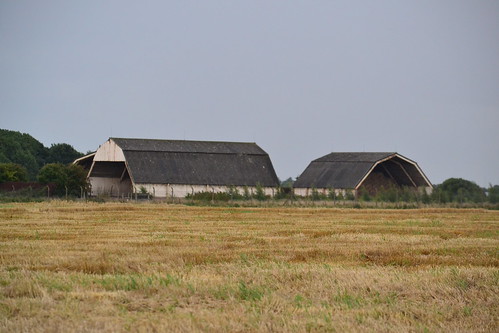
Accommodation would be provided for 1,178 male and 184 female staff, 1,179 of which were ordinary ranks. The original temporary wooden huts (possibly Laing huts) were supplemented with ‘improved’ Ministry of Supply (MoS) huts. These differed in that they had canted sides as opposed to vertical sides normally found in these types of accommodation huts. Three of these huts are believed to survive today in a very much modified condition and used for agricultural purposes, a big change from the time they were used by the W.A.A.F.s of Castle Camps.

Once construction was near complete, operational units would again return. On the 17th December 1941, 157 Squadron (formed at Debden three days earlier) were informed of their immediate  departure to Castle Camps, which would now become a self-serving airfield. The move, which would involve 3 Officers, 34 N.C.O.s and a few airmen, began that day, with ground crews from 3081 Servicing Echelon accompanying them on the next day. A range of other staff began arriving during the course of the closing days of 1941.

However,  the running of the airfield and squadron was badly hampered by the lack of an N.C.O Disciplinarian and Clerk, and by the fact that officers were having to travel back to Debden for accommodation, as it was not available yet here at Castle Camps – the situation was far from ideal.

As Christmas approached, morale began to decline. Influenced by a number of factors it was primarily due to both the lack of work and the isolation of the Castle Camps airfield; the continuing influx of ground personnel also hindered the camp, as by now, it was beginning to put a strain on the lack of completed accommodation. On the 21st, Wing Commander Gordon Slade and Pilot Officer Truscott, his observer, both arrived on posting from 604 Squadron at Middle Wallop. Joining Slade at Castle Camps a month to the day, would be Sqn. Ldr. Rupert Clerke, formerly of No.1 Photographic Reconnaissance Unit (P.R.U.), who flew the first operational Mosquito sortie the previous year on 17th September to Brest. It would be almost a year later on September 30th 1943, that Clerke would fly the first Mosquito day sortie, a flight that resulted in the loss of a Junkers Ju 88 off the Dutch coast.

With little work to do, ‘Normal Squadron Routine‘ was repeatedly entered into the operations records, and so to help boost this flagging morale, the 25th December, was declared a general holiday for all staff who had were said to have a “real good Christmas feed and a good time was had by all“, no doubt a welcome break to the monotony that had preceded the season’s festivities.*3
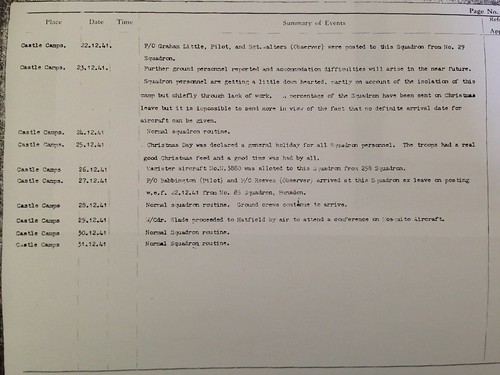
Operations Record Book 157 Sqn

The entries for December reflect the poor morale and the regular Normal Squadron Routine that was becoming ‘routine’. Note the arrival of Sgt. Walters, His name appears in the Roll of Honour – see below. (AIR 27/1045)

Boxing day would see the first aircraft to arrive, bringing new hope to the squadron. A  Magister (N3880) was not what had been hoped for, but at least it was taking the squadron in the right direction.  More ground crews arrived and more “normal squadron routines” occurred. On the 29th, W/Cdr. Slade travelled to Hatfield to attend a conference on the new Mosquito and in the new year, Air Marshal Sir Sholto Douglas (A.O.C. in C. Fighter Command) arrived with the Debden Sector Commander Group Captain Peel. A full inspection of the airfield took place, which coincided with twelve airmen transferring on attachment to 32 Maintenance Unit (M.U.) at St. Athan, where the new Mosquitos were being “fitted and tested”.

A flurry of activity over the next few days saw W/Cdr. Slade travel to both Boscombe Down, and St. Athan – at last things seemed to be happening.

Finally, on the 26th January, 1942 the first Mosquito would land, flown in by W/Cdr. Slade. Slade, who had flown the prototype Mosquito previously at Boscombe Down, brought in a dual control aircraft (W4073) but hopes of more aircraft were soon dashed as this was sadly the only model to arrive for some time.

For the remaining weeks bad weather hampered work on the airfield, and with workshops, decent accommodation and tools still lacking, Castle Camps was rapidly becoming a thorn in the Squadron’s side.

Further ground staff came and went, Mosquitos were ferried between Hatfield and St. Athan by pilots of 157 sqn, for fitting of electronic equipment, W/Cdr. Slade and five officers moved in to dispersed accommodation at a large mansion known as “Walton House” near Ashdon, 3 miles from the airfield.

RAF Castle Camps

The village sign at Castle Camps reflects the ever-present Black Mosquitos of 157 Sqn at the airfield.

On February 22nd, a Beaufighter II arrived, flown by W/Cdr. Ashfield, and by the end of the month more than a dozen Mosquitos had been transferred for modification to St. Athan. There was now a light at the end of the cold, dark tunnel. Staffing was now up to 16 Officers, 12 N.C.Os and 160 other ranks; some of the accommodation site drainage had been sorted, officers showers and baths were now working, and the N.A.A.F.I was at last open and providing entertainment for the staff. The first football match was played between the squadron and the works flight, a resounding thrashing saw the squadron winning 6 – 0.

Over the next few weeks facilities would gradually improve, the weather began to get warmer, and the signs were that more aircraft would soon arrive. On March 9th 1942, the first two operational Mosquitos arrived at Castle Camps, and what a welcome sight it must have been.

The first to arrive were W4087 and W4098, neither were yet fully fitted, but that wouldn’t dishearten the staff at Castle Camps, at least things were now moving. Over the next few days a large number of Mosquitoes would arrive, these NF.IIs were Airborne Interception (AI) equipped night fighters, armed with four .303in Brownings and four 20mm cannon – all very potent weapons of the night war.

By March 29th 1942, 157 squadron had to its name: 14 Mosquitos, 1 Beaufighter (fully equipped), 1 dual Mosquito, 3 not fully equipped Mosquitos, and 2 Magisters. Night flying would now start, but a lack of workshops, sleeping accommodation and fitters meant that not all aircraft could be kept serviceable at this time. By the end of April, training flights had reached their peak, and 157 was now ready for war.

On April 27th 1942, operations would begin. Three patrols would take off followed by four the next day and then three on the 29th. No visuals were recorded from the first two nights but a Do. 217 was identified but subsequently lost in cloud.

At the end of the month F/Lt. Stoneman (Engineer Officer) invented a modification that improved the effectiveness of the Browning’s flash eliminator, an improvement that was so successful, it was quickly adopted by the Air Ministry for other models.

Successes were slow coming to 157 Sqn, problems with the A.I. sets led to frustrations and missed opportunities, but eventually they did come, and the Mosquito proved itself to be a truly outstanding night fighter.
RAF Castle Camps

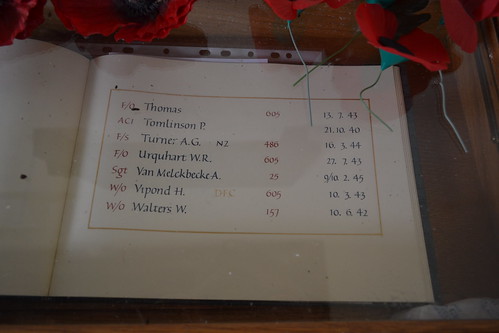
The Roll of Honour in All Saints Church lists W/O. W. A. C. Walters death as 10th June 1942. Walters (s/n 755538) arrived at Castle Camps on 22nd December 1941 (see above entry in O.R.B), he is currently buried in Nottingham Southern Cemetery, Sec. F.24. Grave 55. He was Son of Arthur and Annie Walters, of West Bridgford, Nottingham, and died at the age of 21.

By  March 1943 a change in command, Wing Commander V. J. Wheeler, M.C., D.F.C. replacing W/Cdr Slade, and then as night defenders turned to intruders, the role of 157 Sqn changed, and they prepared to move to pastures new and R.A.F. Bradwell Bay.

Around this time a small detachment of Mosquitos would share the facilities at Castle Camps, 456 sqn, who were primarily based at Middle Wallop, would have aircraft use the site between March and August 1943 – a month that would take Castle Camps into a new period, and new leadership.

The 15th would be a very busy day for staff at Castle Camps, with the departure of 157 Sqn came the simultaneous arrival of 605 Squadron.
RAF Castle Camps

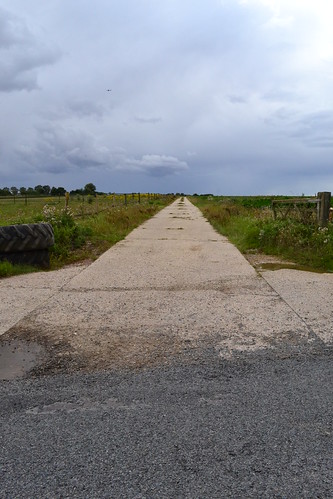
Part of the Perimeter Track that leads away to the airfield.

Led by the then Wing Commander George Lovell “Uncle” Denholm D.F.C., he was himself a Battle of Britain veteran, a Turbinlite advocate and was also famed for his part in the shooting down of the first German bomber on British soil. The famous ‘Humbie Heinkle’ was generally credited to Flight Lieutenant Archie McKellar of 602 Squadron from R.A.F. Drem, but Denholm and his 603 Sqn, played their part in damaging the aircraft before its eventual crash in East Lothian.

With the arrival of 605 Sqn and their Mosquitos, Castle Camps, like the stations at Bradwell Bay and Hunsdon, were quickly becoming synonymous with squadrons of the new type. Also Flying Mosquito IIs, (replaced four months later by the FB.VI) they would eventually depart here also for Bradwell Bay, but not before the ruggedness and reliability of the Mosquito would be put to the test.

On August 17th 1943, Sqn. Ldr. Mack and Flt. Sgt. Harrison, flew Mosquito FB.VI (HJ781) on a night intruder mission to Jagel in the northern most tip of Germany. Whilst on this mission, the aircraft was hit by a cable rocket projectile (Parachute and Cable or P.A.C.) fried from the ground. With a thin cable attached to a parachute they were designed to bring down allied aircraft and could be fired from either multiple or single launchers. HJ781, flew into one such cable which severed around 3 feet off the end of the starboard wing. The Mosquito, suffering considerable damage, managed to return to Castle Camps and was later repaired and returned to flight – such was the strength of the design of the Mosquito.

For the duration of their stay, 605 Sqn would perform almost nightly patrols over the airfields of the low countries and northern Germany, a tit-for-tat game played between the R.A.F. and the Luftwaffe, each aiming to catch returning aircraft as they approached their home airfield. A game that resulted in minor and relatively insignificant attacks on Castle Camps itself.

For eight months from June 1943, Castle Camps would be shared with a new squadron, the only squadron to be formed here, 527 Squadron, who were formed through the combining of both 74 and 75 Wing Calibration Flights from Duxford and Biggin Hill respectively.  Flying a collection of Hurricanes (I & IIB), Blenheim IV and Hornet Moths, they would test the accuracy of Britain’s defence radar systems across southern England and East Anglia.

The October departure of 605 sqn left 527 the only unit operating from Castle Camps, and operationally all was quiet once more. In the December 1943, 410 Sqn, another Hunsdon Mosquito unit arrived, stayed for a short while and then returned to Hunsdon in the April of 1944. A short but active spell saw them victors over a number of German types.

1944  would see another flurry of activity, with units arriving and departing in quick succession, and it would be a few months before another Mosquito would grace the skies over Castle Camps once more. 486 Sqn (RNZAF) , yo-yoed between Castle Camps and Ayr during the month of March, bringing with them yet another potent and deadly weapons platform, the Tempest V; followed by 91 Sqn while they were upgrading their Spitfire XII to XIVs.

Giving a useful indicator of scale, F/O. J. R. Cullen of No. 486 Squadron (RNZAF), poses with his Tempest Mk V at Castle Camps. Cullen became a successful Operation DIVER pilot, shooting down around 16 flying bombs. © IWM (CH 13967)

Between March and June little happened at Castle Camps, 68 Sqn*4 breaking the quiet with their Beaufighter VIFs at the end of June, which were quickly replaced with Mosquito XVIIs and Mosquito XIXs.  68 (Night Fighter) Squadron was primarily an R.A.F. Squadron, but Czechoslovak pilots formed one of its flights. The determination of the Flight’s crews resulted in some high ‘kill’ rates, with twenty-one verified kills, three probable, seven enemy planes damaged  and three V-1 flying bombs to their credit. The flight saw Twenty-three Czechoslovak pilots (twenty-one Czechs and two Slovaks) pass through their doors, culminating in an incredible 1,905 combat sorties covering 4,095 operational hours during the war.*5 By the October 68 Sqn too had departed, replaced by 151 Sqn and 25 Sqn for a short period both with yet another Mosquito model, the MK XXX.

1945 and the close of war saw units slowly begin to disband and wind down, 307 were followed by 85 Sqn who returned in the June and September also with the MK. XXX. A  huge improvement and development from their early Hurricanes of 1939 / 40 and a fitting end to a station that had seen many a brave young man come and go. 25 Sqn also returned, in both the August and October with the Mosquito VI, staying until June 1946, whereupon the airfield closed and returned to agriculture, a state it remains in today.

Castle Camps has little – aviation wise – to offer the visitor these days.  A recently erected memorial stands at the northern end of the airfield, the only visible marker of this once busy site that grew from a cold and windy field with little more than tents for accommodation, to a bustling site with possibly the most advanced and formidable fighters of the Second World War.

It may not appear to be much more than green fields and cattle farming, but sitting in the summer sun, as I did, you can still hear the rumblings of that magnificent engine the Merlin, as the Hurricanes and Mosquitos of the R.A.F. fly over your head transporting you back to those days of 1940s England.

Sources and further reading.

*1 The Castle Camps Village webiste details the history of the Castle.

*2 AIR/27/703/14 National Archives

*3 AIR/27/1045 National Archives

*4 An interesting blog highlighting some of the Czech pilots who flew with 68 Sqn.

*5 Pilot Josef Capka, D.F.M. (a member of the Guinea Pig Club) joined 68 Sqn after they left Castle Camps. His incredible story is told in the Free Czechoslovak Air Force blog and through his book ‘Red Sky at Night‘.
Chivalry Amongst Enemies

On December 20th 1943, high above war-torn Europe, the lives of a Luftwaffe fighter pilot and the crew of an American B-17 would collide in an event that has become famous around the aviation world.

On that day, a B-17, “Ye Olde Pub“, of the 379th BG based at RAF Kimbolton (USAAF Station 117) , would be so severely damaged it would defy the laws of gravity and somehow remain airborne as it departed Bremen, Germany, having valiantly carried out its mission. In the skies over the freezing waters of the North Sea, the bomber hanging by a thread, with two engines out, all but one of its guns but the top turret empty or frozen, its rudder and left horizontal stabiliser torn to pieces, a dead crew member and several others wounded;  “The Pub”, as its crew affectionately nicknamed her, seemed destined to fall from the skies. Just then, the pilot and co-pilot watched helplessly as bullets ripped through the cockpit ceiling, wounding the pilot, and causing the oxygen system to malfunction, leaving the desperate crew destined to succumb to anoxia in mere moments. It was then that the bomber fell into a slow upside-down flat spin. It did not take long before the pilot saw his co-pilot, eyes closed due to lack of oxygen, that he too, slowly lost consciousness as he watched the farmlands of Germany far beneath them, grow closer with each passing moment. The fate appeared sealed for the badly beaten bomber and the lives of her remaining crew. “The Pub” would be easy prey for the hunters of the Luftwaffe. At that precise moment, and with hundreds of miles still to get home, a lone Bf 109 would see the stricken bomber, take off and prepare to shoot it down. The German pilot was an ace, and  his plane had 22 victory marks, and he only needed to shoot down one more bomber to earn the long coveted Knight’s Cross.

However, the loaded guns of the 109 did not rain down its fire of death upon the bomber. Instead – and against all that was meant to happen in war – they stayed silent. The 109 cautiously approached the B-17, its pilot carefully manoeuvred around the aircraft watching for any sign from the gun crews that might suggest they were about to fire.  Inside, he saw its pilot who sat stunned in disbelief at the sight before him, and from the outside of the bomber, he knew whatever crew remained were likely desperately fighting to save their wounded comrades and themselves. (As the B-17 lost altitude, the remaining crew, including the pilot and co-pilot regained consciousness, and somehow managed to right the plane and set her on a course for home.)

In the B-17, pilot 2nd Lieutenant Charlie Brown watched in amazement as the 109 piloted by 2nd Lieutenant Franz Stigler formed up against it, perhaps teasing the crew before delivering the final and devastating blow. Stigler however, a sworn enemy of the Eighth Air Force, instead of firing, gestured to the crewmen to fly to Sweden and safety. But Brown, stubborn in his determination to get his crew home, didn’t understand, and carried on flying straight and level toward the North Sea and home. Stigler flew alongside, fearing the bomber would never make it and crash into the sea, so he continued to gesture to the crew. Steadfast, they carried onward, watching the 109, waiting for him to attack the defenceless bomber. Finally, fearing he may be shot down himself, Stigler saluted the crew and departed, leaving the bomber to fly safely back to England.

The story of this brief encounter remained unknown for many years – Stigler sworn to secrecy for fear of his own life, and Brown for fear of complacency in the Air Force, were both unable to openly talk about the experience. Then, after many years and through extensive research and letter-writing, the two pilots finally met up in a meeting that was so charged with emotion that it reduced both men to tears.

Immortalised in John Shaw’s painting* and Adam Mako’s book, “A Higher Call” is the dramatic story of this strange and heartfelt encounter.

Image result for higher call

John Shaws’ painting of the two aircraft flying together.

This is not a book about one meeting though. This is a book  about two men, the people behind the guns, the characters, their experiences and their lives. It tells the story of Franz Stigler, how he, as a natural pacifist, was drawn into a vulgar fight waged by madmen and tyrants thirsty for revenge. The story is told as he progressed from flying school then onto Egypt and Sicily and eventually back to defend his homeland against the continued onslaught of heavy bomber formations reigning death and destruction upon a foe so evil, it led to the slaughter of millions of innocent people.

But why did Stigler let the bomber crew live? The book reveals his character, his determination to carry out his duty to defend his homeland, the honour that existed between friend and foe, the unwritten rules of warfare, and the distaste he had for all that Nazism stood for. When these worlds collided, he had to make a decision. His finger poised over the trigger, to squeeze it or not? That… That was the moment when Franz Stigler realized if he DID shoot, it would be no ‘victory’ for him. With that, his desire to earn the Knight’s Cross disappeared. He knew that there were more important aspirations for him.

In this well written book , Mako reveals the man behind the gesture. Through research and interviews with both crewmen, he lays out the story of Stigler delving into his character, digging deep into the memories of that night and the events that led up to and after it. He explores the events that created the man, the decisions that made him the person he was. A man to whom medals and numbers were not important, a man who would risk his own life to ensure the safety of others.

It would look at how the people of post war Germany, would turn against him and his kind, laying the blame for defeat firmly at the feet of the fighter pilot. How a once hero of the Reich would become the villain, be despised by those he protected even though he disagreed with what they stood for.

This is a fascinating and compelling book, detailed in every aspect – it is difficult to put down. It provides a fascinating insight into the man and his machine, the tragedies and traumas of war. Supplemented by original letters and photographs, this book is a fascinating read into the story behind the picture, and the events that occurred on that day, December 20th 1943.

A Higher Call is written by Adam Makos and Larry Alexander is published by Atlantic Books.

* The original painting was created by Robert Harper, the Assistant Intelligence Officer of the 448th BG at RAF Seething where Brown’s B-17 landed.

Hingham – an airfield fallen into obscurity.

Continuing  on Trail 38, we depart Swanton Morley and travel south-east toward the former RAF / USAAF base at Hethel. Here we find fast cars, a museum, and more remnants of yesteryear. On the way, we pass-by another former RFC airfield from the First World War – the Home Defence Station at Hingham.

Hingham Home Defence Station.

There is considerable speculation about the true location of Hingham airfield. It is sadly one of those sites that has long since gone, and its history is now so blurred that its true location is not accurately known. It is known however, that it housed only three squadrons in its very short life: 51 (HD), 100 and 102, but only 51 Sqn remained for any period of time, thus making it the sole unit to have flown actively from this airfield.

A grass site, it was believed to be located near to the village of Hingham in Norfolk, some 12 miles south-west of Norwich, however, some sources cite it as Scoulton (latterly Watton airfield) located a few miles to the west of here. Wherever the true whereabouts of Hingham are, it is known that it did play a small but important part in the defence of Great Britain, and therefore worthy of a thought as we pass by.

Following the reorganisation of the RFC and RNAS in 1916, it was known that 51 (HD)  transferred from Thetford to Hingham, arriving at the fledgling airfield on 23rd September 1916, with the Royal Aircraft Factory BE12s. With detachments at Harling Road, Mattishall and Narborough, they were widely spread and would operate solely in the Home Defence role. These airfields were designated Home Defence Stations of which there were two, the ‘Flight‘ station (the smaller of the two) and the ‘Squadron‘ Station, the larger and main station. It is very likely that Hingham was designated as a Flight Station.

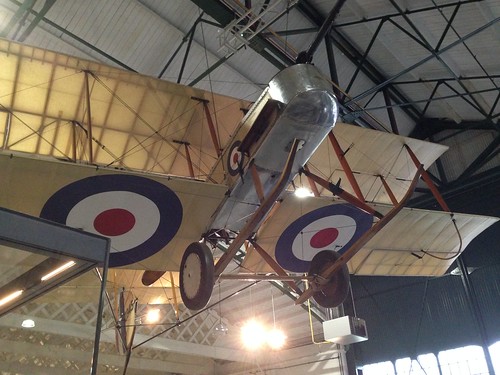
In October 1916, 51 (HD) replaced with the BE12s with  two-seat FE2bs and then with further RAE aircraft, the BE2e, in December 1916. The Hingham flight moved to Marham in early august 1917, whilst the Mattishall flight remained where they were.  ‘B’ flight moved west to Tydd St. Mary, a small airfield located on the Lincolnshire / Cambridgeshire border.

RAF Museum Hendon

The Royal Aircraft Factory F.E.2b at Hendon, London

Throughout the war 51 (HD) squadron fought against the Zeppelins that foraged over the eastern counties. By flying across the North Sea and then turning into The Wash, they were aiming to reach targets as far afield as Liverpool, Coventry and London.

One of several Home Defence airfields in this region, the role of Hingham aircraft (and the other Home Defence units around here), was to protect these industrial areas by intercepting the Zeppelins before they were able to fly further inland.

However, in the early days of the war, Zeppelins were able to fly at greater speeds and altitudes than many of the RFC aircraft that were available, and so the number of RFC ‘kills’ were relatively light. Many of these German Naval airships were able to wander almost at will around the Fens of Cambridge and Lincolnshire dropping their bombs wherever they pleased. It was this lack of a strong defence strategy that perpetuated the creation of the Home Defence squadrons. This new organisation along with improvements and developments in both ammunition and aircraft performance, began to improve the ‘kill’ success rates, and gradually the number of raids decreased. 51 (HD) Sqn played a pivotal part in this role, attacking Zeppelins on a number of occasions in these mid-war years.

It was during this time that two new RFC squadrons would be formed at Hingham. On February 11th 1917, the nucleus of 51 Sqn were relocated here to form the new 100 Sqn, whilst on August 9th that same year, the new 102 Sqn was formed. Both these units would train in the night bombing role and then go on to attack airfields and troops in Northern France in support of the stagnating Allied ground troops.

A stay of about 6 weeks for 102 Sqn and 12 days for 100 Sqn saw them both depart to pastures new, St. Andre-aux-Bois in France and Farnborough in the south of England respectively. It was at these locations that they would collect their operational aircraft before reuniting in Northern France in March that year.

After 51 (HD) squadron left Hingham, the site was never used again by the military and it was subsequently closed down. Whatever structures that were there were presumably sold off in the post war RAF cutbacks, and the field returned to agriculture with all traces, if any, removed – Hingham’s short history had finally come to a close.

Hingham was a small airfield that played its own small part in the defence of the Eastern counties. Whilst its true location is sadly not known, it is certainly worthy of a thought as we travel between two much larger, and perhaps much more significant sites, in this historical part of Norfolk.

RAF Wittering – a history rooted deep in the First World War.

You can’t look at the remnants of RAF Collyweston (Trail 37), without taking in RAF Wittering. Renowned for its Harrier Squadrons, RAF Wittering was an airfield that fell quiet as a result of the Government cutbacks that affected all the armed forces in December 2010. Sadly it meant the loss of the RAF’s Harrier fleet, an aircraft that had been stunning the crowds at air shows both here and overseas from many years. The Harrier remains one of the few RAF/RN jets to have proven itself in a combat environment, when it took on the Argentinian Air Force in the war over the Falkland Islands in 1982. However, the Harrier squadrons were just one small part of Wittering’s long and established history.

RAF Wittering.

RAF Wittering dates back to the First World War, its roots set in 1916 when an airfield was built on the site then known as Wittering Heath. Stamford Airfield, as it was then designated, was to initially operate BE12 aircraft in the anti-Zeppelin role, acting in conjunction with their main force of 38 Squadron at Melton Mowbray. These aircraft would eventually, in turn, be replaced by BE2e, FE2b and FE2d aircraft. During this time a small detachment from 90 Sqn would also be stationed at Wittering, but their stay would be short, between August and September 1918 – they were also flying the FE2b.

AERIAL VIEWS IN THE UNITED KINGDOM 1941-1942

Wittering airfield taken early in the Second World War. The A1 road can be seen to the east of the airfield. © IWM (HU 91901)

As the war progressed, Stamford became the training ground for new recruits, forming No1. Training Depot Stamford whilst a short distance to the west a second station was established at Easton on the Hill, operating as No. 5 Training depot. These two sites operated only a stones throw apart but both totally independent of each other. Eventually with the formation of the Royal Air Force on April 1st 1918, Stamford would become RAF Wittering and Easton on the Hill – RAF Collyweston.

RAF Wittering had been born. It would go on to be one of the RAF’s most significant airfields operating in excess of 36 active flying squadrons. Some of these would be formed here, some disbanded and many pass through in transit to other sites around the country. The aircraft here would range from Royal Aircraft Factory Biplanes to Whirlwind HAR 10 Helicopters, Boulton Paul Defiants through Supermarine’s Spitfire to Hawker Hunters; Hawker Siddely Harriers, Vickers mighty Valiant and Handley Page’s ‘V’ bomber the Victor, would all operate from here during its long life.

Following cessation of the First World War, Wittering was placed under care and maintenance, looked after and cared for until 1926 when the Central Flying School moved in from their previous base at Upavon.

The post war years were turbulent times for the RAF, having not only to fight off Government cutbacks and spending caps, but the Government’s tendency to favour both the Navy and the Army in terms of a national defence force. Since the war’s end, over 23,000 officers, 21,000 cadets and 227,000 other ranks would be lost from the RAF’s service. The landing grounds that had been used to fight off Germany’s mighty Zeppelins, along with vast quantities of material and machinery, were disposed of at near give-away prices. The fact that any force  had been kept at all was down primarily to the determination and foresight of one Hugh Trenchard who would himself rise to the rank of  Marshal of the Royal Air Force in 1927.

As global tensions grew in the 1920s and British interests abroad were put at risk, a review was called for of Britain’s defence forces. The review concluded that some 52 squadrons would be needed to provide a sustainable and strong Home Defence Force that would not only be capable of holding back any force that should take desires on Britain, but could also respond adequately by taking the fight to the enemy.

So in the mid 1920s the RAF’s expansion began.  The first four Auxiliary Air Force squadrons were formed along with the first of the University Air Squadrons (UAS). A combined Air Force Cadet College and flying training school was established at Cranwell along with the Air Force Staff College at Andover, – the fledgling Royal Air Force was making its first proper steps in the right direction.

Further tensions in the 1930’s brought home the need to develop and increase the Air Force. The not so subtle build up across the channel with increasing tensions in Germany, meant that she was rapidly becoming a major threat. Now woefully under manned, the Government poured money and manpower into improving the stature of the Royal Air Force.

With design and engineering pioneering the way in long distance flight, speed and manoeuvrability, new models of aircraft were being designed. Monoplanes were the way forward and with Britain winning the Schneider Trophy for the final time, the way ahead was set for aircraft capable of incredible speeds and performance.

With war looming, Wittering was about to come into its own receiving its first operational squadrons both 23 Sqn and 213 Sqn in May 1938. By the end of the following year, Wittering would be designated Sector Station of 12 Group whose responsibilities stretched from the boundaries of London in the south, to the Welsh border in the west, Liverpool and Hull in the north and the entire eastern counties.  Wittering units would be responsible for a wedge through the middle of this sector running from the North Sea coast to Wales.

In that same year, Spitfire Is of 610 Sqn Auxiliary Air Force joined the recently arrived Blenheim IFs and Hurricane Is before they headed south to Biggin Hill in support the BEF’s evacuation from Dunkirk in May 1940.

Wittering was really too far north to be able to effectively participate in the either the Battle of Britain or the defence of London; fuel and journey times would have left her fighters at a disadvantage, so Wittering concentrated on both resting and reforming battle worn units from the south, and defending the industrial Midlands and the north.  Her units would become key in the night fighter role, protecting the eastern and North Sea routes from the Luftwaffe – a role in which her squadrons would learn and develop very quickly.

23 Squadron were key in this very role. Dispersing their Blenheims at Collyweston, they shared Wittering with Hurricanes of 32 and 229 sqn, Spitfires of 74 and 266 Sqn and Defiants detached from 264 Sqn. These fighter versions of the Blenheim benefited from the addition of a bolt-on underbelly gun-blister housing four .303 machine guns; but they lacked any technologically advanced radar or Airborne Intercept (AI) mechanisms and so relied heavily on visual identification, referred to in the ranks as ‘Eyeball Mark One’!

23 Squadron would fly a number of patrols from Wittering, intermixed with sections being detached to RAF Digby for night flying co-operation duties on a weekly rotation basis. Few of these night patrols proved to be fruitful however, and many enemy aircraft escaped simply because they could not be found in the dark skies.

To improve kill rates, carefully drawn up patrol lines were set up fanning outward from Wittering. Often, pilots would use distant searchlights as a guide to locating the enemy intruders, however, this had its dangers and some RAF crews were lost because they too found themselves illuminated in the dark night sky, only to become victim to the enemy or the over eager A-A crews below. One such incident occurred on the night of 18th June 1940 when Blenheim L1458 ‘YP-S’ crashed near RAF Sutton Bridge as a result of being shot down by a He111 from KG4 that it was attacking. In getting close to the Heinkel, the Blenheim was itself caught in the local searchlight and the Heinkel returned fire. The pilot Sergeant A.C. Close, died as a result of the crash whilst the air gunner, LAC L. R. Karasek bailed out at low-level and was taken to Sutton Bridge and treated for his injuries*1.

The autumn of 1940 saw further changes at Wittering. In August, 266 Squadron arrived using various models of Spitfire, whilst in September, 23 Squadron departed moving to RAF Ford. Then in came No. 1 Sqn, the oldest RAF squadron, with Hurricane MKIs. Battle hardened from the fall of France and a summer of fighting in the skies over Kent, they remained here until the end of the year before returning south in the defence of London once more.

It was around this time too that a detachment of Hurricanes from 151 Sqn would arrive from RAF Digby, a station Wittering worked very closely with. After a short period these were replaced by Defiant Is also participating in the night fighter role. One determined and perhaps aggressive pilot, Flt Lt Richard Payne Stevens DSO, DFC would bring an element of mythical mystery to the flight as the squadron moved through Hurricane IICs, Defiants IIs and onto Mosquito IIs before the now permanent squadron left for Colerne in April 1943.

Using nothing more than his remarkable night vision, he would become the greatest scoring night fight pilot during the Blitz, downing a total of 12 Luftwaffe bombers in his black Hurricane.

In November / December 1940, 25 squadron came in bringing with them the much improved, faster and better AI equipped Beaufighter IF. In addition, a single Beaufighter MKII was also deployed here purely for evaluation purposes. A rarer Merlin engined model, R2277, it was credited with the shooting down of  a Ju88 on the night of June 22nd 1941 when piloted by F.O. Michael Herrick and his radar operator F.O. Yeoman. It was later stuck off in June and remains the only Merlin powered model to enter the books of 25 Sqn*2.

AIRCRAFT OF THE ROYAL AIR FORCE 1939-1945: BRISTOL TYPE 156 BEAUFIGHTER.

Similar to R2277, Beaufighter R2270 was the first Merlin powered prototype MK IIF, © IWM (MH 4560)

At the end of 1940 a new commander arrived, Group Captain Basil Embry, who disliked the Defiant as a night fighter and considered Wittering too poorly designed for a night fighter station. He set about devising a plan to join adjacent Collyweston and Wittering together to develop and create a single airfield with a new much longer hard runway to replace the grass ones used until now. The expansion was completed in record time, Embry by-passing the more conventional channels of procedure.

In July 1941, the Beaufighters of 25 Sqn were replaced by the Douglas (Boston) Havoc Mk Is, an aircraft they took to Ballyhalbert (Ireland) in the following January.

The summer of 1941 would also see another new experimental model arrive. In conjunction with operations at RAF Hunsdon, the rather ill-fated Turbinlite project was put into operation here. Elements of the 1451 Flight were formed into a new squadron designated 1453 Air Target Illumination Flight, a concept that involved bolting an enormous 800,000 watt lamp to the front of the aircraft. As these modified Havocs were now much heavier, they could not carry any weapons and so relied upon an escorting Hurricane, Defiant or Spitfire to shoot down the enemy once located by the massive 950 ft wide beam of light. On October 22nd 1941, 151 squadron carried out its first official Turbinlite operation.

Fighter command decided to establish 10 dedicated Turbinlite squadrons in total, numbered 530 sqn- 539 sqn, they all became operational on either the 2nd or 8th of September 1942. On the 2nd, 532 was formed at Wittering using a combination of 1453 Flight and Hurricanes from both 486 Squadron and various Operational Training Units (OTU). The rather poor performance and low success rate however, meant that all these units were disbanded in one fell swoop on January 25th 1943*3.

It was part way though these operations (April 1942) that 151, released from their restrictive Turbinlite operations, replaced their Defiant IIs with the new ‘Wooden Wonder’ the Mosquito NFII. Only the second squadron to use them, they were to prove a formidable weapons platform and a deadly night fighter. The night skies were now a prime hunting ground and partly as a result of the Mosquito successes, the number of Luftwaffe intrusions began to reduce.

The turn of 1942/3 wold see further changes at Wittering with many short stays by 118, 288 (on Detachment), 349, 141, 91 and 438 Sqn taking Wittering through the new year. 151 remained until April moving off to Colerne and new model Mosquitoes, 141 who replaced them brought more Beaufighters in the form of VIFs. With increased engine power, more fuel and a capacity for increased bomb loads, the VIFs had modified noses to accommodate the new AI radar. Now the hunters were taking the war to Germany and intruder missions began to take place.

During this time Wittering was also home to No 1426 (Enemy Aircraft) Flight, utilising the former RAF Collyweston site which evaluated captured enemy aircraft. A remarkable unit they flew captured aircraft around the many bases of the RAF and USAAF for crews to examine.

As the war drew to a close, sorties began to get fewer and fewer, and operational flying at Wittering would all but stop. Other than the P-38s and latterly P-51s of the USAAF 55th Fighter squadron –  who had been sharing Wittering with their RAF counterparts – Wittering became operationally quiet.

Eventually the war ended and various units used Wittering for training and experimental work. Post war 1946, 23 Squadron was reformed here from the ashes of 219 Sqn, taking their Mosquito NF30 to Lubeck almost immediately. A range of squadrons using various piston-engined aircraft passed through Wittering and two reception centres were set up to receive incoming POWs from the continent. By the end of 1948 all aircraft had left , and it returned to its roots once more becoming the home of No. 1 Initial Training School, Flying Training Command.

In the early 1950s, Wittering was placed under care and maintenance whilst upgrading work was carried out to its runways. During August 1953 both Lincoln bombers and Canberras (B.2, B.6, PR7) would operate overseas from here – these included detachments at the infamous Christmas Island.

Further Canberras of both 76 and 40 Squadron would fly from Wittering and in 1955 Wittering entered the atomic age with the arrival of the Vickers Valiant. Operations using conventional bombs were seen during the Suez crisis in 1956, when Valiants from No 138 Sqn flew 24 missions against targets in Egypt. Two other squadrons would fly the enormous but less favoured ‘V’ bomber: 49 and 7 squadrons, and it would be 49 Squadron who would take Britain forward as a nuclear nation when in 1956 a Valiant B.1 dropped Atomic bombs on both the Maralinga Range (Central Australia) and in 1957 a total of 6 Hydrogen bombs over Malden Island. During this time the aircraft were operating as detachments from Wittering, again on Christmas Island in the Pacific.

RAF VALIANTS FOR CHRISTMAS ISLAND TESTS

Vickers Valiant bomber crews of No. 49 Squadron RAF about to leave RAF Wittering for Christmas Island in the Pacific to take part in Britain’s nuclear tests, March 1957. © IWM (C(AM) 2466)

With no decrease in the perceived threat from the Warsaw Pact, the  ‘V’ bomber force would continue from Wittering for a few more years . The Valiant being replaced by the Victor B.2 and later B.2Rs of 139 and 100 Squadron, who had themselves been disbanded in September 1959 to reform at Wittering in May 1962.

In December and September 1968 respectively both these squadrons were disbanded and Wittering would then enter the dawn of vertical take off and landing. A short stay by Westland Whirlwinds HAR.10s of 230 Squadron led to the arrival of probably one of the most famous aircraft in aviation – the Harrier.

In August / July 1969 No. 1 Squadron returned to Wittering, its first time since the 1940s. Wittering became famous as ‘The Home of the Harrier’ and its fame would spread far and wide. With combat success most famously in the Falklands campaign and later the Balkans, Serbia and Kosovo, it would go on to serve Wittering well flying the GR.1, GR.3, GR.5 and GR.7  before moving away to Cottesmore and disbandment in December 2010.

The only other units to fly from here (less any training squadrons) were 4 Squadron flying both the Hunter FGA.9 and Harrier GR.1, 45 Squadron and 58 Squadron both flying the Hunter FGA.9 until they were disbanded on the same day 26th July 1976.

With that flying ceased at Wittering, but it remained an active military base operating a number of logistics units including a wide range of logistical support organisations. It is also home to the RAF’s bomb disposal squadron 5131 (BD) Sqn.

Further reorganisation of flying training units has been Wittering’s saviour. Today 100 years after its inception, and after a 6 year gap, flying has finally returned to Wittering, with the re-introduction of flying training units from No.3 and 6 Flying Training Schools, relocating here from both RAF Wyton and RAF Cranwell.

It would seem that Wittering has gone full circle again, not once, but twice, with its history rooted deep in the First World War, it has always been one of the RAF’s most important airfields. It has trained aircrews, defending these shores against the night terrors of two World Wars, and its crews have defended us against invading forces both here and in British Territories far off. Wittering forces have provided a strong and powerful peace-keeping force across the globe and even today it plays a major part in support, training and defence against those who wish to cause harm to both British sovereignty and democracy.

Note: As a fully active military site, much of Wittering is understandably hidden behind high fences and trees. When passing along the main A1, the main gate, and some buildings are visible, but stopping is not permitted. There are other places to the rear of the airfield but views are limited and little can be gained from using them. Permission should be sought before approaching the site.

Sources and further reading.

*1 Commonwealth War Graves Commission Website
– Battle of Britain London Monument website
– Traces of World War 2 Website

*2 Goodrum, A, “No Place for Chivalry” Grubb Street, 2005

*3 Mosquito W4087 flew as Turbinlite aircraft at Wittering February 5th 1943 – Source: Jefford, C.G.RAF Squadrons – 2nd Edition“, Airlife, 2001

MOD UK – Website

RAF Tydd St. Mary

Just over the Cambridge border into the area known today as South Holland in Lincolnshire, is a field that was a small airfield during the First World War. Designed for home defence, it was used for attacking marauding Zeppelin airships approaching England across the North Sea. Larger towns and cities such as Norwich and Lincoln were prime targets, although most designated targets were much further north for example Manchester and Liverpool. To protect themselves, the crews of these mighty airships flew at night and at altitude, but navigation skills were poor and crews were generally unaware of their actual location. As a result, they rarely made it beyond the eastern counties or the Fens of Cambridge and Lincolnshire. Because of poor weather and inexperienced pilots flying against these ships, some Zeppelins were able to wander – at the will of the weather – for as much as 10 hours unabated, randomly dropping bombs on what they considered to be ‘prime targets’.

A major turning point in this air-war, was the night of January 31st 1916 when nine Zeppelins of the German Navy attacked what they believed to be the industrial north-west. In fact they had barely got beyond the lower regions of Lincolnshire before dropping their ordnance. These attacks resulted in the loss of sixty-one people and whilst no British fighter was known to have engaged the airships, a number of Royal Flying Corps (R.F.C) crews were lost due to bad weather.

This disastrous night led to major changes in the Home Defence Squadrons of the R.F.C and R.N.A.S (Royal Naval Air Service), a process that would take a considerable time to complete.

As a part of these changes, an airfield was developed just south of the South Holland Drain a mile or so north of the village of Tydd St. Mary.

RAF Tydd St. Mary

Designed as a class 1 landing ground, Tydd St. Mary covered 125 acres by the time it closed in 1919. Development of the site began in mid 1916 following the re-organisation of the home defence force, but the first units didn’t arrive until the autumn of 1917. Not much more than a field, it did eventually have a small number of  Bessonneau*1 hangars and a small selection of crew huts.

The main unit to use Tydd St. Mary was 51 Home Defence (HD) Squadron whose main flight was based at Thetford. Formed from the nucleus of 9 Reserve Squadron (RS) on 15th May 1916, they moved to Hingham with flights dispersed at Harling Road, Norwich (‘A’ Flight), Mattishall (‘B’ Flight), ) and Narborough (‘C’ Flight). Initially they were equipped with the BE2c, which were soon replaced by the BE12 and subsequently the FE2b aircraft and then the BE2e in December 1916.

For a short while Zeppelin intruder flights were rare and this breather allowed for extensive practice flights by both 51 (HD) Sqn and their partner unit 38 (HD) Sqn who were based a little further to the north.

This lull in movements ceased in the autumn of 1916, when a large formation of Zeppelins gathered over the wash and headed for London. Badly hindered by fog and bad weather, they were eventually scattered across the southern and eastern regions of England where they dropped their bombs on remote farmland. This attack caused no damage to property, nor were the Zeppelins challenged in any major way – the marauders had little to worry about other than poor weather. Patrols by 51 and 38 (HD) Sqn’s were in vain, a pattern that was to continue for the large part, for the duration of the war.

At the end of 1916, Tydd St. Mary was re-designated a Night Landing Ground (NLG) following the renaming of R.F.C Home Defence Stations. 51 (HD) Squadron would soon fly from here in the defence of the eastern counties.

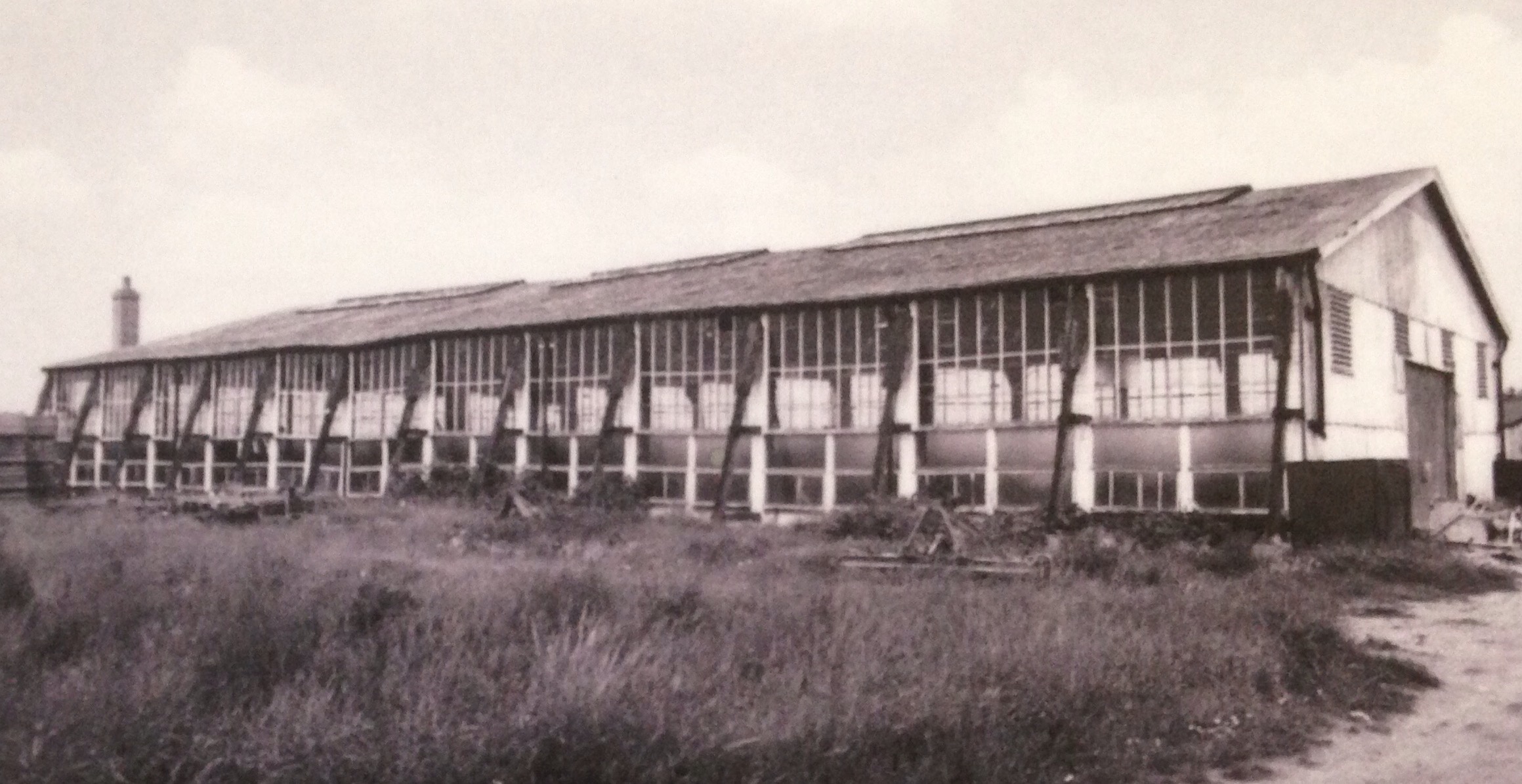
51(HD) Sqn aircraft hangar modified for agricultural use post war.*2

The Zeppelins main advantage over the British was the poor performance of the aircraft types the R.F.C used.  Whilst capable of operating at the 8,000 – 10,000 ft altitude used by the Zeppelins, many aircraft simply took too long to get there and thus could not reach the airship in time to attack it.

As performance improved along with the development of the explosive ammunition that would ignite the airship’s gases, the odds were a little more balanced and larger numbers of airships were being brought down over the eastern region. The tide was turning and pilots of 51 (HD) Sqn were playing a large part in this.

In the early part of 1917  cuts to the Home Defence units were announced based on the increasing gains made by units of the Norfolk / Cambridge / Lincoln squadrons. But the Germans had not given up yet. Reductions in weight enabled new Zeppelins to reach greater altitudes. Now capable of 16,000 – 20,000 feet, few British defences could reach them.

As the tide was turning in France, attacks became fewer and fewer. These high altitude flyers were more at the mercy of the bitter cold and poor weather than defending aircraft.

In August 1917 51 (HD) Sqn moved their headquarters to Marham, and ‘A’ Flight arrived at Tydd St. Mary and 51 (HD) Sqn began replacing their BE2e aircraft with the Martinsyde G.100 ‘Elephants’ – so-called because of their size and poor manoeuvrability.

A large contingent of airships gathered once more on the night of October 19th 1917, requiring extensive sorties by 51 (HD) Sqn at Tydd St. Mary and her counterparts. Whilst a determined effort was made by the R.F.C crews, they had little or no impact, and the gathered airships made off only to be badly beaten by bad weather and anti-aircraft fire over France.

Further changes to R.F.C Squadron designations  in the latter parts of 1917/18, dropped the title ‘Home Defence’ and Tydd St. Mary became the base for 51 Sqn ‘A’ Flight in Eastern Command. Aircraft by now were primarily Royal Aircraft Factory FE2bs, although 51 Sqn were now replacing some of their ‘Elephants’ with BE12b variants which they kept until the autumn of that year. Further changes in February 1918 meant that ‘A’ Flight moved to Mattishall, whilst ‘B’ Flight took their place at Tydd St. Mary.

As the R.F.C turned into the R.A.F on April 1st 1918, Tydd St. Mary would once again become significant. On the night of April 12th 1918, Zeppelin L62 was sighted close by and aircraft took off to intercept. As it was dark at 22:00 the flare path was lit to assist the now R.A.F crews, which openly guided L62 directly onto the airfield. Gliding above the site, L62 dropped a small number of incendiary bombs onto the aerodrome in an attempt to damage or destroy aircraft on the ground. Fortunately the bombs fell well away from parked aircraft and caused no damage to either buildings or aircraft. Pursuit was made by Lt. F. Sergeant in FE2b ‘A5753’, but to no avail and he returned to base empty-handed. Other pilots also tried to catch L62, some crashing due to engine failure, but many simply weren’t able to catch-up with the intruder. Eventually L62 reached the coast and made a break for it across the sea under the protection of yet more bad weather.

By November 1918 the final FE2bs had been relinquished and for the remainder of the year and into May 1919, 51 Sqn operated Sopwith Camels. A move by ‘B’ Flight in May to Suttons Farm (RAF Hornchurch) not only signified the end of the Camels (replaced by Sopwith Snipes) but the end of 51 Squadron who were disbanded in June. This departure also meant the end of Tydd St. Mary and in November 1919 notice of closure was given and the site finally closed in January 1920.

Tydd Gote Village sign

The village sign at Tydd Gote, remembers the RFC from the airfield at Tydd St Mary.

At its height Tydd St. Mary covered an area of 125 acres, and contained two Home Defence flight sheds as single units (believed to measure 130 x 60 ft). These were utilised by local farmers and business and lasted for many years. Other buildings were also utilised, the last, believed to be the Flight Office, is thought to have been demolished as late as 2009.

Not a major player in the war and never to return to aviation, Tydd St. Mary is a notable site and perhaps when passing, a second thought for those who flew from here in defence of the Eastern counties, should be offered.

Tydd St. Mary forms part of Trail 37.

Sources and Further Reading

*1 Early Bessonneau hangars were constructed of wood covered in canvas. Various types were made and were designed to be erected by small trained groups of men. Later models replaced wood with metal and were more permanent.

*2 Photo on display at Thorpe camp, Woodhall Spa.

Goodrum, A. ‘No Place For Chivalry: RAF Night Fighters Defend the East of England Against the German Air Force in Two World Wars‘. 2005, Grub Street

The Great War Forum – website 

Small but significant – RAF Collyweston

This airfield is the most northerly one in Cambridgeshire. It borders two counties and has its origins as far back as World War I. It was a small airfield, but one that played a major part in both the First and Second World Wars. It sat only a short distance from its parent airfield, an airfield that became so big it absorbed it. Today we visit the airfield that was RAF Collyweston.

RAF Collyweston

Throughout their lives, both airfields would go through a number of dramatic changes, especially as new ideas, concepts or advancements in technology were made. The biggest initial change may have been as a result of Major Smith-Barry of 60 Sqn (RFC), when he came up with the ‘revolutionary’ idea of teaching people to fly rather than allowing them to prove it! Widely accepted and quickly adopted, it led to the creation of a series of new and unique RFC Training Depot Stations (TDS). The idea behind these TDSs, was to train new pilots from the initial stage right the way through to gaining their ‘wings’ – all in one single unit; a philosophy that would change the way the Air Force would operate for a very long time.

Initially the two airfields ran independently from each other, Stamford airfield (later RAF Wittering) opened in 1916 operating as a Royal Flying Corps base for No 38 Home Defence Sqn’s anti-Zeppelin unit. It operated both the BE2C and BE12 fighters. The following year in 1917, it changed to the No 1 Training Depot Station (Stamford), then as a result of the formation of the Royal Air Force on 1st April 1918, it was finally re-named RAF Wittering.

RAF Collyweston was located to the western end of Wittering, and opened on 24th September 1917, as No 5 Training Depot Station under the name of Easton-on-the-Hill. It operated a number of training aircraft including: DH6s, Sopwith Camels, RE8s and Avro’s 504. It was also renamed with the formation of the RAF and became known as RAF Collyweston. It continued in the training role until after the war when the squadron was disbanded and the airfield was closed.

Photograph of Wittering airfield looking east, taken 9th May 1944. Collyweston can just be seen at the bottom end of the main runway. (USAAF Photography).

Two years after the outbreak of World War II, Collyweston was re-opened as a grass airfield, a satellite to its rather larger parent station RAF Wittering. By the end of 1944 it would have a total of 4 blister hangars and would be used by a wide range of aircraft.

On May 14th 1940, the first aircraft would arrive, not permanent residents, but a detachment of Spitfire Is of 266 (Rhodesia) Squadron whose main units were based at RAF Wittering. They would stay here only temporarily but return in 1941 for a full month with Spitfire VBs.

Later that month on the 31st of May 1940, the first permanent residents did arrive, Blenheim IFs of 23 Squadron, who would share the night-fighter role with Beaufighters from RAF Wittering. These Beaufighters were using the new and updated AI MK IV radar, a new model that was so heavy and cumbersome, few aircraft could accommodate it. The new radar was introduced in conjunction with Ground Controlled Interception Techniques (CGI) aimed at locating and ‘eliminating’ enemy aircraft at night. The Blenheims – considered too poor for daylight fighter duties – and Beaufighters would prove their worth operating across the Midland and Eastern regions, eventually flying over to the continent later on in the war. After three months of operations from Collyweston, 23 Squadron would completely move across to Wittering leaving Collyweston empty once more.

Then on 28th September 1941 the infamous 133 ‘Eagle‘ Squadron manned by American volunteers arrived with their newly acquired Hurricane IIBs. Armed with four potent 20mm canons, they were a force to be reckoned with. This was however, only a short one week stay at Collyweston, and the ‘Eagles’ moved on to RAF Fowlmere leaving their indomitable mark on this quiet Cambridgeshire airfield.

At the end of September 1942, Spitfire VBs of 152 (Hyderabad) Squadron would pass though, staying for three days whilst on their way to Wittering, then North Africa and eventually Malaya. Battle hardened from the Battle of Britain where they had been covering the English Channel and the south coast, they were now non-operational as they began preparing for their move overseas.

Embry (right) was to devise a plan to join RAF Wittering and RAF Collyweston. (Photo Wikipedia)

There then followed a period of change. 288 squadron flying Spitfire VB and IXs would yo-yo around a number of different airfields whilst keeping a detachment at Collyweston. Initially based at Digby, they would be spread over six different airfields (Church Fenton, Duxford, Wittering, Coltishall, Bottisham and Collyweston) creating what must have been a logistical nightmare. The Spitfire would perhaps be their most potent and graceful aircraft which they operated from January to March 1943, before replacing them with Airspeed Oxfords and then Martinets. Moving the main section to Coleby Grange and then Digby, a detachment would remain at Collyweston until the main squadron arrived here in January 1944 – still spread across 6 airfields. In March 1944, 288 Sqn replaced the Martinets with Beaufighter VIs which in turn were replaced with the Vultee Vengence MK IVs in May 1945. After this the squadron moved on and to eventual disbandment in 1946. Throughout their time as an operational unit, they provided anti-aircraft co-operation duties for gunners, flying across the north-eastern regions of England.

It was during 1943 that 349 (Belgium) Squadron would reform at Wittering, with Spitfire VAs. They had previously covered ‘defensive duties’ in North Africa using the American built ‘Tomahawk’ , a role that lasted for a short five month period. In June 1943 they reformed, moved from Wittering to Collyweston and then on to nearby RAF Kings Cliffe.

After concerns were raised by the then Group Captain Basil Embry DSO, DFC, AFC, about the high number of accidents at Wittering, a proposal was put forward, and agreed, to merge the Collyweston and Wittering grass runways. A remarkable feat that was accomplished not by the Ministry but under the direction of Embry himself.   By the time the work was completed, Wittering had a much longer 3 mile, well-lit, runway capable of taking crippled heavy bombers. This move was to really signal the end of Collyweston as an airfield in its own right and apart from a short detachment of Austers belonging to 658 Sqn, all major operational activity ceased.

Collyweston would however have one last ‘claim to fame’. The 1426 (Enemy Aircraft) Flight,  would operate captured Luftwaffe aircraft in RAF markings. Once new models were found and evaluated, they would be passed on to the flight to be paraded around the country giving ground and flying demonstrations to allied aircrews. Whilst perhaps considered a ‘glamorous’ role, this was fraught with danger, many aircraft crashing with fatal results. On 10th November 1943, Heinkel He111 H-1 ‘1H+EN’ crashed  at the Northampton airfield, RAF Polebrook, killing the pilot and four passengers, and injuring four others.  1426 Flight ceased operations at Collyweston on January 17th 1945, being reformed later that year at Tangmere.  Some of these Luftwaffe aircraft were later scrapped whilst some like Ju 88 R1 ‘PJ876’, have thankfully found their way into museums  such as the Imperial War Museum at Hendon.

With the disbandment of 1426 Flight, Collyweston’s fate had been sealed and it was now officially closed becoming fully absorbed into RAF Wittering.

A captured RAF Messerschmitt Bf 109 (serial number NN 644) with a B-17 Flying Fortress of the 379th Bomb Group at Kimbolton, 8 January 1944. Passed for publication 8 Jan 1944. Handwritten caption on reverse: 'USAAF 36.' Printed caption on reverse: 'Strange Bedfellows. Associated Press Photo Shows:- Rivals in the air battles over Europe, a B-17 Flying Fortress and a German Me109, are here seen together at a U.S. Heavy Bomber Base

A captured RAF Messerschmitt Bf 109 (serial number NN 644) with a B-17 Flying Fortress of the 379th Bomb Group at Kimbolton, 8 January 1944. (IWM)

Remnants of Collyweston have all but disappeared. The original site now forms part of what was Wittering’s huge bomb store. No longer used, it has been the venue for many illegal raves, vandalism is rife and the site has been stripped of cabling and other materials. Whilst there are various ‘urban explorer’ videos on You-Tube, it is completely private land and kept behind locked gates. All other traces are well within the boundary and high fences of Wittering airfield, whilst not openly guarded at this point, it still remains an active military site.

Collyweston’s life had been short but notable. A variety of aircraft had graced its runways; it played a major part in the training of crews of the once fledging Royal Air Force, and had been the new home for numerous captured enemy aircraft. A range of multi-national units passed through its gates, either on their way locally or to foreign lands. It fought bravely, competing against its larger more prominent parent station, it was never really likely to survive, but perhaps, and even though Wittering has ceased operational flying activities, the legacy of Collyweston might fight for a little while yet.

Britain’s Airfields 1944

By the end of the Second World War, there were a substantial number of airfields covering the UK, mainly used by the Royal Air Force, the United States Army Air Force, the Royal Navy and all their associated branches; they were handed back to the RAF at the end of the war as the various forces were pulled out. Some were used as POW or repatriation camps, some were used to store surplus aircraft, vehicles or ordinance; many were put into care and maintenance whilst the RAF decided their ultimate fate.

Thankfully a few have lasted as airfields and are even fulfilling that role today, sadly though, many were dug up, their runways used for hardcore, the buildings demolished and the events that occurred there reserved for the history books.

The scale and pace of development was massive. The size of these sites bigger than many of the villages they took their names from, the populations larger than many towns of the time. Architecturally they changed the landscape dramatically.

Today as they dwindle away, many are mere names, locals have little knowledge of their existence, memorials are being forgotten, and life is moving on.

As a little reminder of those times and to put the scale of development into perspective, here are two maps held by the British Library that show the main Royal Air Force and Royal Navy airfields as of 31st December 1944.

The two maps, divide the UK and show not only the airfields but satellites as well. They also show Royal Air Force and Royal Navy Water Airfields, and Royal Air Force Moorings. There are a number of sites not included on the map such as relief landing grounds, and training schools, but they do give an indication of the number of airfields that covered the UK by the end of the war.

These are both low resolution pictures, and copyright is held by the British Library who have given permission for them to be reproduced here.

Security Released Airfields in the United Kingdom (Sheet 1)
Security Released Airfields in the United Kingdom (Sheet 2)

© The British Library, Maps MOD GSGS Misc. 505 (sheet 1 and Sheet 2)

Britain’s Airfields – What does the future hold?

There has been a recent ‘spate’ of developments with planning applications that affect Britain’s wartime heritage, and in particular the airfields that were used during the Second World War.

With land at a premium, a housing crisis that is growing, these sites are becoming more and more handsome as development opportunities. Many have a ready-made infrastructure, many are open fields and as such, prime agricultural or development land. So what does the future hold for Britain’s heritage?

We have seen applications submitted or at least interest shown, for the former: RAF Kings Cliffe, RAF Downham Market, RAF West Raynham, RAF Denethorpe and RAF Coltishall, further applications have now been seen affecting former RAF Dunsfold, RAF Bourn and RAF Wellesbourne Mountford.

We also know that the USAF have given notice of withdrawal from their major UK base at RAF Mildenhall, the smaller site at RAF Molesworth and the remaining site at RAF Alconbury. The Government has already announced it will be selling these sites for housing after the military withdrawal in 2020-23. These three sites form part of an estimated £500m sell-off that would also include: RAF Barnham (Suffolk), Kneller Hall (Twickenham), Claro and Deverell Barracks (Ripon), Lodge Hill (Kent), Craigiehall (Edinburgh), HMS Nelson Wardroom (Portsmouth), Hullavington Airfield (Wiltshire) and MOD Felton (London). Changes at RAF Lakenheath will also see job losses through streamlining of operations.

It is estimated that the 12 sites could accommodate an estimated 15,000 homes with Alconbury having 5,000 alone.

The former airfield and barracks at RAF Waterbeach is also subject to planning proposals, and the Bassingbourn barracks near Cambridge is also under the development spotlight. The recent closure of Manston (a vital Second World War airfield) has led to speculation of its future both as an airfield (possibly London’s third) and as a development opportunity. These are perhaps just a few of the prime areas of land that are now becoming the focus of planners and developers alike.

There are many variables in this heated and long-lasting debate, in fact far too many to raise and discuss here. Strong feelings exist both toward and against the idea of development and it is certainly not a new one. Employment, jobs, environment, heritage, housing etc, they all create discussion and a strong case for both arguments, but the debate here is not “should we build or not” this is quite frankly, inevitable and in many cases much-needed, no, it’s more how can we meet the needs of an ever-growing population with the needs to preserve historically important sites that form the very thread of today’s society.

We have a dynamic population, and as health care improves, social mobility increases and a growing desire to own our own home increases, the need for more housing, affordable homes and homes for rent also increases. We are an ageing population, care homes, schools for our children and hospitals for the sick are all in much greater need. Where do we build them?

Whilst housing demands have always been with us and the need for more housing an all important one, the recent developments suggest that these old airfields could become prime land to meet these future housing needs.

Many of the current Second World War airfields are now either industrial conurbations or agricultural areas. Most have little or no remnants of their former lives visible, and certainly not widely accessible. Many argue that these sites are scrub, derelict and in need of development, and some indeed are. A proportion of the more recently used sites, are ‘mothballed’ or in part operating aviation related activities. They cover huge areas and have a ready-made infrastructure such were the designs of war and post war airfields. These sites also contain extensive dereliction, primarily due to being left and allowed to decay by their owners. Vandalism and pilfering has left them rotting like carcasses of forgotten wild animals. Where industry has been operating, contaminates have seeped into the soils, damaging flora and fauna growth; some so severe that they are rendered too difficult to reclaim as ‘Green Space’. Certainly on paper, they offer good sources for today’s desperate housing stock.

However, balance this against the historical and cultural importance of these places and the argument becomes a little blurred at the seams. Had it not been for the people who came to this country from all over the world to fight the Nazi tyranny in the war years 1939-45, then Britain and Europe would probably not be the Europe we know today. Many thousands of people gave their lives during those dark days, and for many of them, these airfields were their last homes, cold, often draughty huts on the outskirts of some bleak airfield. Their dedication helped form the very society we live in today, the democracy and freedom of speech we so enjoy and relish, the open spaces where we can walk our dog without fear and in freedom. The fact that we can have this very debate, is in itself, testament to those who came here never to return. The very nature and fabric of our local communities has been built around the ‘friendly invasion’ the acceptance of others into our quaint life and idyllic life-styles. Influences from other nations and cultures grew and developed as a result of those who came here from far and wide to give up their lives.

These sites have become monuments to them, their lives and deaths, many still have no known grave; many simply ‘disappeared’ such was the ferocity of the explosion that killed them. The design of Britain’s airfields are architecturally significant to our heritage, buildings were designed to fulfil a purpose and just like our castles and stately homes, they are monuments to a significant period of not only British, but world history. Our education system, includes this very period as a subject for discussion, debate and analysis. To build over such sites without due regard to them would be a travesty, and one that we would regret in the future. To paraphrase that well-known quote; If we are to learn from our mistakes then we need to remember the past. The Second World War is still, for the moment, in living memory, the veterans and civilians who survived it are dwindling in numbers and very soon their memories will be lost for ever. Each day brings news of a lost veteran or a newly discovered story. If we don’t acknowledge the value of these places, if we don’t plan for their ‘preservation’ then both we and our future generations, will be the ones to regret it.

So where do we go from here? The plans published for RAF West Raynham and RAF Coltishall take into account the nature of these sites, they are sympathetic to their historical value and acknowledge the sacrifices made. West Raynham utilises the very buildings that were created, thus keeping the atmosphere for those who wish to visit. Small museums create a record, first hand experiences and artefacts, all valuable records for the education of future generations. But both of these are unique. Both closed in more recent history, they have retained their structures whereas many older sites have had theirs long since demolished.

It is a delicate balance, and as sad as it would be to see them go, there has to be legislation to create compromise. Sympathetic developments have to be the way forward, acknowledgement of the sacrifice has to be high on the agenda. Many of the airfields I have been too have no museum, no memorial barely even a signpost. Surely this is wrong.

If we are to preserve our fragile heritage, we need to consider the implications of the planning process, to look at the value of these sites as both suitable housing and significant historical areas, the sacrifice of the many needs to be acknowledged and it needs to be done soon.

Sources and Further Reading.

Laying the Foundations: A Housing Strategy for England ” HM Gov, November 2011

Stimulating housing supply – Government initiatives (England)” House of Commons Library, 9 December 2014

The “Get Surrey” news report issued on January 5th 2016 relating to Dunsfold can be found here.

Then latest news from “Cambridge News” December 16th 2015 can be found here.

The “Stratford-Upon-Avon Herald” January 6th 2016 front page story about Wellesbourne can be found here. (This may be a limited time link).

The latest news on RAF Mildenhall and Lakenheath published by the BBC, 18th January 2016 can be found here.

RAF Gransden Lodge aircraft revealed.

A recent article published by the Royal Canadian Air Force, tells the story of the fate and eventual discovery of, RCAF 405 “Vancouver” Sqn Halifax II, LQ-B.

LQ-B, s/n HR871, was based at RAF Gransden Lodge as part of 8 Group, Pathfinder Force from April 19th 1943 and was flown by Sgt. John Philips with his six crew members.

On the night in question, August 2/3 1943, they were part of a 740 strong force consisting of a mix of heavy and light bombers, who were despatched to Hamburg as part of the ongoing operation “Gomorrah”, to destroy Hamburg through blanket bombing. A combined operation by the RAF and USAAF would see continuous bombing both day and night from the end of July to the beginning of August whereupon they turned their attention to Nuremberg, Milan and then Peenemunde. In this short period some one hundred RAF aircraft were lost, many flown by Canadian, Australian and New Zealand crews, all fighting a war a very long way from home.

LQ-B set off with the other aircraft on the night of August 2nd and it was during this leg of the trip that they would encounter a terrific thunderstorm, in which lightning would strike the aircraft knocking out the two inboard engines, damaging a number of instruments and the radio.

With the aircraft difficult to control Philips made the decision to head north toward Sweden where the crew were eventually ordered to bail out. All the crew escaped the aircraft safely and were interned by the Swedish authorities until January 1944, when they were repatriated.

LQ-B went on to crash into waters just off shore of the Swedish coast where it has recently been discovered in 17 metres of water broken up and partially submerged in the silt. It is hoped to recover the aircraft in the near future.

During this same night 405 Sqn also lost the aircraft and crews of Halifaxes, LQ-E (HR849) and LQ-G (HR917) most of whom have no known grave.

Gransden Lodge, located on the Bedfordshire / Cambridgeshire border, can be seen in Trail 31, whilst the Royal Canadian Air force article can be found through this link.