379th Bomb Group Memorial update – 3 weeks to go!

A message from Mitch Peeke:

Another update for everyone, probably the final one as the event is now only three weeks away!

Everything is now pretty much “there”. We had a meeting at the Holiday Park to set out a rough timetable for the day which has now been emailed to all interested parties.

I picked up the metal supports for the plaque and storyboard yesterday. Just have to paint them now! They will be a slightly warm shade of blue, with a planished finish.

I finished mounting the plaque and the storyboard onto their respective mahogany pieces last weekend and have to admit that they look quite handsome! Three coats of Ronseal varnish brought the wood out beautifully!

The Holiday Park’s Grounds Team have now started construction of the memorial base. It will be in the form of an elongated diamond (landscape) with the plaque on the left side angled toward the crash site and the storyboard on the right angled slightly inwards toward the reader. The base will be bordered by white painted kerbstones and the whole diamond will be infilled with large plum slate chips. Once installed, the memorial will be covered with a US flag till it is unveiled.

The memorial will be unveiled jointly by Noel Tognazzini and Jeanne Cronis-Campbell; their path to the memorial flanked by an Honour Guard from TWO Squadrons of Air Cadets, whilst TAPS is being blown solo on a trumpet by the Leader of The Medway Big Band, who has been practising diligently, I am told!

After the brief unveiling and dedication ceremony, the Band will be playing the music of Glenn Miller and other relevant music for nearly two hours as a background to everything else that will be going on.

All we need now is for the English weather to smile upon us and it should be a good day and a fine tribute to those lost airmen.

Anyone wishing to make a contribution to the construction of the memorial costs can do so at: https://www.gofundme.com/ww2-aircrew-memorial  Any monies left over will be donated to the upkeep of of the B-17 ‘Sally B’, the last flying B-17 in Europe.

For those who don’t know, the original story as told by Mitch:

June 19th, 1944: Just thirteen days after the Allied D Day Invasion. The weather that day was dry, but the late afternoon sunshine over Kent in Southern England was hazy. A formation of around 30 American B17 “Flying Fortress” bombers from the 379th BG, part of “The Mighty Eighth”, were returning home across the Kent countryside, heading due North, toward their base at Kimbolton, in Huntingdonshire. They were returning from a raid on the V1 launching site at Zudausques in Northern France.

The raiders had taken some Flak, but thankfully, no German fighters had found them. They were doubtlessly busy elsewhere, trying to stem the Allied advances. But the Flak they had encountered had been accurate and had exacted a price from the 379th for their raid. Many of those B17’s were now badly damaged and flying home on three engines rather than four. More of them than not, now had “extra ventilation”, courtesy of the German Flak Gunners, and were trailing heavy smoke from those engines that remained running. However, the B17 was known to be “a good ship”. Inherently stable, it was a remarkable aircraft for its size, able to withstand a hell of a lot of battle damage and still be capable of flying. Many a pilot had been able to “nurse” one home, despite the odds. The crews all had faith in their aircraft. It was a faith that was born from hard experience in hostile skies.

The formation crossed the South coast of England at 21,000 feet. Leading the No. 2 Section was B17 Heavenly Body II, of the 525th Squadron, Captained by 1st Lieutenant Lloyd Burns. A veteran crew, this had been their 29th mission over enemy territory. Just one more mission and the crew would have completed their tour and then they’d be going home, Stateside. The D Day Invasion had of course been keeping them busy. This mission to the V1 site at Zudausques had been their second mission of the day.

Lloyd Burns was an exceptional pilot with an enviable reputation for pulling off the smoothest of landings under any circumstances. The original Heavenly Body had been written off quite recently when the brakes failed on landing. Not even Burns could prevent that aircraft from being a runaway and as the heavy B17 simply ran out of airfield space, she rolled off the end of the runway, down a small hill and straight into a pile of scrap concrete rubble. Miraculously, Burns and his entire crew walked away from that landing. They got a new aircraft and quickly named her Heavenly Body II. (In fact, there were at least 4 other US aircraft named Heavenly Body. Two B29’s, another B17 of the 401st Squadron and at least one B25, all of which had a pin-up girl as nose art). This was now their third mission in the replacement aircraft and although they’d not yet had the time to paint the name and art on the bomber’s nose, the crew had happily settled in to their new ship.

Just after the formation crossed the South coast, Lloyd Burns swapped seats with his co-pilot, 2nd Lieutenant Fred Kauffman. Fred was hoping to get a ship of his own after they completed their tour and had asked Lloyd if he could take over for the descent and landing, as he wanted more 1st pilot experience. Lloyd saw no reason not to. Now as the formation was beginning the let down toward Kimbolton, they gradually lost their height over Kent.

At nearly 18:15, the formation was almost over Allhallows and down to 17,000 feet. Ahead of them, left to right, was the Thames Estuary; even busier than usual, with all sorts of shipping, due in no small part to the D Day invasion traffic.

At 17,000 feet, the haze grew thicker. Fred Kauffman was beginning to work hard for his 1st pilot experience. He was having to fly more by instruments as the visibility forwards was down to about 1,000 yards and the horizon was beginning to disappear into the miasma, though to the airmen flying through it, it didn’t seem to be too bad at that moment.

Flying above and slightly behind Burns’ aircraft, was his Port Side Wingman. This B17  bore the serial number 44-6133, but  no name. The pilot was 2nd Lieutenant Armand Ramacitti and he was in trouble. This was his first combat mission and his B17 had been very badly damaged by the German Flak. He’d been nursing her along since leaving France behind. He’d already lost one engine, his Port elevator and a fair piece of the Starboard one had also been blown away and he had another engine on the Port side smoking heavily and running rough. Now, that engine was making an unbearably loud whining noise, looking and sounding as if it was about to seize up too. Jockeying the throttles on his remaining engines, Ramacitti was trying to compensate for the dropping power, but the flight controls were growing sloppy and with the Port elevator gone, maintaining the crippled bomber’s height was getting harder by the minute. She was beginning to give up the unequal struggle to stay in the air.

Ramacitti’s Bombardier, 2nd Lieutenant Theodore Chronopolis, saw that having surged slightly ahead of their leader, they were now dropping back, out of formation. He called Ramacitti on the intercom, warning him to pull up, as they were now dropping very close to Heavenly Body II. Ramacitti was desperately wrestling with the dying bomber’s controls, trying to claw back some height, but it was a losing battle. Without warning, 6133 side-slipped sickeningly to Starboard, literally dropping out of Ramacitti’s hands. Chronopolis frantically buckled on his parachute, as did the Navigator, for both men now knew with absolute certainty, what was coming next.

6133’s side-slip cut across the top of Burns’ aircraft at an angle of about 35 degrees. Engine bellowing, the Starboard outer prop cut into the top of Heavenly Body II‘s flight deck, right behind the Pilot’s window, killing Fred Kauffman instantly. The two aircraft momentarily locked together in a deadly embrace.

Theodore Chronopolis knew they’d hit Burns’ aircraft. All he’d heard was a very loud, sharp bang and a terrible rending sound, as the two aircraft collided. He and the Navigator went straight for the nearest escape hatch. The Flight Engineer and a couple of the Gunners were already there, but the hatch was totally jammed. Just then, 6133 rolled off Heavenly Body II‘s back and inverted. Thrown about inside the aircraft like a small toy, Theodore didn’t know what happened next. He recalled hearing another big bang, then he blacked out.

The momentum of 6133’s continuing side-slip had separated the two planes. As 6133 rolled off Heavenly Body II‘s back and then inverted, her Flak-battered Port wing now sheared off completely, which was probably the second bang that Theodore Chronopolis had heard. As the wing came off, 6133 started to spin, pointing her nose straight down and plunging headlong toward the muddy waters of the Thames Estuary below.

When Theodore came to, he was free-falling outside of the aircraft. Instinctively, he pulled the ripcord on his parachute, which thankfully deployed. As his descent rapidly slowed, he saw a B17 going down below him, its death-plunge marked by a thick trail of black smoke. Then shock set in and he blacked out again. Unbeknown to Theodore, he was the only one who’d got out of 6133 alive.

Literally moments before, on Heavenly Body II, Lloyd Burns suddenly realised that something was horribly wrong. He was about to reach over behind Fred to pull back the curtain. He wanted to see if their rookie wingman, Ramacitti, was keeping with them, when a terrible grinding noise to his left made him duck down instinctively. The daylight through the left side windows was blocked momentarily and he felt the aircraft shudder viciously. He realised in that instant that they’d been hit by another B17, which seemed to him, to be on top of them. Then as 6133 slid off the top, he looked over at Fred. Lloyd was in no doubt at all that Fred was now dead. The first thing Lloyd tried to do was to somehow stabilise the aircraft. Grabbing the controls, he found  the ailerons completely unresponsive and he got next to no feedback from the elevators. This was not surprising as the B17’s control cables ran centrally along the top of the fuselage. 6133’s prop had undoubtedly chopped through them. Heavenly Body II was still flying as she’d been trimmed, just; but for how much longer was the question.

Lloyd noticed that the Flight Engineer was at the escape hatch, trying to open it. Realising that he’d no hope of flying the plane, Lloyd quickly reached for where his parachute was stowed, but couldn’t find it. As he climbed off the flight deck, one of the crew thrust a chute into his hands and he hurriedly strapped it on; only partially as it turned out. He assisted the Engineer in forcing the escape hatch open then literally shoved him through it, as he immediately followed the Engineer himself. As his parachute opened, Lloyd realised he was only half in the harness. Hanging on for dear life, he saw a B17 going down in a steep turn with one engine smoking badly, but was unsure which of the two aircraft it was.

The Bombardier on Burns’ aircraft, Jack Gray, later recalled that the bomber’s Plexiglas nose had been all but severed and he suddenly found himself seemingly more outside of the aircraft than inside it. Jack pulled himself back in and went for his parachute.

Heavenly Body II continued flying, though steadily losing height, even though there was only the dead co-pilot at the now useless controls. Six of her crew managed to safely escape. The Ball Turret Gunner, S/Sgt William Farmer, was one of the last to leave, noting that the aircraft looked like it was coming apart. He needed no second telling to get out and fast.

The six crew members that managed to escape were: Pilot Lloyd Burns, Bombardier Jack Gray, Top Turret Gunner Leonard Gibbs, Ball Turret Gunner William Farmer, Tail Gunner Richard Andrews and Radio Operator/Gunner Leroy Monk. All but one of those six landed in the water and were rescued by fishing boats. Tail Gunner Richard Andrews came down on dry land at Canvey. The three men who didn’t make it were: Co-pilot Fred Kauffman, Navigator Edward  Sadler and Gunner Louis Schulte.

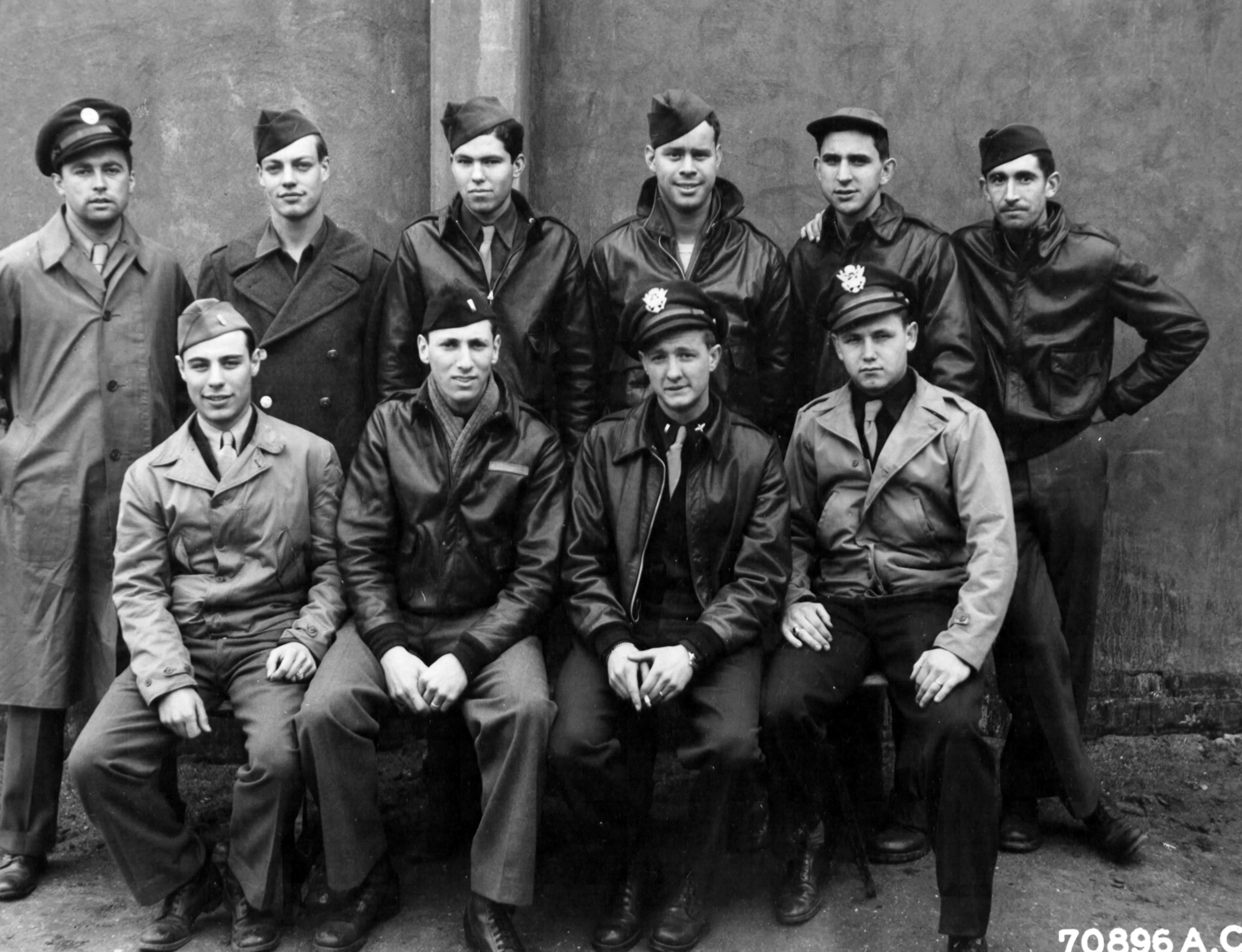
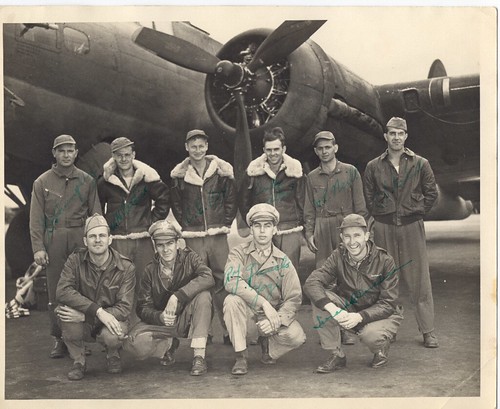
Crew of Heavenly Body II: Front Row, L to R: Edward Sadler; Fred Kauffman; Jack Gray; Lloyd Burns
Back Row, L to R; Louis Schulte; Leroy Monk; Richard Andrews; Richard Billings; William Farmer; Leonard Gibbs
Note that Richard Billings was part of the Burns crew on arrival at Kimbolton, but was the 10th man when crew size was reduced to 9, and so was not with the crew at the time of the collision. The survivors of the Burns crew are all deceased except for Richard Andrews. (Photo courtesy 379th BG Association archive,  by kind permission.)

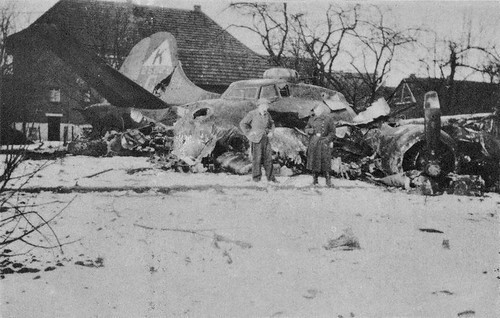
6133 meanwhile, had gone straight down and crashed in twenty feet of water, in what was then a minefield, about half a mile or so off the west beach at Allhallows. The Estuary bottom was and still is, soft Thames mud and the main part of the wreck undoubtedly buried itself to some extent in the mud. (What remained of the wreckage was later salvaged, probably when the minefield was cleared). She had taken most of her crew with her, trapped inside.

Sole survivor Theodore Chronopolis, landed safely by parachute. He was fished out of the water by a passing  boat. The eight men of 6133’s crew who died that day were: Pilot 2nd Lt. Armand Ramacitti, Co-pilot 2nd Lt. William Hager, Navigator 2nd Lt. Donald Watson, Gunner S/Sgt. Richard Ritter, Gunner S/Sgt. Cecil Tognazzini, Gunner S/Sgt. John  Burke, Gunner Sgt. Warren Oaks and Gunner Cpl. Paul Haynes.

Meanwhile, having been abandoned by her crew, Heavenly Body II continued flying, somewhat erratically and losing height all the time. At first, she’d turned west and seemed to be heading directly toward the oil storage tanks at ShellHaven on Canvey Island. To those watching on the ground, a disaster seemed inevitable, then; still losing height, she miraculously turned east, away from the refinery, over the town, toward Canvey Point and the mudflats. It seemed as though the pilot was still trying to find somewhere safe to put her down. She then circled once over Canvey Point before she  finally nose-dived onto the mudflats, throwing an engine forward as she crashed.

To this day, those who can remember the event have always held the pilot of that aircraft in high esteem. Trouble was, the pilot was at that moment, just landing in the water off Canvey Island by parachute! Did Fred Kauffman not die in the collision after all? Had he somehow survived his injuries, regained consciousness and taken control of the shattered aircraft? Unlikely. Burns had tried to take control just after the collision and found the controls unresponsive. It is also extremely unlikely that Fred could have come round from such traumatic head injuries as he’d received when 6133’s Starboard outer prop cut through the roof and side of the Flight deck.

The answer probably has more to do with the B17’s inherent stability. With the nose section totally open and the escape hatches gone, the sheer force of the through-rushing air was probably responsible for the apparent “steering” of the aircraft. Also of course is the fact that, though a stable design, the aircraft was literally coming apart in flight. Who knows precisely how the aerodynamics were working, but one thing is certain, she was not being actively piloted.

The semi-submerged wreckage of Heavenly Body II remained on the mudflats for decades. Every so often, the tides would uncover more of it and bury other sections. The wreck was easily accessible and so subjected to many souveniring expeditions. A local historical society salvaged some of it and put it on display in a museum, until it closed. The thrown engine was salvaged fairly recently and together with some other artefacts, is now on display at another local museum. There is also a storyboard on the seafront close to the crash site at Canvey Point and a memorial plaque, dedicated to the memory of both crews. Sadly, there is nothing of the kind at Allhallows, where 6133 crashed.

Most of the bodies, including Ramacitti’s, were recovered; some at the time, some a little later, and are interred in the American Cemetery at Madingley, Cambridge; a long way from home. One body was later sent home. The body of Gunner Louis Schulte from 6133 now rests at home in a cemetery in St. Louis. Only two are still unaccounted for: Fred Kauffman, Co-pilot of Heavenly Body II and Gunner Cecil Tognazzini from 6133, both of whom are listed on the tablets of the missing at Madingley. Their last resting places are very probably in the soft Thames mud that their aircraft crashed in. They too, are a long way from home.

Post Script.

B-17  #44-6133 was a Douglas/Long Beach B-17G-45-DL Flying Fortress delivered to Tulsa airbase, Oklahoma, May 10th, 1944. It was transferred to Hunter airbase, Savannah, Georgia, on May 19th, 1944, and then onto Dow Field on May 29th, 1944. She was assigned to the 525th BS, 379th BG as ‘FR-Y’at Kimbolton Jun 8th, 1944. The crew of #44-6133 were:

Pilot: Second Lieutenant Armand Ramacitti
Co-pilot: Second Lieutenant William ‘Bill’ Hager
Navigator: First Lieutenant Donald ‘Don’ Watson
Flight engineer/top turret gunner: Staff Sergeant Cecil Tognazzini
Radio Operator: Sergeant Richard ‘Dick’ Ritter
Ball turret gunner: Staff Sergeant John Burke
Waist gunner: Corporal Paul Haynes
Tail gunner: Sergeant Warren Oaks (his second mission)
Bombardier: Second Lieutenant Theodore Chronopolis

Flight engineer/top turret gunner: Staff Sergeant Cecil Tognazzini (Photo Janet Penn, via http://www.findagrave.com)

#42-97942 was a Lockheed/Vega B-17G-40-VE Flying Fortress delivered to Denver on April 11th, 1944. She then went onto Kearney air base in Nebraska on May 4th, 1944, before transferring also to Dow Field May 23rd, 1944. She was then assigned to 525th BS,  379th BG at Kimbolton as ‘FR-K’. The crew of #42-97942 were:

Pilot: First Lieutenant Lloyd Burns (just 19 years of age)
Bombardier: Second Lieutenant Jack Gray
Flight engineer/top turret gunner: Technical Sergeant Leonard Gibbs
Radio Operator: Technical Sergeant Leroy Monk
Ball turret gunner: Staff Sergeant William ‘Bill’ Farmer
Waist gunner: Staff Sergeant Richard ‘Dick’ Andrews
Co-pilot: Second Lieutenant Fred Kauffman
Navigator: Flight Officer Edward Sadler
Tail gunner: Staff Sergeant Louis Schulte

RAF Glatton – a short lived airfield with a big history (Part 2)

Part 1 of RAF Glatton saw how the 457th were thrown into the deep end of the war. With a baptism of fire in the ‘Big Week’ campaign attacks against the German aircraft industry, they managed to survive with few casualties, but learned a great deal about the air war over Germany. In Part 2, we see the 457th in yet more high prestige raids and how they played a further part in the attacks on German industry. We also see unusual visitors and ‘oddities’ appear in the skies over Glatton.

Following the February campaign, the 457th would go on to drop both leaflets and bombs on coastal targets and more prestige targets including Wilhelmshaven on March 3rd 1944, and Berlin on March 6th. On this mission, two further aircraft were lost, not by being shot down by flak or enemy fighters, but because one was rammed by a Luftwaffe Me-410 fighter causing it to strike a second B-17 of the same group in the lower section.

Mission 8 for the 457th would take the group consisting of eighteen aircraft to the V.K.F. ball-bearing works in Erkner on the outskirts of Berlin. The factory, a subsidiary of the Swedish S.K.F. ball-bearing company, produced many of the ball-bearings required for the German war machine. B-17G #42-31595 ‘Flying Jenny‘ was struck by the fighter causing it to fall into the lower section of the formation B-17G #42-31627. Only the tail gunner of 627 survived, the remainder being ‘killed in action’*3.

During this period, losses remained remarkably low for the group, possibly due to the many targets they bombed being secondary, or targets of opportunity, a decision forced on the group primarily by bad weather over the primary target area.

March 1944 saw a remarkable and unique visitor to Glatton, one that not only attracted many military visitors to the airfield, but one that lightened the atmosphere amongst the men. A plan had earlier been formed in the United States to send B-29 ‘Superfortresses’ to China in a bid to support the Chinese and to allow the bombing of Japan from Chinese bases. In early 1944 this plan became reality but reliability problems had dogged the B-29’s engines and so major modifications had to be carried before the long flight could begin.

There was a fear that the Germans might attack the aircraft as they were ferried across the Mediterranean, and so a devious plan was set in motion to fool the Germans into thinking that B-29s were to be based in England, ready to be used against German targets. The first part of this rouse was in early March 1944, when YB-29 #41-36963 ‘Hobo Queen‘ took off from Salina Airbase in Kansas taking initially the southern route then deviating to the north and heading to Newfoundland. The B-29, piloted by Colonel Frank Cook, then flew across to the UK landing at RAF Glatton. The aircraft remained at Glatton for a short period before visiting both St Mawgan and Bassingbourn, before its final departure to India in April that year. The ruse had been a success. The B-29 certainly was a draw to the crews, its enormous size dwarfing anything hat had been seen at Glatton before, it was truly a remarkable aircraft, the likes of which had never been seen over the Huntingdon countryside previously.

Crews and ground staff swarm around B-29 #41-36963 at Glatton airfield 11th March 1944*4.

On April 22nd 1944, the 457th took part in the famous Mission 311, the mission in which US forces lost more aircraft to enemy intruders than at any other time in the war. On this mission, Hamm – the largest marshalling yard in Germany – was the target. The 457th along with the 401st BG and the 351st BG of the 94th Combat Wing, found themselves arriving last over the target, by which time it was covered in smoke from both previous bombing and German defensive smoke pots. Finding a break in the cloud the 457th dropped their bombs onto the target achieving ‘good’ results. However, by the time the Group were approaching home, it was dark and a group of Luftwaffe fighters had managed to hide themselves within the formations mingling with the bomber stream. By the time their presence was known, it was too late, and a number of aircraft, mainly B-24s, were attacked and either shot down or badly damaged. The 457th were once again lucky, only one aircraft, #42-106985 ‘La Legende‘, was severely damaged, but not to the point that it couldn’t crash-land back at Glatton. Significantly, on-board this aircraft was the station commander Lt. Col. James R. Luper.

B-17G #42-106985 after crash landing at Glatton April 22nd 1944. On board the aircraft was the station Commander Lt. Col James Luper. *5

It was Lt. Col. Luper who had had the honour of both collecting and naming the 1000th Douglas Long Beach built B-17, (#42-38113), ‘Rene III‘, named so after his wife. Initially called ‘Pistol Packing Mama‘ by the very people who built the aircraft, she was flown from the United States to Glatton by Lt. Col. Luper and his crew.

Lt. Col. Luper with ‘Rene III’ the 1000th Douglas built B17 (IWM)

Over the next year, ‘Rene III‘ would complete fifty-three missions, many over Germany including: Augsburg, Schweinfurt, Ludwigshafen, Leipzig, Munich, Cologne and Bremen. On her final mission, March 21st, 1945 to Hopsten, she was piloted by Lt. Craig P. Greason (s/n: 0-825840) of the 749th BS.

As the 749th BS aircraft approached the target, ‘Rene III‘ took a direct hit in the wing, close to the No. 4 engine, which caused a fuel leak and subsequent fire. The aircraft then dropped out of formation – one of the worst things that could happen to a stricken bomber. Official records suggest that the B-17 then went on to bomb the target after the fire appeared to extinguish itself. However, the crew were known to have all bailed out safely, after which all the aircrew (apart from Aircraft Engineer Sgt. William Wagner, who was caught and became a POW) managed to evade capture.

The station commander, Lt. Col. Luper, who was not aboard that day, continued to fly with his crew, eventually being lost on 7th October 1944 whilst flying in B-17 #44-8046 on a mission to Politz. Lt. Col. Luper survived a Flak strike on the aircraft and along with 4 other crewmen, was captured and taken prisoner by the Germans. The other six members who were not captured were sadly killed in the attack*6.

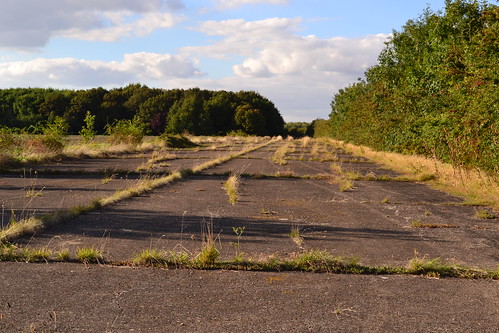
Glatton Runway

The main runway now serves light aircraft where B-17s once roared.

The salvage and rescue of damaged aircraft went a long way to supporting the work of the allied Air Forces in Europe. The need to keep aircraft flying meant stripping bits of damaged or scrapped aircraft and reusing them to repair less damaged examples. At Glatton, this went one step further.

B-17 #42-38064 was made into a composite aircraft with an olive drab front end and an aluminium rear; the two fuselage halves being joined at the wing root. The aircraft was named ‘Arf ‘n’ Arf‘, after a popular pub drink at the time made up of half a bitter and half a mild.

The rear of the aircraft came from B-17 #42-32084 ‘Li’l Satan‘  which lost an engine on landing at Glatton after receiving battle damage over Bremen in June 1944, the tail section being salvaged and added to #42-38064.

B-17 ‘Arf ‘n’ Arf’ a composite aircraft operating with the 457th BG at Glatton. (IWM UPL 28214)

Arf ‘n’ Arf‘ went on to complete several missions, its fate being sealed on November 8th 1944, in a heavy dousing of irony when it collided over the channel with B-17 #44-8418, ‘Bad Time Inc II’. In the collision, in which all the crewmen of ‘Arf ‘n’ Arf‘ were killed, the propellers of 8418 sliced through the fuselage of ‘Arf ‘n’ Arf‘ cutting the aircraft in two. 8418 went on to land ‘safely’ the crew being uninjured.

With the end of the year in sight, many were looking forward to the New Year celebrations and a renewed hope for peace. But New Years day 1945, would  be a notable day in the European Air War for other reasons. Not only for the appalling bad weather that had dogged the whole theatre of operations for the entire winter, but also for the fact that the Eighth Air Force Bomb Divisions were re-designated as ‘Air Divisions’. It was also a day where the Luftwaffe launched a series of attacks against allied airfields in the low countries causing widespread damage to aircraft and airfields.

The turn of 1944/5 would be a terrible time for bad weather. Mission either being cancelled at the last minute or flown in appalling conditions. As the end of the war draws ever closer the wind-down begins and the thought of going home becomes ever increasingly stronger. The end of the war also signifies the end of Glatton as a military base, but even after it is all but removed, its legacy lives on. 

The full account can be found at Trail 6 – American Ghosts.

RAF Glatton – a short lived airfield with a big history (Part 1 – The beginning)

In Trail 6 we visit six former World War Two airfields, each one being a major  base used by American forces during the 1940s. One of these was a late opener, and housed a brand new Bomb Group fresh out of training, who were thrust into the war during the combined ‘Big Week‘ campaign against the German aircraft industry in February 1944. It is this airfield that we visit first. Located just off the main A1 road, it remains an active airfield today, although the roar of the Wright Cyclone engines have been replaced by much smaller and more sedate single engined aircraft. We start off at RAF Glatton, otherwise known as Station 130.

RAF Glatton (Conington) Station 130.

Glatton peri track

Glatton’s unused runways and perimeter tracks are gradually being taken over.

Built by the 809th Engineer Battalion (Aviation) of the U.S. Army in the last months of 1942, Glatton was unique in that it was constructed around a farm that remained in situ throughout the war. The owner moved out as the airfield was built with the site returning to agricultural use after the Americans left. Built as a Class A airfield, it had the standard 3 runways; one of 2,000 yards and two of 1,400 yards, whose surface construction was of tarmac and wood chip. The apex of the ‘A’ pointed easterly with the main runway running west to east. To the north-west of the site lay the bomb store,  a traditional site consisting of Pyrotechnic stores (x4), incendiary stores (x10), small bomb container stores, fuzing points and component stores amongst others.

Around the perimeter track were forty-three spectacle and six frying pan style hardstands for aircraft dispersal. Unusually, the perimeter track split to the west side of the airfield, which meant that aircraft movement encircled both the technical area and main administration site. It is here, to the west of the main airfield site, that the majority of the aircraft dispersal pans were found.  The other section of this track wound round the front of this area allowing for uninterrupted views across the main airfield and its runways.

Glatton was also constructed with two type T2 hangars, both built to the 1941 design drawing No: 3653/41, with one being located to the eastern side, and the other to the western side, in the main technical area of the airfield.

To the northern side of the airfield lies the small village of Holme, and to the south the hamlet of Conington. The airfield’s name however, Glatton, came from yet another village some 4 miles away to the west; the reason ‘Glatton’ was used and not ‘Conington’ being due to the very similar RAF Coningsby not far away in Lincolnshire.

It was to the south-west of the airfield that the dispersed accommodation sites were located. Site 2, a communal site, included a barbers and shoemakers shop; Site 3, the mess, included a dining room and cooking facilities for 1,200 people; Site 4, a second mess site; Sites 5 and 6 (RAF sites) airmen’s barracks and sergeants’ quarters; Sites 7, 8 and 9 were Officers’ quarters with associated drying rooms and ablutions; Site 10 another sergeants’ site; Sites 11 and 12 were the WAAFs’ site with a hairdressers, small sick quarters, recreation room and officers’ quarters; Site 13 the main sick quarters and lastly Site 14, the sewage disposal site. The majority of the huts found on the site were Nissen, built to standard 1941 / 42 designs. All in all, the airfield could accommodate around 3,000 men and women of mixed rank.

These accommodation huts, with their cement floors and iron roofs, were cold and lacking any comforts at all, double bunks were provided for the enlisted men with slightly more space for Officers, but they all had minimal locker room or private space. Here, like many air bases in wartime Britain, new crews were largely ignored, friendships were not forged for fear of losing them on the next mission. As a result, many on these bases did not know other crews outside of their own huts, instead choosing to spend every minute with their own crew – the heartache of losing good friends being too painful to bear on a daily basis.

Used primarily by the US Eighth Air Force, Glatton was opened in 1943 and designated Station 130, home to the 457th Bomb Group, U.S. Eighth Air Force.

Composed of the: 748th, 749th, 750th, and 751st Bomb Squadrons, it was assigned to the 94th Combat Bombardment Wing (joining both the 351st and 401st BG) of the 1st Bombardment Division. Its aircraft, B-17G ‘Flying Fortresses’, flew throughout hostilities with the tail code a black ‘U’ on a white triangle, reversed in an Air Force restructuring during the winter of 1944/45 with a blue diagonal added to the fin.

The 457th’s journey to war began on May 19th, 1943 (the same time as the Trident Conference which led to a re-organisation of the USAAF in Europe), with activation that summer at Geiger Field, Washington. Being formed so late in the war, the 457th would be a short-lived group, but they were none-the-less still involved in some of the most ferocious air battles of the Second World War.

After training at Rapid City Airfield in South Dakota, they moved to Ephrata Army Air Base, one of the United States’s largest training bases, then onto Wendover Field in Utah before their final departure to the United Kingdom and Glatton airbase.

Maintenance crews work on fighters stationed at the Ephrata airport in 1944*1

The 457th entry to the war would be a real baptism of fire. On Monday 21st February 1944, the combined forces of the USAAF and the RAF were involved in the ‘Big Week‘ campaign. Officially known as Operation ‘Argument‘, it was designed to smash the German aircraft industry in one fell swoop. Postponed repeatedly from early January due to bad weather, it finally began on the night of February 19th 1944, with US air forces flying their first operations on the 20th.

Two days into ‘Big Week‘ the 457th were dispatched along with 335 other B-17s of the 1st Bomb Division (BD) to attack Gutersloh, Lippstadt and Weri airfields, but having no pathfinder aircraft and in poor weather, they had to turn to targets of opportunity. With the 2nd and 3rd BDs also in operation that day, some 860 heavy American bombers filled the skies over Germany.

With poor results and difficulty in forming up, this initial mission was further marred by the group’s first loss; that of B-17G #42-31596 piloted  Lt. Llewellyn G. Bredeson, of the 750th BS. Flying their first mission, and in the unenviable position of ‘tail-end-Charlie’, they were singled out for a prolonged and devastating attack. Two engines were hit and substantial damaged was caused to the aircraft, including its oxygen system, in attacks which left the tail gunner seriously injured. Lt. Bredeson gave the order to bale out, an order that included the injured tail gunner. The other crewmen, tethered him to the aircraft by his static line, and then pushed him out so that his parachute would release automatically. After the stricken bomber was vacated, it crashed four miles west of Quackenbruck in northern Germany, one of the gunners, Sgt William H. Schenkel, dying from his injuries whilst the remainder of the crew were captured becoming prisoners of war.

The next day (22nd) the 457th  were back in action, with more ‘Big Week‘ attacks. This time there were no losses for the group, a reassuring mission that was followed by a day’s break from flying. On the 24th, they joined with other 1st Bomb Division groups attacking Schweinfurt, a target that struck fear into the hearts of American airmen. This mission, Mission 3 for the 457th and Mission 233 for the USAAF, would be the return to the ball bearing plants, a product that without which, the German war machine would literally grind to a halt.

In the original attack on 17th  August 1943, a combined offensive against Schweinfurt and Regensburg saw a 19% loss rate, some sixty bombers from 315 that were sent out. It was no wonder the target’s name struck fear into the hearts of the new group.

The 1st BD were the only group sent to Schweinfurt that day. The 3rd and 2nd attacking targets elsewhere in Germany. The 457th sent eighteen aircraft, part of a force of 265 B-17s. As well as dropping 401 Tonnes of high explosive bombs and 172 Tonnes of incendiary bombs, they also dropped just short of 4 million propaganda leaflets.

The defensive ring around the city had not weakened, if anything it had been strengthened since its previous attacks, flak was heavy and accurate and fighters were abundant. Some 110 US airmen were classed as ‘Missing in Action’ that day, but luckily for the 457th, only one aircraft was lost. Douglas-Long Beach built B-17G #42-38060 of the 750th BS, was hit by flak, the #1 and #2 engines were put out of action, and #3 and #4 began over revving – the crew unable to control them.

Glatton (Conington) second runway markings

Glatton’s Second Runway.

With the navigator, 2nd Lt. Daren McIntyre badly wounded and the Right Waist Gunner Sgt. Italo Stella killed when flak pierced his flak jacket; the pilot, 2nd Lt. Max Morrow decided the best option was to crash land the aircraft and hope that in doing so, they would all survive. After carrying out a wheels-up belly landing near to Giessen in Germany, the aircraft was surrounded by locals, who removed the dead and wounded from the aircraft wreckage. Fearing for their lives, the immediate future looked bleak for the crew. Eventually German officials intervened, and the survivors were taken to POW camps where they stayed for the remainder of the war. 2nd Lt. McIntyre sadly later died, succumbing to his severe wounds.*2

The 457th’s final mission for ‘Big Week‘ occurred on the 25th, a mission to attack the Messerschmitt factory in Augsberg, Bavaria. On this day they lost two more aircraft: #42-97457 (six killed the remainder POWs)  and #42-31517 (Seven killed the remainder either evading capture or taken as POWs). Of the twenty-four aircraft that took part in this mission, all but one suffered battle damage to a various degree. The first week had not been disastrous, but it had nonetheless, been a very difficult week for the men of the 457th.

In Part 2 we see how the 457th went on, continuing attacks against the German heartland. We see unusual visitors to the airfield and some ‘oddities’ that graced the Skies over Glatton. 

The full account can be found at Trail 6 – American Ghosts.

A Wing and a Prayer – B-17 Memorial update.

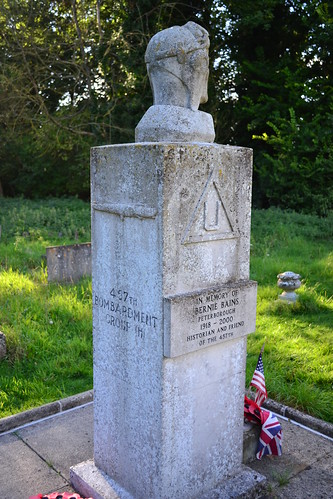
The planned memorial for the crew of B-17 #44-6133 which collided with another B-17 ‘Heavenly Body II’ over Allhallows in Kent, has taken a major step forward recently.

In the crash all but one of the crewmen were killed and Mitch Peeke has been organising the erection of a memorial to commemorate the tragic accident.

With a large part of the funding having been raised, materials donated and a considerable number of leaflets distributed, there has been great interest shown from not only the UK but also from the United States.

Both Mitch and I have been in contact with Noel Tognazzini, the nephew of S/Sgt. Cecil Tognazzini, Flight Engineer/Top Turret Gunner on the B17 #44-6133.

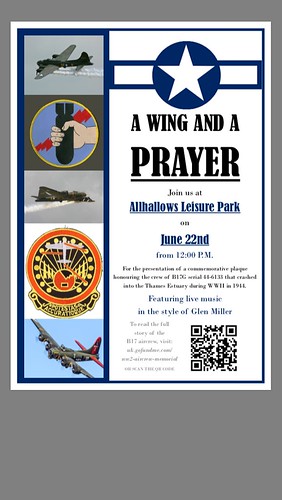
Noel has made arrangements for not only himself, but also the daughter of 2nd Lt. Theodore Chronopolis, (Bombardier), Jeanne Crons Campbell, the only child of the sole survivor of #44-6133, to attend both the 75th anniversary of the crash on June 19 and the Allhallows event which Mitch has organised for June 22nd.

With a collection of Second World War vehicles, a live band and stalls from aviation related organisations, it is going to be a superb day with a great deal of supporters in attendance. With other events occurring locally at the same time, this will be a remarkable way to commemorate the loss of these young men who were so tragically taken from us in 1944.

Following the collision between the two aircraft, #44-6133 fell into the mud flats at Allhallows, from where most of the bodies were recovered; some at the time, some a while later, and who are now interred in the American Cemetery at Madingley, Cambridge. The body of Gunner Louis Schulte from #44-6133 was sent home and rests in a cemetery in St. Louis. Only two crewmen are still unaccounted for: Fred Kauffman, Co-pilot of Heavenly Body II, the second B-17, and Cecil Tognazzini from #44-6133, both of whom are listed on the tablets of the missing at Madingley. Their last resting places are very probably in the soft Thames mud that the aircraft crashed in.

Sole survivor Theodore Chronopolis, landed safely by parachute. He was fished out of the water by a passing  boat. The eight men of #44-6133’s crew who died that day were: Pilot 2nd Lt. Armand Ramacitti, Co-pilot 2nd Lt. William Hager, Navigator 2nd Lt. Donald Watson, Gunner S/Sgt. Richard Ritter, Gunner S/Sgt. Cecil Tognazzini, Gunner S/Sgt. John  Burke, Gunner Sgt. Warren Oaks and Gunner Cpl. Paul Haynes.

Mitch has set up a ‘gofundme’ fundraising account, with a target of £1000 to help secure the memorial for those young men who lost their lives that tragic day. Additional funds and collections on the day will go towards the up keep of Britain’s only flying B-17 – ‘Sally B’ (http://www.sallyb.org.uk/). 

For further information or if you would like to have a stall promoting your group, please contact Mitch direct at: madmitch.peeke978@gmail.com or leave a comment here and I’ll make sure he gets it.

Find the fund-raising account at: https://www.gofundme.com/ww2-aircrew-memorial 

The full story of the crash can be found using the link: ‘A Long way from Home’.

B-17 Memorial flyer Allhallows, Kent.

1st  Lieutenant John E. Morse – RAF Kimbolton

Kimbolton station was home to the four Squadrons of the 379th BG, Eighth Air Force flying B-17 ‘Flying Fortresses’, identifiable by a triangle and large ‘K’ on the fin.

The 379th BG took part in many of the war’s greatest air battles carrying out numerous bombing missions over occupied Europe. They also flew, unprotected, into the heartland of Germany, attacking prestige industrial targets, losing many aircraft and aircrew in the process.

As with many squadrons of both the USAAF and RAF, heroic acts of bravery and self-sacrifice were common place, crews putting their own lives in jeopardy to save those of their fellow crewmen and colleagues. Many did not return as a result. This is the story of one such crew, told by Mitch Peeke.

I was recently contacted by a lady via the GoFundMe page linked to the memorial I am raising here at Allhallows, to 2nd Lieutenant Armand Ramacitti and the crew of B-17 #44-6133. The lady’s name is Mary Barton and her Dad was a pilot in the 524th Squadron, 379th Bombardment Group, who were also based at Kimbolton.

Mary Barton’s Dad was 1st  Lieutenant John E Morse and his B-17 was  #42-5828  “The Sweater Girl“.

Crew photo

The John Morse Crew: (not the final crew of ‘The Sweater Girl’ – see below) Standing left to right : John F. Humphreys (top-turret gunner, fatally injured , mission 54, Dec. 31, 1943) Charles S. Sechrist S/Sgt – Eng/TTG; Homer L. Neill S/Sgt – BTG; Charles E. Cox S/Sgt – RWG; Andrew L. Allen S/Sgt – LWG; Willard H. Clothier T/Sgt RO;  Kneeling left to right: John E. Morse 1st Lt – Pilot; Robert J.Philips FO – CP; Robert Y. Daniels 2nd Lt – Bom; Leonard R Lovelace 2nd Lt – Nav;  Photo by kind permission of Mary Barton

John Morse’s crew were the second crew assigned to that ship, taking over when the first crew completed their tour. She had already been named “The Sweater Girl” by her first crew. As she’d seen her previous crew safely through their tour, John and his crew kept the name. Sadly, the run of luck was not set to continue. On John’s third mission, their Top turret gunner, John Humphreys was fatally wounded when a German fighter attacked the aircraft.

John’s eighth mission was on February 22nd 1944 during “Big Week.” The target was an aircraft factory at Halberstadt. However, near Koln, “Sweater Girl” was seen to take a devastating hit from Flak in the starboard wing. The aircraft dropped out of formation and went down in a spin. No parachutes were seen to emerge and “Sweater Girl” was presumed lost.

The exploding Flak shell had not only severely damaged the aircraft, but it had started a fire in the Cockpit and terribly wounded the Radio Operator, T/Sgt Willard Clothier. The shrapnel had practically severed Clothier’s thigh. The Tail Gunner, Sgt Edward Pate, had also been wounded and now had a large gaping hole in his ankle. However, John Morse was an exceptional pilot, he’d been a flying Instructor for two years previously and was just shy of thirty years old when he’d volunteered for combat duty. He was not about to give up on his ship or his crew. Somehow, John managed to regain control of the aircraft pulling it out of its potentially terminal fall.

The Cockpit fire having now been put out, John and his Co Pilot realised that “Sweater Girl” would never make it back to Kimbolton.  With two critically wounded crewmen aboard, John’s next decision was how best to get his crew and his aircraft safely down. There were really only two options: a traditional wheels-up crash landing, or letting the crew bail out.

By now, they were over the German town of Oberbruch, about six miles short of the Dutch border. It was crunch time. John saw a piece of open ground below, away from the houses, but it wasn’t big enough to accommodate a B-17 coming in wheels-up. Gently banking left, he began circling, giving the “Everybody out!” order to the crew. The Bombardier had already put a tourniquet on the Radio Operator’s thigh and a field dressing on the Tail gunner’s ankle. Both men were now strapped into their parachutes and put out of the aircraft. As the rest of the crew bailed out, John trimmed the stricken B-17 and lashed the control yoke with belts to hold “Sweater Girl” in the shallow spiral dive he’d started, then he too bailed out.

John’s piloting skills had saved his crew. Moreover, as “Sweater Girl” continued to circle, descending unmanned over that open ground, the people on the ground watching the drama unfold had plenty of warning that a crash was inevitable. Witnesses on the ground said that the plane had circled for nearly fifteen minutes before finally and literally flying itself into the ground behind the houses. There was no explosion and nobody was hurt.

B-17 'The Sweater Girl'

B-17 ‘The Sweater Girl’ #42-5828 after crashing at Oberbruch (by kind permission of Mary Barton)

The Tail Gunner, Sgt  Edward Pate, and the Radioman, T/Sgt Willard Clothier, were both repatriated some months later, after treatment in a POW Hospital, Clothier losing his leg. John Morse and the rest of “Sweater Girl”s crew spent the remainder of the war as POW’s. All later returned home.

In 2015, A civic-minded citizen of Oberbruch, Helmut Franken, created a monument to the event bearing the names of all nine crew members, near to the place where the B-17 crashed. He also sent Mary, John Morse’s daughter, the pictures of the wreck, which were taken the day after the crash. Oberbruch has never forgotten how John Morse’s actions that day not only saved the lives of his crew, but also spared the town from what certainly would have been a devastating plane crash.

A few years ago, Mary was fortunate enough not only to have been given a tour, with her sister, of Kimbolton as it is now, but also to have been able to take a flight in a B-17. She described it as an unforgettable experience and one that added to her understanding of her late Father. She wants others to be able to have that experience, which is why she is kindly supporting A WING AND A PRAYER. She wants to help keep Britain’s last remaining airworthy B-17 in the air, as a flying memorial to the 79,000 US and British airmen who gave their lives flying B-17’s during World War 2.

Thank you, Mary; for your support and for sharing your Dad’s remarkable story and the equally remarkable photographs.

Note:

My own thanks go to Mitch for writing the article and for gaining Mary’s permission to publish both it and her photos. I also thank Mary for taking the time to share her father’s story, it is truly a remarkable one.

Sweater Girl‘ was a B-17-F-VE ‘Flying Fortress’ delivered to Long Beach March 1st, 1943. She travelled to Sioux City, onto Kearney and then to Dow Field where she was assigned to the 524thBS/379thBG and Kimbolton. Her loss is detailed in MACR 2868.

The crew at the time of the crash were:

Sgt. Edward T Pate (TG) – repatriated
1st Lt. John E. Morse (P) – POW
F.O. Robert J. Philips (CP) – POW
2nd Lt. Leonard R. Lovelace (Nav) – POW
2nd Lt. Robert Y. Daniels (Bom) – POW
T. Sgt. Willard H. Clothier (RO/Gunner) – RTB
S/Sgt. Homer L. Neil (BTG) – POW
S/Sgt. Charles S. Sechrist (Eng/TTG) – POW
S/Sgt. Charles E. Cox (RWG) – POW
S/Sgt. Andrew L. Allen (LWG) – POW

Kimbolton airfield is part of Trail 6, little exists of it, the main buildings and runways being removed many years ago. Patches of concrete do still remain and part of it forms a kart track. A memorial and a Roll of Honour stand outside what was the airfield’s technical area.

This story appears alongside other remarkable memories under ‘Heroic Tales‘.

Latest update to 379th BG Memorial

Since the first posting about the proposed memorial to the crews of two B-17s, #44-6133 and  #42-97942 (Heavenly Body II) who collided over Allhallows on Monday 19th June 1944, I am pleased to announce that Mitch has made excellent progress and has secured: a Guard of Honour, a Vicar to bless the memorial, materials to build the memorial, a 1940’s ‘swing’ band, a display of military vehicles, refreshments for the day and a representative of the USAF possibly from the 48th Fighter Wing from RAF Lakenheath. Also, the plaque has been delivered to Mitch, and the story board to complement the memorial is also in the process of being made. Sadly a fly past was not permitted largely due to the fact that the flight path for Southend airport lies directly overhead!

The park where the memorial is to be placed is expecting between 3,000 and 4,000 people to be there, so this is an ideal opportunity for local charities or aviation related organisations to attend and raise themselves some much-needed funds.

Funding for the memorial itself has reached £500 (half of which has been promised by the park on which the memorial will stand) 50% of the original £1,000 sought after. A considerable amount of materials have very kindly been donated, the local paper ‘Kent Messenger’ has published the story, and local television news are also following the project with great interest. A number of other supporters have also shown an interest and their support.

Any money left over, along with money raised by collection buckets on the day, will go to support the B-17 ‘Sally B‘ (http://www.sallyb.org.uk/) to help keep Britain’s only B-17 where she belongs – in the sky.

The event is set for Saturday 22nd June 2019, with the unveiling taking place at midday, the first weekend after the anniversary of the crash.

Anyone wishing to attend, either as a visitor or for a stand, can contact Mitch at: madmitch.peeke978@gmail.com or leave a comment here and I’ll make sure he gets it.

Anyone wishing to donate to the memorial can do so at:  https://www.gofundme.com/ww2-aircrew-memorial 

Crew of Heavenly Body II: Front Row, L to R: Edward Sadler; Fred Kauffman; Jack Gray; Lloyd Burns
Back Row, L to R; Louis Schulte; Leroy Monk; Richard Andrews; Richard Billings; William Farmer; Leonard Gibbs (Photo courtesy 379th BG Association archive,  by kind permission.)

B-17  #44-6133 was a Douglas/Long Beach B-17G-45-DL Flying Fortress delivered to Tulsa airbase, Oklahoma, May 10th, 1944. It was transferred to Hunter airbase, Savannah, Georgia, on May 19th, 1944, and then onto Dow Field on May 29th, 1944. She was assigned to the 525th BS, 379th BG as ‘FR-Y’at Kimbolton Jun 8th, 1944. The crew of #44-6133 were:

Pilot: Second Lieutenant Armand Ramacitti
Co-pilot: Second Lieutenant William ‘Bill’ Hager
Navigator: First Lieutenant Donald ‘Don’ Watson
Flight engineer/top turret gunner: Staff Sergeant Cecil Tognazzini
Radio Operator: Sergeant Richard ‘Dick’ Ritter
Ball turret gunner: Staff Sergeant John Burke
Waist gunner: Corporal Paul Haynes
Tail gunner: Sergeant Warren Oaks (his second mission)
Bombardier: Second Lieutenant Theodore Chronopolis

#42-97942 (Heavenly Body II) was a Lockheed/Vega B-17G-40-VE Flying Fortress delivered to Denver on April 11th, 1944. She then went onto Kearney air base in Nebraska on May 4th, 1944, before transferring also to Dow Field May 23rd, 1944. She was then assigned to 525th BS,  379th BG at Kimbolton as ‘FR-K’. The crew of #42-97942 were:

Pilot: First Lieutenant Lloyd Burns (just 19 years of age)
Bombardier: Second Lieutenant Jack Gray
Flight engineer/top turret gunner: Technical Sergeant Leonard Gibbs
Radio Operator: Technical Sergeant Leroy Monk
Ball turret gunner: Staff Sergeant William ‘Bill’ Farmer
Waist gunner: Staff Sergeant Richard ‘Dick’ Andrews
Co-pilot: Second Lieutenant Fred Kauffman
Navigator: Flight Officer Edward Sadler
Tail gunner: Staff Sergeant Louis Schulte

379th BG Memorial update.

Recently I posted a guest post from Mitch Peeke regarding the collision and subsequent deaths of a number of crewmen on board two 379th BG B-17s over southern England, on 19th June 1944.

Mitch is aiming to have a memorial erected close to the site where one of the B-17s  #44-6133 fell, killing all but one of the crew. So far, he has received permission and a very positive response from the land owners on which the memorial is hoped to go, along with information, including a crew photograph, from the 379th BG Association.  Mitch has also been contact with the local TV station and newspapers hoping to generate further interest and funds to cover the cost of such a memorial.

A number of other avenues are still being pursued but the response so far has been very promising indeed!

A preliminary date has been set for the anniversary of the crash but this will of course, largely depend on progress over the coming weeks.

Mitch has set up a ‘gofundme’ fundraising account, with a target of £1000 he hopes the public will get behind the project and secure a memorial for those young men who lost their lives that tragic day. Find the account at: https://www.gofundme.com/ww2-aircrew-memorial 

Crew of Heavenly Body II: Front Row, L to R: Edward Sadler; Fred Kauffman; Jack Gray; Lloyd Burns
Back Row, L to R; Louis Schulte; Leroy Monk; Richard Andrews; Richard Billings; William Farmer; Leonard Gibbs (Photo courtesy 379th BG Association archive,  by kind permission.)

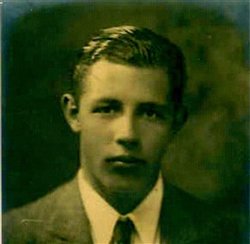
Sgt Cecil A Tognazzini

Flight engineer/top turret gunner: Staff Sergeant Cecil Tognazzini (Photo Janet Penn, via www.findagrave.com)

29th December 1944 – Disaster at RAF Waterbeach

Christmas and New Year doesn’t stop for war, and the inevitable battle of the Second World War continued on with air and ground crews across Britain carrying out their duties as normal, perhaps looking forward to a rest in the following days. December 29th 1944 was one such day.

RAF Waterbeach Museum

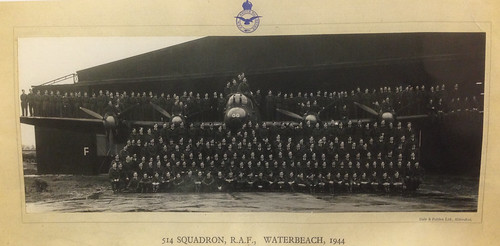
514 Squadron RAF 1944. Photo taken at Waterbeach Military Heritage Museum, August 2017

It was a hazy morning with a severe winter frost laying across the ground, fourteen aircraft were allocated for operations whilst for those non-operational crews it would be H2S and G.H. training. Out on the dispersal, the operational aircraft were being loaded with their bombs and prepared for the forthcoming flight, when suddenly one of the bombs being loaded on to Lancaster PD325 ‘JI-L2’ fell and exploded. The resultant explosion completely destroyed the aircraft and severely damaged seven others including NG141 which was parked alongside. The blast, heard as far away as Mildenhall some 23 miles away,  had repercussions right across the airfield, damaging windows and sending aircraft parts far and wide. Nine members of the ground crew attending to the aircraft also died, five of them simply ‘disappeared’ as did a tractor along with its portable generator. Following the incident, which was thought to have been caused by an ‘old stock’ bomb, the Station Commander cancelled operations for the day in case time delayed bombs on other aircraft exploded. The bomb disposal teams were brought in to remove those that were left remaining in the aircraft bomb bays. New Year at RAF Waterbeach would be very solemn in 1944.

Those that lost their lives that day were all members of 514 Sqn:

Leading Aircraftman Derrick Gordon Bichard (RAFVR) Radar Mechanic (s/n: 1870102)

Leading Aircraftman Samuel Bolton (RAFVR) Flight Mechanic (s/n: 1639785) – Commemorated at Runnymede

Aircraftman 2nd Class Donald Victor Brewer (RAFVR) Armament Assistant (s/n: 1893614)

Leading Aircraftman Ronald Davies (RAFVR) Flight Mechanic (s/n: 1128796)

Leading Aircraftman Geoffrey Graham Haydn (RAFVR) Radar Mechanic (s/n: 1863381)

Aircraftman 1st Class Harry George Leach (RAFVR) Electrician (s/n: 1429200) – Commemorated at Runnymede

Leading Aircraftman Laurence Smales (RAFVR) Flight Mechanic (s/n: 1621436) – Commemorated at Runnymede

Leading Aircraftman Frederick Charles Watson (RAFVR) Flight Mechanic (s/n: 1169390) – Commemorated at Runnymede

Corporal John Westgarth (RAF) Armourer (s/n: 552023) – Commemorated at Runnymede


RAF Waterbeach – A period of change (Part 3).

In this last part looking at RAF Waterbeach we see how its military career finally came to a close. The jet age was had arrived but would soon pass, the curtain was about to fall on this historic airfield.

Immediately after the war, two new squadrons would take up residence at Waterbeach. During early September 1945 No. 59 Squadron would arrive followed within a few days by No. 220 Squadron, both flying the Consolidated B-24 Liberator. Both these squadrons transferred from Coastal Command into the Transport Command and were used to ferry the many troops back and forth from India and the Far East. These operations would continue well into May (59 Sqn) and June (220 Sqn) 1946 whereupon both Squadrons were disbanded. The cessation of the units allowed for crews of the Squadrons to be transferred to a new unit and training on the Avro York aircraft, a model 59 Sqn would then use once reformed in 1947 at Abingdon. No. 220 Sqn would later reform flying the Shackleton, returning once more to Maritime Patrols from Kinloss in Scotland. Neither Squadron would return to Waterbeach, but whilst here, they would carry almost 19,000 troops across the world, a tremendous achievement indeed.

Whilst neither 59 nor 220 Squadrons would return, the Avro York would come to Waterbeach. In the August of 1946, No. 51 Squadron brought the C.1 York from Stradishall, continuing the India flights that both 59 and 220 had performed before her. Initially carrying freight, they the went on to carry passengers before departing themselves to Abingdon in December 1947.
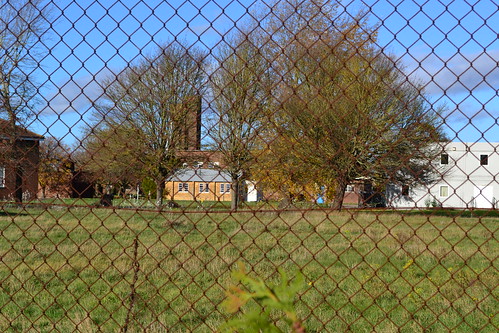
RAF Waterbeach

Waterbeach seen through the fence.

The advanced party of 51 Sqn would arrive on the 16th, with the main party arriving on the 20th of August (1946). Flights would occur almost daily for the whole of August, flying to Palam (India) and back. In that month alone the Squadron would fly 1,435 hours of training flights, 355 of which were at night.

With a regular number of aircrew being posted to RAF Bourn amongst other airfields, the turnover of staff would be very high. Specific training was targeted at the long distance flights, many going to Cairo or Singapore, and many flying via RAF Lyneham in Wiltshire.

A year later, in mid November 1947, 242 Squadron joined the York group, crews gradually absorbing into 51 Sqn. Shortly after this however, notice came through that 51 Squadron was to move to Abingdon, along with the remnants of three other squadrons (242 included) to form a new long-range unit there.

After their departure, two more transport squadrons moved in to Waterbeach, taking a step backwards in terms of aircraft, both with that Second World War Veteran the  Dakota. No. 18 and 53 Squadrons stayed here, operating flights to and around the Middle East from December 1947 to early September 1948 (18 Sqn) and the end of July 1949 (53 Sqn).

With the Berlin Airlift demanding high levels of aircraft, 18 and 53 Sqns were soon ordered into the affray, and began carrying out flights under operation ‘Plainfare‘. After their withdrawal from the operations, 18 Sqn moved to Oakington for almost a year, during which time No. 24 Squadron moved into Waterbeach momentarily sharing the ramp with 53 Sqn. Yet another York unit, they also flew Avro’s Lancastrians and Dakotas, a role that involved them carry numerous dignitaries such as Field Marshall Lord Montgomery to various destinations around the globe. A short return of 18 Sqn meant that Waterbeach was again particularly busy with transport aircraft, and then for another short two month period it would get even busier.

During the New Year period, 1st December 1949 – 20th February 1950, No 206 Squadron appeared at Waterbeach, also reforming with that old favourite the C-47 Dakota. Using examples such as KN701, it was another squadron who had a long and distinguished history in Maritime patrol, eventually going on to return to this role also from Kinloss in Scotland.

Between the 25th February and the 29th February 1950, both No. 18 and 24 Squadrons departed Waterbeach, 18 Squadron disbanding and 24 Sqn moving to Oakington. During the move, the resident aircraft were disposed of, and the new Vickers Valletta was used in their place.

Quiet then reigned at Waterbeach for about three months. After which time Waterbeach took yet another turn of its page in the history books. With a combined flight of twenty-seven Meteors from both No. 56 and 63 Squadrons the silence was broken and the jet age had arrived. On May 10th 1950, the Meteors became the first major units of the RAF’s front line to be stationed at Waterbeach, two units that would remain here for a number of years operating several variants of the Meteor, Supermarine’s Swift and then the Hawker Hunter.

The initial variants of Meteor F.4 were replaced within two years by the F.8, during which time a number of accidents occurred – some incurring fatalities. Perhaps the worst blow came with the death of the Station Commander Sqn. Ldr. J. Yeates DFC when on 27th June 1951 his Meteor F.8 (WA953) rolled after take off crashing into the ground. Sqn. Ldr. Yeates was killed in the resultant crash and is buried in the local cemetery next to the airfield.
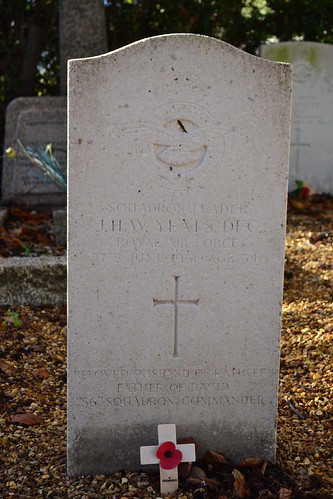
Sqn. Ldr. J. Yeates DFC

Sqn. Ldr. J. Yeates DFC killed on 27th June 1951.

Sqn. Ldr. Yeates’ death came at the end of a month that had seen four other aircraft damaged in landing accidents. These included two Station Flight Tiger Moths and two other Meteor F.8s, a decidedly bad month for the two squadrons.

A further landing accident brought home the dangers of jet aircraft on November 1st 1951, when Meteor WA940 of 63 Sqn collided with Meteor VZ497 of 56 Sqn after landing. The collision caused a fire in which both F/O. K Jones and Sgt. G Baldwin were both killed. As if through foresight, the personnel of 63 Sqn has noted on their arrival in 1950 that not only was the accommodation sub-standard but the hangarage and aircraft dispersals were insufficient for the needs of two squadrons. Highlighting the problems certainly didn’t prevent this tragedy from occurring. The terrible conflict of the Second World War may have been over, but casualties at Waterbeach would continue on for some time yet.

The work of 56 Sqn and 63 Sqn was carried out in cooperation with the US forces at nearby RAF Lakenheath, who at that  time were operating Boeing’s B-29 ‘Superfortress’ known for their devastating effect on Japan. These exercises, carried out over the skies of the UK,  were joint Anglo-American fighter affiliation exercises and included not only the B-29s but F-86 ‘Sabres’ as well.

As if history was to repeat itself, the bad weather that had brought disaster upon the bombers of the RAF’s Bomber Command on ‘Black Thursday‘ (RAF Bourn) ten years earlier also brought havoc to 56 Sqn on December 16th 1953.

With visibility down to a little as 100 yards on the Tuesday, Wednesday saw some improvements. With flying restricted to four aircraft per flight, it was going to be difficult. The Cathode Ray Direction Finding equipment (C.R.D.F.) was not working and so bearings needed to be obtained by VHF. Whilst the majority of aircraft were able to land using a Ground-Controlled Approach (G.C.A.) ‘A’ flight were not so lucky. Red Section were diverted to Duxford, but failed to achieve a landing. Being too low on fuel to continue on or try for a third time, the two aircraft climbed to 5,000 feet and the pilots, Flt/Lt. G. Hoppitt  and F/O. R. Rimmington ejected. Fuel gauges at the time were reading as little as 20 Gallons. Both aircraft came down near to each other, no damage was caused to public property and both pilots were unhurt. Yellow section, also diverted to Duxford, where they attempted G.C.A. landings also, but unable to do so, the section leader, F/O. N. Weerasinghe suffered a broken neck and fractured skull after he force landed in a field. The fourth pilot, F/O. Martin, broke his back in two places after ejecting at only 700 feet. A court of enquiry ruled that three of the pilots had difficulty in jettisoning their canopies, and F/O. Martin, even though he managed to succeed,  ejected at an all time low-level. It was well into the New Year before  F/O. Weerasinghe regained consciousness, and all four aircraft, WA769, WH510, WA930 and WH283 were written off.  In a light-hearted but perhaps tasteless ‘that’s how its done‘ demonstration, both Flt/Lt. Hoppitt  and F/O. Rimmington jumped off the bar at a Pilot’s party in the Bridge Hotel.*2

Over the next four years a number of other squadrons would arrive and depart Waterbeach. On 18th April 1955 a new night fighter squadron was formed, that of No. 253 Sqn. Operating the DH Venom NF.2A, an aircraft designed around the earlier Vampire, it was a short-lived squadron, disbanding on September 2nd 1957. 253’s reforming would however, see the beginnings of a string of Night Fighter Squadrons being stationed here at Waterbeach.

Almost simultaneously to the disbanding of 253 Sqn, was the arrival of a second Night Fighter squadron, the Meteor NF.14 of 153 Sqn from RAF West Malling absorbing the staff of the now disbanded 253 Sqn. Training crews on Meteors along with being on 24 hour standby, meant that flights were frequent, a regime that continued until July 2nd 1958 when 153 was disbanded being renumbered 25 Sqn. After having a short spell in the turmoil of the Middle East, they then began to prepare to upgrade to Gloster’s Delta wing fighter the Javelin in September. By December only a handful of aircraft had been received, but further training and upgrades saw the FAW.7 replaced by the FAW.9. Work was slow but by late 1959 the squadron was considered operational.  By the October 1961, 25 Sqn was posted north to Scotland and RAF Leuchars, where it received the FAW.7 back before being disbanded once more.

Gloster Javelin FAW.7 of No 25 Squadron RAF Waterbeach, showing its missile complement of De Havilland Firestreak infra-red homing air-to-air missiles. © IWM (RAF-T 2172)

During this time 56 Sqn who had been one of Waterbeach’s longest standing squadrons, departed to RAF Wattisham where it would receive the Lightning, the RAF’s high-speed interceptor that burnt fuel at an incredible rate of knots. No. 56 Sqn had whilst here at Waterbeach, used not only the Meteor but the Supermarine Swift (F.1 and F.2) and the Hunter F.5 and F.6. No. 63 Sqn, who also flew the Hunter F.6 was also disbanded at Waterbeach during this period (October 1958), and the loss of these Hunters would also see the end of the line for 63 Sqn RAF.

The last 5 years would see the last of the RAF’s involvement at Waterbeach. July 17th 1959 saw the arrival of No. 46 Sqn with Javelin FAW.6s. Disbanded in 1961 the nucleus would remain ferrying Javelins to the Far East. The November 1961, would then see two more squadrons arrive; No. 1 on the 7th and No. 54 on the 23rd.

Both these squadrons were Hunter FGA.9 Squadrons, both moving in from RAF Stradishall operating as Ground Attack squadrons. With successive  deployments to the Middle East, they were armed for operational flying patrolling the border along Aden.

By August 1963, both No.1 and No.54 Sqn were moved on, thus ending the RAF’s ‘front line’ flying involvement with Waterbeach. Whilst the military retained Waterbeach as an active airfield, the Royal Engineers as airfield construction and maintenance units used the site to  test numerous runway surfaces and construction methods. Testing of these surfaces used a wide variety of aircraft types, from small jets to large multi-engined aircraft such as the Hercules and BAC 111. A further ten years of intermittent flying activity ensured that the legacy of Waterbeach continued on. With various open days and flying events to raise much need money bringing crowds onto the airfield, Waterbeach’s life was extended yet further, but then in March 2013 the MOD finally pulled out, and the site has since been earmarked for development.

The post war era saw many gate guardians at Waterbeach. Spitfire Mk22 (PK664) was later moved to Binbrook, whilst the Hurricane MKIIc went to Bentley Priory. Another  Spitfire replaced both these examples, Mk XVIe (TE392) which was brought here in 1961 and remained here until 1966. A veteran of 63, 65, 126, 164, 595 and 695 Sqns, it eventually ended up in the United States flying with the Lone Star Flight Museum in Texas.

Other guardians include Westland Whirlwind HAR3  (XG577) of the Royal Air Force and a Hawker Hunter (WN904) which flew with 257 Squadron at RAF Wattisham. It was brought in to represent the Hunters, the last aircraft that flew from Waterbeach, and was present here until 2012. It was then moved to the Sywell Aviation Museum in Northampton.

Plans are already in the pipe-line to develop the 293-hectare site along with adjacent fields into a £2.5bn ‘Silicon Valley’ style township, complete with marina facilities and three schools. The barracks site alone will include 6,300 new homes with some original aspects such as the Watch Office utilised in the modern development.

At present the site is empty, entrance strictly controlled and by prior appointment only, the gate guarded by a private security firm. A fabulous museum exists in a managed building just inside the gate and can only be accessed by appointment. Whilst the site is gradually becoming overgrown, it is virtually intact, the main runway, hangars and ancillary buildings are all present. Local farmers store hay on the disused runways and an eerie silence blows across the parade ground.

Some views are possible from certain public advantage points but these are very limited and restrictive. The busy A10 allowing only occasional glimpses to the watch office and hangars, and side roads giving no more than fleeting glimpses through high fences and locked gates.

This once thriving airfield has finally met its match. The enormous hangars that once housed the heavy bombers of Bomber Command, the mighty B-24s of Transport Command and the fast jets of Fighter Command, now shells awaiting their fate. Once one of the RAF’s biggest and most important airfields, Waterbeach will soon been relegated to the history books, buried beneath the conglomeration of houses, schools and small technology businesses that thrive in today’s fast living world. Which buildings survive have yet to be finalised, the future of Waterbeach lays very much in the hands of the developer, and as a historical site of major aviation significance it is hoped that they look upon it sympathy and understanding, something that is often left out when it comes to development.

RAF Waterbeach appears in full in Trail 11 with Mepal and Witchford.

Sources and further reading.

*Aviation Trails – “The Development of Britain’s Airfields“.
*2 AIR 27/2620/1 – The National Archives
AIR 27/789/5 – The National Archives
AIR 27/792 – The National Archives
AIR 27/1977/2 – The National Archives
AIR 27/1978/11 – The National Archives

Grehan, J., & Mace. M. “Bomber Harris – Sir Arthur Harris’ Despatch on War Operations 1942-1945“, Pen & Sword. 2014

The museum website has details of opening times and access.

For details of the development of Waterbeach see the Cambridge News Live website, with links to the plans.

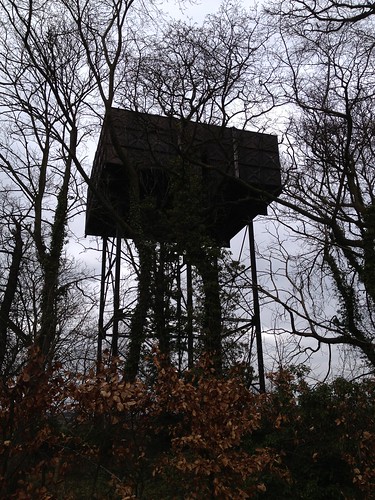
RAF Waterbeach – Stirlings to Lancasters (Part 2).

In Part 1 we saw how Waterbeach was built. How the Conversion Units were created in response to the demands of Bomber Command and how crews were being  trained in old and war weary aircraft. In this next part we see how the station transitioned from the Stirling to the Lancaster and how Waterbeach’s squadrons fared with the aerial war.

Training exercises in old and worn aircraft were often the cause of mishaps, accidents and tragedies, and as was seen in other training squadrons, the casualty rates were sometimes high. One of the first accidents for 1651 Conversion Unit (CU) at Waterbeach was caused by a malfunction in the extractor controls of N3642 which was being flown solo at the time by Sgt. K. Richards. The damage to the aircraft was so severe that it was downgraded being used as an instructional airframe only. Thankfully Sgt. Richards was unhurt in the incident and went on to fly with a new operational squadron later on.

Several more incidents in the following months led to further badly damaged aircraft, but the first fatalities came on the evening of June 16th 1942 when Stirling N6088 ‘LS-X’ flown by 24-year-old New Zealander F/O. Milan Scansie (s/n: 411491) was seen to fall from the sky over Nottingham with its port wing in flames and parts falling away. The entire crew died as a result of the accident, the cause of which has not yet been verified. The Stirling they were flying, was a veteran of European Operations, it had flown for nearly 250 hours and in twenty-two operational sorties, a remarkable achievement for a Stirling!

Bombing-up a Stirling of No 1651 CU/HCU  Waterbeach, Cambridgeshire, 30 April 1942.© IWM (CH 5474)

Gaining operational experience was one of the most valuable tasks the trainee crews could undertake, and there was no ‘softly, softly’ approaches for the Conversion Units. The first 1,000 bomber raid to Cologne required every available aircraft and the Conversion Units were called upon to provide some of these aircraft.  In June 1942, whilst on operations to Bremen, the first operational aircraft casualty would occur when N7442 was shot down shortly before 01:00 by a Luftwaffe night-fighter over Holland. Another factor that made this loss so great was the fact that not only did all seven crewmen lose their lives, but one of the crew, P/O. Lewis A. Booth (s/n: 118627), had international caps for the England rugby team.

Born in 1909, Booth is one of sixteen boys from the Malsis School, who is commemorated on the Chapel’s stained glass window. After playing his debut match against Wales, his career ended in a game against Scotland at Murrayfield. In-between these games he achieved seven international caps for England scoring three tries.

The following July and August were to see the start of a catalogue of accidents and operational losses that would reflect not only the poor quality of the machines that trainees were expected to fly, but the disadvantages that the Stirling became famous for. The night of July 28th/29th being one of the worst with the loss of four aircraft in a mission to Hamburg, followed on the 30th by a further loss of an aircraft whilst on a training flight. In two nights alone, twenty-four airmen had lost their lives with a further one being injured and four taken prisoner.

Waterbeach would prove to be a safe haven again on the night of August 10th/11th 1942, when aircraft sent to drop SOE troops at zones ‘Giles‘ and ‘John‘ found their home base at Fairford fog-bound. Spread far and wide the sight of Waterbeach’s runway must have been a very welcome sight indeed.

In the early days of October 1942, on the 7th, the two flights, 214 and 15 Squadron Conversion Flights were amalgamated fully into 1651 Conversion Unit raising the number of personnel to over 1,000. This change would mean that 1651 would now be designated 1651 Heavy Conversion Unit (HCU) allowing for the first time, flight engineers and second air gunners to join the crews. Training would then continue, some of it for only a matter of a few weeks, as would more losses.

Whilst the transition between Conversion and Heavy Conversion Unit went smoothly, the 2nd and 18th saw two more training accidents. Whilst both incidents only involved one crewman – the pilot – both accidents involved the aircraft developing a swing that became uncontrollable – the resultant crash leaving both aircraft severely damaged.

1942 turned to 1943, and by the end of the year 1651 HCU would eventually depart Waterbeach. With a further small number of training accidents, some due to the aircraft swinging, some due to mechanical failures, others were due to forces outside of the control of Waterbeach crews.

On the night of 4th/5th May 1943, a Lancaster from 97 Squadron from RAF Bourn was diverted to land at Waterbeach. On landing, the aircraft overshot the runway colliding with Stirling MK.I  (BF393), wrecking both aircraft. Of the seven aircrew in the Lancaster, the pilot Sgt. Anthony Reilly (s/n: 1005145) was killed with a further three injured, thankfully there were no injures associated with the parked Stirling.

May would also see an increase of the numbers of Heavy Conversion Units at Waterbeach, but inadequate planning meant that this unit was spread across three separate airfields, a situation that proved too much and so within a month, they were all moved to RAF Woolfox Lodge. This short interlude by 1665 HCU played no major part in Waterbeach’s history.

The last 1651 HCU  accident occurred at Waterbeach on October 27th 1943 when Stirling N3704 piloted by F/O. K Becroft DFC, another New Zealander, and F/S. F Burrows, an Australian, landed with its undercarriage still retracted. Neither airmen were hurt in the accident, but it was F/O Becroft’s third accident in a Stirling in the last year. Whilst no further accidents were to occur at Waterbeach, a 1651 HCU aircraft did have the misfortune to crash-land at RAF Witchford a few miles away, after suffering brake failure, on the last day of the month.

November 1943 would bring further changes to Waterbeach as 1651 CU pulled out, moving to Wratting Common to allow room for the new radial engined version of the famous Lancaster bomber – the Lancaster MK.II of 514 Squadron and her associated Conversion Unit 1678 HCU. This move was in response to a reorganisation of No. 3 Group, the whole process of transferring taking a mere few days, primarily by road.

514 were formed on 1st September 1943, and 1678 HCU on the 16th September, both whilst at Foulsham (under the control of No.3 Group) and would go on to specialise in blind bombing techniques. Like many of Bomber Command’s Squadrons, 514 Sqn would draw their crews from a broad spectrum of the Commonwealth countries, giving it a real multi-national feel.

The squadrons first mission took place on the night of November 26th/27th and it would be to the German heartland, and Berlin. This would be their second trip into the Lions den in three days and would see eight aircraft  leave Waterbeach each carrying 4,000lb bombs and a wide range of incendiaries. Leaving between 17:45 and 17:55, they would arrive over the target at around 21:30 dropping their bombs from a height of between 20,000 and 21,000 feet. Large fires were seen from the bomber stream, some crews saying from 100 miles away, indicating that the city was “well alight”. On this mission, one aircraft returned at 19:28 with engine problems jettisoning its bombs before returning and another was reported ‘missing’ over the target area. It was later found that the aircraft was shot down over Germendorf killing all on board. Lancaster MK.II (DS814) ‘JI-M’ was piloted by twenty-one year old Canadian F/O. Maurice R. Cantin (RCAF).

RAF Waterbeach

The main entrance of Waterbeach through which many have passed.

It was during this period of the war that the Stirling was withdrawn from front line operations, its losses far outweighing its benefits. From this point on no further action over Germany would include the Stirling, and the hunters now focused on the Halifaxes and Lancasters. On this night alone over 40 Lancasters were lost (either over the target or crashing in England) with the majority of the crews being killed. This would prove to be one of the most devastating raids of Berlin causing extensive damage, loss of life and casualties.

The terrible winter of 1943/44 made operational flying very difficult. Ice was a problem as was thick cloud over the target area. With numerous bombing missions taking place, many to Berlin again, Harris’s desire to destroy the German Capital was proving difficult. Whilst many front line squadrons were suffering high casualties, for 514 Sqn, losses would be light.

The first loss of 1944 would not occur until January 14th/15th in a raid to Brunswick. During this night two Lancasters would be lost, that of LL679 ‘JI-J2’ and LL685 ‘JI-G2’ with the loss of fourteen airmen. For a raid that cost thirty-eight Lancasters, equivalent to 7.6% of the force, it provided very disappointing results, many of the bombs falling on open countryside or in the suburbs of the city.

Berlin would be hit hard during January. Over almost three consecutive nights, 27th-31st Lancasters would strike at the heart of the Reich, 514 Sqn losing  no aircraft in their part even though nineteen aircraft would participate in the mission. Of those nineteen, four would not get off the ground and one would return early.

February 1944 was a big month for both the RAF and USAAF as more combined operations began against the aircraft production and supply facilities. On the 19th/20th, Leipzig was hit by 823 aircraft of which 561 were Lancasters. 514 Sqn would lose three aircraft that night: DS736 ‘JI-D2’, piloted by F/S. Norman Hall, DS823 ‘J1-M’ piloted by F/S. Walter Henry and LL681 ‘JI-J’ piloted by F/L. Leonard Kingwell, there were no survivors from any of the three aircraft.

Schweinfurt ball bearing factories were once again targeted on the night of the 24th/25th, a foreboding target that had proven so disastrous for the USAAF in the previous October. Luckily for 514 Sqn though, losses were much lighter, with only one crew failing to return home.

As the summer arrived in England, so too did the invasion of continental Europe. May meant that the RAF’s bomber force would switch from the industrial targets of Germany to strategic bombing of defences, marshalling yards, communication lines and fortifications all along western France and in particular the Normandy area. Allied leaders stressed the importance of blocking a German reinforcements through the rail network, as a result, the entire system west of the Rhine became a target with Bomber Command being given the lion’s share to attack. Seventy-nine rail centres were chosen for the attacks, and by D-Day all those assigned to Bomber Command had received their attention.

On the days before the invasion the aircraft were painted with the well-known black and white invasion stripes, used to allow easy identification of allied aircraft by friendlies. On the early morning of June 6th, twenty-two 514 Sqn aircraft set off to attack fortifications at  Ouistreham, the port at the mouth of the Canal de Caen à la Mer, the canal that serves Caen found on the eastern flank of the allied beachhead area.

RAF Waterbeach

The remaining hangars in close proximity to the Cemetery.

Considering that the June raids set new records for the number of Bomber Command raids, 514 Sqn suffered no casualties. The first coming in the days after when two Lancasters (DS822) ‘JI-T’ and (LL727)  ‘JI-C2’ were lost over France. With a loss of four, the remainder of the two crews were either captured or managed to escape.

By June 1944 the need for the HCU had diminished, crews no longer needing the training to transfer to heavy bombers, and so 1678 HCU was disbanded in the usual grand style that was becoming famous in RAF circles.

It was also at this time, mid June, that 514 Sqn began to replace it MK.II Lancasters with the more famous Merlin engined MK.I and IIIs. The change itself didn’t herald a significant change in operations, now dogged by bad weather the constant cancellation of missions began to affect morale as crews were stood down often at a moments notice. The poor weather continued for most of the summer, what operations did take place were in support of the Allied forces as they advanced through France. Harris remained under the control of Eisenhower and so the focus of attacks continued to be Western France and German supply lines to the invasion area.

July into August saw a return to Germany for the bombers, a new experience for many crews of Bomber Command. By the October, raids were now being carried out in daylight hours. The first enemy jet aircraft were encountered and morale was high. However, the year would not end quietly.

December 29th 1944 was a hazy day with severe frost, fourteen aircraft were allocated for operations whilst H2S and G.H. training was provided for the non-operational crews. Out on the dispersal, the operational aircraft were being loaded with their bombs and prepared for the forthcoming flight, when suddenly one of the bombs being loaded on to Lancaster (PD325) ‘JI-L2’ fell and exploded. The explosion completely destroyed the aircraft and severely damaged seven others including NG141 which was parked alongside. The blast, heard as far away as Mildenhall, had repercussions across the airfield damaging windows and sending aircraft parts far and wide. Nine members of the ground crew attending to the aircraft also died, some simply ‘disappeared’ as did a tractor along with its portable generator. Following the incident, which was thought to have been caused by an ‘old stock’ bomb, the Station Commander cancelled operations for the day, partly in case time-delayed bombs exploded. To clear them and make the area safe, bomb disposal teams were brought in to remove those that were left remaining in the aircraft’s bomb bays.

1945 brought good fortune as the war came to an end. ‘Manna’ operations became the order of the day along with ‘Exodus’ flights bringing POWs back home for their captive camps across the continent. Slowly flights were wound down and on August 22nd 1945, 514 Squadron was disbanded at Waterbeach. Whilst they had been here, 514 Sqn had lost sixty-six aircraft on operational missions with the loss of over 400 aircrew, some of whom are buried in the neighbouring Cemetery at Waterbeach.

Thus ended the wartime exploits of RAF Waterbeach, despite crews leaving and the aircraft being taken away, Waterbeach’s wartime legacy would go on, strongly embedded in Britain’s aviation history. The peace would not last long though, for within a month a new era would dawn, a new aircraft type would arrive and Waterbeach would begin to see a change in operational flying take place.

In the final part of this trail we see how Waterbeach entered a new age of flying and how its wartime legacy was carried on through the front line fighters of the RAF as the jet age arrived.