RAF Sculthorpe – The age of the Jet Bomber (3)

In Part 2, the war finally came to an end and Sculthorpe closed only to be reopened as a Very Heavy Bomber Base. Reconstruction has taken a number of years and although not fully ready, it starts to accept its new residents.

The first of the aircraft, two of Boeing’s huge B-29s, touched down at Sculthorpe on the 7th February 1949 late in the afternoon. However, six others also deployed to Sculthorpe, had to divert to RAF Lyneham due to the pilots not being able to see the runway in the bad weather. These aircraft would not arrive in Norfolk until later on, and so it was not to be the grand opening that many had wished for.

The deployment of US heavy bombers was seen by some as an extension of the US, and that Britain was becoming a ‘puppet’ of the US Government. The British Government try to make it clear to the public that this was not the case, and that these aircraft were only here on a temporary basis (90 day rotations), and that they were both ‘invited ‘ and did not have a nuclear capability. The Press on the other hand, did not see it quite so clearly.

It didn’t take long before the US 92nd Bomb Group were established at Sculthorpe. A veteran group of the Second World War, the 92nd had a prestigious history and one they would preserve and build upon. Formed of three squadrons, 325th BS, 326th BS and 327th BS, their numbers would swell staffing levels to almost 1,400, including both RAF and US personnel.

Various officials attended Sculthorpe’s many opening events, but the start of a new era was marred by a tragic mishap in late February, when an armourer,  Corporal Turcell, was killed when one of the B-29’s guns he was cleaning  accidentally discharged. It would unfortunately be the first of many tragedies to befall those at Sculthorpe over the coming years.*7

In March the airfield was officially opened with both the Union Flag and the Stars and Stripes being raised simultaneously. Behind the scenes however, construction work continued, with only half of the proposed six ‘Z’ blocks ready to take new residents and only sixty-two of the proposed married quarters being completed, it was far from ready.

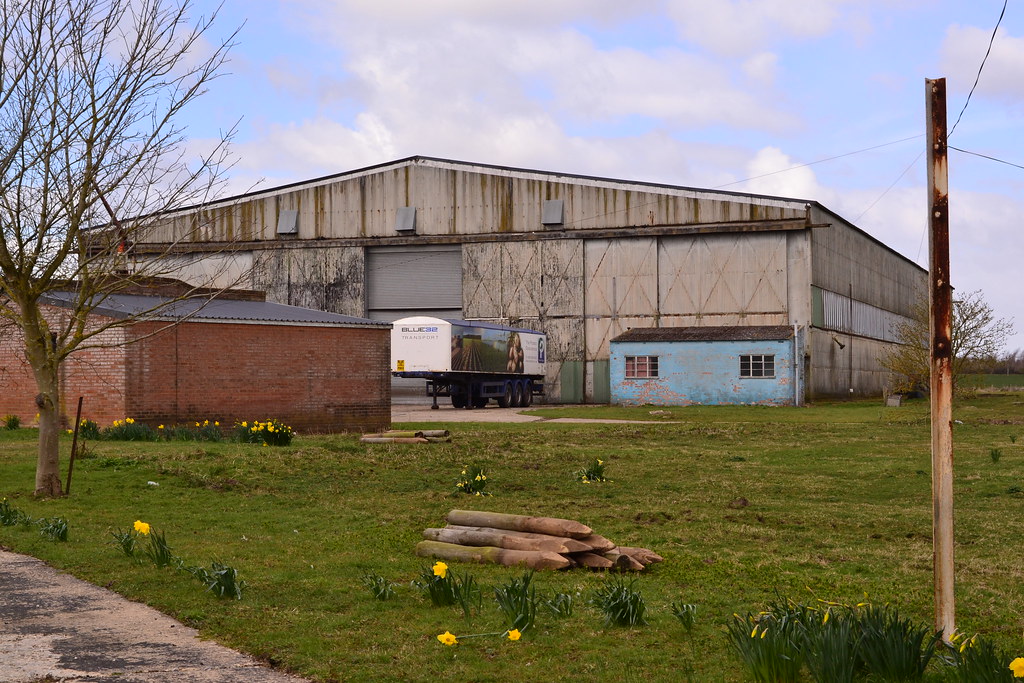
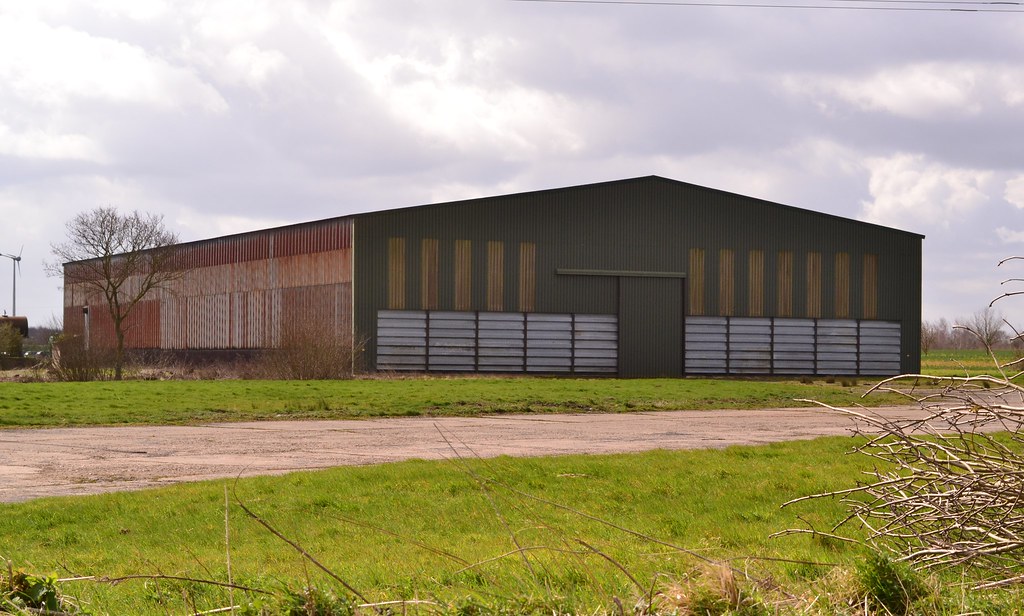
Technical site buildings

A large part of Sculthorpe has been left to rot, piece by piece. These are the former RAF HQ and later the USAF Wing HQ.

The work carried on throughout the initial deployment and 90 days quickly passed. The 92nd’s placement at Sculthorpe soon came to an end and no sooner had they arrived then they began their journey back home to the United States. A relatively uneventful opening had come to a close.

The next of the rotations would take little time in coming. The intensity of each deployment getting greater each time, and even though the Berlin Blockade had come to an end, tensions remained very high right across Europe.

As the 92nd pulled out, a further three squadrons of B-29s began to arrive. Having already been in Japan, the three units the 343rd, 344th and 345th BS began by carrying out a number of exercises with the RAF, which included over June and July, the first multinational exercise code named “Foil“. Like many that would follow, this involved mock attacks by US and RAF bombers whilst fighters from the UK, US and Netherlands attempted to intercept them using camera guns. A successful exercise it gave rise to some interesting comparisons between the US and RAF aircraft, with many surprises in store.

As with the first deployment, the arrival of the B-29s did not all go to plan though, as on July 21st 1949, whilst transferring across from the US, one of them #44-62191 ‘suffered problems’ when its number 3 engine caught fire causing it to crash in an orchard at West Walton, 2 miles east of Wisbech in Cambridgeshire. The aircraft, a Boeing B-29A-65-BN, had a crew of twelve on board, and when it became clear that they were not going to make it, they  decided to abandon the aircraft and leave it to its fate.

All twelve of the crew successfully departed the aircraft landing nearby, but in doing so, two of them sustained serious, but not thought to have been life threatening injuries after exiting. The worst, suffered by the pilot, was a possible fractured skull whilst a second crewman suffered a fractured leg; it is believed both airmen made full recoveries. The aircraft itself ultimately crashed, landing in a field east of the small Fenland market town. The remains were quickly retrieved and some parts ended up in the local Fenland and West Norfolk Aviation Museum located in Wisbech. Now sadly closed, they were transferred to the Sculthorpe Heritage Centre located at Sculthorpe.

The 90 day rotations continued unabated. The next deployment bringing two different models; firstly the 63rd BS (43rd BG) with the extended B-29 the B50A ‘Stratobomber’ along with three refuelling aircraft the KB-29M, also a modified version of the B-29 with its turrets removed and refuelling facilities added.

What was perhaps more significant with this move was that the B-29 ‘Lucky Lady II‘ was part of this group. She and her crew had completed a ninety-four hour flight non-stop around the world, being refuelled four times in the air. This achievement sent out a major message to all those would be aggressors, wherever they may be in the world, that they were not beyond the range of the US heavy bombers.

As 1949 drew to a close, one other unit, 19th BS (22nd BG), would complete its rotation at Sculthorpe replacing the 63rd in November. It too brought another version of the B-29 the RB-29, a reconnaissance version of the heavy bomber. In support of this, a further unit would arrive in December, the 23rd Reconnaissance Squadron, bringing yet more versions of the B-29 to the airfield.

Tragedy then struck again in June 1950 when an RB-29A #42-94081, took off on a routine air test and gunnery exercise. During the exercise the outer engine was hit by the aircraft’s own guns setting it on fire. The aircraft was then difficult to  control and the pilot ordered the crew to bale out. As the B-29 hit the sea, three airmen, including the captain were still onboard; he failed to reach the aircraft’s dingy and sadly died as a result. Of the thirteen airmen on board seven lost their lives that day.
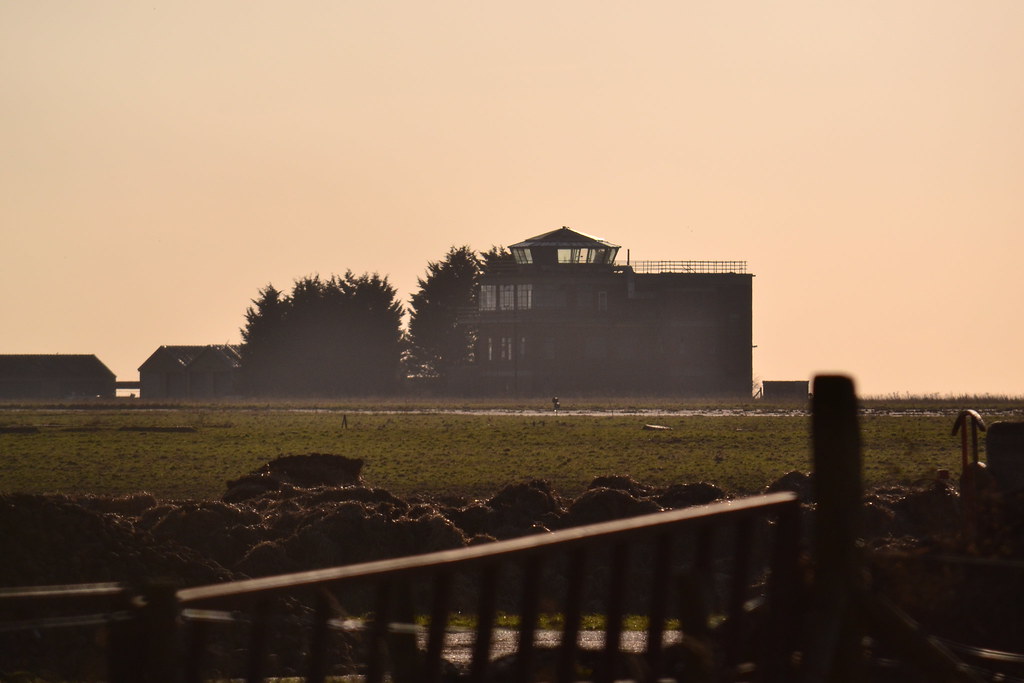
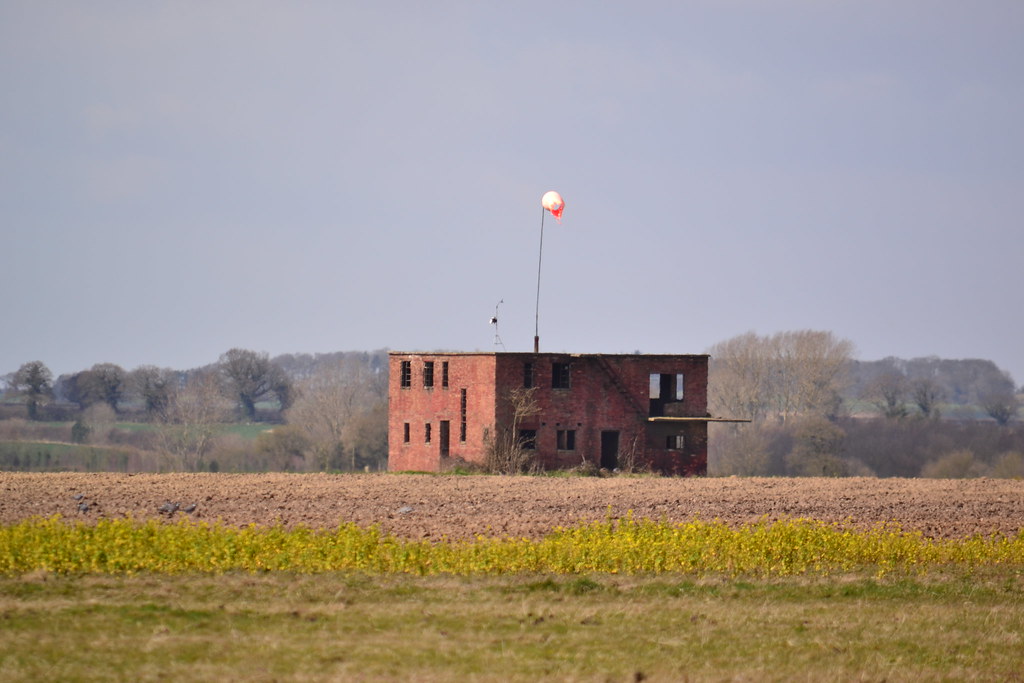
Control Tower

The watch office in a setting sun. This was ‘secretly’ demolished at short notice in March 2022.

The east/west crises continued with the war in Korea. The threat of an escalation spilling over into Europe led to a call for all US bases in Europe to be brought to full strength and further sites opened. Sculthorpe began its preparations and as the 301st BG and the 72nd Strategic Reconnaissance Squadron both departed for other UK bases, the site was left ready for the arrival of the 97th Bomb Group  and their B-50Ds.

This move signalled the beginning of a huge influx of men and machinery at Sculthorpe. Anti-aircraft batteries were brought in, along with ground units to defend the site from any possible attack. A range of aircraft support units also arrived boosting staffing considerably. With just over 400 RAF personnel, 1,800 US personnel and in excess of 600 army personnel, the quantity of men and women on the base was now as high as it had been during the Second World War.

With further deployments and new, larger aircraft arriving, not only was the need for further accommodation matched by the need for larger additional hardstands for the new bombers – the B-50 and B-36 ‘Peacemaker’, but the runways had to be extended even further, and an additional 1,200 feet was added calling for yet another diversion of the local road network.

In early 1951, after some friction between the RAF and US staff on the base, Sculthorpe, like both Mildenhall and Lakenheath, was officially handed over to the US forces, and although they all retained their RAF designation, they would be operated and maintained by US personnel; a standard that applies even today. It was a move that finally ensured America had its desired firm and permanent foot hold on UK soil.

The Cold War would then take a more devious turn. The arrival of the 323rd Reconnaissance Squadron (of the 91st Strategic Reconnaissance Wing) began its 90 day rotation with RB-45C ‘Tornados’, a reconnaissance version of the B-45 four engined bomber – the first if its kind to land on British soil. After landing at RAF Manston, the 323rd moved to Sculthorpe, where it would carry out ELINT (Electronic Intelligence Gathering) and mapping operations of western Europe. This intelligence gathering was not new, but since the end of the war, it had become more clandestine and difficult due to the clamp down by the Soviets on western spies.

Sculthorpe had now entered a new world, the Soviets had developed their own atomic bomb, and using a B-29 obtained at the end of the Second World War, reversed engineered it to provide a means by which to deliver it. The West had to find out more, and aerial reconnaissance was the only viable method with which to establish the location and number of such facilities.

There then followed extensive talks between the US and British Governments regarding Soviet ‘overflights’, western aircraft flying through Soviet airspace photographing and recording Soviet ground positions, SAM sites, airfields etc. Whilst not a new tactic, it was certainly a dangerous one, and one that could lead to all out atomic war should it go wrong.
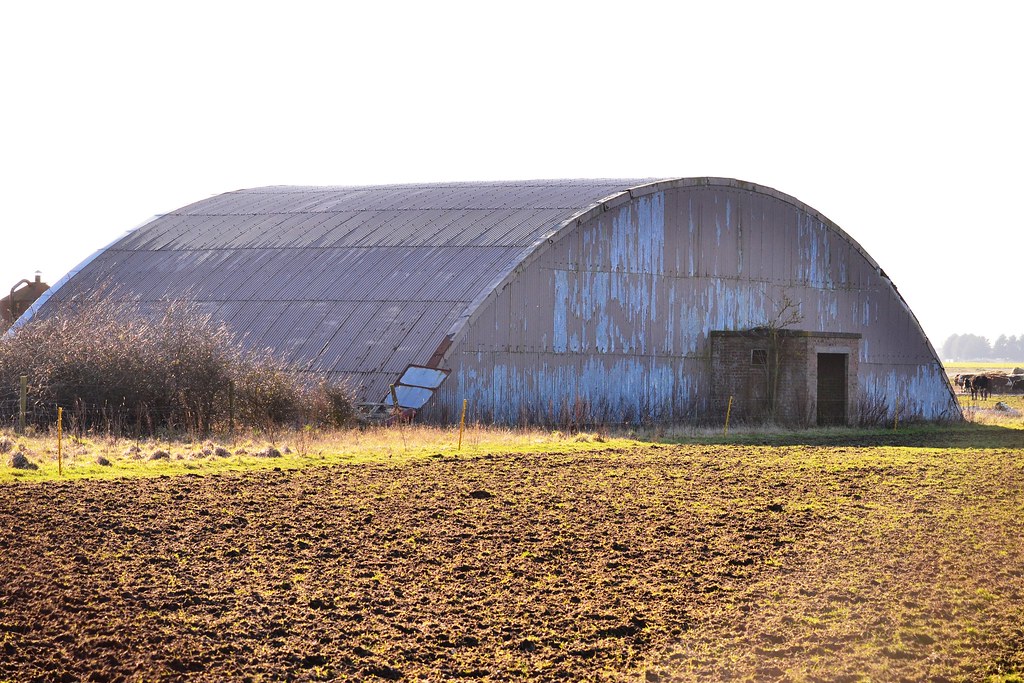
Blister Hangar

Sculthorpe’s last remaining Blister hangar in a low setting sun.

As a result of these talks, the ‘Special Duties Flight Sculthorpe’ was formed, working in conjunction with the various squadrons of the 91st Strategic Reconnaissance Wing. RAF crews consisting of two pilots and a navigator, were flown to America for a period of extensive training on the RB-45. By the end of 1951, the course was complete and they returned to Sculthorpe to continue with further training along side crews of the 91st Wing in Norfolk.

This was a British unit, led by Squadron Leader John Crampton (who replaced the initial choice Sqn. Ldr. Micky Martin of the ‘Dambusters’ fame, as he had failed a high altitude medical examination) and was designed in part, to perform deep penetration flights into Soviet airspace carrying out reconnaissance missions for Britain’s planned ‘V’ Bomber force. It would also supply the Americans with substantial information for their own tactical use.

Four RB-45Cs were converted (including one spare), flown to RAF West Raynham they were stripped of all their American markings (allowing them to deny any knowledge of such activity) before their RAF insignia were applied (The RAF would deny ever having operated these aircraft). They were then returned to Sculthorpe as British aircraft operated by British crews. The flights would be code named Operation ‘Ju-jitsu‘, and would follow the same track that the British ‘V’ bombers would take in the event of all out war.

Initially three routes were chosen, one of which took the aircraft close to Moscow; a second flew to the Baltics and the last to southern Russia. To ‘protect’ crews, they were issued with false papers and maps, and told, if caught, to explain that, rather implausibly, they had simply become incredibly lost! Failure of the mission would therefore require a high degree of gullibility on the part of the Russians.

Only two such flights were ever made, each with three aircraft; the first on 17th/18th April 1952, and the second on 28th/29th April 1954*6.  The first occurred without any Soviet intervention, but they were understandably outraged and an investigation was carried out immediately.

After the first flight, the crews were congratulated by General LeMay, and the unit was then disbanded. However, it was reformed again, also at Sculthorpe, in 1954 (after a second such temporary reformation in September 1952 which was quickly disbanded again) and a second flight was made. This time the Soviets were ready for them. After having evaluated their air defence network they were far better prepared and the RAF crews were at a much greater level of danger than during their initial flights.

Whilst Soviet SAMs (Surface to Air Missiles) were impotent in that they had no guidance system, and it was thought Flak was unable to reach the high flying RB-45s, the trip would still be a dangerous one and strict radio silence was to be maintained by the crews. The flight itself turned out to be relatively uneventful, but Squadron Leader Crampton did witness Flak, and noticing that, whilst generally ineffective, it was indeed exploding at their height. Bursts were sufficiently close to convince the crews on board that a hasty return to the West was the better option, and a halt was called to the flight.

Some time after the operation, it was revealed that Soviet Mig pilots were instructed to ram the RB-45Cs as they had no suitable radar with which to track the intruders. However, no such contact was made and so thankfully the need never arose.

The unit was then again disbanded and all flights by them ceased for good. The consequences and risk of flying over Soviet territory now considered far too high.

1952 was a busy year at Sculthorpe, it went on to see the deployment of the 47th Bomb Wing (formally the 47th BG) of the Strategic Air Command from the United States. This wing consisted of the 84th, 85th, and 86th BS, along with the 420th Refuelling Sqn and the 19th Tactical Reconnaissance Sqn. These units operated a number of aircraft types including both the aforementioned B-45C and RB-45C, along with the B-66, KB-29, and KB-50 aircraft.

The 47th was activated on March 12th 1951, initially as the 47th Bombardment Wing (BW) but with just two squadrons – the 84th and 85th. As a new unit, it had the honour of being not only the first, but the only jet powered medium bomber Wing in the US Air Force. With NATO becoming more established and nuclear weapons arsenals expanding at a great rate of knots, the 47th were posted to Sculthorpe to provide an airborne nuclear strike force in support of NATO forces  who would be operating on the ground in any future conflict.
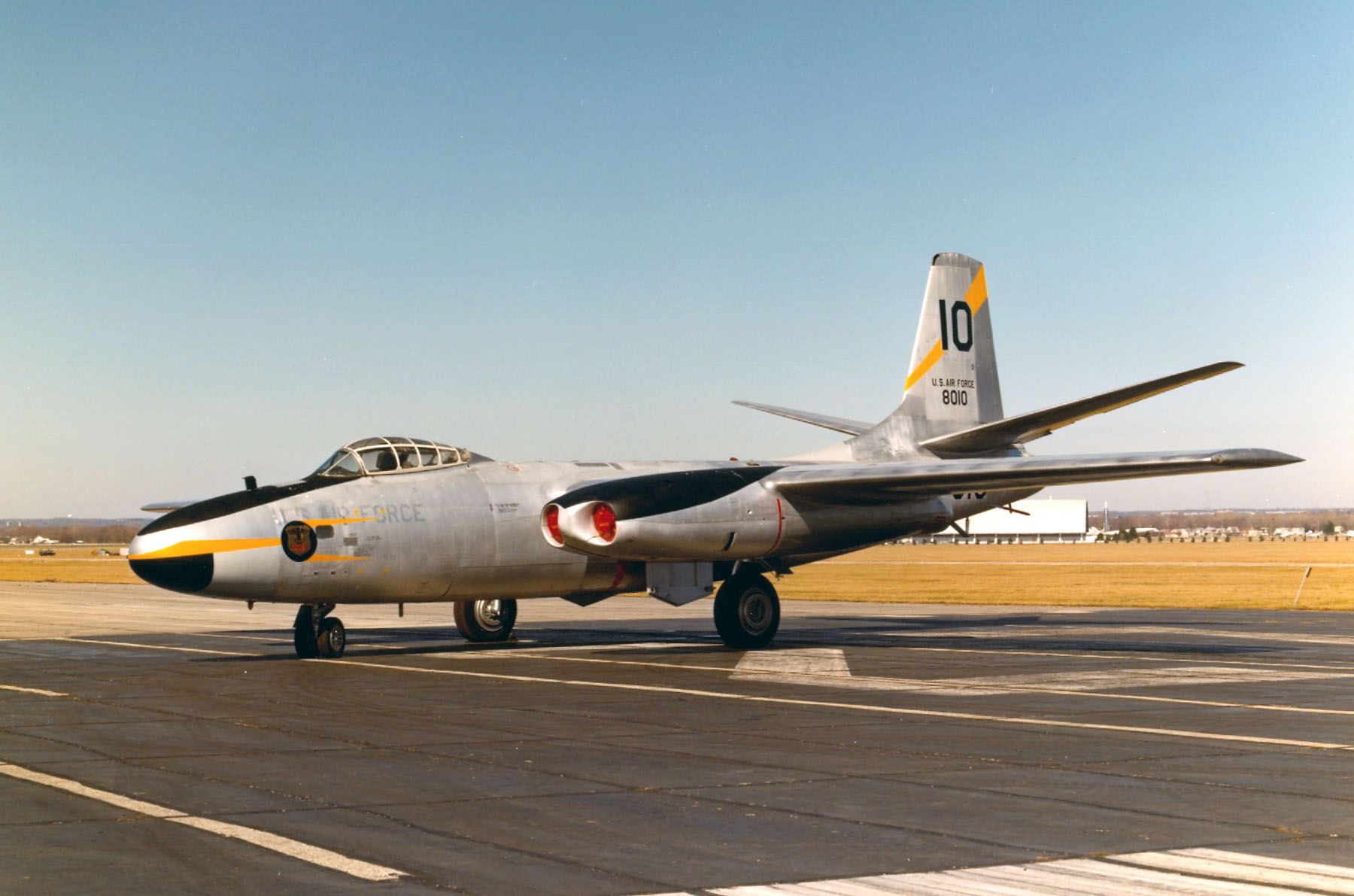
The B-45 achieved many “firsts.” It was the first US four-engine jet bomber to fly; the first American production jet bomber; the first jet bomber capable of carrying an atomic bomb; and the first multi-jet reconnaissance aircraft to refuel in mid-air. These were based at Sculthorpe between 1952-1958, with the 47th Bomb Wing (Light) along with RB-45Cs from the 19th Tactical Reconnaissance Squadron and Royal Air Force (RAF) Special Duty Flight. These RAF RB-45 crews flew highly classified reconnaissance missions deep into communist territory. (National Museum of the USAF)

A year later, a third squadron would arrive to join the Group, that of the 422nd BS. Within a month or two of its arrival though, the unit was re-designated as the 86th BS a move that brought it in line with its two sister squadrons. For six years the 47th would operate out of Sculthorpe acting as a nuclear support unit for NATO forces in Europe.

The influx of US personnel not only impacted on the immediate and local community, but much further afield as well. In 1953, it cemented strong relations with the people of Norfolk as a whole and in particular those of the coastal town of Hunstanton, when severe floods claimed over 300 lives nationally and 100 locally; some of these were families of those located at the base living in austerity houses near to the seafront.

However, it was more the actions of the personnel at Sculthorpe that led to this unique relationship. When the floods came, staff at Sculthorpe rallied round and attempted rescues of those stranded by the high waters. One such man was 22 year old Airman 2nd Class, Reis Leming of the 67th Air Rescue Squadron, who even as a non-swimmer, braved the freezing waters to rescue no less than twenty-seven people using dinghies from B-29s. His brave and selfless act won him the Soldier’s Medal from the US forces and the British George Medal.

Road sign Hunstanton

Airman 2nd Class, Reis Leming of the 67th Air Rescue Squadron was awarded the George Medal for his brave act on the night of 31st January 1953.

Various other personnel also received awards for their bravery. These included Staff Sergeant Freeman kilpatrick, (George Medal); Airman 1st Class Jimmy Brown  and Technical Sergeant John Germaine (Queen’s Commendation for Brave Conduct); Airman 1st Class Jake Smith (British Empire Medal) and Major Julian Perkinson (Honorary Member of the Order of the British Empire). Both Leming and Kilpatrick have roads in Hunstanton named after them and a plaque dedicated to those who lost their lives stands by the town’s war memorial alongside the Union Flag and the Stars and Stripes*7.

As the 1950s progressed the influx of personnel reached its maximum with some 10,000 personnel being associated with the airfield. The 47th remained the main force located at Sculthorpe but as a division, there would be other, more tactical short range aircraft, also present here. At any time, the 47th could put up between forty and fifty aircraft*7, predominately the B-45, in response to events either in Europe or across the world.

Joint operations continued between the Americans and RAF; including ground forces carrying out training operations ‘attacking’ the airfield to test the defenders in case of war, and training flights assisting gunnery battalions along the north Norfolk coast.

The build up of nuclear weapons also increased, weapon sizes were now more modest although the punch they packed was considerably greater than the original bombs dropped on Hiroshima and Nagasaki. Smaller and faster aircraft could carry these weapons and both were being stored at Sculthorpe. The unfortunate release of this information, soon became media headlines, and quickly became widely known. This plainly identified Sculthorpe as a major site from which any future nuclear attack would come.

The swelling of personnel numbers at Sculthorpe would be further aided by the arrival of the 19th Tactical Reconnaissance Squadron (TRS) and yet more RB-45Cs. Headed by the wartime and Korean veteran Major John Anderson, they would photograph Soviet movements along with installations both along and over the delicate east-west border.

In the final part, Sculthorpe maintains its status as a leading nuclear bomber base, housing US bombers and reconnaissance aircraft on this enormous site. East-West relations deteriorate further but there is hope for the future. In the meantime, bigger and more powerful jet bombers arrive.

The full story can be read in Trail 21.
RAF Sculthorpe – The War ends and the Americans arrive (2)

In Part 1, we saw how Sculthorpe was developed and how it became an airfield in its own right. 2 Group had taken charge and brought in it light bombers, but all would no go to plan.

Meanwhile 464 and 487 Sqn had both been flying operationally, October 9th being the blackest day yet for the New Zealanders, when twelve Mosquitoes were dispatched for the first operations over occupied territory. An attack on Metz was planned but owing to bad weather only one or two aircraft managed to find the target. After dropping their bombs it wasn’t clear whether the target was hit or not, but worse news was yet to come. The formation, which had been dispersed due to poor weather, was being led by Wing Commander Alan G. Wilson DFC along with his navigator F.O. Donald C. F. Bridgman of 487 Sqn. During the attack the formation encountered severe anti-aircraft fire, and Wilson’s aircraft (HX965) was repeatedly hit. The navigator sustained mortal wounds and the aircraft was set on fire. In a desperate attempt to clear the fire, Wing Commander Wilson had to douse the flames with his hands resulting in extensive burns and injury. After fighting the fire, Wilson managed to eject the now smouldering material from the aircraft, but considerable damage had been done. Now flying on his own with his mortally wounded companion beside him, Wilson showed extreme courage and determination, flying the stricken aircraft back to England where he made a successful crash landing at RAF Manston in Kent.

Accomodation blck adjacent to the guard room

Blocks adjacent to the Guard Room.

A second aircraft (HX912), flown by Flt. Lt. Phillip C. C. Kerr and F.O. Bernard J. E. Hannan (464 Sqn) – was less lucky, both pilot and navigator being killed when the aircraft dropped its bombs at low level. It is believed the subsequent explosion also blew up the Mosquito they were flying.

On a separate operation to attack the aircraft engine factory at Woippy in France, Mosquito  HX938 piloted by Sqn. Ldr. Walter F. Wallington DFC and navigator P.O.  James H. Fawdrraf, dropped its bombs by accident and crashed. This time, both airmen managed to bail out, but some thirty people on the ground were killed. Sqn. Ldr. Wallington managed to evade capture but P.O. Fawdrraf was not so lucky and was soon picked up by German ground forces.

The same fate did not befall two more 487 Sqn airmen that day. Flt. Lt. Edgar W. P. Court and Flt. Lt. Jack B. Sands were both killed when their Mosquito (HX937) blew up whilst flying on one engine near to Antwerp. It had been a very sad day for the Wing, and the loss of several ‘good’ men would be deeply felt by both squadrons.

More rain and strong winds eventually turned Sculthorpe into something that resembled a “seaplane base”, by the end of the month, the entire site was waterlogged. The winds were so severe they were reported to have lifted hut roofs off their mountings causing even more problems for those inside.

On the 22nd – 23rd October, the foul weather momentarily broke and allowed for some bombing practice to take place. On return  from the range, one of the 464 Sqn Mosquitoes (HX948) overshot due to an electrical failure with its instruments and crashed onto a hedge at the end of the runway blocking a road as it did so. On the 23rd, in more foul weather, one of 487’s Mosquitoes ‘T’ for Tommy (HX831), did exactly the same thing, coming to rest only feet from the wreck that was previously a Mosquito. As if that was not remarkable enough, a few minutes later one of 21 Sqn’s aircraft (HX956) also overshot, colliding with the 3-ton crane that had been brought in to recover the first aircraft, landing directly on top of the wrecked Mosquito! Miraculously no one was hurt in any of these incidents, but according to 21 Sqn’s ORB “considerable loss of public property sustained“, presumably referring to the pile of wood chippings now sitting at the end of the runway.*4 The fact that no one was hurt was a miracle in itself, and all the cockpits remaining intact was a sight that gave the personnel at Sculthorpe a great belief in the strength of the Wooden Wonder! But the catastrophe would begin a series of events that would eventually lead to 140 Wing leaving Sculthorpe for good.

By October’s end, the crews of all squadrons were now fully conversant with the new Mosquito, and the supporting Conversion Flight was disbanded; specific training units taking on the role elsewhere.

The harsh winter of 1943-44 would see a special visitor come to Sculthorpe. Wing Commander Leonard Cheshire arrived to discuss, with Pickard, the plausibility of dropping food and clothing to his brother in Sagan (Salag Luft III) using the Mosquito. Cheshire knowing Pickard’s vast experience, thought he was the ideal person to speak to. Whether this was a personal effort to provide comfort to his brother or whether Cheshire was considering the Mosquito for low level precision attacks is not known, but the latter befell the Wing not long after Cheshire’s visit.

The December of 1943 would then bring major changes here at Sculthorpe. On New Year’s Eve, two months after the initial three Mosquito accident, the Wing, along with Pickard and all three Mosquito squadrons, would leave the Norfolk site, taking their Mosquito VIs to RAF Hunsdon. A much smaller airfield, where the overcrowding experienced at Sculthorpe must have been considerably worse.

It was from Hunsdon that Pickard would famously make his last flight. A story goes that Pickard had left his dog ‘Ming’ at Sculthorpe to be looked after whilst he was away. On the day he was shot down, 18th February 1944, on the Amien raid, the dog fell gravely ill. Pickard’s wife, Dorothy, went to get him and sensed that Pickard had been killed after seeing the state of the animal. It took months for Ming to recover, and some years later whilst living in Rhodesia, Ming went outside, looked up to the sky as he always did when Pickard was flying, heard a whistle, collapsed and died.*2

The departure of the Wing effectively left Sculthorpe with no operational units, until on January 6th 1944, when a new and very different squadron began to move in.

Crews from 214 (Federated Malay States) Squadron based under 3 Group at Downham Market, arrived in two waves, the initial group coming across in early January 1944, whilst the main body continued  operations flying their Stirling bombers. Those that arrived here quickly settled in, but a lack of decent paths meant that initial training was mixed with the unenviable task of digging and laying of new paths. Whilst attending lectures and link training were the primary tasks for the pilots and Flight Engineers, the gunners and other aircrew were given the more ‘practical’ task of constructing the new paths ready for the remainder of the squadron’s arrival.

Bomb store

Sculthorpe’s bomb store was relocated in the late 1950s and was nuclear capable.

Then on the 25th, the remaining crews and staff of the squadron departed Downham Market, thus ending their link with 3 Group. Once here, flying circuits and more lectures became the order of the day. Additional training on ‘Monica‘ equipment, fighter affiliation tasks and local cross countries then took the squadron to late spring at which point operations began to take place.

The arrival of 214 Sqn heralded more than just a new bomber squadron though, for they would not be flying the Stirling as they had been; instead, they were set up as part of 100 Group, becoming an official member in mid January 1944. Their arrival here would not only see them change Groups but would also see them convert to the American built B-17 ‘Flying Fortress’. Now designated 214 (BS) Sqn,  their arrival would bring another major change to Sculthorpe, a change that would continue for the next five months, but would have repercussions for many years to come.

Operating in the Electronic Warfare role within 100 Group, they would carry out radio jamming operations, an early form of Electronic Counter Measures (ECM). The urgency of the conversion, led to the unit taking on fourteen UK based B17-Fs , their ordered ‘G’ models being used as a trade off*3.

The British B-17 (designated Fortress I, II and III) crews were joined by personnel from various U.S. units. Their role was to train and support the air and ground crews in both flying and maintaining the new aircraft, a role they performed well, right into the early summer of 1944. The set up was so successful that American personnel were soon posted in to fly alongside the RAF crews, thus expanding the influence of the Group.

Flying along side other bomber formations, 214 Squadron would use systems including ‘Monica‘ to track or jam enemy radar, they performed ‘spoof’ missions to entice enemy fighters up to them rather than the main force that was attacking targets elsewhere; a rouse that worked well initially.

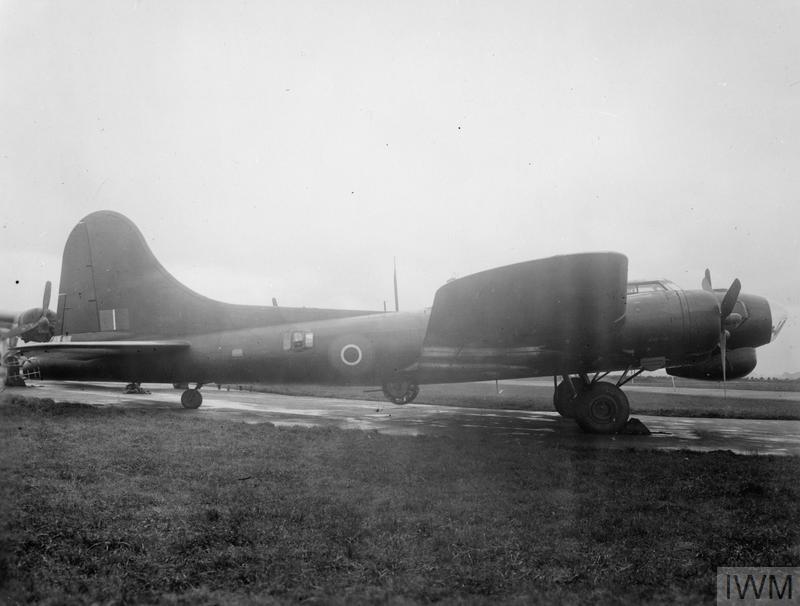
Fortress B Mark III, HB796, at Prestwick, after being fitted with radio counter-measures equipment by Scottish Aviation Ltd. It served with No. 214 Squadron from November 1944. Equipment fitted included American AN/APS15 radar in the large radome under the nose, ‘Airborne Cigar’ (ABC) radio-jamming equipment (shown by the large aerial on top of the fuselage), and an ‘Airborne Grocer’ aircraft radar jamming installation, the aerials of which can be seen on either side of the tail turret. HB796 failed to return from a bomber support mission on 9 February 1945. (© IWM ATP 13090E)

Other operations flown by the Group, included: jamming or swamping German radio communications, jamming navigation aids and searching for new signals that may suggest new or improved German radar.*3 The successes of 100 Group, prompted the setting up of the U.S. 803rd (Prov) BS (H) in March that year, a US Group who would learn from, and perform in the same role as 214 Sqn. Initially taking six veteran crews, all having reached 25 missions, from 96th BG at Snetterton Heath combined with those already at Sculthorpe, they would soon build up to a strength of twelve aircraft all based here at the Norfolk airfield. Of these initial six all but one were fitted with Carpet and Mandrel jamming equipment, whilst the sixth (B-17G) had jammers and search equipment in the form of SCR-587 and Hallicrafters S-27 VHF signals intelligence receivers (SIGINT) to track Luftwaffe radar and radio transmissions.*5

However, the initial set up of the unit was seen as ‘messy’ and disorganised with no real focus, a problem that led to delays in preparation, organisation and training. As D-day appeared over the horizon, the U.S. group was distinctly lacking in preparation and action was needed fast. To assist in the training and operations of the Fortress, a further new separate unit was also set up here at Sculthorpe.

From April 24th 1944, 1699 (Fortress Training) Flight who operated each of the Fortress I, II and III, carried out the conversion and training role for these crews, and to speed the process up, they also used the B-24 Liberator along with some smaller examples such as the Avro Anson and Air Speed Oxford. By this time, personnel at Sculthorpe amounted to some 104 RAF Officers, 233 Senior NCOs, 705 airmen, 190 WAAFs of various ranks and 1,073 US Officers, NCOs and airmen*7.

Then, five months after their arrival, both 214 Sqn and the 803rd were both posted out to RAF Oulton, (May 1944), where they continued with their ECM roles. The 803rd, now commanded by Lieutenant Colonel Clayton Scott, began to work on the support of Operation Overlord, and even as late as June 5th, equipment was still being fitted to the aircraft. The Fortress Training Flight moved with the two ECM units and in October it was disbanded and immediately reformed as 1699 (Bomber Support) Conversion Unit, a designation it used for a year before being renamed once more.

The departure of the three squadrons (along with the resident non-flying units) was not a coincidence, for Sculthorpe had been earmarked for redevelopment into a Very Heavy Bomber base (VHB). As soon as the personnel had moved out, it was placed into ‘care and maintenance’ and the workmen from Taylor Woodrow moved in; taking up residence in the now empty nissen huts on Site 3.

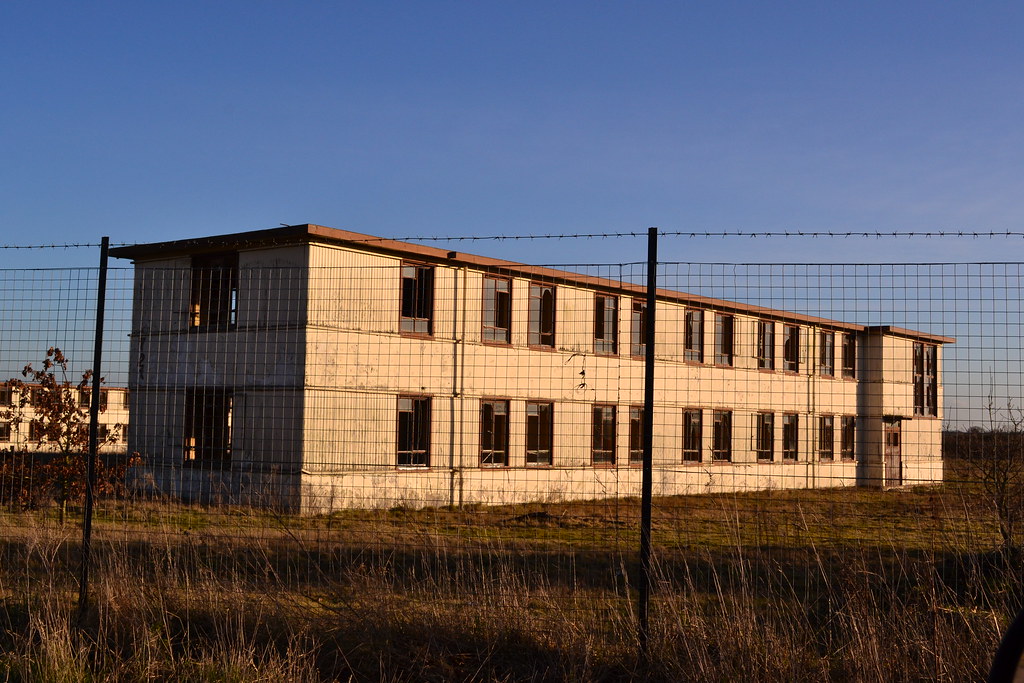
Accomodation Block

‘Z’ type Barrack Block (named so due to their shape – many of these are now in serious dilapidation)

The end of the war in 1945, didn’t unfortunately bring an eased peace. Tensions with Russia and a possible threat from the east meant that discussions had already started between the US and UK authorities over staging American heavy bombers on UK soil. This was not a decision taken easily; firstly, it would put Britain firmly on the front line in a war with Russia, and secondly, these bombers would need a significant infrastructure to support them. Runways would need to be extended to a minimum of 8,000 feet long and 200 feet wide with an additional 1,000 feet for any unintended overrun. Specialist buildings would be needed, larger dispersal pans required and hangars able to house the aircraft would also have to be erected.

With all that in mind, a number of sites in Lincolnshire,  Kent and East Anglia were identified as possibles, one such airfield in the eastern region being Sculthorpe. It, like Lakenheath, already had a strong string to its bow, already having sufficient buildings to house the 10,000lb atomic bomb should the need arise. It was also, already a substantial size with good room for extension and further development. These factors essentially saved the life of Sculthorpe and for several decades after the end of the Second World War would see it really come to the fore and become a major player in not only British, but world aviation as a whole.

And so, US development specialist moved in, after which followed a period of sustained redevelopment of the site. This included the removal and reinstatement of longer runways along with the construction of twelve very heavy bomber hardstands. Surrounding public roads were also diverted and further properties were demolished to make way for the airfield’s expansion. New accommodation blocks, ‘Z’ blocks, were built, and new married quarters were created. The whole process took around three to four years to complete during which time the station was basically closed with only an occasional use keeping it alive; one such operator being the 1510 Beam Approach Beacon System Flight (BABS) based at nearby Bircham Newton.

A further deterioration in east-west relations then led to the Berlin crisis and what has famously become known as the Berlin airlift. The political situation in Europe essentially forced the hand of both Governments to make a final decision, one which resulted in the deployment of sixty (2 Bomb Groups) Very Heavy Bombers at various UK airfields. Whilst these deployments were on a temporary basis only, the decision would however, be the first step on the ladder to the US establishing itself officially, on UK soil for many years to come.

The lack of use over the last few years had meant however, that much of the accommodation at Sculthorpe had deteriorated to an unacceptable level. Damp and rot had set in and more work was now needed to bring it back up to standard before further deployments could take place. Even as this was being carried out though, bombs and other supplies along with, in February 1949, an advanced party of US personnel from the 92nd Bomb Group, began to arrive. As they passed through the main gate so began a new page in Sculthorpe’s history,  and soon it would be ready to be an active base once more.

By December 1948,  Sculthorpe, operating as a satellite to RAF Marham, began to prepare for its official opening. A somewhat premature move as reconstruction work was still going on and there was much to do before the airfield would be truly ready for its new residents.

In Part 3, Sculthorpe develops further, it receives its new residents and a new page is turned. As relations with the East becoming difficult, a new age dawns and nuclear weapons become the way forward.

The full story can be read in Trail 21.
Little Snoring hardly the quietest of airfields! (Part 4)

In Part 3 Little Snoring had seen some short stay visitors, it had been attacked by enemy bombers and a famous face had been posted here. The bad weather had played havoc with flying duties but the parties had more than made up for it. In the final part, the war draws to a close, the airfield declines eventually closing to military activity. But its not quite the end for this little airfield with a big, big history.

The dawn of 1945 brought more of the same with both squadrons remaining here until after the end of hostilities.

The Sunderland Cup, an annual award presented to the most efficient WAAF section within Bomber Command, finally came to Little Snoring in 1945. A prestigious award, it brought many dignitaries to the airfield including: Air Commodore R.G. Spencer, Group Captain B.R. O’B. Hoare, DSO., DFC., and Air Vice Marshal E.B. Addison, CB., CBE., Air Officer Commanding 100 Group.

The cup was presented by Group Officer C. Woodhead, Deputy Director WAAF. to Flight Officer C.L. Gallavan, officer in charge of the WAAF. Section at the airfield. It was a very proud moment for the ladies of the airfield.

A group of WAAF. officers photographed with the Sunderland Cup. L-R – Front: Flight Officer Kitson of RAD Chipping Warden, Squadron Officer Ford of 100 Group, Group Officer E.C. Bather of H.Q. Bomber Command; Group Officer C. Woodhead, Deputy Director W.A.A.F. Flight Officer C.L. Gallavan of Little Snoring. (© IWM. CH15776)

515 were finally disbanded on June 10th that year whilst 23 Squadron remained in situ until 25th September 1945. With the addition of 141 Squadron in July 1945, the last few months were much quieter operationally even though there were three squadrons on the base, During this time, a great change began in the structure of the Air Force, with crews being posted out to other squadrons and units, and surplus aircraft being put into storage. Operational records show a continuous list of ‘Operational Flying Hours – Nil’.

The new Mosquito NF XXXs began replacing the ‘old stock’ of Mosquitoes that had been so successful in the previous months and years. But these updated models, with their more sophisticated radars, were not to see any operational flights with these units.

Eventually in September 1945, flying officially ceased  and the airfield was soon reduced to care and maintenance. Given over to 274 Maintenance Unit it became a storage site designated as No 112 Storage Sub-Site.

Like other airfields in this area, it became the home for surplus Mosquitoes on their way to a sad ending under the choppers blade. Luckily for some though, their fate would not be so awful and they were fired up and flight tested ready for delivery to the Fleet Air Arm or alternative Air Forces overseas. Many sadly though, ended up as fire wood.

The Nissen huts, like many airfield huts, were used to accommodate civilians until such times as suitable housing became available locally. In July 1951, No. 2 Civilian Anti-Aircraft Cooperation Unit (CAACU) was formed here, and flying a collection of warbirds including a: Beaufighter TT 10 (RD781); Spitfire XVI (TD344); Mosquito TT.35 (TA633); Vampires FB.5  (WA117); FB.9 (WL573); T11 (WZ584); Oxfords and an Anson. These would take to the skies, operating over the Wash off the Lincolnshire / Norfolk coast. In 1953 they too pulled out though, the airfield becoming too run down to be operational.

At this point, the site was largely passed to civilian hands, what was left was used by the Americans to store their own surplus equipment and not for any flying activities. A short lived move that eventually led to the final closure and demise of the airfield.

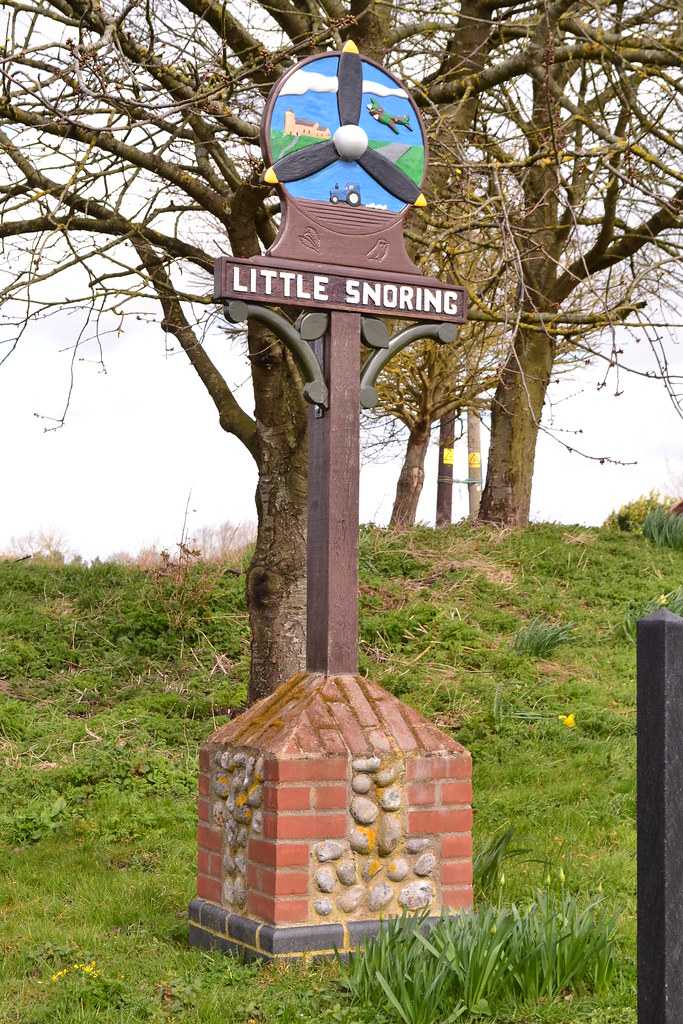
Following sale of the site, a large number of buildings were demolished or taken away for use elsewhere. The officers’ mess – which housed four ornately and beautifully written honours and awards boards, painted by Douglas Higgins – was also demolished, but luckily, these were saved by a local woman and now reside in the base’s ‘official’ church, St. Andrew’s, on the west wall. Written in paint, they detail the awards and ‘kills’ of the various crew members stationed at Little Snoring. Just a short walk from the church is the village sign which depicts a Mosquito, often seen over the skies of Little Snoring all those years ago.

In 1957, the McAully Flying Club was established here as the Fakenham Flying Club headed by its founder Elwyn ‘Mac’ McAully who sadly lost his life three years later in a flying accident at the airfield.

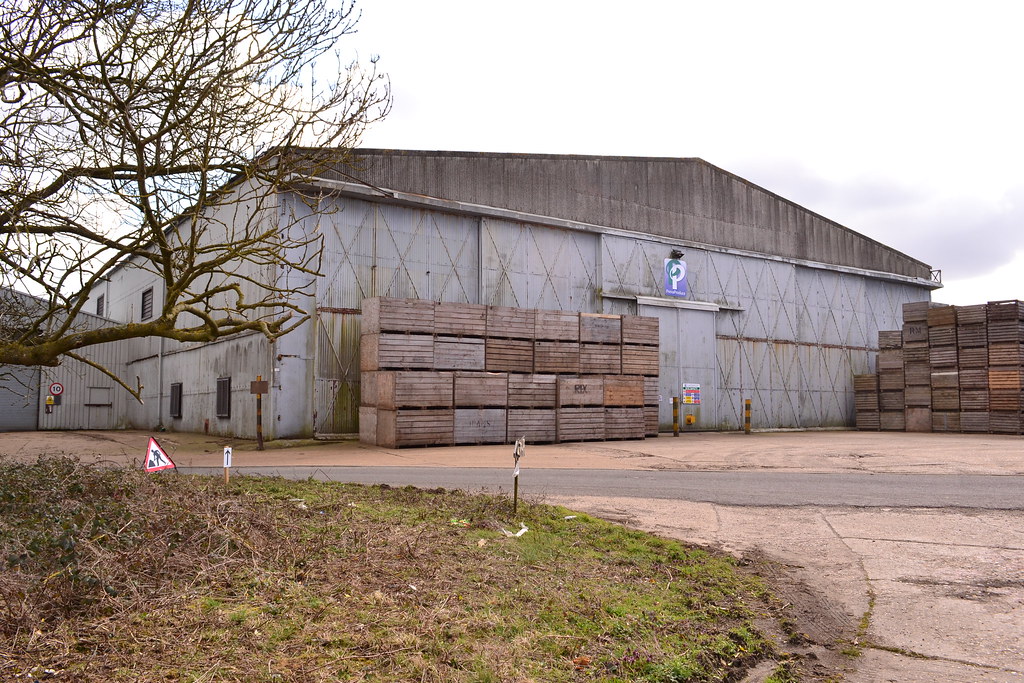
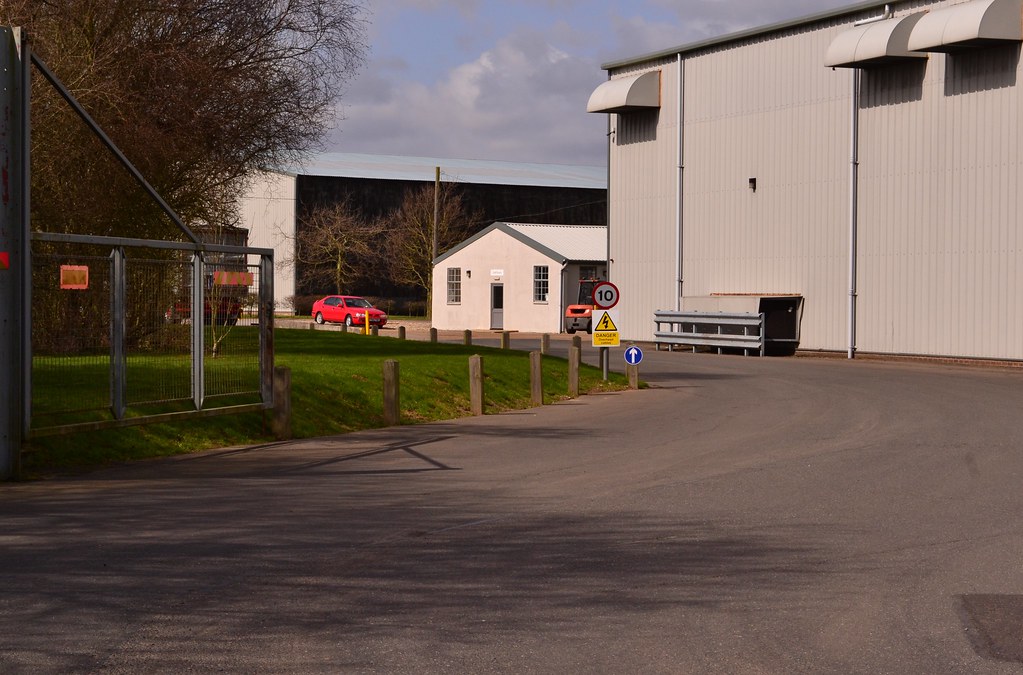
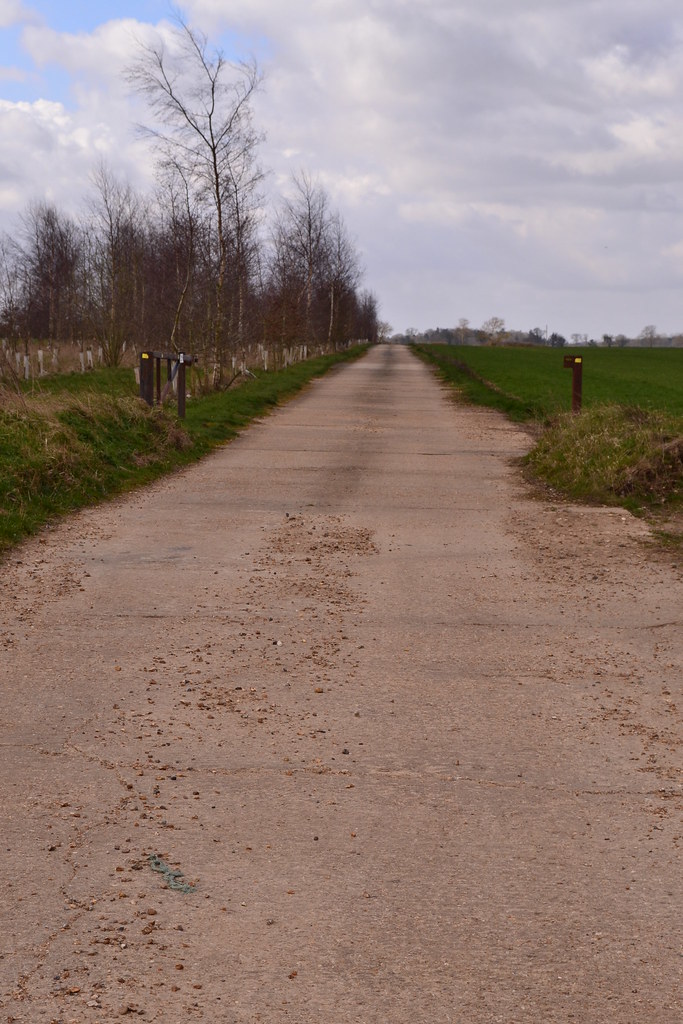
Since its closure, the runways have virtually all been removed, with only a few remnants of concrete left existing; the northern threshold of the main runway being used to store gravel and other road material. The largest and best preserved examples are two of the original T2 hangars, both used to store farm produce. A blister hangar is also on site but thought not an original of Little Snoring. Private flying now occurs on the sole remaining part of the runway located to the west. Part of the perimeter track forms the public road on the boundary of the eastern side of the airfield, and a small number of buildings, mainly huts, exist in private gardens used as storage sheds. The local caravan site has what is believed to be the base hospital and / or mortuary now a washing block.

Little Snoring’s gem is its watch office, standing proud in the centre of the site, a lone wind sock fluttering from its walls. Run down and dilapidated, it is crying out for love and restoration, but I suspect this isn’t  going to happen and perhaps its days are very sadly numbered.

During its short operational life, twelve Lancasters and forty-three Mosquitoes were lost during missions over enemy territory and up until 2018, there existed no ‘official’ memorial in memory of these tragic losses. In July,  the Airfields of Britain Conservation Trust placed an airfield marker on the western end of the site, just beyond the runway’s threshold, that omission has at least been corrected.

The base commander, ‘glass eyed’ Group Captain ‘Bertie’ Rex O’Bryan Hoare (Sammy) was a known character and has been mentioned in a number of books discussing night intruder missions. He was a very successful Mosquito pilot  and looked up to by his fellow pilots. A superbly detailed account of him appears in ‘The Snoring Villages and is certainly worth a read. He sadly died in an air accident in 1947 in Singapore.

Little Snoring was by far a sleepy airfield. Those who were stationed here made the best use of what they had, and when the cold winter weather put paid to operational activities, recreational ‘sorties’ took over and the airfield came to life in other ways. Operationally, Little Snoring played a huge part in intruder operations, strafing airfields and interfering with German Night Fighter operations. Even Adolf Galland in his book ‘The First and the Last‘ acknowledges the extent to which 100 Group went to “set really difficult problems for the German Night Fighter Command”. A true accolade to any wartime airfield and the men and women who worked there.

Sources and further reading 

*1 National Archives AIR 27/890/15; AIR 27/890/16; AIR 27/1094/17; AIR 27/288/11; AIR 27/1981/31

*2 Ward C., & Smith S. “3 Group Bomber Command An Operational Record” Pen and Sword, 2008

*3 This is taken from the official Squadron Operational records, other sources including Chorley’s Bomber Command Losses state the crash was near to Broughton near Huntingdon.

*4 Bowman, M., “Battle of Berlin: Bomber Command over the Third Reich, 1943–1945” 2020, page 297 Pen and Sword (accessed via google books) 

Galland, A., “The First and and the Last“. Methuen & Co., London, 1955
The four award and honours boards in St. Andrew’s Church can be seen on the Flickr page.
A personal recollection of life at Little Snoring can be heard via the International Bomber Command Website.
The full story can be seen in Trail 22.

Little Snoring hardly the quietest of airfields! (Part 3)

In Part 2, 115 Squadron moved away from Little Snoring and the Electronic Warfare Group 100 Group took over. With that came a new type of aircraft, the Mosquito, operating as night intruders attacking enemy night fighters at their airfield. In this part, we see more new faces, a small detachment arrives, and a famous face is posted in.

The first of these new faces would appear over March and April, a small section comprising of only three aircraft (believed to be just two P-51s and a P-38) flying in American colours for training and trials with 100 Group. On March 24th, one of these aircraft would take part, somewhat unofficially, in the raid over Berlin. Flown by Major Tom Gates, he managed to get his name added to the operations board for that night, taking a P-51 to Berlin and back. During this epic flight, he apparently strayed over the Ruhr but the German anti-aircraft gunners failed to bring him down and he returned to Little Snoring unscathed by the first of several such experiences.*4

During mid April, Little Snoring was itself the subject of an attack from Luftwaffe aircraft, these intruders following the bomber stream home from a Serrate mission over Tergnier. According to operational records, the attack consisted of scattered bombs and cannon fire which caused no major damage nor casualties.

Another new face, this time for 515 Sqn, was that of Sqn. Ldr. Harold B. ‘Mick’ Martin of 617 Sqn fame, pilot of Lancaster ‘P – Poppsie‘. Whilst at 515 Sqn Martin would excel as a Mosquito pilot, strafing airfields, trains, railway yards and a flying boat base all in one night. He is also accredited with the shooting down of an unidentified aircraft and an Me 410.

But the bad luck that had shadowed Little Snoring crews would have the final say, when on April 11th, Mosquito DD783 flown by F.O. H. Stephen and F.O. A. Clifton spun from what was thought to have been a low level roll that went wrong. The manoeuvre led to a stall and spin at a height between 2,000 and 3,000 feet. Both airmen were sadly killed in the crash, the only 169 Sqn airmen to lose their lives whilst at the airfield.

Finally on June 4th 1944, both 169 Sqn and 1692 (Radar Development) Flight departed Little Snoring for pastures new. The move, hours before the D-Day landings being more than coincidental. The 3rd and 4th were given over to packing and moving equipment to Great Massingham, and only one early morning sortie was planned, but it had to be cut short when the aircraft developed engine trouble and hour or so into its flight over France.

With that, the two squadrons moved out and began to prepare for early morning flights over the Normandy coast in the early hours of June 6th 1944. Their short time at Little Snoring had been far from noteworthy, other than to say how badly the weather and lack of serviceable aircraft had dogged their early flying days.

515 Squadron who had moved onto the airfield just days after 169, would now be joined by 23 Sqn, also flying the Mosquito VI.   Both these squadrons would concentrate on enemy night fighter airfields, seeking them out and destroying enemy aircraft on the ground, a low level intruder role that 23 Sqn had performed well in the Middle East.

RAF Little Snoring

The watch office now derelict and forlorn.

The summer arrival brought a little light relief to those at Little Snoring. 23 Sqn who had arrived in two parties via Liverpool and Gourock, had previously been at Alghero in Sardinia. Their journey had not been the delight they would have wished for,  both ferries, the Strathnaver and the SS Moolton, being held outside the ports for over four days before staff were allowed to disembark. However, once at the airfield, seven days leave was granted and the majority of personnel left for London and a week’s recreation.

Training flights, night flying practise and target practice then filled their time with both squadrons taking part in firing practise over the Holbeach Range on the Wash. Compasses were swung on the aircraft and low flying became the immediate focus. Those crews undertaking night flying were amazed at the number of lights displayed at British airfields, the 23 Sqn adjutant describing them as ‘Pansy’ when referring to the Drem lighting system employed at many airfields at this time.

Sadly the poor weather returned and yet again many flights were cancelled at the last minute. Instead parties were held, and great merriment once again fell over the airfield.

On 5th June, ten sorties were carried out over night by 515 Sqn Mosquitoes. Airfields at Montdider, Rossieres, Ardorf, Varal and Marx being targeted. Further patrols were carried out over Wunstorf, Celle, Creil, Beavis and Courmeilles with bombs being dropped on some and vehicles set on fire at others. A road bridge and barge were attacked on the Vecht Canal and airfields at Twente and Plant Lunns were patrolled by two more Mosquitoes. Further patrols and attacks were undertaken using a variety of HE bombs and incendiaries. Other vehicles were also set on fire during these intruder raids. Two aircraft flown by, Sqn. Ldr. Shaw (the Flight Commander) and Sgt. Standley Smith (a/c 950), along with Flt. Lt. Butterfield and Sgt. Drew (a/c 189), took off from Little Snoring but neither were ever heard from again and were recorded as missing in action.

The remainder of June involved much the same, poor weather hampering night flying but where the squadron was able to get airborne, 515 patrolled numerous enemy airfields, attacking goods trains and destroying a small number of enemy aircraft. Some He 111s and Ju 88s were amongst those destroyed whilst attempting to take off. The month ended with 515 crews undertaking in excess of 415 hours night flying time and 48 hour daylight flying.

23 Sqn meanwhile were suffering the same disappointments with the weather, although this did not spoil the merriment, the adjutant reporting several parties occurring whilst the remainder of leave was taken and the last of the crews arrived from abroad. Some night sorties did take place, again trains were attacked and several airfields were bombed. A small number of aircraft were seen and attacked with some resulting in ‘kills’.

A small number of the Mosquitoes of both squadrons were modified to carry ASH, the American built airborne interception (AI) radars. By the end of the year training on the new equipment was in full swing as were the parties!

December brought a devastating blow for 23 squadron though, with the loss of their Commanding Officer W.Com. A. M. Murphy DFO, DFC and C de G with Palm. He had been in charge of 23 Sqn for almost a year and was both liked and respected by all those in the squadron. Air-sea patrols were carried out by the squadron in conjunction with the Air Sea Rescue Service but nothing was found of him, his aircraft, nor his navigator Flt. Sgt. Douglas Darbon. That night, the squadron was stood down and on the following day a party was held in which many attended from lunch time to well into the night – few were seen before lunch the following day. Within a few days, Murphy’s navigator took a turn for the worst, and applied for a posting out of the squadron. Much to his disappointment though he was offered an Operational Training Unit (OTU), a move he did not wish for nor relish.

On the 9th December a little lightheartedness crept into the squadron when two Canadian aircrew landed at the wrong base by mistake. Only when they were down did they realise their mistake and were immediately awarded the M.H.D.O.I.F. The adjutant doesn’t explain the acronym, but it is likely to be something derogatory!

The number of sorties being performed by the crews in 23 Sqn were reflected in their departures. With seven crews with between 50 and 65 flights on their logs, they were all lost as tour expired, the lack of crews now becoming an issue at the airfield.

The poor weather returned once more closing down the station on several occasions. More training mean that December had been the ‘heaviest’ training month since the squadron arrived in the UK. 23 Squadron’s first ASH sortie had to be scrubbed on the night of 18th, and was followed by the inevitable party and poker.

The 22nd saw two aircraft manage to get off the ground. Unfortunately these ASH equipped aircraft had no luck in seeking out the enemy. A Lancaster diverted from its own airfield made an appearance at the airfield on Christmas Eve and the crews were treated to one of Little Snoring’s magnificent parties, a party that needless to say, went on well into Christmas Day.

The squadron remained stood down for several days, but as December drew to a close further ASH equipped aircraft took part in sorties over occupied Europe. The year ended on a positive note though, and although the squadron had lost many experienced and well liked crews, they were looking forward to better weather and more operational flying.

In the last part, the war draws to a close, the military eventually pull out leaving the airfield to nature and new owners. Although there is no more military action, it is not yet the end of flying. Little Snoring is to live on for some time yet.
The full story can be seen in Trail 22.

Little Snoring hardly the quietest of airfields! (Part 2)

In Part 1, we saw how Little Snoring developed,  taking on the Lancasters of 115 Squadron with the radial engined MK.II aircraft. In this next part, they soon depart and ownership of the site takes a change and with it comes new aircraft, anew crews and a new role.

September for 115 Sqn would be much of the same for those stationed at the airfield. More training flights, interspersed with operations to Germany. As with other months, September would see further losses for the squadron. On September 6th, DS658 piloted by F/O. R. Barnes, ran off the runway on return from operations, the aircraft was so severely damaged it was considered beyond repair and used for spares. The crew fared much better though, with none receiving any injuries in the accident. A second incident occurred on the 14th when during crew trials on a new aircraft, the bomb sight jammed resulting  in the pilot being unable to maintain level flight. After ordering the crew into crash positions, the aircraft struck a bank a few miles from RAF Downham Market near to Magdalen station.  Six of the eight on board were killed, the two survivors sustaining serious injuries.

During this month, the HCU that had joined 115 Sqn at Little Snoring received a new posting, they would depart the airfield moving on to RAF Foulsham where they would carry on their role of training pilots for the Lancaster.

RAF Little Snoring

An air-raid shelter protected the personnel from attack.

In October, further operations to Kassel and mine laying in the West Frisians were badly affected due to six of the twelve aircraft being unable to take off. The first was affected by one of the air crew suffering airsickness; the second suffered a burst tyre which left it stranded on the perimeter’s edge; a third got bogged down in the mud trying to pass this one and three more got stuck behind these unable to pass or turn. The remainder of the aircraft got away safely though, and although carrying out operations satisfactorily, they encountered electrical storms over the target area which hampered the equipment on board. All these crews returned safely and there were no further mishaps

On November 7th, a near catastrophe was luckily avoided after Lancaster DS825 crashed on take off after one of its engines cut out part-way down the runway. After inducing a violent swing the bomber crashed causing its other engines to catch fire. Luckily there were no explosions and all the crew managed to escape the wreckage unhurt.

115’s last operation from Little Snoring would take place on November 23rd 1943, the day prior to its departure for RAF Witchford. Twelve Lancasters, six from both ‘A’ and ‘B’ Flights, lined up and revved their engines to take off speed departing once more for Berlin. With them  they took the usual mix of incendiaries and ‘cookies’, all destined to fall on Berlin’s streets. Two aircraft failed to take off and two returned early; one due to a faulty Gee set and the other a faulty air speed indicator. One of the returning aircraft dropped its payload on Texil, the other safely on unoccupied land before turning for home.  The remainder of the squadron continued on and successfully completed the operation, the attack being considered ‘satisfactory’.

With that, 115 Sqn’s time at Little Snoring had come to an end, departing the next day for RAF Witchford where it would continue the brave fight over Nazi Germany. On their arrival at Witchford, a new flight was immediately formed, ‘C’ Flight, and as a result new crew members would soon arrive.  Little Snoring meanwhile was about to see some major changes itself, not only in personnel and aircraft, but ownership as well.

On December 8th 1943, the station became the charge of 100 Group, the Electronic Warfare Group who had taken up residency elsewhere in this part of Norfolk.

100 Group were the last operational Bomber Command Group to be formed during the war, with a clearly defined role which was to provide night intruder support for bombing operations, and was headed by Air Commodore Edward Addison.  Like their counterparts at Great Massingham, Foulsham, North Creake, West Raynham and Sculthorpe amongst others, they would take part in electronic warfare and counter measures against enemy fighter operations. 100 Group, investigated a wide range of devises suitable for tracking, homing in on, or jamming enemy radars. With a wide rage of names; “Airborne Cigar“, “Jostle“, “Mandrel“, “Airborne Grocer“, “Carpet” and “Piperack“, they used both “Serrate” and “ASH” to attack the enemy on their own airfield at night before they could intercept the allied bombers.

With its takeover of Little Snoring, came 169 Sqn who had only been formed at Ayr just two months before. They received the Mosquito II, the remarkable twin engined beast from de-Havilland which was to perform well in its new role as Night Intruder. In support, came 1692 (Radar Development) Flight, also know as the (Bomber Support Training) Flight from RAF Drem, also in Scotland.

A few days later the two units were joined by a third squadron, 515 Sqn from RAF Hunsdon also with the Mosquito II and VI, and Bristol’s Beaufighter IIF.  All three would work in the area of Electronic warfare.

169’s departure from Ayr was marked with a very ‘successful’ party in the corporal’s mess, with contributions of £1.00 from officers and 2/- from non-commissioned ranks. The beer flowed well into the night, with many trying their rather shaky hands on the piano. Regular rallying on the squadron hunting horn brought the party goers back together and ensured the party spirit was maintained and kept going well into the night.

Norfolk’s wet and miserable weather greeted the personnel as they arrived over the next few days here at Little Snoring. Once they settled in, training flights were scheduled but many of these had to be cancelled due to the continuing rain and fog,

With talks by staff from Rolls Royce on engine handling and another on Bomber Command Operations and Tactics, December’s poor weather provided little time for flying. A reconnaissance was made of the Norwich pubs, and parties became the order of the day, Christmas leave was arranged and various quarters were decorated. As the mood lasted well into the New Year, the war had at least for now, come to a standstill.

On January 5th 1944, the monotony was broken when thirteen USAAF B-17s landed at the airfield by mistake, the American crews, much to the annoyance of those in residency, were given temporary use of the mess until they could depart some days later. Much ribbing by the locals  no doubt helped ease the burden of sharing their beer and alcohol supply.

Various flights did manage to take place in the meantime, using both the Beaufighter and Anson. Further talks were given by escaped POWs, who gave an interesting insight into what to expect if you were shot down over occupied territory.

Over the winter months, gliders were brought in for storage and maintenance, ready for the impending assault on the French coast. These were stored in hangars on teh western side of the airfield and moved prior to D-day.

On January 20th, the first operation finally took place, a Serrate flight over Northern Holland in support of the bombing of Berlin. Two Mosquitoes were detailed but one had to return shortly after take off as the aircraft’s skin began peeling away from the wing root. Those on board were ‘thoroughly disgusted with their bad luck’.

It was this bad luck that would dog the squadron for the remainder of the month. More cancelled flights, aircraft unserviceable and instruments failing during flights. It wasn’t until the 30th January that the string of bad luck would be broken when Sqn. Ldr. Joe Cooper and Flt. Lt. Ralph Connolly, shot down an Me 110, forty miles west of Berlin in Mosquito HJ711 (VI-P). This was the squadron’s first ‘kill’ of the war since being reformed. Utilising their AI equipment, they destroyed the aircraft with a 3 and 7 second burst of gunfire from 200 ft. The aircraft blew up causing the Mosquito to swerve so violently that it entered a near fatal spin. The crew were only able to pull out after falling to an altitude of 5,000 ft. All in all, they fell some 15,000 feet before recovering. Needless to say, there was huge jubilation when they returned, the aircraft being greeted by several hundred personnel at Little Snoring.

With two more kills in February, the tally of three would remain stagnant until mid April when a series of five more 110s were brought down. With three more in May, their total would stand at eleven by the time 169 Sqn were destined to leave.

RAF Little Snoring

The road uses the former eastern perimeter track, part of which is still visible to the side.

In the next part, a small detachment arrives bring further new types with them, a  famous face appears and bombers strike at Little Snoring.
The full story can be seen in Trail 22.

Little Snoring hardly the quietest of airfields! (Part 1)

In Trail 22 we revisit a former airfield that housed the mighty Lancasters of Bomber Command, one of the few Norfolk airfields to do so. It later took on the Mosquito, a model that remained here for the remainder of the war, taking part in the Night Intruder role, a role it excelled at.

This small and quiet village played host to some remarkable people and aircraft, it was an airfield that certainly didn’t reflect its name.

RAF Little Snoring

Little Snoring is, as its name suggests, a quiet village deep in the heart of Norfolk. Surrounded by beautiful countryside, it boasts a superb round towered church that holds a remarkable little gem of historical significance. Its history dates back to Anglo Saxon times, a time from whence its name derives.

Little Snoring

The Village sign reflects Little Snoring’s aviation history.

The airfield, located about 3 miles north-east of Fakenham on land  191 feet above sea level, was opened in July 1943 following a period of construction by the company Taylor Woodrow Ltd. It would during its history, house no less than five different squadrons along with several conversion units, development units and a glider maintenance section before being used for civilian flying in more modern times.

The airfield was originally opened over the period July / August 1943, quite late in the war, as a satellite for nearby RAF Foulsham. It had three runways: two constructed of concrete 1,400 yards in length, (01/19 and 13/31) and one (07/25) of 2,000 yards again in concrete. As with other Class A airfields its runways formed the typical ‘A’ shape, with thirty-six dispersal sites constructed around the perimeter. A bomb site lay to the north of the airfield, a fuel dump to the south and the accommodation blocks dispersed away from the airfield to the south-west. The airfield was built to accommodate 1,807 RAF and 361 WAAF personnel housed over eight dispersed domestic sites.

To accommodate the various squadrons and their aircraft, the airfield would have 5 hangars, two T2s, two Glider and a B1, all dotted around the perimeter of the airfield, Many of these were not finished when the first aircraft moved in.

Initially opening under the command of 3 Group Bomber Command, its first occupants were the rare Bristol Hercules engined Lancaster IIs of both 1678 HCU (Heavy Conversion Unit) and 115 Squadron (the first unit equipped with the model); formally of RAF East Wretham, who were to carry out night bombing duties, a role it would perform throughout the war.

Of the two units, 115 Sqn were the first to arrive, the advance party being led by F.Lt. W. A Major DFC on the 5th August 1943, from East Wretham. The main party, led by F.Lt. R. Howarson, followed the next day, with the rear party, led by P/O. M.G. Gladwell arriving on the 7th. During this time all flying operations were suspended allowing the squadron time to move and settle in.

115 Sqn was historically a First World War unit, forming in 1917 going on to see action in France in the following year. Post war it was disbanded only to reform again in 1937 in preparation for the second impending world conflict. It would go on to have the dubious honour of having the highest losses of not only 3 Group but the whole of Bomber Command as well – a title, which amounted to 208 crews,  not envied by anyone. *2

The two days following their arrival were taken up with flying training including bombing practice and air-to-sea firing before the first operations on the night of the 10th -11th August 1943.

Fourteen aircraft took off between 21:45 and 22:10 to attack Nuremberg, each aircraft carrying a mix of a 4,000lb ‘Cookie’ and incendiary bombs. Although much of the target was obscured by cloud, crews reported seeing many explosions on the ground along with fires being visible some 100 miles away.*1

Of those that departed that night one aircraft (DS684) had to return early due to the gunner’s economiser lead being unserviceable, with a second aircraft (DS665) failing to return and not being heard from again. Following a phone call received from RAF Detling in Kent, it was established that the aircraft had in fact crashed some 5 miles east of Maidstone, near to Hall Farm, Boughton Monchelsea in Kent*3. It would later be revealed that none of the crew on board had survived the crash.

With Italy crumbling, further pressure was applied to Germany’s ally through the bombing of both Milan and Turin; the might of the Lancasters now delivering their huge payloads on the two Italian cities.  It was during the Turin raid on the night of 12th August, that Flt.Sgt. Arthur Louis Aaron from 218 Sqn at RAF Downham Market, would earn a VC for his courageous effort in keeping his aircraft flying whilst seriously wounded.

RAF Little Snoring

One of two original T2 hangars still in use today. These have since been re-clad.

For 115 Sqn though, the night passed without mishap and all thirteen aircraft returned intact. The next few days saw no further operational flying, the crews undertaking training flights instead, a short relief from operations before they turned their attention northwards and the German rocket research establishment at Peenemunde.

Between 21:38 and 21:50, twelve Lancasters took off from Little Snoring taking a further combination of Cookies and incendiaries with them. Bombs were released  between 7,800 and 12,000ft, a level that just scraped the ceiling of the rising smoke. Of the twelve aircraft that departed, one was lost, that of DS630 ‘H’ flown by F/O. F.R. Pusey – none of the seven aircrew, who were only on their third operation, survived. This took the total of those aircraft lost in the first few days of flying from Little Snoring, to three, almost one per operation.

Another short period of training then followed, before they once again turned their attention to Germany and the capital Berlin.

Amazingly the Lancaster squadron would fair much better than many of its counterparts, particularly those flying Halifaxes and Stirlings, losing only one aircraft, DS630 to the enemy, unlike other squadrons, which were decimated by the Luftwaffe and air defences surrounding the German capital. Of the seven crew on board this aircraft, three were picked up after spending six days drifting in a dingy off the Dutch coast.

The remainder of August was much similar. Training flights and further operations, including mine laying off the West Frisians Islands and the French coast, saw the month draw to its end. Whilst comparatively quiet in terms of losses, the squadron was none the less racking up a steady score of ‘failed to returns’.

In August, Little Snoring would become one of those airfields that would bear witness to an incredible act of bravery one that like so many others would become one of those little known about stories of the war.

On the night of August 23rd – 24th 1943, Berlin was again attacked. On this raid Lancaster ‘KD802’ ‘M’ flying with 207 Sqn from RAF Langar, was attacked by a Ju 88 night fighter. The rear gunner, Sgt. R. Middleton, managed to return fire achieving some strikes on the enemy aircraft, which led to it catching fire and crashing. But Sgt. Middletons determined efforts did not prevent the enemy aircraft from getting his own hits on the Lancaster, causing a fire in both the starboard wing and fuselage. In addition t this, the tail plane and all its controls had also been damaged and the pilot was struggling to maintain control over the burning aircraft.

P.O. McIntosh ordered the bombs ditched at 22:49 hrs. With a lighter load he then turned for home in the hope of reaching home or at least safer territories. In a desperate effort to extinguish the fire, Sgt. Middleton then volunteered to climb out of the fuselage onto the wing, something that had been tried by others in similar situations, but it was a risky and daring challenge. The pilot P.O. McIntosh, refused to grant permission, fearing the the rear gunner would be lost in the strong winds, a risk he was not prepared to take.

Remarkably the aircraft reached the North Sea, McIntosh considered ditching the aircraft fearing its time was almost up, but before he could take action, the navigator announced that they had in fact reached England and the safety of home. Coming in from the north, the first suitable airfield they came across was Little Snoring.

Fuel was now low, and with the landing gear down one of the aircraft’s engines cut out, but using all his skill and training, McIntosh manged a successful and safe landing

The aircraft was written off, so extensive was the damage caused by the fire, but the crew were all safe and uninjured thanks due to an amazing feat of courage and determination by the crew to get the aircraft back home.

In part 2, 115 Sqn’s time at Little Snoring draws to a close. The Lancasters depart and a new aircraft arrives. With it, comes new ownership and a change in operations.
The full story can be seen in Trail 22.

RAF Foulsham – A Leader in Electronic Warfare. (Part 5)

Part 4 revealed how FIDO proved to be a valuable asset to Foulsham. A new model of aircraft arrived along with its US crews and the war entered its final year. Now, as the war draws to a close, the future looks uncertain.

FIDO’s record at Foulsham was, like many other airfields, a great success. Only on the night of 23rd February 1945 did fatalities occur whilst using the system. With several aircraft on ops that night, fog again prevented many from returning to their own bases, and a Mosquito from 239 Sqn based at nearby RAF West Raynham, attempted a landing without permission. FIDO had just been lit but some of the pipes had burst adding smoke to the fog that had by now risen to 50 feet above the runway. The pilot, 23 year old Flt.Sgt. Leonard Twigg attempted to land Mosquito NF.30 ‘NT354’ only to miss the runway and land some 70 feet to one side, colliding with a Halifax of 192 Squadron parked at its dispersal. The pilot was killed in the incident but the navigator (Flt Sgt. Turner) managed to escape with injuries. As a result only one other aircraft, a Halifax, landed that night, the others being diverted to alternative airfields.

Two other 192 Halifaxes were lost that night, both being shot down over Germany with the loss of almost all sixteen crewmen – the only three survivors being taken prisoner. Both Halifax MK. IIIs ‘DT-T’ and ‘DT-O’ carried British, Australian and other commonwealth crews.

But the events of the 23rd February would pale into insignificance on the next night- the worst on record for the Australian 462 Sqn. Considered ‘minor operations’, they were tasked with dropping window, flying ahead of seventy-four training aircraft who were acting as a diversionary raid over northern France. Four of the squadron’s aircraft were lost that night, with the loss of twenty-six of the thirty-one lives. A further 100 group aircraft, a B-17 from RAF Oulton was also lost that night, these five accounting for the bulk of the losses of that one operation.

The late spring of April 1945 produced further poor weather, and FIDO was brought into action once more (possibly for the last time) on the night of 18th/19th. The use of FIDO that night allowed some thirteen aircraft to successfully land, providing a safe landing for crews who were no doubt by now, looking to the war’s end and a apprehensive return to peacetime,.

By August 1945 the war in Europe was over and squadrons were already beginning to disband. The FIDO system was drained and dismantled after providing a safe take-off or landing for a considerable number of aircraft. For 462 Sqn, the 24th September 1945 signified the end of its road. Eleven months after its reformation at Driffield, it ceased to exist, being removed from RAF inventory for good. Its demise also signified the coming of the end of flying operations at Foulsham and ultimately its closure.

In June 1946 the airfield was closed to all flying duties, whereupon it became the final resting ground for a large number of Mosquitoes prior to scrapping. Foulsham then remained ‘in-service’ until the mid 1950s, with a US Army Special Signals Unit, until the MOD deemed the site surplus to requirements. It was then sold off in the 1980s and its doors closed for the last and final time.

RAF Foulsham

A former workshop nestled between two refurbished T2s.

Foulsham, like many of its counterparts in this region played a major part in the electronic war, monitoring and jamming radar transmissions for larger formations of bombers. Despite this important and ground breaking role, Foulsham had only a short operational existence.

Many of Foulsham’s buildings have surprisingly withstood the test of time. Whilst the runways have all but gone, now farm tracks and tree lines, some of the buildings do still remain and even from the roadside, you can see what must have been a remarkable place during its short, but hectic life. The road passes along the eastern side of the airfield, here, you can still see a number of the original T2 hangars, three in total, now utilised by a local potato business. (‘Addison Farm’ as it is aptly named, is in recognition of Air Vice Marshall Edward Barker Addison, the only person to Command 100 Group*2 during the war). Whilst two of these hangars have been re-clad, the third is still in its original metal. Hidden amongst these structures, are some of the original technical buildings, again some refurbished, some original. The mass concrete bases signify the manoeuvring areas linking this area to the main section of the airfield to the west.

At this point, there was until recently, gates separating the dispersal area to the east (now farm dwellings) to the hangar area on your left. During the War, this road was surprisingly open to the public and aircraft would be manoeuvred across the road, traffic being halted by an RAF Policeman.

Further to the north, beyond this area passing an air raid shelter, is the original entrance and further technical area. A pill-box, marks where the main entrance was. Turn left here and follow the road west. To your right you pass the original Fire Tender shed, a B1 hangar and other minor buildings in varying states of disrepair. To your left, a further T2, partially refurbished partially original. Further along, the road crosses the original N/S runway, full width remnants to the right and a tree-lined track to the left mark clearly where the enormous concrete structure was laid. The road ahead, is the where the 08/26 runway ran as it disappears over the brow of the hill. The road then turns away north leaving the runway and airfield behind you.

As with all airfields, the accommodation blocks and bomb stores were scattered well away from the main airfield. With some searching, evidence of these may be found amongst the hedges and trees, public roads utilising the concrete sections of RAF road laid down originally.

Whilst the main layout of Foulsham is difficult to see from the road, the last remaining buildings have fared quite well and remain some of the better examples of original wartime architecture. There is a distinct ‘feel’ to the site that transforms you back in time to the days when heavy bombers and lighter twin-engined aircraft would rumble along its runways. Recent and ongoing development work by the farmer seems to be sympathetic and ‘in tune’ with the site, many buildings being reclaimed from nature and now ‘on show’ to the passing public. Whilst all are on private land, they are easily seen and it seems that there may be a winning formula here that other land owners could quite easily follow and preserve what is left of our disappearing heritage.

RAF Foulsham

The remains of the 08/26 runway.

In the nearby village of Foulsham, beneath the village sign, stands a memorial to the crews and personnel who once served at RAF Foulsham.

The entire story of Foulsham can be seen in Trail 22.

Sources and Further Reading (Foulsham)

*1 Williams, G. “Flying through Fire – FIDO the Fogbuster of World War Two“. Alan Sutton Publishing, 1995.

*2 There is a 100 Group Association that keeps the memories of 100 group alive.  A number of Veterans from the group meet for reunions, coming from all over the world.

*3 The Congregational Medal of Honour Website.

*4 Bowman, M., “100 Group (Bomber Support)” 2006, Pen and Sword.

*5 National Archives: AIR 27/782/1

National Archives: AIR 27/1156/59
National Archives: AIR 27/1156/60
National Archives: AIR 27/1456/69
National Archives: AIR 27/1917/17
National Archives: AIR 27/1917/18
National Archives: AIR 27/1156/43

Sweetman. J., “Bomber Crew – Taking on the Reich“, Abacus, 2004

Janine Harrington, secretary for the Association, writes her own books based around 100 Group, read it through her blog.

Janine’s writings are inspired by her mother’s story of her wartime fiance Vic Vinnell of 192 Squadron at Foulsham, who, together with Canadian pilot Jack Fisher, never returned from a secret operation on the night of 26th / 27th November 1944.

The wartime memories project, has a section focusing on RAF Foulsham and people trying to trace crew members who served there. It is worth a look through perhaps you may know someone from there.

RAF Foulsham – A Leader in Electronic Warfare. (Part 4)

In Part 3, we saw the arrival of FIDO at Foulsham, a system yet to be fully tested. As poor weather continues to hamper operations, FIDO eventually comes into its own and proves its worth. A new aircraft arrives with its aircrew, and its an aircraft not commonly seen in UK skies.


On 27th April 1944 seven aircraft, a mix of three Halifaxes, two Mosquitoes and two Wellingtons, were detailed to operations performing ‘special duties’ over the continent. On their return, Mosquito DZ377 ‘DT-L’ landed first. Moments later, Halifax MZ564 ‘DT-X’ came in behind. After what appears to have been an error by the ground control staff, the Halifax landed on-top of the Mosquito without any knowledge of the heavy bomber’s crew. The situation had been made worse, not only by the poor weather, but by the fact that the Halifax appeared to have no working radio and that aircraft navigation lights had been extinguished due to an air raid warning at the airfield.

The accident occurred *4, after the Senior Control Officer had flashed a steady ‘green’ to the Mosquito pilot, who was at the wrong height and (apparently) accepted the light as permission to land. The result being, the two aircraft came in to land simultaneously with near disastrous consequences. However, there were no causalities except for the Senior Flying Control Office being posted and demoted for his misjudgement of the situation.

Meanwhile, the FIDO installation continued, with initial test burns being made in July. This first burn consumed some 16,250 gallons of fuel*1, and although results were positive, it wouldn’t be until the end of the year before the system would be put to the test and its first operational use.

Being such a ‘specialist’ unit, 192 Sqn  operated for a short time in conjunction with a detachment of P-38/F-5 Lightnings of the USAAF. It would appear that there were five aircraft, Lightning 155, 156, 479, 501 and 515, operated by ten aircrew (Lt. Zeilder, Lt. Alley, Lt. Richards, Lt. Stallcup, Flt. Off. Vasser, Lt. Kunze, Capt. Brink, Capt Adams, Capt. Dixon and Lt. Holt) rotating around each one. The P-38 being a single seat fighter had to be modified to a two-seater to take the ‘Special Operator’. The purpose of this detachment was to search over the Zuider Zee in south Holland looking for signals associated with enemy radar controlled missiles – V2s. Often these searches would occur in pairs, but occasionally singular. On October 26th, Lightning 515 piloted by Capt. F. Brink with special operator Lt. F. Kunze, sent a message stating their intention to ditch in the North Sea. Using a position 60 miles off the Norfolk coast, four aircraft, two Mosquitoes and two Halifaxes, were immediately dispatched to search the area, unfortunately no sign of the aircraft was seen nor the crew. An Air-Sea-Rescue launch was also dispatched to the area locating items of wreckage that was later identified as part of a P-38 Lightning. The crew though, were never found.

December 1944 was one of Bomber Commands busiest. On the 9th the poor weather broke sufficiently for operations to take place. Four aircraft were ordered to fly, two Mosquitoes, a Wellington and a Halifax. The Mosquitoes, flew to Germany to monitor and record R/T transmissions; the Wellington monitored Knickebein transmissions thought to be used for Flying Boat activities whilst the Halifax was sent to the Ruhr for a ‘window’ dropping exercise. Unfortunately the Wellington had to return due to the bad weather whilst the Halifax failed to get airborne and crashed beyond the runway.

The aircraft, a Halifax III piloted by  F.O. N. Irvine, had 22 operations under its belt. However, with time up at 18:28, the four engined heavy was unable to get airborne and ran off the end of the runway into an adjacent field. In the accident MZ817 ‘DT-O’, “Pete the Penguin” was badly damaged but thankfully none of the crew were injured and all walked away unhurt.

ROYAL AIR FORCE BOMBER COMMAND, 1942-1945.

Halifax B III, MZ817 ‘DT-O’, “Pete the Penguin” 192 Squadron, after running off the runway, 9th December 1944.  @IWM HU 60601

December was an eventful month for Foulsham. With the continuing bad weather, Bomber Command were having great difficulty getting aircraft back safely. On the night of the 18th/19th, a particularly poor night, the FIDO installation at Foulsham was finally lit and used operationally.

On that night, a large force of Lancasters were ordered to perform four operations to the Polish port of Gdynia on the Baltic coast. Along with the heavy bombers were a number of 100 Group aircraft including those from 192 Sqn based here at Foulsham. Five aircraft were ordered out on ‘Special Duties’, four Halifaxes and a Mosquito, in which ‘Window’ was dropped by three of them over the Rhur, whilst the other two monitored German radio transmissions – one 50 miles west of Stettin and the other over Gdynia.

On return to Foulsham, it was found that the airfield, as were many others in the area, was fogbound, and it had become necessary to light FIDO. The alert went out to all FIDO airfields and at Foulsham the burners were lit just after 02:00 hrs. A lack of experience and waterlogged pipes meant the system was not fully burning until some 25 minutes after the initial lighting, but just in time for the first aircraft ‘S’ Sugar to approach the runway.

The first aircraft to land was Halifax III LW623 piloted by Wing Commander D. W. Donaldson who, even after encountering strong winds caused by the fires, made a safe and successful landing. He is recorded as being the first captain to land such an aircraft at Foulsham.

Following on behind Donaldson was B-17 ‘R’ Roger from nearby RAF Oulton, who like many others, was flying on fumes. The pilot had just one chance and as he approached, he ordered the crew to take up crash positions. With visibility down to some 100 yards, he brought the B-17 in making a relatively good landing in appalling conditions between the rows of flames lining either side of the runway. Two further B-17s landed that night, one on three engines and another who missed the runway and became bogged down in the mud alongside.  By the end of the night after all aircraft had been received, the burners were extinguished and visibility over the airfield diminished  once more.

By the end of December, fifteen aircraft had benefited from the installation of FIDO at Foulsham; a system that had enabled them all to land safely in conditions that would otherwise have necessitated either finding an alternative site or bailing out. A third option was of course available, but the consequences almost final and fatal.

Whilst all this was going on, it was decided to create a new unit at Foulsham to support the electronics group. The Bomber support Development Unit (BSDU) were formed here during the April of 1944. Born out of the Special Duties (Radio) Development unit they would go on to disband at Swanton Morley in 1945 to become the Radio Warfare Establishment. Whilst here at Foulsham though, they would operate both Mosquitoes and Spitfire VBs along with the Tiger Moth and Avro Anson.

A further Halifax unit would grace the skies of Foulsham in the remaining months of the year. Also an electronics unit, 462 (RAAF) Squadron, was brought in to enable full coverage of ECM work as the war drew to its close. A former RAF Driffield unit, the squadron spent most of the last few days of the month transporting equipment to Driffield train station before departing themselves for Foulsham.

The weather over the winter of 1944 – 45 was one of the worst recorded. The Allies had reached the Ardennes where a final desperate counter attack was mounted by the Germans. Embedded in the thick woodland, troops fought both the weather and the enemy whilst much of the air cover was prevented from flying due to the continuing fog and snow.

At Foulsham some operations did occur, and on some occasions FIDO had to be lit to enable aircraft to either take off or land. January saw particularly strong winds, rain and snow, necessitating all personnel being tasked with snow clearing on January 10th. On the 15th, whilst climbing to cruising altitude the starboard outer engine caught fire. The engine was feathered and action taken to remedy the situation. However, a feathered propeller soon began windmilling causing dangerous drag and the fire spread. The bale out order was given but only two members of the crew were able to escape before the wing became detached and the aircraft came crashing to earth in a fireball. The two who escaped (Sgt. G. Sandy and F/Sgt N. Reed) were both injured in their landing, none of the others escaped with their lives.

On another occasion, an American B-24 had difficulty of its own and whilst attempting to land, crashed after over shooting the runway. The aircraft was eventually salvaged after coming to a stop on a local road.

Liberator ‘DC-F’, (s/n 42-95464) of the 577th BS, 392nd BG over ran the runway at Foulsham, 14th February 1945. (IWM FRE 7993)

In Part 5, the final part, Foulsham begins the slow down of activity, the war draws to a close and the future becomes uncertain. Apprehension falls across the airfield as flights begin to reduce and personnel are posted out.

The entire story of Foulsham can be seen in Trail 22.

RAF Foulsham – A Leader in Electronic Warfare. (Part 3)

In Part 2, we reached a milestone in the life of Foulsham as it was on the brink of changing hands once more. As the new Group takes over new challenges are about to be faced, and FIDO, the fog dispersal system is desperately needed to counter the appalling weather.

By the 25th November, the move had been completed, and both 514 and 1678 HCU had now departed the airfield. With Foulsham now empty, it would undergo yet another change of ownership, this time to 100 Group, the specialists in electronic warfare. This change of ownership would, as before, bring another two new units, 192 Sqn and a supporting training unit 1508 (Blind Approach Training) Flight.

100 Group was formed that November as 100 (Special Duties) Group under the Command of Air Commodore E.B. Addison CB, CBE with its headquarters at Radlett in Hertfordshire. The aim of the move was to place all the electronic units under one single command, thus unifying its aim and bringing together all the resources of the thinly spread units. One of the main aims of the Group was to provide ‘spoof’ operations, confusing the ground operators and radar controlled night fighters, thus spreading them over wider areas. This would in turn, it was hoped, reduce the number of casualties from RAF bombers and achieve better bombing results as a consequence.

Other duties of the Group would involve the jamming of radar and radio equipment used by German aircraft and ground stations, monitoring German airways and providing incorrect orders to German crews using native speaking RAF crewmen. The war had become a battle of science.

RAF Foulsham

One of four T2 hangars.

Over November and December, airfields were taken over and aircraft supplied to the new Group. Squadrons were brought in to fill these sites and the Group grew from strength to strength.

A newly registered unit, 192 Sqn (formed a year before at RAF Gransden Lodge)  operating a mix of Wellingtons, Mosquitoes, Halifax IIs and more  recently, their newly acquired Halifax Vs, were transferred over to Foulsham, in one of the first moves to the airfield.

Formed through the renumbering of 1474 (Special Duties) Flight, 192 Sqn had been previously been monitoring the German Ruffian and Knickebein beams. In their new form they would monitor, amongst others, the western approaches to the Bay of Biscay, monitoring and recording night fighter channels.

However, the winter weather was up to its usual tricks, and it played havoc with initial flights. But despite this, within 48 hours of their arrival, 192 Sqn was classed as operational, and a memo to that effect was sent off to Headquarters 3 Group Bomber Command.

With no flying over the next three days due to the continuing bad weather, initial flights were able to begin on the 29th November, with three aircraft, all Wellingtons, performing Special Duties Flights over the Bay of Biscay. After landing at Davidstow Moor for refuelling, there was a major electrical fault at the airfield and the entire flare path and flying control facilities were put out of action. As a result, the three Wellingtons were grounded and unable to continue their flight home.

The weather continued to play havoc for the crews at Foulsham. A flight planned for a Mosquito and two Wellingtons on the 1st December had to be postponed and then finally cancelled. The next day, 2nd December 1943, three aircraft were ordered to fly to the Frisian Islands and the Dutch coast, but one had to return due to the pilot’s escape hatch blowing off, and a second overshot the runway on take off becoming bogged down in the mud. The aircraft was damaged but the crew were unhurt in the incident.

On December 7th, Foulsham officially became part of 100 Group and another unit No. 1473 (Radio Counter Measures) Flight also arrived here to assist with the ELINT (Electronic Intelligence) operations. By February 1944, it was decided to merge the Flight with 192 thus forming a ‘C’ Flight. With additional Mosquitoes and Ansons – the hardware inventory at Foulsham was now growing rapidly.

Much of December suffered the same fate as its preceding months however, poor weather rendering flying unsuitable, leaving many aircraft and their crews grounded for prolonged periods of time.

100 Group’s inaugural operation on the night of 16th / 17th December, did not however, go in their favour. On what has become known as ‘Black Thursday’ the RAF bomber force of over 480 aircraft, took heavy losses. These losses whilst high over occupied territory, were made far worse by poor weather which claimed some eight aircraft from 97 Squadron at RAF Bourn – one sixth of its strength,

The beginning of the new year, 1944, saw big changes not only in Bomber Command, but at Foulsham also. As the second phase of the ‘Battle of Berlin’ began, Stirling squadrons and now Halifax units were being pulled out of the front line bombing campaign; their shortcomings becoming all to obvious as losses in the types began to mount. The poor weather continued to cause misery across Britain’s airfields, rain and fog preventing large  continuous attacks on the German heartland.

The interminable fog was the driving force behind the new FIDO system now being installed at Foulsham. Bomber command had initially asked for eight airfields across the UK, but by the end of 1943 they were seeking twelve, and Foulsham (designated Station XXI) was identified as one suitable.

William Press were given the contract to install the system, and by mid February work had begun. Supplying the huge storage tanks was going to be a challenge though, and so a new siding was constructed at nearby Foulsham railway station. Its not known for sure whether the fuel was then piped the two mile distance to the airfield, or brought across in tankers, but whichever it was, it required a good deal of extra work.

At the airfield site, three storage tanks were assembled on Land at Low Farm, located at the northern end of the main runway. The much needed pump house and control point were also located here. Operators were kept on a 24 hr watch system, being billeted near to the equipment in two Nissen huts, one for officers and the other for ‘other ranks’.

RAF Foulsham

One of the air raid shelters used around wartime airfields.

Initial plans were for a mile of runway to be lined with the Haigill MK IV burners, with intersecting burners placed in trenches across the two intersecting runways. The placing of these burners, well out of the way of moving aircraft, initially being a difficult challenge to overcome.

Operating the burners was a tedious and dangerous job. After opening the valves and allowing petrol to fill a pool through which the operator had to walk, a match was thrown into the pool and the poor ‘Erk’ had to then run as fast as he could and throw himself into a small indentation in the ground hoping the flames would pass over and not ignite the clothes he was wearing. Once the burn had been achieved and all aircraft were down safely, the system was shut down and allowed to cool. Once the pipes were cool enough to touch, some 72,000 holes along the length of the pipes adjoining the runway had to be cleaned out to prevent a build up of soot. It was perhaps, one of the most tedious but vital jobs, RAF personnel had to perform.

Before the system could be fully tested though, a bizarre accident happened that resulted in no crew injuries, but two badly damaged aircraft and a Senior Flying Control Officer being posted and demoted.

In the next part (4) Foulsham’s  appalling weather accounts for a bizarre accident. The arrival of a new and relatively unique aircraft brings excitement to the site and FIDO really comes into its own.

The entire story of Foulsham can be seen in Trail 22.

RAF Foulsham – A Leader in Electronic Warfare. (Part 2)

In part 1 we saw how Foulsham began its life and how early squadrons suffered with bad weather and malfunctioning guns. In Part 2, we continue our journey and find out how an American pilot, who crash landed at Foulsham was awarded the Medal of honour.

On that particular day, the aircraft, “Ruthie II“, was in a mass formation heading for Hanover, when a canon shell ripped through the windscreen splitting the pilots head. In addition to this, the oxygen system to the tail, waist, and radio positions was  also inoperable, the top turret gunner had lost both arms and had major injuries to his side; the intercom system was out of action and several crew members had lost consciousness due to the lack of Oxygen.

Morgan grappled with the severely wounded pilot, who had wrapped his arms round the controls, to try and maintain level flight. Morgan decided the protection of the formation was better than heading for home alone, and so for the next two hours he flew in formation holding the pilot back with one hand whilst steering with the other. Eventually the navigator came forward and gave assistance allowing the aircraft to reach the safety of England and Foulsham.

For his actions, Morgan, of Vernon, Wilbarger County, Texas, received the Medal of Honour the following December in a ceremony presided over by Lt. General Ira C. Eaker. The story of Morgan’s bravery would form a part of the story line in the book and movie “Twelve O’Clock High”.*3

The posting of 98 and 180 Squadrons in August 1943 was no coincidence, as the airfield saw further development and new hangars added. These hangars were erected at various locations around the airfield site, ready to accommodate the forty or so Horsa gliders that would soon arrive here escorted by 12 Heavy Glider Maintenance Section. Their arrival marking the beginning of the  preparations for the invasion of Normandy the following year.

A few days later, on September 1st, 1943, the handover of Foulsham took place and 3 Group became the new owners in a move that also signified the forming of 514 Squadron with Lancaster IIs, the less common radial engined version of this famous Avro aircraft.

514 Sqn was initially headed by Acting Wing Commander A.J. Samson D.F.C., although the first to arrive at the airfield was the squadron adjutant. On first inspection, he and his small party found that the office blocks had been completely stripped of all their furniture, even shelving had annoyingly been removed from walls. As a result the offices were virtually unusable, and so a huge clean up operation began in readiness for the ground and air crews who were to shortly follow.

RAF Foulsham

One of the original T2 hangars.

Accommodation sites 2 and 5 were quickly allocated to the squadron for personnel use, and as soon as equipment began arriving, on a rainy and very wet September day, everyone was drafted in to unload and store the various much needed supplies.

To provide flying personnel for the new squadron, a support unit would also be formed at the airfield, that of 1678 Heavy Conversion Unit. The formation of this unit was achieved through the renumbering of the Flight of the same designation, a changeover that took place a month later, on October 16th 1943. The role of this unit was to convert experienced bomber crews over to the new Lancaster.

In the interim period, the new aircraft began to arrive. The first Lancaster ‘DS735’ touching down on 11th September, 1943, followed by three more (DS785, 783 and 784) over the next three days. Their arrival was met not with pomp and ceremony though, but by heavy showers and thunderstorms, the weather that had dogged earlier squadrons continued to play its terrible part in life at Foulsham. Over the next few weeks, aircraft were quickly modified and air-tested ready for flying, by the end of the month, eighteen Lancasters had been flown in and virtually all the crews had arrived ready for converting to the new type.

Over the next month, and although the weather yet again played havoc with flights, cross-countries and air tests were carried out with a high level of success. However, no one could control the weather, and the first planned operational sortie had to be cancelled due to extensive fog that blanketed the Norfolk countryside. Not until November 6th did a break allow any operational flying to take place, and that break allowed two small flights to get airborne.

A mining operation undertaken by four aircraft along with a bombing mission in which only two aircraft got off the ground, were the squadrons break into operational flying; not a major mission, but one that nevertheless broke the ice.

With the poor weather continuing, several more ‘ops’ were again cancelled allowing only the occasional ‘Bulls-eye’ or morning flight to get away. Whilst it must have been frustrating for crews, this did allow them to finally put into practice all the training they had undertaken so far.

Then on the 14th November 1943, news came through from above that 3 Group was being reorganised and that 514 Sqn would be moving from Foulsham to RAF Waterbeach in Cambridgeshire as a result. The move, expected to be completed by the 23rd, would coincide with the first operation to Berlin, a move that also signified the first phase of the ‘Battle of Berlin’. This would also be the first time a 514 Sqn aircraft (DS784 ‘JI-C’) would not return from operations; the loss being a blow to the squadron. Of the seven-man crew, one would be taken prisoner (F/S. B. Haines (RAAF)) whilst a further (Sgt. H. Lucas) would evade capture,  successfully hiding out in Brussels until its liberation in 1944. The remaining five crewmen however, all perished in the aircraft’s crash.

In Part 3, Foulsham passes to new ownership and its life in electronic warfare begins. The new Group will bring new challenges, new aircraft and the installation of FIDO, the Fog dispersal system.

The entire story of Foulsham can be seen in Trail 22.