Philpott J.A. (GB1312948) (RCAF) (Part 1)

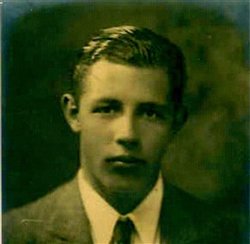
Some time ago I was given the chance to look through the flying logs of Jack Philpott (RCAF), books that record his daily activities through flying training to operational duties and eventual demobbing at the end of the war. I have been researching these events ever since and have a draft version of his early career. This is an ongoing project and I would like to hear from anyone with information or photos they are willing to share, of any of the stations or events mentioned in Jack’s history.

My sincerest thanks go to his wife Hazel, her son Ronnie and the family members that have contributed to the works, without them it would not have been possible.

P/O J. A. Philpott - Log Books

P/O J. A. Philpott - Log Books

P/O J. A. Philpott - Log Books

P/O J. A. Philpott - Log Books

Jack Philpott and Englishman who went to war for Canada.

On September 2nd 1941, almost two years to the day after Britain declared war on Germany, the flying career of Jack Philpott began. He learned to fly through the British Commonwealth Air Training Plan (BCATP), a plan designed to bolster the Royal Air Force’s dwindling numbers by training aircrews in Canada ready for the war in Europe.

Jack Philpott went through a years training, qualifying as an Air Observer Navigator and Bomb Aimer before being posted to the Middle East and operations over the Mediterranean. He survived the war, returning to the UK where he married his sweetheart on October 18th 1949.

After leaving school Jack entered the building trade where he worked with his father. He decided to sign up and joined the ranks of the Royal Air Force being seconded to Canada to train as an aircrew member under the terms of the British Commonwealth Air Training Plan. Whilst in Canada, Jack would undertake a range of flying duties, air navigation, bomb aiming and cross-country flying, qualifying in September 1942. Jack would not be chosen for Pilot training though, the reason being due to something being wrong with his eyesight under night flying conditions; particularly with landing judgement. So Jack would go on to train as aircrew, being a successful airman in the many courses he undertook.

As a trainee in Canada he was a non-combatant, and initially flew with civilian pilots before meeting his first military instructor.

On arrival in Canada on September 2nd 1941, Jack was stationed at No.1 Elementary Flying Training School (EFTS) Malton, Ontario in Canada. Here he joined course no. 37 and would begin flying training on both the bi-plane, the De Havilland Tiger Moth, and the ground based Link trainer. His first flight, which lasted 35 minutes, was a  familiarisation flight with ‘Mr. May’ as pilot and took place in aircraft #4377. Two further flights would take his total flying hours in a D.H. Moth to 2:15, flying in aircraft  #5116 and #4377.

After a two-day break, he would then fly four other D.H. Moths, #4216, #4390, #4399 and #4396, this time his pilots were Mr. Dagley, Mr. Hinch and Mr. Clark. These four sessions amounting to 3:15, took his total flying hours so far to 5:30.

Jack’s wife Hazel, who carried out war work as a civilian working with the RAF, noted that where she was they had the de Havilland Tiger Moth, and whilst they were very manoeuvrable, she recalls how they could easily go into a spin if not handled properly.

Again a short break led to further flying, carrying out different aerial manoeuvres with Mr. Hinch, Mr. Mongraw, Mr. Anten and his first military pilot Flying Officer Turner. The latter two flights being ‘progress checks’ after which Mr. Hinch signs Jack off with a total of 9:00 hours flying time. Interspersed with these sessions in the air, would be challenges in a Link trainer (#617) over seven days between 4th and 19th. Jack achieved grades here of B to A+, all completed over four hours in total during this time.

Jack’s initial training at Malton would end there, on September 19th 1941, seventeen days after his arrival.

10 Air Observer School

There then followed a two month break after which Jack transferred to No. 10 Air Observer School (AOS) Chatham, New Brunswick. Here, he would undertake a series of flying activities, some of which were with Mr. George Neal, who went on to be a Guinness Book of World Record Holder qualifying as the oldest active, licensed pilot.

The RCAF Station Chatham, opened in 1940 under the British Commonwealth Air Training Plan. Here two schools were opened one of which was No. 10 Air Observer School on 21st July 1941. Jack would attend the School between 10th November 1941 and 16th February 1942.

His first flight would be on the 23rd in Anson ‘4’, with another civilian pilot Mr. Neal. A number of cross-country flights would see Jack as Navigator (1st and 2nd) until the 19th December when he undertook his first bombing flight. Using flash bombs, Jack would fly Anson ‘S’. A single photography flight using hand-held obliques, preceded further practice bombing flights in which both flash bombs and 11.5 lb bombs were dropped. It is thought these occurred on the Miramichi river range.

Miramichi River Range, New Brunswick.

Over the Miramichi River Range, New Brunswick.

January 1942 brought further cross-country flights again with Jack flying as 1st or 2nd Navigator, his initial night flying experience being on the 7th January 1942 with Mr. Roy as pilot in Anson ‘U’. Further cross-country flight and bombing practices followed with his first taste of unforeseen action being on the 22nd January 1942, when one of the engines of Anson ‘Y’ failed just after take off.

January ended with a total of 31:40 hours flying time, to which two days in February gave a total of 64:50 hours flying time at Chatham. By the end of the Air Observer’s Navigation Course Jack had achieved 85.5 % marks achieving an ‘exceptional’ status. Subjects included: Plotting, compasses and instruments, meteorology, bombing, reconnaissance, photography, signals, maps and charts and finally air work.

No 6 Bombing and Gunnery School, Mountain view

After moving to Mountain View in Ontario, Jack joined No. 6 Bombing and Gunnery School (B & G) Mountain View, Ontario, his course running between 16th February 1942 and 28th March 1942.

His first flight was recorded on 28th February in Fairy Battle #1986, flying with F/O Compton, his first experience with RCAF military personnel. This would be the first of two air-to-air camera gun exercises, which were followed on 2nd March by his first live air-to-ground gunnery action. A free gun beam test, he fired 200 rounds achieving 4 hits in a flight of 45 minutes.

Throughout the remainder of March he would undertake a mix of air-to-air; air-to-ground; low-level and high-level bombing duties, tasks which included night flights and flying with a number of different instructors.

By the end of his course his total day bombing time would amount to 15:05 hours with a further 5:20 hours at night. With a gunnery total of 10:40, Jack’s total flying time at No. 6 B & G was 31:05 hours. His marks for the gunnery course amounted to 83.5% and the bombing course slightly lower at 77.4% both achieving a pass. With this he was now Qualified as Air Observer Bomb Aimer.

2 Advanced Navigation School, Pennfield Ridge

After completing this course he moved on to navigation, joining No. 2 Advanced Navigation School, Pennfield Ridge, New Brunswick, on 30th March 1942. Jack would be on the Air Observers Advanced Navigation course and would fly a large number of air training flights all in Avro Ansons between 5th April and 24th April 1942. During this course, and before taking to the air, Jack would learn to use the Mk.IX Sextant, carrying out a substantial number of measurements during March and early April. It would be this sextant that he would then operate in his many initial flights, all in Anson #6888. Ground sessions would be interspersed with air sessions, later flying in Ansons #6717, #6399 and #6275. Using the stars, moon and sun, Jack would calculate their location all using the Mk.IX. This was a sextant put into service in 1938, and was designed by P. F. Everitt of Henry Hughes and Son.

During April he would amass 17:35 hours flying time during the day and 16:25 at night. This took his total flying time to 117 hours. At the end of the course, his log book states ‘Passed’, and this would set him off on his way to England.

England.

Jack’s arrival in England would be on 22nd May, after which there would be a period of non-flying. He was then posted to No.1 Coastal Operational Training Unit (COTU) based at Silloth, in Cumberland. Silloth was not described by some as homely place, having few permanent buildings and mainly tents for sleeping. The Mess was a small, local hotel used to serve the local golf course in peacetime

Here, starting on 16th September 1942, the now Sergeant Jack Philpott would fly a number of local sorties and familiarisation flights as ‘Observer’. All these flights would be carried out in a new aircraft, the Lockheed Hudson. The Hudson was a twin-engined, all metal skinned aircraft with a twin tail and a rather ‘tubby appearance’.

During these flights Jack would get used to the workings of the Hudson, the undercarriage, flaps and other systems, he would also undertake map reading exercises and fly along the coastline to familiarise himself with the landmarks. Other flights included trips across to Carlisle, Stranraer and onto Newcastle. During this flight on 28th October, the aircraft suffered from severe ‘up currents’ from the Scottish hills, this made flying the aircraft difficult for a ‘novice’.

November would see Jack and his pilot Sgt Hewitt, begin a series of Air Sea Rescue sorties as well as bombing and gunnery practice. The first search flight was for a lost Anson, an air sea rescue operation that produced no result. By the end of November (23rd), Jack would have achieved a further 33:05 hours of daylight flying and 3:45 night. His grading following this posting was as an ‘above average’ navigator and he was recommended for specialist raining by the Chief Flying Instructor at Silloth. This would end his period in Cumberland.

The new year would bring a new posting and the Ferry Unit at RAF Lyneham in Wiltshire. This would be a short stay, carrying out a small number of local flights, ferry flights and air tests, transferring to the Ferry Unit at Portreath in Cornwall, in Hudson AM631 on 9th February 1943 along with his pilot, Sgt Hewitt.

Posting to his first Operational Squadron.

On 10th February 1943 Jack would get his first operational posting to the Mediterranean and No. 500 Squadron RAF. He would fly out to Gibraltar that day, flying via Lisbon and having to navigate through very low cloud often ‘down to the deck’.

Whilst here, Jack would carry out further training again with the Mk.IX and Mk. IXA sextant. This would build on the work he did in the UK, with his last training flight occurring later on, on 20th July 1943.

On the next day 11th February 1943, the Hudson flew to Blida from Gibraltar, where the weather was good and the crew would carry out local circuits and familiarisation flights. Jack’s pilot for some of these flight would be F/L Barwod DFC in Hudson FX627, who would be replaced by F/O Fitzgerald in Hudson FK708 for dive bombing practice.

On the 19th February, F/O Poole DFC would be Jack’s pilot for his first operational sortie, taking off at 13:43 they would perform a convoy escort which was scrubbed after 2 hours into the flight because of deteriorating weather! A rather frustrating first experience no doubt.

The remainder of February saw four anti-submarine sweeps for Jack with his own pilot Sgt. Hewitt, flights that would take them around Algiers Bay, Bone, Oran and the Balearic islands off eastern Spain.

By the end of February 1943, Jack had flown 41:00 operational hours, over 7 sorties, giving a total of 10 sorties so far. His total operational flying hours now amounted to 51:00.

March 1943 was much of the same, but sightings were of a different nature. On the 2nd, flying in Hudson ‘Q’, Sgts. Hewitt, Philpott, Hickmott and Elliott, took off at 06:00 for a sweep of “Special X No. 1”. Whist flying, a Ju 88 was seen which initially appeared to turn to attack, but then flew into the sun and avoided combat with the Hudson. They returned to base landing at 12:30.

On the 15th, whilst performing a 7 hour flight, 2 convoys were sighted along with a whale as the sun sank over the horizon. Further convoy escorts which included several false contacts, sub hunts and a ship from convoy ‘Riband‘ which struck a submerged mine. Other convoys for the month included: ‘Sateen‘, ‘Don‘ and ‘Trafford‘.

On the 29th, the Hudson (AM781) in which Jack was flying with Sgt Hewitt, was involved in a U-boat strike. The U-boat, which was unidentified, was later reported destroyed off Ibiza. Another aircraft was seen, but it too was unidentified. The month ended with the escort of convoy ‘Lotus‘. A further 14 sorties this month took Jack’s operational flying total to 118:30 hours.

The next part currently being researched is Jack’s operational history. It involves numerous convoy escorts, sub hunts and a crash. I am also looking into his post war life and details of his early life, but described as a secretive man, he kept a lot to himself.
Latest update to 379th BG Memorial

Since the first posting about the proposed memorial to the crews of two B-17s, #44-6133 and  #42-97942 (Heavenly Body II) who collided over Allhallows on Monday 19th June 1944, I am pleased to announce that Mitch has made excellent progress and has secured: a Guard of Honour, a Vicar to bless the memorial, materials to build the memorial, a 1940’s ‘swing’ band, a display of military vehicles, refreshments for the day and a representative of the USAF possibly from the 48th Fighter Wing from RAF Lakenheath. Also, the plaque has been delivered to Mitch, and the story board to complement the memorial is also in the process of being made. Sadly a fly past was not permitted largely due to the fact that the flight path for Southend airport lies directly overhead!

The park where the memorial is to be placed is expecting between 3,000 and 4,000 people to be there, so this is an ideal opportunity for local charities or aviation related organisations to attend and raise themselves some much-needed funds.

Funding for the memorial itself has reached £500 (half of which has been promised by the park on which the memorial will stand) 50% of the original £1,000 sought after. A considerable amount of materials have very kindly been donated, the local paper ‘Kent Messenger’ has published the story, and local television news are also following the project with great interest. A number of other supporters have also shown an interest and their support.

Any money left over, along with money raised by collection buckets on the day, will go to support the B-17 ‘Sally B‘ (http://www.sallyb.org.uk/) to help keep Britain’s only B-17 where she belongs – in the sky.

The event is set for Saturday 22nd June 2019, with the unveiling taking place at midday, the first weekend after the anniversary of the crash.

Anyone wishing to attend, either as a visitor or for a stand, can contact Mitch at: madmitch.peeke978@gmail.com or leave a comment here and I’ll make sure he gets it.

Anyone wishing to donate to the memorial can do so at:  https://www.gofundme.com/ww2-aircrew-memorial 

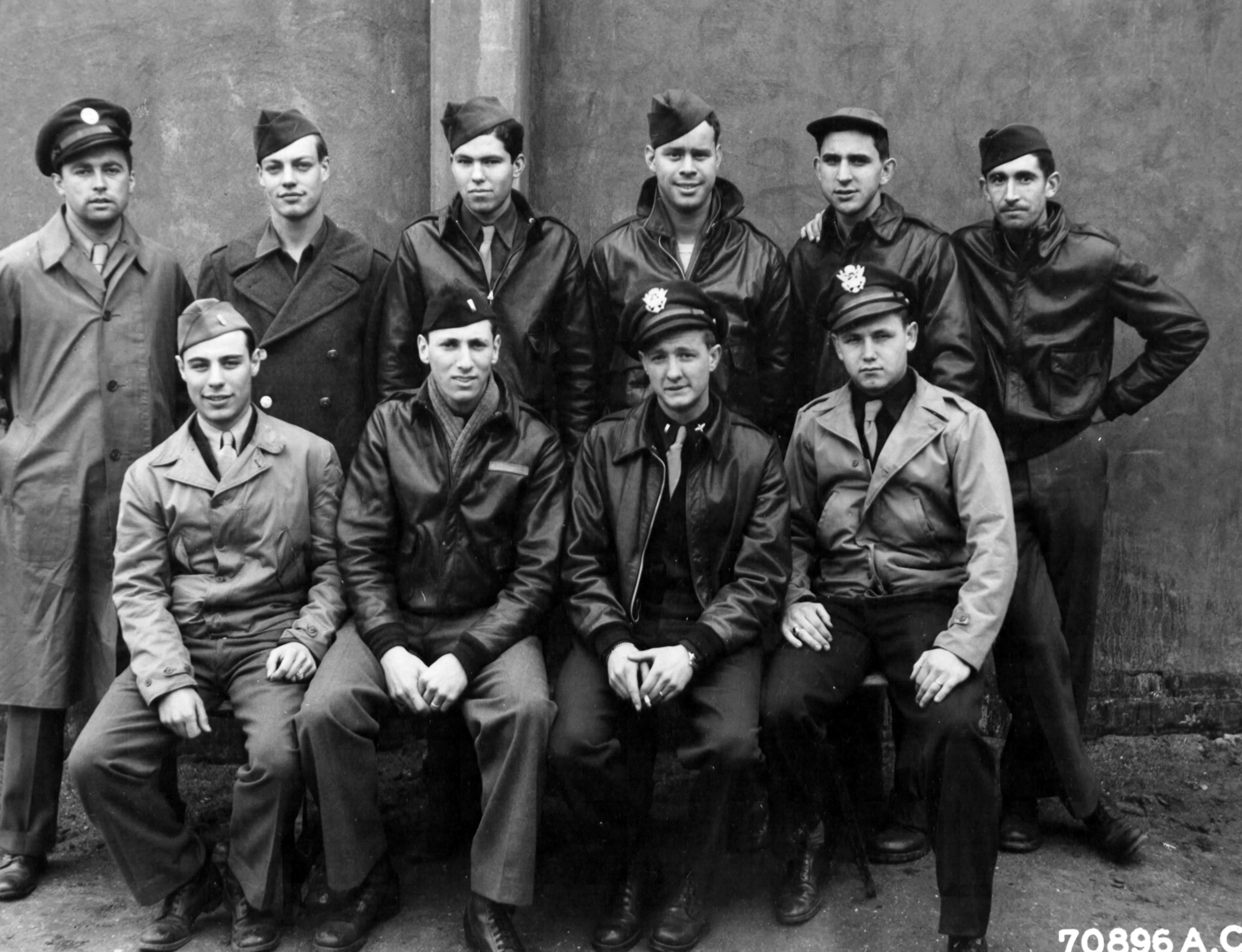
Crew of Heavenly Body II: Front Row, L to R: Edward Sadler; Fred Kauffman; Jack Gray; Lloyd Burns
Back Row, L to R; Louis Schulte; Leroy Monk; Richard Andrews; Richard Billings; William Farmer; Leonard Gibbs (Photo courtesy 379th BG Association archive,  by kind permission.)

B-17  #44-6133 was a Douglas/Long Beach B-17G-45-DL Flying Fortress delivered to Tulsa airbase, Oklahoma, May 10th, 1944. It was transferred to Hunter airbase, Savannah, Georgia, on May 19th, 1944, and then onto Dow Field on May 29th, 1944. She was assigned to the 525th BS, 379th BG as ‘FR-Y’at Kimbolton Jun 8th, 1944. The crew of #44-6133 were:

Pilot: Second Lieutenant Armand Ramacitti
Co-pilot: Second Lieutenant William ‘Bill’ Hager
Navigator: First Lieutenant Donald ‘Don’ Watson
Flight engineer/top turret gunner: Staff Sergeant Cecil Tognazzini
Radio Operator: Sergeant Richard ‘Dick’ Ritter
Ball turret gunner: Staff Sergeant John Burke
Waist gunner: Corporal Paul Haynes
Tail gunner: Sergeant Warren Oaks (his second mission)
Bombardier: Second Lieutenant Theodore Chronopolis

#42-97942 (Heavenly Body II) was a Lockheed/Vega B-17G-40-VE Flying Fortress delivered to Denver on April 11th, 1944. She then went onto Kearney air base in Nebraska on May 4th, 1944, before transferring also to Dow Field May 23rd, 1944. She was then assigned to 525th BS,  379th BG at Kimbolton as ‘FR-K’. The crew of #42-97942 were:

Pilot: First Lieutenant Lloyd Burns (just 19 years of age)
Bombardier: Second Lieutenant Jack Gray
Flight engineer/top turret gunner: Technical Sergeant Leonard Gibbs
Radio Operator: Technical Sergeant Leroy Monk
Ball turret gunner: Staff Sergeant William ‘Bill’ Farmer
Waist gunner: Staff Sergeant Richard ‘Dick’ Andrews
Co-pilot: Second Lieutenant Fred Kauffman
Navigator: Flight Officer Edward Sadler
Tail gunner: Staff Sergeant Louis Schulte

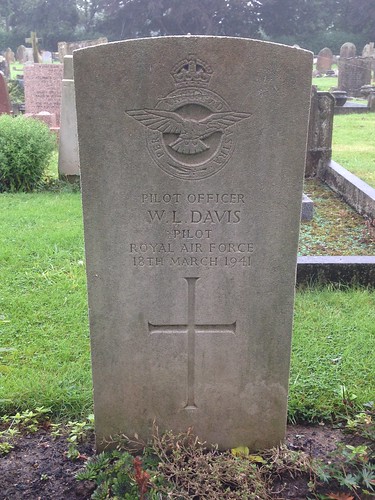
March 18th 1941 – Death of P.O William Davis (Eagle Sqn)

RAF Sutton Bridge, was a small airfield on the Norfolk / Lincolnshire border a few miles from the Wash off the north Norfolk coast. Before, during and after the war it served as  training camp for new pilots, training them in the art of gunnery, utilising a firing range that had been in situ since 1926.

Many airmen of the RAF passed through Sutton Bridge, many of these were Commonwealth aircrew, some from Czechoslovakia and a few from the United States.

In the church yard behind the church of St. Matthew in the village, lie almost 60 graves of those who died in the fight for freedom, they are also joined by a German airman, foe united in death.

One such airmen is that of American Airman Pilot Officer William Lee Davis s/n: 61459 (RAFVR) who joined as part of the famed ‘Eagle’ Squadron, a group of volunteer American flyers.

P.O. Davis was from St. Louis and graduated at Central High School, before going on to attend Washington University. He was the son of William J. Davis of 4500 Arsenal Street, and a salesman in a cork and insulation firm in the area, when he joined up at the age of 25.

He left his job, signing with the Clayton-Knight Committee, a recruitment company for the Canadian and British Air Forces operating in the United States.  He was initially stationed at Love Field in Dallas, where he received four weeks of intensive training in aerobatics, gunnery and combat flying. After qualifying here, he transferred to Ottawa, where he was commissioned and then sent onto England to further his training. He was the first person from St. Louis to obtain a Commission in the Royal Air Force obtaining a deferment of his draft in doing so. When asked about joining the RAF, he told reporters that it was “a matter of sentiment and heritage” citing his English grandfather’s role as an officer in the Boar war.

P.O. Davis was no stranger to flying, having been a flyer before signing up for the RAFVR, achieving a total of 223 hours flying time, a commercial pilots licence and an advanced CAA Licence.

On arrival on March 5th 1941, these pilots were generally sent to No.3 Personnel Reception Centre at Bournemouth, before posting to No.56 Operational Training Unit (OTU) at Sutton Bridge. Here they completed their training and were then sent onto their respective operational squadrons.

There were something in the region of 156 American Airmen who found their way into 56 OTU, many passed through with little or only minor mishaps. For P.O. Davis though it was to be the end of his dream, in an accident that would take his life.

On March 18th, a week after his arrival at Sutton Bridge, he took off in Hurricane P5195 on a general map reading flight across the Lincolnshire Fens. Whilst on the flight P.O. Davis became lost and decided to put down on farm land at New Leake Fen near Boston. Unfortunately, the ground in the Fens was soft causing the undercarriage to dig in and flip the Hurricane on its back. In the resultant crash, P.O. Davis broke his neck killing him instantly. He was not only the first from St. Louis to die, but the first American from Sutton Bridge to die also.

A citizen of the United States, Pilot Officer William Lee Davis is buried in the Church yard of St. Matthew’s Church, Sutton Bridge, Lincolnshire, Section P, Grave 56.

Pilot Officer William Lee Davis

Pilot Officer (Pilot) William Lee Davis

RAF Polebrook – the First USAAF Bombing mission (Pt 2).

In Part One of RAF Polebrook, we saw how the airfield had been developed, how it had been used by the first B-17s in RAF service. We saw how the first USAAF B-17 had landed setting the wheels of history in motion. We also saw the first USAAF bombing mission, and the American’s first major losses of the war. By mid 1943 a new unit, the 351st Bomb Group, was now arriving at Polebrook and they too were preparing for combat and their first mission of the War.

On May 12th 1943, the 351st would be initiated into the conflict, but it was not the most auspicious of starts to their campaign. The Eighth Air Force put up a force of seventy-two B-17s from the 4 BW and a further ninety-seven from the 1 BW. The call required all fourteen 351st BG aircraft to head for St. Omer / Ft. Rouge in France. After the lead aircraft discovered a fault in the oxygen system, it turned for home, the remaining aircraft then became disorganised and returned to base without dropping a single bomb.

The 351st would improve and go on to attack many prestige targets including: Schweinfurt, Mayen, Koblenz, Hannover, Berlin, Cologne, Mannheim and Hamburg. They would later go on to target submarine pens, harbours and ‘V’ weapons sites. Ground support was provided for both the Normandy invasion, the Battle of the Bulge and other major ground battles up to and including the crossing of the Rhine.

foundations

Stone foundations poke through the undergrowth.

In October 1943, the unit received the first of its Distinguished Unit Citations (DUC), with highly accurate bombing in very challenging conditions raising the standing of this new group. A second DUC was to follow in January 1944 for action deep in the heart of Germany. During an attack on Leipzig in the ‘Big Week’ campaign of 20th – 25th February 1944, two crewmen of the 510th, 2nd Lt Walter Truemper (Navigator) and Sgt. Archibald Mathies*2 (Flt. Engineer), both received Medals of Honour for taking over their stricken aircraft when both Pilot and Co-Pilot were injured / killed. B-17, TU-A ‘Ten Horsepower‘ (#42-31763), was directly hit by flak, both Truemper and Mathies nursed the aircraft back to Polebrook where they allowed the other crew members to bail out safely. On attempting to land the aircraft for the third time, it crashed (Great North Road) between Glatton (Trail 6) and Polebrook exploding, killing all three remaining crew members.

A B-17G Flying Fortress nicknamed

The last moments of B-17G “Ten Horsepower” (TU-A, #42-21763) piloted by Second Lieutenant Walter E Truemper  and Sergeant Archibald Mathies, as it is guided by a fellow aircraft after the pilot was severely injured. Truemper and Mathies unsuccessfully attempted to land the aircraft at Polebrook and were posthumously awarded the Medal of Honour for their bravery, 20th February 1944. (IWM FRE 4724)

It was also during this time that (Cp.) Clark Gable was stationed at Polebrook, initially to make recruitment films for air gunners, flying five combat missions in total and taking a film crew on each one. The first was on 4th May 1943 and his last on 23rd September that same year. He was initially awarded the Air Medal, and later the Distinguished Flying Cross, finally leaving Polebrook with over 50,000 feet of film on 5th November 1943. In 1944, the film ‘Combat America’, narrated by Gable himself, was shown in theatres around the United States. The film covers the 351st from their departure from the United states through their campaign. Included is footage of the collision between the two B-17s on May 7th 1943.

Another remarkable record was set at Polebrook, between 13th June 1943 and January 11th 1944, when Maj. Eliza LeDoux would lead the 509th BS (351st BG) for fifty-two  consecutive missions without losing either a single man nor a single aeroplane. An astonishing example set when at the same time other US Groups were losing aircraft at a rate of around 5%.

Major LeDoux, commanding officer of the 351st Bomb Group the cockpit of a B-17 Flying Fortress, 20 June 1943. Official caption on image:

Major LeDoux, CO, 509th BS, 351st BG, 20th June 1943. He led his squadron without loss for 52 consecutive missions.

The 351st remained at Polebrook until shortly after VE day, returning to the US and becoming deactivated on August 28th 1945. Polebrook then became quiet once more being put under care and maintenance until its closure in 1948.

During the three years the 351st were at Polebrook, they flew a total of 279 B-17s on 9,075 sorties with 7,945 of them dropping 20,778 tons of bombs. Air gunners on these aircraft were credited with 303 enemy aircraft destroyed. In all they flew 311 credited missions losing 175 B-17s in all.

One interesting point about Polebrook was that as a station under care and maintenance, it is thought that within its hangars was the last Short Stirling to be owned by the Royal Air Force.  A MK.V aircraft, it was struck off charge in 1946, a point that ended a long and interesting career for an aircraft that has long been considered a failure. As a bomber, this was certainly partly true, the many teething problems it had suffered – a lack of altitude, poor climb rate, continued engine problems and a tendency to swing on take off – all giving it a bad name. However, it could out manoeuvre a Lancaster and it could give any fighter of its time a run for its money. By the end of its flying career, the Stirling was loved by its crews, it had been a successful transport aircraft, mining platform and had brought many POWs back home after the war. Sadly though, none survived other than as wrecks at the bottom of Fjords or as bits salvaged from various crash sites across Europe. The days of the Stirling were now over and the only person to gain any benefit from them was to be the scrap man.

Thor site walls

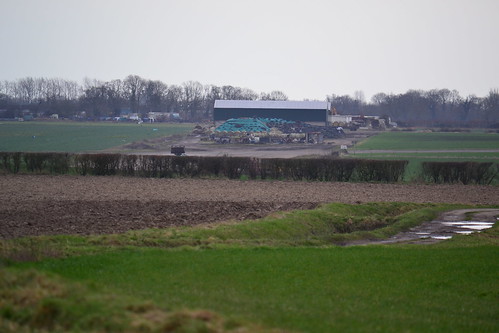
3 Thor missile sites remain used for farm machinery.

But it wasn’t quite the same for Polebrook. Post war, and with the heightened threat from the Soviet Union, Polebrook was once more brought back to life, with three Thor missile sites being constructed in the centre of the main runway. These remained operational until August 1963 when they were finally removed and the site closed off. It was sold back to the former owners, at which point the airfield’s runways were dug up for valuable hardcore and many of the buildings were pulled down.

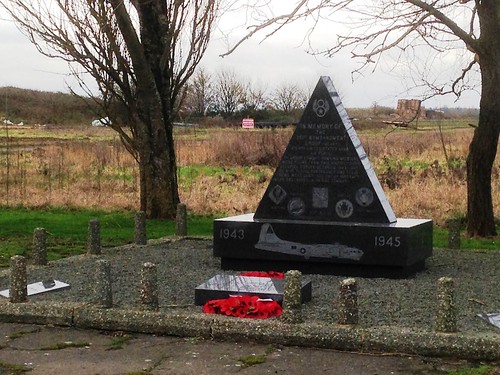
Standing on the site now, the wind howling across the open fields, it is easy to imagine how the site must have been all those years ago. A memorial stands on what remains of the main runway, a small section of concrete, overlooking the airfield.

Memorial

A memorial looks over the remnants of the main runway.

Two benches carved in marble with a main triangular stone are beautifully carved and cared for. Trees planted in lines mark the threshold where many bombers would have left on their way to targets in occupied Europe. A guest book is supplied in a wooden box and signatures reveal visitors from all over the world.

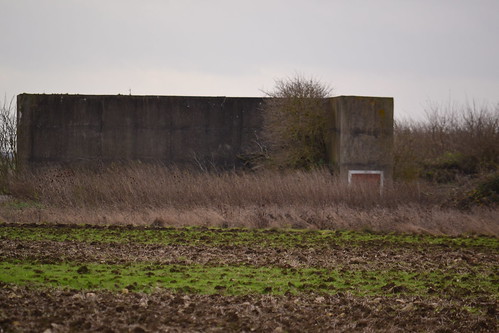
Across the road from here, tucked away in the corner of a field, is the main battle headquarters. Originally a sunken chamber with communications centre and raised platform, it allows observers a full 360 degree view over the site and surrounding area. Built to specification 1008/41 it is sadly now flooded and standing proud of the ground. Both access points are open to the more adventurous, or fool hardy, explorer.

Battle Headquarters designed to drawing 1008/41.

The battle headquarters offers 360 degree views.

The single largest and most well-preserved building is the original ‘J’ type hangar. Used for farming purposes, it is well looked after and visible from most parts of the site. The T2 hangars that would have been opposite are gone. as has the control tower and other main structures.

The three Thor sites are still standing, used by the farmer for storage. They were (at the time of visiting) buried beneath hay bales and farm machinery. One is clearly visible however, the blast walls standing proud. Whilst careful exploring around the others reveals tracks and remains of the housing for the Liquid oxygen supply tank and hydropneumatic controllers, all ancillary buildings are gone.

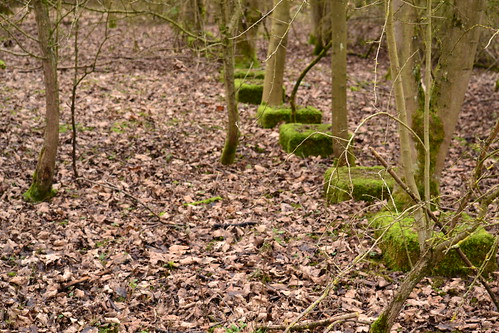
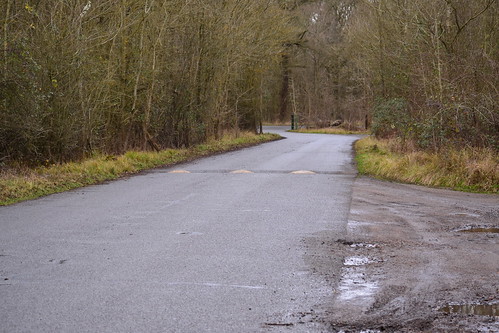
The best evidence of life at Polebrook can be seen from the entrance to the ‘industrial’ site on the Lutton to Polebrook Road. This area, now woodland, is actually designated a nature reserve and access is freely available. This small road is the original entrance to the airfield and to both your left and right are the technical areas. Beneath the leaves and muddy floor, road ways still lined with kerbstones, are visible, and whilst the road way is not clear, it is possible to make out the general view of the site.

main entrance

The original entrance to the airfield. The main road in the distance separates the technical areas, left and right, from the accommodation areas in the woods ahead.

Hidden amongst the trees and brambles, are a few good examples of the buildings once used. Most, are now piles of concrete, but quite a few shelters are still about and accessible. Storage tanks are open, the covers gone and so as a caution, tread very carefully amongst the bushes watching your footing.

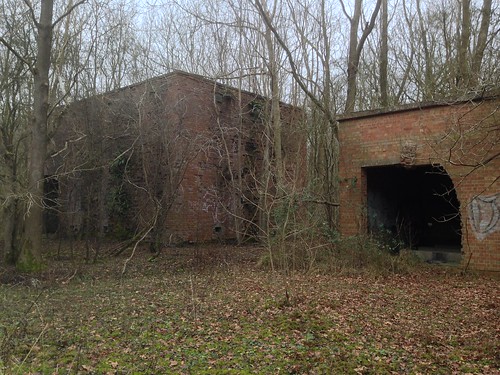
From the entrance, to your left and a little further in, are two buildings, still shells but intact. The larger, I believe is the operations block, a smaller building next to it may have been a power or perhaps communications building.

operations block and adjacent building

One of the various substantial remains, possibly the operations block.

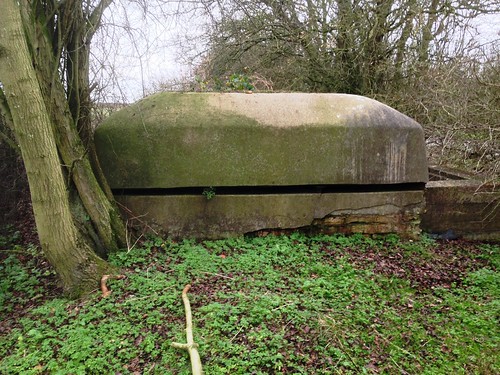
Polebrook is unique in that it has/had examples of twin looped pill boxes. Here one firing window is situated above the other. A few other more standard examples are also on site some easily seen from the road or track.

I believe that the office on the site contains a full-scale model of the airfield as it was, and that the owner is more than helpful to visitors. Unfortunately on the day I was there, I was unable to take advantage of this so a return visit is certainly on the cards for later.

I was amazingly surprised by Polebrook. It is a truly an atmospheric place with plenty to see for the visitor; remnants of a time gone by lay hidden amongst the trees and brambles of the now wooded area, and little reminders of lives lost, lay beneath the leaves. A howling winter wind replaced by summer sun, carry the voices of those young men across its open expanse and through its decaying walls of history.

Polebrook appears in Trail 19.

Sources and further Reading

*1 Ashton Wold – Historic England information sheet List Entry Number: 1001715 accessed 6/2/19

*2 Photo taken from Wikipedia open source. http://commons.wikimedia.org/wiki/File:Polebrook-Aug1948.png

*3 The story of Archie Mathies appears in the ‘Heroic Tales‘. The crew list of B-17 ‘Ten Horsepower‘ was:

Pilot: Clarry Nelson,
Co-Pilot: Roland Bartley,
Navigator: Walter Truemper
Engineer / Top Turret Gunner: Archie Mathies
Bombardier: Joe Martin (POW)
Radio Operator: Joe Rex,
Ball Turret Gunner: Carl Moore,
Waist Gunner: Tom Sowell,
Waist Gunner: Russ Robinson,
Tail Gunner: Magnus Hagbo

Anton. T., & Nowlin. B., “When Football went to War” 2013, Triumph Books

Freeman, R., “The Mighty Eighth War Diary“, (1981) Jane’s Publishing.

Freeman, R., “The Mighty Eighth“, (1986), Arms and Armour Press.

For further information, see the superbly detailed website dedicated to the 351st BG with photos of crews and aircraft.

If time allows, the nearby Polebrook church also has a memorial dedicated to the personnel of the base.

Polebrook was originally visited in the latter part of 2014, the full Trail can be seen in Trail 19.

RAF Polebrook – The First USAAF Bombing mission (Pt 1).

At the top of Northants, close to the Cambridge / Huntingdon borders, lie a number of wartime airfields. Relatively high up, they can be bleak and windy, but to those interested in aviation history they offer some amazing stories and fascinating walks. Some of these sites have been covered in earlier Trails e.g. Kingscliffe, Deenethorpe, Spanhoe Lodge and Grafton Underwood, but because of their close proximity, they could all be combined with this trip.

Our visit today in Trail 19 is the former RAF Polebrook, home to the famous Clark Gable, and the site that saw the very first official Eighth Air Force Bombing mission in August 1942.

RAF Polebrook (Station 110)

To the west of Peterborough, across the A1 and through some of the most gorgeous countryside this area has to offer, is Polebrook, a small village that once bustled with the sound of military voices. Originally designed for the RAF’s Bomber Command, Polebrook opened in May 1941, as a Class II airfield built by George Wimpey and Co. Ltd. It had three runways, the main one being (08-26) 1,280 yards in length, with two further runways (14-32) of 1,200 yards and (02-20), 1,116 yards, giving the site a substantial feeling of size. To accommodate the dispersed aircraft, it was designed with thirty hardstands laid mainly to the south-west and eastern sides of the airfield. The administration and technical sites were located to the north.

Aircraft maintenance was carried out in two type T2 hangars and one J type hanger, which sat next to each other, there were in addition, a range of technical buildings, a Watch Office (with Meteorological Section to design 518/40, to which a circular addition was made to the roof) and around 20 pill boxes built to provide defensive cover of the overall site.

To the north of the site across the main road, lies an area known as Ashton Wold Woods. Within the wood is the Ashton Estate, which was purchased and developed by the banker, Lionel Rothschild in 1860. It was after this that the estate was developed into a country home for his grandson, Charles Rothschild.

Charles, a banker by trade, set about creating a formal garden on the estate along with his wife Rozsika, and later his daughter Miriam. He had the grand honour of being the country’s leading expert on fleas, as well as a naturalist and conservationist who was responsible for forming the Society for the Promotion of Nature Reserves in 1912.

After his death and subsequently Rozsika’s in 1940, the house passed to their daughter, but when the construction of the airfield began, the house and gardens were requisitioned for use as both as a hospital and accommodation site. During the war, the site suffered badly through neglect, and post war, Miriam set about restoring parts of the estate. Sadly it was not fully restored and parts continued to fall into disrepair*1.

RAF Polebrook, Taken August 1948*2

A year after Miriam inherited the estate, the first RAF unit arrived, No 90 squadron (28th June 1941) with Fortress Is, otherwise known as Boeing’s B-17C, who stayed until their disbandment in February 1942. Although liked by their crews, the Fortresses were dogged by high altitude problems (freezing guns) and poor bombing results. This early version of the B-17 was not to be a record breaker and had a relatively short life before being replaced later by better models. Between 8th July and September 2nd, 1941 Polebrook Fortresses made 22 daylight attacks against targets including: Wilhelmshaven, Bremen, Brest, Emden, Kiel, Oslo, and Rotterdam. The RAF eventually decided to pull out of these daylight raids and the airfield momentarily fell silent to operational activities.

B-17C #40-2079 delivered to the RAFSerial: AN518 (Mistakenly marked as AM518 at the Boeing Factory) 90 Squadron

Delivered to the RAF [AN537] as part of Lend-Lease. This was the last B-17C produced; 90 Squadron [WP-L] Polebrook 13th May 1941. The aircraft later transferred to No. 220 Squadron at Alder-grove, Northern Ireland. (IWM UPL 31070)

Polebrook airfield was then handed over to the USAAF (June 28th 1942) and re-designated Station 110. It was felt however, that the current runways were inadequate for the American’s new model B-17s, and so a period of expansion then occurred. During this time the hardstands were increased to 50, the main runway (concrete and tarmac) was extended to 2,000 yards and the two secondary runways were both extended to 1,400 yards. Accommodation blocks were increased now allowing for 2,000 personnel, and the whole site was brought up to Class A standard; all-in-all it was a major redevelopment of the entire site.

The first American units were those of the 97th BG of the 1st Combat Wing. The 97th were constituted on 28th January 1942 and activated in the following February. Passing from MacDill Field in Florida through Saratosa they would make their way across the northern route to Prestwick. On route to their departure points, elements of the group were detached and sent to the Pacific coast, whilst the remainder continued on to Europe. The first manned B-17 #41-9085, ‘Jarrin Jenny‘ arrived in the UK on 1st July 1942 touching down at Prestwick in Scotland after a 3,000 mile long flight via Greenland, with the first ground echelons arriving via the Queen Elizabeth, shortly before on 10th June. Five days after ‘Jarrin Jenny’s‘ arrival, the aircraft would reach their new base, and the Northampton countryside would become a buzz of activity, as much from the curious locals as the Americans they were in awe of.

Bill Colantoni of the 306th Bomb Group with a B-17 Flying Fortress (serial number 41-9085) nicknamed

Bill Colantoni poses in front of B-17 #41-9085 ‘Jarrin’ Jenny’ at Polebrook, the first B-17 to arrive in the UK. (IWM UPL 6830)

Almost immediately after arriving int the UK the four squadrons of the 97th were split. Between June and the end of November the Headquarters unit, along with the 340th BS and 341st BS were based here at Polebrook, whilst the 342nd and 414th BS went to the satellite airfield at nearby Grafton Underwood (Trail 6).

Within a month of arriving on August 17th, the 97th BG would enter service flying the first operational mission of the USAAF from England, under the control of the Eighth Air Force. However, hastily formed, these early groups of bombers were made up of poorly trained crews, many of the gunners never having fired their guns at moving targets, nor had pilots flown at high altitude on Oxygen or in close formation. Such was the rush to get the aircraft overseas, that basic radio, flying and gunnery skills were all lacking, and if they were not to become easy targets for the more experienced and ruthless Luftwaffe, then they were going to have to endure a very steep learning curve indeed. Thus the early part of August was to be filled with intensive flying practice, with the RAF offering their services as mock enemy fighters, trainers and advisers, supporting the Americans through the tough training regime that would hopefully save their lives in the coming weeks and months.

By the 9th August it was decided that the 97th was combat ready and orders came through for their first mission. Sadly the 10th August brought poor weather, and the mission was scrubbed much to the disappointment of the those in the Group.

Two days after this, even before a bomb was dropped in anger, the dangers of flying in cloudy European skies would become all too apparent when a 340th BS, B-17E #41-9098 ‘Big Bitch‘ (not to be confused with #41-9021 ‘The Big Bitch’, which transferred to the 390th BG at Framlingham and was renamed “Hangar Queen“), collided with mountains in Wales whilst on a navigation exercise to Burtonwood, killing all eleven on board. The 97th were now racking up many ‘firsts’ adding the first B-17 fatalities to their extending roll.

August 12th saw the next call to arms, but again the weather played a cruel joke on the men of the 97th, the mission being scrubbed yet again; it was beginning to appear that someone was playing a rather frustrating joke at the expense of the eager young men.

Their next mission, detailed on the 16th was then again called. This time was ‘third time lucky’ and the following day the first official mission of the Eighth Air Force was given the green light. At 15:12 six B-17s in two waves of three left the runway at Polebrook and history was made. After rendezvousing with their ninety-seven RAF Spitfire escorts, they headed for the French coast only to turn away and head for home when just ten miles from the enemy’s coast. This time it was not the weather at fault, the mission was a planned feint to tease the Luftwaffe away from the main force following behind – a group of Twelve B-17s from each of the 342nd, 414th and 340th BS.

This mission was not only the USAAF’s first mission, but it also saw the testing of new electronic counter-measures equipment. Flying alongside this formation were nine Boulton Paul Defiants carrying the counter-measures equipment. Code named “Moonshine“, the equipment consisted of ‘repeaters’ designed to repeat back to the German’s their own radar signals thus giving the impression of a much larger and more formidable force.  These first two Polebrook flights split, the first making their feint toward Alderney, whilst the second force flew toward Dunkirk, it was this flight that was accompanied by the nine Defiants. Before reaching the coast though, they turned and headed for home their job done. It was reported by the British that an estimated 150 Luftwaffe fighters rose up to meet the ‘massive’ force, but no interception took place and all aircraft returned to base.

Amongst the main force following on, were three of the Eighth’s most prestigious personnel; the Group’s Commander Colonel Frank Armstrong Jnr who sat beside Major Paul Tibbbets (Tibbets was to go on and drop the first Atomic bomb on Hiroshima thus ending the war with Japan) in ‘Butcher Shop‘; whilst in the second wave flew General Ira Eaker, Commanding General of the entire Eighth Air Force, in ‘Yankee Doodle‘. Bombing results were ‘good’, the clear skies proving to be the bombardiers best friend that day. All aircraft returned, the only casualty being a pigeon that hit the windshield of one of the B-17s as it approached Polebrook. The first mission was over, the ice had been broken.

This first mission, a trip to Rouen, preceded several attacks across the low countries, until in the November when the Group (previously assigned to the Eighth on September 14th) transferred to the Twelfth Air Force. They were now heading for  North Africa. Over the period 18-20th November the air echelons departed Polebrook heading for Hurn before flying on to North Africa. The Ground echelons left shortly after, a point at which the 97th’s connection with Polebrook ceased leaving nothing but a legacy behind.

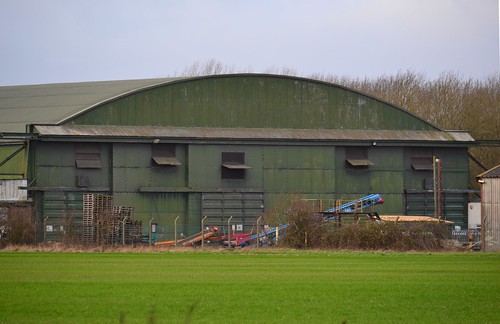
Original J type hangar built to specification 5835/39

The original Type ‘J’ Hangar still in use today.

In the short time the 97th stayed at Polebrook they would complete 14 missions over occupied Europe, dropping 395 tons of bombs. They would then go on to earn themselves two Distinguished Unit Citations and complete a number of ‘firsts’ whilst operating in the Middle East. But with the 97th now gone, Polebrook airfield would enter a period of relative calm and peace.

Then in April / May 1943, Station 110 once more resonated with American voices, with the arrival of the 351st BG. Another new Group, they were initially assigned to the 1 Bombardment Wing (1 BW) of the 101 Provisional Combat Bomb Wing (101 PCBW). After the USAAF went through periods of change and renumbering, this eventually became the 94th Combat Wing, (1st Bombardment Division). The 351st operated with B-17s of the: 508th (code YB), 509th, (code (RQ), 510th, (code TU) and 511th (code DS) Bomb Squadrons, distinguished by a triangular ‘J’ on the tail.

A film taken at Polebrook showing a number of aircrew and aircraft of the 351st BG. Several views of the technical and accommodation sites give a good contrast to the views of today, especially the ‘J’ type hangar that appears above.

The 351st were only activated in the previous October, and were, as ‘rookies’, to take part in some of the most severe aerial battles in Europe. Luckily for them though, training programmes back home had improved, and the gaps that were present in the first crew selections had now been filled.

As with all units new to the theatre of war, a short time was spent on familiarisation and formation flying techniques. Shortly before the 351st were deemed combat ready they were practising formation flying over Polebrook when tragedy struck.

Former Washington Redskins player Major Keith Birlem (508th BS) was piloting B-17 #42-29865 ‘YB-X’ when the plane dropped down severing the tail of another B-17 #42-29491 (509th BS) piloted by Capt Roy Snipes. Both aircraft fell from the sky landing as burning wrecks near to the perimeter of the airfield. The accident took the lives of all twenty airmen on-board the two aircraft. Major Birlem had flown his one and only combat mission just three days earlier, on his birthday, gaining experience as a co-pilot with the 303rd BG who were stationed at Molesworth.

In part 2 we see how the 351st entered the European conflict along with the further development and subsequent rundown of Polebrook immediately after the war. We also look at how the increase in tension of the Cold War brought Polebrook back to life once more, and how it eventually closed for good leading to the condition we find it in today.

RAF Shipdham – The 44th BG ‘The Jinx Squadron’ (Pt. 2)

In part 1 we left the “Eightballs” in the middle of a cold and icy winter, before which, a heavy toll had been paid. The January of 1944 would not prove to be any better for the men of the 44th BG, with both further losses and the high levels of stress playing their part in the coming months at RAF Shipdham.

On January 13th, a training mission was organised for a new crew, who had only joined the group on the Christmas Eve, and were barely three weeks into their war. On this day, B-24 #42-7551 of the 68th BS piloted by 2nd Lt. Glenn Hovey, would come in on approach to Shipdham, a landing in which one of the engines was feathered to simulate one engine out. With flaps and gear down, the pilot overshot, banking to the left striking a tree causing the aircraft to crash. The ensuing fireball killed nine men instantly, the tenth 2nd Lt. Richard Sowers being taken to hospital where he died shortly after. For a rookie crew this was perhaps the worst possible cause of death.

B-24 Liberators, including a B-24 (serial number 41-29153) nicknamed

Liberators, including a B-24 (#41-29153), ‘Greenwich’ of the 506th BS, 44th BG (pilot 1st Lt. Robert Marx) conducts a raid on a German airfield near Diepholz. February 21st 1944. This aircraft was subsequently lost on April 8th 1944, all the crew were taken prisoner. (Official U.S. Air Force Photo)

The extreme pressures placed of aircrew were beyond that imaginable, and for some, it was just too much. After having joined the 44th and flown since July 1943, for one pilot it all became too great, and on January 20th he sadly took his own life. Not a unique event by any means, but his death shows the great pressure that airmen were subjected to and for some it was simply a step too far.

The end of March and into April saw the poor weather continuing, with many missions being aborted. On April 1st, a mission to Grafenhausen was yet again cancelled, but B-24s of the 44th and 392nd did continue on. Unbeknown to them, they were way of course, and when they released their bombs it was the Swiss town of Schaffhausen that was beneath them, and not the Germany city. Ten aircraft were lost that day whilst Swiss papers reported the loss of thirty residents. The Nazi propaganda machine-made good use of this most unfortunate accident.

Only eight days later the ‘Eightballs’ would suffer their greatest loss of the war, April being the month that cost more in men and machines than any other month of the conflict. This was a month that put even Ploesti and Foggia in the dark. A mission to Brunswick was scrubbed as the town was shrouded in smoke, and so a secondary target was selected Langenhagen Aerodrome near Hanover in Germany.

Now for the first time, fitted with PFF, the B-24s flew toward the target. It was a cloudless and sunny day, an escort of P-51s were with the Liberators when suddenly, out of the sun, came a whole horde of enemy fighters. They struck from above and in front making a concentrated attack that took out eleven of the 44th’s group; forty-one airmen were killed that day with almost as many being taken prisoner.

For the remainder of the war the group attacked many high prestige targets, including airfields, oil refineries, railways, V-weapon sites, aided the Normandy landings and the breakout at St. Lo. They supported the ground forces in the Battle of the Bulge and attacked railway bridges, junctions and tunnels preventing German reinforcements arriving at the front.

With their last operational bombing sortie taking place on April 25th 1945, never again would they lose as many aircraft as they did during those three major raids. Bombing turned to food supplies and transit flights bringing home POWs from camps across Europe.

Then over May / June 1945, the various echelons began to depart Shipdham returning to the U.S., they had completed 343 missions using six different marks of B24. They had flown against submarine pens, industrial complexes, airfields, harbours and shipyards. Whilst in Africa they had flown in the Ploesti raid in Romania, the raid on Foggia and had helped in the invasion of Italy.

The Unit achieved one of the highest mission records of any B24 group for the loss of 153 aircraft, the highest loss of any B-24 group. They had taken the taunting of the B-17 crews, been called ‘Jinxed’ and had lost a lot of young men in the process. The 44th had paid the price, but they had earned two DUCs, a Purple Heart and numerous other medals for gallantry and bravery in the face of adversity.

The 44th and their home at Shipdham had well and truly written itself into the history books.

Following cessation of conflict the mighty 8th left Shipdham. The airfield became a POW camp closing in 1947, it then remained in care and maintenance until finally being sold off in 1963. Over the years it has been turned into agricultural premises with an industrial complex covering the technical area of the airfield. Fortunately, flying activity has managed to keep a small part of Shipdham alive with the Shipdham Aero Club utilising one of the remaining runways.

If you drive round the site to the industrial area, you  can clearly see the remaining two hangers through the fence. Behind these are a small selection of dilapidated buildings from what was the technical site, including the control tower and operations block.

RAF Shipdham

Shipdam’s runway used for storage.

The tower is now a mere shell and in danger of demolition. For those not tempted to venture further, views of these can be seen from across the fields on the aero club side of the site. Further views reveal one runway covered in farm storage units, but the runway they sit on, remains intact.

This is a large site, much of which is now either agriculture or industrial, with what is left is in desperate need of TLC. Whilst there is a small part of this airfield alive and kicking, the more physical features cling on by their finger nails desperate for the care and attention they wholeheartedly deserve.

The club house at the aero club houses a small museum in memory of those who flew from here, with many pictures and personal stories it is one to add to the list of places to go.

I found this rare original footage of the 44BG taken at Station 115 on ‘You Tube’.  This features a number of B-24s preparing for, and returning from, the November 18th Mission to Kjeller Airfield, Oslo (not the 19th as implied on the film). It also includes B24H #42-7535 ‘Peepsight‘ of the 506th crash landing after a mission.

The latter half of the film includes footage from 1944-45 noted by the change in the tail fin Bomb Group coding (Black stripe on white background as opposed to the black ‘A’ in a white circle). It would appear therefore to be a compilation of dates, but this aside, it is very much worth watching.

Shipdham was a relatively short-lived airfield, used by only one unit, the 44th Bomb Group, it saw many crews come and go and bore witness to some incredible actions. Whilst Shipdham lives on, the future of its buildings remain in doubt, the creeping industrial strong hold gaining in strength with each passing day. How long will it be before it sinks into obscurity and the brave actions of those who never returned are forgotten.

RAF Shipdham appears in Trail 10.

Sources and Further Reading.

Lundy, W., “44th Bomb Group Roll of Honor and Casualties“, 2005, Greenharbor.com  – a detailed account of the 44th’s missions, including personal accounts of each mission and details of the losses. (Twitter @44thbgROH)

Todd, C.T., “History of the 68th Bomb Squadron 44th Bomb Group – The Flying EIghtballs“. PDF document

Loss of Wellington Z1327 – 17th February 1942

On February 17th 1942 a cross-country training flight was planned in which the crew of No. 460 Squadron RAF would fly from their base at RAF Breighton in the East Riding of Yorkshire, to Peterborough, Harwell, Pershore, Sywell and then back to Breighton.

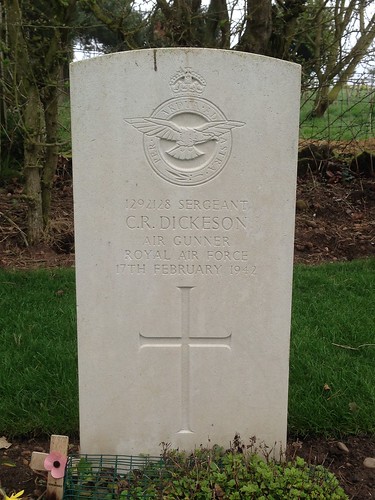
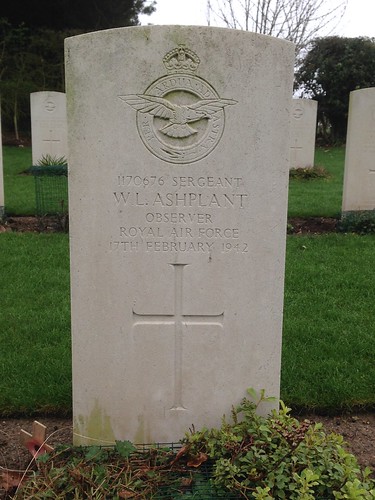
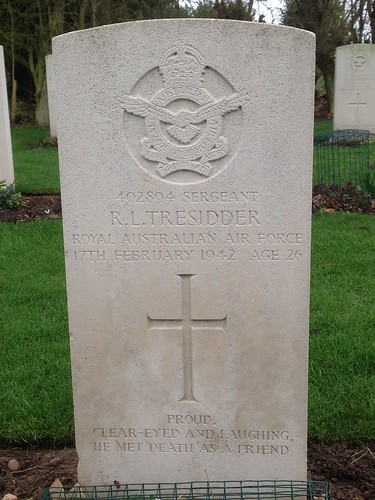
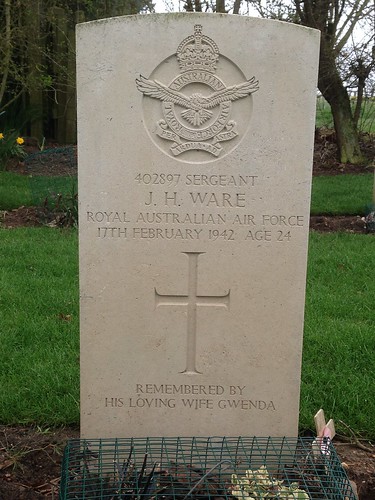
At 19:20 the Wellington MK.IV ‘Z1327’ (listed in the operational record books as V1327) took off. On board were a crew consisting of all Sergeants: Sgt. James Henry Ware  (RAAF) (s/n: 402897), Sgt. Robert Litchfield Tresidder (RAAF) (s/n: 402894), Sgt. William Leonard Ashplant (RAFVR) (s/n: 1170676), Sgt. Cyril Caradoe Davies (RAFVR) (s/n: 1052270), Sgt. Frederick Dutton (RAFVR) (s/n: 1006728) – the youngest member – and Sgt. Cyril Raymond Dickeson (RAFVR) (s/n: 1292128), a mix of pilots, wireless operators, observers and Air Gunners.

The initial part of the flight went according to plan and contact was made between the ground Station at RAF Holme-upon-Spalding Moor at 22:22 hours moments before the aircraft crashed into a hillside killing all on board. In the fire that followed the crash as Farnley Tyas near to Huddersfield, the Vickers Wellington was also destroyed being written off charge shortly after. It is thought that the aircraft was off course by almost 40 miles and may have been looking for landmarks, when it hit the roof of a cottage  sending it crashing into the hillside.

This was the first 460 Sqn fatality since the squadron was formed in the previous November. Four of the crew remain buried together at All Saint’s Church, on the hill overlooking the village of Holme-upon-Spalding Moor.

All Saint's Church

Sgt. C.R. Dickeson (RAFVR)

All Saint's Church

Sgt. W.L. Ashplant (RAFVR)

All Saint's Church

Sgt. R. L. Tresidder (RAAF)

All Saint's Church

Sgt. J. H. Ware  (RAAF)

Sources:

AIR 27/1907/1 National Archives.

RAF Shipdham – The 44th BG ‘The Jinx Squadron’ (Pt. 1)

As part of Trail 10, we revisit the first Norfolk airfield opened as a heavy bomber base for the USAAF. It is an airfield that lives on – just – and was the home to only one major bomb group. This group led the way for the B-24, they took heavy loses and bore the brunt of B-17 jokes. Their loses were so high that unofficially, they became the ‘Jinx Squadron’.

In this Trail, we go to RAF Shipdham otherwise known as Station 115.

RAF Shipdham (Station 115)

On leaving Watton, we travel north-east across the countryside to the small village of Shipdham, some 3.5 miles south of East Dereham. If you miss the turn, you will pass along the main road and a row of memorial trees dedicated to the parishioners of Shipdham who died in both World Wars. A list of those concerned is on a large board placed adjacent to the road. Turn back, return towards the village and take the left turn toward the airfield site. Opened in 1942, it was the first airfield to receive the Mighty 8th, who named it Station 115.

RAF Shipdham

One of Shipdham’s remaining Hangars.

Shipdham was built during the period 1941-42 and opened as the first US heavy bomber airfield in Norfolk. It was built as a Class A airfield having three concrete runways, one of 2,000 yards, and two of 1,400 yards, each 50 yards wide. A standard perimeter track linked all three runways, the main one of which ran east-west.

The technical and administrative area was located in the south-eastern corner, the bombs store to the south-west, and the accommodation areas dispersed off to the south, unusually, between the two aforementioned sites. There were initially 50 concrete hardstands, but this increased later on to 55 as the airfield was updated. The majority of these hardstands (37) were the single pan style, whilst the remainder were the dual spectacle style.

Accommodation was built for around 3,000 personnel using a range of temporary buildings over nine different sites, with a further two sites, both sewage works, and a wireless transmitter site, also being located here . Shipdham unusually had three communal sites, two male and a WAAF, and many buildings were temporary in nature: Laing, Nissen, Thorn and some Hall huts. A further number of buildings were brick with both temporary and permanent designs in use.

The Watch Office (built to drawing 8936/40) was part timber and part concrete, a deviation from drawing 2423/40, and still stood, albeit in a very poor condition, at the time of visiting.

The first group to arrive here were the 319th BG, a group made up of twin-engined B-26 ‘Marauders’, who flew across the northern route of the Atlantic during September 1942. Their trip across was hazardous, many aircraft suffering as a result of the cold and closing winter months. Sent to Shipdham to begin training operations, they only remained here for around one month, being moved to RAF Horsham St. Faith in October, and with it vacating Shipdham for good. In their place came the main resident unit, the 44th BG known as the ‘Flying Eight Balls‘ bringing with them the mighty B-24 Liberators.

RAF Shipdham

Shipdham’s Watch Office sites amongst the cranes and industrial buildings. (Just below the two cranes)

Activated on January 15th 1941, they were the USAAF’s first Liberator unit, becoming an operational training unit in February 1942, carrying out anti-submarine duties before making preparations for the European theatre. They moved from MacDill Field in Florida to Barkdale Field, Louisiana, and then onto Will Rogers Field in Oklahoma before setting off for England in October 1942. The three squadrons of the 44th, the 66th, 67th and 68th BS, were finally provided with aircraft and a full complement of aircrew at Will Rogers; however, this did not include the fourth and final squadron, the 404th BS, who were diverted to Alaska to protect the west coast against potential Japanese attacks. Being only three squadrons, the 44th BG would operate below full strength for almost six months until the replacement squadron, the 506th BS, would arrive. This weakened force would play its part in the 44th’s short and tragic history.

On September 4th, the ground echelons sailed on the Queen Mary, arriving in Scotland on the 11th. The first aircraft did not leave the US until later that same month, after which all personnel were gathered at their temporary base at Cheddington before moving off to Shipdham in October.

Once in England, the Liberators of the 44th were modified, flown to Langford Lodge, they were given scanning windows in the nose, the fitting of British IFF equipment, and improvement to the guns. The B-24s had been supplied with limiting ‘cans’ of ammunition rather than the much longer belt fed ammunition. Another adaptation at this point was the fitting of two .50 calibre machine guns in the nose, similar in style to those of the B-17.

On November 7th 1942, the ‘Flying Eight Balls‘ were put on limited combat status, with a small number of eight aircraft being sent on their first operational sortie. A diversionary flight, it was followed by four more sorties, of which only one involved any bombing at all. The 44th were not having a successful time though, the equipment they had been provided with was not protecting the crews from the extremely low temperatures found at high altitudes, several crewmen suffering from frostbite as a result.

By early December the last of the modified B-24s arrived back at Shipdham and the Group was back up to its three squadron strength. On the 6th December 1942, the group flew its first mission, a nineteen strong formation was sent to bomb the airfield at Abbeville-Drucat in France.

This mission would not go well. A diversionary attack, it would see the two squadrons the 66th and 67th called back, the abort signal did not however reach the 68th who unaware of the changes, carried on to the target. Being only six aircraft, they were woefully under protected, and after releasing their bombs over the target, were attacked by around thirty FW-190s. What resulted was devastating for the 68th, one aircraft was lost, Liberator #41-23786 piloted by 1st Lt. James Du Bard Jr. (s/n: 0-410225), along with its entire crew.  Witness accounts from other crews say that as the aircraft went down, its guns continued to fire, the gunners of #786 staying at their respective stations even though their fate was sealed. As the pilot struggled to regain control and get the aircraft home, they managed to bring down two enemy aircraft before crashing into the sea themselves. For their actions and bravery, the entire crew were awarded the Silver Star.

In the attack on Abbeville-Drucat , every B-24 was hit by enemy cannon fire. Following a head on attack by fourteen FW-190s in waves of three or four, an exploding 20mm shell in the cockpit of  ‘Victory Ship‘ #41-23813, badly injured both the pilot and co-pilot; but undeterred, 1st  Lt. Walter Holmes Jr (s/n: 0-437615), managed to get home and land the aircraft even though he and his copilot, 2nd Lt. Robert Ager, were badly injured. For his brave action and determination to get home, he was awarded the first DFC for the group. Holmes would also go onto receive a DSC in the mission to Ploesti in August going on to complete his tour of duty later that same month.

A medical truck and ground personnel of the 44th Bomb Group on standby as a B-24 Liberator (V, serial number 41-23813) nicknamed

A medical truck and ground personnel standby as B-24 Liberator #41-23813 “Victory Ship” returns from a mission. (IWM FRE 640)

A second attack to the same target was aborted, but during this mission one crewman suffered frostbite and had to have his arm amputated at the elbow. Then followed the  third mission, and it proved just as disastrous for the 44th. A flight of 101 aircraft, a mix of B-17s and B-24s were sent to Romilly-sur-Seine, and of the 101 aircraft sent, only seventy-two made it to the target, the remainder being lost or aborting. From the 44th, only twelve of the twenty-one sent out made it through, and of these, one suffered a head on attack by a FW -190. The pilot Cap. Algene E. Key took evasive action but cannon shells ripped through the aircraft killing gunner S/Sgt. Hilmer Lund and seriously wounding two others. Key manged to fly the aircraft to the target and then home, even though it was badly damaged and difficult to fly. For his actions he was awarded the DSC.

The start of the war was not a good one for the 44th, many of those who came over were now in a state of shock, the extremely cold temperatures and determined fighters of the Luftwaffe both taking a toll on the crews. The early days of the 44th were difficult and the crews faced a very steep learning curve.

When the 44th’s sister group the 93rd BG departed for North Africa, the 44th’s three squadrons consisting of only nine aircraft each, accounted for the entire Liberator force in the European Theatre. Performance figures for the B-24s made it difficult to fly in tight formations, the faster speed of the B-24 also meant it ended up at the rear of the large formations and slightly higher. It was a difficult aircraft to fly and crews were finding it hard to maintain flight with the slower and lighter B-17s.

To counteract these problems they were given restricted fuel levels, a restriction that proved to be fatal on the January 3rd 1943 mission to St. Nazaire. With further aircraft aborting, only 8 aircraft reached the target and able to drop their bombs. On the way back, the leading B-17s took an incorrect heading, and the flight flew up the Irish Sea as opposed to crossing over southern England. Now desperately short of fuel they split up, searching for a safe haven. Some aircraft unable to locate an airfield, ran out of fuel, and had to land in fields with the expected results. Three crewmen were killed that day and seventeen were wounded, some dying later from injuries sustained in the crashes.

1943 had started as badly as 1942 had ended. Spirits were now low and over the next few weeks several aborted missions added to the misery of the 44th. With further losses in the few missions they flew, rumours spread of a ‘hard luck’ squadron, and questions were raised as to the suitability of the B-24 as a bomber. Things got so bad that the 67th was reduced to just three aircraft, with no sign of replacements of men or machine being delivered anytime soon.

Nissen huts at Shipdham airbase, home of the 44th Bomb Group. Image via Colonel William R Cameron. This is part of the 67th BG LIVING SITE

Relaxation time at the 67th BS accommodation site (IWM FRE 670)

Then came some good news, the fourth squadron the 506th, arrived in March 1943 raising the 44th to its full complement of four squadrons for the first time since leaving the United States. Manning these aircraft was going to be another challenge though, many of the gunners were ground crews retrained as aircrew, some were drafted in from other squadrons, often being crewmen who had ‘failed’ in their previous roles. The future didn’t look any better even with the full complement of staff.

The Eighth now looked toward night flying as a possibility, the 93rd, having returned from Africa, stopped flying in order to train in their new role, leaving the 44th to ‘carry the can’ once more. Reduced to diversionary raids, the 44th were sent to Kiel on May 14th 1943, carrying a large number of incendiaries. Flying behind the higher B-17s, they were easy pickings for the FW-190s who picked off five of the twenty-one sent out before they reached the target. However, the determination of the crews saw some aircraft both get through and bomb successfully, a determination that won the group their first Distinguished Unit Citation (DUC).

With another aircraft lost on the return leg, the 44th had taken yet another beating, apart from odd crewmen who had been on leave or indisposed, the entire 67th had now been wiped out, one-quarter of the 44th was gone. Those that were left became bitter, some refused to fly, some had breakdowns but many others became stronger and more determined to see this through. The strength of those left was fuelled by both the bitter feeling toward the B-17 crews who continually mocked them, referring to them as ‘the jinx unit’, and those in command who it was felt used them for Luftwaffe bait.

There then followed a short period of good luck. A raid on the Submarine repair depot at Bordeaux on May 17th 1943 saw the loss of only one aircraft. ‘Avenger II‘ #42-40130 suffered engine problems, and being too far from England to make it back, the pilot 1st Lt. Ray Hilliard and the crew, decided to try their luck in neutral Spain. Turning south, they landed at the airfield at Alhama de Aragon where they were interned spending the next three months at the pleasure of the Spanish, before being returned to England.

There next followed an operational intermission, the B-24s swapping ‘ops’ for low flying practice over the English countryside until, on June 26th, when they departed Shipdham for the warmer climates of North Africa. Here they would carry out bombing missions over Italy and southern Europe including the famous Ploesti Oil refinery raid in August, for which they took another hammering and earned a second DUC in August 1943.

In late August, the 44th began returning  to Shipdham, with some detachments remaining in North Africa, this meant that the 44th was split between both England and North Africa, performing missions from both locations. A disastrous few months however, had taken further tolls on the crews, but camaraderie remained high and resilience strong.

The winter of 1943/44 was one of the worst for the cold, ice and snow. England like most of Europe was snowed in and temperatures dropped dramatically. For the 44th, the new year would not bring any let up, and it started on yet another terrible note!

RAF Gamston – Home of the OTU.

Britain’s longest, and perhaps most famous road the A1, which is known in part as the ‘Great North Road’, stands at 410 miles (660km) in length, and  connects the two capitals of England (London) and Scotland (Edinburgh) in one direct route. Original parts of it were built by the Romans, always easily distinguished by its direct routing. Over the years, the numerous upgrades and widening programmes have revealed both Roman settlements and Roman artefacts now totalling their thousands.  Much has been written about the A1, both its history and its legacy, but little about its aviation connections.

It is therefore along this route that we next travel, for here we find many of Britain’s wartime airfields, and while most have now disappeared into the history books,  a few still linger on operating the fast jets of the current Royal Air Force.

With such a huge route to cover, it will take time to travel from one end to the other, but it is along this route that we begin our next trail, Trail 54, The Great North Road.

The majority of these airfields, of which there are literally dozens, lie in Northern England, but include notable examples such as: Old Warden (The Shuttleworth Collection), Brampton, Alconbury, Glatton, Wittering, North Witham, Bottesford, Winthorpe, Dishforth, Leeming, Brunton, East Fortune and Macmerry as its close or direct neighbours.

Our first stop in this next trail, is one of the lesser known airfields along this route, one that sits on the very edge of this great road, and one that survives today, not as a military site, but as a civilian airfield where flying is a strong today as it was during those dark days of the 1940s.

From Newark in Nottinghamshire we travel north where we find our first stop, the former RAF Gamston.

RAF Gamston (Retford Airport).

Gamston is a little known airfield, but it is one that played an important part during the Second World War. Opened in December 1942 it was a classic Class A airfield, built with three concrete and tarmac runways with a main runway of 2,000 yards and two subsidiary runways of the standard 1,400 yards forming the distinctive offset A frame. A perimeter track linked all three runways with thirty heavy bomber hardstands located around its length giving an indication as to its wartime role. Further clues to this role are the four type T2 and single B1 aircraft hangars, designed large enough to hold medium to heavy bombers of the RAF. As with all wartime airfields, the technical area came with a variety of ancillary buildings, workshops, MT sheds (12775/41) and stores.

RAF Gamston

Gamston’s former Watch Office is now a residential property.

With temporary accommodation for almost 1,000 male ranks and over 300 female ranks, it was by no means a large airfield, but at a cost of £468,000, it was quite an expensive airfield to build.

When Gamston was being constructed in 1942, Bomber Command was going through a period of reorganisation and re-equipment. At the beginning of the year there were six operational groups: 1,2,3,4,5 and 8 along with two training groups 6 and 7. No. 8 Group was disbanded only to be reborn as the Pathfinders in January 1943 whilst No. 2 Group was transferred to the Tactical Air Force in that same year. A further part of this reorganisation was the renaming of 6 and 7 Operational Training Unit (O.T.U) Groups as No. 91 and 92 (OTU) Groups in the May 1942. In the June, another new Training Group No. 93 (OTU) Group was formed, giving three training Groups in total under Bomber Command’s control. 93 Group bucked the general trend at this point in the war, being the only expansion in what was basically a shrinking Command.

It was this third Group, led by Air Vice Marshal P. E. Maitland, that Gamston would fall beneath, joining in a collection of twelve airfields: Finningly, Bircotes, Worksop, Ossington, Castle Donnington, Wymeswold, Lichfield, Church Broughton, Hixon, Seighford and Peplow that all fell under the direct control of the headquarters at Eggington near Nottingham. This meant that the responsibility of No. 93 Group stretched from Shropshire in the west, through the centre of England into Derbyshire and Nottingham, and north as far as Yorkshire. The purpose of these Operational Training Units was to meet the demand for new crews whilst conducting operational flights with experienced crews as their leads. To this end, Gamston’s closet neighbour Ossington, was to be its ‘parent’, Gamston forming the satellite airfield for all flying operations.

RAF Gamston

One of the many buildings left standing on the Technical Site.

The first unit to use Gamston was No. 82 Operational Training Unit, who were formed at Ossington on June 1st 1943 with Wellington MK.IIIs. Over the time that 82 OTU used the two airfields, they would also fly Wellington MK.Xs. Martinets, Oxfords, Tomahawks, Miles Masters and the Hawker Hurricane. Their period of operations lasted for almost two years until they were disbanded in January 1945 just prior to the war’s end. Flying mainly out of Ossington, 82 OTU wold have their fair share of fatalities, with their first occurring with devastating effect on August 9th 1943, with the loss of all five crewmen and the first total aircraft write-off since forming.

The first Gamston based fatalities occurred on 12th October  that year, when Wellington MK.X HK201 took off on a training flight. Immediately after take off the port engine cut out forcing the aircraft down. Three of the seven crew were killed, the remaining four being treated for their injuries in hospital. For his actions that day, F/O. J Coughian was awarded the DFM.

Gamston would also serve as a safe haven for other operational bombers returning from action over occupied Europe. On December 1st 1943, a No. 9 Squadron RAF, Lancaster MK.I was returning from operations over Berlin. In attempting to land at Gamston, the aircraft DV334 ‘WS-C’ crashed killing six of the eight crewmen on board. The remaining two crew, Sgt. C. Rickards and F/S. L. Owen (RCAF), both being injured. This tragedy brought an end to 1943 but not a change in luck for the training crews of 82 OTU.

RAF Gamston

Many buildings are overgrown and in a poor state.

The January and February 1944 brought two more accidents, the first without fatalities as F/L. D. Parry brought the aircraft, a Wellington MK.X, down with its wheels retracted after the port engine lost power. F/L. Parry was uninjured in the accident unlike his five colleagues, who on the night of February  3 – 4, were all killed when their Wellington ‘X3409’ was seen to dive into the ground near the airfield resulting in a massive explosion. The crew, four Canadians and an Englishman, all perished.

Being an operational training unit, 82 OTU would participate in operational duties, such as flying ‘Nickel‘ operations (leaflet dropping) over occupied Europe. One such operation saw the loss of Wellington MK.X on the night of May 14 – 15 with the loss of all as the aircraft ran out of fuel on the return flight from Rennes.

Another near tragic accident occurred in June when a returning bomber, a Halifax from 1667 HCU was trying to make an emergency landing at Gamston when it collided with a stationary Wellington. There were no injuries in the collision but it was another event that brought home the dangers of flying heavy bombers in wartime Britain.

With two further losses in August 1944, and another in April 1945, death or injury were never far from the minds of the crews. Even as a ground crew you were not safe from the slightest lack of concentration or slip. In November, an accidental spark caused by a slipping airman ignited petrol in one of the hangars whilst working on Wellington MK.X ‘HK750. The accident on November 13th 1944, proved fatal for the Wellington destroying it completely in the subsequent fire.

RAF Gamston

1944 saw yet further changes to the Training Command. In June, the number of Bomber Command Squadrons increased, conversion training was taken away from the main squadrons and given to a new Heavy Conversion Group No. 7 (HCU) Group.  it was also decided that a new OTU was required and so ‘C’ Flight of 82 OTU was moved permanently to Gamston where it was re-designated No. 86 OTU who would specialise in the role of night training with both the Wellington MK.III and X. This was a  short-lived unit though, lasting only until October 15th that same year before being  disbanded. Crews from 86 OTU were then used to form the Heavy Glider Conversion Units elsewhere.

A gradual reduction in crew losses toward the end of 1944 meant that 93 (OTU) Group could now be disbanded,  with the operational training being consolidated into the two original groups. By the end of February 1945, No. 93 (OTU) Group was no more.

As the war drew to a close, other training units also began to close. No. 30 OTU who were originally formed at Hixon in June 1942, also with Wellingtons, moved to Gamston where they were disbanded on 12th June 1945. Their final days at Gamston would not be the quite and sedate ending that many would have hoped for though.  On May 18th, a month before disbanding, Gamston would see its final wartime loss, when Wellington NA718 ‘BT-O’ crashed killing both crewmen: F/O. Robert Fraser Thompson (s/n:174908)  and Leading Aircraftman. Douglas Fletcher Dryden (s/n:1353162). It is not known what caused the accident but, the pilot had attempted to glide the aircraft back into Gamston without success.

With the closure of these units, Bomber Command began the rapid decline that would see it become a shadow of its former self. Crew training was put on hold, aircrew held pending a decision as to where to send them and aircraft mothballed.

Once the European war was finally over, Gamston’s flying days were over, at least for the time being, and from July 1945, it became the main resettlement camp for repatriating Royal Australian Air Force personnel. The responsibility for this fell to No. 9 Aircrew Holding Unit (ACHU), where crews were sent before departure to either the Pacific Theatre or more likely home. Once all the residents had departed the Nottingham site, it lay dormant, being used primarily for agricultural purposes.

RAF Gamston

Many buildings a re left open to the elements.

For 8 years the airfield remained closed, but over 1950-51, the site was used for motor racing activities. Small races were held but these never truly ‘took off’ and any future use of the site for such activities, were curtailed in May 1953, when Gamston reopened as a satellite for nearby RAF Worksop, where No. 211 Advanced Flying School (AFS) were currently based. The aircraft type had now changed and the jet age had dawned. The RAF’s latest jet aircraft the Gloster Meteor and de Havilland Vampire now being the aircraft to utilise Gamston’s runways.

No.211 AFS would go through several numerical changes over the next few years, on June 1st 1954 it became 211 Flying Training School (FTS), disbanding on June 9th 1956 to be absorbed into No. 4 Flying Training School (FTS). This in turn was disbanded at Worksop in 1958 to be reformed at RAF Valley in Wales – thus ending the links with Gamston. All through these changes, the aircraft remained primarily the same types, Meteors, Vampires and Prenctices of various marks.

It was during this time, on 1st April 1955, that a Gloster Meteor T.7  WL474 of 211 FTS would crash 2½m north-east of Gamston whilst performing asymmetric training. During the manoeuvres the aircraft dived into the ground killing both its crewmen: F/O. Stanley T. Jenkins and Acting Pilot Officer Duncan H. Moffat.

Gamston then again closed in 1957, but although officially closed it was used during the 1970s and 80s as a satellite landing ground by training aircraft from RAF Finningley. These consisted mainly of the small de Havilland ‘Chipmunks’ and later Scottish Aviation’s ‘Bulldogs’.

Then in 1993 when the site was purchased by Gamston Aviation Limited who opened and operated it as a civil airport under the name Retford Gamston Airport.

RAF Gamston

Gamston’s former runway is still in use (in part) today as part of Retford Airport.

Since then, Gamston has been upgraded with maintenance work being carried out on both the hangars, usable runway and perimeter tracks. Whilst these are part of the original infrastructure, they are much smaller only dealing with single or twin-engined light aircraft rather than the larger bombers of Bomber command.

The airfield is a going concern today, the main site operated by the Airport Authority whilst the technical area is a small industrial unit. Within this, there are numerous original wartime buildings still surviving in varying degrees of condition. The various stores are used for storing of industrial ‘components’ and general industrial rubbish, whilst another houses a car repair shop. Discarded vehicles lay buried beneath an ever-increasing range of thorny shrubbery while the whole area is fenced off and basically left with little outside interest.

Accessing the two sites is best from the A1, the industrial area is the first turning off this road and takes you along the former perimeter track past the end of the former main runway. It is this runway that is used today, very much a smaller part of the original. The former watch office is also here, tucked away behind hedges it is now a private residence. Various huts and small buildings can be found here, the whole area in a rapid state of decline and disrepair.

Taking a left turn back onto the main road takes you toward the airfield with its modern buildings, hangar space and offices. A small but excellent cafe ‘The Apron’ provides refreshments and the chance to sit and watch the activities of this small but thriving airport. There is also further evidence of the airfields history here, one of the hardstands now forms a parking area, discernible only where a careful eye will distinguish its outline amongst the more modern structures around it.

RAF Gamston

The general state pf the site suggests a bleak future for these historic buildings.

Compared to front line operational airfields Gamston’s history is perhaps ‘less intense’. But, in the bigger picture of Bomber Command, it is a major cog that helped turn the wheels of this massive wartime organisation, providing trained crews for operations over a country, whose determination to destroy all in its path, was finally brought to its knees by those who passed though Gamston’s very doors.

As we leave Gamston behind, we return to the A1 and head north and yet more trails around Britain’s forgotten airfields.

Sources and further reading. 

AIR 27/127/24 – 9 Squadron ORB National Archives.

Chorley, W.R., “Royal Air Force Bomber Command Losses Vol 7“, Midland Publishing, 2002.

The website for Retford (Gamston) Airport has details of its operations and facilities.

My thanks to the anonymous reader for the update of the 1970s and 80s.

379th BG Memorial update.

Recently I posted a guest post from Mitch Peeke regarding the collision and subsequent deaths of a number of crewmen on board two 379th BG B-17s over southern England, on 19th June 1944.

Mitch is aiming to have a memorial erected close to the site where one of the B-17s  #44-6133 fell, killing all but one of the crew. So far, he has received permission and a very positive response from the land owners on which the memorial is hoped to go, along with information, including a crew photograph, from the 379th BG Association.  Mitch has also been contact with the local TV station and newspapers hoping to generate further interest and funds to cover the cost of such a memorial.

A number of other avenues are still being pursued but the response so far has been very promising indeed!

A preliminary date has been set for the anniversary of the crash but this will of course, largely depend on progress over the coming weeks.

Mitch has set up a ‘gofundme’ fundraising account, with a target of £1000 he hopes the public will get behind the project and secure a memorial for those young men who lost their lives that tragic day. Find the account at: https://www.gofundme.com/ww2-aircrew-memorial 

Crew of Heavenly Body II: Front Row, L to R: Edward Sadler; Fred Kauffman; Jack Gray; Lloyd Burns
Back Row, L to R; Louis Schulte; Leroy Monk; Richard Andrews; Richard Billings; William Farmer; Leonard Gibbs (Photo courtesy 379th BG Association archive,  by kind permission.)

Sgt Cecil A Tognazzini

Flight engineer/top turret gunner: Staff Sergeant Cecil Tognazzini (Photo Janet Penn, via www.findagrave.com)