Diary of a Luftwaffe pilot

A recent visit to an antiques shop, led to the purchase of two books, one detailing the events of the Battle of Britain, the second included short diary entries of Luftwaffe pilots. Sadly, not many Luftwaffe diaries exist today, all but a few being destroyed in case they fell into enemy hands! As a result, records are sketchy, few and far between.

Some of these Luftwaffe entries refer to the Battle of Britain.  I tried to make a comparison, maybe one entry would refer to the other – sadly they were not sufficiently detailed enough to be certain. This aside, I was intrigued to see the Germans portrayed their part in the battle and how they might compare in terms of recounts.

After the fall of France, the Germans built up strong groups of fighters, transports and bombers in readiness for the coming invasion of Great Britain. Five main groups (Luftflotte ‘air fleets’ similar to the RAF groups) operated across the German empire. Covering the eastern borders were Luftflotte 1 and 4, to the north in Norway and Denmark was the newly formed Luftflotte 5 and in Belgium and France , Luftflotte 2 and 3 respectively.Total servicable aircraft facing Britain amounted to 3,157.

Jagdgeschwader 3 (fighter ‘wing’ made up of 3 Gruppen*1 and 1 Stab) normally stationed on the eastern front, had been brought in to bolster numbers in Luftflotte 2 and were now based at Samer not far from Boulogne. Commanded by Hauptmann Hans von Hahn*2 (himself a German Luftwaffe ace and recipient of the Knight’s Cross), Luftflotte 2 were able to field 23 Messerschmitt Bf 109Es at the start of September.

The mid part of September had been dogged by poor weather, on the 12th 13th and 14th, the Luftwaffe launched only small raids and reconnaissance missions with minimal numbers of aircraft. Many fighter pilots were given the luxury of rest periods some even taking in local sites.

One of the biggest days of the Battle of Britain, now celebrated as Battle of Britain day, was Sunday 15th September 1940. It saw a major change in Luftwaffe policies. The weather was misty but promised to improve, and the Germans saw this as an opportunity to bring a severe blow to London and the RAF; this would be the ultimate prelude to invasion.

The Unit war diary for 1 Gruppe, Jagdgeschwader 3, September 15th 1940*3, reads:

12:00.

Escort (by 12 aircraft) Do 17s against London. Oblt Keller shot down the Spitfire, Leutnant Rohwer a Hurricane. Fw Wollmer dived into the channel; the impact was seen by Lt Springer. This crash appears not to have been caused by enemy action. After a long dive Wollmer’s machine rolled a quarter turn into a vertical dive and he did not succeed in bailing out. A motorboat detached from a German convoy near Cap Gris Nez and went to the scene of the crash.

15:10.

Operation by nine aircraft to escort He 111s against London. At 1,500m there was almost total cloud cover. Over the Thames estuary and to the north of London there were gaps in the cloud. During the flight in there was contact with Spitfires. The bombers flew in loose formation to the north of London. Strong and accurate flak. The Spitfires came from above, fired, and dived away. Hauptmann von Hahn shot down the Spitfire, Lt Rohwer probably destroyed a Hurricane. During an attack by Spitfires Oberleutnant Reumschuessel became separated from his wing-man, Obfw Olejnik, and has not returned (this aircraft crashed near Charing, Kent; the pilot bailed out and was taken prisoner). After he was separated from the formation Obfw Hessel was heard on the radio, but he failed to return (this aircraft crash near Tenterdon; The pilot bailed out was taken prisoner). Obfw Buchholz’s aircraft was hit in the cooling system and forced down in the Channel. Oblt Keller made contact with the rescue aircraft nearby, which picked up Buchholz. He had injuries and was taken to the military hospital a Boulogne. The body of Lt Kloiber has been washed ashore near St. Cecile, and buried. Lt Meckel and two Feldwebeln attended the funeral. During the last few days news has been received from the Red Cross in Geneva that Oblt Tiedmann, Oblt Rau, Oblt Loidolt, Lt Landry (these last two wounded) and Obfw Lamskemper have been captured by the British”.

 An interesting read, if only there were more!

Notes:

*1 The singular is ‘Gruppe‘ and each Gruppen operated with three Gruppe. Each Gruppe would operate from one airfield but moved as a Gruppen.

*2 Hauptmann Hans von Hahn more infomration can be found at http://www.luftwaffe.cz/hahn3.html or http://falkeeins.blogspot.co.uk/2013/11/hans-von-hahn-and-his-stab-ijg-3.html

*3 The Luftwaffe Data Book, Dr. Alfred Price (1977) Greenhill Publications pg196-197

Sgt. Archibald Mathies, USAAF, RAF Polebrook (Medal Of Honour)

Staff Sgt. Archibald Mathies (U.S. Air Force file photo)*1

Born in the Scottish town of Stonehouse, South Lanarkshire, on the 3rd June 1918, Archibald (Archie) Mathies was to become a Second World War hero. He was awarded the Medal of Honour (MOH) for his actions whilst at RAF Polebrook (USAAF Station 110) in Northamptonshire, England.

It would be on the 20th February 1944, shortly after arriving at Polebrook, that he would earn this honour but his life would be dramatically cut short.

Not long after his birth in Scotland, Mathies moved with his family to the United States, to a small town in Western Pennsylvania called Finleyville, in Washington County.

After leaving school, he began work in a local coal mine. The work was hard, and the pay was low; Mathies was not inspired. Then, following the Japanese attack on Pearl Harbour, as many other brave young American men did, he joined the Army, enlisting in Pittsburgh on the 30th December 1940. Mathies would transition through a number of stations and training centres before finally completing a course in aerial gunnery on the 22nd March 1943. His last U.S. posting was to the 796th Bombardment Squadron at Alexandria, Louisiana for operational training duties flying B-17s. He would leave here on the 8th December 1943 bound for England and the European Theatre of Operations.

Mathies arrived in the U.K. eight days later. His initial assignment was with the Eighth Air Force Replacement Depot, before being attached to the 1st Replacement and Training Squadron. On the 19th January 1944, he received his first and only operational squadron posting; the 510th Bomb Squadron, 351st Bomb Group, based at RAF Polebrook, as an engineer/gunner. Promotion was swift, and on 17th February 1944, probably following his first mission, Mathies was awarded the rank of Staff Sergeant.

A few days later, on 20th February 1944, the allies began the enormous aerial campaign known as ‘Big Week’. During this short period a massive number of aircraft would attack targets deep in the heart of Nazi Germany. One of the first, (Mission 226) would see a total of 417 aircraft fly from airfields across England. From RAF Polebrook, 39 B-17s took off to attack Leipzig. In the lead planes were Maj. Leonard B. Roper (s/n O-734101 ) of the 510th BS forming the high group, and Maj. James T. Stewart (s/n O-659405) of the 508th BS, leading the low group.

Flying in the number three ship of the lower Squadron, in B-17 (42-31763) ‘Ten Horsepower‘ was: Pilot: Clarry Nelson, Co-Pilot: Roland Bartley, Navigator: Walter Truemper, Engineer / Top Turret Gunner: Archie Mathies, Bombardier: Joe Martin, Radio Operator: Joe Rex, Ball Turret Gunner: Carl Moore, Waist Gunner: Tom Sowell, Waist Gunner: Russ Robinson, and Tail Gunner: Magnus Hagbo.

A B-17 believed to be “Ten Horsepower” (TU-A, serial number 42-31763) taken prior to its crash”2.

On approaching the target, the formation was hit hard by fighters and flak, who would attack the formation for over an hour, hitting many aircraft in the subsequent melee. Ten Horsepower, was targeted repeatedly receiving many hits from 20mm cannon shells. In these attacks the co-pilot was killed and the pilot knocked unconscious from his wounds. Fearing the bomber was doomed, the bombardier jettisoned the bombs and then bailed out, later being captured by the Germans and becoming a prisoner of war. The remaining crew remained with the B-17 which soon began a deathly spiral toward the ground.

Mathies and the navigator (Walter Truemper) would eventually take over control of the aircraft and nurse it back to England. Once over their base at RAF Polebrook, the crew were instructed to bail out but both Mathies and Truemper refused to leave the injured pilot. After deliberation, they were given permission to try to land, the remaining two crew members prepared themselves for a heavy landing.

The first two attempts had to be aborted, but on the third attempt, as they approached the airfield, the aircraft struck the ground, killing all three crew members onboard.

The crash was a severe blow for the base, both air and ground crews were devastated. On returning from the mission, five other aircraft (42-38028, 42-38005, 42-39760, 42-39853 and 42-6151). were forced to land at nearby Glatton (Conington) only a short distance away.

This was only Mathies’ second mission and sadly, his last.

For his bravery, Mathies was awarded the Medal of Honour; his name now appears on page 280 of the St. Paul’s Cathedral Roll of Honour. Also, as a dedication to him, one of the temporary lodging units at the Joint Base Anacostia-Bolling is named after him, as is the Airman Leadership School at RAF Feltwell,  and the Noncommissioned Officer Academy at Keesler AFB, Mississippi. In addition, the bridge on Truemper Drive crossing Military Highway at Lackland Air Force Base, Texas; the USCIS Dallas District Office and the Mathies Coal Company in Pittsburgh, Pennsylvania, are all named in his honour.

Archibald Mathies  citation reads:

For conspicuous gallantry and intrepidity at risk of life above and beyond the call of duty in action against the enemy in connection with a bombing mission over enemy-occupied Europe on 20 February 1944. The aircraft on which Sgt. Mathies was serving as engineer and ball turret gunner was attacked by a squadron of enemy fighters with the result that the copilot was killed outright, the pilot wounded and rendered unconscious, the radio operator wounded and the plane severely damaged. Nevertheless, Sgt. Mathies and other members of the crew managed to right the plane and fly it back to their home station, where they contacted the control tower and reported the situation. Sgt. Mathies and the navigator volunteered to attempt to land the plane. Other members of the crew were ordered to jump, leaving Sgt. Mathies and the navigator aboard. After observing the distressed aircraft from another plane, Sgt. Mathies’ commanding officer decided the damaged plane could not be landed by the inexperienced crew and ordered them to abandon it and parachute to safety. Demonstrating unsurpassed courage and heroism, Sgt. Mathies and the navigator replied that the pilot was still alive but could not be moved and they would not desert him. They were then told to attempt a landing. After two unsuccessful efforts, the plane crashed into an open field in a third attempt to land. Sgt. Mathies, the navigator, and the wounded pilot were killed“.*3

Mathies was truly a brave and dedicated man, who in the face of adversity, refused to leave his wounded pilot and friend. Daring to land a badly damaged aircraft, he sadly lost his life showing both great courage and determination.

The crew of ‘Ten Horsepower‘ were:

Pilot: Clarry Nelson,
Co-Pilot: Roland Bartley,
Navigator: Walter Truemper
Engineer / Top Turret Gunner: Archie Mathies
Bombardier: Joe Martin (POW)
Radio Operator: Joe Rex,
Ball Turret Gunner: Carl Moore,
Waist Gunner: Tom Sowell,
Waist Gunner: Russ Robinson,
Tail Gunner: Magnus Hagbo

Notes:

*1 Photo from Malmstrom Air Force Base website.

*2 Photo IWM Freeman Collection FRE 4725

*3 Citation taken from: US Army Centre for Military History website.

RAF Polebrook (USAAF Station 110)

In April / May 1943, Station 110 once more resounded with American voices, the arrival of the 351st Bomb Group. Assigned to the 94th Combat Wing, (1st bombardment Division) they flew B-17s of the: 508th, 509th, 510th and 511th Bomb squadrons. These aircraft would be distinguished by a Triangular ‘J’ on the tail.

The 351st were only activated in the previous October, and were, as ‘rookies’, to take part in some of the most severe aerial battles of the Second World War.

Primary targets they would attack included: Schweinfurt, Mayen, Koblenz, Hannover, Berlin, Cologne, Mannheim and Hamburg. The 351st would later go on to attack submarine pens, harbours and ‘V’ weapons sites. Ground support was also provided for the Normandy invasion, the Battle of the Bulge and other major European ground battles.

foundations

Stone Foundations Poke Through the Undergrowth

In October 1943, the 351st received the first of its two Distinguished Unit Citations, with highly accurate bombing in very challenging conditions raising the standing of this new group. A second DUC was to follow in January 1944 for action deep in the heart of Germany. During an attack on Leipzig in the ‘big week’ campaign of 20th-25th February 1944, two crewmen of the 510th, 2nd Lt Walter Truemper (Navigator) and Sgt. Archibald Mathies (Flt. Engineer), both received Medals of Honour for taking over their stricken aircraft when both Pilot and Co-Pilot were injured / killed.  On attempting to land the aircraft, the B-17 crashed between Glatton (Trail 6) and Polebrook, exploding it killed all three remaining crew members.

It was during this time that (Cp.) Clark Gable was stationed at RAF Polebrook, initially to make recruitment films for air gunners. He only flew five combat missions in all, taking a film crew on each one. The first of these missions was on 4th May 1943 and his last on 23rd September that same year. He was initially awarded the Air Medal, and later the Distinguished Flying Cross, finally leaving Polebrook with over 50,000 feet of film on 5th November 1943. In 1944, the film ‘Combat America’, narrated by Gable himself, was shown in theaters around the United States.

A memorial looks over the remnants of the main runway.

A memorial looks over the remnants of the main runway.

The 351st remained at Polebrook until shortly after VE day, returning to the US and becoming deactivated on August 28th 1945. Polebrook became quiet once more being put under care and maintenance until its final closure in 1948.

During the three years the 351st were at Polebrook, they flew a total of 279 B-17s on 9,075 sorties with 7,945 of them dropping 20,778 tons of bombs. Air gunners on these aircraft were credited with 303 enemy aircraft destroyed. In all they flew 311 credited missions losing 124 B-17s in all.

The story of RAF Polebrook,  how it looks today and the story behind the men can be found here.


Australian Flt. Sgt. Rawdon H. Middleton VC (RAAF) 149 Sqn RAF

100641

Pilot Officer Rawdon Middleton (RAAF)*1

Middleton (s/n: 402745) was born on 22nd July 1916 in Waverley, New South Wales, Australia. Son of Francis and Faith Middleton, he was educated at Dubbo Hugh School. Nicknamed ‘Ron’ by his friends, he was a keen sportsman excelling at many sports particularly cricket and football. After leaving school, he worked as a ‘Jackaroo’ (cattle handler) until joining the Royal Australian Air Force on the 14th October 1940 under the Empire Air Training Scheme. He learnt to fly at Narromine, New South Wales and then was sent to Canada for further training in preparation for his posting to the UK. He finally arrived in Britain in September 1941, as a second pilot, and his first operational squadron was No. 149 Squadron RAF, who were flying Short Stirling bombers out of both Lakenheath and nearby Mildenhall in Suffolk.

P01019.003

Five student pilots from No. 7 Empire Air Training Scheme (EATS) course at No. 5 Elementary Flying Training School (5 EFTS) Narromine. They are left to right: Aircraftman (AC) Gordon Orchard; AC Douglas Scott; Leonard Reid; Pilot Officer (PO) Douglas Wilberforce Spooner (DFM); PO Rawdon Hume Middleton*2

Middleton’s first experience of operations, was in a Short Stirling over the Rhur, the industrial heartland of Nazi Germany. After spending a short time with 149 squadron he moved temporarily to No. 7 Squadron (RAF).

In July 1942, as first pilot, he was given his own aircraft and crew, it was also around this time that he returned to 149 squadron.

Their first mission together would be on July 31st, to bomb the strategic and heavily defended target, Düsseldorf. Middleton and his crew would continue to fly together and took part in other prestigious missions; namely Genoa on the 7th of November and his 28th mission, Turin on the 20th November. His 29th and final mission, would take place on the night of 28/29th November 1942.

In the early evening of the 28th he took off in Stirling BF372 coded ‘OJ-H’ as part of the raid on the Fiat works in Torino, Italy, along with 227 other aircraft which included – 117 Avro Lancasters, 46 Short Stirlings, 45 Handley Page Halifaxes, and 19 Vickers Wellingtons.

Middleton’s crew consisted of: Ft.Sgt. Leslie Anderson Hyder, Ft. Eng: Sgt. James Ernest Jeffrey, Bomb Aimer F.O. G. R. Royde, Wireless Operator: Sgt. John William Mackie; Gunners: P.O. N. E. Skinner, Sgt. D. Cameron and Sgt. H. W. Gough. Three of these had already completed their tour of 30 operations and could have left. However, their dedication to Middleton kept them together.

The mission would take the aircraft over the Alps and the Stirling, laden with bombs and fuel combined with having a notoriously poor ceiling, had to negotiate through the mountains rather than fly over them. A factor that often resulted in a high number of casualties.

Once over the target area, OJ-H was subjected to an extreme flak barrage. With poor visibility, Middleton had to make three passes over the target area to enable his crew to positively identify it. It was on the third pass that a shell burst hit the cockpit. The resulting damage was severe, and fragments had hit Middleton’s head badly injuring him. His right eye was lost and his skull exposed. There were further hits on the aircraft’s fuselage causing considerable damage to the control systems and airframe. Knocked unconscious by the blast, Middleton lost control and the aircraft plummeted through the skies to an altitude of around 800ft. The second pilot, Fl.Sgt. Hyder eventually managed to take the controls, release the bombs over the target and then pull the aircraft into a climb, safely reaching 1,500ft.

With his aircraft severely damaged, Middleton had a choice, get his crew to bail out over occupied France and certain capture, fly to Africa or head back to England; a journey that would last over 4 hours and put the aircraft at risk of attack and the crew in danger. Wanting to give them a fighting chance of getting home, he opted for the latter, and set a course for England.

SUK10501

Middleton was buried with full military honours at St. Johns Church, Beck Row. Suffolk.*3

The aircraft experienced a number of attacks as they crossed occupied France, but Middleton, fighting for survival, kept reassuring the crew that he would get them home. Eventually, and against all the odds, they made the English coast, and once over land Middleton ordered the crew to bail out. Five crewmen left the stricken aircraft whilst the other two remained to help him control it. Turning for the Channel, Middleton ordered the two remaining crew members to bail out, whilst he stayed at the controls, steadying the aircraft.

By now the Stirling was very low on fuel and it finally gave up the fight and crashed at 03:00 on the morning of November 29th 1942. Middleton, too injured and too weak to escape the wreckage, drowned within the aircraft fuselage. His two crew members, Sgt. James Ernest Jeffrey (576050) age 19 and Wireless Operator Sgt. John William Mackie (994362) age 30, despite escaping, also drowned. Both the bodies of Sgt Mackie and Sgt. Jeffrey were washed ashore later that day on the 29th.

Middleton’s body remained in the aircraft, but was eventually freed from the wreckage by the action of the sea, and was washed ashore on Shakespeare Beach, Dover, in February 1943. His remains were taken to RAF Lakenheath and he was buried in St John’s churchyard, Beck Row, within sight of his airfield in Suffolk, with full military honours. Middleton was only 26 and only one mission away from ending his tour and returning home.

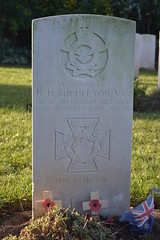
For his action, dedication and bravery, Flt. Sgt. Middleton was posthumously awarded the Victoria Cross, the first to any serving member of the R.A.A.F in World War II. He was also posthumously awarded a commission as Pilot Officer, backdated to mid November before his sortie to Turin. Thirty years later, in 1978, Middleton’s V.C. was presented to the Australian War Memorial, in Canberra for safe keeping and preservation.

For their actions, the other crew members received three DFMs and two DFCs. Fl.Sgt. Leslie Hyder (DFM) was injured, P.Officer. N. Skinner (DFC) was also injured, along with Sgt. H. W. Gough (DFM). F.O. G. R. Royde (DFC) and Sgt. D. Cameron (DFM) escaped unhurt.

The London Gazette published a report on 12th January 1943. It said:

“Fl. Sgt. Middleton was captain and first pilot of a Stirling aircraft detailed to attack the Fiat Works in Turin one night in November, 1942. Very difficult flying conditions, necessitating three low altitude flights to identify the target, led to excessive petrol consumption, leaving barely sufficient fuel for the return journey. Before the bombs could be released the aircraft was damaged by anti-aircraft fire and a splinter from a shell which burst in the cockpit wounded both the pilots and the wireless officer. Fl. Sgt. Middleton’s right eye was destroyed and the bone above it exposed. He became unconscious and the aircraft dived to 800 ft. before control was regained by the second pilot, who took the aircraft up to 1,500 ft. releasing the bombs, the aircraft meanwhile being hit many times by light flack. On recovering consciousness Fl. Sgt. Middleton again took the controls and expressed his intention of trying to make the English coast, so that his crew could leave the aircraft by parachute. After four hours the badly damaged aircraft reached the French coast and there was once more engaged and hit by anti-aircraft fire. After crossing the Channel Fl. Sgt. Middleton ordered the crew to abandon the aircraft. Five left safely, but the front gunner and the flight engineer remained to assist the pilot, and perished with him when the aircraft crashed into the sea”.

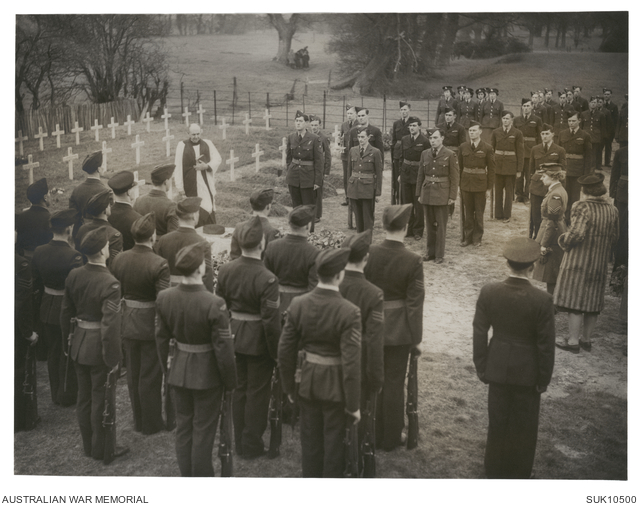
Funeral service for 402745 Flight Sergeant Rawdon Hume Middleton, the RAAF’s first VC winner. He was buried with full military honours in a country churchyard near his station. Air Vice Marshal H. N. Wrigley represented the High Commissioner for Australia (Mr S. M. Bruce) and the RAAF. The graveside service was conducted by Squadron Leader H. C. Thrush of Prospect, SA, RAAF Chaplain. (Australian War Memorial Public Domain)

Middleton’s citation read:

“Flight Sergeant Middleton was determined to attack the target regardless of the consequences and not to allow his crew to fall into enemy hands. While all the crew displayed heroism of a high order, the urge to do so came from Flight Sergeant Middleton, whose fortitude and strength of will made possible the completion of the mission. His devotion to duty in the face of overwhelming odds is unsurpassed in the annals of the Royal Air Force”.

In honour of Middleton’s bravery, Number 1 RAAF Recruit Training Unit at RAAF Base Wagga has renamed the club in his name, the “Middleton VC Club”, and he also appeared on one of the 1995 Australian 45c stamps. The dining hall located at the nearby (now American) base at RAF Mildenhall in Suffolk, has also been named in his honour.

St. John's Church Beck Row, Mildenhall Fl. Sgt. Rawdon Hume Middleton, VC (RAAF) 149 Sqn RAF, St. John’s Church, Beck Row, Suffolk.

Middleton was a brave and dedicated young man who gave his life to save those of his crew. Each and every one of them acted with the highest dedication, sadly for some, it cost them dearly.

Sources

*1 photo courtesy of Australian War Memorial, image 100641, Public domain.

*2 photo courtesy of Australian War Memorial, image P01019.003, Public domain.

*3 Photo courtesy of Australian War Memorial, Image SUK10501, Public domain

*4 Photo courtesy of Australian War Memorial, Image SUK10500, Public domain

Kings Cliffe under threat!

Following my recent revisit to RAF Kings Cliffe (Trail 6) I have been contacted by a reader who informs me that there is a planning application in to change the site to a caravan and camping site.

The application will utilise the site of the T2 hanger used by Miller for his final hangar concert in October 1944 and the memorial that now stands there. Details and photos of the site are in the trail update.

In the application, there is no reference to maintaining or preserving this memorial or any of the few remaining buildings that exist on this site.

This application was placed just prior to Christmas and so the offices have been shut for a large part of the holiday.

This is an area of natural beauty, used by walkers, cyclists and horse riders, not to mention visitors to the memorial. The roads are narrow and the surrounding villages are beautiful.

From an aviation point of view, Kings Cliffe is an historical site and is yet another example of world history being developed with little or no regard to its significance.

If you wish to see this application, it can be found on the East Northants Website application reference 14/02225/FUL. Linked below – The closing date for any objections is January 12th 2015.

http://pawebsrv.east-northamptonshire.gov.uk/online-applications/applicationDetails.do?activeTab=summary&keyVal=NFDYXIGO03N00 or google ’14/02225/FUL’

Thank you
Andy.

/home/wpcom/public_html/wp-content/blogs.dir/dc6/67045631/files/2015/01/img_2306.jpg

/home/wpcom/public_html/wp-content/blogs.dir/dc6/67045631/files/2015/01/img_2285.jpg

/home/wpcom/public_html/wp-content/blogs.dir/dc6/67045631/files/2015/01/img_2283.jpg

What Now for 2015?

Now that Christmas and the New Year celebrations are over, it’s time to take stock and consider where we go next with the blog.

Since starting this site last April, the blog has grown and developed in ways I never thought possible. I’ve visited over 40 different airfields and written trails about each one. As each trail has been written, I’ve found some amazing stories of heroism, bravery and heartache. The more I delve, the more I find, to the point where it has now become quite factual in its basis but the original idea of a nostalgic trip is still strong and evident in each and every article.

I have now of course, had a great deal of help from Marcella, whom I met on ‘Twitter’, spent Christmas 2013 with and have developed an amazing long distance relationship with. With her living in the United States and me in England, we have learnt to live with 3,500 miles and a time difference of 5 hours. Not easy at times!

She has an incredible eye for detail and a determination to find and check every detail, researching many of the additional facts and pieces of information that I wouldn’t necessarily have the time to do. She has also brought new ideas to the blog and has played a large part in its overall development.

As a result of this partnership, the blog has diversified from a range of trails around Britain’s old disused airfields, themselves a record of historical events, to include poetry and personal tales of bravery and heroism. It has also given me the chance to talk at length with my father, to learn about his time in the RAF, to know some of the stories behind his photos. We have learned about the structure of the USAAF, individual squadrons of the RAF and the ‘friendly invasion’ that affected so many lives both here in Britain and in the United States.

The blog following has grown too. Traffic to the site has grown steadily, readership is on the increase and a ‘family’ of friends has developed through a shared interest. I met in person, people through the blog who have shared their own pictures and stories. I personally have learned so much from others. It has truly been a terrific year.

So what now, where do we go? Certainly more trails, they are the backbone of the blog and tell the tale of events in World War Two. More heroic tales too, to highlight the sacrifices these young men (boys in many cases) made in the name of freedom and democracy. Perhaps too a new look, a revamp of the style. More factual information to back up the trails, and perhaps some revisits to old sites to update them and see what has happened since I was last there.

We would also like to share our trails with more people, raise the awareness of the state of these sites, and maybe encourage others to follow the trails around Britain’s disused airfields. Now is a fantastic time (if you are brave enough to withstand a little wintry weather), to go out and have a look round. The winter provides excellent views of buildings and other remnants of history that remain on these airfields, that in the summer, are obscured by trees and other greenery.

We welcome guest posts too, encouraging readers to add and share their own trails or stories. The more trails, the better the record we have! These posts need not necessarily be about a trail. We would love to share stories of those who served during this tumultuous time in history.

Finally, as always, we greatly appreciate your feedback and thoughts in the comments sections.

With a readership that is growing world-wide, ‘Aviation Trails‘ has truly taken off and is climbing. Here’s to 2015, new trails and new friends!

Andy and Marcella

‘In the Mood’ for aviation nostalgia?

Taking advantage of the winter sun and nearby location, I decided to take a short visit to one of the earlier trails and see how things had changed. Being a different time of year too, perhaps the buildings I saw would now be less obscured. I also thought that the initial trails were lacking and needed a little ‘historical substance’.

Whilst not wanting to lose sight of the idea behind the blog, I felt a little extra would not go amiss. Hearing about a memorial that I had missed earlier, I braved the late December air, donned coat, hat and scarf and set off to Kings Cliffe, in the top corner of Northamptonshire – land of Fighter squadrons and the last hangar concert performed by Major Glenn Miller.

RAF Kings Cliffe (Station 367)

(Revisited and updated December 2014)

DSC_0169

The Memorial at Kings Cliffe.

Unlike the other airfields in the tour, Kings Cliffe was a fighter airfield. Pass through the village from the south, out the other side, under the odd twin-arched bridge and then right. A few hundred yards along and the airfield is now on your right hand side. The memorial is here, flanked by the two flags. It is a more elaborate memorial than some, being made with the wing of a Spitfire on one side and the wing of a Mustang on the other. Various squadron badges are etched into the stone and as the weather takes it’s toll, these are gradually disappearing.

DSC_0197

Protected aircraft pen, with ‘dual skin’ defences on three sides. A number of these litter the site.

Over its life, Kings Cliffe would have a number of fighter units grace it skies. Built in 1943, it would receive its first squadron late that same year when P-39 Airacobras of Duxford’s 347th FS (350th FG) were temporarily based here. A short spell they would soon leave and be replaced with another short-term unit.

The following January, the 347th left and three squadrons: the 61st (code HV), 62nd (code LM) and the 63rd (code UN) of the 56th FG arrived from the U.S. This group fell under the command of the 67th Fighter Wing, Eighth Air Force. Redesignated the 56th FG in the previous May, they were initially given P-47s and continued to train at Kings Cliffe for fighter operations until moving on the 4th/6th April 1943 to Horsham St Faith, Norfolk. A few days later on 13th April 1943, they undertook their first operational sortie. Over the next two years the 56th FG would become famous for the highest number of destroyed aircraft of any fighter unit of the entire Eighth Airforce. A remarkable feat.

Littlefriends.co.uk

Pilots of the 77th FS, at Kings Cliffe 1944-45*1

After the 56th left Kings Cliffe, three more squadrons arrived. In August that year, the 20th FG arrived with their P-38 Lightnings. The 55th (code KI), 77th (code LC) and the 79th (code MC), would fall under the umbrella of the 67th Fighter Wing, Eighth Airforce.

After a spell of renaming, aircraft changes and training, their arrival at Kings Cliffe would see a period of stability for the 20th. Initial operations started in December that year, and their primary role would be to escort bombers over Europe, a role it maintained until the cessation of conflict. Targets of opportunity were often found whilst on these missions, but toward the end of the war, with fighter cover becoming less of an issue, dive bombing and ground attack missions became more common place. Their black and white chequered markings became feared by airfields, barracks and in particular trains as they became known as the “Loco Group” for their high number of locomotive attacks.

Oakington Pillbox Kings Cliffe Dec 2014

Oakington Pillbox, found in pairs, they offer a 360 degree field of fire.

On April 8th 1944, the 20th attacked an airfield in Germany, action for which they received a Distinguished Unit Citation (DUC). They would later take part in the Normandy invasion, Operation Market Garden, and air cover in the Battle of Bulge. In July 1944 they converted to P-51s and continued to escort bombers and search out targets of opportunity until the war closed. In the following October 1945, they returned to the U.S. and Kings Cliffe was returned to RAF ownership. The RAF would use it as a storage depot until selling it off in 1959. Its runways were dug up for hardcore, the buildings demolished and the site finally returned to agriculture.

Kings Cliffe December 2014 Draincover

Drainage covers and pipes adorn the remains of the runway.

Whilst standing at the memorial, it is difficult to imagine any of the activity that occurred here all those years ago. However, behind the memorial you can see a number of brick defence buildings enshrouded in trees and bushes. Move along the road to your right and there is the main gate. Stating that it is an airfield, it doesn’t encourage entrance. However, walk or drive a little further and there is a bridal way that allows access to the site. Walking along around the edge of the airfield, you can see hidden amongst the thorn bushes  an Oakington Pill box. Found in pairs and common in this area, they offer a 360 degree view of the site. The second of the pair is  short distance away in the middle of the field and more visible to the viewer. Also round here are three protected dispersal pens. Each pen has a double skin, in other words, an outside loop holed wall for firing through and an inner wall to protect air and ground crews in the event of an attack. There are a handful of other ancillary buildings here, all of which can be accessed with careful treading. A considerable number of these exist close to the road and path, so extensive travelling or trespass is not required for the more ‘informal’ investigation.

DSC_0188

Inside the Shelter.

Walking further along the path, you pass a large clump of trees heading of in an easterly direction. These mark the line of the east-west runway. Whilst the runway has gone, evidence of its existence can be found. A drainage channel, numerous pieces of drainage material and grates can be found amongst the remains of hardcore.

The path continues in a southerly direction away from the main part of the airfield, and a better option may be to return to the car and drive along to a different part of the site.

If you return through Kings Cliffe, bear left and through the small but gorgeous village of Apethorpe. Continue on and you’ll see a footpath that goes through the woods. Park here and walk through the woods. A couple of miles in and you come across a large open space, to your left is a distinguished memorial to Glenn Miller.

Glenn Miller Memorial RAF Kings Cliffe Dec 2014

Memorial to Glenn Miller’s final hangar concert, 3rd October 1944.

The memorial is located on the site of the original T2 hangar, quite a distance away from the main airfield. It was here that Miller performed his final hangar concert on October 3rd 1944. Standing here in the wintry air listening to ‘In the Mood’, is a surreal experience. To think that, on this spot 70 years ago, this very tune was performed by Miller himself; whilst young couples jitterbugged the evening away – a brief respite from the wartime tragedies that dominated their daily lives.

Leaving here, back to the track, you come across a footpath that takes you north, toward the main airfield before veering off and away to the west.

This path provides what is probably the nearest access point to the tower, as it crosses the track that joins the perimeter near to the towers location. The control tower still stands, but access from the path is over private land and should be undertaken with the land owner’s permission.

A final car trip back to the north side of the airfield reveals evidence of the accommodation blocks. The cinema, Gymnasium and chapel along with some other communal buildings still stand and in use by local timber companies. Well preserved, they are easily accessible and offer a good view to anyone aiming to find evidence of Kings Cliff’s history.

Kings Cliffe December 2014 Chapel with gym

Gymnasium and Chapel now used by a timber company.

Like many sites of it’s age, the majority of Kings Cliffe’s buildings are overgrown, indeed entering them you can see how the roofs have become detached in many cases, and mature trees now the only inhabitants where personnel once stood.

The main part of the airfield is agriculture, and it can be seen from further back, why this site was chosen as the views across the landscape toward Peterborough and the south are stunning. A remarkable place, it offers good evidence, nostalgia and beautiful walks into the bargain.

Overgrown buildings

Overgrown buildings

Kings Cliffe concludes this tour, however, if you return back along the road to the village of Kings Cliffe, turn right away from the village, you will eventually find yourself sitting opposite one of the crash exits of RAF Wittering, the main station to which Kings Cliffe was built as a satellite. Also along here, is a remnant of RAF Collyweston, an airfield absorbed into RAF Wittering at the end of the war when it expanded ready for the V – force bomber aircraft and later the Harriers. Now closed to flying due to government cutbacks, it houses an army detachment and a small RAF detachment for maintenance duties only.

Much of the evidence from the American participation in the Air War of the Second World War has now disappeared, being swallowed up by natures determination to regain what was originally hers. Agriculture and small businesses have clung on to the remainder, leaving little to see. In some ways, and I touched on this earlier, the fact that peace has now taken over what were bustling camps of 3000+ personnel, the roar of four engined bombers laden with high explosives or troop carriers taking scared young men to the killing fields of Europe, is a reflection on their bravery and dedication. These areas are simply peaceful now because of the men that served, lived and died here and whilst they are now gone, maybe their ghosts remain.

Kings Cliffe originally featured in Trail 6 ‘American Ghosts’.

*1 photo by Robert Derenbacker from ‘Little friends’ website http://www.littlefriends.co.uk

The year comes to a close.

It’s been a little quiet on the trials, for me, school work has taken over and it’s been difficult to get out and about. But as the year draws to an end, we can see progress has definitely been made and the blog has taken many steps forward in its development.

Each completed trail reveals many little anecdotes that deserve to be researched further and shared. Personal stories of heroism, dramatic tales of sacrifice and tragedy, each one a story of one individual’s life and death.

There are many people out there who share our interests. Before visiting these wonderful places, I like to see what others have seen before. Their records provide a great reference as to the extent of decay and the loss of these historic sites. It never fails to amaze, how quickly not only developers take over, but Mother Nature herself. A powerful force, she very quickly sows her seeds and before long brambles, bushes and trees reduce these old buildings to rubble.

Many of us believe that the historical impact of these airfields should be much better preserved. I for one, appreciate the need for housing and cost of maintenance etc but there must be a compromise so everybody ‘wins’. One suggestion is that with each development contract there could be a clause to restore, renovate and preserve a small element of each site so that generations to come can witness some small part of what happened in these amazingly emotive places. Perhaps our planners could consider all options before the last remaining sites disappear for ever.

There are currently a number of projects around the UK who are striving to preserve remnants of these sites, some with small successes, but it is all an uphill struggle. It is hoped that by raising awareness and sharing the trails, we can do our small part to help keep the memories of those brave young men and women who fought a war, some a very long way from home, very much alive.

Here’s to 2015, more trails and maybe some revisits, thank you to all those who have read, commented and contributed to the blog, it’s great to have you onboard and to share our common thoughts. We look forward to reaching out to many more in the coming months.

I would like to give a big personal special thank you to Marcella who has helped with much of the research, I know it has become a very big part of her life too and together we have learnt so much about those days back in the 1940s.

A merry Christmas and a happy and safe new year to you all.

Andy and Marcella.

A Tuskegee Airmen from St. Louis, MO: Captain Hugh J. White

It was 35 years ago today that the life of a brave African-American man from St. Louis, Missouri, (MO) ended. His name was Captain Hugh J. White, and he was a Tuskegee Airmen.

Riviera Beach high schoolers meet the United States' first black military aviators, the Tuskegee Airmen photo

Tuskegee Airmen Charles Hill, second from left, with fellow pilots (l-r) Hugh White, Lincoln Hudson and Carl Ellis, taken in 1944 in Alabama. Courtesy of Charles Hill.


You might recognise St. Louis, MO and places like nearby Ferguson, MO from the news as of late, but not for the great accomplishments of its citizens, rather for the seemingly never-ending division among between people of different races. The actual Ferguson case aside (because I do not know enough about it to comment intelligently, nor do I want this post to draw any more attention to a topic that has had more than its share), It is my goal, that we, as a community, as members of the human race, spend more time considering the things we share in common and discussing the positive contributions that are made by all people. That is not to diminish the importance of such issues of racial division, because they are of the utmost importance. It is simply, that I would like to see the focus move in a different direction.

On December 14th, 1979, Captain Hugh J. White, passed away. Yes, it was 35 years ago this very day. An anniversary worth noting I believe. Captain White was a veteran of the United States Army Air Corp and a famous Tuskegee Airmen, who began his decorated career as an Aviation Cadet.

Captain White was born on August 24th, 1922 in St. Louis, MO. As he did with nearly everything in his life, he approached his high school years with nothing short of expecting complete excellence from his efforts. As a young teenager at Charles Sumner High School, he did just that; he excelled. He was voted by his peers to be president of his class and earned top grades and graduated as a member of the National Honour Society.

His plans, like many young men growing up in wartime, changed quite suddenly. His initial plans were to attend Stowe Teachers College and pursue a worthwhile career. However, as events in Europe grew more dire, it became apparent that every able-bodied young man must rise to challenge and answer the imminent call of duty to country and homeland. It was in January 1943 that he volunteered for the United States Army Air Corp. Not long after, Captain White was sent to Tuskegee, Alabama for his initiation and training.

Captain White graduated as part of Class 44-F, and because of his own high standards and insistence upon personal excellence, he graduated at the top of his class. He was then sent to the European Theater of Operations to participate in the war in Italy. He became a pilot assigned to the 99th Pursuit Squadron of the 322nd Fighter Group, and in the course of his dedicated service, earned 190 combat hours and flew 35 combat missions.

Photograph shows, first row: 1. Hugh J. White, St. Louis, MO, 44-F; 2. Col. Benjamin O. Davis, Commanding Officer, 332nd Fighter Group, Class 42-C; 2. Conrad A. Johnson, New York, NY, 44-G; 4. Thurston L. Gaines, Freeport, NY, 44-G; 5. Robert W. Williams, Ottumwa, IA, 44-E; 6. Lewis J. Lynch, Columbus, OH, 44-F; 7. William T. Matison, Conway, AR, 42-I. Second row: 1. Rual W. Bell, Portland, OR, 44-D; 2. Elbert N. Merriweather, Jr. Brooklyn, NY, 44-G; 3. John H. Lyles, Chicago, IL, 44-G; Leland H. Pennington, Rochester, NY, 44-G; 5. unidentified; 6. unidentified; 7. James H. Fischer, Stoughton, MA, 44-G; 8. George Arnold Lynch, Valley Stream, NY, 44-F; 9. Rupert C. Johnson, Los Angeles, CA, 44-F. Image and caption credit: Library of Congress, Prints & Photographs Division, Toni Frissell Collection.


On April 23rd, 1945, whilst flying his 35th mission, Captain White’s P-51 was shot down by anti-aircraft fire whilst escorting B-24s on a bombing mission over Italy. He survived but was captured and became a prisoner of war. Though no doubt both trying and difficult for him, he survived his ordeal as a POW. Thankfully, while White was in captivity, the Second World War in Europe finally drew to its conclusion and hostilities ceased. White was soon released and repatriated with his unit.

Captain White received an honourable discharge and eventually returned to his beloved homeland safe and sound, and he went home to St. Louis, MO. Never one to be without a goal, he applied to and was accepted to the Cleveland Marshall Law School (in Cleveland, Ohio). He graduated from law school, passed the Missouri bar exam, and his practice specialised in criminal law.

Not unlike high school, Captain White was again elected by his peers, though this time to the Missouri Legislature where he served as a State Representative. He was first elected in 1961, and in 1963, his constituents re-elected him to be their State Representative once again,

Captain White was a key figure in the organisation of the St. Louis Chapter of the Tuskegee Airmen before his death in 1979.

scan painting Hugh J. White Tuskegee Airmen P51 Pilot St. Louis

For his dedication, determination and bravery, and for action against the enemy, Captain White was awarded the Purple Heart. Captain White and the numerous other Tuskegee Airmen, fought alongside their fellow American airmen, for the rights and freedoms that all of us enjoy today.

On the 35th anniversary of his death, we owe a great deal of gratitude, not only to Captain White and his compatriots, but to all who fought in World War II.

–  By Marcella Beaudreau


What the Luftwaffe failed to do, the local council have finally managed.

Many of Britain’s airfields have hung on desperately to a small corner of history. Hawkinge is sadly one of those that has been buried deep beneath housing, schools and shops. Sadly, one of England’s most historic airfields, has finally been defeated not by Goring’s Luftwaffe, but by local planners.

Hawkinge was at the forefront of the Battle of Britain, it was repeatedly attacked by the bombers of the Luftwaffe. Because of its location, just minutes from France, crews would often have little warning and would have to take to the sky unprepared. Many returning aircraft would use its runways as a safe haven returning battle damaged and weary; Hawkinge fire crews were some of the busiest Britain was to have. It was used as a transport depot in the First World War, became a mecca for international pilots, saw some of the first ‘drones’ and was used in the filming of the 1969 film ‘The Battle of Britain’.

Today a small museum, utilises what’s left of the original buildings whilst housing creeps like poison ivy, ever further across the airfield.

The nearby cemetery is home to not only RAF pilots but also fallen Luftwaffe crews, ironically remaining in the land they tried to take all those years ago.

As part of a second aviation trail around historic Kent, Hawkinge is a must for any follower of history, aviation or the Battle Of Britain.

See the full story and Kent’s second trail here.
lady cropped 2 B&W