In Part 1 we saw how RAF Thurleigh emerged from the Bedfordshire countryside and was shaped by early Luftwaffe raids on the construction site. We saw the arrival of new RAF training units flying Wellington bombers, and their subsequent departure to the far East. We saw how tragedy and fatal accidents claimed the lives of new Polish crews training at the station with 18 OTU, and how with Bomber Command moving on, Thurleigh’s role was set to change dramatically.
A New Ally Arrives: The American Transformation of Thurleigh
At the end of 1941, after the surprise attack on Pearl Harbour, America entered the conflict declaring war on both Japan and Germany and their allies. Over the next few months high ranking officials hurriedly put plans in place to send twenty-eight American bomb groups to the United Kingdom, and the European theatre of war. In a meeting between General Eaker and Air Chief Marshal Arthur Harris, discussions took place that would not only facilitate such a move, but also give the Americans suitable airfields on which to house their new heavy bombers.
Aware that most British airfields were too small to accommodate the American’s heavy bomber units, Eaker went on to press Harris for specific details including both their locations and the facilities available at each one. Anticipating this, Harris handed over the identity of eight potential sites, many of them RAF satellite stations, but all suitable for the American’s use. Amongst these were the airfields at Polebrook, Chelveston, Molesworth, Kimbolton, and of course Thurleigh.
Initially designated Station B-4, Thurleigh would then undergo a major modification programme, one that would bring it up to the new Class ‘A’ standard, a specification that would make it suitable for the American heavy bombers, both the B-24 ‘Liberator’ and the B-17 ‘Flying Fortresses’ that Eaker was sending over.

One of the former arms buildings.
Construction crews quickly began work, both extending and reinforcing the short runways; they added additional hardstands, and expanded both the technical and domestic sites. Upon completion, the airfield would feature three concrete runways: one of 2,000 feet and two of 1,400 feet in length, each being the standard 50 yards wide. Aircraft dispersal was facilitated by a total of 51 loop and frying-pan style hardstands arranged around a full length perimeter track.
In addition, and unusually, four T2 hangars were erected, providing protective aircraft shelter and maintenance facilities. The bomb store was discreetly placed in Galsey Wood, a wooded area to the northwest and away from the main flying and accommodation areas – an essential safety precaution in wartime.
Fifteen accommodation sites, including two communal areas, two WAAF quarters, medical facilities, and barrack blocks, were all established along the road leading away from Thurleigh village to the south-west of the airfield. These sites employed a variety of wartime construction styles – brick, timber, concrete, steel, asbestos, and plasterboard – using standard designs from Laing, Nissen, Seco, Jane, Romney, and others. At full capacity, the base would accommodate over 440 officers and more than 2,500 enlisted personnel, including members of the Women’s Auxiliary Air Force.
After being allocated to the Americans on August 10th 1942, Thurleigh opened with its first residents. On 7th September that year, the first and only front line bomber Group to operate from the airfield, the 306th Bomb Group (BG), arrived with its four squadrons of B-17s: the 367th, 368th, 369th and 423rd Bomb Squadrons (BS). In command would be Col. Charles B. “Chip” Overcracker.
The 306th Bomb Group: Arrival of “The Reich Wreckers” (Autumn 1942)
Known as “The Reich Wreckers” the 306th would have many claims to fame, including being the oldest operational Bomb Group in the 8th Air Force and the only one to remain at the same station (Thurleigh) in England for the longest period of time. In addition, they were the first unit to have personnel achieve their first tour of operations, a major mile stone that gave the whole air force hope that going home was indeed possible.

A graffiti panel rescued from a 423rd BS barrack now on display at the museum.
The Group, designated the 306th, were constituted on January 28th 1942, and activated in March that same year. Their journey to the UK began at Gowen Field in Idaho, transferring through Wendover Field to their embarkation point at New York onboard HMS Queen Elizabeth. The ground echelon set sale, travelling across the treacherous north Atlantic route to arrive at Greenock in Scotland, on September 5th, 1942.
The air echelon travelled separately, arriving a week later in small groups touching down at Thurleigh between the 8th and 13th September, having flown their own thirty-five aircraft across the northern route. This cold and bleak route took them via Greenland and Iceland, before passing over northern Ireland to arrive at Prestwick in Scotland on the north-west coast. During the journey over, one B-17F, with a crew of nine and one passenger, exploded for no apparent reason, 150 miles from Gander Lake, Newfoundland. A second aircraft also ditched in the Irish Sea. The crew in this instance were picked up, but the aircraft was lost in the cold waters of the North Atlantic. This was the third B-17 the group had lost since their inauguration.
The 306th would go on to fight in some of the most bitter air battles of the war, including Schweinfurt, Stuttgart, Hannover, Berlin, Ludwigshafen and Leipzig. They would lead the first US bomber penetration of German skies; Big Week in February 1944, and go on to support both the Normandy landings and the St. Lo breakout. They would remain active throughout the war achieving numerous awards including two Medals of Honour, numerous Purple Hearts and two Distinguished Unit Citations (DUC) for action over occupied Europe.
Their arrival at Thurleigh was not however the great dream they may have wished for. On unloading, the 306th were greeted by unfinished buildings and mud – lots of it. Tents immediately formed the basis of personnel accommodation and the officers’ mess was so small, staff had to operate in three shifts to enable them all to get fed.
Not only was a considerable amount of work needing to be done to get the station ready, but being new to the European theatre, a huge amount of ‘up-skilling’ was also going to be needed. To this end, intelligence staff, operations controllers and flight controllers were all sent to RAF stations to learn the ‘tricks of the trade’ enabling them to operate alongside their British counterparts in what was about to become a very busy airspace.
Baptism by Fire: First Operations and Early Losses
This poor start was then compounded when on October 2nd 1942, during a practice mission over the Wash, one of the waist gunners of B-17 #41-24492 ‘Lady Halitosis‘ of the 367th BS, suffered oxygen failure. In a bid to help the gunner, the pilot put the aircraft into a steep dive losing some 9,000 feet of altitude in a matter of minutes. The dive and subsequent recovery was so severe that the aircraft’s control cables snapped, and part of the starboard wing broke away taking an engine with it. The aircraft then caught fire and the bomb bay doors became detached. One of these doors, struck the rear section of the aircraft with such force that it severed the fuselage at the tail. The rear gunner, trapped inside his position, desperately tried to escape, hammering at the plexiglass and fuselage to break out. With only a 1,000 feet of air left, he just managed to break through the fuselage and free himself from his falling coffin. His parachute luckily opened, and he landed safely some distance away south-east of Spalding in Lincolnshire. His luck, already used exhaustively, somehow managed to continue on for a few moments more, when the remainder of the burning B-17 came crashing down a mere one hundred yards or so from where he was sat.
Rescue crews from a nearby anti-aircraft gun ran to the scene but they were unable to get close enough to the wreckage due the the ferocity of the fire, and sadly, all six of those left inside, perished. During the whole episode only one other crewman managed to escape – Ball Turret Gunner Private Raymond McAskill – suffering slight injuries as he did so.
The event was so understandably harrowing for gunner S.Sgt. William Kellum, that he was eventually grounded, his mental state rendering him ‘unfit’ to continue on after having only carried out a few missions following his horrific flight debut in England.
With this disaster behind them, the 306th took to the air once more on their maiden operation on October 9th 1942, an operation to bomb the steel works at Lille, France. But again, it was not to be the glorious outcome they all would have wished for.
For the first time, over 100 American bombers, a mix of B-24s and B-17s, led by the soon to be legendary Col. Edward “Ted” Timberlake, flew across the English Channel to France. The huge formation, escorted by over 400 fighters, a mix of Spitfires – now part of the 4th Fighter Group – and P-38 “Lightnings”, knew how important this mission was going to be.
Waiting for them were the battle hardened Luftwaffe pilots of JG 26 in their FW190s, they were not going to let the bombers through easily and the sky would be full.
With departure planned for 08:32, the lumbering giants gradually rose in to the air and set route for France.
As the bombers reached the target, the Luftwaffe struck, focussing initially on the B-24s of 93rd BG. Attacking from their favoured position, the rear, they struck at the formation ignoring the fighters flying high above. Releasing over the target, bombing was considered poor, some bomb aimers not even finding the target and so dropping their bombs on alternative sites. During the action, the formation had become disjointed, partly due to some turning back with technical problems and partly to some being knocked out by enemy fighters – the defensive wall had been breached.
As for the 306th, a second aircraft was lost, and this time there were no survivors. A third B-17, #41-24486 “Man O’ War” piloted by 2nd. Lt. James M. Stewart, lost three engines and its radio failed. It was about to ditch in the English Channel, when – as if out of a boy’s action story – a Spitfire, flown by Flt. Lt. Andrews of 91 Sqn, appeared alongside and guided the B-17 to RAF Manston in Kent where it made a successful crash landing. None of the crew were injured in the event, saved no doubt by the actions of Flt. Lt. Andrews.
Inexperience played a large part for many of the crews taking part that day. Being new to operational duties, not only had they suffered poor aiming but gunners had made hugely exaggerated claims about the numbers of enemy aircraft shot down – although probably unknowingly to them. In reply to the frenzied attack on the formation, air gunners sprayed bullets all over the sky hitting everything except the enemy. A mix of poor training and a determination to prove their worth, had been a recipe for disaster.

One of several buildings on the bomb store.
Not only was the bomb aiming poor but so was the navigation. Many navigators, like the gunners, were simply not experienced enough, nor trained well enough for the European geography. With thick cloud being present almost all of the time, many new crews were unable to identify specific geographical features and were simply lost within 10 minutes of leaving their home base.*4
During this initial operation experienced enemy fighters were both fearsome and determined in their attacks. Whilst few bombers were actually shot down, all of those in the lagging 306th received hits from the FW-190s – some severely. The opening few weeks had been a real eye opener for the 306th, an experience resembling a baptism of fire not only for those newbies the “The Reich Wreckers“, but for the Eighth Air Force as a whole.
Weather, Warnings, and Misfires: October’s Frustrating Missions
The British winter weather then intervened. Several operations were cancelled as were training flights which were greatly needed. A cancelled flight to Lorient on October 21st, merely two weeks after their first operation, meant that the entire 306th returned without dropping a single bomb. The declining weather and poor visibility was to blame, but some ninety aircraft did continue on, and of those who did bomb, their bombs simply “bounced off” the submarine pens, having no impact whatsoever. *5
Aircrews were learning that operations over enemy territory were high risk, but even scrubbed missions could have their problems: aircraft still had tanks full of petrol and bomb-bays were still filled with tons of high explosives. For the 306th, troubles on this mission began even before they had left British airspace. When the abort signal came through, it instructed crews to drop their ordnance in the Wash – a large body of shallow coastal water off the north Norfolk coast. Whilst it became a common practice for scrubbed missions, for one B-17 it was not going to be a simple or straight forward task.
Emergency Landing: A B-17 Touches Down at Sutton Bridge
B-17F, #41-24460 ‘RD-A’, “Little Audrey” of the 423 BS, began the process of releasing its bombs when suddenly the life raft latch broke loose causing the raft to escape and wrap itself around the elevator rendering the aircraft difficult to control.

Captain Mack McKay, 306th BG points to a “kill” marking painted on his B-17 Flying Fortress “Little Audrey” (IWM FRE 4418)
Now being unstable in flight, the B-17 had to find a safe place to land, and near to the Wash was the firing range at Holbeach and its associated airfield at RAF Sutton Bridge. A physically small grass airfield that was used for gunnery training of RAF fighters, it was not designed to take large four-engined heavy bombers. The likely hood of getting down safely was slim, but after using all his skill and judgement, the pilot managed to put the bomber down safely on the grass much to the joy of those inside the bomber. Once remedial work had been carried out on the aircraft, the crew began to prepare for the take off, an event just as risky as the landing and with odds just as bad.
Being an unusual aircraft to see at Sutton Bridge, huge crowds gathered to see the B-17 and to witness what could have been a terrible accident had the take off been misjudged on the small grass strip. Fortunately though, again using all his skill and judgement, the pilot got the aircraft up and the B-17 successfully rose in to the air making its way home to Thurleigh being waved off by the extensive crowd of locals gathered by. *6
Mounting Pressure: Heavy Losses and Royal Visits
The early days of November 1942, saw missions 3, 4 and 5 for the 306th. Visits to Brest, Lille and St. Nazaire, saw a further four aircraft lost with all crews listed as ‘missing in action’. These early loses were beginning to mount, and those in charge were beginning to voice their concerns.
On November 13th, a Royal visit was made in which General Carl Spaatz and King George VI carried out a tour of the many airfields now in the region, including Thurleigh. Whilst the Royal party were here, they were shown around the airfield, seeing the various facilities available. They were also introduced to several crews and ground staff with whom they chatted happily.
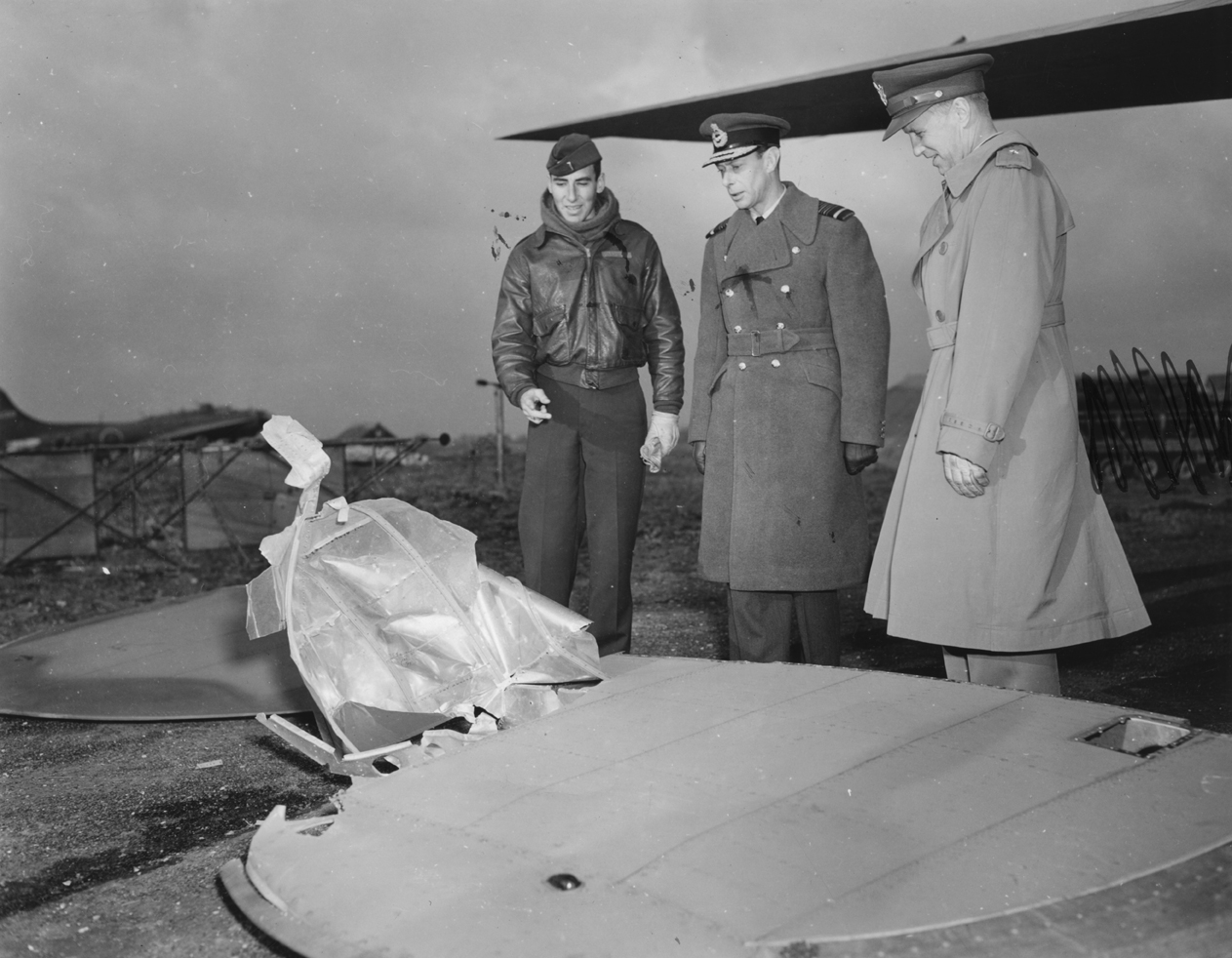
Brigadier-General Newton Longfellow and Lieutenant Robert L Riordan of the 306th Bomb Group, show King George VI part of a damaged B-17 Flying Fortress during a royal visit. (IWM FRE 4390)
The B-17’s Fatal Flaw – and its Remedy
But the relief brought by important visitors didn’t prevent problems in the air. By now, the Luftwaffe had got the measure the of the B-17 and pilots, such as Oberstleutant Egon Mayer, quickly found its Achilles heel. Even though bristling with guns, the B-17s suffered from ‘blind spots’, areas where the gun’s arc didn’t cover. This made the bomber vulnerable, and the worst position was through a direct full frontal attack. New tactics were then used by the Luftwaffe, directing fire directly at the front of the aircraft, potentially its most vulnerable position. It became so successful, that some 30% of pilots and co-pilots in the 306th were killed in such attacks.*7 With little protection, early model B-17Es were quickly withdrawn from front line operations and investigations carried out into a possible remedy to the problem.*8
Naturally the B-17 crews realised this vulnerability too, and also set about finding their own remedy. Whilst official routes were being taken to solve the problem, these were taking too long, and a quicker solution was needed. Within the 367th BS an armourer and a welder (S. Sgts. James C. Green and Ben F. Marcilonis) got together and took matters into their own hands. They designed and built a new bracket that could hold a heavy .50 machine gun fitted into the nose of the aircraft to protect this gap in the forward arc. Once constructed and fitted, trials began, the ‘guinea pig’ being a B-17F #42-5130 named “Sweet Pea“.
The bracket fitted to Sweet Pea, proved to be so successful that it was adopted not only by the 306th but the 8th Air Service Command as a whole*9 becoming part of a modification feature to future B-17 models.
The aircraft was unusual for other reasons though. It was ‘christened’ on December 20th 1942, by a small orphan girl called ‘Maureen’ whom the 367th BS had adopted from a London orphanage. They gave her the nickname ‘Sweet Pea‘ and to mark the occasion, she dipped her hand in paint and placed a print on the aircraft as a form of dedication.. Like many aircraft of the ‘Reich Wreckers’, Sweet Pea would fly on several operations, suffering a great deal of damage in the process; eventually failing to return from operations to Lorient on March 6th 1943, with one airman killed in action, one evading and eight being taken prisoners of war.
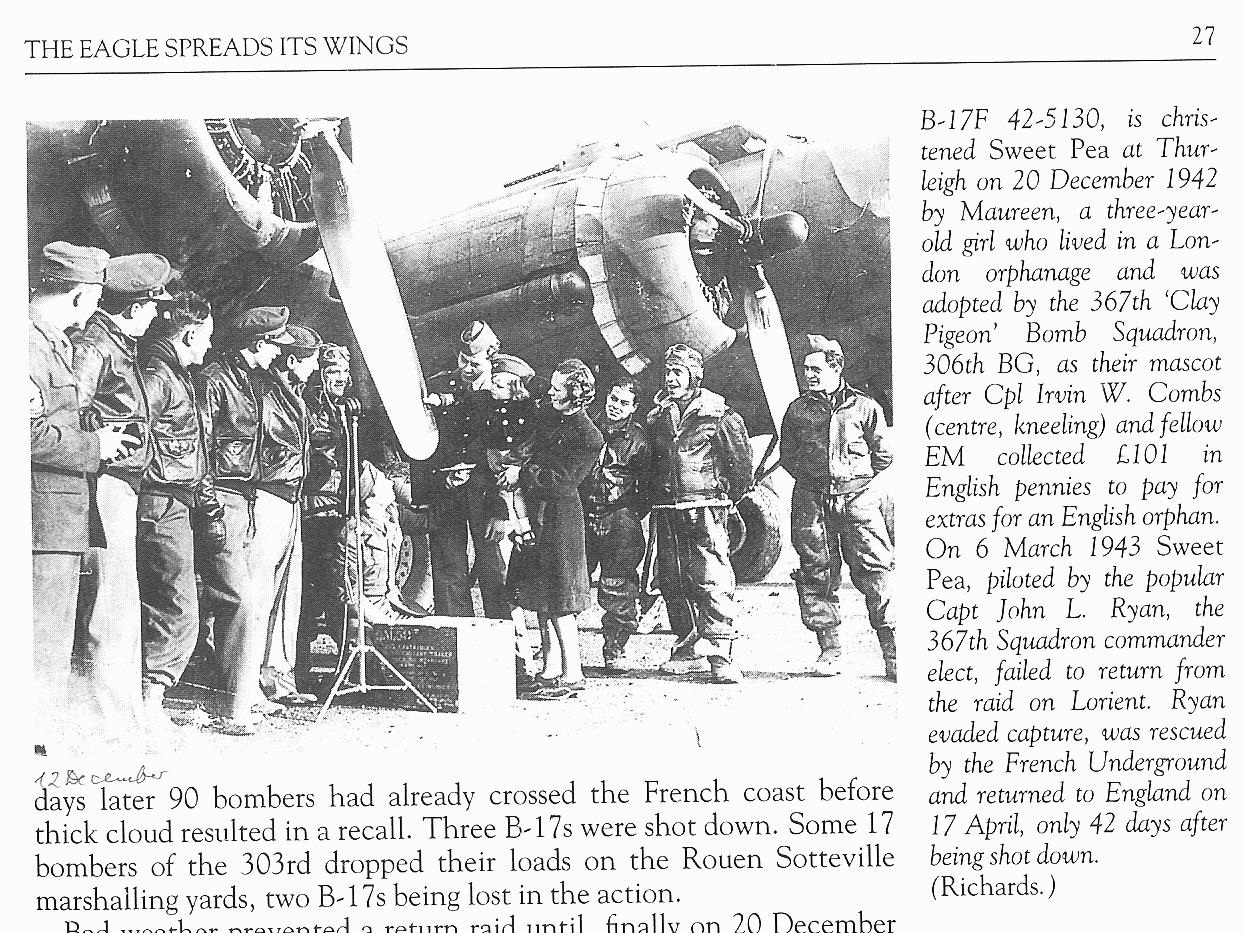
The news report on the dedication of ‘Sweet Pea‘ by Maureen – a three year-old orphan – at Thurleigh. (IWM UPL 15963)
Thurleigh had transformed from a training airfield into a heavy bomber base ready for its new American role. Upgraded to Class “A” standard it soon became home to the 306th Bomb Group – “The Reich Wreckers.” Their arrival in September 1942 was far from smooth though: unfinished buildings, muddy conditions, and a steep learning curve in the European theatre made for a difficult start. Early missions brought tragedy, from training accidents to heavy combat losses, while poor weather and inexperience compounded their struggles. Yet alongside setbacks came resilience, adaptation, and even innovation, as crews refined tactics and strengthened their aircraft. With these foundations laid, the stage was set for the 306th to face the increasingly bitter air battles of 1943.
The entire history can be read in Trail 65
 Aviation Trails