In Part 2, Scone supported the RAF throughout the war, training pilots and navigators in a range of aircraft. Post war, this demand reduced, but it was not the RAF’s end with Scone, nor the end of pilot training.
With Airwork now owning the site outright, they began to look to the future. In 1950, BEA began trials with flights to Renfrew and Glasgow, a scheme that was hoping to open doors to destinations wider afield, but it was not successful and so the idea never came to fruition. Keen to expand, Airwork then took on conversion flying for the Admiralty, converting naval pilots to from single to twin-engined aircraft. They also carried out engineering and navigational training and began work overhauling radio systems, the future was looking bright for the expanding airfield.
The December of 1950 saw the Glasgow University Air Squadron (UAS) move to Scone as a temporary measure whilst their runway at Abbotsinch was resurfaced. As a result, Airwork became responsible for the maintenance of the training aircraft they were using, primarily Tiger Moths and Miles Magisters. Airwork soon came up with the idea of a trophy to be contested for by the various Scottish University Air Squadrons, called the Scone Cup, the first competition was held in October 1951 and won by Glasgow. After a further name change of the UAS to Universities of Glasgow and Strathclyde Air Squadron (UGSAS) in 1965, the squadron re-equipped with DH Chipmunks, bringing yet another type to the small Scottish airfield.
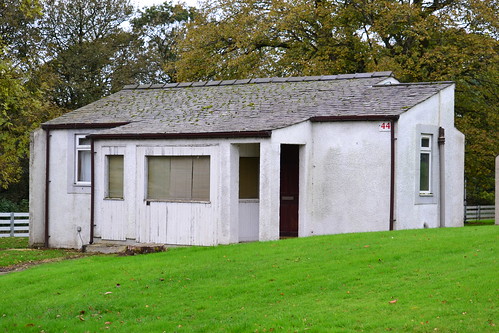
Old buildings are utilised for modern purposes.
Meanwhile the Scone Cup continued, as did the relationship between Scone and the various Air Squadrons, until in 1969, when the RAF centralised all its maintenance work at RAF Turnhouse, and the link with Scone was broken. The GSAS were then reassigned back to Glasgow airport, the location of its origin way back in April 1941.
Like so many other contracts with the military post war, the Admiralty’s pilot training programme wouldn’t last long either, and a gradual reduction in the need for pilot training for the service, forced Airwork to look elsewhere for their trade. The dynamic years that followed saw a huge growth in civil aviation, with jets now spanning the globe in hours and not days, and private flying was becoming evermore affordable to the masses. It was this opportunity that Airwork seized, becoming the first civil school to gain an Instrument rating course certificate for pilot training.
This enabled the now renamed ‘Airwork School of Aviation’ to officially offer its services to civilian operators for the first time, an offer that was taken up by numerous airlines including the first, Sudan Airways, with the first trainees arriving in November 1955.
Although the Navy had ended its contract with Airwork and Scone, it was not the end of military training for good. Whilst 1957 brought the disbandment of some landmark units, on March 8th, another training unit, 1 Civilian Fighter Control Co-Operation unit, formed here at Scone operating the Avro Anson T22. Little seems to be published about the activities of this unit, but I would assume it was, like other training units at Scone, operated by civilians working as part of the Royal Air Force’s training programme. The unit remained active here at Scone, until 31st January 1961 where upon it was disbanded. A year after its cessation on May 10th, an Anson of the unit ‘VV977’ was sold as scrap at No.27 Maintenance Unit (MU) at Shawbury.
With that any RAF connections with Perth ceased. The airfield was passed to ACS Aviation, who claim to be the “leading Commercial Flight Training Organisation in Scotland”. Operating a range of services including commercial pilot training and maintenance provisions.
By the turn of the 1950s / 60s, Scone was heralded as a thriving pilot training facility, seen by many organisations as one of the best available. In acknowledgement of this, the recently formed British United Airways sent their pilots here and were quickly followed by other UK based airlines. The prestige that attracted these airlines led to an award by the Ministry of Aviation confirming Scone’s high ranking status, something that had not been done before to any other UK based school.
Airwork’s organisation stretched the length and breadth of the UK, and as military reorganisations took place, so some of Airwork’s units were either closed or relocated to alternative locations. In the early 1960s, Scones Airwork School of Aviation began to expand further by taking over the School of Aeronautical Engineering from Hamble, which led to yet another name change to Airwork Services Training (AST) to match the new role now being served at Scone. As the school developed and established itself at Scone, so it too began to expand, delving into the roles of electrical, turbine and rotary fields, all of which required further development of the pre-war site.

Modern day Scone is home to a large number of small aircraft.
As Airwork has expanded into the rotary field, the next natural step was to train helicopter pilots at the airfield. The first such operation took place on 30th September 1963, with students from the Ghana Air Force. The instructor on that course, one Cryil Sweetman, would go onto gain his own fifteen minutes of fame flying a Hiller UH-12C in James Bond’s ‘From Russia with Love.’
The growth of Scone continued on throughout the (1960s) decade. During these years no less than thirty Cessnas (130 and 150 models) were brought into the airfield to train pilots, a number that would make it the largest fleet in Europe, giving Scone the advantage over other European training centres. Combine that with the additional training facilities and private maintenance work, Scone was rapidly becoming one of the biggest players in the civil aviation industry.
In the final part, we see how Scone had grown from strength tot strength, through different ownership it has continued to supply training for new and established pilots, establishing itself as one of the largest training centres around.
The full history of Scone can be read in Trail 56.
 Aviation Trails