In Trail 56, we head north once again, this time across the River Tay into Perthshire, the gateway to the Highlands.
The grand city of Perth boasts a majestic history, once the capital of Scotland, it is a city with galleries, museums and stunning architecture; described by VisitScotland.com as “a picturesque playground for Kings and Queens“, and rightly so.
The village that gave this airfield its name, has its own history, going back as far as the Iron age. Once the seat of Royals, it is mentioned in Shakespeare’s Macbeth, and once housed the famous ‘Stone of Scone‘ or ‘Coronation stone‘ that has for centuries been used for coronations of the Kings and Queens of Scotland and England. It was stolen by King Edward I of England who took it to London, where it remained until 1950 when it was stolen once more by four Scottish students and taken back to Scotland. It was a year later, returned to London where it remained, being used for the coronation of Queen Elizabeth II. In 1996, the Queen and Prime Minister agreed the stone should be returned to Edinburgh on the proviso that it be brought to London for any future coronations, the last one being King Charles III – it must be the most famous 125kg of rock anywhere in the world. *1
So, on Trail 56 after passing through the beautiful city of Perth and onto this small but famous village, we find one former RAF airfield that has since become Perth Airport. Located in the same region as Scone Castle, we now visit the former RAF Scone.
RAF Scone.
RAF Scone was built in the 1930s, and has been known by a series of names: Perth Airport, Perth Aerodrome, Perth Municipal Airport, RAF Perth, RAF Scone and Scone Aerodrome. The airfield is located about 3.5 miles north-east of the aforementioned city of Perth.
In the days before Scone was built, the Lord Provost of Perth, Thomas Hunter, had an idea to build an aerodrome near to his home town, designated Newlands aerodrome. The idea never came to fruition however, and no real progress was ever made on the site. However, in 1935, with the rumblings of war in Europe, the Government announced the expansion of the Royal Air Force, and so the idea was taken up again, this time by Sir John Ure Primrose.
Sir John, with support from many Perth Councillors, put forward a plan costing some £20,000 for an aerodrome, and with a small committee of members, began to seek advice from a number of sources including the aircraft company A.M. Airwork Ltd., and the architects Norman, Muntz and Dawbarn. After looking at the designs and reviewing Sir John’s plans, a revised model was put forward doubling the cost to some £40,000.
The new scheme was passed however, and 250 acres of woodland and pasture were purchased from two local landowners, Scone Estates and J. Patrick Cuthbert of Barclayhills. In September 1935, work began on clearing the site which employed around 440 labourers and tradesmen all employed by two companies, Maxwell M. Hart & Co. and William Taylor & Son.*2
It was agreed that the running of the airfield would be undertaken by the Airwork company, who were founded in 1928 and based at the then Heston Aerodrome in Middlesex. For much of this time, Airwork’s chief pilot was Captain Valentine Baker MC, DFC, who later joined forces with Sir James Martin to form the now famous Martin-Baker company, famous for it ejector seats found on numerous fast jests world wide.
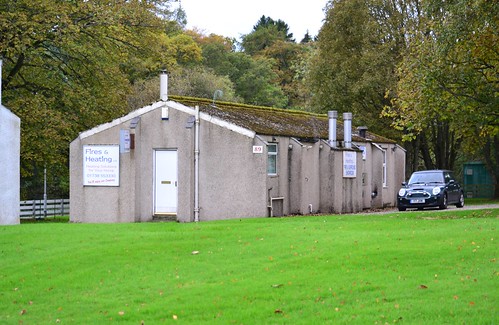
Numerous buildings survive from Scones wartime past.
Initially Scone (pronounced Scoone) aerodrome, would be a municipal aerodrome used by various civilian operators including North Eastern Airways and Railway Air Services, who made both local and national flights as far as London and Aberdeen. Some of these flights began in the dawning of 1936, before the airfield had officially opened and so the future looked fairly bright.
This burning light was also fuelled by the formation of the Strathtay Aero Club here at Scone, on May 29th 1936. Set up by three ex-RAF personnel, its initial operations were short lived however, being suspended due to the impending war in Europe. Despite this, with the war’s end in 1945, the club was allowed to continue these operations, including holding major events in 1947 leading to further growth over the next few years.
However, with increasing tension on the continent in the 30s, the RAF’s expansion was paramount and it would take preference over civilian operations. Not only would huge numbers of military personnel be required – an additional 2,000 pilots and over 16,000 ground personnel – but new airfields to operate and fly the aeroplanes from to wage such a war.
With some fifty new aerodromes required by the end of 1937, and so many new pilots to train, elementary flying training would have to form a major constituent of the programme, the majority of which would pass to civilian hands allowing the RAF to focus their efforts on advanced flying techniques. To meet this demand, civilian centres were to be increased from four to an initial thirteen *1, of which Scone would be one.
The entire training programme was overhauled with separate sites providing different instructions – ground or air – and a new RAF Volunteer Reserve class was set up to provide temporary training to cadets designated the rank of Sergeant. It was planned that those part-time trainees located at Scone, would learn to fly in one of twelve aircraft, each aircraft accumulating as many as 3,500 flying hours each year as a result.
The demand was therefore great, and Scone’s civilian operators, who were by now well established, would be joined on 27th January 1936, by No. 11 Elementary & Reserve Flying Training School (E&RFTS) operating under the control of 51 Group RAF, who were then based in Leeds. Even though 11E&RFTS were a military unit, their pilots would be trained by civilian instructors whilst they were stationed at the airfield.
It was clear at this point though, that Scone’s infrastructure was going to be insufficient for both the military and Airwork’s needs, and further land and development was going to be required. To this end, another 120 acres were either purchased, or leased from local landowners, allowing the development, now costing £60,000, to have two runways, 1,000ft and 4,200ft both initially of grass. These new extensions and the extra teaching facilities provided would add both space and accommodation to the original large hangar, administration and support buildings, terminal and its six cottages.
Airwork’s influence stretched far beyond the boundaries of Scone though, their experiences elsewhere allowing them to develop the airfield and provide much of the infrastructure themselves. As an established aviation company they already provided maintenance facilities and operations across Britain, supporting what would become a thriving civil aviation network. In fact, this additional work would provide as much for the aviation industry as the flying training did.
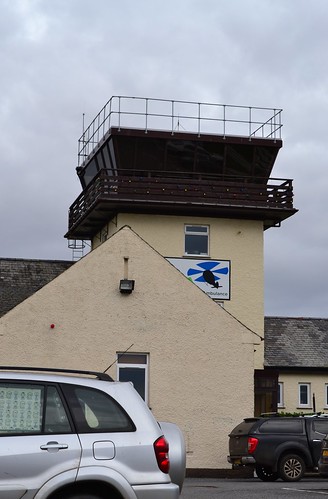
The current Watch Office at Scone (Perth Airport).
The original twelve training aircraft supplied by the RAF were also going to be insufficient, so a further eight were obtained giving of total of twenty, a mix of Tiger Moths (DH.82) along with a handful of Hawker Harts and Hawker Hinds. Over the next few months, various other models would be obtained and used by the unit at Scone, these included: Audax, Fairy Battles and Avro Ansons at some point.
With the number of operators using the site growing, it was going to be busy, and the ground would take considerable punishment. But the cold winter weather prevented the growth of newly laid grass and so, for a period of some two months, 11 E&RFTS moved out until the grass had established itself and the colder weather had passed.
Not long after this, the airfield was officially opened. On June 5th, 1936, a grand ceremony, led by Viscount Swindon, and a number of dignitaries, saw the airfield officially handed over to the Airwork Company under the management of P. Perkins, the general manager of Airworks – Scone had been born.
Even with all the development and extension work that had been going on, Scone would remain a relatively rudimentary station. On site, there would be a watch office, a single Civil 160 x 90 ft hangar; one 120 x 110 ft hangar, six blister hangars but no hardstands and the runways remained grass. A hard perimeter track did circumnavigate the airfield and although it only had two runways, a third strip was also used. A set up that would see Scone enter the war.
In Part 2, Scone develops as the war progresses. Pilot training and maintenance work increases.
The full history of Scone can be read in Trail 56.
 Aviation Trails
I had not heard this very interesting story about the stone of Scone. I learned several years ago that King Edward I and Queen Eleanor are my 23rd-great-grandparents. When I visited England in 2019, I made sure to see the Eleanor Cross in Geddington. Next visit to the UK, I’ll make a point to visit Perth and see the stone of Scone in the Perth museum!
LikeLiked by 1 person
It’s certainly a beautiful part of the world and for history is excellent. There was a film made about the stone, I think it was on Netflix, worth a watch too if you can get it.
LikeLiked by 1 person
Thanks for that info. The movie Stone of Destiny is not on US Netflix right now, but I think I can find it through other streaming services. Sounds interesting.
LikeLiked by 1 person
I hope you find it.
LikeLiked by 1 person
Found the Stone of Destiny movie on the Roku Channel, for free, too! Watched it last night and enjoyed it! Thanks for making me aware of it!
LikeLiked by 1 person
You are very welcome. I’m glad you found it and enjoyed it!
LikeLiked by 1 person
“Scohne”, Scon” and now “Scoone”! However you pronounce it, I prefer mine with butter, strawberry jam and clotted cream!
Seriously though, the story so far reminds me very much of that of my local (now sadly long gone) airfield, RAF Gravesend.
LikeLiked by 1 person
I had a little bet with myself as to who would bring that up. I won! Can’t beat a good scone with jam and cream though can you. I guess it’s not too dissimilar to Gravesend, certainly in its development, and as with both, it gets bigger as time goes on.
LikeLike
Oh I think it was a forgone conclusion that I’d be the one to raise the Devon Cream Tea subject! 🤣🤣
LikeLiked by 1 person
Indeed. I had a pretty safe bet! 😂
LikeLiked by 1 person