RAF East Kirkby – Part 2 – a Relentless Slog.

In Part 1 we saw how East Kirkby came about, how its one main unit was used to create further units and how the war had taken its toll on those stationed here. In this part, we end 1943, but the high hopes of better things are far, far away.

The opening of September 1943, was however, the tip of the iceberg, for on the night of 23rd – 24th, three more aircraft were lost whilst on operations to Mannheim; all but five of the twenty-one men involved being killed, with those surviving five being incarcerated by the German forces. The operation had seen almost 630 aircraft take part in a raid that resulted in huge devastation with over 25,000 people being bombed out of their homes.

With the loss of two further aircraft in the closing days of September, the total dead or captured stood at seven Lancasters (forty-nine crewmen) with only four airmen returning to their Lincolnshire home. It had been a devastating start for the squadron at their new home in Lincolnshire.

October 1943 was much the same, major battles over the German Reich took further tolls with another four Lancasters falling from the skies. Most of these crews were also killed with just a handful surviving to be taken prisoner. The numbers of experienced crews on roll were quickly dwindling and replacements were now urgently needed.

NX611 'Just Jane'

The Lancaster ‘DX-F’ at East Kirkby, paying tribute to all those who flew from the airfield and in Bomber Command.

Then in mid November, 57 Sqn would be split for a second time to form yet another new squadron. This time, ‘B’ Flight were taken out and re-designated 630 Sqn. Initially being given the designation of an auxiliary squadron, it was however, a status that was never achieved. The entire flight consisting of nine crews and 106 ground staff, were led by the American, Sqn. Ldr. Malcom Crocker DFC, who simply moved across the airfield locating to new quarters and new dispersals, thus creating two operational squadrons at the site. Being battle hardened already, it took less than three days to complete the move before operations for them began once again.

November also saw Bomber Command enter its fourth month of the ‘Battle of Berlin‘, a period that saw intense bombing of the German capital with repeated raids on the city by heavy bombers of the RAF. It was also a time when the ill-fated Stirlings were finally pulled out of front line bombing campaigns, their losses becoming insurmountable. The decision to do so however, would put further pressure on the Lancaster and Halifax crews who were then left to complete the job with fewer aircraft and increasingly tired crews.

This period would become one of the RAF’s most testing times, and for the next four and a half months, Bomber Command, led by Sir Arthur Harris,  would continue to pound Berlin and other major cities deep inside Germany. The winter would be harsh, flights would be long, and it would be a gruelling time for the crews of Bomber Command.

The void left by the Stirlings was filled by the Halifaxes, and their loses now also soared. The battle for Berlin was a battle that would quickly diminish the capability of the RAF if loses were to continue at their current pace.

As the war entered 1944, the crews of Bomber Command became weakened and tired. Extensive battles had taken their toll and a rest was much needed. With poor weather dominating January that rest came, as crews were grounded unable to fly in the appalling winter weather.

The new year would see 617 Squadron dominate the way for 5 Group, their fame and successes taking a large chunk of the new reels. However, at East Kirkby, 630 Squadron would take on a new commander with the arrival of Wing Commander Deas in early February, taking over from Wing Commander J. Rollinson. Deas would continue to lead the squadron for the next five months, as it battled its way through the harsh winter period into spring and onto summer.

The pressure was however on Harris. He was now ordered to turn his men away from Berlin and help the Americans with the invasion plans supporting them in Operation Argument, otherwise known as ‘Big Week’. The operation was designed to weaken the German aircraft industry to prevent reinforcements of aircraft in the build up and launch of Operation Overlord.

In one last vain attempt to hit the capital, Harris planned four nights of raids in February, but poor weather curtailed these allowing only one raid to take place that on the night of the 15th – 16th February.

In the raid, which proved to be Bomber Command’s penultimate flight over the city, both 57 and 630 Squadrons would be involved. A mix of almost 900 Halifaxes and Lancasters saw losses amounting to over forty aircraft, one of these coming from 57 Sqn and another from 630 Sqn with the loss of all crewmen.

In order to lower losses, the formations would be concentrated, dropping 2,600 tonnes of bombs in just twenty minutes, a rain-storm of explosives that would see forty-five aircraft bomb every minute.*2

With that the Battle of Berlin came to an end, fizzling out as operations turned to The Rhine and its heavily defended industrial infrastructure.

The first area targeted was Leipzig, on the night of February 19th-20th. Here another 800 plus aircraft flew to Germany and back. They met determined German fighters as soon as they crossed the coast after which ensued a relentless air battle all the way to the target. Once there, it was completely covered in cloud and sky marking by the Pathfinders was the only possible method of identifying the target. In the operation, 630 Sqn put up nineteen aircraft and 57 Sqn, twenty; all but three returned home that night.

The Leipzig attack would prove to be a disaster for Bomber Command, strong winds meaning some bombers had arrived before the Pathfinders, and then had to circle the target for some considerable time before the markers arrived. This resulted in many of them being shot down by flak with some colliding in the dark, night sky. A loss of seventy-five aircraft that night led to the withdrawal of the second of the heavies – the Merlin powered Halifaxes – from front line operations; like the Stirlings before them, their loses had become unsustainable. This move put yet another heavy burden on the Lancasters crews, as it became the main heavy bomber now able to carry the war into Germany,

The night also proved to be an important one for one East Kirkby Pilot, W.O. J. White, whose determination to get the ‘job done’ and come home, led to him receiving the award of a DFM. In the attack, his rear gunner was mortally wounded, and the aircraft badly shot up with both hydraulics and an outer engine rendered unserviceable. Undeterred, W.O. White carried on to the target, dropping the bombs and then returning to England. On arrival, he managed to negotiate  landing the crippled aircraft at an unfamiliar airfield away from home. His courage and determination being more than worthy of the award he received for his actions.

With no break nor time to rest, another operation was ordered the following night, and although the 20th-21st attack on Stuttgart was a clear scoreboard for 57 Sqn, 630 lost another two; one of these ‘ND563’ swinging violently to port after travelling three-quarters of the way along the main runway. After crashing through a boundary fence and crossing a road on its belly, the bomb load exploded before anyone could escape. It was a tragic loss of life for those based at East Kirkby.

BBC war correspondent Richard North interviews the crew of Lancaster “S -Sugar” of No. 630 Squadron RAF on their return to East Kirkby, after bombing the marshalling yards at Juvisy-sur-Orge, France. IWM (CH 12778)

February closed with operations to Schweinfurt and Augsburg, an enquiry into the crash of ND5663 and the funerals of those who had lost their lives that day. With one squadron each losing a further crew, losses were continuing to mount for the two squadrons.

The early spring months would finally draw to a close over two disastrous nights. The first, on 24th – 25th March, saw Harris send his men back to Berlin one more time. In a last effort to bomb the capital, the RAF sent another 800 plus aircraft to the German capital, it would prove to be one of the worst for 630 Sqn, when three aircraft, including that of W.O. J. White who had just been awarded the DFM, were lost.

It was a dramatic figure that would be repeated on the last night of the month, when almost another 800 aircraft made up of Lancasters, Halifaxes and Mosquitoes were sent to Nuremberg. Weather reports from a Meteorological Mosquito were ignored and whist the operation should have been cancelled, it went ahead. In a moon-filled sky, the  result was carnage.

By the time all aircraft had returned, losses stood at 95 crews, almost 12% of the entire force sent out, and the biggest loss for the Command of the war so far. The weather experienced had caused the biggest problems, not only for the main bomber-stream, but also for the Pathfinders,  with strong winds blowing many aircraft widely off track causing them to bomb Schweinfurt, some 50 miles away,  by mistake. Of those that did bomb the correct target, many reported that they were unable to see it due to heavy cloud, which combined with the strong winds, forced both them and the Pathfinders to mark and bomb the wrong area. As a result, little damage was done to the city, and dropping bombs too early, caused ‘creep back’ to extend for some 10 miles ahead of the target. All-in-all more crews were lost that night then there were casualties on the ground, losses that were totally unsustainable for the command.

The German defences on both nights had been extensive and determined. Tame Boar and Wild Boar tactics along with Schrage Musik, the upward firing cannons, had devastated formations who were scattered far and wide. Harris had gambled with his crews and lost.

The disastrous nights of Berlin and Nuremberg led to a short pause in operations in much the same way as the dreaded raid on Schweinfurt did for the Americans. A new focus would take no chances, and precise bombing became the order of the day.

After devastating operations over the German cities, thoughts turn to the invasion and supporting the ground forces. A choice that did not agree with Harris, but one the crews would take in their stride…

The full page can be read in Trail 1 – Lower Lincolnshire.

RAF East Kirkby – Part 1 – A new Station emerges.

In the heart of Lincolnshire lies a former wartime bomber base that holds a particular and unique item dedicated to those who served in Bomber Command. The airfield where it is housed, was only used for a relatively short period of time, and by two main operational squadrons, yet it was one which saw the greatest number lost in the whole command.

In the next part of the trail, we travel away from Woodhall Spa to a former airfield synonymous with the Lancaster – RAF East Kirkby.

RAF East Kirkby

RAF East Kirkby is one of many Bomber Command airfields located in the Eastern county of Lincolnshire, a region that known as ‘Bomber County’. During its life it was home to two main front line squadrons along with a handful of other support units.

The airfield sits some 4 miles south-west of Spilsby and 12 miles north of Boston, in an area strongly associated with the Romans. Indeed, Lincoln – or Lindum Colonia as the Romans called it – became one of the largest and most influential Roman towns in England. Later, this area was where many invading Vikings settled, providing the local towns with examples of their own Nordic names, many of which can still be seen today. As time passed, both the Normans and the armies of Cromwell played their own part in the development of Lincolnshire, meaning the region has been left littered with several hundred monuments and numerous sites of archaeological and historical interest to offer the visitor.

Being in the lower regions of Lincolnshire, parts of it are only 40 feet above sea level meaning it is an area with a rich agricultural history as well; some areas being used to grow crops and of course tulips, bringing a wealth of colour and a wide range of crop to the area. It is all this that gives Lincolnshire both its beauty and its wide ranging historical interest.

Initially, East Kirkby airfield was built as a decoy site for nearby Coningsby and Manby, the site, complete with decoy wooden Whitley bombers, was decommissioned on June 27th 1941 and the area designated for a class A airfield –  RAF East Kirkby. Following requisition of the farmland in 1942, construction began by the building company John Laing & Sons Ltd., which included, amongst others, the first flushing toilets in the area. The airfield was finally completed in 1943, opening on August 20th that same year under the control of Bomber Command.

Located to the south-east of the village that gave it its name, the apex of the ‘A’, formed by the three standard runways, pointed westward with the main runway approximately north-south and the two subsidiaries west to north-east and west to south-east, each being the standard 2,000 and 1,400 yards in length and 50 yards wide.

As a bomber airfield the much needed runways would be of a concrete construction, and the airfield would boast six T2 hangars and a single B1 for maintenance and storage; a technical area stood to the north-west, with accommodation and the bomb store, spread around the area away from the main airfield site. Dispersals for aircraft storage and preparation consisted of twenty-seven spectacle hardstands along with five loop hardstands, all located around the extensive perimeter track.

As a decoy site, it had been bombed on several occasions, and having accommodation and high explosives near to the airfield was not a good combination. These accommodation blocks were of  a ‘temporary’ construction, very different to the luxury of Scampton, from where the first residents would come.  At its height RAF East Kirkby could cater for 1,965 RAF personnel with a further 482 WAAFs all of mixed rank.

Initial ownership went to 5 Group Bomber Command, whose headquarters were at the time at Morton Hall near Swinderby, in the North Kesteven district of Lincolnshire, and would operate as 55 Base, the parent station of sub-stations Spilsby and Strubby.

A somewhat posed photo of Flt. Sgt. J Morgan, the rear gunner of a 630 Sqn. Lancaster at East Kirkby. @IWM (CH 12776)

The first resident unit was that of 57 Squadron who took it on immediately upon its opening, bringing both the Lancaster MK.I and MK.III with them.

After forming in 1916, they were, like many other squadrons at that time, disbanded after the war’s end in 1919, but then, as similar events unfolded on the continent once more, they were reformed (in 1931) to run continuously to the end of the Second World War. With further breaks post-war, they would continue to operate up to the current day, flying a wide range of aircraft from Victor tankers in the Falklands to their current model the Prefect T1 trainer at RAF Cranwell.

57’s history goes far deeper than that though, for it was whilst at Scampton, their previous home before East Kirkby, that ‘C’ Flight was separated from the main squadron to form the basis of 617 Squadron, better known as ‘The Dambusters‘; the Flight Commander, Sqn. Ldr. ‘Dinghy’ Young only being appointed to 57 Sqn a matter of weeks before the transfer took place.

However, it was at East Kirkby that 57 Squadron were now based. On August 27th 1943, just after the split, the advanced party arrived at East Kirkby to start what would be three days of moving and settling in. The first section of the main party arrived on the 28th with the remainder joining them on the 29th. During this time all flying operations were understandably cancelled and the time was allocated to the huge task of moving men and equipment over to their new base.

Operations commenced quickly on the 30th, when fourteen aircraft were detailed for operations to Munchen-Gladbach. All aircraft except one, completed the operation in which ground defences were ‘light’ and bombing was recorded as being ‘good’ with a large explosion seen in the target area. The only casualty of the flight being Lancaster MK.III ‘ED655’ which returned early with an engine failure. Thankfully though, there were no injuries nor any further problems incurred.

On the following night another fourteen aircraft were detailed to attack Berlin, the ‘big city’, an operation which brought August to an end and a total of twelve operations (179 sorties) amounting to over 940 hours flying time for the month.

It wouldn’t be long though before the first causalities would arise at the new station. On the night of September 3rd 1943, Lancaster ‘JA914’  DX-O was part of another fourteen flight raid on Berlin. On board that night was Australian Pilot Flt. Sgt. W. Grindley and his crew, which included one other Australian and a New Zealander.

After departing East Kirkby at 19:30 hrs, the aircraft made its way toward the capital. As it neared the target, search lights managed to cone the bomber, allowing a German night fighter (FW190) flown by pilot Unteroffizier Fritz Brinkmann of the Stab/JG 300, to attack the aircraft, bringing it down at Zehrensdorf with the loss of all seven crewmen on board.

Three of the crew were recovered and remained buried in the Berlin 1939-1945 War Cemetery whilst the remaining four were not. They have been commemorated on the Runnymede Memorial.  The remains of the bomber were themselves discovered in a lake, and recovered on September 29th 1997; a large section of wing which is now displayed in the Deutsches Technik Museum, in Berlin.*1

On the 22nd September, a further crew were lost when an intruder, since known to be Major Wolf Dietrich Meister of the Stab V./KG 2, flying an Me 410 A-1 from Schiphol airfield, followed the bomber home and intercepted it near to the airfield. As it fell from the sky both the Flight Engineer and the Bomb Aimer managed to escape the burning wreck, both parachuting to safety, but the other five failed to get out and were killed in the resultant crash and fire.

In Part 2, we continue with the ups and downs of life in Bomber Command, seeing how the airfield continues to develop and how the war affects those based at the Lincolnshire airfield.

The full page can be read in Trail 1 – Lower Lincolnshire.

Lt. Jack Watson 303rd BG. – From Villain to Hero.

The end of training flights in the Second World War in the quiet and blue skies of the United States, were occasionally ‘celebrated’ with flyovers and ‘buzzing’ of the home town of family or girl friend

The end of training flights in the Second World War in the quiet and blue skies of the United States, were occasionally ‘celebrated’ with flyovers and ‘buzzing’ of the home town of family or girl friends. Whilst this unofficial activity was frowned upon, in general, a blind eye was turned by Commanding Officers of the various Groups. However, one such activity was not taken quite so lightly, and almost led to the end of a promising career before it had even started.

At RAF Molesworth (Station 107) not far from Huntingdon, Cambridgeshire, the 303rd Bomb Group (BG) had been serving the Allied offensive since mid September 1942. They had taken heavy casualties after participating in many prestige missions including the disastrous August and October raids on the ball-bearing plant at Schweinfurt. The invincibility of the heavily armed B-17 was very quickly shown to be a myth.

After a period of calm, primarily due to persistent bad weather rather than any  significant strategic military decision, the USAAF was allowed unofficial time to recuperate, rebuild and rearm. During this period, new recruits and aircraft poured into the United Kingdom via either the Northern or the Southern transit routes over the Atlantic Ocean.

On one of these aircraft was Lt. Jack Watson, a ‘green’ pilot’ who had recently completed his training, and was now on his way to fight in a war a long way from his Indianapolis home.

jack watson page A fresh faced 2nd Lt. Jack Watosn who bravely brought home his burning and crippled B-17 bomber after ordering his crew to bail out. (IWM UPL 32160)

On eventual arrival at Molesworth, Lt. Watson was soon to experience for himself the horrors and reality of war. On January 11th 1944, he was part of a 291 bomber force attacking both the FW190 production factory as Oschersleben and the Junkers factory at Halberstadt, Germany. On what became one of the blackest days for the Group, eleven out of the forty aircraft dispatched were lost, an attrition rate of just over 25%, which was also the highest loss of the entire force.

On the inward flight, the weather, which had dogged much of the winter, closed in over the continent.  A recall message was sent out, the 2nd and 3rd Divisions turning for home, but it was ignored by Brigadier General Robert F. Travis, 1st Bombardment Division Commander in the lead plane – ‘The Eight Ball‘. Original orders were to bomb by visual methods but if cloud cover prevailed then pathfinder Liberators  were to mark the target.

As the weather had deteriorated, cloud being present as high as 24,000 feet, fighter cover was all but withdrawn. The bombers were now virtually on their own and much smaller in number.

Alerted early on, the Luftwaffe had managed to form an enormous welcoming party for the now weakened force. It would be the strongest collection of Luftwaffe aircraft since the October raids, and it was waiting, eager for blood.

The first contact between the two forces was made over the shallow waters of the  Zuiderzee on the inward flight. A collection of rocket-firing fighters launched a gruesome attack on the lead section of the 303rd, an attack that lasted for several hours and took out numerous aircraft.

From the Initial point (IP) to the target, flak was light but accurate, more aircraft took hits and further damage was sustained by the formation. Those bombers that did get through managed to bomb the target, the accuracy of which was considered ‘excellent’.

On the return flight  B-17F #42-29524 ‘Meat Hound‘, piloted by Lt. Jack Watson was attacked again by waves of enemy fighters who zoned in on the bomber and its supporting formation. With many aircraft now crippled, the B-17s were easy targets for the fierce and determined Luftwaffe defenders.

Lt. Watson’s aircraft, (a B-17F-55-BO, which had previously been assigned to the 306th BG transferring to the 303rd in July 1943), was hit hard over Durgerdam. The damage looked terminal, two engines were on fire, there was substantial damage around the wing root and the left elevator had been shot completely off. With such damage, not only was the aircraft difficult to control but it was losing vital airspeed and altitude as well.

Lt. Watson, gave the bail out order, holding the aircraft steady until all the crew had departed. Lt. Watson, who had by then put the aircraft on automatic pilot, was himself preparing to jump, but the thought of the cold waters below forced his retreat to the cockpit and the challenge of getting home alone.

Of those who did jump, four fell into the Ijsselmeer and sadly drowned, and another four were caught by occupying forces and sent to POW camps. The ninth, Lt. Col. Clayton David, the Co-Pilot, managed to evade capture eventually making his way back to England. Clayton’s journey took him through Holland and Belgium and on into France, where he headed south, eventually crossing the Pyrenees into Spain. From there, he reached Gibraltar eventually returning to England in May 1944, four months after he was reported as ‘Missing in Action.’ For his efforts he received the Purple Heart*1.

Lt. Watson, now alone in the crippled B-17 fought on, keeping the aircraft flying toward England. Once over home territory he brought the aircraft down through the thick cloud that had dogged so many of Britain’s airfields that winter, landing at RAF Metfield, an American Fighter airfield home at that time to the 353rd Fighter Group.

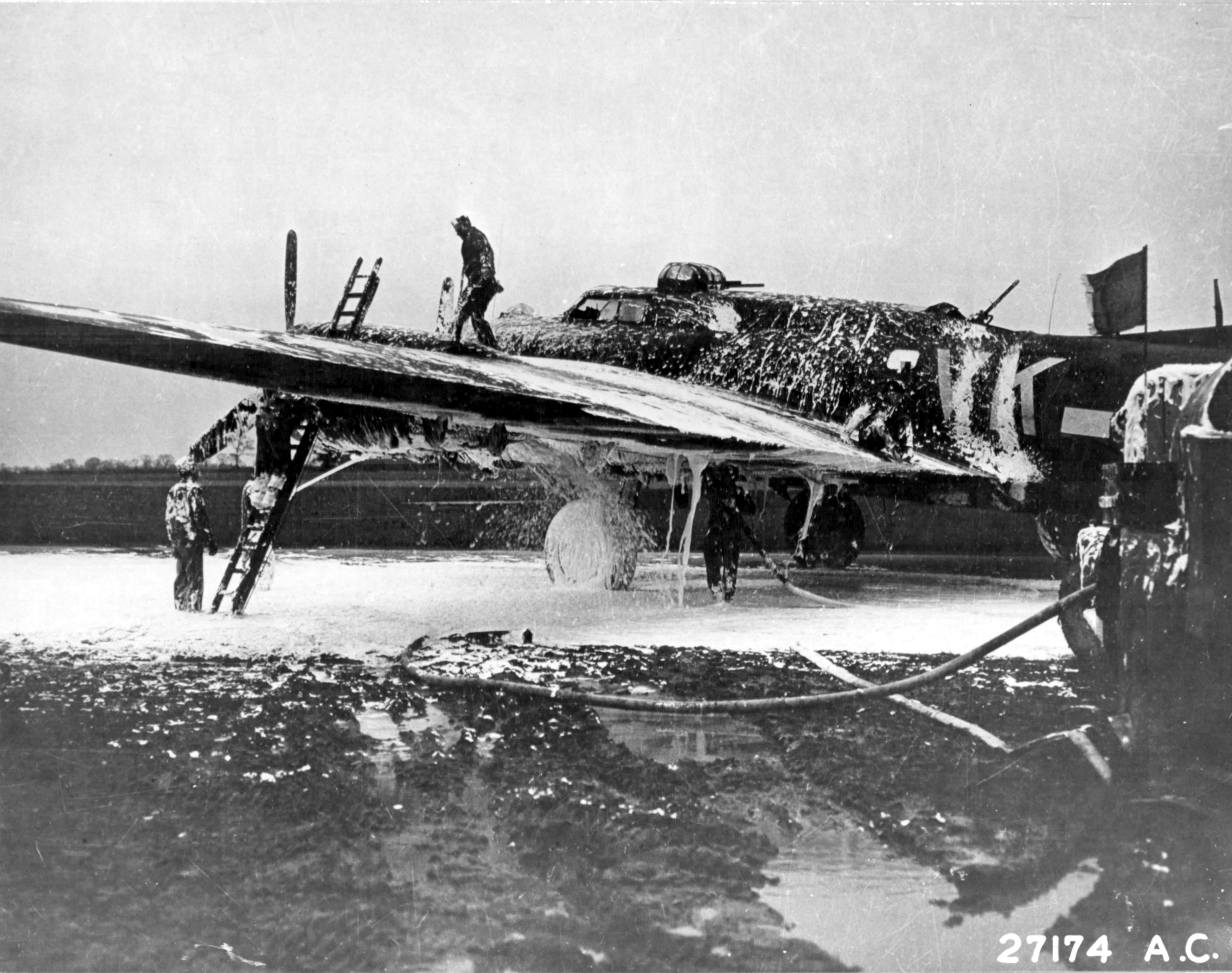
So severe was the fire on the aircraft that it took fire crews a considerable time to extinguish it. These crews were not only amazed to see just one crewman exit the aircraft, but also to find an unexploded shell sitting directly behind the pilots seat.

WM UPL 32171 B-17 ‘Meat Hound‘ on the ground at Metfield, Suffolk after landing with two burning engines. The aircraft was subsequently written off and salvaged for usable parts.  (IWM UPL 32171).

On his arrival back at Molesworth, Lt Watson received a telegram sent by New York Mayor Fiorello LaGuardia, forgiving Watson for his villainous activity previously in late 1943.

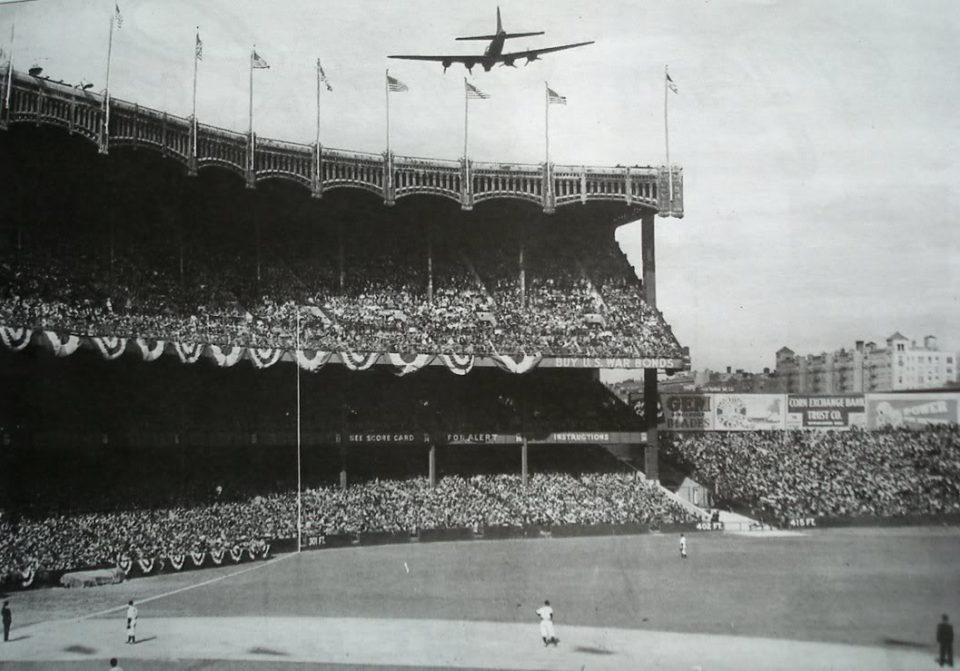
It was at this time that Watson along with three other pilots; 2nd Lts. Robert Sheets, Elmer Young, and Joseph Wheeler, buzzed the World Series game between St. Louis Cardinals and the New York Yankees at the Yankee Stadium, New York. Mayor LaGuardia was so incensed by the action at the time, that he insisted Watson and the others be disciplined, court martial proceedings being instigated as soon as the four landed in Maine*2.

However, it was not to be, the top brass needing every aircraft and crewman they could muster, sent the four on their way with a $75 fine and a stiff telling off!

Although tinged by the sad loss of his crew, the villain of the World Series’ Buzzing, had gone on to prove himself more than a worthy pilot, making history in more ways than one.

Yankee Stadium, Bronx, NY, October 5, 1943 – B-17 Flying Fortress bombers makes a surprise visit during the first game of the 1943 World Series

A Boeing B-17 ‘buzzes’ the Yankee stadium October 5th 1943. (Author unknown).*3

The crew of ‘Meat Hound‘ were:

Pilot – 2nd Lt. Jack Watson (Returned to Duty)
Co-Pilot – Lt Col. Clayton David (Evaded)
Navigator – 2nd Lt. John Leverton (POW)
Radio Operator –  Stf. Sgt. Harry Romaniec (KIA)
Bombardier – 2nd Lt. Vance Colvin (KIA)
Flight Engineer/Top Turret Gunner – Stf. Sgt. Sam Rowland (POW)
Right Waist Gunner – Sgt. William Fussner (KIA)
Left Waist Gunner – Gene Stewart (POW)
Tail Gunner – Sgt. Roman Kosinski (POW)
Ball Turret Gunner – Sgt. Fred Booth (KIA)

The B-17F, #42-29524, was delivered to Denver 31st December 1942; then assigned to the 423rd BS (306th BG) as ‘RD-D’ at Thurleigh 2nd March 1943. It was later transferred to the  358th BS (303rd BG) as ‘VK-K’ based at Molesworth on 30th July 1943.

For their efforts in this mission, the 303rd Bomb Group were awarded a Distinguished Unit Citation, the only time the entire unit achieved such an accolade.

This and other similar stories appears in Heroic tales of World War 2.

Sources and Further Reading.

Missing Air Crew Report 4269

*1 Herald-Whig Obituaries Website accessed 27/5/19

*2 303rd BG website ‘Outfield Fly’ by Hap Rocketto accessed 27/5/19

*3 Photo appeared in ‘Old-Time Baseball Photos and Essays’, blogsite. accessed 27/5/19