In Part 2 of this Trail, we saw how the 55th FG finally departed Nuthampstead having been dogged by mechanical problems. In this part, they are replaced by the 398th BG, a heavy bomber group who brought the B-17 ‘Flying Fortress’ with them. As ‘rookie’ crews though, their start may not have been the start they had wished for.
The new Group was a Heavy Bomber Group, equipped with B-17Gs, and would be the last Fortress Group to join the USAAF. Made up of four squadrons: 600th, 601st, 602nd and 603rd Bomb Squadrons (BS), the first personnel would arrive in Liverpool, on April 21st 1944, sailing on the USS Wakefield from Boston. Once at Nuthampstead, they would begin combat flights in a matter of days, their first mission taking place an May 6th that year.
Their journey to Nuthampstead had been a long one. Being activated on 1st March 1943 with a cadre from the 34th BG at Blythe, California. They trained hard, transferring to Orlando in Florida and then onto Spokane, Washington. In June 143, they transferred once more, this time to Rapid City, South Dakota, each time picking up new staff and crews as they went.
During training in the Autumn of 1943, the monotony of routine was broken when 2nd Lt. Thompson Highfill displayed courage and to assure the safety of his crew. After his B-17 suffered engine failure and complete wing disintegration, he ordered the crew to bale out, holding the aircraft as steady as he could whilst they made their escape. Too low to use his own chute, he made a wheels up landing, for which he was awarded the Distinguished Flying Cross, the first to the unit.
After further moves the unit was eventually war ready, and on March 24th 1944, the advance party began their journey to England. On April 22nd, the ground echelon arrived at Nuthampstead, the same day as the first section of the air echelon.
Having only been activated the year before, the 398th were a novice Group, but that would not prevent them operating against important strategic targets in Germany. These operations would include factories in Berlin, warehouses in Munich, marshalling yards in Saarbrucken, shipping facilities and docks in Kiel, along with oil refineries and aircraft production facilities in Munster. Thus even as a new unit, it would take part in some of the heaviest attacks on German industrial centres.
On May 6th, the 398th went into action for the first time, and like other newbies, it was a disaster. Although these missions were not seen as full missions (flying the full complement of aircraft and crews) they were nevertheless important in the development of the crews, honing their skills and allowing them to begin gelling as a close knit crew.
The morning started badly when breakfast was delayed. The take off as a result was also late with departures being badly timed. Forming up was ‘less than tidy’, with ten of the eighteen aircraft forming up on the wrong formation or in the wrong place. Once over the target, the ‘V’-weapons site at Sottevast, cloud prevented the bombers from seeing the target and so they returned without dropping a single bomb. Their inauguration had been far from successful but looking at it positively, there were no loses and all aircraft returned unharmed.
The rest of May saw the Group fly to Berlin no less than four times, in addition to targets at Kiel, Saarbrucken, Ludwigshafen, Ruhland and Dessau in Germany. They also flew to several targets in both France and Poland meaning there had been no let up for the novice flyers.
During the lead up to D-day, the 398th would attack coastal defences along the Cherbourg peninsula, softening up defences for the invasion forces who were about to land along the Normandy coast. These and other targets in France would dominate the early weeks of June, whilst July saw a return to the homeland and targets deep into Germany once more.
October 15th brought the true realities of war to the Group when a flak shell hit B-17G #43-38172 in the nose exploding inside the aircraft. The Toggler/bombardier, Sgt George Abbott, was killed outright, and the instruments were all but obliterated. With no oxygen and the nose barely recognisable, the pilot 1st Lt. Lawrence DeLancey, managed to bring the B-17 home thus saving the lives of the other crewmen on board.
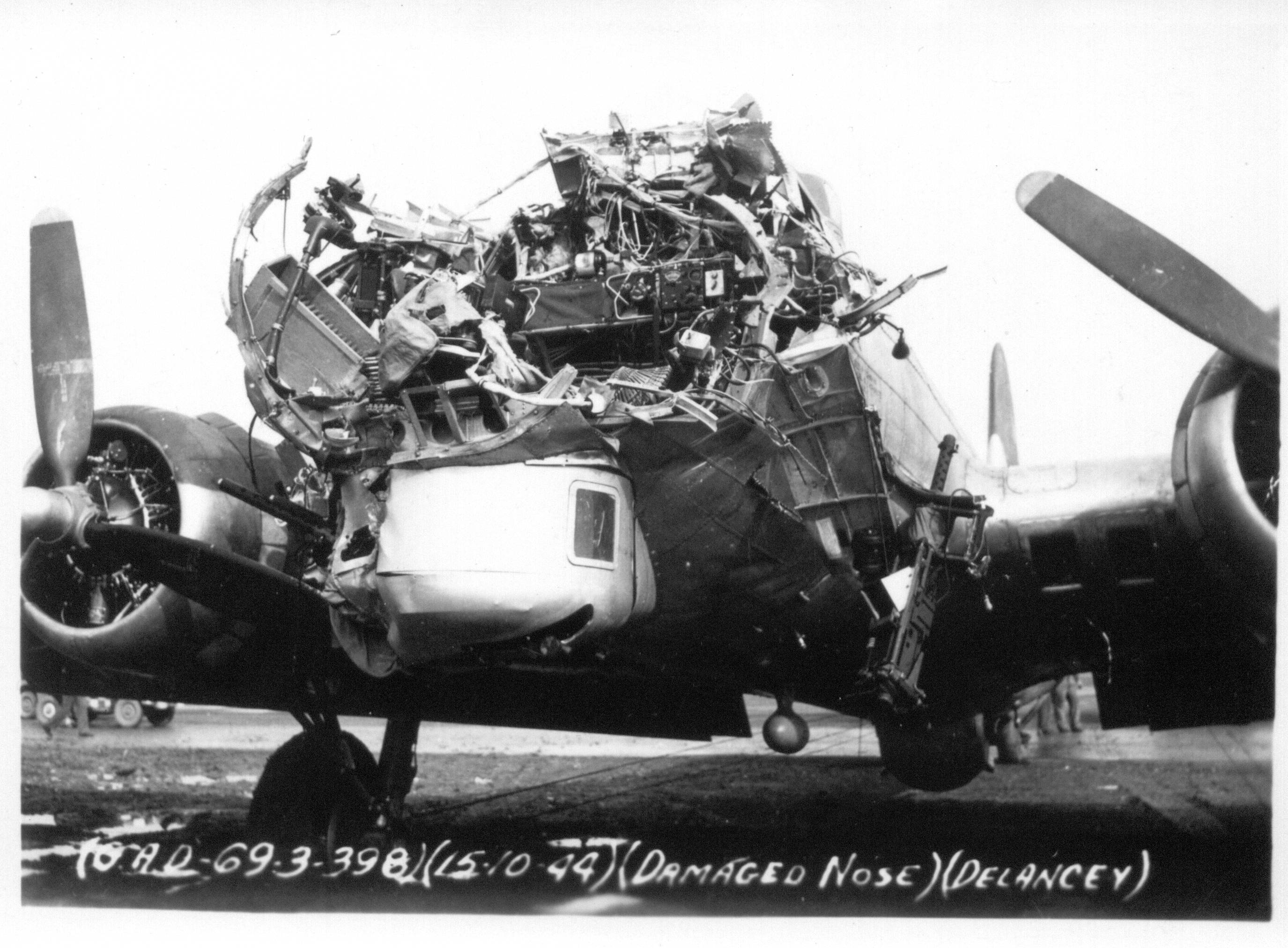
B-17G #43-38172 “2 Sad Lovely Julie” hit in the nose by flak, killing the bombardier outright. (@IWM UPL13907)
For his actions, Lawrence De Lancey was awarded the Silver Star, Lt. General Doolittle’s letter citing the “sheer determination and tenacity” of De Lancey in bringing the aircraft and remaining crew home safely.
Christmas 1944 saw no easing up for the crews. On Christmas Eve, orders came through for every available bomber to be airborne. The winter of 1944-45 being one of the worst saw ground forces take a pounding in the Ardennes by a desperate last attempt at a breakthrough by the German land forces. Taking advantage of the fog and mist that had prevailed, air cover was limited for the allies but as soon as a break occurred, they would return in large numbers. That break occurred momentarily on the 24th.
Over 2,000 bombers of the Eighth Air Force, (which included 500 RAF and number of bombers from the Ninth AF) took to the skies that day, the largest Eighth Air Force operation to assemble over enemy territory in history.
The flyers did not experience mass opposition, in fact it was insufficient to make a difference, and so the operation fulfilled its objective of destroying supply links and disrupting airfield operations. On the way home, the bombers were faced with encroaching haze, many UK airfields becoming closed in and closed to landings. The 1st Air Division (formally 1st Bomb Division) were faced with a thick fog that forced them to land elsewhere, the 398th coming in at Ridgewell along with the 351st and Ridgwell’s normal residents the 381st. Christmas for the crews would be spent away from their England home that year.
On 3rd February 1945, the 1st AD were part of a force attacking Berlin again, lead by the 91st BG with Lt. Col. Marvin Lord, the group Operations manager who was chalking one up, never having flown to Berlin before, he took over from the normal lead pilot who was on a short pass.
As the formation neared the initial point (IP) over Lehmke, near Gardelegen, the formation began to close up causing extensive turbulence from prop wash. Before the bombardiers took over, aircraft jostled for positions ensuring their safe place in the group. At this point, it took two pilots to control the buffeting aircraft, as they were thrown about the sky within the ever tightening formation. Ninth in line were the 398th BG led by 1st Lt. Perry Powell in B-17G #43-38697, of the 603rd BS.
Affected by this powerful prop-wash, Powell decided to drop back and in doing so he got too close to the low squadron. His automatic reaction was to lift the nose of his heavily laden B-17, a reaction that caused the air-frame to suffer extreme stress, stresses that caused the fuselage to split open around the ball turret, sending the powerful front end into the front of Lt. John McCormick’s B-17 #42-97387 of the 602nd BS. The collision cut away the nose of the second aircraft. With no parachutes or safety straps, the navigator 2nd Lt. Second Lieutenant Bruce Phelps fell to his death.
Now no longer flyable aircraft, both B-17s began to fall, spiralling toward the ground and their inevitable fate – of the two crews, only three were seen to escape that day.
Out of Perry Powell’s aircraft, #43-38697, eight were killed, only the tail gunner S.Sgt. Joe Bancroft survived becoming a prisoner of war. From John McCormick’s B-17, #42-97387, only he and the Bombardier, Bill Logan, survived, seven losing their lives in the tragic accident that marred the operation that day*3, *4.
Later that month, on the 13th, the 398th would take part in the hugely disputed attack on Dresden, a combined force of Allied aircraft that would drop in excess of 4,500 tons of bombs on a city whose conditions led to a firestorm that killed more than 25,000 inhabitants.
In the last part we see how Nuthampstead’s war comes to a close. The airfield no longer required eventually closes, but not before it enters a great debate about its future and possible expansion.
The full history of RAF Nuthampstead can be read in Trail 32.
 Aviation Trails