Numerous churches across England have beautiful and ornate stained glass windows, many depicting stories from the Bible, some simply as decoration and some describing the lives of Saints, heraldry or angels. They are from a wide range of periods and cover a range of styles, although in each, lead framing provides the medium in which the glass is held together to form the window as a whole.
Each one is made from delicate and fragile glass, and although very decorative, they are vital to the churches integrity and to prevent water ingress. The oldest in-situ window dates back to the 12th Century, but fragments of glass have been found dating as far back as the 7th Century, when they were excavated at two monastery sites in both Monkwearmouth and Jarrow, both in Northumbria, in Northern England.
However, with the decline in the need for stained glass windows, the skill of making them has also declined. Thankfully though, due to the need for restoration and demand from modern churches, some skilled professionals do still make and restore these delightful pieces of art.
Stained galls windows have also been used more recently in the post war period as memorials to various bases, squadrons, and personnel who were lost during the Second World War, and these are just as ornate and delicate in their design as their original forbears.
A more recent example, and probably the most intricate one I’ve seen, is the memorial window in the Norman church St. George’s, Anstey, in East Hertfordshire, not far from the former RAF Nuthampstead, previously an American bomber base and the airfield to which it applies.
The window itself – dedicated in 2000 – was designed by Patrick Reyntiens, himself a veteran whose artistic career includes work at Westminster Abbey, Coventry Cathedral and the Washington Cathedral in Washington DC. He took his inspiration for this window from the Old Testament, in particular the journey of the Israelites out of Egypt, and when designing the window, split it into three separate panels.
The right panel depicts a pillar of fire, which led the Israelites by night. It is intertwined with B-17s utilising the fire to show the chaos and violence from which the crews emerged after their daylight bombing raids. Each B-17 shows the tail identification letter and the red wing and tail stripes of the 398th BG. The left panel portrays a pillar of smoke, from Exodus in the Old Testament, which led the Israelites by day, and again depicts the B-17s of the 398th as they perform their daylight operations. The centre panel, is a series of flying butterflies, mainly in silver, and symbolise the flight and transformation of the soul after death; something that occurred to all squadrons and bomb groups of the allied Air Forces. A close look at the window will reveal several of these butterflies are yellow, each forming part of a huge cross whose arms stretch out across the top of the window encompassing three birds.
What is particularly significant about these butterflies is that twenty-eight of them hold the names and squadron number of all those who lost their lives whilst serving with the 398th BG at Nuthampstead.
In all, there were 278 men killed on operations, with a further 10 either killed on base or in transit from the States, and another 7 killed whilst training in the United States – 294 personnel in total.
One of the many butterflies that hold the names of those lost at Nuthampstead.
St. George’s church was itself involved in the war when a B-17 from nearby Nuthampstead crashed into the castle mound located behind the church. No major damage was done to the church as the aircraft’s bombs did not explode, but, windows were blown damaged, the remnants of which are visible today.
The church can be found in the small village of Anstey, just south-west of the airfield site. To accompany the window, a booklet, free to visitors, has been complied by two, now very grown up, children of former 398th BG crewmen, Lee Anne Bradbury and Randy Strange. The booklet details every name on the window with details of its precise location within the butterflies. It also details each mission and loss statistic including those lost on training or whilst not on operations. It is a very useful and valuable addition to this amazing window.
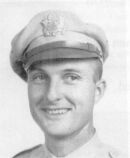
The story of Leon Vance is one of the saddest stories to emerge from the Second World War. He was a young American, who through his bravery and dedication, saved the lives of his colleagues and prevented their heavily stricken aircraft from crashing into populated areas of southern England. Following a mission over France, his was very severely injured, but miraculously fought on.
Leon Robert Vance, Jr. known as ‘Bob’ to his family and friends, was born in Enid, Oklahoma, on August 11th, 1916. He graduated from high school in 1933 after receiving many honours and being singled out as a high performing athlete. He went on, after University, to the prestigious Training College at West Point in 1935, staying until his graduation four years later in 1939. It was here, at West Point, he would meet and marry his wife Georgette Brown. He and Georgette would later have a daughter, after whom Vance would name his own aircraft ‘The Sharon D’.
Vance would become an aircrew instructor, and would have various postings around the United States. He became great friends with a Texan, Lieutenant Horace S. Carswell, with whom he would leave the Air Corps training program to fly combat missions in B-24 Liberators. They became great friends but would go on to fight in different theatres.
Prior to receiving his posting, Vance undertook training on Consolidated B-24s. Then, in October 1943, as a Lieutenant Colonel, he was posted to Europe with the newly formed 489th Bombardment Group (Heavy), as the Deputy Group Commander. One of the last groups to be assigned to the European theatre, they formed part of the 95th Combat Bombardment Wing (2nd Bomb Division), Eighth Air Force, and were sent to RAF Halesworth (RAF Holton) designated Station 365 by the USAAF.
The group left their initial base at Wendover Field, Utah in April / May 1944 and their first mission would be that same month on May 30th, 1944, as part of a combined attack on communication sites, rail yards and airfields. A total of 364 B-24s were to attack the Luftwaffe bases at Oldenburg, Rotenburg and Zwischenahn, along with other targets of opportunity far to the north in the German homeland. With only 1 aircraft lost and 38 damaged, it was considered a success and a good start to the 489th’s campaign.
As the build up to Normandy developed, Vance and the 489th would be assigned to bombing targets in northern France in support of the Normandy invasion about to take place further to the south. An area the unit would concentrate on, prior to the Allied beach invasion on June 6th that year.
The day before D-day, the 489th would fly to Wimereaux, in the Pas-de-Calais region of northern France. This would be Leon Vance’s final mission.
B-24H Liberator of the 489thBG, RAF Halesworth*2
The group, (Mission 392), consisted of 423 B-17s and 203 B-24s and were to hit German coastal defences including: Le Havre, Caen, Boulogne and Cherbourg areas as a precursor to the Normandy invasion. Some 127 P-47s and 245 P-51s would support the attacks. The 489th would assemble at 22,500 feet on the morning of June 5th, proceed to the south of Wimereaux, fly over dropping their payload, and then return to England. On the run in to the target, Vance was stationed behind the pilot and copilot. The lead plane encountered a problem and bombs failed to jettison. Vance ordered a second run, and it was on this run that his plane, Missouri Sue, took several devastating hits.
Four of the crew members, including the pilot were killed and Vance himself was severely injured. His foot became lodged in the metal work behind the co-pilots seat. There were frantic calls over the intercom and the situation looked bad for those remaining on board. To further exacerbate the problems, one of the 500lb bombs had remained inside the bomb bay armed and in a deadly state, three of the four engines were disabled, and fuel spewed from ruptured lines inside the fuselage.
Losing height rapidly, the co-pilot put the aircraft into a dive to increase airspeed. The radio operator, placed a makeshift tourniquet around Vance’s leg, and the fourth engine was feathered. They would then glide toward the English coast.
The aircraft was too damaged to control safely, so once over English soil, Vance ordered those who could, to bail out. He then turned the aircraft himself out to the English Channel to attempt a belly landing on the water. A dangerous operation in any aircraft, let alone a heavy bomber with an armed bomb and no power.
Still trapped by the remains of his foot, laying on the floor and using only aileron and elevators, he ensured the remaining crew left before the aircraft struck the sea. The impact caused the upper turret to collapse, effectively trapping Vance inside the cockpit. By sheer luck, an explosion occurred that threw Vance out of the sinking wreckage, his foot now severed. He remained in the sea searching for whom he believed to be the radio operator, until picked up by the RAF’s Air Sea Rescue units.
Vance was alive, but severely injured. He would spend a number of weeks, recuperating in hospital, writing home and gradually regaining his strength. Disappointed that his flying career was over, he looked forward to seeing his wife and young child once more. However, on a recuperation trip to London, Vance met a young boy, who innocently, and without thought, told him he wouldn’t miss his foot. The emotional, impact of this comment was devastating to Vance and he fell into depression. Then, news of his father’s death pushed him down even further.
Eventually, on July 26th, 1944 Vance was given the all clear to return home and he joined other wounded troops on-board a C-54, bound for the US. It was never to arrive there.
The aircraft disappeared somewhere between Iceland and Newfoundland. It has never been found nor has the body of Leon Vance or any of the others on board that day. Vance’s recommendations for the Medal of Honour came through in the following January (4th), but at the request of his wife, was delayed until October 11th 1946, so his daughter could be presented the medal in her father’s name.
The citation for Leon Vance reads:
“For conspicuous gallantry and intrepidity above and beyond the call of duty on 5 June 1944, when he led a Heavy Bombardment Group, in an attack against defended enemy coastal positions in the vicinity of Wimereaux, France. Approaching the target, his aircraft was hit repeatedly by antiaircraft fire which seriously crippled the ship, killed the pilot, and wounded several members of the crew, including Lt. Col. Vance, whose right foot was practically severed. In spite of his injury, and with 3 engines lost to the flak, he led his formation over the target, bombing it successfully. After applying a tourniquet to his leg with the aid of the radar operator, Lt. Col. Vance, realizing that the ship was approaching a stall altitude with the 1 remaining engine failing, struggled to a semi-upright position beside the copilot and took over control of the ship. Cutting the power and feathering the last engine he put the aircraft in glide sufficiently steep to maintain his airspeed. Gradually losing altitude, he at last reached the English coast, whereupon he ordered all members of the crew to bail out as he knew they would all safely make land. But he received a message over the interphone system which led him to believe 1 of the crew members was unable to jump due to injuries; so he made the decision to ditch the ship in the channel, thereby giving this man a chance for life. To add further to the danger of ditching the ship in his crippled condition, there was a 500-pound bomb hung up in the bomb bay. Unable to climb into the seat vacated by the copilot, since his foot, hanging on to his leg by a few tendons, had become lodged behind the copilot’s seat, he nevertheless made a successful ditching while lying on the floor using only aileron and elevators for control and the side window of the cockpit for visual reference. On coming to rest in the water the aircraft commenced to sink rapidly with Lt. Col. Vance pinned in the cockpit by the upper turret which had crashed in during the landing. As it was settling beneath the waves an explosion occurred which threw Lt. Col. Vance clear of the wreckage. After clinging to a piece of floating wreckage until he could muster enough strength to inflate his life vest he began searching for the crew member whom he believed to be aboard. Failing to find anyone he began swimming and was found approximately 50 minutes later by an Air-Sea Rescue craft. By his extraordinary flying skill and gallant leadership, despite his grave injury, Lt. Col. Vance led his formation to a successful bombing of the assigned target and returned the crew to a point where they could bail out with safety. His gallant and valorous decision to ditch the aircraft in order to give the crew member he believed to be aboard a chance for life exemplifies the highest traditions of the U.S. Armed Forces”*2
Leon Vance’s actions would be remembered. His local base in Oklahoma was renamed ‘Vance Air Force Base’ on July 9th, 1949. The gate at Tinker Air Force Base, Oklahoma was also later named after him on May 9th, 1997, and his name appears on the ‘Wall of the Missing’ at Madingley American War Cemetery in Cambridge, England.
The American War Cemetery, Madingley. Leon Vance’s Name Appears on the wall of the missing (to the left of the picture).
Leon Robert Vance, Jr. (August 11th, 1916 – July 26th, 1944)
After leaving the open expanses of Deopham Green and the roar of Snetterton, we head to a very remote and quiet airfield. Quiet and remote for a very special reason. From here, crews would experience top-secret flights, we would see a link to one of America’s greatest and most powerful families, and from here, the RAF would strike another blow at the heart of the Gestapo. We head to RAF Fersfield.
RAF Fersfield (Station 140/554)
29th August 1946. Photograph taken by No. 541 Squadron, sortie number RAF/106G/UK/1707. English Heritage (RAF Photography).*1
Originally built as a satellite for RAF Knettishall, RAF Fersfield was built-in late 1943. The third Class A airfield on this Trail, its main runway ran along a NE-SW direction, was 2,000 yds in length and was constructed of concrete. There was a second and third runway each of 1,400 yds running N-S and E-W, again of concrete. Fersfield had two T-2 Hangars, one to the north side and one to the south, and 50 loop dispersals for aircraft storage. The bomb dump was located to the north, the technical area to the south and the accommodation blocks to the south and south-west. Fersfield would eventually be able to accommodate up to 2,000 personnel of mixed rank and gender.
Initially, the airfield was called Winfarthing and designated station 140, it was then handed over to the USAAF who would rename it Station 554.
Fersfield was specifically chosen for its remote location as, unknown to those who came here, it was going to play a major role in the battle over Europe.
The first residents were a detachment of the 388th Bomb Group (BG) who were then based at Knettishall, and consisted of four bomb squadrons: the 560th, 561st, 562nd and 563rd. A detachment specifically from the 562nd, were brought here to perform special operations and research into radio controlled bombs using war-weary B-17s and B-24s. These special flights taking place between July 12th 1944 and 1st January 1945.
The 388th were unique in many ways. Aside from their work in radio controlled flights, they were also the only unit in the USAAF to not have formal squadron identification codes. However, after VE day and the end of hostilities, wireless transmitter codes were applied to aircraft under the left wing preceded with the aircraft’s individual letter as a prefix. This then, gave a unique four letter identification on each aircraft. Similarly, the various aircraft used as remote controlled aircraft had the top surfaces of each wing and tailplane painted white for recognition purposes. *4
An original T2 Hangar now stores grain.
Operating as Operation ‘Aphrodite‘, the idea of these operations was to remove all operational equipment from the aircraft, fill it with around 20,000 lb of ‘Torpex’ and fly it by remote control, into a specified target such as ‘V’ weapon sites, submarine pens (Operations Crossbow and Noball) or similar high prestige targets that were otherwise difficult to destroy .
Both the USAAF and USN were carrying out these trials. The Navy, also using Fersfield, called their operations ‘Anvil‘ and used the PB4Y (the Navy version of the B-24 ‘Liberator’) as their drone.
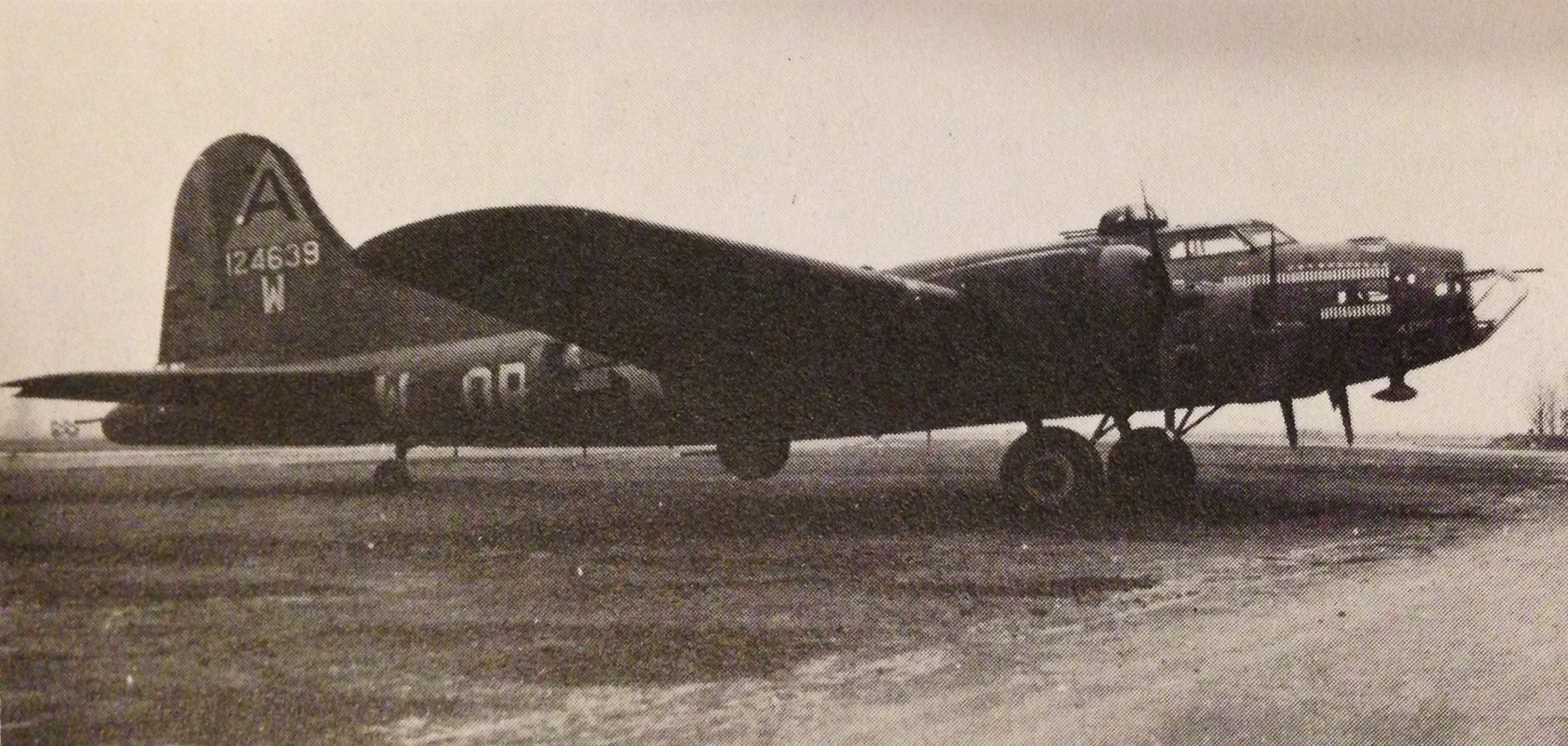
The first Aphrodite mission took place on August 4th 1944, and was to set the tone for all future operations. Mission 515, was flown using four B-17 ‘babies’ with four accompanying ‘mothers’ to target ‘V’ weapon sites at : Mimoyecques, Siracourt, Watten, and Wizernes. Escorting them were sixteen P-47s and sixteen P-51s. One of the babies, B-17 (#42-39835) ‘Wantta Spa(r)‘ (TU-N), had completed 16 missions between November 18th 1943 and July 6th 1944 with the 351st at Polebrook, and was declared to be “war-weary”. It took off but very quickly the crew – Lt J. Fisher and T/Sgt E. Most – realised there was a problem with the altimeter causing it to climb too quickly. Whilst T/Sgt Most bailed out, Lt. Fisher struggled on with the controls until it finally crashed in an almighty fireball in woodlands at Sudbourne, Suffolk, creating a crater 100ft wide. The three remaining ‘babies’ carried on but all failed to hit their designated targets. One Mother lost control and the baby hit a Gun Battery at Gravelines, the second overshot and the third B-17F formally (#41-24639) “The Careful Virgin” (OR-W) of the 91st BG (323rd BS), hit short due to controller error.
B-17F “The Careful Virgin” before modification and whilst in the hands of the 91st BG. (USAF Photo)
Similar results were to follow in another mission only two days later, and then again in further operations throughout both the Aphrodite and Anvil projects.
The most famous tragedy of these missions was that of Lieutenant Joseph P. Kennedy Jnr, who was killed when his PB4Y unexpectedly blew up over Suffolk killing both him and his co-pilot on 12th August 1944.*2 In all, there were twenty-five drone missions completed, but none successfully hit their designated target with either control or accuracy. The missions were all considered failures and the operations were all cancelled soon after.
Former Operations Block south of the Technical site.
Another secret operation taking place from Fersfield, also involved radio controlled bombs. Designated Operation ‘Batty‘ it involved GB-4 television controlled bombs being slung underneath B-17s and guided onto targets using TV. The 563rd BS provided much of the support whilst the other squadrons in the 388th BG, the crews. In the later part of 1944, a small number of these operations were flown again with little success and this too was abandoned before it could have any significant effect on the war.
All in all, the operations carried out here, were disastrous, killing as many crews and causing as much damage to the UK as it did the enemy. However, it did mean that the Allies had entered into the drone war and set the scene for future military operations. In all, there were 19 Aphrodite missions and 6 Batty operations carried out from RAF Fersfield.
The Americans left Fersfield toward the end of 1944, and it was then handed back to the RAF. A number of units used it for short periods, primarily for aircrew training, but none for major operational flights. However, it was not the end for the airfield, as Fersfield was to have one last remarkable mission and a further claim to fame.
Nissan Huts on the former accommodation site.
One of those squadrons who came here was 613 (City of Manchester) Squadron, who arrived at Fersfield on November 20th 1944. They were one of the twenty-one Royal Auxiliary Squadrons, and were considered the ‘baby’ of the Auxiliary Air Force by the other units. Formed on 1st February 1939 as part of No. 22 (Army Cooperation) Group, under Fighter Command, they were initially created with Hawker Hinds and a few Avro Tutors. It was then with another biplane, the Hawker Hector, and the monoplane the Lysander, that they moved with to France, early in the war to attack German gun positions and drop supplies to troops trapped in Calais by the advancing Wehrmacht.
613 performed a mix of roles, from Air Sea rescue operations from Martlesham Heath, to spraying lethal gas on troops in the event of an invasion, they moved from airfield to airfield gradually exchanging their older obsolete aircraft for more modern fighters as they went. They would take on both the North American Tomahawk followed by the incredible Mustang. It was with these aircraft that they were to escort the Venturas of 487 Sqn in their disastrous attack on the the Amsterdam power station in which Leonard Trent was awarded the VC. A mix up in rendezvous times meant the Venturas went on alone to the target, and thus paid the price for not having an escort with them.
In mid 1943, 613 Sqn operated from Snailwell near Newmarket, after which the ground personnel were sent to Sculthorpe and the aircrew to Lasham in Hampshire. This was to train all the personnel on the new Mosquito that the squadron was about to receive.
On joining the 2nd Tactical Air Force, they began attacks with their ‘Mossies’ on ‘Noball’ targets, and locomotives operating on the continent. It was at Lasham that 613 would become part of the newly formed 138 Wing, which would move soon after to Swanton Morley, but not before performing a very secret and daring mission.
Flying at very low level, they were to bomb the Kunstzaal Kleizkamp Art Gallery in the Hague, a former gallery turned Gestapo records office. Here documents relating to Dutch citizens for executions, deportation to concentration camps or labour camps were kept, and so it became a vital target for the wing. The operation was a total success, the building being all but demolished whilst nearby Dutch properties remained completely untouched.
The unit operated both on D-day, and supported the Americans in the Ardennes, flying through poor weather to strafe enemy ground troops who were trying to break through the American lines.
In November, the squadron moved to the continent in support of the allied forces whilst a small detachment of Mosquito VIs arrived here at Fersfield. They remained here until 7th August 1945, taking part in training flights, the last flight out taking place on August 5th 1945. At that point the squadron was disbanded the personnel transferring to 69 Squadron until their service ran out.
However, it was on March 21st 1945, that the crews of 613 Sqn would reunite with 487 Sqn, when the three Mosquito VI units of 21 Sqn (RAF), 464 Sqn (RAAF) and 487 Sqn (RNZAF) – now part of 140 Wing – were pulled back from the continent for a special mission to attack the Gestapo Headquarters at Copenhagen. Previously based at Hunsdon, the mission was Led by Gp. Capt. R. Bateson and Sqn. Ldr. E. Sismore, who took off in Mosquito RS570 ‘X’ at 08:35 and led a group of Mosquitoes in three waves of 6 aircraft in Operation Carthage.
The Shellhaus building raid gained notoriety for two reasons. Firstly, a large part of the building was bombed and destroyed and important documents were set alight, thus achieving the overall objective of the mission; another low-level, daring raid, it was operationally a great success.
However, Mosquitoes following the initial wave, attacked what they believed to be the target building, but it was in fact, a school masked by fire and smoke. This attack caused a significant number of unintentional civilian casualties including children at the school.
Six aircraft failed to return from the mission, four Mosquitoes (one of which crashed causing the smoke and fire that masked the school) and Two P-51s that were part of a twenty-eight strong fighter escort.
This operation was one of many daring low-level raids that the wing carried out, attacking various prestige targets including the Amiens prison. Together with 138 Wing, the Mosquito under the charge of Basil Embry, more than proved itself as a successful low-level bomber aircraft capable of delivering high precision attacks on pin-point targets.
The aircraft eventually left Fersfield which signified the end of overseas operations for the site, and Fersfield would become a staging post for units prior to disbandment. Between November 1944 and September 1945 a number of units would be located here which included: 98 and 107 (one week each); 140 (four days); 180 (one week), along with 226, and 605 Sqns. Operating a number of aircraft types including: Mosquitoes (T.III), Bostons (IIa), Hurricanes (IV), Martinets (TT.III), Mitchells (III) and Anson Is, Fersfield had now had its day, and in the last months of 1945, the site was closed and the land was sold off. Fersfield had closed its door for the last time and history had been written.
Post war, Fersfield had a brief spell of motor racing on its tracks and runways, but unlike Snetterton or Podington it would not last, and in 1951 Fersfield became agricultural once more, with many of the buildings being demolished and the remainder left to rot or, some thankfully, used for storage.
A few buildings remain on the technical Site.
Today a few buildings still do remain clinging onto life. The T-2 on the south side stores grain, and a number of Nissen huts that housed the technical aspects of the airfield, are now storage for farm machinery and other associated equipment. All these can be located at the end of a small road from the village, and when visiting, I found the workers here only too willing to allow the visitor to wander freely among them. Footpaths cross the southern side of this site and to the north across the field dissecting the airfield. The path is very poorly marked and you are simply wandering across the crops. From here, you can find the last few remains of the accommodation site, further south a short distance away. Latrines and other communal buildings are shrouded in weeds, gradually disappearing beneath the undergrowth. Trees sprout from between the walls where so many walked before or after a mission. Nissen huts survive further out, now dilapidated and hastily patched, their memories mixed amongst the personal belongings of new owners.
One of the many Latrines on the communal site.
It is hard to believe that an airfield with such an iconic history such as Fersfield never made it to the high status of so many others, as surprisingly, it was here in this quiet and remote part of Norfolk that aviation history was made and American politics changed forever.
Squadrons that stayed at Fersfield in the last months of the war.
98 Sqn – Arrived here first, on April 18th 1945, remaining here until December 18th that same year with the Mitchell. They were disbanded at this point.
605 Sqn – Arrived 25th April 1945 staying until 31st August 1945 as a detachment of Mosquito VIs. They were then disbanded and renumbered as 4 Squadron.
226 Sqn – Joined 605 at Fersfield on 27th April 1945, also as a detachment but with Mitchell IIs. They too were disbanded on September 20th that same year.
180 Sqn – stayed here between 7th June and 14th June 1945, a weeks break from their airfield at Achmer to where they returned.
107 Sqn – Arrived at Fersfield a month later on 3rd July, also staying for one week with Mosquito VIs coming across from France to where they to returned.
140 Sqn – Stayed here between the 9th and 12th July 1945 with Mosquito XVIs, whilst en route from Eindhoven to Acklington.
Mosquito Mk.VIs involved in the Operation Carthage,*3.
No 487 Squadron
RS570 ‘X’
Gp Capt R N Bateson / Sqn Ldr E B Sismore (Raid Leader)
PZ402 ‘A’
Wg Cdr F M Denton / Fg Off A J Coe (damaged, belly landed at base)
PZ462 ‘J’
Flt Lt R J Dempsey / Flt Sgt E J Paige (hit by flak, 1 engine u/s, returned safely)
PZ339 ‘T’
Sqn Ldr W P Kemp / Flt Lt R Peel
SZ985 ‘M’
Fg Off G L Peet / Fg Off L A Graham
NT123 ‘Z’
Flt Lt D V Pattison / Flt Sgt F Pygram (missing)
No 464 Squadron
PZ353
Flt Lt W K Shrimpton RAAF (Pilot) / Fg Off P R Lake RAAF
PZ463
Flt Lt C B Thompson / Sgt H D Carter
PZ309
Flt Lt A J Smith RAAF / Flt Sgt H L Green RAAF (Flt. Lt. Green’s first given name was “Eric” known to all as “Les”, a common abbreviation in Australia. H.L. Green is used in the ORBs)*5
SZ999
Fg Off H G Dawson RAAF / Fg Off P T Murray (missing)
RS609
Fg Off J H Palmer RAAF / 2nd Lt H H Becker RNorAF (missing)
SZ968
Wg Cdr Iredale RAAF / Fg Off Johnson
All aircraft took off at 0840; last back landed 1405.
No 21 Squadron
SZ977
Wg Cdr P A Kleboe / Fg Off K Hall (missing)
PZ306
Sqn Ldr A F Carlisle / Flt Lt N J Ingram
LR388
Sqn Ldr A C Henderson / Flt Lt W A Moore
HR162
Flt Lt M Hetherington / Fg Off J K Bell
No 21 Squadron records list only these four aircraft and crews above as taking part in this operation.
All aircraft took off at 0835; the three which returned did so at 1355.
Sources and further reading.
*1 Photograph in Public Domain, taken from Wikipedia 20/8/15

 The story of Leon Vance is one of the saddest stories to emerge from the Second World War. He was a young American, who through his bravery and dedication, saved the lives of his colleagues and prevented their heavily stricken aircraft from crashing into populated areas of southern England. Following a mission over France, his was very severely injured, but miraculously fought on.




 Aviation Trails