RAF Nuthampstead Museum

There are many museums around the country linked to former airfields that honour the lives of those who served at the site.

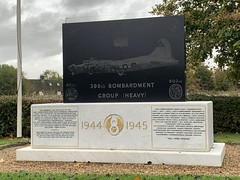
One of these is the Nuthampstead museum which honours the 55th FG and more predominately the 398th BG, who served at Nuthampstead from April 1944 to June 1945.

The museum is located behind the excellent Woodman Inn, a 17th Century Inn that sat on the outskirts of the airfield and was frequented by many who served at the airfield. Its ties are strong, displaying a range of photographs and housing some memorabilia from the airfield demonstrating this incredible link with the base’s personnel. I can strongly recommend a visit here if you are at the museum.

The entrance to both the pub and museum is notable by a large and stunning memorial  to the 398th BG; a second smaller memorial pays tribute to the 55th FG, and sits close by.

RAF Nuthampstead

The Memorial outside the Woodman Inn.

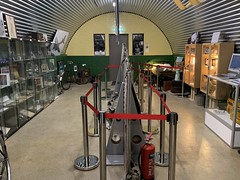
The museum itself sits at the back of the Inn located in three small, but packed huts, entrance is free at the time of writing.

The first hut contains photographs, written documents and memorabilia concerning the 55th FG, who were stationed at Nuthampstead between 16th September 1943 and mid April 1945.

Moving on through, the remainder holds a huge range of personal letters, documents, photographs and memorabilia relating to the 398th, including part of a B-17 wing that was found in a nearby field, being used as a bridge over a small ditch.

There are also uniforms donated by relatives, and even a piece of PSP (Pierced Steel Planking) used to create taxiways and runways on several airfields especially temporary forward bases where speed was the essence.

RAF Nuthampstead Museum

The wing of the B-17 forms the centrepiece of the main display.

The museum like so many others, is run and staffed by volunteers, all very knowledgeable and helpful. It only opens in the summer months but it may be possible to gain access outside of these times, details are available on their website below.

If you are in the area, or want to know more about Nuthampstead, do visit the museum and have a drink / meal in the adjacent pub – both are highly recommended.

RAF Nuthampstead’s history can be seen in Trail 32.

Links.

The Woodman Inn can be found through their website.

The Nuthampstead Airfield Museum can be found through their website.

RAF Glatton Mural

There are many memorials and murals around the world dedicated to those who lost their lives or served on wartime airfields fighting the Nazi tyranny. In the UK these amount to hundreds if not thousands, and every now and again, one springs up and looks stunning.

At Conington, the former RAF Glatton, now a training airfield which utilises one of the three original runways, is one such mural, dedicated to those of the  457th Bomb Group  who served with and flew missions from the airfield between February 21st, 1944, until April 20th, 1945.

Glatton airfield was built in the last months of 1942,  by the 809th and 862nd Engineer Battalion (Aviation) of the U.S. Army, as a class ‘A’ airfield, and would be of a standard size and shape catering for some 3,000 men and women of mixed rank.

The only units to use the airfield were the four bomb squadrons: the 748th, 749th, 750th, and 751st Bomb Squadrons of the 457th Bomb Group, 94th Combat Bombardment Wing of the 1st Bombardment Division. Flying B-17s, they would take part in some of the most horrific battles of the air war, losing some 729 personnel as either killed, missing or taken prisoner, dropping just short of 17,000 tons of bombs in 237 missions.

After training at Rapid City Airfield in South Dakota, the 457th would enter the war with a real baptism of fire. On Monday 21st February 1944, the combined forces of the USAAF and the RAF were involved in the ‘Big Week‘ campaign. Officially known as Operation ‘Argument‘, it was designed to smash the German aircraft industry in one fell swoop. For an entire week the allies pounded the industrial regions of the Rhine, as one of the war’s biggest joint operations, it didn’t nevertheless prove to be as definitive as planned.

They would attack ball bearing plants, aircraft factories and oil refineries. Helped prepare the way for the invasion  and took part in Mission 311, on April 22nd 1944, a mission that became famous for the operation in which US forces lost more aircraft to enemy intruders than at any other time in the war.

They would also attack coastal defences, railways, fuel depots took part in the attacks at St. Lo.

Many special visitors would also be seen at Glatton airfield, including in March 1944, YB-29 #41-36963 ‘Hobo Queen‘*8 which took off from Salina Airbase in Kansas piloted by Colonel Frank Cook, as part of a plan to ferry B-29s to China to bomb Japan from airfields there.

On April 20th 1945, the 457th flew their final operational mission, attacking the marshalling yards at Seddin, to the south of Berlin. With the end of the war just around the corner there was little resistance from either ground forces or the Luftwaffe, none of the 457th aircraft taking hits or suffering any damage, it was virtually a ‘milk run’.

Following VE day, the 457th flew POWs back from Europe to England, then with no further action to undertake, the airfield was handed back to the RAF’s No. 3 Group under the control of Bomber Command operating both the Avro Lancaster and Consolidated B-24 Liberators flying out to the Middle East.

By June the war for the 457th was over. The men and machines were transferred back to the United States with the aircraft leaving Glatton between May 19th and 23rd, and the ground echelons sailing on the Queen Elizabeth from Gourock in Scotland, at the end of June. After arriving at New York there was 30 days rest before the men assembled at Sioux Falls. Here the axe fell and the 457th was no more, the four squadrons being disbanded for good and the Group removed from the Air Forces inventory.

Glatton itself was eventually closed and the site was then sold off in 1948, mostly returning to agriculture.

Since then, a training company has taken over part of the airfield, T6 Harvard Ltd, a small light training company, have operated out of Glatton since 2021 providing flying training for pilots on a variety of aircraft including both Chipmunks and Harvard aircraft.

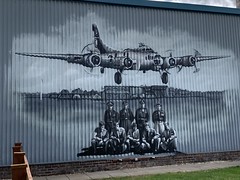
On the side of one of their buildings is a mural, painted  by Nathan Murdock, a Peterborough artist, who created the design as a commission by the company owner Julie Churchill, and depicts a Lockheed/Vega B-17G-70-VE Fortress, #44-8557 of 748th Bombardment Squadron on its 234th mission, April 18, 1945. On board that day and depicted in the painting are: Roy Truba; Craig K Winters; Joseph Taylor; William Thistle; Luther Smith; Louis Domato; John H Taylor; John Miller and Harvey Henkel.

This crew was the last 457th crew to sustain a loss in the war when the aircraft was hit by flak over the marshalling yards in Freising on April 18th, two days before their last mission. Following the strike, the crew safely parachuted from the damaged plane, but Sgt. John T. Miller, the engineer, was killed. The rest of the crew landed safely but were soon captured and taken prisoner by the Germans. All were liberated by allied forces ten days later.

The mural was completed and then dedicated on August 19th, 2021 by the U.S. Air Force Col. Abe Jackson, EUCOM JAC commander, who said “Today symbolises an opportunity for us to recognise the significant contributions of those Airmen who came before us,”*1

The mural can be easily seen behind the clubhouse, which also has a display of photographs and memorabilia relating to the 457th and their time here at Glatton. It is a stunning piece of art work, not least of all becasue it is painted onto corregated metal, and is well worth a visit if you are in the area.
RAF Conongton (Glatton)

The mural depicting the crew and B-17 #44-8557 can be seen behind the clubhouse.
RAF Conongton (Glatton)

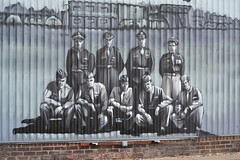
457th Bomb Group crew in 1945. Back row left to right: Roy Truba (Bombardier), Craig K Winters (Navigator), Joseph Taylor (Co-Pilot) and William Thistle (Pilot). Front row left to right: Luther Smith (Tail Gunner), Louis Domato (Radio Operator), John H Taylor (Ball Turret Gunner), John Miller (Flight Engineer) and Harvey Henkel (Right Waist Gunner). (Names taken from an original photo on the American Air Museum website).

Sources and further reading.

*1 501st Combat Support Wing Website

T6Harvard Ltd flying details can be found on their website.

The full history of Glatton can be read in Trail 6.
M/Sgt. Hewitt Dunn – 104 Missions with the 390th (Framlingham)

RAF Framlingham (Parham) otherwise known as Station 153, achieved a remarkable record, or rather one man in particular did. His name was Hewitt Dunn, a Master Sergeant in the U.S.A.A.F and later the U.S.A.F.

Known as “Buck” he would achieve the remarkable record of completing 104 missions with the 390th Bombardment Group (Heavy) – a record that astounded many as life expectancy in a heavy bomber was short, and few survived beyond one tour of 30 missions.

Hewitt Tomlinson Dunn (s/n 13065206) was born on July 14th 1920. He progressed through school to join the Air Corps where he was assigned to the 390th Bombardment Group (Heavy), 13th Combat Wing, 3rd Air Division, Eighth Air Force, as a gunner in December 1943.

His first mission was with the 569th Bombardment Squadron in the following January. He completed his first gruelling tour of 30 missions by April that year, upon which he immediately applied for a further tour that he would complete by the summer of 1944. His attitude of ‘its not over until its won’, would see him accept a further remarkable third tour, virtually unheard of for a heavy bomber crew member.

On Friday, April 6th 1945, mission 930, an armada of aircraft of the U.S.A.A.F would strike at the marshalling yards in Leipzig, Germany. Inside B-17 #43-38663, ‘The Great McGinty‘, was Hewitt Dunn.

After the mission Dunn described how earlier at the morning briefing, he, like so many of his colleagues, had been a little ‘nervous’. Then, when the curtain was pulled back, their nervousness was justified, Leipzig – the 390th had been there before.

Many crews in that briefing would look to Dunn for signs of anguish, if he remained steady and relaxed, they knew it would be ‘easy’, if he sat forward, then it was going to be a difficult one. The atmosphere must have been tense.

Luckily, unlike other missions into the German heartland, this one turned out to be ‘just another mission’ a ‘milk run’. Much to the huge relief of those in command of the 390th, all aircraft returned safely.

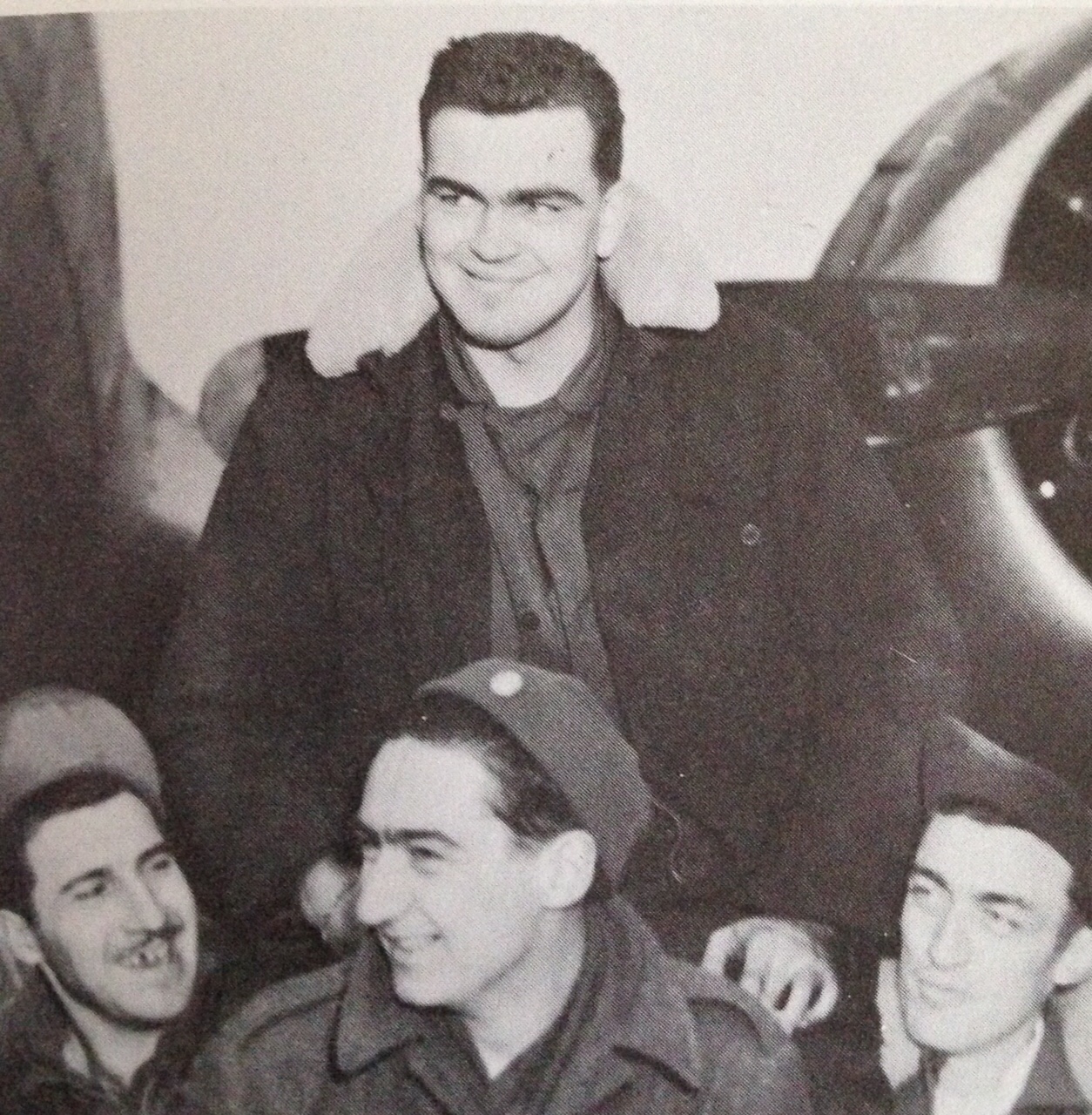
On his arrival back at Framlingham, Dunn was greeted by cheering crowds, ground crews lifted him high in their air carrying him triumphantly away from his aircraft, it was a heroes welcome.

By the time the war had finished, Dunn had flown in 104 missions, he had been a tail gunner on twenty-six missions, twice a top-turret gunner, a waist gunner and the remainder as togglier (Bombardier). He had flown over Berlin nine times, he claimed a FW-190 shot down and had amassed an impressive array of medals for his bravery and actions, and all at just 24 years old.

Post war, he continued to fly as an Instructor Gunner for B-52s in the 328th Bomb Squadron, 93rd Strategic Bomb Wing, at Castle Air Force Base in California. Here he was described as “quiet and reserved” and never talked about his war experiences. He was “handsome man with black hair”, and only when he wore his dress uniform, did others realise how well decorated he was.

Dunn was considered a rock by those who knew him and perhaps even immortal, but he was not, and on June 15th , 1961 after flying for a further 64 flights, he was tragically killed in a domestic incident that involved both his wife Peggy and his son. Precise details of his death are sketchy, and due to its nature, not a story to go into here, but at 41 years of age it was a domestic tragedy that took the life of a brave and heroic young man at far too an early age.

Dunn was a man who had flown in more missions than any other person in the Eighth Air Force and one who had gone on to train others in that very same role. He was highly decorated, and was looked up to and liked by those who knew him.

Following his death a service was held in Merced, California, his body was then taken to Arlington National Cemetery in Washington D.C. where he was finally laid to rest in grave number 3675, section 28.

For a man who achieved so much in his fighting career, little exists about him or his achievements. Maybe, by the end of the war, records were no longer needed, tales of dedication and bravery were no longer useful propaganda. Whatever the reason, Hewitt Dunn’s name should be heavily embossed in the history books of the Second World War.

hewiit-dunn

Hewitt Dunn on return from his 100th mission, April 1945 (IWM)

Hewitt Dunn’s medal tally:

– Air Force Longevity Service Award with 3 oak leaf clusters
– Air Medal with 13 oak leaf clusters (2 silver, 3 bronze)
– Air Medal with 7 oak leaf clusters (1 silver, 2 bronze)
– American Campaign Medal
– Distinguished Flying Cross with 1 oak leaf cluster
– Good Conduct Medal
– National Defence Service Medal
– Silver Star
– World War II Victory Medal
– European-African-Middle Eastern Campaign Medal with 1 bronze star
– European-African-Middle Eastern Campaign Medal with 1 silver star

Post-script

This page was updated on 12th December 2023. I would personally like to thank all those who have contacted me in relation to the story, particularly in respect of his tragic and untimely death, they have all been appreciated. I believe there are numerous articles on-line looking at the events surrounding the domestic incident that ended his life, and for those who wish to seek more information, I have been told that “TJ3 History” is the most recent and details the events that led to his untimely and most tragic end of a brave and dedicated man. 

This and other such accounts can be found in the link Heroic Tales of World War Two.