In Part 2, we saw how the Turbinlite system failed to produce what was expected of it, and eventually the system was scrapped and the squadrons disbanded. Those left at Hunsdon continued the night operations but soon they too would depart this Hertfordshire airfield leaving room for an influx of Mosquitoes – de Havilland’s ‘Wooden Wonder’.
On May 5th 1943, 85 Sqn would officially receive its squadron badge, although it was a former World War One Squadron, it had never been officially presented with it, and time had caught up. With the whole squadron lined up outside the Bellman Hangar, A.O.C. 11 Group, Air Vice Marshall H.W. Saunders, C.B.E., M.C., D.F.C., M.M., gave a speech highlighting how well the squadron had performed; shooting down ninety enemy aircraft in France, fifty in the Battle of Britain and a further twenty in night operations whilst at Hunsdon. He went on to highlight the number of decorations its crews had been awarded: four D.S.Os; seventeen D.F.Cs; three D.F.Ms, and Bars to both the D.F.Cs. and D.F.Ms. He then presented the station badge to the Commanding Officer Wing Commander Cunningham. At this point it was announced that the squadron would be moving south to West Malling in Kent and he wished the squadron good luck.
With just a few more days left before departure, operations continued and on the 8th, three more JU. 88s were spotted but intercepted by Spitfires from other squadrons before the Mosquitoes could get to them. It was not to be the glorious ending 85 Sqn had hoped for.
After a farewell dinner for both 85 and 3 squadrons in the officer’s mess, preparations began for the move. Three Harrows arrived to collect personal belongings and equipment, and then, on the 13th, 85 Squadron departed, all ten aircrews performing individual flypasts over the watch office to show their respect and thanks to those who had worked along side them, it was a sad day for Hunsdon. The Harrows once loaded, departed shortly after with the main ground party departing by train soon after that.
The dispersals and accommodation did not remain vacant for long though, they were immediately taken over by a new squadron, 157 Squadron along with their servicing wing 3081 Servicing Echelon.
The new squadron was also a Mosquito Squadron, transferring in from Bradwell Bay. Night patrols had been the order of the day and these continued, and even as the squadron moved into their new home a Do. 17 was intercepted and shot down near Felixstowe.
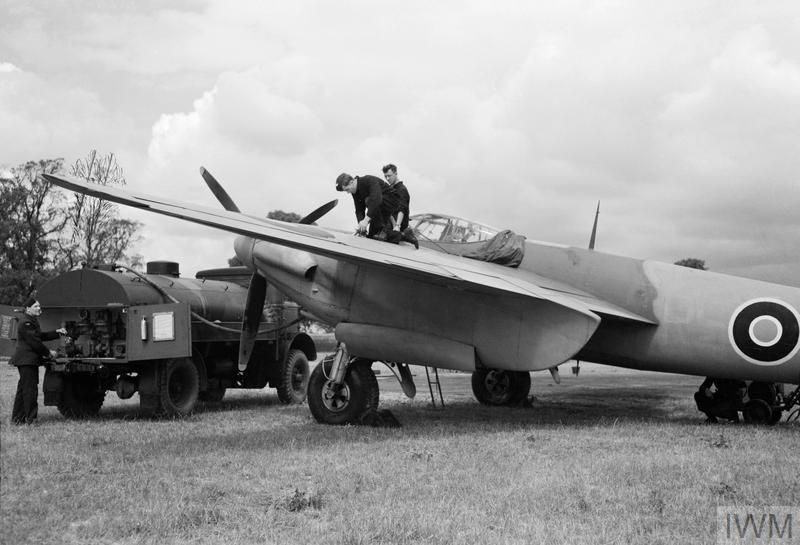
Mosquito II of 157 Sqn being refuelled at Hunsdon, 16 June 1943. (©IWM CH 10312)
During the day, personnel took to painting and refurbishing the dispersals, whilst at night patrols continued on, an F.W. 190 falling victim to Flt. Lt. H. Tappin DFC and Fly. Off. I. Thomas in Mosquito S.727
The remainder of the month and into June involved further night patrols, many being cancelled due to poor weather, whilst on the ground yet more decorating took place, with all crews taking part.
June then saw the temporary arrival of 515 Sqn with Defiants moving in from Heston. On June 1st, all aircraft had been received at Hunsdon with the rear party arriving later by road. As soon as 11 Group Headquarters had been notified of the squadron’s readiness, the order came though to move sections to forward bases ready for night operations. Eight aircraft immediately took off from Hunsdon but poor weather curtailed any further flights and they all returned the next day without taking part. This routine pretty much set the scene the remainder of the month. Shortly after arriving here 515 would start to accept the Beaufighter, a remarkable step up from the Defiant and an aircraft they would take when they left Hunsdon for Little Snoring in December that year.
Then in July, a new version Mosquito began to arrive with 157 Sqn – the MK.VI. ‘Ranger‘ patrols became a priority, attacking freight locos across the enemy network. On the 19th August, the Sqn claimed their 100th victim, a landmark number that was acknowledged by Sector Commander Group Captain Harris.
The next few months were a mix of sporadic contacts but few engagements, ‘uneventful’ patrols and cancelled flights due to poor weather. The arrival of a Lancaster out of fuel in early October, a Wellington damaged by flak and a lost B-17 possibly heightening the excitement on the airfield. A large portion of this time was taken with sports including shooting until finally ‘discouraged’ by local landlords.

Remains of the latrines and drying rooms.
157 Sqn however, wouldn’t remain at Hunsdon for much longer, departing with their Mosquitoes for Predannack in November that same year. A relatively uneventful stay at Hunsdon had finally come to an end.
Movements into and out of Hunsdon would continue in November, with the arrival of yet another Mosquito unit, 410 (Royal Canadian Air Force) Squadron. The unit would stay here on three separate occasions throughout 1943 and 1944, each time being for a short period only before moving on again elsewhere. Each stay would bring a new model Mosquito: MK. VI, MK.XIII, and finally the MK.XXX before moving off to the continent in 1944 and their eventual disbandment in June 1945. Whilst the squadron was primarily Canadian (seventy-two personnel), it also consisted of sixteen RAF personnel and four Americans, making it a multinational mix of aircrew, officers and ground crews.
It was whilst at their previous station, West Malling, that they would make the first ‘kill’ of 11 Group, when on the 5th November, a Mosquito piloted by Flg. Off. Green and his navigator Pt. Off. Goodhew, intercepted an Me. 410 and shot it down approximately 15 miles from Dungeoness. Three days later they would arrive at Hunsdon, where a turn in the weather prevented any further kills for the unit for the remainder of the month.
Training flights were managed on the odd occasion, intercepting friendly bombers with camera guns along with several Mahmoud exercises. On the 26th November tragedy struck when on one of these flights Flg. Off. J.J. Blanchfield in Mosquito DD669 struck the target Mosquito DZ259 flown by W.Off. C. James and his navigator Flt. Sgt. T. Levine. Both crews reported that they were bailing out, but both Blanchfield and his navigator Flg. Off. K. Cox, were killed in the accident.
The squadron’s remaining time at Hunsdon was much similar, training flights, the odd operational scramble and bad weather persisted to the end of the year. But in December, one Mosquito flown by Flg. Off. “Joe” Schultz and Flg. Off. Williams manged to shoot down no less than three Dornier 217s in an epic air battle in which they themselves narrowly missed being the victim.
After vectoring onto the initial target, Schultz managed to shoot it down even though the Dornier tried to evade the attack by both attempting to fly into cloud and carrying out violent evasive movements. After dispatching this aircraft, Schultz pursued a second aircraft which exploded some 50 feet ahead of him, causing his own aircraft to jolt as it passed through the debris. A third Dornier gave a more difficult challenge, and even though both its engines were hit, the crew continued to return fire whilst the pilot made aggressive and violent defensive movements. The Mosquito in return, had its instruments put out of action and both engines hit, causing a fire in one. Luckily, this extinguished itself, but the second engine then failed altogether. Schultz managed to safely land the aircraft at Bradwell Bay using the single damaged engine, a remarkable feat considering the damage to the Mosquito and its components.
During the month, yet another new version Mosquito began to arrive at the squadron in addition to those already on station. By the end of the December, when they finally departed Hunsdon for Castle Camps, they had on their books: two Mosquito MK.IIs, one MK.III, one XII and seventeen XIIIs. A squadron Magister was also registered, but the Oxford they had, had struck a hill severely injuring the pilot, Flt. Lt. M.A. Cybulski DFC at Winter Hill, Belmont near Bolton. Flt. Lt. Cybulski had completed his tour of duty and was transferring to 9 Group when the accident happened.
New years eve 1944 would undoubtedly bring the most significant of the RAF units to Hunsdon and the one for which it is most famous. The arrival of 21 Sqn, 464 Sqn and 487 Sqn combined together to form 140 Wing, would see a number of dare-devil raids against German targets which, like the dams raid of 617 Sqn, would be forever discussed by historians.
 Aviation Trails