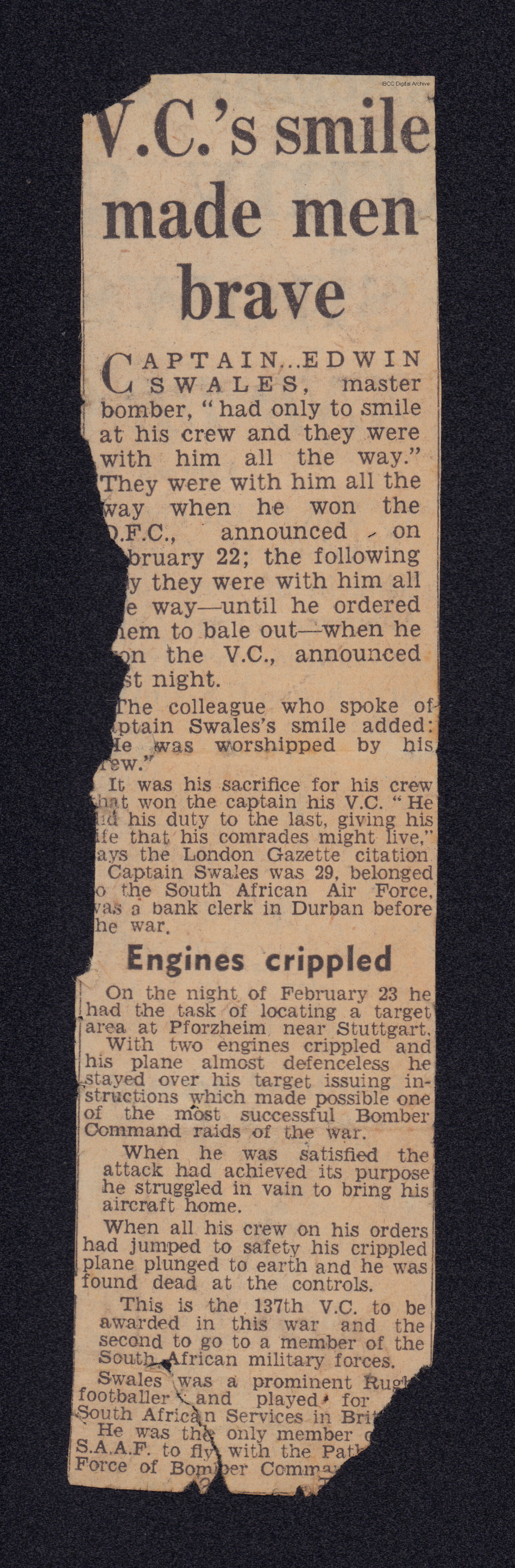
Captain Edwin Swales VC, DFC RAF Little Staughton.

The Royal Air Force was made up of many nationals including both those from the Commonwealth and those from across the globe.

In Bomber Command, and the Pathfinders in particular, one man stood out not just for his nationality, but for his bravery and dedication in the face of death.

That man was one Acting Major*1 Edwin Essery Swales VC, DFC based at RAF Little Staughton on the Bedfordshire / Cambridgeshire border.

Swales (fourth from right) and his crew with their Lancaster ‘M’ Mother *9

Swales was born on 3rd July 1915, the son of Harry Evelyn Swales and Olive Essery, in Inanda, Natal South Africa. He was one of four children whose father was a farmer. Whilst Edwin was young, his father, Harry, died from  the influenza epidemic that claimed some 50 million lives after the First World War. Without a father, the family were unable to maintain the farm, and so they moved away to Berea in Durban.

Once of high school age, the young Edwin Swales attended Durban High School, he also joined the Scouts learning valuable skills with like minded youngsters, that would help in him in later life. After leaving school Swales landed himself his first job, working at the international branch of Barclays Bank in Durban. But with with war looming, Swales like many young men at the time, was drawn to military service, and so he joined up, posted to the Natal Mounted Rifles where he achieved the rank of Sergeant Major.

Whilst with the Mounted Rifles, Swales served in several locations including: Kenya, Abyssinia and North Africa where he fought bravely alongside his compatriots and the Eighth Army under Montgomery. He would remain with the rifles until January 1942 at which point he transferred to the South African Air Force, obtaining his wings on 26th June a year later. Two months after this milestone, he, like many others from across the commonwealth, was seconded to the Royal Air Force ensuring his position overseas.

Swales (s/n: 6101V) like many new recruits to the Royal Air Force, would undergo a tense period of retraining, eventually being posted to fly heavy bombers within Donald Bennett’s 8 Group – ‘The Pathfinders’. His first and only posting, would be at Little Staughton with 582 Sqn.

During his short time at Little Staughton, Swales would fly a number of missions piloting Avro’s delight, the four engined heavy bomber the Lancaster.

Swales took part in many operations over occupied Europe, including the ill-fated attack on Cologne on December 23rd 1944, which saw the loss of five  aircraft from 582 Sqn. In total, eight aircraft from seventeen flying from both Little Staughton and Graveley were lost that day including the lead bomber flown by Sqn. Ldr. Robert Palmer who himself was awarded the Victoria Cross for his actions.

On that day, an Oboe mission that went terribly wrong, Swales heard the instruction to bomb visually releasing his bombs at 12:51hrs. Flak and fighter attacks were so ferocious, that Swales, like many others in the formation, had to take “violent evasive action” to shake off persistent and accurate attacks from fighter and ground based gunners. He was able to return his aircraft and crew safely to Little Staughton landing at 14:35*2

The action taken by Swales that day was indicative of his determination to succeed and protect both his aircraft and crew, and one that would be repeated time after time by the airman. As a result, it was seen fit to award Captain Swales the DFC for his action that night, his citation stating:

This Officer was pilot and Captain of an aircraft detailed to attack Cologne in December, 1944. When approaching the target, intense anti-aircraft fire was encountered. Despite this, a good bombing attack was executed. Soon afterwards the aircraft was attacked by five enemy aircraft. In the ensuing fights, Capt. Swales manoeuvred with great skill. As a result his gunners were able to bring effective fire to bear upon the attackers, one of which is believed to have been shot down. Throughout this spirited action Captain Swales displayed exceptional coolness and captaincy, setting a very fine example. This Officer has completed very many sorties during which he has attacked a variety of enemy targets*3

Within two months of the operation and at the time his award was being awarded, Swales would be in a similar position again.  This time as Master Bomber leading the formation and directing the bombers to the target.

On that night, only ten days after the historical attack on Dresden, 367 Lancasters and 13 Mosquitoes from 1, 6 and 8 Groups were detailed to attack the city of Pforzheim to the north-west of Stuttgart. This would be the only attack on the city during the war and it would prove almost as devastating as both Dresden and Hamburg.

Flying along side Swales that night in his Lancaster III PB538 ‘N’, were seven other crewmen, including two navigators as was commonplace for Oboe fitted aircraft.

On the run in to the target, the Lancaster was badly mauled by night fighters who successfully put one engine and the rear turret guns out of action. But undeterred, Swales remained on station guiding the following bombers onto the target with the greatest of precision.

When he was finally satisfied that the attack had been carried out successfully, he left his station and turned the aircraft for home. It had been difficult to keep the Lancaster flying, but Swales had persevered in order to complete the job. But he was now easy prey for enemy fighters and inevitably more attacks came.

Soon a second engine was put out of action and flying controls were damaged further with some now completely inoperable. With a reduced speed and difficult flying conditions he headed for the allied lines, where he hoped to get his crew out safely.

All those on board made the jump to safety, leaving just Swales at the controls of the failing Lancaster. As if someone had been watching over them, just as the last man left, the Lancaster finally gave up the struggle and dived into the earth –  Edwin Swales was still sat at the controls when it was found later on.

The attack on Pforzheim  was considered to be very accurate, with over 1,800 bombs having been dropped in as little as twenty minutes or so. Over 17,000 people were known to have died that night in the raging fire that followed the bombing, and a post-war photo, revealed that 83% of the built up area had been destroyed by the raid *4

Following the death of Captain Swales, Air Chief Marshall Sir Arthur Harris KCB, OBE, AFC, Chief of Bomber Command, personally write to Swales’ mother saying: “On every occasion your son proved to be a fighter and a resolute captain of his crew. His devotion to duty and complete disregard for his own safety will remain an example and inspiration for all of us.”*10

For his action, bravery and dedication to duty, 29 year old Edwin Swales, a prominent rugby player and South African “who only had to smile at his crew and they were with him all the way“*5  was awarded the Victoria Cross posthumously, the second such award to go to an airman of RAF Little Staughton, just one of three to the Pathfinders and one of only four South Africans to be awarded the Victoria Cross during the war. His citation appeared in the Fifth Supplement to The London Gazette, of Friday, the 20th of April, 1945:

Air Ministry, 24th April, 1945.

The KING has ‘been graciously pleased to confer the VICTORIA CROSS on the undermentioned officer in recognition of most conspicuous bravery:.—

Captain Edwin SWALES, D.F.C. (6101V), S.A.A.F., 582 Sqn. (deceased).

Captain Swales was ” master bomber ” of a force of aircraft which attacked Pforzheim on the night of February 23rd, 1945. As ” master bomber,” he had the task of locating the target area with precision and of giving aiming instructions to the main force of bombers following in his wake.

Soon after he had reached the target area he was engaged by an enemy fighter and one of his engines was put out of action. His rear guns failed. His crippled aircraft was an easy prey to further attacks. Unperturbed, he carried on with his allotted task; clearly and precisely he issued aiming instructions to the main force. Meanwhile the enemy fighter closed the range and fired again. A second engine of Captain Swales’ aircraft was put out of action. Almost defenceless, he stayed over the target area issuing his aiming instructions until he was satisfied that the attack had achieved its purpose.

It is now known that the attack was one of the most concentrated and successful of the war.

Captain Swales did not, however, regard his mission as completed. His aircraft was damaged. Its speed had been so much reduced that it could only with difficulty be kept in the air. The blind-flying instruments were no longer working. Determined at all costs to prevent his aircraft and crew from falling into enemy hands, he set course for home. After an hour he flew into thin-layered cloud. He kept his course by skilful flying between the layers, but later heavy cloud and turbulent air conditions were met. The aircraft, ‘by now over friendly territory, ‘became more and more difficult to control; it was losing height steadily. Realising that the situation was desperate Captain Swales ordered his crew to bale out. Time was very short and it required all his exertions to keep the aircraft steady while each of his crew moved in turn to the escape hatch and parachuted to safety. Hardly had the last crew-member jumped when the aircraft plunged to earth. Captain Swales was found dead at the controls.

Intrepid in the attack, courageous in the face of danger, he did his duty to the last, giving his life that his comrades might live.*6

His body was removed from the aircraft in which he gave his life and was interned at the War Cemetery at Leopoldsburg, in Belgium, Section VIII Grave C.5.

In honour of Captain Swales, two memorial stones were laid and revealed outside his Durban High School on Armistice day 2009. One in the Memorial Courtyard of the School and the second on the Memorial Wall of the Natal Mounted Rifles also in Durban. In attendance were both his niece, Professor Edwina Ward, and Lt. Gen. Carlo Gagiano, Chief of the South African Air Force.

In 2013, Swales was also awarded the “Bomber Command” clasp to be worn on the 1939 – 1945 Star already awarded.

Edwin Swales was indeed a very brave man, who through sheer determination managed to save his crew in spite of the dangers facing him. His award was in no doubt deservingly awarded.
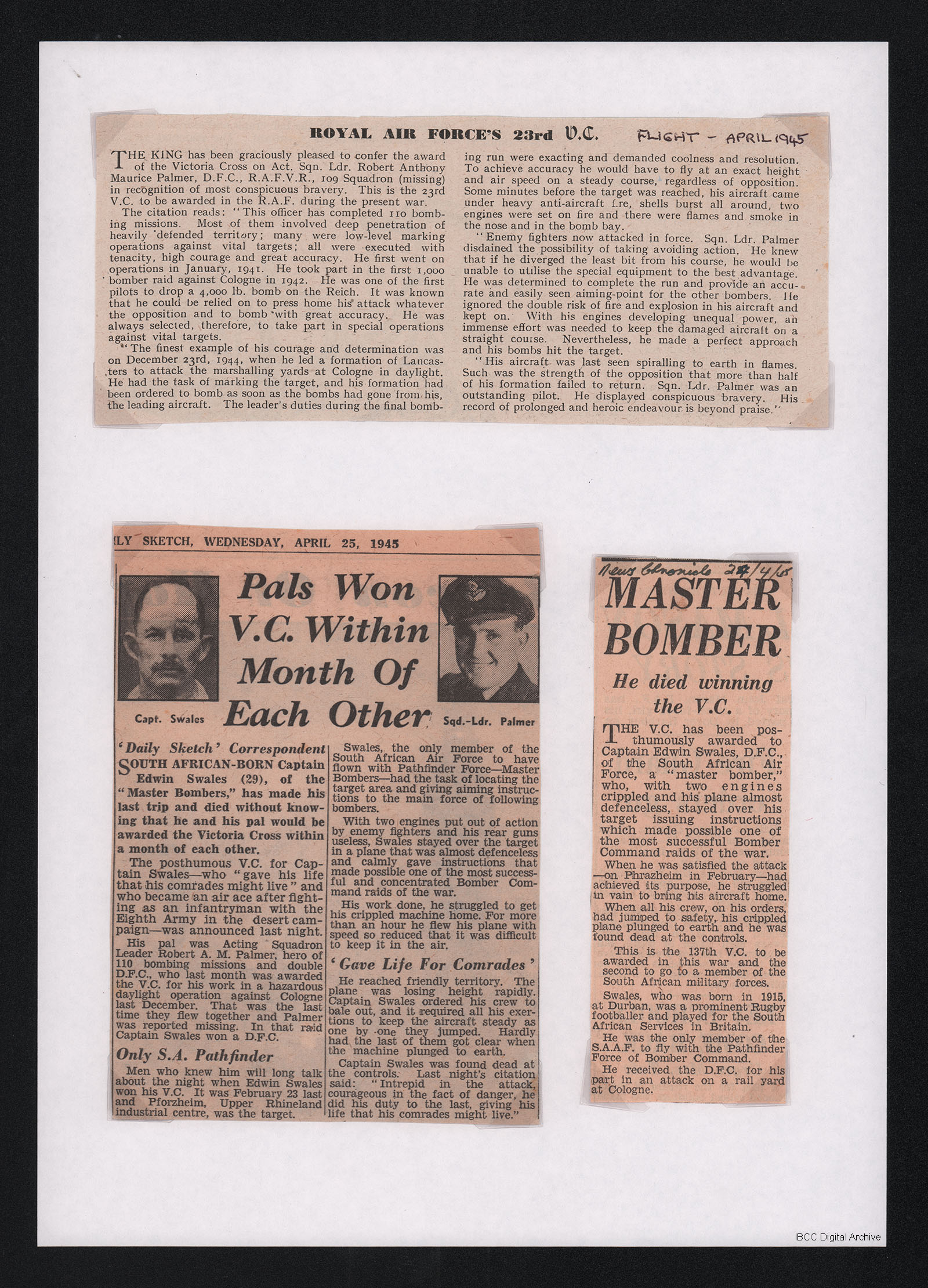
The story of pals Edwin Swales and Robert Palmer both of whom won VCs posthumously whilst at RAF Little Staughton.*7
NColeFIG170709-020001.jpg

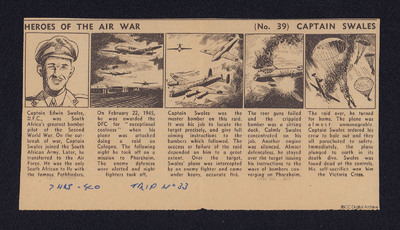
The story of Captain Swales appeared in a newspaper cartoon “Heroes of the Air War”.*8

RAF Little Staughton appears in Trail 29.

Sqn Ldr. Robert Palmer’s story appears in Heroic Tales.

Sources and further reading.

*1 the documents showing Captain Swales’ promotion to the rank of Major only reached the UK authorities after his death and as a result he was cited as being a Captain. (South African Aviation Foundation)

*2 National Archives 582 Operational Record Book AIR-27-2052-18

*3 Supplement 36954, to The London Gazette, 23rd February 1945, published 20th February 1945, page 1070

*4 Middlebrook, M., Everitt. C., “The Bomber Command War Diaries“, Midland Publishing Ltd, 1996

*5 International Bomber Command Centre National Archive website.

*6 Fifth Supplement to The London Gazette, of Friday 20th April 1945. Published on Tuesday 24th April 1945, Supplement 37049, Page 2173.

*7 “Newspaper cuttings concerning awards of Victoria Crosses,” IBCC Digital Archive, accessed November 11, 2023,

*8 “Heroes of the Air War (No. 39) Captain Swales,” IBCC Digital Archive, accessed November 11, 2023,

*9 Photo The South African Legion of Military Veterans website

*10 South African Aviation Foundation website

RAF Sculthorpe – The Cold War continues but the end is in sight (4)

In Part 3, Sculthorpe had undertaken reconnaissance flights over Soviet territory risking all out war with the Russians. New bombers were arriving and Sculthorpe had reached its heyday. As the Cold War continued, new aircraft would arrive and mistakes will happen.

Mid 1955 would then see a change leadership at Sculthorpe with the departure of the Station Commander Colonel M. Jones, himself a veteran of the famous Tokyo raid led by General Doolittle. He would be replaced, in time, by another veteran, the former commander of RAF Attlebridge, Brigadier General Joseph Holzapple.

It was during this same year that a further and more serious disaster would strike at the heart of Sculthorpe personnel, when on the 9th December, an F-84F (#52-6692)  of the 55th Fighter-Bomber Sqn/20th Fighter-Bomber Wing,  was flying from Sculthorpe on an instrument training flight. Whilst over the Derbyshire countryside the aircraft flown by Lieutenant Roy Evans, a 24 year old from Polaski, Tennessee, ran low on fuel and suffered an engine flame out. After several attempts to relight the engine, Evans decided it was time to eject as the aircraft was losing height. The tower at RAF Burtonwood, could hear the pilot but he could not hear them, as he informed them that he was leaving the aircraft. At the time of the ejection the jet was said to be at about 2,500 ft and losing height rapidly.

Evans ejected, landing on the moors east of Hathersage injuring his ankle in the process. The aircraft meanwhile, hit the ground at around 300 miles per hour, some six miles away at Lodge Moor Hospital in Sheffield. The Thunderstreak  struck the roof of Ward ‘North Two’ ploughing through Ward ‘North One’ before eventually coming to rest in two parts by the garage and mortuary. One person inside the hospital was killed whilst seven others received minor injuries and shock*8.

One version of The Daily Mirror of 10th December, led with the story with the headline “Pilotless Jet Crashes on Hospital“, and gives details of the incident which could have been much worse as the jet narrowly missed a huge petrol storage tank and ambulance station. Whilst Lieutenant Evans survived this incident, he would later lose his life in another accident this time involving a reconnaissance version of the F-84 the ‘Thunderflash’ (#52-7349) on 21st August 1958 in Morocco.

Throughout the closing years of the 1950s, Sculthorpe and the 47th remained at the forefront of the nuclear tactical force. But changes were coming and already the move toward nuclear missile delivery systems was happening. The Tornado was becoming old and outdated yet it remained as the main aircraft with the USAF in Europe. The RB-66A ‘Destroyer’, a Douglas built all weather reconnaissance aircraft was being developed at this time, and would soon be delivered as a direct replacement for the Tornado. The RB-45s had performed well, but their record was not flawless either, a matter borne out in 1953 when between March 9th and 13th May, there were five incidents due to engine fires in RB-45As. In all there were thirty-seven serious mishaps including seven serious engine fires which marred the B-45’s record at Sculthorpe, some of which had resulted in fatalities*9.

File:Douglas RB-66B 54-506 19 TRS Scul BWD 18.05.57 edited-2.jpg

Douglas RB-66B #54-506 Between 1957 and 1959; it flew with the 19th TRS (66th TRW) (wikipedia)

Advances in in-flight refuelling were also made their presence felt. At Sculthorpe three KB-50 tankers joined the KB-29s of the 420th Air Refuelling Squadron bringing the advancement of three point refuelling replacing the single boom as used previously. The change would not be smooth though as on February 2nd 1957, two of the Sculthorpe aircraft collided in poor weather near Morigny, twenty miles from Saint-Lo (Manche), Normandy, thirteen crewmen were killed as a result of the crash.

The arrival of the RB-66A  ‘Destroyer’ in early 1958 was quite a step forward for the crews at Sculthorpe. Training and conversion courses became a priority, and the aircraft was generally liked by those who flew it.

The thought of nuclear weapons being stored locally raised a number of issues. People were naturally concerned about the security and safety of such weapons being located on such an important airbase, and in particular what the consequences of any accidents would be. Their fears were fuelled in 1958 when a weapons technician suffering from mental illness, locked himself in an atomic ‘bunker’ with a pistol for some eight hours.

The US authorities naturally played down the event, not quite reaching the point of denying it ever happened, but local people connected with the base, knew better. The base was put into ‘lock down’ and all staff were confined to quarters. Eventually the crisis was aired in the Commons, but reassurances from the American authorities did little to alleviate the worries of the local people.

By the summer of 1958, the B-45s’ days had finally come to a close and they were replaced by the B-66. But the introduction of any new aircraft can be difficult and the B-66 was no different.

One of the first incidents to befall the type at Sculthorpe was on April 14th 1958, when B-66 #54-0422 of the 19th TRS crashed on approach to Sculthorpe whilst attempting a blind landing. The weather at the time was good, but the aircraft was under instruction from the tower and so operating in ‘blind’ conditions. In the accident, which occurred just four miles from the airfield, all three crewmen were sadly killed.

In other cases, a number of aircrew found themselves without hydraulic fluid due to leaks in the undercarriage system. Unable to lower them by hand, they were faced with a difficult decision, and it would not be long before the first such incident would take place.

On July 3rd 1958, RB-66B #54-433 of the 19th TRS, was approaching Sculthorpe after having ‘gone around’, and was unable to lower the port landing gear. Both the starboard and nose wheels were down but the crew were unable to release the port. Deciding to eject from the aircraft, they set the autopilot to take the aircraft out to sea and then ejected.

Unfortunately, and for whatever reason, the aircraft flew in large circles until running out of fuel some twenty-six minutes later crashing just short of thirty miles from the airfield. There were no injuries in the accident but it would be one of several similar incidents to befall the model.

In all though, the B-66 at Sculthorpe only suffered four fatal accidents during its time in Britain, a rather more favourable record than that of its predecessor*9.

Long range operations of the 47th BW were gradually taken over by other branches of the US Strategic Air Command (SAC), reaching such a point that inevitably, the 47th’s services were no longer required. On June 22nd, 1962 they were officially disbanded and staff posted elsewhere. The designation was removed from the US military inventory and their remarkable achievements condemned to the history books. Cold War tactics now changing with long range bombing being replaced with more short range tactical aircraft and missiles.

Their departure left just two units at Sculthorpe, the 420th refuelling squadron and a detachment of a weather squadron with a handful of WB-50Ds. Any possibility of a nuclear air strike from Sculthorpe was now completely eliminated.

After this, political talks and imposed de-escalation strategies between the Cold War factions, prevented further deployment of large-scale US bombers on European soil, and so further deployments on this scale would not be seen again in the UK.

Gradually, as nuclear deterrents turned to both missiles and naval based platforms, Sculthorpe’s activity began to slow. Speculation then grew as to the future of the airfield. As early as 1961 it was suggested that there was truth in the reports and that the airfield would close in the near future, a rumour that came as a blow for the locals who had developed good relationships with the Americans.

A year later the announcement was made that it would close, and a gradual run down began. The bitter-sweet pill was made worse by the announcement that the US were also ‘phasing down’ Alconbury and Chelveston, whilst also closing RAF Bruntingthorpe in Leicestershire, all ex-wartime airfields extended by the US in the Cold War.

A possible reprieve due to the Cuban Missiles crises led to nothing, and the gradual wind down continued. By March 1964, the number of US personnel on the base stood at around 1,700 plus their dependants, a few civilians and Air Ministry employees*7. The 420th then with their outdated KB-50s also departed, and with no staff to administer, the admin and support group (7375th Combat Support Group) was also disbanded. There would be no more operational units to serve at Sculthorpe.

Then the base was returned to RAF ownership, and quickly placed into care and maintenance once more, held open by only a small detachment of support staff. Sections of the site were then sold off and preparations made for the disposal of the rest of the airfield. Some of the housing was retained however, for use by staff at various other airfields locally, primarily West Raynham and Marham.

For two years the base languished. The usual vandalism and stripping of any useful materials took its toll and the the base quickly fell into disrepair. However, all was not yet lost, two years after its closure in 1966, Sculthorpe saw yet another reprieve, when the USAF returned once more after being given their marching orders by the French. The base would act as both a storage facility and a support airfield for the American units at RAF Lakenheath, but the extensive damage was going to take time to repair and cost a considerable amount of money.

Grand ideas for the future of the base were put forward, even using it to test Concorde, the Anglo-French Supersonic airliner that would eventually end its days following a tragic crash in France. But none of these ideas materialised and Sculthorpe remained a standby base used for dispersing aircraft from other airfields.

This reprieve lasted for the next twenty years, but with minimal staffing and no operational units, it was a shadow of its former self. This change of luck did however, temporarily bring new life back to the airfield, with American F-4 Phantoms, C-130s, Galaxys and A-7 Corsairs appearing regularly. The RAF, needing a similar facility for RAF Bolthole operations (used when other airfield runways were resurfaced) also used Sculthorpe as a temporary base; Coltishall for example, basing their Jaguars here temporarily. As a storage facility it would also be used to store and convert foreign aircraft, F-100s, F-104 ‘Starfighters’ and T-33s from air forces overseas. French Mysteres and North American Sabres were also brought here for scrapping and disposal, first bids going to local museums, a process that went on well into the late 1980s. Sculthorpe became a mecca for plane spotters for at least another few years.

Eventually, with the Cold War ending, all this too ceased and in October 1992, Sculthorpe was officially closed, and the remaining handful of staff were posted out elsewhere.

Airmens huts

‘Hut 380’, a Second World War remnant- the former chapel which was restored in 2023 and occupied by the new Heritage centre.

The enormous accommodation blocks and technical sites were sold off, but these and many of the remaining buildings were left to decay whilst planners gave thought as to what they should be used for. In 2008, the four T2 hangars were demolished, along with eight blister hangars, leaving just one remaining on the east side of the airfield. However, like a phoenix, Sculthorpe returned from the dead yet again, this time part of the enormous STANTA training area, with the RAF, the Army Air Corps and the USAF using it for manoeuvres, seeing such diverse models as the V-22 Osprey tilt wing aircraft using it for paratroops and rehearsals of supply drops over its enormous runways; much of this activity taking place at night. Even up until recently, C-130s had also been seen operating over here, again rehearsing quick ‘stop-‘n’-go’ drops, something that continues in part to this day.

The rise in ‘Soviet Aggression’ and post conflict tensions during the Cold War had secured the immediate post-war future of Sculthorpe. Not only were atomic weapons stored here ready, but a wide range of US aircraft that would otherwise not have been seen on British soil, were also based here. The demise of world peace had been the saviour of Sculthorpe’s future.

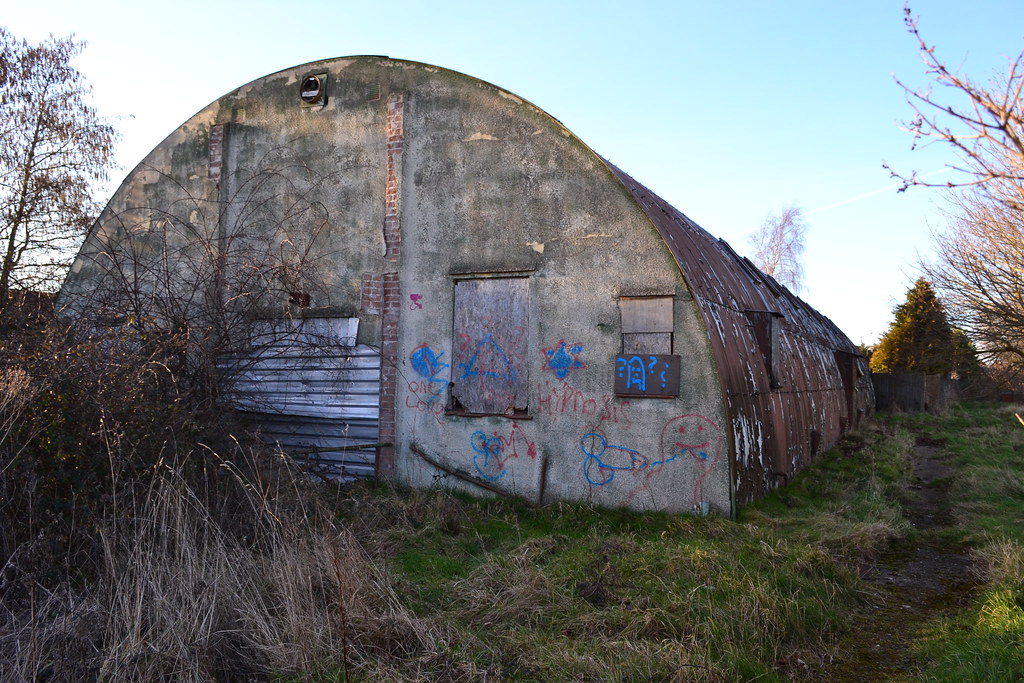
Looking at Sculthorpe, it is hard to believe its origins were in the Second World War. Being a real monster of the Cold War, Sculthorpe is clinging on by the skin of its teeth. The accommodation blocks that once housed 10,000 personnel have decayed and are severely vandalised, refurbished areas are now sold off and accommodating local families. A small industrial area has been developed from the technical area, and the local farmer grazes his cattle on the far reaches of the site. Many of the older original buildings have been left to rot and fall down. The MOD still retain ownership of the main part of the site, with a large part of the ancillary areas in private hands, such ownership does prevent some access but a good deal of the site is visible from permissible points.

The original guard-house is no longer manned, and a number of other buildings close by are also empty. A small public track that once took eager plane spotters to the rear of the airfield, still allows views across the north of the now quiet site where a blister hangar continues to stand alone. The control tower that was visible in the distance from this point was demolished with little or no warning in 2022, and a number of original Nissan huts and Second World War buildings still remain hiding amongst new buildings and old developments.

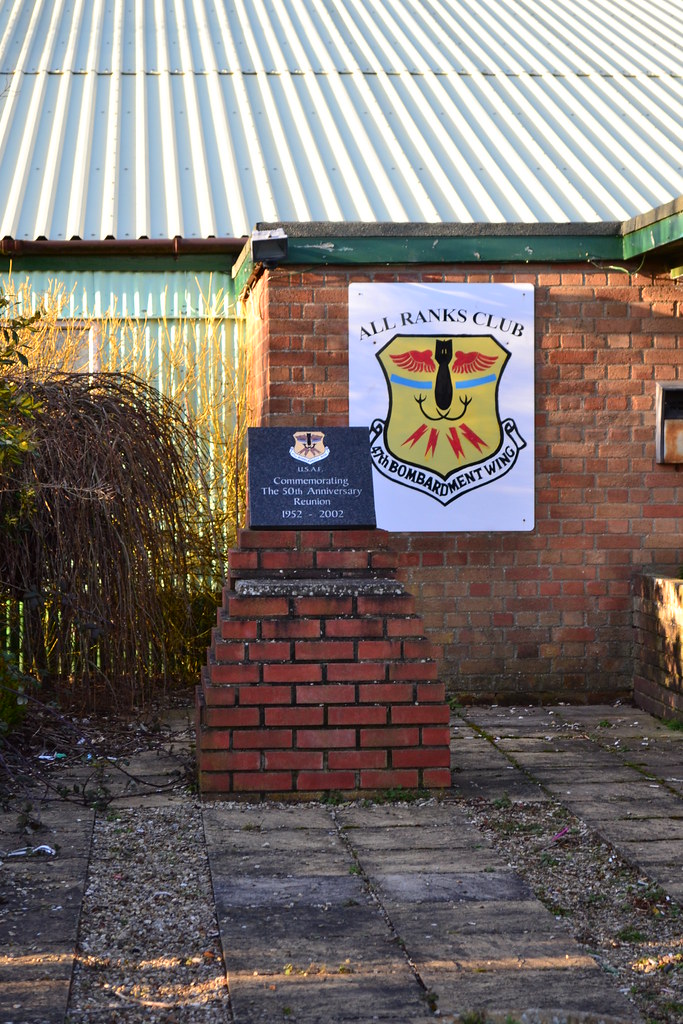
Reunion 'memorial'

In remembrance of the 47th BW, 50th anniversary reunion, 2002.

The post war ‘All Ranks Club’ housed a small exhibition of artefacts and information about Sculthorpe, depicting its post war life, and includes many interesting photos. The exhibition is open at certain times throughout the year allowing visitors to view them and talk to the volunteers some of whom actually served here at the base. In 2023/24, the Heritage Centre moved into the former Chapel after the staff refurbished the premises. The previous accommodation being returned to the public as a club house, its original purpose.

In 2022, a memorial was finally erected by the Airfields of Britain Conservation Trust outside the former main gate, and the original airfield sign was returned to the Heritage centre making its last journey home again.

The original name board returned to Sculthorpe 2023.

The original airfield sign had come back to Sculthorpe.

Sculthorpe was once a bustling airfield, it was home to some of the world’s heaviest bombers, and a mecca for aviation enthusiasts and plane spotters alike. Today, it is a decaying industrial site, a mix of old buildings and new developments; a remnant of the Cold War, it clings on to life by the skin of its teeth, maybe, just maybe, the Phoenix will rise up once more and spring into life once again.

The full story can be read in Trail 21.

Sources and further information (Sculthorpe).

*1 National Archives – AIR 27/1924/17

*2 Gunn, P.B., “Flying Lives – with a Norfolk Theme“, Peter Gunn, 2010

*3, *5 Cahill, W. “The Unseen Fight: USAAF radio counter-measure operations in Europe, 1943 to 1945” Journal of Aeronautical History Paper, 2020/06

*4 21 Sqn ORB Summary of Events 1943 Oct 01 – 1943 Nov 30, AIR 27/264/19

*5 Cahill, W., “The Unseen Fight: USAAF radio counter-measure operations in
Europe, 1943 to 1945” Journal of Aeronautical History, Paper 2020/06

*6 The Spyflight Website which gives considerable detail into the flights.

*7 Gunn., P. “Sculthorpe – Secrecy and Stealth, A Norfolk Airfield in the Cold War.” The History Press, 2014. (An excellent and well researched book that tells the in-depth story of Sculthorpe and the lives of those connected with it. A definite read for those wanting to know more).

*8 Aviation Safety Network Website.

*9 Davies, P. “B/EB-66 Destroyer Units in Combat” Osprey Publishing. 2021

Thirsk, I., “de Havilland Mosquito – an Illustrated Story Vol 2” 2006, Crecy Publishing Limited

National Archives: AIR 27/1924/19; AIR 27/1935/19; AIR 27/1326

Photos of Sculthorpe in its heyday can be seen on the Sculthorpe  Air Base website.

Further information and personal stories can be found on the 214 (Federated Malay States) Squadron website.

RAF Sculthorpe – The age of the Jet Bomber (3)

In Part 2, the war finally came to an end and Sculthorpe closed only to be reopened as a Very Heavy Bomber Base. Reconstruction has taken a number of years and although not fully ready, it starts to accept its new residents.

The first of the aircraft, two of Boeing’s huge B-29s, touched down at Sculthorpe on the 7th February 1949 late in the afternoon. However, six others also deployed to Sculthorpe, had to divert to RAF Lyneham due to the pilots not being able to see the runway in the bad weather. These aircraft would not arrive in Norfolk until later on, and so it was not to be the grand opening that many had wished for.

The deployment of US heavy bombers was seen by some as an extension of the US, and that Britain was becoming a ‘puppet’ of the US Government. The British Government try to make it clear to the public that this was not the case, and that these aircraft were only here on a temporary basis (90 day rotations), and that they were both ‘invited ‘ and did not have a nuclear capability. The Press on the other hand, did not see it quite so clearly.

It didn’t take long before the US 92nd Bomb Group were established at Sculthorpe. A veteran group of the Second World War, the 92nd had a prestigious history and one they would preserve and build upon. Formed of three squadrons, 325th BS, 326th BS and 327th BS, their numbers would swell staffing levels to almost 1,400, including both RAF and US personnel.

Various officials attended Sculthorpe’s many opening events, but the start of a new era was marred by a tragic mishap in late February, when an armourer,  Corporal Turcell, was killed when one of the B-29’s guns he was cleaning  accidentally discharged. It would unfortunately be the first of many tragedies to befall those at Sculthorpe over the coming years.*7

In March the airfield was officially opened with both the Union Flag and the Stars and Stripes being raised simultaneously. Behind the scenes however, construction work continued, with only half of the proposed six ‘Z’ blocks ready to take new residents and only sixty-two of the proposed married quarters being completed, it was far from ready.

Technical site buildings

A large part of Sculthorpe has been left to rot, piece by piece. These are the former RAF HQ and later the USAF Wing HQ.

The work carried on throughout the initial deployment and 90 days quickly passed. The 92nd’s placement at Sculthorpe soon came to an end and no sooner had they arrived then they began their journey back home to the United States. A relatively uneventful opening had come to a close.

The next of the rotations would take little time in coming. The intensity of each deployment getting greater each time, and even though the Berlin Blockade had come to an end, tensions remained very high right across Europe.

As the 92nd pulled out, a further three squadrons of B-29s began to arrive. Having already been in Japan, the three units the 343rd, 344th and 345th BS began by carrying out a number of exercises with the RAF, which included over June and July, the first multinational exercise code named “Foil“. Like many that would follow, this involved mock attacks by US and RAF bombers whilst fighters from the UK, US and Netherlands attempted to intercept them using camera guns. A successful exercise it gave rise to some interesting comparisons between the US and RAF aircraft, with many surprises in store.

As with the first deployment, the arrival of the B-29s did not all go to plan though, as on July 21st 1949, whilst transferring across from the US, one of them #44-62191 ‘suffered problems’ when its number 3 engine caught fire causing it to crash in an orchard at West Walton, 2 miles east of Wisbech in Cambridgeshire. The aircraft, a Boeing B-29A-65-BN, had a crew of twelve on board, and when it became clear that they were not going to make it, they  decided to abandon the aircraft and leave it to its fate.

All twelve of the crew successfully departed the aircraft landing nearby, but in doing so, two of them sustained serious, but not thought to have been life threatening injuries after exiting. The worst, suffered by the pilot, was a possible fractured skull whilst a second crewman suffered a fractured leg; it is believed both airmen made full recoveries. The aircraft itself ultimately crashed, landing in a field east of the small Fenland market town. The remains were quickly retrieved and some parts ended up in the local Fenland and West Norfolk Aviation Museum located in Wisbech. Now sadly closed, they were transferred to the Sculthorpe Heritage Centre located at Sculthorpe.

The 90 day rotations continued unabated. The next deployment bringing two different models; firstly the 63rd BS (43rd BG) with the extended B-29 the B50A ‘Stratobomber’ along with three refuelling aircraft the KB-29M, also a modified version of the B-29 with its turrets removed and refuelling facilities added.

What was perhaps more significant with this move was that the B-29 ‘Lucky Lady II‘ was part of this group. She and her crew had completed a ninety-four hour flight non-stop around the world, being refuelled four times in the air. This achievement sent out a major message to all those would be aggressors, wherever they may be in the world, that they were not beyond the range of the US heavy bombers.

As 1949 drew to a close, one other unit, 19th BS (22nd BG), would complete its rotation at Sculthorpe replacing the 63rd in November. It too brought another version of the B-29 the RB-29, a reconnaissance version of the heavy bomber. In support of this, a further unit would arrive in December, the 23rd Reconnaissance Squadron, bringing yet more versions of the B-29 to the airfield.

Tragedy then struck again in June 1950 when an RB-29A #42-94081, took off on a routine air test and gunnery exercise. During the exercise the outer engine was hit by the aircraft’s own guns setting it on fire. The aircraft was then difficult to  control and the pilot ordered the crew to bale out. As the B-29 hit the sea, three airmen, including the captain were still onboard; he failed to reach the aircraft’s dingy and sadly died as a result. Of the thirteen airmen on board seven lost their lives that day.

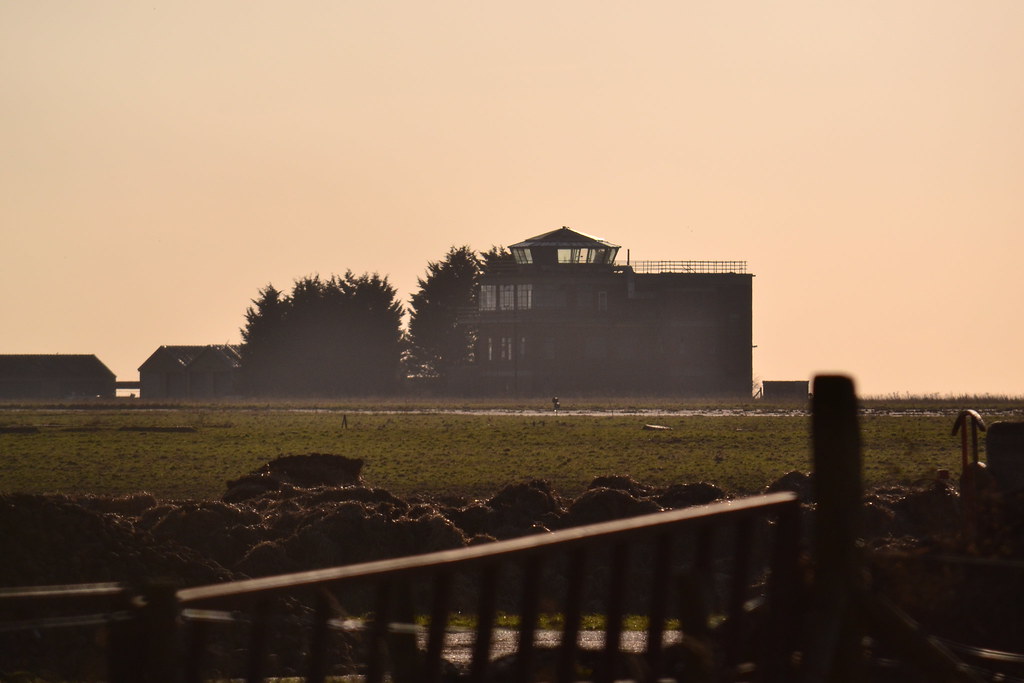
Control Tower

The watch office in a setting sun. This was ‘secretly’ demolished at short notice in March 2022.

The east/west crises continued with the war in Korea. The threat of an escalation spilling over into Europe led to a call for all US bases in Europe to be brought to full strength and further sites opened. Sculthorpe began its preparations and as the 301st BG and the 72nd Strategic Reconnaissance Squadron both departed for other UK bases, the site was left ready for the arrival of the 97th Bomb Group  and their B-50Ds.

This move signalled the beginning of a huge influx of men and machinery at Sculthorpe. Anti-aircraft batteries were brought in, along with ground units to defend the site from any possible attack. A range of aircraft support units also arrived boosting staffing considerably. With just over 400 RAF personnel, 1,800 US personnel and in excess of 600 army personnel, the quantity of men and women on the base was now as high as it had been during the Second World War.

With further deployments and new, larger aircraft arriving, not only was the need for further accommodation matched by the need for larger additional hardstands for the new bombers – the B-50 and B-36 ‘Peacemaker’, but the runways had to be extended even further, and an additional 1,200 feet was added calling for yet another diversion of the local road network.

In early 1951, after some friction between the RAF and US staff on the base, Sculthorpe, like both Mildenhall and Lakenheath, was officially handed over to the US forces, and although they all retained their RAF designation, they would be operated and maintained by US personnel; a standard that applies even today. It was a move that finally ensured America had its desired firm and permanent foot hold on UK soil.

The Cold War would then take a more devious turn. The arrival of the 323rd Reconnaissance Squadron (of the 91st Strategic Reconnaissance Wing) began its 90 day rotation with RB-45C ‘Tornados’, a reconnaissance version of the B-45 four engined bomber – the first if its kind to land on British soil. After landing at RAF Manston, the 323rd moved to Sculthorpe, where it would carry out ELINT (Electronic Intelligence Gathering) and mapping operations of western Europe. This intelligence gathering was not new, but since the end of the war, it had become more clandestine and difficult due to the clamp down by the Soviets on western spies.

Sculthorpe had now entered a new world, the Soviets had developed their own atomic bomb, and using a B-29 obtained at the end of the Second World War, reversed engineered it to provide a means by which to deliver it. The West had to find out more, and aerial reconnaissance was the only viable method with which to establish the location and number of such facilities.

There then followed extensive talks between the US and British Governments regarding Soviet ‘overflights’, western aircraft flying through Soviet airspace photographing and recording Soviet ground positions, SAM sites, airfields etc. Whilst not a new tactic, it was certainly a dangerous one, and one that could lead to all out atomic war should it go wrong.

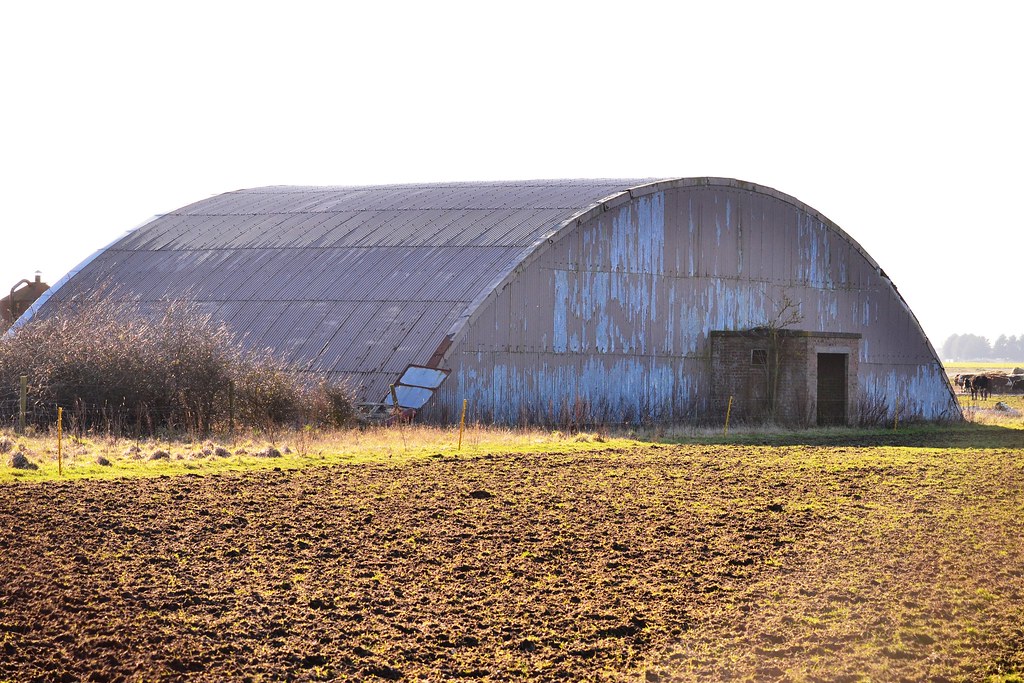
Blister Hangar

Sculthorpe’s last remaining Blister hangar in a low setting sun.

As a result of these talks, the ‘Special Duties Flight Sculthorpe’ was formed, working in conjunction with the various squadrons of the 91st Strategic Reconnaissance Wing. RAF crews consisting of two pilots and a navigator, were flown to America for a period of extensive training on the RB-45. By the end of 1951, the course was complete and they returned to Sculthorpe to continue with further training along side crews of the 91st Wing in Norfolk.

This was a British unit, led by Squadron Leader John Crampton (who replaced the initial choice Sqn. Ldr. Micky Martin of the ‘Dambusters’ fame, as he had failed a high altitude medical examination) and was designed in part, to perform deep penetration flights into Soviet airspace carrying out reconnaissance missions for Britain’s planned ‘V’ Bomber force. It would also supply the Americans with substantial information for their own tactical use.

Four RB-45Cs were converted (including one spare), flown to RAF West Raynham they were stripped of all their American markings (allowing them to deny any knowledge of such activity) before their RAF insignia were applied (The RAF would deny ever having operated these aircraft). They were then returned to Sculthorpe as British aircraft operated by British crews. The flights would be code named Operation ‘Ju-jitsu‘, and would follow the same track that the British ‘V’ bombers would take in the event of all out war.

Initially three routes were chosen, one of which took the aircraft close to Moscow; a second flew to the Baltics and the last to southern Russia. To ‘protect’ crews, they were issued with false papers and maps, and told, if caught, to explain that, rather implausibly, they had simply become incredibly lost! Failure of the mission would therefore require a high degree of gullibility on the part of the Russians.

Only two such flights were ever made, each with three aircraft; the first on 17th/18th April 1952, and the second on 28th/29th April 1954*6.  The first occurred without any Soviet intervention, but they were understandably outraged and an investigation was carried out immediately.

After the first flight, the crews were congratulated by General LeMay, and the unit was then disbanded. However, it was reformed again, also at Sculthorpe, in 1954 (after a second such temporary reformation in September 1952 which was quickly disbanded again) and a second flight was made. This time the Soviets were ready for them. After having evaluated their air defence network they were far better prepared and the RAF crews were at a much greater level of danger than during their initial flights.

Whilst Soviet SAMs (Surface to Air Missiles) were impotent in that they had no guidance system, and it was thought Flak was unable to reach the high flying RB-45s, the trip would still be a dangerous one and strict radio silence was to be maintained by the crews. The flight itself turned out to be relatively uneventful, but Squadron Leader Crampton did witness Flak, and noticing that, whilst generally ineffective, it was indeed exploding at their height. Bursts were sufficiently close to convince the crews on board that a hasty return to the West was the better option, and a halt was called to the flight.

Some time after the operation, it was revealed that Soviet Mig pilots were instructed to ram the RB-45Cs as they had no suitable radar with which to track the intruders. However, no such contact was made and so thankfully the need never arose.

The unit was then again disbanded and all flights by them ceased for good. The consequences and risk of flying over Soviet territory now considered far too high.

1952 was a busy year at Sculthorpe, it went on to see the deployment of the 47th Bomb Wing (formally the 47th BG) of the Strategic Air Command from the United States. This wing consisted of the 84th, 85th, and 86th BS, along with the 420th Refuelling Sqn and the 19th Tactical Reconnaissance Sqn. These units operated a number of aircraft types including both the aforementioned B-45C and RB-45C, along with the B-66, KB-29, and KB-50 aircraft.

The 47th was activated on March 12th 1951, initially as the 47th Bombardment Wing (BW) but with just two squadrons – the 84th and 85th. As a new unit, it had the honour of being not only the first, but the only jet powered medium bomber Wing in the US Air Force. With NATO becoming more established and nuclear weapons arsenals expanding at a great rate of knots, the 47th were posted to Sculthorpe to provide an airborne nuclear strike force in support of NATO forces  who would be operating on the ground in any future conflict.

The B-45 achieved many “firsts.” It was the first US four-engine jet bomber to fly; the first American production jet bomber; the first jet bomber capable of carrying an atomic bomb; and the first multi-jet reconnaissance aircraft to refuel in mid-air. These were based at Sculthorpe between 1952-1958, with the 47th Bomb Wing (Light) along with RB-45Cs from the 19th Tactical Reconnaissance Squadron and Royal Air Force (RAF) Special Duty Flight. These RAF RB-45 crews flew highly classified reconnaissance missions deep into communist territory. (National Museum of the USAF)

A year later, a third squadron would arrive to join the Group, that of the 422nd BS. Within a month or two of its arrival though, the unit was re-designated as the 86th BS a move that brought it in line with its two sister squadrons. For six years the 47th would operate out of Sculthorpe acting as a nuclear support unit for NATO forces in Europe.

The influx of US personnel not only impacted on the immediate and local community, but much further afield as well. In 1953, it cemented strong relations with the people of Norfolk as a whole and in particular those of the coastal town of Hunstanton, when severe floods claimed over 300 lives nationally and 100 locally; some of these were families of those located at the base living in austerity houses near to the seafront.

However, it was more the actions of the personnel at Sculthorpe that led to this unique relationship. When the floods came, staff at Sculthorpe rallied round and attempted rescues of those stranded by the high waters. One such man was 22 year old Airman 2nd Class, Reis Leming of the 67th Air Rescue Squadron, who even as a non-swimmer, braved the freezing waters to rescue no less than twenty-seven people using dinghies from B-29s. His brave and selfless act won him the Soldier’s Medal from the US forces and the British George Medal.

Road sign Hunstanton

Airman 2nd Class, Reis Leming of the 67th Air Rescue Squadron was awarded the George Medal for his brave act on the night of 31st January 1953.

Various other personnel also received awards for their bravery. These included Staff Sergeant Freeman kilpatrick, (George Medal); Airman 1st Class Jimmy Brown  and Technical Sergeant John Germaine (Queen’s Commendation for Brave Conduct); Airman 1st Class Jake Smith (British Empire Medal) and Major Julian Perkinson (Honorary Member of the Order of the British Empire). Both Leming and Kilpatrick have roads in Hunstanton named after them and a plaque dedicated to those who lost their lives stands by the town’s war memorial alongside the Union Flag and the Stars and Stripes*7.

As the 1950s progressed the influx of personnel reached its maximum with some 10,000 personnel being associated with the airfield. The 47th remained the main force located at Sculthorpe but as a division, there would be other, more tactical short range aircraft, also present here. At any time, the 47th could put up between forty and fifty aircraft*7, predominately the B-45, in response to events either in Europe or across the world.

Joint operations continued between the Americans and RAF; including ground forces carrying out training operations ‘attacking’ the airfield to test the defenders in case of war, and training flights assisting gunnery battalions along the north Norfolk coast.

The build up of nuclear weapons also increased, weapon sizes were now more modest although the punch they packed was considerably greater than the original bombs dropped on Hiroshima and Nagasaki. Smaller and faster aircraft could carry these weapons and both were being stored at Sculthorpe. The unfortunate release of this information, soon became media headlines, and quickly became widely known. This plainly identified Sculthorpe as a major site from which any future nuclear attack would come.

The swelling of personnel numbers at Sculthorpe would be further aided by the arrival of the 19th Tactical Reconnaissance Squadron (TRS) and yet more RB-45Cs. Headed by the wartime and Korean veteran Major John Anderson, they would photograph Soviet movements along with installations both along and over the delicate east-west border.

In the final part, Sculthorpe maintains its status as a leading nuclear bomber base, housing US bombers and reconnaissance aircraft on this enormous site. East-West relations deteriorate further but there is hope for the future. In the meantime, bigger and more powerful jet bombers arrive.

The full story can be read in Trail 21.