In Part 1, we saw how Sculthorpe was developed and how it became an airfield in its own right. 2 Group had taken charge and brought in it light bombers, but all would no go to plan.
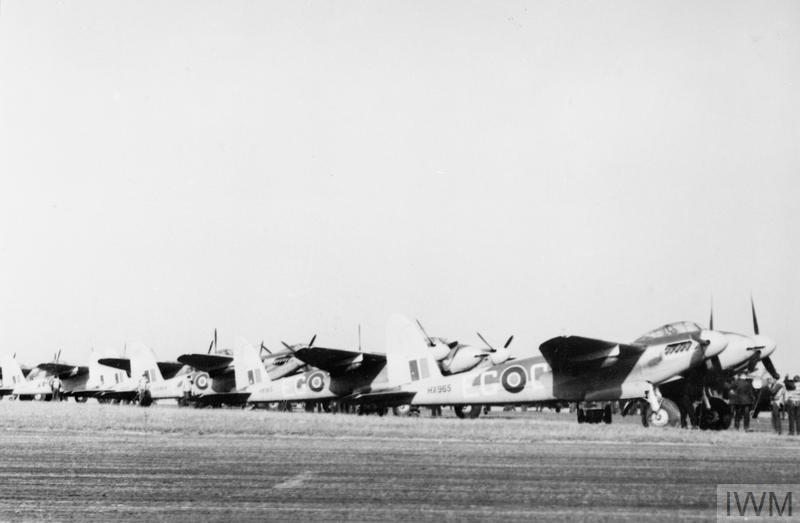
Meanwhile 464 and 487 Sqn had both been flying operationally, October 9th being the blackest day yet for the New Zealanders, when twelve Mosquitoes were dispatched for the first operations over occupied territory. An attack on Metz was planned but owing to bad weather only one or two aircraft managed to find the target. After dropping their bombs it wasn’t clear whether the target was hit or not, but worse news was yet to come. The formation, which had been dispersed due to poor weather, was being led by Wing Commander Alan G. Wilson DFC along with his navigator F.O. Donald C. F. Bridgman of 487 Sqn. During the attack the formation encountered severe anti-aircraft fire, and Wilson’s aircraft (HX965) was repeatedly hit. The navigator sustained mortal wounds and the aircraft was set on fire. In a desperate attempt to clear the fire, Wing Commander Wilson had to douse the flames with his hands resulting in extensive burns and injury. After fighting the fire, Wilson managed to eject the now smouldering material from the aircraft, but considerable damage had been done. Now flying on his own with his mortally wounded companion beside him, Wilson showed extreme courage and determination, flying the stricken aircraft back to England where he made a successful crash landing at RAF Manston in Kent.
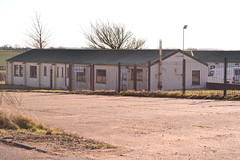
Blocks adjacent to the Guard Room.
A second aircraft (HX912), flown by Flt. Lt. Phillip C. C. Kerr and F.O. Bernard J. E. Hannan (464 Sqn) – was less lucky, both pilot and navigator being killed when the aircraft dropped its bombs at low level. It is believed the subsequent explosion also blew up the Mosquito they were flying.
On a separate operation to attack the aircraft engine factory at Woippy in France, Mosquito HX938 piloted by Sqn. Ldr. Walter F. Wallington DFC and navigator P.O. James H. Fawdrraf, dropped its bombs by accident and crashed. This time, both airmen managed to bail out, but some thirty people on the ground were killed. Sqn. Ldr. Wallington managed to evade capture but P.O. Fawdrraf was not so lucky and was soon picked up by German ground forces.
The same fate did not befall two more 487 Sqn airmen that day. Flt. Lt. Edgar W. P. Court and Flt. Lt. Jack B. Sands were both killed when their Mosquito (HX937) blew up whilst flying on one engine near to Antwerp. It had been a very sad day for the Wing, and the loss of several ‘good’ men would be deeply felt by both squadrons.
More rain and strong winds eventually turned Sculthorpe into something that resembled a “seaplane base”, by the end of the month, the entire site was waterlogged. The winds were so severe they were reported to have lifted hut roofs off their mountings causing even more problems for those inside.
On the 22nd – 23rd October, the foul weather momentarily broke and allowed for some bombing practice to take place. On return from the range, one of the 464 Sqn Mosquitoes (HX948) overshot due to an electrical failure with its instruments and crashed onto a hedge at the end of the runway blocking a road as it did so. On the 23rd, in more foul weather, one of 487’s Mosquitoes ‘T’ for Tommy (HX831), did exactly the same thing, coming to rest only feet from the wreck that was previously a Mosquito. As if that was not remarkable enough, a few minutes later one of 21 Sqn’s aircraft (HX956) also overshot, colliding with the 3-ton crane that had been brought in to recover the first aircraft, landing directly on top of the wrecked Mosquito! Miraculously no one was hurt in any of these incidents, but according to 21 Sqn’s ORB “considerable loss of public property sustained“, presumably referring to the pile of wood chippings now sitting at the end of the runway.*4 The fact that no one was hurt was a miracle in itself, and all the cockpits remaining intact was a sight that gave the personnel at Sculthorpe a great belief in the strength of the Wooden Wonder! But the catastrophe would begin a series of events that would eventually lead to 140 Wing leaving Sculthorpe for good.
By October’s end, the crews of all squadrons were now fully conversant with the new Mosquito, and the supporting Conversion Flight was disbanded; specific training units taking on the role elsewhere.
The harsh winter of 1943-44 would see a special visitor come to Sculthorpe. Wing Commander Leonard Cheshire arrived to discuss, with Pickard, the plausibility of dropping food and clothing to his brother in Sagan (Salag Luft III) using the Mosquito. Cheshire knowing Pickard’s vast experience, thought he was the ideal person to speak to. Whether this was a personal effort to provide comfort to his brother or whether Cheshire was considering the Mosquito for low level precision attacks is not known, but the latter befell the Wing not long after Cheshire’s visit.
The December of 1943 would then bring major changes here at Sculthorpe. On New Year’s Eve, two months after the initial three Mosquito accident, the Wing, along with Pickard and all three Mosquito squadrons, would leave the Norfolk site, taking their Mosquito VIs to RAF Hunsdon. A much smaller airfield, where the overcrowding experienced at Sculthorpe must have been considerably worse.
It was from Hunsdon that Pickard would famously make his last flight. A story goes that Pickard had left his dog ‘Ming’ at Sculthorpe to be looked after whilst he was away. On the day he was shot down, 18th February 1944, on the Amien raid, the dog fell gravely ill. Pickard’s wife, Dorothy, went to get him and sensed that Pickard had been killed after seeing the state of the animal. It took months for Ming to recover, and some years later whilst living in Rhodesia, Ming went outside, looked up to the sky as he always did when Pickard was flying, heard a whistle, collapsed and died.*2
The departure of the Wing effectively left Sculthorpe with no operational units, until on January 6th 1944, when a new and very different squadron began to move in.
Crews from 214 (Federated Malay States) Squadron based under 3 Group at Downham Market, arrived in two waves, the initial group coming across in early January 1944, whilst the main body continued operations flying their Stirling bombers. Those that arrived here quickly settled in, but a lack of decent paths meant that initial training was mixed with the unenviable task of digging and laying of new paths. Whilst attending lectures and link training were the primary tasks for the pilots and Flight Engineers, the gunners and other aircrew were given the more ‘practical’ task of constructing the new paths ready for the remainder of the squadron’s arrival.
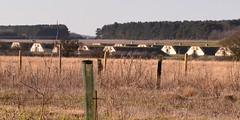
Sculthorpe’s bomb store was relocated in the late 1950s and was nuclear capable.
Then on the 25th, the remaining crews and staff of the squadron departed Downham Market, thus ending their link with 3 Group. Once here, flying circuits and more lectures became the order of the day. Additional training on ‘Monica‘ equipment, fighter affiliation tasks and local cross countries then took the squadron to late spring at which point operations began to take place.
The arrival of 214 Sqn heralded more than just a new bomber squadron though, for they would not be flying the Stirling as they had been; instead, they were set up as part of 100 Group, becoming an official member in mid January 1944. Their arrival here would not only see them change Groups but would also see them convert to the American built B-17 ‘Flying Fortress’. Now designated 214 (BS) Sqn, their arrival would bring another major change to Sculthorpe, a change that would continue for the next five months, but would have repercussions for many years to come.
Operating in the Electronic Warfare role within 100 Group, they would carry out radio jamming operations, an early form of Electronic Counter Measures (ECM). The urgency of the conversion, led to the unit taking on fourteen UK based B17-Fs , their ordered ‘G’ models being used as a trade off*3.
The British B-17 (designated Fortress I, II and III) crews were joined by personnel from various U.S. units. Their role was to train and support the air and ground crews in both flying and maintaining the new aircraft, a role they performed well, right into the early summer of 1944. The set up was so successful that American personnel were soon posted in to fly alongside the RAF crews, thus expanding the influence of the Group.
Flying along side other bomber formations, 214 Squadron would use systems including ‘Monica‘ to track or jam enemy radar, they performed ‘spoof’ missions to entice enemy fighters up to them rather than the main force that was attacking targets elsewhere; a rouse that worked well initially.
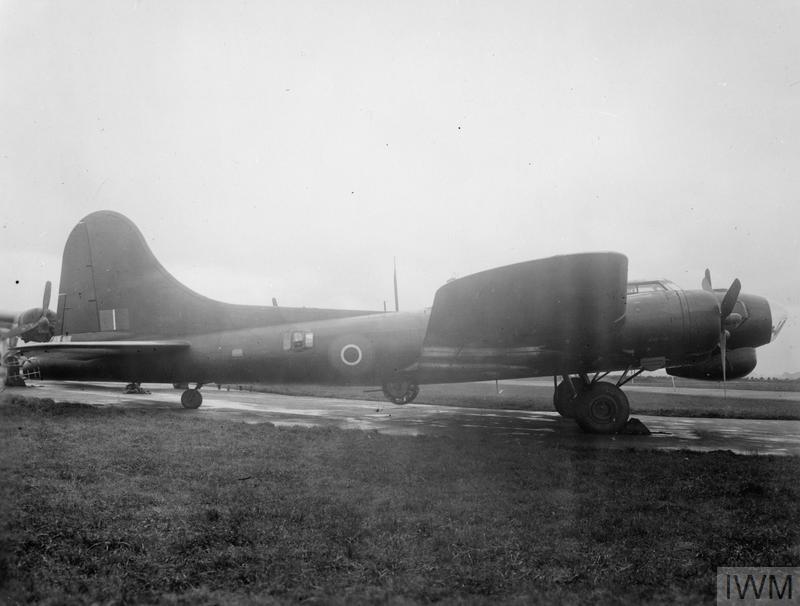
Fortress B Mark III, HB796, at Prestwick, after being fitted with radio counter-measures equipment by Scottish Aviation Ltd. It served with No. 214 Squadron from November 1944. Equipment fitted included American AN/APS15 radar in the large radome under the nose, Airborne Cigar (ABC) radio-jamming equipment (shown by the large aerial on top of the fuselage), and an Airborne Grocer aircraft radar jamming installation, the aerials of which can be seen on either side of the tail turret. HB796 failed to return from a bomber support mission on 9 February 1945. (© IWM ATP 13090E)
Other operations flown by the Group, included: jamming or swamping German radio communications, jamming navigation aids and searching for new signals that may suggest new or improved German radar.*3 The successes of 100 Group, prompted the setting up of the U.S. 803rd (Prov) BS (H) in March that year, a US Group who would learn from, and perform in the same role as 214 Sqn. Initially taking six veteran crews, all having reached 25 missions, from 96th BG at Snetterton Heath combined with those already at Sculthorpe, they would soon build up to a strength of twelve aircraft all based here at the Norfolk airfield. Of these initial six all but one were fitted with Carpet and Mandrel jamming equipment, whilst the sixth (B-17G) had jammers and search equipment in the form of SCR-587 and Hallicrafters S-27 VHF signals intelligence receivers (SIGINT) to track Luftwaffe radar and radio transmissions.*5
However, the initial set up of the unit was seen as ‘messy’ and disorganised with no real focus, a problem that led to delays in preparation, organisation and training. As D-day appeared over the horizon, the U.S. group was distinctly lacking in preparation and action was needed fast. To assist in the training and operations of the Fortress, a further new separate unit was also set up here at Sculthorpe.
From April 24th 1944, 1699 (Fortress Training) Flight who operated each of the Fortress I, II and III, carried out the conversion and training role for these crews, and to speed the process up, they also used the B-24 Liberator along with some smaller examples such as the Avro Anson and Air Speed Oxford. By this time, personnel at Sculthorpe amounted to some 104 RAF Officers, 233 Senior NCOs, 705 airmen, 190 WAAFs of various ranks and 1,073 US Officers, NCOs and airmen*7.
Then, five months after their arrival, both 214 Sqn and the 803rd were both posted out to RAF Oulton, (May 1944), where they continued with their ECM roles. The 803rd, now commanded by Lieutenant Colonel Clayton Scott, began to work on the support of Operation Overlord, and even as late as June 5th, equipment was still being fitted to the aircraft. The Fortress Training Flight moved with the two ECM units and in October it was disbanded and immediately reformed as 1699 (Bomber Support) Conversion Unit, a designation it used for a year before being renamed once more.
The departure of the three squadrons (along with the resident non-flying units) was not a coincidence, for Sculthorpe had been earmarked for redevelopment into a Very Heavy Bomber base (VHB). As soon as the personnel had moved out, it was placed into ‘care and maintenance’ and the workmen from Taylor Woodrow moved in; taking up residence in the now empty nissen huts on Site 3.
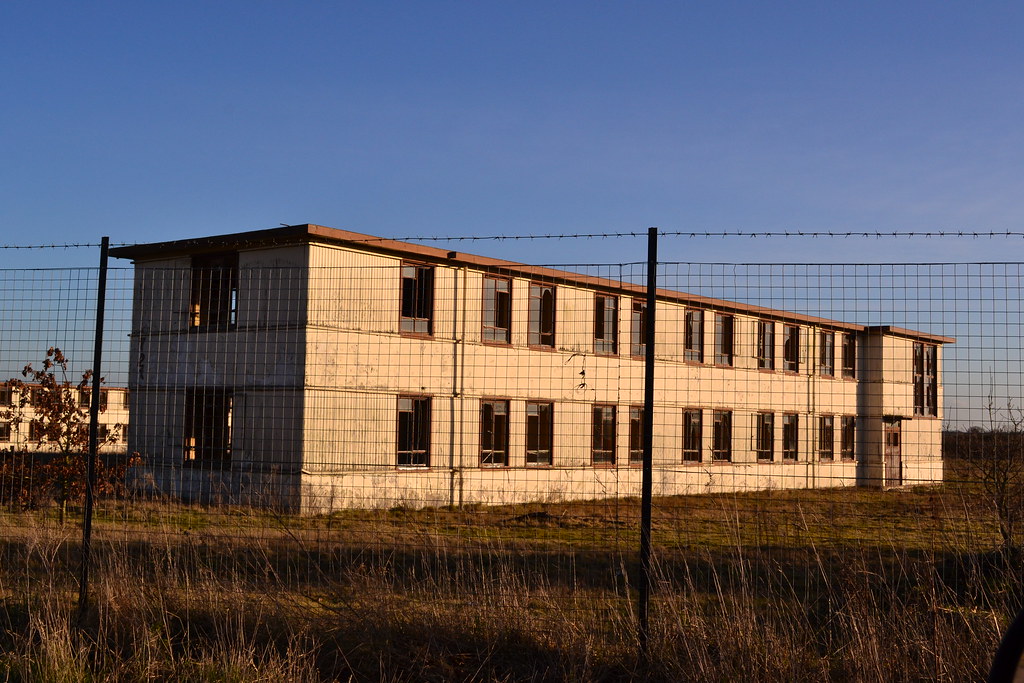
‘Z’ type Barrack Block (named so due to their shape – many of these are now in serious dilapidation)
The end of the war in 1945, didn’t unfortunately bring an eased peace. Tensions with Russia and a possible threat from the east meant that discussions had already started between the US and UK authorities over staging American heavy bombers on UK soil. This was not a decision taken easily; firstly, it would put Britain firmly on the front line in a war with Russia, and secondly, these bombers would need a significant infrastructure to support them. Runways would need to be extended to a minimum of 8,000 feet long and 200 feet wide with an additional 1,000 feet for any unintended overrun. Specialist buildings would be needed, larger dispersal pans required and hangars able to house the aircraft would also have to be erected.
With all that in mind, a number of sites in Lincolnshire, Kent and East Anglia were identified as possibles, one such airfield in the eastern region being Sculthorpe. It, like Lakenheath, already had a strong string to its bow, already having sufficient buildings to house the 10,000lb atomic bomb should the need arise. It was also, already a substantial size with good room for extension and further development. These factors essentially saved the life of Sculthorpe and for several decades after the end of the Second World War would see it really come to the fore and become a major player in not only British, but world aviation as a whole.
And so, US development specialist moved in, after which followed a period of sustained redevelopment of the site. This included the removal and reinstatement of longer runways along with the construction of twelve very heavy bomber hardstands. Surrounding public roads were also diverted and further properties were demolished to make way for the airfield’s expansion. New accommodation blocks, ‘Z’ blocks, were built, and new married quarters were created. The whole process took around three to four years to complete during which time the station was basically closed with only an occasional use keeping it alive; one such operator being the 1510 Beam Approach Beacon System Flight (BABS) based at nearby Bircham Newton.
A further deterioration in east-west relations then led to the Berlin crisis and what has famously become known as the Berlin airlift. The political situation in Europe essentially forced the hand of both Governments to make a final decision, one which resulted in the deployment of sixty (2 Bomb Groups) Very Heavy Bombers at various UK airfields. Whilst these deployments were on a temporary basis only, the decision would however, be the first step on the ladder to the US establishing itself officially, on UK soil for many years to come.
The lack of use over the last few years had meant however, that much of the accommodation at Sculthorpe had deteriorated to an unacceptable level. Damp and rot had set in and more work was now needed to bring it back up to standard before further deployments could take place. Even as this was being carried out though, bombs and other supplies along with, in February 1949, an advanced party of US personnel from the 92nd Bomb Group, began to arrive. As they passed through the main gate so began a new page in Sculthorpe’s history, and soon it would be ready to be an active base once more.
By December 1948, Sculthorpe, operating as a satellite to RAF Marham, began to prepare for its official opening. A somewhat premature move as reconstruction work was still going on and there was much to do before the airfield would be truly ready for its new residents.
In Part 3, Sculthorpe develops further, it receives its new residents and a new page is turned. As relations with the East becoming difficult, a new age dawns and nuclear weapons become the way forward.
The full story can be read in Trail 21.

 Aviation Trails