In Part 1, we saw how Grangemouth was created through incredible vision, but how the impending war shattered that dream. Also how it then went on to become a training airfield, training young pilots to fly Spitfires. This was not an easy task, the weather playing havoc with training schedules and an ill prepared airfield adding to the cauldron of problems that would culminate in the inevitable accidents and resultant deaths.
On October 1st 1939, F.O. James A. B. Somerville (known as Young Hamish, to his family) was taxiing his Spitfire I. (L1047), when P.O. J.S. Morton flying Spitfire I (L1059) landed on top of him. In the resulting accident Somerville was killed outright and his aircraft totally written off. P.O. Morton was uninjured and his aircraft received only minor damage, however, the accident would no doubt have a lasting impact the injuries to F.O. Somerville being so severe. *5
On October 6th, the order to move the entire 602 Squadron finally came though and the next day the main portion of the unit transported its belongings to Grangemouth. More poor weather prevented another early departure by the aircraft, but by lunchtime, all ground and air crew along with their Spitfires, were over at Grangemouth. Lacking in accommodation, airmen had to be billeted off site in the town itself, whilst Officers took up residency in one of the vacant houses just north of the airfield. The war had finally started for this small airfield in Central Scotland.
602’s stay at Grangemouth was to be short lived though. With threats of German attacks coming from the east, it was decided to move 602 elsewhere, and within a week new orders had come through to move lock, stock and barrel to RAF Drem, in North Berwickshire. By the 13th October, the Spitfires and all their personnel, were gone and Grangemouth was vacant once more.
602 Sqn would go on to make further ‘firsts’ whilst at Drem, when on the 16th of October, pilot George Pinkerton would intercept and shoot down, a Heinkel 111. In doing so, he would be the first pilot to to fire in anger in the skies over Great Britain. It would also be 602 who would down the first ‘intact’ enemy aircraft onto British soil. Known as the Humbie Heinkel, it would become famous for this reason.
It would then be all change again, and on the 19th October 1939, Grangemouth would see the arrival of a new squadron and a new aircraft. 141 Squadron Led by Pilot Officer H. Anderson, another former Turnhouse unit, brought with them Gloster’s Galdiator, an outdated but much loved biplane that began being supplemented during November by the more updated Blenheims.
Like their predecessors, airmen were billeted in three halls in the town whilst officers occupied two vacant houses -110 Boness Road and its neighbour. Whilst accommodation was far from ideal, it would do for now and all those assigned here were soon in and settled.
On the next day, a funeral guard of honour was provided back at Turnhouse for the burial of several German airmen. Those who were to stay behind had the unenviable task of filling sandbags, which were to be used around the dispersal points to protect aircraft from attacking bombers; a task that was eventually postponed due to yet more heavy Scottish rain.
In the following weeks little happened at Grangemouth. Six Gladiators were eventually brought in and used for local flying practise. The squadron tried to use the Air Observer School Ansons and although permission was eventually granted by Fighter Command, no instructors were available due to the School’s own backlog of hours. Further sand was delivered and yet more bags were filled, the monotony of such duties being broken only by the trickle of a small number of Blenheims from Hullavington.
Training flights were fraught with danger, and there were several accidents including on November 12th 1939, a crash on a night approach by Sgt. P. Green in his Gladiator. Sgt. Green was unfortunately injured in the accident, but after being taken to nearby Falkirk hospital for treatment, he made a good recovery. Also in November five Gladiators were sent to Acklington for firing practice. Due to bad weather though, all five had to make emergency landings en route, P.O. Louden hit a wall and P.O. Smith landed badly. In both incidences the aircraft received substantial damage but thankfully neither pilot was injured. The other three aircraft reported no damage after their various forced landings.
P.O. Louden would have a second lucky escape in the following January when the Blenheim he was flying, overshot the runway and crashed beyond the airfield boundary. Again the aircraft was badly damaged but P.O. Louden was once more unhurt.
The weather in southern Scotland can be terrible, and persistent heavy rain not only caused cancelled flights, but also made the ground boggy and difficult to traverse. Even the floodlight tractor became bogged down and stuck in the mud causing further problems for night flying activities.
The routine of local flying, link training and lectures then became the norm for the days leading into the new year. January 1940 saw snow, rain and fog play a large part in the daily lives of those stationed here, causing as many issues on the ground as it did in the air. In the following month, the squadron was given new orders to transfer to Prestwick, a move it made on the 13th. But before they had time to unpack and settle in, further orders came in to return back to Grangemouth, their stay at Prestwick lasting no more than a week!
The early part of the year saw yet more night flying practice and yet more landing accidents. The Blenheims taking a bit of beating as heavy landings caused considerable damage to landing gear and aircraft structures.
By April 1940 another new aircraft was being delivered to the Grangemouth squadron, the Boulton Paul Defiant I. A ‘fighter’ that had failed miserably in its initial role – falling foul of the enemy’s superior aircraft – but would later become more effective as a night fighter. The first of these aircraft was delivered on April 4th 1940, by from 24 Maintenance Unit (MU) based at Ternhill.
141 Squadron continued to re-equip with the Defiants, and by the end of June 1940 they were carrying out target practice at various sites around the UK. Excitement then came to the airfield when on 26th June 1940, crews were called to standby – the first air raid warning of the year sounded over Grangemouth. No bombs were dropped but an enemy aircraft was seen to be shot down. Those pilots from 141 Sqn who were put on stand by at the airfield were not needed and probably disappointed for not having the opportunity to put into practice their new found flying skills.
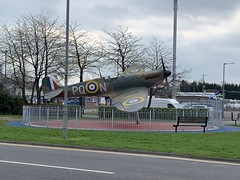
Replica Supermarine Spitfire Mark I X4859 PQ-N -which crashed 15th September 1941 over Avondale estate killing Sergeant Eugeniusz Lukomski. It stands at the front of the former airfield as a memorial to all those who trained here, especially the Polish airmen. Unveiled by 1333 Grangemouth Air Cadet Squadron in 2013.
A second warning sounded again on the 28th June, but once more those 141 Sqn pilots put on standby were not required, another disappointment for those waiting for the signal to scramble and a chance to get their revenge.
On that very same morning (June 28th 1940), new orders came through to 141, their posting to Grangemouth had come to an end. It was all move once more. Busses began to ferry the staff and their equipment from Grangemouth back to Turnhouse, a move that lasted for most of the day. By the late afternoon all aircraft and personnel had made the transfer across and the settling in process would begin once more. This wouldn’t be the end of the link however, for a small detachment would return in July before the ties between Grangemouth and 141 Sqn were finally severed for good.
The month of June would see many changes at Grangemouth, not only did 141 Squadron depart, but there would be three other units all arrive within days of each other before the month was out.
On the 8th, 614 Squadron arrived, followed the next day on the 9th by No 52 (Army Co-operation) Wing and then on the 28th, 263 Squadron. It would be a hectic time for this small and ill prepared airfield.
Two of these units, 52 ACW and 263 squadron would both be short lived stays, neither remaining beyond the end of September 1940.
The role of No. 52 (Army Co-operation) Wing, was a tactical move to help defend the northern regions from enemy attack. These Lysanders and Defiants were brought in to free up valuable Spitfires and Hurricanes who could subsequently be moved south to protect London and the South East. Here in Scotland, they could protect not only the industrial regions of the north from attack, but assist in army training operations ready for their return to the continent – whenever that would be. Being located at Grangemouth, they were in easy reach of both the west and east coast, an area they began patrolling almost immediately. This stay would be yet another short lived one though and they soon would move on elsewhere just a month after their arrival.
The second of these short stay units were the Hurricanes from 263 Squadron. 263 had been re-established at RAF Drem earlier in the month, after flying on board naval carriers, including HMS Glorious until she was sunk on June 8th 1940. They were now firmly a land based unit, and gradually getting back to full strength.
The other change came with the introduction of Westland’s Whirlwind for 263 Squadron. The underrated and rather obscure fighter being brought in to replace the Hurricanes they had been using since their reformation the month before.
In early September 1940, the time for change came once more, this time it was 263 who were to transfer from Grangemouth back to Drem, taking their newly acquired Whirlwinds with them. This would be the squadron’s only spell at Grangemouth before their final disbandment in 1963.

Aircraft of No. 58 Operational Training Unit at Grangemouth: a Miles Master Mark I undergoes an engine service in the hangar, while another Master is parked on the hard standing outside. In the background a Spitfire can be seen taxiing on the airfield.(© IWM H 9190)
The first of these June moments however, was to be the longer lasting one, remaining at Grangemouth until March 1941. 614 (County of Glamorgan) Squadron arrived on June 8th 1940, transferring north from Odiham
Over the next two days, twenty-two Lysanders would arrive, the crews being billeted in tents around the airfield site; hardly an ideal situation considering the location of the airfield and the weather they were experiencing at the time.
614 Sqn was another of the twenty-one Auxiliary Air Force units, and the only one formed in Wales. It had been operating in France assisting the Army as artillery spotters, providing coordinates for the French and British gunners desperately trying to stem the tide that was the blitzkrieg.
Once settled, 614 Squadron began practise flights dropping messages and performing tactical reconnaissance sorties. By the 17th June 1940, day long patrols were being carried out along the east coast of Scotland, covering an area from Inverness to Berwick, flying over the coastline and up to 5 miles inland. None of these patrols provided any signs of enemy action though.
Over the next few weeks further patrols and practise flights took place, one aircraft was damaged when struck by a second trying to land, and others had to land in fields due to bad weather or engine failures. There were no causalities but some of the aircraft were badly damaged in these incidents.
614 were also used to test gas spraying techniques in a chemical warfare role. Parts of Grangemouth were off limits and heavily guarded, and permits had to be issued to those personnel needing access to such areas. The idea behind this was that of the enemy launched an invasion force along the Scottish coast, then mustard gas (stockpiled at Grangemouth) would be used against them. This secret and somewhat underhand method of warfare was carried on by 614 once it moved to Macmerry in the following year.*4
In July 1940, internal changes saw the headquarters, motor transport unit and armaments sections move from one part of the airfield to a farm located at the northern side of the site. Simultaneously 180 airmen moved into the recently requisitioned annex at the local Grange School, whilst a further 100 moved into the school itself. A temporary measure that would only last until the next school term started. Other duty personnel were moved to tents around the airfield, perhaps somewhat reluctantly, especially as within days, heavy rain would flood them out resulting in them being billeted off site as well.
Over the next few weeks little flying took place as bad weather continued to cause problems. Airfield defences continued to be erected and a visit by the Inspector General Sir E. Ludlow-Hewitt, broke the monotony of the pouring rain.
On August 10th 1940 an accident occurred when Lysander P9186 piloted by F.O. N. Merrett and F.O. J. Harper collided with Lysander N1251 flown by P.O. Cheminant. During the evasive tactics exercise the aircraft struck Merrets Lysander losing virtually all its main-plane. The aircraft then crashed to the ground killing both occupants. The second aircraft, whilst damaged, managed to land safely.
Bad landings caused extensive damage to several aircraft in the month that followed, whilst three others were grounded awaiting spares. Luckily none of the occupants in the poor landings were injured, but it did mean the squadron was now six aircraft down causing issues with both cover and patrols.
The last few days of September 1940 brought other incidents and fatalities. Outside the airfield, a dispatch rider was killed in a head on collision with a car, and an enemy bomber dropped a bomb in the vicinity of the airfield. No damage was done to the site but it brought home the fact that war was never very far away. At this time work also began on building the asphalt runways, which up until now had remained as grass. With luck, the heavy rain that had continued throughout the summer would soon not hinder flying activities.
At the close of September 1940, 754 hours had been flown by crews in daylight but only 17 had been flown at night; it had not been a great summer all round.
On the 4th November (1940) news came though that Grangemouth was transferring from 22 Group back to Fighter Command, the news brought little more than hope, those units already here remaining where they were and with what they had.
The miserable weather of 1940/41 brought little to cheer about at Grangemouth. Perhaps the greatest interest, apart from a hopeful christmas break, was the formation of a training unit in December. On the 2nd, 58 Operational Training Unit (OTU) was set up and provided with Spitfires along with a selection of Fairy Battles, Hurricanes and a Whitley amongst others. The OTU was supposed to have been formed earlier in November, but when Sqn. Ldr, (later Air Vice Marshal) Henry Hogan arrived, it was not ready for the OTU and so he left disappointed having to return the following month.
The last part of the trail shows how Grangemouth met it demise. Once the dream of a visionary it slowly begins to decay as the war comes to an end and units are gradually pulled out, surplus to requirements. The end comes slowly, but not before its last and longest standing unit arrives.
 Aviation Trails