In this latest trail around Britain’s wartime airfields, we travel to central Scotland, and the foothills of the Highlands. Travelling west from Scotland’s capital Edinburgh, we head toward an area of outstanding beauty where the flat lands begin to meet the lower highlands. Here during the Second World War, lay an airfield that never reached its full potential, but it did play a major part in the training of the RAF’s fighter pilots.
In Trail 64, we visit the former RAF Grangemouth.
RAF Grangemouth.
Grangemouth lies 1 mile from the town that gave it its name and 3 miles from Falkirk. The Firth of Fourth, Edinburgh’s major sea outlet, crosses west to east north of the airfield providing not only major docks and shipping services, but dry docks for submarines and other naval vessels as well. It is the natural sea outlet that led to Grangemouth’s very existence when founded in 1768 by Sir Lawrence Dundas, following the creation of the Forth and Clyde Canal that linked Glasgow to Edinburgh.
The Shipping that this development brought led to a huge expansion of the docks at Grangemouth. Exports increased along with the number and size of the docks available. Then during the First World War, these were taken over and renamed HMS Rameses, by the military, who set up a mine manufacturing and training school here. Once usefulness of mines was realised, old merchant vessels were quickly adapted to drop mines and these were both stored and loaded here at Grangemouth.
The airfield itself was located to the south of these docks, and would play a large part in their defence, especially as a major oil refinery has been located here for many years. The expansion of this refinery, albeit a turbulent one, has since taken over the airfield site leaving little trace of its history behind.
Accommodation for those personnel stationed here was often rudimentary to say the least, tents providing cover for many whilst the local town hotels were used for the luckier ones. A substantial number of houses along Boness road, just beyond the airfield perimeter, were also known to have been requisitioned over a period of time, some used for sick quarters whilst others became aircrew billets.
Life for Grangemouth airfield began long before the current industrial modernisation of the area though, initially being earmarked as a civilian site for commercial operations before war broke out. It was opened on May 1st, 1939 and was intended to have as many as four grass runways, the longest being 1,360 yards long. It would be operated and run by Scottish Aviation Ltd., who were based at Prestwick. Built by a number of companies including the construction company Wimpey, it would have at least twenty dispersals, two of which had blister hangars on them by the war’s end.
The main Edinburgh road originally passed between the airfield and the Firth, thus restricting any wartime expansion northwards. Now replaced by the M9 to the south, this road is now a minor road through housing serving a thriving residential community.
When it was handed over to the military, the site was then developed further, some of the rudimentary accommodation was replaced by more substantial blocks, and the grass runways were replaced with tarmac. The airfield was by then, able to cater for upwards of 600 personnel of mixed rank and gender.
With a total of eight Blister hangars added, its maintenance facilities were then extended far beyond those of its civil requirements.
It ambitious origins began in early 1939, with the purchase of 500 acres of farmland to develop into what was intended to be Scotland’s largest airport, initially serving routes to London, Glasgow, Edinburgh and the Shetland Isles. During its construction, two large civil airport hangars were built along with a large and luxurious terminal at a cost of some £160,000 (£14,000,000 today).

The luxurious Terminal building (Falkirk Herald)
Even before the site was completed, the grass runways were active with the first commercial ticket being sold to Provost Robert Peddie for the princely sum of £9.00 10 shillings. The ticket gave him passage south in a de Havilland Dragon Rapide, but more importantly, this inaugural flight meant that Grangemouth was now commercially ‘operational’, even though it had not yet been officially opened.
On July 1st, 1939, Air Marshall Viscount Trenchard, the ‘Father of the RAF’.*1 arrived at the airfield declaring it officially open for business. Known as Central Scotland Airport, it was part of the expansion of the much troubled North-Eastern Airways, a company that had only been formed five years earlier, on March 4th 1935 by a group headed by the wealthy racehorse owner and banker, Ralph Beckett, 3rd Baron of Grimthorpe.
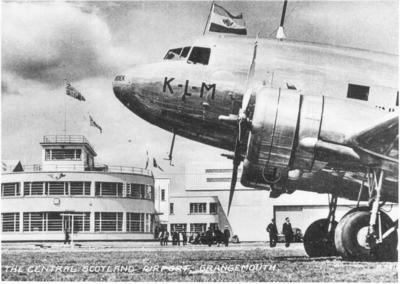
A KLM operated DC-3 at Grangemouth. It is thought this was taken at the opening of the airfield,. The terminal is in the background. (Feel Falkirk website P12358)
Flying in direct competition with the rail service LNER, North-Eastern Airways operated flights from London to Newcastle and then onto Grangemouth before heading northward again to Perth and beyond. The majority of their fleet were Airspeed AS.6A Envoys, with the Rapides following on later.

Eastern Airways Timetable April 1939 @Bjorn Larsson
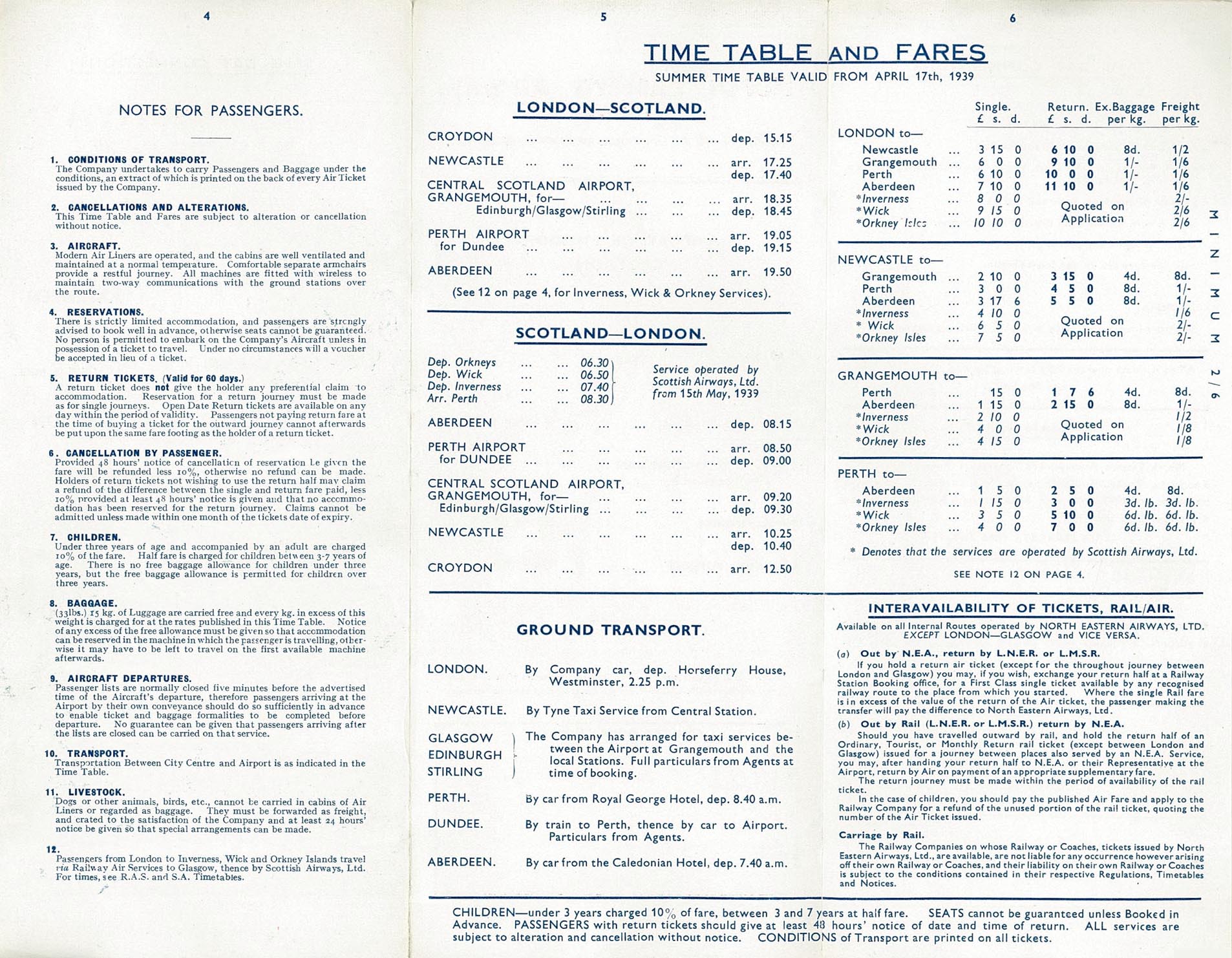
North Eastern Airways Timetable April 1939 @Bjorn Larsson
North It was intended that more routes would soon open up encouraging new operators and prosperity to the area, unfortunately this was only a pipe dream and with increasing costs and cheaper rail tickets challenging the operator, these routes were soon closed proving uneconomical to run in light of strong competition. The onslaught of war then hammered the final nail in to the coffin of commercial operations, By September 1939, all flights had ceased, and the future of Grangemouth was no longer in the hands of civilian operators.
Whilst these commercial operations were the prime reason for the purchase and development of Grangemouth, Scottish Aviation’s interest, and that of Air Marshall Trenchard was more than a passing coincidence. The company had early on in the proceedings, secured a government contract to train pilots for what seemed to be an inevitable war with Germany.
Scottish Aviation set up their own civilian run training group 35 Elementary and Reserve Flying Training School (ERFTS) to fulfil this contract. They operated some fifty-one aircraft including: the Audax, Hawker Hinds, Tiger Moths and soon after Avro Ansons, with an intended capacity of 200 trainee pilots at any one time*2
Soon after the declaration of war, a reformation of military training operations took place, and a new unit was established here with 35 ERFTS being disbanded and reformed as 10 Civil Air Navigation School (CANS). The use of the Ansons continued. This name however, would only last until November, when a further re-naming took place, forcing the disbanding and renumbering of the unit to 10 Air Observers Navigation School (AONS)*3
10 AONS, continued to soldier on with the Ansons. Then on 2nd December 1939 it was all change again when the unit was absorbed into the Prestwick school, 1 Air Observers Navigation School. Grangemouth, now closed to all civilian operations, was passed to full control of the RAF’s Fighter Command and 13 Group. It would seem there were to be big changes ahead.
Meanwhile, back on August 25th 1939, the RAF began mobilisation, orders were sent round military airfields to begin preparing for war. One such order came through to the Abbotsinch based 602 (City of Glasgow) Squadron, instructing them to inspect the buildings at Grangemouth with a view to moving there shortly afterwards. Sqn Ldr. Farquhar and two other members of his staff then travelled by car to Grangemouth, inspected the site and made their findings known later that evening.
On September 1st 1939, at 23:45 hrs, a notice came through to 602 Squadron to mobilise all units and prepare for war. With a considerable amount of preparation already having been done, the squadron were able to pronounce themselves ‘mobilised’ by 10:30 hrs the following morning. Commanding Officer Sqn Ldr A.D. Farquhar with Flight Lieutenants W. Robinson “A” Flight, and G.D. Pinkerton “B” Flight, led the way, taking the Scottish unit to war.
602 Sqn had the grand distinction of being the first of the Auxiliary Air Force squadrons to be formed, an honour that occurred in 1925. Although the first staff member, adjutant Flt. Lt. Martyn arrived at Renfrew to begin proceedings on September 12th 1925, the squadron’s official birthday wasn’t recorded until September 15th.
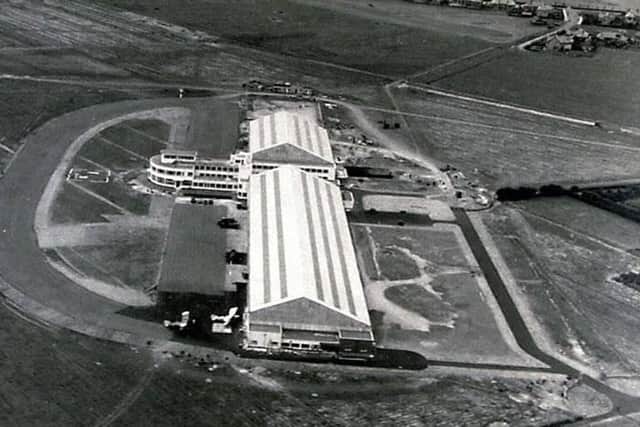
The two hangars and terminal building. These hangars are the sole remaining structures left on the site. See photo below. (Falkirk Herald Website)
Between its formation and its impending move to Grangemouth, 602 Sqn had operated a wide range of aircraft: Hawker Harts, Hinds, Hectors Gauntlet IIs and from May 1939, Spitfire MK.Is. The Spitfire being a major leap forward in terms of flying technology, speed and power. This change gave 602 yet another ‘first’, being the first Auxiliary unit to receive the new aircraft type.
Two days later on September 3rd, official notice Movement Order 3 of 1939, gave notice of the imminent move, and preparations immediately began at Abbotsinch. The aim of the squadron’s move to Grangemouth was to protect the valuable iron foundries, dockyards and numerous chemical factories that were now abundant along the banks of the Fourth.
Apart form organising the move, the first few days of war were unsurprisingly uneventful, with orders to “Stand by” being given to both A and B Flights coming to nothing more. The routine quickly changed to night flying practise, and as a result, the first ‘casualty’. In the dark, with little lighting to guide them in, a Spitfire crashed on the airfield whilst trying to land but luckily no one was injured and the aircraft only suffered ‘minor’ damage.
The quietness of the Phoney War, enabled the C.O. to test a new device that would stop the obscuring of the windshield from oil thrown out by the propeller. The unit was made, fitted and tested in the air, and photographs along with a detailed report was submitted to Fighter Command on September 6th. On the 8th, Sqn Ldr. Tidd of 13 Group came to see the item in action for himself, and finding it most suitable, had it used on all aircraft. As a result, the idea played a major part in future Spitfire development.

Left: One of the two original hangars still used at Grangemouth.
On the 30th September, a further visit to Grangemouth led to the decision that only a small detachment, and not the entire squadron, of 602’s Spitfires could be moved to Grangemouth, not at least until the accommodation, currently held by the Navigation School, had become vacant. These few aircraft and their ground crews would operate from Grangemouth between 09:00 and 18:00 hrs each day with ground staff and pilots being billeted on site during their tour there.
The next day, October 1st, a small detachment comprising of six aircraft, along with ammunition and all the necessary flight equipment, departed Abbotsinch for Grangemouth. The desired early departure was unfortunately delayed by poor weather, something that was going to dominate the next few years at Grangemouth, and so the group, led by Flt. Lt M. Robinson, didn’t arrive until later than planned that day.
It was also at this time that 602’s sister squadron and rival, 603 (City of Edinburgh) Squadron, another Turnhouse unit, would begin to receive their Spitfires. As these were new aircraft to the squadron, each Flight, ‘A’ and ‘B’, would travel to Grangemouth to train. ‘B’ arrived first, flying between 17th and 24th, followed by ‘A’ Flight between the 25th and the 30th. These daily flights meant a considerable amount of movement in and out of the airfield, and with so many trainees in unfamiliar aircraft, accidents were almost inevitable.
In Part 2, we see how Grangemouth goes on to develop further, how the weather played a role in its operation and how with so many young men eager to learn, mistakes were made with dire consequences.
 Aviation Trails