July 30th 1944 – Loss of Lancaster PB304 – 106 Squadron.

On Sunday July 30th 1944, Lancaster PB304 from 106 Squadron RAF Metheringham in Lincolnshire, crashed with the loss of all on board, along with two civilians, in Salford Greater Manchester.

Lancaster PB304, was a MK.III Lancaster based at RAF Metheringham in Lincolnshire, flying under the squadron code ZN-S. It was tasked to attack enemy strong points at Cahagnes in the Normandy battle zone following the Allied invasion in June.

The early briefing at 04:00 was not a welcome one, many men having been out the night before following a stand down order due to bad weather and heavy rain over the last two days. On board that day was: F/L. Peter Lines (Pilot); Sgt. Raymond Barnes (Flt. Eng.); F/O. Harry Reid RCAF (Nav.); F/O. John Harvey Steel (Air Bomber); Sgt. Arthur William Young (W.O/Gunner); Sgt. John Bruce Thornley Davenport (Mid-Upper Gunner) and Sgt. Mohand Singh (Rear Gunner)*1.

The operation, code-named Operation Bluecoat, would involve attacking six specific targets, each one identified to assist a forthcoming offensive by British land forces in the Normandy area.

After all the ground checks were completed and the signal given to depart, PB304 began the long taxi to the runway, take off was recorded as 05:55, but it is thought that this was ten minutes early with the first aircraft (ND682) departing at 06:05. Once in the air, the aircraft formed up alongside twenty other 106 Sqn aircraft,  meeting with a smaller formation from 83 Sqn at Coningsby before joining the main formation.

The weather remained poor with heavy cloud blanketing the sky between 5,000 and 10,000 feet, as the 183 Lancasters from No. 5 Group and one Mosquito headed south toward the Normandy coast.

With further poor weather ahead, signals were beginning to come through to abandon the mission and return to base, but communication between aircraft was garbled and difficult to understand, it may have been as a result of German interference broadcasting messages over that of the master bomber. The order to abort finally came through just after 08:00 even though some of the formation had released bombs on target indicators (TI) dropped by the Pathfinders. Smoke was by now mixing with the low cloud causing more confusion and difficulty in identifying the primary targets. Not all aircraft understood the message however, and many continued circling in the skies above Cahagnes. To make a difficult situation even worse, there was by now, an  approaching formation of over 450 American A-20s and B-26s along with just short of 260 P-51 and P-47 escorts on their way to France; the sky was full of aircraft in thick cloud and was an accident waiting to happen.

Difficult communication continued, some aircraft were seen disposing of their bomb loads over the Channel, whilst others retained them. Various courses were set for home, but with many airfields closed in by low cloud, alternatives were gong to be needed and alternative courses were issued to the returning bombers of each squadron.

106 Sqn were ordered to fly north along the western coast, passing over Pershore and on to Harwarden near Chester, before turning for home. The messages coming through continued to be misheard or misunderstood with several aircraft landing at either Pershore, Harwarden or Squires Gate at Blackpool. Gradually all aircraft managed to land, whether at home at Metheringham or at away airfields. Patiently the Metheringham staff waited, nothing had been heard from PB304 and they could not be contacted on the radio, something was wrong.

Precise details of the accident are sketchy, but an aircraft was seen flying low and in some difficulty. It passed low over Prestwich on the northern edges of Manchester, where it was later seen engulfed in flames. It twice passed over a playing field, where some suspect F/L. Lines was trying to make a crash landing, but this has not been confirmed. At some time around 10:10 -10:15 the aircraft came down resulting in a massive explosion, a full bomb load and fuel reserves igniting on impact. Many houses were damaged in the explosion with one being completely demolished.

As a result of the accident, all seven of the crew were killed along with two civilians, Lucy Bamford and George Morris, as well as, what is believed to be, over 100 others being injured all to varying degrees.

PB304 was the only aircraft lost that night, in a mission that perhaps with hindsight, should not have taken place. The poor weather and difficult communication playing their own part in the terrible accident in Salford on July 30th 1944.
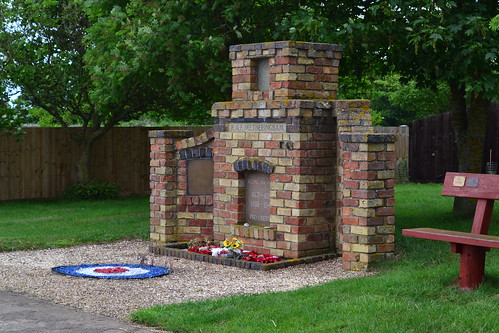
RAF Metheringham

The Memorial at Metheringham pays tribute to all those who flew with 106 Sqn.

Notes and Further Reading.

*1 Operational Record Book AIR 27/834/14 notes Sgt. Young as Sgt. A.L. Young.

A book written by Joseph Bamford the Grandson of Lucy who was killed that night, was published in 1996. “The Salford Lancaster” gives excellent details of the crew, the mission and the aftermath of the accident, published by Pen and Sword, it is certainly worth a read for those interested in knowing more about the incident.

Carter. K.C., & Mueller. R., “Combat Chronology 1941-1945“, Centre for Air Force History, Washington D.C.

Freeman. R., “Mighty Eighth War Diary“, Jane’s Publishing. 1980
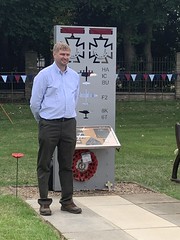
Downham Market VC Memorial Updated.

The memorial, located outside of Bexwell church, opposite what was the entrance to RAF Downham Market (Bexwell) was updated and officially rededicated on Sunday 8th July 2023.

It commemorates two pilots who were posthumously awarded the VC  both whilst serving at the airfield during the Second World War.

Both Flt. Sgt. Arthur Louis Aaron, (218 Squadron) and Sqn. Ldr. Ian Willoughby Bazalgette (635 Squadron) lost their lives in heroic attempts to save not only their injured crew but also the aircraft in which they were flying. The awards were given posthumously following their deaths, a year apart, on 12th August 1943 and August 4th, 1944 respectively.

Up until now, a small memorial has been on the site commemorating the heroic action of both men, but on Sunday, a new memorial was unveiled which is far more befitting not only of the two men, but all those who served at the airfield during those dark days of World War II.

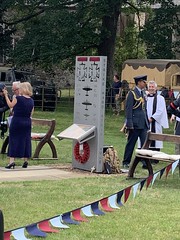
The memorial, in steel, stands at around six feet in height and shows not only the two VCs but the types of aircraft flown (Stirling, Lancaster and Mosquito) by the six squadrons who operated from RAF Downham Market along with their relative squadron codes.

Each symbol is cut out of the steel which (intentionally or not) allows the sun to shine through casting an image on the ground. The creator, Jonathan Horton, also made a series of steel silhouettes of the different aircraft, these were placed in the ground to appear as if flying toward the memorial.

Downham Market updated memorial

Designer Johnathon Horton with the memorial.

The service opened at 02:30hrs, and was well attended by various military dignitaries from nearby RAF Marham, and the RAAF, also with representatives from the Royal Air Force Association, a local village spokeswomen and members of the community who helped organise the memorial as well as a former Mosquito pilot Flt. Lt. Colin Bell DFC, AE now 102 years old.

Downham Market updated memorial

The new memorial with Station Commander Grp. Cpn. Frederick Wigglesworth (right) and Colin Bell DFC AE (left)

Words of prayer were said by Reverend (Wg CDR) Eddie Wynn, the blessing by Reverend Nigel Moat, words from Grp. Cpn. Frederick Wigglesworth (station Commander RAF Marham) and a bible reading from Air Commodore Steve Thornber CBE RAFR. Sadly a fly past by the BBMF Spitfire didn’t happen.

Two hymns were sung: O God, our help in ages past and The Airman’s hymn,  with the National Anthem closing the ceremony.

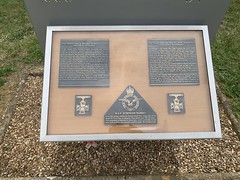
The new memorial uses the original memorial rearranged in a new setting and attached to the new memorial rather than on a pedestal as before. The Pathfinder Moto ‘Strike Hard Strike Sure’ is also cut down the flanks of the sheet, further reflecting the work carried at Downham Market.

Downham Market updated memorial

The updated board from the original memorial.

The memorial can be found outside of Bexwell Church opposite what is the former technical area of RAF Downham Market. Grid Reference TF 63142 03460, Post Code PE38 9LZ

The Transformation of 2nd Lt. Kermit D. Wooldridge, 379th BG, 525th BS.

Kermit D. Wooldridge’s future looked dim as a teenager. The troubled youngster was described as truant, incorrigible, and a run-away. He dropped out of high-school. Born to deaf-mute parents who could not control him, he was raised by an uncle in Lubbock and Abernathy, Texas.

Bored and headed for trouble, on July 12, 1934, Kermit Wooldridge, age 17, joined the US Army. No one would have predicted that a few years later he would find himself in the midst of the most important war America would ever fight. It was unimaginable that he would pilot the formidable four-engine heavy bomber – the B-17 Flying Fortress.

Enlisted man Wooldridge – with a GED in one hand and a forged document of parental permission in the other – would soon be whipped into shape by the United States Army.

Private Wooldridge spent five years with the 7th Cavalry, Ft. Bliss, Texas. In 1939, Corporal Wooldridge was transferred to the Hawaiian Coast Artillery Corps.

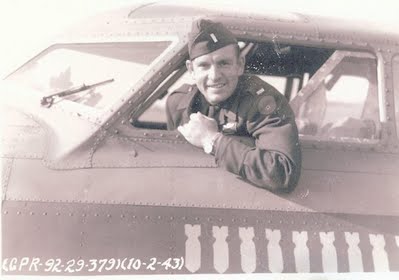
K.D. Wooldridge in his B17

K.D. Wooldridge in his B-17

Life for Wooldridge changed on Dec. 7, 1941. The bombing of Pearl Harbor heightened urgency for pilots in our woefully inadequate Army Air Corps (now the USAAF.) Two weeks later, Dec. 24, 1941, Kermit Wooldridge was commissioned a 2nd Lt. – appointed on a temporary basis for “the duration of the present emergency.” On that day, the now disciplined, military-indoctrinated “Woody” Wooldridge began pilot training, initially in twin engines, and later in the B-17 four engine bomber.

Looking at his military records, the amount of time to learn to fly an aircraft in wartime was greatly abbreviated. Pilots and airmen were needed – and fast. Air schools and fields were authorised. Wooldridge’s military records show he began intensive pilot training Dec, 24, 1941 (200 hrs flight time) for one year. Training in the B-17 followed – completed in fewer than six months.

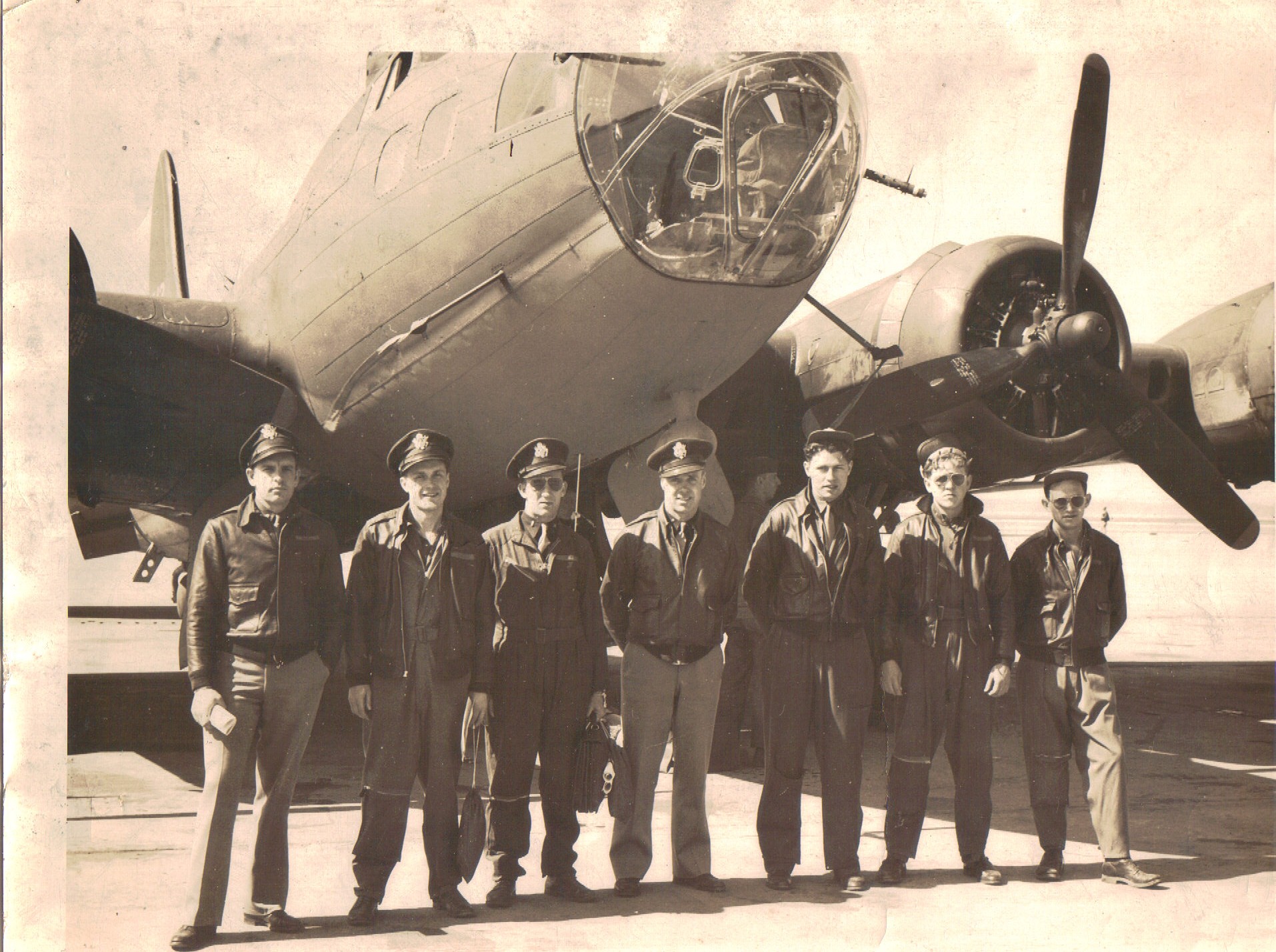
KDW_(L)_and_crew_B-17__1943_200_dpi

Pilot Wooldridge (L) and His Crew Beside their B-17

On June 9, 1943, with eighteen months flight training total (495 hrs flight time) Wooldridge – along with thousands of other eager airmen – would land at Kimbolton Airfield, England. On June 29, 1943, he would fly his first mission of the war – the bombing of Paris.

The transformation of a truant high school dropout was well on its way.

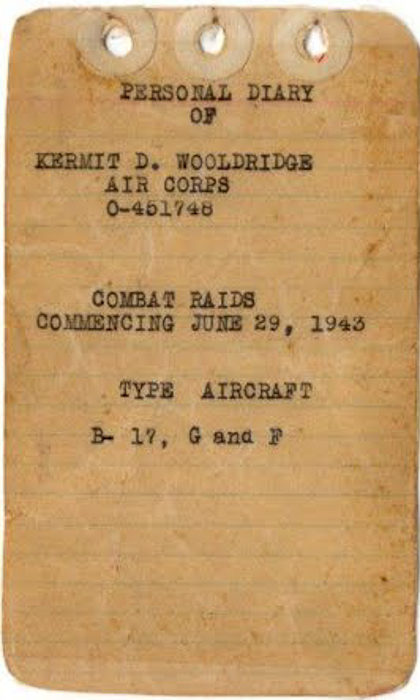
At Kimbolton Airfield, 2nd Lt. Wooldridge, 379th Bomb Group, 525th Bomb Squad, who formerly scorned the written word, began a chronicle of each of his 25 missions over Nazi-occupied Europe. Returning from each mission, pilot K.D. Wooldridge typed on small diary pages his recollection of that day’s work – targets bombed, engagements with Nazi fighters, planes being shot down, crippling damage to his own bombers and horrible loss of life.

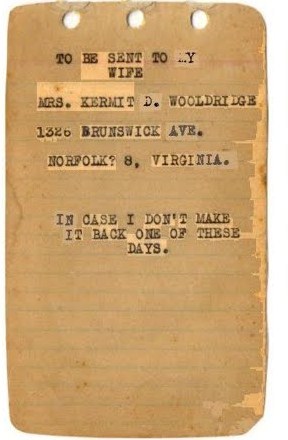
His written work, “Personal Diary of Kermit. D. Wooldridge, Combat Raids Commencing June 29, 1943” was dedicated to his wife Marjorie Wooldridge with these chilling words:

“IN CASE I DON’T MAKE IT BACK ONE OF THESE DAYS.”

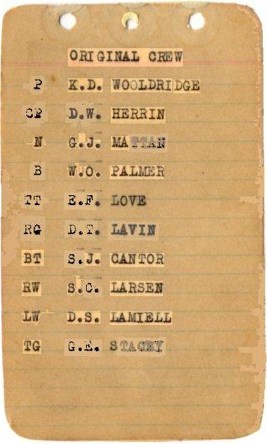
"To be sent to my wife" Wooldrige's diary KDW_Original_crew_from_scan
To Be Sent To My Wife Wooldridge’s diary Original Crew List of Wooldridge’s B-17

The missions were from June 29 to December 13, 1943.

Kermit Wooldridge would return home to the United States and his wife, where I would be born in November, 1944. Wooldridge would spend 25 years in the Army, retiring a Lt. Colonel in 1958. He and his my mother would raise four children.

Lt. Wooldridge, After Last Raid on December 13 1943

It was only after retirement from the Army that the wayward young man who wrote of the horrors of war as a 26 year-old, would then go to college and begin a second career as a math teacher.

After his death in 1994, my mother gave me the diary and asked me to do something with it one day. I did not read it until many years after his death. His story is not unique – my dad was an ordinary man, who along with his crews, was put into extraordinary circumstances. They all acted heroically, but would not like to be called heroes.

Over one-third of the B-17s over WWII Europe were lost.

I donated my father’s diary to the Library of Congress in Washington, D.C.

Here are a few excerpts from the diary of Lt. Kermit Wooldridge. The entire diary is online, each raid separately. sites.google.com/view/wooldridge-diary-wwii-pilot/home

Raid 18: 10/14/43

“Today we took off with a load of three 1000’ demos and a load of incendiaries. Our target the ball bearing plant at Schweinfurt, Germany. We had been briefed several times for this target and we knew it was going to be rough. It turned out to be the roughest ride that I ever hope to see…… we dropped our bombs OK and turned away from the target and ran right into the whole German air force….they were coming through the group in droves and shooting all the way. One FW190 rammed my right-wing man head on. They both went down in flames. They kept coming in groups of five and ten at the formation and in less than five minutes five of the seven ships in the squadron that I was leading had been shot down.

Well I and the other ship joined another squadron that had only four ships left. For the next hour and a half the fighters kept hammering at us. I was really doing violent evasive action to make them miss.   My ball turret gunner asked me if I thought I was flying a P-38. Well frankly I was giving her all she could take but still had no hope of making it back…we were near out of gas and it was time to do something if it was wrong….when the altimeter got down to an indicated 200 ‘ above the ground I started praying. One of the many that I had said today. When the reading was low (80 feet) the navigator said he saw a row of lights ahead. Sure enough there was a field about half a mile ahead. We went straight in and landed for we were too low to make much of a turn.

About half of our tail was shot off and the wings and fuselage were full of holes. The crew was O.K.”

KDW_and_wife_Marjorie__Bomber_returns_to_US_Dec,_1943

News cutting showing Wooldridge’s return from War.

This post was written by Frances Bekafigo, the daughter of Kermit D. Wooldridge.  My gratitude goes to her for allowing me to share these most personal details. She regularly posts extracts from the diary on Twitter @FrancesBekafigo and the full diary can be found on her website at sites.google.com/view/wooldridge-diary-wwii-pilot/home

This is an excellent recount of the life of a young B17 Pilot and is well worth a read.

Kimbolton

RAF Kimbolton Memorial Today