On April 25/26th 1944, 487 Sqn (RNZAF) moved from RAF Gravesend to RAF Swanton Morley in Norfolk, taking with them D.H. Mosquitoes. They had only been at Gravesend a few days when news of the new move came through.
487 Sqn had previously been involved in ground attacks on German airfields across the occupied countries, and in several high profile missions. In particular, during the previous February, they had been involved in Operation ‘Jericho‘, the attack on the Amiens Jail, in France. It was also a Methwold based Ventura piloted by Squadron Leader Leonard H. Trent, who, on 3rd May 1943, had led the Squadron in a disastrous daylight attack on the power station at Amsterdam. As a result of his actions that day, Sqn. Ldr. Trent received the V.C., the highest honour bestowed on personnel of the armed forces.
On their arrival at Swanton Morley, 487 Sqn would immediately begin training for new air operations, their part in the forthcoming D-day invasion at Normandy, with the first flights taking off the following day.
On April 27th three ‘targets’ were chosen, the Grimston Range not far away from Swanton Morley, the Bradenham Range in the Chilterns, and lastly the Army Gunnery School site at Stiffkey, on the North Norfolk coast. Each of these were to be ‘attacked’ in cross country sorties by the Mosquitoes.
In one of those Mosquitoes ‘EG-A’ was Pilot Flight Lieutenant John Charles Paterson (NZ/2150), and his Navigator Flight Lieutenant John James Spencer Mellar (s/n: 49175) both of the R.N.Z.A.F.
The day’s sortie went well, until the return flight home was made. It was on this leg of the flight that the port engine of the Mosquito, a Hatfield built FBVI ‘NS828’ under contract 555/C.23(a), began to overheat.
Immediately Flt. Lt. Paterson feathered the engine – now flying on just one. The Mosquito was lined up on approach to Swanton Morley for a single-engined landing, but all did not go well. Unfortunately, instead of putting the aircraft down on the runway, the aircraft overshot the airfield crashing into a field beyond, the resultant accident killing both pilot and navigator instantly.
The Operational Record Book (AIR 27/1935/31) for April 27th states:
“Formation dive bombing on Grimstone [sic] range. Low level bombing on Bradenham Range. Formation cross country with air to sea firing practice off the coast at Wells. In the evening six aircraft carried out formation attacks on gun positions at an army Gunnery School at Stiffkey. Returning from this ‘A’, F/Lt. Paterson developed engine trouble and feathered the airscrew. In attempting to land, he overshot and crashed. F.Lt. Paterson and his navigator F. Lt. Mellar, were both killed.”
Since then, a memorial has been erected in memory of the two men, located on the side of the B1110 Dereham Road just outside the village of North Elmham in Norfolk, it stands not far from the site of the crash site, west of Swanton Morley airfield. After the crash, Flt. Lt. Paterson’s body was buried at Shepperton Church Cemetery, whilst Flt. Lt. Mellar was buried at Brookwood Military Cemetery plot 24. D. 20.
Flight Lieutenant Mellar was 29 on the date of his passing, he was the son of William Edward and Eleanor Mellar; and husband of Dorothy Freda Mellar. Flight Lieutenant Paterson was 24 years of age, he was the son of John Alexander and Alice Louise Paterson, of Papakura, Auckland, New Zealand, and husband of Doris Josephine Paterson, of Shepperton.
‘Aviation historians attempt to trace family members of wartime tragedy for new Memorial unveiling’
On November 10th 1943, a B-17 Flying Fortress heavy bomber which had taken off from Thorpe Abbotts Airfield, near Diss minutes earlier, crashed in Brome village after unsuccessfully attempting to reach the newly constructed concrete runway at Eye airfield.
Civilian eyewitness reports, documented at the time by United States Army Air Force Accident Investigators, stated that the aircraft was observed with an onboard fire and flying at very low level, before pulling-up sharply to avoid hitting the tree-lined avenue at the front of The Old Rectory (now the Oaksmere Country Hotel). The aircraft immediately stalled out, crashing into overhead power lines and a gang of local road workers clearing drainage ditches. Fire quickly engulfed the already burning aircraft as it dragged a horse and tumbril into a nearby field as the road men tried in vein to flee the scene. As the heat from the aviation-fuelled fire rapidly intensified, exploding ammunition and phosphorus ordnance prevented bystanders from being able to help any of the young airmen onboard the doomed Bomber.When the gravity of the situation was fully realised, 13 American Airmen, 4 British civilians and one horse had all tragically succumbed to the horrific accident which still to this day ranks as one of the very worst aviation related loss of life incidents in the whole of the Mid-Suffolk District.
Fressingfield lorry driver Roland Thirkettle narrowly avoided serious injury when he was stood beside his truck close to Brome Crossroads and saw the aircraft approaching at what he estimated to only be 100 feet high and heading directly towards him. It cleared the trees, violently nosed down, hit the road and came to an abrupt halt in the ploughed field with the tumbril beneath it. He stated in his report written on the day of the crash that he “had to run fast to keep from being hit!’
The local roadmen killed in the crash were Walter Clarkeaged 50 from Stradbroke, William Charles (Charlie) Burridge aged 54 of Langton Green, Eye, William Dixonof Finningham (who also owned the horse and tumbril) and Ernest Barker of Wetheringsett who died of his injuries two days later in Hartismere Hospital, Eye. (Dixon was working at the time for a Mr G Arnold and his former employer was a Mr R Turner – These details are provided in the faint hope that somebody might just have a picture of Dixon with his horse and tumbril).
Another eyewitness to the incident, William Cooper Browne, a local Builder, stated “I saw an Officer rush up to the burning plane, dive under one wing and drag out two of the badly burnt roadmen. In view of the intense heat, this Army Officer demonstrated the highest bravery and disregard for his own life.” Sadly both of those men rescued did not survive the ordeal.
Whilst Press censorship, propaganda and the issues of public morale often compromised such stories from being told during times of war, the incident was covered by the local Diss Express Newspaper at the time where funeral details of all the civilians killed were posted in the November 19th 1943 edition of the Newspaper. The bodies of the 13 young Servicemen who were aboard the aircraft were also recovered and buried at Brookwood Military Cemetery in Surrey with full Military honours. At the end of WWII, the next-of-kin for all those men where given the choice of having their sons and husbands returned to America for family burials or to be reinterred at the American Military Cemetery at Cambridge along with their fellow combatants, on land gifted for the purpose by Cambridge University at Madingley. Five of the Aircrew lost in the Brome crash still rest at Madingley today, including the pilot of the aircraft, Lt. Arthur Reynolds, who had previously flown a Combat Tour of missions over Europe with 91st Bomb Group, to which the famous B-17 ‘Memphis Belle’ was assigned.
It is very much hoped that any descendant family members of those locals who were both eyewitnesses to the tragedy and the four roadmen who were killed, could be traced in time to attend an unveiling of a new Memorial to honour all those who lost their lives at Brome eighty years ago this coming November. Ipswich resident Tarkey Barker of Chantry Estate, has spent the past few years researching his family tree and determined to be a distant cousin of Ernest Barker of Wetheringsett.
On Friday November 10th at 10:40am, exactly 80 years to the minute that the mighty bomber crashed, local people are being invited to attend a Memorial Dedication Ceremony in the grounds of the Oaksmere Country Hotel, Brome, where current serving United States Air Force (USAF) personnel from Alconbury, near Huntingdon will perform an Honour Guard Ceremony and Folding of the Flag. The original B-17F Bomber, which was a top-secret radar equipped Pathfinder aircraft, was assigned to the 482nd Bomb Group and stationed at Alconbury Airfield and was performing a routine non-combat transit flight from Thorpe Abbotts Airfield and returning back to its home base, when events overtook the airmen moments into what should have been an entirely routine flight in unlimited ceiling and 1500 yards visibility.
The organisers are very keen to gain any further information concerning the accident and would very much like to hear from anybody with a family connection to those involved. Local WWII Historians Maggie Aggiss, Steve Andrews and Clive Stevens who are coordinating the Memorial Project, can be contacted on3drews@tiscali.co.uk and stressed that the general public are very much welcome to attend the Memorial unveiling ceremony in November, just 48 hours before the whole Country falls silent on Remembrance Sunday itself.
The timing of the Memorial Unveiling Service (which has been largely dictated by the date of the original crash) is anticipated to gain greater interest from the public due to the eagerly awaited release this Autumn of Stephen Spielberg & Tom Hank’s final ‘tip of the hat’ to WWII – Masters of the Air. Based upon the story of the United States 100th Bomb Group, who were posted to Thorpe Abbotts airfield in Norfolk in 1943, this new television Nine Part Series (and sister series to the award winning 2001 Band of Brothers), has been entirely filmed in the UK and charts the story of the United States Eighth Air Force daylight bombing campaign, flown from the many wartime airfields of Suffolk & Norfolk.
Fund-Raising for this significant Memorial Project is very much an ongoing effort and any individual or business that might wish to consider donating towards to the extensive costs of constructing the Memorial can find out more details from the GoFundMe website by looking up ‘B-17 Crash Memorial Project – Suffolk, England.’
The official November 1943 Accident Report concluded, from both eyewitnesses interviews and the condition of the plexiglass canopy that was throw clear upon impact, that the pilots were combating fire in the cockpit at the point of loosing control, but the cause of the fire was 100% undetermined. It is hoped that by the placing of the Memorial in a prominent position within the beautiful grounds of The Oaksmere Hotel, the names of the many individuals who lost their lives that day will be forever remembered and the tragic story surrounding their deaths exposed to a new, younger audience, who are most probably unaware of what took place in the village eighty years ago.
Please do not hesitate to make contact for any further details on the Pathfinder Memorial Project and we very much welcome your enquiry.
In Part 3 Little Snoring had seen some short stay visitors, it had been attacked by enemy bombers and a famous face had been posted here. The bad weather had played havoc with flying duties but the parties had more than made up for it. In the final part, the war draws to a close, the airfield declines eventually closing to military activity. But its not quite the end for this little airfield with a big, big history.
The dawn of 1945 brought more of the same with both squadrons remaining here until after the end of hostilities.
The Sunderland Cup, an annual award presented to the most efficient WAAF section within Bomber Command, finally came to Little Snoring in 1945. A prestigious award, it brought many dignitaries to the airfield including: Air Commodore R.G. Spencer, Group Captain B.R. O’B. Hoare, DSO., DFC., and Air Vice Marshal E.B. Addison, CB., CBE., Air Officer Commanding 100 Group.
The cup was presented by Group Officer C. Woodhead, Deputy Director WAAF. to Flight Officer C.L. Gallavan, officer in charge of the WAAF. Section at the airfield. It was a very proud moment for the ladies of the airfield.
515 were finally disbanded on June 10th that year whilst 23 Squadron remained in situ until 25th September 1945. With the addition of 141 Squadron in July 1945, the last few months were much quieter operationally even though there were three squadrons on the base, During this time, a great change began in the structure of the Air Force, with crews being posted out to other squadrons and units, and surplus aircraft being put into storage. Operational records show a continuous list of ‘Operational Flying Hours – Nil’.
The new Mosquito NF XXXs began replacing the ‘old stock’ of Mosquitoes that had been so successful in the previous months and years. But these updated models, with their more sophisticated radars, were not to see any operational flights with these units.
Eventually in September 1945, flying officially ceased and the airfield was soon reduced to care and maintenance. Given over to 274 Maintenance Unit it became a storage site designated as No 112 Storage Sub-Site.
Like other airfields in this area, it became the home for surplus Mosquitoes on their way to a sad ending under the choppers blade. Luckily for some though, their fate would not be so awful and they were fired up and flight tested ready for delivery to the Fleet Air Arm or alternative Air Forces overseas. Many sadly though, ended up as fire wood.
The Nissen huts, like many airfield huts, were used to accommodate civilians until such times as suitable housing became available locally. In July 1951, No. 2 Civilian Anti-Aircraft Cooperation Unit (CAACU) was formed here, and flying a collection of warbirds including a: Beaufighter TT 10 (RD781); Spitfire XVI (TD344); Mosquito TT.35 (TA633); Vampires FB.5 (WA117); FB.9 (WL573); T11 (WZ584); Oxfords and an Anson. These would take to the skies, operating over the Wash off the Lincolnshire / Norfolk coast. In 1953 they too pulled out though, the airfield becoming too run down to be operational.
At this point, the site was largely passed to civilian hands, what was left was used by the Americans to store their own surplus equipment and not for any flying activities. A short lived move that eventually led to the final closure and demise of the airfield.
Following sale of the site, a large number of buildings were demolished or taken away for use elsewhere. The officers’ mess – which housed four ornately and beautifully written honours and awards boards, painted by Douglas Higgins – was also demolished, but luckily, these were saved by a local woman and now reside in the base’s ‘official’ church, St. Andrew’s, on the west wall. Written in paint, they detail the awards and ‘kills’ of the various crew members stationed at Little Snoring. Just a short walk from the church is the village sign which depicts a Mosquito, often seen over the skies of Little Snoring all those years ago.
In 1957, the McAully Flying Club was established here as the Fakenham Flying Club headed by its founder Elwyn ‘Mac’ McAully who sadly lost his life three years later in a flying accident at the airfield.
Since its closure, the runways have virtually all been removed, with only a few remnants of concrete left existing; the northern threshold of the main runway being used to store gravel and other road material. The largest and best preserved examples are two of the original T2 hangars, both used to store farm produce. A blister hangar is also on site but thought not an original of Little Snoring. Private flying now occurs on the sole remaining part of the runway located to the west. Part of the perimeter track forms the public road on the boundary of the eastern side of the airfield, and a small number of buildings, mainly huts, exist in private gardens used as storage sheds. The local caravan site has what is believed to be the base hospital and / or mortuary now a washing block.
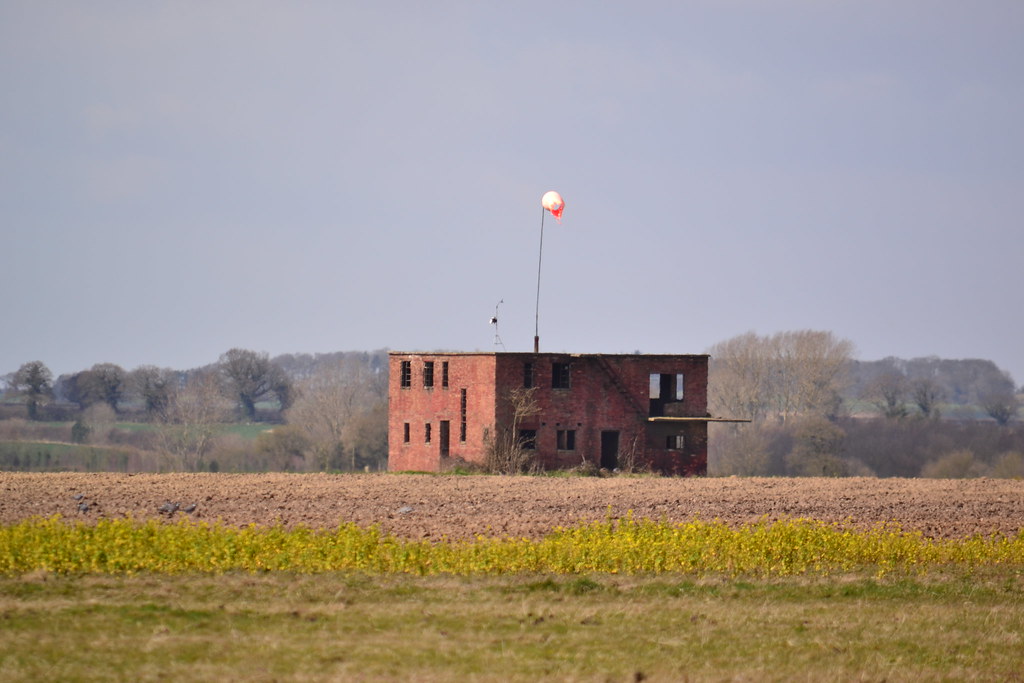
Little Snoring’s gem is its watch office, standing proud in the centre of the site, a lone wind sock fluttering from its walls. Run down and dilapidated, it is crying out for love and restoration, but I suspect this isn’t going to happen and perhaps its days are very sadly numbered.
During its short operational life, twelve Lancasters and forty-three Mosquitoes were lost during missions over enemy territory and up until 2018, there existed no ‘official’ memorial in memory of these tragic losses. In July, the Airfields of Britain Conservation Trust placed an airfield marker on the western end of the site, just beyond the runway’s threshold, that omission has at least been corrected.
The base commander, ‘glass eyed’ Group Captain ‘Bertie’ Rex O’Bryan Hoare (Sammy) was a known character and has been mentioned in a number of books discussing night intruder missions. He was a very successful Mosquito pilot and looked up to by his fellow pilots. A superbly detailed account of him appears in ‘The Snoring Villages‘and is certainly worth a read. He sadly died in an air accident in 1947 in Singapore.
Little Snoring was by far a sleepy airfield. Those who were stationed here made the best use of what they had, and when the cold winter weather put paid to operational activities, recreational ‘sorties’ took over and the airfield came to life in other ways. Operationally, Little Snoring played a huge part in intruder operations, strafing airfields and interfering with German Night Fighter operations. Even Adolf Galland in his book ‘The First and the Last‘ acknowledges the extent to which 100 Group went to “set really difficult problems for the German Night Fighter Command”. A true accolade to any wartime airfield and the men and women who worked there.
Sources and further reading
*1 National Archives AIR 27/890/15; AIR 27/890/16; AIR 27/1094/17; AIR 27/288/11; AIR 27/1981/31
*2 Ward C., & Smith S. “3 Group Bomber Command An Operational Record” Pen and Sword, 2008
*3 This is taken from the official Squadron Operational records, other sources including Chorley’s Bomber Command Losses state the crash was near to Broughton near Huntingdon.
*4 Bowman, M., “Battle of Berlin: Bomber Command over the Third Reich, 1943–1945” 2020, page 297Pen and Sword (accessed via google books)
Galland, A., “The First and and the Last“. Methuen & Co., London, 1955
The four award and honours boards in St. Andrew’s Church can be seen on the Flickr page.
A personal recollection of life at Little Snoring can be heard via the International Bomber Command Website.
In Part 2, 115 Squadron moved away from Little Snoring and the Electronic Warfare Group 100 Group took over. With that came a new type of aircraft, the Mosquito, operating as night intruders attacking enemy night fighters at their airfield. In this part, we see more new faces, a small detachment arrives, and a famous face is posted in.
The first of these new faces would appear over March and April, a small section comprising of only three aircraft (believed to be just two P-51s and a P-38) flying in American colours for training and trials with 100 Group. On March 24th, one of these aircraft would take part, somewhat unofficially, in the raid over Berlin. Flown by Major Tom Gates, he managed to get his name added to the operations board for that night, taking a P-51 to Berlin and back. During this epic flight, he apparently strayed over the Ruhr but the German anti-aircraft gunners failed to bring him down and he returned to Little Snoring unscathed by the first of several such experiences.*4
During mid April, Little Snoring was itself the subject of an attack from Luftwaffe aircraft, these intruders following the bomber stream home from a Serrate mission over Tergnier. According to operational records, the attack consisted of scattered bombs and cannon fire which caused no major damage nor casualties.
Another new face, this time for 515 Sqn, was that of Sqn. Ldr. Harold B. ‘Mick’ Martin of 617 Sqn fame, pilot of Lancaster ‘P – Poppsie‘. Whilst at 515 Sqn Martin would excel as a Mosquito pilot, strafing airfields, trains, railway yards and a flying boat base all in one night. He is also accredited with the shooting down of an unidentified aircraft and an Me 410.
But the bad luck that had shadowed Little Snoring crews would have the final say, when on April 11th, Mosquito DD783 flown by F.O. H. Stephen and F.O. A. Clifton spun from what was thought to have been a low level roll that went wrong. The manoeuvre led to a stall and spin at a height between 2,000 and 3,000 feet. Both airmen were sadly killed in the crash, the only 169 Sqn airmen to lose their lives whilst at the airfield.
Finally on June 4th 1944, both 169 Sqn and 1692 (Radar Development) Flight departed Little Snoring for pastures new. The move, hours before the D-Day landings being more than coincidental. The 3rd and 4th were given over to packing and moving equipment to Great Massingham, and only one early morning sortie was planned, but it had to be cut short when the aircraft developed engine trouble and hour or so into its flight over France.
With that, the two squadrons moved out and began to prepare for early morning flights over the Normandy coast in the early hours of June 6th 1944. Their short time at Little Snoring had been far from noteworthy, other than to say how badly the weather and lack of serviceable aircraft had dogged their early flying days.
515 Squadron who had moved onto the airfield just days after 169, would now be joined by 23 Sqn, also flying the Mosquito VI. Both these squadrons would concentrate on enemy night fighter airfields, seeking them out and destroying enemy aircraft on the ground, a low level intruder role that 23 Sqn had performed well in the Middle East.
The watch office now derelict and forlorn.
The summer arrival brought a little light relief to those at Little Snoring. 23 Sqn who had arrived in two parties via Liverpool and Gourock, had previously been at Alghero in Sardinia. Their journey had not been the delight they would have wished for, both ferries, the Strathnaver and the SS Moolton, being held outside the ports for over four days before staff were allowed to disembark. However, once at the airfield, seven days leave was granted and the majority of personnel left for London and a week’s recreation.
Training flights, night flying practise and target practice then filled their time with both squadrons taking part in firing practise over the Holbeach Range on the Wash. Compasses were swung on the aircraft and low flying became the immediate focus. Those crews undertaking night flying were amazed at the number of lights displayed at British airfields, the 23 Sqn adjutant describing them as ‘Pansy’ when referring to the Drem lighting system employed at many airfields at this time.
Sadly the poor weather returned and yet again many flights were cancelled at the last minute. Instead parties were held, and great merriment once again fell over the airfield.
On 5th June, ten sorties were carried out over night by 515 Sqn Mosquitoes. Airfields at Montdider, Rossieres, Ardorf, Varal and Marx being targeted. Further patrols were carried out over Wunstorf, Celle, Creil, Beavis and Courmeilles with bombs being dropped on some and vehicles set on fire at others. A road bridge and barge were attacked on the Vecht Canal and airfields at Twente and Plant Lunns were patrolled by two more Mosquitoes. Further patrols and attacks were undertaken using a variety of HE bombs and incendiaries. Other vehicles were also set on fire during these intruder raids. Two aircraft flown by, Sqn. Ldr. Shaw (the Flight Commander) and Sgt. Standley Smith (a/c 950), along with Flt. Lt. Butterfield and Sgt. Drew (a/c 189), took off from Little Snoring but neither were ever heard from again and were recorded as missing in action.
The remainder of June involved much the same, poor weather hampering night flying but where the squadron was able to get airborne, 515 patrolled numerous enemy airfields, attacking goods trains and destroying a small number of enemy aircraft. Some He 111s and Ju 88s were amongst those destroyed whilst attempting to take off. The month ended with 515 crews undertaking in excess of 415 hours night flying time and 48 hour daylight flying.
23 Sqn meanwhile were suffering the same disappointments with the weather, although this did not spoil the merriment, the adjutant reporting several parties occurring whilst the remainder of leave was taken and the last of the crews arrived from abroad. Some night sorties did take place, again trains were attacked and several airfields were bombed. A small number of aircraft were seen and attacked with some resulting in ‘kills’.
A small number of the Mosquitoes of both squadrons were modified to carry ASH, the American built airborne interception (AI) radars. By the end of the year training on the new equipment was in full swing as were the parties!
December brought a devastating blow for 23 squadron though, with the loss of their Commanding Officer W.Com. A. M. Murphy DFO, DFC and C de G with Palm. He had been in charge of 23 Sqn for almost a year and was both liked and respected by all those in the squadron. Air-sea patrols were carried out by the squadron in conjunction with the Air Sea Rescue Service but nothing was found of him, his aircraft, nor his navigator Flt. Sgt. Douglas Darbon. That night, the squadron was stood down and on the following day a party was held in which many attended from lunch time to well into the night – few were seen before lunch the following day. Within a few days, Murphy’s navigator took a turn for the worst, and applied for a posting out of the squadron. Much to his disappointment though he was offered an Operational Training Unit (OTU), a move he did not wish for nor relish.
On the 9th December a little lightheartedness crept into the squadron when two Canadian aircrew landed at the wrong base by mistake. Only when they were down did they realise their mistake and were immediately awarded the M.H.D.O.I.F. The adjutant doesn’t explain the acronym, but it is likely to be something derogatory!
The number of sorties being performed by the crews in 23 Sqn were reflected in their departures. With seven crews with between 50 and 65 flights on their logs, they were all lost as tour expired, the lack of crews now becoming an issue at the airfield.
The poor weather returned once more closing down the station on several occasions. More training mean that December had been the ‘heaviest’ training month since the squadron arrived in the UK. 23 Squadron’s first ASH sortie had to be scrubbed on the night of 18th, and was followed by the inevitable party and poker.
The 22nd saw two aircraft manage to get off the ground. Unfortunately these ASH equipped aircraft had no luck in seeking out the enemy. A Lancaster diverted from its own airfield made an appearance at the airfield on Christmas Eve and the crews were treated to one of Little Snoring’s magnificent parties, a party that needless to say, went on well into Christmas Day.
The squadron remained stood down for several days, but as December drew to a close further ASH equipped aircraft took part in sorties over occupied Europe. The year ended on a positive note though, and although the squadron had lost many experienced and well liked crews, they were looking forward to better weather and more operational flying.
In the last part, the war draws to a close, the military eventually pull out leaving the airfield to nature and new owners. Although there is no more military action, it is not yet the end of flying. Little Snoring is to live on for some time yet.


 Aviation Trails