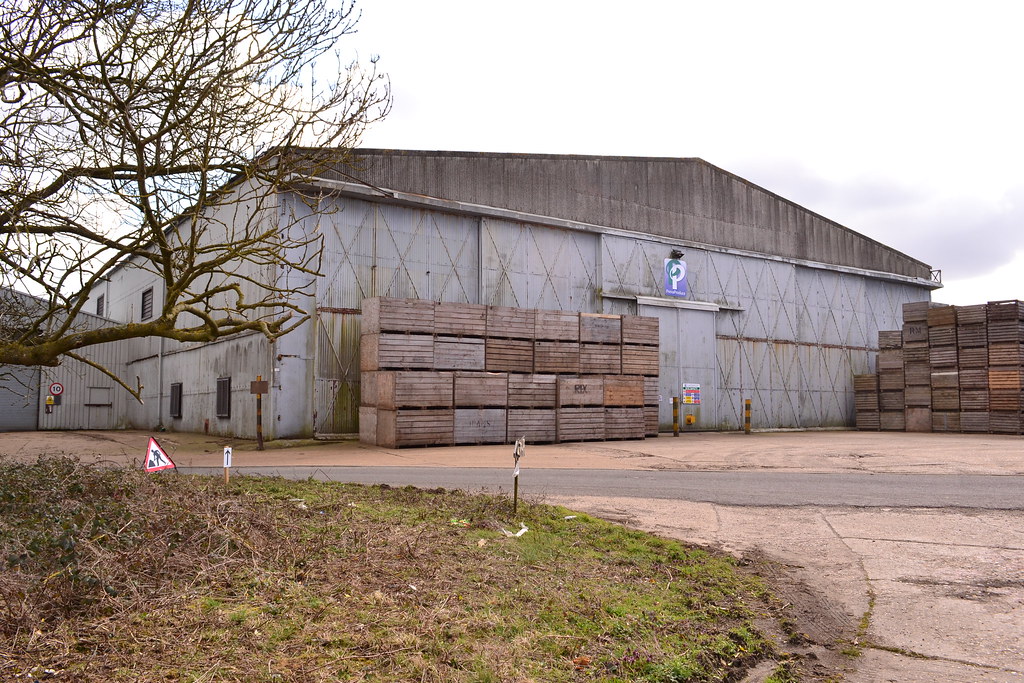
Little Snoring hardly the quietest of airfields! (Part 2)

In Part 1, we saw how Little Snoring developed,  taking on the Lancasters of 115 Squadron with the radial engined MK.II aircraft. In this next part, they soon depart and ownership of the site takes a change and with it comes new aircraft, anew crews and a new role.

September for 115 Sqn would be much of the same for those stationed at the airfield. More training flights, interspersed with operations to Germany. As with other months, September would see further losses for the squadron. On September 6th, DS658 piloted by F/O. R. Barnes, ran off the runway on return from operations, the aircraft was so severely damaged it was considered beyond repair and used for spares. The crew fared much better though, with none receiving any injuries in the accident. A second incident occurred on the 14th when during crew trials on a new aircraft, the bomb sight jammed resulting  in the pilot being unable to maintain level flight. After ordering the crew into crash positions, the aircraft struck a bank a few miles from RAF Downham Market near to Magdalen station.  Six of the eight on board were killed, the two survivors sustaining serious injuries.

During this month, the HCU that had joined 115 Sqn at Little Snoring received a new posting, they would depart the airfield moving on to RAF Foulsham where they would carry on their role of training pilots for the Lancaster.

RAF Little Snoring

An air-raid shelter protected the personnel from attack.

In October, further operations to Kassel and mine laying in the West Frisians were badly affected due to six of the twelve aircraft being unable to take off. The first was affected by one of the air crew suffering airsickness; the second suffered a burst tyre which left it stranded on the perimeter’s edge; a third got bogged down in the mud trying to pass this one and three more got stuck behind these unable to pass or turn. The remainder of the aircraft got away safely though, and although carrying out operations satisfactorily, they encountered electrical storms over the target area which hampered the equipment on board. All these crews returned safely and there were no further mishaps

On November 7th, a near catastrophe was luckily avoided after Lancaster DS825 crashed on take off after one of its engines cut out part-way down the runway. After inducing a violent swing the bomber crashed causing its other engines to catch fire. Luckily there were no explosions and all the crew managed to escape the wreckage unhurt.

115’s last operation from Little Snoring would take place on November 23rd 1943, the day prior to its departure for RAF Witchford. Twelve Lancasters, six from both ‘A’ and ‘B’ Flights, lined up and revved their engines to take off speed departing once more for Berlin. With them  they took the usual mix of incendiaries and ‘cookies’, all destined to fall on Berlin’s streets. Two aircraft failed to take off and two returned early; one due to a faulty Gee set and the other a faulty air speed indicator. One of the returning aircraft dropped its payload on Texil, the other safely on unoccupied land before turning for home.  The remainder of the squadron continued on and successfully completed the operation, the attack being considered ‘satisfactory’.

With that, 115 Sqn’s time at Little Snoring had come to an end, departing the next day for RAF Witchford where it would continue the brave fight over Nazi Germany. On their arrival at Witchford, a new flight was immediately formed, ‘C’ Flight, and as a result new crew members would soon arrive.  Little Snoring meanwhile was about to see some major changes itself, not only in personnel and aircraft, but ownership as well.

On December 8th 1943, the station became the charge of 100 Group, the Electronic Warfare Group who had taken up residency elsewhere in this part of Norfolk.

100 Group were the last operational Bomber Command Group to be formed during the war, with a clearly defined role which was to provide night intruder support for bombing operations, and was headed by Air Commodore Edward Addison.  Like their counterparts at Great Massingham, Foulsham, North Creake, West Raynham and Sculthorpe amongst others, they would take part in electronic warfare and counter measures against enemy fighter operations. 100 Group, investigated a wide range of devises suitable for tracking, homing in on, or jamming enemy radars. With a wide rage of names; “Airborne Cigar“, “Jostle“, “Mandrel“, “Airborne Grocer“, “Carpet” and “Piperack“, they used both “Serrate” and “ASH” to attack the enemy on their own airfield at night before they could intercept the allied bombers.

With its takeover of Little Snoring, came 169 Sqn who had only been formed at Ayr just two months before. They received the Mosquito II, the remarkable twin engined beast from de-Havilland which was to perform well in its new role as Night Intruder. In support, came 1692 (Radar Development) Flight, also know as the (Bomber Support Training) Flight from RAF Drem, also in Scotland.

A few days later the two units were joined by a third squadron, 515 Sqn from RAF Hunsdon also with the Mosquito II and VI, and Bristol’s Beaufighter IIF.  All three would work in the area of Electronic warfare.

169’s departure from Ayr was marked with a very ‘successful’ party in the corporal’s mess, with contributions of £1.00 from officers and 2/- from non-commissioned ranks. The beer flowed well into the night, with many trying their rather shaky hands on the piano. Regular rallying on the squadron hunting horn brought the party goers back together and ensured the party spirit was maintained and kept going well into the night.

Norfolk’s wet and miserable weather greeted the personnel as they arrived over the next few days here at Little Snoring. Once they settled in, training flights were scheduled but many of these had to be cancelled due to the continuing rain and fog,

With talks by staff from Rolls Royce on engine handling and another on Bomber Command Operations and Tactics, December’s poor weather provided little time for flying. A reconnaissance was made of the Norwich pubs, and parties became the order of the day, Christmas leave was arranged and various quarters were decorated. As the mood lasted well into the New Year, the war had at least for now, come to a standstill.

On January 5th 1944, the monotony was broken when thirteen USAAF B-17s landed at the airfield by mistake, the American crews, much to the annoyance of those in residency, were given temporary use of the mess until they could depart some days later. Much ribbing by the locals  no doubt helped ease the burden of sharing their beer and alcohol supply.

Various flights did manage to take place in the meantime, using both the Beaufighter and Anson. Further talks were given by escaped POWs, who gave an interesting insight into what to expect if you were shot down over occupied territory.

Over the winter months, gliders were brought in for storage and maintenance, ready for the impending assault on the French coast. These were stored in hangars on teh western side of the airfield and moved prior to D-day.

On January 20th, the first operation finally took place, a Serrate flight over Northern Holland in support of the bombing of Berlin. Two Mosquitoes were detailed but one had to return shortly after take off as the aircraft’s skin began peeling away from the wing root. Those on board were ‘thoroughly disgusted with their bad luck’.

It was this bad luck that would dog the squadron for the remainder of the month. More cancelled flights, aircraft unserviceable and instruments failing during flights. It wasn’t until the 30th January that the string of bad luck would be broken when Sqn. Ldr. Joe Cooper and Flt. Lt. Ralph Connolly, shot down an Me 110, forty miles west of Berlin in Mosquito HJ711 (VI-P). This was the squadron’s first ‘kill’ of the war since being reformed. Utilising their AI equipment, they destroyed the aircraft with a 3 and 7 second burst of gunfire from 200 ft. The aircraft blew up causing the Mosquito to swerve so violently that it entered a near fatal spin. The crew were only able to pull out after falling to an altitude of 5,000 ft. All in all, they fell some 15,000 feet before recovering. Needless to say, there was huge jubilation when they returned, the aircraft being greeted by several hundred personnel at Little Snoring.

With two more kills in February, the tally of three would remain stagnant until mid April when a series of five more 110s were brought down. With three more in May, their total would stand at eleven by the time 169 Sqn were destined to leave.
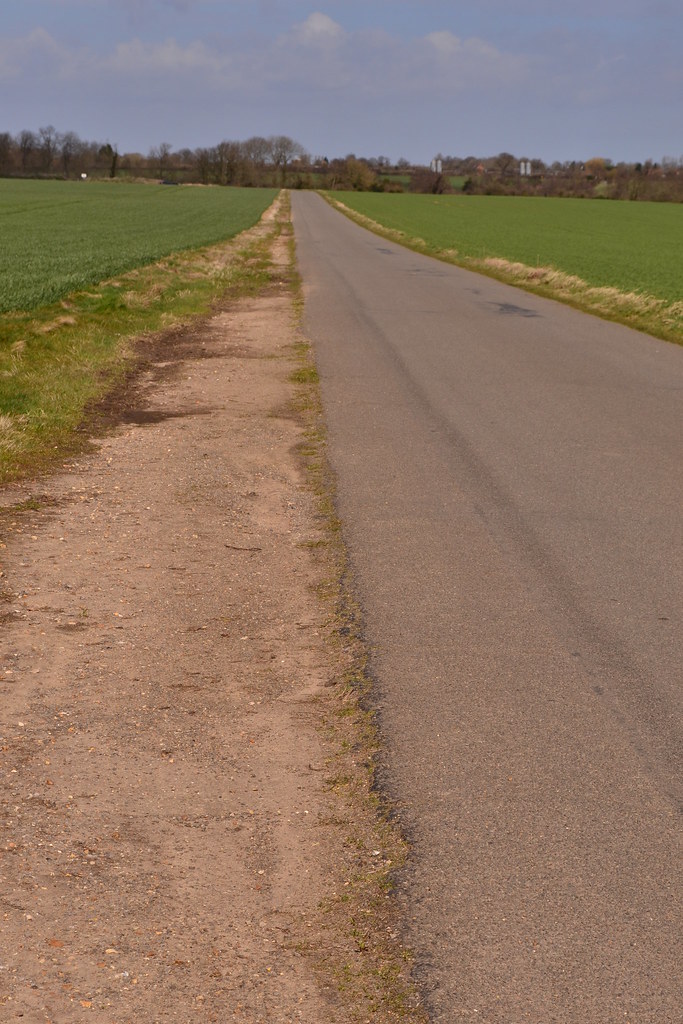
RAF Little Snoring

The road uses the former eastern perimeter track, part of which is still visible to the side.
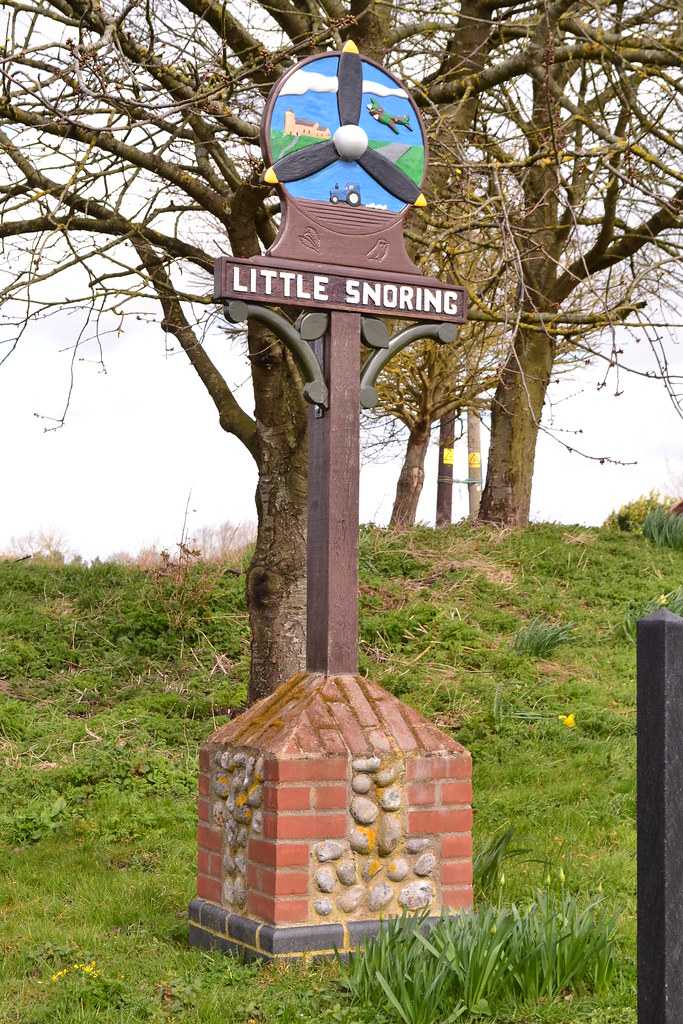
In the next part, a small detachment arrives bring further new types with them, a  famous face appears and bombers strike at Little Snoring.
The full story can be seen in Trail 22.

Little Snoring hardly the quietest of airfields! (Part 1)

In Trail 22 we revisit a former airfield that housed the mighty Lancasters of Bomber Command, one of the few Norfolk airfields to do so. It later took on the Mosquito, a model that remained here for the remainder of the war, taking part in the Night Intruder role, a role it excelled at.

This small and quiet village played host to some remarkable people and aircraft, it was an airfield that certainly didn’t reflect its name.

RAF Little Snoring

Little Snoring is, as its name suggests, a quiet village deep in the heart of Norfolk. Surrounded by beautiful countryside, it boasts a superb round towered church that holds a remarkable little gem of historical significance. Its history dates back to Anglo Saxon times, a time from whence its name derives.

Little Snoring

The Village sign reflects Little Snoring’s aviation history.

The airfield, located about 3 miles north-east of Fakenham on land  191 feet above sea level, was opened in July 1943 following a period of construction by the company Taylor Woodrow Ltd. It would during its history, house no less than five different squadrons along with several conversion units, development units and a glider maintenance section before being used for civilian flying in more modern times.

The airfield was originally opened over the period July / August 1943, quite late in the war, as a satellite for nearby RAF Foulsham. It had three runways: two constructed of concrete 1,400 yards in length, (01/19 and 13/31) and one (07/25) of 2,000 yards again in concrete. As with other Class A airfields its runways formed the typical ‘A’ shape, with thirty-six dispersal sites constructed around the perimeter. A bomb site lay to the north of the airfield, a fuel dump to the south and the accommodation blocks dispersed away from the airfield to the south-west. The airfield was built to accommodate 1,807 RAF and 361 WAAF personnel housed over eight dispersed domestic sites.

To accommodate the various squadrons and their aircraft, the airfield would have 5 hangars, two T2s, two Glider and a B1, all dotted around the perimeter of the airfield, Many of these were not finished when the first aircraft moved in.

Initially opening under the command of 3 Group Bomber Command, its first occupants were the rare Bristol Hercules engined Lancaster IIs of both 1678 HCU (Heavy Conversion Unit) and 115 Squadron (the first unit equipped with the model); formally of RAF East Wretham, who were to carry out night bombing duties, a role it would perform throughout the war.

Of the two units, 115 Sqn were the first to arrive, the advance party being led by F.Lt. W. A Major DFC on the 5th August 1943, from East Wretham. The main party, led by F.Lt. R. Howarson, followed the next day, with the rear party, led by P/O. M.G. Gladwell arriving on the 7th. During this time all flying operations were suspended allowing the squadron time to move and settle in.

115 Sqn was historically a First World War unit, forming in 1917 going on to see action in France in the following year. Post war it was disbanded only to reform again in 1937 in preparation for the second impending world conflict. It would go on to have the dubious honour of having the highest losses of not only 3 Group but the whole of Bomber Command as well – a title, which amounted to 208 crews,  not envied by anyone. *2

The two days following their arrival were taken up with flying training including bombing practice and air-to-sea firing before the first operations on the night of the 10th -11th August 1943.

Fourteen aircraft took off between 21:45 and 22:10 to attack Nuremberg, each aircraft carrying a mix of a 4,000lb ‘Cookie’ and incendiary bombs. Although much of the target was obscured by cloud, crews reported seeing many explosions on the ground along with fires being visible some 100 miles away.*1

Of those that departed that night one aircraft (DS684) had to return early due to the gunner’s economiser lead being unserviceable, with a second aircraft (DS665) failing to return and not being heard from again. Following a phone call received from RAF Detling in Kent, it was established that the aircraft had in fact crashed some 5 miles east of Maidstone, near to Hall Farm, Boughton Monchelsea in Kent*3. It would later be revealed that none of the crew on board had survived the crash.

With Italy crumbling, further pressure was applied to Germany’s ally through the bombing of both Milan and Turin; the might of the Lancasters now delivering their huge payloads on the two Italian cities.  It was during the Turin raid on the night of 12th August, that Flt.Sgt. Arthur Louis Aaron from 218 Sqn at RAF Downham Market, would earn a VC for his courageous effort in keeping his aircraft flying whilst seriously wounded.

RAF Little Snoring

One of two original T2 hangars still in use today. These have since been re-clad.

For 115 Sqn though, the night passed without mishap and all thirteen aircraft returned intact. The next few days saw no further operational flying, the crews undertaking training flights instead, a short relief from operations before they turned their attention northwards and the German rocket research establishment at Peenemunde.

Between 21:38 and 21:50, twelve Lancasters took off from Little Snoring taking a further combination of Cookies and incendiaries with them. Bombs were released  between 7,800 and 12,000ft, a level that just scraped the ceiling of the rising smoke. Of the twelve aircraft that departed, one was lost, that of DS630 ‘H’ flown by F/O. F.R. Pusey – none of the seven aircrew, who were only on their third operation, survived. This took the total of those aircraft lost in the first few days of flying from Little Snoring, to three, almost one per operation.

Another short period of training then followed, before they once again turned their attention to Germany and the capital Berlin.

Amazingly the Lancaster squadron would fair much better than many of its counterparts, particularly those flying Halifaxes and Stirlings, losing only one aircraft, DS630 to the enemy, unlike other squadrons, which were decimated by the Luftwaffe and air defences surrounding the German capital. Of the seven crew on board this aircraft, three were picked up after spending six days drifting in a dingy off the Dutch coast.

The remainder of August was much similar. Training flights and further operations, including mine laying off the West Frisians Islands and the French coast, saw the month draw to its end. Whilst comparatively quiet in terms of losses, the squadron was none the less racking up a steady score of ‘failed to returns’.

In August, Little Snoring would become one of those airfields that would bear witness to an incredible act of bravery one that like so many others would become one of those little known about stories of the war.

On the night of August 23rd – 24th 1943, Berlin was again attacked. On this raid Lancaster ‘KD802’ ‘M’ flying with 207 Sqn from RAF Langar, was attacked by a Ju 88 night fighter. The rear gunner, Sgt. R. Middleton, managed to return fire achieving some strikes on the enemy aircraft, which led to it catching fire and crashing. But Sgt. Middletons determined efforts did not prevent the enemy aircraft from getting his own hits on the Lancaster, causing a fire in both the starboard wing and fuselage. In addition t this, the tail plane and all its controls had also been damaged and the pilot was struggling to maintain control over the burning aircraft.

P.O. McIntosh ordered the bombs ditched at 22:49 hrs. With a lighter load he then turned for home in the hope of reaching home or at least safer territories. In a desperate effort to extinguish the fire, Sgt. Middleton then volunteered to climb out of the fuselage onto the wing, something that had been tried by others in similar situations, but it was a risky and daring challenge. The pilot P.O. McIntosh, refused to grant permission, fearing the the rear gunner would be lost in the strong winds, a risk he was not prepared to take.

Remarkably the aircraft reached the North Sea, McIntosh considered ditching the aircraft fearing its time was almost up, but before he could take action, the navigator announced that they had in fact reached England and the safety of home. Coming in from the north, the first suitable airfield they came across was Little Snoring.

Fuel was now low, and with the landing gear down one of the aircraft’s engines cut out, but using all his skill and training, McIntosh manged a successful and safe landing

The aircraft was written off, so extensive was the damage caused by the fire, but the crew were all safe and uninjured thanks due to an amazing feat of courage and determination by the crew to get the aircraft back home.

In part 2, 115 Sqn’s time at Little Snoring draws to a close. The Lancasters depart and a new aircraft arrives. With it, comes new ownership and a change in operations.
The full story can be seen in Trail 22.