This is an article submitted by Steve Williams on behalf of FONFA (Friends of the New Forest Airfields), a charity aiming to preserve the aviation heritage of the New Forest. For more information about their work and the airfields concerned see their website at https://fonfa.co.uk/
The Twelve airfields of the New Forest.
Driving through the New Forests’ lush and tranquil scenery today, it is hard to imagine that during the mid-1940s The Forest was progressively militarised, as Britain defended itself from threatened invasion, and prepared for Operation Overlord, the D Day landings. By May 1944 there were a staggering 2,876,000 troops from many nations, together with their vehicles and equipment in Southern England. Many of these were in the New Forest, which is located close to the major ports of Southampton and Poole and had flat terrain and trees to provide camouflage for the build-up of troops and supplies, as well as hiding aircraft.
At the start of The War there were only two active airfields in the New Forest. The sea plane base at Calshot, and the civilian airport at Christchurch. Both played key roles during and after The War. The bombing of Britain during the early part of The War provided the stimulus to build many new airfields across the South of England. Five concrete runway airfields for heavy aircraft such as bombers, maritime patrol, troop transport and glider towing were built in the New Forest at Stoney Cross, Ibsley, Holmsley South, Beaulieu and Hurn.
As part of the preparation for D Day, a chain of Advanced Landing Grounds (ALG) were rapidly built on agricultural land, or existing airports. Five of these were in the New Forest at Winkton, Lymington, Needs Oar Point, Bisterne and on Christchurch airfield. These were temporary airfields and there were few permanent buildings. Much of the accommodation was tented. These five airfields played a major role during the build-up and execution of the D Day landings. They became operational during late March or early April 1944 and in the few weeks after D Day the RAF and USAAF squadrons moved from the New Forest Advanced Landing Grounds to new Advanced Landing Grounds built on liberated land in France, to continue providing support to the advancing troops.
This meant that four of the New Forest Advanced Landing Grounds were no longer required and were returned to agricultural use after just three months of intense operation. The larger concrete runway airfields remained in use longer. By the end of the 1940s only Calshot, Christchurch and Hurn existed. Calshot and Christchurch shut down in the 1960s leaving only Hurn, or what we now know as Bournemouth International Airport.
For me, the most interesting of the New Forest Airfields was Christchurch. It was operational for around 40 years, starting and finishing its life as a civilian airfield. The Air Defence Research and Development Establishment was set up at Christchurch and this made many ground-breaking scientific developments in areas such as airborne radar, ground controlled interception, radio navigation and low visibility landing aids. During the War, the Airspeed factory at Christchurch was an important Centre for the assembly of Horsa gliders and the manufacture and maintenance of aircraft including the Airspeed Oxford and the Mosquito. After the War, De Haviland took over the Airspeed factory and produced Vampire, Venom and Sea Vixen military jets as well as the Ambassador twin engine airliner.
During 1944, the New Forest airfields were manned by over 25,000 military and 10,000 civilian staff and there were estimated to be around 1,500 RAF and USAAF aircraft. The airfields were involved in every aspect of air warfare from research and development, training, defensive and offensive missions, reconnaissance, and supporting the operations of secret agents and Resistance Organisations in occupied Europe. During the D-Day period, hundreds of sorties were flown daily. The ‘Advanced Landing Ground’ at Needs Oar Point was the busiest airfield in the country for around three weeks. Take offs or landings occurred as often as one every 45 seconds, for up to eighteen hours a day.
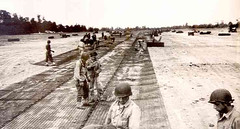
Building an Advanced Landing Ground
It is hard to imagine the scale of the social impact that this number of military personnel had on the unique culture, legal framework and way of life of the population of the New Forest. Each of the airfields has unique stories of bravery of those who flew from them and there are fascinating memories of life during these difficult years from those living on the RAF stations or in the New Forest during this period.
Today there is very little left of these airfields, especially the Advanced Landing Grounds. There are remnants of the larger concrete runway airfields and the runway pattern of some are still visible from the air.

RAF Beaulieu Airfield today from an aircraft approaching Southampton Airport

Airspeed Ambassador taking off from Christchurch airfield (Photo by John Levesley)
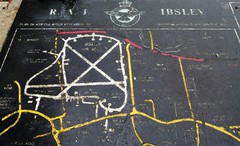
There are memorials and/or information boards at some of the airfields, this is at RAF Ibsley
A good overview of each of the airfields can be found in Alan Brown’s book, Twelve Airfields. For those who would like to find out more there is a wealth of detailed information, artefacts, archives, interactive displays, pictures, videos, models and dioramas, pilot’s stories and limited edition prints at The Friends of the New Forest Airfields, (FONFA) Heritage Centre, located near Bransgore on the former RAFCamp at Sopley.
RAF Sopley was not an airfield, but a very important early radar station, also known as “Starlight”. Much of the ground-breaking work done at Purbeck Radar in Swanage and at Christchurch was put into operation at Sopley. This evolved into what we now know as air traffic control.
A great deal of archives, pilot stories, memories of those who servedand useful information, together with the opening times for the Heritage Centre, can be found on the FONFA web site at https://fonfa.co.uk

The USAAF P-38 Lightnings that operated from New Forest Airfields during 1944 in support of D Day
Article written by Steve Williams (FONFA) who provided all the photos. (My thanks go to Steve for the article and the work FONFA do in keeping this important part of our heritage alive. It is hoped to add more as information comes in from Steve and eventually to separate each of the twelve airfields out to give as much detail as possible to each).
 Aviation Trails