After
Part 4, in this, the final part, we see how Sculthorpe has fared, and what has happened to it now. As a major Cold War player its future is uncertain, but definitely not yet over!
Gradually, as nuclear deterrents turned to both missiles and naval based platforms, Sculthorpe’s activity began to slow. Being returned to RAF ownership in 1964, it was eventually placed in care and maintenance once more, held open by only a small detachment of support staff. However, all was not yet lost, for later in that same decade, Sculthorpe saw yet another reprieve, when the USAF returned once more, needing a base from which to operate its aircraft whilst other airfields were redeveloped and runways resurfaced. This temporarily brought new life back to Sculthorpe, with American F-4 Phantoms and C-130s operating from here. The RAF, needing a similar facility, also used Sculthorpe as a temporary base, Coltishall for example, basing their Jaguars here temporarily. This process went on well into the late 1980s and Sculthorpe became a mecca for plane spotters for at least another few years.
Eventually all this too ceased and before the final farewell the site was used to store North American Sabres prior to them being scrapped and disposed of.
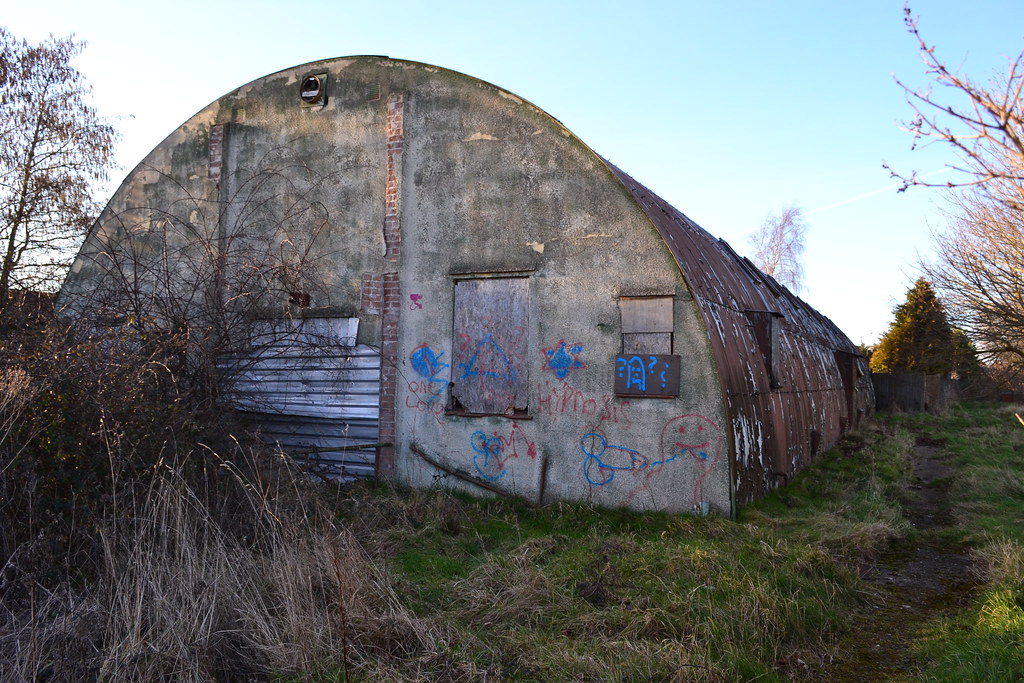
‘Hut 380’, a Second World War remnant.
Sculthorpe finally closed its doors in 1992, the enormous accommodation blocks and technical sites were sold off. Both these and many of the remaining buildings were left to decay, whilst planners gave thought as to what they should be used for. However, like a phoenix, Sculthorpe returned from the dead yet again. The RAF, the Army Air Corps and the USAF using it for manoeuvres, seeing such diverse models as the V-22
Osprey tilt wing aircraft, using it for paratroops and rehearsals of supply drops over its enormous runways; much of this activity taking place at night. Even up until recently, C-130s had also been seen operating here, again rehearsing quick ‘stop-‘n’-go’ drops, something that continues in part to this day.
The rise in ‘Soviet Aggression’ and post conflict tensions during the Cold War had secured the immediate post-war future of Sculthorpe. Not only were atomic weapons stored here ready, but a wide range of US aircraft that would otherwise not have been seen on British soil, were also based here. The demise of world peace had been the saviour of Sculthorpe’s future.
Looking at Sculthorpe, it is hard to believe its origins were in the Second World War. Being a real monster of the Cold War, Sculthorpe is clinging on by the skin of its teeth. The accommodation blocks that once housed 10,000 personnel are decaying and vandalised, refurbished areas are now sold off and accommodating local families. A small industrial area has been developed from the technical area, and the local farmer grazes his cattle on the far reaches of the site. Many of the older original buildings have been left to rot and fall down. The American authorities still retain some ownership of the site, whilst a large part of it is in private hands, such ownership does prevent some access but a good deal of the site is visible from permissible points.
The original guard-house is no longer manned, and a number of other buildings close by are also empty. A small public track that once took eager plane spotters to the rear of the airfield, still allows views across the north of the now quiet site where a blister hangar continues to stand alone. The control tower is still intact visible in the distance from this point, as are a number of original Nissan huts and Second World War buildings hidden amongst new buildings and old developments.
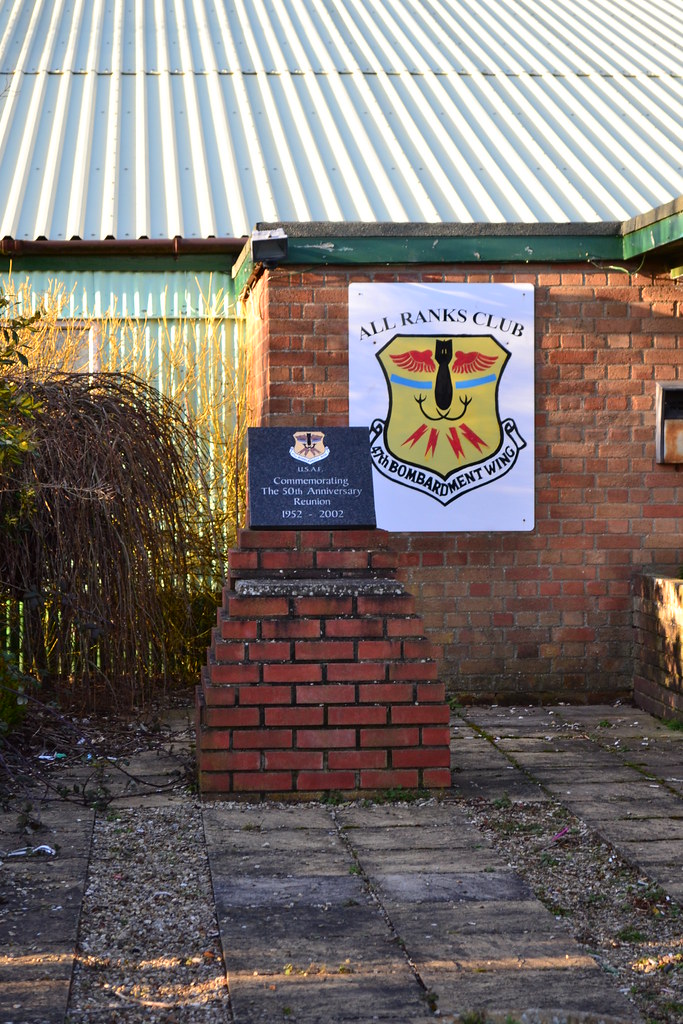
In remembrance of the 47th BW, 50th anniversary reunion, 2002.
The post war ‘All Ranks Club’ houses a small exhibition of artefacts and information about Sculthorpe, depicting its post war life, and includes many interesting photos. The exhibition is open at certain times throughout the year allowing visitors to view them and talk to the volunteers some of which actually served here at the base.
Sculthorpe was once a bustling airfield, it was home to some of the world’s heaviest bombers, and a mecca for aviation enthusiasts and plane spotters alike. Today, it is a decaying industrial site, a mix of old buildings and new developments; a remnant of the Cold War, it clings on to life by the skin of its teeth, maybe, just maybe, the Phoenix will rise up once more and spring into life once again.
The full history can be seen in
Trail 21.
Sources and further information.
*
1 National Archives – AIR 27/1924/17
*
2 Gunn, P.B., “
Flying Lives – with a Norfolk Theme“, Peter Gunn, 2010
*
3, *5 Cahill, W. “
The Unseen Fight: USAAF radio counter-measure operations in Europe, 1943 to 1945” Journal of Aeronautical History Paper, 2020/06
*
4 21 Sqn ORB Summary of Events 1943 Oct 01 – 1943 Nov 30, AIR 27/264/19
*
5 Cahill, W., “
The Unseen Fight: USAAF radio counter-measure operations in
Europe, 1943 to 1945” Journal of Aeronautical History, Paper 2020/06
*
6 The Spyflight
Website which gives considerable detail into the flights.
National Archives: AIR 27/1924/19; AIR 27/1935/19; AIR 27/1326
Photos of Sculthorpe in its heyday can be seen on the Sculthorpe Air Base
website.
Further information and personal stories can be found on the 214 (Federated Malay States) Squadron
website.
Gunn, P., “
Sculthorpe – Secrecy and Stealth, A Norfolk Airfield in the Cold War“, 2014, The History Press.
 Aviation Trails