In
Part 3, Sculthorpe had been through he war, and was now being developed ready for the arrival of B-29s on 90 day rotations. Their arrival though, was not as easy as they had hoped.
The arrival of the aircraft did not all go to plan though, as on July 21st 1949, whilst transferring across from the US, one of the B-29s #44-62191 ‘suffered problems’ 2 miles east of Wisbech in Cambridgeshire. The aircraft, a Boeing B-29A-65-BN, had a crew of twelve on board, but it soon became clear that they were not going to make it, and so decided to abandon the aircraft and leave it to its fate.
All twelve of the crew successfully departed the aircraft landing nearby, but in doing so, two of them sustained serious, but not thought to have been life threatening, injuries after exiting. The worst, suffered by the pilot, was a possible fractured skull, whilst the second crewman suffered a fractured leg; it is believed both airmen made full recoveries. The aircraft itself ultimately crashed, landing in a field east of the small Fenland market town. The remains were quickly retrieved and some parts have since ended up in the local Fenland and West Norfolk Aviation
Museum located in Wisbech.
The lack of constant use however, meant that much of the accommodation at Sculthorpe had deteriorated to an unacceptable level. Damp and rot had set in and more work was now needed to bring it back up to standard before further deployments could take place. Even as this was being carried out though, bombs and other supplies were quickly beginning to arrive, and soon Sculthorpe was ready to allow an American foothold on British soil once more.
Further temporary deployments included both the 92nd and 98th BGs, each also flying B-29s that were capable of dropping atomic weapons should the need arise, thankfully, this requirement wasn’t needed and at the end of each deployment the units moved on to other theatres or their home bases back in the United States.
These regular ninety day duty rotations became a bit of a saviour for Sculthorpe, with other aircraft like the mighty B-36 ‘Peacemaker’ and the North American B-45 ‘Tornado’ finding themselves located here. Acting as the front-line bombers designed to attack Soviet targets from the UK, they became a major deterrent in the dramatic face off between East and West.
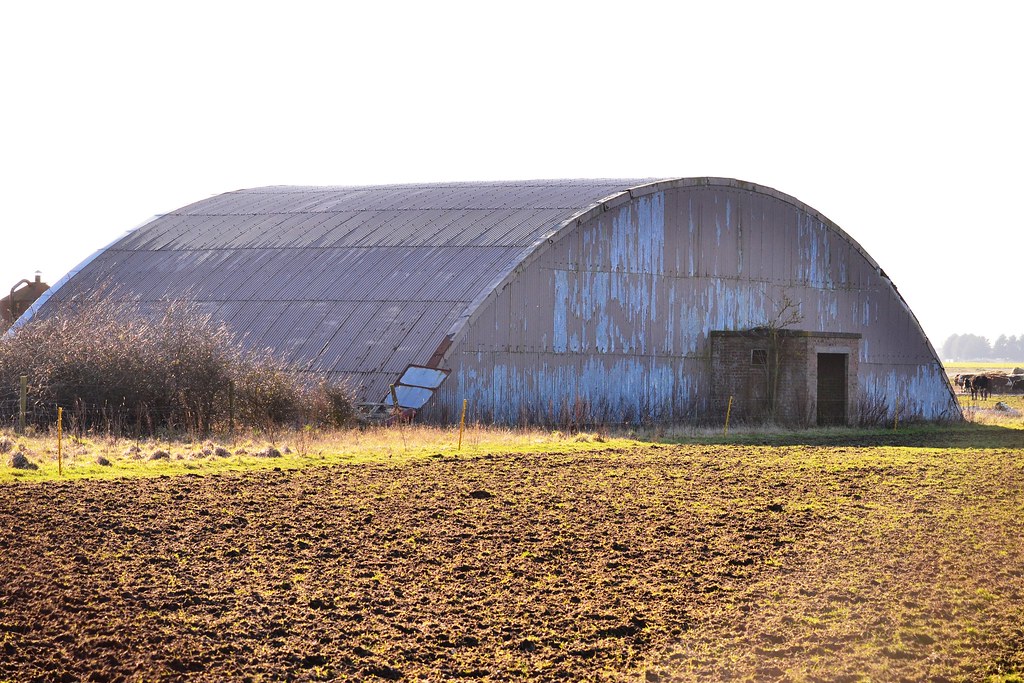
Sculthorpe’s remaining Blister hangar in a low setting sun.
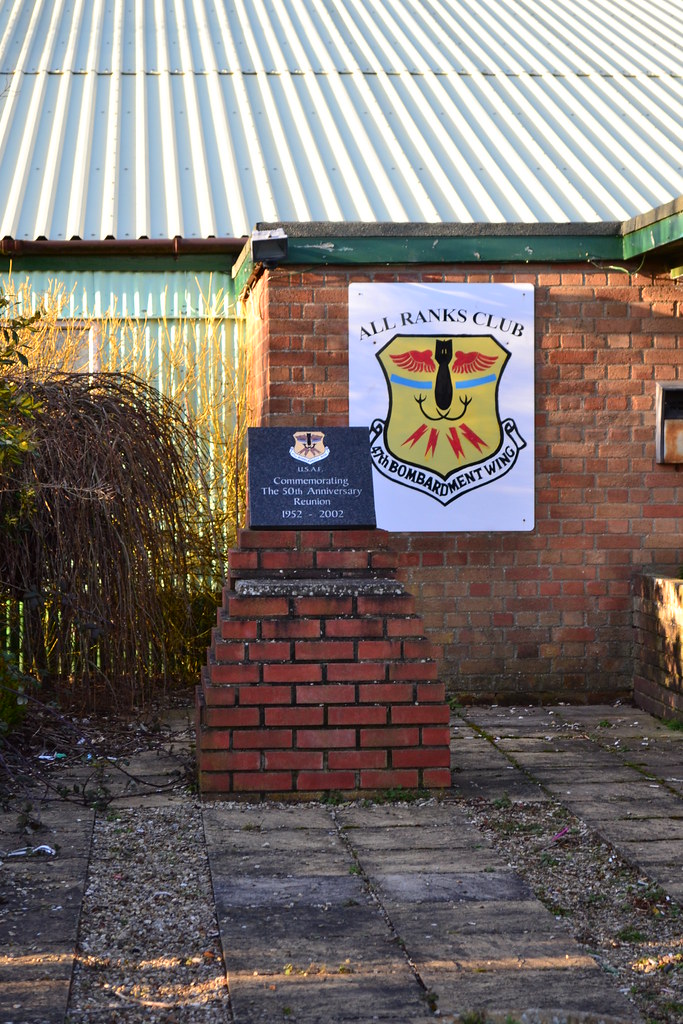
Further cold war tensions saw in 1952, the deployment of the 47th Bomb Wing (formally the 47th BG) of the Strategic Air Command from the United States. This wing consisted of the 84th, 85th, and 86th BS, along with the 420th Refuelling Sqn and the 19th Tactical Reconnaissance Sqn. These units operated a number of aircraft types including the: B-45, B-66, KB-29, KB-50, and RB-45C aircraft.
The 47th was activated on March 12th 1951, initially as the 47th Bombardment Wing (BW) but with just two squadrons – the 84th and 85th. As a new unit, it had the honour of being not only the first, but the only jet powered medium bomber Wing in the US Air Force. With NATO becoming more established and nuclear weapons arsenals expanding at a great rate of knots, the 47th were posted to Sculthorpe to provide an airborne nuclear strike force in support of NATO forces who would be operating on the ground in any future conflict.
A year later, a third squadron would arrive to join the Group, that of the 422nd BS. Within a month or two of its arrival though, the unit was re-designated as the 86th BS a move that brought it in line with its two sister squadrons. For three years the 47th would operate out of Sculthorpe acting as a nuclear support unit for NATO forces in Europe.
Coinciding with the arrival of the US Wing in 1952, was the formation of the ‘Special Duties Flight Sculthorpe’. This was a British unit, led by Squadron Leader John Crampton (who replaced the initial choice Sqn. Ldr. Micky Martin of the ‘Dambusters’ fame, as he had failed a high altitude medical examination) and was designed to perform deep penetration flights into Soviet airspace carrying out reconnaissance missions for Britain’s planned ‘V’ Bomber force. This was also used as a cover for covert US operations. Only two such flights were made, each with three aircraft; the first on 17th/18th April 1952, and the second on 28th/29th April 1954*
6. These flights were performed by British crews flying American RB-45Cs with their US markings replaced by British roundels. A political ‘loop-hole’ that prevented US aircraft flying over Soviet territory allowed British aircraft to do so. These flights took place under Operation ‘
Ju-jitsu‘, with four aircraft which were leased from the US 91st Strategic Reconnaissance Wing.
Initially three routes were chosen, one of which took the aircraft close to Moscow. To ‘protect’ crews, they were issued with false papers and maps, and told, if caught, to explain that rather implausibly, they had simply become incredibly lost!
After these flights, which weren’t totally without mishap, the crews were congratulated by General LeMay, and the unit was then disbanded. However, it was reformed again, also at Sculthorpe, in 1954 (after a second such temporary reformation in September 1952) and a second flight was made. This time the Soviets were ready for them, after having evaluated their air defence network they were far better prepared and the crews were at a much greater level of danger than during their initial flights.
It has since been revealed that Soviet aircraft were instructed to ram the RB-45Cs as they had no suitable radar with which to track the intruders. However, no such contact was made, and whilst flak was now the problem, it was generally ineffective, but sufficient to make the crews on board make a hasty return to the West where they received more fuel before returning to Sculthorpe.
The unit was then again disbanded and all flights by them ceased. The RB-45Cs now being outdated, were too slow and obsolete to perform such high risk flights over soviet territory.
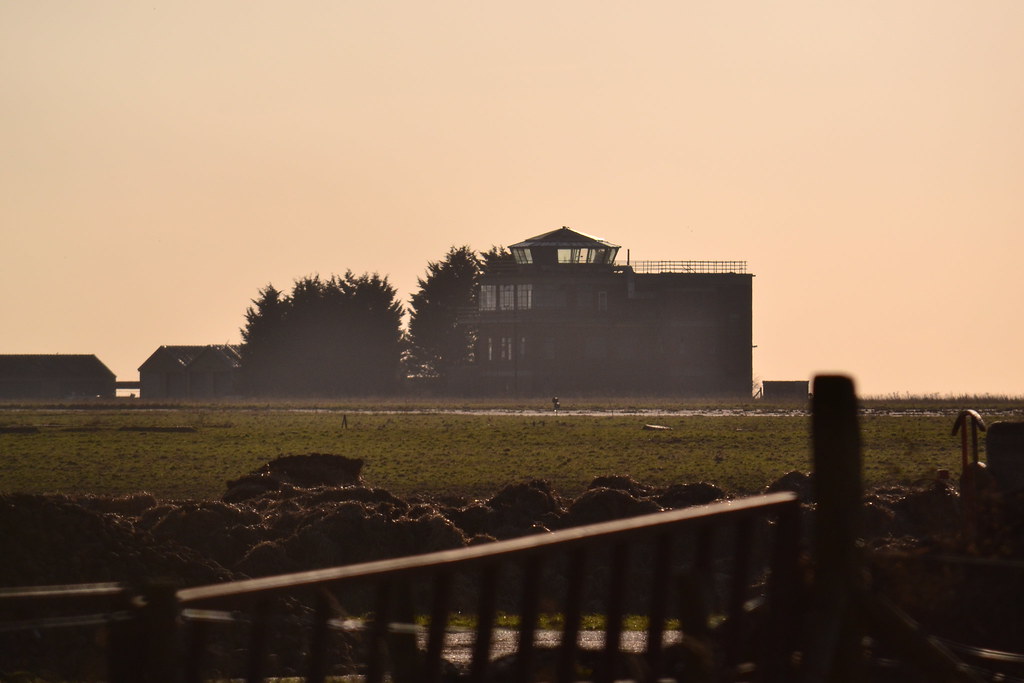
The watch office in a setting sun
Meanwhile at Sculthorpe, the operations of the 47th BW were gradually being taken over by other branches of the US Strategic Air Command (SAC), this take over reached such a point that inevitably the 47th were withdrawn and transferred home to the US. Once here, they were dissolved, and on February 8th 1955, the wing was removed from the US military inventory and their remarkable achievements condemned to the history books.
After this, political talks and imposed de-escalation strategies between the Cold War factions, prevented further deployment of large-scale US bombers on European soil, and so further deployments on this scale would not be seen again in the UK.
As the Cold War subsides, Sculthorpe’s future become uncertain, but it is definitely not yet over. In the last part we see how Sculthorpe has fared and look at what the future holds now.
The full history can be seen in
Trail 21.
 Aviation Trails