In
Part 1 we saw how Sculthorpe was developed in the mid war years but had not lived up to expectations. Two squadrons were about to move in, 464 and 487 neither of whom were overly impressed by its lack of comfort!
487 were the first to transfer. On the 19th, the advance party left Methwold followed in the early afternoon of the 20th by the main road party. The aircraft and crews then transferred over an hour or so after that. On the 21st the aircraft of 464 Sqn also departed Methwold, the departure tinged with sadness as many were sorry to be leaving what had been a good home. The weather typical as it is, once again closed in, and several aircraft had to try two or three times before finally getting down safely at Sculthorpe. Fortunately there were no mishaps and all crews and aircraft arrived safely. By the evening all were unpacked and settling down for the night.
The lack of buildings became quickly evident though, a fact made worse by the lack of bicycles, Sculthorpe being so widespread that it meant it was difficult to get around without transport. As a result, more bikes were needed and an order was placed with an urgent request. Coinciding with this, was a memo informing staff, of the impending move to form a new headquarters here, a move which would see both new recruits along with an increase in staffing levels. This was a further worry as there was still insufficient accommodation for those already here.
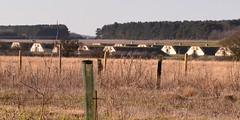
Sculthorpe’s bomb store.
The month ended on a better note however, with good weather, night sorties and training on new equipment gave a hint of things to come. A new station Commander also arrived at this time, in the form of Group Captain P.C. Pickard DSO, DFC, once again hopes for the two squadrons were rising.
Pickard’s arrival was by no means a coincidence – a new Wing was being formed and he had been chosen to lead it. Pickard’s record as a leader was outstanding, and he had been hand picked, for the role, by none other than Air Vice Marshall Basil Embry.
Pickard’s role here at Sculthorpe was to set up and command 140 Wing, a new unit consisting of three Mosquito squadrons, under the control of 2 Group of the Second Tactical Air Force headed by Embry himself.
Even while the new Wing was being formed, training continued for those already here at Sculthorpe. On August 18th, whilst on one such flight, one of the Venturas (AE668) of 464 Sqn crashed into a Welsh hillside at Llandwrog, with the loss of all four crewmen. What was unusual, and concerning, was why the aircraft was so far off course at the time; the Welsh mountains not being where it should have been. It was not known why the aircraft crashed nor indeed whether the deviation of course was a factor in the accident, but it was a heart felt tragedy and the squadron’s first accident whilst at Sculthorpe.
Three days after this, on August 21st, the first of the new replacement aircraft arrived, two DH Mosquitoes, a milestone that coincided the following day with the setting up of a Mosquito Conversion Flight. The purpose of the Flight was to convert Ventura aircrew from both 464 and 487 Sqns over to the Mosquito.
Flying was slow to start with, as appalling weather prevented any chance of taking off, even in the day-time; a situation that would prevail for some time. By now, the new postings for the surplus gunners of both units had begun to filter through, and gradually, one by one, they trickled out of Sculthorpe to their new respective squadrons elsewhere.
It wasn’t just the aircrew that were being posted out either, a number of tradesmen were also posted out, but oddly enough, they were not being replaced. The distinct lack of skilled technical personnel soon raised alarm bells amongst the units, for as a Mosquito squadron, 487 had no carpenters, and other skilled workers were becoming distinctly lacking.
By early September Mosquito numbers had reached well into double figures, the lack of manpower was now the issue which was being made worse by the lack of spares, a situation that led to many aircraft being classed as unserviceable. A common problem seemed to be the undercarriages, repairs taking longer than usual keeping aircraft annoyingly grounded.
The 15th September 1943 saw another turn in the status of Sculthorpe, seeing it gain its own independence and becoming an operational airfield in its own right. With this, Sculthorpe had finally grown up.
On the 28th, the numbers of aircraft on the books had reached over 70 when another squadron (21) arrived to join both 464 and 487 thus completing the formation of the Wing. The ORB for 464 Sqn stating that the airfield was not built for three squadrons (and a conversion flight) and that overcrowding was now a major issue for those based here at a cold and wet Sculthorpe.
21 Sqn was another Ventura unit, themselves having a history as far back as 1915, and very soon after their arrival, they too, would begin to receive the Mosquito. As with 464 and 487 Sqns, pilots were quickly placed on the conversion course flying with the Conversion Flight at Sculthorpe. The transformation from Ventura to Mosquito being expedited with all speed. By the 4th October, virtually all pilots had converted and completed cross country solo flights at low level. Only the incident on the 1st, when Ft. Lt. Henderson suffered engine trouble and subsequent fire, marred the otherwise rapid and clean transfer across. In the incident, Fl. Lt. Henderson managed to bring the aircraft down safely at
RAF Attlebridge.
Other good news for the unit was that those in the administration offices were now able to move from their cold and unsuitable temporary accommodation block to a new permanent building, this new block being the ‘best they had experienced since leaving
RAF Oulton‘.
Meanwhile 464 and 487 Sqn had both been flying operationally, October 9th being the blackest day yet for the New Zealanders, when twelve Mosquitoes were dispatched for the first operations over occupied territory. An attack on Metz was planned but owing to bad weather only one or two aircraft managed to find the target. After dropping their bombs it wasn’t clear whether the target was hit or not, but worse news was yet to come.
The formation, which had been dispersed due to poor weather, was being led by Wing Commander Alan G. Wilson DFC along with his navigator F.O. Donald C. F. Bridgman of 487 Sqn. During the attack the formation encountered severe anti-aircraft fire, and Wilson’s aircraft (HX965) was repeatedly hit. The navigator sustained mortal wounds and the aircraft was set on fire. In a desperate attempt to clear the fire, Wing Commander Wilson had to douse the flames with his hands causing extensive burning and injury. He managed to eject the now smouldering materials from the aircraft, but considerable damage had by now been done. Now flying on his own with his mortally wounded companion beside him, Wilson showed extreme courage and determination, flying the stricken aircraft back to England where he made a successful crash landing at RAF Manston in Kent.
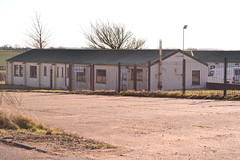
Blocks adjacent to the Guard Room.
A second aircraft (HX912), flown by Flt. Lt. Phillip C. C. Kerr and F.O. Bernard J. E. Hannan (464 Sqn) – were less lucky, both being killed when the aircraft dropped its bombs at low level. It is believed the subsequent explosion also blew up the Mosquito.
On a separate operation to attack the aircraft engine factory at Woippy in France, Mosquito HX938 piloted by Sqn. Ldr. Walter F. Wallington DFC and navigator P.O. James H. Fawdrraf, dropped its bombs by accident and crashed. This time, both airmen managed to bail out, but some thirty people on the ground were killed. Sqn. Ldr. Wallington managed to evade capture but P.O. Fawdrraf was not so lucky and was picked up by German ground forces. The same fate did not befall two more 487 Sqn airmen that day. Flt. Lt. Edgar W. P. Court and Flt. Lt. Jack B. Sands were both killed when their Mosquito (HX937) blew up whilst flying on one engine near to Antwerp.
It had been a very sad day for the Wing, and the loss of several ‘good’ men would be deeply felt by both squadrons.
More rain and strong winds eventually turned Sculthorpe into something that resembled a “seaplane base”, by the end of the month, the entire site was waterlogged. The winds were so severe they were reported to have lifted hut roofs off their mountings causing even more problems for those inside. The foul weather broke momentarily on the 22nd – 23rd October and allowed for some bombing practice to take place. On return, one of the 464 Sqn Mosquitoes overshot and crashed onto a hedge at the end of the runway. On the 23rd, one of 487’s Mosquitoes ‘T’ for Tommy, did exactly the same thing, coming to rest only feet from the wreck that was previously a Mosquito. As if that was not remarkable enough, a few minutes later one of 21 Sqn’s aircraft also overshot, landing directly on top of the 464 Sqn aircraft!
Miraculously no one was hurt in any of these incidents, but according to 21 Sqn’s ORB “
considerable loss of public property sustained“, presumably referring to the pile of wood chippings now sitting at the end of the runway.*
4 The fact that no one was hurt was a miracle in itself, and all the cockpits remaining intact was a sight that gave the personnel at Sculthorpe a great belief in the strength of the Wooden Wonder!
By October’s end, the crews of all squadrons were now fully conversant with the new Mosquito, and the supporting Conversion Flight was disbanded; specific training units taking on the role elsewhere.
In Part 3, the harsh winter of 1943-44 arrives and so does a special visitor. Does it mean something new for Sculthorpe?
The full history can be seen in
Trail 21.
 Aviation Trails