On this, Remembrance Sunday, we pay tribute and homage to those who gave the ultimate sacrifice, to those who put their lives on the line so that we may live peacefully and free.
Not far from the former RAF Charterhall airfield in Berwickshire, is a small church that dates back to the late 1600s. The hamlet in which it stands, Fogo, is small. In 2004 it had a population of just 21 people, yet it is the resting place of 16 service personnel from the Second World War. These are Commonwealth graves with men from: the Royal New Zealand Air Force; Royal Australian Air Force; Royal Navy Volunteer Reserves; Royal Air Force Volunteer Reserves; Royal New Zealand Navy and the Royal Canadian Air Force, all of whom died in service on and around RAF Charterhall.
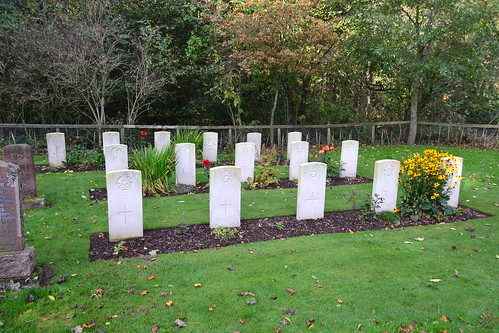
The sixteen men lay together in a Commonwealth War Graves Commission site.
These are those sixteen – We shall remember them:

F.O. John Morris, (s/n: J/10253) RCAF, killed October 24th, 1942.
F.O. John Morris was one of many pilots who suffered as a result of the autumn storms. It is believed he lost control of his Beaufighter MKIIF (R2313) whilst in the clouds and crashed into the ground in the local area.
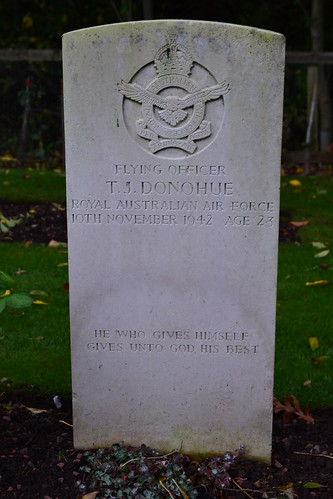
F.O. Thomas James Donohue (s/n: 411880) RAAF, Killed November 10th, 1942.
F.O. Donohue was one of many Australian crewmen to pass through Winfield and Charterhall. Sadly it was to be the final resting place for F.O. Donohue, his Blenheim MK V (BA111) crashing into the ground following the port engine cutting out. This was the third Blenheim crash of the month.
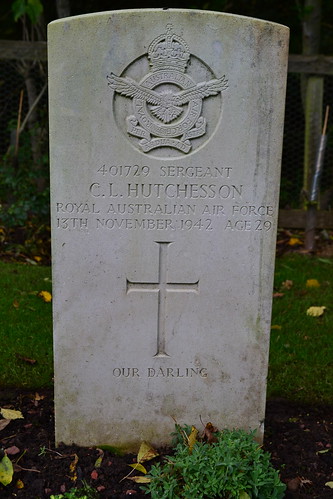
Sgt. Clarence Leonard Hutchesson (s/n: 401729) RAAF, Killed November 13th, 1942.
On the 13th November Beaufighter MKIIF R2378 took off from RAF Winfield with Pilot Sgt. Hutchesson and Navigator Sgt. R. Bell on board. The aircraft collided with another Beaufighter (T3359) near to Kettleshall Farm, Poleworth. Both crewmen in R2378 were killed, whilst the other crew managed to fly back to Winfield where they landed safely.

Flt. Sgt. Terence Cosson (s/n: 417024) RNZAF, Killed June 9th, 1943.
Flt. Sgt. Cosson was killed when the Beaufighter he was flying (V8163) spun into the ground and burned.
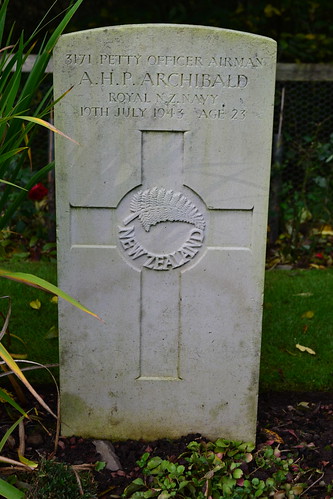
Petty Officer Airman Arthur Herbert Percy Archibald (s.n: 3171) RNZN, Killed July 19th, 1943.
Petty Officer Airman Archibald was flying a Fairy Barracuda MKII (DP868) from the RNAS Worthy Down to Scotland when he got into difficulties. The engine failed, after which the aircraft crashed at Charterhall killing him.

Flt. Sgt. Will Andrew (S/n: 415280) RNZAF, Killed July 27th 1943.
July 1943 saw a high number of accidents at Charterhall, Flt. Sgt. Andrew being one of the first fatalities of the month. He was killed when his Beaufighter (T3419) swung on take-off. This action caused the aircraft to collide with a blister hangar and then crash into a taxiing Beaufort. The pilot of the Beaufort was uninjured although the aircraft sustained considerable damage.
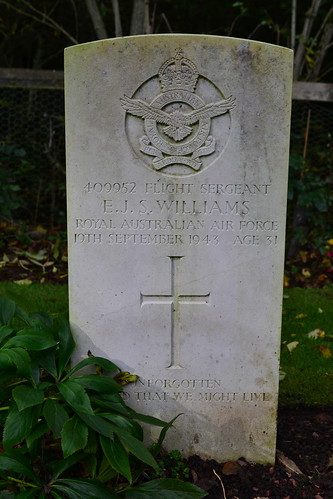
Flt. Sgt. Edward John Stacy Williams (s/n: 409952) RAAF, Killed September 19th, 1943.
Flt. Sgt. Williams was killed following a night flight engine fire. The pilot of the Beaufighter (T3361) Flt. Sgt. McGrath reported to RAF Winfield that he and his navigator were bailing out, but the when the aircraft was later found in the area, the bodies of both crewmen were still inside – both dead.
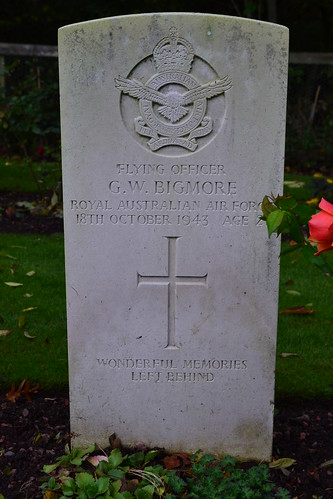
F.O. Gordon William Bigmore (s/n: 418047) RAAF, Killed October 18th, 1943.
It is believed that on the 18th, F.O. Bigmore lost control of his aircraft, Beaufighter MKIIF (T2438) whilst in cloud and on approach to the airfield. The aircraft collided with high ground killing the pilot and causing severe injuries to the navigator F.O. Hirst.
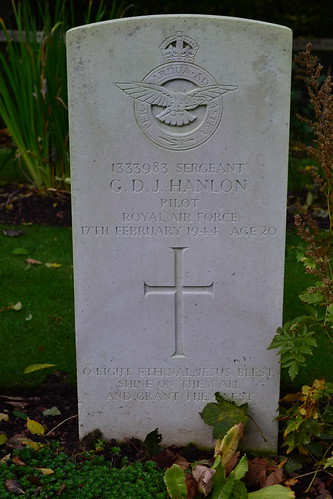
Sgt. Gilbert Douglas James Hanlon (s/n: 1333983) RAFVR, Killed February 17th, 1944.
Sgt. Hanlon was killed when he lost control on final approach to the airfield at Winfield. The Beaufighter MKIIF (R2375) collided with the ground some 2 miles south of the airfield on farmland.
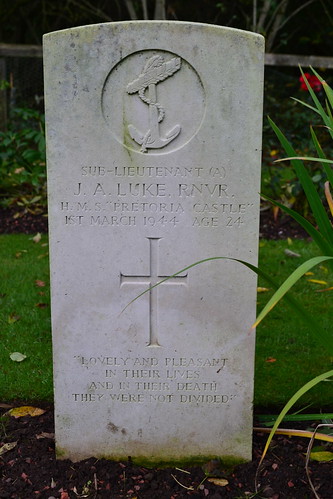
Sub-Lieutenant (A) James Allen Luke, RNVR, Killed March 1st, 1944.
March 1944 started off badly, when Sub-Lieutenant (A) Luke (above) and Sub-Lieutenant (A) Newburgh-Hutchins (below) tried to land their Fairy Fulmar in a snow storm at nearby RAF Winfield. The aircraft, a Fulmer MKI (X8696), was on a flight from the trials aircraft carrier HMS Pretoria Castle when it flew into the snow storm.
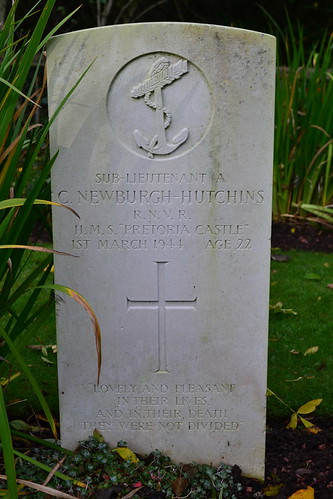
Sub-Lieutenant (A) Christopher Newburgh-Hutchins RNVR, killed March 1st, 1944.
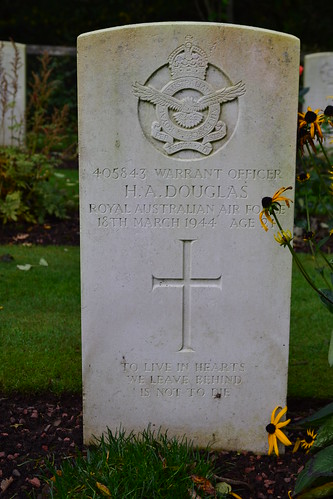
W/O. Hamilton Alexander Douglas (s/n: 405843) RAAF, Killed March 18th, 1944.
On March 18th, W/O. Douglas of the RAAF was killed when the Miles Martinet T.T. (EM481) he was flying crashed on take-off at RAF Charterhall.
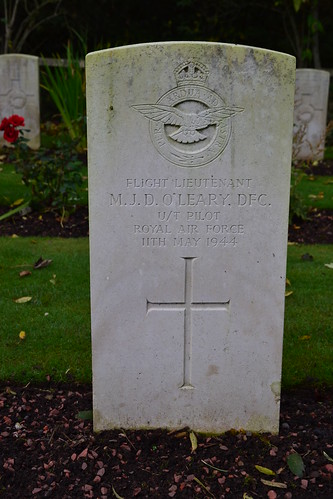
Flt. Lt. Michael John Dunn O’Leary DFC (s/n: 77614), RAFVR, Killed May 11th, 1944
Flt. Lt. O’Leary DFC was involved in what was possibly Charterhall’s most serious accident, when Beaufighter V8614 suffered an engine failure on the starboard wing; the aircraft unable to gain height, crashed into the ground. Flt. Lt. O’Leary was one of four crewmen killed, a crew that included two instructors and two pupils. O’Leary had just been awarded his DFC for gallantry prior to arriving at 54 OTU.
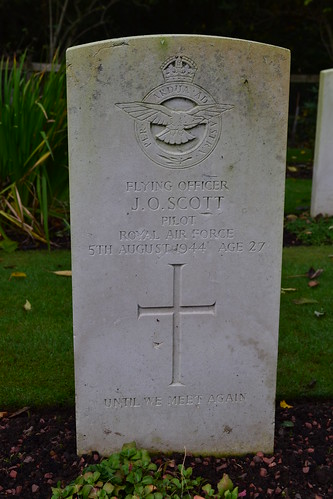
F.O. John Owen Scott (s/n: 151287) RAFVR, Killed August 5th, 1944.
F.O. Scott was killed in early August when his Beaufighter MKIF (V8739) suffered engine failure at 800 feet and spun into the ground at Charterhall.
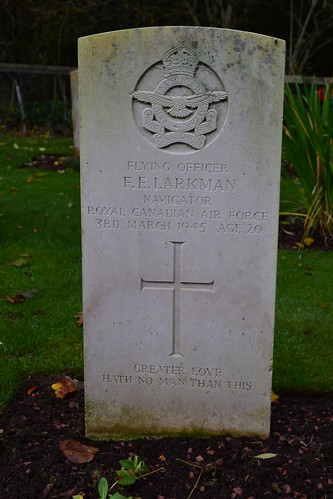
F.O. Frank Ernest Larkman ( s/n: J/42709) RCAF, Killed March 3rd, 1945.
F.O. Frank Ernest Larkman was another crewman involved in a serious accident, when the Beaufighter NF VI (KV976) he was a pupil in, lost both its artificial horizon and its gyros. At 5,000 feet and in cloud, the pilot Flt. Sgt. Wedgewood as instructor, perhaps became disoriented and the aircraft crashed into the sea 3 miles north of Berwick. A further unknown crewman who was also aboard, also died in the incident.
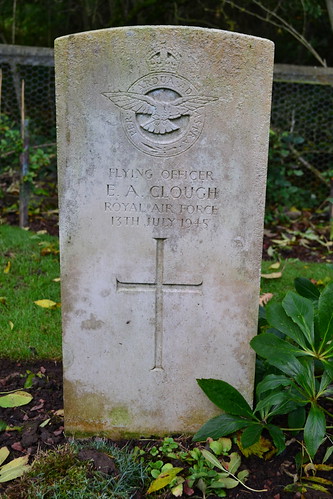
F.O. Ernest Arthur Clough (s/n: 147069) RAFVR, Killed July 13th, 1945.
Sadly many crews lost their lives at, or after, the war’s end. Flt. Lt. Clough was one such man. Flying a Hawker Typhoon IB (RB210) of 56 OTU from Winfield, he flew into high ground near North Charlton, Northumberland, in the resultant crash on July 13th, 1945, he was killed.
RAF Charterhall and RAF Winfield were both training grounds where many airmen were trained using unfamiliar or war-weary aircraft. As a result of inexperience, bad weather or in many cases, technical issues, there were a number of accidents many of which ended tragically. These sixteen are just a few of those who lost their lives in these accidents and are now buried in this quiet and secluded part of Scotland.
Lest we forget.

Fogo Kirk in the autumn sun.
 Aviation Trails
Very moving.
Thom.
LikeLiked by 1 person
Thank you Thom.
LikeLiked by 1 person
excellent research and very appropriate for Armistice Day.
Many thanks
David
LikeLiked by 2 people
Thank you very much David, I’m so pleased you enjoyed the post.
LikeLike
excellent research and very appropriate for Armistice Day.
Many thank
David
LikeLike
What a magnificent post you have put together to help these men be remembered!! We may not know them all, but we owe them everything.
LikeLiked by 1 person
Thank you GP. We certainly do owe them everything!
LikeLiked by 1 person
So many Commonwealth War Grave sites with rows of sad reminders of a tragic waste of life. It seems almost worse when all of these men lost theirs in training accidents rather than in combat, not sure why. Lovely that you’ve found the story for each person in that cemetery, we always visit if we see a CWGC and never fail to wonder what the stories are behind the graves. Touching post.
LikeLiked by 2 people
Thank you Jonno. Rows of headstone make us think, personal stories, I feel, bring them to life.
LikeLiked by 1 person
That was a very impressive way of making us all think about these young men. Today is really, I suppose, a day to recognise the war dead and the huge sacrifices they made. Having a list of the young men at Fogo and a short explanation of the incidents that killed them was extremely effective.
LikeLiked by 2 people
Thank you very much John, that’s really appreciated.
LikeLike
A sad but charming piece, Andy! We will remember them and indeed all those who paid the ultimate price for the freedom we enjoy today. I have already placed a silken Poppy on the plaque for the crew of 44-6133 yesterday and I shall of course be wearing my Poppy with pride today.
“Age shall not weary them,
Nor the years condemn.
At the going down of the Sun,
And in the morning,
We will remember them”.
LikeLiked by 1 person
Thank you Mitch. It’s a day we should all show our appreciation of their sacrifices.
LikeLiked by 1 person