During March 1944, an event took place in the UK that considering its historical importance, is little known about. It was actually quite a momentous event, especially in terms of aviation history, and in particular the Second World War.
As a follow on to RAF Glatton and Trail 6, we look into the short-lived presence of Boeing’s mighty aircraft the B-29 ‘Superfortress’, in what would appear to be its first and only wartime presence on British soil.
At the time of the bombing of Pearl Harbour in 1941, the United States was less than ready for a global war. The retaliation and defeat of not only Japan, but Nazi Germany as well, was going to be both costly and massive, requiring a huge increase in manufacturing of both arms and machinery.
This increase meant not only aircraft for the Air Force, but the infrastructure to support and train the aircrews too. A network of airfields and supporting organisations totalling some $100 million in 1940, would, by the war’s end be valued in the region of $3,000 million. In terms of size, this infrastructure would cover an area of land equal to the combined areas of: New Hampshire, Vermont, Massachusetts, and Connecticut.*1
To complete the task, along with aiding her allies, the U.S. was going to need to design and manufacture many new models of aircraft, aircraft that would outshine anything previously made available to the U.S. forces. Long range bombers in particular, capable of travelling great distances were going to be required – and a lot of them. At the outbreak of the European war, the U.S. Army Air Corps was in comparison to the European forces, very small, commanding just 26,000 officers and enlisted men, and operating only 800 front-line aircraft. The Luftwaffe on the other hand, had expanded considerably over the previous years, now commanding some 3,600 aircraft. The British, who were still some way behind the Germans but growing rapidly, had available to them some 2,000 aircraft, whilst the French could muster slightly over 1,700. *1a
To meet this demand, U.S. aircraft manufacturers were going to have to start by modifying, and with some exceptions, redesigning the various aircraft types that were already available to the U.S. forces. However, and likewise the British and German manufacturers, new models were going to have to be designed and put into production very quickly if victory was to be achieved in any of the world’s theatres.
Preempting war, the US Government put out tenders for long range bombers, in answer to which during the 1930s, the Boeing Model 299, first flew. Eventually being purchased by the US Government to fulfil the role, it was put into production as the iconic B-17 ‘Flying Fortress’, and was followed not long after by the B-24 ‘Liberator’; a more modern aircraft which took its maiden flight in 1939. But sitting on the drawing board at this time, was another aircraft that performed even better, the formidable B-29, a bomber designed to fly at altitudes up to 40,000ft, beyond the range of anti-aircraft guns and faster than many fighters of the time. The aircraft was so advanced in design that depending upon its payload it was capable of flying distances of up to 5,000 miles, far beyond that of any other heavy bomber.
Whilst the U.S. aircraft manufacturers had already begun designing and testing these new models, it would be some time before the number and types of available aircraft would come anywhere close to being comparable to those of the Luftwaffe, R.A.F. or even later, the Imperial Japanese Air Force.
By August 1942 both the development and production of these two heavy bombers, the B-17 and B-24, were well underway, and so it was decided that they would go initially to the European theatre rather than the Far East. The competition for the attack on Japan now lay between the B-29 and Consolidated’s competitor the B-32 ‘Dominator’ – an enlarged and also pressurised version of their B-24. However, two years after the first design drawings were revealed, neither of these aircraft types had yet flown, and so the shorter ranged B-17 and B-24s were going to have to fill the gap until such times as their replacements could arrive.
The war in the Far East would provide its own set of problems. The distance that supplies would have to be taken would take time and before any invasion could take place, lost ground not only had to be recovered, but held. To achieve this, ground forces would need to be protected by an air umbrella, a defensive shield formed so tightly that air supremacy was guaranteed.
Getting supplies into China was difficult, by air it required long and dangerous flights over the ‘Hump’, the Himalayan mountain range, usually fulfilled by C-47s and DC-3s, their commercial equivalent. With the C-46 ‘Commando’ and C-87 coming on line later on, the frequency and quantity of these supplies could increase but it was still not enough for the Chinese, nor for the difficult task ahead.
By March 1943 the stage was set. The Fourteenth Air Force was created out of Maj. Gen. Claire Chennault’s China Air Task Force, which by the summer time, had begun attacks on coastal positions, ports and troop concentrations under Japanese control. This air umbrella was in part achieved over Burma, and the desired attacks on Japan now looked more possible, but the B-17s and B-24s that had worked tirelessly lacked the range to hit the Japanese homeland; the long range high performance B-29 was by now desperately needed.
During the Quebec Conference in August that year, U.S. officials put forward their proposal to stage American long range bombers on airfields in China, the area required for such bases being under Chinese control already and therefore not at the mercy of the Japanese forces. This offensive, designated the Matterhorn Project, would involve the still as yet untested in battle, B-29s, their longer range and larger bomb capacity enabling them to ‘bomb Japan into submission’ in a similar way that Sir Arthur Harris had hoped for in Europe with the RAF’s bombing campaign against Germany’s industrial targets and cities.
To meet these aims a new force would be created, the Twentieth Air Force, which would be made up of two commands: the XX Bomber Command from China and the XXI Bomber Command who would be based in the Mariana Islands after they were retaken from Japanese control.
The aircraft destined to carry out this role, the B-29, was still very much an unknown quantity. Rushed into production with scant attention to testing, it was a monster of an aircraft, with a crew of eleven in pressurised compartments, electronic gun turrets and a massive 141 ft wingspan. The project was to be the biggest in U.S. aviation history, spares alone in the initial contract costing $19.5m, and one which General Arnold
referred to as the “$3 billion gamble”.*1b
The following film “Birth of the B-29 Superfortress” shows a B-29 production line and a test YB-29 in flight. It also contains some short graphic images at the start.
A batch of four XB-29 prototypes were built, and after initial test flights, a further fourteen ‘test’ aircraft, designated the YB-29, were also constructed. But problems with design drawings, missing parts and rushed testing meant that production was slowed to a minimum, part finished aircraft being stored whilst awaiting vital components. After test flights it became apparent that the B-29’s engines were prone to overheating and in several cases catching fire. This delayed further testing reducing flying time considerably until the problems could be solved. During flight tests, this problem with the engines was graphically seen, first on February 18th 1943, and then again a year later.
In February, XB-29 #41-003 (the second prototype XB) crashed into a meat packing factory killing all eight crew on board along with twenty civilians on the ground. The pilot, Eddie Allen, had already received the Air Medal for successfully landing the same XB-29 following another engine fire in the preceding December. A year later, January 29th 1944, engine problems caused yet another accident when #41-36967, the last of the fourteen*2 Wichita YB-29s manufactured, crashed after losing all four engines whilst in the air. This problem with overheating engines becoming the proverbial ‘thorn in the side’ of the Boeing production team.
By the summer of 1943, B-29 training squadrons were being set up, the first, the 58th Bombardment Operational Training Wing (Heavy) later the 58th BW (Very Heavy), was formed with the 40th, 444th, 462nd, 468th and 472nd Bombardment Groups, each with four or five squadrons of their own.
After a period of training four of these groups (the 472nd was disbanded April 1944) would transfer to India flying via Africa to join the Twelfth Air Force initially flying supplies over ‘the Hump’, before taking part in operations against Japan from the Chinese airfields.
Departure for these groups occurred over the March – April 1944 period, during which time one of these aircraft would divert to the U.K. causing a huge stir whilst ‘touring’ several U.K. airbases.
Whilst precise sources seem scarce, it is thought that flying B-29s across the southern route raised fears of a Luftwaffe attack whilst en-route, and so a plan of ‘disinformation’ was set in motion to fool the Germans into thinking that the B-29s were to be based in England, ready to be used against German targets. The first part of this ruse was in early March 1944, when YB-29 #41-36963 ‘Hobo Queen‘ took off from Salina Airbase in Kansas and flew to England. It initially took the southern route toward Africa, but then deviated north heading to Newfoundland. The YB-29, piloted by Colonel Frank Cook, then flew across to the UK initially landing at RAF St. Mawgan, in Cornwall.
During its short stay in the U.K. it was known to have visited RAF Horsham St. Faith near Norwich, RAF Bassingbourn on the 8th March, RAF Knettishall and RAF Glatton on 11th March before its final departure from RAF St. Mawgan to India in April that year. The route took the YB-29 to Marrakech, Cairo (2nd April), Karachi (5th Apr) finally arriving at Kharagpur, India, on 6th Apr 1944 . Once here, it was assigned to the 769th Bomb Squadron, 462nd Bomb Group who were then based at Piardoba in India, where it was modified as a tanker to ferry fuel over ‘the Hump’. The YB-29, the only test model to fly overseas, gave a successful service, eventually being declared war weary and returned to the United States, its eventual fate being unknown, presumably, like many war weary models, the aircraft was scrapped.*3
Whilst in the U.K. the YB-29 was certainly a major draw, over 1,000 key personnel viewing the aircraft at RAF Glatton alone, its enormous size dwarfing anything that had been seen in U.K. skies before.
The ruse was considered a success. The many B-29s that followed across the southern route did so without any interference from German aircraft, although how much of that was actually down to the ruse itself, is hard to distinguish. It is even thought in some circles that photos of the ‘Hobo Queen‘ appeared in the newspaper of the National Socialist German Workers’ Party, The Völkischer Beobachter, although an initial search of the paper through the Austrian National Library proved fruitless.

Crews and ground staff swarm around B-29 #41-36963 at Glatton airfield 11th March 1944*4.
Although B-29s were initially considered for the European theatre none operated from British soil until after the wars end, when a joint British and American operation, Project ‘Ruby‘*5, investigated deep penetration bombs against reinforced concrete structures. Three B-29s were prepared in the United States along with four B-17s and a select detachment of admin, maintenance, technical staff and air crew, who arrived at RAF Marham, Norfolk, on March 15th 1946. Initial plans were to test a series of bombs on the submarine assembly plant at Farge, but due to the close proximity of housing and an electricity plant, the U-boat shelter at Heligoland was used instead. The bombing trials began on March 25th by which time an original three B-17s from RAF Mildenhall had also joined the group.
A number of both American and British bombs were tested in the trials:
- The US 22,000lb. ‘Amazon’ bomb
- The US rocket assisted 4,500lb. ‘Disney’ bomb (used by B-17s in the latter stages of the war)
- The 4,500lb. ‘Disney’ bomb without rocket assistance
- The American 22,000lb. fabricated ‘Grand Slam’ (designated T14)
- The American 12,000lb. fabricated ‘Tall Boy’ (designated T10)
- The British 12,000lb, ‘Tall Boy’
- The British 2,000lb. Armour Piercing bomb
- The inert loaded 2,000lb. SAP (M103) bomb
- The Picratol filled 2,000lb. SAP (M103) bomb
- The 1,650lb. Model bomb
The results of the trials were quite conclusive, none of these bombs in their current form, were capable of penetrating the 23 ft thick concrete of the Farge roof, and therefore, all would need adapting, redeveloping or redesigning if such operations were to be carried out again.
Post war, B-29s were brought into the UK and operated as Boeing Washington B1s, operating with nine RAF Squadrons: No. 15, 35, 44, 57, 90, 115, 149, 192 and 207 at various airfields including RAF Marham, RAF Coningsby, RAF Watton and RAF Waddington, eventually being replaced by the high flying English Electric Canberra. The B-29 then disappeared from operational service in the UK.
Without doubt, the development of the B-29 had a major impact on the world as we know it today, and even though its first arrival in the UK in March 1944 caused a major stir in the aviation world, it incredibly remains a little known about clear fact. With little documentation available, there is clearly much more research to be done.
Since the original posting of this article, I have been contacted by Daniel Partridge whose grandfather (Leon Suthers) was at Randolph Field in the United States, after the war’s end. He has sent me some photos of ‘Hobo Queen’ after she returned to the US. According to information Daniel has supplied, she was used as a training airframe from January 1945 until 1954, after which she was scrapped. From the photos, you can see that much of the aircraft has been stripped away, presumably as part of this programme, yet the 45 camel ‘mission scores’ have been left. Further information from Daniel confirms that these Camels represent flights ‘over the hump’. My sincere thanks to Daniel for the information.
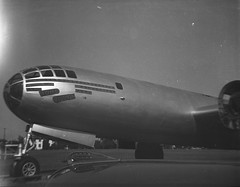
Hobo Queen Post War (Photo courtesy Daniel Partridge)
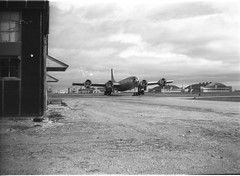
Hobo Queen Post War (Photo courtesy Daniel Partridge)
Sources and further reading.
*1 Nalty, B., et al. “With Courage The U.S. Army Air Forces in World War II” 1994. Air Force Historical Studies Office (p61)
*1a ibid (p38)
*1b ibid (p147)
*2 Only 14 YB-29BWs were built (#41-36954 – #41-36967) and all at Wichita. They were painted olive drab upper surfaces and light gull grey lower surfaces.
*3 MSN 3334.
*4 Image courtesy of 457th BG Association.
*5 Comparative Test of the Effectiveness of Large Bombs Against Large Reinforced Concrete Structures (PDF), Report of the Air Proving Ground Command, Elgin Field, Florida – Anglo-American Bomb Test Project “Ruby”. October 31st, 1946.
Simons. G.M., “B-29 Superfortress: Giant Bomber of World War Two and Korea“. Pen and Sword Aviation. (2012)
Mann. R.A., “The B-29 Superfortress: A Comprehensive Registry of the Planes and Their Mission“ McFarland & Company Inc. (2004)
Harris, S.R., Jr. “B-29s Over Japan, 1944-1945: A Group Commander’s Diary” McFarland & Company Inc. (2011)
Mann. R.A.,.”The B-29 Superfortress Chronology, 1934-1960” McFarland & Company Inc. (2009)
 Aviation Trails
Hello, I have some photo negatives from my grandfathers old service photos that might be of interest for this piece. I have a few photos of YB-29 (Hobo Queen) right around the close of the war that sheds some light on what happened to it after its time in Asia. Not a complete final fate but pretty close I would think. Looks like it had over 40 Hump flights during its service.
LikeLiked by 1 person
Hi Daniel, thanks for getting in touch. They sound very interesting and a big piece of the Hobo Queen jigsaw. I’d love to see them if at all possible. I’d also be interested to know how your grandfather was involved with the aircraft. Andy
LikeLike
That was absolutely fascinating. It must have taken ages to research, and pull it all together so well.
LikeLiked by 1 person
Thank you, it certainly did take a long time, but was exceedingly interesting too! Worth every minute!
LikeLiked by 1 person
That was really interesting and thank you for sharing it. It’s such a pity that no B-29s were used in ordinary bombing raids over Germany. They would have been a real challenge for the few Me262s and Me 163s in action!
As far as I know the Russians had four B-29s of which Stalin ordered them never to dismantle one as that was the model for putting the other three back together again. Wikipedia has a short account about these aircraft under “Tupolev Tu-4”.
LikeLiked by 2 people
Thank you as always John. It certainly would have been a challenge to the Luftwaffe especially toward the end of the war. I believe the Tu-4 was reverse engineered using those dismantled B-29s, virtually identical copies.
LikeLike
Absolutely fascinating as usual, so much to take in that I may have to come back and read it all again. Brilliant stuff.
LikeLiked by 2 people
Thank you Jonno. It was a fascinating one to research and there’s still much more to find.
LikeLike
A very interesting post – very well researched. Another great ‘what-if’ of WWII- I would imagine the sight of these Bombers heading out to Germany would have been pretty awesome.
Didn’t the Russians also my their own copy of the B-29?
LikeLiked by 2 people
Hi Stuart thank you very much for your kind words. It would have been incredible to see these, ‘ordinary’ bomber streams could be hundreds of miles long what a sight and sound that would be. The Russians did indeed reverse engineer the B-29, I don’t think it was overly successful, but don’t quote me on that!
LikeLiked by 1 person
It would have been quite a sight.
LikeLiked by 1 person
Another most interesting article, Andy! (For which I am especially grateful for at the moment, as you know!). One can easily understand the stir caused by the arrival of this aircraft but given the almost lack of testing devoted to it, I am surprised that the type was as successful as it was, or that anybody wanted to fly one!
As for the Amazon Bomb: Was it next day delivery, with Prime?!
LikeLiked by 1 person
Thank you Mitch I hope it has lightened your pain. It really did seem to be rushed but once the troubles were understood, it became a little less hazardous. That said it still caused issues. As for the bomb, it would have definitely been Prime(d). !!!!
LikeLiked by 1 person
Excellent, unsurpassed research. Congratulations. In a Japanese report, a shocked Zero pilot reported encountering one during its first deployment, engaged it but did not receive return fire. He reported he began making another pass on the otger side only to encounter defensive fire and retreated. Apparently, the remote controlled gun system on one side failed to operate. Typical for these first units as you report.
LikeLiked by 1 person
Thank you very much. It was a real foray into an unknown area for me. The B29 is a fascinating aircraft and so advanced for its day. It amazes me that one could land in the uk in wartime and no one know very much about it. It certainly must have been a shock to the Japanese pilots the first time they saw it too!
LikeLiked by 1 person
Even Hap Arnold couldn’t remedy the production ills fast enough. Of the first 100 “assembled”, all weights varied greatly even though they were to be “identical”.
LikeLiked by 1 person
It was a bit of an engineering nightmare I think. I’m surprised they were as successful as they were considering some of the problems they had getting it built, tested and in full production. I wasn’t aware of the weight difference although I’m not at all surprised!
LikeLike
I am on my phone and can’t see an option to email but while my story is nowhere in depth as yours, some of the issues are reported: https://p47koji.com/2014/11/11/the-firebombing-of-tokyo-part-2/
LikeLiked by 1 person
A very interesting and well researched post. You cover many aspects I didn’t, especially the problems that dogged the B-29’s production, although I was trying to cover more of the UK flight rather than its Pacific operations. This is something I lack knowledge on! Thanks for the link!
LikeLike
I had absolutely no knowledge of a “B-san” touching down the England, Sir. It was a fascinating piece of lost history. Given the unreliabilities of the engines I was shocked it made it there…
LikeLiked by 2 people
Certainly, as I found, it is a little known about fact, and considering the significance of it, I think there should be more. There are photos available in one or two books but they are limited and tend to be the same photos. I also came across the ‘Ruby’ project official report, and whilst I haven’t read it all, it’s an interesting document. This would be the second time a B29 made it to England. It in incredible that they made it here, but if the can get to the Far East then England shouldn’t be too much of a problem., even with unreliable engines.
LikeLike
Hi Koji. Your blog is a fascinating additional read! As I put in my original comment, the crews must have had some trepidation just flying the B29. Add the type of bomb load they were carrying into the equation and as you so succinctly put it, it took balls! They were flying a gasoline tanker that was quite likely to burst into flames before they got to the target anyway!
LikeLiked by 1 person