August 23, 1944 The worst aircraft accident in the UK during WW2.

During the Second World War, Britain’s landscape changed forever. The friendly invasion brought  new life, new music, rationed items became sought after bounties and they were plentiful – if you knew an American.  But this dramatic change in the British way of life could also be explosive and deadly.

Anyone living near to a wartime airfield knew only too well the risks of such a life. Aircraft could ground loop, collide in the air or suffer a major mechanical failure on take off, all of which could result in a massive explosion in a fully laden bomber. There are numerous recordings of such accidents occurring, and the brave attempts of crewmen trying to avoid local housing. One such crash was that of B-17 #42-39825, “Zenobia” which crashed on take off coming to rest in the nearby village of Deenethorpe. Luckily, the crew were able to escape and warn the locals of the impending danger, thus averting a catastrophe when the aircraft, fully laden with bombs and fuel, exploded twenty minutes later. The explosion was so fierce that it was heard nine miles away!

However, not everyone was as lucky, and on August 23rd 1944, Wartime Britain experienced what is considered its worst wartime air disaster. A disaster in which sixty-one people lost their lives when a USAAF aircraft from BAD2 at RAF Warton crashed into the adjacent village of Freckleton in Lancashire.

Warton, or BAD2 (Base Air Depot No. 2), was responsible for the modification and overhaul of US aircraft and engines when they arrived fresh from the United States. They were assembled, modified and transferred from here to front line operational airfields across the UK. A massive operation that began even before the United States had even entered the War.

Initially, Warton was built as a satellite for the RAF Coastal Command station at Blackpool, known at the time as Squires Gate Airfield, an airfield with a history going as far back as 1909. With many pleasure flights, air pageants and civil flights, it was eventually taken over and used for fighters and bombers of Coastal Command.

With many aircraft being shipped into the UK via the Atlantic during the early years of the war, the need for a site to build and then maintain them became evermore apparent and urgent. It was not long after the outbreak of war, that four such sites were earmarked for use by the USAAF as Air Depots, each one dealing solely with aircraft maintenance and refurbishment. The proposal, initiated by Lord Beaverbrook as early as October 1939, which then progressed through discussions between the American and the British Governments in 1941 , specified that these bases would need to be able to deal with large quantities of aircraft and be able to handle aircraft modifications at any stage of the assembly process. In October, these bases were identified by a consortium of American and British representatives, who selected: Warton, Little Staughton (Bedford), Burtonwood (Warrington) and Langford Lodge in Neagh, Northern Ireland, as the most suitable sites.

Warton would be massive, housing almost 16,000 people in over ten accommodation sites, which when compared to a normal Class A airfield of some 3,000 people, was an enormous conurbation. To be adaptable, the runway was strengthened and extended to match that of any wartime airfield, at almost 2,000 yards long, it could take any aircraft brought over from the United States. Along side this were a wide range of ancillary buildings: stores,  maintenance sheds, office blocks, hangars, engine test sheds and fifty dispersal points. As the war progressed, Warton was extended further with the largest European storage shed and further hangars being added in 1944.

The entire site was completed in just nine months, using a combination of construction groups led by Frank Thomas; this included both Alfred McAlpine, and Wimpey, two of the largest airfield contractors at that time.

Station 582 of the US Eighth Air Force was opened August 1942, housing a small contingent of USAAF personnel. Officially handed over to the USAAF a year later, it now had some 5,000 personnel on its books already, all specially trained to handle the unique American aircraft being brought over from the United States.

Each base would specialise, Burtonwood in radial engines and the B-17, whilst Warton concentrated on in-line engines and B-24s. However, that did not mean that this was a ‘closed door’ operation, Warton would, over the period of the war, see every example of US built aircraft pass though its doors, and at its peek, held over 800 aircraft within its grounds.

Living near such a large and active base would bring many benefits, 700, children were given a Christmas party that lasted for a week, the locals were well provided for and money poured into the local economy. However being so close also brought it dangers. There were numerous accidents with parked aircraft being hit as other aircraft taxied past. There were also several crashes, including a North American P-51D-5-NA Mustang #44-13403 that crashed on June 12th, 1944, killing its pilot. The accident being caused by a catastrophic structural failure of the wing assembly. Another P-51D #44-14608 (310th Ferry Squadron, 27th Aircraft Transport Group) was involved in a landing accident at Warton, on October 5th, 1944. The pilot survived, but the aircraft was destroyed in the crash.

Then there was the P-51B-5 #43-6623 that crashed after taking off from Liverpool’s Speke airport, it was was subsequently taken to Warton where it was combined with other parts of P-51Bs that had been dropped on delivery. The new aircraft, aptly named ‘Spare parts‘, would then be used as an unarmed two-seater ferrying VIPs around, delivering small spare parts to the other airfields and collecting supplies of of whiskey from a distillery in Glasgow. The aircraft itself was lost in late 1944 when it experienced engine failure. The two crew bailed out and survived but the aircraft crashed coming to a rest at the bottom of the Irish Sea.

One of the more terrible accidents at Warton involved the collision of two Douglas A-26B-10-DT Invaders, on November 29th 1944, when #43-22298 collided in midair with #43-22336 over Warton Marsh. The crews’ bodies were removed from the site, but the aircraft remained buried in the silt until excavation in 2004. Both aircraft were then transferred to the RAF Millom Museum at Haverigg, Cumbria where they remained until its closure on 1st September 2010. With many of it exhibits being ‘on loan’, they were returned to their original owners whilst the rest were publicly auctioned off in January 2011. The fate of the two Invaders is unknown at the time of writing.

However, it was on Wednesday, August 23rd 1944, that Warton would be shocked by Britain’s worst wartime air disaster and the terrible events that would unfold that day.

Everything appeared normal that day as the workers at BAD 2 and the surrounding area awoke. The news was generally good, the war was heading in the right direction and victory for the allies appeared to be on the cards. There were high pressure zones to the east and west and low pressure to the north. The first 2 weeks of August were generally dry and  warm with spells of sunshine. There had been  a spell of warm weather that continued into the third week, with temperatures reaching as high as 28°C in the south. On the 23rd, early sunshine was expected to change to light rain later on, nothing that should have caused any significant problems to the experienced crews at Warton.

Early on that day, two routine test flights were booked by experienced pilots on newly refurbished Consolidated B-24 Liberators  before they were sent out out to the 2nd Bomb Division. The first, piloted by First Lieutenant John Bloemendal, ‘Classy Chassis II‘, and the second piloted by First Lieutenant Peter Manassero.

After a delayed start, First Lt. Bloemendal and his two crewmen boarded the B-24, ran their ground checks and started the engines. They then departed on was was a routine test flight. Meanwhile, the second B-24 piloted by First Lt. Manassero also departed and both aircraft headed out from Warton. During this time a weather warning was passed to Warton tower informing them of an impending storm, the likes of which even the British had rarely seen. The notorious British weather had played a cruel joke.  In seconds, the summer sky had turned jet black. Daylight had been all but wiped out, Heavy rain lashed the landscape, localised flash floods and unprecedented strong winds battered the Warton skyline. Locals reported seeing trees being uprooted and buildings being damaged such was the strength of the wind and lashing rain.

The tower issued an immediate warning to land the two aircraft. B-24 #42-50291 “Classy Chassis II“,  was given clearance first, the second flown by First Lieutenant  Manassero was to come in next. With visibility down to some 500 yards, the two aircraft approached the airfield in close formation, simply to keep in visual contact. Bloemendal  lowered his undercarriage followed by Manassero. Bloemendal  then began his approach, suddenly retracting his undercarriage informing Manassero he was going round again for another try. But by now, the weather had deteriorated so much that the tower was extremely concerned, and issued an order, to both aircraft, to withdraw from the circuit and abort landings, telling them to fly to the north to avoid the storm. Bloemendal never received the message.

By now contact had been lost between the two pilots, Manassero headed out of the circuit and flew out of harms way, Bloemendal on the other hand had already hit the ground, a massive fireball ensued. Eye witness accounts differed as to what the cause of the crash was, one witness said she saw  lightning strike the aircraft at the wing root, “splitting the aircraft in two“, others say they saw the wings in a near vertical position as if the pilot was banking steeply to turn away.

The aircraft came down across Lytham Road, after hitting the ‘Sad Sack Snack Bar’, purposefully built for the American servicemen of BAD 2. It demolished three houses and the infant section of Freckleton’s Holy Trinity School, which at the time, was full of children between the ages of 4 and 6 who, along with their teachers, were going about their daily routine. The resultant crash led to a fireball, one that eventually took the lives of sixty-one people. Eighteen in the cafe, forty in the school and the three crewmen aboard “Classy Chassis II“.  Many of these dying in the days that followed from severe burns as burning petrol engulfed the school before flowing into the street .

The crash was so devastating that at the inquest, only the School’s register could be used to identify some of the missing children whilst others were identified merely by parts of their clothing painfully presented to grieving parents. First Lieutenant John Bloemendal was only identified by the remains of his dog tags and wedding ring, the only married man aboard the aircraft.

The US servicemen from BAD2 were highly praised in the days that followed for their quick and brave response to the crash. Pulling away debris while the aircraft still burned, attempting to put out the fire and fighting to save whomever they could from the burning wreck that was once Freckleton village school.

The papers understandably ran the story for months and even years afterwards, as more and more information came to light. Some of the injured were so severely burned, they were read their last rights, whilst many had to have long term skin grafts, including some as part of McIndoe’s Guinea Pig Club.

From Lytham St. Annes, to London and New York, the story of Britain’s worst air disaster spread, putting good news from the front line into painful perspective. Whilst convalescing, young survivors were visited by Bing Crosby, who diverted from his tour of American airfields across the UK, to pay his respects. A small gesture to avert the grieving now felt across both sides of the ocean.

A mass funeral service took place in Freckleton on August 26th, the streets were lined with mourners as service personnel carried the many tiny coffins along in one mass parade. Afterwards, a fund was set up by the USAAF, and an area of land was developed into a playground as a lasting memorial to those lost in the accident. A tablet laid at the playground reads:  “This playground presented to the children of Freckleton by their neighbours of Base Air Depot No. 2 USAAF in recognition and remembrance of their common loss in the disaster of August 23rd 1944”.

The inquest into the crash could not prove conclusively as to the cause of the crash. It states:

“The cause of this accident is unknown. It is the opinion of the Accident Investigating Committee that the crash resulted from pilot’s error in the judgement of the violence of the storm. The extent of the thunder-head was not great and he could have flown in perfect safety to the North and East of the field”.

It also states that a possible “rough air structural failure occurred“, although verification of this was impossible due to the total destruction of the aircraft’s structure.

freckleton 28 Aug 1944 funeral procession Photo Ralph Scott

Crowds line the street as US Servicemen carry the many coffins at Freckleton (Photo Ralph Scott, BAD2)

What did arise from the crash was that US service personnel who were trained in the bright blue skies of America, were unaccustomed to the changeable and fierce British weather. Many, like First Lieutenant Bloemenda, often under-estimating the dangers of these thunderstorms and as a result, training was amended to include warnings about such events.

With the eventual withdrawal of US forces from Warton, the memories of that day linger on, regular services are held at Frekleton in remembrance of those sixty-one lives who were all innocent victims of Britain’s worst air disaster of World War Two.

Sources and Further reading

There are many sites that cover this story, in particular I refer you to:

British Newspaper Archive website.

The Lancashire Aircraft Investigation Team Website which has many photographs pertaining to the crash and is well worth a visit.

BAD2 Blog 

The Book “The Freckleton, England, Air Disaster” by James R. Hedtke, details the accident in depth giving eyewitness accounts, background details and transcripts of the conversations between pilots and the tower. It served as a valuable source of information for this post and is worth buying if interested in reading about this further.

Also, the book ‘Blood and Fears‘ by Kevin Wilson, (Weidenfeld & Nicolson) also briefly mentions accounts of the event. Again a good book should you wish to read further.

RAF Metheringham – One of Bomber Command’s finest. (Part 3)

In this, the last part of RAF Metheringham, we see how one of its brave crews earned the Victoria Cross for their outstanding bravery, and how, as the war camr to a close, Metheringham was closed down and disposed of.

On the night 24th/25th April, 1944, took 106 Sqn back to Germany once more, to Munich and another ‘clear night’ with accurate bombing reported. But, then it was Schweinfurt a city that would become synonymous with high casualties especially amongst colleagues in the US Air Force.

Metheringham would send sixteen aircraft that night with take off commencing at 21.25 from the Lincolnshire airfield with another mix of 4,000lb, 41lb and 30lb bombs. Over the target, marking would again be low level by Mosquitoes but this time  it was inaccurate. Strong winds hampered the bombers, with many of the bombs falling away from the main target. Crews reported large fires across the city accompanied by ‘large explosions’. Sadly these were not to be the target and as a result the mission was not deemed a success.

Of the 206 Lancasters sent out that night (26th/27th) twenty-one were lost to heavy and sustained night fighter attacks, a figure of 10% of the force, a terrible blow for Harris and his Command. From Metheringham, five aircraft failed to return, with a further one returning on three engines. Methringham’s loss that night was some 31%, a third of its force gone in one mission. It was a difficult mission for 106 Sqn, with thirty-six airmen lost,  (JB601 was carrying a second pilot). Ten of these were taken alive as POWs, four managed to evade capture, whilst the rest were killed. The deaths of the remaining twenty-two must have had another huge impact in the Metheringham dining room that morning.

During this mission the remarkable actions by the crew of Lancaster ME669, and in particular Flight Engineer Sergeant Norman C. Jackson (later Warrant Officer), would become well known. After being hit several times by a  night fighter, a fire started in the inner wing section next to the upper fuel tank.  Sgt. Jackson, who had been wounded in the leg and shoulder, donned his parachute and grabbed a fire extinguisher before climbing out on to the wing through an escape hatch in the fuselage roof. Upon leaving, his parachute was deployed into the cockpit area, where his colleagues gathered it up and gradually fed the lines through the hole allowing Jackson to gain access to the fire in the wing. Undertaking such an act on a burning aircraft and at altitude, was no easy task and getting back, had he been successful, virtually impossible. The wind knocked the extinguisher out of his grip which prevented Jackson from succeeding in achieving his aim. The fire, now spreading, began to burn both his parachute, hands and face and fearing for his safety, his colleagues let go, releasing him from the stricken bomber. Sgt. Jackson fell to Earth, his parachute partially burned, opened and allowed him to reach the ground alive, but suffering several injuries in the process.

The 21 year old Canadian Captain, F/O. Frederick M. Miffin D.F.C., then ordered the crew to abandon the aircraft; himself and 20 year old F/Sgt, Norman H. Johnson (Air Gunner) both failing to survive.

Sgt. Jackson’s brave attempt to save his colleagues and their aircraft earned him the Victoria Cross for his actions, his citation being published in the Fourth Supplement to the London Gazette on Tuesday 23rd October 1945.*2

The Schweinfurt raid had been a major blow to the Metheringham crews, but it had also shown their courage and determination to win, regardless of the dangers to their own safety.

Another heavy blow on the night of 7th/8th May took another four aircraft along with all but one of the crew, Sgt. J Smith evading capture, in a month that would see a further six aircraft go down with heavy losses.

June 1944 would see another remarkable event take place. Although the entire crew of DV367 were lost on the night of 7th / 8th, they were all awarded the DFM for their action, an usual act in any squadron, and one that nonetheless reflected the bravery of RAF crews at that time.

RAF Metheringham

Metheringham’s memorial garden rests besides a C-47 Dakota ‘KG651’ as a representative model that visited the airfield at the end of the war. Visitors are able to enter the aircraft and sit in the cockpit.

Following the Allied invasion of Normandy, the US forces would begin to use Metheringham as an evacuation point for wounded American troops from nearby  Nocton Hall Military Hospital. Once a suitable recovery had been made, the troops were brought to Metheringham and flown on to Prestwick for onward travel and reparation to the United States.

Rarely a month would go by without the squadron facing some loss. Exactly a month later in July, Metheringham would see yet another dip in their crew numbers as five more aircraft went down on the mission to St.-Leu-D’Esserent – the flying bomb storage dump. A force of 208 Lancasters and thirteen Mosquitoes accurately bombed the mouth and access roads to the tunnels in which the bombs were being stored. Metheringham’s loss was particularly high, almost a third of the sixteen sent out being lost. Whilst many airmen were either captured or evaded capture, another eighteen were lost.

In September 1944, No. 1690 (Bomber) Defence Training Flight arrived ay Metheringham airfield. A unit formed seven months earlier at Syerston after 1485 (Bomber) Gunnery Flight was re-designated, it operated a number of single and twin engined aircraft including the Spitfire, Oxford and Wellington bomber under the code ‘9M’. They were used to train bomber crews in the art of defence against fighters, performing violent moves to throw off their attacker. One famous pilot of this unit who served at Metheringham was the Commanding Officer Sqn. Ldr. John Leslie Munro, CNZM, DSO, QSO, DFC, JP of 617  Sqn fame. The Flight would leave Metheringham in the summer of 1945, being disbanded in October that same year back at Syerston.

It had been a long and difficult war for the crews at RAF Metheringham. As the end of the war drew ever closer, they all knew their last mission would soon be here. On April 25th 1945, that day arrived.

Sixteen Lancasters took off to either bomb Tonsberg in the southern region of Norway, or mine the Oslo fjord. A last ditch effort to force the capitulation of the German leadership and end the conflict that had devastated the world for the last six years.

By the time the cease fire was announced, 106 squadron had flown 5,834 sorties with a loss of 187 aircraft (59 from Metheringham), 3.21% on average per mission. 17,781 tons of bombs and mines were dropped and 267 decorations awarded.

After the war, 106 Sqn was earmarked for ‘Tiger Force’ operations and training was tailored to meet these new requirements: fighter affiliation sorties, high level bombing and air-sea firing exercises. Also during May, operation ‘Exodus‘ was put into place and a number of 106 Sqn aircraft flew to the Continent to bring back POWs, many landing at Dunsfold on their return. On the 9th May, whilst evacuating POWs from Rheine airfield, one aircraft from 106 Sqn struck a bomb crater causing damage to the aircraft, the crew and their valuable cargo of POWs thankfully escaped unhurt. The aircraft was then repaired with parts being ferried over from Metheringham the next day. Between May 4th and May 11th, Metheringham crews repatriated 1,484 prisoners of war bringing them home from captivity.

During June aircraft were exchanged with those from 8 Group at RAF Oakington, RAF Warboys and RAF Graveley, allowing Operation ‘Firebrand‘ to be completed by the 19th. Other operations included ‘Rebecca‘, ‘Dodge‘, ‘Nickel‘ and ‘SPASM‘.

On June 15th, another Lancaster squadron, No. 467 (RAAF), joined 106 here at Metheringham. In the days preceding their arrival, they spent many hours dropping ordnance into the sea, a comment in the ORB stated “it seemed like the old days with all serviceable aircraft loaded with incendiaries and it looked like a real operational take off.” It goes on to say a ‘waste but necessary‘ reflecting perhaps the feelings of the men as the squadron wound down for the final few weeks.

The advanced party arrived to make sure the transition went smoothly, with the main party arriving shortly afterwards. Beer was supplied by Metheringham and the crews soon got to know each other well. On July 11th, an athletics competition was run between the two squadrons, involving contests such as ‘tug-o- war’, ‘hop, step and jump’, ‘throwing the cricket ball’ and distance races.

With the announcements of Japan’s capitulation on August 15th, all 106 Sqn ‘Tiger Force’ training flights were cancelled although it continued to be used as the basis of further training operations. B.A.B.S. (Beam Approach Beacon System) training also continued at the airfield.

RAF Metheringham

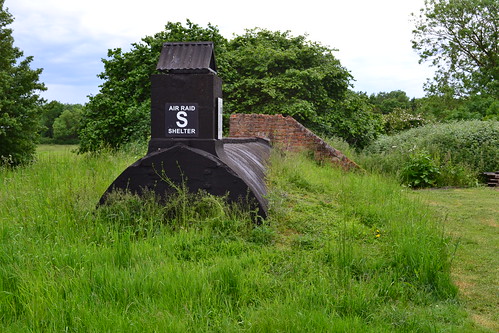
Air Raid Shelters were once common place on Britain’s airfields.

Shortly after 467’s disbandment on September 30th 1945, October saw yet another Lancaster unit arrived at Metheringham, No. 189 Squadron who brought yet more Lancaster MK.Is and III. to be disposed of and they too were disbanded within a month.

The poor weather that had caused so many problems during the winters of the 1940s leading to Metheringham having FIDO installed, continued on into 1946 curtailing many flights and operations. On 13th  February 1946 the final curtain came down and a memo came though to Metheringham to ‘stand down’ from all operational and non-operational flying as of 00:01, 15th February 1946. Sixteen aircraft were to be ferried to RAF Graveley to have Mark III H2S units fitted, although this was cancelled and the aircraft were sent to Waddington (10), Binbrook (1), Lindholme (4) and one further Lancaster going to Waddington. By 22nd February 1946 all aircraft had left Metheringham and the squadron no longer existed, 106 Squadron was once more consigned to the history books and Metheringham airfield would follow not long after. Men, machinery and administrative items were then disposed of in accordance with the relevant Bomber command instructions. By April, everyone had left, the site was stripped and placed in care and maintenance, a condition it remained in until December 1950, whereupon it was abandoned before being sold off ten years later.

Like many stations, local people used the accommodation sites for their own accommodation, the runways were eventually pulled up for hardcore, buildings and other metal structures were removed for scrap or sold off to farmers. By the early 1970s Metheringham had all but been wiped off the map. The Watch Office left to decay has since been bought by a local developer, with a mammoth task ahead of him he hopes to turn it into accommodation and a small museum/residential block.

Metheringham’s record of achievement was a proud one, with generally low loss statistics they were to face some of the toughest challenges of the war, losing many crews in the process. Their determination to survive and to win over the Nazi tyranny led to many brave and heroic acts, acts which helped secure the release of hundreds of captured airmen.

RAF Metheringham

There are many reminders of RAF Metheringham.

Metheringham’s gallant and brave young men, are all remembered in a small, but excellent museum that now utilises part of one of the accommodation areas. A memorial to the aircrew stands on the eastern perimeter track as a reminder of the 995 Airmen who were lost whilst serving with 106 Sqn.

Much of Metheringham’s runway and perimeter track still exists today, in most part as a public road. The width of the concrete bases far exceeding the width of the road. A memorial stands to the eastern side overlooking the main airfield site (Site 1) with lines of tress denoting the remainder of runways long gone. The main B1189 road dissects the accommodation areas with Site 1, as was common with late wartime airfields. The museum lies off the junction of this road and the main Woodhall Spa road B1191 along the entrance to Westmoor Farm. If taking the B1189 toward the Metheringham village, you will pass a number of former wartime buildings used as small industrial units and farm storage. These are on private land although the museum do organise visits to some of these at certain times of the year. After passing these, turn right, this road was one of the secondary runways and crosses the remains of the main runway part way down. It then bends to the right taking you along the perimeter track, and then right again to the memorial – a circular route that traverses what was the peri track. Several of the hardstands still survive, mainly on farm property and difficult to see from the ground, but the number of buildings still standing is quite remarkable for such a short lived airfield.

Trail 1 then continues on, visiting another former Bomber Command airfield RAF Woodhall Spa.

Sources and further reading.

*1 Fleming, J., “The Callendar Effect: The Life and Work of Guy Stewart Callendar (1898-1964)“, 2007, The American Meteorological Society

*2 The London Gazette, 23rd October 1945.

*3 Operational Record Book March 1944 – IWM AIR-27-834-6

Operational Record Book January 1944 – IWM AIR 27/834/1

Operational Record Book November 1943 – IWM AIR 27/833/22

Operational Record Book April 1944 – IWM AIR 27/834/8

Operational Record Book – Squadron Number: 106 Summary of Events: Y – IWM AIR 27/835/9, (01 May 1945 – 28 February 1946)

467 RAAF (Royal Australian Air Force) Summary of Events: Y 01 May 1945 – 30 September 1945 – IWM AIR 27/1931/33

Middlebrook. M., Everitt. C., “The Bomber Command War Diaries.” 1996, Midland Publishing.

Records of a 1690 BDTF pilot can be read on the Website ‘A Pilot’s Story‘.

Metheringham Airfield Museum webiste holds details of opening times, admission fees and special events. An excellent little museum it is well worth a visit.

RAF Metheringham – One of Bomber Command’s finest. (Part 2)

After Part 1, we continue following the crews of 106 Squadron at RAF Metheringham. The weather and in particular fog became a huge problem for aircrew, and bomber Command in particular. Something had to be done.

During the 1940s, fog was a particular problem around Britain’s airfields, often reducing visibility down to virtually nil, meaning bombers could neither take off nor land. Arthur Harris realising the effect this was having on his bomber operations, requested investigations be carried out into a possible method for clearing the fog thus allowing bombers to operate in this appalling conditions and widening the possibilities of operations in bad weather.

Churchill, influenced by Harris’s argument, instructed his Scientific Adviser Lord Cherwell to begin action at once, and so the Petroleum Warfare Department began to assemble a team of experts – who had already carried out some investigations into the weather and methods for dealing with fog – into a team to investigate the problem. A wide ranging group of scientists and industrialists carried out research concluding that heat was by far the best method for clearing fog over the low lying landscape.

The requirement put forward was to clear a standard Class A runway of at least 1,000 yards long and 50 yards wide, and an area up to 100 feet above the ground – a staggering 1.65m cubic yards of air. Further limitations were then put on the order restricting the placement of any obstacles likely to endanger an aircraft within 50 feet of the runway’s edge.  A mammoth task but one which saw the development of the oil burning FIDO system.

The FIDO (Fog Investigation and Dispersal Operation) system was developed under the leadership a British Civil Engineer Arthur Clifford Hartley, CBE who worked with the Petroleum Warfare Department, and whose initial ideas involved using one of two streams of fuel; petroleum trialled at RAF Graveley, and Coke trialled at RAF Lakenheath.  After initial (and rather crude) tests at both Moody Down (petroleum) and Staines (coke), petroleum was found to be the better of the two fuels, and henceforth, the Gravely model was used as a template for fourteen further sites of which Metheringham was one.

Installed at Metheringham during early 1944, it saw pipes laid alongside the runway which when lit, created an initial mass of smoke. Once the system had ‘warmed up’ the smoke dissipated and the fog began to ‘burn off’ as the immense heat from the burners created an up draft of warm air.

By the war’s end FIDO had been used across England to assist in the landing of almost 2,500 aircraft most of which would otherwise have not been able to land without great danger to the crews or ground staff; it had been one of the war’s greatest success stories and was sold as such to the wider public. So successful in its outcomes, FIDO was intended to be installed at London’s major airport Heathrow, after the war, but the cost of running each system was astronomical, burning some 6,000 – 7,000 gallons of fuel in four minutes – the time it took to clear the designated volume of air. It is estimated that during its wartime use, something like 30 million gallons of fuel were burnt and whilst the cost to the taxpayer was tremendous,  it is thought to have saved the lives of over 10,000 airmen in the process.*1

Back in the air, the night of March 15th/16th saw split missions  with one section going to Stuttgart and and a further six aircraft heading to the aero-engine factory at Woippy in France. These six made up a total formation of twenty-two Lancasters, a flight that included 617 Sqn aircraft. With promises of good weather over the Metz region, it came as  a huge disappointment to find 10/10 cloud cover over the entire target.  Even with the target being identified on the H2S screen and five marker flares being dropped, the leader announced the mission scrubbed and all aircraft were instructed to return to base taking their full complement of bombs with them. So strong were the crew feelings that 617 Sqn’s leader, Leonard Cheshire, seriously considered complaining! However, despite this, all aircraft returned including those of 106 Sqn to Metheringham with only minor flak damage to ND331.

Lancaster B Mark IIIs of No. 106 Squadron at Metheringham,heading to Frankfurt. The attack on 22/23 March 1944 caused extensive destruction to eastern, central and western districts of the city. © IWM (CH 12543)

With the next few missions passing without major incident, the night of March 30th, would deal a hefty blow to the crews of 106 Sqn.

With take off starting at 22:15, seventeen Lancasters would depart Metheringham heading for Nurumberg carrying a range of 4,000lb, 1,000lb, 500lb, 41lb and 30lb bombs. Over the target, skymarkers guided the bomb-aimers as cloud was reported as heavy as 10/10 again. Searchlights and flak were evident as were fighters which attacked and damaged Lancaster ND332 piloted by F/O. Penman. The Lancaster, which claimed two enemy aircraft damaged, returned to England putting down on Manston’s emergency runway. Both the rear and mid upper turrets were out of action, one of the engines caught fire, and on landing, the undercarriage collapsed due to the enemy action. luckily though, no crewmen were injured in the sustained attack that caused the Lancaster’s severe damage.

A further Lancaster had to return early, Lancaster JB567 after suffering the failure of the port inner engine landing back at Metheringham after two and half hours into the flight. Similarly it was an engine failure that also caused the early return of JB641 this time landing three hours after departure. Three of the seventeen Lancasters were already out of action.

Meanwhile on the continent, Lancaster ND585, was reported missing, later being found to have been shot down by a German night fighter, crashing in Belgium with the loss of all its crew. On board was, at 18 years old, another of Bomber Command’s youngest ever crewmen, Sgt. Julian Mackilligin RAFVR (S/N: 1804016), who even at his young age, was already half way through his operational quota. He was buried at the Hotton War Cemetery, Luxenbourg.

Next came another two losses, Lancasters JB566 piloted by F/S. T. Hall DFM and ND535 piloted by F/O. J Starkey. Both went down with the loss of all but four crewmen. The mission had indeed been costly, forty-two airmen were out of action, seventeen of them killed.*3

By the end of the first quarter of 1944, 106 Sqn had carried out more sorties than any other 5 Group squadron (358) losing 8 aircraft in the process. This gave the men of Metheringham an average of 19 sorties per aircraft in the first 90 days.

April began with a mix of bombing and ‘Gardening‘ missions, operations that included laying mines along the Koningberger Seekanel, with mines being dropped from as low as 150 ft. Even though some aircraft reported heavy ground fire from the banks of the Canal, the mission was deemed to be a great success and all aircraft returned safely.

The month continued to go well for the Metheringham crews, but the night of April 22nd / 23rd would take another toll on the morale of the crews. That  night saw twenty Lancasters fly to Brunswick as part of  a much larger force of 238 Lancasters and seventeen Mosquitoes. The mission, whilst generally uneventful, marked the first operation in low level target marking by No. 5 Group over a large city, an aid that proved fruitless on this occasion partly due to low cloud/haze obscuring the bomb aimer’s clear sight. With varying reports of cloud from 5/10 to no cloud and haze, all bombers reported bombing on markers, but damage and ground causalities were recorded as low.

RAF Metheringham

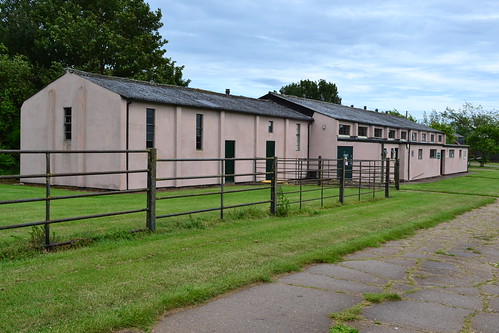
The former Gymnasium now forms part of the museum and holds a range functions including weddings and talks.

RAF loses that night were also relatively low, with only four aircraft being lost from the whole flight. Sadly though, one of these, Lancaster MK.III ‘JB567’ ZN-E piloted by F/Lt. J. Lee was a Metheringham aircraft. F/Lt Lee had only one more mission to go before completing his first tour of duty. Only two of his crew survived, being picked up by German forces and sent to POW camps. This loss only went to strengthen the idea that it was difficult, if not impossible, to achieve a full tour of duty unscathed.

The next night 24th/25th April, 1944, took 106 Sqn back to Germany once more, to Munich and another ‘clear night’ with accurate bombing reported. But, then it was Schweinfurt a city that would become synonymous with high casualties especially amongst colleagues in the US Air Force.

In part 3, we see how incredible brave acts earned a Metheringham airman the highest honour – the Victoria Cross.

The entire post can be seen in Trail 1.