Part 1 of RAF Glatton saw how the 457th were thrown into the deep end of the war. With a baptism of fire in the ‘Big Week’ campaign attacks against the German aircraft industry, they managed to survive with few casualties, but learned a great deal about the air war over Germany. In Part 2, we see the 457th in yet more high prestige raids and how they played a further part in the attacks on German industry. We also see unusual visitors and ‘oddities’ appear in the skies over Glatton.
Following the February campaign, the 457th would go on to drop both leaflets and bombs on coastal targets and more prestige targets including Wilhelmshaven on March 3rd 1944, and Berlin on March 6th. On this mission, two further aircraft were lost, not by being shot down by flak or enemy fighters, but because one was rammed by a Luftwaffe Me-410 fighter causing it to strike a second B-17 of the same group in the lower section.
Mission 8 for the 457th would take the group consisting of eighteen aircraft to the V.K.F. ball-bearing works in Erkner on the outskirts of Berlin. The factory, a subsidiary of the Swedish S.K.F. ball-bearing company, produced many of the ball-bearings required for the German war machine. B-17G #42-31595 ‘Flying Jenny‘ was struck by the fighter causing it to fall into the lower section of the formation B-17G #42-31627. Only the tail gunner of 627 survived, the remainder being ‘killed in action’*3.
During this period, losses remained remarkably low for the group, possibly due to the many targets they bombed being secondary, or targets of opportunity, a decision forced on the group primarily by bad weather over the primary target area.
March 1944 saw a remarkable and unique visitor to Glatton, one that not only attracted many military visitors to the airfield, but one that lightened the atmosphere amongst the men. A plan had earlier been formed in the United States to send B-29 ‘Superfortresses’ to China in a bid to support the Chinese and to allow the bombing of Japan from Chinese bases. In early 1944 this plan became reality but reliability problems had dogged the B-29’s engines and so major modifications had to be carried before the long flight could begin.
There was a fear that the Germans might attack the aircraft as they were ferried across the Mediterranean, and so a devious plan was set in motion to fool the Germans into thinking that B-29s were to be based in England, ready to be used against German targets. The first part of this rouse was in early March 1944, when YB-29 #41-36963 ‘Hobo Queen‘ took off from Salina Airbase in Kansas taking initially the southern route then deviating to the north and heading to Newfoundland. The B-29, piloted by Colonel Frank Cook, then flew across to the UK landing at RAF Glatton. The aircraft remained at Glatton for a short period before visiting both St Mawgan and Bassingbourn, before its final departure to India in April that year. The ruse had been a success. The B-29 certainly was a draw to the crews, its enormous size dwarfing anything hat had been seen at Glatton before, it was truly a remarkable aircraft, the likes of which had never been seen over the Huntingdon countryside previously.

Crews and ground staff swarm around B-29 #41-36963 at Glatton airfield 11th March 1944*4.
On April 22nd 1944, the 457th took part in the famous Mission 311, the mission in which US forces lost more aircraft to enemy intruders than at any other time in the war. On this mission, Hamm – the largest marshalling yard in Germany – was the target. The 457th along with the 401st BG and the 351st BG of the 94th Combat Wing, found themselves arriving last over the target, by which time it was covered in smoke from both previous bombing and German defensive smoke pots. Finding a break in the cloud the 457th dropped their bombs onto the target achieving ‘good’ results. However, by the time the Group were approaching home, it was dark and a group of Luftwaffe fighters had managed to hide themselves within the formations mingling with the bomber stream. By the time their presence was known, it was too late, and a number of aircraft, mainly B-24s, were attacked and either shot down or badly damaged. The 457th were once again lucky, only one aircraft, #42-106985 ‘La Legende‘, was severely damaged, but not to the point that it couldn’t crash-land back at Glatton. Significantly, on-board this aircraft was the station commander Lt. Col. James R. Luper.

B-17G #42-106985 after crash landing at Glatton April 22nd 1944. On board the aircraft was the station Commander Lt. Col James Luper. *5
It was Lt. Col. Luper who had had the honour of both collecting and naming the 1000th Douglas Long Beach built B-17, (#42-38113), ‘Rene III‘, named so after his wife. Initially called ‘Pistol Packing Mama‘ by the very people who built the aircraft, she was flown from the United States to Glatton by Lt. Col. Luper and his crew.

Lt. Col. Luper with ‘Rene III’ the 1000th Douglas built B17 (IWM)
Over the next year, ‘Rene III‘ would complete fifty-three missions, many over Germany including: Augsburg, Schweinfurt, Ludwigshafen, Leipzig, Munich, Cologne and Bremen. On her final mission, March 21st, 1945 to Hopsten, she was piloted by Lt. Craig P. Greason (s/n: 0-825840) of the 749th BS.
As the 749th BS aircraft approached the target, ‘Rene III‘ took a direct hit in the wing, close to the No. 4 engine, which caused a fuel leak and subsequent fire. The aircraft then dropped out of formation – one of the worst things that could happen to a stricken bomber. Official records suggest that the B-17 then went on to bomb the target after the fire appeared to extinguish itself. However, the crew were known to have all bailed out safely, after which all the aircrew (apart from Aircraft Engineer Sgt. William Wagner, who was caught and became a POW) managed to evade capture.
The station commander, Lt. Col. Luper, who was not aboard that day, continued to fly with his crew, eventually being lost on 7th October 1944 whilst flying in B-17 #44-8046 on a mission to Politz. Lt. Col. Luper survived a Flak strike on the aircraft and along with 4 other crewmen, was captured and taken prisoner by the Germans. The other six members who were not captured were sadly killed in the attack*6.

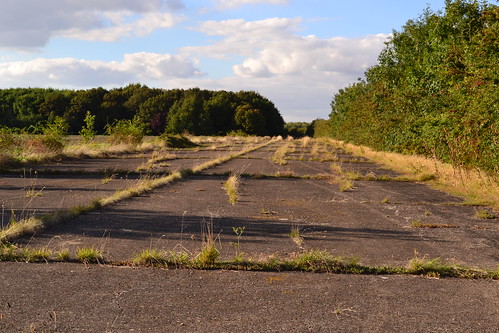
The main runway now serves light aircraft where B-17s once roared.
The salvage and rescue of damaged aircraft went a long way to supporting the work of the allied Air Forces in Europe. The need to keep aircraft flying meant stripping bits of damaged or scrapped aircraft and reusing them to repair less damaged examples. At Glatton, this went one step further.
B-17 #42-38064 was made into a composite aircraft with an olive drab front end and an aluminium rear; the two fuselage halves being joined at the wing root. The aircraft was named ‘Arf ‘n’ Arf‘, after a popular pub drink at the time made up of half a bitter and half a mild.
The rear of the aircraft came from B-17 #42-32084 ‘Li’l Satan‘ which lost an engine on landing at Glatton after receiving battle damage over Bremen in June 1944, the tail section being salvaged and added to #42-38064.

B-17 ‘Arf ‘n’ Arf’ a composite aircraft operating with the 457th BG at Glatton. (IWM UPL 28214)
‘Arf ‘n’ Arf‘ went on to complete several missions, its fate being sealed on November 8th 1944, in a heavy dousing of irony when it collided over the channel with B-17 #44-8418, ‘Bad Time Inc II’. In the collision, in which all the crewmen of ‘Arf ‘n’ Arf‘ were killed, the propellers of 8418 sliced through the fuselage of ‘Arf ‘n’ Arf‘ cutting the aircraft in two. 8418 went on to land ‘safely’ the crew being uninjured.
With the end of the year in sight, many were looking forward to the New Year celebrations and a renewed hope for peace. But New Years day 1945, would be a notable day in the European Air War for other reasons. Not only for the appalling bad weather that had dogged the whole theatre of operations for the entire winter, but also for the fact that the Eighth Air Force Bomb Divisions were re-designated as ‘Air Divisions’. It was also a day where the Luftwaffe launched a series of attacks against allied airfields in the low countries causing widespread damage to aircraft and airfields.
The turn of 1944/5 would be a terrible time for bad weather. Mission either being cancelled at the last minute or flown in appalling conditions. As the end of the war draws ever closer the wind-down begins and the thought of going home becomes ever increasingly stronger. The end of the war also signifies the end of Glatton as a military base, but even after it is all but removed, its legacy lives on.
The full account can be found at Trail 6 – American Ghosts.


 Aviation Trails