RAF Bodney – High casualties and Heroic acts (Part 2).

After Part 1, we return to RAF Bodney to the point where the RAF had pulled out handing Bodney over to the US forces. From now on, it would be the home of the USAAF 352nd FG, its P-47s and P-51s.

Famed for the blue-noses on their P-51s, there would be high successes but there would also be many tragedies along the way.

Formed previously in September 1942, the 352nd Fighter Group (FG) composed of three Fighter Squadrons (FS): 328th FS, 486th FS (previously the 21st PS) and 487th FS (formally the 34th PS). Their journey had been both long and difficult, using elements of two squadrons who had previous battle experience in the Pacific theatre. The new 352nd would move through a series of training camps and bases across America, serving as part of the US Air Defence force before deploying overseas. From Mitchel Field, they transferred to Bradley Field (Connecticut), Westover Field (Massachusetts), Trumbull Field (Connecticut) and onto Republic Field, New York before  eventually leaving on the Queen Elizabeth arriving a week later at Bodney on July 7th 1943.

Arriving via Greenock and the Queen Elizabeth, the ground echelons of the 352nd were deposited at Watton station where they were taken by truck to RAF Watton. Pleasantly surprised by the far nicer accommodation blocks they had been used to, their joy was to be short-lived as Bodney was perhaps even worse than the original training camps they had endured back home.

Whilst the surrounding woods had been utilised for aircraft dispersal, the base was in need of an upgrade if it was to be used successfully. These improvements included the addition of steel mat and pierced-steel planking hardstands, additional taxiways and more roads constructed of both macadam and concrete. The men of the 352nd commuted daily from Watton carrying out repairs and improvements until such time as the airfield was more or less ready for occupation and they moved in.

During its time, Bodney would have two T2 hangars and five Blister hangars, accommodation would continue to be limited, allowing for around 1,700 men of mixed rank. Eleven accommodation sites were spread round the north and east of the main airfield, which included two communal sites (site 2 and 3) and two sewage works (sites 12 and 13). There were no WAAF accommodation blocks and due to initial shortages of Nissen huts, nearby Clermont Hall (originally a grand plastered brick Italian style building built by William Pilkington in 1812 as Lord Clermont’s hunting lodge*1)  was ‘requisitioned’ and flying crews moved in, it was a complete change and total luxury compared to other bases and camps used by either the RAF or USAAF. However, following a visit from an Air Inspector, the stay was short-lived and the airmen moved back to the basic hutting of Bodney, even after strong protests from Group Commander, Lt. Col. Joe Mason.

Master Mark II glider tug at Bodney, during airborne forces Exercise ‘SNAFFLE‘ © IWM (H 31737)

During this time manoeuvres regularly took place in the local area, and between August 9th and 11th 1943, one such exercise was conducted near to Newmarket, an exercise that involved both Polish and Canadian divisions opposing each other in mock attacks. During exercise ‘SNAFFLE‘, Master Mark II glider tugs used Bodney airfield whilst dropping a range of supplies such as petrol, ammunition and ordnance to illustrate both the usefulness, and importance of such activities. This made an interesting change to Bodney and something else for the crews to focus on.

It wasn’t long however, before the first P-47s were to arrive at Bodney, and at last flying could begin again with training flights started very soon afterwards. However, maintenance and flying operations were arrested by the lack of equipment, spares and aircraft – all very typical of the build up of US squadrons across the UK. As morale sunk, a special visitor arrived at Bodney, that of Capt. Clark Gable along with a film crew who were documenting the lives of American Fighter Squadrons involved in the European war.

A line up of P-47 Thunderbolts including (PZ-T,) “Little Evey” and (PZ-Z) “Pistol Packin’ Mama” at Bodney.  (IWM FRE 2795)

On September 9th 1943, some two months after their arrival, the 352nd flew their first mission. An uneventful patrol over England’s eastern coast between Southwold and Felixstowe. For the next few mission, even those into enemy territory, similar conditions were found, the enemy were not seen and flak remained low. However, this did not mean the 352nd were casualty free.

On 13th September 1943, Lt. Arthur Eaker was killed in a local flying accident, the groups first, then on the 14th, Lt. William Alm disappeared whilst in flight over the North Sea. His aircraft P-47D (#42-22531) was thought to have been lost due to mechanical failure, he was never found.

It wasn’t until the 10th October that the pilots of the 352nd got to fire their guns in anger, when they encountered a flight of Bf-109s near to Hertogenbosch, Holland. The first kills were recorded, but it was not to be all plain sailing. Four days later on the 14th (‘Black Thursday‘), the Luftwaffe changed tactics and hit the escorts as they crossed the coastline. Leaving the bombers unescorted to their targets in Germany. Once away from their ‘Little Friends’ the bomber formations were decimated by Me-110s – something need to be done.

With more mission to Germany and escort duties, the 352nd began to cut their teeth and become battle hardened. By the turn of the year they had completed 38 missions with the loss of ten aircraft. The pilots of the 352nd had now twenty-two enemy aircraft as confirmed ‘kills’, but five of their own were killed and two others had been made prisoners of war.

A new year and new directives for fighter squadrons. in order to achieve total air superiority pilots were instructed to hunt for the Luftwaffe and destroy them whenever the opportunity arose. Every aircraft destroyed on the ground now counting as a battle credit, the same as an aerial kill. In addition, fighter squadrons were now given designated ‘zones’ to protect, and once the bomber stream had passed through their zone, the fighters were free to roam at will. The gauntlet had been thrown and the US pilots were hungry for rewards.

Early 1944 saw these directives put into action. ‘kill’ rates began to rise, but along with it casualties also mounted. By February the war-weary P-47s were looking tired and the new P-51 began to appear. The Ninth Air Force taking first pickings with Don Blakeslee, (Trail 46 and Trail 50) formerly of the ‘Eagle Squadrons’ becoming the first US squadron to have the mighty Mustangs. It wasn’t until March 1st, 1944 that the 352nd would receive their first P-51s, with seven being delivered and duly handed over to the pilots of the 486th FS at Bodney.

A battled damaged P-51 Mustang (PZ-S) of the 486th FS, in a Blister hangar at Bodney. (IWM- FRE 2803)

It would take just eight days for the Bodney crews to mark their first Mustang ‘Kill’. Capt. Ed Gignac, in P-51B ‘PZ-W’ (#43-7022), shooting down a Bf-109 in battle that saw both P-51s and P-47s of the 352nd participate.

April saw more changes and new arrivals, by now there were two squadrons of P-51s at Bodney, a new sound reverberated around the grassed airfield and with it came more new directives, As many squadrons were equipped with a mix of aircraft, it was beginning difficult to tell them apart in the hectic skies. Coloured noses, wing tips and fins were rapidly becoming markings of individual squadrons and those in charge realised that a standard form of scheming was now necessary for this new and innovative way of distinguishing squadrons.

The blue nose was born, and Bodney’s Blue-nosed Mustangs were soon to be seen at low-level attacking airfields, locomotives, vehicles, troop columns and other similar ground targets.

In May, whilst acting on escort duties for a raid over Brunswick, the group shot down 27 enemy Bf-109s and FW-190s with the loss of only one aircraft. This action earned them a Distinguished Unit Citation, for taking on a “numerically superior force of German interceptors” continuing on until lack of ammunition and fuel forced their withdrawal.

The 352nd went on to support the Normandy invasion, an operation that proved to be a fatal tragedy for one pilot in particular, Lieutenant Bob Frascotti.

IMG_2210

Robert Frascotti next to his P-51B, 43-6685, named ‘Umbriago’ . At 21 years of age he was killed on his final mission before returning home. (Photo – Marc Hamel)

D-Day began early for the 352nd, the night sky was dark and to assist the take off temporary runway lights had been lit. Preceding Frascotti were his compatriots of the 486th FS. During the take off, one of the preceding aircraft struck a light causing the entire collection to extinguish. In the moments that followed, Frascotti and his wing-man, Lt. Carlton Fuhrman, were plunged into total darkness. Unable to see, the two were now committed and carried on, Fuhrman slightly behind Frascotti. Within seconds of them leaving the ground, there was a sudden and massive fireball in front of Fuhrman, a fireball that was the result of Frascotti striking the new, and as yet unfinished, watch office. His aircraft, fully armed and fully fuelled, became a fireball that lit-up the night sky, and one from which Frascotti would not survive.

Blinded temporarily by the flash, Fuhrman fought to prevent his aircraft stalling as he flew through the flames and on out into the night sky, struggling to orientate himself and  unable to register his instruments due to the blinding flash. Behind him, Frascotti’s burning wreck lit up the field, one of the 352nd’s finest had been killed in a total and needless tragedy. The only saving grace from this was that every other aircraft taking off after Frascotti was able to see, a guiding light some say, and so prevented other tragic accidents from happening that night. This was the young 21 year old’s final mission, his 89th, and on completion he would have been returning home.

During D-Day the 352nd flew 116 sorties, reigning death and destruction down on the German forces below, other casualties were to follow, but none until now, as destructive and heart rendering as that of Frascotti.

The Watch Office after being hit by Frascotti’s P-51 on the morning of D-Day. (© 352nd FG, USAAF)*2

After Normandy, the 352nd went on to support the breakout at St.Lo and the airborne assault in Holland. As autumn led into winter, the temperature dropped and the weather took a dramatic turn for the worse; with heavy snow and cold winds across the continent, as the ground forces held out on the Ardennes forest knew only too well. The 352nd, like many other squadrons, were to help support the paratroops, being moved on a short-term basis to Belgium (Asch (Y-29) and Chievres (Y-84)) to join the Ninth Air Force earning themselves the French Croix de Guerre on New Year’s Day 1945.

A week earlier, on Christmas Day 1944 a second tragedy was to befall the 352nd, one that would take the life of another one of the 352nd’s finest. The squadrons highest scoring pilot at that time, Major George Preddy, a hero to many of the airmen and ground crews at Bodney, flew into an American Flak barrage put up by the US Army’s 12th Anti-Aircraft Group. His plane was hit and whilst his canopy was seen to be ejected, no chute appeared, and his body was found still in the wreckage of his beloved P-51. The news of Preddy’s death stunned the celebrations at both Asch and Bodney, no-one could believe that such a daring and brave pilot could have been lost, let alone lost to friendly fire.

April would see the 352nd return to Bodney, where they continued operations until May 3rd 1945. Their final move on November 4th would take them home to the United States, a move that left Bodney empty and a legacy that would be hard to follow. The 352nd had flown 420 missions, losing 118 aircraft with 70 pilots killed. They had been awarded 13 DSC’s, 31 Silver Stars, 336 DFCs, 1304 Air Medals and 42 Bronze Star Medals. The Group had created 52 ‘Aces’, 28 of which had achieved the status in air-to-air combat, accounting for 505 aircraft in the air with Major George Preddy achieving 27 of these himself.

With that departure Bodney fell silent, it closed very soon after the war in Europe ended on November 26th 1945, reverting back to farmland soon after.

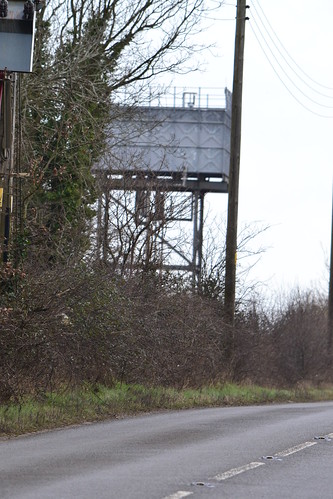
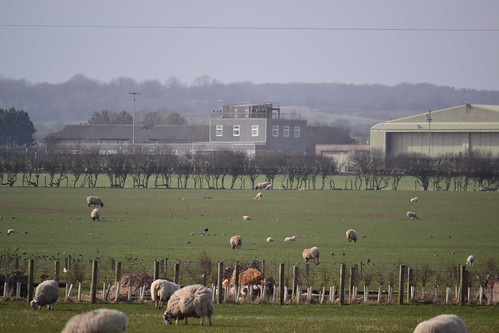
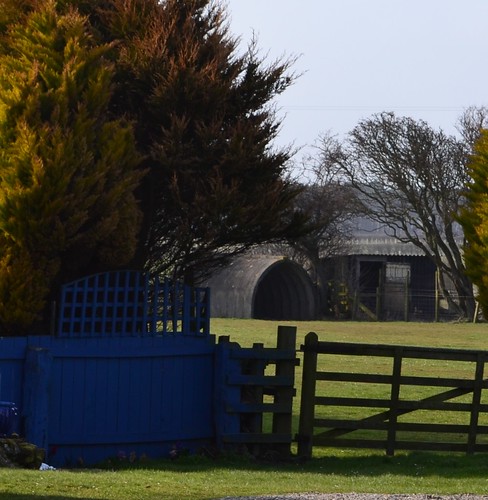
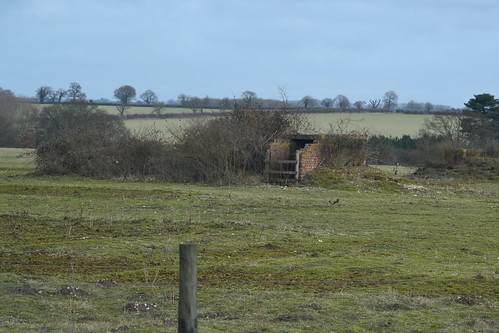
Today Bodney falls next to the British Army’s STANTA training ground and as such parts are a military site. Some structures can easily be seen from the main road, B1108,  with signs warning of MOD activity are everywhere.  The original water tower and pump still serve the camp, a few air raid shelters exist and some buildings on the camp. Hardstands can be seen in the woods but little from the road itself.

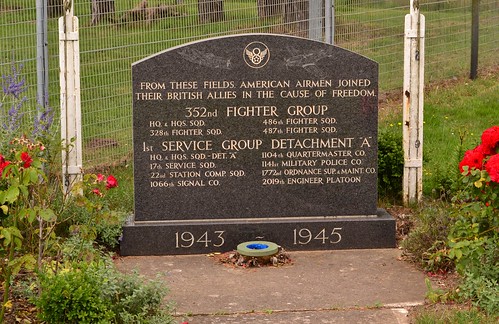
The watch office is accessible (on farmland) where there are also a few other buildings to be found, including  number of Type 22 pillboxes, many are derelict. The main army base is on part of the former accommodation site, with a memorial outside the gate dedicated to 352nd FG and associated units.
RAF Bodney

Bodney’s memorial to the 352nd FG.

Many of the buildings that were in existence were pulled down in 2012/13 due to increased vandalism and their heavy use for Rave parties. As a result even less now stands visible telling the incredible stories of this forgotten airfield.

Sources and further reading.

*1 Norfolk Heritage Explorer website, accessed 15/8/18

*2 Photo via www.controltowers.co.uk

Frascotti’s story is told in more detail in Heroic tales.

Preddy’s story is told in more detail in Heroic Tales.

Walton, D. “Northumberland Aviation Diary” (1999), Norav Publications

Freeman, R. “The Mighty Eighth“, (1986), Arms and Armour.

There is a website dedicated to the 352nd with a link to the superb ‘Bluenoser’ magazine.
RAF Bodney – High casualties and Heroic acts (Part 1).

Much has been written about the Famous ‘Blue Nosed Bastards of Bodney‘, the 352nd Fighter Group, Eighth Air Force. Famed for their determination and ferocious attacks on Luftwaffe aircraft, they produced some remarkable results – but they also suffered some terrible losses. Nicknamed the ‘Blue Nosers‘, because of their blue nosed P-51 Mustangs, they became one of the most successful fighter groups of the Eighth Air Force. In just a two-year period (September 1943 to May 1945), they were credited with 800 enemy aircraft destroyed, either on the ground or in the air, flying a total of 420 missions. Today the airfield they served from, RAF Bodney, is a small part of the STANTA training ground used by the Army for military exercises, and whilst the airfield has all but gone, the stories and tales of the 352nd continue to live on.

In this Trail, we look again at RAF Bodney, the units and the men who served, the heroic acts and the cost paid at this small grass airfield.

RAF Bodney (Station 141)

Bodney was initially an RAF airfield, opened in 1940 as a grassed site with a hardened perimeter track. During its construction, it had 27 asphalt hard stand of mixed sizes, fifteen large and twelve small, and was designed as a satellite for nearby RAF Watton (Trail 9). Whilst primarily associated with the USAAF, it was in fact an RAF Airfield for several years, housing detachments of aircraft from its parent station.

On 2nd March 1939, 21 (Norwich) Squadron (RAF), now part of 2 Group,  moved into Watton from Eastchurch bringing with them Blenheim MK.Is which they retained until the September when they changed them for the MK.IV. Being early on in the war, they were not yet fully operational, and so were limited to reconnaissance flights over northern France. They were also joined in the August by 82 Sqn, another Blenheim squadron, and it was at this time that they began to utilise Bodney as a satellite, dispersing aircraft here away from the parent airfield.

One of the earliest casualties to occur at Bodney was that of 82 Squadron, on the 22nd anniversary of the forming of the Royal Air Force – 1st April 1940. Take off occurred at 11:00 hrs when Blenheim MK.IV #L8867, piloted by F/O. Glyn Harries (s/n 39520), along with Sgt, Herbert Kelleway (s/n 561573) and LAC. Eric Wolverson (s/n 544700), was sent to attack enemy shipping off the Danish coast. During an attack, the aircraft was hit by Flak from enemy shipping and brought down with the loss of all three  crewmen on board. Their bodies were never recovered and they are commemorated at Runnymede.

RAF Bodney

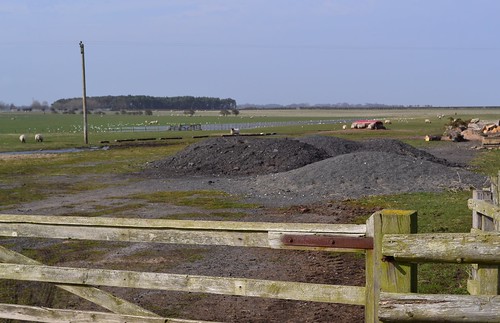
Bodney today.

By the summer of 1940, Western Air Plan W.A.4(b) was put into operation, a plan that formed part of a 16 part operations plan in the event of a German attack, and one that would focus British Air power in the destruction of German power sources. Part 4(b) focused on the advancing troop and armour columns when they crossed into Southern Holland, Belgium and France. This required aerial attacks primarily from Blenheim and Fairy Battle Squadrons, and was intended to slow or even stop the advancement.

Blenheims of 21 Squadron were assigned to this plan focusing on troop columns and bridges, but being under-powered and weaker than their adversaries, Blenheim casualties were very high and operations over enemy territory were soon curtailed.

Western Air Plan W.A.4(b) was a plan that sent many pilots to their ultimate death or capture, as the aircraft they were flying were woefully inadequate for the job in hand. A fact borne out by the brave attempts of three crewmen on June 14th. On this day, Blenheim #R3742, of 21 Squadron at Bodney, was shot down over France, the three crewmen: P/O. W. Saunders, Sgt. H. Eden and Sgt. C. Webb,  fortunately surviving the resultant crash. After making their way to the coast, finding a boat and attempting to row to England, the three men began to hallucinate through exhaustion. After the second night, P/O. Saunders ‘disappeared’, leaving only his tunic behind in the boat. After being what they thought was only 10 miles from the English coast, they were eventually picked up in France and taken to a new POW camp on the Baltic coast.

On June 24th, 21 Sqn left Bodney moving north to RAF Lossiemouth where they performed anti-shipping operations off the Norwegian coast, before returning once more to Watton (and Bodney) where they continued these low-level operations. It was whilst back here at Bodney that another of 21 Sqn’s pilots, Sqn. Ldr. Malcolm McColm, flying in Blenheim MK.IV #T2223 ‘YH-T’ would also be shot down also ending his war as a POW.

On the night of 27th/28th December 1940, he took off with his crew, Sgt.  Cecil Hann (s/n 580541) and Sgt David Shepherd (s/n 625253), to attack coastal targets. After being shot down, both Sgts. Hann and Shepherd were killed but Sqn. Ldr. McColm survived and would go on to be one of the RAF’s greatest evaders, escaping no less than seven times from German incarceration. Eventually he was sent to Colditz where he shared a room with Douglas Bader and was an active member of the Colditz Escape Committee along with Airey Neave. These would prove to be residencies that would befall many Blenheim pilots at this point in the War.

Eventually in 1941, 21 Sqn moved away to the Middle East, only to be disbanded and reformed later on, all on the same day.

Being a satellite, the facilities at Bodney were rudimentary, and remained so even when 90 Squadron (RAF) began using it during testing of the mighty B-17 (Fortress MK.I). Initially reformed at Watton on May 3rd 1941, they quickly moved to larger bases at West Raynham and then Polebrook, where the Fortresses were tested for RAF bombing missions. Unfortunately operations proved too costly with too little success for them to continue, and the B-17s were gradually phased out of RAF operations.

RAF Bodney water tower

The water tower and pump house at Bodney are some of the structures remaining.

These coming and goings at Bodney had left 82 Sqn one of the few squadrons still in situ. Performing anti-shipping activities off the coast of the Friesian Islands, they would regularly fly over the sea at very low levels, attacking whatever ships they could find. On August 20th 1941, Blenheim MK.IV #V6445 ‘UX-E’ took off from Bodney on what was supposed to be a routine operation; at the controls was 20-year-old F/Lt. Dennis R. Gibbs (s/n 63471), with Sgt. Stanley V. Pascoe (s/n 548419) as wireless operator / gunner, and Sgt. Eric L. Cash (s/n 916895) as Observer / bomb aimer.

As the aircraft flew in low toward its target, Sgt. Cash (referred to as ‘Laurie’) released the bombs, at which point the pilot, realising how low he was, pulled up only to strike the mast of the ship they were attacking. The mast smashed the Blenheim’s perspex front severely wounding Sgt. Cash, and damaging numerous instruments, including the radio, in the process.

Unable to navigate properly, the pilot turned west and headed for what he hoped would be land. After some 6 1/4 hours flying time, a point very close to the flying limit of the Blenheim, F/Lt. Gibbs, not knowing where he was, decided to put the aircraft down in a suitable field. The nose of the aircraft still had part of the mast embedded in it, which made handling and landing the aircraft even more difficult than it would have been normally.

Luckily a passing Home Guard platoon were near by, and once the aircraft had come to a stand still, they helped pull the crew out of the wreckage; Sgt. Cash was taken to Acklington Hospital whilst F/Lt. Gibbs and Sgt. Pascoe were treated for minor injuries.

Later that night Sgt. Cash died from wounds he sustained in the collision, and was buried in Chevington Cemetery. F/Lt. Gibbs and Sgt. Pascoe returned to Bodney and after a short period of leave, returned to flying duties; F/Lt. Gibbs later receiving the DSO.

Until now Bodney had not had its own squadron, but on March 14th, 1942, a unique day in 21 Sqn’s history, the unit was disbanded in Malta only to be reformed the same day at Bodney. They continued to use the Blenheim MK.IVs, placing a small detachment at Abbotsinch (now Glasgow Airport) whilst the main part of the squadron stayed at Bodney. It was also during this month that 82 Sqn departed for the far east leaving Bodney to the new 21 Sqn.

During May 1942, 21 Sqn began to change their Blenheims, replacing them with the American built Lockheed Ventura (MK.I and MK. II), the first RAF squadron to do so. Throughout the summer months 21 Sqn carried out training flights converting crews from the Blenheim onto the Ventura, a slow process as new aircraft were only being sent as few as one or two at a time. The Ventura, a former passenger aircraft, could carry a 2,500lb bomb load with a larger crew of 4 or 5 including a top turret gunner. Take offs, landings and formation flying were the order of the day until in the October 1942, when 21 Sqn finally departed Bodney for RAF Methwold (Trail 8). This move signalled the permanent break that would mean 21 Sqn would now leave Bodney behind for good.

The winter months of 1942-43 were quiet at Bodney. The gradual build up of American forces in the UK meant that more and more airfields were needed to house fighters and bombers of the Eighth and Ninth Air Forces. Through both a renewed building programme and the taking over of older RAF sites, this heavy demand would soon be met. As part of this buildup, Bodney was identified as suitable site for a bomber station, but upgrading to Class A standard never happened, and instead it was allocated to a fighter group. After being designated Station 141, it was handed over to the US forces, who quickly began to make improvements to its design.

In part 2 of this RAF Bodney – High casualties and heroic acts, we shall see how Bodney  became home to the three squadrons of the 352nd FG, The tragedies that occurred at this small grassed airfield, and how the 352nd became one of the top scoring Fighter Groups of the US Air Force.

(See part two for references).

RAF Boulmer – Sophistication and intrigue (Part 2).

After Part 1 of ‘RAF Boulmer – Sophistication and intrigue’ we see how Boulmer developed during and after the Cold War. From a small decoy airfield, to a training facility for fighter pilots of 57 Operational Training Unit it then closed at the end of World War 2. Laying dormant for a while, flying would return, and Boulmer would become one of the most sophisticated RAF facilities anywhere in the United Kingdom.

RAF Boulmer

Boulmer’s modern watch office and hangar

After this, the RAF had no need to retain Boulmer, and so it was placed into care and maintenance. But then, in the early 1950s with the Cold War heating up, Boulmer was put back into action but not as an operational airfield flying front line aircraft, but as part of a sophisticated network of radar stations monitoring British airspace. To accommodate this new equipment, a new part to the of the airfield was opened up, located on both new land and former domestic sites to the north-west of the main airfield. This new construction took the name of the airfield but remains separate from its namesake, and well guarded from prying eyes.

During this time Boulmer would use  Linesman Passive Detection equipment, *1 to detect jamming targets in mass formations. An innovative design they were eventually removed as new and more modern equipment came into operation. In conjunction with this was the primary radar, the Marconi Type 84 and 85 search radars. These massive structures used  antenna reflectors measuring some 60 feet wide by 22 feet high, completing a full rotation four times every minute.

It was at this time, in the mid 1960s, that Boulmer the airfield, would once again see military flying take place. But by now the hard runways had been removed, and Boulmer’s gain had sadly been Acklington’s loss.

The closure of RAF Acklington meant that the Search and Rescue helicopters of 202 Sqn ‘A’ flight, would be moved into Boulmer to carry out Search and Rescue operations over the eastern regions of England and Scotland.  The Whirlwind HAR 10s of 202 Sqn were spread far and wide in a complex range of changes that saw them move as far a field as Coltishall, Leuchars, Lossiemouth, Manston and Port Stanley. These moves placed many stresses on the unit, and with the reduction in operational aircraft, Boulmer’s search area became much bigger.

A series of updates over the coming years meant several changes to the  various sites at Boulmer.  For a short period between 1968 and 1974, Boulmer Radar Station (Lesbury) was closed, as upgrading took place which saw ‘electronic’ warfare, and later a computerised interception control system, added. By the 1990s mobile radar was becoming more widely available and the giant Type 85 radar was dismantled and replaced by modern 3-D screening and automated tracking radar. Part of this network being housed on part of the former RAF Brunton.

In 1975 the robust Search and Rescue helicopters on the former airfield began being replaced by the successful Sea King HAR-3, an aircraft they operated for a further forty years in the Search & Rescue role. In 1978, the Sea King was withdrawn from some of these 202 Sqn operations and replaced themselves by the Wessex HAR 2, but three Sea King helicopters continued on at Boulmer, being the last aircraft to fly here under Military control. In conjunction with these changes, the main headquarters of 202 Sqn also moved into premises at RAF Boulmer, giving a new and extended lease of life to the former airfield.

In this new role Boulmer would regularly bear witness to accidents and fatalities. On Sunday 17th May 1987, an ex Boulmer airmen F/Sgt. Philip Scott crashed in an Steen Skybolt he had built himself at Boulmer. The aircraft ploughing into the ground killing  both F/Sgt. Scott and his passenger Cpl. Martin Leitner. It was suggested that a suitcase on board the aircraft had restricted control column movement leading to the crash.

In July 1989 an RAF Sea King from Boulmer was involved in a rescue mission to save two downed military airmen. A Tornado F3 of 23 Sqn RAF Leeming crashed into the sea 35 miles off Tynemouth, both airmen ejected, and whilst the navigator was saved, the pilot F/Lt. Stephen Moir was killed, trapped under his parachute in the cold waters of the North Sea.

Another RAF Leeming Tornado F3 (11 Sqn) got into difficulties later in 1994, the crew ejecting again but not before managing to transmit a distress call. This time both airmen were pulled from the water and taken to hospital with minor injuries, RAF Boulmer crews being on the spot within minutes.

A year later, 1995 saw another rescue mission by a Boulmer Sea King, when two Tornadoes collided 60 miles off the coast of Berwick-upon-Tweed. All four aircrew survived with two ejecting from one aircraft at the scene, whist the second (ZE773) was gingerly nursed back to RAF Leuchars. The aircraft landed without further incident even though it had no hydraulics or navigational aids.

In 2003 the Government put forward plans to close Boulmer, but protests from those opposed to the end of search and rescue operations led to a reprieve, and Boulmer would live a little longer.

Then during 2015, it was decided that the last six remaining UK RAF Search and Rescue bases – RAF Lossiemouth (202 Sn ‘D’ Flt.), DST Leconfield (202 Sqn ‘E’ Flt.), RAF Valley (22 Sqn ‘C’ Flt.), RAF Wattisham (22 Sqn ‘B’ Flt.), RAF Chivenor (22 Sqn ‘A’ Flt.) and RAF Boulmer’s ‘A’ Flight – would close, as Search and Rescue operations were finally privatised. Boulmer ceased operations on 30th September, with the last crews at RAF Chivenor being told to ‘Stand down’ a few days later on October 4th 2015, an event that ended seventy-four years of Search and Rescue history.

Since April 1st 1983 Search and Rescue units had answered 34,122 call-outs during which time 26,916 people have been rescued from both the sea and land*2.  Boulmer’s operations had now ended, raising a feeling of great sadness in the local community, a community who had regularly witnessed the S & R helicopters over their small village.

RAF Boulmer

Many of the private gardens around the airfield use shelters for storage.

During this time the Sea Kings had operated in some of the most treacherous of conditions and some of the most important events in recent history. This included rescue operations in the Lockerbie bombing, the collapsed North Sea oil rig ‘Alexander Kielland‘ and the Carlisle floods.

Boulmer’s name would not end there though, now forming the backbone of Britain’s Air Defence Network as the headquarters of the Air Surveillance and Control System Force (ASACS), it monitors the UK and NATO airspace 24 hours a day, 365 days year.  As part of a sophisticated network of mobile and fixed radar monitoring stations, it is linked to European based networks ready to intercept any threat or unidentified aircraft entering British Airspace. Boulmer remains the headquarters of this force with No.1 Air Control Centre currently at RAF Scampton in Lincolnshire, but due to return to Lossiemouth once Scampton has closed and refurbishment at Lossiemouth are complete. Together their information can lead to the dispatch of QRA Typhoons from RAF Coningsby or RAF Lossiemouth depending upon the direction and location of the threat.

Whilst the main airfield site is still owned and used by the RAF, there are currently no flying operations taking place. High tech training is the order of the day, Boulmer being home to the RAF School of Aerospace Battle Management (SABM). This is a worldwide centre of excellence leading battlespace management training and education for not only the UK’s Armed Forces, but NATO and other foreign military personnel as well. A range of associated technical units also serve and train here, giving Boulmer one of the most sophisticated organisational groups in RAF service. There are currently some 1,000 Service, civilian and contracted personnel working at the site at any time.

RAF Boulmer

RAF Phantom guarding RAF Boulmer.

Whilst flying ceased some years ago, Boulmer’s aviation history has not been forgotten. The main gate at Boulmer continues today to be guarded by Phantom XV415 an FGR.2 which operated with eight RAF squadrons before its final retirement. Prior to this, Spitfire MKVb EP120 was in pride of place until 1967 when it was removed for use in the film ‘The Battle of Britain‘. Its replacement was another Spitfire F, Mk XVI TB252 which left in December 1969 for RAF Leuchars.

These Spitfires headed a succession of aircraft to guard Boulmer’s gate. In 1972 Lightning XP745 became guardian as  tribute to the close work carried out between the radar station and 11 Group’s fighters. The twenty-sixth MK.3 Lightning built, XP745 was formerly based at RAF Wattisham with 56 Sqn, it moved to Akrotiri and then back to Wattisham and 29 Sqn. The Lightning made its last flight on February 4th 1975 to Leconfield, where it remained for a number of years donating parts and being gradually stripped of its components. Eventually it was given to Boulmer and returned to guardian standard. The current gate guardian, a McDonnell Douglas Phantom FGR.2 XV415 ‘E’, like its predecessor, also stands at Boulmer in the colours of No. 56 Sqn formerly of RAF Wattisham.

Even though Boulmer is no longer a flying RAF base, it is heavily guarded and its operations kept secret behind high fences. The main airfield site has itself gone, the runways all removed (a small patch remained at the time of visit in 2018) and little of the wartime airfield remains in public view.  The road approaching Boulmer gives you a choice, turning right takes you to the Radar centre an area patrolled by dog handlers and armed guards, this gives some indication of the seriousness taken inside the perimeter fence. Taking the left fork brings you to the main gate of the former airfield and Air Sea Rescue centre, and the location of the Phantom gate guard mentioned above. Behind here are the various training facilities, again guarded from prying eyes and unwanted visitors.

Carrying on past here, in a small coppice on the left, is a small collection of wartime buildings, very much left to the elements they are still mainly intact and possibly the best reminders of any wartime activity here at Boulmer.

Continue on from here along the coast road. This takes you to the eastern end of the former airfield, and in parts, along the original perimeter track used during Boulmer’s flying life. A caravan park sits on what was part of the airfield here, the only location where the remnants of the runway can still be found.

RAF Boulmer

What’s left of Boulmer’s runways are barely distinguishable beneath the stones.

Further along this road and you come to a bend, this is the threshold to the two main runways with their location still visible as scars on the earth disappearing into the distance. Distant views also allow sighting of the current hangar and watch office, but there is little to be gained here. The road then continues round and whilst the perimeter track carries on into the field, the road leaves here and passes away from the airfield site. The perimeter track at this point is now a mere single track hardly distinguishable as an airfield perimeter track.

RAF Boulmer

The scars of the two runways can still be seen in the fields of Boulmer.

Other than small buildings found in private gardens, little exists of this rather interesting site. Whilst its early wartime history is not earth shattering, it has however become one of the most important and key RAF sites in the UK today.

Sources and Further Reading.

*1 For a detailed explanation of these radar systems and personal accounts of using them, visit Dick Barrett’s excellent website.

*2 MOD Memo dated 10 May 2016 in response to a freedom of information request.

Chronical Live website accessed September 29, 2015 “Farewell to the Sea Kings at RAF Boulmer as new era in search and rescue dawns

RAF Scampton – What does the future hold?

Many in the aviation world were saddened and even shocked recently (24th July 2018) with the MOD’s announcement that RAF Scampton and RAF Linton-on-Ouse were to close, and the two sites sold off.

Whilst there seems to be little general objection to Linton-on-Ouse, there has been quite a backlash regarding the closure of RAF Scampton in Lincolnshire. Scampton is of course home to the RAF’s Red Arrows display team who moved in there around twenty years ago, but more famously, it was the home of 617 Squadron RAF otherwise known as ‘The Dambusters’ during the Second World War.

It is this that has primarily caused the huge backlash resulting in a petition and some quite heated social media ‘discussions’ over the closure. So what are the reasons behind such a move and what could the future hold for RAF Scampton?

Scampton has been under RAF ownership since the First World War, it is one of their oldest stations and has housed some 19 operational flying squadrons as well as a number of non-flying units during this time. The base was closed in 1996 and then again partially reopened for the storage and maintenance of aircraft, it was also at this point that it became home to the RAF’s Red Arrows. Currently the only other units stationed here are No.1 Air Control Centre and the Mobile Meteorological Unit.

No. 1 Air Control Centre was moved here from RAF Lossiemouth whilst upgrading work was undertaken on its site. They work in conjunction with, amongst others, RAF Boulmer to provide National and International air surveillance operations ready to deploy QRA Typhoons from either Lossiemouth or nearby Coningsby at a moments notice. They also provide support to international operations including those with the British Army and the Royal Navy.

The Mobile Meteorological Unit uses civilian operators (Reserves) to monitor weather conditions primarily for aviation related operations, but they can also assist in any operation where the weather may impact on the overall objective.

The Red Arrows (RAFAT) are perhaps the most famous of the world’s aircraft display teams, currently flying the BAE Hawk, in close formation flying displays that have spanned fifty-four years. The Red Arrows are famous the world over, with pilots undertaking a rigorous selection process and subsequent training programme, that sets them amongst the most elite pilots in the world.

These three units mean that there are around 600 people employed on the Scampton site, mainly armed forces personnel who will be moved with their various units to new postings when the move finally takes place. Some of these employees are civilian and live locally to the airfield.

The argument for closure.

The RAF has been under considerable pressure to reduce its costs whilst keeping a viable and effective force. The recent purchase of the F-35 Lightning to replace the now ageing Tornado, had a significant impact in the RAF’s overall budget. However, this was taken into consideration within the MOD’s strategy which aimed to reduce costs, streamline operations and reshape the RAF for the modern world. Notifications of these cuts were aired in the 2010 Strategic Defence & Security Review (SDSR) in which it was announced that the RAF would*1:

  • Reduce its manpower force by around 5,000 personnel to 33,000 by 2015;
  • Retain Tornado but remove Harrier from service in the
    transition to a future fast jet force of Typhoon and JSF;
  • Not bring into service the Nimrod MRA4;
  • Withdraw VC10 and the three variants of Tristar aircraft
    from 2013 as part of the transition towards the more capable
    A330 future strategic transport and tanker aircraft;
  • Withdraw the C-130 Hercules transport fleet 10 years earlier than planned to transition to the more capable and larger A400M;
  • Withdraw the Sentinel surveillance aircraft once it is no longer required to support operations in Afghanistan;
  • Rationalise the RAF estate (40% of which is over 50 years old)
VC 10 flypast 29/8/12

The VC-10 fly past over RAF Coningsby on August 29th 2012, prior to their withdrawal from service.

Whilst much of this criteria has already been met, the estates management review has yet to take full effect. A series of reviews and assessments have been carried out by relevant Government bodies in conjunction with personnel from the MOD. The Better Defence Estates strategy 2016 (which is part of the Defence Estate Optimisation Programme) focuses on streamlining the MOD’s estates: land, bases and housing by 30% by 2040. Only by doing this, will the MOD meet its SDSR commitment, saving £3bn by 2040, allowing £4bn to be invested over the next 10 years on over 40 separate sites.

A further Government commitment is to generate 55,000 new private homes, some of which will be for armed forces personnel (Service Families Accommodation, SFA), but most will be released to private housing ventures. Much of the land owned by the MOD (which covers 1.8% of the UK land mass), and in particular the RAF, has huge building potential and is therefore prime building land.

So far, the MOD has disposed of nine military sites, with a further ninety-one earmarked for closure. This doesn’t include Scampton or Linton-on-Ouse, but does include: Swansea Airport, Newtownards Airfield, RAF Colerne, RAF Henlow, RAF Halton and the three American bases at Molesworth, Mildenhall and Alconbury (currently occupied by USAF personnel).

The cost of maintaining one of these sites, is not cheap, and a considerable amount of money was spent on Scampton following the 2010 review, to resurface the runway to allow both the Red Arrows to operate from here and to keep the base in operational status should other units be posted here later on. However, the infrastructure remains a pre World War II design, the buildings and hangars dating back to the expansion period of the 1930s (as do Linton-on-Ouse’s) and therefore completely inadequate for today’s modern Air Force. In his deliverance of the ‘Better Defence Estate’ statement, the Parliamentary Under-Secretary of State for Defence, Mr Tobias Ellwood, said “The disposal of the site would offer better value for money and, crucially, better military capability by relocating the units based there“.

Considering other aspects of Scampton, the Museum of RAF Fire Fighting*2 was told to vacate their premises in 2017, they have since found alternative accommodation in Gainsborough and aim to be up and running very soon. There was also a renewed effort to bring airshows back to Lincolnshire after the Waddington shows were stopped following upgrade at RAF Waddington. The first, and so far only attempt, at Scampton in September 2017, made a loss even though 50,000 visitors passed through the gates over the two-day period. This was a huge drop in figures however, compared to the 170,000 previously attained at Waddington. A planned event for 2018 was postponed until 2019, but no firm decision has been made about the future viability of this event.

Sisters together

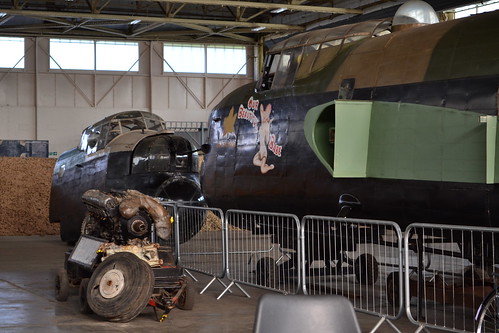
Under restoration, two Lancaster front sections housed in the Grade II listed building. They may have to find new homes.

A further point to be considered is that of the local economy. Many argue that the base provides economic benefits to the local economy. Being only 600 personnel, this is quite a weak argument, unlike say Mildenhall that has 4,000 personnel contributing £219m (2013-14 figures) to its local economy.*3

So on the face of it, Scampton is ‘ideal’ for disposal, it is underused, located in an area already busy with aircraft activity (RAF Cranwell, RAF Waddington and RAF Coningsby are all nearby) and has an infrastructure suited for a private venture. The accommodation areas are mostly empty and those units based there are easily moved elsewhere, only the Red Arrows could prove a problem due to interference with other operational flying units.

The argument against closure.

However, that said, Scampton (more so than Linton-on-Ouse) has a huge historic value. Being a pre-war airfield it was vital for Bomber Command in the fight against Nazi Germany. Initially built with grass runways, these were improved upon with hard runways in the early war years, being extended to 10,000 feet later on in 1956, to be able to take the mighty Vulcan. This expansion led to extensive renovations including the re-sighting of the main Roman road (Ermine Street) that passes alongside the airfield. It is this extension that led to Scampton’s famous station badge of the bow and arrow. In 2016 Scampton celebrated its centenary and this year (2018) marks the 100th anniversary of the RAF.

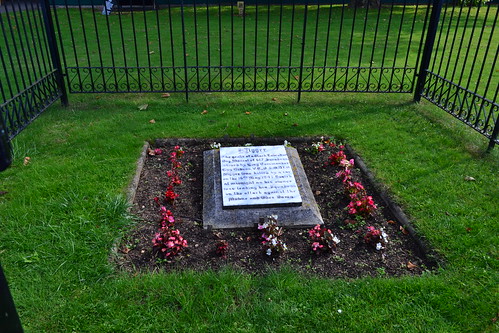
The biggest factor in favour of keeping Scampton open are its historical, political and architectural aspects, the most famous being the presence of 617 (Dambusters) Sqn during the 1940s. A specialist squadron, formed under the leadership of Guy Gibson VC, DSO & Bar, DFC & Bar,  who led the 133 airmen in nineteen Lancasters in the famous attack against the dams of the Rhur valley on May 16th, 1943. In memory of this historic event, a museum was opened up showcasing a number of artefacts from the Dambusters including Guy Gibson’s office. Gibson’s dog ‘Nigger‘ is also buried in the grounds of Scampton, outside of what was Gibson’s office and many of the offices used by the squadron are also open for pre-arranged visits.

Scampton September 2015 (17)

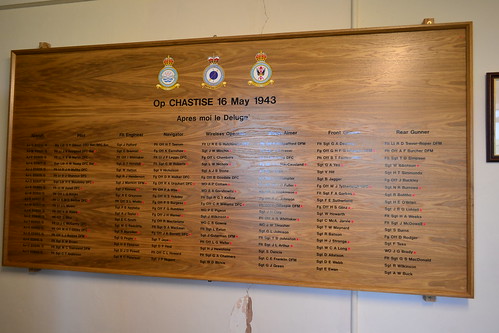
The names of those who took part in Operation ‘Chastise’

There are of course a number of other historical aspects to this site. Airmen from Scampton were awarded a greater number of honours that any other bomber airfield, including two Victoria Crosses and a George Cross in 1940 alone. The first 2,000 lb bomb was delivered by aircraft based at Scampton, and numerous raids were undertaken from here including its participation on the first 1,000 bomber raid.

Post war and Scampton played a major part in the Cold War, an airfield housing the Vulcan, an aircraft capable of carrying and delivering the Blue Steel stand-off nuclear missile, one of only two airfields that could complete such a task. In order to complete this role, further T2 hangars were added, the dispersals were modified and additional ancillary buildings erected for fuelling and avionics.

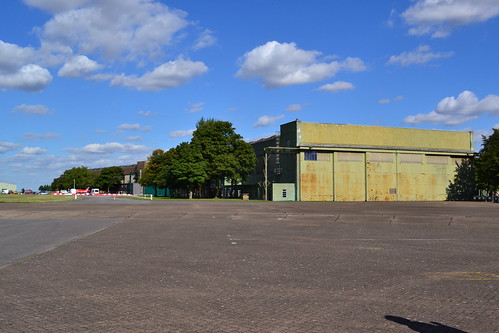
The four ‘C’ type hangars now Grade II listed (1st December 2005 – List entry Number: 1391594) are the only listed buildings on site, the Blue Steel maintenance shed being demolished in March 2004, before listing was made. In fact over recent years, many unused buildings have been gradually demolished: the pre-war parachute stores, the main station workshop outbuildings, the Vulcan simulator, parts of the medical centre and the Warrant Officers’ Quarters are all included.

The main reason for the listing of these hangars is their ‘Legacy’ record, and includes the attached stores, workshops and offices. These ‘C’ type hangars were built in the period 1936-1937 by J. H. Binge of the Air Ministry’s Directorate of Works and Buildings, to drawing number 5043/36, and signify the airfield as a bomber airfield. The sacrifice by Bomber Command was immense, some 55,000 aircrew were killed in operations and many came from airfields in and around Lincolnshire. Thus these hangars, as listed buildings, stand as unofficial memorials to those who never came back and in particular to those of 617 Sqn who gave the ultimate sacrifice. As listed buildings, they cannot easily be demolished and therefore must be retained in any future development whatever that may be. Even with these modifications having taken place, the general layout of the airfield, the road networks and most buildings are still the pre-war expansion period designs, little has changed here since those days of the late 1930s when Britain was expanding it national network of airfields.

A review of Britain’s airfields by English Heritage, classified Scampton (and Linton-on-Ouse) “as one of most complete surviving of our Airfields with Runways and Perimeter tracks” comparable with RAF West Raynham, RAF Finningley, and RAF Waddington. It is a prime example of an expansion period model, being built under Scheme B of the period and only one of four to be so. The architectural designs of the buildings significant in themselves, being a mix of neo-Georgian and concrete within its non-dispersed site. The shape and design of Scampton (and Linton-on-Ouse) are unique to this period in time, square with straight roads and grassed / tree areas to hide the accommodation and technical areas.

A further point is that there have been numerous archaeological investigations and finds on and around the airfield itself. These include: Prehistoric remains, Roman remains (the Roman road traverses part of the airfield), Anglo-Saxon burial sites, Medieval sites, post-medieval and modern warfare sites (WWI & II) that remain buried. Many of these have yet to be fully investigated and mapped, but it is thought that there are strong links to all of these periods in time.

"Nigger's" grave

The grave of Guy Gibson’s Labrador “Nigger“.

So what are the possible options?

These are certainly strong advocates for keeping the station alive, however, the question then arises does this warrant the huge expense of maintaining an operational airfield without service personnel being present? Does it warrant the use of an operational airfield just for the Red Arrows? Even if the RAF were to stay here, which unit(s) could be brought in and at what cost to other airfields? Many would argue not, and if the RAF / MOD are to meet their commitment to both a leaner more efficient Air Force and the SDSR, then on paper surely Scampton must close.

However, there are a number of options open when Scampton is closed. The worse scenario is that the entire site is sold to housing / industrial development. In such cases the historical aspect of Scampton could be lost, the hangars turned into industrial units and the airfield removed completely. This, if it were to happen, would no doubt cause a huge backlash from many in the aviation field including the RAF itself, and is unlikely (in my opinion) to happen.

Since the announcement of the 2010 SDSR the future of Scampton has been under considerable debate, with numerous studies being completed on behalf of the RAF and Lincolnshire County Council. On December 15th, 2011*4, Parliament were notified of the suggestion that Scampton could be closed by 2014 following the merger of No 1 Air Control Centre and the Control and Reporting Centre at RAF Kirton-in-Lindsey , which also closed as a result. Both these units would then move to RAF Coningsby, a move that was postponed following further investigations.

Scampton September 2015 (2)

Two of the four Grade II listed ‘C’ type hangars. Note the BAE Hawk ‘Red Arrow’.

In October 2013, Lincolnshire County Council*5,6,7 carried out its own feasibility study following a request to investigate possible options for Scampton’s use in the future. The study looked at a range of options including combining civil and military aviation, a combined heritage and RAF base, and an expansion of the site to form a leisure complex. The report concluded that:

  1. The potential for “increased airspace use on a joint military / civilian basis was not feasible given the requirements of RAFAT. This effectively ruled out the option of developing the base as a commercial or leisure aerodrome alongside RAF use“.
  2. Many buildings were not being used and were therefore able to be demolished without any serious issues. Only the hangars were listed and would be more difficult to remove. Whilst there is currently a museum on site, this could be exploited establishing an “aviation focused attraction of national and international importance“.  The cost of such a venture would be in the region of £80m, and it was thought that this would deliver an operating surplus based on “approximately 200,000 visitors per year“.  These figures would make Scampton comparable with the National Space Centre at Leicester, and with a greater visitor rate than that of Lincoln Castle.
  3. It was also suggested the unused space could be turned into leisure activities “themed hotels” for example, and that any such activity would compliment the RAF’s expansion at Scampton should it go ahead. The entire process of this consultation was met with interest by the base commander, and at that time it was thought that Scampton would expand in terms of operational staff.
  4. In conclusion of the study, it was suggested that “The aviation heritage attraction would tell key stories relevant to Lincolnshire and its involvement in defence and aviation. It is likely to attract significant new visitors to the county, generating sufficient revenue to support long-term operational sustainability of the attraction, plus spend in the local economy.” It also suggested that “a major new aviation heritage attraction at RAF Scampton could sit alongside the current scale of military use and would be sufficiently flexible to work with a greater or lesser RAF presence.”

Whilst much of these points include an RAF presence of some sort, it would be flexible in nature until such time as it became self-sustaining. A further option is to develop Scampton retaining its historical features and infrastructure. Much of the married quarters area has already been sold off and is currently in private ownership. These utilise the actual married quarters and has proven quite successful. Further sections of this area are also being sold and developed and so the atmosphere of the site has changed little since its wartime days.

Recently we have seen similar ventures at both RAF Coltishall and RAF West Raynham, where the airfield buildings have been retained (including the hangars, watch office and many associated buildings including the aircraft pens) and the site turned into a working heritage site with small industrial units utilising the workshops and hangars, and private housing using the refurbished personnel homes.

Scampton September 2015 (4)

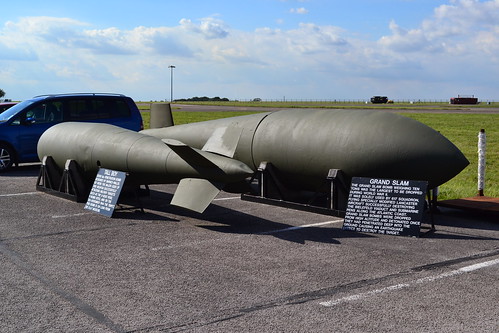
The ‘Grand Slam’ and ‘Tallboy’ bombs at Scampton.

The main argument against closing Scampton is one of cost, defence budgets are being cut and savings have to be made in the estates area. Scampton as it is, is not a viable airfield. However, its historical value is much higher, and any future decision and development needs to take this into account. If we are to retain our aviation heritage then serious consideration needs to be given to Scampton as a future development opportunity, themed hotels, museums of national importance or even a living history museum are all possible. What needs to be considered very carefully, is how that change is brought about. Lack of suitable knowledge or understanding of even small aspects of the site could degrade the overall venture, with important features degrading beyond safe use and poor managerial provision wasting an ideal opportunity in raising public awareness of the site’s true historical value.

Developments at both RAF Coltishall and RAF West Raynham have shown what good planning can do, creating something useful from a former airfield, whilst allowing for the preservation of its unique historic infrastructure.

This is clearly going to be a long and heated discussion, whether Scampton closes or not is only part of the debate, the crux of the matter being the historical value that it holds and what happens to the legacy it carries for all future generations.

Sources and Further Reading.

*1 Fact Sheet 8: Future Force 2020 – Royal Air Force.  Published 19 October 2010, accessed 25/7/18.

*2 Museum of RAF Firefighting website, accessed 25/7/18.

*3 Figures from ‘Forces Network News’ website, accessed 25/7/18

*4 Memo to Parliament 15th November 2011

*5 Scampton – Appendix A – Scampton Aviation Heritage Consultancy Brief Final Version.pdf  (RAF Scampton – Feasibility Study for an Aviation Heritage Attraction and
related Site Development Options – Brief – March 2013 ) accessed 25/7/18

*6 RAF Scampton Feasibility Study, 29 October 2013 to the Economic Scrutiny Committee on behalf of Executive Director for Communities Lincolnshire County Council. accessed 25/7/18

*7 Lincolnshire County Council Agenda item – RAF Scampton Feasibility Study Meeting of Economic Scrutiny Committee, Tuesday, 29th October, 2013 9.30 am (Item 34.)

The Development of Britain’s Airfields – AviationTrails

‘A Better Defence Estate’, November 2016, accessed 25/7/18.

News story “Defence Minister outlines progress on building a Better Defence Estate”  Government news bulletin published 24th July 2018, by Ministry of Defence and The Rt Hon Tobias Ellwood MP

A Better Defence Estate, 24 July 2018, Volume 645, House of Commons, The Rt Hon Tobias Ellwood MP

Feasibility Study fr RAF Scampton, Purcell 2018 website.

Artech Designs Ltd. Design and Access Statement, April 2015

Historic England Website accessed 27/7/18