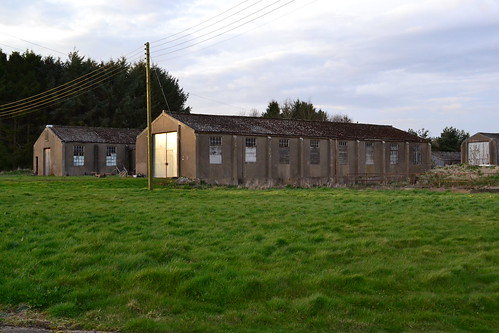
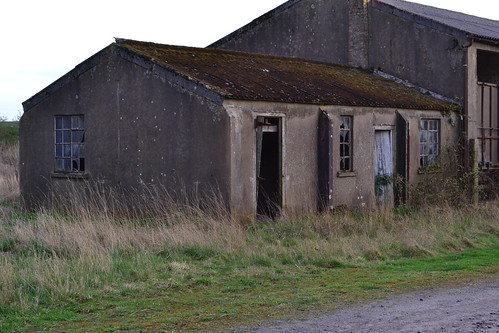
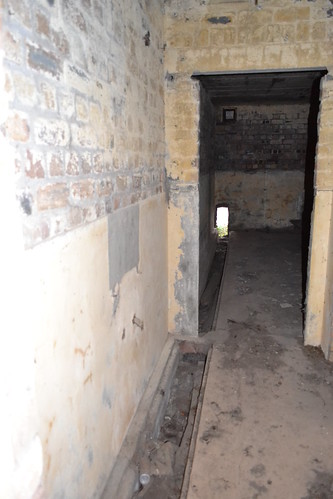
RAF Winfield and the Polish Connection (Part 1)

The second airfield on Trail 41 takes us a little further east to Charterhall’s satellite and a site that had strong links with the armed forces of Poland. Remembered here is an usual mascot, a bear known as ‘Wojtek’. We stop off a few miles away at the satellite that was RAF Winfield.

RAF Winfield.

RAF Winfield, located a few miles east of Charterhall, was pivotal to the success of the night-fighter training programme and in particular to Charterhall and 54 Operational Training Unit (O.T.U.).

Charterhall and Winfield cannot be talked about with great reference to each other, they were built together, manned together and operated as part of the same training programme. Winfield and Charterhall probably operated together more closely than any parent / satellite airfields of the Second World War.
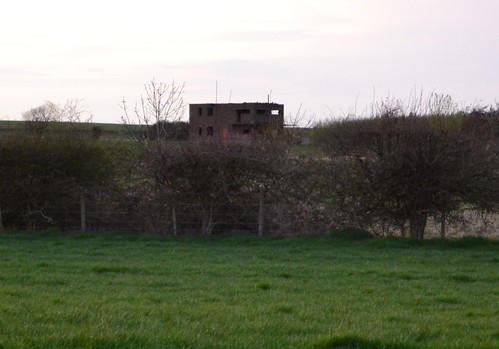
RAF Winfield

Winfield Watch Office one of the few remaining buildings now derelict and forlorn.

Winfield (like Charterhall) was initially used as a First World War landing ground for 77 Sqn based at Edinburgh flying a range of Royal Aircraft Factory B.E. types in the Home Defence role. Whilst many of these airfields were designated ‘landing grounds’, many were not officially recorded to the point that their precise locations remain vague even today. Winfield (or Horndean as it was known), was designed as a site where crews could land in an emergency, perhaps if their aircraft developed problems or if weather prevented landing at their home station.

77 Sqn were part of a force who were to patrol the eastern regions of Britain, an area stretching from Dover in the south to Edinburgh in the north. This area, was the furthest point north and the defence of the Scottish border region fell to 77 Sqn. The conditions at Horndean were not luxury, and the ‘runways’ were far from smooth, but in an emergency any semi-decent ground was most likely welcome. Crews often practised emergency landings at both Horndean and Eccles Toft (Charterhall), where aircraft guards would restart the aircraft before flight could take place again. These ‘guards’ (or Ack Emas as they were known) were often mechanics recruited into the Royal Flying Corps because of their mechanical background and knowledge of engines. After a brief training period of some eight weeks, they were sent to various establishments to maintain and prepare aircraft before and after flight.

Horndean as an airfield was not to last though, and before the war’s end it would close returning to its former agricultural use.

With the outbreak of the Second World War, the training of pilots and other crewmen became a priority. Night fighters were also needed and Winfield would fulfil this role.

Winfield was built over the period 1941 – 42 opening later than expected, due to bad weather, in April 1942. A rather hastily affair, it was built between two roads and would only have two runways. Oddly, the initial construction of the runway was by hand, red shale from local quarries being brought in by endless lorries and laid down by local workers. It didn’t take long though before it was realised that this method was too slow, and so heavy machinery was brought in, and the stocks of shale bulldozed into the foundations. At the threshold, rubble stone was laid to a depth of some 12 feet, much deeper than the remainder,  to take the impact of landing aircraft. A covering of tarmac was laid over this layer in depths of between four and six inches thick. The runways at Winfield, like Charterhall, were 1,600 and 1,100 yards and both 50 yards wide. Aircraft dispersal was provided by thirty-seven hardstands whilst maintenance was carried out in four blister hangars.

The first personnel to arrive were an advanced party of thirty-four airmen led by Flying Officer Beal, who arrived on April 30th 1942. Unlike Charterhall, the airfield was complete and ready for the new recruits to move straight in. Being a satellite station, accommodation numbers catered for were less than those at Charterhall, 686 airmen and 56 WAAFs, all spread over five sites: three airmen, a WAAF, and a communal site. A small sewage plant was located not far from these, all to the north-eastern side of the airfield.

Trainees were to follow an initial three-tier programme. Starting in ‘A’ squadron – the conversion unit – they would then pass to ‘B’ and then finally onto ‘C’ here at Winfield. C Squadron, would finely tune skills and train aircrew in uses of Aircraft Interception (AI), ground attack and air-to-air gunnery techniques. Later on, a fourth tier would be added, focusing purely in flying the D.H. Mosquito in the night fighter role.
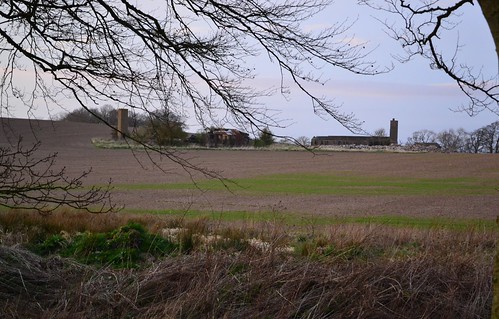
RAF Winfield

Remains of the former WAAF site.

These initial stages primarily used Beaufighters and Blenheims, aircraft that had been passed down from front line units to the training squadrons of the O.T.U.s. Many were therefore ‘war weary’ and as a result, mechanical problems were common place.

The first fatality at Winfield occurred in a rather bizarre accident on May 23rd 1942. A dispatch rider, Aircraftman 1st Class, John R. Livesey (s/n1478277), was struck by a Blenheim flown by Sgt. J. Grundy as the aircraft was taking off. The aircraft was damaged in the collision and the pilot unhurt, but Livesey was very sadly killed; he now rests at Marton (St. Paul) church in Blackpool.

In August 1942 a combined operation was planned involving Spitfire VBs from 222 Sqn (based at North Weald) and Boston IIIs from Attlebridge’s 88 Sqn. These manoeuvres saw eighteen Spitfires and twelve Bostons arrive, supported by three H.P. Harrows of 271 Sqn bringing ground crews, spares and supplies for the various aircraft. In all, around 360 new crews were accommodated at Winfield over the short two-week period.

Adept at low-level attacks, the two squadrons would arrive here between 1st and 4th August 1942, spend several days attacking ‘enemy’ transport and troop routes across southern Scotland, before departing. Considered a relative success, their stay was only for a short period vacating to RAF airfields at Drem, near Edinburgh, and Attlebridge, in Norfolk, respectively by mid August.

A further deployment of Mustang Is of 241 Sqn based at Ayr was cut short when bad weather prevented both flying and training operations from occurring. Later that month the small party left rather disappointed having hardly flown since arriving here at Winfield.

Being the more advanced tier of the training programme, serious accidents at Winfield occurred less frequently than at Charterhall. Burst tyres and mechanical problems being the main cause of many of the problems that were incurred.

RAF Winfield

Few buildings remain at Winfield, the WAAF site having the majority of the examples.

During July 1943, a Beaufighter from ‘C’ Squadron at Winfield misjudged the distance from himself to the target drogue being pulled by a Lysander, after firing and passing, his airscrew caught the drogue’s wire; luckily both aircraft were able to land safely and neither crew were injured. At the end of July a less fortunate incident occurred when, on a night flight, the port engine of Beaufighter T3370 (a former 456 Sqn RAAF aircraft coded RX-Z) caught fire. The crew bailed out, the pilot surviving but the Radio operator/navigator P/O. Frank Walmsley (s/n J/17124) of the RCAF was posted missing, presumed drowned, after the aircraft crashed into the sea. No trace was ever found of him.

October saw further deaths of crews from Winfield. On the 11th, Beaufighter VI, (ND184) crashed killing its Pilot Sgt. Angus Taylor, after it suffered engine failure; followed the next day by the crash of Beaufighter T3218 in a gunnery exercise over the North Sea. The aircraft crashed into the water after incurring a stall, both crewmen; F/O. John W. Roussel and F/O. Francis L. Kirkwood both of the RCAF, were missing presumed drowned. Both are commemorated on the Runnymede memorial.

During 1944 the tide began to turn and night fighter crews were on the offensive. The invasion of Normandy brought new hope and a new aircraft – the Mosquito. But as 1944 ended it would be the worst for fatalities in 54 OTU.

January brought many heavy bombers to the grounds of Winfield, returning from missions over Europe, they were either damaged or unable to land at their own respective bases due to poor weather. On February 17th 1945, fourteen Halifax IIIs from 420 Squadron RCAF landed at Winfield along with a further 408 Squadron aircraft. Whilst not able to comfortably accommodate such numbers and aircraft, it would have no doubt been a happy, and very much appreciated landing.

As the war drew to a close so did the number of flying hours. By May 31st the war was over and Winfield was no longer required, all the various ranks were pulled back to Charterhall leaving only a small maintenance party behind. For the next few years Winfield would have no operational units stay here, either temporary or permanently.

In the second part of this visit, we see how Winfield changed after the war, an odd visitor arrives, and Winfield’s decline begins. 


Sqn. Ldr. Ian Willoughby Bazalgette (RAFVR) VC

RAF Downham Market was one of a small number of airfields that were home to the RAF’s Pathfinder Squadrons. Elite airmen who would lead formations of heavy bombers into some of the most heavily defended areas of the Reich, often against insurmountable odds and always at great risk to themselves. The Pathfinders produced some remarkable flyers and many, many heroes. Of all the crews who flew with 8 Group PFF, only three were rewarded for their valour and gallantry with the highest possible accolade, the Victoria Cross. One of those went Posthumously to Sqn. Ldr. I. W. Bazalgette, whose long and distinguished career led him to achieving 58 missions before his death. Based at RAF Downham Market, Bazalgette, would become legendary, flying his Lancaster bomber in pursuit of victory against a tyranny beyond all evil.

Ian Willoughby Bazalgette.jpg

Sqn Leader Ian Bazalgette (RAFVR) died August 4th 1944, a few days before his 26th Birthday.*1

Squadron Leader Ian Willoughby “Baz” Bazalgette was born on October 19th 1918 in Calgary, Canada and was the youngest of three children. His parents decided to move to England in 1924 when he was six, settling in New Malden, Surrey on the outskirts of London.

During his school life he developed a passion for music, and in particular Classical Music, which he immersed himself in spending hours listening to and writing about.

As a teenager, he would have his first real battle, that of tuberculosis, which meant he would have to undergo four long months of hospital treatment. Bazalgette’s strength and determination would see him pull though this, a strength and determination that would go on to show itself on a number of occasions later on during his RAF career. 

Prior to the outbreak of war, Bazalgette decided to enlist, applying to, and being accepted by, the Royal Artillery; achieving a commission as Second Lieutenant within a year. This new role took him to the outskirts of Edinburgh operating a radar searchlight, protecting both the city, and the Forth Estuary from Luftwaffe bombers. Dissatisfied with the routine of searchlight activities, he decided to give up this role, and whilst on a trip into nearby Edinburgh in March 1941, he applied to the Royal Air Force Volunteer Reserves. His application was accepted and in the following July, he received his first posting to a training unit – 22 Elementary Flying Training School at Cambridge.

Throughout his training Bazalgette showed great tenacity and promise, quickly passing  a number of stringent and difficult flying tests. Flying solo for the first time during August, gave him the opportunity he had been longing for. His flying skills impressed his seniors so much that on the 28th, he passed the C.O.s test taking just 30 minutes to complete the flight. Upon passing, he was graded as an ‘above average’ pilot by his examiners.

Bazalgette was then transferred to Cranwell where he trained on Airspeed Oxfords. At Cranwell he achieved his wings, and after a short break, he was sent to Scampton and 18 Beam Approach School. Bazalgette eventually left Scampton, heading towards his first operational unit, 25 Operational Training Unit, where he would form his first crew.

Informal crewing up was very much encouraged by the RAF, but those that didn’t manage the task were allocated crew members by the relevant staff at the various bases; Bazalgette had no problems in finding his own.

Whilst at the OTU, Bazalgette would have his first experience of heavy bombers flying the Vickers Wellington; a remarkable aircraft that used Barnes Wallis’ geodesic construction in Rex Pierson’s design.  Bazalgette and his crew competed a range of training flights whilst at 25 OTU, including air gunnery and bombing practice, all of which they passed. On September 18th 1942, after accumulating some 223 hours as a pilot, Bazalgette received his first posting to a fully operational Squadron, 115 Squadron at RAF Marham, Norfolk, he was off to war.

The very next day he flew “Second Dickie” assisting an experienced crew tackling the rigours of an operational sortie to Saarbrucken. Two days later he was back out, but this time laying mines on a ‘Gardening’ mission shortly before the squadron moved to nearby RAF Mildenhall in Suffolk. It was here that Bazalgette would fly his first operational mission as a pilot leading his own crew.

After moving to East Wretham, 115 squadron then began the task of replacing their Wellingtons with Stirlings, and Bazalgette was sent to 1567 Operational Conversion Unit (OCU) to convert to the big heavy four-engined aircraft. Between him completing the course and returning to East Wretham though the Stirling had been superseded, proving to be a poor performer in conflict zones. Bazalgette would now get his chance to fly the legendary Lancaster.

On the 3rd April 1943, Bazalgette was awarded the DFC, and the same strength and determination that had got him though tuberculosis would get him through his tour of 30 missions. On completion, as was customary at this point, he and his crew were separated and scattered across a range of new squadrons within the Air Force.

Bazalgette was sent back to Scotland and RAF Lossiemouth where he reluctantly trained new bomber pilots, a position he disliked immensely. He pleaded for postings to an operational unit, a plea that was eventually granted in April 1944, and a posting to RAF Warboys and the Pathfinder Conversion Unit.

From here he transferred with a new crew to 635 Squadron at RAF Downham Market, in Norfolk, a few miles west of Marham the very station he had spent his early days at with 115 Sqn.

As a model crew, he was looked up to by others at Downham Market. He would go on to fly 58 missions in total, two off his score of two tours of duty.

However, his 58th mission would be his last. On August 4th 1944, Lancaster ‘M’ for Mother would not be listed for duty, but an absent crew left an opening that Bazalgette and his crew jumped at. It was a decision that would change their lives forever.

On that day, Bazalgette would fly Lancaster Mk III, F2-‘T’ for Tommy, not their usual aircraft but it was ready, fuelled and bombed up. The aircraft was known for a history of mechanical problems, its usual pilot tending to work the engines much harder than necessary, but it was a choice of stay on the ground or fly the mission: for Bazalgette and the crew of ‘M’ for Mother it was an easy choice.

The mission for the day was as Master Bomber of the Pathfinder squadron to identify and mark a V1 storage site at Trossy St. Maximin, a heavily defended area to the north of Paris. Take off was set for 11:00, over the next fifteen minutes at five-minute intervals, 14 Lancasters of 635 Sqn would leave Downham Market heading for France. The weather was less than 3/10 cloud over the target, excellent for the determined and accurate anti-aircraft gunners below. On the second run in to the target, the Master Bomber and Deputy Master bomber were both hit, one being downed (PA983 F2-A piloted by F/L. R. W. Beveridge) and the second forced to return home, leaving Bazalgette as the lead aircraft.

Flak was incredibly intense and his aircraft repeatedly hit. The starboard wing was struck causing damage to both engines, subsequently putting them both out of action. In the wing the fuel tanks caught fire, fuel poured into the rear of the fuselage and the situation becomes desperate. The bomb aimer was mortally wounded, his arm barely recognisable due to his injuries, but Bazalgette managed to reach the target, drop both his markers and his bombs, whereupon the aircraft began a steep spin toward the ground below. As the situation worsened, he gave the order to bail out, all but three; Bazalgette, F/Lt. I. A. Hibbert and F/Sgt. V. V. R. Leader are left.

Bazalgette continued to fight with the controls and quite remarkably managed to keep the stricken bomber flying long enough to avoid the French village of Senantes. Unable to maintain height, the aircraft finally hit the ground, resting momentarily before exploding in a massive fireball killing all those remaining on board.

Once the ferocious fire subsided, locals were able to reach the wreck and remove the bodies of both Leeder and Hibbert. Bazalgette’s remains were not found until the air frame was removed, some days later.

For his bravery and sacrifice, Ian Bazalgette was awarded the V.C., the highest honour for military personnel. The London Gazette, of 14th August 1945, published the following:

On 4th August 1944 Squadron Leader Bazalgette was “Master bomber” of a Pathfinder Squadron detailed to mark an important target for the main bomber force. When nearing the target his Lancaster was seriously damaged and set on fire by anti-aircraft fire; the bomb aimer was badly wounded. As the deputy “Master bomber” had already been shot down, the success of the attack depended on Squadron Leader Bazalgette who despite appalling conditions in his burning aircraft pressed on gallantly, bombed, and marked the target accurately. That the attack was successful was due to his magnificent effort. The condition of the aircraft had by now become so bad that Squadron Leader Bazalgette ordered his crew to leave the aircraft by parachute. He attempted the almost hopeless task of landing the crippled and blazing aircraft to save the wounded bomb aimer, and one air-gunner, who had been overcome by fumes. With superb skill and taking great care to avoid a French village, be brought the aircraft safely down. Unfortunately it then exploded and this gallant officer and his two comrades perished. His heroic sacrifice marked the climax of a long career of operations against the enemy. He always chose the more dangerous and exacting roles. His courage and devotion to duty were beyond praise.

Ian Bazalgette’s sacrifice marked the end of a career covering an incredible 58 operational missions. His courage, determination and devotion to duty going way beyond those expected of any serving officer. With him that day on ‘T’ for Tommy were: Sgt. G. R. Turner; F/L. G. Goddard; F/L. I. A. Hibbert DFC; F/O. C. R. Godfrey DFC; F/S. V. V. R. Leeder (RAAF) and F/O. D. Cameron DFM. Of the four men who manged to get out of the aircraft: Turner, Goddard, Godfrey and Cameron, all managed to evade capture*2.

In his honour, Bazalgette has a Garden in New Malden, Surrey named after him, a school in Calgary, the ‘Ian Bazalgette Junior High School’, and at the Bomber Command Museum of Canada, an Avro Lancaster, FM159, was painted in the markings of his aircraft; the Lancaster was dedicated in 1990. At the ceremony, Bazalgette’s sister, Mrs. E. Broderick, unveiled a commemorative plaque whilst the aircraft itself was unveiled by two of Bazalgette’s former crew members, Chuck Godfrey DFC and George Turner, both of whom were with him of that fateful night.

Outside the church of St. Mary’s at Bexwell close to the accommodation sites of Downham airfield, stands a small memorial in his name. Laying beside him is the memorial of another V.C. winner Arthur Aaron, who was also based at RAF Downham Market during the Second World War.

Ian Bazalgette was one of those many young men who sacrificed their lives in the hope of saving others. He dedication to duty, determination to win and above all, his value of other’s led to a tragic and sad end, that shall forever be remembered in the hearts and minds of those who lived through those terrible years 1939-45.

RAF Downham Market

The memorial at St. Mary’s Church Bexwell.

RAF Downham Market appears in Trail 7: Northwest Norfolk.

There is a book written listing every operation of 635 Sqn whilst at RAF Downham Market, with crew details, aircraft profiles and mission aerial photographs. It is an amazing record and the result of three years work. The author Christopher Coverdale, is also on the committee aiming to construct the new memorial at RAF Downham Market.

Notes and Further Reading.

Coverdale C. ‘Pathfinders 635 Squadron – definitive history March 1944 – September 1945‘ Published by Pathfinder Publishing, 2009. ISBN: 978-0-9561145-0-1

The Bomber Command Museum of Canada website has a detailed account of the restoration of Lancaster FM159.

*1 Photo IWM – CH 15911 in the public domain.

*2 Chorley, W. R. ‘Bomber Command Losses of the Second World War‘ Vol 5, 1944, 1997

Other records of heroism and crew stories can be found on the Heroic Tales page.

Appeal for Help RAF Methwold 320 sqn.

I have been contacted by a reader (Diek Roessingh) looking for information and / or photographs of his Uncle, Albert Roessingh, of 320 (Dutch) Sqn based at RAF Methwold.

Albert and his crew: Willem Ritte, Evert van’t Eind, William Blok and Cornelius van de Does, were all killed when their aircraft, B-25 Mitchell FR144 crashed into the sea on July 30th 1943.

I have sent the Operational Record Books and various links to websites covering the aircraft and other crew members, but nothing has come to hand about Albert.

Diek is also looking for details of a second airmen, Albert’s friend, Kees Waardenburg who died on August 30th 1943 (although I believe this may be 1944).

Any information about Albert or Kees would be gratefully received and passed onto Diek.

The Borders – RAF Charterhall (Part 3)

We carry on from Part 2 of Trail 41 for the final Part of RAF Charterhall. An airfield that had become known as ‘Slaughterhall’ it was about to see a new breed of aircraft, perhaps even a turn in luck.

RAF Charterhall

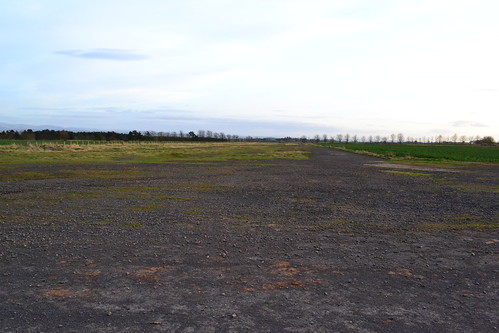
The main runway at Charterhall looking south.

The night of May 27th – 28th 1944 was a heavy night for Bomber Command, with large numbers of four engined heavies attacking targets in Germany.  On their return, ten Lancaster bombers were diverted to Charterhall, the first time the four engined bombers would use the airfield, but not the last. On the 8th June, another seven were to arrive, also diverted on their return from the continent. Then in July, a Halifax was diverted here after sustaining heavy flak damage over Helioland. The pilot, P/O W. Stewart of the RCAF and navigator P/O K. Evans (RAF) were both awarded DFCs for their action whilst badly injured, such was the determination to get all the crew and aircraft back safely.

July to October saw an increase in flying and an increase in accidents. July ‘led the way’ with heavy landings, burst tyres, ground collisions and engine failures being common place. The majority of these incidents were Beaufighter MKIIfs, some were visiting or passing aircraft who suffered problems and had to divert. Charterhall saw a mix of Lysanders, Barracuders, Beauforts, Wellingtons and Hurricanes all use Charterhall as a safe haven.

As the threat of attack was now diminishing, a reorganisation of the O.T.Us would see 9 Group disband in September that year. The responsibility of 54 O.T.U (now flying mainly Mosquitoes) and Charterhall would now pass to 12 Group.

Eventually 1944 turned to 1945 and the year that saw for 17 fatal crashes also saw 54 O.T.U. take on more aircraft and more crews.

January 1945 was incredibly harsh in terms of weather and the cold. Training new crews on new radar meant that Wellingtons were brought into Charterhall. Small teams of pupils would take turns to operate the radar to detect Hurricane ‘targets’. These new models increased the air frame numbers at Charterhall to 123 by the end of January.

RAF Charterhall

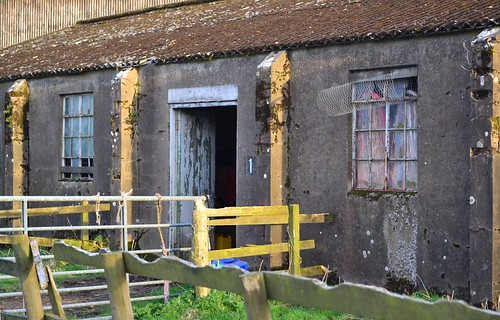
‘No. 1’ Building on the Technical site.

By now the allies were winding their way into Germany, pressure was increased by Bomber Command and so more heavies were to find Charterhall a refuge when the weather closed in. On the 15th February a large ‘Gardening’ operation led to 12 heavies landing at Charterhall along with four Mosquitoes who had been flying with them over Norway. All these aircraft were able to return to their various bases at Skipton-On-Swale, Leeming and Little Snoring the next day.

Two days later, more aircraft were to find Charterhall (and Winfield) needed. Some 266 aircrews – an incredible influx for one night – were going to need bedding – billiard tables, sofas and chairs suddenly became in very short supply.

The poor weather continued well into the year and snow caused some ‘minor’ accidents at Charterhall. The first confirmed death was not until early March and others were to follow. By May the war had come to an end and operations began to wind down. Winfield was closed and crews returned to Charterhall. Beaufighters were gradually sold, scrapped or moved elsewhere, and by August the last aircraft had left.

March would see the last fatalities at Charterhall, both in Mosquitoes on the 25th and 29th. In the former, the aircraft was in a high-speed vertical crash and the latter the pilot, Flight Lieutenant Cole (s/n125484), overshot the runway and crashed his Mosquito FBVI (HR297) a mile south of the airfield. He was 22.

Apart from a small detachment of crews from 770 Squadron Naval Air Branch carrying out trials, operations began slowing down. After VJ day, the Mosquito numbers were also wound down, only fifty-one aircraft remained by the end of August.

In September the order came through to vacate Charterhall and the packing began. By the end of the month 54 O.T.U. had all but vacated leaving Charterhall quiet once more. The last eighty aircraft consisting of: Mosquito VI,  XVII and NF30s, Martinets, an Oxford, Miles Master II, Ansons, Hurricane IICs and Wellington XVIIIs were flown out for the final time, 54 O.T.U. had played its part and their end lay ahead.

In the three years that Charterhall had been in operation, they had passed over 800 crews for night fighter operations, they had suffered over 330 accidents, 56 of which had resulted in deaths. During this time crews had flown just short of 92, 000 hours flying time day and night, with almost a third being carried out at night. Had it not been for this unit, the heavy bombers of Bomber Command may well have suffered even greater losses, the determined and deadly night fighters of the Luftwaffe may have had a much wider and easier reign over our skies and the losses we quote today would be even higher.

But the withdrawal of 54 O.T.U. was not the demise of Charterhall. For a short period it was set up as No 3 Armament Practice Station, designed to support and train fighter pilots in the art of gunnery. During its period here November 1945 – March 1947 it would see a range of aircraft types grace the runways of Charterhall.

The first units were the Spitfire IXB of 130 squadron from December 1st 1945 – January 24th 1946, followed by 165 Squadron’s Spitfire IXE between 30th December and January 24th 1946. On the day these two squadrons moved out, Charterhall entered a new era as the jet engines of Meteor F3s arrived under the command of 263 Squadron. After staying for one month they left, allowing the Mustang IVs of 303 (Polish) Squadron to utilise the airfield. Each of these squadrons followed a course which included air-to-air target practice, ground attack, bombing and dive bombing techniques.

Following the completion of the course 303 pulled out and the order was given to close No. 3 Armament Practice Station and wind Charterhall down for good. The RAF sent no further flying units here and apart from a detachment of Mosquitoes from 772 Squadron of the Fleet Air Arm, by the following summer, it had closed. The final spin of the airscrew had taken place.

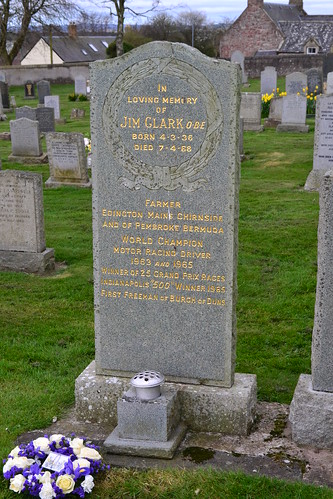
Post war, the airfield was left, the runways and buildings remained intact and the airfield was used by small light aircraft. Gradually though it fell into disrepair, used mainly for agriculture, it had a new lease of life when on Saturday May 31st, 1952, the airfield saw its first motor race using sections of the perimeter track and runways. A two-mile track became the proving ground for a number of the worlds most famous racing drivers including: Sir Stirling Moss, Jackie Stewart O.B.E., Roy Salvadori, Sir John Arthur ‘Jack’ Brabham, AO, OBE, Giuseppe “Nino” Farina and local boy Jim Clark O.B.E. Clark cut his racing teeth at Charterhall, eventually winning 25 Grand Prix races and the Indianapolis 500 in 1965. His grave lies in nearby Chirnside cemetery alongside his mother and father. Charterhall also saw the appearance of Scotland’s first organised sports car team, ‘Ecurie Ecosse’, using Jaguar cars*4. Racing occurred here until 1969, when the current owners took over the site.

The RAF then returned briefly in late 1976 undertaking trials of the Rapier ground-to-air missile system, in which a range of fast jets including Jaguars and Phantoms would participate. These lasted a month which would see the last and final RAF involvement end.

The owners reinvigorated the site providing a venue for rally sport events which started again in 1986. Eventually on March 30th, 2013, the last ever race was run and motor sport stopped for good and so another era finally came to a close.*5

RAF Charterhall

Jim Clark’s grave stone at Chirnside.

Today a section at the western end of the main runway is still available for use by light aircraft (with prior permission) and the main technical area is home to the Co-op Grain store, a facility which has a number of large stores for drying and storage of grain.

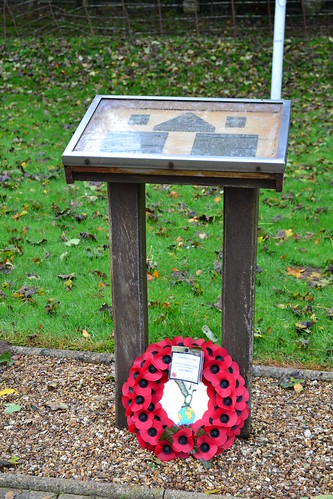
Accessing the site is from the B6460 where a memorial stands to the crews who passed through Charterhall and in particular Flight Lieutenant Hillary and Flight Sgt. Fison, who died in such tragic circumstances. A track leads all the way to the airfield site, which was the main entrance to the airfield. A good quantity of buildings still stand here on the technical site along with two of the original hangars. All of these are used for storage or stabling of animals including horses and are rather rundown. The perimeter track and runways are complete but their surfaces are breaking up and in a poor state of repair.

These buildings are a remarkable and poignant reminder of the tragic but significant years that Charterhall prepared and developed crews for the night fighter squadrons of the RAF. Hundreds passed through here, for many it was a difficult twelve weeks, for some it ended abruptly and decisively. Not known for its comforts, it was a pivotal station in the Second World War and indeed also for many years after for the those who went on to become some of the world’s most famous motor racing drivers.

Many airmen came and stayed, sixteen of them who were killed on active service whilst at Charterhall are buried in the nearby cemetery at Fogo, a short distance to the north of the airfield. Many are from around the commonwealth who came here to help and were never to return.

After leaving Charterhall, we head a little further east to Charterhall’s satellite and a site that had strong links with the forces of Poland. Remembered here is an usual mascot, a bear known as ‘Wojtek’. We stop off a few miles away at the satellite that was RAF Winfield.

Sources and further reading

*4 Obituary of Bill Dobson: ‘Ecurie Ecosse’ racing driver in ‘The Scotsman‘ newspaper 21st October 2008.

*5 A news report of the event can be read on ‘The Berwickshire News‘ Newspaper, 28th March 2013.

The Borders – RAF Charterhall (Part 2)

Following on from Part 1 of Trail 41 – The Borders, we return to Charterhall in the beginning of 1943.

During the Battle of Britain many pilots suffered from burns in aircraft fires and crashes. The famous ‘Guinea Pig club’ became synonymous with those men who underwent experimental techniques in reconstructive skin work carried out by of Archibald McIndoe at the Queen Victoria Hospital, East Grinstead in Sussex. Some of these men wrote about their experiences, and one, Flight Lieutenant Richard Hillary, sadly lost his life at Charterhall.

Hillary arrived here in November 1942 – after two long years of surgery and hospitalisation. Writing about his experiences in ‘The Last Enemy‘ he opted for night fighter training and was posted to Charterhall. Still disfigured, he had virtually no experience in night flying and none on twin-engined aircraft.

RAF Charterhall

One of two remaining hangars.

The controls of the Blenheim were awkward and difficult to use at the best of times, Hillary, with his disfigured hands, found the Blenheim I more so and often needed help with the undercarriage. Cockpit lighting was another issue experienced by crews, even in later models instrument panels were difficult to read in the dark and this led to several pilots making errors when reading the various dials and gauges. Hillary found this a further challenge, with damaged eyelids his night sight was ‘impaired’ and on January 8th 1943, his aircraft, Blenheim V BA194, struck the ground killing both him and his Radio Operator Flight Sgt. K.W. Fison. The cause of the crash is unclear, whether Hillary’s condition added to the accident is not known, and it is generally thought to be as a result of icing due to the thick, cold Scottish fog. Whatever the cause, it ended the life of two very brave young men, one of whom had fought long and hard to survive in some of the harshest of times.*2

In April 1943 Beauforts began arriving to replace the ageing and very much outdated Blenheim Is. It was also in this month that responsibility of the O.T.Us passed over to 9 Group, and there were now fourteen operational units countrywide. Monthly ‘processing’ of new crews would be increased to an intake of 40 all undertaking a 12 week course before finally being posted to operational squadrons.

The summer of 1943 saw a rapid increase in accidents. Some of these occurred on the ground as well as whilst flying. On June 14th a tragic accident occurred when a Beaufighter piloted by Sgt. Wilkie, swung on take off colliding with another aircraft being refueled. The Bowser exploded in the accident destroying both aircraft and killing two ground staff: Leading Aircraftman (LAC) Francis P. Matthews and Leading Aircraftman George Lotherington.*3

A further incident, also caused by a Beaufighter swinging on take off, caused the first July fatality, when the aircraft hit both a blister hangar and a taxiing Beaufort. The two collisions wrote off the Beaufighter and severely damaged the Beaufort. The pilot of the Beaufighter,  Flight Sgt. W. Andrew (s/n 415280) aged just 21, was killed in the incident.

July was a milestone for 54 O.T.U in that it was the first time that 3,000 flying hours had been exceeded of which 894 had been carried out at night at a cost of 20 accidents – such was the demand for trained operational crews.

During September, new MK VI Beaufighters began to arrive. These were passed directly to Winfield and ‘C’ squadron after delivery and inspection at Charterhall. Even though they were ‘factory new’, they did not prevent further accidents nor deaths occurring. By the end of 1943, 54 O.T.U had amassed 28,940 hours flying time of which 7,012 were at night. A huge total that had enabled the RAF to pass the equivalent of 12 operational squadron crews but it had also taken a serious loss of life.

In January 1944 the unit strength was up to ninety-six aircraft, flying continued where the inclement weather allowed, and the year would start off with no serious accidents or deaths – a welcome break; but 1944 would eventually prove to be Charterhall’s worst year.

May brought a new focus for the trainees when it was decided to make  54 O.T.U operational in support of the impending invasion. Operating in the night fighter role, they were called out on to intercept German aircraft roaming over the north-east of England and southern Scotland. Unfortunately, whilst intruders were detected, no contacts were made during these operations, primarily due to the intruders flying too low for the GCI to pick them up; but it did give some purpose to the heavy losses that were being incurred.

At this time a new aircraft began appearing in ‘C’ Squadron, a model that gave new hope and determination to the crews – the incredible, D.H. Mosquito. By the war’s end, 54 O.T.U. would have used eight different variants of the Mosquito.

The initial batch of two were located at Winfield, rather disappointing perhaps for those at Charterhall, but they were not to be  devoid of their own special breed of aircraft.

The final part of our visit to RAF Charterhall will follow soon, the end of the war is in sight and so starts a new era for RAF Charterhall…

Sources and further reading

*News report on Hillary in ‘The Scotsman‘ Newspaper, 11th November 2001

*3 Commonwealth War Graves Commission website accessed 29/4/17

The Borders – RAF Charterhall (Part 1)

After leaving the Wolds of Yorkshire, Trail 41 takes us north across the border into Scotland. A land as diverse in its history as it is its beauty.  With fabulous views of the Cheviots to the south and the North Sea coast to the east, it is an area renowned for beautiful scenery and delightful walks. With Holy Island and Lindisfarne Castle standing proud, it also an area with a rich and diverse aviation history,

In this trail we stop off at two airfields where we find some remarkable relics and some terrible stories.

Our first stop is at a site that is little known about even though it played a major part in the night-fighter air war, and was also the proving ground for some of the world’s top motor racing drivers as well. Yet beneath all this glamour and bravado it holds a collection of terrible stories. We stop off at the former RAF Charterhall.

RAF Charterhall.

Located some 15 miles south-west of the coastal town of Berwick, Charterhall airfield had its aviation origins in the First World War. Its original name was RFC Eccles Tofts (although the two were not quite the same physical site), a landing ground for 77 Squadron who were based further north at Edinburgh, and flew the Royal Aircraft Factory BE.2c/d/e, BE.12, RE8, de Havilland DH6 and Avro’s 504k.  Whilst not official detached here, the airfield was available for these aircraft to land upon and be recovered should the need arise. It wasn’t kept open for long and soon disappeared returning to its former agricultural use.

Charterhall is one of those airfields that has a grand sounding name, suggesting regency and nobility, its reality though, was somewhat different. It gained the rather unsavoury, but apt, nick-name ‘Slaughterhall’, due to the high accident rate of the trainee aircrew who passed through here.

RAF Charterhall

Technical buildings at Charterhall.

Many of the aircraft that operated from here were outdated and ‘war weary’, held together by the dedicated mechanics that took great pride in their work. Used for short-term placements of trainees, it would not house any true front line squadrons until the war’s end in 1945.

As a training airfield it would have a large number of airfield buildings, two Tarmacadam (Tarmac) runways the main running east-west of 1,600 yards and the second north-east/south-west of 1,100 yards; both were the standard 50 yards wide. There were some 38 dispersal pans, similar in shape to the ‘frying pan’ style , eight blister hangars and four main hangars of which two still survive. Chaterhall’s accommodation was initially designed for 1,392 airmen and 464 WAAFs – consisting of 126 Officers (both male and female) and 1,730 other ranks (again both male and female).

The main technical area was to the north side of the airfield with accommodation spread amongst the woods around this area. The watch office, long since demolished, was a mix of concrete and timber (thought to be initially a 518/40 design), which originally had timber floors, roof and stairs. However, an acute shortage of wood led to all these designs having only a timber balcony and control room. These modified designs (Charterhall included) were therefore built to a mix of 518/40 and 8936/40 specifications.

Another interesting feature of Charterhall would have been the instructional fuselage building. Here crews would have been trained using an aircraft fuselage (Charterhall had two, one each of Beaufighter and Blenheim) jacked up and linked to a controller’s panel. A number of simulated problems could be created for the crews to experience, anything from radio exercises through small warning lights to engine failure and even ditching. All crewmen had to have a good understanding of their aircraft, working hydraulics, electrical and fuel systems were all taught using this same method. In addition to these training fuselages, Charterhall would operate six Link Trainers, along with several other ‘state of the art’ training facilities.

RAF Charterhall

Many of the remaining buildings are in a poor state of repair.

The entire airfield would occupy around 143 hectares, it was certainly not large, especially considering the numbers of crews and mix of aircraft it would have during its short life.

Construction of Charterhall took place over 1941/42 opening on April 30th as part of 81 Group Fighter Command (and later 9 Group), receiving 54 Operational Training Unit (O.T.U) in May 1942. Formed two years earlier, they flew primarily Blenheim Is and Beaufighter IIs under the Squadron code ‘BF’ (Four different unit codes were used: BF, LX, ST and YX). A number of these aircraft were fitted with Aircraft Interception radar (AI) and some Blenheims were dual control.

To support the operations at Charterhall, a satellite airfield was built at nearby Winfield, a few miles east, both sites being used by 54 O.T.U. simultaneously. Later in the war, in an effort to divert marauding Luftwaffe bombers away from the two airfields, a dummy ‘Q’ site (No. 179) was built at Swinton also to the east of Charterhall.

The increase in O.T.U.s in these early days of the war was as a direct result of the increase in demand for new pilots in Fighter Command. In December 1940, 81 Group had six such units (54-59 O.T.U.) and by June 1941 this had increased to nine (52 – 60). By 1942, a total of twelve were in existence boosted by the addition of 12, 61 and 62 O.T.U. 54 O.T.U. would be one of two specialising in twin-engined night fighter flying. New crews, of which there were about 30 per month, were initially given about ten days to establish themselves and ‘crew up’. As time passed however, this time reduced to the point where some intakes were literally herded in a hangar and told to find a crewman or they would be allocated one! *1

Many of the crews arriving at Charterhall were brought in from around the Commonwealth and after passing their basic flying training instruction, would proceed through a further three stages of training. Some crews were also ex-fighter pilots already battled hardened, who had transferred in from front line units to night-fighters.

Progression through the course would be through initially three, and latterly four, squadrons. ‘A’ Squadron would be the initial conversion unit initiating crews on the rudiments of twin-engined aircraft as many had come from single engined fighter units. ‘B’ Squadron was the intermediate squadron, where the crews moved onto the larger twin-engined aircraft and finally ‘C’, (based at Winfield) was the advanced squadron honing skills such as aircraft interception and attack.  After completing the full training period, crews would receive postings to front line squadrons across the U.K. and beyond.

RAF Charterhall

A latrine on the technical site.

Initially on opening, Charterhall was not completely ready, especially the airfield’s lighting (Drem), and so training flights would only occur during the day. But, with the help of ground crews, this was soon rectified and by the end of the month considerable work had been done, and very soon night flying could begin.

The first daylight flights took place on May 13th 1942, followed by night flying seven days later, and – as crews were to find out very quickly – flying these aircraft would be a risky business.

During 1942 some 5000 aircrew would enter 81 Group’s training units, and they would suffer in the region of 2,000 accidents, of which just under 200 would be fatal. On May 23rd, 54 O.T.U’s first accident would occur when a ‘technical failure’ on a Blenheim Mk I, would cause the controls to jam. The aircrew were thankfully unhurt but the aircraft was severely damaged in the resultant crash. The first fatality would not be long in coming though, occurring just two days later, on May 25th, less than a month after 54 O.T.U’s arrival. On this day, Blenheim IV (Z6090) crashed killing both Pilot Officer J. A. Hill (s/n 115324) and Observer Sgt. A.E. Harrison (s/n 1384501) in an accident which is thought to have been caused by icing. P/O Hill is buried at Haddington (St. Martin’s) burial ground in East Lothain, whilst Sgt Harrison is buried in Middlesbrough (Acklam) Cemetery, Yorkshire.

During June, the first Beaufighters would begin to arrive, followed quickly by their first accident. Whilst on delivery by 2 Aircraft Delivery Flight at Colerne, the aircraft – a Beaufighter MkIIf – had an engine cut out causing it to crash about 10 kilometres north-west of Charterhall. Luckily the crew were able to walk away but the aircraft was written off.

During July bad weather hampered flying activities, but it didn’t prevent the unit from increasing its strength to seventy-seven aircraft.  Primarily Blenheims and Beaufighters, there were also a small number of Lysanders for target towing and four Airspeed Oxfords.

Accidents continued to occur at Charterhall, and it wasn’t until September 1942 that it would be fatality free – a welcome boost to the morale of the instructors at the time. However, the reprieve was short-lived, and October would see further accidents and yet more fatalities. On the 5th, two Blenheim MK Is (L6788 and L8613) collided: Pilot Sgt. J. Masters (missing – presumed drowned) and Navigator Sgt. J. Gracey were both killed. There were seven other accidents that month, a tally that involved two Blenheims and five Beaufighters, with the loss of one life. Causes included: two burst tyres, two overshoots, a loss of control and an undercarriage failure, all of which added to the lengthening list of accidents occurring at Charterhall.

The need for new crews increased the pressure on training stations to increase flying hours. Courses were cut short, spares were lacking and with only rudimentary rescue equipment, further deaths were inevitable. As a result, it wouldn’t be until March 1943 before Charterhall would see a break in these increasing fatalities.

The start of 1943 saw a new Station Commander, but the new change in command would not see the new year start on a good note…


(Part 2 of Trail 41 will continue shortly).

Sources and further reading

*1 An interview with Edward Braine, in ‘reel 4’ he describes his posting to RAF Charterhall for operational training; crewing up; transfer onto Bristol Beaufighters; position of navigator in Bristol Beaufighter; accident during training; method of observing aircraft at night and interpreting radar signals. Sound file reel 4 Recorded and presented by the Imperial War Museum.