As we depart Framlingham we head a short distance away to the south-west, to another U.S Bomber base also with a remarkable museum. As we head towards Ipswich we arrive at Debach, the former base of the 493rd BG(H) and a group named after its commander Col. Elbert Helton, “Helton’s Hellcats.”
RAF Debach (Station 152).
Debach was one of the last bases to be built during the war, hence its life span was relatively short. Construction began in 1943 opening in 1944 and was constructed by the 820th Engineer Battalion (Aviation) whose headquarters were at Great Barrington in the Cotswolds.
The 820th arrived, by boat, at Glasgow, unprepared but warned about the ‘English reserve‘ that they were likely to encounter. After travelling by train to Debach they were kept ‘on base’ sleeping in tents that were arranged around the airfield they were intending to build. Against orders, the men then decided it was time to see what England was all about and set off along its leafy lanes with thatched cottages and chocolate box views. Their first real taste of England came at the local pub ‘The Dog‘ in Grundisburgh, which sat across a wooden bridge from the local village green.
A traditional pub, it had served the locals for centuries, and to the Americans, it was stuck there. Old men with pipes sat in the corners while oak beams held the low ceilings just above the GI’s heads.
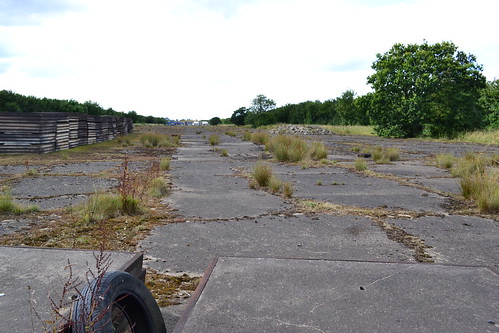
Part of the runway at Debach, cracking and breaking up, built by the 820th Engineer Battalion, it once resounded to the roar of heavy bombers.
After thinking they had entered a weird new world, the GIs tried the beers, all of them, to find one that suited the American taste buds the best. Before long, word spread, and the pub empty on their arrival, quickly filled with inquisitive English people, interested in seeing what these Americans were really like.
After an evening of much talk and drinking, the GI’s left for their tented homes, their first introduction to the British being a polite and pleasant affair. By the end of the evening the pub had run out of beer, the first time such a thing had happened in its 450 year old history.
Debach as a Class ‘A’ site, had three concrete runways, the main running slightly off north/east-south/west, the second east-west, and the third slightly off north-south. The runway patterns at Debach were slightly different to the norm in that the cross of the ‘A’ was at the base rather than part way up, but the various lengths were as per other Class ‘A’ models.
A perimeter track with 50 spectacle hardstands joined the thresholds of each runway, with the bomb store to the south-east and the accommodation, admin and technical areas all spread along the western side. The airfield site encompassed the medieval site of Thistledon Hall, a three-moated house that has historical features dating back to the late 16th and early 17th Century. A building that was demolished by the 820th Engineer Battalion to make way for the airfield.
Accommodation was split over 6 officer and enlisted crewmen sites, two WAAF sites, a sick quarters and admin block that granted access to the main airfield. The majority of the buildings were Nissen huts, with some Romneys, a blister hanger for the gunnery trainer and two T2 hangars.
The watch office was of the standard wartime design, built to drawing 12779/41 later adapted to take the much smaller windows as per the updated drawing 343/43. This gave it a slightly different appearance to non-modified towers of the time.
In the technical area, Debach had the usual range of buildings, stores and supply huts, however, the parachute store was almost unique in that it had its own drying room attached – perhaps as a result of the late building of the site. Like many of the forty-one airfields built to house the USAAF heavy bombers, Debach cost nearly £1,000,000 to construct, a small amount compared to the £645, 000,000 it cost to build all 250 US airfields in the UK*.
The mid war years saw a dramatic and rapid build up of the Eighth Air Force on British soil. This build up had seen huge numbers of both men and machinery arrive via Atlantic routes, many coming through the large ports at Greenock or Liverpool. The 40th, and last group to be assigned to the ‘Mighty Eighth’, would be the 493rd Bombardment Group (Heavy) and they would be assigned to RAF Debach.
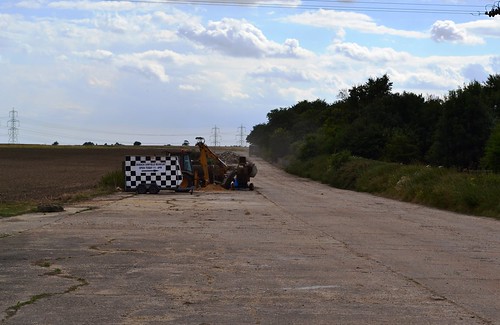
The perimeter track forms access for farm vehicles.
The 493rd would be a relatively short-lived unit, moving from their training ground at McCook Army Airfield in Nebraska, to their headquarters at Elveldon Hall, and Debach airfield. They remained here until their return to Sioux Falls post war. Their entire service would last just short of 2 years. Following their activation in November 1943, they had their ground echelons assigned in early 1944 with the air echelons joining in the following May. Ground crews were pulled in from other units to form these ground echelons, with additional support coming over from the U.S arriving at Liverpool on the USS Brazil. The 493rd were initially assigned the mighty ‘Olive-Drab’ B-24H ‘Liberator’ a lumbering giant of the skies it was loved by many and loathed by some.
Their inauguration would be a baptism of fire, celebrations overshadowed by events taking place overseas. On the morning of Tuesday 6th June 1944, high spirits took the crews of the 860th, 861st, 862nd and 863rd Bombardment squadrons high above the beaches of Normandy. Joining some 11,000 other aircraft, this 3rd Air Division unit would aim to soften up German gun defences dug in along the Normandy beach head. As the allies moved inland, the 493rd would go on to target key bridges and airfields, German strongholds around St. Lo and Caen. Other strategic targets further inland would include marshalling yards, manufacturing plants and the heavily defended oil plants at Merseberg.

Cpl. Kenneth Blair died in a tragic accident on July 8th 1944. He is buried in the Cambridge American Cemetery, Madingley.*1
Losses in battle are often more ‘acceptable’ than losses though accidents, and Debach would have its share of both. On July 8th 1944 only a month after their first mission, Cpl. Kenneth Blair (s/n: 39692721) of the 18th Weather Squadron, 493rd BG would be killed in a tragic accident that involved him walking into the spinning propeller of a running B-24. Only minutes before, he had received good news that took him to his ultimate and tragic death.
The last mission to see the 493rd using B-24s was on August 24th, when fifty-two B-24s and 383 B-17s attacked Kiel in Germany. Within two weeks crews were using the formidable B-17G ‘Flying Fortress’, an aircraft that took them back to the German Heartland. Using these aircraft they went on to support the allied push through Holland to Arnhem, and in the fight back against Von Rundstedt’s last-ditch attempt to push back the Allies in the Ardennes.
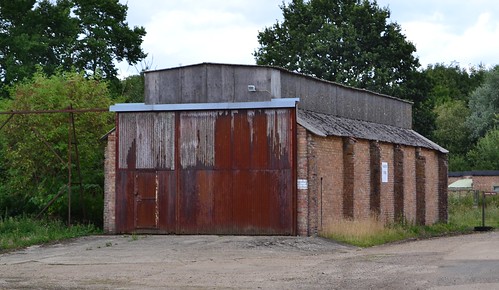
The parachute room was rare with its addition of a separate drying area.
Late 1944 was a difficult time for the crews of the Air Forces. many of the airfields in the UK were shrouded in fog, causing many operations to be cancelled at late notice. Those that did go ahead were largely ineffective until finally, the clouds lifted and the fog dispersed. The frustration for the crews must have been immense.
It was during this time that one crew had a very lucky escape in an event that was reflected on many airfields across England. On December 12th, whilst on the 493rd’s third trip to Darmstadt, B-17 #43-38219 ‘Devil’s Own‘ suffered an engine problem that resulted in an intense fire on the port wing. In an attempt to extinguish the fire, the pilot, Lt. John E. DeWitt, put the aircraft into a dive. This proved fruitless and with little choice left he decided to bring the stricken aircraft back to Debach. The fire had now become so intense that there was an almost certain chance that the wing would separate from the fuselage. The resulting crash would have most certainly led to the deaths of the crew and those on the ground below.
DeWitt flew straight in to Debach narrowly missing parked aircraft and vehicles. The crew abandoned the B-17 and within moments the entire bomb load exploded in an explosion that was so severe that the nearby hangar doors were blown completely off their rails. The aircraft was blown apart and pieces spread across a wide area.

With fires still burning, ‘Devil’s Own‘ is scattered across a wide area of Debach. (IWM)
The weather at this time was to play its own part in Debach’s history. Even though it was a relatively new airfield, the frost and cold worked its way into the runway surfaces, and with continued heavy use, it began to break up. New runways were the only answer and so as soon as the aircraft left to attack Uim on March 1st, the ground echelons and servicing units began the arduous task of moving every possible piece of machinery and all supplies over to a temporary base at Little Walden. The 493rd would fly twenty missions from this site as the runways of Debach were removed and then relaid. Remarkably the entire event went with out a single hitch.
In 1945, the 493rd went on to support the Rhine crossing softening up defences along the German borders, but by the end of April, their bombing war was over, their last mission was carried out on the 20th April 1945 in which they attacked the marshalling yards at Nauen just 38 km west of Berlin. An event that would take their bomb load tally to 11,733 tons in 4,871 sorties. For the remainder of the war the 493rd took part in operation Mania, dropping food in six missions over Holland. Further revival flights took the 493rd to Austria on four occasions in the last days of May 1945.
In the following month the ground echelons returned via the Queen Elizabeth to New York whilst the air echelons flew back in the following July and August. Following thirty days rest and recuperation the unit was disbanded. Debach was now devoid of aircraft and the empty accommodation blocks became a site for both German and Italian Prisoners of War, and displaced persons.
Post war, Debach fell into disrepair. It was eventually sold to the current landowner after the T2s were removed and the runways largely dug up for the lucrative road hardcore. Many of the technical buildings were left and, as with the watch tower, they were in a very poor state of repair.
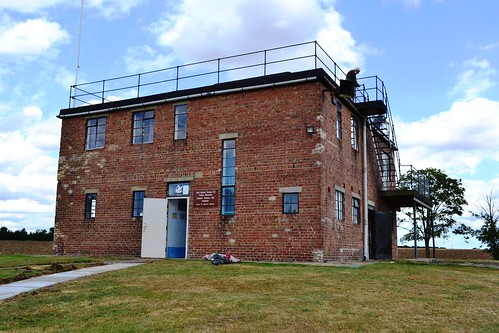
The Watch Office is now a superbly restored museum dedicated to those who served at Debach.
Debach is now a busy farm, the watch tower has been superbly refurbished as have many of the remaining buildings. It now forms the 493d BG museum which houses an incredible amount of memorabilia and wartime stories. It also has a remarkable collection of toys and other items made by prisoners of war and is thought to be the largest collection in the East Anglia region.
Debach is a working farm and the museum is only open at limited times. However, the curators and farm owners are happy to oblige visitors, my self having a personal guided tour of the museum during the summer of 2016. Much of the perimeter track is still there, sections of the runways are also there in part and allow for the landing of light aircraft during special occasions; but these are amongst the farm grounds and generally off-limits to the public. Then technical area has several buildings used for storage of farm material and a wide collection of military vehicles and memorabilia. The parachute and dingy store are still present as are former motor transport shed and other stores; as a visitor you are able to wander these at will.
If you leave through via main entrance (itself the original airfield entrance) cross the road, walk along the track, on your right you will find the former headquarters building which is now a small industrial unit, this is where you will find the memorial. I was invited in to the building to browse, again freely, at the various photos and mission charts that adorned the walls. These give a fascinating insight into the lives of those at Debach.
When you leave here, head north, (left) turn right at the main road and pass the Clopton Commercial Park (the northern most end of the main and secondary runway, which is still visible beneath the many huts built upon them now). Turn right into Debach village, the village sign is on your left. Depicting a B-17 flying over the village, it has at its base a dedication to those who served and died at the base. Behind the houses to your right are where many of the hardstands upon which the B-17s would have stood. These are now gone beneath the homes of the local residents. Continue on and then turn first right, this road is the old perimeter track and takes you to the end of the secondary runway. From here you can see along its length and width which is still full width today. The decay is obvious though and large cracks filled with small bushes are a sign of its impending demise. This road, still using the perimeter track, then takes you round toward the end of the main runway and away from the site.
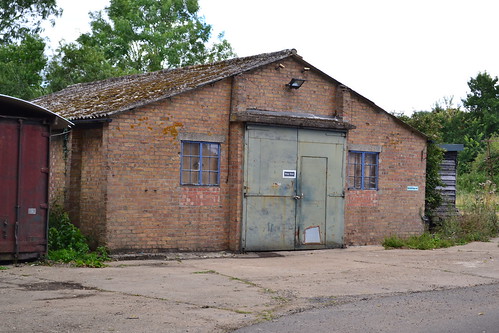
The Dingy Store is one of the many buildings in use today storing farm machinery.
Whilst only being around for a short period of time, Debach has, like so many of these wartime airfields, its own unique stories to tell. It has a history that is part of a time so dramatic that it has become a monument to human ingenuity, planning and suffering.
Almost forgotten and abandoned for good, Debach has been painstakingly and lovingly restored to represent a superb monument to those who fought and died from his airfield. The dedication of the owners is second to none, their passion for the site reflected in the warm welcome you receive when visiting. The small group of volunteers that work so tirelessly to keep it open, enables it to stand today as a reminder of so many events that occurred in the dreadful years leading up to end of the conflict in 1945.
Links and further reading.
Whilst in the village, the now closed church of All Saints also has a memorial in its graveyard.
The 493rd Museum website has all the details of the site and the museum opening hours.
*Wilson, K., “Blood and Fears – How America’s Bomber Boys and Girls in England Won Their War.”, Weiden & Nicolson. 2016
*1 Photo from IWM image UPL 20040
Arbib, Robert S, “Here we are together: The Notebook of an American Soldier in Britain.”, Longmans, Green And Co. (1946)

 Aviation Trails