Georges Nadon – Spitfire pilot, flew 277 sorties

War creates some remarkable heroes. It makes people perform beyond the limits of normal human endurance; through immense pain and suffering, these heroes are able to perform duties beyond those expected or even believed possible.

There were many airmen who carried out these duties with little or no recognition for their actions, never to speak of them or be acknowledged for them. Georges Nadon, a French-Canadian Spitfire pilot, is one of them.

Georges had a long career, he fought both in the skies of Britain and Malta, and completed two ‘tours’ that amounted to an incredible 277 operations and more than 500 hours in the air.

Georges Nadon’s flying career began with 122 Squadron based at RAF Hornchurch, where he flew Spitfires. Of the 27 original pilots of 122 Sqn, only Georges and one other pilot survived. On Christmas Eve 1943 he sailed to Malta, where he would fly – on average and against incredible odds – four sorties a day with 185 Sqn, defending the small island and vital supply routes through the Mediterranean.

At the end of this tour, he returned to England and onto his home country Canada, where he was married.

His second tour began in June 1944, with 403 Sqn (RCAF) based at RAF North Weald, in Essex. They then moved across to France where they gave cover to the advancing allied armies. He eventually left flying service in March 1945.

In 2015, as part of the Canadian commemorations of the Battle of Britain, an image of his face was painted on the tail of the Canadian CF-18 demo aircraft, an image seen by thousands; but yet he still remains relatively unknown and unrewarded.

To find out more about this remarkable man, visit Pierre Lagace’s  fabulous 403 Sqn blog, containing information, letters and photographs of Georges Nadon. A man who achieved great things defending the skies over countries far from home, and a man who deserves much greater recognition than he gets.

File:Flight Sergeant Georges Nadon, a French-Canadian pilot with No. 122 Squadron, in his Spitfire at Hornchurch, May 1942. CH6781.jpg

Georges Nadon of No. 122 Squadron, in his Spitfire at Hornchurch, May 1942. (public domain)

Other remarkable achievements can be found on “Heroic Tales of World War II

Col. Ashley Woolridge; 106 Missions in a B-26

At the height of the war, the life expectancy of a fighter pilot was measured in weeks, for a bomber crew it was perhaps even less. With tours of duty standing at around 30 missions, it was rare to find anyone who survived these tours without at least serious injury or mental health issues. Many paid the price with their life.

Whilst aircraft could be salvaged, patched up, repaired and put back into the air, it was not  so easy for crewmen to be returned to battle so quickly. It was therefore, very rare to find anyone completing one or even two missions in a front line aircraft. Of course the subject of what constitutes a mission is in itself open for debate, ‘milk runs’ leaflet drops etc all create fractions of a mission, but this aside, for any airman to surpass 100 missions was indeed rare.

We have seen that Master Sergeant Hewitt Dunn flew 104 missions from RAF Framlingham, the highest in the European Theatre, but he was by no means the only one to surpass this incredible number.

Pilots and crews occasionally transferred across theatres, especially at the end of the war in Europe, or conveyed via the U.K. to the Middle Eastern theatre during these hostilities. One such man was Ashley E. Woolridge, initially a 2nd Lt. in the U.S.A.A.F. during the Second World War.

Woolridge was born on November 8th, 1916 in Clearfield County, Pennsylvania. He graduated from school in 1934 going on to West Point Military Academy and then achieving a BSc from Lock Haven State Teachers College also in Pennsylvania. He used his numerous qualifications to teach Maths, English and Science at  Hanover High School until 1941, when, just prior to the Japanese attack on Pearl Harbour, he enrolled in the U.S. Aviation Cadet Detachment, graduating in July of 1942. He was commissioned as a 2nd Lt. and pilot of the Air Corps.

Woolridge’s first operation was to fly the northern route to England with his group the 319th Bomb Group (Medium) operating the B-26 ‘Marauder’. The 319th initially arrived at East Anglia along with three other medium bomb groups. The 319th were sent to RAF Shipdham where they regrouped before being posted to nearby Horsham St. Faith (now Norwich airport). A period of low-level training across the Norfolk countryside, saw the unit posted to their designated theatre in north Africa. A number of accidents due to poor weather saw Woolridge’s crews suffer before experiencing any battle at all.

The 319th began transferring to Africa in the Autumn of 1942, joining the Twelfth Air Force, who would attack targets in Tunisia until early 1943. After further training, Woolridge and the 319th went on to support the Sicily and Italy campaigns: Salerno, Anzio and Monte Cassino.

At the beginning of November 1944, he was awarded command of the 320th BG, a sister group of the 319th and one who had followed them across the Atlantic and onto Africa.

By early 1945 he had achieved 106 missions, accumulating in excess of 440 combat hours. He and the groups he had served in, had gained a number of distinguished awards including Unit Citations. Personally, he gained a Silver Star, a DFC with two clusters, a Presidential Unit Citation with two clusters and two Personal Croix De Guerre Avec Palms. At the end of 1945, in November, he was discharged from the Air Force with a remarkable record of achievement behind him.

In civilian life he joined a number of church groups, married Barbara Anne Leitzinger on September 16th, 1948  and raised a family many of whom preceded him in death.

Ashley Woolridge eventually died on Monday, May 3, 2004 at the age of 87. He was buried at Hillcrest Cemetery, Clearfield,
Pennsylvania. His memorial stone depicts a B-26, the aircraft he flew 106 incredible missions in and achieved so much with.

Lt. A. Woolridge in the cockpit of a B-26 Marauder, nicknamed “Hellcat.” (IWM)

His full obituary can be seen on the ‘Findagrave website.

Other remarkable achievements can be found in “Heroic Tales“.

Remembrance Sunday 2016

Today I attended my local Church for the Remembrance Sunday service. In the cemetery are 50, very mixed nationality, Second World War graves: English, Canadian, New Zealand, Australian, Polish and German. Walking distance from where we were stood is a former RAF airfield where many of these young men died carrying out their duties in the service of their country.

The vicar spoke of remembrance, reflection and forgiveness and mentioned one startling fact; in the two world wars, a period of only 30 years apart, some 50 million people died. A staggering figure.

One of the hymns we sang was written by Richard Bewes, and was based on Psalm 46. The tune is better known as ‘The Dambusters’.

1. God is our strength and refuge,
our present help in trouble;
and we therefore will not fear,
though the earth should change!
Though mountains shake and tremble,
though swirling floods are raging,
God the Lord of hosts is with us evermore!

2.There is a flowing river,
within God’s holy city;
God is in the midst of her – she shall not be moved!
God’s help is swiftly given,
thrones vanish at his presence
God the lord of hosts is with us evermore!

3.Come, see the works of our maker,
learn of his deeds all-powerful;
wars will cease across the world where he shatters the spear!
Be still and know your creator,
uplift him in the nations-
God the lord of hosts is with us evermore!

May the sacrifices of those people never be forgotten.

London Feb 2015 003

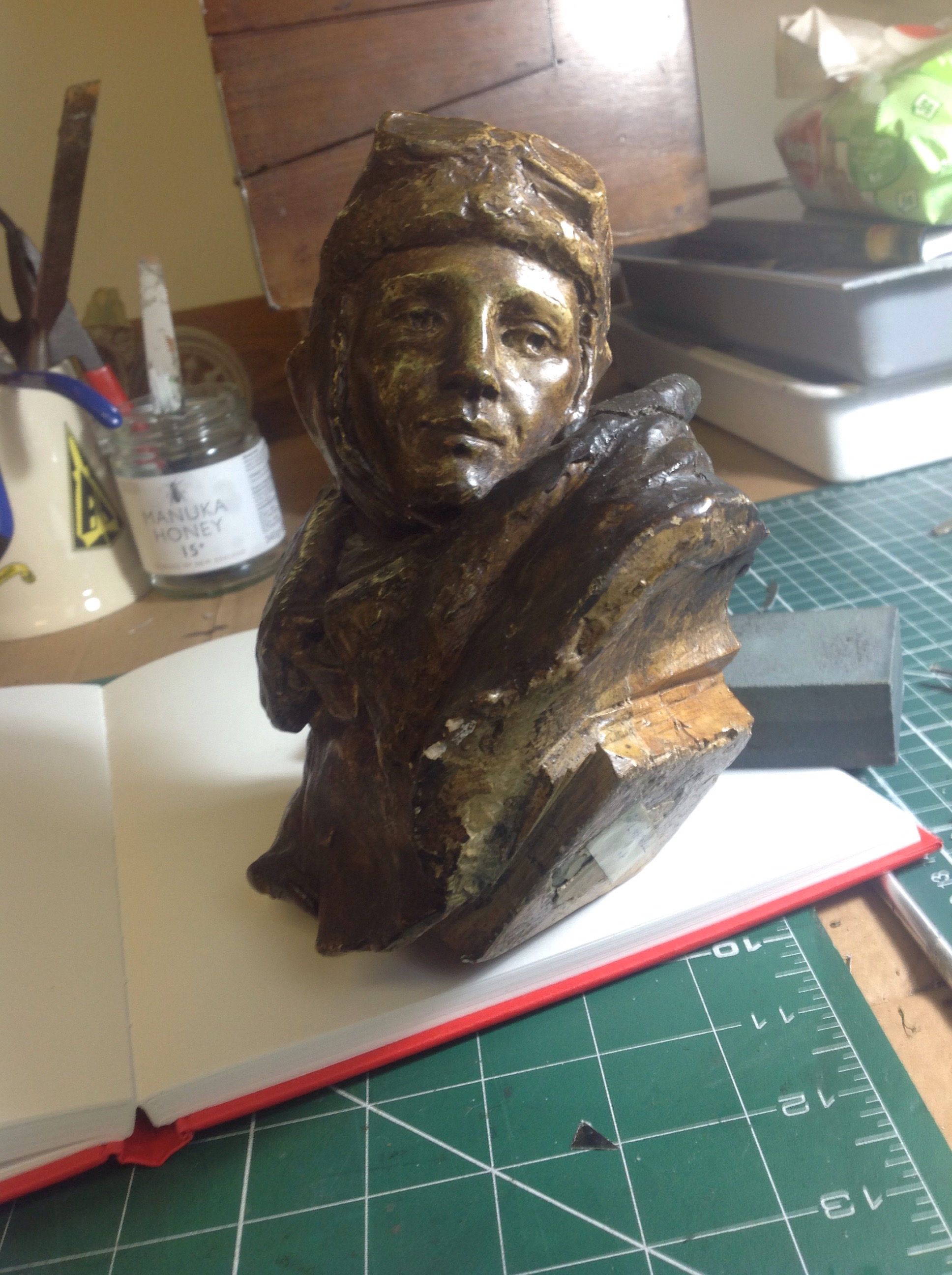
Can anyone identify this ‘unknown’ airman Sculpture? 

Not my area of expertise at all, but certainly aviation related. This stunning sculpture is of an airman, thought to be of RFC origin, looking over the side of his aircraft possibly at the enemy or at a compatriot.

His face looks saddened, perhaps reflecting the horrors of war or in quiet contemplation of what has been – I don’t know.

A reader has contacted me asking me if I can help establish the origin of the piece, the story behind him, who modelled it or even confirm who made it. It is believed to have been created by the artist C. L. Hartwell, but my own usual initial searches have proven fruitless in establishing this.

It is a superb piece, and must have a story behind it. If you are able to help identify the ‘unknown airman’, or anything of its origin or history,  then please do contact me, and I will gladly pass on your replies.


Who is the ‘unknown’ airman? Do you know?