The story of a B17 Pilot- Watching Hogan’s Heroes with my Dad

Hogan’s Heroes, the CBS sitcom about life in a German prisoner of war camp during World War II, debuted September 17th, 1965. Our family was living in Burnt Hills, New York, a small, bedroom community upstate just a few miles north of Schenectady. I was fifteen years old and just starting the 10th grade.

http://aboxofoldletters.com/2016/08/10/watching-hogans-heroes/

RAF Swanton Morley – Small but rich in history.

In this Trail, we return to Norfolk and take in three former airfields each of notable historical value. Our first is probably better known as an Army barracks than it is an RAF airfield, but, for the duration of the Second World War, it would be home to a number of different aircraft types and to a range of international crews. Amongst the many residents here would be those from Poland, the Netherlands, Australia and New Zealand. We start our journey at the former RAF Swanton Morley.

RAF Swanton Morley

Following the end of hostilities in 1918, Britain’s defences and in particular the RAF, were cut back dramatically. From around 250,000 personnel (the worlds largest air force) to just under 30,000 by the early 1920s, the reductions were both severe and widespread. Political in-fighting between the three armed forces and the Government had seen the RAF lose out significantly, and under the terms of the ‘Ten year Rule’, expansion was prevented, and so little could be done to redress the declining situation.

During the 1930s, world developments (and in particular those in Germany) raised the threat of yet another war, at which point the Government realised that Britain’s defences were now totally inadequate and in dire need of redevelopment and expansion.

Their response was a series of expansion ‘schemes’  which would not only reshape the organisation of the RAF, but would cater for the huge increase in numbers of personnel that would be required to raise an adequate fighting force .

Considered lacking in direction by many, these early schemes surprisingly paid little attention to future needs, and so no real provision was made for supporting aspects such as training, maintenance or supply.

Scheme A, approved in July 1934, would set the bench mark at 84 home-based squadrons, a figure that was still woefully inadequate compared to the might that was building up across the channel. Each scheme would build on and replace the former, taking into account layout, new developments and the materials available – but all under the monetary restrictions of the 1930’s depression.

By the time war came, Scheme ‘M’ had been implemented (November 7th 1938), which called for 163 home based squadrons involving 2,500 aircraft for Britain’s home defence. It was under this scheme that Swanton Morley would be built.*1.

Initially designed as a fighter station, construction began in 1939, and one of the criteria for this scheme was to include type ‘C’ hangars. However, being incomplete by the outbreak of war, it was caught in the transition period between temporary and permanent aircraft storage. The ‘C’ types were cancelled in favour of three ‘J’ types, only one of which was actually built – this left Swanton Morley with considerably less hangar space than was actually required. Unfinished, the airfield opened on September 17th 1940 under the ownership of No. 2 Group Bomber Command.

As war broke out, a small detachment of 107 Squadron Blenheim IVs were based here. 107 Sqn were widely spread with other detachments at: Lossiemouth, Newmarket, Hunsdon, Horsham St. Faith and Ipswich, whilst the main squadron was based at RAF Wattisham. As part of 83 Wing, 107 would be joined by a further detachment from 110 Sqn the following month, also bringing the twin-engined Blenheim IV.

It was a No. 2 group aircraft that famously made the first sortie over the German frontier on the very day war broke out, and then on the second day, Monday September 4th 1939, a flight of four 107 Sqn aircraft and one 110 Sqn all from RAF Wattisham, dropped the first salvo of bombs on German ships at Wilhelmshaven . It was from one of these aircraft (Blenheim IV ‘N6240’) that Observer, Sergeant George Booth, and AC1 L. J. Slattery would become the first British Prisoners of War, captured when their Blenheim was shot down by German defences. None of the five aircraft returned, a rather disastrous start to the war for the RAF.*2

Work continued at Swanton Morley throughout the next two to three years, and eventually accommodation blocks were raised, hard perimeter tracks laid and four T2 hangars erected. Around twenty hardstands were created although many aircraft were still dispersed on the grassed areas around the technical site. A bomb store was developed to the south, and lighting added to the three runways, but despite of all the improvements, upgrades and developments, it was felt Swanton Morley did not warrant having any hard runways and so they continued to remain as grass.

It wasn’t until the end of October 1940, that Swanton Morley would have its own squadron of aircraft, 105 Squadron arrived bringing their Blenheim IVs to compliment those of 107 Sqn and 110 Sqn. With two detachments at Lossiemouth and Luqa (Malta), 105 would take part in anti-shipping sorties and attacks on targets in the low countries. A successful unit they swapped these for the Mosquito IV in November 1941, becoming the first operational squadron to receive these highly manoeuvrable aircraft, taking them to nearby Horsham St. Faith in the following month.

ROYAL AIR FORCE BOMBER COMMAND, 1939-1941.

A Blenheim of 105 Squadron passing over a fiercely burning enemy merchant vessel (© IWM (C 1940)

One of Swanton Morley’s earliest casualties was a 105 squadron aircraft, piloted by F/O. D. Murray DFC with Sgt’s C. Gavin and T. Robson. The aircraft, Blenheim IV ‘T1890’, was brought down over Brussels with the loss of all three crew members.

It was during August of 1941, that the first of many units would arrive – No. 152 Squadron. Like so many other squadrons around the country, their stay was to be short-lived taking their Spitfire IIAs to Coltishall the following December.

Coinciding with 105’s departure, was 226 Squadron’s arrival. At the end of December 1941, 226 Sqn would bring a new twin-engined aircraft to the grounds of Swanton Morley, the Douglas Boston. The Mk III was proving to be a formidable medium bomber and night-fighter, featuring improved armour, larger fuel tanks and its two Wright Twin Cyclone engines providing 1,600hp each. 226 Sqn were to later replace the MKIIIs with the MKIIIAs in January 1943 under the lend-lease agreement and then very shortly afterwards, with the B-25 Mitchell II. 226 Sqn operated these aircraft for almost a year at Swanton Morley before moving on to Hartford Bridge and the continent in 1944, thus becoming Swanton Morley’s longest standing squadron.

It was with 226 Squadron that the United States would make its mark on the war. On June 29th 1942, with both Eisenhower and Churchill present, twelve RAF Boston IIIs were sent to bomb the Marshalling yards at Hazebrouck, one of these aircraft (AL743) was flown by an all American crew. A rather ‘unofficial’ entry into the conflict, it was made more formal on Independence day, July 4th 1942 when six U.S. crews joined 226 Squadron in a low-level attack against Luftwaffe airfields in Holland. Twelve RAF aircraft took off a few minutes after 07:00 hrs and flew low and fast over the North Sea toward Holland. After splitting up to attack their designated targets, one group encountered severe flak and was badly beaten, one aircraft crashing whilst another had an engine knocked out. Before the pilot could regain control, the aircraft, Boston AL750, scraped the ground coming remarkably close to a complete disaster. However, the pilot Major Charles Kegelman, managed to regain control and nurse the stricken aircraft back to Swanton Morley. Of the twelve Bostons sent out, two U.S. and one RAF crewed aircraft failed to return. A baptism of fire that resulted in a 30% loss of the U.S. Air Force contingency. For their bravery, three DFCs were awarded to the U.S. crews, with Major Kegelman receiving a D.S.C. from Major Gen. Dwight D. Eisenhower, American commander in the European war theatre. This made Major Kegelman the first member of the United States forces in Europe to be decorated for gallantry against the enemy.

Whilst not the first U.S. involvement nor their first casualties of the war, their actions did officially bring the United States into the European conflict.

Sergeant Bennie Cunningham, Technical-Sergeant Robert Golay, Major Charles C Kegelman and Lieutenant Randall Dorton in front of a Boston bomber. (Roger Freeman Collection IWM)

1943 would go on to prove to be an eventful year for Swanton Morley. With the Allied invasions plans taking shape, a new force was needed to support those destined to take to the Normandy beaches. The creation of the Second Tactical Air Force (TAF) in November 1943, was designed to meet that challenge and with it came changes at Swanton Morley.

Ownership now passed from Bomber Command to the Second TAF, and many units that would operate from here were part of that force. Following a relatively short stay by 88 Squadron (30th March 1943 – 19th August 1943) flying both the Boston III and IIIA, No. 305 (Weilkopolski) Squadron would arrive bringing the first Polish crews to Swanton Morley. Being the fourth and final Polish bomber squadron to be formed, they arrived in early September bringing Wellington MK Xs with them. Whilst serving in Bomber Command, the Polish had amassed some 1,117 sorties in which they had lost 136 brave young men as either killed or captured.

After arrival here, 305 Sqn changed their Wellingtons for Mitchell IIs and in line with the Second TAF objectives, began attacking targets around the Cap Griz Nez region. Being daylight operations, this was something new for the Polish crews, but one they relished and carried out well. In November after only being at Swanton Morley for two months, the Polish crews left leaving 226 Sqn with only a small detachment of 98 Squadron Mitchells for company.

At the end of 1943, three days after Christmas, No. 3 Squadron arrived bringing  a new breed of aircraft with them – the single-engined Typhoon IB, which they kept at Swanton Morley until February 14th 1944. No. 3 Sqn had been one of three founder squadrons of the Royal Flying Corp in 1912 and they remain one of the few squadrons to retain an active role today, flying the aircraft’s namesake, the modern Eurofighter Typhoon.

Whilst here at Swanton Morley, No. 3 Sqn carried out duties that the ill-fated Hawker Typhoon performed well at, low-level ground attack and anti-shipping roles. Dogged by development problems – engines fires and deadly levels of Carbon Monoxide in the cockpit – the Typhoons suffered terrible problems throughout their wartime service, subsequently virtually every model was scrapped at the end of war.

February 1944 was all change again at Swanton Morley. A detachment of 107 Squadron would return after a couple of years absence, and with their arrival came the departure of 226 Sqn after just over two years of being at Swanton. On the thirteenth of that month, they left for Hartford Bridge in Hampshire, in preparations for the Allied invasion at Normandy.

In the two months that followed, Swanton Morley began its wind down, a move signified by a number of short stay units. Each of these would however bring a wide range of nationalities, including crews from the Australian unit No. 464 (RAAF) Sqn, from 25th March 1944 to 9th April 1944. Then came 180 Sqn (12 – 26th April 1944) a short-lived unit that survived just under four years before disbandment only to be reformed as No. 69 Sqn.

Coinciding with 180 Sqn was the Auxiliary Squadron, No. 613 Sqn with Mosquito VIs. This too would disband at the end of the war also to reform as 69 Squadron. Then as April drew to a close another international unit would arrive and depart, a New Zealand unit, No. 487 Sqn (RNZAF)  also bringing Mosquito VIs – an aircraft they used in conjunction with 464 Sqn in the attack on the Amiens prison earlier on.

Finally for two weeks in May 1944 (6th – 18th), a dutch contingency arrived in the form of No. 320 Squadron. 320 Sqn was formed out of evacuated Dutch airmen along with a handful of Fokker T-VIIIW seaplanes which they used until spares were no longer available. Here at Swanton Morley they had lost their seaplanes and were now flying Mitchell IIs, wreaking their revenge by attacking enemy communication lines and airfields. After the war the crews of this unit were transferred to the Royal Netherlands Navy and 320 was disbanded as an RAF unit.

ROYAL AIR FORCE: 1939-1945: COASTAL COMMAND

Before arriving at Swanton Morley, No. 320 Sqn flew a handful of Fokker T-VIIIW float-planes, that they had brought with them when the Netherlands fell to the Germans. Here, one is being serviced at Pembroke Dock, August 1940. (© IWM (CH 1042)

Coinciding with the invasion of Normandy in June 1944, the Bomber Support Development Unit (BSDU) transferred across from RAF Foulsham. Developed under the wing of 100 Group, they used a range of aircraft to investigate and develop electronic counter measures and radar technologies for aircraft.  At Swanton Morley, this involved nine Mosquitoes, MK XIX and XXX, to operate in both operational and non-operational duties. The BSDU (and 100 Group) were responsible for a range of electronic devices including Serrate, Hookah, Perfectos and Mandrel to name but a few, and were involved in some 114 operations, claiming  five air-to-air victories.

The USAAF were to play another small and final part in the life of Swanton Morley, when on 25th July 1944, B-24H ’41-29402′ “The Mad Monk” of the 786th BS, 466th BG, took off from nearby Attlebridge. It clipped some trees causing it to crash-land at Swanton-Morley; the aircraft was so severely damaged it was condemned and salvaged for spares.

Another near disaster was averted at Swanton Morley when Mosquito NFXXX (MM797) of the BSDU crashed after take off on the night of 2nd-3rd January 1945. On take off, with a full fuel load, the port engine began leaking glycol at a furious rate. Too low to bail out, the pilot, Flt. Lt. Harry White DFC, put the aircraft down on the frozen ground. After both pilot and co-pilot were pulled from the wreckage by local farmers, the aircraft exploded creating a ferocious fireball that destroyed the air frame completely.

Eventually the war came to a close, the ‘Window’ research station was transferred to the BSDU and in the summer 100 Group was disbanded. With that Swanton Morley fell quiet and no further operational units would serve from here.

In the closing months of 1946, No. 4 Radio School moved in using Avro’s Anson, and Percival’s Proctor and Prentice aircraft. Various ground units also used the site but gradually flying all but ceased. Eventually on September 15th 1995, Battle of Britain day, the RAF Ensign was lowered and RAF Swanton Morley was officially closed. A small private micro-light club took over part of the site, but in 1996 the Army claimed the airfield forcing the club to close. It remains in the hands of the Army today as the ‘Robertson Barracks’, named after Field Marshal Sir William Robertson and no flying takes place.

Swanton Morley’s history was fairly rare, in that it never had any concrete runways and boasted to be one of the longest lasting Worlds War 2 grassed airfields. It had, at its peak, one – ‘J’ Type hangar and four – ‘T2’ hangars. Its watch office, built to drawing 5845/39, included a Met Section and is now thankfully, a Grade II listed building making it one of the best originally preserved examples of Watch Office designs.

Swanton Morley june 2016 (3)

Swanton Morley had four T type hangars. All but one have been demolished. This one remains in private ownership.

Many of the original buildings have gone and either their concrete bases left or more modern replacements put in their place. Some of the concrete pathways have been removed as have all the dispersal pans. The bomb store is now a field and all but one of the hangars were demolished – the remaining one being re-clad.  A number of pill boxes and air-defence structures also remain, but like the main airfield site it is all securely kept behind very high fences and armed guards.

The public highway circumnavigates Swanton Morley, but views are best achieved from the main entrance. As with all active military sites there is a no stopping rule, but as you pass, careful observations will reveal some of the main buildings of the accommodation area.

Swanton Morley retains some if its historical features, and they are all in the care of either the Army or the local farmer. As the MOD holds this site, many of these features are well hidden from public view, but for now at least, this along with the preservation order on the watch office, does at least mean Swanton Morley’s past is in part ‘protected’ for future generations.

From Swanton Morley we visit two more airfields in the area, Hethel, a USAAF base with its own museum and Hingham an airfield that had possibly the shortest life of any UK airfield.

Sources and further reading

*1 Royal Air Force Historical Journal No. 35

*2 Chorley, W.R., “Bomber Command Losses of the Second World War, V1, 1939-40″, Classic, 1992

Norfolk Heritage Website

Freeman, R.A., “The Mighty Eighth“, Arms & Armour, 1970

Bowman, M., “100 Group (Bomber Support)”, Pen & Sword, 2006

RAF Wittering – a history rooted deep in the First World War.

You can’t look at the remnants of RAF Collyweston (Trail 37), without taking in RAF Wittering. Renowned for its Harrier Squadrons, RAF Wittering was an airfield that fell quiet as a result of the Government cutbacks that affected all the armed forces in December 2010. Sadly it meant the loss of the RAF’s Harrier fleet, an aircraft that had been stunning the crowds at air shows both here and overseas from many years. The Harrier remains one of the few RAF/RN jets to have proven itself in a combat environment, when it took on the Argentinian Air Force in the war over the Falkland Islands in 1982. However, the Harrier squadrons were just one small part of Wittering’s long and established history.

RAF Wittering.

RAF Wittering dates back to the First World War, its roots set in 1916 when an airfield was built on the site then known as Wittering Heath. Stamford Airfield, as it was then designated, was to initially operate BE12 aircraft in the anti-Zeppelin role, acting in conjunction with their main force of 38 Squadron at Melton Mowbray. These aircraft would eventually, in turn, be replaced by BE2e, FE2b and FE2d aircraft. During this time a small detachment from 90 Sqn would also be stationed at Wittering, but their stay would be short, between August and September 1918 – they were also flying the FE2b.

AERIAL VIEWS IN THE UNITED KINGDOM 1941-1942

Wittering airfield taken early in the Second World War. The A1 road can be seen to the east of the airfield. © IWM (HU 91901)

As the war progressed, Stamford became the training ground for new recruits, forming No1. Training Depot Stamford whilst a short distance to the west a second station was established at Easton on the Hill, operating as No. 5 Training depot. These two sites operated only a stones throw apart but both totally independent of each other. Eventually with the formation of the Royal Air Force on April 1st 1918, Stamford would become RAF Wittering and Easton on the Hill – RAF Collyweston.

RAF Wittering had been born. It would go on to be one of the RAF’s most significant airfields operating in excess of 36 active flying squadrons. Some of these would be formed here, some disbanded and many pass through in transit to other sites around the country. The aircraft here would range from Royal Aircraft Factory Biplanes to Whirlwind HAR 10 Helicopters, Boulton Paul Defiants through Supermarine’s Spitfire to Hawker Hunters; Hawker Siddely Harriers, Vickers mighty Valiant and Handley Page’s ‘V’ bomber the Victor, would all operate from here during its long life.

Following cessation of the First World War, Wittering was placed under care and maintenance, looked after and cared for until 1926 when the Central Flying School moved in from their previous base at Upavon.

The post war years were turbulent times for the RAF, having not only to fight off Government cutbacks and spending caps, but the Government’s tendency to favour both the Navy and the Army in terms of a national defence force. Since the war’s end, over 23,000 officers, 21,000 cadets and 227,000 other ranks would be lost from the RAF’s service. The landing grounds that had been used to fight off Germany’s mighty Zeppelins, along with vast quantities of material and machinery, were disposed of at near give-away prices. The fact that any force  had been kept at all was down primarily to the determination and foresight of one Hugh Trenchard who would himself rise to the rank of  Marshal of the Royal Air Force in 1927.

As global tensions grew in the 1920s and British interests abroad were put at risk, a review was called for of Britain’s defence forces. The review concluded that some 52 squadrons would be needed to provide a sustainable and strong Home Defence Force that would not only be capable of holding back any force that should take desires on Britain, but could also respond adequately by taking the fight to the enemy.

So in the mid 1920s the RAF’s expansion began.  The first four Auxiliary Air Force squadrons were formed along with the first of the University Air Squadrons (UAS). A combined Air Force Cadet College and flying training school was established at Cranwell along with the Air Force Staff College at Andover, – the fledgling Royal Air Force was making its first proper steps in the right direction.

Further tensions in the 1930’s brought home the need to develop and increase the Air Force. The not so subtle build up across the channel with increasing tensions in Germany, meant that she was rapidly becoming a major threat. Now woefully under manned, the Government poured money and manpower into improving the stature of the Royal Air Force.

With design and engineering pioneering the way in long distance flight, speed and manoeuvrability, new models of aircraft were being designed. Monoplanes were the way forward and with Britain winning the Schneider Trophy for the final time, the way ahead was set for aircraft capable of incredible speeds and performance.

With war looming, Wittering was about to come into its own receiving its first operational squadrons both 23 Sqn and 213 Sqn in May 1938. By the end of the following year, Wittering would be designated Sector Station of 12 Group whose responsibilities stretched from the boundaries of London in the south, to the Welsh border in the west, Liverpool and Hull in the north and the entire eastern counties.  Wittering units would be responsible for a wedge through the middle of this sector running from the North Sea coast to Wales.

In that same year, Spitfire Is of 610 Sqn Auxiliary Air Force joined the recently arrived Blenheim IFs and Hurricane Is before they headed south to Biggin Hill in support the BEF’s evacuation from Dunkirk in May 1940.

Wittering was really too far north to be able to effectively participate in the either the Battle of Britain or the defence of London; fuel and journey times would have left her fighters at a disadvantage, so Wittering concentrated on both resting and reforming battle worn units from the south, and defending the industrial Midlands and the north.  Her units would become key in the night fighter role, protecting the eastern and North Sea routes from the Luftwaffe – a role in which her squadrons would learn and develop very quickly.

23 Squadron were key in this very role. Dispersing their Blenheims at Collyweston, they shared Wittering with Hurricanes of 32 and 229 sqn, Spitfires of 74 and 266 Sqn and Defiants detached from 264 Sqn. These fighter versions of the Blenheim benefited from the addition of a bolt-on underbelly gun-blister housing four .303 machine guns; but they lacked any technologically advanced radar or Airborne Intercept (AI) mechanisms and so relied heavily on visual identification, referred to in the ranks as ‘Eyeball Mark One’!

23 Squadron would fly a number of patrols from Wittering, intermixed with sections being detached to RAF Digby for night flying co-operation duties on a weekly rotation basis. Few of these night patrols proved to be fruitful however, and many enemy aircraft escaped simply because they could not be found in the dark skies.

To improve kill rates, carefully drawn up patrol lines were set up fanning outward from Wittering. Often, pilots would use distant searchlights as a guide to locating the enemy intruders, however, this had its dangers and some RAF crews were lost because they too found themselves illuminated in the dark night sky, only to become victim to the enemy or the over eager A-A crews below. One such incident occurred on the night of 18th June 1940 when Blenheim L1458 ‘YP-S’ crashed near RAF Sutton Bridge as a result of being shot down by a He111 from KG4 that it was attacking. In getting close to the Heinkel, the Blenheim was itself caught in the local searchlight and the Heinkel returned fire. The pilot Sergeant A.C. Close, died as a result of the crash whilst the air gunner, LAC L. R. Karasek bailed out at low-level and was taken to Sutton Bridge and treated for his injuries*1.

The autumn of 1940 saw further changes at Wittering. In August, 266 Squadron arrived using various models of Spitfire, whilst in September, 23 Squadron departed moving to RAF Ford. Then in came No. 1 Sqn, the oldest RAF squadron, with Hurricane MKIs. Battle hardened from the fall of France and a summer of fighting in the skies over Kent, they remained here until the end of the year before returning south in the defence of London once more.

It was around this time too that a detachment of Hurricanes from 151 Sqn would arrive from RAF Digby, a station Wittering worked very closely with. After a short period these were replaced by Defiant Is also participating in the night fighter role. One determined and perhaps aggressive pilot, Flt Lt Richard Payne Stevens DSO, DFC would bring an element of mythical mystery to the flight as the squadron moved through Hurricane IICs, Defiants IIs and onto Mosquito IIs before the now permanent squadron left for Colerne in April 1943.

Using nothing more than his remarkable night vision, he would become the greatest scoring night fight pilot during the Blitz, downing a total of 12 Luftwaffe bombers in his black Hurricane.

In November / December 1940, 25 squadron came in bringing with them the much improved, faster and better AI equipped Beaufighter IF. In addition, a single Beaufighter MKII was also deployed here purely for evaluation purposes. A rarer Merlin engined model, R2277, it was credited with the shooting down of  a Ju88 on the night of June 22nd 1941 when piloted by F.O. Michael Herrick and his radar operator F.O. Yeoman. It was later stuck off in June and remains the only Merlin powered model to enter the books of 25 Sqn*2.

AIRCRAFT OF THE ROYAL AIR FORCE 1939-1945: BRISTOL TYPE 156 BEAUFIGHTER.

Similar to R2277, Beaufighter R2270 was the first Merlin powered prototype MK IIF, © IWM (MH 4560)

At the end of 1940 a new commander arrived, Group Captain Basil Embry, who disliked the Defiant as a night fighter and considered Wittering too poorly designed for a night fighter station. He set about devising a plan to join adjacent Collyweston and Wittering together to develop and create a single airfield with a new much longer hard runway to replace the grass ones used until now. The expansion was completed in record time, Embry by-passing the more conventional channels of procedure.

In July 1941, the Beaufighters of 25 Sqn were replaced by the Douglas (Boston) Havoc Mk Is, an aircraft they took to Ballyhalbert (Ireland) in the following January.

The summer of 1941 would also see another new experimental model arrive. In conjunction with operations at RAF Hunsdon, the rather ill-fated Turbinlite project was put into operation here. Elements of the 1451 Flight were formed into a new squadron designated 1453 Air Target Illumination Flight, a concept that involved bolting an enormous 800,000 watt lamp to the front of the aircraft. As these modified Havocs were now much heavier, they could not carry any weapons and so relied upon an escorting Hurricane, Defiant or Spitfire to shoot down the enemy once located by the massive 950 ft wide beam of light. On October 22nd 1941, 151 squadron carried out its first official Turbinlite operation.

Fighter command decided to establish 10 dedicated Turbinlite squadrons in total, numbered 530 sqn- 539 sqn, they all became operational on either the 2nd or 8th of September 1942. On the 2nd, 532 was formed at Wittering using a combination of 1453 Flight and Hurricanes from both 486 Squadron and various Operational Training Units (OTU). The rather poor performance and low success rate however, meant that all these units were disbanded in one fell swoop on January 25th 1943*3.

It was part way though these operations (April 1942) that 151, released from their restrictive Turbinlite operations, replaced their Defiant IIs with the new ‘Wooden Wonder’ the Mosquito NFII. Only the second squadron to use them, they were to prove a formidable weapons platform and a deadly night fighter. The night skies were now a prime hunting ground and partly as a result of the Mosquito successes, the number of Luftwaffe intrusions began to reduce.

The turn of 1942/3 wold see further changes at Wittering with many short stays by 118, 288 (on Detachment), 349, 141, 91 and 438 Sqn taking Wittering through the new year. 151 remained until April moving off to Colerne and new model Mosquitoes, 141 who replaced them brought more Beaufighters in the form of VIFs. With increased engine power, more fuel and a capacity for increased bomb loads, the VIFs had modified noses to accommodate the new AI radar. Now the hunters were taking the war to Germany and intruder missions began to take place.

During this time Wittering was also home to No 1426 (Enemy Aircraft) Flight, utilising the former RAF Collyweston site which evaluated captured enemy aircraft. A remarkable unit they flew captured aircraft around the many bases of the RAF and USAAF for crews to examine.

As the war drew to a close, sorties began to get fewer and fewer, and operational flying at Wittering would all but stop. Other than the P-38s and latterly P-51s of the USAAF 55th Fighter squadron –  who had been sharing Wittering with their RAF counterparts – Wittering became operationally quiet.

Eventually the war ended and various units used Wittering for training and experimental work. Post war 1946, 23 Squadron was reformed here from the ashes of 219 Sqn, taking their Mosquito NF30 to Lubeck almost immediately. A range of squadrons using various piston-engined aircraft passed through Wittering and two reception centres were set up to receive incoming POWs from the continent. By the end of 1948 all aircraft had left , and it returned to its roots once more becoming the home of No. 1 Initial Training School, Flying Training Command.

In the early 1950s, Wittering was placed under care and maintenance whilst upgrading work was carried out to its runways. During August 1953 both Lincoln bombers and Canberras (B.2, B.6, PR7) would operate overseas from here – these included detachments at the infamous Christmas Island.

Further Canberras of both 76 and 40 Squadron would fly from Wittering and in 1955 Wittering entered the atomic age with the arrival of the Vickers Valiant. Operations using conventional bombs were seen during the Suez crisis in 1956, when Valiants from No 138 Sqn flew 24 missions against targets in Egypt. Two other squadrons would fly the enormous but less favoured ‘V’ bomber: 49 and 7 squadrons, and it would be 49 Squadron who would take Britain forward as a nuclear nation when in 1956 a Valiant B.1 dropped Atomic bombs on both the Maralinga Range (Central Australia) and in 1957 a total of 6 Hydrogen bombs over Malden Island. During this time the aircraft were operating as detachments from Wittering, again on Christmas Island in the Pacific.

RAF VALIANTS FOR CHRISTMAS ISLAND TESTS

Vickers Valiant bomber crews of No. 49 Squadron RAF about to leave RAF Wittering for Christmas Island in the Pacific to take part in Britain’s nuclear tests, March 1957. © IWM (C(AM) 2466)

With no decrease in the perceived threat from the Warsaw Pact, the  ‘V’ bomber force would continue from Wittering for a few more years . The Valiant being replaced by the Victor B.2 and later B.2Rs of 139 and 100 Squadron, who had themselves been disbanded in September 1959 to reform at Wittering in May 1962.

In December and September 1968 respectively both these squadrons were disbanded and Wittering would then enter the dawn of vertical take off and landing. A short stay by Westland Whirlwinds HAR.10s of 230 Squadron led to the arrival of probably one of the most famous aircraft in aviation – the Harrier.

In August / July 1969 No. 1 Squadron returned to Wittering, its first time since the 1940s. Wittering became famous as ‘The Home of the Harrier’ and its fame would spread far and wide. With combat success most famously in the Falklands campaign and later the Balkans, Serbia and Kosovo, it would go on to serve Wittering well flying the GR.1, GR.3, GR.5 and GR.7  before moving away to Cottesmore and disbandment in December 2010.

The only other units to fly from here (less any training squadrons) were 4 Squadron flying both the Hunter FGA.9 and Harrier GR.1, 45 Squadron and 58 Squadron both flying the Hunter FGA.9 until they were disbanded on the same day 26th July 1976.

With that flying ceased at Wittering, but it remained an active military base operating a number of logistics units including a wide range of logistical support organisations. It is also home to the RAF’s bomb disposal squadron 5131 (BD) Sqn.

Further reorganisation of flying training units has been Wittering’s saviour. Today 100 years after its inception, and after a 6 year gap, flying has finally returned to Wittering, with the re-introduction of flying training units from No.3 and 6 Flying Training Schools, relocating here from both RAF Wyton and RAF Cranwell.

It would seem that Wittering has gone full circle again, not once, but twice, with its history rooted deep in the First World War, it has always been one of the RAF’s most important airfields. It has trained aircrews, defending these shores against the night terrors of two World Wars, and its crews have defended us against invading forces both here and in British Territories far off. Wittering forces have provided a strong and powerful peace-keeping force across the globe and even today it plays a major part in support, training and defence against those who wish to cause harm to both British sovereignty and democracy.

Note: As a fully active military site, much of Wittering is understandably hidden behind high fences and trees. When passing along the main A1, the main gate, and some buildings are visible, but stopping is not permitted. There are other places to the rear of the airfield but views are limited and little can be gained from using them. Permission should be sought before approaching the site.

Sources and further reading.

*1 Commonwealth War Graves Commission Website
– Battle of Britain London Monument website
– Traces of World War 2 Website

*2 Goodrum, A, “No Place for Chivalry” Grubb Street, 2005

*3 Mosquito W4087 flew as Turbinlite aircraft at Wittering February 5th 1943 – Source: Jefford, C.G.RAF Squadrons – 2nd Edition“, Airlife, 2001

MOD UK – Website

Here lay the names of 150,000 RAF Personnel.

If you are in London, maybe taking in a show or visiting one of the many museums London has to offer, perhaps visiting the RAF Museum at Hendon or as I was, the Imperial War Museum in Lambeth, this is an ideal place to stop off and take time out. Its stained outer walls and hectic surroundings hint at nothing inside this remarkable building.

St. Clement Danes Church – London

St. Clement Danes church stands almost oddly in the centre of London in the Strand, surrounded on all sides by traffic; like an island it offers sanctuary and peace yet its history is far from peaceful.

St. Clement Danes - Church of the RAF

The view toward the Altar. The floor contains nearly 900 Squadron badges of the Royal Air Force.

It reputedly dates back to the Ninth Century AD following the expulsion of the Danes from the City of London, in the late 870s, by King Alfred. As a gesture, he allowed Danes who had English wives to remain nearby, allowing them to dedicate the local church to St. Clement of the Danes. Ever since this time, a church has remained, albeit in part, on this very site.

August 2016 009

The ‘Rosette’ of Commonwealth Air Force Badges embedded into the floor.

In the 1300s and then again in the late 1600s it was rebuilt, the second time influenced by the great Sir Christopher Wren – notable for his designs of buildings both in and outside of London. Regarded as being Britain’s most influential architect of all time, he designed many famous buildings such as the Library at Trinity College and the Royal Hospital at Chelsea. Wren also redesigned both Kensington and Hampton Court Palaces – his influences stretched far and wide.

Of course Wren’s ultimate master-piece was St. Paul’s Cathedral in London, a structure that reflected both his skill, vision and personality.

During the Great Fire of London in 1666, eighty-seven churches were destroyed in London, but only fifty-two were subsequently rebuilt. Whilst not directly damaged by the fire, St. Clement Danes was included in that list due to its very poor condition and Wren was invited to undertake the huge task.

St. Clement Danes - Church of the RAF

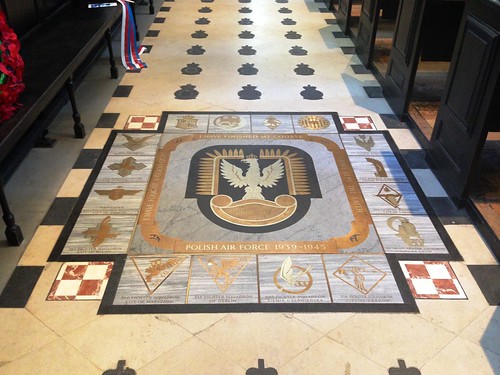
The Memorial to all the Polish airmen who served with the Royal Air Force during World War II.

It then stood just short of 300 years before incendiary bombs of the Luftwaffe destroyed it in May 1941. Leaving nothing but a few walls and the tower, Wren’s design had been reduced to ashes and rubble.

For over ten years it lay in ruins, until it was decided to raise funds and rebuild it. In 1958, following a national appeal by the Royal Air Force, St. Clement Danes was officially opened and dedicated as the Central Church of the Royal Air Force in memory of all those who fought and died whilst in RAF service, and to ‘serve as a perpetual shrine of remembrance’ to them all.

In completing the restoration, every branch of the RAF was included. At the entrance of the church, is the rosette of the Commonwealth made up of all the Air Forces badges of the Commonwealth countries, each of which flew with RAF crews during the conflicts. Beyond the rosette, the floor from the north aisle to the south aisle of the Nave contains nearly 900 squadron badges each one made in Welsh Slate and embedded into the floor.

Around the walls of the church, four on each side and two to the front, are ten Books of Remembrance from 1915 to the present day, in which are listed 150,000 names of those who died whilst in RAF service. A further book on the west wall, contains a further 16,000 names of USAAF personnel killed whilst based in the United Kingdom during the Second World War.

St. Clement Danes - Church of the RAF

Ten Books of Remembrance contain 150,000 names of those who died in RAF Service 1915 – the present day. A further book contains 16,000 names of USAAF airmen who were killed.

On either side of the Altar, are boards and badges dedicated to every branch of the RAF. Two boards list the names of those who were awarded the Victoria Cross and others the George Cross. Other slate badges represent the various units to serve and support the main fighter and bomber groups, including: RAF Training units, Fighter Control units, Maintenance units, University Air Squadrons, Medical units, Communication squadrons, Groups, Colleges and Sectors.

In the North Aisle, a further memorial, also embedded into the floor, remembers those who escaped the Nazi tyranny in Poland and joined the RAF to carry on the fight during World War II. Each Polish Squadron is represented in a beautifully designed memorial around which is written:

“I have fought a good fight, I have finished my course’ I have kept the faith”

Smaller dedications can also be found around the church, such as the Mosquito Aircrew Association, dedicated to both air and ground crews of the mighty ‘Wooden-Wonder’. Some of these memorials are in the form of gifts of thanks many of which come from other nations as their own tribute to those who came from so far away to give their lives in the name of freedom and democracy.

So next time you’re in London, take time out from the hustle and bustle of the West-end, make your way to the Strand ( a fifteen minute bus journey from the IWM) and visit this peaceful retreat.

St. Clement Danes is open every day to the public, so that those who gave the ultimate sacrifice may live on for eternity.

RAF Great Dunmow – In the shadow of Stansted Airport.

In Trail 33, we continue to explore the county of Essex. Touching the outskirts of London to the south and Suffolk to the north, it has an aviation history that has lasted over two world wars.

After visiting both Matching Green and Andrews Field, we travel a few miles west back again toward Stansted Airport.

Our next stop is Great Dunmow.

RAF Great Dunmow (Station 164)

Great Dunmow is another former airfield that sits in the shadow of nearby Stansted airport, itself a former World War 2 airfield. Dunmow was home to only two RAF units, 190 Squadron (RAF) and 620 Squadron (RAF) operating Stirling IVs and latterly the Halifax III and VII. It was also used by the USAAF flying B26 Marauders under the 386th BG.

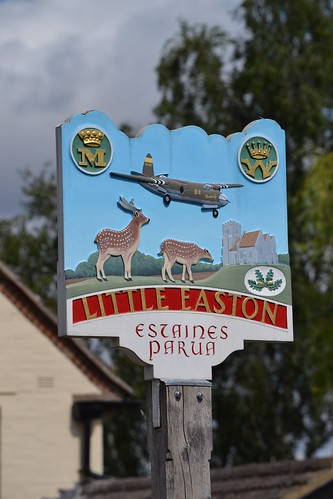
Great Dunmow, had a multitude of names: Little Easton,  Easton Lodge and Great Easton due to its close proximity to all three locations. It was designated Station 164 by the Americans but became more commonly known as Great Dunmow.

RAF Great Dunmow

The Village sign depicts its wartime heritage.

Not built until mid-way through the war (1942-43) by the US Army’s 818th Engineer Battalion (Aviation), the American units of the 386thBG were the first to move in.

It would have three runways (concrete and wood chip), with the main one running north-west / south-east and 6,000ft in length. The second and third runways ran east-west and north-east \ south-west and were both 4,200 ft in length. The main technical and administrative areas were to the north side in which one of the airfield’s two T2 hangars were located. A bomb store was situated to the east and was capable of storing in excess of 800 tons of bombs. Dispersals consisted of 50 loop style hardstands around the concrete perimeter track. The staff accommodation sites were dispersed over 12 sites all to the north around the Easton Lodge, referred to by crews as ‘The Big House’*1. Two Mess sites, two WAAF sites, a sick quarters, an officers and four airmen sites housed a huge number of personnel – even parts of the house itself were used. A communal site provided a number of small shops selling local produce and groceries.

RAF Great Dunmow

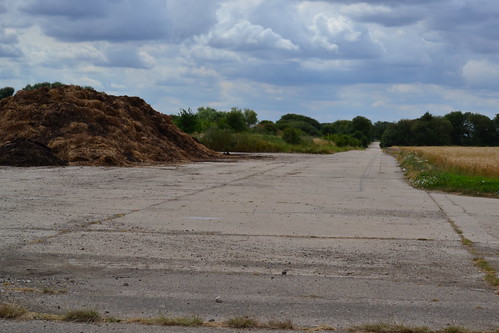
The secondary runway (N/E-S/W) disappears into the distance. This section is the only part in full width. The tree line marks the third E-W runway.

The 386th BG (M) were activated mid-war, on December 1st 1942 at MacDill Field, Florida, and arrived in England with their olive and grey B-26s in the following June. Their journey to Great Dunmow would take them via both RAF Snetterton Heath and RAF Boxted. For four months they would operate under the control of the Eighth Air Force, swapping in October 1943, to the 99th Combat Wing of the Ninth Air Force. Consisting of four Medium Bomb Squadrons: 552nd (code RG), 553rd (AN), 554th (RU) and 555th (YA), they would focus their attention on airfields, marshalling yards and gun batteries. Over the winter of 1943-44 they targeted V weapon sites, along France’s coast, and attacked enemy airfields during the ‘Big-Week’ campaign of February 1944.

During the Normandy invasion, they targeted bridges and Luftwaffe airfields, coastal batteries, fuel and munitions supplies, they preceded the allied forces as they moved inland; supported ground troops at Caen and St. Lo in July 1944, earning themselves a Distinguished Unit Citation (DUC) for their actions. As the allies moved deeper into France, they were then free to move to the continent allowing them to reach further afield and support the advance toward and into Germany itself.

A crashed B-26 Marauder (AN-J, serial number 41-31585) nicknamed

B-26 Marauder ‘AN-J’, (s/n 41-31585) nicknamed “Blazing Heat” of the 553rd BS, 386th BG, 23rd June 1944.  balances on its nose after making a crash landing at Great Dunmow. (IWM)

In total, the 386th would fly 257 missions from Dunmow, operating between 24th September 1943 and 2nd October 1944, in an aircraft that earned itself a rather distasteful name for being unreliable and difficult to fly. Later versions having both larger wingspans and flying surfaces, partly cured this problem, but in the hands of a good crew, they were deemed no more ‘dangerous’ than any other bomber of that time. In fact, a number of Marauders were known to return home in an incredible condition, after taking a substantial beating at the hands of both flak and fighter attention.

After the 386th left Dunmow, it was handed over to the RAF and the first unit to arrive was 190 Squadron (RAF) with the Stirling IV. Pulled out of bomber squadrons for its ‘poor’ record, they were used by various units for both mine laying activities and glider-tug operations. Arriving from Fairford they stayed here until July 1946 whereupon 190 Sqn was disbanded. During this time they also flew the Halifax III and later the Halifax VII – an aircraft that was proven in combat and also as a transport machine. With a history that extended back to the First World War, 190 Sqn operated as a Glider-tug unit taking Horsa gliders to a number of prestige targets;  both Normandy, during the D-Day invasion, and Arnhem during the ill-fated Rhine crossing of Operation Market Garden. They flew fuel and supplies to advancing troops and carried out a number of transport duties as the war drew to a close.

The changeover between the exiting Americans and the arriving British was seen as an ideal opportunity to gather ‘supplies’ by the locals. Many tins of rationed food and other ‘luxuries’ left by the U.S. airmen were deemed ‘fair-game’ and ‘removed’ in the intervening days. Dennis Williams*2 book ‘Stirlings in Action with the Airborne Forces’ describes in detail how the incoming airmen were surprised by the extent of the items left by the Americans.

Four days after 190’s arrival, 620 Sqn also arrived at Dunmow, along with all their respective Echelons. Like their partners, they also came from RAF Fairford flying the Stirling IV. A former bomber squadron, they cut their teeth at RAF Chedburgh, then in November 1943 they transferred across to the Airborne Forces. Also flying glider operations, they too swapped their Stirlings for Halifax A.VIIs in July 1945 before moving off to the Middle East post war. Similarly, 620 Sqn flew troops into some of the most dangerous war zones, losing a number of crews and aircraft along the way.

Both 620 and 190 Sqn returned to operations soon after their arrival, flying SOE operations, glider training sorties across the UK and dropping equipment into occupied territory. As can be imagined these dangerous operations were not without their problems. A number of aircraft were lost and even during training flights, losses were still incurred.

On the 21st November 1944, Stirling LK276 crashed killing all seven crew members. It was initially thought that the pilot either failed to read his altimeter correctly causing the aircraft to strike trees and power lines, or he took his attention away from the instruments in front. Subsequent reports however, show eye witnesses claiming to have seen a following night fighter. Again contradictions in statements were not helpful and no conclusive decision could be reached. The court of enquiry ruled that it was an accident and so the case was closed. Whatever the cause was, it was a major blow to the crews at Great Dunmow.

RAF Great Dunmow

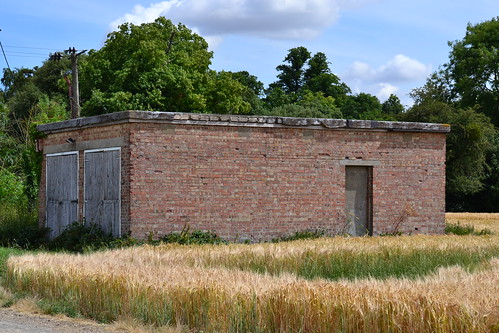
The Administrative site is now used by the local farmer and small ‘industrial’ units. The crew briefing room (front) stands in front of the intelligence block. The main Operations block has gone but the station offices are still here.

Being so far south, Great Dunmow offered a safe haven for some returning bombers. On November 5th 1944, whilst on their return from mission 166 over Frankfurt, the 401st were diverted to the Great Dunmow as bad weather had closed in over Deenethorpe. An eye-witness account describes two B-17s ‘colliding’ on the runway, whilst other records suggest the two B-17s crash landed both suffering from extensive flak damage.  Records show one of them as B-17G ’42-102674′ flown by 2nd Lt. William F. Grimm  and the other as B-17 ’42-31662′ flown by 1st Lt. Leland R. Hayes. However this particular aircraft (42-31662) was known to be ‘Fancy Nancy IV‘ flown by Walter Cox which did not crash at Dunmow, going on to serve to the war’s end. As with many war records, it can be difficult ascertain total accuracy and an anomaly has occurred here somewhere.*3

Both 190 and 620 Sqns continued on in SOE operations, including their first to Norway on the night of November 6th/7th 1944.  Both operations were seen as failures but it would highlight the difficulties of flying for four hours to often heavily fog-laden environments and back again.

Poor weather dogged this part of the country especially in the early 1940s. The airfield was in a poor condition and a great deal of work had to be carried out to assist operations. Lighting, repairs to the runways and drainage were all severe problems and all needed urgent and immediate attention. Conditions therefore were not good. Successive cold winters and the continual mud, left some with very ‘unsavoury’ memories. Working in bitter cold weather outside certainly became a challenge for hard pressed ground-crews.

A number of operations involved Dunmow aircraft over the next few months, but they were mainly confined to practice flights towing Horsa gliders. Then in late March 1945, Operation ‘Varsity’ began. The drive into Germany required 21,000 troops, 1,800 transport aircraft and over 1,300 gliders. The base was sealed off from the outside world, only air-tests and spoof flights were scheduled, and then on the morning of the 24th March 1945 60 aircraft were lined up along the runways ready to go.

Anti-aircraft fire was heavy and conditions poor over the drop zone, but all 190 Sqn and 620 Sqn aircraft returned – some with damage. They seem to fair far better than the gliders though of which some 80% were damaged by flak – many severely.

Toward the end of the war, both squadrons dropped supplies and recovered POWs from the now free Europe. It was an emotional time for all but accidents and losses still occurred and crews still died.

In July 1945 620 Sqn received the Halifax A.VII and finally in January 1946 it would be all change for Great Dunmow. 620 Sqn were posted to Aqir in Palestine; 190 Squadron was disbanded and the unit renumbered as 295 Squadron and sent to Tarrant Rushton – this was the end for Great Dunmow. The airfield was used as a vehicle storage unit until 1948, at which point it was closed for good. The tower and major buildings were demolished, the concrete dug up for hardcore for the new road, and the remainder returned to agriculture, a state it survives in today.

As with many airfields today, there is little left to see in the way of buildings and infrastructure at Dunmow airfield. A memorial stands alongside the B1256 road a few miles to the south side of the airfield site and an adjacent footpath takes you through what was the bomb store on to the airfield itself.  By driving from here to the village of Little Easton, you can more easily access the site from the northern side, by far the better option. Drive through the small village of little Easton, past the quaint village duck pond and on toward Little Easton Manor. Much of the grounds of the Manor were the accommodation areas and now as an estate once more, is (at the time of writing) up for sale for a cool £5,000,000.

Before arriving at the manor – which shows little of its aviation history – there is a small tourist sign and access to the adjacent fields. Stop here. The footpath to your left crosses the airfield utilising  much of the remaining perimeter track. This path is an old access road to the airfield and takes you up to the threshold of the former second runway (N/E-S/W).  It is a short walk but once there the full width of the runway can be seen, and when looking on, so to can the length (albeit cut short). The only part that is full width, the enormity of these tracks is staggering. The path then leads off to the west through the field strangely enough only feet from the usable but broken and much narrower perimeter track. At the end of this path, you arrive at the threshold of the third (E-W) runway. Now only a single farm track; the length is in its entirety but again standing at this point you can see how long the runways were. The path then crosses over the southern half of the airfield away to the south but there is little to be gained from taking this route, other than to know you have walked where many crews would have spent their time.  The dispersals that once stood here are now long gone and no trace remains of their existence.

If you continue east the path splits again and the one turning south takes you through the former bomb store and onto the afore-mentioned memorial. Now a quarry, the store is supplied by the perimeter track which is used by lorries to transport materials. Turning back on yourself it is possible to walk along the perimeter track back to your starting point. Along these paths are signs of the concrete that once carried the B-26s, Stirlings and Halifaxes, much narrower now, their significance little more than a farm track. Away to your right, was the former ‘dump’ or Marauder graveyard, where scrapped B-26s were left to rot.

Return to the road and walk from here west toward the lodge. After a few minutes you arrive at the former airfield entrance. The airfield sub-station marks the entrance and a footpath takes you along the road onto the airfield site. The technical area would be to your left and right, with one of the T2 hangars to your left. Follow the path as it crosses the field and you arrive where the tower once stood. There is no sign of it now, but the path takes you right though the spot where so many decisions were made and aircraft counted back. The path then leads on through the airfield and  joins the third (E-W) runway at its centre. largely overgrown with trees, the line is clearly evident, but again evidence of the concrete structure lay  scattered along the edges of this once gigantic pathway.

RAF Great Dunmow

The airfield substation marks the airfield entrance.

Turn back again and through the technical area. Hovering over the tress to your left you will be able to see the current control tower and landing aircraft at Stansted airport – a mere stones throw away. Also to your left are a small group of farm buildings , amongst them a blister hangar that appears to have been moved here after the war. Beyond these and accessible from the roadway, a small collection of administrative buildings remain now used by the local farmer and as small industrial units. By walking along the road these are accessible and perfectly visible from the roadway.

The road from here continues on and takes you into where the  main accommodation sites once stood. Much of this is private land but traversed in places by small bridal ways and footpaths. Immediately opposite was the mess site 4 and further along the road the sick quarters. The remaining accommodation sites were to the north of here amongst the now dense forests that have replaced them. To the north of these woods was the sewage plant that once served the airfield. It has now been replaced by a more a modern unit but its location is still precise.   Various tracks lead into private land from here, but they are the original tracks for the various accommodation sites that once housed the crews and staff of this once busy base.

Return to your car and drive back to Little Easton stopping at the church  (St. Mary the Virgin). Inside at the back of the church on the north wall are two beautiful widows that commemorate the service of those stationed here at Great Dunmow – both RAF and USAAF. Primarily focusing on the USAAF, they depict a number of scenes – each reflecting the daily lives of the airmen. Some show them holding hands with the civilian children, others preparing for and returning from flight; Marauders in the ‘Missing man’ formation, and two hands clasped together as a sign of American and British unity – each one is beautifully presented and well maintained. One of the windows depicts ‘peace and tranquillity’, whilst the other called “The Window of the Crusaders”; depicts the role played by the 386th. Plaques, rolls of honour and information boards give great detail about the lives of those who were stationed here for those short periods during the Second World War.

August 2015 007

One of two stained glass windows in Little Easton church.

Great Dunmow served an important role during the Second World War. Today its historical significance is in no way played down. Whilst the majority of the airfield is now crops, ‘free access’ allows you to revisit those days of the Second World War, to walk in the footsteps of heroes, to experience the sight of a welcome runway as a returning bomber would. The huts and church windows stand as reminders of those who, whilst so young, gave their all in the name of freedom and democracy.

Notes and further reading

*1The Big House, was the former Estate of Frances, Countess of Warwick, who was regularly visited by the Prince of Wales, who later became King Edward VII. A railway halt was built outside the house to accommodate these visits.

*2 Williams Dennis, Stirlings in Action with the Airborne Forces, Pen and Sword Aviation, 2008 – this book provides an in-depth look at life within both 620 Squadron and 190 Squadron whilst at RAF Great Dunmow. It is highly recommended as a follow-up to the activities of these two units whilst here and abroad.

*3 See the 401st BG website for details of these aircraft and missions, including the original mission reports.