RAF Mattishall Airfield – Part of Trail 36

Following on from previous posts about Tydd St. Mary and Narborough airfields, RAF Mattishall was used by the same squadron, 51 (HD) Sqn to combat the threat from Zeppelin airships over the eastern counties of England. Now long gone and sadly relegated to the history books, we visit another airfield that played a role in the defeat of these once mighty airships.

RAF Mattishall.

Close by to RAF Swannington is the former RAF/RFC airfield at Mattishall, a few miles to the south beyond Attlebridge and its huge USAAF base. Closed at the end of the First World War, Mattishall saw detachments of 51 Squadron during the First World War. 51 (HD – Home Defence) Squadron had its headquarters at Thetford, with other flights at Harling Road, Narborough and Tydd St Mary. Flying a range of models, including both the BE2 and BE12 models; 51 (HD) Sqn had a mix spread across these airfields taking on the FE2b in both single and two variants later on in the war.

Intrusions by Zeppelins were more common in the earlier stages of the war, and the Home Defence Squadrons were created to counter-act them. Poor performance initially led to poor successes against these airships but that didn’t stop the determined young crews of the RFC and latterly the RAF. Toward the end of the war in 1918, home defence had been scaled back. However, as the newer Zeppelins, Gotha and Zeppelin-Staaken were able to fly at much higher altitudes, home defence squadrons needed a more able aircraft to combat them. In poured numbers of Sopwith Camels, SE5 and DH4s, but it was all a bit ‘too-little, too-late’ for the mighty airships that once ruled the skies.

During the last Zeppelin raid of the war on the night of August 5th/6th, 1918, RAF DH4s and Sopwith Camels attacked a small fleet of airships of the Norfolk coast. Inland the home defence squadrons were alerted and scrambled but the group of Zeppelins never made it in-land and flights from 51 Squadron at Mattishall were to play no part in their eventual downfall. Sadly Lt. Drummond from Mattishall flying in FE2b ‘A5732’ had to make a forced landing at Skegness, presumably as a result of engine trouble. This was to bring the night fighter operations to an end and with it the end of both 51 Sqn and RAF Mattishall.

The airfield was built close to Toll House Farm and had a range of facilities common to First World War airfields. A few wooden huts and two hangars were erected on-site and these proved to be the limit of accommodation on the 80 acre site. Post war, these were all sold off to local businesses and farms and the land returned to the farmer.

Now completely agricultural, Mattishall was once a hive of flying activity for a short period of the war, where flying bravely in open cockpits and without parachutes was common place. Sadly, Mattishall’s existence has disappeared into the history books and it is no more.

A short history of Mattishall along with some personal accounts can be found here.

Mattishall is can be found in Trail 36 – North Norfolk (Part 6).

RAF Tydd St. Mary

Just over the Cambridge border into the area known today as South Holland in Lincolnshire, is a field that was a small airfield during the First World War. Designed for home defence, it was used for attacking marauding Zeppelin airships approaching England across the North Sea. Larger towns and cities such as Norwich and Lincoln were prime targets, although most designated targets were much further north for example Manchester and Liverpool. To protect themselves, the crews of these mighty airships flew at night and at altitude, but navigation skills were poor and crews were generally unaware of their actual location. As a result, they rarely made it beyond the eastern counties or the Fens of Cambridge and Lincolnshire. Because of poor weather and inexperienced pilots flying against these ships, some Zeppelins were able to wander – at the will of the weather – for as much as 10 hours unabated, randomly dropping bombs on what they considered to be ‘prime targets’.

A major turning point in this air-war, was the night of January 31st 1916 when nine Zeppelins of the German Navy attacked what they believed to be the industrial north-west. In fact they had barely got beyond the lower regions of Lincolnshire before dropping their ordnance. These attacks resulted in the loss of sixty-one people and whilst no British fighter was known to have engaged the airships, a number of Royal Flying Corps (R.F.C) crews were lost due to bad weather.

This disastrous night led to major changes in the Home Defence Squadrons of the R.F.C and R.N.A.S (Royal Naval Air Service), a process that would take a considerable time to complete.

As a part of these changes, an airfield was developed just south of the South Holland Drain a mile or so north of the village of Tydd St. Mary.

RAF Tydd St. Mary

Designed as a class 1 landing ground, Tydd St. Mary covered 125 acres by the time it closed in 1919. Development of the site began in mid 1916 following the re-organisation of the home defence force, but the first units didn’t arrive until the autumn of 1917. Not much more than a field, it did eventually have a small number of  Bessonneau*1 hangars and a small selection of crew huts.

The main unit to use Tydd St. Mary was 51 Home Defence (HD) Squadron whose main flight was based at Thetford. Formed from the nucleus of 9 Reserve Squadron (RS) on 15th May 1916, they moved to Hingham with flights dispersed at Harling Road, Norwich (‘A’ Flight), Mattishall (‘B’ Flight), ) and Narborough (‘C’ Flight). Initially they were equipped with the BE2c, which were soon replaced by the BE12 and subsequently the FE2b aircraft and then the BE2e in December 1916.

For a short while Zeppelin intruder flights were rare and this breather allowed for extensive practice flights by both 51 (HD) Sqn and their partner unit 38 (HD) Sqn who were based a little further to the north.

This lull in movements ceased in the autumn of 1916, when a large formation of Zeppelins gathered over the wash and headed for London. Badly hindered by fog and bad weather, they were eventually scattered across the southern and eastern regions of England where they dropped their bombs on remote farmland. This attack caused no damage to property, nor were the Zeppelins challenged in any major way – the marauders had little to worry about other than poor weather. Patrols by 51 and 38 (HD) Sqn’s were in vain, a pattern that was to continue for the large part, for the duration of the war.

At the end of 1916, Tydd St. Mary was re-designated a Night Landing Ground (NLG) following the renaming of R.F.C Home Defence Stations. 51 (HD) Squadron would soon fly from here in the defence of the eastern counties.
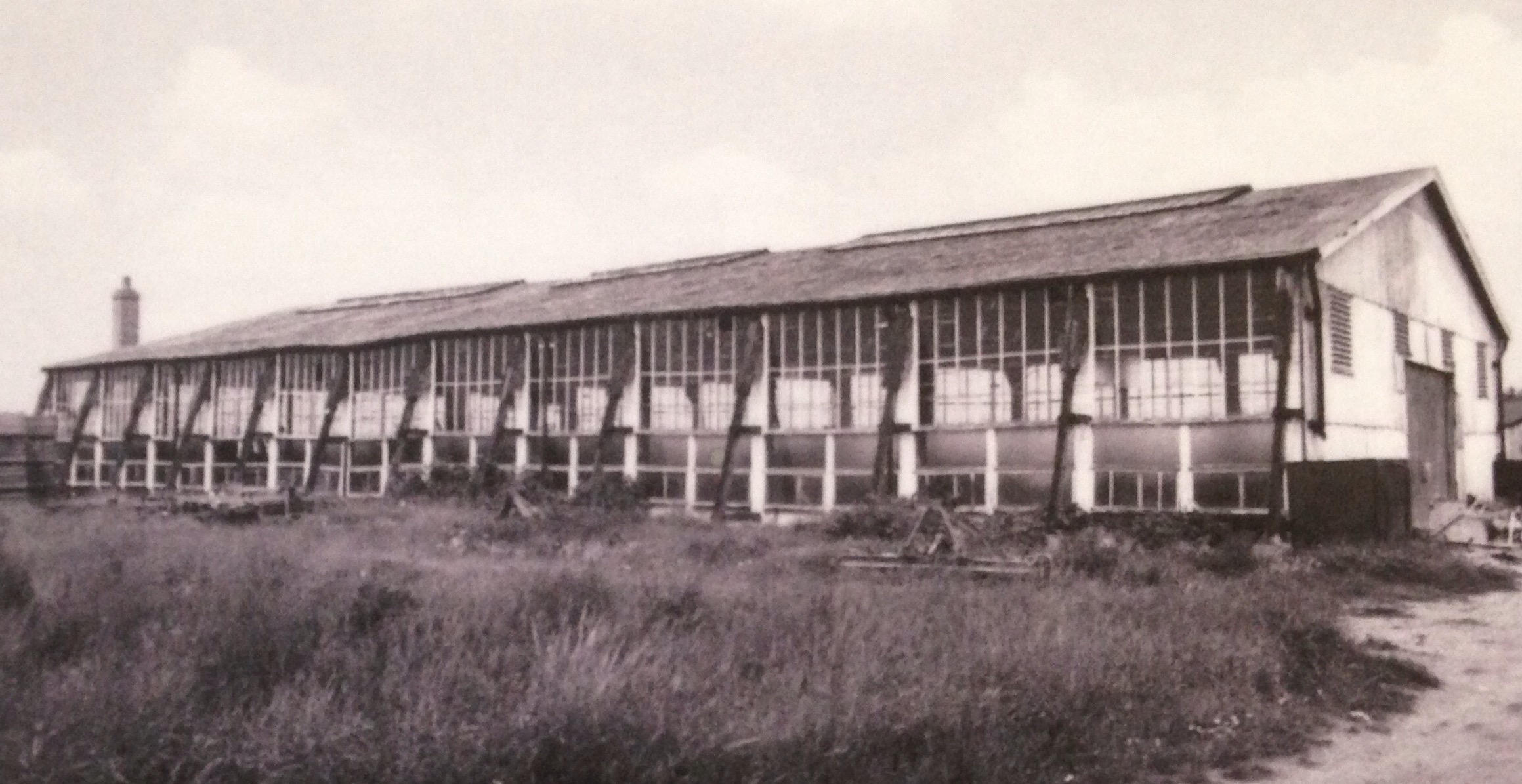
51(HD) Sqn aircraft hangar modified for agricultural use post war.*2

The Zeppelins main advantage over the British was the poor performance of the aircraft types the R.F.C used.  Whilst capable of operating at the 8,000 – 10,000 ft altitude used by the Zeppelins, many aircraft simply took too long to get there and thus could not reach the airship in time to attack it.

As performance improved along with the development of the explosive ammunition that would ignite the airship’s gases, the odds were a little more balanced and larger numbers of airships were being brought down over the eastern region. The tide was turning and pilots of 51 (HD) Sqn were playing a large part in this.

In the early part of 1917  cuts to the Home Defence units were announced based on the increasing gains made by units of the Norfolk / Cambridge / Lincoln squadrons. But the Germans had not given up yet. Reductions in weight enabled new Zeppelins to reach greater altitudes. Now capable of 16,000 – 20,000 feet, few British defences could reach them.

As the tide was turning in France, attacks became fewer and fewer. These high altitude flyers were more at the mercy of the bitter cold and poor weather than defending aircraft.

In August 1917 51 (HD) Sqn moved their headquarters to Marham, and ‘A’ Flight arrived at Tydd St. Mary and 51 (HD) Sqn began replacing their BE2e aircraft with the Martinsyde G.100 ‘Elephants’ – so-called because of their size and poor manoeuvrability.

A large contingent of airships gathered once more on the night of October 19th 1917, requiring extensive sorties by 51 (HD) Sqn at Tydd St. Mary and her counterparts. Whilst a determined effort was made by the R.F.C crews, they had little or no impact, and the gathered airships made off only to be badly beaten by bad weather and anti-aircraft fire over France.

Further changes to R.F.C Squadron designations  in the latter parts of 1917/18, dropped the title ‘Home Defence’ and Tydd St. Mary became the base for 51 Sqn ‘A’ Flight in Eastern Command. Aircraft by now were primarily Royal Aircraft Factory FE2bs, although 51 Sqn were now replacing some of their ‘Elephants’ with BE12b variants which they kept until the autumn of that year. Further changes in February 1918 meant that ‘A’ Flight moved to Mattishall, whilst ‘B’ Flight took their place at Tydd St. Mary.

As the R.F.C turned into the R.A.F on April 1st 1918, Tydd St. Mary would once again become significant. On the night of April 12th 1918, Zeppelin L62 was sighted close by and aircraft took off to intercept. As it was dark at 22:00 the flare path was lit to assist the now R.A.F crews, which openly guided L62 directly onto the airfield. Gliding above the site, L62 dropped a small number of incendiary bombs onto the aerodrome in an attempt to damage or destroy aircraft on the ground. Fortunately the bombs fell well away from parked aircraft and caused no damage to either buildings or aircraft. Pursuit was made by Lt. F. Sergeant in FE2b ‘A5753’, but to no avail and he returned to base empty-handed. Other pilots also tried to catch L62, some crashing due to engine failure, but many simply weren’t able to catch-up with the intruder. Eventually L62 reached the coast and made a break for it across the sea under the protection of yet more bad weather.

By November 1918 the final FE2bs had been relinquished and for the remainder of the year and into May 1919, 51 Sqn operated Sopwith Camels. A move by ‘B’ Flight in May to Suttons Farm (RAF Hornchurch) not only signified the end of the Camels (replaced by Sopwith Snipes) but the end of 51 Squadron who were disbanded in June. This departure also meant the end of Tydd St. Mary and in November 1919 notice of closure was given and the site finally closed in January 1920.
Tydd Gote Village sign

The village sign at Tydd Gote, remembers the RFC from the airfield at Tydd St Mary.

At its height Tydd St. Mary covered an area of 125 acres, and contained two Home Defence flight sheds as single units (believed to measure 130 x 60 ft). These were utilised by local farmers and business and lasted for many years. Other buildings were also utilised, the last, believed to be the Flight Office, is thought to have been demolished as late as 2009.

Not a major player in the war and never to return to aviation, Tydd St. Mary is a notable site and perhaps when passing, a second thought for those who flew from here in defence of the Eastern counties, should be offered.

Tydd St. Mary forms part of Trail 37.

Sources and Further Reading

*1 Early Bessonneau hangars were constructed of wood covered in canvas. Various types were made and were designed to be erected by small trained groups of men. Later models replaced wood with metal and were more permanent.

*2 Photo on display at Thorpe camp, Woodhall Spa.

Goodrum, A. ‘No Place For Chivalry: RAF Night Fighters Defend the East of England Against the German Air Force in Two World Wars‘. 2005, Grub Street

The Great War Forum – website 
RAF Narborough – Norfolk’s first Airfield.

Resting not more than a mile or so from the boundary of RAF Marham, is an airfield that never made it beyond the First World War – but it played such a major part, it should never be forgotten. Opened originally as a satellite by the Royal Naval Air Service, it became the biggest First World War airfield and led the way for the aviators of today’s Royal Air Force.

RAF Narborough

Built as the largest, aircraft based, World War One aerodrome, Narborough was known under a range of different names. The most common, ‘The Great Government Aerodrome’ reflected not only its size but also its multi-national stature and its achievements in aviation history. Used by both the Royal Naval Air Service (RNAS) and the Royal Flying Corps (RFC) it would also have names that reflected both these fledgling services.

Designed to counteract the threat of the German Zeppelin and Schütte-Lanz airships, Narborough was initially used by the RNAS as a satellite station to RNAS Great Yarmouth. No crews were permanently stationed here, but ‘on-duty’ crews would fly in and await the call to arms should a raid take place over East Anglia.

The first recorded arrival was in August 1915; an event that would keep the site in use by the RNAS for the next ten months before being designated as surplus to requirements, and handed over to the RFC in June 1916.

Used as a training ground, accommodation was basic to say the least, being described as a “desolate God-forsaken place”*1 buildings needed to be erected for accommodation, training and maintenance. A total of seven Boulton and Paul hangars and up to 150 buildings would be built on the site over the next two years. By the end of the war, some 1,000 personnel would be based at Narborough – a number comparable with any modest Second World War airfield.

As the First World War raged on the European continent, the use of aircraft was seen as a new way to monitor, kill and record enemy troop movements; it would develop into a lethal weapon and a very potent reconnaissance vehicle. Training programmes were rushed into place, and Narborough would become a preparation ground for new recruits. With training considered basic by today’s standards, recruits had to pass a series of tests before being sent to the France. Written examinations followed up by twenty hours solo flying, cross-country flights and two successful landings, were followed by flying for fifteen minutes at 8,000 feet and landing with a cut engine. These daring young men, many who were considered dashing heroes by the locals, would display their skills for all who lined the local roads awe-inspired by their antics.

Life was not always ‘fun’ though. Accident rates were high and survival from a crash was rare. Some 15 graves lay in the local church  at Narborough, all young men who never made it through the training and on to the battle in France.

The occurrences of these accidents were so frequent, that one instructor, W.E. Johns, creator of ‘Biggles’ cited spies as the cause of many ‘accidents’ – tampering with machines causing the deaths of the crews on board. Johns, himself having written of many machines, believed Americans with German sounding names were to blame for aircraft breaking up in mid-air or crashing at the bottom of loops. More likely, the fault lay with over exuberant or poorly trained recruits.

Narborough as a training station would operate a wide range of aircraft. The French designed Henry Farman F.20, a military reconnaissance trainer, would operate with 35 Squadron from June 1916 until October when they were replaced by the Armstrong Whitworth FK8; 35 Sqn moving to France with these aircraft in January 1917.

The first full squadron to be formed here was 59 Sqn on 21st June 1916. Born out of 35 Sqn, they would operate Avro’s 504K followed by the second French design, the Maurice Farman Shorthorn; named so because of the length of the skids designed to prevent recruits overturning the aircraft on landing. After these came the BE2c, BE12 and RE8s, before the squadron moved to St-Omer in February 1917.

It was during this year that 83 Squadron would be born out of 18 Reserve Squadron (RS) operating various aircraft in the training role. They arrived at Narborough during December that year with FE2bs before they themselves moved to St-Omer in March 1918.

As the war drew to a close, one further squadron was formed at Narborough; 121 Squadron on New Year’s Day 1918. Whilst originally formed to fly the DH9, they actually used a variety of aircraft before being moved to Fliton and eventual disbandment on 17th August 1918.

Three other units would pass through Narborough before it closed. Now part of the Royal Air Force, 56, 60 and 64 Sqns would all come here as cadres in February 1919. 64 Sqn disbanded here in the following year, whilst both 56 and 60 Sqn moved to Bircham Newton and onto disbandment.

The end of the war saw the closure of Narborough. But unlike its sister station RAF Marham a mile or so away, it would remain closed. The buildings were all sold off in what was considered to be one of the biggest auctions in Norfolk, with some of them going to local farmers, small industrial units, schools and the like. Some of these buildings still exist at various places around the local area today but many have long since succumbed to age and inevitable deterioration.

Narborough itself having no hard runways or perimeter tracks has long since gone. A small memorial has been erected by a local group aiming to promote and preserve the memory of Narborough, a memorial plaque also marks the fifteen graves of those who never made it to France; and the small Narborough Museum & Heritage Centre holds exhibits of 59 Squadron in the local church.

Significant not only in size, but in its history, Narborough has now been relegated to the history books. But with the dedication and determination of a few people the importance and historical significance of this site will hopefully continue to influence not only the aviators of tomorrow, but also the public of today.

The memorial to those who served at Narborough.

Sources, Links and Further Reading.

*1 letter from 2/AM C. V. Williams from 59squadronraf.org.uk

C.G. Jefford, RAF Squadrons, Airlife Publishing limited, 2001

The Narborough History Society cane be visited through their website.

The Narborough Airfield Research Group tell the history of 59 Squadron at Narborough, this includes personal notes and details of the Narborough airfield.

Air Crew Memorials – Sgt R. C. Land (RAFVR)

Young men who died in service for their country, may their memories last forever.

On February 4th 1943, Lancaster III, ED496, ‘WS-P’ of No. 9 Squadron (RAF) took off from its base at RAF Waddington, Lincolnshire. On board were the crew members: Sgts Land, Packer, Gullery, Levesque (RCAF) and McGonigal all of the RAF (VR). This was to be a routine test flight for the crew, but it would end tragically for all those on board.

February 1943 was one of the mildest on record, experiencing low snowfalls and warmer temperatures across the country. However, on the fourth, particularly low temperatures were recorded, and during the night many aircraft on operations turned back due to associated icing problems. During that month there was a very low seasonal rainfall, particularly around Lincoln and the east coast area; with prevailing south-westerly winds, the weather was considered to be ‘fair’.

Lancaster WS-P took off on a routine air test, it was to undertake a number of circuits carrying out practice landings testing on-board equipment aiding such manoeuvres. At 16:00, the aircraft dived in to the ground crashing at Scopwick, north of Sleaford, Lincolnshire. With all its four engines still running when the aircraft struck the ground, the resultant crash led to an inevitable explosion and fire killing all on board. Whilst Sgt Land’s body was thrown clear, the remaining crew members were not and they remained trapped inside. The force of the crash buried the aircraft  deep in to the peaty Lincolnshire soil, rendering any recovery virtually impossible.

The crash was investigated by the Air Investigation Branch and their findings summarised in report W1458; but whilst no firm conclusions were drawn, it is believed that ‘structural failure’ of the air frame was to blame for the accident.

The aircraft and bodies remain in the ground to this day and a small monument has been erected in their honour. Sgt Land’s body was taken to Weston Longville, Norfolk, where he was buried in the grounds of All Saints Church. His companions are all honoured at the Runnymede Cemetery, Surrey.

The crew of Lancaster WS-P were:

Sgt Charles Richard Land, (s/n 1332099)
Ronald Jack Packer (s/n 901009) (Panel 160)
Sgt  Hugh Francis Gullery, (s/n 1378136) (Panel 151)
Sgt Joseph Thomas Levesque (RCAF) (s/n R/55503) (Panel 183)
Sgt Francis Victor McGonigal, (s/n 1554452) (Panel 157)

Sgt. CR Land,

Sgt Land is buried in the grounds of All Saints Church, Weston Longville, Norfolk.

Do you know about 455 Sqn – A Request For Information

Hello everybody, I was recently asked to help research the details surrounding the death of a reader’s grandparent lost during World War II while flying operationally. The operation in question concerns No.455 Squadron Royal Australian Air Force attached to RAF Coastal Command flying Hampden TB.Is and took place on January 11th 1943. The information I […]

https://defenceoftherealm.wordpress.com/2016/07/01/a-request-for-information/