466th Bomb Group – a Disastrous start to the War.

The area around Attlebridge is steeped in historical value, archaeological finds have dated inhabitants of the area going back as far as prehistoric times; the Romans, Anglo Saxons and Normans have all left their remnants and marks. So too, has more modern man.

RAF Attlebridge (Station 120)

Initially built as a satellite for Swanton Morley, Attlebridge would eventually pass into the hands of the USAAF, receiving the designation Station 120 . As a satellite it was built with less ‘quality’ features than standard ‘A’ Class airfields, but this would not prevent its development or use by a range of single, twin and four engined aircraft of both the RAF and USAAF.

RAF Attlebridge, which became the home airfield of the 466th Bomb Group, earlier in the war when the RAF still owned the station. The control tower is to the left of the windsock. Handwritten caption on image:

RAF Attlebridge Watch Office with Ops Room, the photo is believed to have been taken before the USAAF moved in. The office is a Type ‘A’ design (17821/40). and would have later additions to bring it up to improved standards.   (IWM)

Opened in 1941, initial occupants were the dispersed Blenheim IVs of 105 Sqn from the parent airfield RAF Swanton Morley. Operating anti-shipping roles, they were originally state-of-the-art aircraft but were quickly left behind in the development stakes as the war progressed. Their failings were soon revealed in front line operations and so activities were reduced to low-level attacks on shipping and coastal targets.

No. 88 Sqn (RAF) were the first permanent residents of Attlebridge. Having replaced their Blenheim IVs for Bostons IIIs in the previous July, they brought these new and updated American built aircraft to Attlebridge to continue the low-level attacks on the European continent. 88 Sqn would operate various model s of the Boston right up until their departure the following year and then subsequent disbandment later in 1945.

These were infant years for Attlebridge, and it was soon realised that upgrading was going to be needed if it was to be a serious contender. So reconstruction work began and the site was upgraded with new concrete runways, improved perimeters tracks and dispersal points.

Across the Atlantic, the American’s began their immense build-up, and in the Autumn of 1942, Martin’s controversial B-26 ‘Marauders‘ were flown in via the northern Atlantic route. Both Attlebridge and nearby-by Horsham St. Faith received the new crews. A period of training was undertaken that consisted of low-level flights across the English countryside, but Attlebridge remained a back-seat airfield, acting as a staging post before the Marauders along with the Twelfth Air Force, moved on to the Mediterranean Theatre.
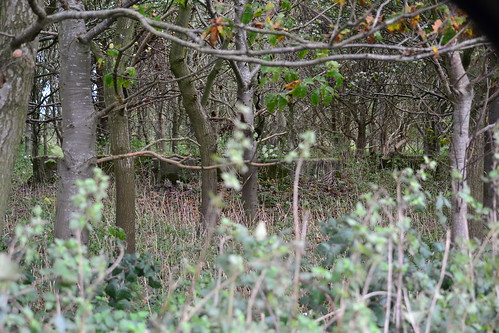
USAAF Station 120

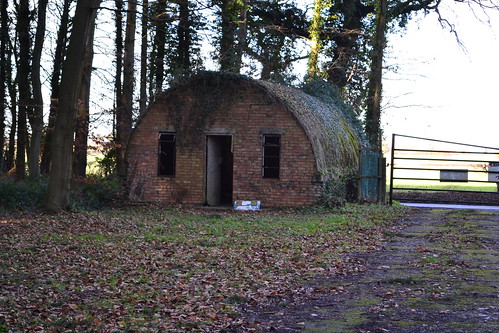
One of the many structures that remain swamped by undergrowth.

Little happened following their departure; the construction work was completed and the RAF returned with another American built model, the B-25 ‘Mitchell II’. 320 Sqn (one of three Dutch squadrons) brought these with them from RAF Methwold in the western regions of Norfolk; they stayed here until August 1943 undertaking a small number of operations in low-level raids.

A spate of Luftwaffe attacks on the East Anglian coast instigated a short stay by Typhoons of 247 Sqn (RAF) which saw them use Attlebridge as a stepping stone, moving through 12 airfields in as many months, a pattern that would continue well into 1947.

At this point, Attlebridge was assigned to the Eighth Air Force and further reconstruction of the airfield began. Improvements to the runways were made, new perimeter tracks, dispersals and technical areas were all added. The three original runways of 1,220, 1,120 and 1,080 yards, were by now increased to the standard 2,000 and two of 1,400 yards accordingly, each being 50 yards wide.

To accommodate the expected influx of 3000 crews and support staff, the accommodation sites would be increased to a total of 11: two communal; a WAAF site; sick quarters; a mix of officers, sergeants and enlisted airmen quarters and a sewage treatments works. Aircraft would be dispersed around a mix of both original and new ‘spectacle’ and ‘pan style’ hard stands, over 60 in total, with two T2 hangars and a blister hanger providing maintenance shelters. A larger bomb store – located to the east, would also accommodate the huge tonnage of bombs that was going to be required in the forthcoming onslaught over occupied Europe.

The scene was set and in February 1944, the Skies over Norfolk would reverberate with the sound of America’s most-produced, four-engined ‘heavy’ bomber.
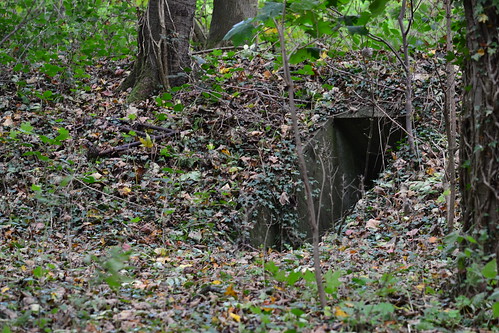
USAAF Station 120

One of the many air-raid shelters that can be seen around the area.

The only major Group to be stationed at Attlebridge was the 466th Bomb Group, 96th Combat Wing, 2nd Air Division, who arrived in early 1944.

The 466th BG were constituted on 19th May 1943, being activated in August that year. They flew Consolidated’s B-24 ‘Liberator‘ in the ‘H’, ‘J’, ‘L’ and ‘M’ models, and was made of four Bomb Squadrons: the 784th BS (code T9), the 785th BS (code 2U), the 786th BS (code U8) and the 787th BS (code 6L). The 466th would be nicknamed “The Flying Deck” and they would operate solely from Attlebridge.

In February-March 1944 the 466th moved in. The air echelon transferred via the southern ferry route to England, the ground echelon taking the Queen Mary to Greenock. They were new, inexperienced in combat, and as ‘rookies’ this would be a major factor in their disastrous start to the war.
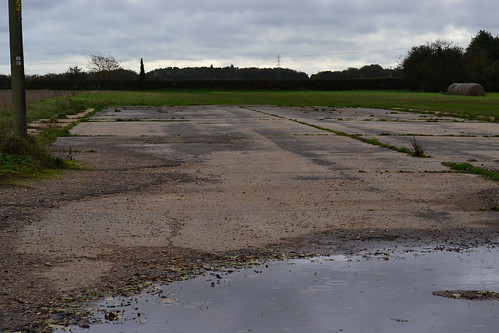
USAAF Station 120

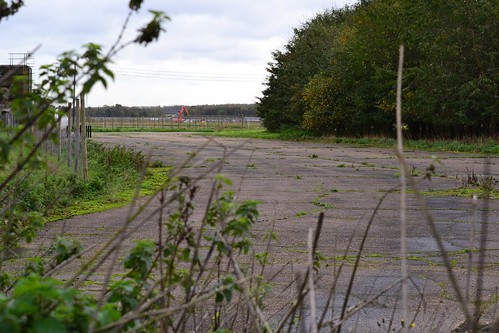
Many parts of the runways and dispersals remain in full width.

Their maiden operation, a mission to Berlin, on March 22nd 1944 would very quickly bring home the dangers of aerial warfare and close formation flying. Even though fighter attacks were non-existent, two B-24s were to collide with the loss of 13 of the two crews. B-24H ’41-29434′ “Terry and the Pirates” collided with B-24H ’41-29416 “Rebel Yell” after “Rebel Yell” was hit by flak. The resultant collision caused both aircraft to fall from the sky and crash West of Oranienburg, in Germany.

On the second operation, the following day, two more B-24s collided over Osterburg, and again heavy casualties were incurred. Onboard one of the aircraft, – B-24H ’41-29466 ‘Dark Rhapsody‘ – were three replacement crew members: Robert A. Gum (C/P), Bogan Radich (R/O) and Aleck A. Amich (TG), it was Amich’s first and only mission – suffering from his injuries, he died three days later in hospital. The two B-24s crashed into or near the Zuiderzee, in the north-west of Holland, where fuselage parts of ‘Dark Rhapsody‘ were later recovered in 1981. Only three of either crew survived taken as prisoners of war.
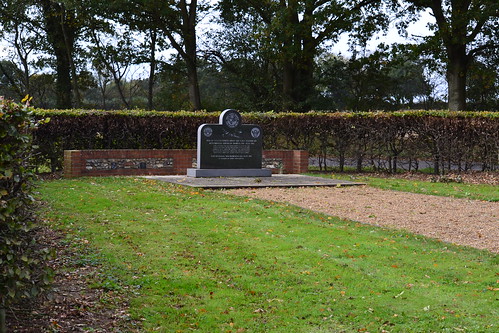
USAF Station 120

A memorial stands to the south-west overlooking the former technical site.

Then a third collision on the 27th March meant that six aircraft had been lost in five days with little or no enemy intervention. It was not a good start for the freshman of the 466th!

In an attempt to reduce these collisions, which occurred throughout the war, war-weary B24s were stripped of their armaments, painted bright colours and patterns, and lit up so formating aircraft could identify their correct path and position in the formation. Known as ‘Forming Ships’, ‘Circus Leaders’, ‘Judas Goats’ or more commonly ‘Assembly Ships’; they were painted in bizarre patterns and carried a huge quantity of pyrotechnics, that itself being a danger to the operating crews. Many units operated their own assembly ships for this purpose, the 466th using a former 44th BG B-24 ’41-24109′ painted entirely in red zigzags.

The 466th BG would recover from this terrible start and go on to operate in a strategic bombing role, attacking targets such as: Liege; Brunswick; the Bohlen oil refineries; Kempten aircraft plants; Hamburg; Saarbrucken; Misburg and airfields at St. Trond. They supported the Normandy landings, the St. Lo breakout, hit communication and transport links during the Battle of the Bulge, and supported the Rhine Crossing. They would fly their last mission on April 25th 1945.

The 466th BG would not suffer as badly as many of the other groups did. Their initial entrance in the war marred by losses, would soon fade away. By the war’s end they would complete a total 232 missions, a remarkable achievement in just over one year. A total of 5,762 operational sorties would see 12,914 tons of bombs dropped on enemy positions. They would lose ‘only’ 47 aircraft in action with a further 24 others being lost as ‘other’ loses. The 785th BS had the enviable record of 55 consecutive missions without loss, but the 466th were to also suffer the last aircrew casualties of the entire Eighth Air Force.

last crew shot down 21 apr 45 10kia

The last crew to be shot down over Germany, taken 21st April 1945, 10 of the crew were killed. Standing Left to Right: John C. Murphy (RN), John A. Perella (N), John A. Regan (CP), Richard J. Farrington (P), George E. Noe (PN), Chris Manners (B) Kneeling Left to Right: Robert E. Peterson (TG), John C. Brennan (WG), Jerome Barrett (FE), Howard G. Goodner (R/O), Albert Seraydarian (G) Only Manners and Seraydarian were able to bail out. .(IWM.)

After the USAAF pulled out, Attlebridge was returned to RAF ownership, it was put under care and maintenance and retained until sold off in 1959.  It is now owned by the Bernard Matthews company and as with many of the airfields that adorn Norfolk, they are now used to house Turkey sheds.

DSC_0064

Views along one of the runways

The main runways and perimeter track of the airfield are very much evident and in a good state. As this is private ground, access is not permitted, but good views across the tracks can be gained from the local road. There were minimal visible signs of standing buildings, but the control tower was extended and is used by the management of the site.  More careful probing will reveal signs of buildings and  the bomb shelters laying waste amongst the trees. It is possible to drive round the entire site, being only feet from the perimeter track at any one time. Amongst these trees evidence can be seen of the airfields perimeter track. Odd derelict buildings lay swamped by vegetation and trees. At entrances to the site, good views along the runways give a perspective of the size of the place. Hard standings and concrete dispersal pens lay on either side of the road, now used to store sugar beet and other produce cultivated by the local farmers.

The accommodation sites, widely spread to the south-east, have little in the way of visible structures, although some huts are still used by small businesses and remain in reasonable condition.

The blister hanger still stands, although it is now showing signs of wear and its life may well be limited. Whilst large parts of the airfield have survived and survived well, many of the spectacle dispersals have been reduced, in some areas completely removed, presumably for hardcore, and only the tracks through the bomb store remain through the trees.

The western end of the main runway, perimeter track and connected dispersals have all been removed, the public road (Breck Road) now cutting through what was the main technical area. It is the only part that utilises any of the original perimeter track.

It is along this road, only feet from one of the dispersals, that there is a memorial dedicated to the crews of the airfield who served here.  A well-kept memorial, it portrays a Liberator of the 466th, 2nd Division, 8th Air force, ‘The Flying Deck’ and the badges of each of the four bombardment squadrons. It tells of the combat missions over Normandy, France, the Rhineland and the Ardennes. Dedicated in 1992, 50 years after the end of hostilities, it serves as a little reminder of those brave souls, who gave their all from this small part of Norfolk.

Attlebridge had the dubious honour of having the last crew to be shot down over Germany fly from it. As with other sites, its easy to picture a bustling base, aircraft rumbling along preparing to take off on what may be their last flight. Where man once stood, turkeys now breed.
USAAF Station 120

One of the Dispersal pans at Attlebridge.

Whilst visiting Attlebridge, it is worth taking a short journey westward to Hockering Wood, a site of Special Scientific Interest and one that is also steeped in history. More recently, it served as a massive bomb store, and evidence of its activities still remain.

(Attlebridge was visited in 2014 this page has been revised.)

Attlebridge forms a Trail taking in a number of airfields in this region all of which are covered in Trail 7.
 

“My Gal Sal” and Global Warming

The amazing story behind ‘My Gal Sal’. The remarkable return from her icy grave. 

Another story from Clarence Simonsen President Franklin D. Roosevelt was a man of great change and foresaw the United States being drawn into the war in Europe long before 7 December 1941. The President knew the aeroplane would play an enormous part in winning such a world war and made plans for expansion of the […]

https://clarencesimonsen.wordpress.com/2016/05/02/my-gal-sal-and-global-warming/

Hockering Wood Bomb Store, Norfolk

With the increase in airfield construction and the demand for greater quantities of munitions, additional bomb storage became a problem during the Second World War. Bomb sites needed to be close enough to the airfields so that stores could be transferred quickly, but far enough away so as to not cause problems should an attack happen at either the airfield or at the store.

Apart from the major underground stores bought and secured in the 1930s, the War Office planned an additional nine above ground ‘Ammunition Parks’ at the outbreak of war*1. They were to add a further two more once the war had started and following the realisation that nine would not be sufficient to meet the demands of the air war over Europe.

Each of these parks were initially designed to hold a total of 1,000 tons of ordnance, but it was quickly realised that this too was not going to be anyway near sufficient and the capacity was soon raised to 10,000 tons.

Any store, needless to say, had to be safe, secure and well hidden from prying eyes, all of which presented the War Office with numerous problems. The initial pre-war sites relied upon the strength of the design to protect them but it was then thought better to use concealment as a way of protecting them and so the latter two sites did just this.

About one mile from RAF Attlebridge (Station 120) in Norfolk, stands one of these two sites. Located in Hockering Wood, now a site of Special Scientific Interest, it not only houses some of the rarest plants and animals in Norfolk but across the country as well.

Hockering Wood is one of the largest ancient, semi-natural woodlands in Norfolk, its ponds provide habitats for the protected Great Crested Newt, and a rare mix of soils support an ecological range that is remarkably unusual for Norfolk. It also contains a moated site believed to date as far back as the middle ages.

Yet with all this fauna and flora thriving, it is hard to believe that during the Second World War, this was an enormous bomb store capable of accommodating 8,400 tons of High Explosive (H.E.) bombs and 840 tons of incendiary bombs. A number of hardstandings, huts, component stores, staffing blocks and open sites, were spread out across the site, each linked by 9 foot (18 foot by adjoining H.E. groups) tar sprayed, metal roads that followed the natural contours of the wood. Whilst the general layout and design of each of these sites were similar, each construction team would have a certain amount of autonomy in the decision-making depending upon the conditions at each site. At Hockering, this would take into account the drainage, natural ditches, tree cover and natural barriers that existed there at the time. The requirement being that all natural features were to be retained as much as possible.

The H.E. bombs and ordinary small arms ammunition (S.A.A.) would be stored on hardstands, with the S.A.A. sited between the H.E. in the wooded area. The incendiaries, components stores and pyrotechnics would be stored in 36′ x 16′ Nissen huts, with some of the incendiaries on open land. The original plan was for the pyrotechnics to be grouped together in 6 huts per group, whilst the component stores would be in pairs. This provided a total of 17,000ft of storage for small arms, and over 20,000ft for pyrotechnics. Tail units, not fitted to the bombs until arming, were stored in an area covering 36,750ft.  In addition to this at Hockering, there were two extra accommodation sites also planned in just beyond the perimeter fence should there be an overspill at nearby Attlebridge.

Access to the site was limited and controlled. Three public roads were closed off and entrance along these roads was by pass only – security was understandably high.

The site designed in the early 1940s, and designated as a ‘Forward Ammunition Depot’, was originally built to supply RAF units of 2 Group Bomber Command, and was under the control of No. 231 Maintenance Unit. It was built in the latter part of 1942, opening in early 1943 closing in 1945 at the end of the war. At its height it is thought to have served both USAAF and RAF units.

The tracks that led around the store are still there today, hidden beneath years of vegetation and soil build up. Foundations from many of the huts are still evident and even the odd building still stands as a reminder of the work that took place here all those years ago.

As with many of these historic sites though, mother nature has a way of claiming them back. Careful ecological management ensures the public get to enjoy the site whilst protecting the rare species that continue to thrive there.

A quiet and unassuming site today, it was once a hive of activity that supplied the bombs and bullets that brought death and destruction upon our enemy. It is somewhat reassuring to know that we can once again enjoy the peace and tranquillity that it now brings.

Hockering Wood Bomb Store

One of the more complete huts on the edge of Hockering Wood.

Sources and further reading
*1 Wikipedia has a full list of all the designated ammunition parks.

The technical information was obtained from the plan drawing MC/97/42 Sheet B.