RAF Grafton Underwood – a remarkably important and historical place.

As part of the ‘American Ghosts’ trail around the borders of Northampton and Cambridgeshire, we move away from Kimbolton to an airfield that is synonymous with both the first and last bombing raids of the American Air War in Europe. We travel a few miles north, here we find a truly remarkable memorial and an area rich in history. We go to RAF Grafton Underwood.

RAF Grafton Underwood. (Station 106)

Construction of Grafton Underwood began in 1941, originally part of the RAF’s preparation of the soon to be defunct bomber group to be based in this region. But with the birth of the Eighth Air Force on January 28th 1942, it would become the USAAF’s first bomber base, when the 15th Bomber Squadron arrived after sailing on the SS Cathay from the United States.
Grafton Underwood

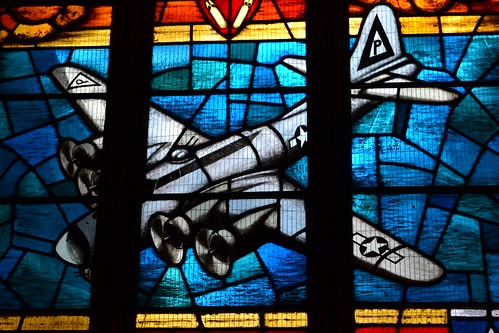
A B-17 of the 384th BG features in the Memorial Window at Grafton Underwood.

The original idea for the ‘Mighty Eighth’ was to house a total of  some 3,500 aircraft of mixed design in 60 combat groups. Four squadrons would reside at each airfield with each group occupying two airfields, this would require 75 airfields for the bomber units alone. This figure was certainly low and it would increase gradually as the war progressed and demand for bomber aircraft grew.

The terrible attack by the Japanese on Pearl Harbour diverted both attention and crews away from the European Theatre, but in April / May 1942 the build up began and American forces started to arrive in the UK.

With ground staff sailing across the Atlantic and aircrews ferrying their aircraft on the northern route via Iceland, the first plain olive drab B-17Es and Fs of the 97th BG set down on July 6th 1942, two squadrons at Polebrook and two at Grafton Underwood.

The sight of American airmen brought a huge change to life in this quiet part of the countryside. Locals would gather at the fence and stand watching the crews as if they were something strange. But as the war progressed, the Americans would become accepted and form part of everyday life at Grafton Underwood.

Eventually the airfield would be complete and although it would go through development stages, it would remain a massive site covering around 500 acres of land.
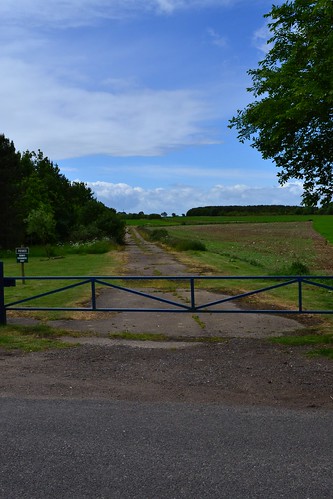
Grafton Underwood

The remains of the main runway looking south.

A total of thirteen separate accommodation and support sites would be built; two communal; seven officers; a WAAF site; a sick quarters and two sewage treatment sites to cope with upward of 3,000 men and women who were to be based here.

The accommodation was based around an octagonal road design, the centre piece being the ‘Foxy’ cinema in Site 3 the main communal site. Roads from here took the crews away to various sites hidden amongst the trees of the wooded area. All theses site were located east of Site 1, the main airfield itself.

Grafton would have three runways; runway 1 (6,000 ft) running north-east / south-west, runway 2 (5,200 ft) running north-west / south-east and runway three (4,200 ft) running north to south, all concrete enabling the airfield to remain active all year round.

42-97948 BK-U,

B-17 ’42-97948′ BK-U, “Hell on Wings” 384th BG, 546th BS. Prior to being lost on 11th October 1944. (IWM UPL 12946)

A large bomb store was located to the north-western side of the airfield, served by two access roads, it had both  ‘ultra heavy’ and ‘light’ fuzing buildings; with a second store to the north just east of the threshold of runway 1. Thirty-seven ‘pan’ style hardstands and three blocks of four ‘spectacle’ hardstands accommodated dispersed aircraft around the perimeter track. Surprisingly only two hangars were built, both T2 (drg 3653/42) one in the technical area to the east and the second to the south-west.

On May 15th 1942, Grafton officially opened with the arrival of its first detachment. The 15th Bombardment Squadron (Light) arrived without aircraft and had to ‘borrow’ RAF Bostons for training and deployment. As yet there was no official directive, and so crews had little to do other than bed in. The 15th BS remained here until June 9th 1942 whereupon they moved to their new base at RAF Molesworth and began operations in their RAF aircraft supported by experienced RAF crews. This move coincided with the arrival of the main body of the Eighth Air Force on UK soil and the vacancy at Grafton was soon filled with B-17s of the 97th BG (Heavy).

Only activated in February that year, the 97th consisted of four Squadrons: at Polebrook were the 340th BS and the 341st BS, whilst at Grafton were the 342nd BS and the 414th BS. Whilst State side they flew submarine patrols along the US coast, but with clear skies and little in the way of realistic action, the ‘rookie’ crews would be ill prepared for what was about to come.

With the parent airfield at RAF Polebrook providing much of the administration for the crews, it was soon realised that gun crews, navigators, pilots and radio operators were poorly trained for combat situations. Quickly thrown together many could not use their equipment – whether a radio or gun – effectively and so a dramatic period of intense training was initiated. The skies around Grafton and Polebrook, quickly filled with the reverberating sound of the multi-engined bombers.

These early days were to be hazardous for the 97th. On August 1st, B-17 “King Condor” would crash on landing at Grafton Underwood. The aircraft’s brakes failed, it overshot the runway, went through a hedge and hit a lorry killing the driver.

B-17 41-9024 ‘King Condor’ Crash landed August 1st, 1942 pilot Lt Claude Lawrence ran off runway, through hedge and hit a truck, killing driver John Jimmison. (IWM UPL 19654)

On August 9th, the atmosphere at Grafton became electric, as orders for the first mission came through. Unfortunately for the keen and now ‘combat ready’ crews, the English weather changed at the last-minute and the mission was scrubbed. This disappointment was to be repeated again only 3 days later, when further orders came through only to find the weather changing again and the mission being scrubbed once more.

In the intervening days the weather was to play another cruel joke on the group claiming the first major victim of the 97th. A 340th BS B-17E ’41-9098′, crashed into the mountainside at Craig Berwyn, Cadair Berwyn, Wales, killing all 11 crew members. A sad start indeed for the youngsters.

Eventually though the weather calmed and on August 17th 1942, at 15:12, twelve aircraft took off from Polebrook and Grafton and headed south-east over the French coast. Not only was it notable for its historical relevance as Mission 1, but on board one of the B-17s was Major Paul Tibbets who later went on to drop the atom bomb on Hiroshima 3 years later. If this wasn’t enough, a further B-17, ’41-9023′, “Yankee Doodle”, also contained the Commanding General of the Eighth, Ira Eaker, – truly a remarkably important and historical flight indeed.

The 97th would go on to attack numerous targets including airfields, marshalling yards, industrial sites and naval installations before transferring to the Twelfth Air Force and moving away from Grafton to the Mediterranean in November 1942.

There then followed a quiet spell, for Grafton. A short spell between September and December 1942 saw the heavy bombers of the 305th BG reside at Grafton before moving off to Chelveston and another short spell for the heavies of the 96th BG in the latter half of April 1943 whilst on their way to Great Saling in Essex. It wouldn’t be until early June 1943 that Grafton would once again see continuous action over occupied Europe.

Activated at the end of 1942, the 384th BG (formed with the 544th, 545th, 546th and 547th BS) would train for combat with B-17Fs and Gs, move to Grafton via Gowen Field, Idaho, and Wendover Field, Utah, and perform as a major strategic bomber force. Focussing their attacks on airfields, industrial sites and heavy industry deep in the heart of Germany, they would receive a Distinguished Unit Citation (D.U.C) for their action on January 11th 1944. Targets included the high prestige works such as: Cologne, Gelsenkirchen, Halberstadt, Magdeburg and Schweinfurt. They would take part in the ‘Big Week’ attacks in February 1944, support the Normandy invasion, the break out at St. Lo, Eindhoven, the Battle of the Bulge and support the allied advance over the Rhine. A further DUC came on 24th April 1944 when the group led the 41st Wing in the attack against Oberpfaffenkofen airfield and factory. Against overwhelming odds, the group suffered heavy losses but took the fight all the way to the Nazis.

A dramatic photo of B-17 Flying Fortress BK-H, (s/n 42-37781) “Silver Dollar” of the 546th BS, 384th BG as it goes down after losing its tail. (IWM FRE1282)

Just as Grafton had played its part in the opening salvo of American bombings, it was to be a part of the last. On April 25th 1945, the last bombing raids took place over south-east Germany and Czechoslovakia. Mission 968 saw 589 bombers and 486 fighters drop the final salvos of bombs of the war on rail, industrial and airfield targets, shooting down a small number of enemy aircraft including an Arado 234 jet. Last ditch efforts by the remnants of the Luftwaffe claimed 6 bombers and 1 fighter, before the fight was over. After this all remaining missions were propaganda leaflets as bombs were replaced by paper.

Two years after their arrival the 384th departed for France, eventually returning to the US in 1949 and disbandment. Their departure left Grafton quiet, it was retained by the RAF under care and maintenance and then finally in 1959 declared surplus to requirements and sold off.

In the short two years of being at Grafton, the 384th had amassed 9,348 operational sorties, in 314 missions. They dropped 22,415 tons of explosives and lost 159 aircraft for the shooting down of 165 enemy aircraft. They received two Distinguished Unit Citations and over 1000 Distinguished Flying Crosses. A remarkable achievement for any bomb group.

Grafton today is very different to how it was in the mid 1940s. But before you go to the airfield, you must visit the local church. Passing through the village you’ll see a signpost for the church, park here and walk up the short path. Approaching the church, roughly from the East, you see a dark window which is difficult to make out. However, enter the church and look back, you will see the most amazing stained glass window ever, – the vibrant colours strike quite hard. This window commemorates the men and women of the 384th Bombardment Group of the Eighth Air Force who were stationed at here at Grafton Underwood.

Next to it, someone has placed a handwritten note with the picture of a very young man 2nd Lt. Thomas K Kohlhaas and details of the crew of B-17 ‘43-37713’ “Sons o’ Fun”. It states that he, along with 3 others of the crew, were murdered by German civilians after their aircraft was downed by flak on 30th November 1944. This is a very moving and personal place to be and a poignant reminder of what these young men were facing all those years ago.

When you leave the church, look on the wall of the porch and you will see two dedications. These list the location and names of trees, dedicated to the personnel of the Mighty Eighth, that have now replaced the runways on the airfield. Unfortunately these are on private land and for some very odd reason, not accessible.

Leave the church, turn left into the village, following the stream and then turn left up the hill. The memorial is on your right. Like most American memorials of the USAAF, it has the two flags aside the memorial which is well-kept. When I visited, ‘the keeper’ (who has since become a good friend of mine) was there and we chatted for ages. The memorial stands on what was the 6000 ft main runway and when you look behind you, you see what is left of it, a small track used for estate business. Other than this and a few inaccessible sections, the remains of the airfield have gone and it is open agriculture once more.
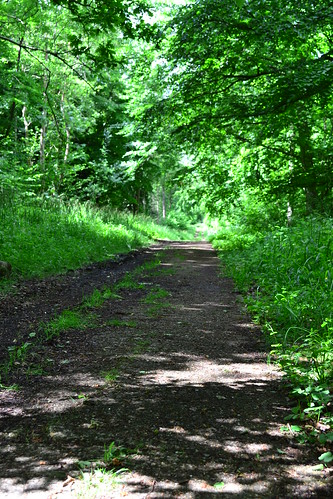
Grafton Underwood

Small tracks remain in the accommodation areas.

Grafton, like Kimbolton, is split by the road. Leaving the memorial drive back to the village, turn left and follow the road. Along on the left is the former technical site, a few small huts still stand here used by the local farmer. Also, a few feet from the roadside would have been the perimeter track and dispersal pans. What is left of the main entrance, now nothing more than a large blue gate, can be seen as you pass. Odd patches of concrete can also be seen through the thick trees but little else. Then a little further along, passed the equine sign, is another blue gate. Park here. This is the entrance to Grafton Park, a public space, and what was the main thoroughfare to the mess, barracks and squadron quarters. Grafton housed some 3000 personnel of which some 1600 never returned. It is immense! Walking along the path, you can just see the Battle Headquarters, poking out of the trees, the site is very overgrown and nature is claiming back what was once hers. The roads remain and are clearly laid out, some having been recovered with tarmac, but careful observations will see the original concrete beneath. Keep on the ‘Broadway’ and you will pass a number of side roads until you come to the hub. This forms a central octagonal star, off from which were the aptly named: ‘Foxy’ cinema, mess clubs and hospitals. Each road taking you from here, site 3, to the various other sites a short distance away. Careful observations and exploring – there are many hidden ditches and pits – will show foundations and the odd brick wall from the various buildings that remain. A nice touch to the hub, is that it is now a grassed area with picnic tables.
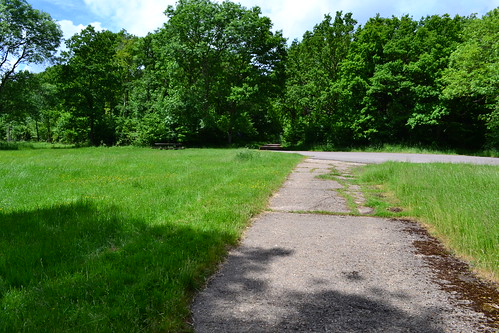
Grafton Underwood

The hub of the accommodation site is now a picnic area.

You do lose a sense of this being an airfield; the trees and vegetation have taken over quite virulently and hidden what little evidence remains. Exploring the area, you will find some evidence, but you have to look hard. Walk back along the Broadway, and take the first turn left. Keep an open to the right, and you will see other small buildings, the officers’ quarters and shelters – this was site 4. Again, very careful footing will allow some exploration, but there is little to gain from this.

Considering the size of Grafton Underwood, and then fact that 3000 men and women lived here, there is little to see for the casual eye. A beautiful place to walk, Grafton’s secrets are well hidden; perhaps too well hidden, but maybe the fact that it is so peaceful is as a result and great service to those that fought in that terrible battle above the skies of Europe directly from here.

There is a superb website dedicated to the crews of  Grafton Underwood and it can be found at: http://384thbombgroup.com

Grafton Underwood was originally visited in 2014, this post has been updated since then. It forms part of Trail 6.

Trail 34 a visit to former RAF Oulton

Laying quietly between the airfields at Matlaske and Swannington is another one of Addison’s 100 group’s small collection. An airfield that not only saw a variety of makes and models, but a range of nationalities as well, each having a remarkable story to tell. In the second part of Trail 34, we travel a few miles south and visit RAF Oulton.

RAF Oulton.

RAF Oulton in 1946, taken  from the north. (IWM)

Although an RAF base, Oulton was also home to the heavy American bombers the B-17 and B-24. However, they were not used in their natural heavy bomber role, but a more secret and sinister one.

Initially built as a satellite for the larger bomber base at Horsham St. Faith, Oulton originally only had grass runways. It would later, in 1942, be upgraded to class ‘A’ standard, which would require the construction of three concrete runways, a new tower and bomb store and upgrading to the technical site. Runway 1 (2000 yds) ran east-west, runway 2 (1,400 yds), north-east to south-west, and runway 3 ran approximately north-south and was also 1,400 yds. All were the standard 50 yards wide and would be connected by thirty-two loop style hardstands and eleven pan style hardstands. Uncommonly, Oulton would also have four T2 hangars (three to the eastern side and one to west, two of which would later hold Horsa gliders) and a further blister hangar.

The majority of the technical area was to the eastern side of the airfield next to the main entrance and along side Oulton Street. The two bomb stores were located to the north and western sides of the airfield well away from personnel and aircraft as was common. The first of the two towers, was built to drawing 15898/40, which combined the tower and crew rooms; the second built later to drawing 12779/41 (adapted to the now common 343/43) brought the airfield in line with other Class ‘A’ airfields.

RAF Oulton

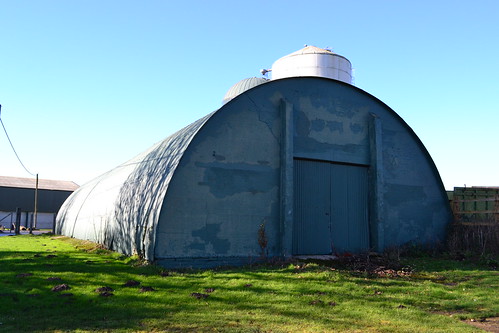
One of the huts used for agricultural purposes today.

Throughout the war personnel accommodation utilised the grand and audacious Blickling Hall. A seventeenth century building that stands in a 4,777 acre estate that once belonged to the family of Anne Boleyn. Owned more recently by Lord Lothian, he famously persuaded Churchill to write to Roosevelt declaring Britain’s position and poor military strength. Lord Lothian was a great entertainer dining with many notable people including Joachim von Ribbentrop, Hitler’s foreign Policy advisor and close friend. A number of other notable events took place at Blickling, including, in early 1945, Margaret Lockwood raising eyebrows when she and James Mason arrived to film ‘The Wicked Lady’ .

In the early 1940s, the hall was requisitioned by the RAF, officers were billeted inside the ‘wings’ whilst other ranks were put up in Nissen huts within the grounds. The lake was used for Dingy training and the upper floors allowed for baths albeit with cold water!  In total some 1,780 personnel could be housed in and around the estate.

For the first two years between 1940 and 1942, Oulton airfield was the home to Blenheims, Hudsons and Beaufighters, each undertaking a light bombing or anti-shipping role as part of 2 Group.

First came 114 sqn on August 10th 1940 with Blenheim IVs. Apart from a small detachment at Hornchurch, they stayed here until the following March whereupon they moved to Thornaby. Their most notable mission was the mid-December attack on Mannheim, an attack that would signify the start of the RAF’s ‘area’ bombing campaign.  A short spell of three months beginning April 1941 by 18 Sqn, preceded their return later in November and then subsequent move to Horsham St Faith.

Like many airfields during this time, units moved around and it was no different for 139 Sqn. With their Blenheims and later Hudsons, they would leapfrog between Horsham St. Faith and Oulton throughout 1941 only to disband and reform returning in 1942 with Mosquito IVs.

RAF Oulton

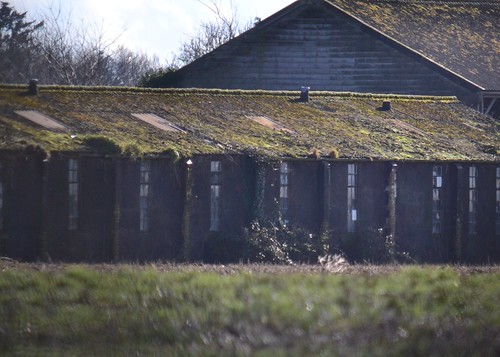
A few buildings remain on the site, many are fighting a losing battle with nature. The main entrance to the airfield is just to the right of this building.

It was during this time in late 1941 that Hudson conversion flight 1428 would be formed at Oulton with the sole job of training crews on the Hudson III. They would remain here until the following May, at which point they were disbanded.

The re-establishment of 236 Sqn in July 1942 with Beaufighter ICs meant Oulton performed as part of Coastal Command for a short time. The success of 236 in torpedo strikes, led to a new wing being formed at North Coates with 236 leading the way, they departed taking their Beaufighters with them. This left a vacancy, that would soon be filled with a new twin-engined model, the Boston III and 88 Squadron.

88 Sqn were split over 6 different airfields before being pulled together here at Oulton. They retained two of these detachments, one at RAF Ford and the other at RAF Hurn, and their arrival and start of operations at Oulton, would be tarnished with sadness.

On October 31st 1942, a month after they arrived, ground crews were unloading a 250lb bomb from 88 Sqn Boston ‘W8297’ when it suddenly went off. The resultant explosion destroyed the Boston and killed six members*1 of the ground crew. The youngest of these, AC2 K. F. Fowler, was only 19.

After having suffered serious losses in France whilst claiming the first RAF ‘kill’ of the war, they were the first unit to fly the new Boston, and would continue to undertake dangerous daylight intruder operations. Flying daring, low-level missions, they would attack shipping and coastal targets before supporting the allied advance on D-day. Their most famous attack was the renowned bombing of the Philips works in Eindhoven, which resulted in the loss of production for six months following the raid. Ninety-three aircraft took part in the raid, all flying beyond the reach of any fighter escort, a factor that no doubt resulted in the heavy casualties sustained by 2 Group on that mission*2 .

DSC_0178

Two Nissen huts would have been next to this building, and according to the site map, it was part of the rubber store.

In March 1943, the Boston IIIs left and Oulton passed to Addison’s 100 group. As with many other airfields in this part of Norfolk, 100 group were using them to fly missions investigating electronic warfare and radio counter measures. This move to 100 Group would bring a major change for Oulton.

The now satellite of Foulsham would soon be seeing larger and heavier aircraft in the form of the American Fortress I (B-17E), II (F), III (G) and Liberator VI (B-24H). This change required extensive upgrading; the construction of hard runways, updating of the accommodation, new technical buildings and a second, updated tower, along with further storage facilities. The airfield was closed throughout the operation, and with the completion in May 1944 operations could begin almost immediately.

Both USAAF and RAF crews moved in. 1699 Flight were providing conversion for crews to fly the heavy bombers for their parent Squadron 214 Sqn, whilst the American 803rd BS, 36th BG flew radio-countermeasures in their B-17s and later B24s. This move here allowed their own parent station RAF Sculthorpe, to also be extensively redeveloped.

The Americans stayed for three months whilst their work was undertaken, but the RAF units remained until the end of the war. After 1699 Flt. had completed conversions, 214 changed Fortress IIs for IIIs and flew these until disbandment on July 27th 1945.

On August 23rd 1944, 223 Sqn reformed at Oulton. Having previously been flying the twin-engined Baltimore, the new unit would have to get used to much larger aircraft very quickly, a task they commanded with relative ease. They flew the heavier Liberator IVs, and Fortress IIs and IIIs until their final disbandment a year later.

Both 214 and 223 flew the heavy bombers now bristling with electronics. Using a range of electronic gadgetry such as ‘window’ ,’H2S’ and ‘Mandrel’, they had their front turrets painted over or removed and electronic equipment added. ‘Window‘ chutes were installed in the fuselage of the aircraft and a heavy secrecy enveloped the airfield.

The winter of 1944 proved to be one of the worst for many years, crews worked hard in the snowy environment, relaxing where they could at the nearby pubs, one nicely placed next to Blickling Hall and the other directly opposite the entrance to the airfield.

Both units would participate in a number of major, high prestige operations, providing radio jamming and window curtains for the bomber formations. ‘Spoof’ operations were common, diverting enemy fighters away from the real force and playing a daring game of cat and mouse with the German radio operators. As the war drew to a close, so too did the operations from 214 and 223. Eventually in July 1945 both Squadrons were disbanded, 214 being the renumbered 614 squadron, with 223 having to wait until 1959 before being reborn as a THOR missile squadron.

With the withdrawal of the heavies, the end was near for Oulton. After being used for storage of surplus  Mosquitoes for a year it was closed and sold off. The end had finally arrived and Oulton closed its gates for the last time.

Oulton airfield stands as a  reminder of the bravery of the light bomber and ECM crews; today many of the original buildings still remain, used for agricultural purposes and even by the National Trust.

RAF Oulton

One of the few buildings that remain, the former squadron offices.

Whilst the general layout of the airfield has changed with the addition of farm and ‘industrial’ units, its layout can still be recognised. The majority of the runways still exist, now housing poultry sheds, and large sections can easily be seen from the roadside. Luckily, even some of the original huts from the technical area are also in existence and ‘accessible’.

Approaching from the north, the first reference point is the memorial. Standing at the crossroads on the north-eastern corner, it serves as a pointer directly in line with the centreline of the Runway 2. Behind you to your right is the former sick quarters, here would have been an ambulance station, Static water tank and sick quarters, now all gone. Turning right here, keeping the airfield to your left, you pass along the northern boundary, within a short distance of what would have been the perimeter track.

The first sign is a pillbox. This was placed next to the special signals workshop which consisted of three small buildings. Now overgrown, this maybe a Vickers Machine gun Pillbox, different to ‘standard’ pill boxes as it has a concrete ‘table’ beneath the gun port designed to support the heavier gun and tripod.

Further along this road, to your right, is the first and main bomb store. A small track being the only visible reminder, the walls having been removed long ago. The large concrete ‘pan’ being the entrance, on which farm products are now stored.

The second store and USAAF quarters were further along this road, again all trace has gone and it is purely agricultural now. Retracing your steps, go back to the memorial. At the crossroads, ahead of you, was Number 1 accommodation site, now all farm buildings, but formerly the officers, sergeants quarters and airman’s barracks.

Turn right here and as you drive down Oulton Street, there are a number of original buildings back from the road in a small enclave. The National Trust own part of these and use them to restore historic textiles, one of these buildings being the squadron offices. The main entrance to the airfield is further along this road and now an insignificant farm gate, allowed to grow and fill in, the path buried beneath the grass. Beyond this, you can see some remaining buildings across the field, truly overgrown and very dilapidated, these are possibly the crew locker and drying rooms. Continue on along this narrow road and you arrive at the pond. Behind the pond, stands a well-preserved hut and smaller buildings. These were the main workshops, rubber store and general stores, now holding agricultural products and waste material. Certainly they are some of the better preserved buildings on the site. Further along, the road crosses the main runway, here it is full width on both sides of the road. Poultry sheds stand on the main section, whilst farm waste resides on the left.

RAF Oulton

The eastern end of the main runway.

Continuing on and the road crosses the third runway, where we turn left. We can now see the site of one of the four T2s, the road at this point using the original perimeter track before it departs away to the north.

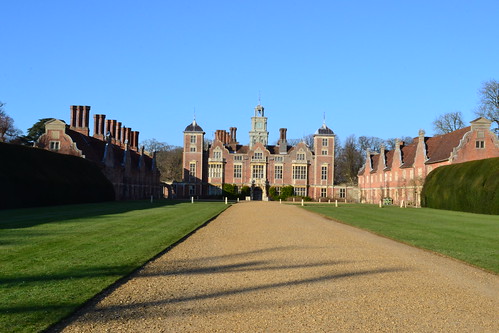
From here, we return north, head back past the airfield and return to the main road. Here we turn right and follow the road for a few miles east through the woodland where we arrive at Blickling Hall. The accommodation sites here, include the No.1 and 2 WAAF sites, NAAFI, No. 4 and 5 accommodation site and various service sites.

The east wing of the Blickling Hall is now a museum, formerly the barracks and still shows the original paintwork. A range of uniforms, photos and personal stories can be seen and read.

There are virtually no remnants of the other sites which were primarily Nissen huts. Footpaths do allow you to walk through these, now natural spaces, walking in the footsteps of former airmen and women.

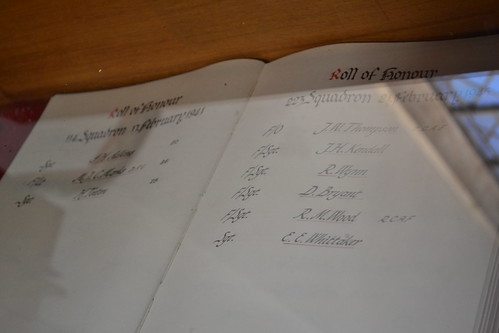
Next to the Hall, is the church of St. Andrew, in here is a small collection of artefacts and a roll of honour for those who died at Oulton. Also here is the sole grave of Sergeant L. Billington, who died on March 4th 1945 at the young age of 20. He was part of a crew in a Fortress III (B-17) on window duties. As the aircraft was returning from its mission, it was attacked by a JU 88, causing it to crash on the airfield boundary. All but two of the crew were killed*3, their bodies being buried in different locations. A sad end to another young life at Oulton.

St. Andrew's Church

The Roll of Honour at St. Andrew’s Church, next to Blickling Hall.

RAF Oulton housed a range of aircraft types and nationalities. Their role encompassed many important duties and missions that certainly helped defeat the Nazi tyranny. Many of these young men, led the way in today’s electronic counter measures and electronic warfare. The daring missions they led, firmly embedded in our history, and now the remnants of Oulton stand as a reminder to both their sacrifice and dedication.

Notes and Further Reading.

*1 The ground crew were:

E.J. Bone, Aircraftsman Ist Class
H. Bramham, Aircraftsman 2nd Class
A.C. Emery, Aircraftsman 2nd Class
K.F. Fowler, Aircraftsman, 2nd Class
F. Packard, Leading Aircraftsman
A. Torrence, Leading Aircraftsman

Source Aircrew remembered website.

*2 National Archives, RAF Bomber command diary 1940.

* The crew were:

P/O H Bennett
Sgt. L Billington
F/S H. Barnfield
W/O LJ Odgers (RAAF)
F/S W Bridden
F/S LA Hadder
F/S F Hares
Sgt. A McDirmid (injured)
W/O RW Church (injured)
Sgt. PJ Healy

Source: Chorley, W.R., RAF Bomber Command Losses 1945, 1998, Midland Counties.

RAF Oulton Museum, Blickling Hall.

If visiting the airfields of North Norfolk, then a stop at the grand 17th Century Blickling Hall is a must. Here, not only do we have a house that dates back some 400 years, but an estate that goes back even further to the 15th Century, and once belonged to the Boleyn family. A mix of Jacobean architecture, grand paintings and tapestries complement a library that contains one of the most historically significant collections of manuscripts and books in England. Walks that take you through a 4,800 acre estate of gardens, wild meadows and woodland, are brimming with wildlife. Even on busy days, you cannot fail to enjoy the peace and tranquillity, the inviting waters of the lake and views over the Norfolk countryside.

But equally important, you have a house that once belonged to Philip Kerr, 11th Marquis of Lothian, Britain’s Ambassador to the United States. Lord Lothian, played a major part in Britain’s war, convincing Churchill to write to Roosevelt, explaining the consequences of a Nazi victory in Europe and the poor defensive position Britain lay in at that time.  A letter that began a chain of events including Lord Lothian’s speech to the American people, that eventually led to the ‘Lend-Lease’ programme being initiated and arms allowed to flow into Britain.

Blickling Hall Blickling Hall, the Museum can be found in the buildings to the right hand side.

A few miles from Blickling, is the airfield RAF Oulton, part of 100 Group commanded by Air Commodore Addison, whom the farm at RAF Foulsham is named after. Oulton utilised much of the house and grounds of Blickling, billeting officers in its ‘wings’ and other ranks in Nissen huts within its grounds. The lake was regularly used for dingy training, the upper floors allowed for bathing in baths – a real luxury for aircrews in the Second World War.

Housed within one of the ‘wings’, is a small museum, the RAF Oulton Museum.

The museum itself is situated in the upper floors on the eastern side, utilising one of the former barrack blocks used by the RAF. The original paintwork still colours the walls and a ‘mock’ billet has been recreated using original furniture sourced from local shops, auctions and through donations.

The museum holds a unique collection of photographs, personal letters and stories gathered over a number of years accumulating into a fascinating record of life at RAF Oulton only a few miles away.  The winter of 1944-45 was one of the worst on record and many of the photographs show crew members relaxing in the snow on and around the base.

Letters tell of the local people, their connections with the base, the pub outside the main gate formerly the ‘Bird in Hand’, (now a private residence) and the Buckinghamshire Arms next to Blickling Hall, (still a pub) where crews would spend their evenings and ‘free’ time.

Log books and uniforms from those stationed at Oulton, along with a mix of original artefacts and replica newspapers, all help to recreate the atmosphere of an RAF billet. It is packed with historical and personal information – a real gem for those interested in history and life on the RAF base.

A great little museum, it is certainly worth a visit.

More information about Blickling Hall and the RAF Museum can be found on the National Trust Website.